
April 21, 2025
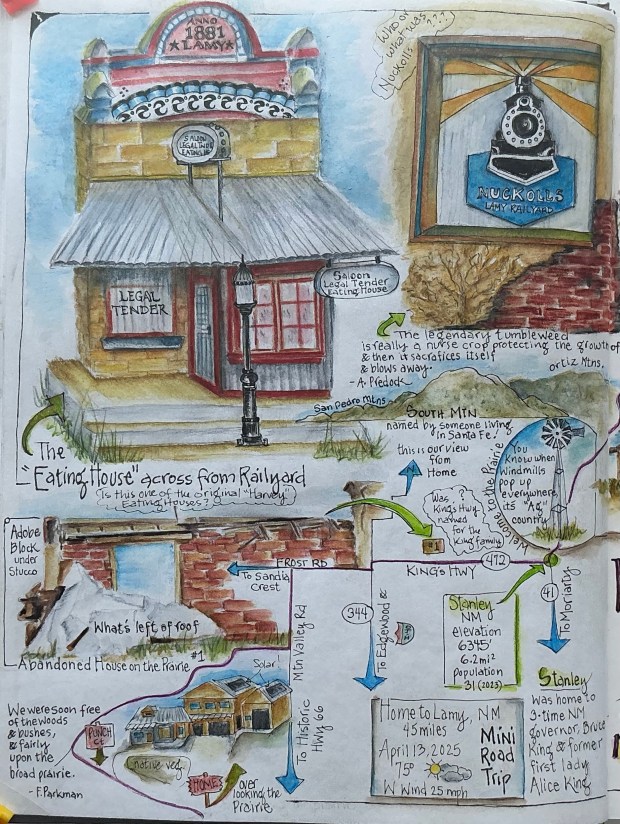
Woke one windy Spring morning about a week ago and decided it was time for a mini roadtrip …. 45 miles NNE, to visit the historic village of Lamy, New Mexico. Years ago (1991) when we lived in El Dorado (a sprawling subdivision southeast of Santa Fe), Lamy was a short 8 mile drive away. As seems true to our nature, we hardly ever visit someplace so close to home. So we didn’t. (Go figure.) But last Fall, the ABQ Urban Sketchers spent a morning exploring and sketching in and around Lamy. Unable to join them then, I promised myself that Roy and I would definitely make our own trip Lamy. So we did ….. and had a great time! Here’s a collection of my sketches and a lot of present day and historic facts about this little railroad community, many discoveries were anticipated; a few were complete surprises!
Lamy, New Mexico, preface: What’s in a Name?
Sometime during the last half of the 19th century, Galisteo Junction was renamed “Lamy” to honor the first archbishop of Santa Fe (1853). Jean-Baptiste Lamy played a major role in the development of the region, including establishment of educational and medical facilities.

Lamy, part 1: Today
….. Location, Location, Location: Such a quaint little village, we found Lamy properly nestled in the foothills of the Sangre de Cristo Mountains, a beautiful range of mountains within the southernmost reach of the Rockies. Primarily a railroad town, Lamy boasted a population of 329 at its peak in the 1930s. Today, Lamy has a mere 93 residents, and continues to experience an annual population decline. With an “Eating House,” Saloon and a Museum, not to mention the historical Train Station, Lamy makes for a fine tourist destination and twice-daily Amtrak stop with shuttle service to and from Santa Fe, only 18 miles away.
….. The Lamy Railroad and History Museum: Dedicated to preserving local history and heritage, this museum emphasizes the railroads and their impact on the area. The museum is housed in the historic “Legal Tender” building, formerly the “Legal Tender Saloon and Restaurant.” But before that, it was the Pflueger General Merchandise Store (built in 1881) and attached Annex Saloon (built in 1884). Because this building complex is quite old, it has been listed on the National Register of Historic Places. If you’re planning a trip to Lamy, note the restaurant and museum are only open Thursday through Sunday, are run as a non-profit, and the waitstaff are volunteers.
Lamy, part 2: The Way-Back Yesteryears
….. Pre-Columbian Inhabitants: An archaeological site known today as The Lamy Junction Community, consists of 14 small Coalition Period1 (AD 1200-1325) pueblos and other structures. Occupying the SE facing slope, northwest and above the Rio Galisteo, the site was discovered by Adolph Bandelier on June 29,1882. Bandelier noted in his journal “a group of small house ruins” west of the depot at Lamy. Excavation of the area began in 1915, resuming in the 1930s and again in August 1981. Archaeologists reported almost all of the pueblos and other structures were similar to each other, having 10-20 rooms each and built of adobe and some stone. The largest structure, however, was probably 60 rooms in size and two or even three stories tall in places.
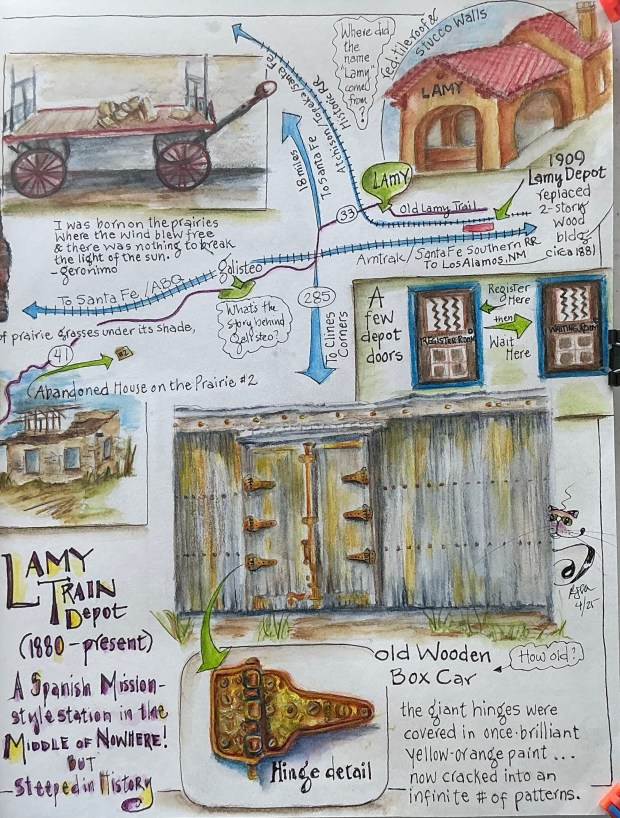
Today this historic site is located near the junction of US Highway 285 and Santa Fe County Road 33, the dead end spur road that passes through Lamy. The location of these roadways makes sense. Over the last century, or probably longer, Lamy Junction has been a crossroads for several roadbeds that crisscross the site: between Lamy and Galisteo, Lamy and Clines Corners, Galisteo/Clines Corners and Santa Fe. Although the history of these roads and their associated artifacts have yet to be studied, it’s clear from archaeological excavations of The Lamy Junction Community, the disturbance from construction, frequent use, and maintenance of these old roadbeds impacted artifacts from the prehistoric site and surrounding area. Also, when the tracks were laid in the early 1880s for the Atchison, Topeka and Santa Fe Railway, the ideal grade ran within the bed of the Rio Galisteo southeast of the Community. Railroad construction required relocating the river to the east, placing it on the far side of the railroad grade; actions impacting prehistoric artifacts in these areas.
Note to self: Because we came to Lamy to learn about the 1880s train station, I only discovered the area was occupied more than 1800 years ago during my follow-up research into Lamy! Yes ….. we will return and try to find this prehistoric Community, now owned by Santa Fe County.
1Coalition Period (AD 1200-1325) was a time of significant changes in the Pueblo culture of the Rio Grande Valley, which included The Lamy Junction Community of the Galisteo Basin. During this time of increasing population and intensified agriculture, expansion into new areas like the Pecos River Valley occurred. In addition, the growing population began living in larger pueblos.
Lamy, part 3: The Not So Way-Back Yesteryears
….. The Lamy Railroad and Train Station (aka Depot): When plans were made for the Atchison, Topeka, and Santa Fe railroad (aka the “Santa Fe”) to run from Atchison, KS to Santa Fe, NM, and then west to California, civil engineers didn’t take into account the challenging terrain surrounding Santa Fe. A direct run to and stop at Santa Fe was not going to happen. So about 145 years ago the line was built through Lamy. But because rail transport was still desired by Santa Feans, a spur line was built north of the Lamy Railroad Junction that could carry freight and passengers into the city. Now Plan “B” logically placed the train station in Lamy, and in 1881 a two-story wood frame building was constructed for that purpose. For 28 years that structure served as the official train station for the “Santa Fe” until a freight depot was needed. This prompted the construction of a new train station, allowing the original 1881 station to be converted into the much needed freight depot, which was in operation into the 1940s. The new train station, a one-story Mission-style red tile roofed/stucco sided structure, built in 1909, was opened to passengers upon completion. This station is still in operation, and is the one we visited.
Lamy, part 4: Growing a Railroad Town
….. El Ortiz: East of the depot, the famed Fred Harvey Company constructed a hotel named El Ortiz in 1910. Started by English immigrant Fred Harvey in the 1870s, the company that took his name ran a series of highly efficient Eating Houses along the “Santa Fe” rail lines, guaranteeing quick, quality meals. These eateries at set stations were necessary stops because dining cars on passenger trains were uncommon west of the Mississippi. The eateries were so successful, that a partnership was formed between Fred Harvey and the “Santa Fe” to branch out into the hotel business. Many hotels were located in trade and business centers, but other Harvey Houses like El Ortiz were built to develop tourism in Lamy. Hotel El Ortiz no longer exists. After a 1930s fire destroyed partial sections of the building, it was completely brought down in them1940s.
Note to self: when we revisit Lamy, must find the original location of El Ortiz. Is there anything remaining?
….. A secret destination: Lamy was commonly the first stop for staff and their families arriving to New Mexico on their way to the secret city of Los Alamos.
Lamy, part 5: Flashbacks of Yesterday
….. the Santa Fe Detour: Today, Amtrak Southwest Chief passengers headed to the state capital still detrain at the 1909 Lamy Station, where they can read interpretive displays about the past, visit historic buildings and the museum, walk around old train cars and engines, and maybe have a bite to eat at the Legal Tender, before catching the shuttle transporting them the remaining 18 miles to Santa Fe.
Well, that’s about all for now. Hope you enjoyed this virtual tour of Lamy, NM
As always, thanks for stopping by!

 a curious nature
Thanks for my monthly history lesson. I’ve been to Lamy, but been a long time ago. Your stories and sketches are so fascinating.
LikeLiked by 1 person
Hi Sue! Thanks for the comments! So delighted you enjoyed the post. Lamy was my monthly history lesson too. After learning more about the little village after our short visit, we must return to fill in the blanks. Happy NM Spring!!
LikeLike
Barb – I love how you enjoy the many interesting and historic places close to home! The old buildings, hinges and doors are real treasures. Wow, history mixed with a little bit of secrecy makes for a fascinating day trip! Thanks for sharing!
LikeLiked by 1 person
Thank so much Karen, for your comments! It was a fun day trip, but another visit is definitely warranted. Happy Spring!
LikeLiked by 1 person