September 16, 2023
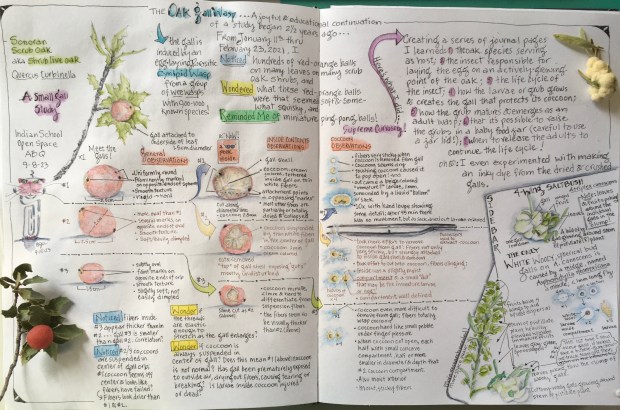
This is a little story about a fascinating discovery I made over 2-1/2 years ago, when in the second winter of the pandemic and in dire need of a belly laugh, our usually drab brown landscape appeared dotted with little reddish colored orbs. An insatiable curiosity sprinkled with a smidge of fantasy led me to some surprising answers to many questions, which continue to pop up to this day.
Open my full blog post and take a small detour with me into the recent past. Learn how observations, connections and similarities in nature ensure there’s always dots to connect and mysteries to solve, no matter how many times you travel the same path.
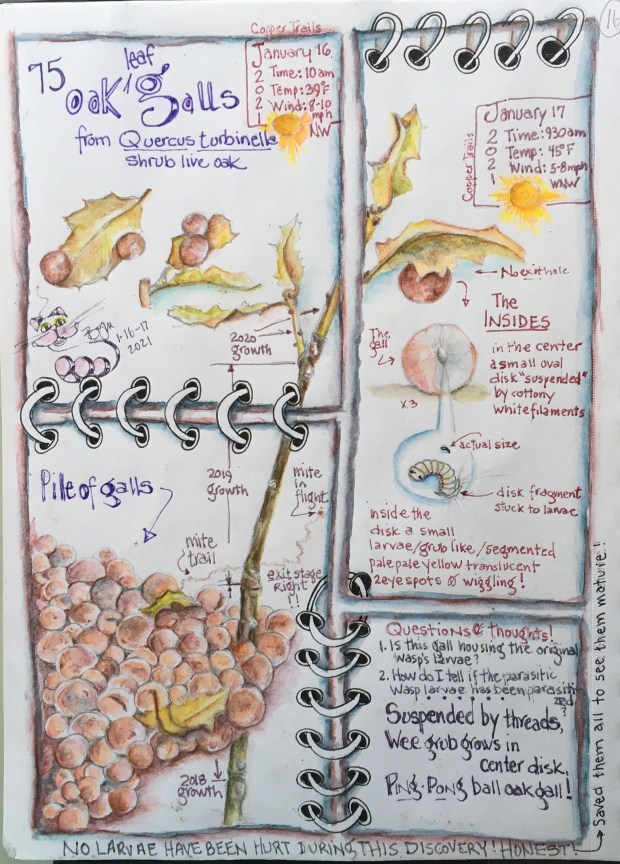
Back in the winter of 2020/2021, during the months of January and February, curiosity finally got the better of me. For years I’d noticed a lot of the scrub oak had been decorated with what appeared to be miniature ping-pong balls. It was like someone had grabbed a handful of these little reddish brown orbs and tossed them willy-nilly onto the oak leaves ….. a very festive ornamentation that appeared chaotically random. Then in January 2021, I encountered hundreds and hundreds of decorated scrub oaks! Were caroling, trail-hiking scouts, with backpacks full of these little round holiday cheer-ios, responsible for dotting our drab wintery brown in red? Was it perhaps the hope of earning some kind of seasonal merit badge that drove them out into the cold to decorate? Well, whatever or whoever was behind this seemingly magical landscape-scale transformation, there didn’t seem to be a single oak unadorned!
Waking myself from irrational fantasy, I concluded something was definitely fishy. Having gathered my wits, I designed a little study to figure out what all those miniature ping-pong balls actually were, and for good measure, threw in a bunch of questions covering the who’s, when’s, why’s, and how’s of this phenomenon.
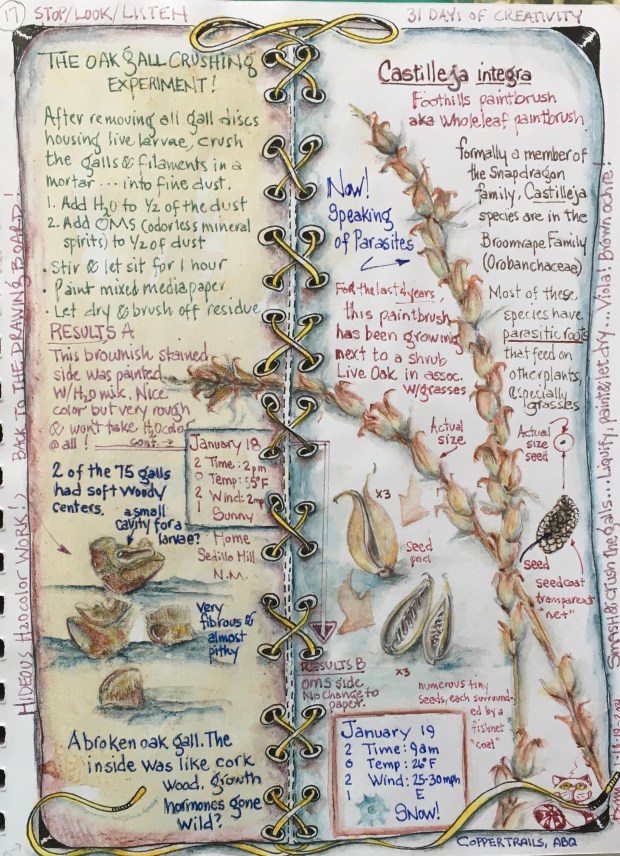
In the following photos of my old journal pages, you can see how my little study progressed. During nearly 6 weeks, I uncovered answers to my initial questions, which led to more questions and answers, and eventually branched into the unexpected by including an ink/dye/stain project and an animal husbandry experiment. It was great fun, kept me excited about returning to the field to make more observations despite freezing temps, and gave me an appreciation of and highlighted the importance of the minute wildlife seldom seen by the casual hiker.
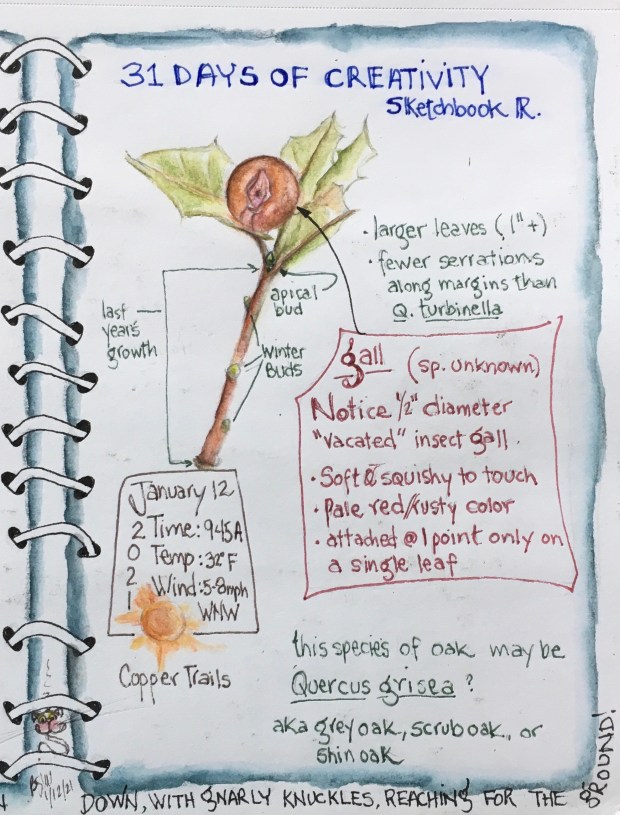
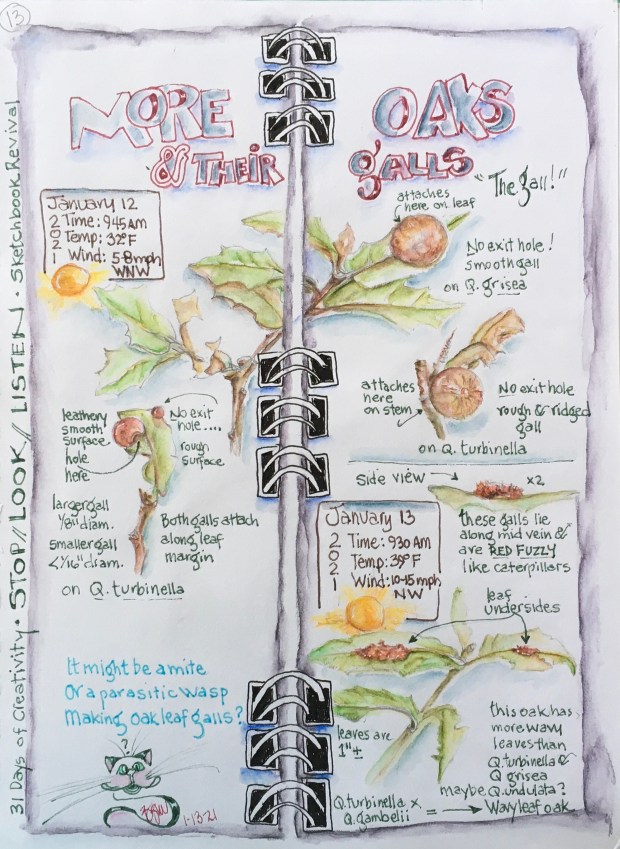


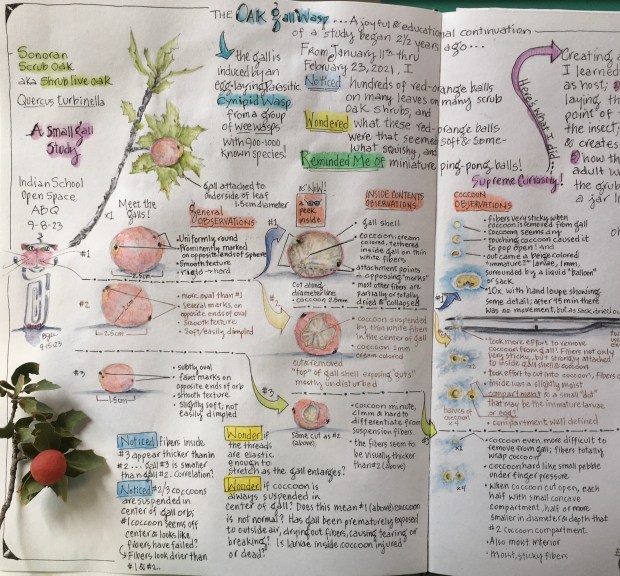
Fast forward to spring and summer, 2023. From March through the end of August it had been abnormally hot and dry. We even skipped over the monsoon season with only light rain sprinkles; barely enough to water even the hardiest of native grasses. It seemed the oak gall crop was a failure. But in early September 2023, I noticed there were reddish colored galls on the scrub oak, twice the size as in past years! Somehow those little cynipid wasps .got their eggs laid, likely in the spring. Was it possible that the eggs and/or larvae remained dormant awaiting favorable weather? Then I noticed that early September downpours seemed to trigger new and continued leaf growth on the scrub oak (and many other plant species as well). Could these heavy rains have triggered rapid development of the wasp larvae, resulting in larger than normal sized galls?
I’m still looking for the answers to these questions, along with the many questions that arose while examining these large oak galls (many questions didn’t make it to my journal pages, but are tucked into my field notebook to revisit in the coming years).
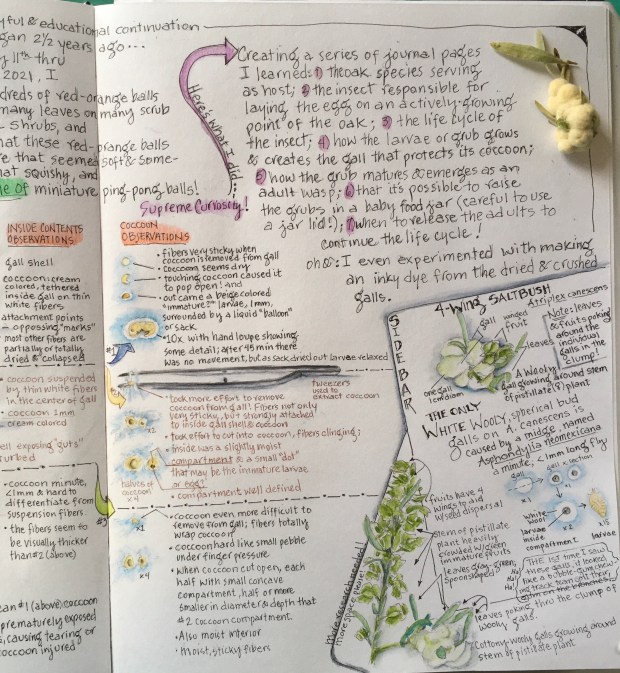
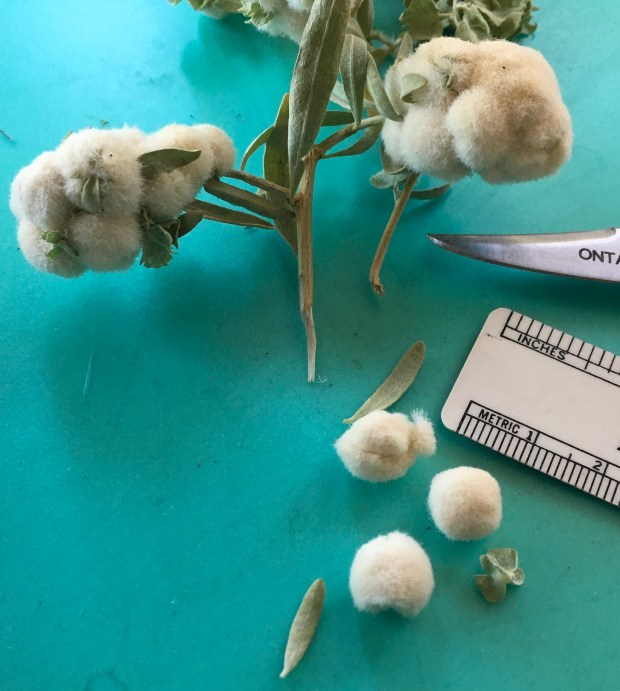
So my “little study” has grown, and even expanded to include a branching-off project loosely related to oak galls ….. the now obvious-to-me insect gall found on four-wing saltbush. Funny story …… Last year I thought a “four-wing” had been profusely decorated by a group of trail running, bubble gum chewing kids (I honestly envisioned that when the team stopped to catch their breath, before drinking a swallow of water, they each removed the wad of gum from their mouths and stuck them all on the same shrub! Really! That’s what I thought!). After passing by the same shrub numerous times, I decided to see just how sticky all of that bubble gum still was. Slowly and oh so gently my hand reached out and, whoa! No way! Not sticky, but the exact opposite ….. they were incredibly soft and white wooly, shaped like little puffy ear buds, and seemed to grow together in large clumps. And wouldn’t you know it ….. just within the last several weeks I noticed many four-wing saltbush shrubs nearly covered with extra large clumps of these galls. Could this exaggerated clump size be caused by the same weird, weather-related trigger resulting in the extra large oak galls too? Worth pondering, don’t you think? A mystery to solve another day.
Wow! I know this was a long post … congratulations for sticking with me! I loved sharing what I’ve learned about these really cool insect galls. Thanks for stopping by, and don’t forget to look at the world around you!

 a curious nature
Wow, Barb — what a curiosity journey into the galls! I am curious about why they are red. I don’t seem to see that many around here. How interesting are the Saltbush fluffy galls! I am enamored with the sketches of the laced binding and ring binding on your journal pages. I admire your curiosity and investigation paths — I was reminded of you in a Wild Wonder session on Whimsical and Imaginative sketchbook adventures — your amazing zentangle creations and how Flambe’s cute face adorns each page that you create. So enjoyable!
LikeLiked by 1 person
Oh wow … excellent question, Karen ….. and awesome comments! Hmmmmm ….. why red? I’ll have to investigate further, and include the answer and many more on my next gall post. During the winter the galls turn brown, but now I wonder if the fresh galls might produce a red tinted dye? I’m glad you like my older journal page layouts. I used to add spiral bindings, lacings and a lot of other ideas on every page. It was fun, but time consuming. Sounds like you’re really enjoying Wild Wonder too! Flambé would love to be there!
LikeLiked by 1 person