December 26, 2023
What comes to mind when you see a group of pigeons perched on electrical wires high above your head, or when a large flock or band of these birds suddenly flushes from under a highway overpass to escape a winged predator, or when you’re walking through a grocery store parking lot full of discarded food scraps and must shoo away pigeons to avoid stepping on them?
click the link below for the entire post, and learn if you believe this large bird is a pest or a prize
The feral descendent of the once celebrated domestic pigeon elicits many strong feelings and emotions, many of which characterize this large bird as distasteful and abhorrent. Some might say we love to hate pigeons. After all, aren’t they noisy, dirty and carry disease? And good grief, they poop everywhere! Even though pigeons have been our neighbors in cities for thousands of years, they are now treated as a pest, going from innocent bird, to mundane nuisance, to public enemy #1 in just a few decades. So much hatred directed at a bird that’s found world wide. So much so that “we’ve criminalized feeding pigeons, shot them, poisoned them, trapped them, zapped them, fed them birth control, and have used repellants such as plastic birds of prey and spike stocks,” all just to keep these birds off of sidewalks, statues, and buildings! But what is the real truth about this often maligned bird commonly referred to as a “rat with wings?”
Sociologist Colin Jerolmack conducted a study (2005) in Greenwich Village, New York, to discover the Origins for our Misguided Hate for Pigeons1. What he found was interesting. It seems it’s not so much about the pigeons as it is with us and how we view pigeons in the urban spaces we share. People build cities (imaginative geography) to separate us from the natural world. City borders of a clean, orderly civilization separates us from uncontrolled nature. “That doesn’t mean there’s no nature [in cities], but ideally the city is the place where we invite nature in ways we can control,” says Jerolmack. And oh my goodness, pigeons frequently and visibly cross city borders, inhabiting the spaces we think of as our own! And even though it’s been shown by epidemiologists and the CDC that pigeons are poor vectors of disease, there’s still a common belief that these “dirty” birds pose a health risk by invading and polluting our spaces.
So like a lot of misleading and downright false information we are taught and then continue to believe, despite the evidence to the contrary, that pigeons became and are still “a symbol of what we find vile and morally repugnant in the urban cityscape.”
I’m embarrassed to admit my long held opinion of these “nasty” birds seems to be based on the erroneous “facts” that were engrained in me since childhood. Almost every day we find ourselves hiking in areas along the city limits of Albuquerque, and frequently pass underneath electrical lines packed with pigeons. I usually try to ignore them, don’t ever look up to observe the large groups, and never give the many molted feathers lying on the ground a second thought. Until one day my curiosity got the better of me, and somehow I needed to learn about feral pigeons. Not until this post did I even consider what I believed to be true about pigeons to be anything but. It was my wish to provide you all with some fun facts about the Rock Pigeon, aka Rock Dove, Feral Pigeon, Homing Pigeon. That I’ll still do (below). But while researching the feathers and looking up fun facts, I stumbled over Mr. Jerolmack’s study. To me, the practice of nature journaling is not only about observation, it’s about always learning while keeping an open mind when it comes to everything in nature. With feral pigeons, I’m officially enlightened, and have sworn a promise to myself to remove the decades-old brand I’ve had on pigeons by elevating them from “winged rats” right back into the family of birds2. After all they are beautiful, sound soulful, and even though they (profusely) poop on anything and everything, turns out they have quite a long history of interacting with people.
1The link for Colin Jerolmack’s research paper, Origins for our Misguided Hate for Pigeons, was found here on 12/26/2023: https://www.audubon.org/news/the-origins-our-misguided-hatred-pigeons
2Oh dear ….. this label “winged rats” has me wondering if my mind holds derogatory opinions about rats? Am I holding on to false beliefs about rats? Hmmmmmmmmm. I detect another rabbit-trail in my future!
As promised, here’s a few fun facts3 about the Rock Pigeon, Columba livia:
- Pigeons can navigate by sensing the Earth’s magnetic fields and cues based on the sun’s position; and may also use sound and smell.
- Mesopotamian cuneiform tablets and Egyptian hieroglyphics suggest that pigeons were domesticated more than 5,000 years ago. In fact, pigeons have such a long history with humans it’s impossible to tell where the species’ original range was.
- Charles Darwin kept pigeons for many years after he returned from his 5-year voyage on the Beagle. His observations on the great variety of pigeon breeds, and the huge differences found between captive breeds and wild pigeons, helped him formulate his theory of evolution.
- Common names for the Rock Pigeon include domestic pigeon, homing pigeon and rock dove.
- Pigeon flocks or bands are typically made up of an equal number of both sexes.
- Pigeon droppings we’re once considered a valuable fertilizer.
- Homing pigeons were used during WWI and WWII for delivering important messages between bases and across enemy lines. Pigeons are credited with saving thousands of lives with their deliveries, commonly known as the “Pigeon Post.”
- Historically, pigeons were released from sinking boats to send for help. Pigeons have also been trained to aid in rescuing people lost at sea. They locate the people who are stranded and notify rescuers of the location. They are perfect for this job because, in addition to having great eyesight, they can detect the ultraviolet light that surrounds the people in the water.
- Pigeons are navigation experts able to find their way home from an astounding 1,300 miles away! What’s more, they have proven they can do so after being transported in complete isolation to a location they’ve never been. The cages were even rotated during transportation to prevent the birds from knowing which direction they were traveling in. Scientists do not fully know how pigeons manage to find their way back when they have no visual, olfactory, or magnetic clues to aid them in knowing their location. However, they now believe that pigeons actually have compass and map mechanisms that help them navigate. While the map mechanism remains a mystery, it is likely that the compass mechanism relies on the sun’s position.
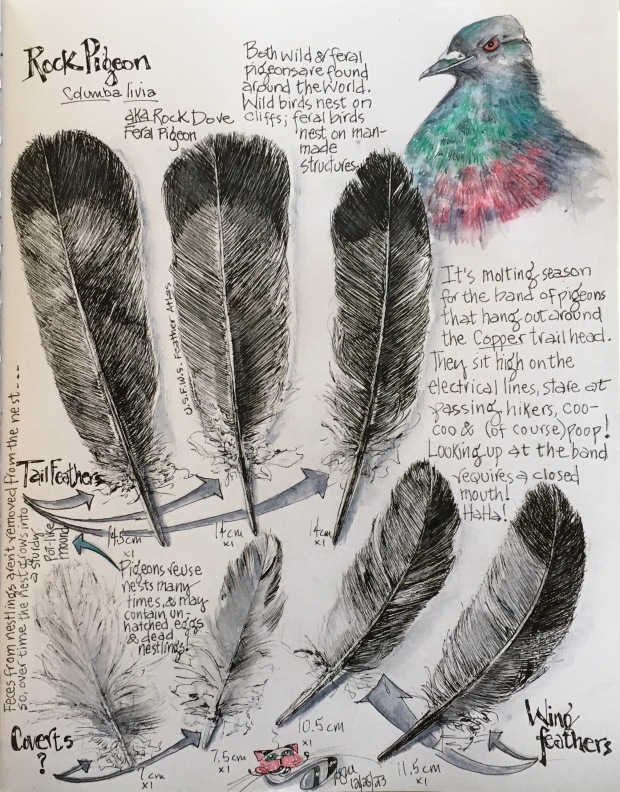
- During nest building, the female sits on the nest and makes a flimsy platform of straw, stems, and sticks from materials brought to her one at a time by the male. Pigeons reuse their nests many times, and they don’t carry away the feces of their nestlings the way many birds do. This means that over time the lightweight nest grows into a sturdy, potlike mound, sometimes incorporating unhatched eggs and mummies of dead nestlings.
- The male pigeon incubates the eggs from mid-morning to late afternoon; the female takes her turn in late afternoon and overnight to mid-morning. Both parents brood the young and feed them by regurgitating a milky liquid secreted by the lining of the birds’ crops (see following fun fact).
- Pigeons produce “milk.” Of course, they don’t produce actual milk- only mammals can do that. However, it is essentially the same as milk in that it is a white liquid containing all the necessary antioxidants, fats, nutrients, and proteins a baby bird needs. Another similarity it shares with mammal milk is that its production is regulated by the hormone prolactin. Both male and female adult pigeons produce this milk in their crop. The crop is a little section in a bird’s esophagus meant for storing food and, in this case, producing crop milk. Pigeons are part of a small group of birds that produce crop milk, only joined on the list by doves, flamingoes, and male emperor penguins.
- Newborn pigeons are a rare sight. Have you ever wondered why you never seem to see baby pigeons among the flock? That is because newly-hatched pigeons stay in the nest for up to six weeks- longer than most bird species. When they do finally leave, they look almost exactly like a fully-grown adult pigeon, other than the downy feathers on their head and the lack of red around their eyes. A pigeon’s eyes don’t get red until between seven months and one year of age.
- Pigeons can detect cancer. Many people don’t know just how smart pigeons are. They can be trained to recognize words and to match art with its artist, but what is perhaps most impactful is that they can even be taught to differentiate between benign and malignant growths. Researchers at the University of California Davis trained pigeons to identify which biopsies were benign and which were malignant. Once they were taught how to distinguish between the two, the pigeons were able to use their newfound knowledge to “diagnose” brand new biopsies that they had never seen before. On average, a pigeon by itself had an 85% accuracy. In a group, their accuracy reached 99%, which is what is expected from a doctor.
- Contrary to popular belief, pigeons are very clean birds and the risk of getting any disease from a pigeon is extremely low.
3 Most of these fun facts were pulled from a Pest Services webpage. How curious, … they provide facts about pigeons and also have repellent and prevention ideas for treating pigeons before and after “pest” status. https://www.excelpestservices.com/11-fun-facts-about-pigeons/
It’s my sincere hope if you’ve never been a pigeon enthusiast, that after reading this post you’ve had or may be considering a change of heart? Let me know!

 a curious nature
Fascinating! I have a new-found respect for these birds. 🐦
LikeLiked by 1 person
Awesome, Dee! Developing a fondness for pigeons will take me some work. So hard to break bad habits! Thanks for checking out my post. Let me know you received this comment too.
LikeLike
Got your reply just fine. 😊
LikeLiked by 1 person
Excellent!
LikeLike
Interesting research you’ve compiled, Barb. Reputation aside, I enjoy seeing them during my morning ride. Beautiful art, as you do! 🪶
LikeLiked by 1 person
Thank you so much, Michele! It was an interesting research project, especially since it began with the feather study.
LikeLiked by 1 person
You are welcome, Barb. Your art and posts are fascinating. Thank you!
LikeLiked by 1 person
Thank you profusely, Michele!
LikeLike
I have a new, enlightened appreciation for pigeons! Wow, I’m blown away with how they can be trained to detect cancer, navigating to aid in rescues, delivering messages during wars (like in Game of Thrones, “Send a Raven!). We recently admired their iridescent feathers in the sun, changing colors as they moved angles to the sun. Your feather drawings are fantastic! Did you use ink or colored pencil, or watercolor? Thanks for adding another layer of appreciation for these creatures in nature!
LikeLiked by 2 people
I know! Amazing, isn’t it! Gotta admit I’m looking at pigeons differently since discovering all that stuff, despite pigeon poop! Hahahah! Thanks for commenting on my feathers too, Karen. I find feathers very challenging. For these I began with ink (using Pitt fineliners) then added touches of watercolor pencil. The bird is all watercolor pencil. Always love your comments, and really appreciate you taking the time to read my often lengthy posts!
LikeLiked by 1 person
I love doves and pigeons and have all my life. I never thought of them as pests but as beautiful intelligent birds and I have a collared dove named Lily b who is a free flying house bird who is 33 years old. I loved this post.
LikeLiked by 1 person
Wow! Thanks for the wonderful comments, Sara! I’m wondering what it’s like having a free flying bird of any species in your home? And she’s 33! That’s amazing! Your love of pigeons and doves is clear ….. the more you get to know a species, the more the love! I’m thrilled you enjoyed my post. It was fun for me learning about pigeons!
LikeLiked by 1 person
It’s easy to have a free flying bird -Just hang baskets around the house for your bird to perch on and change the paper once a week…. no mess at all. Now that Lily b is older I have one basket in Lily b’s plant window and change that and the one under his roost once a week – amazing – no mess! let me make it clear I LOVE all birds and right now am in heaven because I am feeding maybe 20 plus wild turkeys and a whole bevy of juncos besides the other usuals… but when I wanted a house bird I chose Lily ( the b is for boy – originally i thought he was a she and when I found out too late I added the b) because he was considered even then – useless – except for breeding – “a trash bird”. UGH.
LikeLiked by 1 person
I love bird lovers!! And I love how you’ve accommodated Lily b’s needs. And how “she” was magically transformed from she to he! Clever! Thx for the explanation Sara! And how cool to be feeding wild turkeys. Juncos ….. love them! Thx for the follow up
LikeLiked by 1 person