February 24, 2024

Honest …. You can’t make up this stuff! You’ve got to wonder what the person or persons who began the National social media movement, “I Hate Coriander” Day, have against an innocent little herb.
“National I Hate Coriander Day, celebrated annually on February 24th, is a social media movement to express disdain for the herb coriander (also known as cilantro) and its taste and smell.”
“Hate” is such a strong word under any circumstances, but to “hate” an herb? … What do these Coriander “Haters” find offensive about the look of this bright green leafy plant? What is it about the taste and/or smell of Cilantro that elicits such a strong reaction? Now I’m not a Coriander (aka Cilantro) addict ….. a bit now and then as garnish or to flavor a fresh salsa is perfectly fine with me. I’ve even grown Coriander in my garden and marveled at the plant’s growth rate, intense leaf and stem coloring, bouquets of delicate flowers and abundance of seed. So my curiosity was definitely piqued when I came across this peculiar National Day. Just what is it that has and keeps these people all riled up over Coriander?
Coriander – The Plant
Not to be confusing, but Coriander and Cilantro are actually the same thing, Coriandrum sativum. However, in the U.S. we tend to refer to the leaves and stems as Cilantro; the seeds (whole raw or toasted, or ground) as Coriander. But because the National Day is about hating Coriander, I’ve made a leap in assuming they hate the entire plant, including the roots, stems, leaves, flowers and seeds (all of which are edible; all of which are eaten).
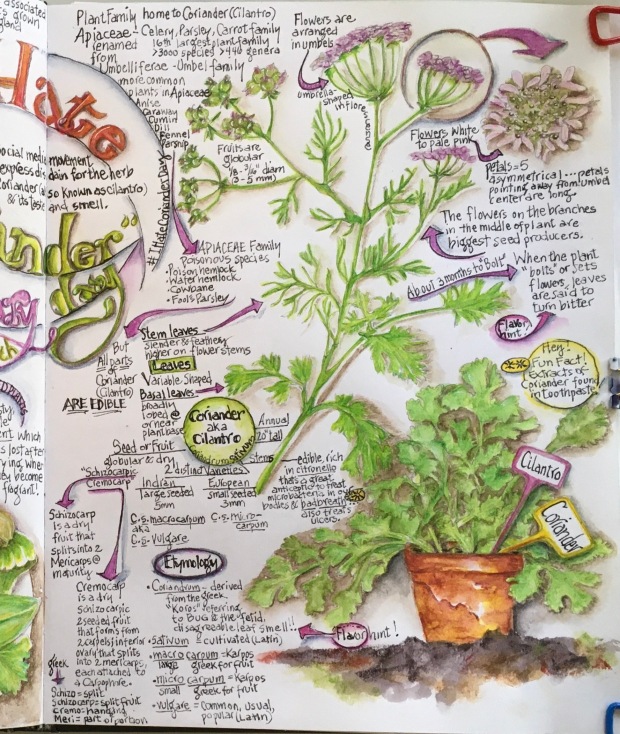
The plant is an annual that grows up to 20” tall. The bright green leaves are variable in shape, broadly lobed at the base of the plant, and slender and feathery higher on the stems. Flowers are arranged in umbels (like a wind blown, inside-out umbrella), are white to pale pinkish-mauve. Each asymmetrical flower has longer petals pointing away from the center of the umbel than those pointing inwards. And each flower produces a dry globular fruit (schizocarpic cremocarp) about 1/8 – 3/16” diameter, which splits when mature into 2 mericarps, each mericarp with a single seed.

Coriander – The Seed
The name, Coriander, is the common name used around the world, for the seed of Coriandrum sativum. There are two cultivated varieties of Coriandrum sativum grown around the world. Although the plants of both varieties appears the same, it’s the seed where the visible differences occur. C. s. var microcarpum is the small-seeded variety found in temperate climates, such as in Europe and the U.S. Its seeds are about 3 mm in diameter, round, and very potent as a spice. C. s. var macrocarpum (aka C. s. var vulgare) is the large-seeded variety found in hot, subtropical areas of Asia and India. It’s seeds are 5 mm in diameter, football shaped and have a very delicate flavor.


If you’ve ever grown Coriander from seed, you probably planted one seed at a time, being careful to follow the spacing instructions on the package. Then when your seeds germinated, sending up those first immature leaves (cotyledons), you noticed that for each seed planted there are 2 little plants! “What the heck?” you say. When you sowed the seeds in each well-spaced spot, you obviously planted an entire globular fruit (both mericarps at once) resulting in the germination of both seeds!
Is There a Consensus of Opinions on Leaf Taste and Aroma?
Nope! Opinions are far from consensual. As a matter of fact, they are frequently polar opposites. Coriander has been described as the “Marmite”*****!!! of herbs; either you love it or hate it. This great analogy reflects how strongly people do feel about flavors of their food.
Opinions on leaf taste and aroma: The good – tart, lemon-lime, fragrant, pleasant, distinctive, spicy hot, peppery, aromatic. The bad – bitter, stinky, unpleasant, nasty, fetid. And the bleh – The leaves smell and taste like dish soap!

Is There a Consensus of Opinions on Seed Taste and Aroma?
Again, Nope! But curiously, most of the opinions about seed taste and aroma were fairly positive, provided the correct variety of C. sativum was properly prepared and used. For example, all seeds contain 1% volatile essential oils, but the quality of oils is different between the two varieties. For some reason the smaller European variety seeds (C. s. var microcarpum) have far superior essential oils resulting in far superior flavor and yield when compared to the larger India variety seed (C. s. var macrocarpum). The larger India variety seeds are preferred as a spice, both whole and ground.
Opinions on taste and aroma of fresh or dried seeds: Spicy, earthy, cumin-like, orange peel, aromatic, dried seeds have full flavor, fresh seeds are undesirable.
Opinions on taste and aroma of toasted seeds++, whole or ground: Fruity, Fruit Loops, lemony, floral, mild perfumy, aromatic, bitingly pungent, delightful bouquet, distinctive flavor.
Now it’s your turn! Where do you stand on the issue of Coriander; it’s taste and smell? Are you celebrating today’s National “I Hate Coriander” Day? Or are you a regular Coriander Connoisseur, savoring the taste, smell and texture in all of your favorite dishes, from sauces and marinades, curries, meats and seafood, stews, to pastries and desserts?

***!!! Marmite! Invented, made and sold in England, this stuff is a sticky, dark brown paste made from fermented yeast. It has a very salty and powerful (understatement) flavor, and is frequently slathered on toasted breads like jam. If you haven’t experienced Marmite, perhaps you’ve dared to taste its equally unappetizing knockoff, “Vegemite,” found all over Australia? If you’ve tasted either or both (wow, you’re tough), what was your reaction? If you’ve never had the culinary pleasure, consider this fair warning! Wonder if there’s a social media group that’s declared “International I Hate Marmite (Vegemite) Day?” I would happily eat a bushel basket of cilantro greens, than dare give these yeasty products another go. (No offense to the marmite and/or vegemite lovers of the world.)


++Toasting Coriander Seed: In a non-stick skillet, over medium-high heat, add the seeds. Keeping the skillet in constant circular motion. When the seed’s aroma is released, toasting is complete! Cool completely and grind with mortar/pestle or in a small electric grinder. Store ground coriander in a cool (refrigerated) location, away from light and moisture. It’s best to toast and grind seeds in small amounts, on an as needed basis, to experience the full flavor.


 a curious nature
Phenomenal information, Barb! The flowers of herbs are so pretty, I like letting mine go to flower, because the Bees & butterflies love them. I had no idea of the history of cilantro in Egypt & Greece & Mediterranean. I mostly associate it with Mexican food and sometimes Thai as well as hummus (which is Mediterranean). I am a cilantro/coriander lover! But, I steer away from Marmite 100%. Thanks for this incredible deep dive into a love it or hate it herb!
LikeLiked by 1 person
Hi Karen! Thank you so much 😊 for the great reply and feedback! It was really fun researching coriander, which makes me want to deep dive into other herbs like basil (why so many varieties!!?), rosemary (aren’t there rosemary trees?), thyme (not just a thanksgiving spice), and lemon grass (is that considered an herb or grass?). The list goes on and on. I also let my herbs go into full bloom, just for pollinator’s benefits (and early seed). I wasn’t aware that coriander flowers are weirdly asymmetrical. Wonder if other members of the family are too (another rabbit trail). I’m with you 100% on Marmite! Ugh UGH! What are you filling your nature sketchbook(s) with lately?
LikeLiked by 1 person
We’ve been studying the moon this month in The Nature Creative. I did some moon shadow painting of the leafless hydrangea tree under the light of the bright moon! I also have a page on Witch Hazel which is blooming at the botanical gardens right now!
LikeLiked by 1 person
I’m not certain I know anything about Witch Hazel ….. your moon shadow painting sounds beautiful. Anything to do with the Moon is awesome! Thanks for sharing, Karen!
LikeLiked by 1 person
As always, your posts are the special treat of my day… beautiful drawings to enjoy and lots to learn… every time! This is one of my favorites of recent months, maybe partly because of the little fold out, accordion gems! (Reminds me, expect a small “something” in your mail soon.)
As for cilantro? delicious when used sparingly… and coriander? adore all coriander-seasoned pastries! Admit to prior learning deficiency and a purple thumb… didn’t know they were one and the same plant. Set straight by you, I now embrace them as an adorable pair!
I’m making books these days, getting more skilled as I learn from YouTube experts. My Zentangles are the pages. Haven’t yet developed my nature drawing interest, but always LOVE seeing yours.
LikeLiked by 1 person
Thank you tremendously, Robin! Such wonderfully thoughtful comments! And how excellent that you’re making little books for your zentangling. But save some for a few nature sketches! As a matter of fact, bring lots of little ones, or perhaps one big one on your Tucson round trip. What an awesome way to record a little something every day as a keepsake! Can’t wait to get your mail!
LikeLike
Geesh! You really took a deep dive on this one! Those coriander haters really motivated you. Maybe there’s an herb series in your future. Thanks for sharing what you learned.
LikeLike
Hi Jean… Thanks for the comments! Yes, I had an extra oxygen tank for this dive into coriander/cilantro! Really interesting stuff. Just couldn’t understand why there’s a group of coriander haters, and needed to know. And yes, I’m contemplating an herb series on paper and in a small garden.
LikeLike
Sadly for me its addition ruins otherwise marvellous meals. The sight of a handful of leaves cast across a dish, or worse stirred into it sinks my heart.
I llove the seeds but I believe it’s a generic thing, I like many can’t enjoy coriander.
I wwish I could and envy your enjoyment!
LikeLiked by 1 person
With coriander leaves (the very pungent cilantro), it appears to be a ‘love it-or-hate it’ relationship! I completely understand your reaction. Thank goodness for the seeds! Really appreciate your comment, Brian!
LikeLike