June 25, 2025
I’ll never forget my first taste of catfish! Just the memory of that meal makes my mouth water. Mmmmmmmmmmmmm!
When I was about 9 yrs old, my aunt and uncle invited the family for a visit to their home in Nashville. My jolly Aunt Sis, always the organizer, planned an entire week of non-stop fun and sightseeing that included a firefly safari, touring a life-sized Parthenon replica, exploring Civil War battlegrounds, front row seats at the Grand Ole Opry, and an overnight camping trip into the Great Smoky Mountains. I especially remember the drive into the mountains. The narrow road, which seemed to twist and turn for hours, was flanked on each side by an impenetrable forest of hardwood trees, the view broken only by roadside cafes spaced 2-5 miles apart. These cafes, with their hand-painted signs, all advertised the same daily lunch special —- 2 fresh caught catfish fillets/breaded with cornmeal and deep fried/served with a pile of hot hushpuppies and slaw/$1.75 to-go. “Could we stop, could we? Please, please, pleeeeaaaassssseee!” Knowing the sight of these cafes would be too hard to resist, Aunt Sis had already planned to stop for lunch at a very special one; Cataloochee Creek Catfish Cafe. She said they always fried up and served the freshest catfish and hushpuppies in all of the Great Smoky Mountains. Two hairpin curves later we had arrived. Oh what an aroma!
Needless to say, my clever Aunt Sis was right! That catfish was (and still is) the best ever! Whether the little one-room Cataloochee Creek Catfish Cafe is still in business, and whatever species of catfish they served up that day may forever be a mystery. But I’ll always have a fond place in my heart (and stomach) for catfish…………. So ……………
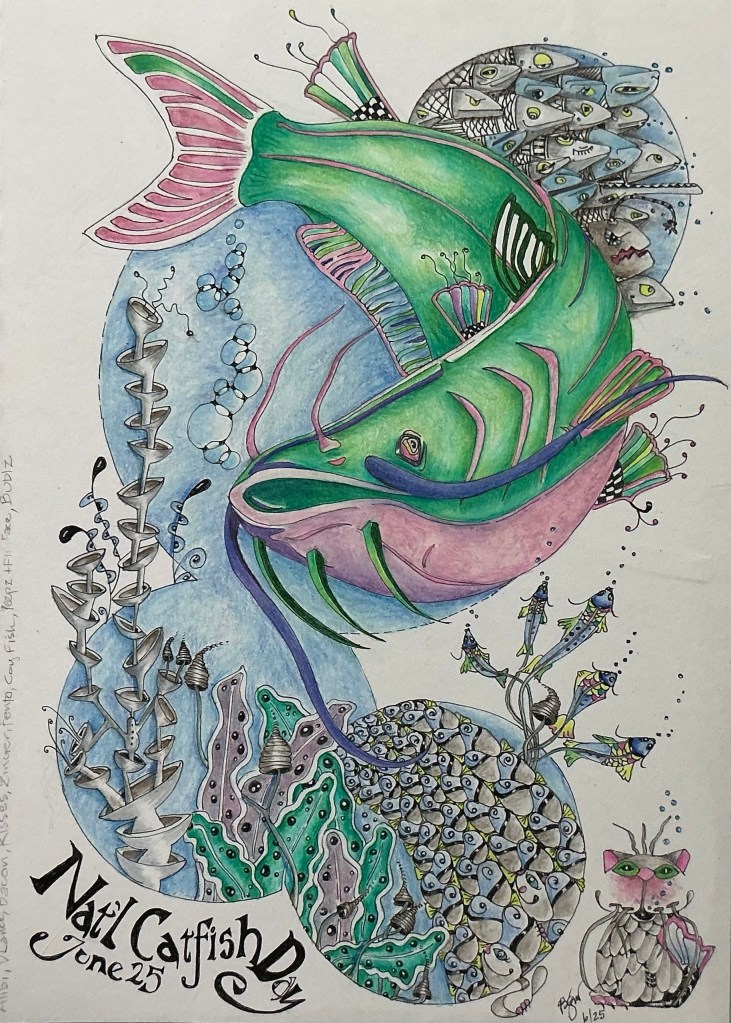
when discovering June 25th is a designated National Day in honor of the catfish, I took notice (and so did Flambé – either hoping for a new friend or a take-away meal!). About time I learned a little something about catfish. And of course I wanted to share.
Why the name “Catfish?”
In addition to not being remotely related to any fish species, it’s well known that most cats are not big fans of water. So how did the catfish get its name? The most likely origin of the name “catfish” comes from the 1610s when mariners referred to the Atlantic wolf-fish as a “catfish” due to its ferocity. But later the name was given to a freshwater fish found in North America’s river systems. This odd looking fish had barbels protruding from its jaw and chin that resembled cat whiskers. Also when this fish was removed from the water, it made a purring sound. It may be one or both of these cat-like similarities that led to the common name “catfish.” ….. Oh, and about those barbels that grow out of the jaw and chin of most all catfish species. They function as sensory organs; used for tasting and feeling their environment.
How do you enjoy your catfish?
In 1986, catfish made up the third-highest volume of finned fish consumed in the U.S., with the most commonly eaten species being the channel catfish and blue catfish. Today, catfish is still a popular dish; one that can be prepared in many different ways, including baking, deep frying, sautéing, and stewing.
Traditionally, the fish was coated in cornmeal and fried. Many still enjoy catfish fillets prepared this way, or prefer baking or frying fillets or even the entire fish. If you fry the entire fish, do you also savor the crunch of the crispy tail? Spices complement catfish, and it’s also yummy served with a little lemon and butter. No matter what method you prefer, this tender whitefish always separates easily from the bones.
There are 38 known species of catfish in the U.S., and 22 are found in Tennessee. But the most commonly caught in the state are the flathead, the channel, and the blue catfish. The flathead is reported to be the tastiest of all. Perhaps the catfish I loved so much as a kid were from the flathead? To this day, my memory has me convinced those fried morsels from yesteryear remain the tastiest I’ve ever enjoyed. (Until further research unveils what hushpuppy ‘species’ were the perfect melt-in-your-mouth side-kick to those delicious cornmeal-breaded flathead bits, I remain clueless ….. but insatiably curious).
HOW TO OBSERVE NATIONAL CATFISH DAY
While baking and frying catfish may be the most popular ways to enjoy this flavorful fish, they’re not the only way. How about some catfish pasta dishes or catfish soup? If you’ve never tasted catfish before, #NationalCatfishDay encourages you to explore catfish dishes bursting with flavor.
Until next time …… add a little catfish to your menu!
As always thanks for stopping by!
And now, for your entertainment and enlightenment, why not take a few minutes to read these
Fun to Fascinating Catfish Facts
- Catfish are found on every continent except Antarctica, with the highest abundance in tropical waters of Asia, Africa, and South America.
- New species of catfish are regularly being discovered, and by 2030 the number of identified species may reach 5,000.
- Catfish exhibit a wide range of sizes, from the tiny candiru (1/2” long) to the giant Mekong catfish, which can grow up to 10 feet long and weigh over 600 pounds. The largest catfish caught on record was 646 pounds and 9 feet long.
- Catfish typically live between 15 and 20 years, but some can live up to 60 years.
- Around 1,600 species of catfish may be venomous. Their venom glands are associated with the bony spines in front of their dorsal and pectoral fins. Used in defense against other fish, venom is released if a spine punctures another organism. If a person is punctured by a venomous spine it can cause severe pain and swelling; the wound may become infected. However, a few catfish species – the striped eel catfish and the Asian stinging catfish – have a venom so strong it can lead to hospitalization or even death for humans.
- Most catfish are nocturnal.
- Electric catfish can discharge up to 350 volts and seem to be immune to high shocks themselves.
- Catfish are sometimes known as “swimming tongues,” because their bodies are covered in about 100,000 tastebuds that detect chemicals present in the water.
- Catfish can produce and detect sounds using the Weberian apparatus, a structure connecting their swim bladder to their inner ear. The hearing of some catfish species is so good that it can be used as a form of echolocation in dark, murky waters.
- Some species have flexible teeth that bend as the fish scrape algae and other food particles from rocks, preventing wear and tear.
- Unlike many fish, catfish typically lack scales; they have smooth, naked skin.
- Some catfish including the Mekong catfish have been known to fast.
- Large catfish usually migrate huge distances and create ecological links between parts of a river miles apart. Catfish native to the Amazon River make some of the longest migrations of any freshwater species: covering up to 5,000 miles when swimming back to their birthplace. Large catfish usually migrate huge distances and create ecological links between parts of a river miles apart.
- The Asian walking catfish, an air breathing species, sometimes resembles a dark, bloated slug and can survive for 18 hours, moving up to 3/4 miles on land to travel between water bodies. Much like slugs, they are often seen after periods of rain or flooding, their long and sweeping barbels helping them navigate the land.
- In 2021 scientists coined a new term – “reffling” – after studying the movement of the armored suckermouth catfish which uses its mouth, tail and a “grasping” pelvic fin to haul itself across dry ground. They can survive 30 hours out of water, provided a layer of mucus keeps them moist.
- Similarly, some catfish have a climbing style known as “inching”, where they alternate between using suction from their mouths and their pelvic disc to shuffle up vertical cave walls.
- The Mekong catfish is one of the world’s most endangered fish species. It’s population is estimated to have decreased by 90% in the last decade.
- Large catfish are especially at risk of endangerment due to habitat loss, the building of dams, river pollution and hunting. Losing them would be a huge loss for species diversity, and would also threaten the ecosystems they live in.
- While some catfish species are at risk, others have become invasive. Invasive species often disturb the food webs and biodiversity of an ecosystem because the native wildlife is not adapted to their presence. The blue catfish was introduced to the Chesapeake Bay for recreational fishing, but have since become an invasive. Like most catfish, blue catfish are generalists and opportunistic feeders, having created a predator-prey imbalance in Chesapeake.
- The Asian walking catfish (mentioned above), has become highly invasive in Florida. Its ability to breath air and “walk” on land has greatly accelerated its invasive nature.
- There are between 34 and 44 families of catfish and at least 3,400 different species, depending on taxonomic classification.
- The End!

 a curious nature
As always, you are so generous with information that is really interesting. And your drawing is beautiful!
LikeLiked by 1 person
Wow …. Thanks for such a doubly wonderful comment, Wes. Thanks so much for reading my post and for following along.
LikeLike
Just a gentle reminder that the person who is corresponding with you is Gouri. I’m Wes’s wife and we share an email! Thanks for your lovely response.
LikeLiked by 1 person
My sincere apologies Gouri! I’ll try very hard to remember that. Your name is unusual to my ear, so please bear with me! I appreciate the reminder.
LikeLike
Your comments are always so wonderful!
LikeLike
You’re amazing! 👏🏻 Your catfish share reminded me of a childhood incidence… not a pleasant one for one of my cousins. I had to rush to his house after he stepped on the top part of a dead catfish. Went right through his foot! A trip to ER… the joys of childhood.
LikeLiked by 1 person
Oh my my my! What a memory my post conjured up for you!. I can’t imagine what must’ve happened to your cousin, and the catfish was dead! Wow. Thanks for sharing such a scary story Michele.
LikeLiked by 1 person
Quite painful for him and dramatic, but he was ok. Phew! What an experience. Your drawing is gorgeous!
LikeLiked by 1 person
An incredible experience and extremely memorable! Ahhhh, thanks for commenting on the drawing!
LikeLiked by 1 person
Fun & fascinating post, Barb! I love your cup-style grasses in your art piece! I don’t believe I have ever had catfish, but I grew up eating a lot of mild, white fish – bass & pickerel, which I still love today! My Dad is a fisherman and our freezer was always well stocked. (I had my own red fishing rod as a child, too!) We coated the fillets in egg & crushed soda crackers, then pan fried in oil & butter. Yum! I loved reading all the fascinating catfish facts — quite a versatile & successful fish!
LikeLiked by 1 person
Thanks for all the fun comments, Karen! What memories you must have of fishing with your dad. And to have your own red fishing pole! Extra fun. I’ve never had pickerel, but have eaten plenty of bass ….. I’d say catfish is much like bass. Your way of preparing fish sounds close to what we do with chicken fingers, but instead of dipping the tenders in egg, we use olive oil first, a coating of fresh grated Romano cheese, then finish with crushed saltines, all before sheet baking. Yum! Thanks for the comments on the cup grasses (Alibi is the Zentangle pattern), and for making your way through the fun facts. Fascinating fish. All the best!
LikeLiked by 1 person