Never Underestimate this Pint-Sized Carnivore…. The Long-Tailed Weasel!

July 13, 2024

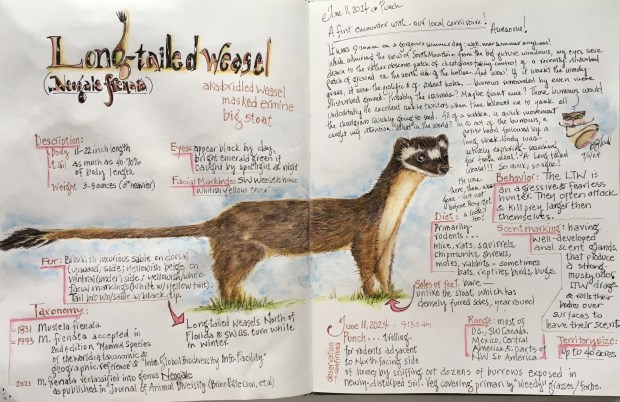
Such a surprise and total delight to find a long-tailed weasel hunting on our property! Busy probing numerous rodent burrows for an easy meal, he was too occupied to notice us staring in awe. What a beautiful little guy ……. from the white mask markings on his head, to his luxurious sable-colored fur draped over creamy buff-colored underparts; from his ground hugging, long, thin and sleek body, to his equally long or longer tail with a dashing black tip ……. the long-tailed weasel is a sight to behold!

long-tailed weasel tracks

Although their range includes southwest Canada, all of the lower “48,”Mexico, Central America and parts of northwest and southwest South America, seeing a long-tailed weasel is rare. Only one animal occupies a territory roughly 40 acres in size, which boundaries are aggressively maintained by frequent scent marking.

Even though the neighborhood pack rat, mole, squirrel and mice populations might suffer within a long-tailed weasel’s territory, we would enjoy and appreciate seeing more of this ferocious, pint-sized carnivore around our home!

Have you ever seen this or any weasel species? If you’ve seen this weasel (aka ermine) during winter, fully cloaked in brilliant white except for a black-tipped tail, ooooooooo! How lucky! Share your weasel observations please.

As always, Thanks for stopping by!
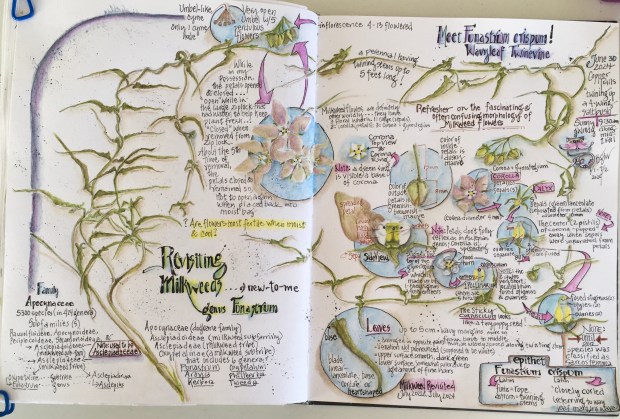
Surprise! A vine-y, twine-y desert milkweed discovery ……

July 9, 2024

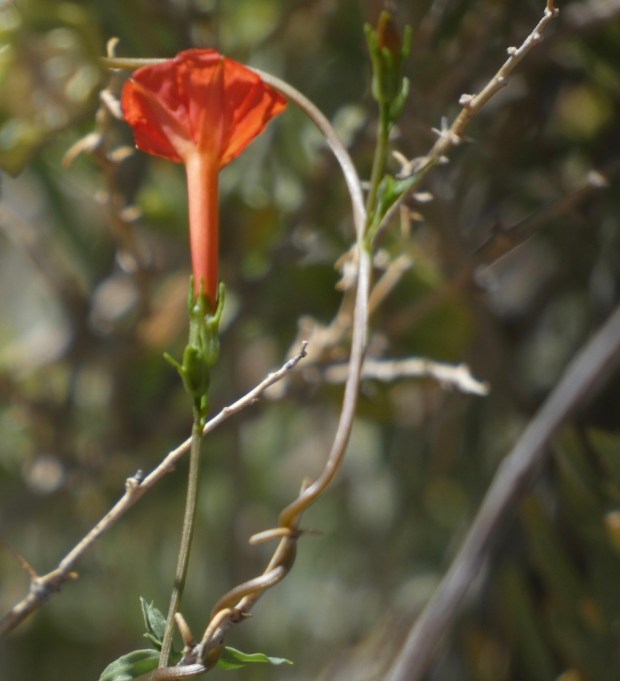
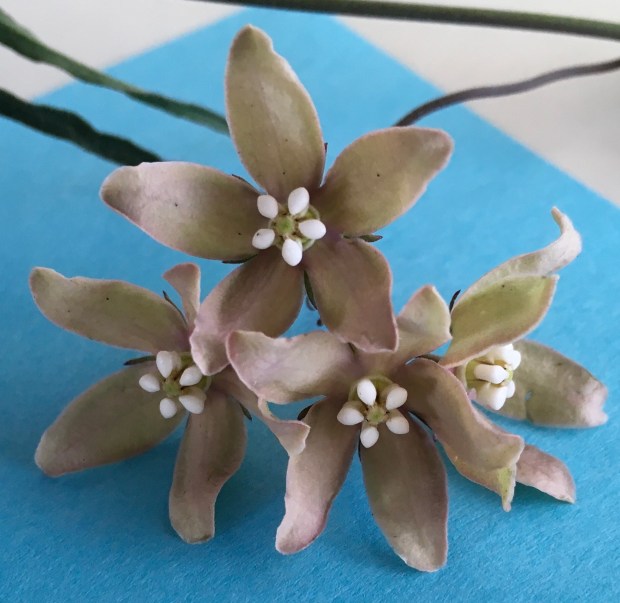
Just when I was feeling confident about the morphology of the milkweed family of plants, a new twist on the familiar leaps out shoutin’ “ Hey, lookie here!”      Expecting to see a common vine gracefully twirling its way up a desert shrub, I paused ……. searching for the crimson red trumpet-shaped flowers of Ipomoea cristulata (Trans-Pecos morning glory). But instead there was an umbrella of 5 flowers, each with 5 widely spreading greenish-brownish-mauve colored petals crowned in the center of an unmistakable floral corona, a sure fire characteristic of a milkweed! Could it be?

Trans-Pecos Morning glory

Oh Yes! 

This unexpected, undeniable discovery had me puzzled though. It’s been two years since I created a detailed post about the Asclepias genus of milkweed (see Summer Botany: Meet the Milkweeds). At that time and throughout the decades prior, my knowledge of milkweeds was limited to Asclepias, and the specific characteristics of that genus. 

Spreading petals of Wavyleaf Twinevine

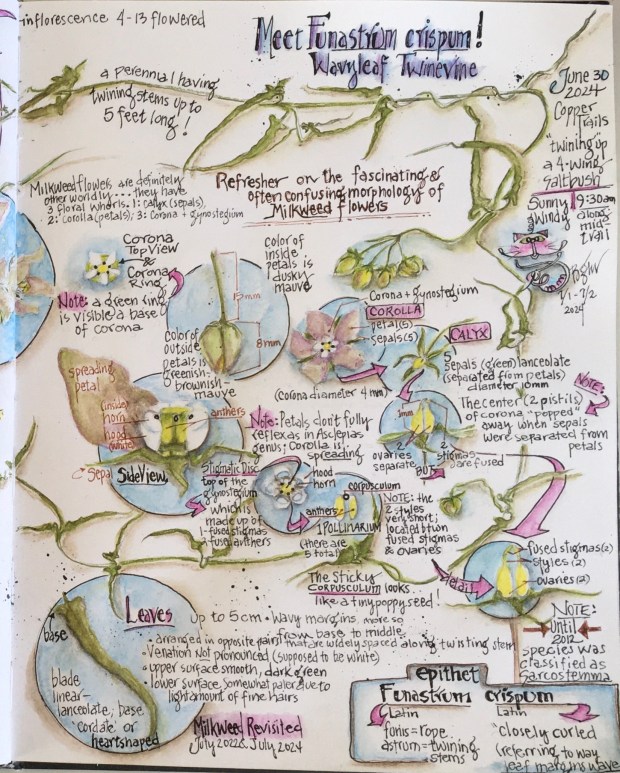
But here was something new-to-me; so worthy of whatever time it might take to learn all about this find in the dogbane family (Apocynaceae), aka the Milkweeds.  I quickly confirmed this vine does not belong with the Asclepias species of milkweeds, but is of the genus Funastrum, which is Latin for rope (funis) with twining stems (astrum), commonly referred to as the “twinevines.” And the full name of this plant is Funastrum crispum, commonly called Wavyleaf Twinevine.

Most of what I uncovered about Wavyleaf Twinevine is included on my 2 journal pages, along with some confusing taxonomy involving family and subfamily names, tribe and subtribe names, and how until 2012, this plant was known as Sarcostemma crispum. Curiosity about the taxonomic history will undoubtedly tempt me to sort through the confusion ……. maybe someday soon!

Have you discovered anything new-to-you in nature lately? What was it, and did it lease to more discoveries?

Thanks for stopping by!