June 12, 2023
David Lukas, naturalist, presented an amazing 2 hour video workshop on the largest family of flowering plants, the family Asteraceae1, commonly called Sunflowers, Daisies, and Asters. Not only are they the largest family, they are also the most successful …. from a botanical and evolutionary perspective. That was the hook! I needed to know more!

Disclaimer! The following post is lengthy and covers many botanical things about sunflower “flowers” I wished to remember. If you decide to take this deep dive with me, prepare to be amazed. And if you make it all the way to the end, congratulations! But beware ….. you’ll develop an irresistible urge to stop and investigate every roadside sunflower on your next trip to town! Are you ready ……?
Introduction
Sunflowers are instantly recognizable by everyone, worldwide. Found in wild abundance from desert to alpine ecosystems, and grown for food and oil (89 million pounds harvested on 65,000 acres in Kansas, the Sunshine State, alone), the brilliant yellow of one individual to thousands all in bloom at once, is an awesome sight.
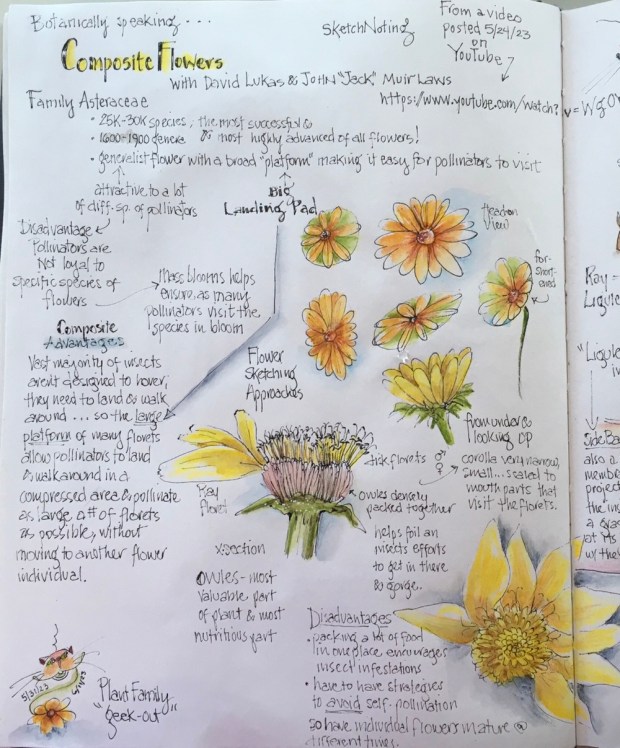
But have you ever taken a close look at a typical garden variety sunflower? When you pluck petal after petal, and wonder if “she loves you, loves you not,” do you realize each discard is an individual flower, or floret? And what about a sunflower’s center? What’s going on there?
Petal by petal, floret by floret, David presented a thorough Botany 101 lesson on the very cool structures and characteristics that make up different members of this most excellent family of flowering plants. Most of the information was familiar, but there were plenty of “ah-ha” moments for me, like ….
The Ray Flower
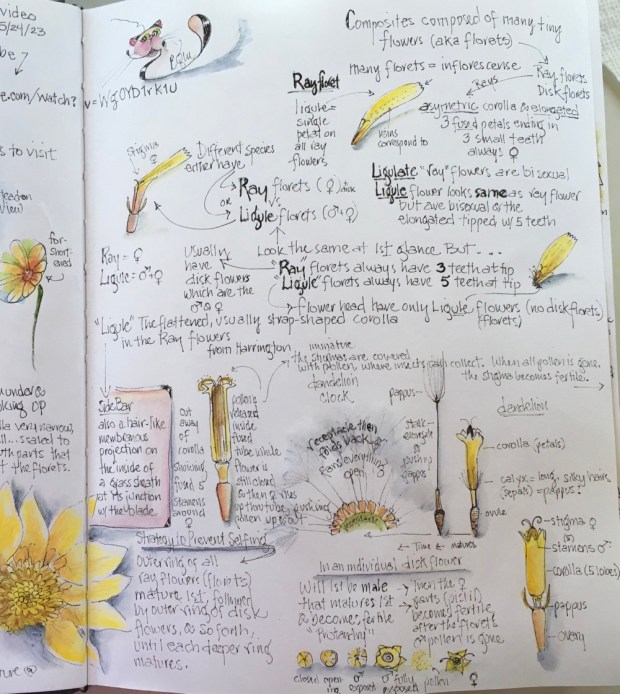
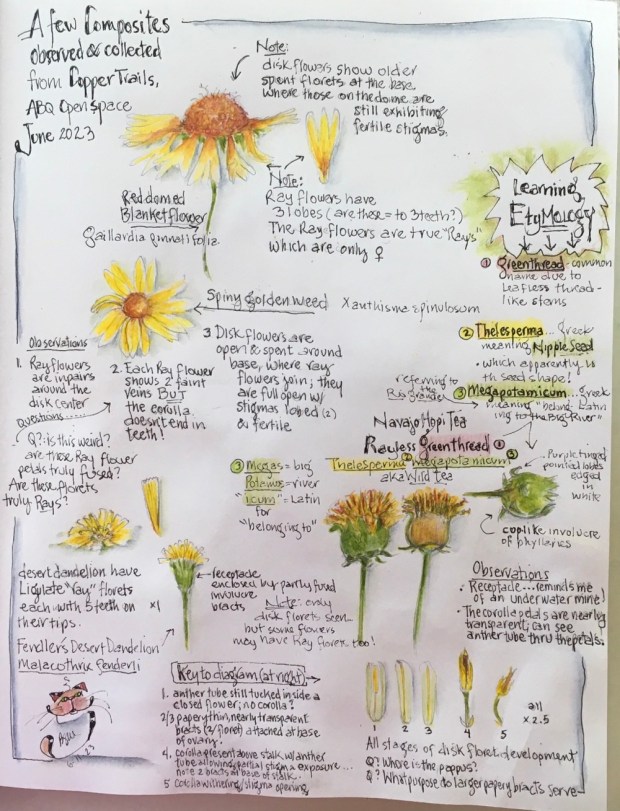
Not all Ray flowers are crested equal. Those pretty yellow petals that create the sun illusion and circle a center disk …. are female florets (florets = little flowers). The “petal” is actually 3 fused petals (the corolla) tipped with 3 small teeth; it’s known as a strap-shaped corolla. But those species without a center disk, having all “ray” florets, are officially called “ligulate” florets; their strap-shaped corolla is made up of 5 fused petals tipped with 5 small teeth. Ligulate florets have both male and female parts!
The Disk Flower
And now the disk florets … the ones in the center of a sunflower. If you look close, you’ll see often hundreds of tiny florets whose petals have been fused into a 5 petalled tube. But on closer inspection, you’ll likely notice the floral tubes are in various stages of open. Those along the outside of the disk open first, after the ray florets open. Then in a spiral pattern, from outside in, the disk florets continue to open. Curiously and ingeniously, each floret doles out its pollen stores only when triggered by a pollinator. For example, a bee lands on a ray floret “landing pad” and walks into the forest of disk florets. The florets sense the bee’s touch and the filaments or stalks supporting each of the 5 pollen-loaded anthers that surround the style and immature stigma in a tube, relax and retract the anthers, allowing the style/stigma to move upward through the anther tube, collecting, carrying then delivering a small measure of pollen outside the floret’s petals to the hungry bee.
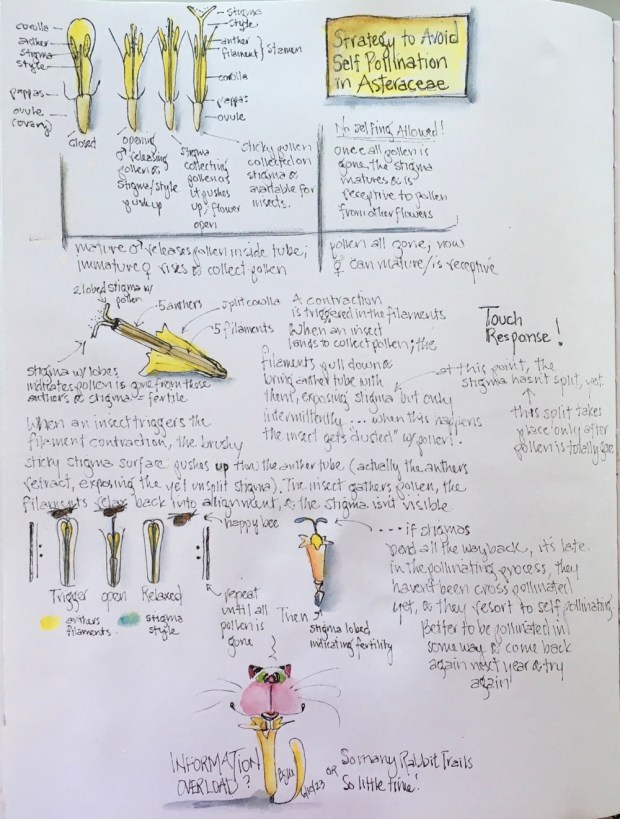
Check out my journal pages, above, for diagrams
I’ve illustrated the parts of the florets and this amazing process, and also described how this plays a hand in preventing self fertilization of a sunflower. This piston-like motion of the style and immature stigma continues until all of the pollen is gone. Only then does the stigma mature and is receptive to the pollen from another flower. Whew!
Next! Field Collections to See for Myself
Because it’s easy to look at a sunflower with ray and disk florets, and determine the stages of development of the disk florets, I had to see for myself. So I collected some examples of sunflowers to have a close-up look! And by golly …. David was right! I also found some sunflower species with only ray or “ligulate” florets and yes! The tip of each strap-shaped corolla had 5 tiny teeth!
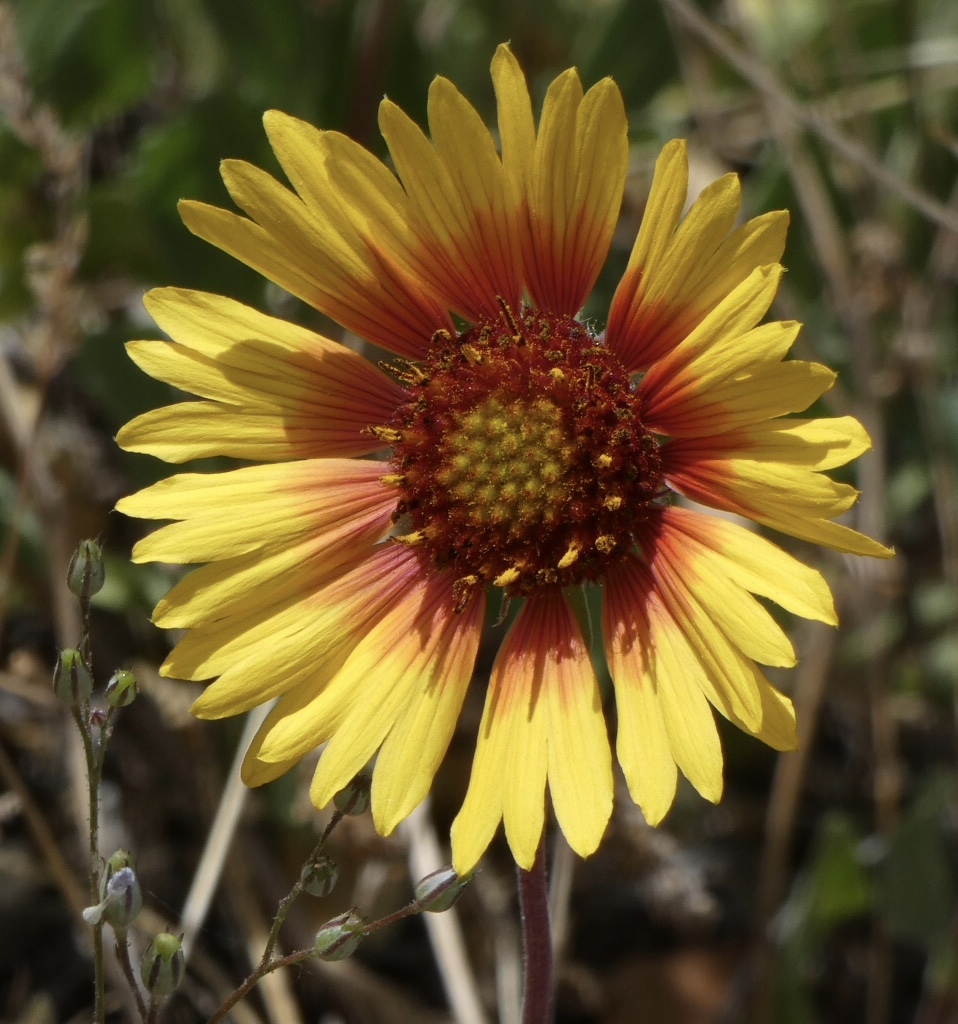
I mean, this is seriously, geek-out, incredible stuff! Go see for yourself, and let me know what you discover! Better yet, make an entry in your nature journal and share!
1Back in the day, when I took a few years of botany classes, the sunflower/daisy/aster group of plants was known as the Composites (the Compositae family), because the a single flower of this diverse family of plants is (usually) composed of several types of tiny florets. I miss this familiar reference, but can really relate to the new family name, Asteraceae, which is from the Greek meaning star or star shaped, conjuring the ideal visual image of these beautiful flowers.

 a curious nature
Lovely series, Barb!!! And your illustrations are fabulous, as usual. Go “geek” on us anytime… always a pleasure to learn! Thank you for the introduction to David’s book… will try to get it on inter-library loan.
LikeLiked by 1 person
Awesome and muchly appreciated comments, Robin! David Lukas is an amazing naturalist, and almost in your back yard! His video workshops are definitely worth seeking out! And also, Thanks for the kudos about my geeking out! So much of Nature is all in the details.
LikeLike
You really did geek out on this one! Good stuff!
LikeLiked by 1 person
Wow! Thanks so much Jean! David presented such a wealth of information, I found myself irresistibly gobbling it up! There’s not a single composite species that I come across that’s not getting up close and personal scrutiny.
LikeLike
Fascinating, detailed look at sunflowers, one of my most favorite flowers of all! I have bookmarked the video for Watch Later as it looks fascinating! How interesting that the floret detects the bee’s touch, then delivers the pollen. Nature is truly amazing!
LikeLiked by 1 person
Thanks so much Karen! I was literally on the edge of my seat during the video, awaiting David’s new surprises around each “corner!” The video is long, but worth the time.
LikeLike
Beautiful post, Barb! 👏 I am growing some. 🌻 💛
LikeLiked by 1 person
Thanks so much Michele! There’s not a happier flower! Growing your own is double happy!
LikeLiked by 1 person
You are welcome. I love watching them grow. 🌻
LikeLiked by 1 person
So lovely 🤩👍 beautiful flowers sketching and explanation 🙏❤️ thank you for sharing dear friend 👏💐
LikeLiked by 1 person
Many many thanks Thattamma! Sunflowers are so beautiful, happy plants! And they’re worldwide! I’d love to know what sunflower species you enjoy in Malaysia!
LikeLiked by 1 person
Most welcome my dear friend and Malaysia Sunflower also so awesome !! It blooming seeing glory of sunrise 👍🙏🤩🌻
LikeLiked by 1 person
Oh I’ll bet your sunflower is spectacular! I’d love to see a photo sometime,
LikeLike
The sunflowers are even more amazing now that I know how they feed the bees. Incredible amount of info and beautiful illustrations!
LikeLike
It was hard to know when to stop absorbing all this purely geeky info!
LikeLike