July 2, 2023
It was early morning, but already a hot 85F as we hiked the dry, dusty trails of the Albuquerque foothills. With a few exceptions, late June’s wildflower display is all but gone, replaced by an abundance of seeds ready to drop, blow away, or feed hungry chicks. While the “stage” resets for the next Act, the Summer Monsoons, plants in the Sunflower-Daisy-Aster family (Asteraceae) still dot the quickly browning landscape with bright yellows, whites, and shades of purples. One of the most curious plants now making a showing is Rush Skeletonplant (Lygodesmia juncea).

Perfectly adapted to the desert environment with its chaotic tangle of blue-green mostly leafless stems, is Rush Skeletonplant. Spindly stems, standing up to 18” tall, are topped with 1-2 petite pale lavender-pink flowers. These tiny delicate beauties may not be as showy as your garden variety sunflower, but when closely examined you’ll find typical characteristics of the family, including 4-6 strap shaped ligulate florets each with a protruding hot pink anther tube surrounding a double lobed stigma. Short lived, the florets quickly transform into dandelion-like seed heads.
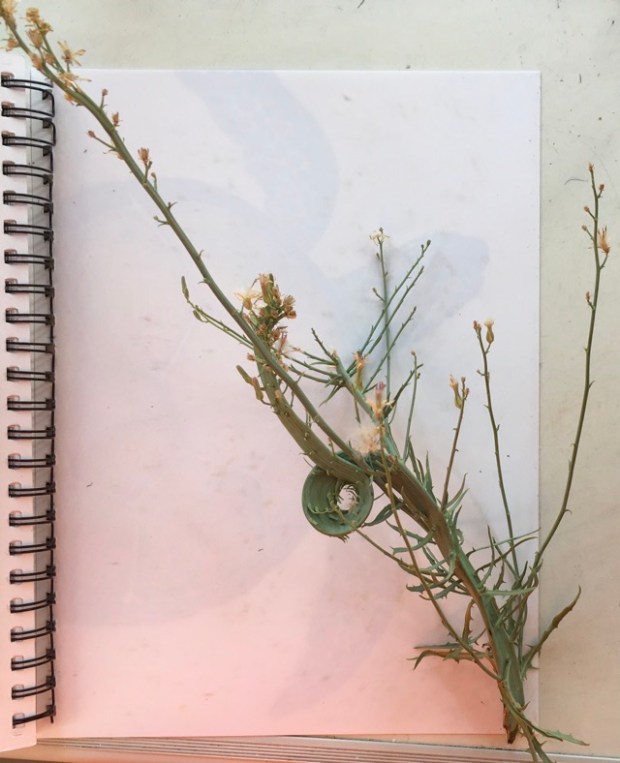
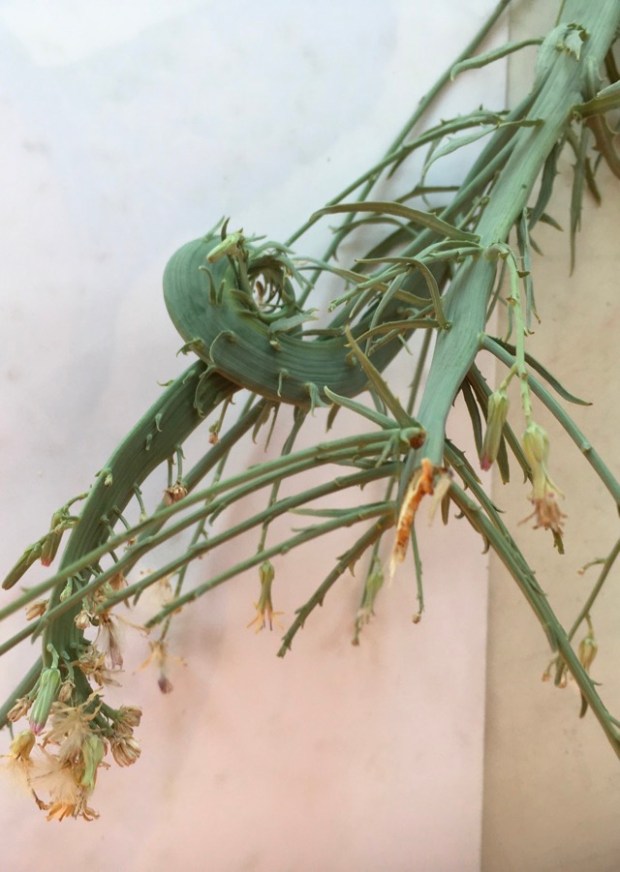
So there we were, hiking along, wishing for even the gentlest of breezes to keep the biting gnats from crawling into our ears and mouths, when out of the corner of my eye …… Weirdness Extreme! A wildly malformed Rush Skeletonplant.
………………. I gasped in surprise, inhaling a gnat in the process, and paused only long enough to 1. wash down the struggling gnat with a gulp of water, 2. agree with myself that Yes! this is a malformed Rush Skeletonplant, and 3. know most certainly that I had to learn more about what went terribly wrong with this unfortunate plant. Sketching on site was out of the question, so I removed half of the deformity, PDQ, and resumed my hike. For the next few miles, most of my attention was focused on this plant, noticing all of its peculiarities while many unanswered questions popped into my mind covering the What’s, When’s, Why’s, How’s. But first I needed to know more about plant malformations.
Luckily my second favorite kind of hiking is down a long and branching rabbit trail. Off I enthusiastically hopped!
A New-to-Me Science!
The Science of Teratology – This is a specialized branch of morphology or embryology focused on the study of the rare occurrences of malformed organisms found in nature. These studies have revealed that most malformations begin at the embryonic stage of development and are caused by a number of factors, such as abnormal genes, environmental conditions, infection, drugs, and interactions between two of more of these factors.
Abnormalities occur in both plants and animals, but for my purposes I focused on types of plant malformations, hoping to learn what happened to the Rush Skeletonplant. Here’s what the literature revealed:
Plant Malformations Described (in brief)
Exaggerated Plant Growth ….. this seems to be related to alterations in normal developmental processes where a fungus or bacterial disease interferes with growth hormones, producing plants with exaggerated or greatly diminished heights, more than normal numbers of leaves, and the like. This didn’t seem to match my skeletonplant specimen.
Alteration of Floral Parts …… plants affected by certain pathogens can develop abnormal looking floral parts (sepals, petals, pistils, stamens). The floral parts of my skeletonplant looked pretty normal to me.
Translocated Plant Organs ….. malformations of this type may exhibit aerial tubers in potatoes, adventitious roots in tomatoes, or spontaneous development of many plantlets in begonias. All of the skeletonplant organs appeared to be in their normal place.
Witches’-Broom …… this anomaly is exhibited by an infection, usually in a tree or shrub, that produces an over abundance and densely clustered buds or shoots. Nope! This didn’t seem to be a match for my skeletonplant.
And lastly ……
Fasciation ….. ah ha! This seemed like a match! Fasciations, placed in the “Monstrosity” category of teratological abnormalities, result in the flattening of the plant’s main axis. This phenomenon, which has many different causes, causes a ribbonlike expansion of the stem. As the Fasciation develops, the growing points can broaden and become blunt, or can coil like a ram’s horn, or can fuse into a grotesque tangle of coils, or may become linear and comblike. The closer to the ground Fasciation develops, the more grotesque and exaggerated the plant will become. What’s interesting is that plants exhibiting Fasciation one year may not show signs of this abnormality in the next or future years. If a plant fasciates in one part of its structure, it won’t spread to the rest of the plant, and the condition isn’t transferable between plants. But in some cases, characteristics of Fasciation are desirable, and breeders have tried grafting, vegetative reproduction and other means to preserve the abnormality as a species, like in some ferns, ornamental plants and flowers, and vegetables (broccoli and beefsteak tomatoes). Maybe I’ll branch off my rabbit trail and chase that bunny!
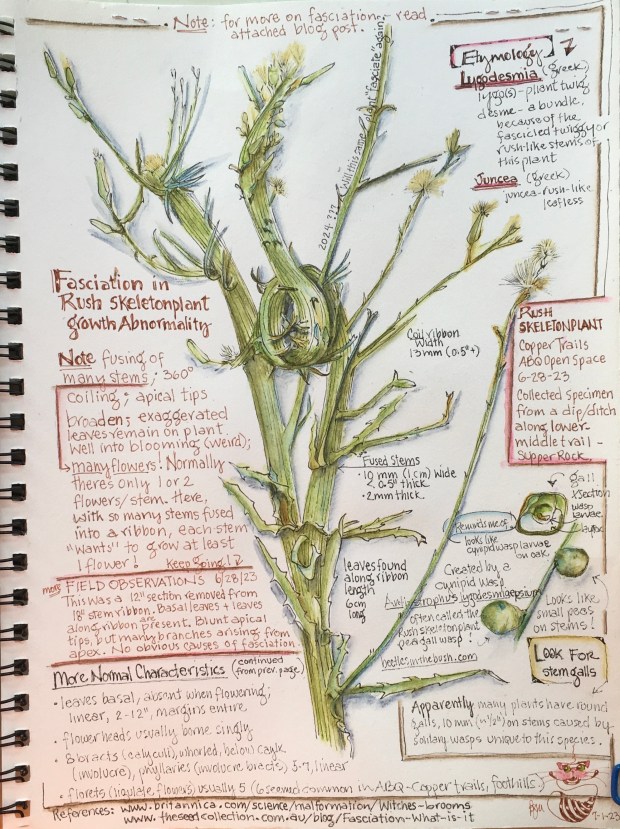
These abnormalities are often triggered by nutritional changes due to disturbances in the growth-hormone. Other causes may be due to viral, bacterial or fungal infections, as well as physical damage to plants by insects, chemicals, frost or even careless gardeners who may traumatize the plant into Fasciation.
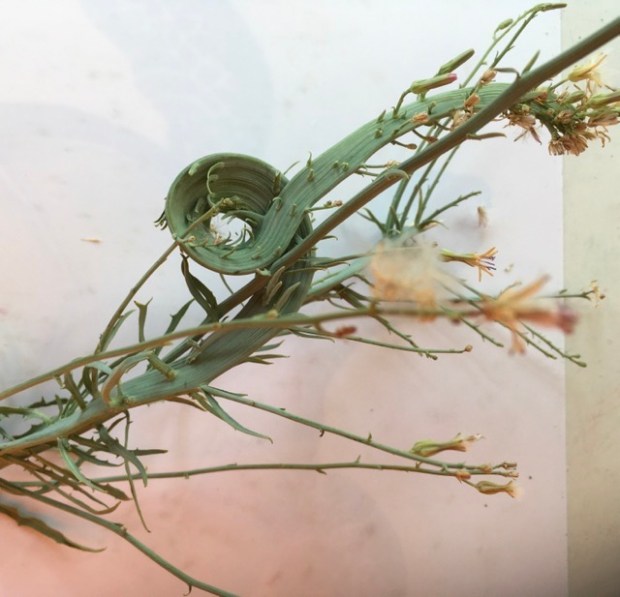
The bottom line is that my best guess is the deformed Rush Skeletonplant is the result of some trigger when it was just beginning to grow causing it to fasciate. Wonder what? Regardless, this was a most excellent discovery!
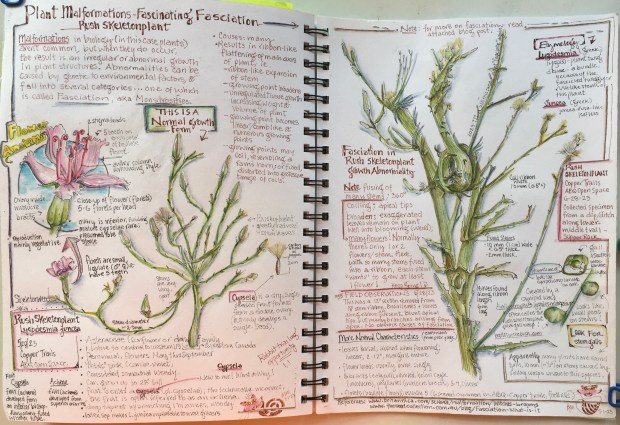
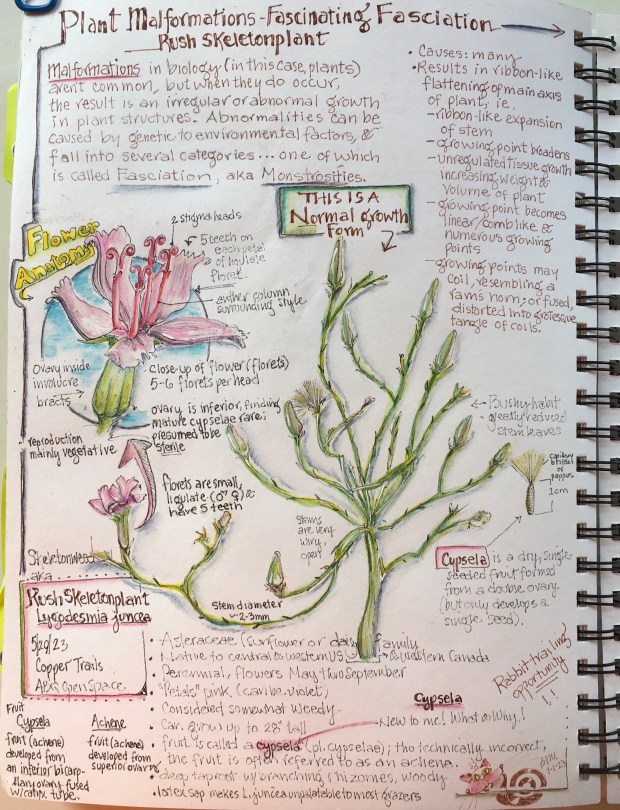
Let me know if you enjoyed learning a bit about plant malformations. Have you ever seen any weird plant oddities? I’d love to know what they were! My two journal pages include some of the information in this narrative, along with some botanical information about and my observations of my Rush Skeletonplant specimen.
Thanks for stopping by, and don’t forget to look at the world around you!

 a curious nature
So gorgeous photos of summer and sketching beautifully so many rare photos 🌷🙏❤️👍
So talented Author, writter you are dear friend ❤️👏 All The Best wishes dear friend 🥰💐
LikeLiked by 1 person
Thank you so much for the gracious comments, dear Thattamma! Have a wonderful evening and morning.
LikeLiked by 1 person
So welcome and thank you for wishes dear friend 🙏 same to you too 🌷🙏❤️🌷
LikeLiked by 1 person
Love your humor, Barb — inhaling the gnat! What a curious deformity on this plant, I have not seen this before! I really enjoyed learning about the various reasons for malformations and glad you narrowed it down — great nature detective work!
LikeLiked by 1 person
Many thanks, Karen! This was an especially fascinating study. It’s funny how you can walk in the same area over and over, and never really see everything. But when I spotted this malformed rush skeletonplant, I knew it was something out of the ordinary! There’s just so much to discover!
LikeLiked by 1 person
Fascinating is exactly the right word, and the malformations are so beautiful!
LikeLike
Yes, Yes! So fascinating!
LikeLike