March 19, 2024

There are a number of different woodpecker and closely related species (sapsuckers and flickers) that frequent our Piñon-Juniper woodlands in the East Mountains of central New Mexico. These include the downy, hairy, Lewis’s, red-naped, Northern flicker, and Williamson’s sapsucker. They are always such a joy to observe, unless they’re drilling a hole in the side of the house. Their stiff tails allow them to ‘walk’ up and down tree trunks and other vertical surfaces that house insects or exude sticky sap. Their sharp bills are ideal for creating nest holes and sapwells in tree trunks. Their sharp calls, drumming, and stiff-winged flight make them easy to recognize as a member of the woodpecker group of birds.
Until mid-March we’ve never seen a Williamson’s sapsucker. Then one morning Roy was trying to catch a glimpse of a strange woodpecker on one of our old growth piñon pines. Immediately recognizing the markings of this bird were unlike any we’ve seen before, he excitedly fetched me from my studio to have a look.

Sure enough! Realizing this was likely a life list sighting for us both, the markings looked just like those illustrated in our numerous field guides. Indubitably, dear Watson! This was a Williamson’s Sapsucker (Sphyrapicus thyroideus) and he was treating us to a visit. We watched him (definitely a male, as females look completely different than the males, which is unusual for woodpecker species) working his way up and down the tree trunk. As he walked and hopped up and down the tree, he would circle the trunk and pause to lick up actively flowing tree sap from rows and rows of sapwells! Why had we never noticed so many sapwells on this tree before?
Did this or other Williamson’s sapsuckers drill these shallow sapwells? Maybe another woodpecker species created them and the Williamson’s was stealing the nutritious sap? Are these new sapwells or have woodpeckers been drilling this tree for many years? Countless questions, but this handsome fellow wasn’t giving up his secrets. So we enjoyed his antics for about 30 minutes until he flew off, maybe to another piñon to lap its sap?

The next day, as we were about to pull into the garage, we spotted the Williamson’s again …… again working the sapwells up and down the piñon tree. We sat in the car and watched him while mulling over new questions, like “isn’t this the same time he was here yesterday?” “Why yes!” We closely observed his feeding pattern, beginning at about 5 feet above the ground, walking and hopping up the tree while circling the trunk, and when he reached the needled branches about 25 feet high, he would make a diving flight back down to the 5 foot height and again work his way up. This went on repeatedly for about 5 times before he flew away. Hmmmm! Why did he stop when he did? Had he licked up all the available sap for the day, and had to wait until the sap began flowing again? (I showed up later to see if he returned ….. he didn’t. Maybe my timing was off? Maybe the sap flow still wasn’t worth his trip?).Day 3, and same time/same place. This hungry bird was back lapping sap! Same up and down behaviors; same departure time.
Day 3, and same time/same place. This hungry bird was back lapping sap! Same up and down behaviors; same departure time.
Day 4, ditto
Day 5, ditto
Day 6 ……. We arrived at the same mid-morning time, and waited. And waited. And waited. The Williamson’s sapsucker was a no show. And we haven’t seen him since.
Was he only migrating through, just long enough to stock up on high energy meals? Apparently this species is widespread and fairly common throughout the Rocky Mountain West, but their breeding range begins just north of us and extends into Canada. However, we are well within the Williamson’s sapsucker’s winter range. Hope he returns again next year!
Meanwhile we’ll be watching that old growth piñon to see if the sapwells draw in other hungry birds!
Now, a few fun facts about the Williamson’s sapsucker and sapsuckers in general.
While the male Williamson’s sapsucker is silky black with a cherry-red throat, a brilliant lemon-yellow belly and bright white wing patches, the female looks totally different. This is very unusual for birds in the woodpecker group. The female has a mousy brown head, banded back and small patches of black and yellow on the belly.
- The difference is so striking between the male and female, they were originally thought to be different species entirely. It wasn’t until 1873 that ornithologists realized they were the same species. Naturalist Henry Henshaw located a pair at their nest in Colorado and published his observations, thus putting an end to the confusion.
Sapsuckers get their name from their habit of drilling rows of shallow holes in tree bark. The birds come back to these holes to lick the sap that flows from these holes and to eat insects that have become caught in the sticky residue.
- Early ornithologists in the West reported seeing Williamson’s Sapsuckers at sapwells in aspen trees; however, in the past 100 years, observers have seen their sapwells only in conifers, never in deciduous trees. The early reports might have been of Williamson’s stealing sap from wells made by Red-naped Sapsuckers.
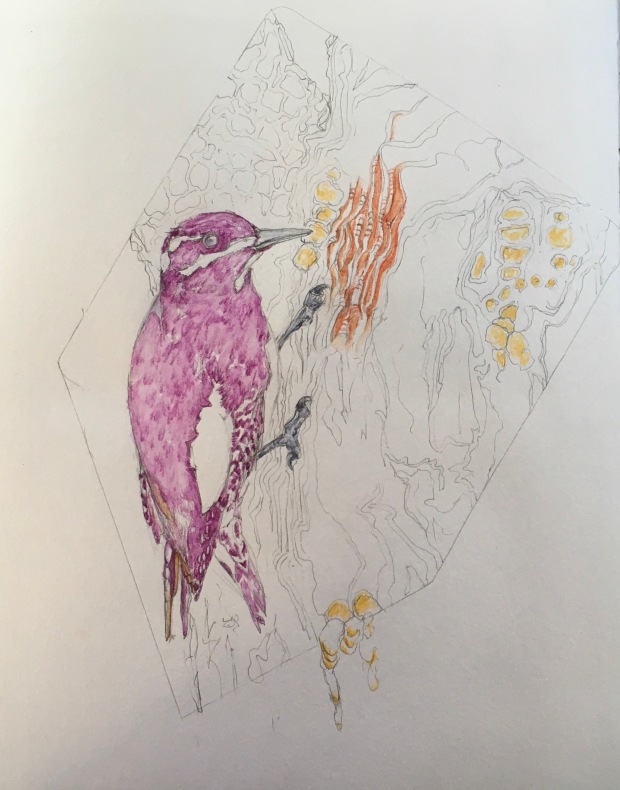
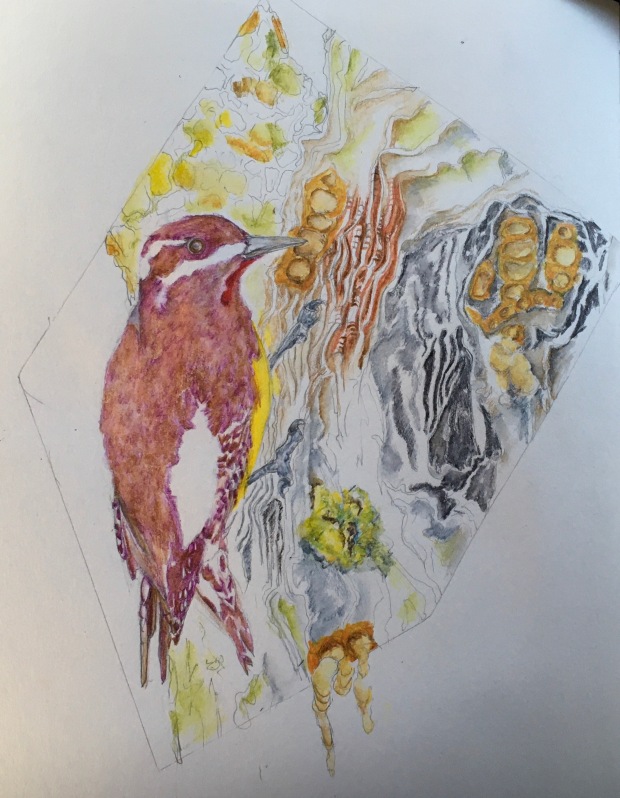
Here’s a few progress shots I remembered to capture while creating the Williamson’s clinging to the tree


 a curious nature
Wow, Barb, what am awesome experience, and those progress pics on your art were so interesting, about the wonderful layering involved…great post! Jane xox
Sent from Gmail Mobile
LikeLiked by 1 person
Thanks so very much Jane! Taking on one of these illustrations reminds me of traveling ……. While reaching the destination is extremely satisfying, it’s the journey that makes it all special! I appreciate your comments on my progress pics!
LikeLike
A very delightful encounter with a sapsucker! It’s so interesting that you observed him for several days in a row at the same time of day, and that you took the time to observe and gather data. I sure hope he returns — maybe the tree needs time to produce more sap after his binging! I loved seeing your process of creating the iridescent black back and the texture of the very interesting bark. I’m also happy to learn about the differences between sap and resin. Phenomenal information, Barb!
LikeLiked by 1 person
Thanks Karen! I hope he returns too, but maybe not until he returns south for the winter. Ah, but then we’ll be in our new home. I’m so happy you enjoyed the post, and we’re as happy to learn the difference between sap and resin as I was!
LikeLiked by 1 person
Barb –
Wonderful post! We don’t have Williamson’s sapsuckers here in Virginia. We have the Yellow-bellied sapsucker. Very similar in appearance but the yellow-bellied males have a barred back as opposed to an all black back. I really loved seeing your painting progression photos. That pink/reddish under painting made the black shine a bit. Thanks for sharing your wonderful experiences with us all!
LikeLiked by 1 person
Thanks so very much for wonderful comments, Dee! I’ve seen the yellow-bellied when we lived out east. A beautiful bird. And so is the Williamson’s, for sure! Hopefully a female will show up for a meal of piñon pine sap too! I love experimenting with creating black colors in nature. I think the iridescence would’ve been more pronounced had I used better quality paper. But it was fun 🤩
Thanks again!
LikeLike
You’re incredible, Barb! Not only for your talent but for your productivity! A busy woodpecker has made it a habit recently of waking me up a little too early. 😄
LikeLiked by 1 person
😂 😆 hahaha 🤪 woodpeckers do have a habit of being soooooo annoying! What kind of rattt-a-tattt-er is he? And wow! Your first comments blew me away! I’m very happy WordPress allows post scheduling, allowing my posts to materialize like magic!
LikeLiked by 1 person
A bit annoying, yes, but I could never get to upset at a bird. It is the kind that likes to peck away at tin. 😂
LikeLiked by 1 person
Oh dear! I’m surprised I couldn’t hear him from my place!
LikeLiked by 1 person