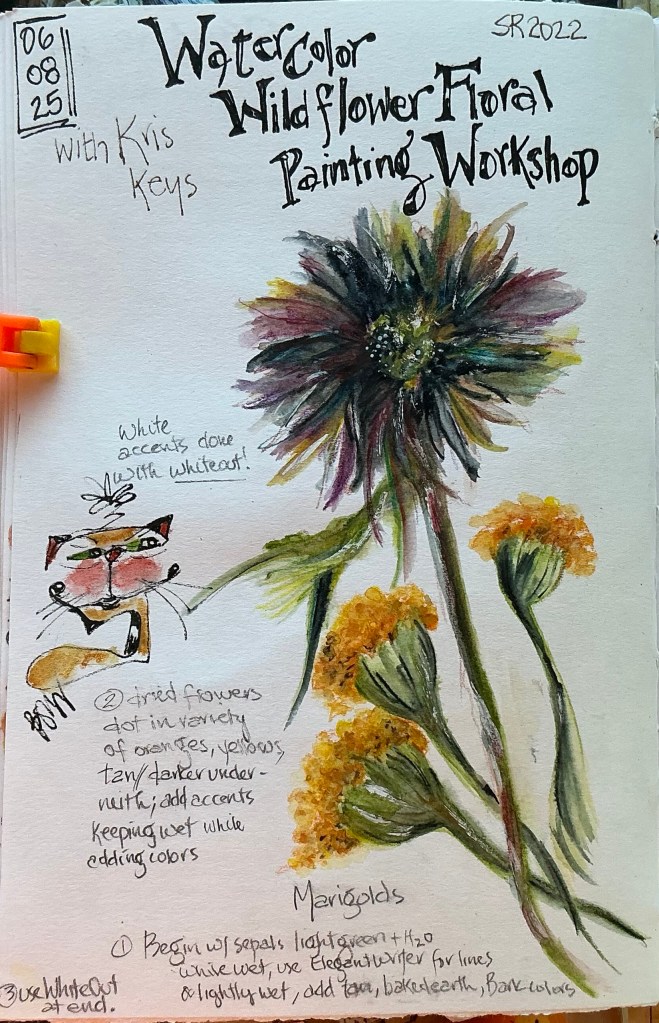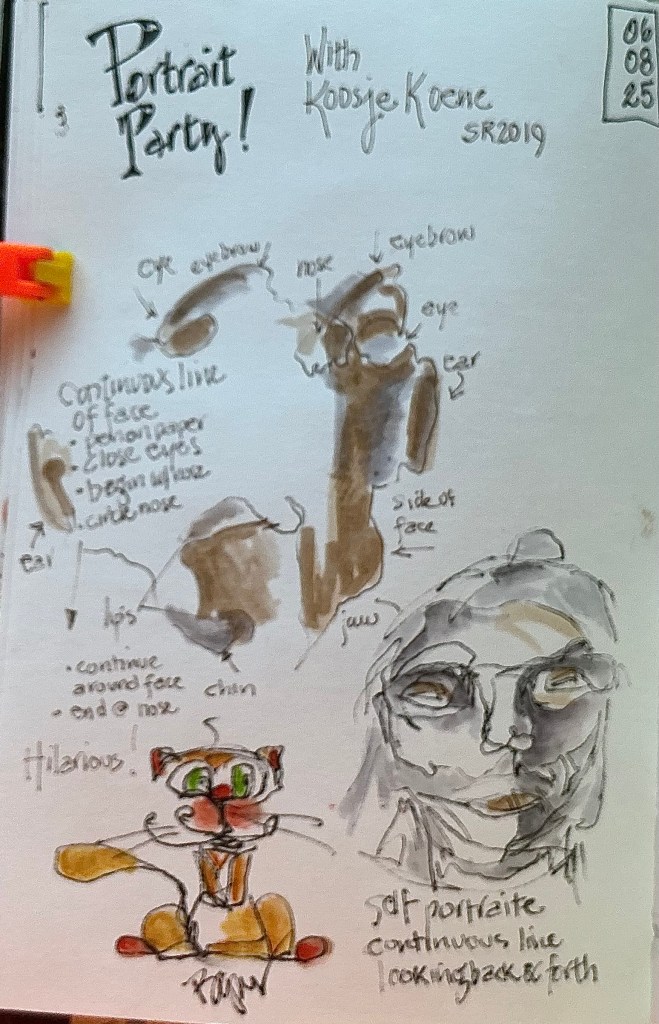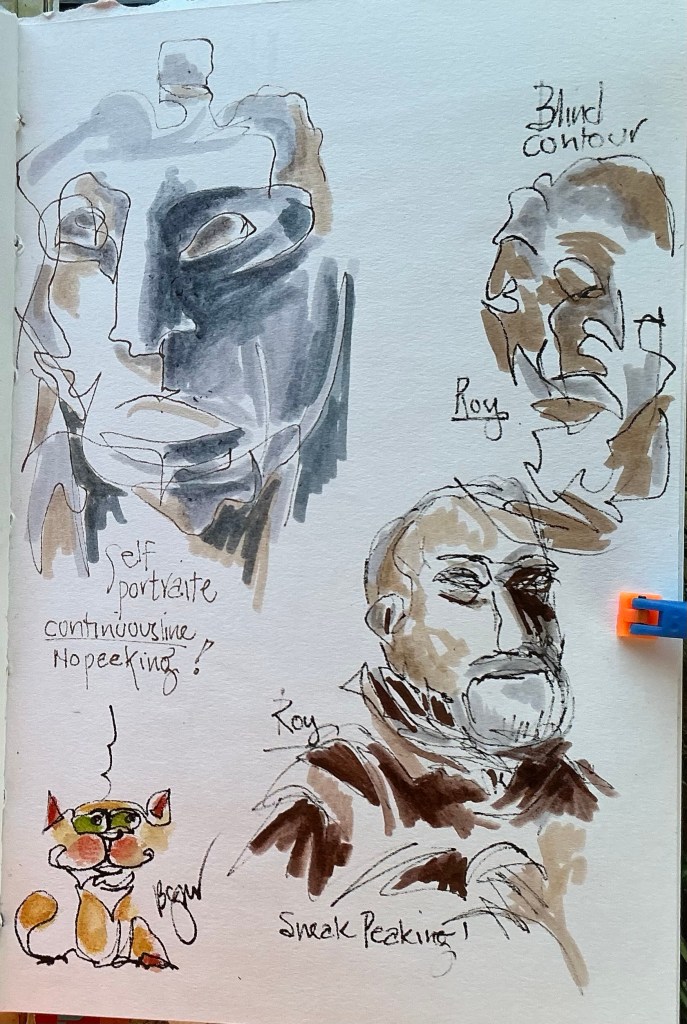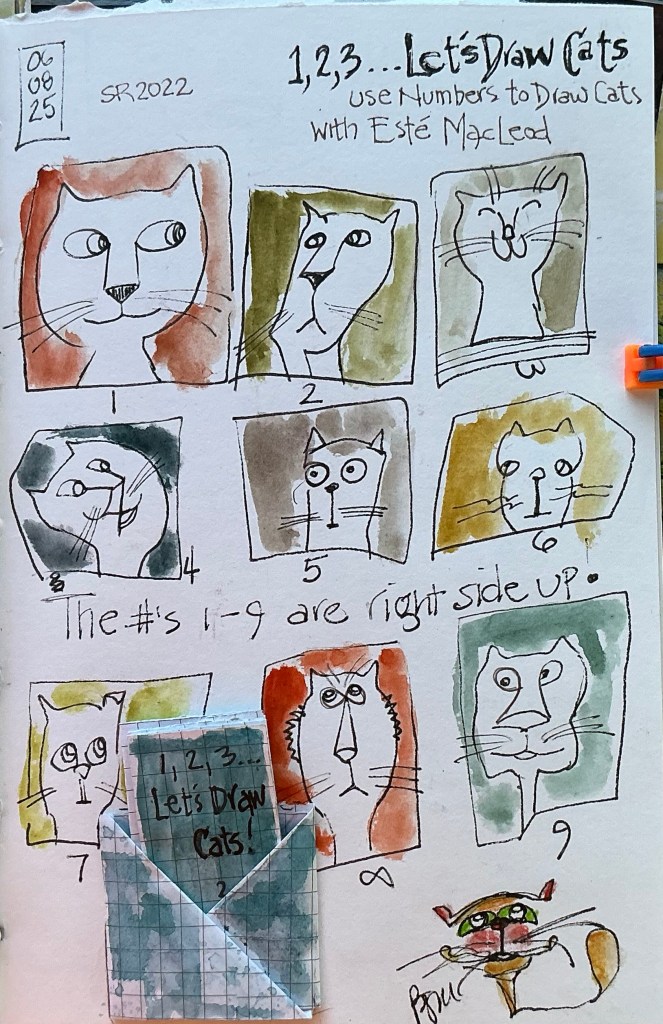
House Finch – Page 14 .. The 100 Day Project (2026)

July 14, 2026

House Finch (Haemorhous mexicanus ssp. frontalis)

aka Common House Finch

More than likely you’ve seen the sparrow-sized House Finch if you live almost anywhere in the U.S., southern Canada, or Mexico. The males are particularly showy with their bright red heads, throats and breasts, and their bouncy flight is sure to catch your attention. Just filling a backyard bird feeder with black oil sunflower seeds can bring a flock of 50 House Finches in to feast. They tend to dominate their favorite feeders, often chasing off competitors, after which you’ll have plenty of time to observe these finches as they sit still while shelling seeds by rapidly biting and crushing them with their large beaks. 

If you aren’t familiar with House Finches, you’ve probably heard their long, twittering song, which they belt out in most neighborhoods from coast to coast. Their song, so full of excitement and energy, is usually sung from the top branch of a tall juniper or pinyon pine tree. House Finches seem to be pleading urgently for attention by clearly singing, “Talk to me PLEASE, isn’t anybody THERE!!” (At least that’s what I hear over and over again first thing every morning throughout the Spring and Summer!) 

Not knowing how many broods have been reared this year, to date, it seems like we’ve enjoyed a large number of family groups around the house. Fledglings are fun to watch in flight as they constantly chase adults to beg for food. These futile attempts for free handouts strengthens their wing muscles and hones their acrobatic skills. Usually defeated, these novice students soon land in a tree and begin a long, hard practice session to learn their parents’ complex song.  

Completely exhausted, they will return to a certain cholla and the nest where the adult female fed and defended them as nestlings during the first 12-20 days of their lives. Finding even one of their well-hidden nests in any of those 4 to 7 foot tall cactus “trees” is quite the prickly endeavor! Even knowing how to recognize a House Finch nest hasn’t prevented me from experiencing plentiful and painful spiny jabs. What an excellent defensive location our local birds choose for nesting.

The Nest and Nesting Habits

In as little as two days, the female builds a cup-shaped nest made of fine stems, leaves, rootlets, thin twigs, string, wool, and feathers, with similar, but finer materials for the lining. This sturdy nest, durable enough to raise up to six broods a season, measures 3-7 inches wide; the inside cup is 1-3 inches across and up to 2 inches deep.

House Finches usually build their nests in cavities in deciduous and coniferous trees, on cactus and rocky ledges, and in or on buildings using sites like vents, ledges, street lamps, ivy, and hanging planters. They will also claim nests abandoned by other birds.

A western House Finch is likely to build its nest within 60 feet of where it was the previous breeding season; eastern birds choose sites more than half a mile away from prior nests. Despite these differing habits, all nest sites have a few things in common: a sturdy base and a roof-like overhang to shelter against sun and rain.

House Finch Facts

  • With over 40 million House Finches across North America, they are currently one of the most widespread and common bird species across the United States, second only to the American goldfinch. 
  • Native to the Southwest U.S. and Mexico, in 1939 a few House Finches captured in Santa Barbara, California, were sold to a New York City pet store owner as “Hollywood Birds.” Even back then, the sale of these birds was recognized as illegal under the Migratory Bird Treaty Act of 1918. To avoid prosecution under the Act, the pet store owner released the finches …. they were set free on New York’s Long Island. By the early 1940s wild nests were discovered on Long Island, and from there the spread continued. 
  • Sometime before 1870, House Finches were introduced to Oahu from San Francisco. By 1901, they had become abundant on all the major Hawaiian Islands.
  • Where House Finches are an introduced species, they are considered naturalized 1. They’re also considered an invasive species in some places, largely in unforested lands across the eastern U.S. where they’ve displaced the native purple finch (and even the non-native house sparrow!).
  • In their native range in the Southwest U.S. and Mexico, House Finches live in desert, grassland, shrubland, and open woodland environments, as well as near human dwellings and cities. The biggest House Finch flocks in the East are found in cities, and it’s much more common to find the eastern birds in habitats developed by people than anywhere else. 
  • Depending on where they live, House Finches can appear very different. Within the 11 officially recognized subspecies, body size, beak size and shape, wing length, tail length, and coloring can all vary regionally. For example, the northeastern migratory populations have longer and more pointed wings better suited for longer flights than the western finches which tend to be permanent, year-round residents.  Also, House Finches on Guadalupe Island off the coast of Baja California, Mexico, have heftier beaks than mainland birds.
  • The bright red (and sometimes orange or yellow) plumage on the head, throat and chest of mature House Finch males comes from compounds in their food (bird species are unable to produce red or yellow other than by diet). These pigments, called carotenoids (the same ones found in carrots and tomatoes), come from the berries and other fruits they eat. Females prefer mates with the biggest and brightest red-colored patches — a sign of a well-fed male.
  • House Finches are among the strictest avian vegetarians: seeds, buds, fruit, and foliage comprise 97% of their year-round diet. Most seed-eating birds not only eat insects in the spring and summer when they are abundant, but will feed bugs to their nestlings to add protein for growth. Except for the occasional fly larva, House Finches stick to a vegetarian diet.
  • Dealing with a pandemic for decades, these birds suffer from “House Finch Eye Disease,” a form of conjunctivitis that was first detected in Washington D.C. in the winter of 1994. Since then, the bacterial illness has expanded continent-wide causing big declines in House Finch numbers. Infected birds often have swollen or reddened eyes and may appear inactive or confused. Over time, it leads to birds becoming blind, disoriented, and vulnerable to predators. Other finch species, such as the American Goldfinch, are also affected. Because the disease is spread through social contact, it’s very important to keep bird feeders and baths clean.
  • The mite, Pellonyssus reedi, is often found on House Finch nestlings, particularly later in the season. However, the adult female has a clever strategy in response to these often fatal attacks. Since male chicks are more vulnerable to a mite outbreak, she will lay eggs containing females first to reduce the length of time male chicks are exposed to mites. This strategy increases the likelihood that representative numbers of both sexes will survive.

…………………………………………………………………………………………………

Share stories of your local House Finches!

Hope you found this interesting!

As always, thanks for stopping by!

1  A species is considered “naturalized” if it didn’t originally evolve in an area but has successfully adapted, established a permanent population, and is reproducing independently in the wild. These species are non-native, surviving without human help. Note: not all naturalized species are considered invasive.

References
allaboutbirds.org

audubon.org

iNaturalist.org

Western Meadowlark – Page 8 .. The 100 Day Project (2026)

May 4, 2026

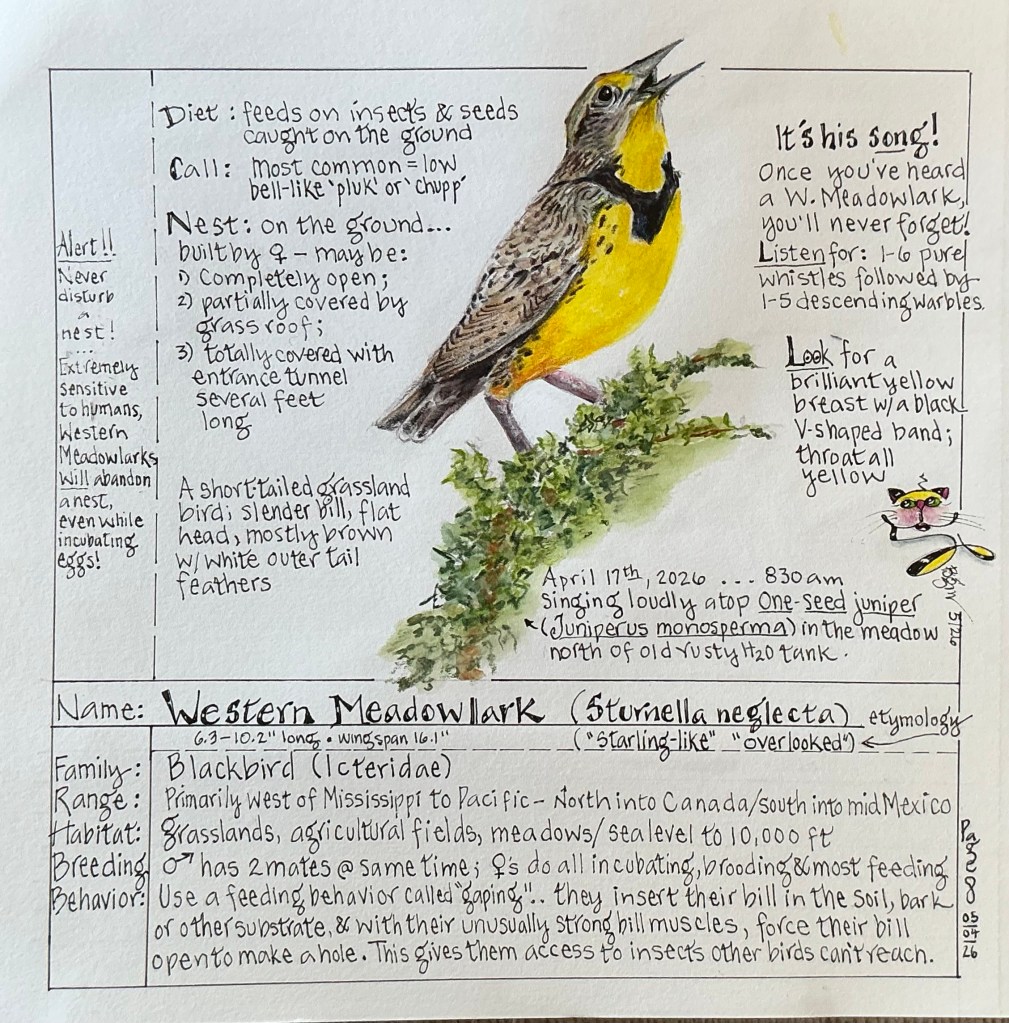
Western Meadowlark  (Sturnella neglecta)

When male meadowlarks return to the grassy meadow north of the old rusty water tank and begin singing, you know it’s Spring! 

There’s something wonderful about his song ……. At first he stutters a few practice notes; rough and rusty like the old water tank. But as daylight lengthens and temperatures warm, his song grows long, strong and melodic. Having perfected that signature song, he sings intently from sunrise to sunset, defending his territorial boundaries against all invaders. And he sings lovingly to announce his breeding readiness, enticing not just one, but two female meadowlarks to mate with him.

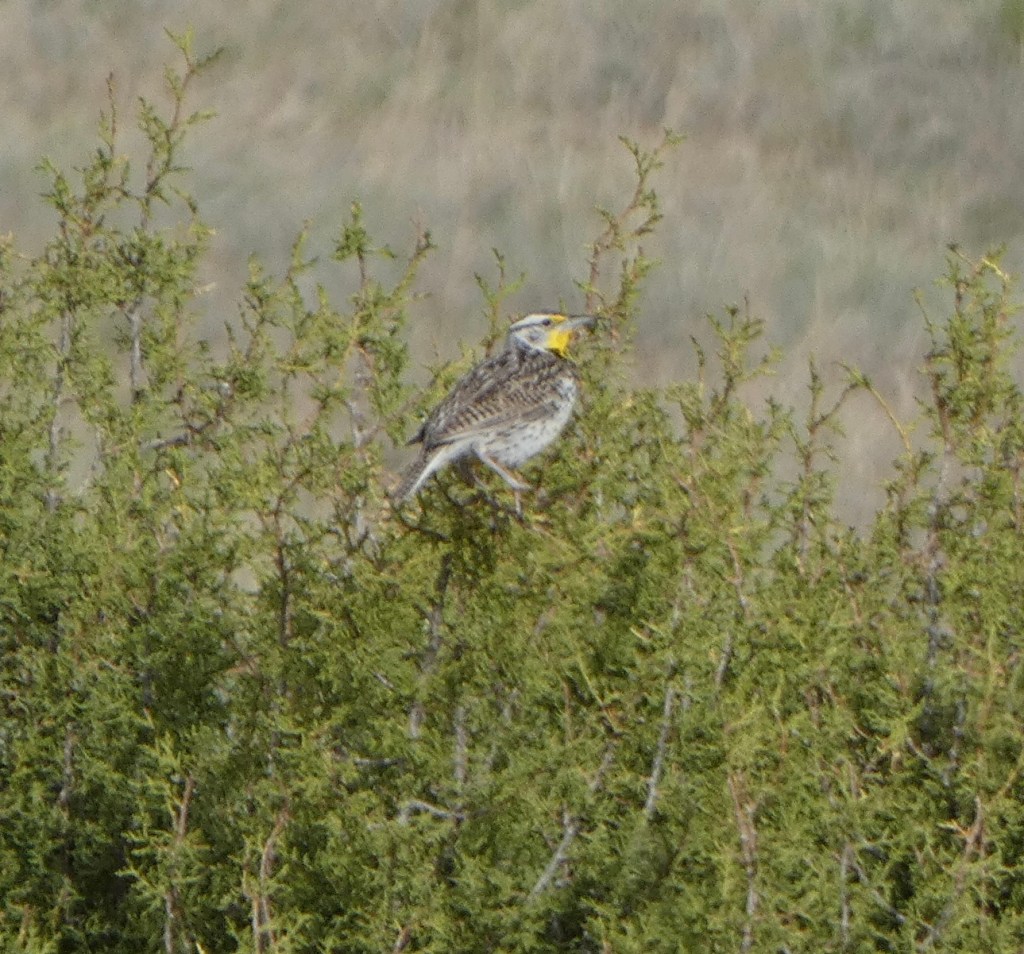
While walking the perimeter of the meadow in mid-April, it was easy to hear a male singing at the top of his lungs about 1/4 mile away. After a few moments scanning the tops of the widely scattered juniper trees with binoculars, I spotted him. (Males seem to favor these trees as perches, perhaps because they get a great view of their territory, and their voices really carry!) Able to get only 50 yards closer, I managed to take a few telephoto pics before he flew to the top of another juniper. Western meadowlarks are very skittish around people, so I held my ground and just watched and listened. It was a wonderful encounter.

Below are a few more fun facts about Western Meadowlarks, in addition to those on my illustrated page ….

If you’re lucky to see a Western Meadowlark, you’ll notice they’re a robin-sized bird but chunkier and with a shorter tail. Their flat head and long, slender bill are visible above a round-shouldered posture that nearly conceals its neck. They have short rounded wings, and a short, stiff, and spiky tail.

When flushed, Western Meadowlarks fly low, wings below the horizontal, gliding and flapping with short, stiff, quail-like wingbeats. 

Other than perching on tall trees, don’t be surprised to find males singing from atop fence posts, bushes, power lines, and anything higher than their surrounding habitat.

John James Audubon gave the Western Meadowlark its scientific name, Sturnella neglecta; Sturnella meaningstarling-like,” and neglecta because he felt most explorers (after Lewis and Clark) and settlers who traveled west of the Mississippi overlooked this common bird.

The oldest recorded Western Meadowlark was at least 6 years, 6 months old when it was found in Colorado in 1965.

…………………………………………………………………………………………………

When was the last time you went Birding? Meadowlarks are calling!

As always, thanks for stopping by!

References:   allaboutbirds.org and inaturalist.org

Spotted Towhee – Page 4 .. The 100 Day Project (2026)

April 1, 2026

Spotted Towhee (Pipilo maculatus)

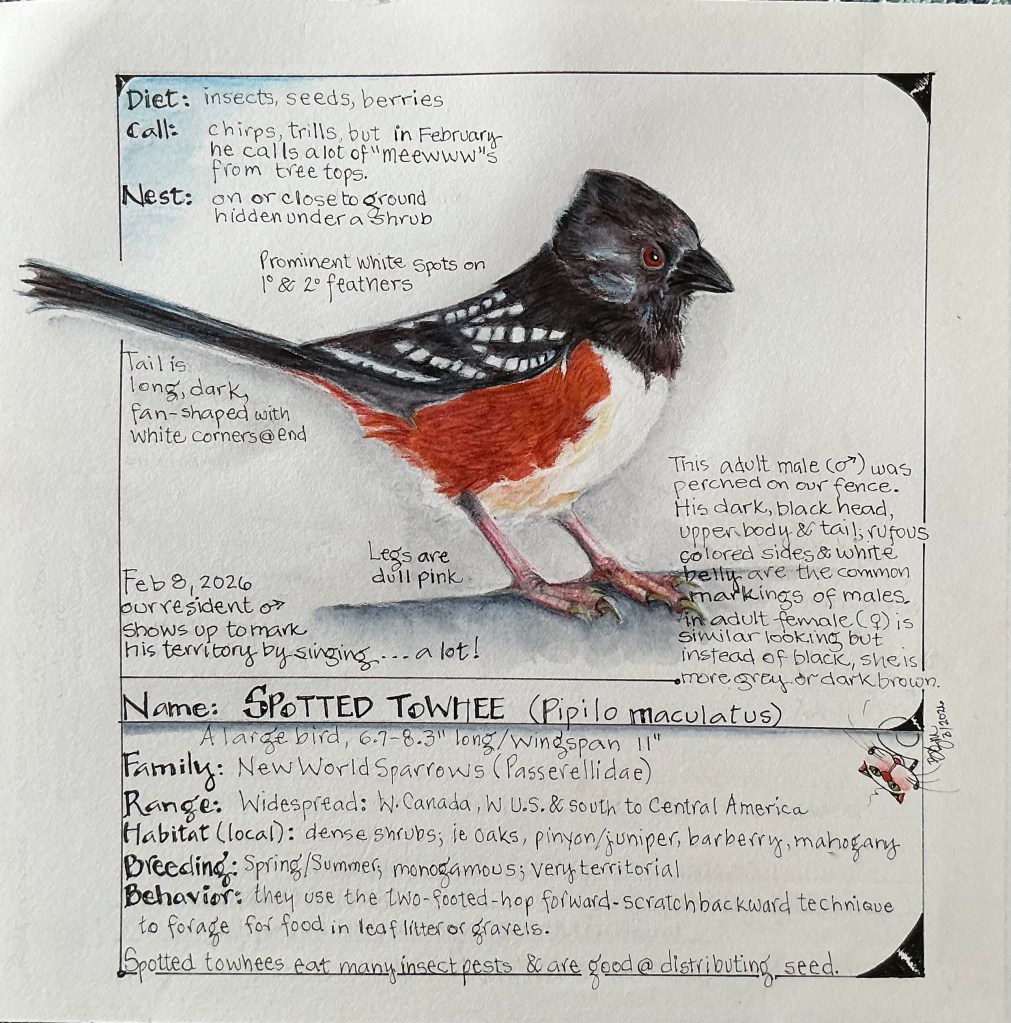
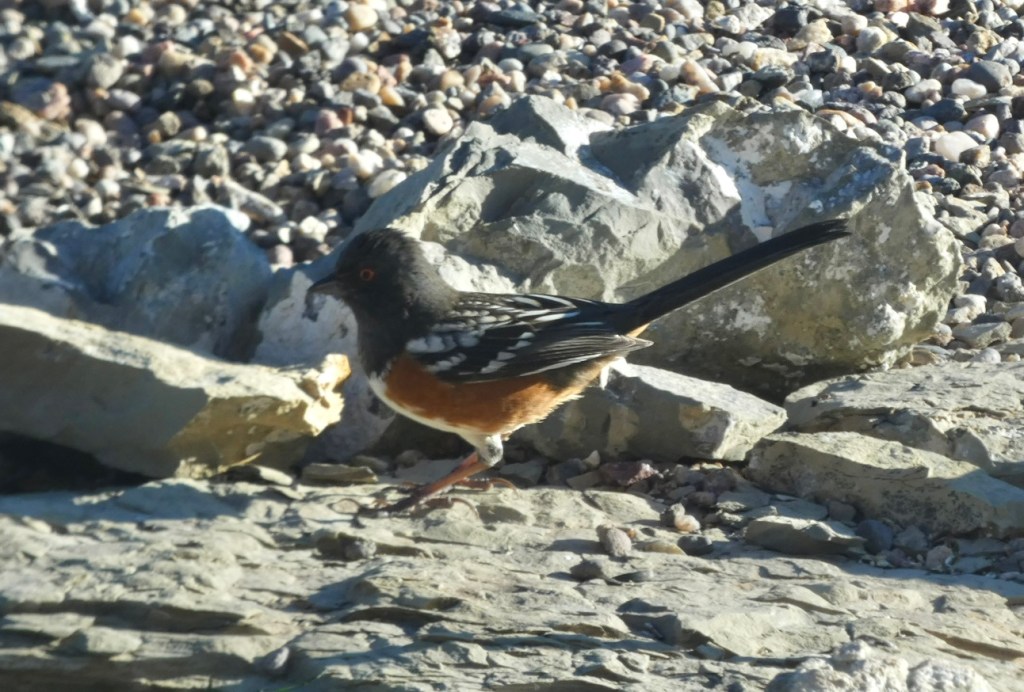
Here’s one of my favorite birds that’s a regular visitor to our yard. Spotted towhees, especially the males, are year-round residents throughout most of New Mexico, which means they breed in the shrubby vegetation surrounding our home. In our area, males sing at the crack of dawn until late afternoon beginning in early February. Instantly recognizable, their beautiful songs carry far and wide. Their songs not only signal to their mate it’s time to pair up again (spotted towhees are monogamous), they also let other male competitors know they’re horning in on his territory.

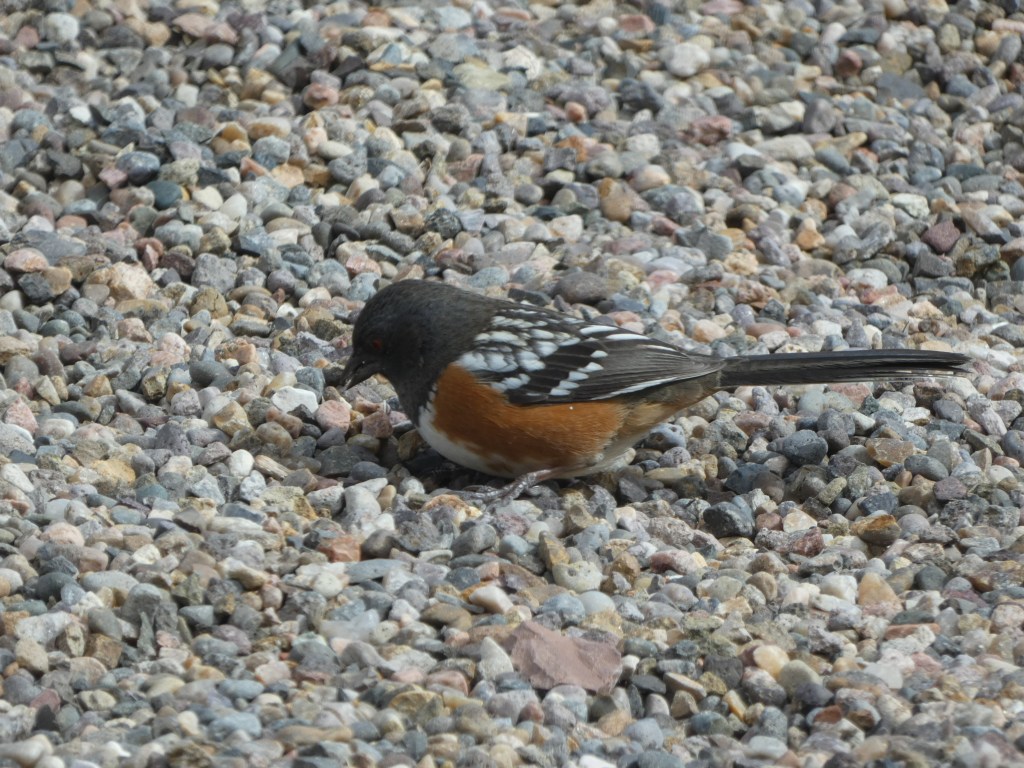
With favorable weather and abundant food, spotted towhees can produce two clutches of chicks during the breeding season. Their ground nests are hidden so well under a dense oak that I’ve never been able to find one. But it’s a lot of fun to watch clumsy fledglings trying to master the “two-footed-hop-forward-scratch-backward” forging technique all spotted towhees use to uncover hidden bugs and seeds.

Fun Facts

  • The spotted towhee and the eastern towhee were considered to be the same species called the rufous-sided towhee until 1995.
  • Male towhees have been recorded spending 70% to 90% of their mornings singing during breeding season.
  • Once a male mates, he only spends about 5% of his time singing.
  • It’s thought that the spotted towhee’s white spots are a form of camouflage.
  • Spotted towhees will sun themselves by lying on the ground feathers spread.
  • They will bathe in the dew or fog that has collected on vegetation.
  • Nesting females have been seen running away when disturbed rather than flying.
  • A group of towhees is called a “tangle” or a “teapot.”
  • When two towhees fight, one bird will pick up a piece of twig and carry it around as a sign of submission. 
  • Their bright red eyes act as a visual signal during the breeding season, standing out in their dark, shady, ground-level habitats.

Do spotted, canyon, green, eastern or any of the towhee species visit your yard? 

Hope you enjoyed this post! Thanks for stopping by!

References

audubon.org

inaturalist.org/taxa

allaboutbirds.org

explorer.natureserve.org

https://peecnature.org/learn/nature-guides/featured-critters/spotted-towhee/

Under Siege! 

A Battle of Wits

Conflict of Interest

November 24, 2025

Were you ever so challenged by something so clever, while at the same time so frustrated with something so beautiful? No, no, wait….. that question may be more complicated than need be. Let me put it this way …… 

Were you ever at your wit’s end finding a solution to a seemingly simple problem that you thought was obviously and repeatedly staring you right in the face?

My reply? Yes!

It’s All About the Genes

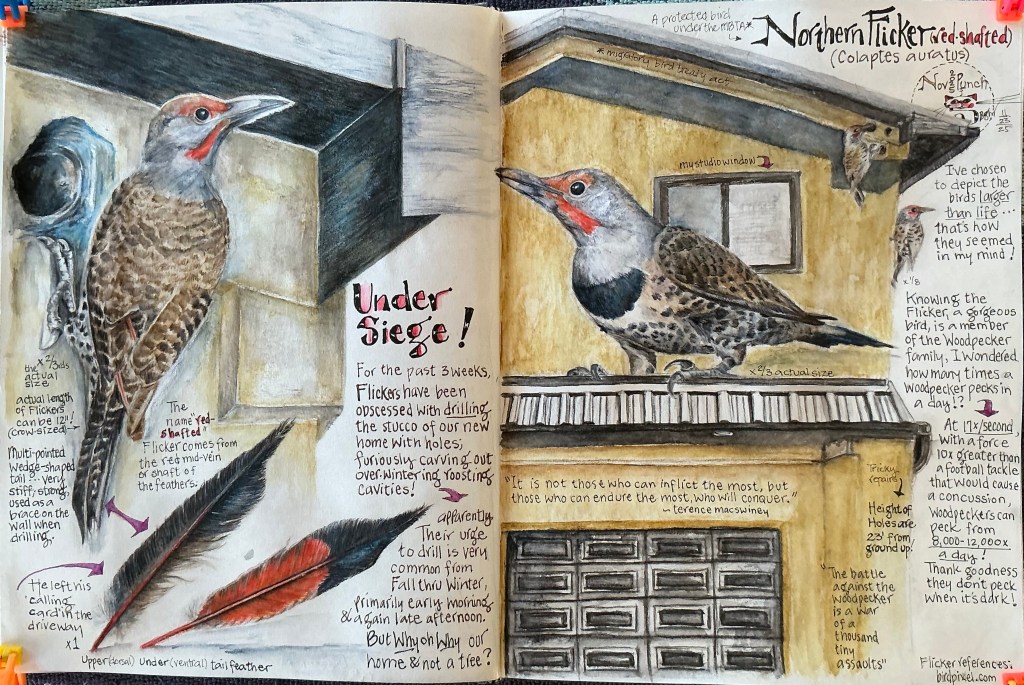
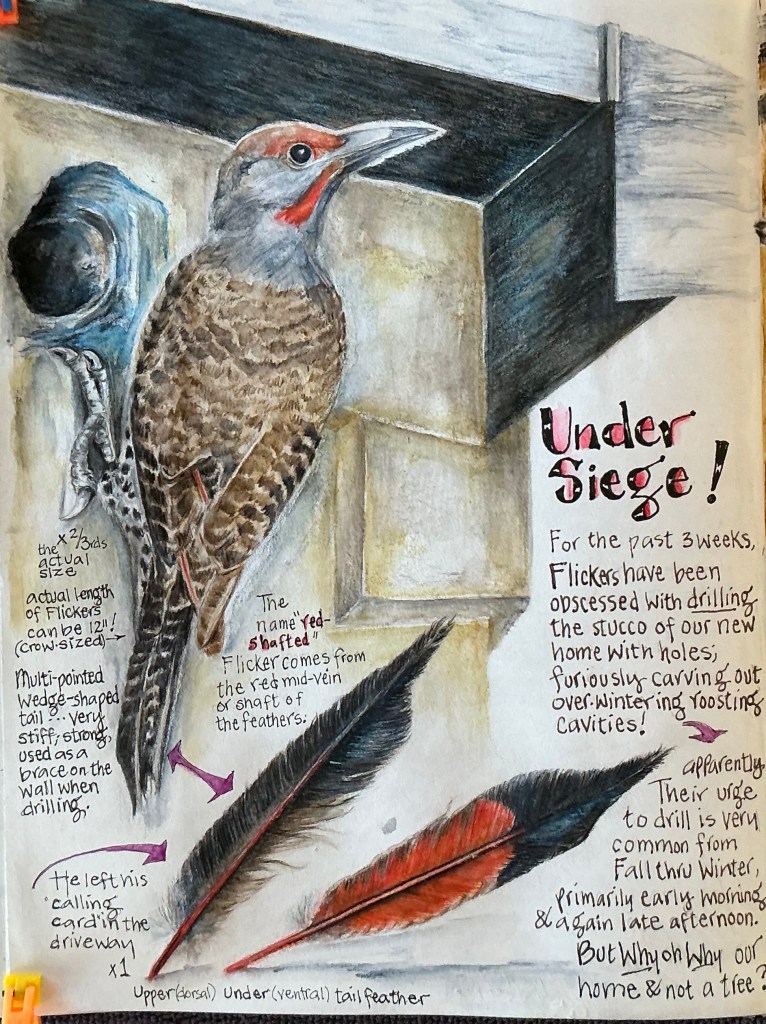
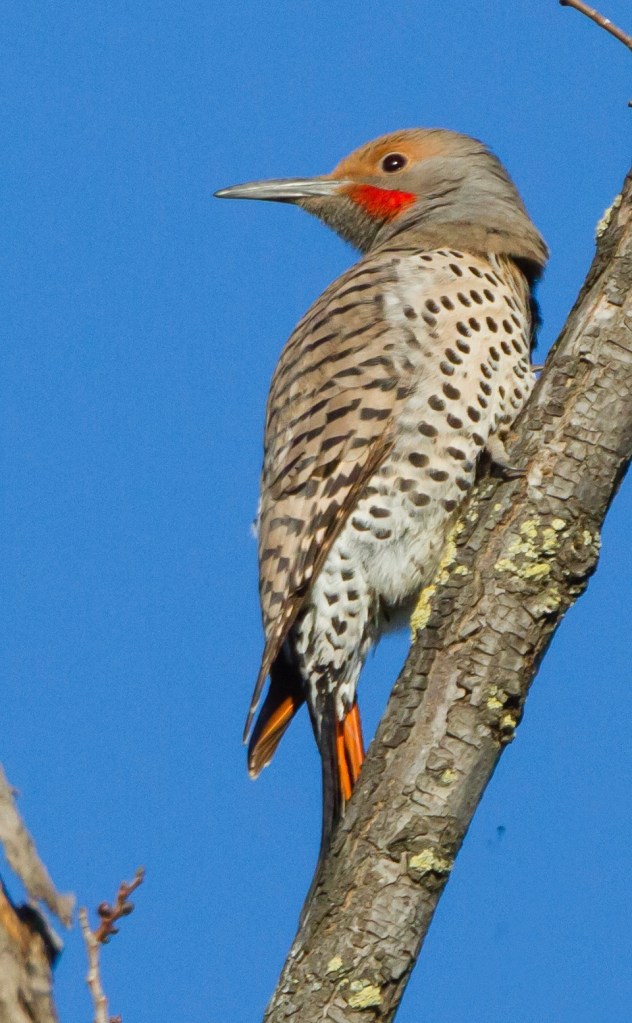
Meet the Northern Flicker (Colaptes auratus) … or more specifically, the Western red-shafted flicker (C. auratus ssp. cafer)*, a gorgeously flamboyant and noisy member of the Woodpecker family, that’s common throughout its western range.**  And as woodpeckers do so well, they peck and peck and hammer and drill with the determination and force of a jackhammer*** on nearly any vertical (preferably wooden) surface. They’re single-minded, from start to finish, when it comes to creating a cozy nesting or roosting cavity, whether in a tree trunk or into your home.  (More about that in a bit.)

Flicker ID – 101

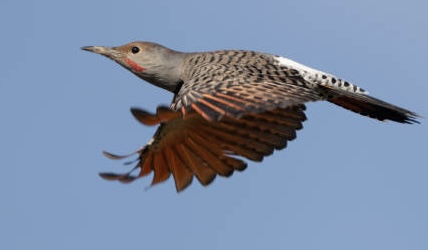
How do you know a Flicker has laid claim to your place? Well, he’s a big, heavy-bodied bird, and when flying overhead, your first thought might be “Crow!” At 12-14” long, with a wingspan of 18”-21”, the size is right. But as he flashes a large showy white rump patch bookended by reddish-orange underwings, you realize he’s not black. Anything but! As his flight slows and dips you notice his brown back is marked with narrow black bars. In preparation for landing, with wings open wide, he vertically aligns his body and feet with the wall, exposing a pale gray belly with bold black spots and a chest-wide black patch. Two strong clawed-toes up, two down (zygodactyl), and a stiff wedge-shaped tail adjusted as a brace, he taps out a few test spots, drawing your attention to his long and heavy bill, on a slate gray head broken by a buff-brown crown, a bright red whisker (male), and light gray cheeks. 

Male Western red-shafted flicker in flight. Note white rump patch (unsplash.com)

On a crisp cool Autumn morning, as you watch in horror …… 

Before you can declare, “It’s a Male Flicker!” ……

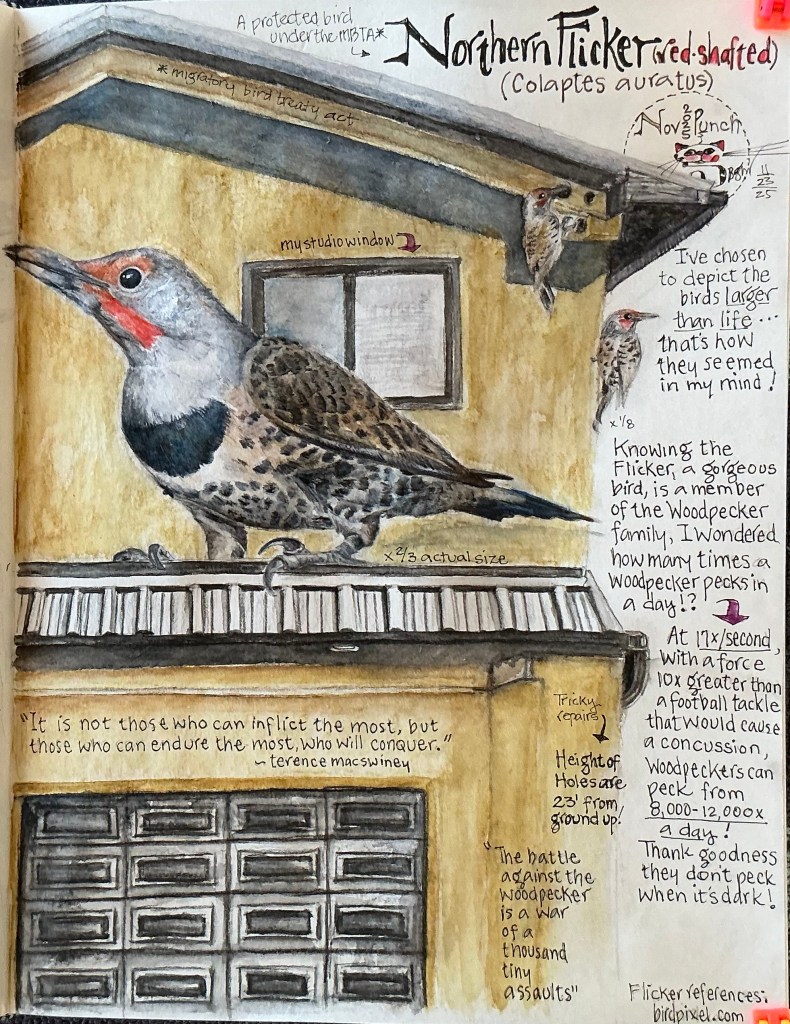
This bigger-than-life bird has landed, tested, and pecked away at his chosen spot  170 times in 10 seconds! He’s created an entry hole about 3” wide, right through the stucco and foam sub layer. This determined Flicker knows winter is coming and he intends to drill into our home, making a cozy roosting cavity in which to hunker down until Spring!  

Oh no, No, NO!

We love Flickers and have no wish to harm this beautiful bird.**** But he’s already caused enough damage (23 feet high on the wall) that needs immediate repair. So I clap my hands and holler loudly (something unintelligible), and off he flys to a nearby snag to see how serious my noise-making was.

That’s the story of Flicker hole #1 

Oh Not Again, and Again, and Again!

Since early November, our resident Flicker (I call him Jack), has continued to return many times, usually between sunrise and 10am. Sometimes he’ll make a fly-by before sunset. Often his quiet arrival escapes our notice; either we’ve been running errands, we’re out hiking with Luna, or enjoying a short roadtrip. These are the times he’s been able to drill six 3”-wide holes on the initial wall, and another 3”x6” hole just around the corner which was so deep, he almost penetrated the interior of Roy’s woodshop! This gives a whole new meaning to the term “Airbnb!”

After a few weeks up and down our fully-extended extension ladder to make a 2-step/2-day repair job/hole, we were making ZERO headway. Jack, unable to resist the need to drill him a roost cavity, was always one hole ahead of us. And because he didn’t hesitate to redrill newly repaired holes, was there something we were doing wrong?

All Flicker painting are larger than life, because that’s how they seemed to me!

It’s an Education in Biology and Patience

So we learned to listen for his noisy “kerrreee” scream-like call announcing his presence from one of Jack’s many favored perches around the house. Unless we missed it, his territorial call would put us on high alert, ready for action. We also listened for his series of warm-up test pecks that usually sounded inside the house. This “alarm” would catapult one or both of us from a comfy chair and run outside yelling and clapping our hands. 

Between listening, running, clapping and yelling (and wondering what the neighbors might be thinking), I discovered a few interesting things on-line…..

  1. Woodpeckers can’t resist drilling holes in synthetic stucco. This product provides the perfect surface for woodpeckers to hammer. When they begin tap pecking, it creates a hollow sound because the synthetic stucco includes a foam layer. The woodpeckers peck through the hard outer surface into the foam where it is easier to create a larger cavity to nest. 

#1 …. Our entire home happens to be covered with synthetic stucco! While this might explain Jack’s insatiable desire to drill his roosting cavity into our home and not into one of the surrounding hardwood piñon pines, we’re not going to replace  the stucco. 

  1. Basil, mint, cinnamon and/or lavender are suggested as natural, non-toxic deterrents for woodpeckers, who dislike strong aromas. The scent of basil, in particular, can be overwhelming and confusing to woodpeckers. Crushing one or a mix of these herbs with adding a bit of water, creates a green slurry that can be filtered and applied with a spray bottle to the affected area(s).

#2 …. This idea was worth a try, especially since there’s still have basil and mint growing in the garden. After collecting several handfuls of each, I popped the mix into the food processor with a bit of water and flipped the on switch. Gathering the resulting slurry, I filtered it through paper towels and collected the liquid for a spray bottle. That was several weeks ago, and with every hole repair, Roy’s been thoroughly soaking first the patch job then follow-up stucco coating with the basil/mint spray. It’s hard to know if it’s actually working, but the initial drilling sites haven’t been redrilled in the past week. It could also be that Jack is gone; pushed out with one of our heavy rainstorms.  Or he’s begun drilling more recent holes over the RV garage door. With each repair, Roy continues to spray the basil/mint mix.

  1. The Federal Migratory Bird Treaty Act*** provides protection for Flickers (and all woodpeckers), making it illegal to harm or kill them. But when warranted, migratory birds can be killed under a depredation permit issued by the Law Enforcement Division of the USDI-Fish and Wildlife Service (USFWS). Authorization by the relevant state wildlife agency also may be required before lethal control methods are initiated. Sound justification must be present for the issuance of depredation permits.

#3 …. Applying for a depredation permit may be our last resort, if Jack and his cohorts threaten to turn our brand new home into Swiss cheese. 

AGAIN!

That’s the story, almost. This clear Conflict of Interest; an obvious Battle of Wits, continues. Just yesterday, one of the holes Roy patched above the RV garage door was redrilled this morning!

Oh Good Grief!

 It’s already been repatched and resprayed, and while writing this story in my studio with window cracked and a clear view of the patched hole, I’m sure to hear and see that gorgeously determined Flicker if he returns to jackhammer away, once again, into a side of our home!

I’d love to know if you or anyone you know has a proven solution to this natural dilemma. Meanwhile ….. 

Thanks for stopping by, and Happy Thanksgiving!

……………………………………………………………………………………………………………

*Northern Flickers are divided into 2 subspecies, the Western red-shafted flicker (C. auratus ssp. cafer) and the Eastern yellow-shafted Flicker (C. auratus ssp. auratus). The red-shafted subspecies is found throughout Mexico, western and west-central U.S. (where it is common all year long), and British Columbia, Canada. The closely related yellow-shafted subspecies, which is highly migratory, is found in eastern and east-central U.S., the Canadian provinces and Territories (except B.C.), and far north into AK. 

**Where the range for both subspecies overlaps (in the ‘lower 48’), a lot of hybridization occurs. It’s common to see a red-shafted flicker with more orange feather shafts and/or shades of yellow-orange on the underside of their flight feathers. The same holds true for the yellow-shafted hybrid. Otherwise, appearances differ notably between both subspecies of the Northern Flicker, primarily where the malar (mustache), nape pattern (back of the head below the crown), face color, and tail and flight feathers are concerned. See the table below for non-hybrid subspecies characteristics. For hybrids, any color and pattern variation(s) and combination(s) you can imagine have probably been found! 

Northern Flicker subspeciesRed-shafted Yellow-shafted
Face colorGrayBuffy to warm, light brown
Malar colorMale: red Female: brownMale: black Female: brown
Nape color & patternGray, unpatternedMale: Red crescent on gray Female: gray, unpatterned
Feather shaft/under flight feathersPinkish to reddish to redYellow

***A woodpecker can peck wood 17x/second, and from 8,000-12,000x/day! Really! And they can drill into wood at a force 10x greater than a football tackle that would cause a concussion. On the November 17, 2025 episode of the Science Friday (SciFri) podcast, biologist Nick Antonson stated that woodpeckers can peck 20-30x their body weight. Now that’s amazing for a Flicker that weighs about 6 ounces! 

****Because we had no desire to harm the Flicker(s) drilling into our new home, even when we reached our point of extreme frustration, we wanted to ensure our deterrent efforts aligned with wildlife regulations; especially with the Federal Migratory Bird Treaty Act (Act). Flickers (and all woodpeckers) are considered a migratory non-game bird species, and protected under the Act. It’s illegal, punishable by fine and/or imprisonment, to harm or kill them. 

Male Western red-shafted woodpecker with his tail braced against the branch(bird pixels.com)

EggTober 2025/Submission Two ….. Days 9 – 16

October 16, 2025

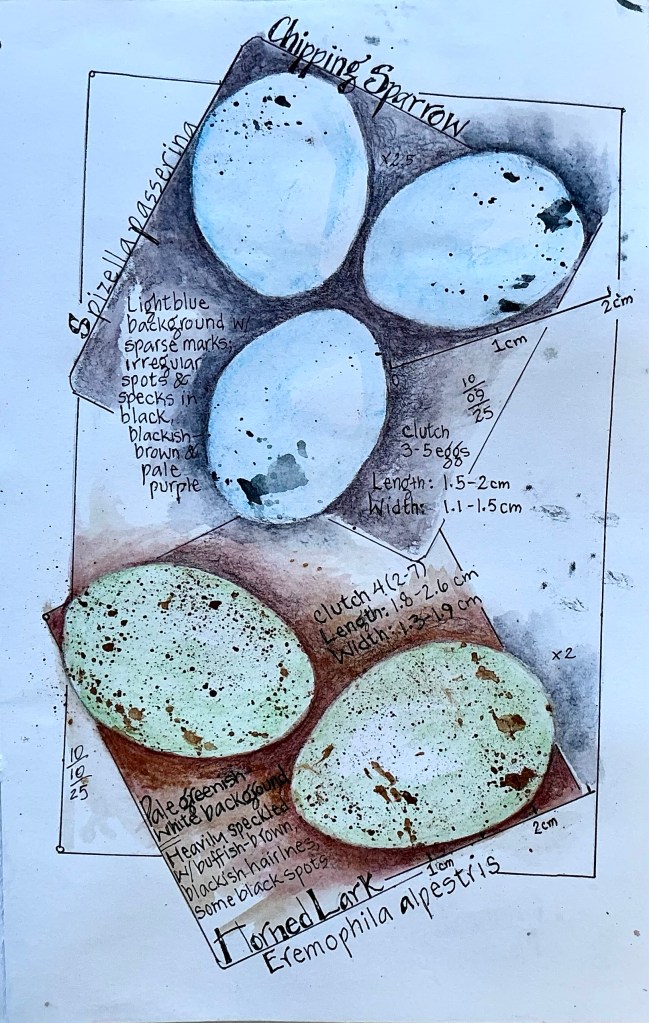
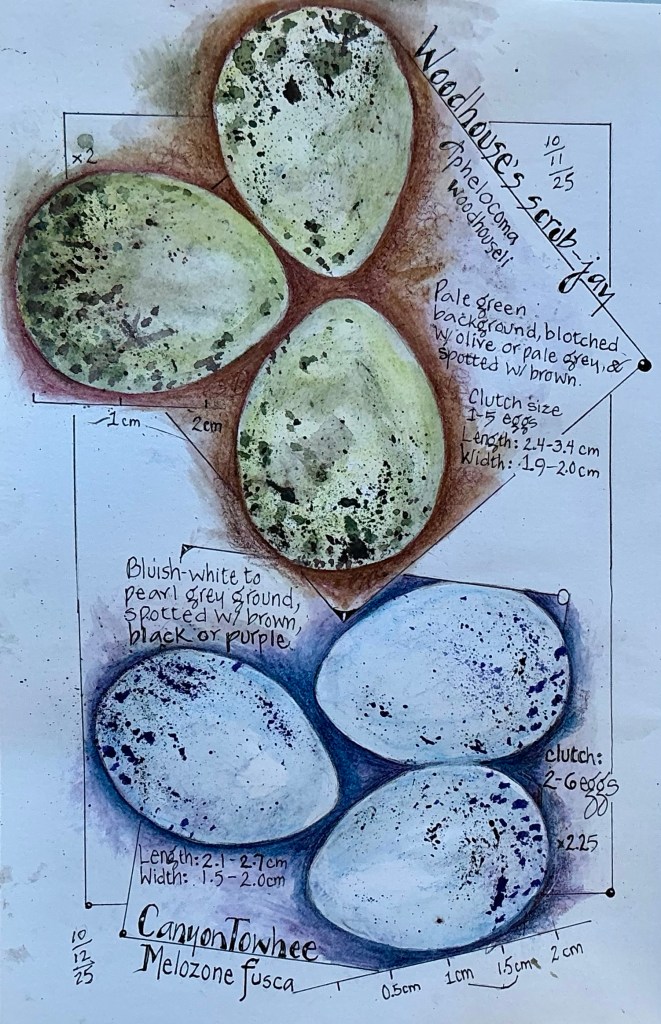
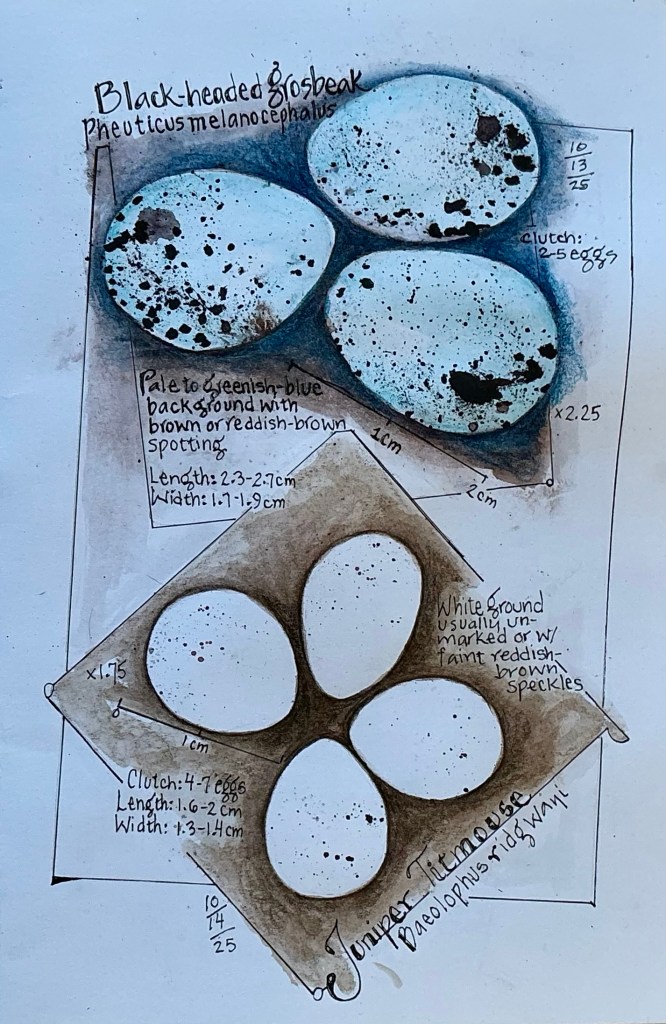
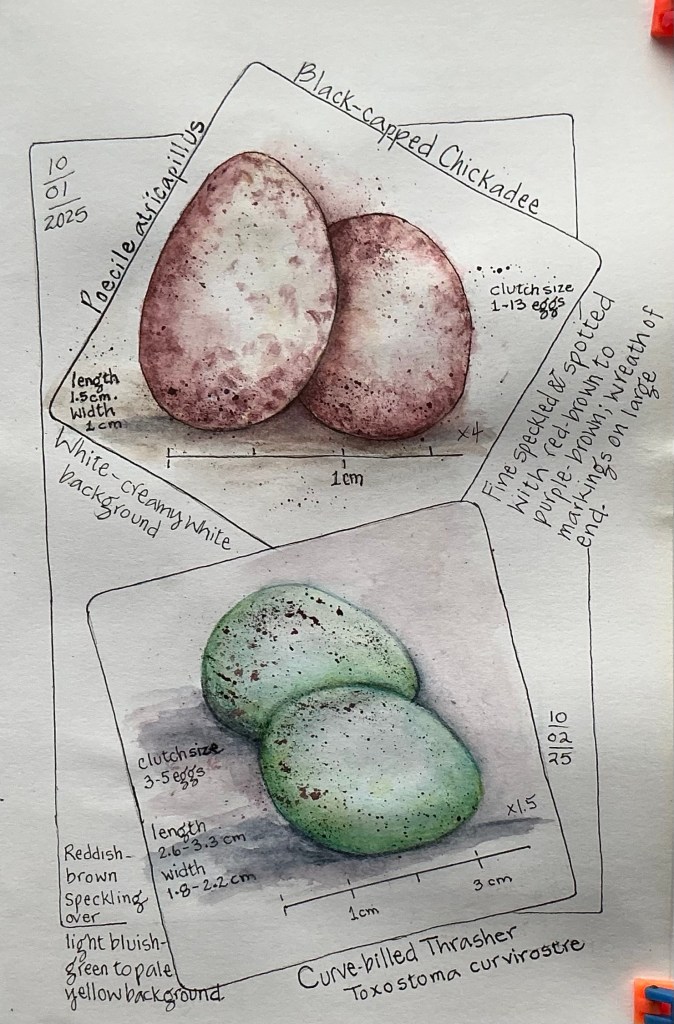
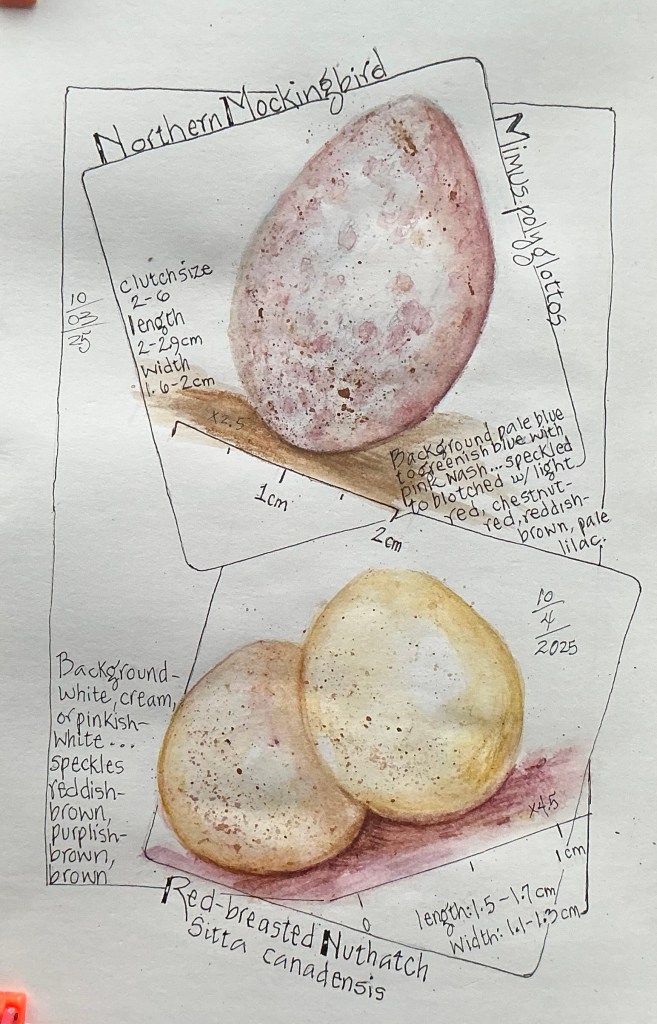
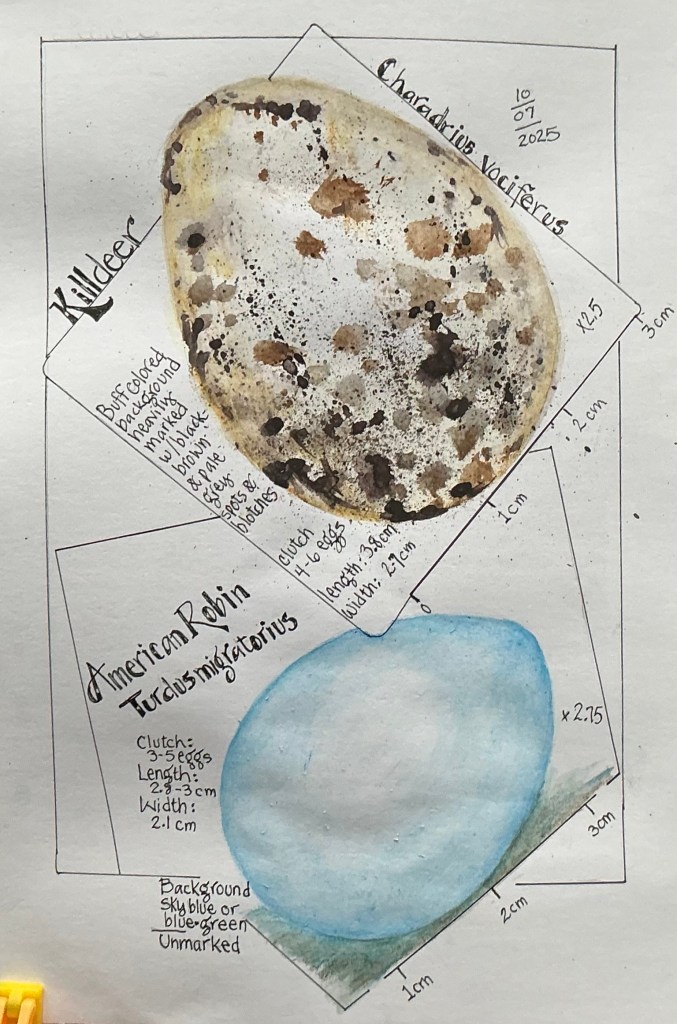
EggTober progress continued, with zeal, as I worked my way through week two. See for yourself! Check out the bird eggs that randomly popped up from my list of nesting birds of New Mexico. As with Submission One, included are a few fascinating facts about the shape of bird eggs to go along with week two birds. 

If you missed Submission One of my EggTober post and would like to catch up, click here.

Egg Shape

The typical oval-shaped bird egg isn’t coincidental. Evolution, influenced by factors such as bird genetics and environmental influences, produced a “smart egg;” a perfectly shaped package just right for survival …….. 

October 9th and 10th

1. Structural Strength

The oval shape provides greater strength and resilience, reducing the likelihood of breakage during incubation. It withstands external pressure more effectively, minimizing deformation or fractures in the developing embryo.

October 11th and 12th

2. Optimal Space

The oval shape maximizes the volume available for the embryo, ensuring proper development and sufficient reserves of nutrients, including proteins.

October 13th and 14th

3. Temperature Distribution

The oval shape promotes the even distribution of heat. When a female bird incubates the egg, her body heat is utilized to maintain warmth. The egg’s oval shape aids in evenly disseminating her body heat, ensuring a consistent temperature for the embryo throughout the incubation process.

October 15th and 16th

4. Prevents Rolling

The blunt, flat end of the oval egg shape helps prevent rolling within the nest. This stability safeguards the eggs, preventing them from accidentally falling from the nest or assuming an improper position.

Summary

While most bird eggs exhibit an oval shape, slight variations in shape do occur among different species. These variations are influenced by the birds’ lifestyles and specific incubation requirements. Overall, the oval shape plays a vital role in the reproductive ecology and physiological adaptations of birds.

Hope you have enjoyed Submission Two of EggTober! If so, please leave me a comment.  And as always, thanks for popping in! 

p.s. Stay tuned for Submission Three, landing in your in-basket next week!

EggTober 2025/Submission One ….. The First 8 Days 

October 8, 2025

Having participated in the Inktober for years by creating a daily drawing or painting throughout the month of October, I’ve found the challenge fun, rewarding, and motivating. However, rarely sticking to “ink only” creations and/or following the official prompts, I’ve shamelessly adopted a variety of approaches shared by others, have different media, or made up my own prompts. For me, this has added an elevated level of complexity that’s so appealing and somewhat wild!

In the past, my “Inktober” art has been about themes, like using a new Zentangle pattern a day that has a name beginning with “Q” or “Z” or “M” ……. or picking different botanical patterns. I’ve played with mixed media, watercolor, watercolor pencils, colored pencils, graphite, and (yes) ink to create a flower a day, rocks, mushrooms, candy, modes of transportation, the alphabet, fonts, portraits of famous people, etc. I’ve found the challenge is a great way to loosen up and try subjects I’m not comfortable or familiar with, while not worry about silly mistakes. 

So, each year I look forward to Inktober, and this year was no exception. 

This year I went way “out on a limb” and switched it up a bit.

This year I’ve named my personal 31-day challenge EggTober! And in keeping true with my love of nature, nature journaling and curiosity, each morning I’ll be randomly pick from a list of birds that nest in my home state of New Mexico and will draw one or several of of their eggs. 🥚 

Here’s my progress so far and a few fascinating facts about bird eggs.  At the end of my post, you can read about my process and materials used.  

Did you know that two pigments are responsible for most eggshell colors: biliverdins, which make blue-green hues; and, protoporphyrins, which make the background hues of rusty yellows, reds and browns.  

Eggshells that have markings like spots, blotches, speckles, or lines, have more protoporphyrins. These markings help camouflage eggs, especially those laid by ground-nesting birds.

The largest known bird egg belonged to the extinct elephant bird. This flightless bird, which stood about 10 feet (3 meters) tall and lived in Madagascar until the 18th century, laid eggs about 11 inches (28 centimeters) long. That’s about the size of an American football!

Bird eggs can be oval, to round, to pear-shaped, depending on the species of bird laying the eggs and where. Many sea birds nesting on cliffs tend to lay more pear-shaped eggs which helps keep them from rolling off steep ledges. It’s said that pushing one of those eggs, because it’s so heavy at one end, will cause it to spin in a circle.

Eggshells are largely made of calcium carbonate, and if hatched without their final ‘spray-paint’ of color, will look pure white to the human eye.  But some white eggshells contain ultraviolet colors visible to birds. (Wonder why?)

Process and Materials

Of course, given that it’s Autumn, and impossible to find any active bird nests housing unhatched eggs, I’ve formulated Plan B. For my references I’ll be relying on digital natural history museum egg collections, on-line bird identification resources, fascinating facts about bird eggs, several key references from my personal library, and other sources, to learn and satisfy my long held love of birds, their incredible eggs, and the egg-laying process. 
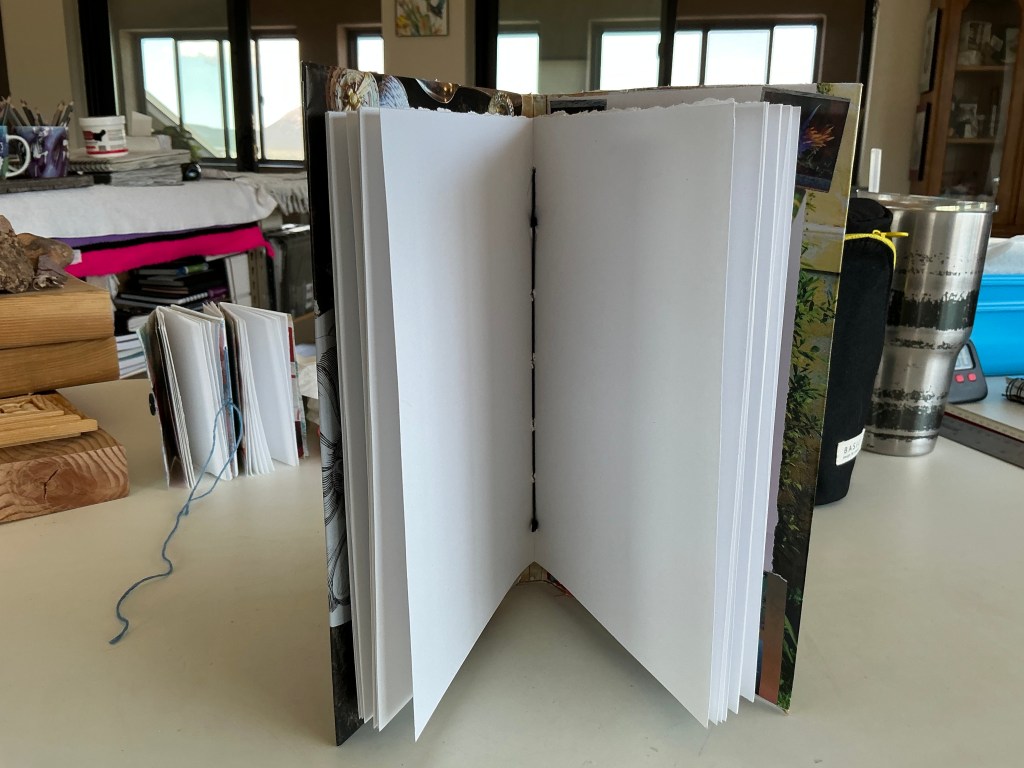
Staying as true to real life as possible, approximate egg shapes will be colored with Derwent Inktense watercolor pencils. For consistency, basic information specific to each individual bird species’ typical egg (clutch size, length and width, background (ground) color(s) and marking color(s) and patterns) will be included. For future reference, I’ve handmade a small booklet that will hold two species’ eggs/page. At the end of October, I’ll then add a title page, table of contents, and a list of references.  

And finally, for now, it’s entirely possible that my process and materials may be changed on a whim! So stay tuned as EggTober unfurls!

If you are an Inktober participant, or have never heard of this month-long creative event, please let me know!

As always, thanks for stopping by!

Shifts in Nature 

August Littles ….. 2025

September 8, 2025

Ohhhhhh, what a sweet month …… August. It almost got away from me without sharing a small collection of Littles1 that reflect the inevitable shifts in nature that occur during the month. It’s always hard to imagine summer winding down; where did the time go?  But as surely as butter melts on freshly baked bread, undeniably, August forms a reliable bridge between summer and autumn. It’s a time of change and transition; abundance and harvest; transformation and a period of letting go. 

So before I “let go” and before the snow flies (and it will), here’s a handful of little discoveries during the month of August:

-A female Wheel Bug gone slightly astray while searching for a protected place to overwinter the eggs she’s about to lay. 

-A female Soldier Beetle doing her best to attract a mate by sending out pheromones while munching late season pollen from the disk flowers of a brilliant yellow Showy Goldeneye. 

-An acorn that made it to maturity, ready to drop beneath a still green-leaved Gambel Oak soon to be decked out in radiant fall colors. 

-Some hot red trumpet-shaped Scarlet Gilia flowers, still irresistible to hummingbirds until migration, will all be pollinated in time for seed set and mature. 

-The snowy white fruit dangling from the draping branches of Roundleaf Snowberry shrubs are ripe and ready for plucking by hungry birds flying south for the winter. 

-And plump purple-black Chokecherry berries that will become a juicy dietary supplement for black bears needing to bulk up for hibernation.

Enjoy!

And as always, thanks for dropping by!

1Littles” is part of a blog series I began posting several years ago, beginning in January 2023. The concept was inspired by Fay (thanks again Fay!) who came up with the idea for her blog madebyfay.wordpress.com

If you’d like to read more of an explanation, check out my January 2023 post, Winter Birding on Sedillo Hill

Sketchbook Revival 2025 ….. Binge Fest Extravaganza!

June 16, 2025

What a whirlwind celebration! Sketchbook Revival (SR) 2025 Binge Fest was so much fun. And Wow! Two jam packed weeks of creativity was over in the blink of an eye! 

Karen Abend, SR creator, host extraordinaire, and wonderful artist, came up with a brilliant idea for the SR 2025 session. I would swear the creative gears inside her head were spinning with delight as she declared, “Yureka! I’ve got it!”

Beginning on May 27th thru June 9th, Karen generously opened up the SR historic vault and set free all of the workshops conducted the first 5 years of SR (2018-2022)! That unbelievable offering came to more than 130 one-hour-long workshops of inspiring, hands-on, and creative  play time all instructed by well-known experts in artistic fields associated with Sketchbook Journaling.  

Challenge presented ……. Challenge accepted.

Since I’ve been participating in SR each year since 2018, and attended most of these workshops in the past, my goals and strategies to tackle the challenge were these: 

  1. Complete a minimum of 4 workshops daily;
  2. Two workshops should involve a project outside of my comfort zone, such as portrait drawing, fantasy, word play, collage, and properly stitching my own SR sketchbook so it wouldn’t fall apart during the 2-week challenge, etc.;
  3. Two workshops should involve projects within my comfort zone, such nature subjects, urban sketching, whimsey, and lettering, and those using watercolor pencils, graphite, and ink;
  4. Develop fresh, interesting, and imaginative sketches during the workshops;
  5. Allow Flambé to play along;
  6. Slow down, breathe, and enjoy the 2-week marathon without becoming overwhelmed;
  7. Recognize and gather take-away tips and techniques to bring into my Nature Journaling practice and Zentangle storytelling. 
  8. Keep sketching and sharing.

After two weeks of play, I was able to fill up my handmade and successfully stitched SR 2025 sketchbook! With a total of 46 pages completed (doubling up workshop projects on a handful of pages), including several pockets with inserts, I was pretty happy (and a bit exhausted). 

If you’ve participated in SR in the past, or maybe took on the 2025 challenge as your first time, you know how intense (in an exhilarating way) it can become.   If not, and would like to learn more, check out this link 

This link will take you to Karen Abend’s website where you can ask for more information about Sketchbook Revival. https://karenabend.com

Hope my collection made you smile and laugh! I certainly got a kick out of the experience.

Well, until Sketchbook Revival next year, thanks for coming along! 

Always Remember to Explore the Cracks!

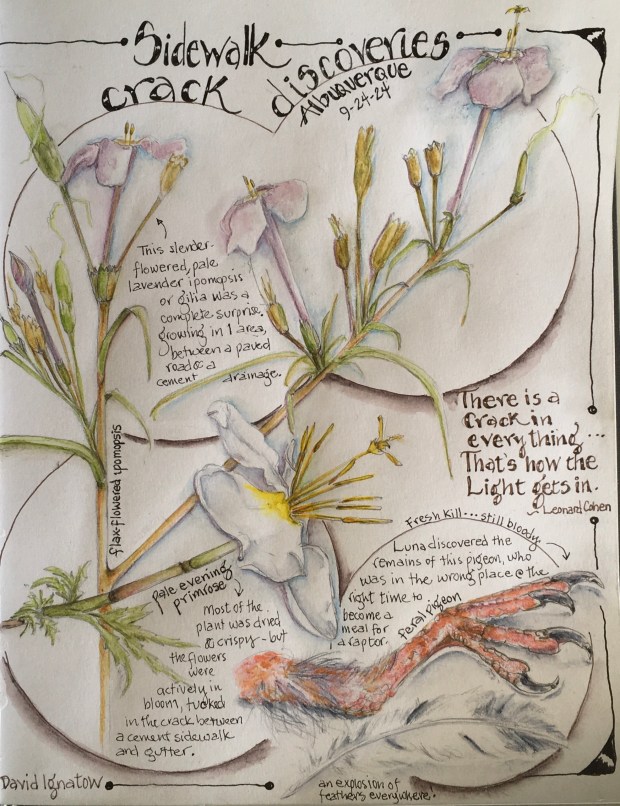
Sidewalk Crack Discoveries

October 12, 2024

Roy had a doctor’s appointment one morning in late September, at an office right off busy I-25, near the ABQ airport. Instead of hanging out in the sterile waiting room, Luna and I spent our time exploring the areas surrounding the office, just to see if there was anything worth observing.

For 2 miles, we wandered about the not quite urban/suburban/industrial/residential neighborhood ….. me looking for a sketchbook entry; Luna sniffing out messages left just for her by visiting dogs, squirrels, or bunnies. 

Interesting discoveries seemed lacking, until Luna caught whiff of something irresistible. Tugging hard on her end of the leash, she urged me to run with her as she zeroed in on the source of the smell. 

By a parking lot light, on the pavement next to a cement curb was an explosion of feathers, but Luna kept leading me on to something better.  There! Lying on the curb was a still wet and bloody bird foot barely connected to what remained of the thigh. All clues pointed to the very recent drama, where a raptor (possibly a red-tailed hawk) had swooped in and nabbed the hapless victim (a feral pigeon), killed and then ate his prey from the platform atop the parking lot light. The inedible remains fell to the ground as a group of 2 dozen “relieved-it-wasn’t-me” pigeon friends looked on.

Quickly solving most of this puzzle in the time it took to pry the pigeon foot from Luna’s mouth, gave me the idea of sketching not only the foot, but to look for other unlikely nature discoveries in this urban/suburban/industrial/residential neighborhood setting. 

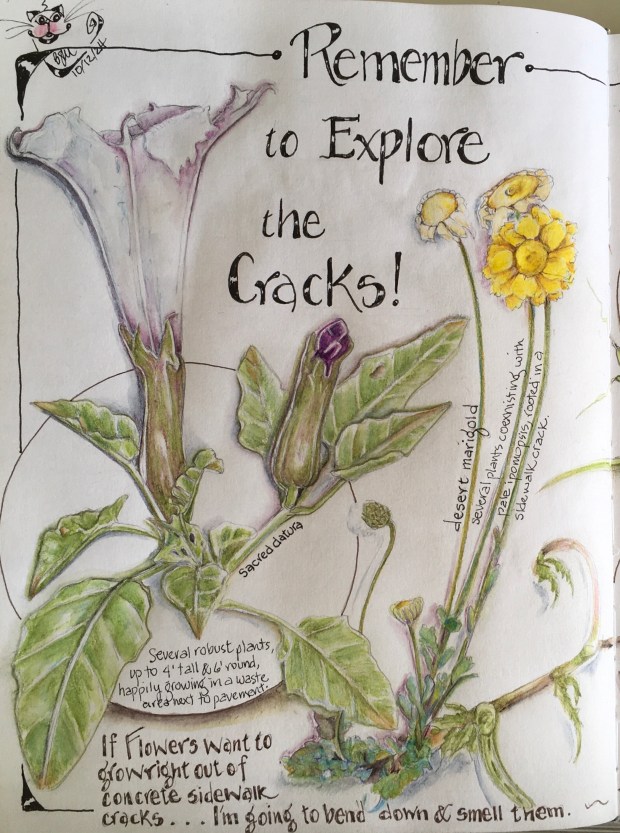
Mentally armed with a keener power of observation and purpose, we retraced our earlier route with excitement!  Now it was obvious an abundance of interesting and beautiful plants were growing from every sidewalk crack and along crumbled pavement edges throughout the ‘hood.  How had I missed seeing these beauties? 

And that’s how my idea for this 2-page layout was born, along with a reminder that finding bits of nature doesn’t have to occur at a botanical garden, wildlife preserve or national park. Nature is everywhere. If you just slow down and really look, even in the most unlikely places like sidewalk cracks, there’s always something to discover. So Remember to Explore the Cracks too and let me know what you find!

As always, thanks for stopping by!

Williamson’s Sapsucker …………. A Life-List Species!

March 19, 2024

There are a number of different woodpecker and closely related species (sapsuckers and flickers) that frequent our Piñon-Juniper woodlands in the East Mountains of central New Mexico. These include the downy, hairy, Lewis’s, red-naped, Northern flicker, and Williamson’s sapsucker. They are always such a joy to observe, unless they’re drilling a hole in the side of the house. Their stiff tails allow them to ‘walk’ up and down tree trunks and other vertical surfaces that house insects or exude sticky sap. Their sharp bills are ideal for creating nest holes and sapwells in tree trunks. Their sharp calls, drumming, and stiff-winged flight make them easy to recognize as a member of the woodpecker group of birds. 
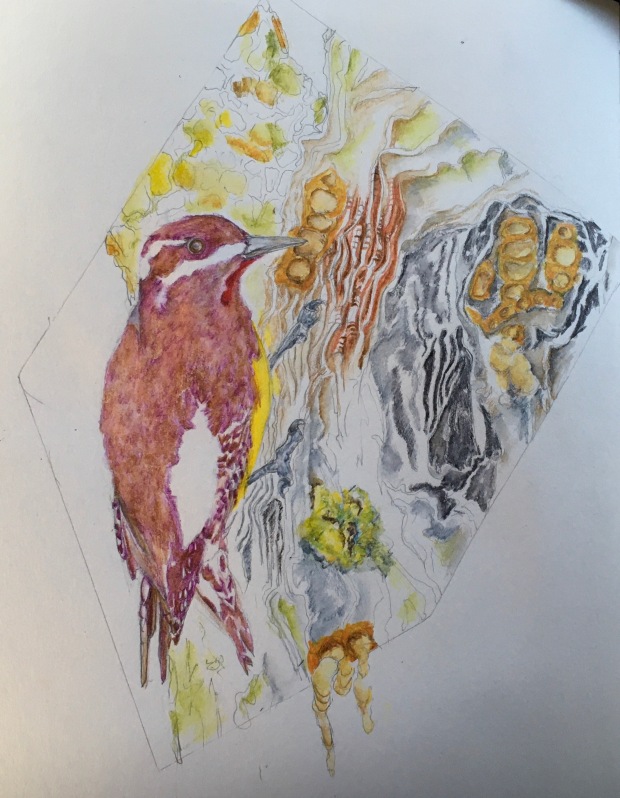
Until mid-March we’ve never seen a Williamson’s sapsucker. Then one morning Roy was trying to catch a glimpse of a strange woodpecker on one of our old growth piñon pines. Immediately recognizing the markings of this bird were unlike any we’ve seen before, he excitedly fetched me from my studio to have a look. 

Sure enough! Realizing this was likely a life list sighting for us both, the markings looked just like those illustrated in our numerous field guides. Indubitably, dear Watson! This was a Williamson’s Sapsucker (Sphyrapicus thyroideus) and he was treating us to a visit. We watched him (definitely a male, as females look completely different than the males, which is unusual for woodpecker species) working his way up and down the tree trunk. As he walked and hopped up and down the tree, he would circle the trunk and pause to lick up actively flowing tree sap from rows and rows of sapwells! Why had we never noticed so many sapwells on this tree before? 
Did this or other Williamson’s sapsuckers drill these shallow sapwells? Maybe another woodpecker species created them and the Williamson’s was stealing the nutritious sap? Are these new sapwells or have woodpeckers been drilling this tree for many years? Countless questions, but this handsome fellow wasn’t giving up his secrets. So we enjoyed his antics for about 30 minutes until he flew off, maybe to another piñon to lap its sap? 


The next day, as we were about to pull into the garage, we spotted the Williamson’s again …… again working the sapwells up and down the piñon tree. We sat in the car and watched him while mulling over new questions, like “isn’t this the same time he was here yesterday?” “Why yes!” We closely observed his feeding pattern, beginning at about 5 feet above the ground, walking and hopping up the tree while circling the trunk, and when he reached the needled branches about 25 feet high, he would make a diving flight back down to the 5 foot height and again work his way up. This went on repeatedly for about 5 times before he flew away. Hmmmm! Why did he stop when he did? Had he licked up all the available sap for the day, and had to wait until the sap began flowing again? (I showed up later to see if he returned ….. he didn’t. Maybe my timing was off? Maybe the sap flow still wasn’t worth his trip?).Day 3, and same time/same place. This hungry bird was back lapping sap! Same up and down behaviors; same departure time.

Day 3, and same time/same place. This hungry bird was back lapping sap! Same up and down behaviors; same departure time.

Day 4, ditto

Day 5, ditto

Day 6 ……. We arrived at the same mid-morning time, and waited. And waited. And waited. The Williamson’s sapsucker was a no show. And we haven’t seen him since.

Was he only migrating through, just long enough to stock up on high energy meals? Apparently this species is widespread and fairly common throughout the Rocky Mountain West, but their breeding range begins just north of us and extends into Canada. However, we are well within the Williamson’s sapsucker’s winter range. Hope he returns again next year! 

Meanwhile we’ll be watching that old growth piñon to see if the sapwells draw in other hungry birds!

Now, a few fun facts about the Williamson’s sapsucker and sapsuckers in general.

While the male Williamson’s sapsucker is silky black with a cherry-red throat, a brilliant lemon-yellow belly and bright white wing patches, the female looks totally different. This is very unusual for birds in the woodpecker group. The female has a mousy brown head, banded back and small patches of black and yellow on the belly.

  • The difference is so striking between the male and female, they were originally thought to be different species entirely. It wasn’t until 1873 that ornithologists realized they were the same species. Naturalist Henry Henshaw located a pair at their nest in Colorado and published his observations, thus putting an end to the confusion.

Sapsuckers get their name from their habit of drilling rows of shallow holes in tree bark. The birds come back to these holes to lick the sap that flows from these holes and to eat insects that have become caught in the sticky residue.

  • Early ornithologists in the West reported seeing Williamson’s Sapsuckers at sapwells in aspen trees; however, in the past 100 years, observers have seen their sapwells only in conifers, never in deciduous trees. The early reports might have been of Williamson’s stealing sap from wells made by Red-naped Sapsuckers.

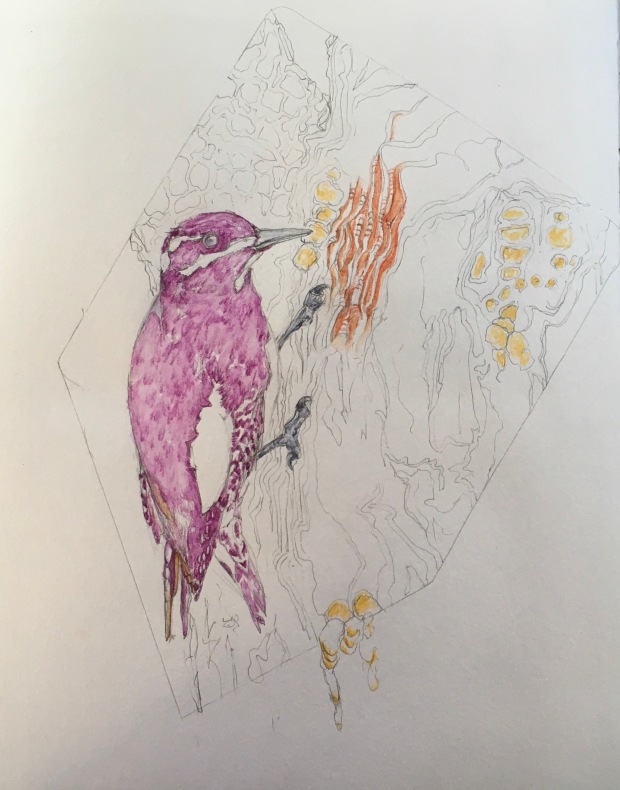
Here’s a few progress shots I remembered to capture while creating the Williamson’s clinging to the tree

Earliest coloring stages …. Laying down base colors to build up to the Williamson’s silky black back
Adding more base colors, sapwell and tree bark furrowing details
Close to final image. The black was achieved by using purples, browns, blues and greens to achieve the iridescence of his black coloring.