
June 14, 2025
What is all the buzzz today? Why it’s National Dragonfly Day!
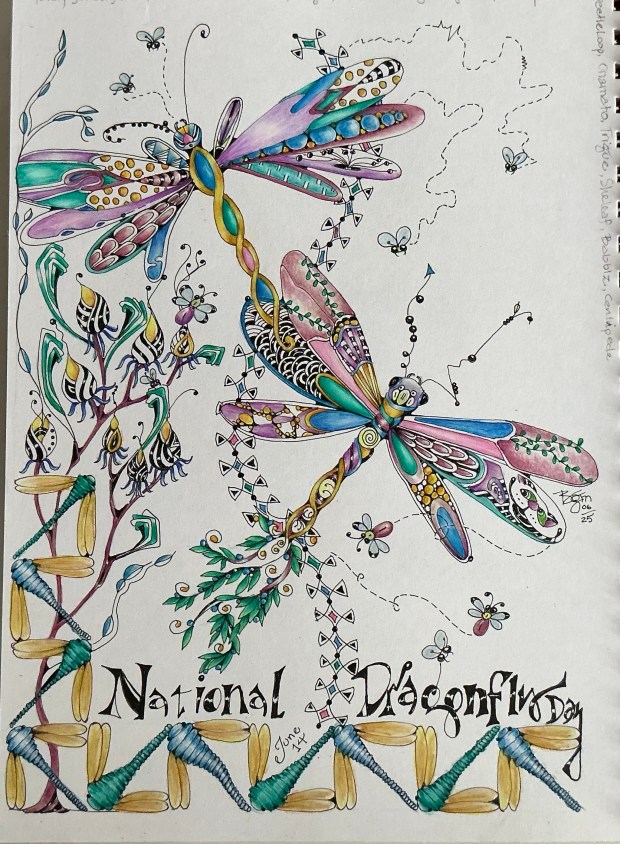
Always landing on the 2nd Saturday in June, the annual dragonfly celebration pays tribute to this fascinatingly unique and beautiful insect that’s been flying over our planet for nearly 300 million years. Wow!
There’s no mistaking the fossil record. Dragonflies have populated the airspace for nearly 300 million years, some with 3-foot wingspans. Paleontologists say they may have had 6-8 foot wingspans, making them the size of a bald eagle!
As scary as that may have looked to their prey, the 2-5 inch wingspans of modern dragonflies, combined with their body makeup, make these animals some of the most accurate and ravenous hunters known today.
It’s a warm summer day and the air above the wetlands is full of countless insects such as mosquitoes, true flies, mayflies, and midges. Perched motionless on a tall reed is a metallic colored dragonfly, and she’s hungry. To feed an insatiable appetite, she’s always on the hunt for her next meal. To satisfy her hunger, she has evolved into one of the most skilled predators in animal kingdom.
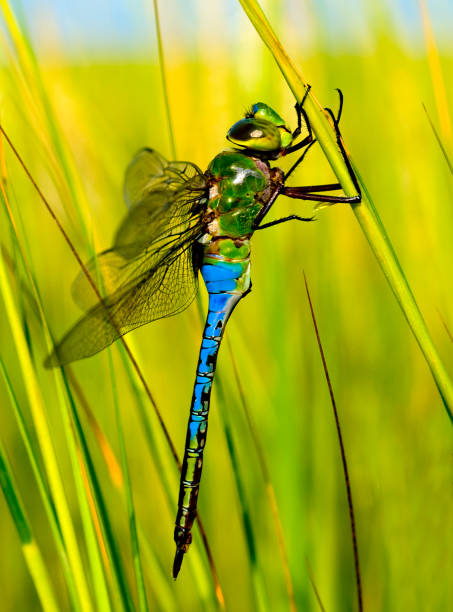
But are dragonflies really that good? And if so, why?
Consider the proverbial ‘King of the Jungle;’ lions are frequent hunters, but might be successful only 20% of the time. Birds of prey, like owls, falcons and hawks, average a 25% success rate. But dragonflies catch their prey 95% of the time! Now I’d call that amazing. Dragonflies owe their survival to two key characteristics:
- Eyes – in addition to three simple eyes, dragonflies (and bees) have two large compound eyes; the largest of any insect. With 30,000 facets per eye, both compound eyes together cover most of their head. This multifaceted eye makes a dragonfly acutely sensitive to movement. Because each of the 30,000 facets face a different direction, dragonflies have almost a 360 degree field of vision. This means they can see you from behind as they wing on by. ……. And speaking of wings! ………
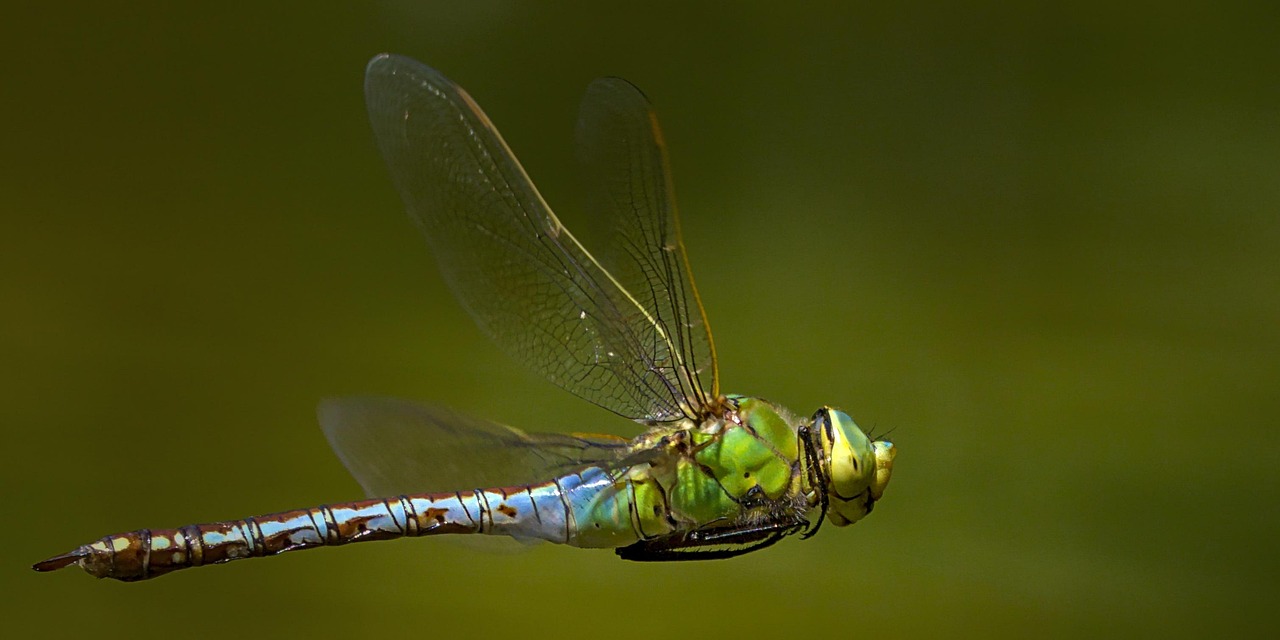
- Wings – When compared to all other insects, dragonflies are the most skilled, agile, and the fastest fliers of all insect species. With muscles attached directly to their wings, they not only can fly at speeds up to 35 mph, but are able to maneuver like a helicopter. They can fly straight up or down, forward or backward, side-to-side, upside down, and can even hover and pivot in place while keeping perfectly level. To understand how dragonflies achieve backward flight, high speed cameras revealed they angle their bodies vertically, at a 90-degree angle to the horizon. They’re also capable of independently moving and twisting each of their four wings to improve flight control.
Look! A Mosquito Hawk!
It’s been reported that one adult dragonfly can capture and eat from 30 to 100 mosquitos a day, earning them the name ‘’Mosquito Hawk.” Considered such prevalent mosquito predators when they are adults, a dragonfly nymph feasts on mosquito larvae too, devouring as many as 40 a day!

And How About these Dragonfly Fun Facts!
- A dragonfly is classified as an Odonata, which is the family of flying insects that includes dragonflies and damselflies. Odonata means “toothed one” in Greek. However, dragonflies don’t have teeth. The name refers to its serrated mandible, which comes in handy for holding and crushing prey.
- There are around 5,000 species of dragonflies around the world.
- Dragonflies can live for years underwater as predatory larvae (aka nymphs). At the end of its larval stage, the nymph crawls out of the water, its exoskeleton cracks open releasing its abdomen (which had been packed in like a telescope), then out come its four wings and its entire body dries and hardens over the next several hours.
- Most adult dragonflies live for only a few weeks, but some do live up to a year.
- Dragonflies can live in the winter but are normally small and stumpy in size.
- Dragonflies use both their feet and mandibles to catch their food.
- When dragonflies mate, the pair first forms a flying, loop-like structure known as a mating wheel or mating circle. Then the male grasps the female’s neck with claspers on his abdomen to transfer his sperm. Sometimes, he will continue to guard the female from other males until she lays eggs in the water. If a female doesn’t consent to mating, she might play dead. Or, she might wrestle away her suitor by twisting, shaking, flying backward or clinging to a reed to prevent takeoff. In some cases, the female might even take control of the flight, then dunk the male into a body of water, buying herself time to flee.
- Mysterious swarming behavior – sometimes 100’s of dragonflies of different species will gather in swarms, possibly to locate new and/or better habitat, for feeding, or migration. Not much is known about this short-lived behavior, but it is being studied by members of the Dragonfly Swarm Project. You can read more about the Swarm Project here: https://thedragonflywoman.com/dsp/ And you can report seeing a swarm through this website: https://thedragonflywoman.com/dsp/report/
- The Scarlet Dwarf is the smallest known dragonfly. Less than two centimeters long, it’s only 0.59 inches long (15 millimeters), and has a wingspan of about 0.79 inches (20 millimeters). These dragonflies are native to Southeast Asia, as well as China and Japan.
- Many species of dragonflies migrate annually. To track them, scientists attach tiny transmitters to their wings with a combination of eyelash adhesive and superglue. One of their findings revealed the two inch dragonfly called the globe skimmer has the longest migration of any insect — flying up to 11,000 miles across multiple generations between India and Africa. Aided by winds, the globe skimmers cross the Indian Ocean stopping at islands along the way. They have even been spotted at altitudes of around 20,000 feet in the Himalayas.
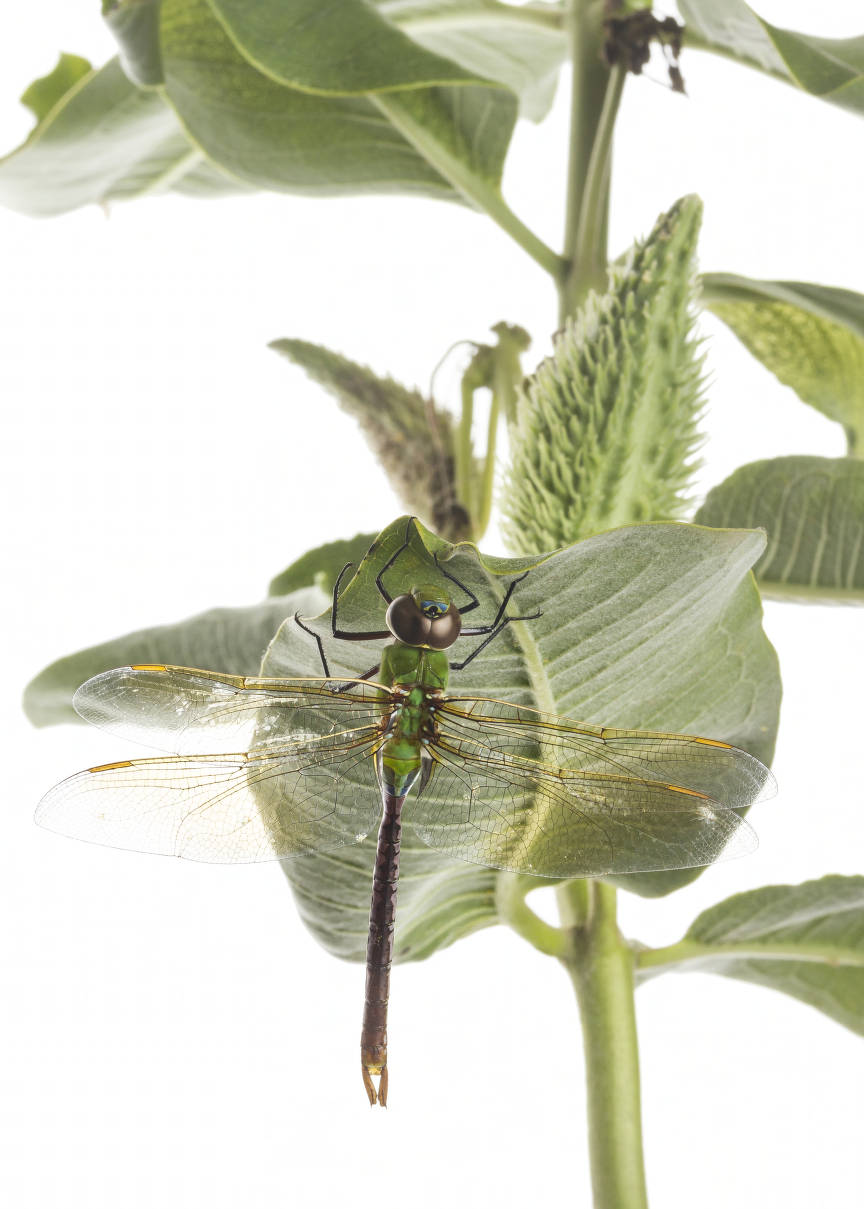
- Of the 445 kinds of dragonflies in North America, only 9 of these species (or 2%) migrate regularly. One of these species is called the green darner which migrates in swarms. They complete a multi-generational migration from Canada and the northern U.S. to the Gulf Coast and Mexico in late summer and fall, and then return again in the spring. By tracking the migration, it was found their journey covered over 800 miles one way. To accomplish this feat, they travel only every third day, averaging 7.5 miles per day.
- The International Union for Conservation of Nature (2021) found that 16 percent of the 6,016 species of dragonflies and damselflies that were studied are at risk of extinction as they lose the freshwater breeding grounds needed to maintain their populations. Clearing of forests in South and Southeast Asia as well as in Central and South America has driven habitat loss for the insects, and in North America and Europe, dragonflies are most threatened by pesticides and climate change.
The Good Luck Insect
Not surprisingly, the dragonfly has symbolic meaning in almost every part of the world. Many cultures believe this insect symbolizes good luck. Because dragonflies have such short lifespans, they also represent new beginnings and change, especially for strength, growth, courage, and happiness. A few ancient cultures say dreaming about a dragonfly indicates you are in a powerful transition in your life.
Here’s a Few of those Symbolic Dragonfly Beliefs. Do you know of more?
- Native Americans believe a dragonfly symbolizes life transformations.
- South American cultures believe the dragonfly symbolizes good luck and prosperity, and many artists include the dragonfly in their work.
- European cultures see the dragonfly as a symbol of change and adaptability, and are included in many of their folklore stories and beliefs.
- Asian cultures believe the dragonfly represents good luck, prosperity and new beginnings.
- South Africans believe dragonflies are a sign of spirits and bring good luck. Africans also hold dragonflies in high regard because they are water gods who bring rain.
How Will you Celebrate National Dragonfly Day? Here’s a few ideas:
- Learn about the species of dragonflies near you.
- Visit your local wetland habitats to observe dragonflies, as nymphs and as adults.
- When you travel in the summer, search out new-to-you species of dragonflies and record your observations.
- Learn about the symbolism of dragonflies in your own culture.
- Sketch or paint a dragonfly in its habitat.
- Photograph a dragonfly and share on social media using #NationalDragonflyDay.
*******************************************************************
It was great fun and so eye-opening to learn about this species. A few months ago I watched a nature program about dragonflies and how they fly like stunt pilots. It was fascinating, and gave me a whole new appreciation of these insects. Can you imagine living in the dragonfly’s world 300 million years ago? Wonder if they could also fly like a helicopter?
Please share your dragonfly stories. Have you ever tried to catch a dragonfly? Have you seen one flying upside down or hover? What colors of dragonflies have you seen? Let me know if you enjoyed this post about dragonflies, and give it a Like!
As always, thanks for stopping by!

 a curious nature