Davis Mountain Mock Vervain – Page 3 .. The 100 Day Project (2026)

March 23, 2026

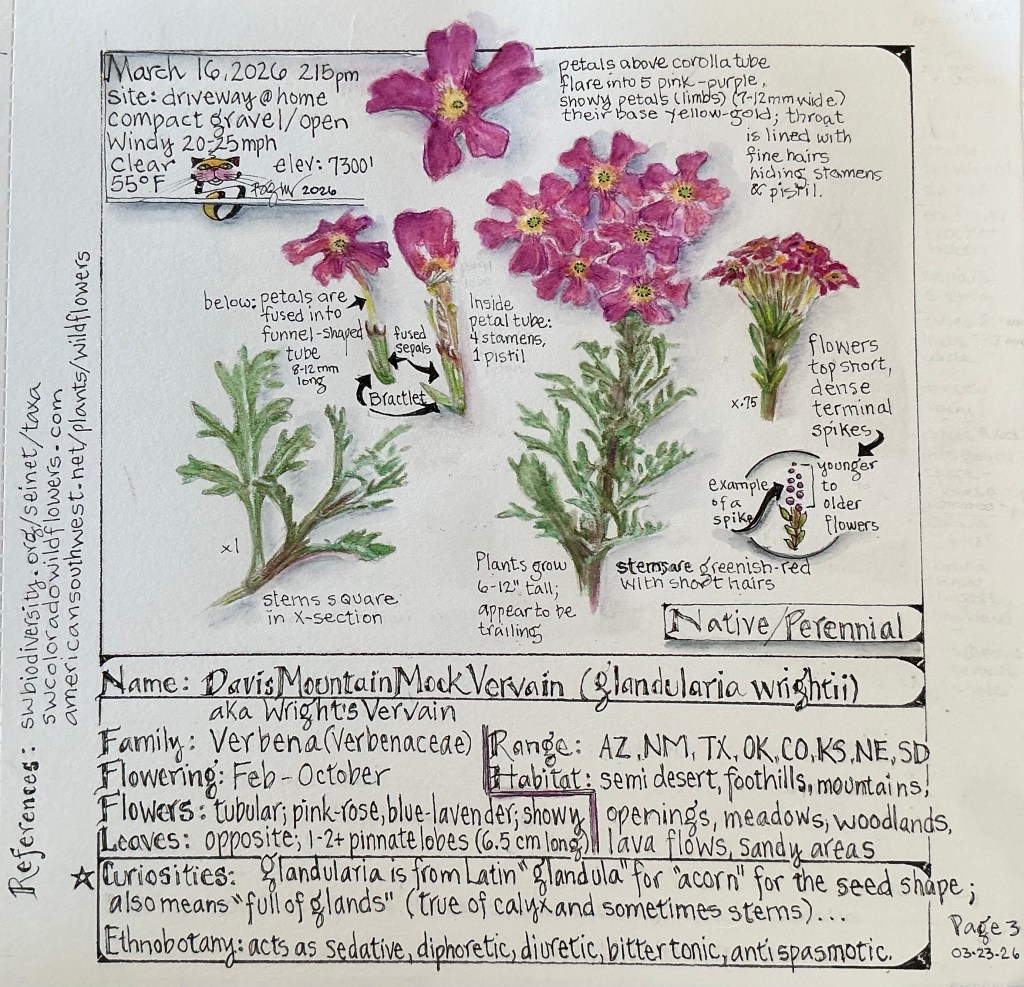
Davis Mountain Mock Vervain (Glandularia wrightii)

The final page
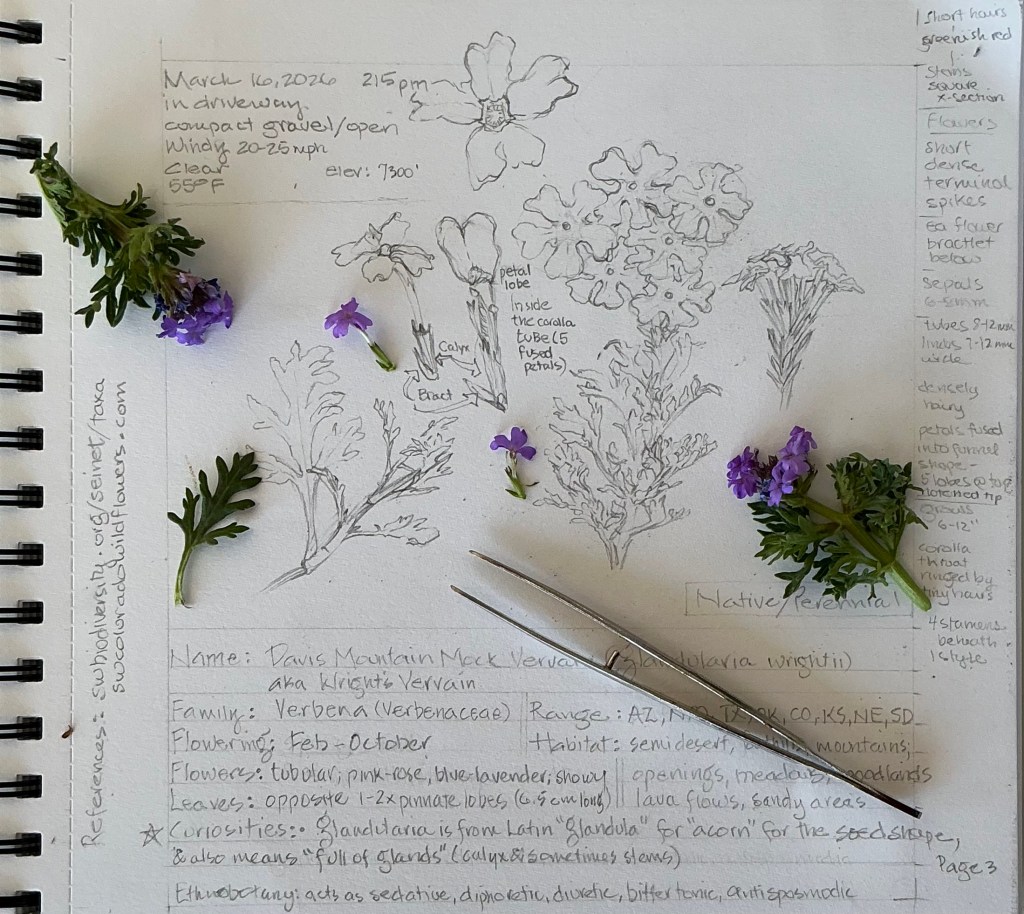
This page shows samples from my specimen.. Although the flowers of my specimens are a purple-blue color, I chose to create the flower petals as reddish-pink; this color is also common.

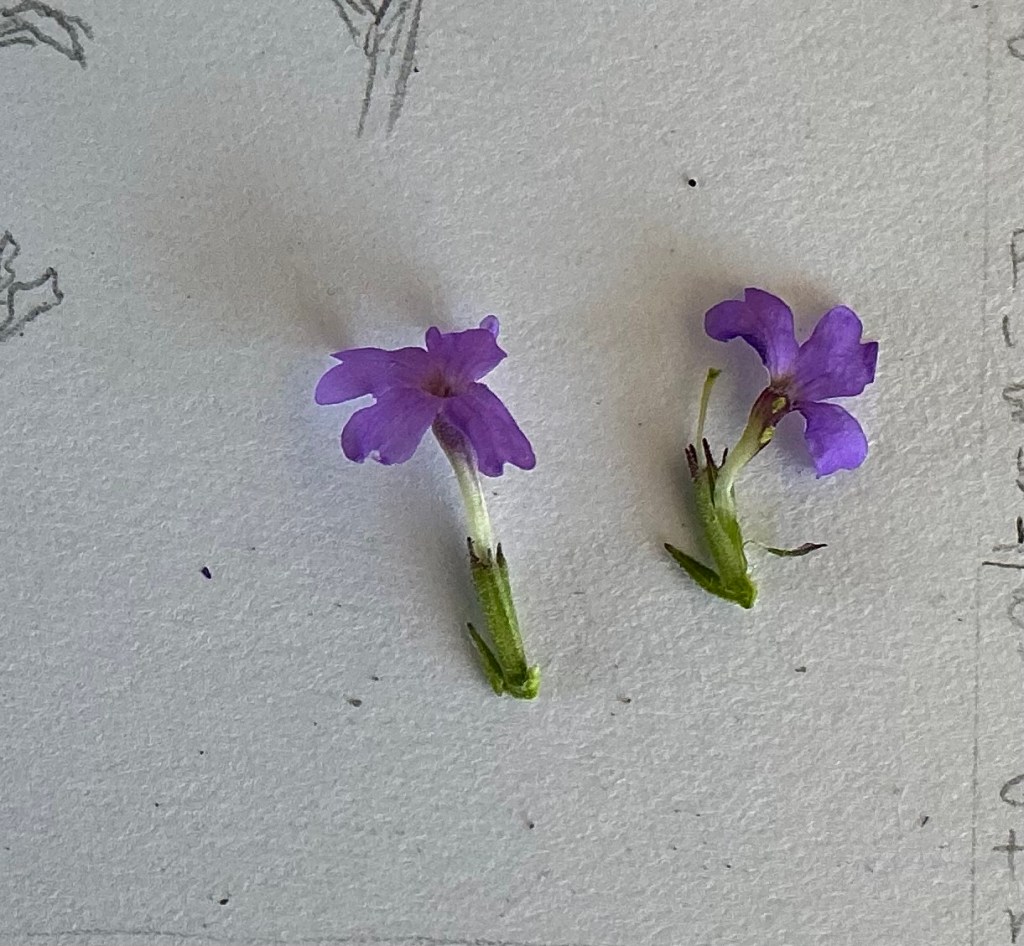
This is a photo of the two flowers I sketched for my final painting.
The specimen on the left shows the upper part of the flower, the “limb” where 5 petals flair out from the throat ringed by fine hairs. The throat leads to the lower part of the flower – the floral tube (5 fused pale green petals). . Both upper and lower petals make up the flower’s corolla. Below the floral tube are 5 red tipped green sepals (collectively called a calyx) all fused into a cup shape. The specimen on the right is a dissected flower; 2 upper petals are removed, and the floral tube has been opened to reveal the reproductive parts. On the left side are 2 of the female parts of the pistil (pale green style supporting the 2-lobed stigma of the pistil; the ovary was not exposed). Two of the four stamens (male) lie in the mid- to upper right side of the opened floral tube; look for the bright yellow anthers, each sitting atop their own filament

Here’s Another Curiosity to Ponder: I wondered why this plant has 5 petals and 5 sepals but doesn’t also have 5 stamens, which is usually the norm in so many other 5-merous plant species??? Here’s what I learned:

Davis Mountain Mock Vervain (Glandularia wrightii) exhibits a common evolutionary trait in the Vervain (Verbenaceae) family where the flower displays a 5-lobed calyx of fused sepals, and 5 5-lobed petals which fuse into a tube (the corolla). This trait, commonly described as 5-merous, curiously has a reduced the number of functional stamens to four. 

This reduction is due to an evolutionary transition from a 5-stamen ancestor. According to literature, the four fertile stamens I observed in my specimens are properly arranged in two pairs (didynamous), both neatly hidden in the floral tube beneath a ring of fine hairs. Also properly so, the filaments (the stalks that support the anthers) of the stamens are fused to the inside of the tube, and not easily teased free.

So apparently, many, many, many, many, Many hundreds of years ago, plants in the Vervain family “decided” having a 5th stamen was unnecessary. “We can do just fine without it, thank you.” Thru the process of evolution, that expendable #5 was ever so slowly reduced to a tiny non-functional structure (referred to as a staminode in modern botanical lingo), or was completely and totally lost, becoming only a memory.

Believe me, this species is an energetic producer of leaves, flowers and seeds. In my experience, Davis Mountain Mock Vervain seems to explode in masses of pink and purple flowers throughout spring, summer and fall, and can last thru winters that don’t freeze. It’s easy to understand why the species has no need of a 5th fertile stamen. Once the plant becomes established, it keeps growing and flowering and spreading, often to the detriment of other desirable plants. If it wasn’t so gorgeous at the height of bloom, it might be considered a weed!   

But I’m reminded of the definition of a “Weed ….. a plant out of place.” So yes, you’ll find me actively weeding actively growing Davis Mountain Mock Vervain so my other native plants have a chance at life too!! 

Thanks for stopping by!

Constance’s Spring Parsley – Page 1 .. The 100 Day Project (2026)

March 18, 2026

Project Introduction

For the last few years my “someday” goal has been to create a nature field guide, of sorts, highlighting my many years of observations in the East Mountains of central New Mexico.   Well, my “Someday” is officially here! Coinciding with the February 22, 2026 kick-off of the 100 Day Project1 (Project), I began by committing an hour/day to developing that field guide as my project and immediately penciled out an outline and a few thumbnail sketches of a sample page. But, after retrieving my iNaturalist lists of East Mountains sightings I’ve made from home and during countless hikes, eliminating redundancies, and totaling up the individual species, my reported observations still numbered in the many hundreds. I would be working on this Project for the next five to six years!

Interlude

When we moved to the East Mountains in the summer of 2017, we quickly fell in love with the beauty of the wide open landscapes, the grasslands and woodlands habitats, the diverse populations of wildflowers and mammals, resident and migratory birds, and the insects and reptiles. So yes, nature is plentiful; species are many. 

Now Back to the Project

Not to be overwhelmed (or defeated) by the potential magnitude of my Project, I decided to:

  1. “Divide and Conquer” by focusing on a single location …. our current subdivision and surrounding area and trails; and
  2. Prioritize quality over quantity by creating one page over two days, keeping each work session to one hour; and 
  3. Keep the Project motivating and interesting, by adding fun facts or other research tidbit about each species.

“These guidelines seemed more realistic,” I thought, with a cautiously optimistic chance of achieving my goal of creating a nature field guide. 

So with that as an introduction to my Project, here’s Page 1 to “An Illustrated Guide to the Nature of Las Leyendas Subdivision & Environs, Tijeras, East Mountains, New Mexico” — with many more pages to follow. 🤞

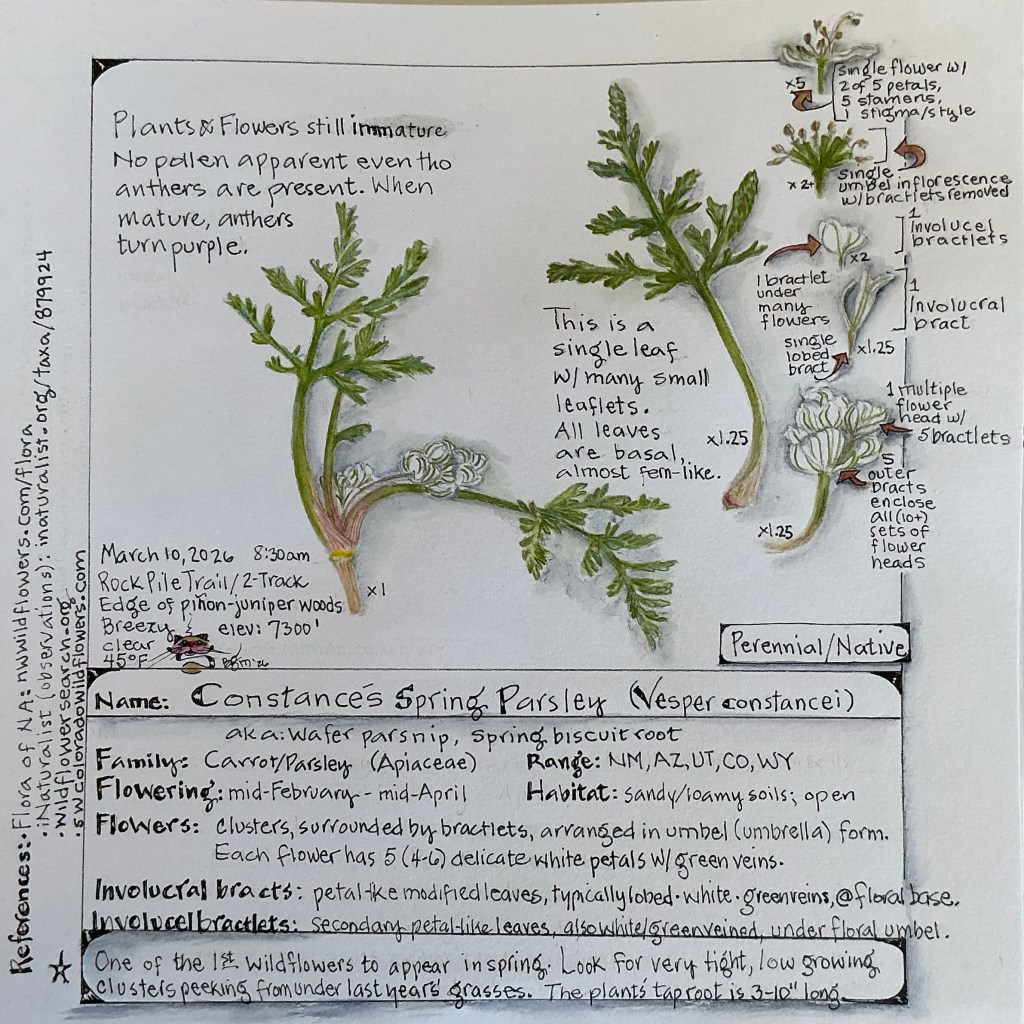
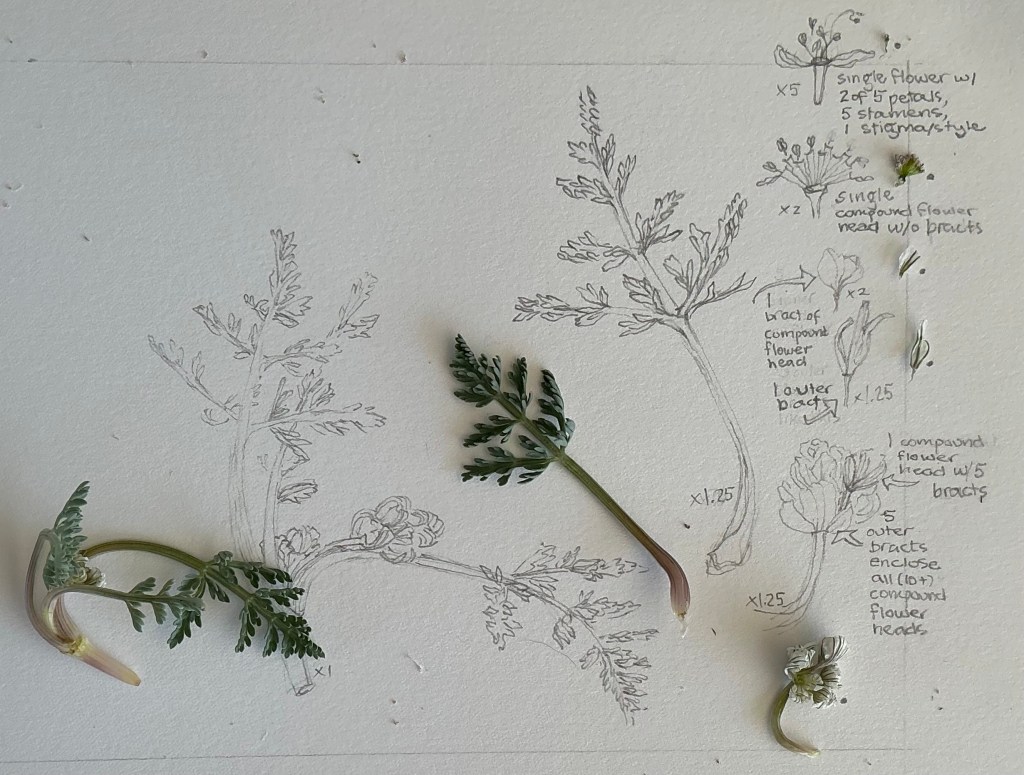
Constance’s Spring Parsley (Vesper constancei)

The final page
An early draft of the page with live samples of this pretty wild parsley

1 “The 100 Day Project is a free global art project that takes place online (https://www.the100dayproject.org/).  Every year, thousands of people all around the world commit to 100 days of creating, and anyone can participate. The idea is simple: choose a creative project, do it every single day for 100 days, and document and share your process online. The most recent round of the Project began February 22, 2026, but any day is a great day to begin.”

Wait For It!   

Spring is on the Way

February 10, 2026

One of my virtues is impatience ……. when it comes to Spring ….. and its arrival ….. finally. 

Admittedly, winter has its perks. After a long, hot summer and fall, winter’s crisp air is a mood lifter, and cooler air temps allow for cozy sleeping under piles of blankets. Longer nights mean my favorite constellations hang in the sky longer, and somehow the moon always seems brighter and friendlier. In New Mexico, winter hiking about is more casual without having to watch every step for rattlesnakes, and certainly any snowfall we’ve been fortunate enough to get helps recharge water tables, tempers our risk of wildfire, and is absolutely beautiful to watch while falling. 

But ….. since Winter Solstice and with daytime hours lengthening, I’m ready for Spring. And the closer it gets, my impatience for the upcoming change in season is obvious. My nature journal, pencils and 10x magnifying loop are packed and ready, each daily hike begins by plucking from a yucca one of last year’s flower stalks to poke the ground for signs of growth, and I’m anxious to snap photos of any passing migrating bird or resident roadrunner in search of a perfect nesting spot.

Meanwhile, I’m thankful for my late winter attack of impatience, because it get’s me out there every day, in anticipation of the first flower bud!

As always, Thanks for stopping by!

Switched the Midge!

A Fourwing Saltbush Gall Mystery Solved

September 30, 2025

If you’re a fan of weird twists in nature (like me), and enjoyed my November 25, 2024 post, “A Quirk of Nature: Fourwing Saltbush,” you may have lost many hours of sleep wondering how I could’ve missed such an obvious mistake! You know the one. The labeling error made when naming those cottonball-like insect galls hugging the Fourwing stems.

In my confusion (or wishing to cover all options?), I seemed to believe two different midge species were somehow responsible for the same gall.

Are they Rosette Bud Gall Midge galls or Fourwing Saltbush Wooly Gall Midge galls?

Decisions, decisions.  

My Quandry quite clear, it was time to consult the experts. 

A short 10 months later, confirmation arrived from the iNaturalist experts in all things “Fourwing.”  All the puffy galls are none other than those made by Fourwing Saltbush Wooly Gall Midges!

And the answer to my question is well timed, as the stems of the female Fourwing shrubs are once again ‘heavy’ with Wooly Gall Midge galls. Now I know! Now you also know!

Enjoy this official correction, at long last, and wishing you sweet dreams.

As always, thanks for stopping by!

PS: My journal page was created by first sketching in graphite the two Fourwing stems, followed by outlining with loose ink lines from a Micron 005, adding a background of both soft and medium charcoal – blending with a stump, then using a Tombow Mono Zero eraser to clean up the ‘cottonballs,’ before adding watercolor pencil, color splatters, and eraser lines randomly placed through the charcoal background. A bit experimental, and lots of fun.

Floss is Flying 🪂  ! 

It Must be Fall …….

September 22, 2025

Like soft, fluffy snow!  Glistening orbs of silky gossamer are floating about the neighborhood, drifting hither and yon in the gentle breeze.  Suspended beneath each orb is a single reddish-brown winged seed that appears to coax its wind-propelled puff in a safe descent to the ground. But the white floss (the Coma) wants to fly, and it becomes a tug of war.  As the weight of the seed overwhelms the ability (and the desire) of the floss to carry it, their brief relationship is severed. But both get their wish …. the floss flies free as the seed drops to the ground, hopefully landing in an ideal spot to overwinter and sprout next spring.

Welcome Fall!  

When the air is full of Horsetail Milkweed parachutes and their ‘riders,’ I walk along the neighborhood roadways and collect a bounty of their new-crop seeds + floss to set free around our property. If they find the right soil, moisture, and light conditions for spring germination, the seeds will not only form the beginnings of a stand of these beautifully blooming, creamy-white milkweed flowers, but the plants might just play host to Monarch and Queen butterflies! 

Now wouldn’t that be dandy!

(Of course, mature seeds from new plants will undoubtedly entice a hungry crop of well-dressed Milkweed Bugs next Fall. That’s OK! They have to eat too!)

Before hint of color

My Journal Pages ……

For something different, instead of using ink and watercolor, all sketches on these pages were created in graphite. The pods, seeds and the milkweed bug were sketched from my collected samples using a mechanical pencil loaded with a fine point HB lead.  The touches of color were added with water soluble graphite.

Work in Progress #1
Work in Progress #2

Thanks for stopping by ….. And Have a Fabulous Fall!

Large Milkweed Bug

Shifts in Nature 

August Littles ….. 2025

September 8, 2025

Ohhhhhh, what a sweet month …… August. It almost got away from me without sharing a small collection of Littles1 that reflect the inevitable shifts in nature that occur during the month. It’s always hard to imagine summer winding down; where did the time go?  But as surely as butter melts on freshly baked bread, undeniably, August forms a reliable bridge between summer and autumn. It’s a time of change and transition; abundance and harvest; transformation and a period of letting go. 

So before I “let go” and before the snow flies (and it will), here’s a handful of little discoveries during the month of August:

-A female Wheel Bug gone slightly astray while searching for a protected place to overwinter the eggs she’s about to lay. 

-A female Soldier Beetle doing her best to attract a mate by sending out pheromones while munching late season pollen from the disk flowers of a brilliant yellow Showy Goldeneye. 

-An acorn that made it to maturity, ready to drop beneath a still green-leaved Gambel Oak soon to be decked out in radiant fall colors. 

-Some hot red trumpet-shaped Scarlet Gilia flowers, still irresistible to hummingbirds until migration, will all be pollinated in time for seed set and mature. 

-The snowy white fruit dangling from the draping branches of Roundleaf Snowberry shrubs are ripe and ready for plucking by hungry birds flying south for the winter. 

-And plump purple-black Chokecherry berries that will become a juicy dietary supplement for black bears needing to bulk up for hibernation.

Enjoy!

And as always, thanks for dropping by!

1Littles” is part of a blog series I began posting several years ago, beginning in January 2023. The concept was inspired by Fay (thanks again Fay!) who came up with the idea for her blog madebyfay.wordpress.com

If you’d like to read more of an explanation, check out my January 2023 post, Winter Birding on Sedillo Hill

One of the Most Aloof Sunflowers Ever! The Cowpen Daisy

Part 3 ….. An Allelopath Declares Chemical Warfare

August 15, 2025

The more I learn about Cowpen Daisy (Verbesina encelioides), the more the words Intrepid (fearless and bold), Interloping (meddlesome and smothering), and Impertinent (pushy and rude) come to mind. 

Cowpen Daisy is literally a plant at war …..

Its adversaries are neighboring plants …..

Its weapons of choice are chemicals ….. 151 different Allelochemicals2 to be exact. 

Cowpen Daisy shows no mercy to its most susceptible victims, and given the right conditions in the right locations, Cowpen Daisy can cripple ecosystems, and unravel biodiversity.

Oh No! What Have I Done! Have I unleashed a formidable enemy to run amok, bullying its way through our mostly intact biodiverse high desert ecosystem?      

Maybe not!  (Spoiler alert…… Allelopathy3can be bad, but I still love this happy Daisy)

On August 6th, I received an excellent question from one of my blog followers, based on my first Cowpen Daisy post :

“Do you have any concerns about this becoming an invasive plant? Best wishes, Nancy”

In reply, I expressed my concern about the number of “seedlings coming up late spring,” and how “I was definitely alarmed and wondered about the need for early control.”  Fortunately, “as the season advanced, it became clear the density of plants seemed self-controlling.”  Based on my limited experience with Cowpen Daisy, I explained how during the summer of 2023 “the plant completely covered an extremely large field near our home,” causing me concern about its invasive tendencies. But upon “[R]eturning the following year (2024) and again this past spring (2025) to see if the same field was blanketed again in these plants, “I couldn’t find a single Cowpen Daisy anywhere! So no, this annual [doesn’t appear to be] “invasive, at least not in central New Mexico.”

But Nancy’s question prompted me to dig deeper into on-line research.  I wondered: Is Cowpen Daisy invasive outside of its native range, particularly where conditions are ideal for its aggressive growth?  Yes, it is! And its invasiveness is further enhanced where neighboring plants are susceptible to the impacts of the allelochemicals released by Cowpen Daisy’s leaves, roots and decaying leaf matter in the soil.

One example where Cowpen Daisy is an introduced species and has become invasive is in India. Fields of mung bean, corn, chickpeas, and sweet melon are being outcompeted by invasive stands of Cowpen Daisies.  These food crops are severely impacted by two allelochemicals released by the both roots and leaves of the Daisy; steroids and phenols. Studies of these four crops demonstrated not only “the suppression of germination and growth in these plants” but “also revealed an antagonistic effect on [their] chlorophylls, carotenoids and protein levels.” In other words, Cowpen Daisy is winning the war against India’s mung bean, corn, chickpea and melon crops, and farmers are currently engaged in a battle to develop a strategy of control and run this biological enemy out of their country.

Cowpen Daisy is only considered a native species to the Southwest U.S. and Northern Mexico. However, it has been introduced (either intentionally or by accident) and is considered naturalized in parts of Eastern North America, the Middle East, Spain, Argentina, Australia and the Pacific islands. As such, Cowpen Daisy’s nature to drop allelochemicals everywhere it grows allows it to behave like an invasive plant in countries where it is naturalized.  Without diligent management (via herbicide application or mechanical control), it can thrive to the detriment of their desirable plant species’ survival.

Have I defeated my goal of reestablishing a diverse native plant community in disturbed areas surrounding our new home? “Not likely,” says I, optimistically!  In addition to Cowpen Daisy, the variety of native plant species I intentionally seeded last fall and early this past spring, have germinated, grown, flowered and seeded or are in the process of flowering and seeding, most of which are adjacent to a Daisy. Of course time will tell. Meanwhile, I’ve declared this to be a happy ending to this post and my stand of happy Cowpen Daisies! However ……. next spring, if germination rates from my reseeders are low or zero, but Cowpen Daisy returns with renewed vigor, then I have a control job waiting for me. And the best advice I’ve read is to “pull out old plants and roots and selectively remove new seedlings.” That’s acceptable! That I can do!

Until then!

Do you struggle with weedy, invasive plant species in your garden or yard? Have you seen fields of blooming weeds and wondered …… “what weed is that?” Do you know the names of those pesty plants and do they seem to keep your favorite variety of cucumbers from growing? It might be interesting to learn if your local invasives are one of the many Allelopaths happily growing in our world! Let me know!

As always, thanks for dropping by!

1Cowpen Daisy is known to release up to 15 different allelochemicals2 from its leaves and roots, such as guanidine, phytosterols, phenolic acids, tripertenes, flavonoids, dicarboxylic acids, phytophenols, steroids, phenols, and others. Fresh and decaying leaf litter leach 14 of those allelochemicals into the soil.

2,3Allelopathy is a biological phenomenon by which an organism produces one or more biochemicals that influence the germination, growth, survival, and reproduction of other organisms. These biochemicals are known as allelochemicals and can have beneficial (positive allelopathy) or detrimental (negative allelopathy) effects on the target organisms and the community. Allelopathy is often used narrowly to describe chemically-mediated competition between plants. Allelopathic interactions are an important factor in determining species distribution and abundance within plant communities, and are also thought to be important in the success of many invasive plants. (source: Wikipedia)

One of the Most Edible Sunflowers Ever! The Cowpen Daisy

Part 2 ….. Ethnobotany, Etymology and Epicureans

August 11, 2025

While compiling last week’s post about the happy Cowpen Daisy party taking place outside our back door, it was no surprise to find way more interesting info about this sunflower than could ever fit on my journal page. Decisions …… decisions! To keep the August 5th illustrated page relatively uncluttered, I decided to include just the botanical basics (mostly), focusing on Cowpen Daisy flowers, leaves and seeds. 

Then the past week I found my nature journal wide open to a blank page, ‘begging me’ for another Cowpen Daisy entry ….. “What about all those interesting info bits?” she asked.   Replying* to my journal with a hearty, “OK,”  I proceeded to locate and gather my rabbit-trailing notes. This scavenger hunt reminded me just how many pages there were; so many fascinating things about the Cowpen Daisy I wanted to remember and share. Decisions …… decisions!  How to keep this next post to one page? By limiting the topics to only three, was it possible?

Barely! (after some clever editing, not a single word dropped off the page)

A little bit closer view for those without a microscope!

P.S. By the way, you may have noticed I’ve indicated this post is Part 2 of what’s now become my Cowpen Daisy series. Unless I start journaling on larger than 8” x 11” paper, there’s likely to be more Parts in store. And this multi-part series resulted in a minor edit to last week’s post, not titled “One of the Happiest Sunflowers Ever! The Cowpen Daisy; Part 1 ….. Can There Be Too Many Sunflowers?”  In case you missed it, please check it out here.

*Yes, you read that right; I talk with my nature journals. Don’t you?  After all, we do spend quite a bit of time together! 

As always, thanks for stopping by!

The Cowpen Daisy ….. One of the Happiest Sunflowers Ever!

Part 1 ….. Can There Be Too Many Sunflowers?

August 5, 2025


It was the Fall of 2024. A small cluster of Cowpen Daisies (Verbesina encelioides) flourishing on the severely disturbed ground surrounding our new home was going to seed. Waiting several weeks until the migratory birds ate their fill, I spent an hour or so collecting as many remaining dried seeds (cypselas) as possible, stuffing full two quart-sized ziplock bags. About 1/3 of the seeds I scattered around the house where they would overwinter on the ground.  The rest were poured into large pill vials that were labeled with species name, location, and date, then placed in the refrigerator to simulate cold storage until Spring.

Cowpen Daisy cypselas (seeds) 08/04/2025 at Punch

It was late April 2025. The chances of heavy frost seemed a distant memory. My fingers crossed, I chose a sunny 42 degree morning to liberate those refrigerated seeds from 6 months of cold storage, and scattered them in disturbed areas not seeded last Fall. Then I waited like an expectant parent, watching for signs of germination, worrying that runoff from late season snows might wash away my scattered seeds, expecting that flocks of migratory birds would gobble them all up, and hoping for gentle rain showers to swell those thousands of seed coats to aid those tiny embryos in growing their first roots (radicles) and first leaves (cotyledons). 

Then early June 2025. Success! Cotyledons were literally popping up everywhere, which meant the radicles were already expanding into the soil. They were especially crowded where I’d scattered all the cold storage seeds, and germination was obvious where seeds had been scattered the Fall of 2024. By early July, those Cowpen daisies were crowding out many of the other native species I’d also seeded in the same areas. 

Backyard and overflow Cowpen Daisies, robust growth after Fall 2024 seeding (08/03/2025)

And now it’s early August 2025, and what a dazzling show! Even though the sunflower yellow flowers of Cowpen Daisy are small (2” wide), there are up to 75 long-stemmed flowers on each plant that can grow from 4-5’ tall! They are so dense, the backyard fence is hardly visible, our walking paths are totally draped with 4” long leaves, and if there’s a rattlesnake lurking around under our massive Cowpen Daisy canopy, we’d probably (hopefully) hear him well before he slithered into view! 

Goals and Lessons Learned

I’ve learned a lot by parenting these Daisies; from the best time to scatter seed (in the late Spring following cold storage) and where (not so close to other desirable natives or pathways), to managing the mass of growth (by organizing through selective removal). Our initial goal of seeding and growing native plant species was to attract and help feed wildlife (pollinators, reptiles, rodents, birds and mammals), and we are optimistic that achieving this goal long-term seems realistic with the success we’ve had to date. However, because so many of our native plants are losing the battle against habitat loss caused by invasive species encroachment and takeover, land development, and climate change, we will continue to explore ideas to expand our initial goal to address the habitat situation. As we gain insight about the best native plants to grow to help restore our disturbed soils, we will learn and share with our neighbors those species that: are drought tolerant; aid in building soils; are effective at invasive weed suppression; provide wildlife benefits; and increase plant diversity. 

Cowpen Daisy and pollinator 08/01/2025 at Punch

Happy – Happy – Happy!  Will I be collecting Cowpen Daisy seed again this Fall? You bet! Having all that sunshine yellow around our home is thrilling. Every morning all those thousands of sunflower faces looking East towards a new day are about the happiest sight ever! And having such wild, uninhibited growth of a native annual out our back door has been ideal for observing the pollinators that benefit from the abundant nectar and pollen, enjoying the aerial acrobatics of several phoebe families that have been feasting on those pollinators, and promises to be a perfect spot for bird watching this Fall when all those cypselas ripen into high protein food.

Can’t wait!

Do you ‘know’ a special native plant? How about a native butterfly garden? Are you a bird watcher? Maybe you enjoy the occasional deer, coyote, or bobcat wander through your yard? Please share your favorite wildlife encounter!

As always, thanks for stopping by!

National Sunflower Day

August 2, 2025

Zentangle patterns: Eeric, Dollpin, Alla, Citrus, Snowflower, Fancy Flower, Crizzy, Suru, KGI, Maryhill, Xplode, Lilyeyes, Odee, Sooflowers, Peaceout, Bulb Lantern, Arrowtree, Adobe

Sunflowers!🌻 Absolutely the happiest flower on Earth. Wouldn’t you agree?

Sunflowers, a symbol of adoration, loyalty, and longevity, represent happiness, friendship, and intelligence. Much like the sun, sunflowers reflect vibrancy and an energy of life. While National Sunflower Day is the official day to celebrate these beautiful flowers, why not declare the entire growing season reason a-plenty to radiate your inner sunshine and mirror the smiling faces of every sunflower encountered! 

Then and Now

Did you know sunflowers have been around since about 1000 BCE? In the U.S. indigenous peoples used sunflowers as a valuable food source, for oil, paint, and textiles, and during ceremonies. Some archaeologists even believe sunflowers may have been cultivated before corn. Today, sunflowers are still used for food (seeds, salad mixes) and beverages (tea), cooking oil, in beauty and skin care treatments, for medicinal purposes, and for hobbies and crafts.

Annual Sunflower over 6 feet tall!

The sunflower crop

The U.S. is a mass producer of sunflowers, particularly in the plains states, and is a major crop in both North Dakota and South Dakota. The average cultivated sunflower plant is five to six feet tall, and the central face of disc flowers can grow bigger than a human head. As the weight of the sunflower head becomes heavy, it begins to fall forward causing the petals to fall off. Shortly after the harvest begins. On average, one sunflower can produce up to 2,000 seeds per head. In 2022, North Dakota produced 762 billion pounds of sunflower seeds!

The Happiest and the most Intelligent flower

Have you ever noticed sunflowers track the sun, from sunrise to sunset? It’s true! Sunflowers follow the sun’s movements throughout the day. You may notice that before sunrise, a sunflower is in sort of a sleeping position with its head slightly down. As the sun comes over the horizon, the flower awakens and slowly lifts its face to ‘look’ directly at the rising sun. As the day progresses and we observe the sun moving from east to west, so too does the sunflower by turning its face in sync with the sun’s apparent movements until sunset.1  When the sun sets in the evening, sunflowers nod off to sleep, but not before untwisting themselves and slowly return to face the east. Ingenious!  

This charmer is called Cowpen Daisy

1 However, on very hot days, sunflowers tend to avoid looking directly at the sun to keep from overheating. And I’ve noticed on cloudy days, sunflowers may appear confused about the sun’s location, seeming to make their best guess on which way to face.

A season of yellows and oranges

Although you can find flowers in the Aster (sunflower) family in the Spring, August is the peak growing and blooming season for these cheerful plants. Brilliant displays of yellow flowers welcoming the morning sun can be found wherever sunflowers grow. Witnessing fields of sunflowers is guaranteed to lift your spirits as you oooooh and aaaaaaaah at their breathtaking beauty. 

A trio of cowpen daisies

Ideas to celebrate a day, week, month or year of sunflowers

  1. Spend a day with a wild sunflower and watch its face track the sun.
  2. Take a drive to view fields of sunflowers to see their true beauty in mass.
  3. Give a bouquet of sunflowers to a friend to brighten their day.
  4. Add sunflower petals and seeds to your salad.
  5. Create a painting of your favorite sunflower and frame it to enjoy year-round.
  6. Try your hand at a Zentangled sunflower bouquet ….. there are as many pattern possibilities as there are blooming sunflowers! 
  7. Plan a road trip to North Dakota in August and coordinate places to stop to visit sunflower fields and get updates from local farmers who cultivate sunflowers. 
A collection of cowpen daisies in my backyard.

If you missed celebrating this year’s National Sunflower Day, no worries! Every time you come across any sunflower, of any size, anywhere, pause and hold a personal celebration in honor of its splendiferous magnificence!

As always, thanks for stopping by!

Sunflower photos were taken in our backyard ….. all volunteers too!