
July 9, 2023
Buckle in ……
In my last blog post, Fascinating Fasciations, I shared my discovery of an extremely malformed Rush Skeletonplant. While researching this much branched and dainty member of the plant family, Asteraceae (which includes asters, sunflowers and daisies), I became entangled in the winding and seemingly never-ending number of rabbit trails on my journey, until finding myself on a surprising detour. Totally absorbed in the subject of plant malformations, and learning a lot of cool stuff about Rush Skeletonplant along the way …….
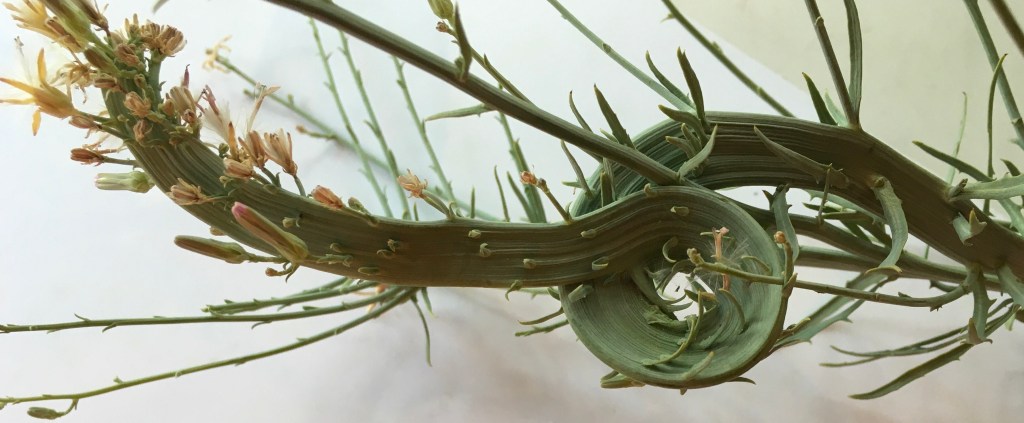
………. I tripped and fell flat on my face (only figuratively!). One of the published research papers appeared to be in error …… regarding the seed (aka fruit) name of this plant. Known to me for decades by the name “Achene,” the researchers had labeled the seed “Cypsela.” And not only did they call seed of Rush Skeletonplant a “Cypsela,” but they used this name when referring to all the seeds of the Aster family!
What! No Way! Who was responsible for this name change? When did this happen? Why oh Why
Shaking my head in wonder and awe, I retraced my steps back to topics regarding Plant Malformations, determined to finish that study. However, I knew this out-of-the-blue (to me) name change would bug me until I learned more. Carefully bookmarking this shocking detour, I made a promise to return to the mystery published in the botanical bestseller, “Cypsela vs. Achene.”
And return I did!
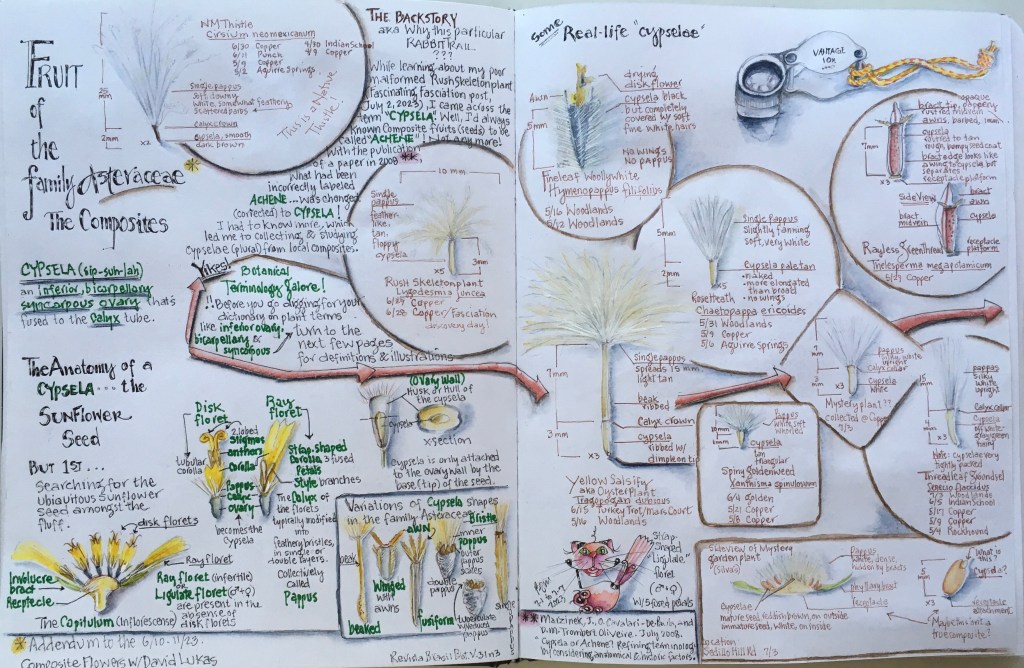
My waders cinched high under my chin, I began wading in a flood of technical terminology only botanists can invent! Starting with name Cypsela (sip-suh-lah), the fruit (a dry indehiscent seed) belonging to all plants of the family Asteraceae, it is described as having an inferior, bicarpellary, syncarpous ovary that’s fused to the calyx tube. Got it?! If you do, congratulations! But even with all my years of botanical training and experience, I was puzzled. So my rabbit trail branched down the road to several illustrated botanical dictionaries, and word for word, I deciphered the definition of each term adding an illustration or several to understand what a cypsela looks like and how to recognize one.

Field Sampling
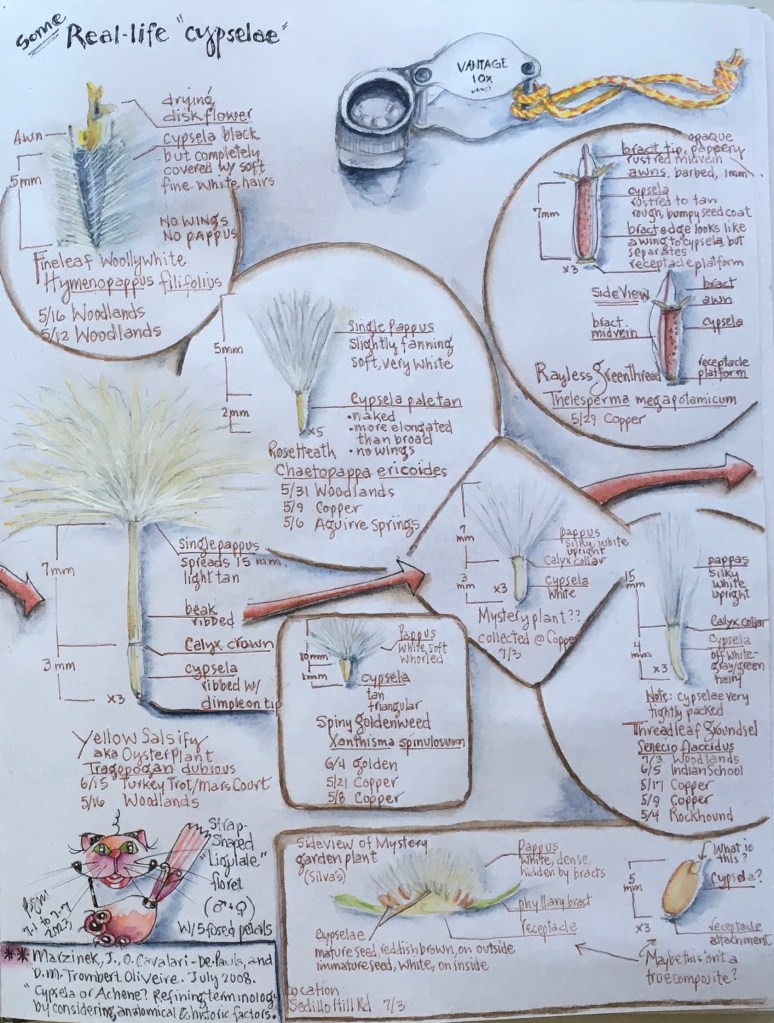
Once I understood exactly what each word meant, and why they were all important in describing something as small as a dandelion seed, I headed outdoors to collect samples of cypselae (plural) still attached to the plant’s receptacle. Back in my studio and armed with my 10x magnifying loope, I began dissecting my collection. To my delight, the basic characteristics of the seeds from each species did, in fact, look just like the definition of a cypsela! And true to the literature, I also discovered several natural variations of cypsela. The cypselae in my collection exhibited differences in size, shape, texture, color; the pappus of each was unique with variations in presence (or absence) of bristles, downy fluff, feathery fluff, awns, or a combination of two or more.
I was beginning to “get it!”
Recognition of these characteristics date way back in time …. More than 200 years ago! It was in 1813 that Mirabel was the first to use the name cypsela, accurately describing its characteristics and showing how it (the cypsela) differed from an achene. Then in 1891, Beck chose to ignore Mirabel’s well-presented arguments, and decided the fruit was to be called an Achene, going so far as to define the achene as no different from the cypsela, causing the names cypsela and achene to be interchangeable; synonymous, and causing confusion. Many year passed. Then in 2008, a trio of Brazilian botanists seemed to settle the debate with the publication of their research paper “Cypsela vs. Achene? refining terminology by considering anatomical and historical factors.” It’s an awesome paper, complete with microscopic views of that inferior, bicarpellary, snycarpous ovary!
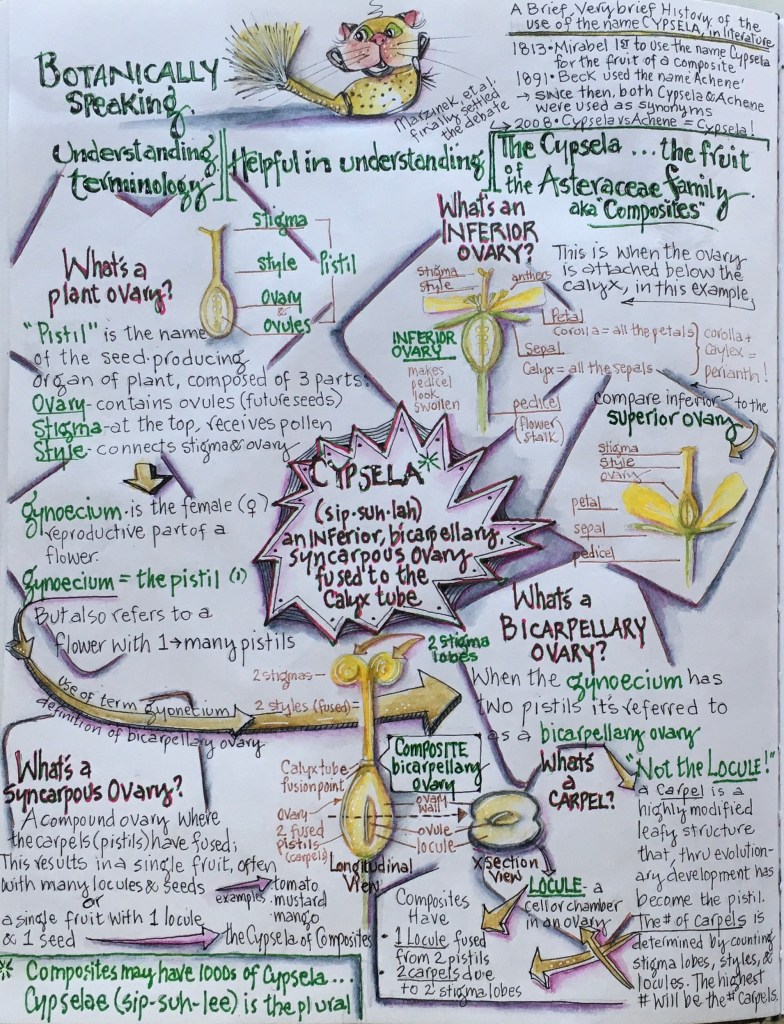
Want to know what all that word stew means in English? Browse through my journal pages for a roadmap to illustrated definitions, word by word! And while you’re doing that, please excuse me while I retrain my brain and welcome the name “Cypsela” into my vocabulary. Something about “old dogs ….. new tricks?” Anything is possible!
If you’ve found yourself a pair of waders to pick your way carefully through this word stew, wow! Let me know ……. Was this post helpful or confusing? Did you find the handful of terms without definitions, and would like to know more? Did you know the sunflower seed is a really a type of fruit? Did you know the tomato is a fruit, not a vegetable? Are you ready to sign up as a full-fledged member of the nature journaler’s “geek out” team?
Until next time ……. be curious!

 a curious nature
Wow, Barb! What a deep dive into seed terminology and details! I suspect Jack & David’s Composite class was helpful in this area, too (I got through part of it at the campsite!). Your information is well documented and detailed along with your incredible drawings! Well done! Inspired by your plant malformations post, I noticed some interesting leaf deformation this morning and they were the subject of my quickie sketch in my tiny journal along with lots of questions! I’ll email you some photos.
LikeLiked by 1 person
Thanks tremendously, Karen! I was thinking David might be interested in my exploration of the cypsela! The plant kingdom is fabulously intriguing. I’ll keep an eye out for your email of you leaf deformation discovery! And I can’t wait to hear more about your Cascade adventure! Cheers!
LikeLiked by 1 person
Wow Karen! I’m so delighted you gave my post on the Cypsela a generous nod! Thank you so much! I’m excited to spend some quality time with your post. Hugs!
LikeLike