It’s not about what it is, it’s about what it can become. — Dr. Seuss, The Lorax
The creation of a thousand forests is in one acorn. — Ralph Waldo Emerson
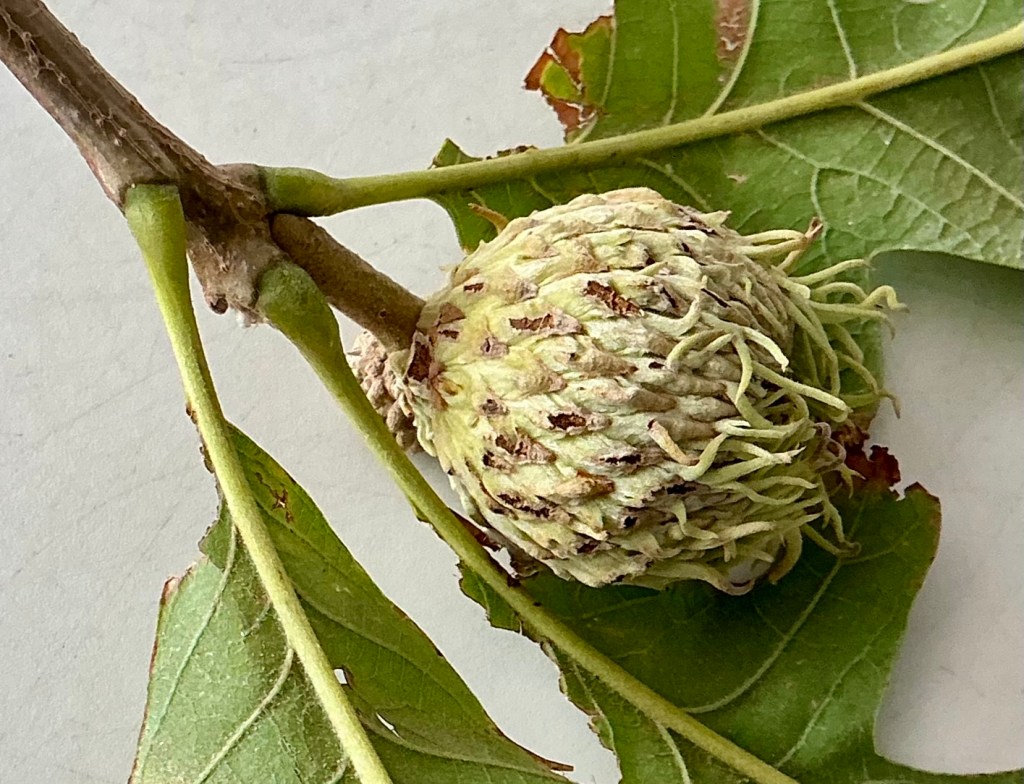
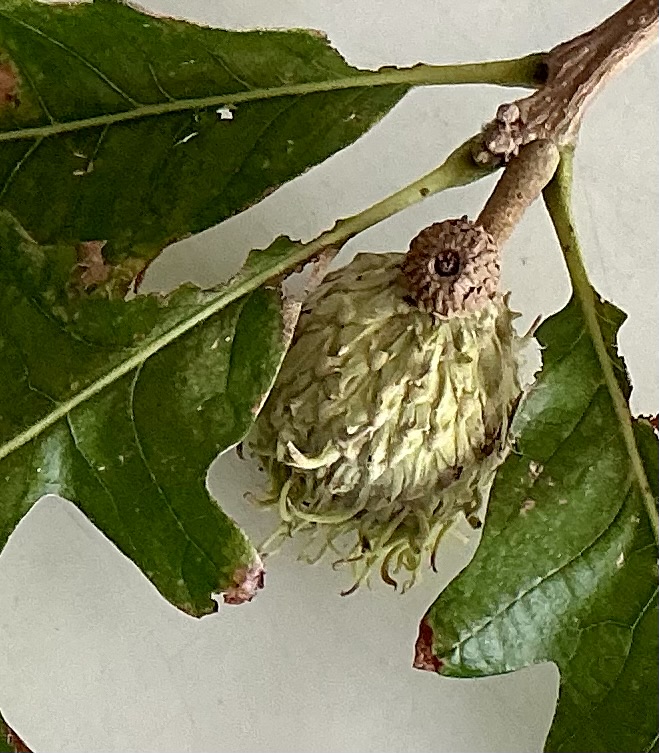
Super thanks to Dana P., a regular reader of my blog and a very savvy observer of my recent post, Acorn or Gall? Dana instantly recognized the mystery oak as Bur Oak (Quercus macrocarpa) from my sketches of the leaves and acorn! “Way to go Dana!!! I’m so grateful you commented and then generously allowed me to share your photos.”
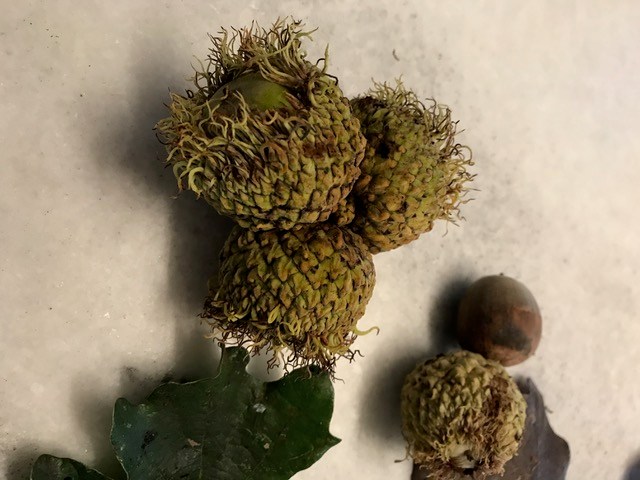
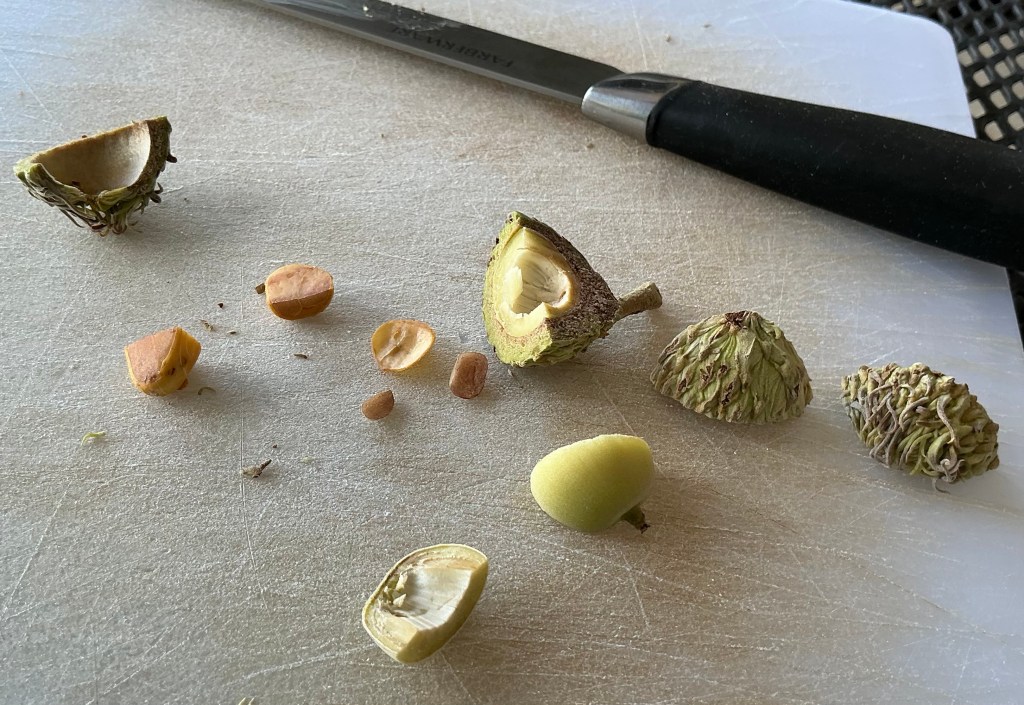
So, those shaggy pale green balls growing from the ends of many leafy branches are acorns after-all. The acorn I collected was apparently immature; that scary-looking tentacled orb was the cap (cupule) still tightly enclosing the growing fruit (the nut).
Dana has a lot of experience growing Bur Oak, some of which were germinated from collected nuts (see Dana’s photo below). Now we all can see how a mature acorn appears when nuts are ready for harvesting. (I still think they are the weirdest acorns ever, don’t you?)
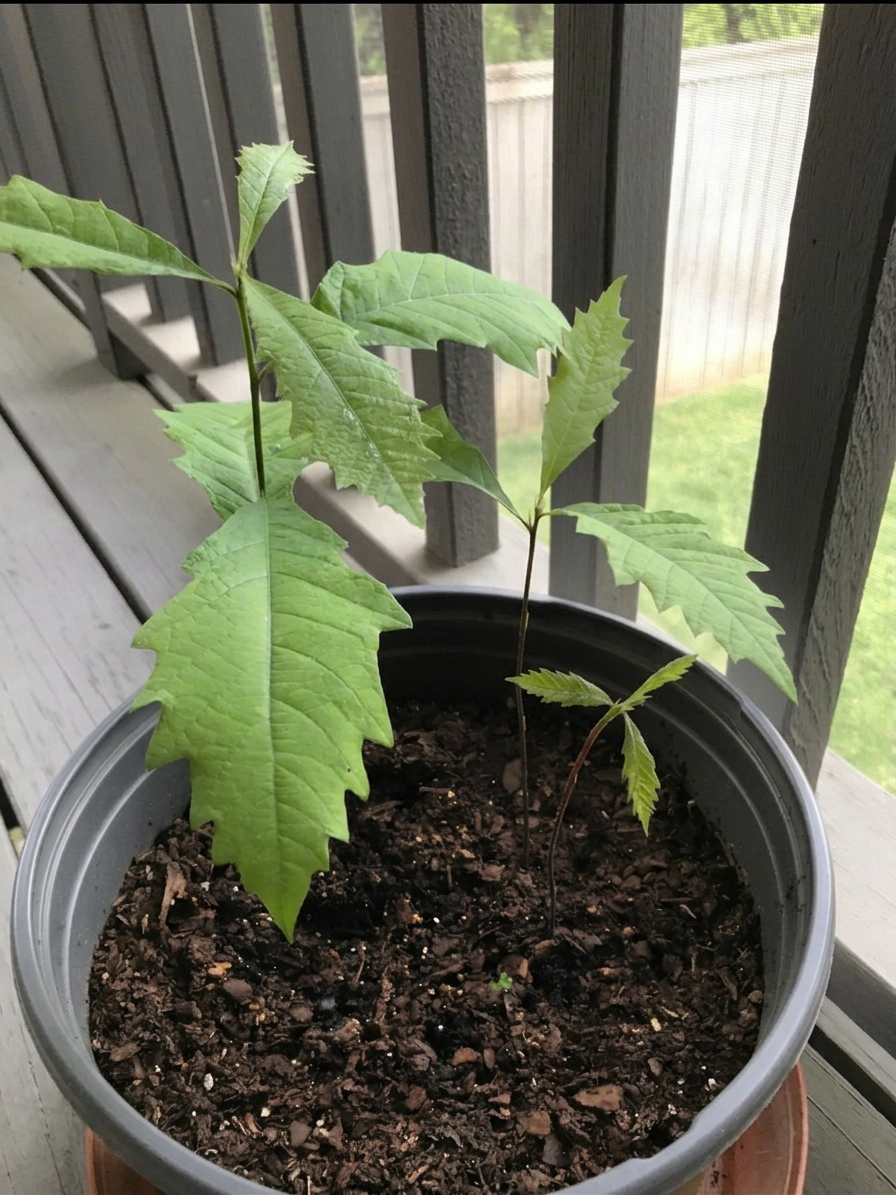
The next photo proudly displays three ‘baby burs’ that sprouted from Dana’s successful germination efforts. The nuts, harvested in the fall from a very old Bur growing in Nashville, Tennessee, were planted in the pot and allowed to overwinter outside, on a screened-in porch to prevent squirrel-theft. They emerged as little trees the following spring. These healthy sprouts in the photo have been happily living in east Texas for the past four years and have grown to four feet tall!
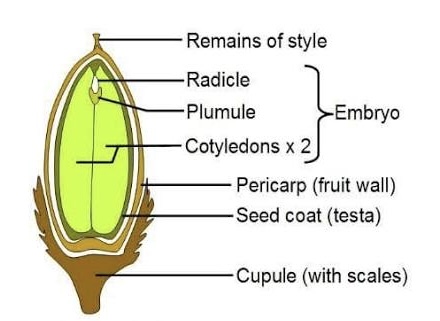
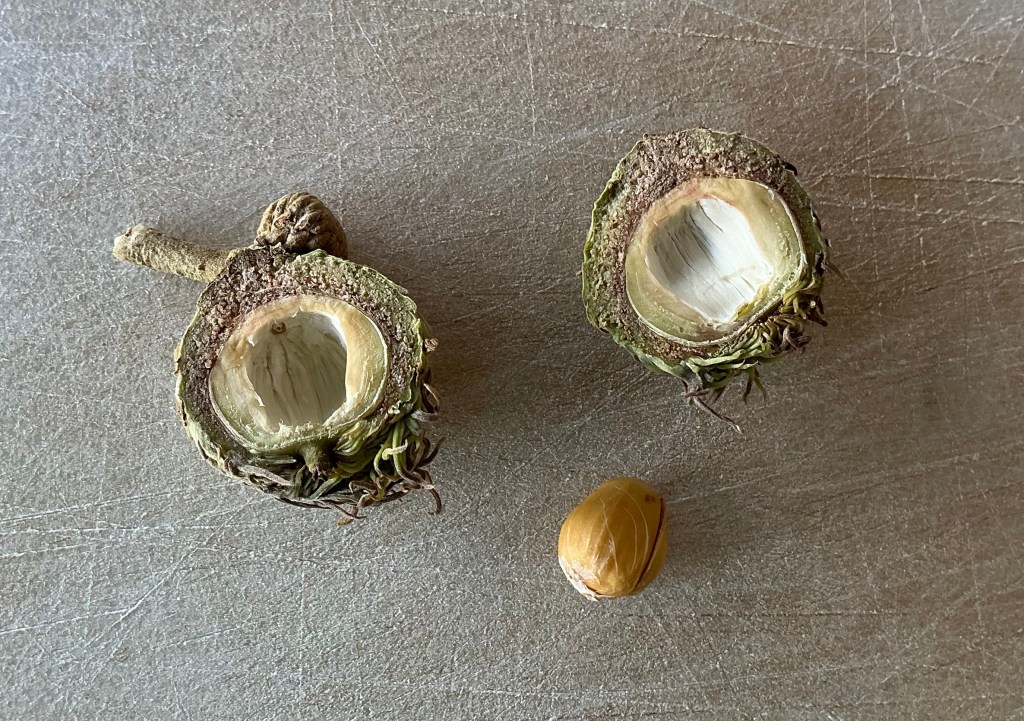
And now for a bit of acorn anatomy (you knew I couldn’t resist!).
The term “acorn” refers to the entire unit; the cap (cupule) and the oak fruit (nut).
Exterior Parts
Cupule – the botanical name for the acorn’s ‘hat.’ It’s the cup-shaped or bowl-like cap made of hardened, modified leaves called bracts. The outside features scales that can be flat and smooth, bumpy and warty, or loose and fringed depending on the oak species. The cupule protects the nut and helps attach the acorn to the tree branch while it grows.
Pericarp – the hard, tough outer shell that encases the inner kernel of the nut.
Stem – the tiny twig attachment point at the base of the cupule.
Interior Parts
Seed Coat (testa) – the thin, papery layer just inside the outer shell that directly covers the nut meat.
Cotyledons – two large, fatty seed leaves that store starches, proteins, and fats to feed the growing plant (and wildlife).
Embryo – the tiny baby oak tree nestled between the two cotyledons at the pointed end of the nut, consisting of the plumule (future shoot) and radicle (future root).
The forecast: Severe clear; calm winds; 82oF & climbing
The place: The Promenade in Albuquerque
The destination:el Oso Grande Park (“The Big Bear”)
After dropping Roy off for his annual eye exam, Luna and I decided to ‘sniff’ around the neighborhood on our way to nearby el Oso Grande Park. With the chance of rain being “zip,” I was confident walking east along a half-mile stretch of the large cement ditch used to drain storm water from Embudito Canyon. Other than creatively colorful graffiti, the ditch itself had nothing interesting to offer. The hot paved walkway, mostly lined by weedy species, provided perfect habitat for scattered bushy sacred datura plants in full bloom. The many city dwellers living ditch-side allowed landscaping plants to cascade over cinderblock privacy walls — the patches of shade – welcome; sprays of pale pink to magenta desert willow flowers – pretty and fragrant.
A sweaty 20 minutes later and the shady expanse of the Park was a welcome sight. Not one to waste time, Luna anxiously led me to tree trunk #1, circling and sniffing excitedly three times ‘round. Not being able to smell the wonderfully curious aromas capturing her full attention, I spent my time looking up into the leafy canopy of this full grown deciduous tree planted years ago in memory of a once local resident.
We moved on to tree #2, a robust conifer towering over the well-manicured green lawn, supported by another aromatic trunk recently ‘watered’ by a happy dog walking their human. Before we could check out tree #3, Luna claimed #2 by leaving her ‘calling card.’
And on and on we wandered and circled, until ….
…. I realized, based on our exam speed/tree (largely driven by Luna’s satisfaction meter), our Park tour of over 100 trees would take a month of Sundays! So we ramped up our pace, making decent progress to (hopefully) ensure our timely return to fetch Roy …. then tree #26 happened!
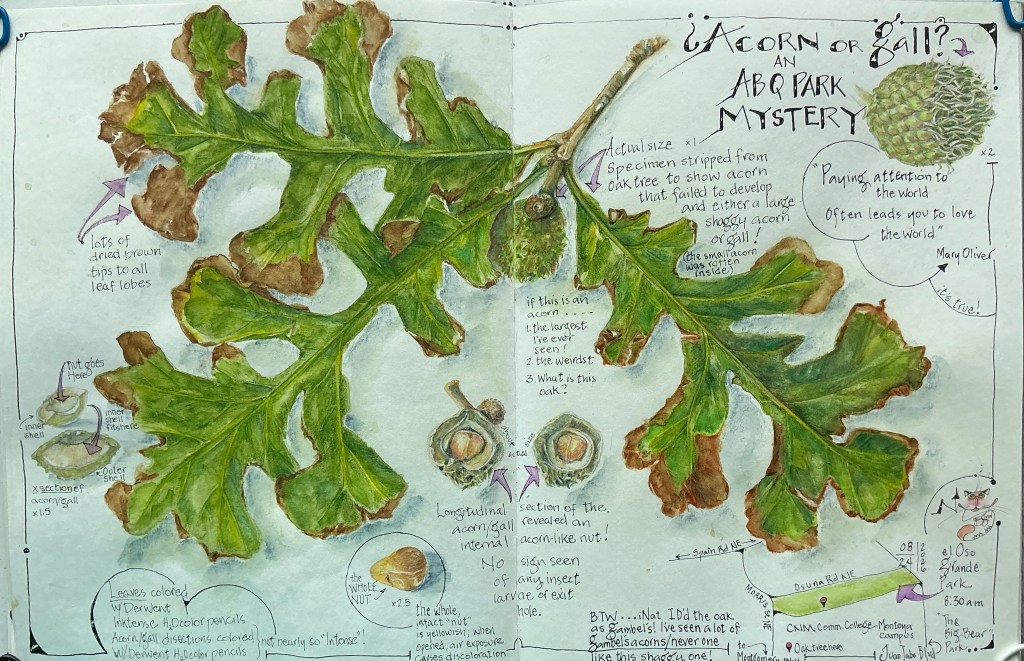
Oh! What was #26? Now it was my turn to encircle a tree, and I couldn’t stop. In addition to the puzzled look on Luna’s sweet face, several other things were certain: 1– this very large tree was a 2– deciduous 3– dicotyledonous member of the 4– oak genus Quercus. The deeply-lobed leaves were a giveaway, even though most of each leaf’s margins were dried and crinkly. But it wasn’t the leaves catching all of my attention — it was the 1-inch diameter shaggy pale green balls growing from the ends of many leafy branches. This certainly didn’t look like any acorn I’d ever seen before …. besides, right beside this scary-looking tentacled orb was a single mini-acorn that tried but never fully developed — only the dried, withered acorn cup had partially formed before rotting.
So what was it that sucked the life right out of that tiny failed acorn, and grew into something alien? If this was some kind of acorn that grows on a non-native oak tree I’ve never seen before, then I had to learn more! If this was a gall, an unusually grotesque, weird and exaggerated growth stimulated by a developing wasp grub living deep inside, then I really had to learn a lot more!
And then I collected and promptly zip-locked a specimen.
This became (and still is) AnAlbuquerque Park Mystery hanging like lime green ornaments all over, and also within reach from, tree #26!
P.S.
iNaturalist identified the tree as Gambel’s oak
Never have I ever seen a Gambel’s oak acorn look like that!
Still waiting for an oak expert to identify the tree leaves and/or acorn/gall-thing
P.S. P.S.
So many questions remain
Upon arriving home, no wildlife observed inside zip-locked bag
I dissected the growth, inside and out — found what looked like an acorn nut
No sign of a grub; no exit holes in the outer or inner shells
P.S. P.S. P.S.
Luna & I practically ran back to the eye doc’s office, arriving minutes before Roy’s exam concluded
……………………………………………………………………………………..
If you’ve seen anything growing on an oak that remotely resembles these mystery green goblins, please let me know what it may be, and what species of oak they come from!
As always, thanks for stopping by!
P.S. P.S. P.S. P.S.
When “An Albuquerque Park Mystery #26” is solved, you’ll be the first to know!
If you’ve ever passed by a barren field, a somewhat rocky yet gentle slope, or a roadside waste area and noticed one or maybe many more very tall stems rising from a rosette of large fuzzy leaves, you were likely looking at Great Mullein (Verbascum thapsus), a non-native biennial plant of the Figwort family. Standing out as sentinels on landscapes across the U.S., this now-naturalized1 species was intentionally brought to North America by early European colonists in the 1700s primarily for its medicinal properties and as a fish poison.
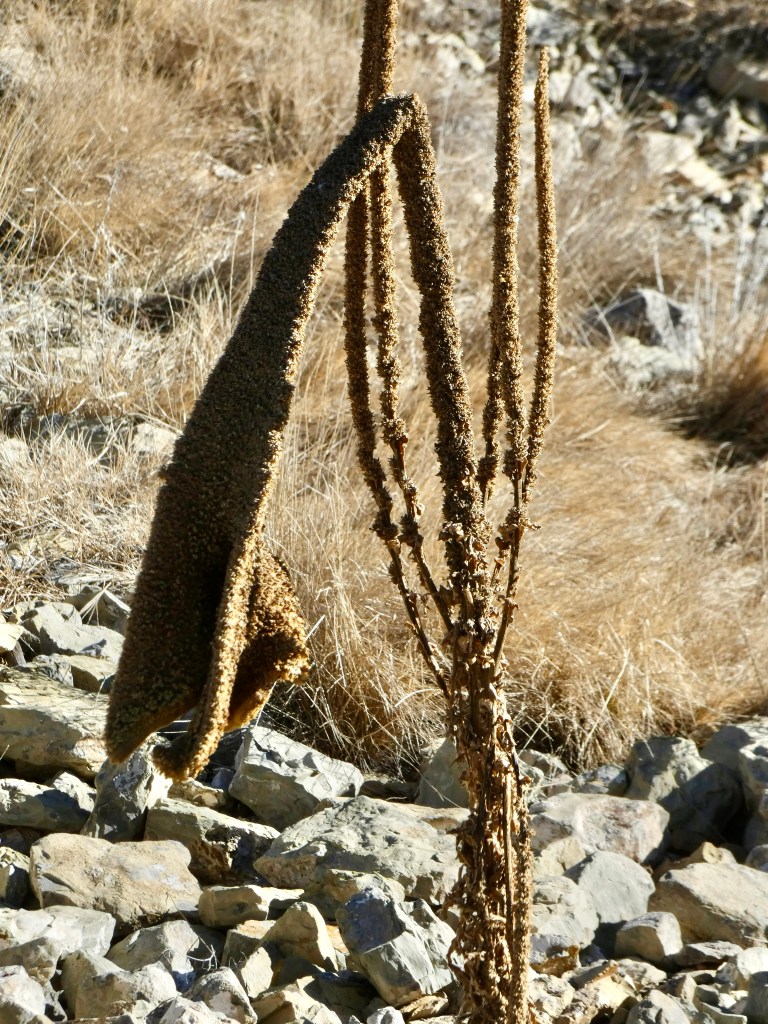
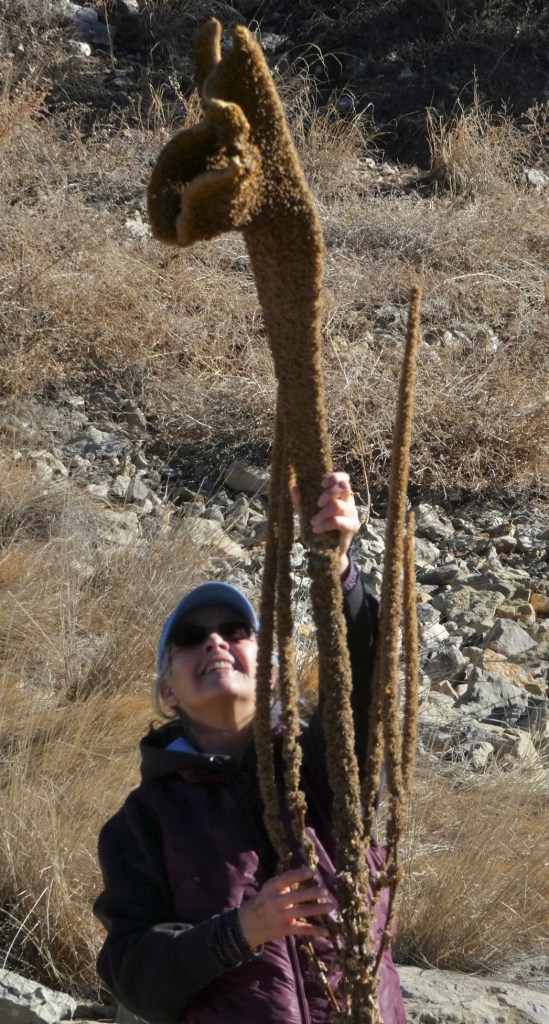
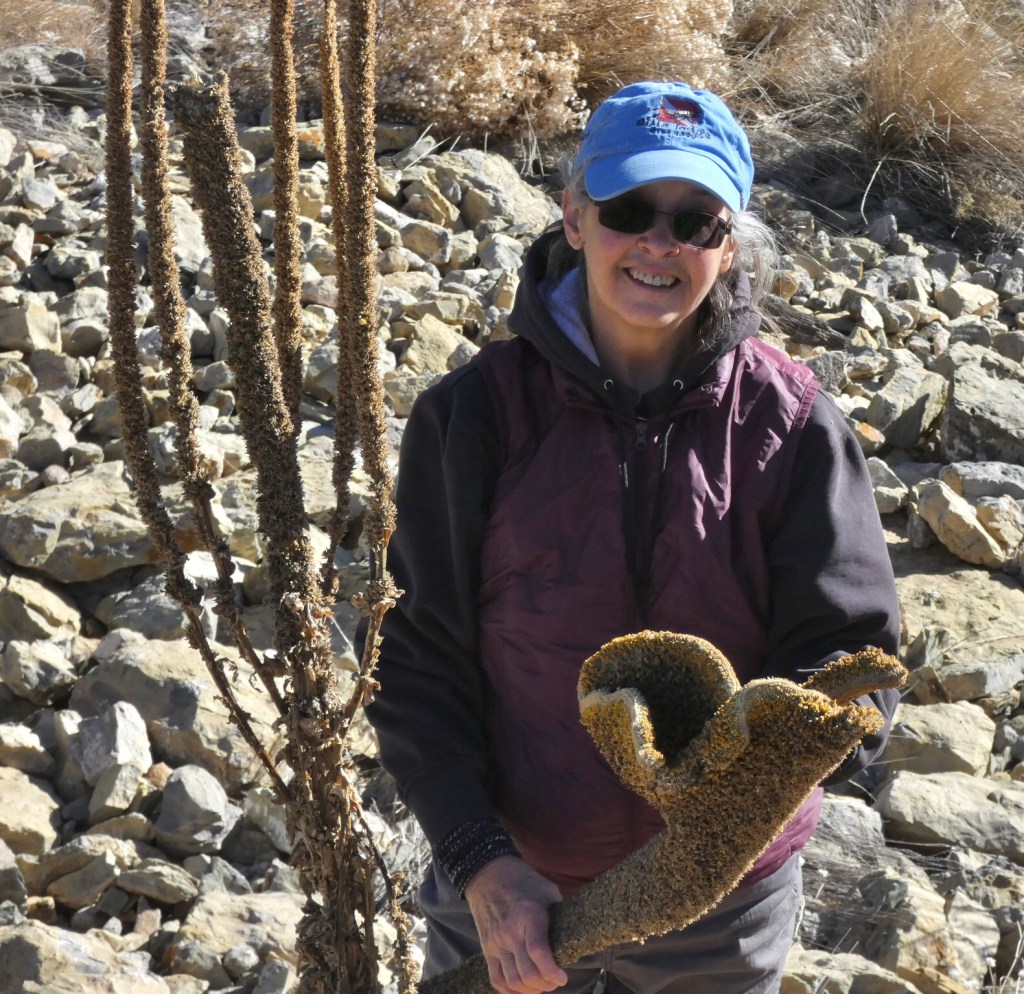
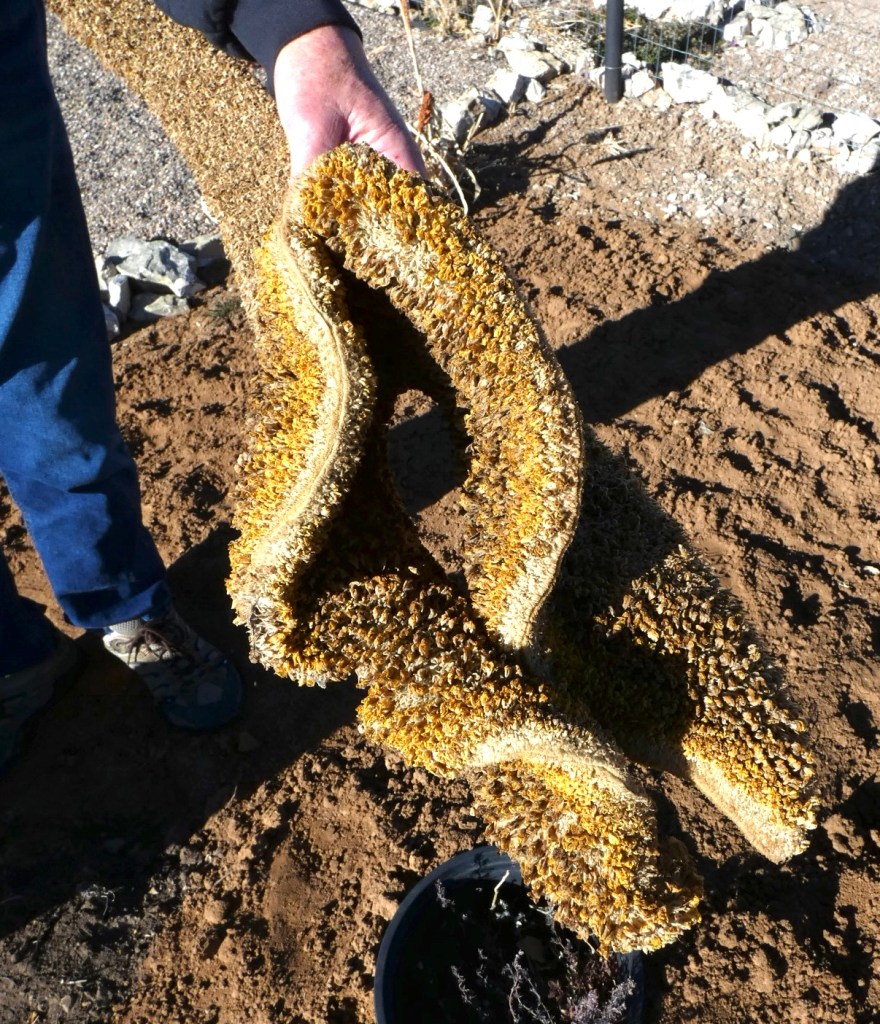
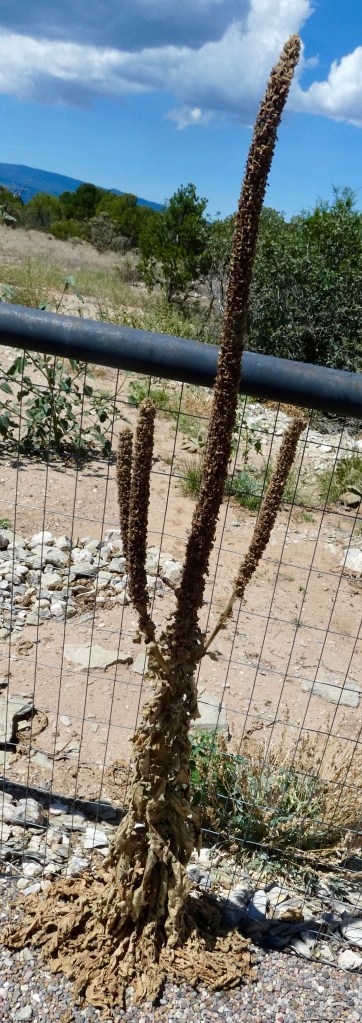
Two years ago while wandering down the “Trash Can” trail, just below the little rocky earthen dam stood an 8-foot tall Great Mullein. This wasn’t just any ordinary mullein though. The top 2 feet of the flower stalk was crowned with one of the most uniquely contorted, bent and folded mullein crests I’d ever seen. Magnificent!
The “Trash Can” trail Great Mullein plant (long dried) with a very large, deformed flower stalk (a fasciation) that had bent from excessive weight.
The top-heavy mass, supporting scattered flowers and many hundreds of growing seed capsules had begun to dip and sway dangerously in the light Fall breeze. While watching and wondering what cause(s) of this rare and exaggerated growth, known as a “fasciation,” the heavy stalk moaned (really!). All I knew on that morning along that trail was that the stalk’s lean would soon take the entire plant to the ground.
Very happy to find this magnificent specimen!
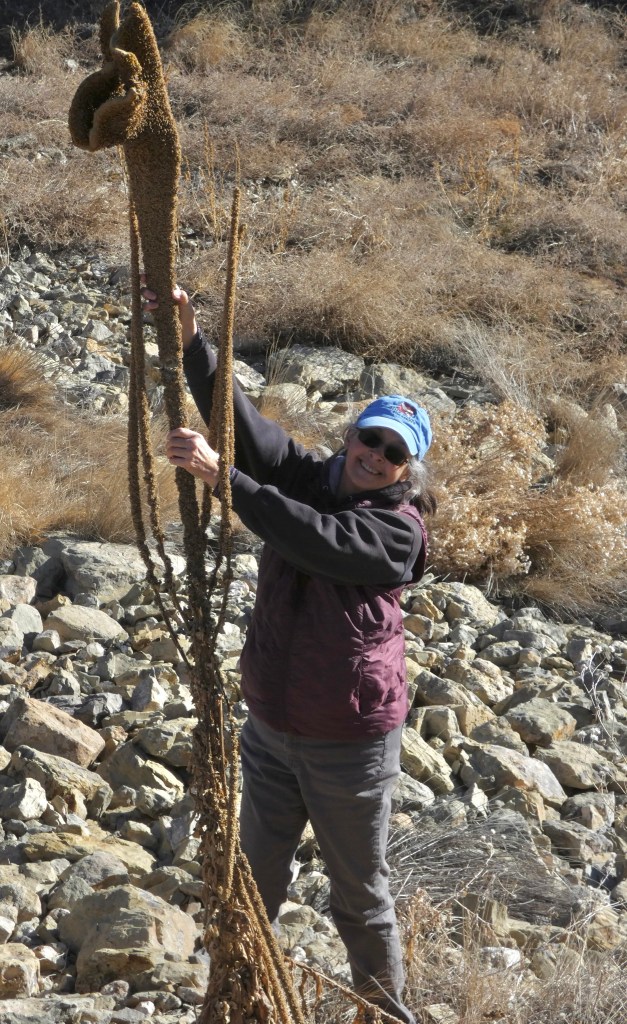
Rushing to the rescue, I grabbed onto the lower third of the stalk, hoping to somehow rotate the top 180°. It was at that moment, when nothing moved, I realized just how heavy that flower stalk was. Then, as my eye blinked only once, the upper 2/3rds of the plant broke and came crashing down …… fasciation and all!
Trying my best to save the flower stalk from snapping off.This was a very tall plant!
Lying on the ground in a heap (mullein pieces, not me), Plan B began to materialize. Here was my chance to learn if Great Mullein “fasciates” genetically. So I collected the still-intact contorted and folded crown with its many ripened seed capsules, and proudly carried it home where it spent the upcoming winter hanging out in a 5-gallon bucket while the seeds dried, became dormant, and experienced a natural dormancy-breaking winter, preparing them for Spring planting. So certain was I that my mother plant had passed her “fasciation genes” on to her seeds, that the flowering plants of her progeny would fasciate too.
All my efforts were in vain ….. eventually the fasciated top of the flower stalk broke and crashed to the ground.
(Here’s an excerpt from my garden journal)
Spring 2025 ….. many minute seeds were scattered about our back yard.
Summer 2025 ….. 8 seeds germinated into petite 1st year rosettes
Winter 2025-2026 ….. 7 rosettes were robust enough to survive the winter
Late Spring 2026 ….. all 7 rosettes bolted, and flower stalks began growing; no sign of fasciation
Mid-Summer 2026 ….. woke one morning to find 3 had died — cause unknown (did they get too much hand watering?); only 4 flowering plants still alive; no sign of fasciation; Ladder-backed woodpeckers feasting on something inside countless seed capsules (some kind of insect?). (You can read about my mulleins’ visits from Ladder-backed Woodpeckers in my June 8, 2026 post here)
Of all the plants in our yard growing tall, with multiple flower stalks, this is the only one remaining alive at the time of this post.
Late-Summer 2026 ….. only 1 flowering plant still alive, still flowering, still plumping up seed capsules that are still feeding hungry woodpeckers (there’s so many capsules, they aren’t opening them all, so there may be seed left over for the next generation?)
Fall 2026 ……………….
Thinking back on the last two years, it seems I have a slight case of Mullein Madness, judging from my apparent obsession with the fasciation (fascinating) characteristics of Great Mullein,Verbascum thapsus! If that’s as weird as contorted flower stalks, so be it. I’ll confess to this tho….. many happy hours were not only spent watching my mullein grow, but in combing the literature and published research in search of answers to my questions while learning so much about such a remarkable plant.
Apologies in advance, but after reading the rest of this post (which is quite verbose), you too might just catch a case of Mullein Madness!
Great Mullein (Verbascum thapsus)
—aka—
greater mullein, common mullein, mullein dock, cowboy toilet paper, hig candlewick, Indian rag weed, bullock’s lungwort, Aaron’s-rod, hare’s-beard, ice-leaf feltwort, velvet dock, and flannel; woolly, velvet and blanket mullein; beggar’s, Moses’, poor man’s, Our Lady’s and old man’s blanket
Home, Sweet Home
Native to Europe, North Africa and Asia, Great Mullein is an introduced (a non-native) species in the Americas, Hawaii, Australia, New Zealand, and parts of Japan.
In the U.S., Great Mullein was imported very early in the 18th century and cultivated for its medicinal and Piscicide2 properties. By 1818, it had begun spreading so much that everyone thought it was native. By 1839, the species had spread as far west as Michigan; by 1876, it was growing in California. Today, Great Mullein is common in all 50 states. In Canada, it’s common in the Maritime Provinces, southern Quebec, Ontario and British Columbia, with scattered populations in between.
Happiness Was Watching My Mullein Grow
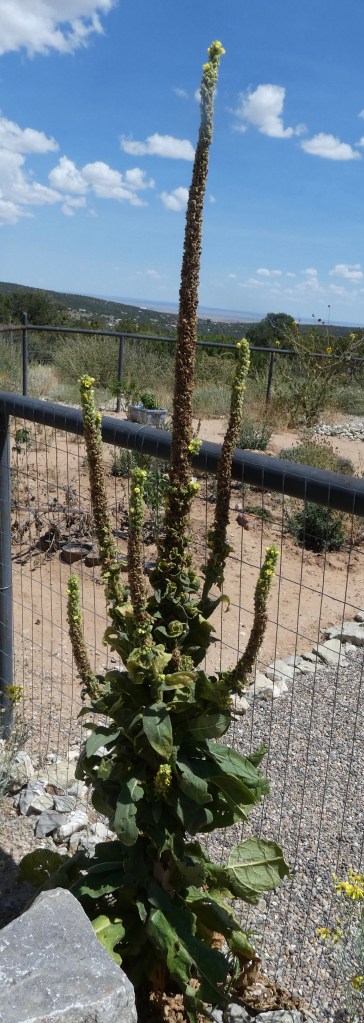
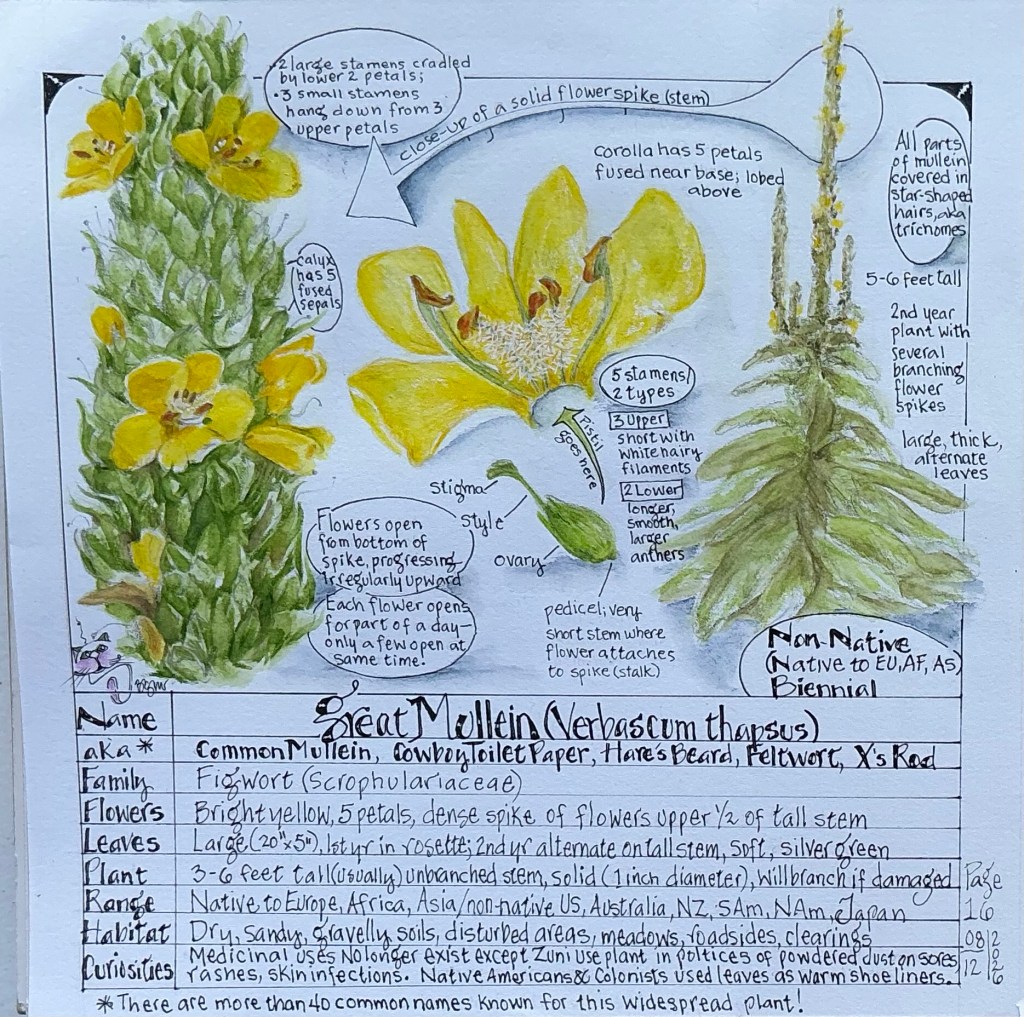
Life cycle: Great Mullein, a biennial (requiring two growing seasons to complete its entire life cycle), needs a winter dormancy period to flower. During its first year, a seed germinating in the spring or early summer develops a showy rosette of large leaves that grows from a taproot. After overwintering, the second year’s growth begins when a solid 1-inch diameter woody stem emerges from the rosette. This single pole-like stem, that can extend 6 feet tall or more, is covered in alternately-arranged leaves along the lower third of its length, becoming completely surrounded with a dense grouping of small flower buds that randomly bloom throughout the summer. Typically, only one stem forms, but if damaged during growth, branching may occur. After flowering and seed release the flower stalk(s) dries up and remains covered in dried brown seed capsules. Dried stalks and any seeds not scattered during fall may persist into the following spring or summer.
Habitat: Great Mullein grows in a wide variety of habitats, but thrives on well-lit disturbed soils, open meadows, and arid or overgrazed rangelands. Viable seeds, that can persist in the soil for hundreds of years, rapidly germinate in the spring soon after the ground warms up. While the mullein can also grow alongside existing plants, growth of the rosettes on bare soil is four to seven times more rapid than under vegetated conditions.
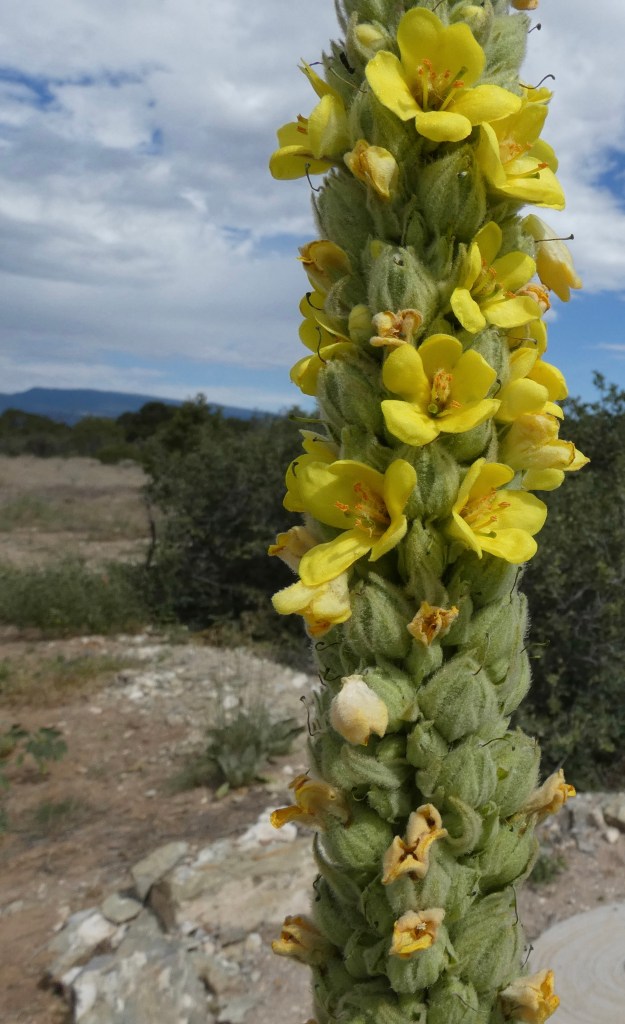
Flowers: Beneath the flower’s corolla (petals) is the deeply lobed, green calyx consisting of 5 hairy, triangular-shaped sepals. The bright golden-yellow saucer-shaped corolla (0.6–1.2 in) is formed from 5 slightly unequal petal lobes that are fused at the base. Attached on top of the petals are 5 stamens of two types: three shorter upper stamens covered in yellow/whitish hairs, and two longer lower stamens that are smooth. The pistil at the center of the flower consists of a superiorovary, a single slender green style, and a two-lobed stigma. Flowering lasts up to three months from early to late summer. Flowers begin blooming from the bottom of the tall stalk (spike) and progress irregularly upward. Each flower opens for part of a day and only a few open at the same time around the stalk. They typically open before dawn and close in the afternoon.
Great Mullein flowers. The lower flowers had closed the day before.
Pollination and Pollinators: Flowers are able to self-pollinate if they haven’t been pollinated by insects during the day. Even though many insects visit the flowers, only certain bees actually get the job done (such as halictid bees (usually dark black or brown, often metallic appearing sweat bees). Birds foraging for insects, such as the white-headed and ladder-backed woodpeckers, are known to feed from the seed capsules covering the flower stalk.
Seeds: Each tiny (<0.04 in) brown Great Mullein seed is marked with longitudinal ridges. Each flower produces a small, ovoid (0.24 in) capsule full of seeds that splits open with two valves when mature. Each plant produces hundreds of capsules that contain up to 700 seeds apiece, totaling anywhere between 180,000 or 240,000 seeds/plant. Seeds germinate in spring and summer on bare soil (or very close to the soil surface) when exposed to light, at temperatures between 10 and 40°C (50 and 104°F).
The seeds are generally too small for birds to feed on, although the American goldfinch has been reported to eat them.
(See the following section for more on seeds.)
Did You Know ………
They Call it Fasciation! If you’re familiar with Great Mullein, you may have noticed some flower stalks don’t always grow straight and tall. For some reason, some tops form weird shapes that may be flat or compressed, folded or ribbon-like, bulbous or crested. These plants have grown what’s called a fasciated flower stalk, the result of a rare developmental mutation. Scientists studying these unusual growths are trying to learn what triggers fasciation, but it remains a mystery. They have, however, identified several potential vectors that may disrupt normal growth:
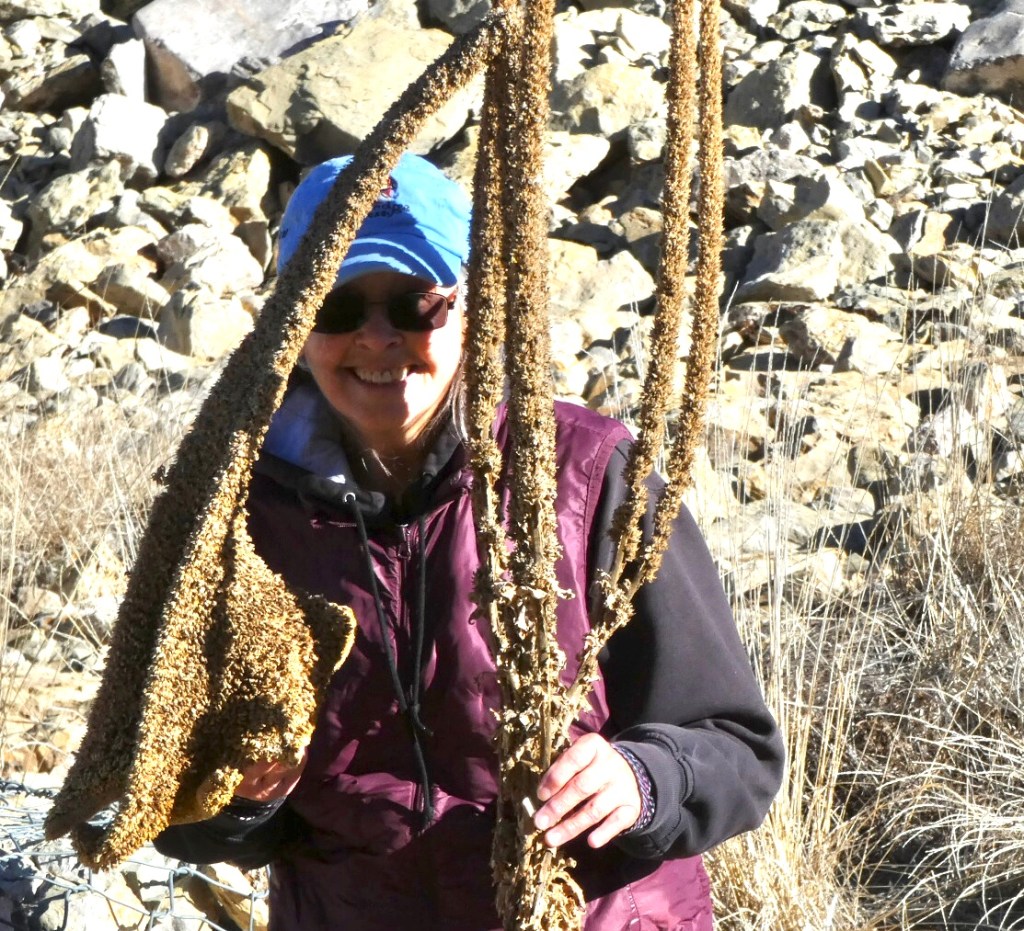
Roy holding the fasciated end of the “Trash Can” trail Great Mullein.
Pests and pathogens: Insect feeding, mite activity, or bacterial infections (like Rhodococcus fascians) can damage or trick the growth tip into abnormal widening, though some field tests found their presence on fasciated mullein as well as on normal plants.
Environmental stress: Severe weather shifts, frost, or chemical/herbicide exposure during early stalk development may shock the growing tip into expressing fasciation.
Physical injury: Mechanical damage to the growing tip is known to disrupt normal elongation, though specific studies carried out on some Great Mullein plants noted that physical damage actually reduced or did not trigger fascination.
And Now! Everything You Wanted to Know About Great Mullein Seeds
Did you know ….. some seeds that germinate in autumn may jeopardize the life of the plant? Rosettes getting a late start must grow to at least 6 inches in diameter or they are likely to die in winter. Regardless, all first year plants that do survive overwintering and go on to complete their life cycle, die at the end of their second year, with some exceptions. Under the best growing conditions, some individuals flower in the first year, only to die the same year. And some individuals, especially in the northern parts of the range, require a longer growing period and don’t flower until their third year. Curiously tho, three-year plants often produce fewer seeds than biennial and annual ones. While year of flowering and size are linked to the environment, most other characteristics appear to be genetic (fasciation is an example).
Did you know ….. decades-old seeds can readily sprout from bare ground, or after forest and range fires, long after Great Mullein plants have died. This ability to quickly grow or even colonize disturbed areas may provide some soil stability, but it does interfer with the natural succession of native species.
Did you know ….. seeds don’t disperse far from a Great Mullein flower stalk? This means plants rarely establish in new areas without human intervention. Seeds scatter naturally when winds or animals move the stem causing 75% of the seeds fall within 3 feet of the parent plant; 93% fall within 15 feet.
Did you know ….. seeds are in the fossil record? Oh My! Discoveries of Great Mullein seeds have been reported from several important geological areas on the British Isles, including:
Cromer Forest Bed geological formation (Early to the early Middle Pleistocene [2 to 0.5 million years ago]) located in coastal areas of the Norfolk region of England;
West Wittering in Sussex in fossil-bearing clay formed during the Eocene epoch around 46 million years ago; and the
Ipswichian interglacial layers falling within the Middle Paleolithic period 130,000 to 115,000 years ago.
Great Mullein Plays Host to Many Visitors
The Good, the Bad, and the Questionable Pests and Beneficial Insects, and Diseases
Represented by 29 different families!
Pests: The majority are western flower thrips (Frankliniella occidentalis), Lygus species such as the tarnished plant bug (L. lineolaris) and various genera from the spider mite family (Tetrantchidae). Other common insects that feed exclusively on Verbascum spp. in general or V. thapsus (Great Mullein) in particular are: mullein thrips (Haplothrips verbasci), mullein moths (Cucullia verbasci), and common stalk borer moths (Papaipema nebris).
Beneficial Insects include predators, pollinators and specialized herbivores, such as:
Honey bees were busy collecting pollen and nectar from my Great Mullein flowers. The flower stalks were a-buzz every morning and into early afternoon when the flowers were open.
Mullein plant bug (Campylomma verbasci) is hosted primarily in summer and permitted to feed lightly on the plant while actively preying on orchard aphids, mites, and thrips.
Leaf bug (Dicyphus hesperus) is hosted year-round as its primary habitat and food source in return for helping to manage greenhouse and agricultural pests like whiteflies and spider mites.
Minute pirate bug (Orius tristicolor) hosted solely as a platform to hunt thrips and other small pests on the foliage.
Predatory mites (Galendromus, Typhlodromus and Amblyseius spp.) hosted year-round on plant surfaces to hunt harmful plant-feeding mites.
Wool carder bees (Anthidiumspecies) hosted as a casual visitor for purposes of gathering the dense, soft/woolly hairs from the plant’s leaves to line their nesting chambers.
Bumblebees, honeybees, hoverflies, butterflies hosted as frequent drop-in visitors throughout the growing season to gather abundant nectar and pollen from the flowers in return for pollination services. Special accommodations are always arranged for the following members of this visitor group known to successfully pollinate the flowers — generalist short- and long-tongued bees, including certain bumblebee species (Bombus spp.), honeybees (Apis mellifera), and assorted solitary bees (small native, wild bees).
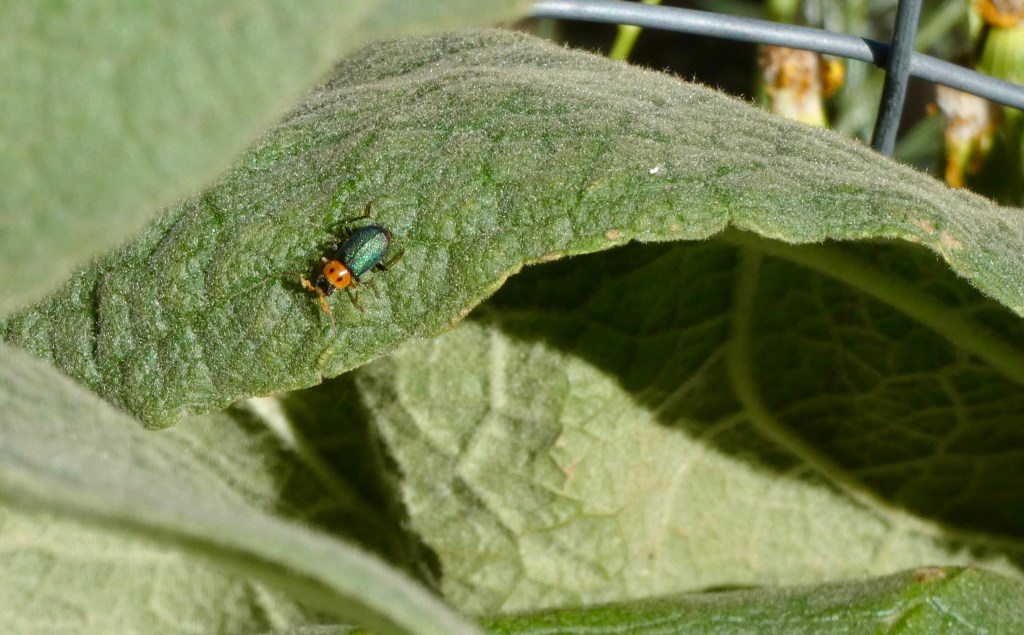
This colorful beetle is two-spotted melyrid (dollops bipunctatus), a predatory insect on mites, aphids and other harmful insects. They were common on the huge leaves on my Great Mullein plants.
Diseases reluctantly hosted by Great Mullein include cucumber mosaic virus — the cucurbit powdery mildew (Erysiphe cichoracearum), and root rot (Phymatotricum omnivorum), along with Cercospora verbasciola; Phoma thapsi; Phyllosticta verbaciola; Heterodera maroni; Meloidogyne sp.; Mycosphaerella verbasciola; Ramularia veriabilis; Septoria verbasciola; and Oidium pyrinum. These microorganisms not only impact the health of the host, but may impact other desirable plants in the area.
A Confusingly Questionable Insect —
The Voracious Mullein Seed-Eating Weevil
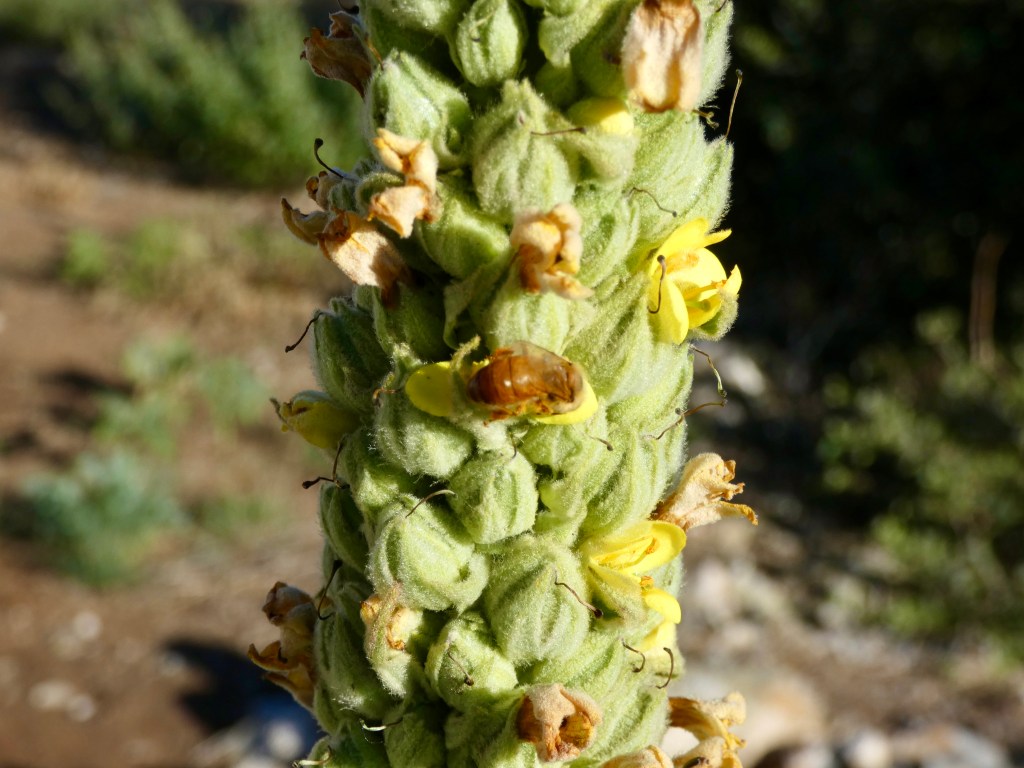
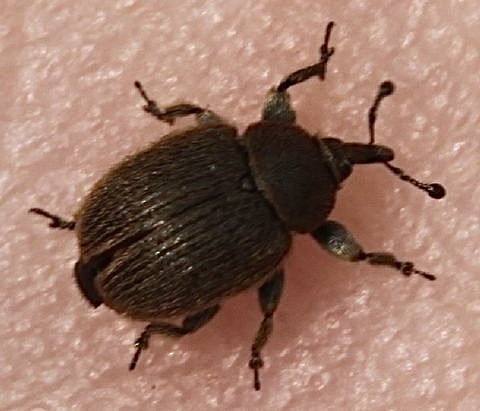
A mullein seed-eating weevil adult. They were found everywhere on all the mullein plants in the yard. Very small weevils made the plant looked like it had been covered in very fine pepper!
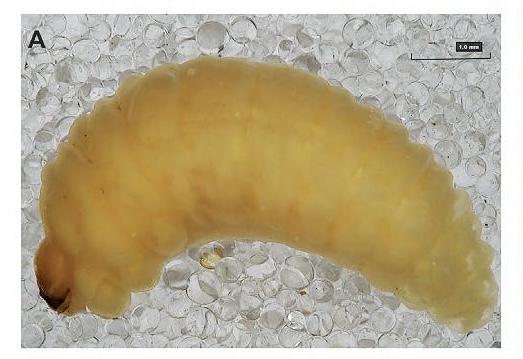
Great Mullein was clearly tricked into hosting the mullein seed-eating weevil (Rhinusa tetra syn. Gymnaetron tetrum) by this demure, sometimes brown to nearly glossy-black beetle that promised to nibble only on leaves and a few seed capsules for the entire 45 days of its adult life. Little did mullein know that this weevil was hiding a secret. When it came to the end of her days (coinciding with flower blossoming) there was only one thing left to do … deposit all 150-200 of her fertilized eggs, two-by-two, into as many flowers as possible, she does this for over an 11-day period, and then she dies. But about 1 week following egg laying, the eggs hatch into larvae (grubs) and commence consuming most of the ~700 seeds in the growing seed capsule. When they’ve about exhausted their food supply, the larvae pupate and finally emerge as adults ~25 days later. The adults remain on the host mullein, munching uninhabited seed capsules and leaves, for 45 days until the next batch of females lays their next batch of eggs, and on it goes, until ….. when the growing season winds down and winter begins to blow in, adult weevils that haven’t completed their life cycle will tuck into a dried seed capsule and hibernate. And larvae that have entered the pupa stage of their lives will remain as such, overwintering until late spring when warmer weather triggers completion of their metamorphosis and the adults can safely emerge, ready to begin feeding on 2nd year flowering mullein.
Weevil Interlude
The mullein seed-eating weevil was accidentally introduced from Europe in 1876, to control the spread of Great Mullein. But back then and for many years following, the weevil was never intentionally used for that purpose. It happened “naturally” as the weevil spread throughout North America, making its living on Verbascum spp. it found on its journey. In more modern times, and because the weevil was never formally cleared as a released biological control agent, local land management and weed programs (such as in parts of the Pacific Northwest and Wyoming) informally recognize it as an already-established bio-agent since its larvae feed extensively on the seeds of Great Mullein. In some regions where the plant is a designated noxious weed, the weevil is viewed as a helpful naturalized helper; in other states—like Colorado—it remains unapproved for intentional release due to a lack of formal ecological impact studies.
The larvae of the mullein seed-eating weevil. By researching the Great Mullein, I learned it was these grubs the Ladder-backed woodpeckers were picking from seed capsules.
Bumper-to-Bumper Weevil Interlude
It seems that using a non-native insect to control a non-native plant is effective in significantly reducing the number of Great Mullein’s viable seeds to limit the plant’s spread. It is also a risky strategy, as many biological slip-ups have occurred in the past when a population of an introduced insect, having depleted its targeted food supply, develops an appetite for other, desirable-to-native-species plants. So far in the U.S., the mullein seed-eating weevil has only feasted on seeds of two Verbascum species—the Great Mullein (its clear favorite) and the equally-alien Moth Mullein (V. blatteria). Because the population of egg-laying adult female weevils doesn’t have enough eggs to lay in all of the hundreds and hundreds of mullein flowers, it’s probably unlikely they will run short of food in the near or far future.
To Weed, or Not To Weed
And What to Do With Unruly Great Mullein
In all areas where Great Mullein has been introduced, it’s recognized as a weedy species. Considered Invasive3 across much of the U.S., Great Mullein is a state-listed Noxious4weed in Colorado and Hawaii, and in several counties in Wyoming, Nebraska and Montana. In these states it aggressively crowds out native plants in dry or open ecosystems.
In other areas of the U.S., opinions on the ecological impacts of Great Mullein vary. Some land managers primarily view it as a short-lived pioneer species on heavily disturbed ground that eventually fades as native vegetation recovers; others classify it as a persistent invasive weed based on its seed longevity. Where agricultural crops are grown, impacts are generally considered minor — the ability of Great Mullein to outcompete most crops is limited because it’s shade intolerant and doesn’t survive tilling. Where it may become invasive, individuals are easy to remove by hand, even though populations are difficult to eliminate permanently.
Control Measures that Work: Mechanical methods that control the growth and/or spread of Great Mullein are the most effective. The best means is by hand pulling and hoeing, preferably followed by sowing of native plants. Regular cultivation is known to be adequate for the control of mullein. Tractor-mounted mowers or scythes can be used to trim the plants when they begin to flower. Repeated mowing prevents the flower stalk from bolting, but if mowing is discontinued then the plant will bolt and produce flowers anyhow.
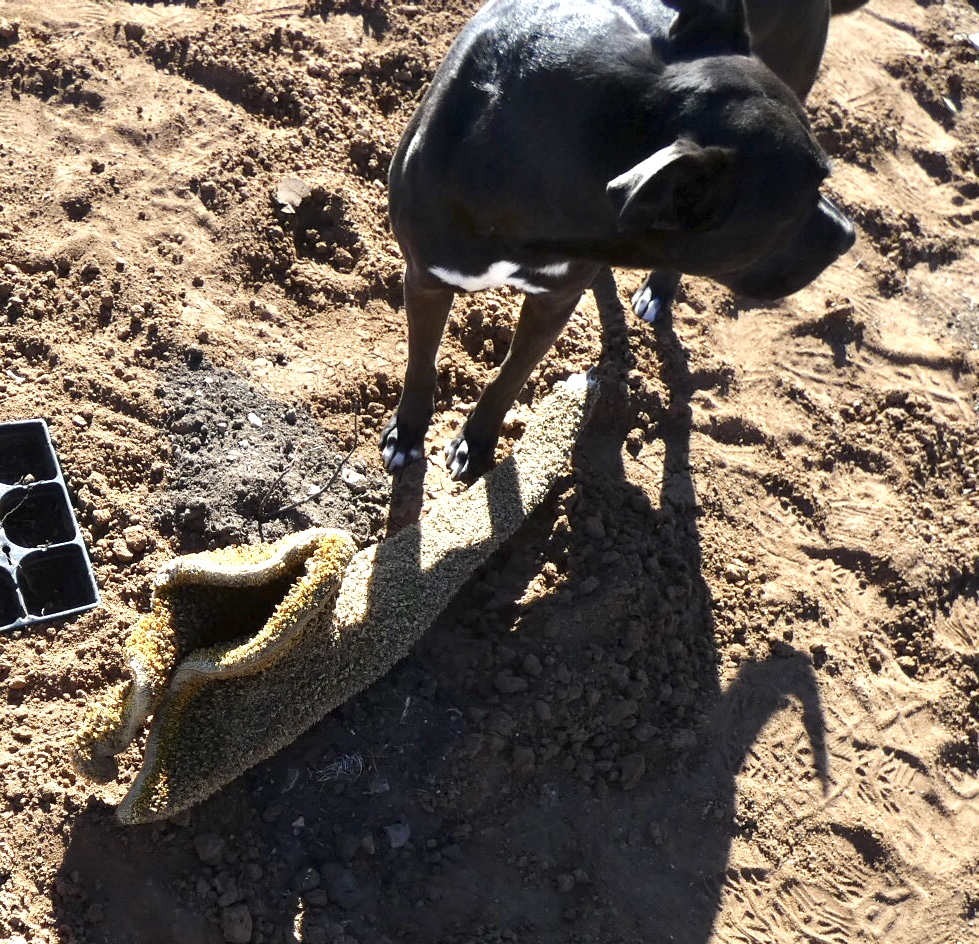
Luna standing next to the rescued fasciated flower stalk, keep watch for thieves!
Not Worth the Time or Effort: All parts of the plant are covered in dense, star-shaped hairs (trichomes). Cattle and sheep avoid grazing the plant because biting into these hairs is irritating. Goats may find the plant edible, but studies are inconclusive. Use of contact herbicides is impractical since the hairs cause the liquid to roll off. Ground herbicides when taken up by the roots will damage or kill the plant, won’t kill seeds stored in the soil from previous years, and also denude the ground creating ideal conditions for growing more mullein. It would take decades of annual applications to slow, let alone prevent, new plants from growing. The use of seed-eating chickens has been proposed for mullein control, but has not been studied.
Multi-Use Mullein
Although commonly used in traditional medicine, today there are no FDA-approved drugs made from Great Mullein. Non-medicinal uses, past and present, are curiously varied.
Traditional Medicine
Dioscorides, an Ancient Greek pharmacologist and botanist, first recommended Great Mullein 2000 years ago as a folk medicine for pulmonary diseases. Leaves were smoked to attempt to treat lung ailments, a condition that in America was rapidly transmitted to Native American peoples.
The Zuni used the plant in poultices of powdered root applied to sores, rashes and skin infections. An infusion of the root was also used to treat athlete’s foot. Any preparations meant to be drunk had to be finely filtered to eliminate the irritating hairs.
Oil from the flowers was used against catarrhs (inflamed mucous membrane(s) in an airway or body cavity) colics, earaches, frostbite, eczema, and other external conditions. Topical application of various V. thapsus-based preparations was recommended to treat warts, boils, carbuncles, hemorrhoids, and chilblains. The plant has been used in an attempt to treat colds, croup, sunburn, and other skin irritations.
Great Mullein (V. thapsus) was in the United States’ 4th edition of the National Formulary from 1916 – 1936, stipulating that fluid extracts of dried leaves and flowers of the plant was approved as a pharmaceutical drug.
Otherwise Practical and Curious Uses
Roman soldiers are said to have dipped the flower stalks in grease for use as torches.
Romans extracted a yellow dye from the flowers to color women’s hair.
In some cultures, leaves have been used as wicks.
Native Americans and colonists lined their shoes with the plant’s leaves to keep out the cold.
As with many plants, Great Mullein was linked to witches, although the relationship remained undefined. At the same time, the plant was also widely believed to ward off curses and evil spirits.
As mentioned earlier, the seeds, which contain saponins, glycosides, coumarin and rotenone, are toxic to fish and have been widely used as piscicide since the plant’s introduction to the U.S. in the 1700s. Settlers threw the seeds and even the leaves into slow-moving water, allowing the chemicals to spread and stun the fish, causing them to float to the top making them easy to catch.
In modern times, Great Mullein is treated as an ornamental plant.
A first-year rosette turning into a 2nd year flowering plant.
Etymology
From the Greek word etymon, meaning
“literal meaning of a word according to its origin”
Scientific Name:Verbascum thapsus
Genus Verbascum: Originally described by Carl Linnaeus in 1753, Verbascum was derived from the classical Latin verbascum, used for the plant by Pliny the Elder (CE 23-79), Roman author, naturalist, scientist, etc. However, the word “verbascum” was widely believed to be and accepted as a corruption of “barbascum,” from “barba” meaning “beard.” The genus name Verbascum, back then (as it does today), refers to the dense, hairy coating on the leaves and the bearded appearance of the plant’s stamens.
Species (specific epithet) thapsus: First used by Theophrastus (BC 371-287), Ancient Greek philosopher and naturalist, for an unspecified herb from the Ancient Greek settlement of Thapsos, near modern city of Syracuse, Sicily ….. OR ….. it may have come from the ancient Tunisian city of Thapsus.
A first-year rosette turning into a 2nd year flowering plant. Would these huge leaves make excellent shoe liners!?
Common Name: Great Mullein
“Great” was used in the plant’s common name to distinguish it from other more diminutive plants of the same genus Verbascum. “Great” refers to the plant’s tall stature.
“Mullein” evolved from Middle English “moleyne,” by way of the Anglo-French word “moleine,” which came from the Latin root “mollis,” meaning “soft.”
…………………………………………………………………………………………………
Wake up Now! Unless you’ve caught a case of Mullein Madness Fever!
Regardless, hope you found this interesting!
(I promise to write a shorter post next time)
As always, thanks for stopping by!
The End!
1Naturalized – a non-native plant species brought from other regions that now reproduces and spreads on its own without human help, but doesn’t aggressively overrun native habitats.
2Piscicide – a chemical substance that’s poisonous to fish. Piscicides are primarily used to eliminate a dominant species of fish in a body of water, done as the first step in attempting to populate the water body with a different fish species. They are also used to combat parasitic and invasive species of fish.
3Invasive – a non-native species introduced to a new-to-it ecosystem where it spreads rapidly, outcompetes native species, and causes economic or environmental harm. Because it lacks natural predators or diseases in its new home, it easily takes over natural habitats, yards, farms, etc.
4Noxious – any plant legally designated by a government agency as harmful to agriculture, public health, wildlife, or property. These plants grow aggressively, spread fast, and lack natural controls. While many are non-native invasive species, some native plants can also be classified as noxious if they cause severe damage.
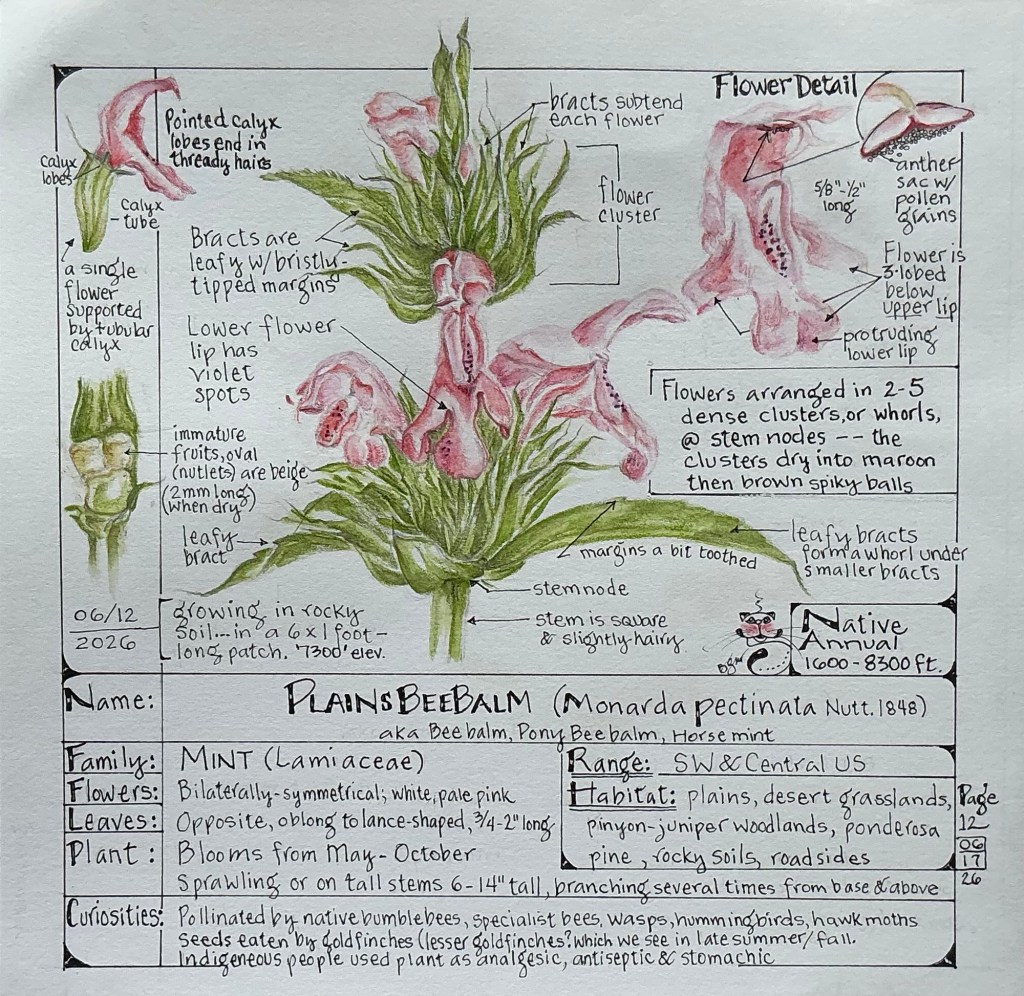
Linnaeus named the genus Monarda to honor 16th century Spanish physician and botanist, NicolásBautista Monardes (1493-1588). Monardes never went to the Americas but was able to study medicinal plants in Spain, publishing the first systematic, in-depth book on medicinal plants and remedies brought to Europe from the Americas.
The species pectinata is derived from the Latin word pecten, meaning “comb.” The suffix -ata denotes possession or resemblance — so it translates loosely to “comb-like” or “having the form of a comb,” referring to the bristle-tipped bracts that sit below flower whorls.
Monarda pectinata is commonly called Plains Beebalm (or Pony Beebalm) because of its historically recorded uses by Indigenous peoples as an analgesic and antiseptic qualities.
Ethnobotanical and Culinary Uses
Indigenous peoples used a plant infusion to treat coughs, colds, fevers, and stomach complaints related to digestion. A flower infusion was used as a wash on insect bites and stings. The plant was rubbed on the head to bring relief from headache. In addition, historic records document that groups, such as the Kiowa, used Monarda pectinata leaves as a perfume due to its strong scent, and were chewed while traveling.
The strongly aromatic smell of crushed Plains Beebalm leaves smell both savory and citrusy, similar to oregano or lemon. Sometimes called “wild oregano,” they can be eaten fresh, dried or cooked to season in salads or other foods. In spring the leaves may be boiled to make herbal tea.
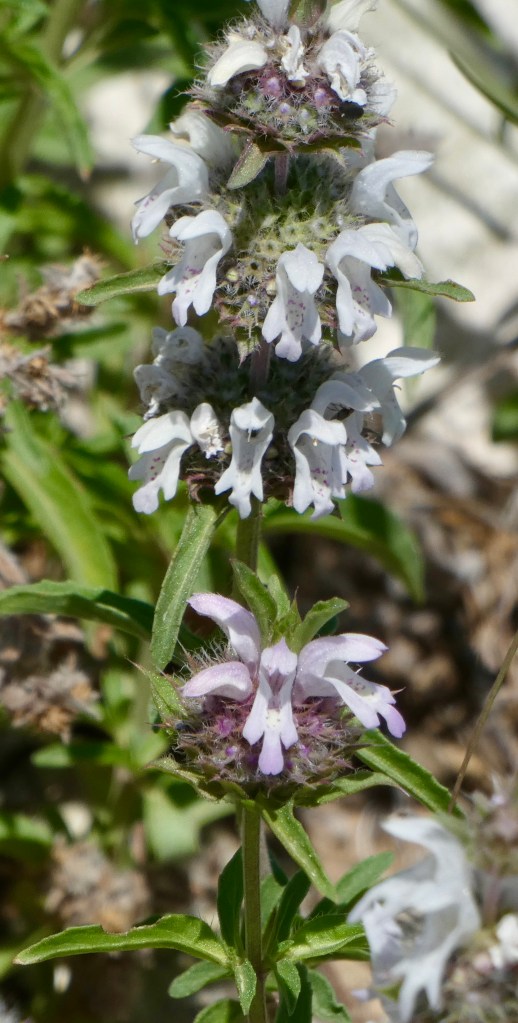
Plains Beebalm blooming in our yard, in bright sunshine and rocky soils.
Pollinators
According to the Xerces Society for Invertebrate Conservation, all Monarda species attract a number of native pollinators such as specialist bees, bumble bees, predatory wasps, hummingbirds, and hawk moths.
A Few Fun Facts
Desert Survivor: Although many Monarda species are moisture-loving, such as Wild Bergamot (Monarda fistulosa) found the along cool trails of Sandia Mountain, Plains Beebalm prefers hot, harsh, dry environments like desert washes, rocky slopes, and sandy pinyon-juniper woodlands.
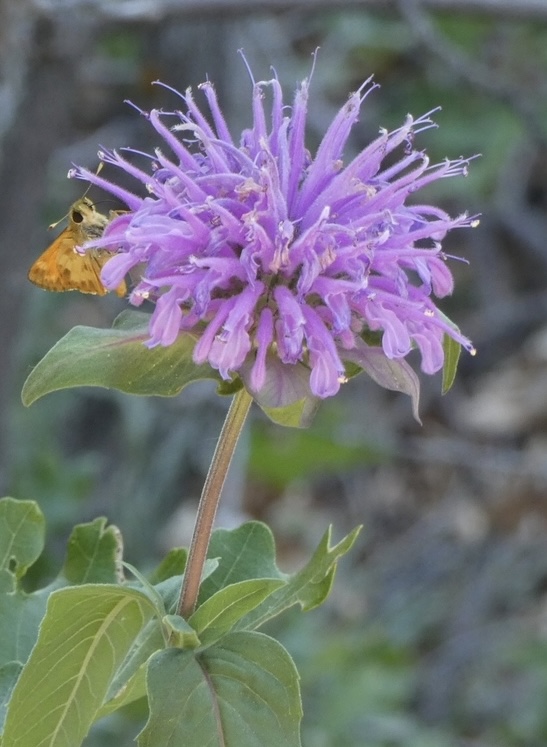
Wild Bergamot and a little skipper pollinator. Tecolote Trail, Sandia Mountain, NM. This Monarda species prefers living in moist soils under the shady canopy of white fir and ponderosa pine.
Mammal Resistant: While pollinators adore Plains Beebalm, its strong, minty-citrusy-oregano essential oils act as a natural deterrent, making the plant resistant to browsing deer and rabbits.
Pollinator Magnet: The tubular pale pink flowers of Plains Beebalm are an excellent nectar source for long-tongued native bees, butterflies, and hummingbirds, especially during the hot summer months.
Soothing Relief: Plants in the Monarda genus are commonly called “Beebalm” due to the soothing nature a wash application of the plant, especially the flowers, has on insect bites and stings — particularly bee stings. Turns out plants in the genus contain the active ingredient thymol, a natural antiseptic found in modern mouthwashes.
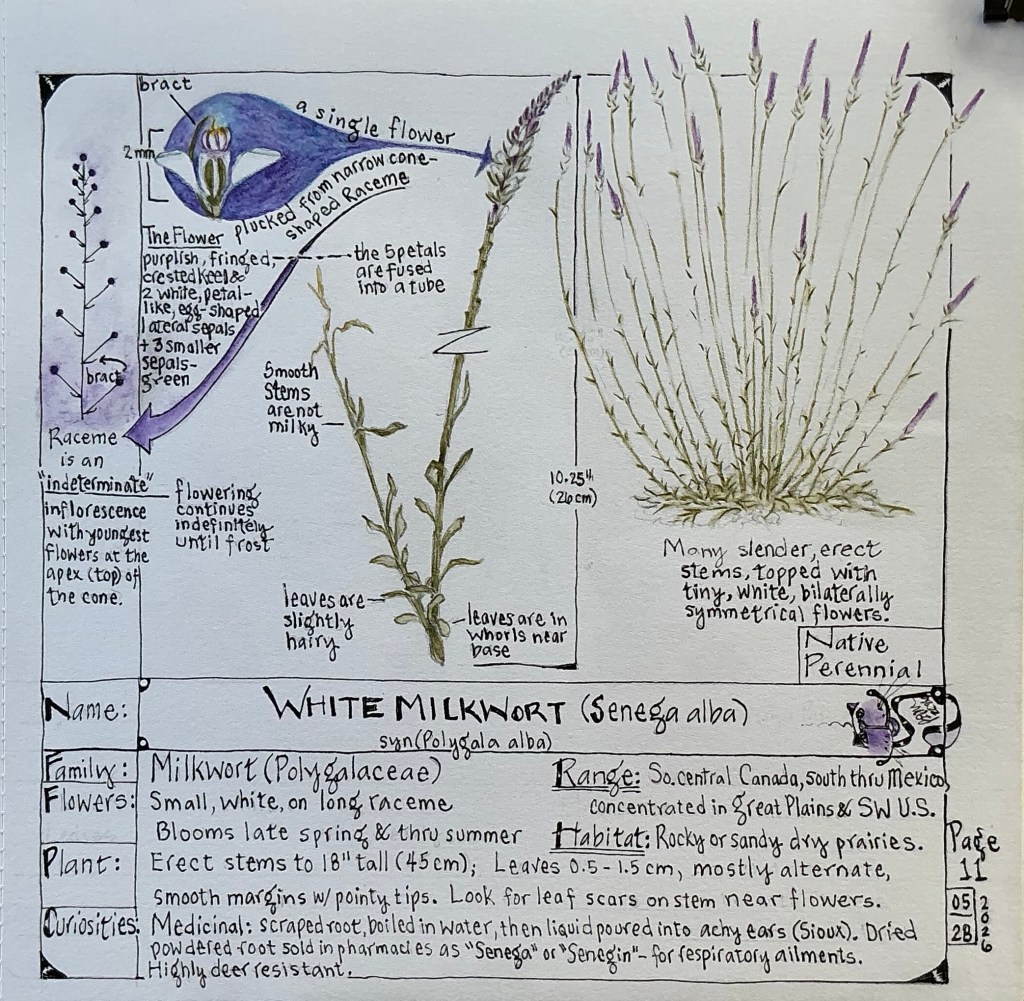
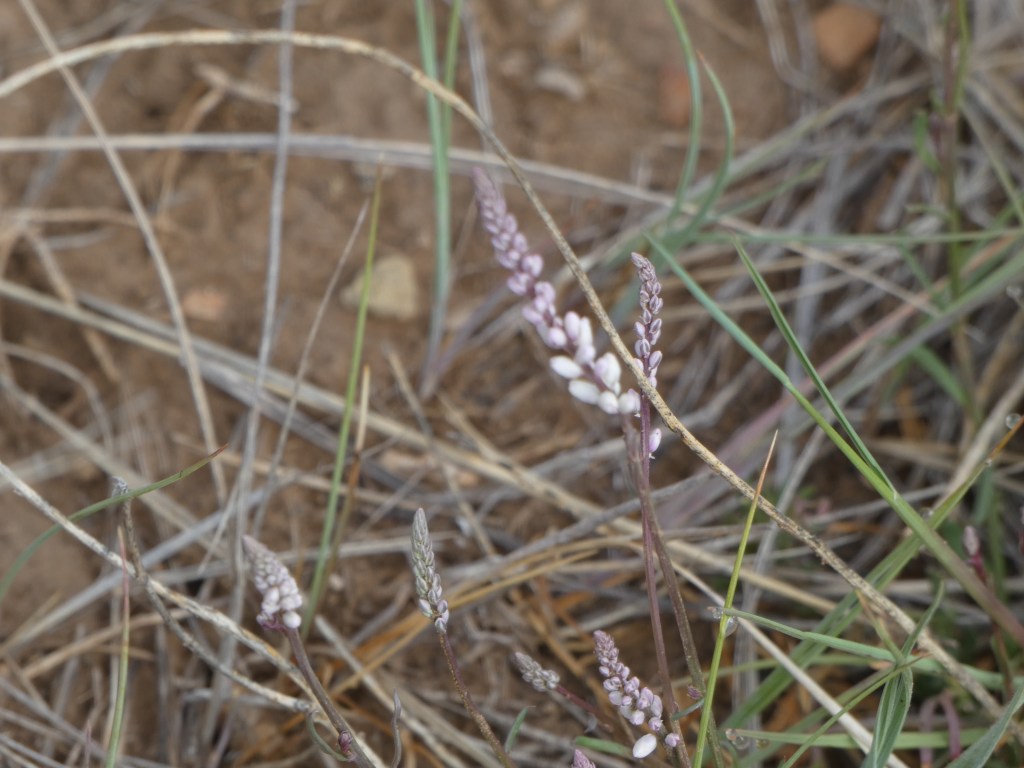
White Milkwort (Senega alba (Nutt.) J.F.B. Pastore & J.R. Abbott)
(synonymous with Polygala alba Nutt.)
A Light Touch
It was a beautiful morning for a walk along one of the neighborhood’s 2-track dirt roads. I was searching for late blooming Spring wildflowers when something lightly brushed against my leg, bringing me to a full stop. There, at my feet, gently swaying in the quiet breeze were a dozen+ foot tall, nearly naked, skinny green stems topped with lavender and white cones. Not wishing to crush these delicate stalks, I noticed there were five other groupings nearby, all growing in the road’s old tire depressions. Upon closer inspection, I recalled having seen this plant before in the yard of our previous home, but they had fewer and shorter stems, and larger (?) flower cones. Still, this was the white milkwort species (back then known as Polygala alba; today called Senega alba) I identified four years ago. It was the larger size and delicate nature of these plants at my feet – that puzzled me.
Here’s what I learned:
The stems, which are ridged, can grow to 18” tall. They branch from a basal caudex (a root-like thickened stem, often found underground, from which branching/stems grow …… and the more extensive the caudex, the more above ground stems form.
You can roughly age this perennial milkwort by counting the number of vertical stems. Typically there’s one stem on seedlings and one-year old plants; as many as 30 stems have been counted on much older (many, many years old) plants.
Even though the official flowering period ends late summer, if mid-summer/early fall rains (our monsoon season) are plentiful, another bloom period peaks and can continue into November. It’s been reported that when old flowers are removed from these milkworts (deadheaded), the plants will bloom continuously for up to four years! Obviously, those plants are not impacted by winter frosts.
The 90% of the pollinators visiting white milkwort are small to medium solitary or semi-solitary bees. Where we live (desert southwest), many of these ground-nesting bees are floral specialists, and based on research dating back to the early 70s, green metallic bees highly favor this native plant’s flowers for nectar and pollen. And with extended bloom times prompted by monsoons, this helps benefit these and other bee species. Unfortunately, the timing and intensity of our monsoons is no longer predictable and is likely causing unfavorable conditions for extended flower bloom and the bees.
Always be prepared to encounter a plant that tickles!
Classification and an Etymological Quandary
To learn the story about the old and new scientific names for white milkwort, and why being a botanist way back when and today is so challenging, read the next section on Etymology. It really is quite fascinating!
Etymology
Way back in the day (say, the early 1800s), when Thomas Nuttall, a English botanist, ornithologist, geologist and explorer, needed an unforgettably descriptive binomial name for a new species he’d discovered, “Polygala alba Nutt.” was his choice. The genus “Polygala,” which was originally assigned by Linnaeus to a group of plants with similar-looking flowers, is Greek for milkwort — meaning “much milk; ” the species name “alba” is Latin for “white, bright or clear.”
Thomas, logically picked “alba” as the species name for his new discovery, because the plant had white flowers. However, he apparently chose the “Polygala” genus based on an ancient belief that nursing mothers (and cows) that ate the milkwort plant experienced increased lactation. However, Polygala alba doesn’t have either milky sap or any plant parts with milk! After diving deeper into the Polygala genus as a whole, I couldn’t find any that ooze a milky substance.
The changing nature of botanical classification: It wasn’t until recently (2023 to be exact) that the official report announcing the transfer of 18 Polygala species to Senega, including Polygala alba to Senega alba, was published by botanists J.F.B. Pastore & J.R. Abbott. This change was based on a number of scientifically-researched plant characteristics, which addressed deviations in seed, fruit, and floral anatomy between Senega and true Polygala species. Now I know I need a bigger microscope!
In case you’re curious (I certainly was) there are no Senega milkworts (today referred to as American milkworts, formerly classified under Polygala) with a milky sap. So, despite their family (Polygalaceae) and originally assigned genus name (Polygala), these plants exude a clear, watery sap when their stems are broken.
Why “Senega” was selected as the genus name for all American milkworts: The genus name “Senega” comes from the Seneca Native American tribe. The first use of the name in the English language was in the 1730s; the Seneca snakeroot plant was given the scientific name Polygala senega, to honor the tribe’s traditional use of the root as a remedy for snakebites and respiratory issues.
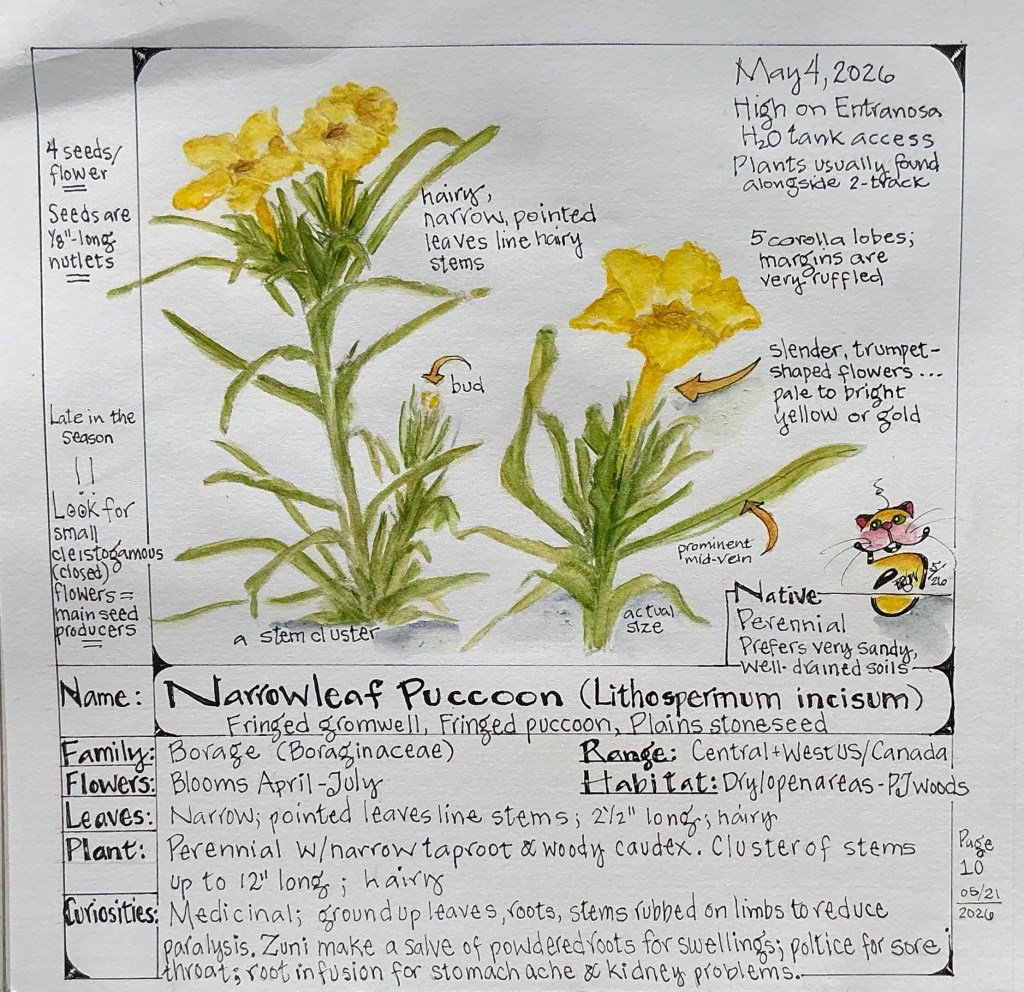
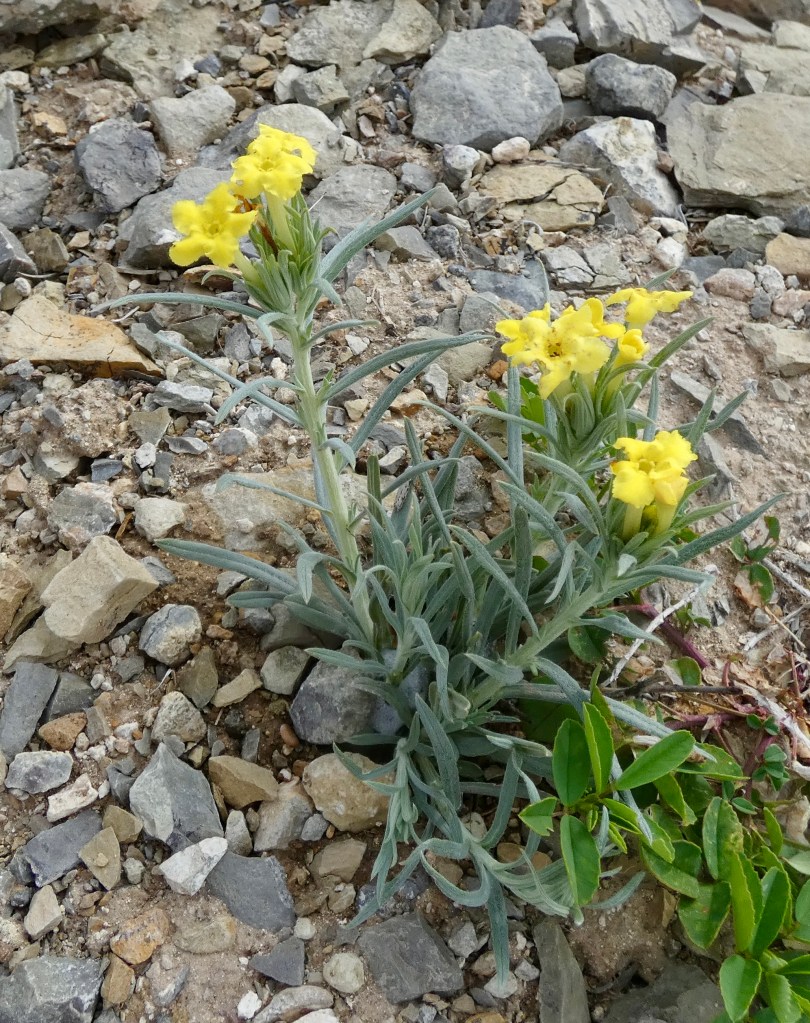
Lithospermum, the genus named by Linnaeus in 1753, is Greek for stone (“Lithos”) and seed (“sperma”), referring to the hard nutlets. And “incisum,” theLatin species name referring to the incised, fringed edges of the trumpet flowers, was named by Lehman (a German botanist) in 1818 from a specimen collected “near the rapids of theOhio” by Andre Michaux (a French botanist and explorer) in 1802.
Puccoon evolved from “poughkone,” a word the Virginia Algonquian language used for plants whose roots yield a red or yellow pigment. The roots of Narrowleaf Puccoon were historically used as dyes ranging from purple to red to yellow.
A Two-Flower Strategy
Very showy and quite lovely, the sunshine yellow trumpet-shaped flowers of Narrowleaf Puccoon are hard to miss. They often cluster at the ends of 12-20” long stems where the floral tube is ringed by five frilly petal lobes. The flowers depend on pollinators like butterflies for cross-pollination which adds genetic diversity to the few seeds they produce. Botanically speaking, these traditional, open flowers with exposed reproductive parts are referred to as Chasmogamous.
Then later in the season, the Narrowleaf Puccoon produces small, petal-less flowers that remain tightly closed. These highly fertile, self-pollinating flowers account for almost all of the plant’s seed production. Botanists refer to this type of closed, often inconspicuous flower as Cleistogamous.
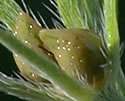
An immature nutlet
The“Stone Seed” Fruit
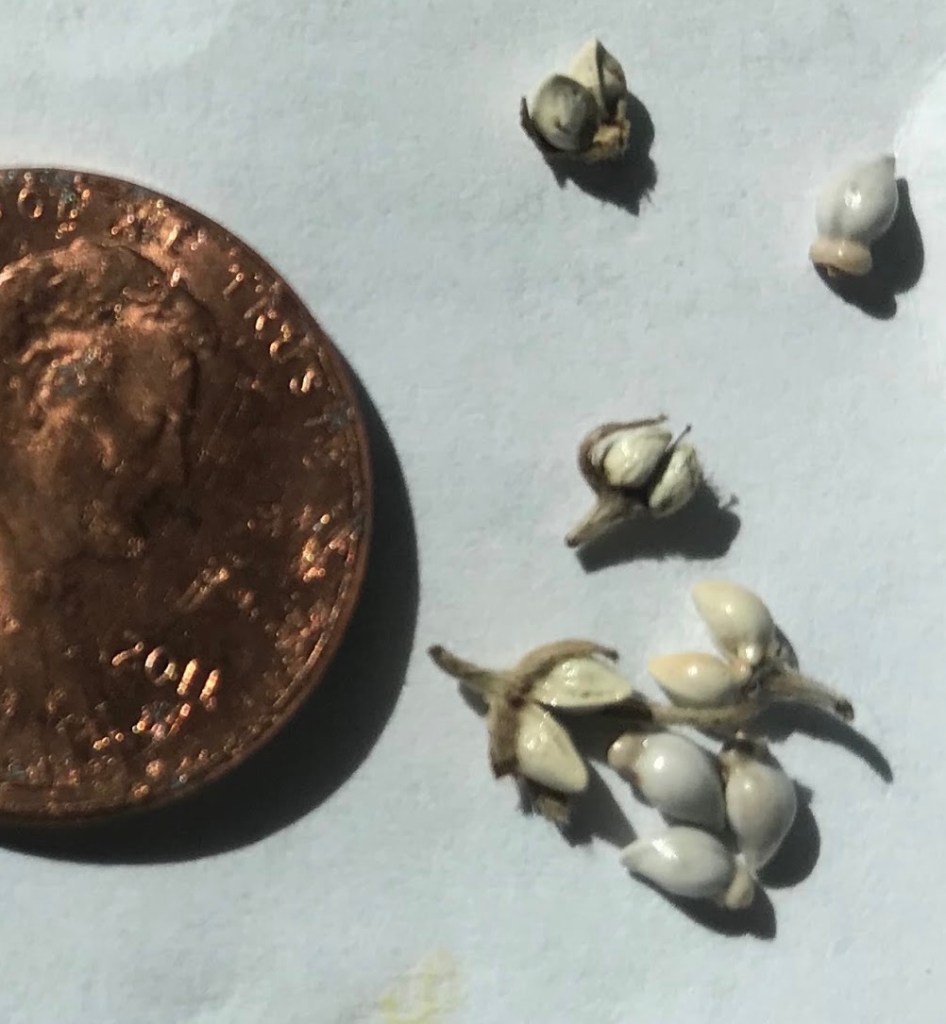
BecauseNarrowleaf Puccoon only produces the occasional fruit from its showy flowers, it takes a bit of searching around the plant’s lower leaf axils to locate a tiny group of up to four hard “stone seed” nutlets. Beginning growth inside the self-fertile, closed (Cleistogamous) flowers that are present late in the season, each egg-shaped nutlet, pitted across the surface, ripens to a shiny white.
Plant Propagation
Seed Germination – To grow Narrowleaf Puccoon from seed, nutlets should be collected in late summer. Soak them overnight in hot water then plant immediately. Because seed germination is sporadic and often disappointing, selecting a desirable location for planting is important. The plant grows best in very sandy, well drained soils found in the dry/open areas within our pinyon/juniper woodlands (though they do grow in soils with some loam or clay).
Shiny white nutlets with Penny for size Photo edited from a post by A Wandering Botanist
Root Cutting – A more successful method may be to take a 2-inch cutting of the taproot in the fall. Dip the cutting in a root stimulant and plant in a desirable location.
Suggestions for root stimulants
Powdered Hormones: Highly cost-effective, have a long shelf life and easy to use. After you moisten the root cutting, just dip it directly into the powder (e.g., Garden Safe TakeRoot) and plant.
Natural/DIY Options: Raw aloe vera gel and crushed, uncoated aspirin both contain natural growth-promoting enzymes. You can also use diluted willow bark extract, which is naturally rich in rooting hormones.
Plant Care – Narrowleaf Puccoon requires full sun and very little water, making it a good plant for xeric gardens or included with other native plants to establish a wildflower meadow.
Photo taken early May 2026 along the Entranosa access road
Medicinal Properties and a Cautionary Note
The Navajo chewed the root of Narrowleaf Puccoon for coughs and colds. They, and the Zuni rubbed the plant’s finely powdered leaves, root and stem on the body to treat paralyzed limbs. An infusion of the root was used for stomach aches and kidney problems. The plant was eaten as an oral contraceptive, and a cold infusion of the pulverized root and seed was used as an eyewash.
Although Narrowleaf Puccoon does have medicinal properties, it contains potentially toxic alkaloids. Self-treatment involving this plant is strongly discouraged.
…………………………………………………………………………………………………
If you’ve seen Narrowleaf Puccoon, did you find their highly fertile, tightly closed flowers and/or the shiny white nutlets? Have you tried growing the plant from seed or root cuttings, and were you successful?
“I have been careless, and so have been thwarted by luck and chance, those wreckers of all but the best laid plans.” ~ J. K. Rowling
Have you ever set foot in a place of business and the first thing you laid eyes on became yours?
That’s exactly what happened to me on April 13th ….
Adoption
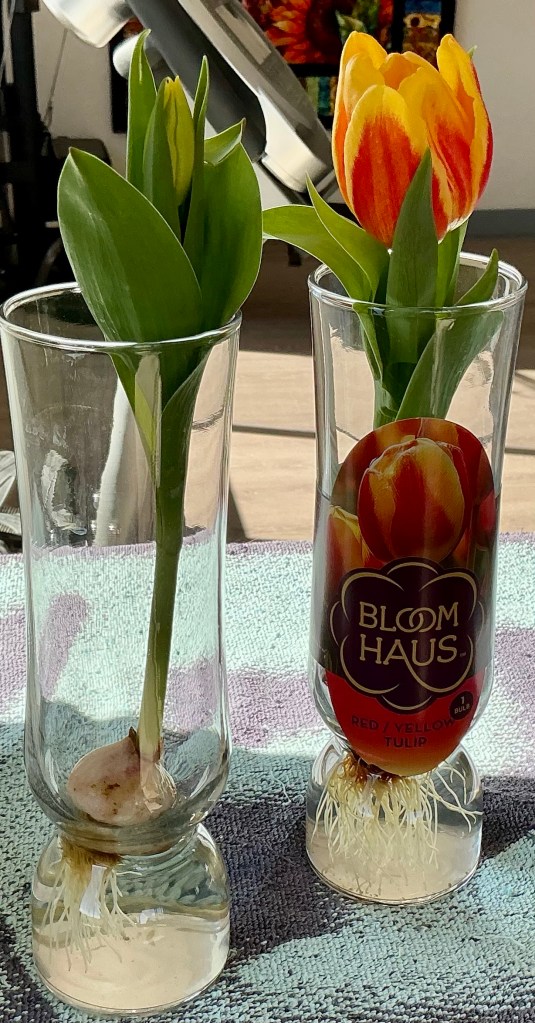
Upon entering a local grocery store, I immediately fell in love with a beautiful display of tulips growing in glass vases, their rooted bulbs producing bright spring green leaves surrounding fledgling flower buds and blossoms! Without hesitation (or consulting my shopping list), two healthy looking plants landed in my buggy! Like a proud parent, I proudly carted these treasures about while finding the actual items on my list, all the while justifying such a frivolous selection (the lovely tulip nearly in full bloom would be a gift for a dear friend; the other with a wee whisper of a bud would be mine to ‘nature journal’).
Nature Journaling
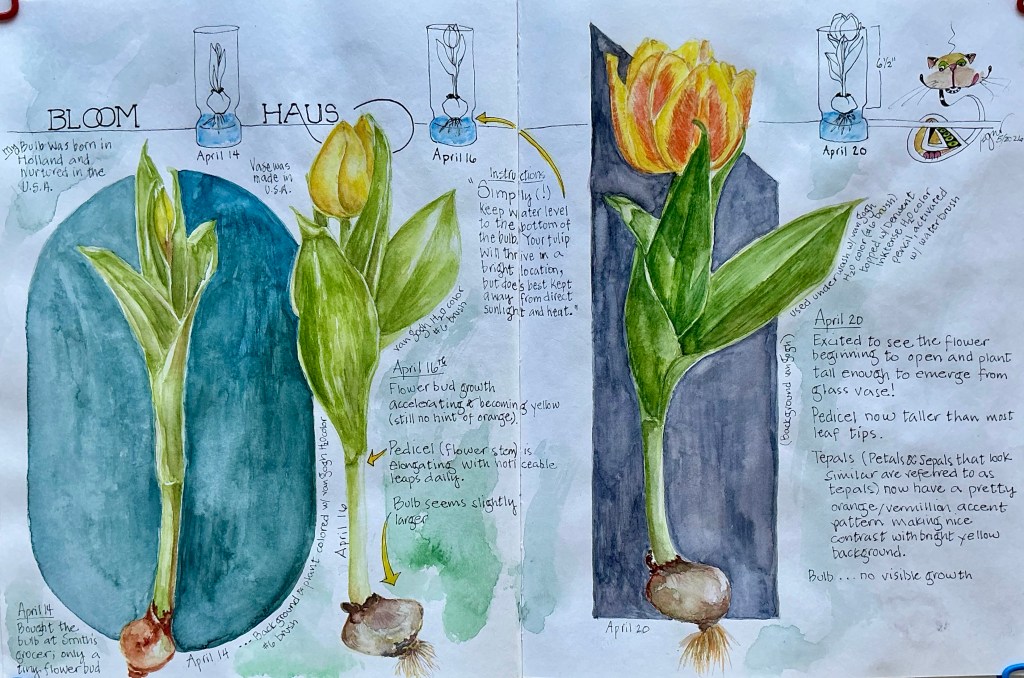
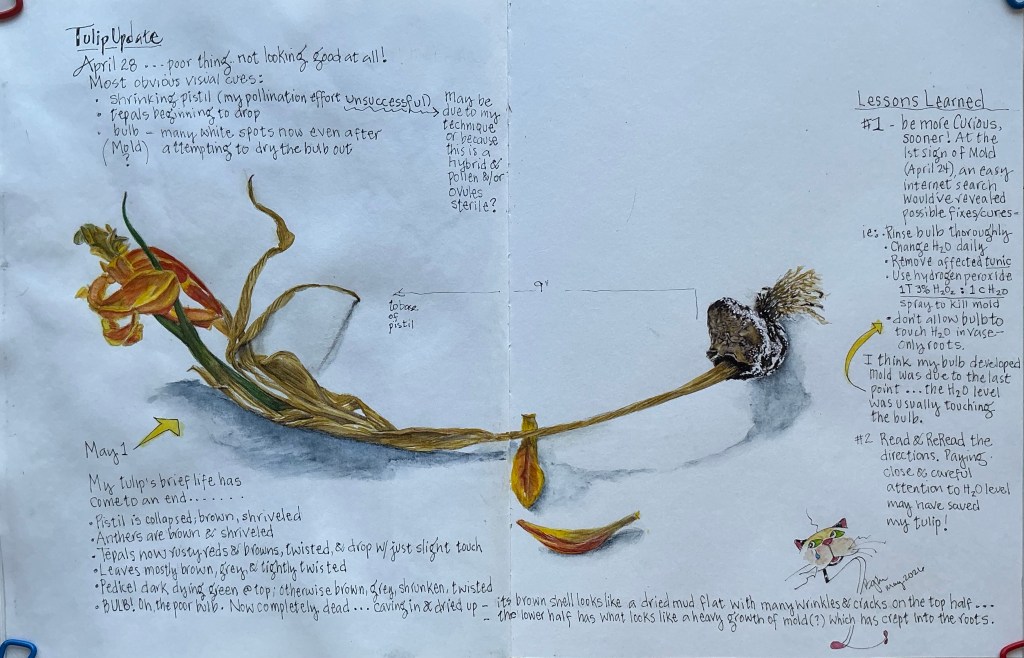
In a few days, my friend was enjoying her new tulip, and I was busy charting the growth of mine in my nature journal. It was amazing how quickly that little bud grew. When it broke free of the vase’s rim the petals and sepals (tepals) began to open, and the yellow became more intense while their centers grew more orange. It was very exciting to see these changes.
Disaster
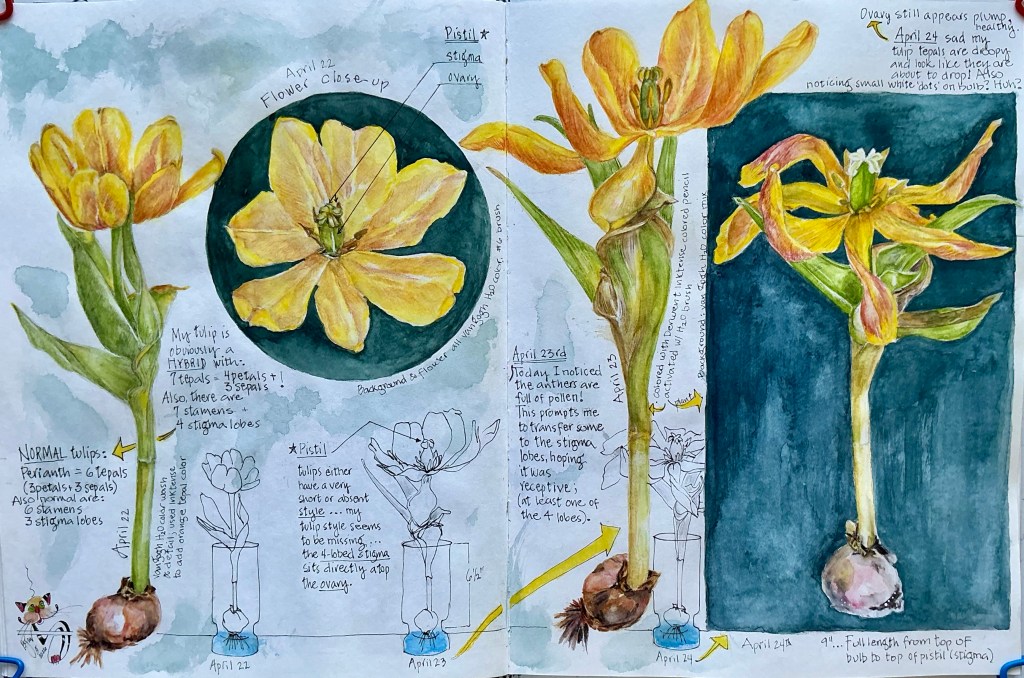
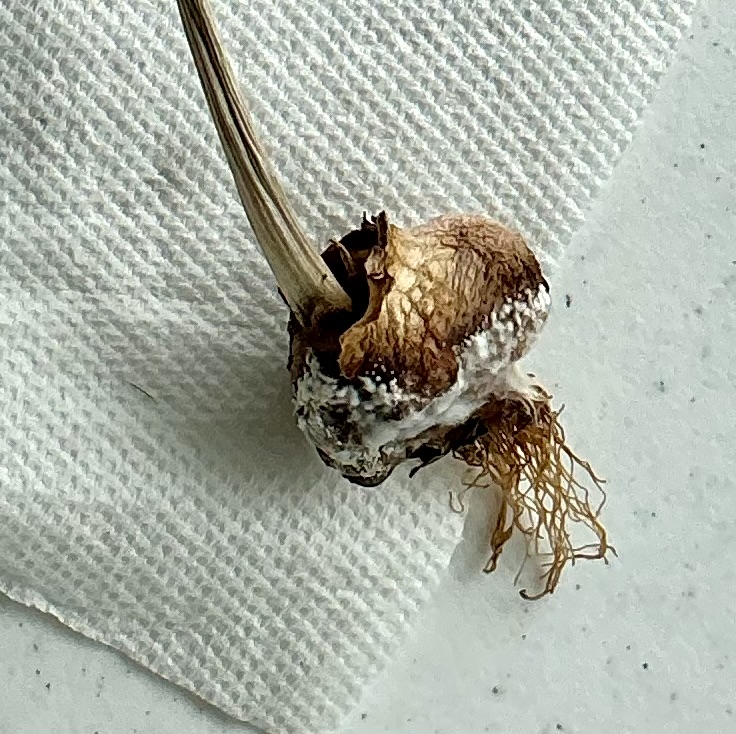
Then on April 24th, something changed. Tiny white dots appeared on the bulb’s papery cover (the tunic) and the tepals drooped. Over the next few days, the white dot population steadily expanded over the bottom of the bulb, along with soft white threads that seemed to reach out from the dots. Mold! A fungus was aggressively devouring the poor defenseless tulip bulb! Why and could it be saved?
Although I’d been careful not to submerge the bottom of the bulb in water, the occasional slip-up had occurred. That, combined with the poor ventilation in the vase and the presence of fungal spores that float naturally in the air made for the perfect mold-loving environment. Even the use of filtered water wasn’t precaution enough to prevent this disaster. Even after gently rinsing the bulb, cleaning the vase and replacing the water with fresh, wasn’t remedy soon enough to save the bulb. The brief life of my adopted tulip had come to an end.
Lessons Learned
Following the demise of my tulip, I scoured the internet for diagnostic clues of a fungal attack and effective first aid. Apparently moldy fungus growth on tulip bulbs is very common, and I learned quite a bit about identifying and treating it in my post-bulb moments. Most importantly, never having grown a bulb of any kind in water (hydroponically), had I begun my aquaculture experiment by searching for helpful tips, my tulip bulb may still be alive. That’s my hindsight lesson.
However, knowing full well my passion for research into any and all things, had I 1) paused just a ‘sec’ and admitted to my lack of knowledge and experience in hydroponic tulip rearing, and 2) gone home to conducti my research in a careful and thorough manner, and 3) returned the next day to buy the two tulips, well ….. they might’ve been sold! (In fact I did return the following day and noticed the tulip display was gone.)
There’s something to be said for spontaneity!
“It’s good to be prepared, but spontaneity is very important — just to let yourself go and let it be whatever it is.” ~ Aron Eisenberg
If you’ve successfully raised a bulbed plant in water, what precautions did you take? If you’ve had an encounter with bulb mold, if you were able to stop it’s rapid spread, what measures did you take to save the bulb?
Hope you enjoyed journal pages I created to chart the life and death of my tulip bulb. Because I was conducting an experiment in hydroponics, I decided to experiment with various watercolor techniques, including trying out something new in adding backgrounds. Please let me know if and which compositions and/or colors you liked. I found experimenting with different watercolor materials and color mixing added valuable lessons for future journal pages. (On my pages I provided a brief description of what was used to color each stage of growth.)
As always, thanks for coming along on my nature journaling journey!
Davis Mountain Mock Vervain (Glandularia wrightii)
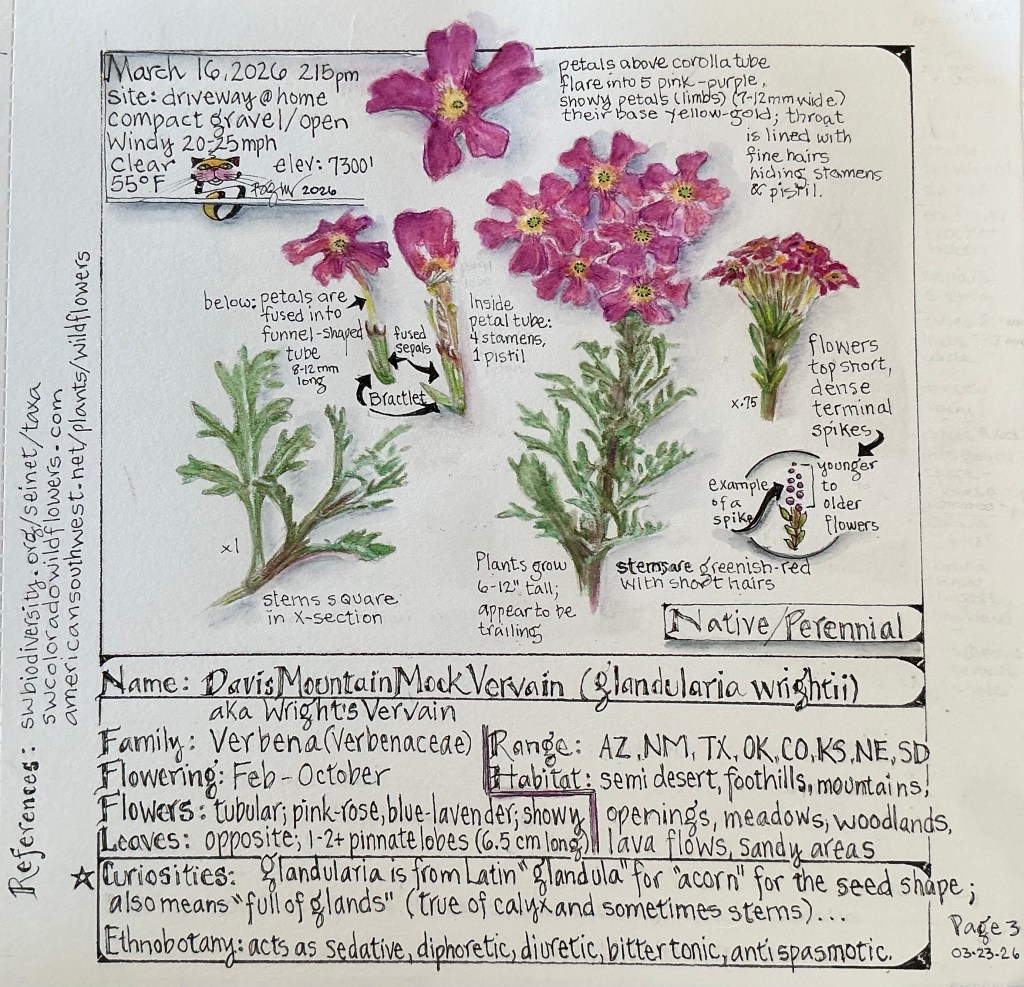
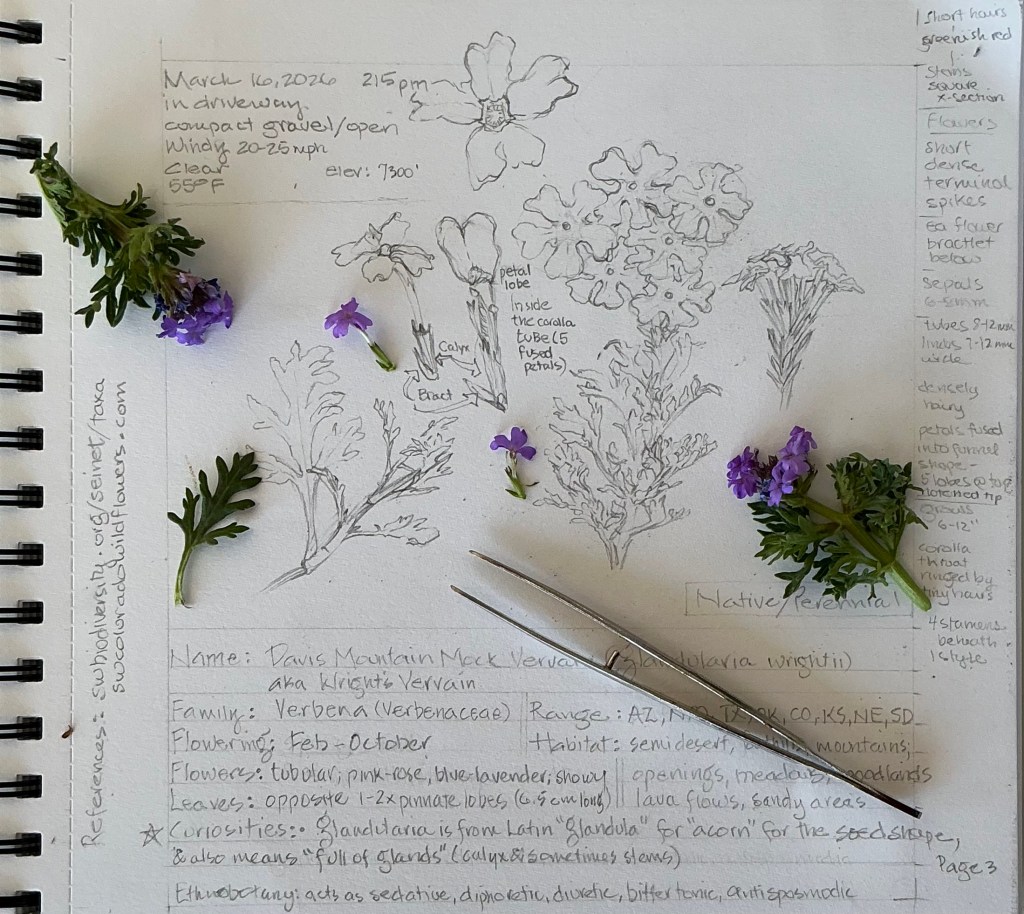
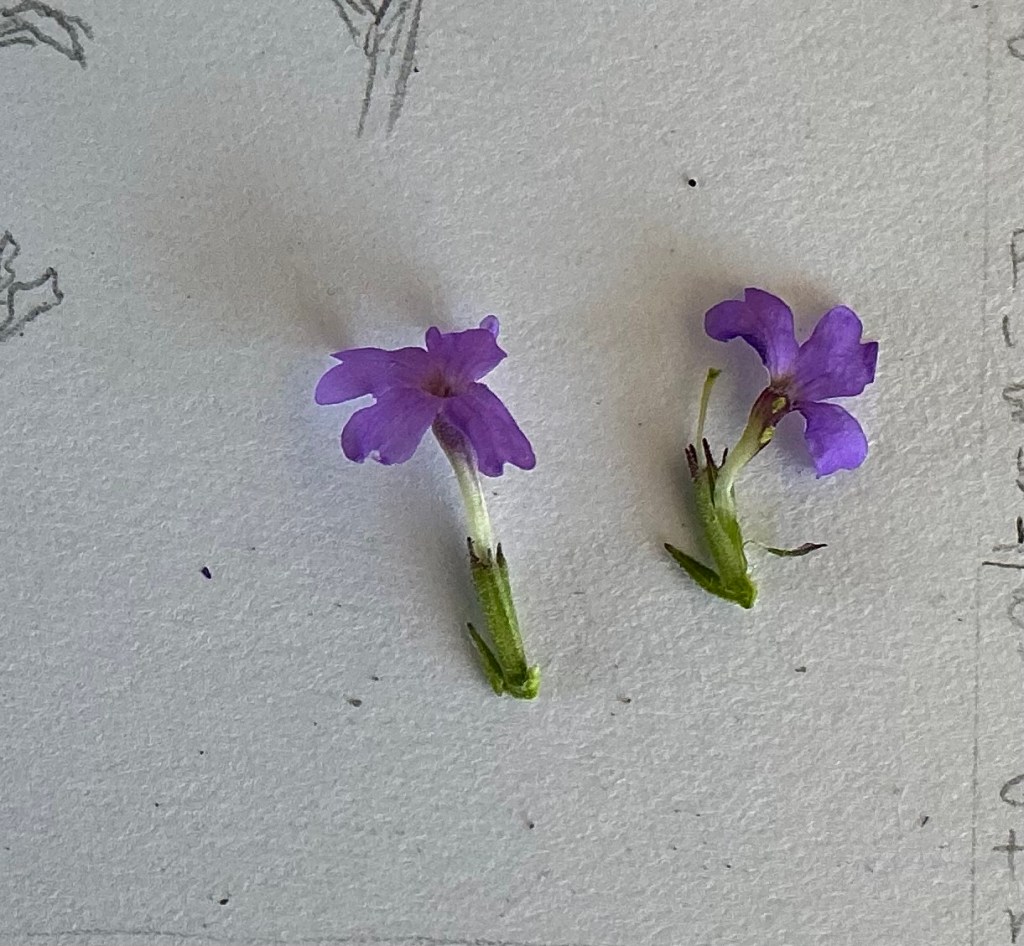
The final pageThis page shows samples from my specimen.. Although the flowers of my specimens are a purple-blue color, I chose to create the flower petals as reddish-pink; this color is also common. This is a photo of the two flowers I sketched for my final painting. The specimen on the left shows the upper part of the flower, the “limb” where 5 petals flair out from the throat ringed by fine hairs. The throat leads to the lower part of the flower – the floral tube (5 fused pale green petals). . Both upper and lower petals make up the flower’s corolla. Below the floral tube are 5 red tipped green sepals (collectively called a calyx) all fused into a cup shape. The specimen on the right is a dissected flower; 2 upper petals are removed, and the floral tube has been opened to reveal the reproductive parts. On the left side are 2 of the female parts of the pistil (pale green style supporting the 2-lobed stigma of the pistil; the ovary was not exposed). Two of the four stamens (male) lie in the mid- to upper right side of the opened floral tube; look for the bright yellow anthers, each sitting atop their own filament
Here’s Another Curiosity to Ponder: I wondered why this plant has 5 petals and 5 sepals but doesn’t also have 5 stamens, which is usually the norm in so many other 5-merous plant species??? Here’s what I learned:
Davis Mountain Mock Vervain (Glandularia wrightii) exhibits a common evolutionary trait in the Vervain (Verbenaceae) family where the flower displays a 5-lobed calyx of fused sepals, and 5 5-lobed petals which fuse into a tube (the corolla). This trait, commonly described as 5-merous, curiously has a reduced the number of functional stamens to four.
This reduction is due to an evolutionary transition from a 5-stamen ancestor. According to literature, the four fertile stamens I observed in my specimens are properly arranged in two pairs (didynamous), both neatly hidden in the floral tube beneath a ring of fine hairs. Also properly so, the filaments (the stalks that support the anthers) of the stamens are fused to the inside of the tube, and not easily teased free.
So apparently, many, many, many, many, Many hundreds of years ago, plants in the Vervain family “decided” having a 5th stamen was unnecessary. “We can do just fine without it, thank you.” Thru the process of evolution, that expendable #5 was ever so slowly reduced to a tiny non-functional structure (referred to as a staminode in modern botanical lingo), or was completely and totally lost, becoming only a memory.
Believe me, this species is an energetic producer of leaves, flowers and seeds. In my experience, Davis Mountain Mock Vervain seems to explode in masses of pink and purple flowers throughout spring, summer and fall, and can last thru winters that don’t freeze. It’s easy to understand why the species has no need of a 5th fertile stamen. Once the plant becomes established, it keeps growing and flowering and spreading, often to the detriment of other desirable plants. If it wasn’t so gorgeous at the height of bloom, it might be considered a weed!
But I’m reminded of the definition of a “Weed ….. a plant out of place.” So yes, you’ll find me actively weeding actively growing Davis Mountain Mock Vervain so my other native plants have a chance at life too!!
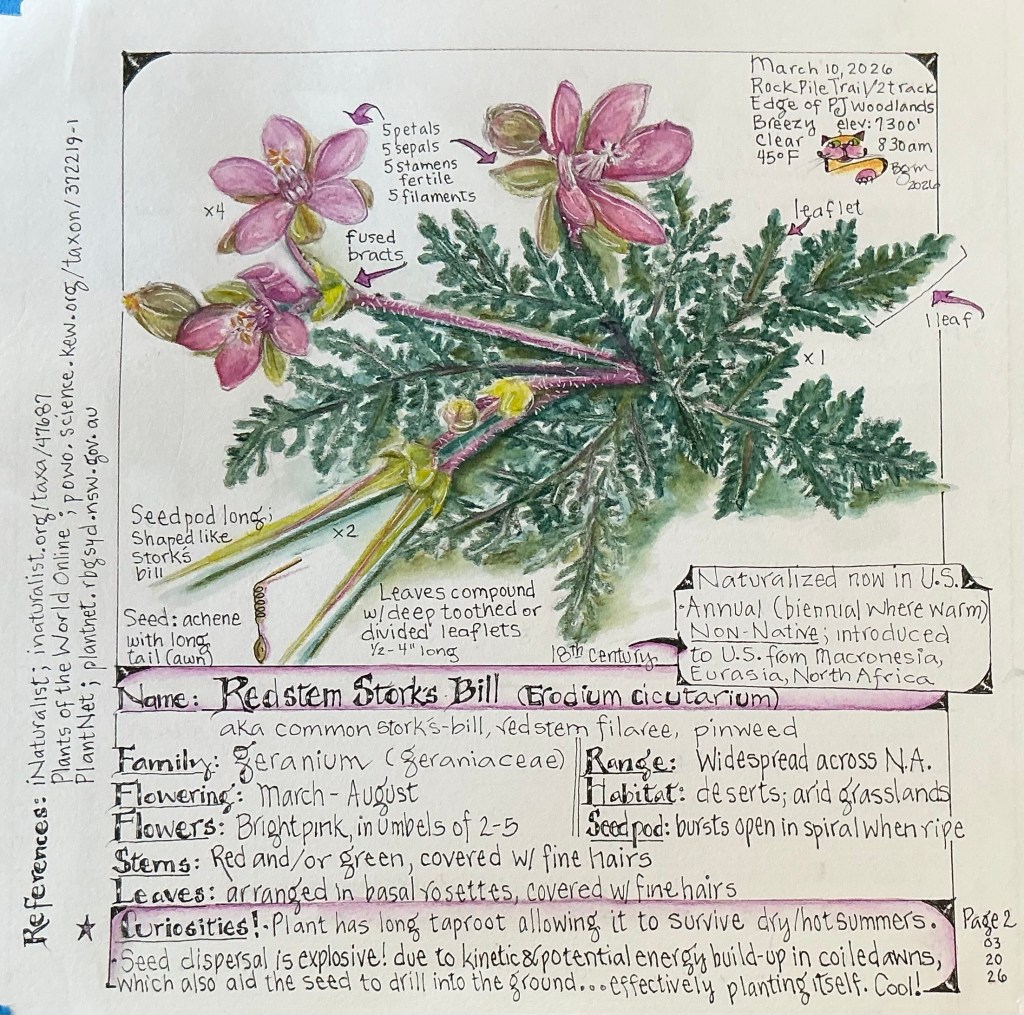
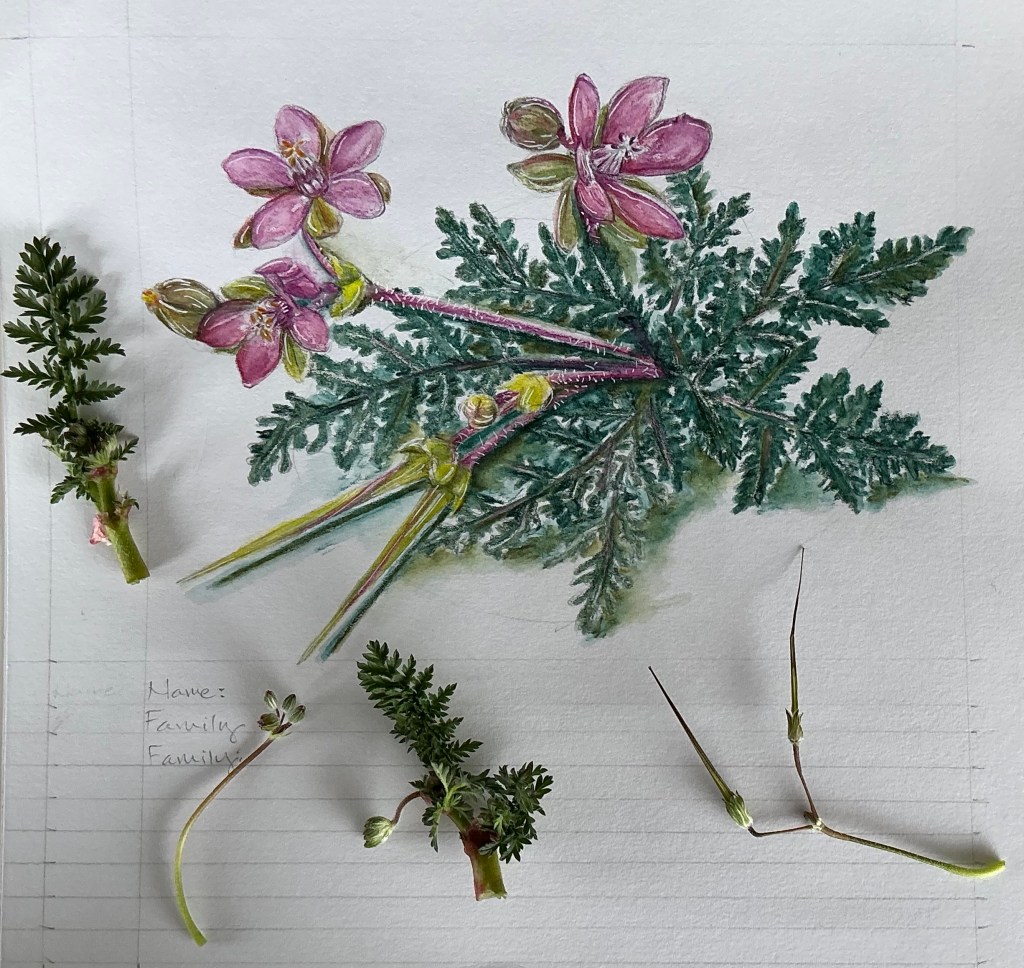
For the last few years my “someday” goal has been to create a nature field guide, of sorts, highlighting my many years of observations in the East Mountains of central New Mexico. Well, my “Someday” is officially here! Coinciding with the February 22, 2026 kick-off of the 100 Day Project1(Project), I began by committing an hour/day to developing that field guide as my project and immediately penciled out an outline and a few thumbnail sketches of a sample page. But, after retrieving my iNaturalist lists of East Mountains sightings I’ve made from home and during countless hikes, eliminating redundancies, and totaling up the individual species, my reported observations still numbered in the many hundreds. I would be working on this Project for the next five to six years!
Interlude
When we moved to the East Mountains in the summer of 2017, we quickly fell in love with the beauty of the wide open landscapes, the grasslands and woodlands habitats, the diverse populations of wildflowers and mammals, resident and migratory birds, and the insects and reptiles. So yes, nature is plentiful; species are many.
Now Back to the Project
Not to be overwhelmed (or defeated) by the potential magnitude of my Project, I decided to:
“Divide and Conquer” by focusing on a single location …. our current subdivision and surrounding area and trails; and
Prioritize quality over quantity by creating one page over two days, keeping each work session to one hour; and
Keep the Project motivating and interesting, by adding fun facts or other research tidbit about each species.
“These guidelines seemed more realistic,” I thought, with a cautiously optimistic chance of achieving my goal of creating a nature field guide.
So with that as an introduction to my Project, here’s Page 1 to “An Illustrated Guide to the Nature of Las Leyendas Subdivision & Environs, Tijeras, East Mountains, New Mexico” — with many more pages to follow. 🤞
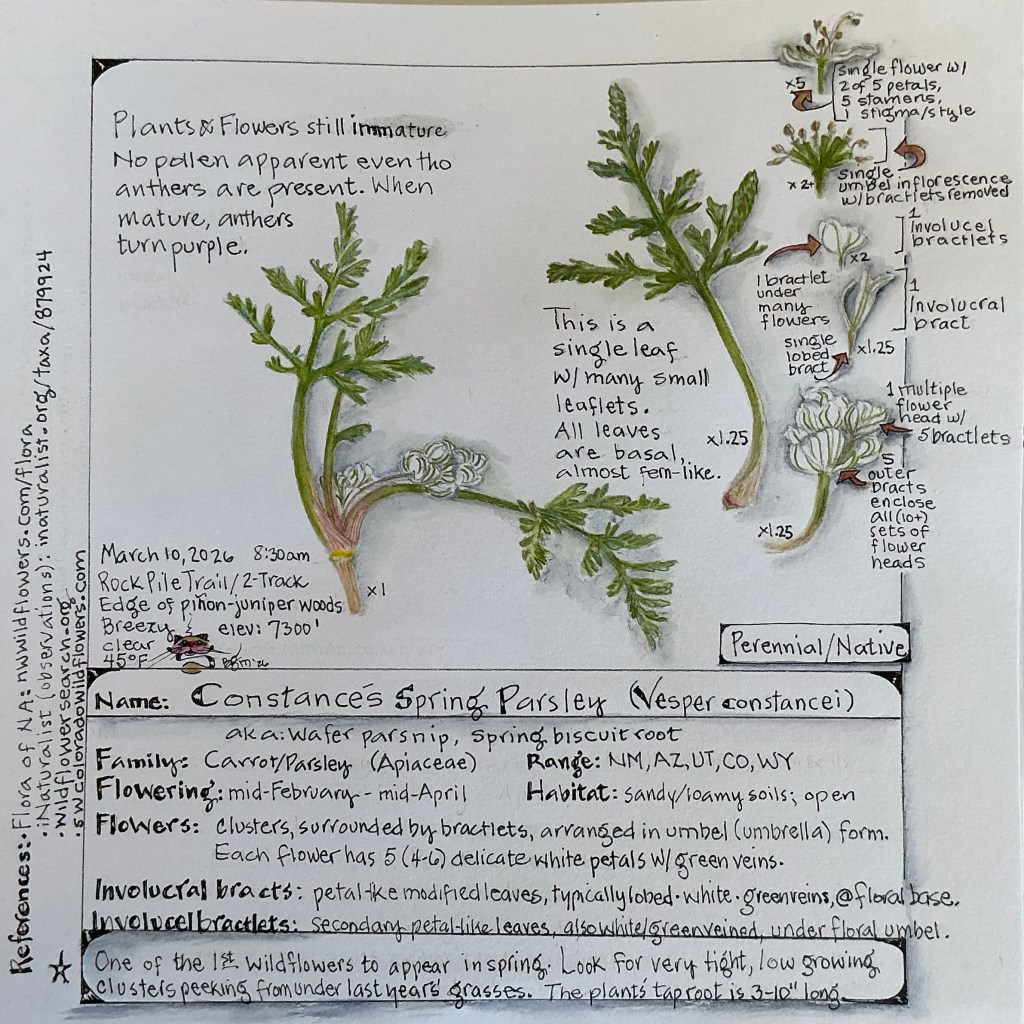
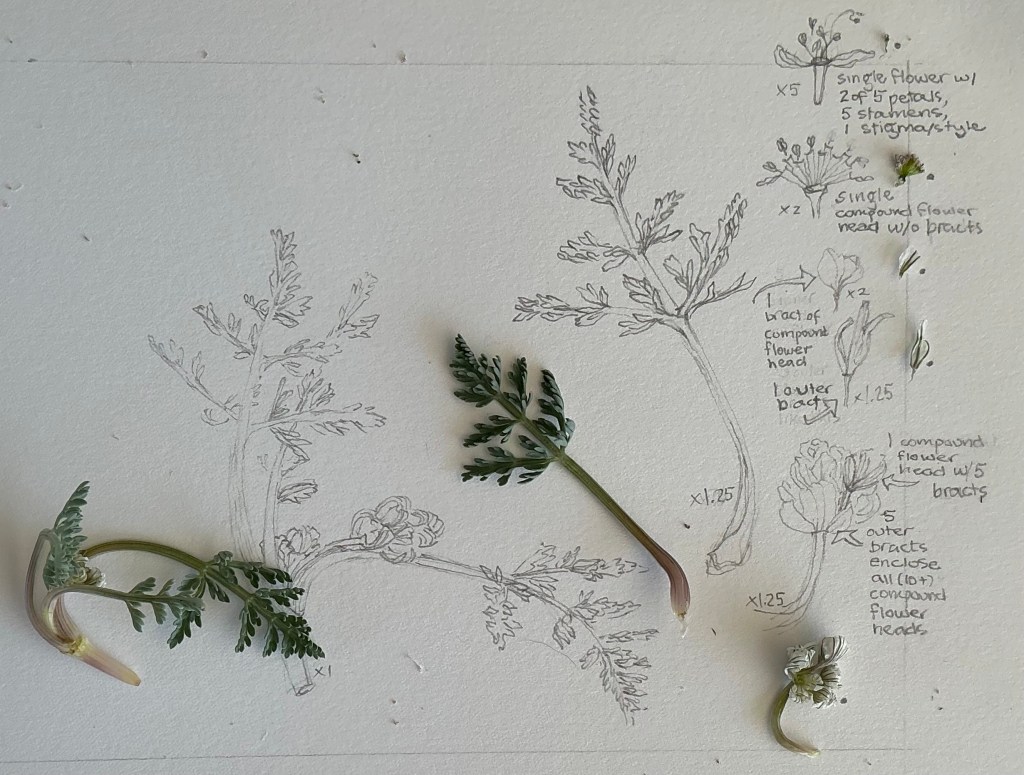
Constance’s Spring Parsley (Vesper constancei)
The final pageAn early draft of the page with live samples of this pretty wild parsley
1“The 100 Day Project is a free global art project that takes place online (https://www.the100dayproject.org/). Every year, thousands of people all around the world commit to 100 days of creating, and anyone can participate. The idea is simple: choose a creative project, do it every single day for 100 days, and document and share your process online. The most recent round of the Project began February 22, 2026, but any day is a great day to begin.”