Late Bloomers …. Fall’s Flowery Foothills

September 26 & 27, 2023


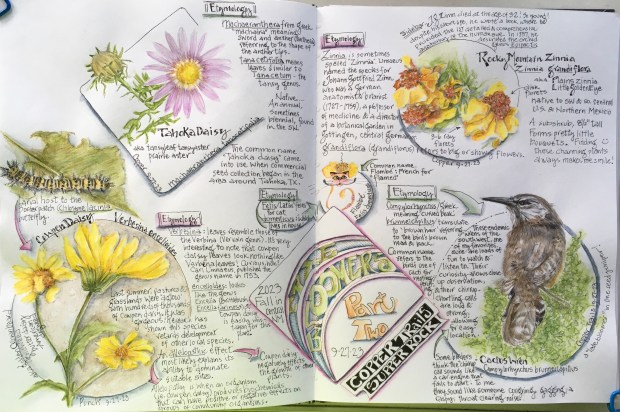
It’s hard now to imagine how extremely hot and dry the summer was this year. Without even a spittle of rain, the 100+ degree temps for weeks effectively suppressed the usual mid-season bloomers in and around the Albuquerque foothills/East Mountains. Even invasive plants, like goathead and tumbleweed, remained dormant or failed to germinate all together. It looked like winter browns had arrived early.

Then in less than a week, a small rain followed by several long downpours flooded the parched landscape, transforming browns to greens. You’ve heard this from me in a few earlier posts, but it was magical, and a reminder about the resiliency of desert vegetation.

Here’s a few pages highlighting a handful of the Late Bloomers I recorded in only 2 days. More than 2 dozen species had sprung back to life, setting flowers at all stages of accelerated vegetative growth. The landscape seemed wide awake. If plants could talk, I imagined them laughing while excitedly chanting, “hurry, hurry, hurry!” Only their roots prevented them from dancing! 

In addition to the species on these journal pages, there are many (more) composites, native grasses, shrubs and sub shrubs, small forbs from Spring and early Summer actively growing and blooming right now, and (of course) the weedy invasives are growing and blooming with wild abandon.
Random thoughts and wonderings ….. are pollinators still hanging around …… or ….. how many of today’s bloomers are self fertile …… are local birds, insects, reptiles and mammals that depend on earlier summer pollen and/or fruit and seed production stressed with this timing change/availability of food sources … will there be noticeable shifts in species composition, including plants, insects, reptiles and animals (including birds) ….. what species can and will adapt to changes, and how quickly ….. etc. The answers to these and many more questions are probably best answered in coming years, if it’s even possible to answer them at all.

Have you observed vegetation anomalies that may be influenced by changes in climate? If so, please share your observations and where these changes are taking place.  Meanwhile, keep your eyes wide open.

“Closing your eyes isn’t going to change anything. Nothing’s going to disappear just because you can’t see what’s going on. ……….. Closing your eyes and plugging up your ears won’t make time stand still.”  – Haruki Murakami.

published October 2, 2023
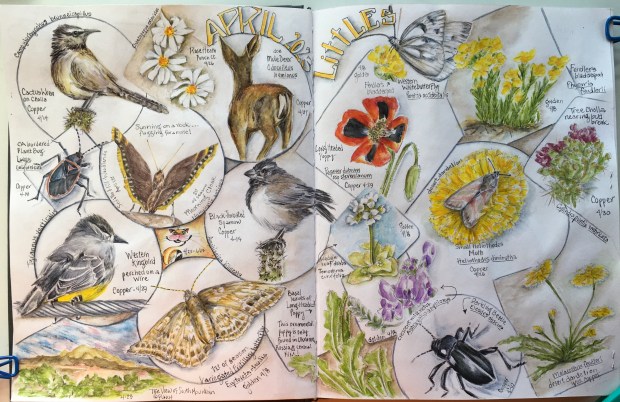
April “Littles” ….. A Rush of Spring!

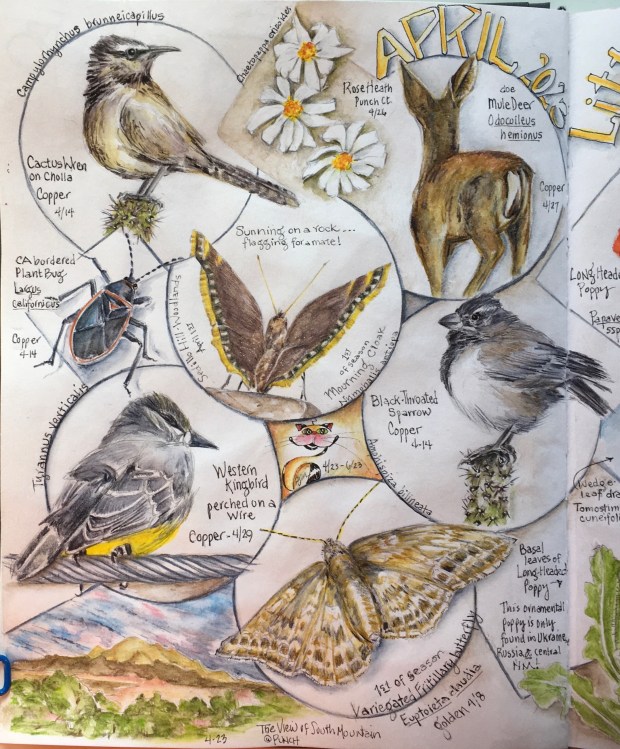
In the blink of an eye …… April! The dusty browns of late winter gave way to landscapes full of color! Movement was everywhere ….. Flower buds began opening as emerging insects smacked their lips in anticipation. Birds, flocking to their breeding grounds, had hungry eyes on the growing bug population. Hibernating reptiles began to stir as the earth warmed; lizards stretching sleepy legs in their underground burrows, that will help them flee slithering snakes; snakes wriggling and coiling and hissing, perhaps thinking about a breakfast of juicy lizard or a baby bird. Mule deer moved down from the surrounding hills to nibble fresh plant growth. Coyotes hunted desert cottontails as they snacked on prickly pear pads. 

April was amazing! There was so much happening, that it was all I could do to take in so many changes. It was such a challenge just to slow hike the hills every day, observing and taking  photos, that keeping up with my “Littles” pages seemed impossible! 

Close up

So here it is mid-June, and I’ve finally put the finishing touches on my April “Littles.” While creating my tiny framed discoveries, I questioned my desire and/or the need to continue with this project. But then I quickly dismissed those thoughts. After seeing these pages finished, I realized it was not only great fun, but an important reminder of what happens in nature during April.  

Another close up

Again, many thanks to “Made by Fay” for the inspiring “Littles” idea!

June 17, 2023

A Prickly Situation ….. A Renovating Wren

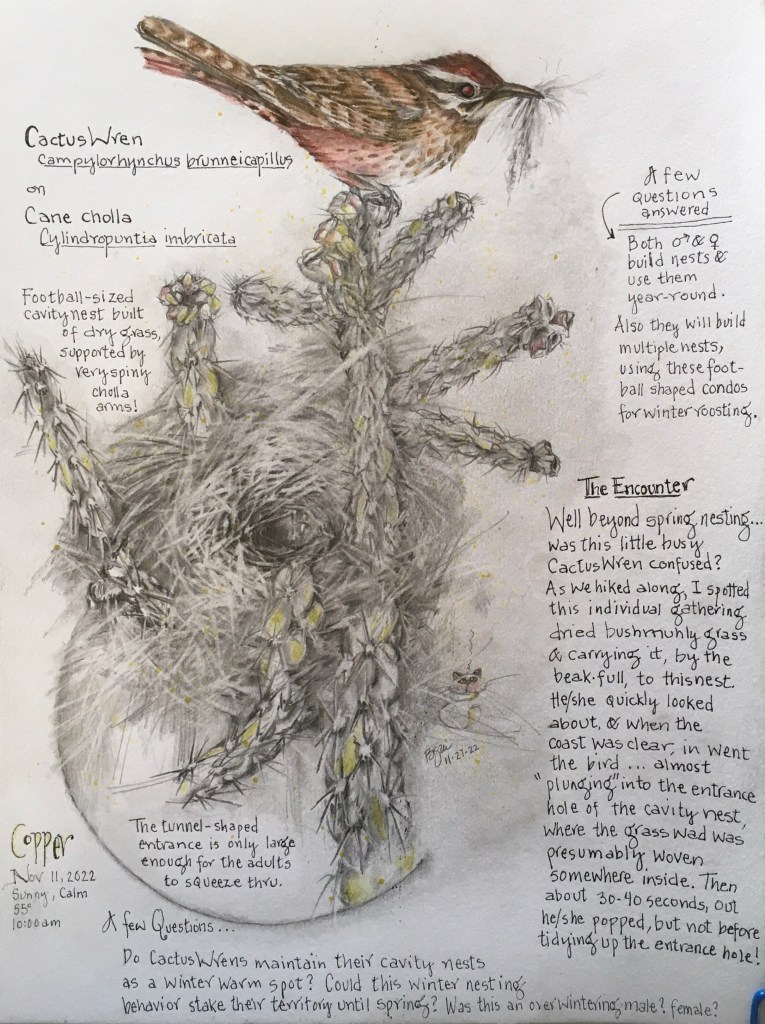
For years we’ve hiked (carefully) past hundreds of stately cane chollas, many with what looks like wads of dried grasses caught tightly in and around the numerous spindly and haphazard arms that grow all over this desert cactus. On closer examination, we’ve discovered the cholla does not actually capture grasses blowing in the wind.  Instead, an industrious and very chatty little bird collects great quantities of dried grass to build a football-sized cavity nest woven protectively and securely on and between    the many arms of a cholla. 

Meet the Cactus Wren.  

Full journal page

Once you’ve heard this gregarious wren chatter and sputter hilariously, you’ll never forget it’s call! As we were walking along the trail one day, I instantly recognized a wildly vocalizing cactus wren. Scanning the skyline (because I know they also love rattling from a perch), he readily showed himself, and did not shy away as I approached. He was calling from the highest (10 feet) arm of a pretty stout cholla, and then quickly jumped down into the center of the branches to inspect an old nest.

This nest may have been old, but apparently this little guy felt a facelift was in order and began tidying up the tunnel-like entrance. He then collected a wad of grasses he’d plucked from the entrance and plunged himself down the tunnel, grasses included! What? What was this crazy bird doing …… nest building?

Turns out cactus wrens build several nests in the spring within their territory, and maintain them year-round. I have to believe they use their nests throughout the cold winter months to keep warm, and it looked like this guy was fixing up the interior of this particular nest with super soft bushmuhly grass stems. I would’ve loved an invitation to peek inside, but hiked on, leaving the cactus wren to his chores.

I’ve been by this nest several times in the past few weeks, hoping to catch the wren at home, but to no avail. Maybe he’s tending another nest somewhere else, as this one is in disarray. 

The Sketch
My sketch, mostly from memory, was done all in graphite using the “subtractive” technique. I don’t usually sketch in his manner, because it can get quite messy ….. laying graphite down then using my mono zero eraser to create the image …. but it was an effective way to illustrate the complexity of the nest and so many cholla spines.  Let me know what you think!

November 27, 2022