Lanceolated Chafer- Page 13 .. The 100 Day Project (2026)

July 9, 2026

Lanceolated Chafer (Phyllophaga lanceolata)

(syn Melolontha lanceolata)

aka Brown Scarab Beetle, May (June) Beetle

The Lanceolated Chafer (Phyllophaga lanceolata) is a scarab beetle native to North America. In New Mexico (along with Colorado and Kansas) these chafers thrive in open, grassy ecosystems, including native shortgrass prairies, pastures, rangelands, and agricultural fields dominated by grasses like blue grama (Bouteloua gracilis) and others. It’s in these arid habitats that the larvae (grubs) are rarely considered major pests1. Unlike most Phyllophaga species, adults are diurnal (active during the day); females are flightless

Adults – This small to medium-sized chunky beetle, is about 0.5 to 0.7 inches (13 to 17 mm) long; females are larger than males. Their hard wing/body cover (elytra) is brown with several darker brown/grayish longitudinal marks under a coat of white bristly hairs. Their segmented abdomens are mostly a smooth grayish/white; their thorax (pronotum) is heavily covered with long brown hairs. Because of their noticeably long, magenta-colored legs, they stand tall above the ground while walking. If picked up, their legs feel clingy and prickly. Adults live only 1 – 2 months, just long enough to grab a quick bite to eat, mate, and lay eggs.

Calling All Males!

The female Lanceolated Chafer produces and uses a unique sex pheromone, l-leucine methyl ester, to attract males! Because this pheromone acts as a highly-targeted sex attractant in the wild, she is able to communicate her readiness to mate and get a rapid response. As has been demonstrated in field trials, male chafers catching a whiff of her urgent communication can’t resist the call and come flying (read the true story of my eye-witness account in my post titled The Life and Times of the Lanceolated Chafer ). Research scientists (and I) whole-heartedly believe this pheromone contributes to the species’ reproductive success in its native range. 

This was a unique discovery because the Lanceolated Chafer is the first scarab beetle ever identified to produce an amino acid-derived pheromone. (And there are over 35,000 species of scarab beetles in the world, making up one of the largest and most diverse insect families on Earth!) The pheromone is so effective at targeting male chafers that entomologists use it to monitor and manage populations of these beetles in agricultural crops and turfgrass. 

Probably a male chafer, walking along the 2-track trail

And now a note about topic organization  ….. 

As in all beetle species, it’s usually the adults that are encountered. And it was the adult stage of the Lanceolated Chafer that’s most obvious along the subdivision’s 2-track rockpile trail. That’s why information about the adults was placed first, even though it’s actually the final stage in the life cycle of the chafer. But it’s interesting to understand how all those adults came to be. So the following few sections tackle the highlights of the 1 – 3 year long larval stage, and pupal stage of their life cycle, which take place after egg laying and hatching. Afterall, the Lanceolated Chafer spends the longest parts of their lives underground.  And then, for no particular reason, I’ll end with a section on entomology.

Larval Stage – Larvae (grubs) have a translucent white to cream-colored body and a light tan to brown hard and stiff (sclerotized) head capsule.  Larvae have three pairs of well-developed legs. When at rest they do so in a C-shaped curve.

By the 3rd instar, internal organs are more visible and jaws are larger! Grubs have a voracious appetite.

Larvae live for 1 – 3 years, primarily in the upper layers of the soil profile. To protect themselves from extremes in soil temperatures, both in  summer and winter, they will burrow to depths ranging from 3 to 20 inches (7.6 to 50.8 cm), averaging 10.3 inches (26.2 cm). Larvae actually hibernate in the winter.

The three instar stages of larvae development, serves to progressively increase body size, head capsule width, and degree of sclerotization. At the end of each instar, larva take up excess air and/or water to swell their bodies. This extra pressure causes its old exoskeleton to split, allowing it to be shed (a process called ecdysis). Mature (third instar) larvae are 1.75 inches (45 mm) long with a nearly uniform body width.

Pupal Stage and Metamorphosis – When larvae are ready to move beyond the third instar, each individual builds a protective, earthen cell in the soil 8 to 12 inches (20 to 30 cm) deep where they will remain for the next 2 – 4 weeks while they undergo metamorphosis and and finally emerge as adult beetles.

Etymology 

The genus, Phyllophaga, is a generic name that comes from two Greek words ….. phyllon which means “leaf,” and phagos which means “eater.”  The specific epithet lanceolata comes from the Latin word lanceolatus, meaning lance-shaped, probably referring to the fine, lanceolate hair-like scales covering parts of the beetle’s body, such as the head (frons) and thorax (pronotum).  The etymology of the word “chafer” comes from an Old English word meaning “gnawer,” referring to the beetle’s strong jaws.

…………………………………………………………………………………………………

Hope you found this interesting!

As always, thanks for stopping by!

1  Larvae of Lanceolated chafers are considered serious pests in the humid central and eastern U.S. they cause extensive damage to agricultural crops like corn, timothy, potatoes, and various other plants in the grass (Gramineae), pea (Fabaceae), and sunflower (Asteraceae) families.

References

ageconsearch.unm.edu

bugguide.net

grokipedia.com

iNaturalist.org

insectIdentification.org

invasive.org

npsnm.org

Lunginbill Sr., P and Printer, H.R., 1953, May Beetles of the US 

The Life and Times of the Lanceolated Chafer

The Case of a Mysterious Wormy Thing

July 9, 2026

This is the third year in a row that I’ve noticed these seemingly unremarkable-looking brown beetles “hiking” along the rock pile 2-track road. They appear all at once, about mid-June, then vanish after several weeks. This year (2026) these scruffy/fuzzy beetles, know as Lanceolated Chafers (Phyllophaga lanceolata), really caught my attention, especially after finding myself at ground zero of a mass male Flash Mob1 !!! From all directions, determined (and awkwardly) flying male chafers were dodging my legs to land on top of a lone female beetle frantically struggling against an earlier arriving male. His prickly lance-like legs had pinned her to the ground so she was lying on her side unable to use her legs. While she squirmed at my feet, newly landed beetles tried to fling off the original male to claim their rights to the female. Males continued to land until there must’ve been 30 or more, with fights breaking out everywhere, on top of the female and all around my feet. Each male was jousting to be victor. 

Males arriving, fights break out

But a victor of what? Was this some sort of mating ritual? Had the female released highly potent pheromones to attract a mate? If so, how far did her “call” drift on the wind to bring together so many males at one time? Did she intend to call only one male, or was her purpose to entice a stampede? If she anticipated a herd, was her intent to mate with the first one (the fastest?) to arrive? Maybe she hoped for battles and skirmishes to ensue, where the strongest of all males would win her favor(s)? This still remains a mystery, as I couldn’t find anything in the literature to explain this behavior? 

While pondering these questions (and daring not to move my feet for fear of squishing one of the many male pile-ups), I bent over for a better look. It was then I noticed an opaque white, worm-like thing slowly emerging from the female’s abdomen! “What could this be?” ….. 

Was it a larva? Probably not ….. Female chafers don’t give live birth; they lay eggs in the soil beneath their favorite host plants (such as mallows), where they hatch into grubs that remain underground for up to two years before emerging as adult beetles. 

Five males fighting for the female (notice how much larger she is than a male). Bit of a skirmish, left side.

Was it part of or the actual female genitalia? Maybe? I’m still searching for information about that notion.

Was it part of the male genitalia that had somehow broken off inside the female during insemination? Is that even possible? Again, still searching for answers about chafer sex.

Three males with the female (notice the “wormy” thing). One male, lower left, apparently confused?

For another 5 minutes I closely observed the squirming female laying helpless on the ground fighting off numerous suitors while still displaying the wormy “thing.” As more males continued to arrive, crash-landing on other grounded males and adding to the chaos, something changed. Can’t explain what happened, but in a matter of 15 seconds all the males stopped their aggressive fighting and took flight; the female uprighted herself (regaining her dignity?), quickly walking away like the nothing unusual had just happened. I watched her go, noticing she was no longer in possession of the wormy “thing,” and couldn’t find it anywhere at or near the scene! 

The party is over. A male walking away, looking for a mallow to snack on.

After-math

Over the next several days, nary a chafer was found! Had all the males satisfied their natural desires? Had all the females become pregnant, laid their eggs and vanished? “After” doing the “math” on the days following the event, I counted only two beetles walking the 2-track road, one headed north — one headed south. Scouts? ….. Because Lanceolated Chafer adults only live 1-2 months, and because none have been seen since the last two, that may be the end of sightings for this year. While there’s still the occasional pack of ants dragging away a dead beetle to share with their colony, the legacy of adult chafers lives on. Recently-laid eggs will hatch after only 18 days into white or cream colored, C-shaped larvae. Those grubs will munch away on mallow and grass roots for the next 1-3 years until a perfectly warm mid-June day, sometime in the future, the adults emerge from the soil to complete their life cycle. 

Epilogue 

Since most chafer beetles are nocturnal (active at night), if you’ve seen an adult during the day, it may have been the Lanceolated species which are diurnal (active during the day).  And you may have unwittingly encountered any of the chafer species found in North America……. 

An exhausted male, a bit off balance, as he feeds on mallow leaves.

…….. If you’ve ever seen one or more of your carefully-tended, vigorously-growing garden plants up and die overnight, it may have been victimized by root-living chafer grubs.

…….. If you live in the central or eastern U.S., grubs may be feasting on the roots of agricultural crops, like corn, soy, or sunflowers. Headline news is sure to cover the story of devastation and financial ruin brought on by the voracious chafer beetle larvae, complete with video of farmers holding a handful of grubs dug from below the soil surface.

Have you experienced one of these close encounters?

Hope you’ve found the “Life and Times of the Lanceolated Chafer” interesting (or maybe educational, peculiar, or maybe even fascinating!?!). Let me know what you thought.

As always, thanks for stopping by!

1 A flash mob is defined as a large group of people who suddenly assemble in a public place, perform a brief, pre-arranged action (like a synchronized dance), and then quickly disperse. Flash mobs are typically organized online via social media or viral messaging for entertainment or artistic expression. I think this definition nearly perfectly fits the chafer beetle dance I was witness to on that fine mid-June morning somewhere along the 2-track rock pile trail. 

Dance of the Bagworms

May 9, 2025

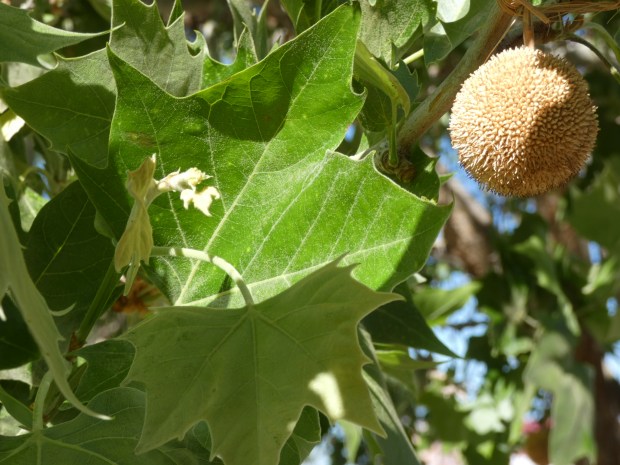
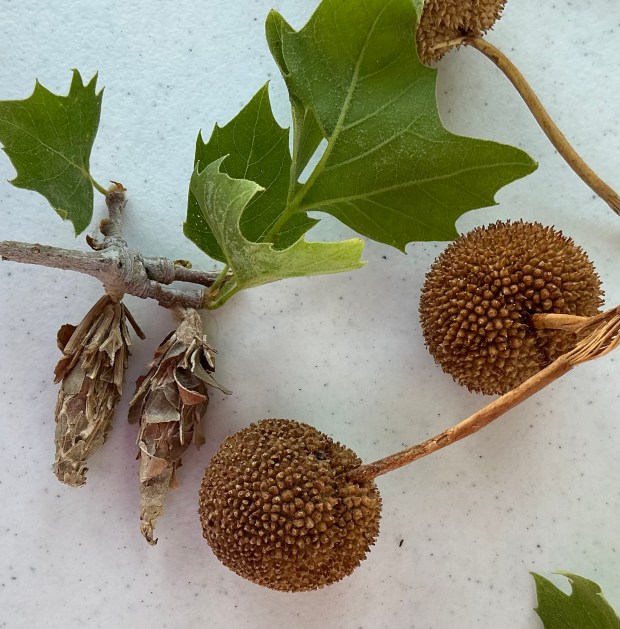
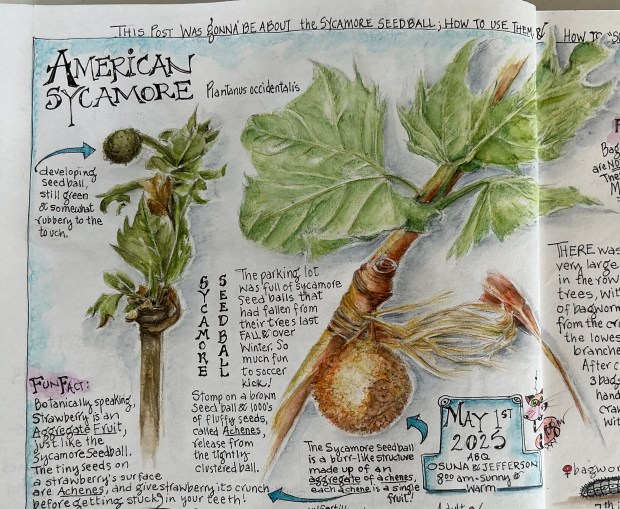
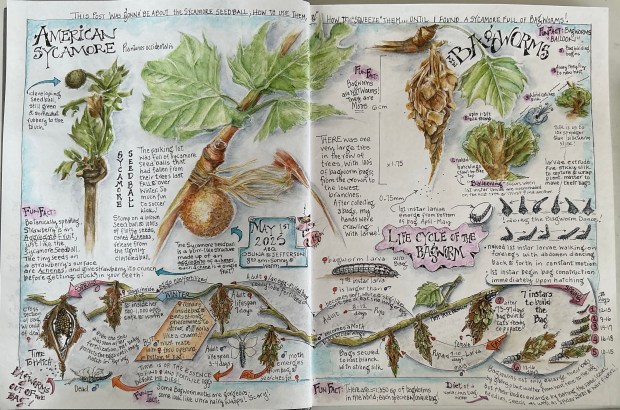
On a warm Spring morning, wandering around a grove of American Sycamore, I became curious about these magnificent trees: where in the US are they native; why are some leaves larger than the palm of my hand and some half the size; what about those odd pingpong sized seedballs lying on the ground everywhere you look ….. why don’t they roll away in search of an ideal spot to pop open so the seeds can germinate …… when the seedballs are kicked, stepped on or crushed beneath a car tire, do the 1,000’s of seeds inside blow away to sprout ….. are the seeds (all or some of them) even viable ….. do the seedballs make a good ink or dye or maybe they’re edible or even medicinal……. what, if any wildlife species eat the seedballs or seeds; and ooooohhhhhhh, sycamore bark! Why does this tree’s bark flaunt a pastel palette of greens, yellows and pinks. These and many more questions came to mind that it seemed about time the American Sycamore became a subject for my nature journal, until ……………..
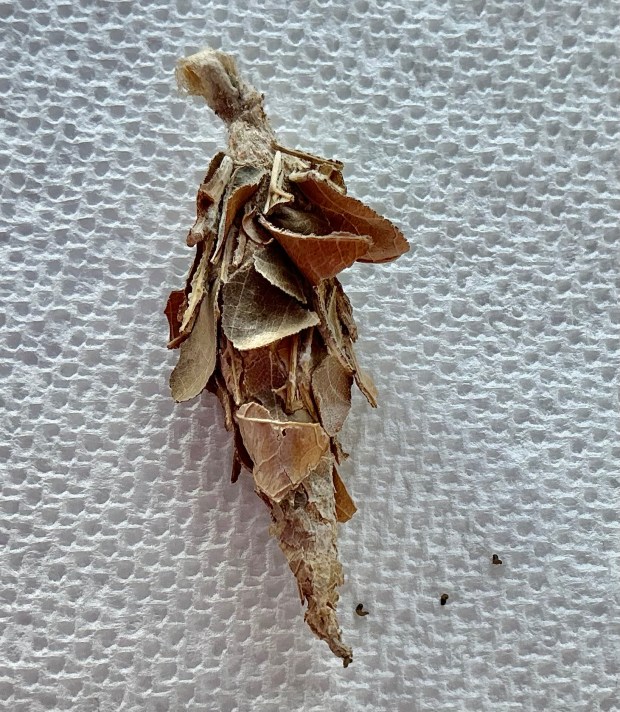
There! In the tree above my head, I spotted a most curious thing. Parting a few of that sycamore’s beautiful Spring green palmate-shaped leaves was a bundle of dead brown and beige leafy bits and sticks all haphazardly glued together. Wishing to get a closer look at that elongated ornament shaped “thing,” I found it was securely suspended from a branch. Trying to puzzle out this fascinating mystery while searching for my pen knife, a stiff breeze blew through the tree. It was then a I noticed hundreds of those 2-3” long bundles all over the tree; from the base to its crown!

Curiosity is the Essence of Nature Journaling

What continues to draw me to nature and nature journaling after so many years are the surprises in the familiar and in the unknown. I know well enough that new encounters in nature are infinite; you just have to open your eyes and look.  Having learned by carefully observing what appears to be familiar, often leads to new discoveries. That’s when my curiosity kicks into high gear ….. when it’s time to engage in some serious poking around to figure something out; to learn what the “thing” is. 

Curiosity, for me, is the very heart and soul of nature journaling. The ‘art’ of curiosity even precedes skill in observation. It’s what drives me out the door in the morning and fuels my exploration. Curiosity fills the mind with countless questions if for no other reason but to develop a deeper understanding of the natural world. 

But I “wax philosophical.” Needless to say, my curious discovery on that warm and breezy Spring morning prompted an abrupt change of mind for my next blog post (this post). Anxious to learn about the “thing” suspended from a tree branch, probably minding its own business, I proceeded to cut it down (along with two more) and popped them in a bag along with a few sycamore leaves and seedballs.

Later that same day …….

Upon completing my journal sketches of sycamore leaves and seedballs, and posting a few photos to iNaturalist for an initial ID, it was time to take a closer look at my discovery. Reaching into the bag for one of the “things” (wiping my hand free of spider webbing?), I placed it on my examination table surrounded by several hand lenses, a larger magnifying glass, a penknife, and 2 pairs of tweezers. Before beginning the dissection, I noticed about a dozen black pepper-sized bits moving about the “thing.” Thinking tiny spiders had come from the bag, I didn’t give them a second thought (should’ve been curious!).

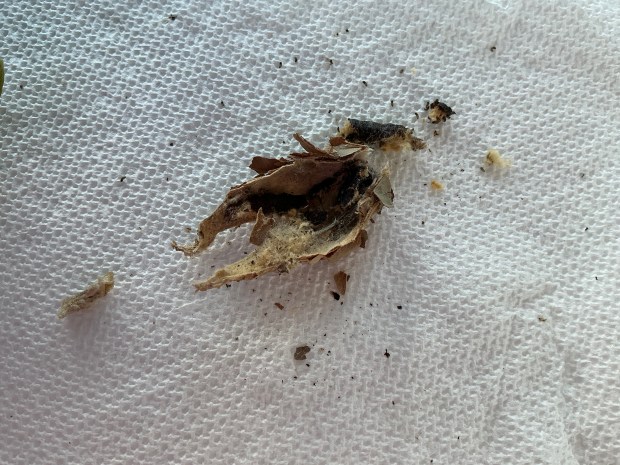
This bagworm bag was the subject of my dissection. Notice the pepper-sized black dots next to the bag ….. those are wiggling 1st instar larva.

iNaturalist ID Pick :::::::::::::: BAGWORM MOTH ::::::::::::::: iNaturalist ID Pick

(awaiting genus/species ID)

A Bagworm Moth!

How cool is that!?!

The opened bag of a female Bagworm moth. She’s very dead, but her progeny are escaping as fast as they can.

Dissection resumes ……

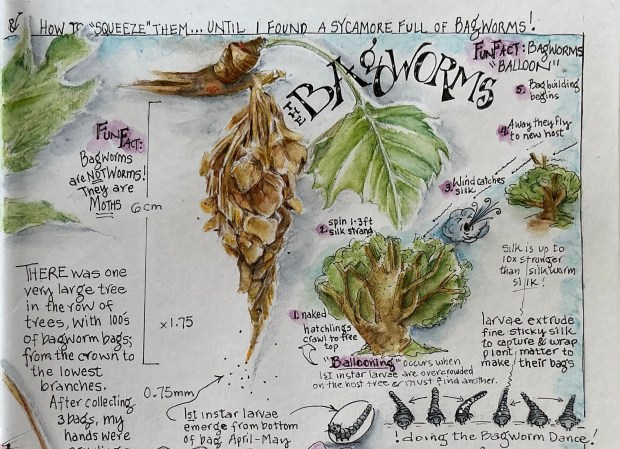
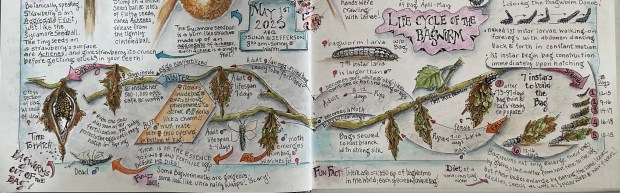
After finding out the “thing” I’ve been pondering over is the Bag of a bagworm moth, I learned the Bag was built during last Spring, Summer and Fall by either a male or female bagworm moth. If a male, the Bag would be empty; if a female, the Bag would contain her remains …. she would’ve died last fall after a male fertilized 500-1,000+ eggs she overwintered inside her body until Spring when newly-hatched larvae would emerge from the bottom of the Bag and begin the species’ life cycle all over again.

The Bag, that took about 10 minutes and all my dissection tools to open, contained the black and mushy remains of a female and 100’s of wiggling/dancing larvae! They were on the move; escaping from the now wide open Bag, and quickly covering my examination table like a pepper grinder out of control.

And my effort to open the Bag? This made sense after reading about the high tensile strength of the silk they produce. These thin strands of silk, 10x stronger than that produced by silkworms, is used in abundance to construct their Bags.

The coolest thing ever! Notice the either late 2nd or early 3rd instar larva, no longer naked, but swaddled in very chewed up leafy bits glued together with strong silk. This dude was hiking up a sycamore branch, continually chewing, wiggling, and gluing.

After disposing of all the naked 1st instar larvae waggling and dancing across my examination table, I placed the dissected Bag, the two whole Bags, and collected leaf material into a clear plastic ziplock to observe what would happen. Over 10 days, the number of larvae multiplied and the naked 1st instar caterpillars grew in size (at least to 2nd instar) while building their individual Bags from tiny bits of leaf litter! Their wiggling dance seemed to be the way their silk strands wrapped and secured leafy bits around their bodies. It’s been fun to watch all the activity.

Have you ever encountered one or more of the 1,350+ species of bagworm moths? What materials were their Bags made from? Please share your experience with these fascinating members of the butterfly/moth family of insects.

As always, thanks for stopping by!

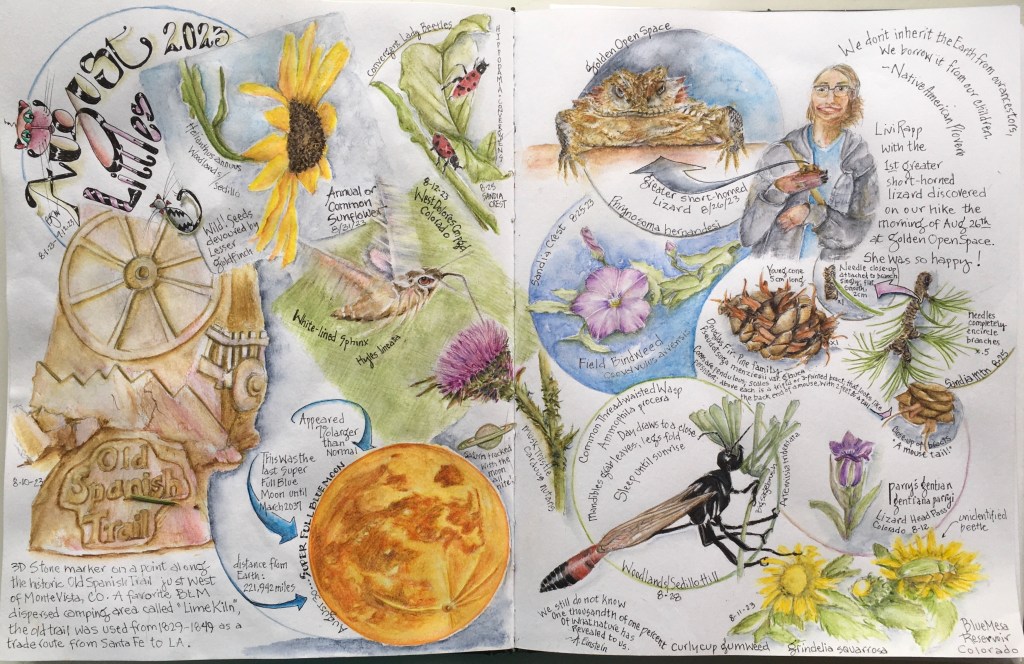
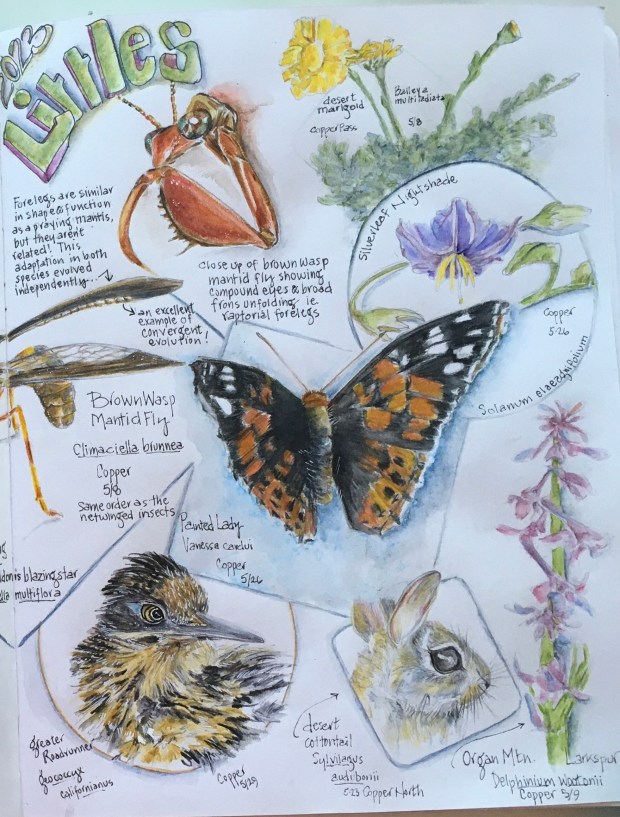
August “Littles” …. Horned lizards and Sphinx moths, a sleepy wasp under the Super Full Blue Moon, and nature through the eyes of a 15 year old!

Two-page spread for August Littles

August was a busy month, filled with high elevation camping in Colorado, and a lot of cool mountain hiking back home. Even though the lower elevations took on a hot and parched look, at 9,000 feet and higher the wildflower season was far from over as evidenced along roadways and trails, where fresh, colorful blooms could still be found.

The highlight of the month was a 3-1/2 day visit from my brother Bob and grandniece Livi. At 15 years of age, Livi is already a fine artist, and took to nature journaling like a pro! It was great fun discovering and sketching nature on our daily hikes. She even got a chance to hold one of the adult ornate short-horned lizards we see frequently along various trails, and then found a baby lizard on her own, hiding nearly motionless under a small plant. Her smiles were priceless!

Despite the high temps, it was a month of good days and nights, ending perfectly with the rising of a rare Super Full Blue Moon! If you missed it, there’s plenty of time to prepare for the next …… which occurs in March 2037.

Once again, a big shout-out to “Made by Fay” for the inspiring “Littles” idea! These pages are fun to create, and remind me of monthly highlights as I revisit my previous “Littles” posts. Hope you’re enjoying them too, along with the ending days of the season.
Stay tuned for the next installment of “Littles.” 

September 14, 2023

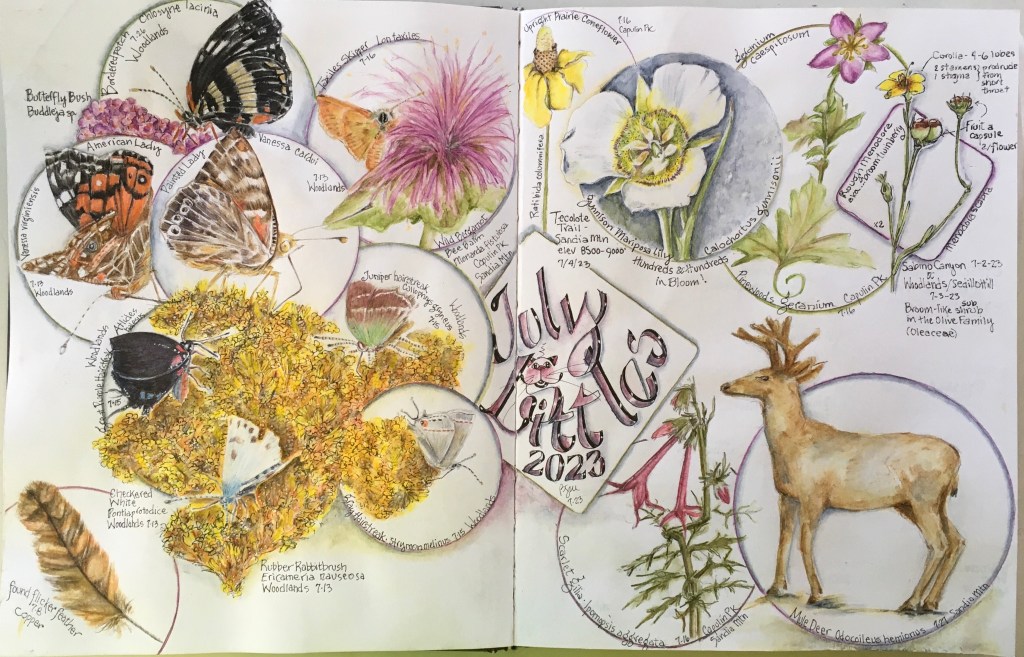
July “Littles” ….. Blooming flowers attract famished butterflies

Two-page spread for July Littles

June’s hot, dry weather slipped stealthily into July as we became mired in one of those infamous heat domes for weeks. Our rabbitbrush shrubs, usually late summer bloomers, burst into piles of brilliant yellow flowers a full month before normal, and for the first week of their premature bloom, not a single pollinator was in sight. I was so concerned the over abundance of nectar would dry up, pollen would blow haphazardly away, and seeds wouldn’t form. Then one morning I woke to find hundreds of butterflies, weevils, flies and bees flitting, crawling and buzzing about, nearly covering the shrubs completely in a pollination frenzy! How did they know? Where did they come from? What a relief for me, but it must’ve been an unimaginable relief for all of those pollinators that happened upon our oasis in the desert.

And so it went, all month…. bursts of early blooms rapidly completing their floral life cycles, thanks to urgently feeding pollinators.

This is how I remember July, with everything in bloom at once, the air full of pollen and pollinators. It was quite a sight!

Once again, a big shout-out to “Made by Fay” for the inspiring “Littles” idea!  Stay tuned for the next installment of “Littles.” 

September 4, 2023

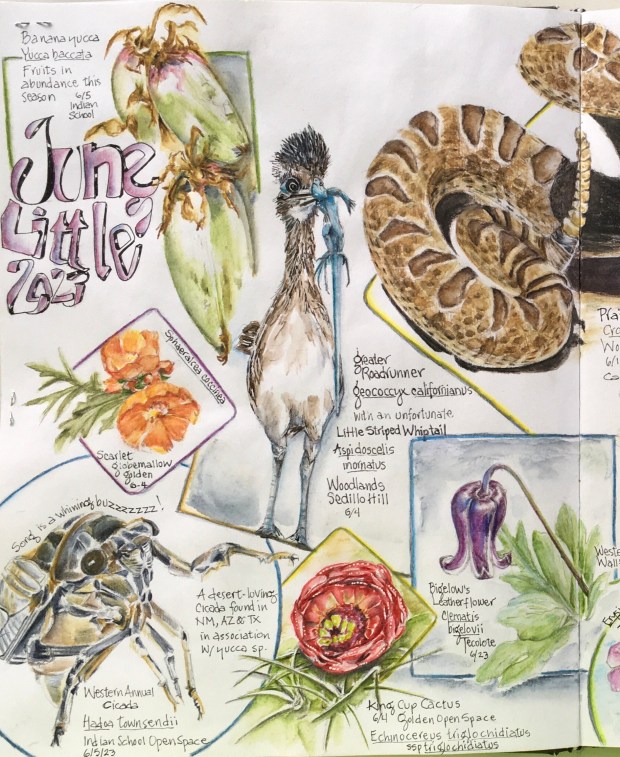
June “Littles” ….. a buzzy, buggy, snake-y month

June was hot, Hot, HOT

Two-page spread with 14 June Littles + Flambé

June was dry, Dry, DRY

Close-up

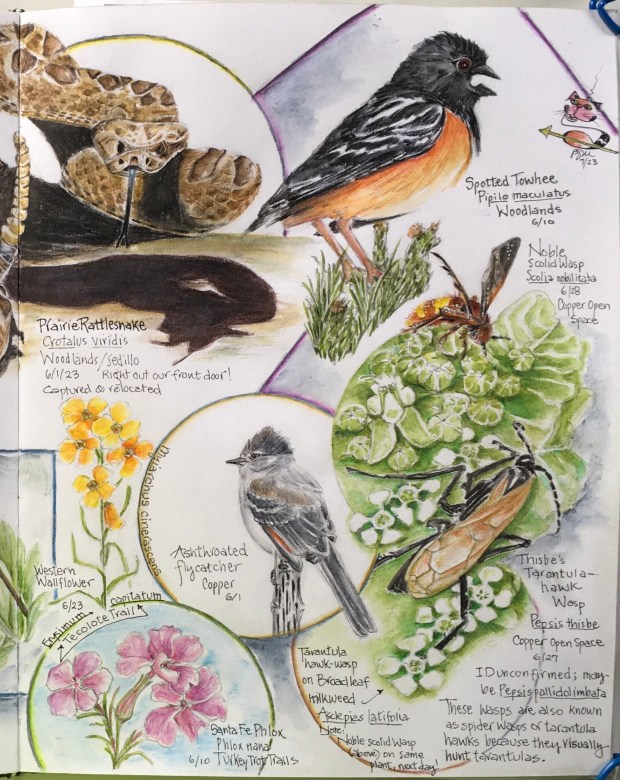
June was the month of bugs (from the big tarantula hawk wasps, to the microscopic gnats), withering flowers, disappearing birds, and snakes! We seemed to encounter an extraordinary number of snakes this month, including gopher (bull) snakes, diamondback rattlesnakes, patch nose snakes, garter snakes, and one very scary prairie rattlesnake. Read on for that story.

Another close-up

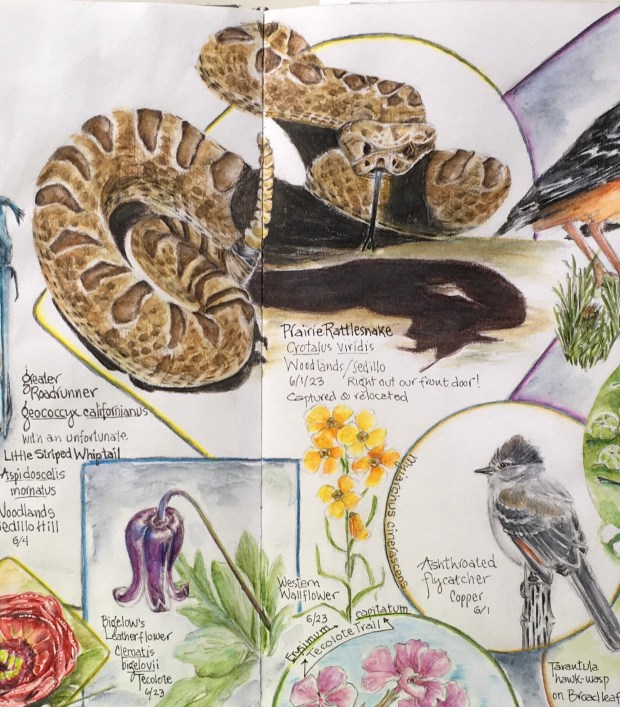
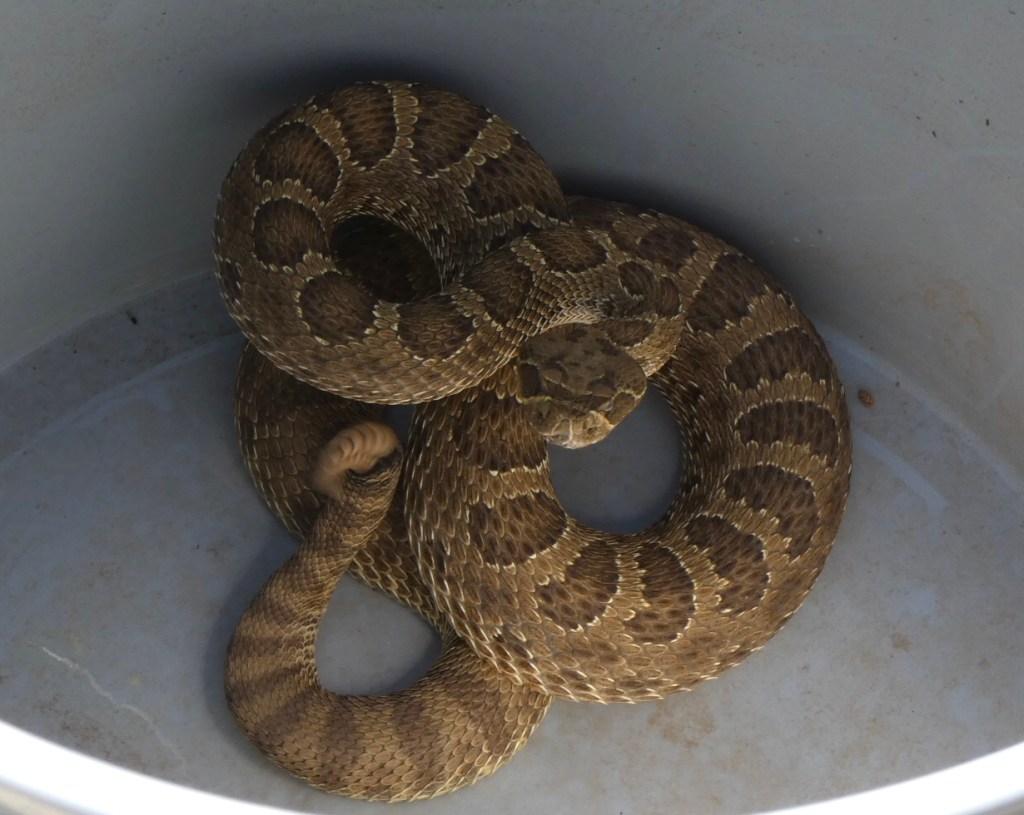
Luna and the Prairie Rattler! Our scariest encounter was with a 3-foot prairie rattlesnake right in our front courtyard. One day he had crawled out from the shade of a blue spruce to warm up in the morning sun. It was Luna that had changed his demeanor from placid to pissed off. Prairie rattlers don’t typically alert trespassers; that’s the secret to their hunting success, and Luna didn’t recognize the danger. She began sniffing around and unintentionally violated his personal space. The snake responded by instantly coiling and violently rattling his tail. The noise seemed deafening and was definitely alarming. As I came running to Luna’s rescue, Roy noticed the commotion and quickly arrived with snake stick and bucket in hand. By this time the snake had backed into a corner, furiously rattling, but was relatively easy to capture. Snake temporarily out of the way, we then carefully checked Luna for signs of snake bite (none detected! Lucky Luna).

Another close-up
Another close-up

Now back to the snake in bucket. It had taken less than 30 seconds for Roy to capture and slip him into the 5 gallon bucket. It was then that I was able to take my first photos, from a respectable distance just in case the snake decided to leap clear of the bucket!. If looks could kill, well ………….. About 15-20 photos later, the bucket lid was secured in place, and we took the snake for a little ride about a mile from home where he was carefully released in an uninhabited area, unharmed.

After release

Again, a big shout-out to “Made by Fay” for the inspiring “Littles” idea!   Stay tuned for the next installment of “Littles.” 

July 27, 2023

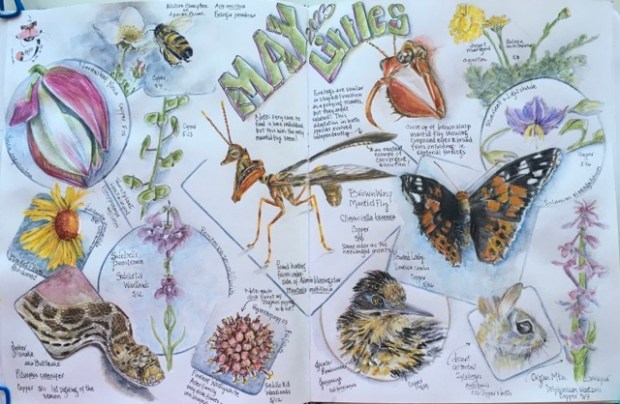
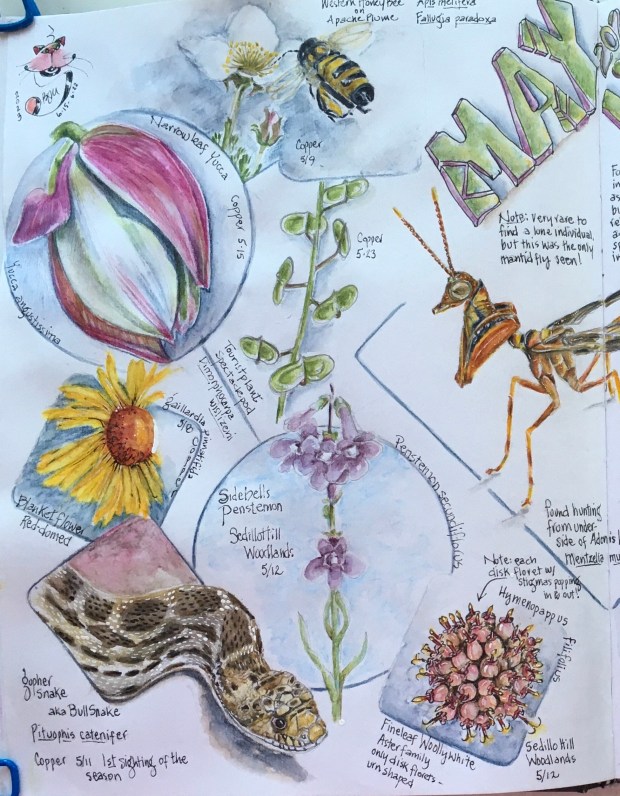
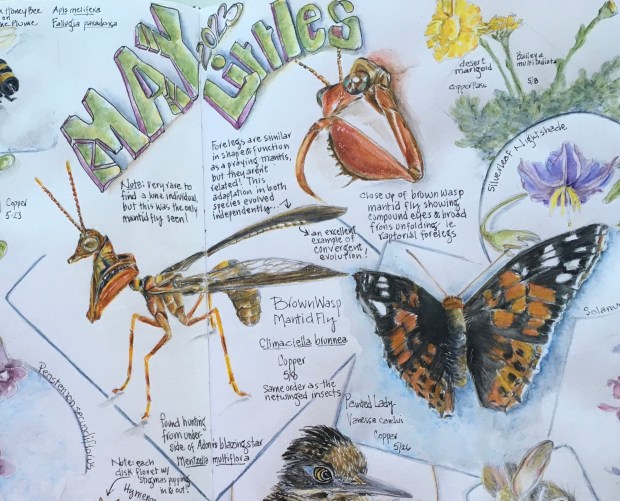
May “Littles” ….. blooming, buzzing, flying, fleeing, stalking, slithering surprises!

April may have been amazing, but it was nothing compared to the explosion of life during May. My 2-page spread doesn’t even come close to representing all that we encountered throughout the month. And the 15 species I chose as “picks” aren’t even a third of those making an appearance …… enter stage left and right! 

Noticeably missing was the black chinned hummingbird. They arrived mid-May, and began defending breeding territories. One of these years, I hope to find one of their miniature nests to see what building materials the hummers use. Until then, their aerial performance is always breathtaking! 

Close-up

Then there was the morning Luna nearly stepped right in the middle of a really upset, hissing and striking prairie rattlesnake, practically right out our front door! It was a scary few moments until we determined Luna did not get bit! Whew.  Roy expertly wrangled up the guy, herding him into a 5-gallon bucket, and relocated him a safe distance away.  (I may cheat and add him to my June “Littles,” if you don’t mind, along with the first rattlesnake encounter of the season! Gotta love the desert.)

Another close-up

Included in the long list of flowering plants, was prickly pear cactus. Several species began opening their buds to reveal 20-30 delicate waxy yellow to apricot colored petals per bloom. It didn’t take long for the pollinators to find these delicacies! 

And Another close up

Blooming in the foothills (5,000’ up to 7300’ elevation), there was milkwort, fleabane, scarlet globemallow, banana yucca, sundrops, milkweed, paintbrush, golden weed, common hoptree, puccoon, several species of pink-flowered hedgehog cactus, blazingstars, bee blossom, tahoka daisy, NM thistle, ……. etc.  I could go on and on! And even at nearly 9,000’ elevation, rock jasmine, valerian, creeping mahonia, prairie bluebells, pasque flower and dwarf lousewort were all in bloom. 

All in all, a bountiful full-on Spring bloom! 

A big shout-out to “Made by Fay” for the inspiring “Littles” idea!   Stay tuned for the next installment of “Littles.” 

June 22, 2023

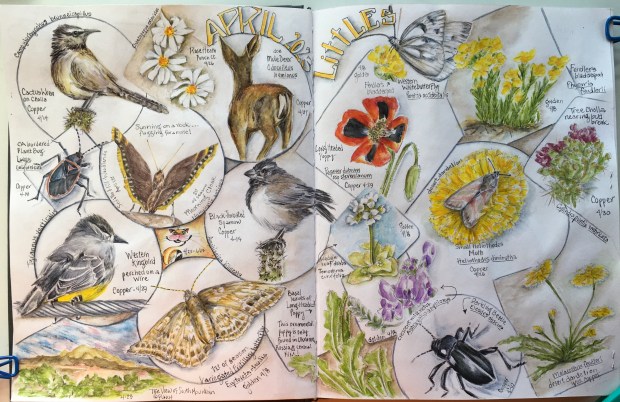
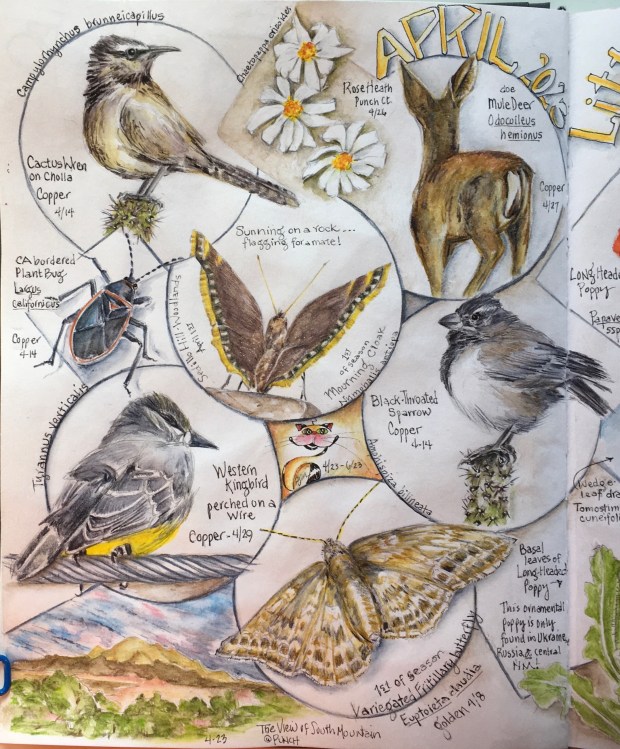
April “Littles” ….. A Rush of Spring!

In the blink of an eye …… April! The dusty browns of late winter gave way to landscapes full of color! Movement was everywhere ….. Flower buds began opening as emerging insects smacked their lips in anticipation. Birds, flocking to their breeding grounds, had hungry eyes on the growing bug population. Hibernating reptiles began to stir as the earth warmed; lizards stretching sleepy legs in their underground burrows, that will help them flee slithering snakes; snakes wriggling and coiling and hissing, perhaps thinking about a breakfast of juicy lizard or a baby bird. Mule deer moved down from the surrounding hills to nibble fresh plant growth. Coyotes hunted desert cottontails as they snacked on prickly pear pads. 

April was amazing! There was so much happening, that it was all I could do to take in so many changes. It was such a challenge just to slow hike the hills every day, observing and taking  photos, that keeping up with my “Littles” pages seemed impossible! 

Close up

So here it is mid-June, and I’ve finally put the finishing touches on my April “Littles.” While creating my tiny framed discoveries, I questioned my desire and/or the need to continue with this project. But then I quickly dismissed those thoughts. After seeing these pages finished, I realized it was not only great fun, but an important reminder of what happens in nature during April.  

Another close up

Again, many thanks to “Made by Fay” for the inspiring “Littles” idea!

June 17, 2023

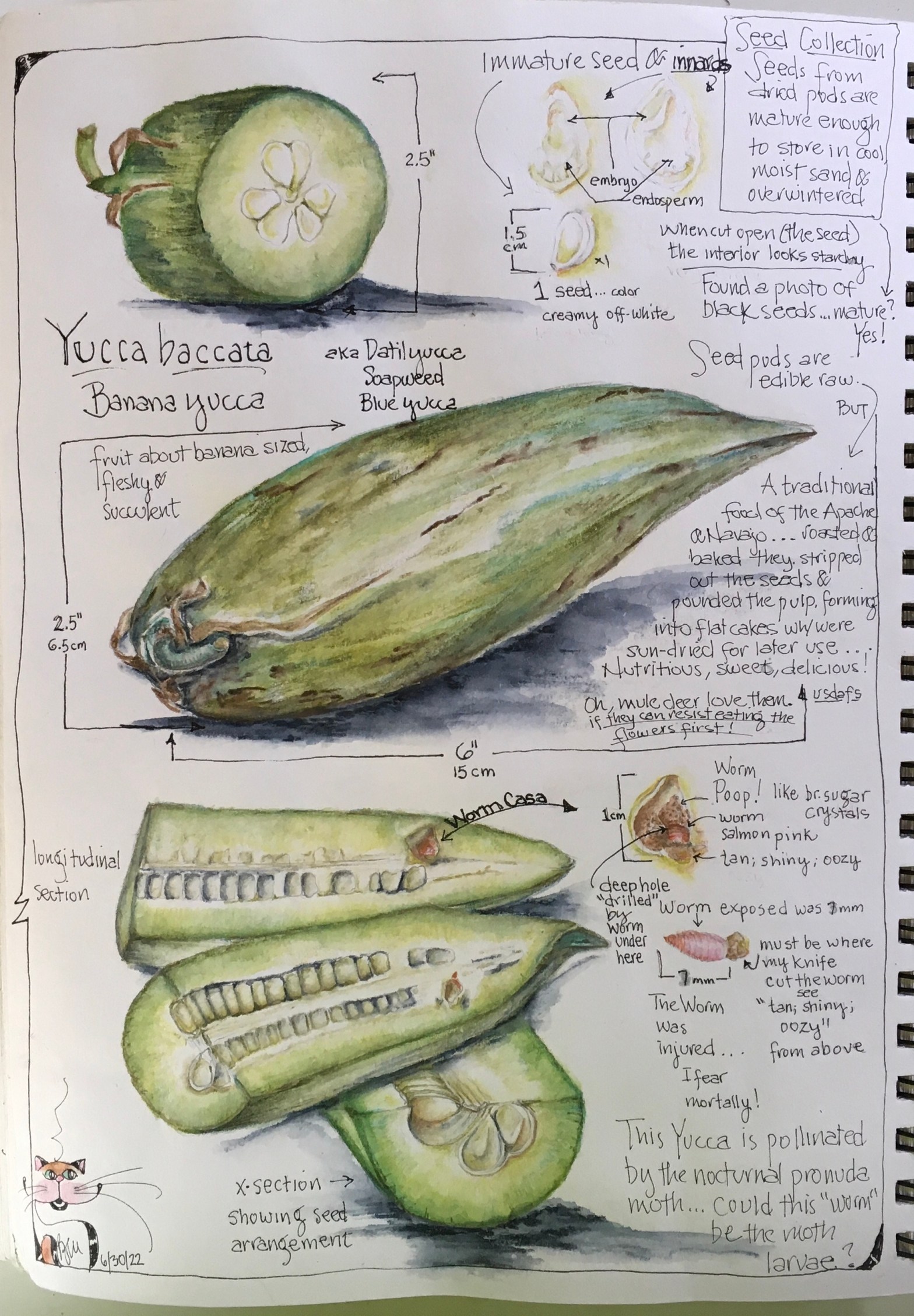
Summer Botany: Banana Yucca Seed Pod Dissection

After trying for 4 years to collect one of the giant seed pods from our small population of banana yuccas, I was sure this would be the year. One of the plants was in full bloom about a month ago, and after noticing the fleshy fruits were enlarging, I kept watch almost daily.

I should’ve suspected the local population of mule deer were also keeping close watch, because a week ago they snuck in and harvested every single seed pod! Disappointed? Yes. But still determined …….

Then a few days ago I discovered another plant loaded with a dozen of the huge fleshy green pods! Without further ado, I liberated 2 of them and dissection began …..

Continue reading “Summer Botany: Banana Yucca Seed Pod Dissection”

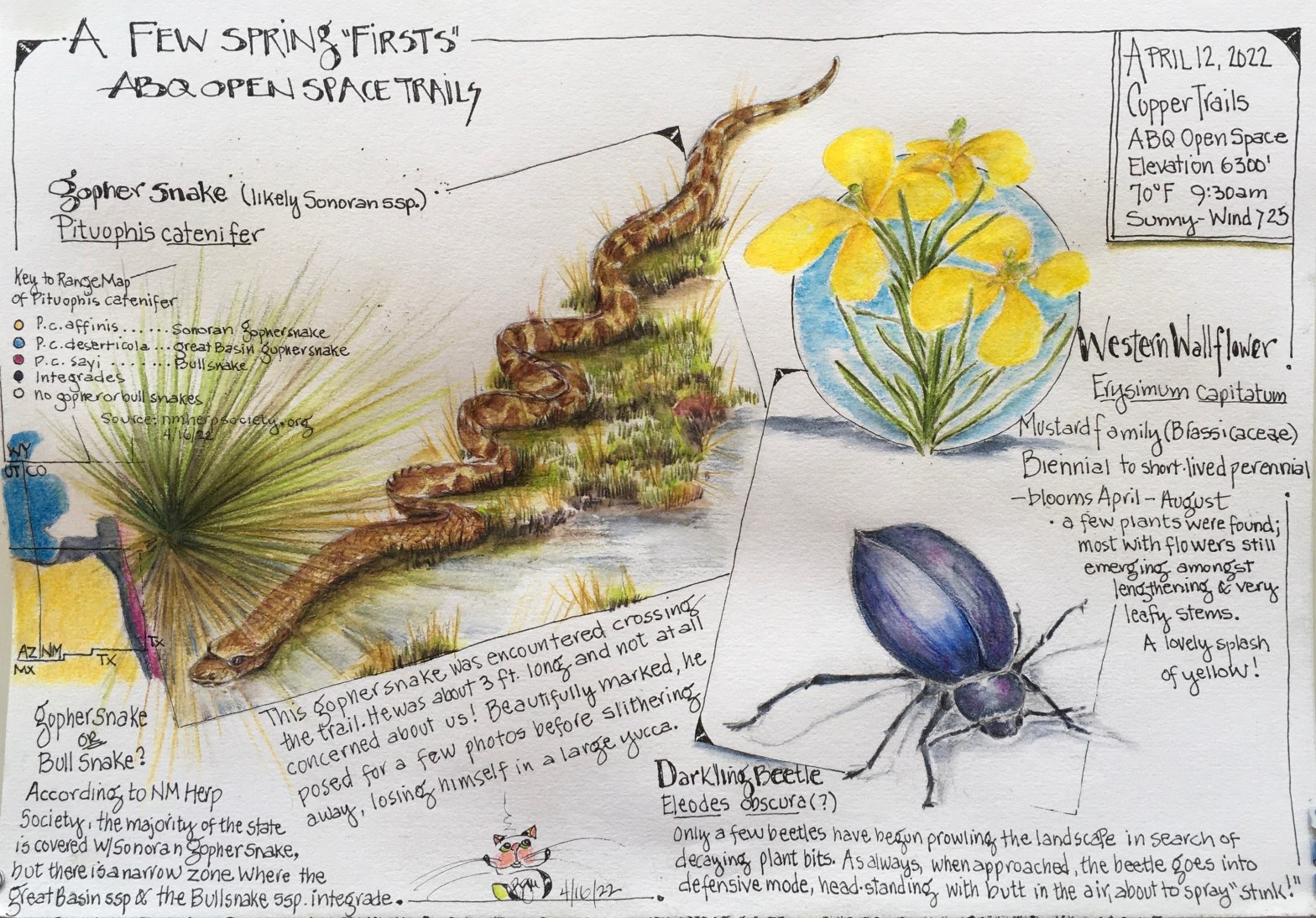
Spring Has Arrived! Part 2: More Season’s Firsts

Sometimes when hiking familiar trails, it’s easy to get lost in thought. Just being outdoors is very meditative, don’t you think? My mind wanders and it seems my head is high in the clouds, or at the very least I find myself looking up to marvel at that seemingly endless New Mexico blue sky. After all, my boots know where all the foot-tripping rocks are, and autopilot kicks in until ……

Out of the corner of my eye, a slight movement. A small stone gets pushed aside by the wary approach of a snake! Now’s not the time for daydreaming. It’s time to pay close attention to each footfall, because Spring in New Mexico has woken up all the slithering, crawling and buzzing wildlife and they are back at work.

Continue reading “Spring Has Arrived! Part 2: More Season’s Firsts”