July 1, 2026
Today’s tangled drawing was not inspired by a special day of the week or month. Instead I was smitten by a recent scissors-shaped discovery. It began with a desire to create a nature-themed action piece, like birds in flight. As I mentally rabbit-trailed the many possibilities, it seemed important to think of a reason why my birds were flying in the first place. Maybe they were fleeing something, but what? Being momentarily distracted while addressing an envelope, my mind took an exit ramp while considering the name of our return address town of Tijeras. Excitedly recalling that “Tijeras” is Spanish for “Scissors,” I nearly decided my birds would be scissor-tailed flycatchers — gorgeously graceful birds — but a tad too obvious? Regardless, the notion of “scissors” stuck in my brain. So I returned to my main rabbit trail with thoughts of fanciful, yet desperate birds fleeing a pair of big scissors!
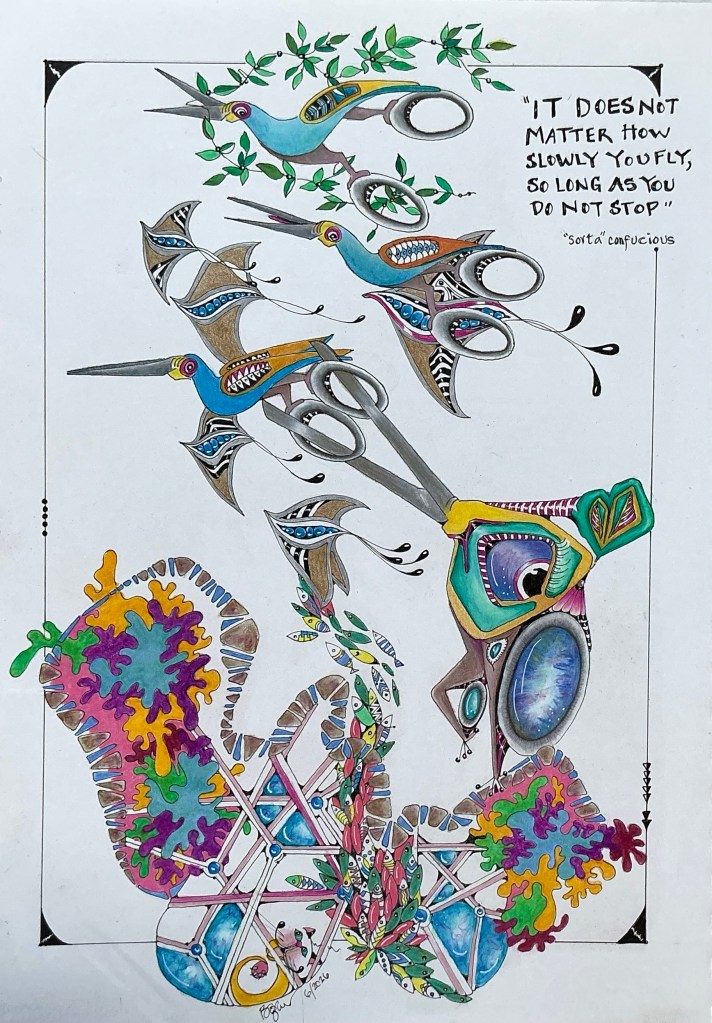
Those totally irrational thoughts focused my internet search for “flying birds and scissors.” As I wasn’t terribly optimistic about finding any interesting results, imagine my shock when after only a few short moments of scrolling I shouted ….. “Bazinga!”
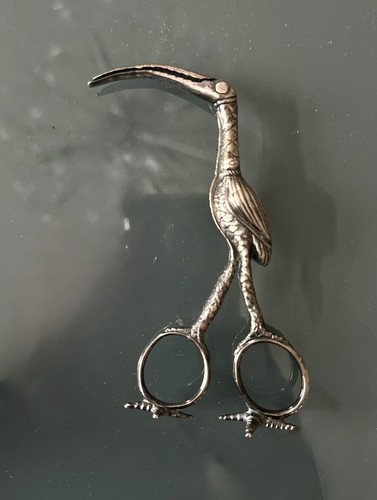
There, before my eyes, had to be one of the wonders of the world (and the answer to my flying-fleeing birds) ….. Stork Scissors! I never knew such a thing existed, but right then and there I began mentally designing and composing a tangled illustration of birds with scissors!
Of course I had to learn the why’s and what-for’s behind Stork Scissors and the use of such clever scissors in the shape of a stork who’s long bill actually forms the scissors’ blades. Here’s what I learned:
“Stork Scissors” (sometimes called crane or bird scissors) are used today as a classic sewing tool shaped like a bird. Even though they look decorative, those long, precise bird beak blades are very efficient for snipping tiny threads in embroidery and crafts.
But there’s oh so much more to the story.
It’s believed that the first Stork Scissors were used in the late 18th and early 19th centuries by midwives as medical clamps to stop blood flow in a newborn baby’s umbilical cord after birth. The original 4 – 6 inch long clamps were designed with a stork motif because of the bird’s folklore association with childbirth, good luck and hope. The head of the stork was mounted at a 45 degree angle and had a beak that was blunt and heavy. The handles looped to form the wings and body of the bird. Some clamps had an inlay of a little baby hidden inside the beak that appeared when opened. Also, Stork Scissors usually came with a set of forceps to help the midwife deliver the baby.
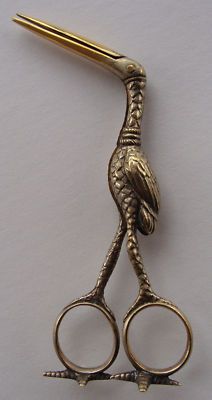
Once disposable clamps replaced them in the 1960s, the design of Stork Scissors as umbilical clamps began to change in shape and size. The 45 degree angle of the bird head was straightened so it aligned with the handle and the bird beak was sharpened into blades making the Stork Scissors an elegant and precision tool for sewing and needlework projects.
Fast forward to today ….. Since the vintage design was never copyrighted, charming and whimsical Stork Scissors have continued to be made under various brand names.
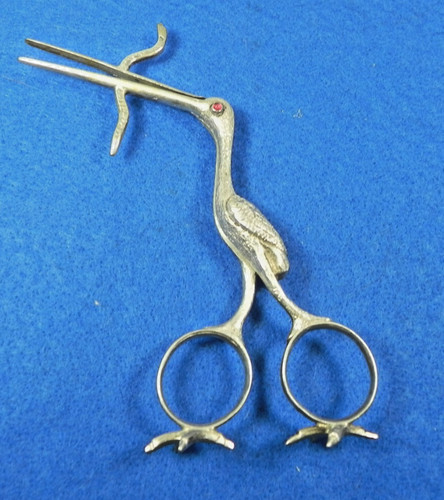
After checking various on-line sites for antique clamps (mostly EBay and Etsy) and modern scissor designs (Amazon, art supply stores), I found a wide range of prices. For $700, you can own a circa 1800s “stork midwife umbilical cord clamp” made of 800 sterling silver. Another antique sterling silver “stork bird clamp scissors” with baby inlay costs $300. Today’s versions, some highly rated, are mostly gold or brass color coated and may cost as little as $8.99 for a 2-pack.
Have you ever heard of Stork Scissors? If so, do you own a pair of vintage Stork Scissors or even a newly manufactured pair? Maybe you’re even a collector of Stork Scissors. Seems that’s a thing! Do you think today should be designated as National Stork Scissors Day? Maybe not ….. but for me, this was a fun story to share and tangle!
Happy July everyone!

