House Finch – Page 14 .. The 100 Day Project (2026)

July 14, 2026

House Finch (Haemorhous mexicanus ssp. frontalis)

aka Common House Finch

More than likely you’ve seen the sparrow-sized House Finch if you live almost anywhere in the U.S., southern Canada, or Mexico. The males are particularly showy with their bright red heads, throats and breasts, and their bouncy flight is sure to catch your attention. Just filling a backyard bird feeder with black oil sunflower seeds can bring a flock of 50 House Finches in to feast. They tend to dominate their favorite feeders, often chasing off competitors, after which you’ll have plenty of time to observe these finches as they sit still while shelling seeds by rapidly biting and crushing them with their large beaks. 

If you aren’t familiar with House Finches, you’ve probably heard their long, twittering song, which they belt out in most neighborhoods from coast to coast. Their song, so full of excitement and energy, is usually sung from the top branch of a tall juniper or pinyon pine tree. House Finches seem to be pleading urgently for attention by clearly singing, “Talk to me PLEASE, isn’t anybody THERE!!” (At least that’s what I hear over and over again first thing every morning throughout the Spring and Summer!) 

Not knowing how many broods have been reared this year, to date, it seems like we’ve enjoyed a large number of family groups around the house. Fledglings are fun to watch in flight as they constantly chase adults to beg for food. These futile attempts for free handouts strengthens their wing muscles and hones their acrobatic skills. Usually defeated, these novice students soon land in a tree and begin a long, hard practice session to learn their parents’ complex song.  

Completely exhausted, they will return to a certain cholla and the nest where the adult female fed and defended them as nestlings during the first 12-20 days of their lives. Finding even one of their well-hidden nests in any of those 4 to 7 foot tall cactus “trees” is quite the prickly endeavor! Even knowing how to recognize a House Finch nest hasn’t prevented me from experiencing plentiful and painful spiny jabs. What an excellent defensive location our local birds choose for nesting.

The Nest and Nesting Habits

In as little as two days, the female builds a cup-shaped nest made of fine stems, leaves, rootlets, thin twigs, string, wool, and feathers, with similar, but finer materials for the lining. This sturdy nest, durable enough to raise up to six broods a season, measures 3-7 inches wide; the inside cup is 1-3 inches across and up to 2 inches deep.

House Finches usually build their nests in cavities in deciduous and coniferous trees, on cactus and rocky ledges, and in or on buildings using sites like vents, ledges, street lamps, ivy, and hanging planters. They will also claim nests abandoned by other birds.

A western House Finch is likely to build its nest within 60 feet of where it was the previous breeding season; eastern birds choose sites more than half a mile away from prior nests. Despite these differing habits, all nest sites have a few things in common: a sturdy base and a roof-like overhang to shelter against sun and rain.

House Finch Facts

  • With over 40 million House Finches across North America, they are currently one of the most widespread and common bird species across the United States, second only to the American goldfinch. 
  • Native to the Southwest U.S. and Mexico, in 1939 a few House Finches captured in Santa Barbara, California, were sold to a New York City pet store owner as “Hollywood Birds.” Even back then, the sale of these birds was recognized as illegal under the Migratory Bird Treaty Act of 1918. To avoid prosecution under the Act, the pet store owner released the finches …. they were set free on New York’s Long Island. By the early 1940s wild nests were discovered on Long Island, and from there the spread continued. 
  • Sometime before 1870, House Finches were introduced to Oahu from San Francisco. By 1901, they had become abundant on all the major Hawaiian Islands.
  • Where House Finches are an introduced species, they are considered naturalized 1. They’re also considered an invasive species in some places, largely in unforested lands across the eastern U.S. where they’ve displaced the native purple finch (and even the non-native house sparrow!).
  • In their native range in the Southwest U.S. and Mexico, House Finches live in desert, grassland, shrubland, and open woodland environments, as well as near human dwellings and cities. The biggest House Finch flocks in the East are found in cities, and it’s much more common to find the eastern birds in habitats developed by people than anywhere else. 
  • Depending on where they live, House Finches can appear very different. Within the 11 officially recognized subspecies, body size, beak size and shape, wing length, tail length, and coloring can all vary regionally. For example, the northeastern migratory populations have longer and more pointed wings better suited for longer flights than the western finches which tend to be permanent, year-round residents.  Also, House Finches on Guadalupe Island off the coast of Baja California, Mexico, have heftier beaks than mainland birds.
  • The bright red (and sometimes orange or yellow) plumage on the head, throat and chest of mature House Finch males comes from compounds in their food (bird species are unable to produce red or yellow other than by diet). These pigments, called carotenoids (the same ones found in carrots and tomatoes), come from the berries and other fruits they eat. Females prefer mates with the biggest and brightest red-colored patches — a sign of a well-fed male.
  • House Finches are among the strictest avian vegetarians: seeds, buds, fruit, and foliage comprise 97% of their year-round diet. Most seed-eating birds not only eat insects in the spring and summer when they are abundant, but will feed bugs to their nestlings to add protein for growth. Except for the occasional fly larva, House Finches stick to a vegetarian diet.
  • Dealing with a pandemic for decades, these birds suffer from “House Finch Eye Disease,” a form of conjunctivitis that was first detected in Washington D.C. in the winter of 1994. Since then, the bacterial illness has expanded continent-wide causing big declines in House Finch numbers. Infected birds often have swollen or reddened eyes and may appear inactive or confused. Over time, it leads to birds becoming blind, disoriented, and vulnerable to predators. Other finch species, such as the American Goldfinch, are also affected. Because the disease is spread through social contact, it’s very important to keep bird feeders and baths clean.
  • The mite, Pellonyssus reedi, is often found on House Finch nestlings, particularly later in the season. However, the adult female has a clever strategy in response to these often fatal attacks. Since male chicks are more vulnerable to a mite outbreak, she will lay eggs containing females first to reduce the length of time male chicks are exposed to mites. This strategy increases the likelihood that representative numbers of both sexes will survive.

…………………………………………………………………………………………………

Share stories of your local House Finches!

Hope you found this interesting!

As always, thanks for stopping by!

1  A species is considered “naturalized” if it didn’t originally evolve in an area but has successfully adapted, established a permanent population, and is reproducing independently in the wild. These species are non-native, surviving without human help. Note: not all naturalized species are considered invasive.

References

allaboutbirds.org

audubon.org

iNaturalist.org

Lanceolated Chafer- Page 13 .. The 100 Day Project (2026)

July 9, 2026

Lanceolated Chafer (Phyllophaga lanceolata)

(syn Melolontha lanceolata)

aka Brown Scarab Beetle, May (June) Beetle

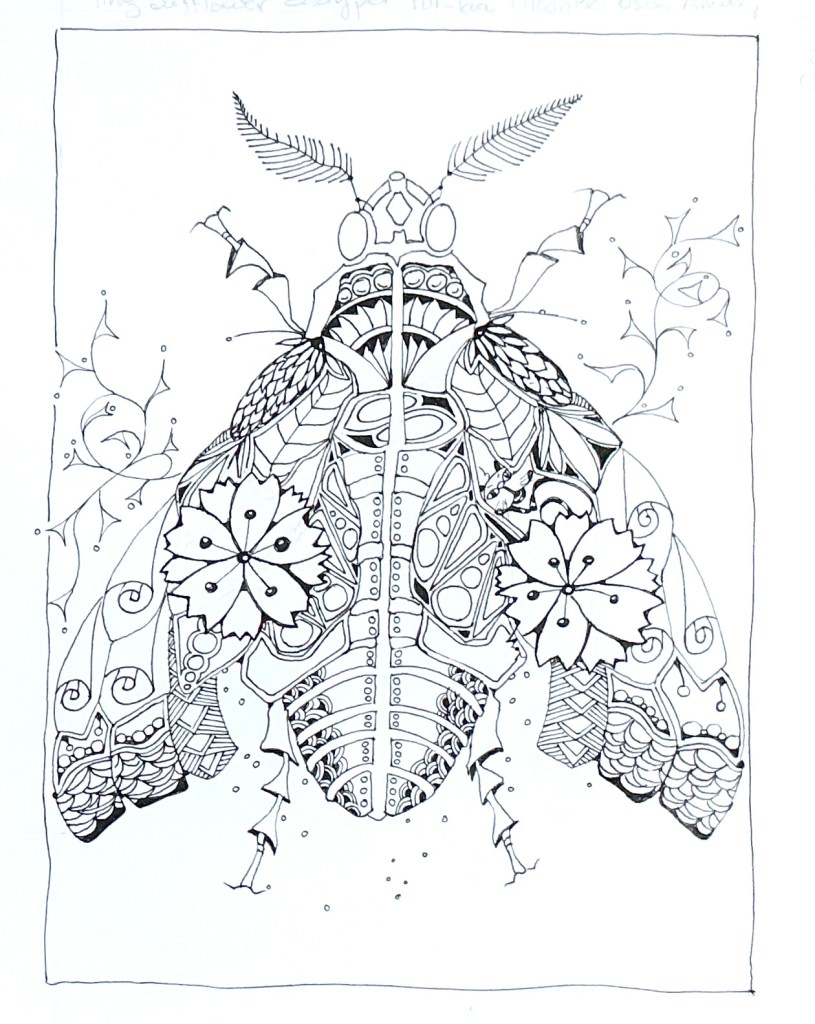
The Lanceolated Chafer (Phyllophaga lanceolata) is a scarab beetle native to North America. In New Mexico (along with Colorado and Kansas) these chafers thrive in open, grassy ecosystems, including native shortgrass prairies, pastures, rangelands, and agricultural fields dominated by grasses like blue grama (Bouteloua gracilis) and others. It’s in these arid habitats that the larvae (grubs) are rarely considered major pests1. Unlike most Phyllophaga species, adults are diurnal (active during the day); females are flightless

Adults – This small to medium-sized chunky beetle, is about 0.5 to 0.7 inches (13 to 17 mm) long; females are larger than males. Their hard wing/body cover (elytra) is brown with several darker brown/grayish longitudinal marks under a coat of white bristly hairs. Their segmented abdomens are mostly a smooth grayish/white; their thorax (pronotum) is heavily covered with long brown hairs. Because of their noticeably long, magenta-colored legs, they stand tall above the ground while walking. If picked up, their legs feel clingy and prickly. Adults live only 1 – 2 months, just long enough to grab a quick bite to eat, mate, and lay eggs.

Calling All Males!

The female Lanceolated Chafer produces and uses a unique sex pheromone, l-leucine methyl ester, to attract males! Because this pheromone acts as a highly-targeted sex attractant in the wild, she is able to communicate her readiness to mate and get a rapid response. As has been demonstrated in field trials, male chafers catching a whiff of her urgent communication can’t resist the call and come flying (read the true story of my eye-witness account in my post titled The Life and Times of the Lanceolated Chafer ). Research scientists (and I) whole-heartedly believe this pheromone contributes to the species’ reproductive success in its native range. 

This was a unique discovery because the Lanceolated Chafer is the first scarab beetle ever identified to produce an amino acid-derived pheromone. (And there are over 35,000 species of scarab beetles in the world, making up one of the largest and most diverse insect families on Earth!) The pheromone is so effective at targeting male chafers that entomologists use it to monitor and manage populations of these beetles in agricultural crops and turfgrass. 

Probably a male chafer, walking along the 2-track trail

And now a note about topic organization  ….. 

As in all beetle species, it’s usually the adults that are encountered. And it was the adult stage of the Lanceolated Chafer that’s most obvious along the subdivision’s 2-track rockpile trail. That’s why information about the adults was placed first, even though it’s actually the final stage in the life cycle of the chafer. But it’s interesting to understand how all those adults came to be. So the following few sections tackle the highlights of the 1 – 3 year long larval stage, and pupal stage of their life cycle, which take place after egg laying and hatching. Afterall, the Lanceolated Chafer spends the longest parts of their lives underground.  And then, for no particular reason, I’ll end with a section on entomology.

Larval Stage – Larvae (grubs) have a translucent white to cream-colored body and a light tan to brown hard and stiff (sclerotized) head capsule.  Larvae have three pairs of well-developed legs. When at rest they do so in a C-shaped curve.

By the 3rd instar, internal organs are more visible and jaws are larger! Grubs have a voracious appetite.

Larvae live for 1 – 3 years, primarily in the upper layers of the soil profile. To protect themselves from extremes in soil temperatures, both in  summer and winter, they will burrow to depths ranging from 3 to 20 inches (7.6 to 50.8 cm), averaging 10.3 inches (26.2 cm). Larvae actually hibernate in the winter.

The three instar stages of larvae development, serves to progressively increase body size, head capsule width, and degree of sclerotization. At the end of each instar, larva take up excess air and/or water to swell their bodies. This extra pressure causes its old exoskeleton to split, allowing it to be shed (a process called ecdysis). Mature (third instar) larvae are 1.75 inches (45 mm) long with a nearly uniform body width.

Pupal Stage and Metamorphosis – When larvae are ready to move beyond the third instar, each individual builds a protective, earthen cell in the soil 8 to 12 inches (20 to 30 cm) deep where they will remain for the next 2 – 4 weeks while they undergo metamorphosis and and finally emerge as adult beetles.

Etymology 

The genus, Phyllophaga, is a generic name that comes from two Greek words ….. phyllon which means “leaf,” and phagos which means “eater.”  The specific epithet lanceolata comes from the Latin word lanceolatus, meaning lance-shaped, probably referring to the fine, lanceolate hair-like scales covering parts of the beetle’s body, such as the head (frons) and thorax (pronotum).  The etymology of the word “chafer” comes from an Old English word meaning “gnawer,” referring to the beetle’s strong jaws.

…………………………………………………………………………………………………

Hope you found this interesting!

As always, thanks for stopping by!

1  Larvae of Lanceolated chafers are considered serious pests in the humid central and eastern U.S. they cause extensive damage to agricultural crops like corn, timothy, potatoes, and various other plants in the grass (Gramineae), pea (Fabaceae), and sunflower (Asteraceae) families.

References

ageconsearch.unm.edu

bugguide.net

grokipedia.com

iNaturalist.org

insectIdentification.org

invasive.org

npsnm.org

Lunginbill Sr., P and Printer, H.R., 1953, May Beetles of the US 

The Life and Times of the Lanceolated Chafer

The Case of a Mysterious Wormy Thing

July 9, 2026

This is the third year in a row that I’ve noticed these seemingly unremarkable-looking brown beetles “hiking” along the rock pile 2-track road. They appear all at once, about mid-June, then vanish after several weeks. This year (2026) these scruffy/fuzzy beetles, know as Lanceolated Chafers (Phyllophaga lanceolata), really caught my attention, especially after finding myself at ground zero of a mass male Flash Mob1 !!! From all directions, determined (and awkwardly) flying male chafers were dodging my legs to land on top of a lone female beetle frantically struggling against an earlier arriving male. His prickly lance-like legs had pinned her to the ground so she was lying on her side unable to use her legs. While she squirmed at my feet, newly landed beetles tried to fling off the original male to claim their rights to the female. Males continued to land until there must’ve been 30 or more, with fights breaking out everywhere, on top of the female and all around my feet. Each male was jousting to be victor. 

Males arriving, fights break out

But a victor of what? Was this some sort of mating ritual? Had the female released highly potent pheromones to attract a mate? If so, how far did her “call” drift on the wind to bring together so many males at one time? Did she intend to call only one male, or was her purpose to entice a stampede? If she anticipated a herd, was her intent to mate with the first one (the fastest?) to arrive? Maybe she hoped for battles and skirmishes to ensue, where the strongest of all males would win her favor(s)? This still remains a mystery, as I couldn’t find anything in the literature to explain this behavior? 

While pondering these questions (and daring not to move my feet for fear of squishing one of the many male pile-ups), I bent over for a better look. It was then I noticed an opaque white, worm-like thing slowly emerging from the female’s abdomen! “What could this be?” ….. 

Was it a larva? Probably not ….. Female chafers don’t give live birth; they lay eggs in the soil beneath their favorite host plants (such as mallows), where they hatch into grubs that remain underground for up to two years before emerging as adult beetles. 

Five males fighting for the female (notice how much larger she is than a male). Bit of a skirmish, left side.

Was it part of or the actual female genitalia? Maybe? I’m still searching for information about that notion.

Was it part of the male genitalia that had somehow broken off inside the female during insemination? Is that even possible? Again, still searching for answers about chafer sex.

Three males with the female (notice the “wormy” thing). One male, lower left, apparently confused?

For another 5 minutes I closely observed the squirming female laying helpless on the ground fighting off numerous suitors while still displaying the wormy “thing.” As more males continued to arrive, crash-landing on other grounded males and adding to the chaos, something changed. Can’t explain what happened, but in a matter of 15 seconds all the males stopped their aggressive fighting and took flight; the female uprighted herself (regaining her dignity?), quickly walking away like the nothing unusual had just happened. I watched her go, noticing she was no longer in possession of the wormy “thing,” and couldn’t find it anywhere at or near the scene! 

The party is over. A male walking away, looking for a mallow to snack on.

After-math

Over the next several days, nary a chafer was found! Had all the males satisfied their natural desires? Had all the females become pregnant, laid their eggs and vanished? “After” doing the “math” on the days following the event, I counted only two beetles walking the 2-track road, one headed north — one headed south. Scouts? ….. Because Lanceolated Chafer adults only live 1-2 months, and because none have been seen since the last two, that may be the end of sightings for this year. While there’s still the occasional pack of ants dragging away a dead beetle to share with their colony, the legacy of adult chafers lives on. Recently-laid eggs will hatch after only 18 days into white or cream colored, C-shaped larvae. Those grubs will munch away on mallow and grass roots for the next 1-3 years until a perfectly warm mid-June day, sometime in the future, the adults emerge from the soil to complete their life cycle. 

Epilogue 

Since most chafer beetles are nocturnal (active at night), if you’ve seen an adult during the day, it may have been the Lanceolated species which are diurnal (active during the day).  And you may have unwittingly encountered any of the chafer species found in North America……. 

An exhausted male, a bit off balance, as he feeds on mallow leaves.

…….. If you’ve ever seen one or more of your carefully-tended, vigorously-growing garden plants up and die overnight, it may have been victimized by root-living chafer grubs.

…….. If you live in the central or eastern U.S., grubs may be feasting on the roots of agricultural crops, like corn, soy, or sunflowers. Headline news is sure to cover the story of devastation and financial ruin brought on by the voracious chafer beetle larvae, complete with video of farmers holding a handful of grubs dug from below the soil surface.

Have you experienced one of these close encounters?

Hope you’ve found the “Life and Times of the Lanceolated Chafer” interesting (or maybe educational, peculiar, or maybe even fascinating!?!). Let me know what you thought.

As always, thanks for stopping by!

1 A flash mob is defined as a large group of people who suddenly assemble in a public place, perform a brief, pre-arranged action (like a synchronized dance), and then quickly disperse. Flash mobs are typically organized online via social media or viral messaging for entertainment or artistic expression. I think this definition nearly perfectly fits the chafer beetle dance I was witness to on that fine mid-June morning somewhere along the 2-track rock pile trail. 

Scissor-billed Stork Stalker

July 1, 2026

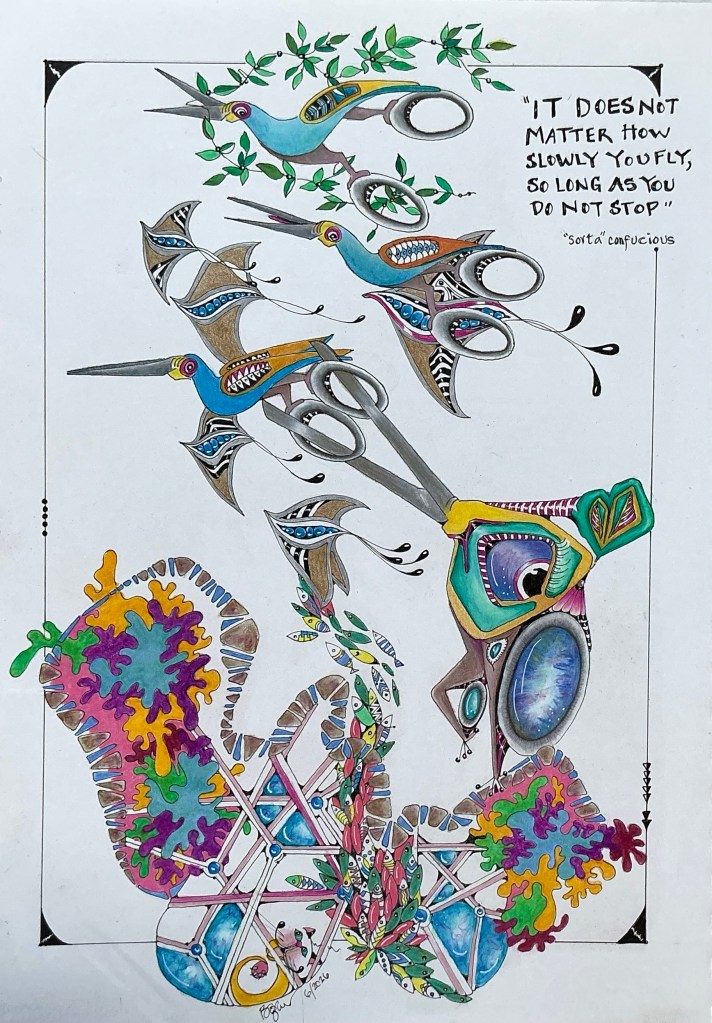
Today’s tangled drawing was not inspired by a special day of the week or month. Instead I was smitten by a recent scissors-shaped discovery. It began with a desire to create a nature-themed action piece, like birds in flight. As I mentally rabbit-trailed the many possibilities, it seemed important to think of a reason why my birds were flying in the first place. Maybe they were fleeing something, but what? Being momentarily distracted while addressing an envelope, my mind took an exit ramp while considering the name of our return address town of Tijeras. Excitedly recalling that “Tijeras” is Spanish for “Scissors,” I nearly decided my birds would be scissor-tailed flycatchers — gorgeously graceful birds — but a tad too obvious?  Regardless, the notion of “scissors” stuck in my brain. So I returned to my main rabbit trail with thoughts of fanciful, yet desperate birds fleeing a pair of big scissors! 

Zentangle patterns: Greenery Vibrant, Toku, Neb, Wind Farm, Rayz, Spangle

Those totally irrational thoughts focused my internet search for “flying birds and scissors.” As I wasn’t terribly optimistic about finding any interesting results, imagine my shock when after only a few short moments of scrolling I shouted ….. “Bazinga!” 

There, before my eyes, had to be one of the wonders of the world (and the answer to my flying-fleeing birds) ….. Stork Scissors! I never knew such a thing existed, but right then and there I began mentally designing and composing a tangled illustration of birds with scissors!

Of course I had to learn the why’s and what-for’s behind Stork Scissors and the use of such clever scissors in the shape of a stork who’s long bill actually forms the scissors’ blades. Here’s what I learned:

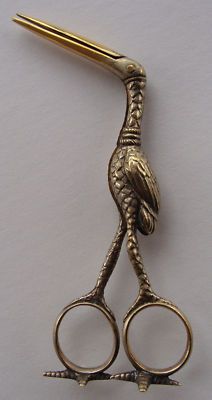
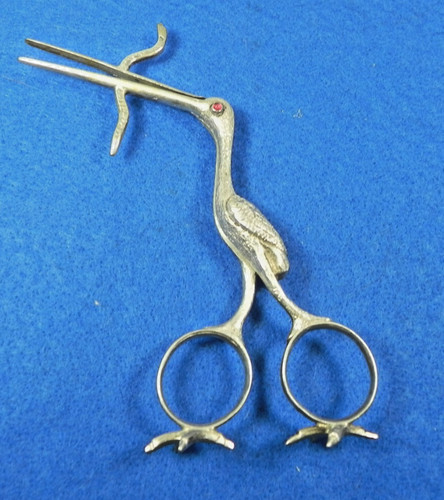
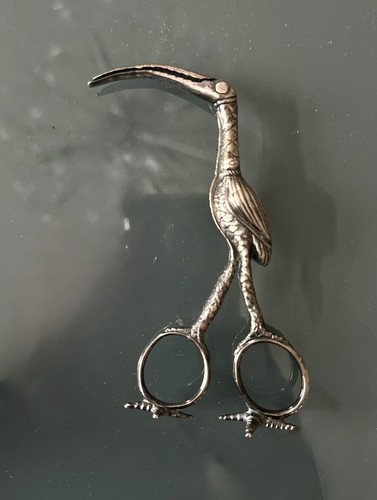
Stork Scissors” (sometimes called crane or bird scissors) are used today as a classic sewing tool shaped like a bird. Even though they look decorative, those long, precise bird beak blades are very efficient for snipping tiny threads in embroidery and crafts.

But there’s oh so much more to the story. 

It’s believed that the first Stork Scissors were used in the late 18th and early 19th centuries by midwives as medical clamps to stop blood flow in a newborn baby’s umbilical cord after birth. The original 4 – 6 inch long clamps were designed with a stork motif because of the bird’s folklore association with childbirth, good luck and hope. The head of the stork was mounted at a 45 degree angle and had a beak that was blunt and heavy. The handles looped to form the wings and body of the bird. Some clamps had an inlay of a little baby hidden inside the beak that appeared when opened. Also, Stork Scissors usually came with a set of forceps to help the midwife deliver the baby.

Once disposable clamps replaced them in the 1960s, the design of Stork Scissors as umbilical clamps began to change in shape and size. The 45 degree angle of the bird head was straightened so it aligned with the handle and the bird beak was sharpened into blades making the Stork Scissors an elegant and precision tool for sewing and needlework projects.

Fast forward to today ….. Since the vintage design was never copyrighted, charming and whimsical Stork Scissors have continued to be made under various brand names. 

After checking various on-line sites for antique clamps (mostly EBay and Etsy) and modern scissor designs (Amazon, art supply stores), I found a wide range of prices. For $700, you can own a circa 1800s “stork midwife umbilical cord clamp” made of 800 sterling silver. Another antique sterling silver “stork bird clamp scissors” with baby inlay costs $300. Today’s versions, some highly rated, are mostly gold or brass color coated and may cost as little as $8.99 for a 2-pack. 

Have you ever heard of Stork Scissors? If so, do you own a pair of vintage Stork Scissors or even a newly manufactured pair? Maybe you’re even a collector of Stork Scissors. Seems that’s a thing!  Do you think today should be designated as National Stork Scissors Day? Maybe not ….. but for me, this was a fun story to share and tangle! 

Happy July everyone!