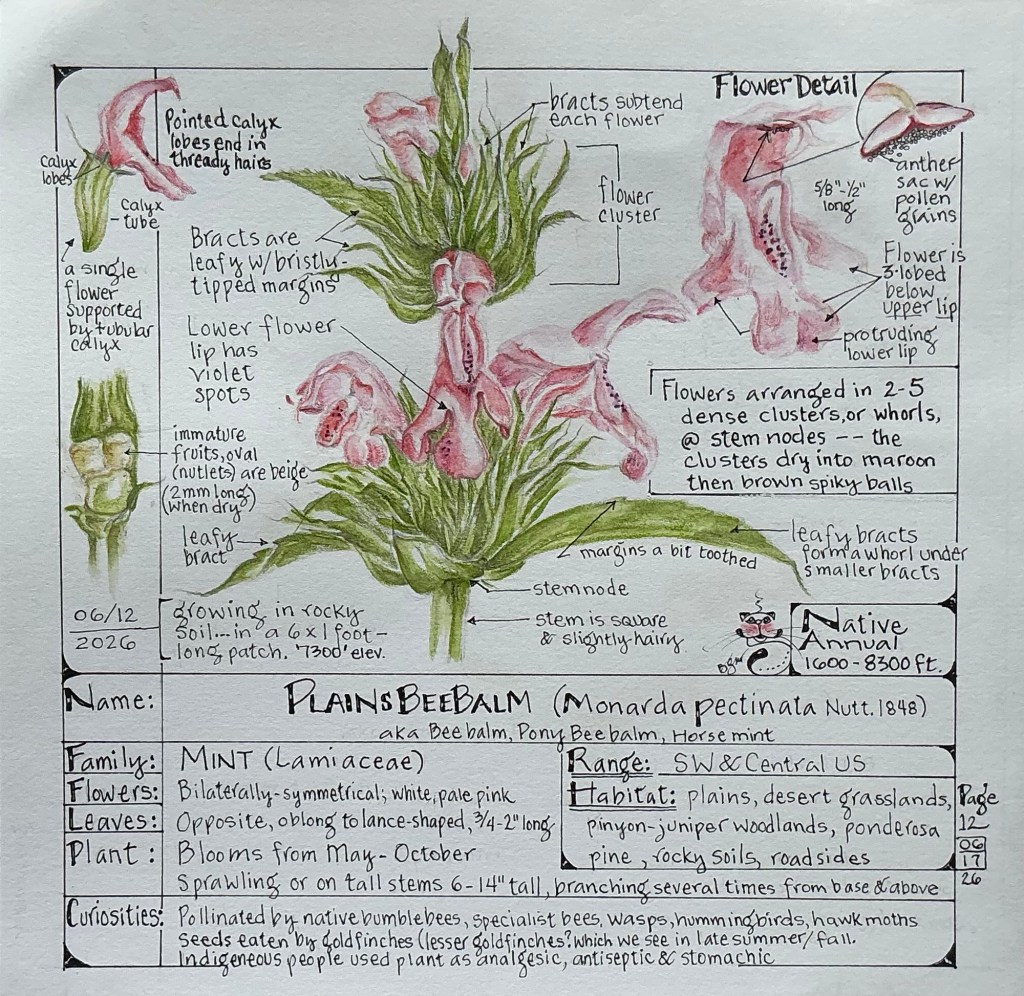
Linnaeus named the genus Monarda to honor 16th century Spanish physician and botanist, NicolásBautista Monardes (1493-1588). Monardes never went to the Americas but was able to study medicinal plants in Spain, publishing the first systematic, in-depth book on medicinal plants and remedies brought to Europe from the Americas.
The species pectinata is derived from the Latin word pecten, meaning “comb.” The suffix -ata denotes possession or resemblance — so it translates loosely to “comb-like” or “having the form of a comb,” referring to the bristle-tipped bracts that sit below flower whorls.
Monarda pectinata is commonly called Plains Beebalm (or Pony Beebalm) because of its historically recorded uses by Indigenous peoples as an analgesic and antiseptic qualities.
Ethnobotanical and Culinary Uses
Indigenous peoples used a plant infusion to treat coughs, colds, fevers, and stomach complaints related to digestion. A flower infusion was used as a wash on insect bites and stings. The plant was rubbed on the head to bring relief from headache. In addition, historic records document that groups, such as the Kiowa, used Monarda pectinata leaves as a perfume due to its strong scent, and were chewed while traveling.
The strongly aromatic smell of crushed Plains Beebalm leaves smell both savory and citrusy, similar to oregano or lemon. Sometimes called “wild oregano,” they can be eaten fresh, dried or cooked to season in salads or other foods. In spring the leaves may be boiled to make herbal tea.
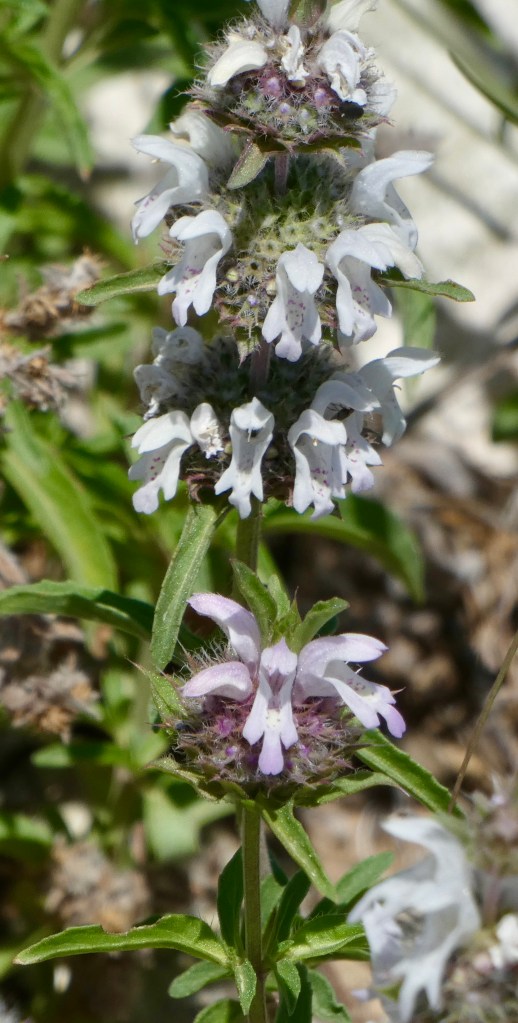
Plains Beebalm blooming in our yard, in bright sunshine and rocky soils.
Pollinators
According to the Xerces Society for Invertebrate Conservation, all Monarda species attract a number of native pollinators such as specialist bees, bumble bees, predatory wasps, hummingbirds, and hawk moths.
A Few Fun Facts
Desert Survivor: Although many Monarda species are moisture-loving, such as Wild Bergamot (Monarda fistulosa) found the along cool trails of Sandia Mountain, Plains Beebalm prefers hot, harsh, dry environments like desert washes, rocky slopes, and sandy pinyon-juniper woodlands.
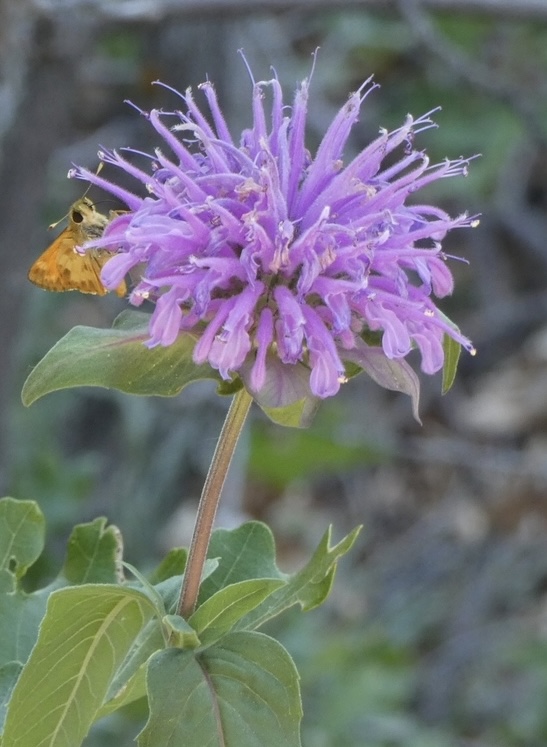
Wild Bergamot and a little skipper pollinator. Tecolote Trail, Sandia Mountain, NM. This Monarda species prefers living in moist soils under the shady canopy of white fir and ponderosa pine.
Mammal Resistant: While pollinators adore Plains Beebalm, its strong, minty-citrusy-oregano essential oils act as a natural deterrent, making the plant resistant to browsing deer and rabbits.
Pollinator Magnet: The tubular pale pink flowers of Plains Beebalm are an excellent nectar source for long-tongued native bees, butterflies, and hummingbirds, especially during the hot summer months.
Soothing Relief: Plants in the Monarda genus are commonly called “Beebalm” due to the soothing nature a wash application of the plant, especially the flowers, has on insect bites and stings — particularly bee stings. Turns out plants in the genus contain the active ingredient thymol, a natural antiseptic found in modern mouthwashes.
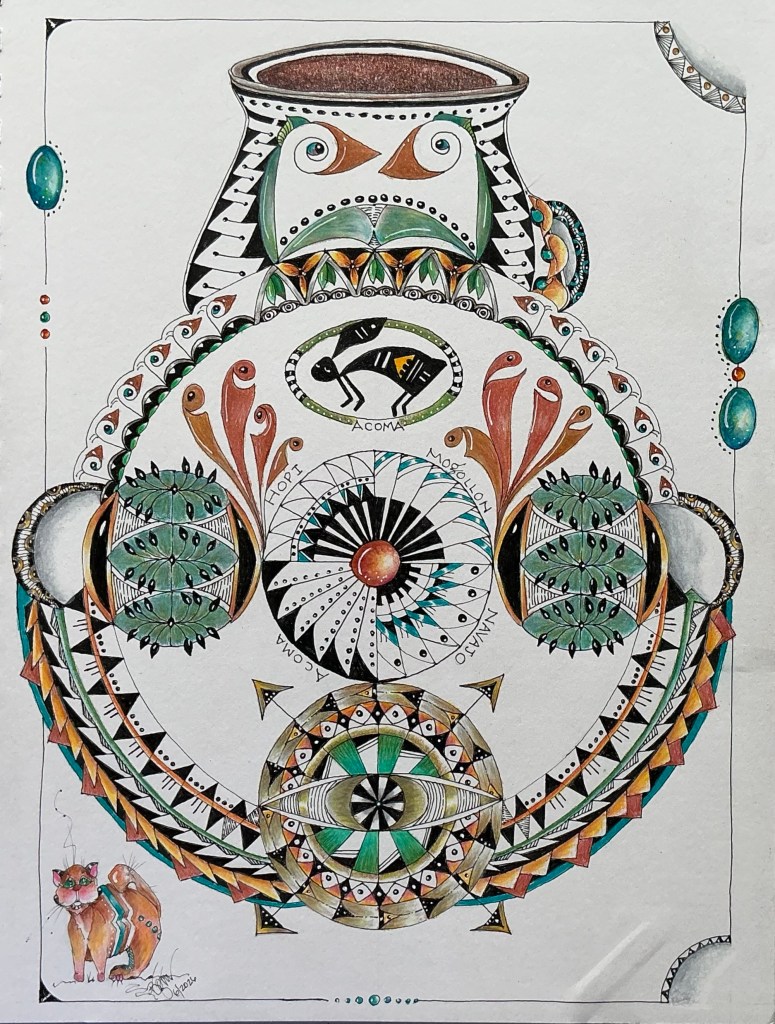
The Tale of the Tangled Pot: Recognizing our Deeply Rooted and Inseparable Connection with the Natural World Through the Practice of Nature Journaling
June 14, 2026
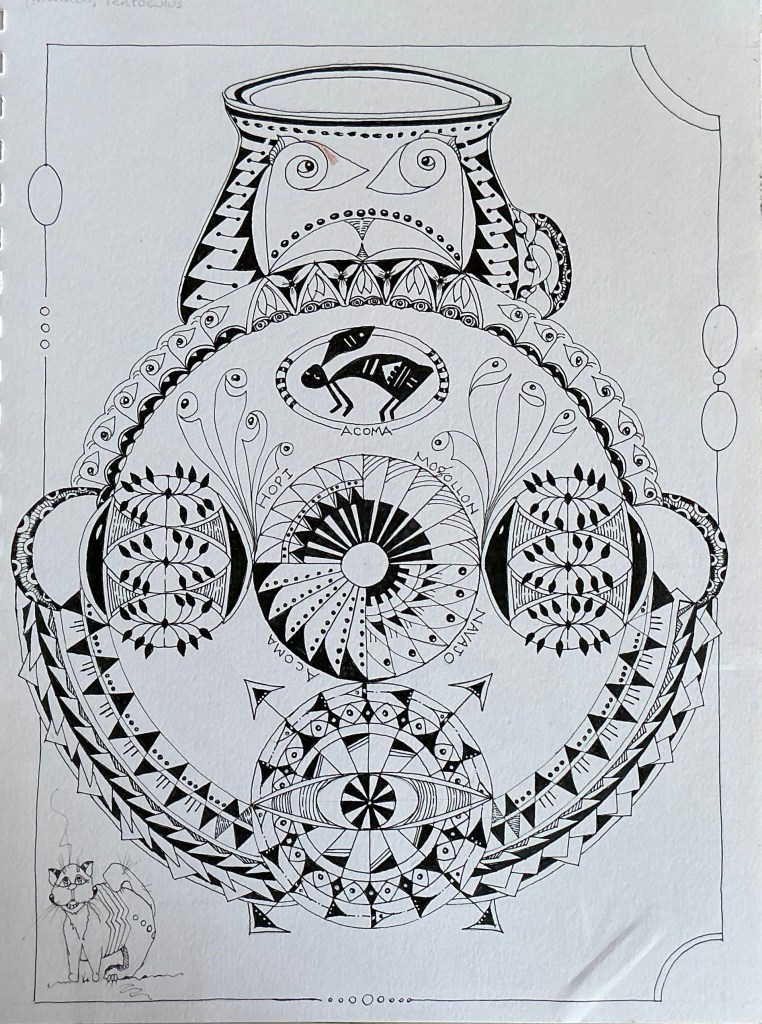
Zentangle patterns: Mogo, Sage, Roadrunner, Agave, Lazy Leaf, Monsoon, Zona, Voyage, Hokam (patterns created by Angie Gittles). Also added Hahna and Tentoculus. All patterns found on tanglepatterns.com
Living in the desert Southwest, inspiration for many of my Zentangle work comes from the representative art created by the indigenous peoples of New Mexico and the Four Corners region. Their deep connection with nature was often expressed in ancient rock art and on handcrafted pottery in ways that amaze. It takes me back to a different time and place; where their way of life was deeply rooted and inseparable from the natural world; where survival required an understanding and appreciation of the countless interdependent components required for the productive function and evolution of complex ecosystems.
Fast forward to today. Our fast-paced, stress-filled, consumer-centric lifestyles, full of techno-gadgets (demanding so much of our attention), and instant gratification, offers people a cushy arm-chair view of the world. Why put down those phones or turn off the TV, when we can safely and comfortably “witness” nature from our homes? Better yet, why not?
While pondering that question, many compelling reasons came so easily. Just being present in nature can be calming; relaxing; stress-reducing — we slow down, taking time to observe our natural surroundings. By really “seeing” local ecosystem(s) with all of our senses, we experience awe and wonder and make meaningful memories. Our once dormant skills in curiosity and critical thinking come alive as we learn about the integral connectedness of nature’s many and diverse components. By understanding and valuing how our connectedness to nature always has been and always will be critical not only to our very survival, but to the survival of all species, we realize the ability of all living things to thrive benefits from natural ecosystem services that provide things like clean water to drink, clean air to breathe, food to eat, and a habitable climate. These vital services are priceless. All nature asks is that we keep it healthy. First-hand personal exposure to the natural world fosters appreciation, love, and a desire to nurture and protect nature; an investment in the future of all life on Earth.
Observing the Natural World through the Practice of Nature Journaling
People have been observing, learning, and recording nature around the world for millennia. The oldest known cave art (pictographs) with paintings of wildlife, primitive humans, and human-bird hybrids hunting pigs, was discovered on an Indonesian island, and dates back almost 70,000 years. The oldest known rock carvings (petroglyphs), created by the Aborigines of Western Australia 40,000 – 50,000 years ago, depict wildlife and hunting parties. The oldest known petroglyphs found in North America were carved into boulders by still-unidentified humans that lived in the Winnemucca, NV area (east of Reno) between 10,000 and 14,800 years ago; their rock art represents leaves and trees. The oldest pictographs and petroglyphs found in New Mexico were made by Ancestral Puebloans and other Indigenous groups between 3,000 to 4,000 years ago in the Guadalupe Mountains/Carlsbad Region (southern NM) and depict hunting parties, wildlife and other natural elements.
The travelers, explorers and settlers that arrived in North America significantly influenced nature recording. They kept journals, field notes, and artistic renderings tracing a rich history of scientific inquiry and ecological changes spanning early colonial times to the formal natural history expeditions of the American West. For example, John Lawson (1709) and Mark Catesby (1731-1743), each published a book with their observations of the flora and fauna of the eastern colonial colonies (Catesby) and the southeast (Lawson). Extensive and diverse nature observations were recorded by all members of the Lewis and Clark Expedition (1804-1806), and by John James Audubon (1827-1838) with a focus on birds in their natural habitats. These and many more examples of “journaling nature” provided an understanding of the complex ecosystems that existed between two oceans, and was indispensable to the successful settling of North America.
Today’s Practice of Nature Journaling — paying attention, recording observations, asking questions, noticing changes, and reflecting on the natural world — is nearly identical to historical journaling practices, with some healthy advantages for mind and body. For example, Nature Journaling offers much needed mental, cognitive, and emotional relief, particularly important in today’s world. It also provides a screen-free way to reduce stress, encourage mindfulness, and sharpen observational and critical thinking skills. By intentionally immersing ourselves in nature — by being fully present — we can experience these benefits, and more. We find our place in nature by making connections and understanding how we are an integral and inseparable part of the environment around us.
“Walking” thoughtfully and gently in nature inspires us to nurture and protect what we are all part of, instilling in us a deep appreciation for the natural resources essential for the survival of our ancestors, as well as for our survival today and for future generations.
……………………………………………………………………………………………………
Zentangle patterns: Mogo, Sage, Roadrunner, Agave, Lazy Leaf, Monsoon, Zona, Voyage, Hokam (patterns created by Angie Gittles). Also added Hahna and Tentoculus. All patterns found on tanglepatterns.com
Many thanks to Angie Gittles, a Certified Zentangle Teacher, for developing the step-outs to an abundance of patterns inspired by Indigenous Peoples of the Southwest. Her inspiration inspired me to weave 10 of her different designs into a stylized pot to honor and encourage such an important way of life. In doing so, I took my time, taking many deep breaths during the process, and thought about the days when appreciating and expressing nature was a natural way of living.
……………………………………………………………………………………………………
Resources and a Few Important Tips
Whether you consider yourself a “Nature Journaler” and would like to learn more, or are interested in how to begin, there are countless resources and examples to refresh your skills or to get you started. Borrow a library book, such as Nature Drawing by Claire Walker Leslie, Keeping a Nature Journal by Leslie Roth, or Nature Drawing and Journaling by John Muir Laws.
To get started in journal sketching or to improve your skills, check out the following: Discovering the Art of Field Sketching by Kristin Link, Botanical Drawing using Graphite and Colored Pencil by Sue Vize, or The Artist’s Guide to Sketching by James Gurney and Thomas Kinkade.
Of course there hundreds of thousands of on-line resources and social media sites about Nature Journaling and related topics. But beware the pit trap ….. lest you get caught up in doom of perpetual scrolling, never to get a breath of fresh air in the light of day!
If you’re unsure about becoming a “Nature Journaler,” know that anyone can head to the woods, the backyard, or sit by a window. You don’t have to travel hundreds of miles to visit a National Park ….. nature is everywhere! All you need is a pencil and piece of paper, the curiosity to see what’s around you, and the desire to slow down and observe with all your senses. There’s no right or wrong way to journal in nature, but when you do, be fully present; take the time to really “see” your surroundings. Just committing to turning off your screens to nature journal for 5 minutes a day will be perfect for you!
……………………………………………………………………………………………………
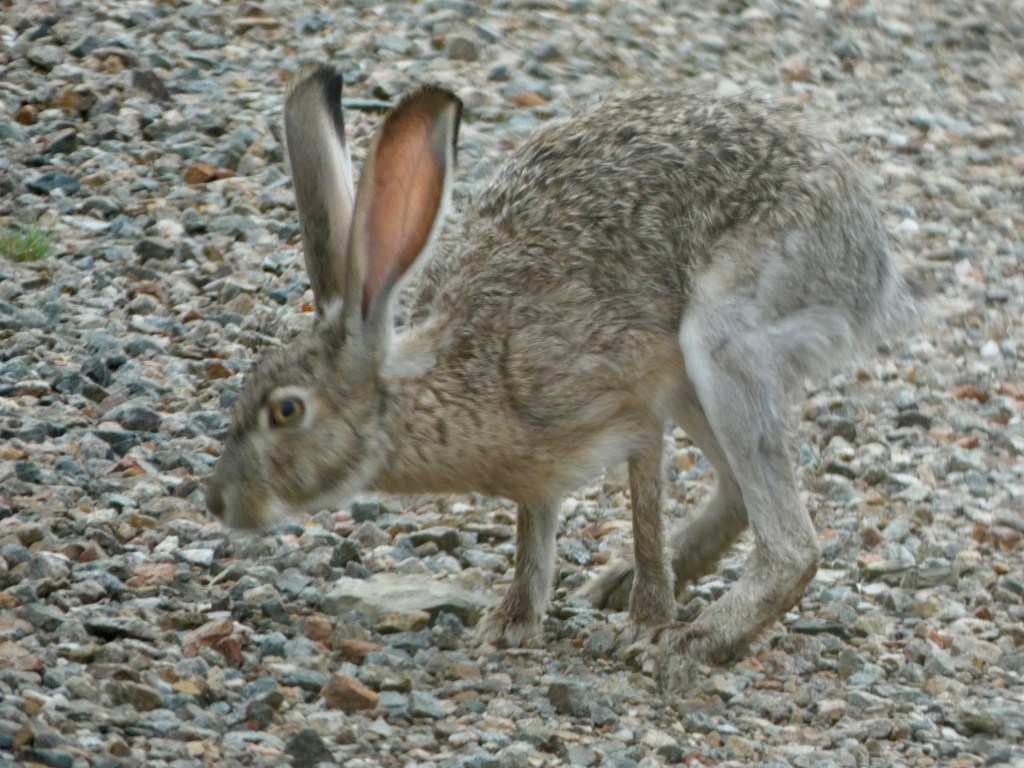
Black-tailed jack rabbit on the move!
Hope you enjoyed my Tangled Pot. As I always do while nature journaling, when creating these kinds of Zentangle-inspired works, my automatic slow-down mode becomes engaged, allowing me to think about possible directions I can take to complete a page. Sometimes the path is direct, but more often a world of rabbit trails leading to deep holes opens up before me, and I gotta take the plunge. That’s exactly what happened while tangling the Pot. And that’s what got me thinking about— how our ancestors used to live in nature, how art represents nature— how nature is endlessly tangled up in life— how today’s values take a back seat to our crucial connections with nature—how nature journaling can be used as a tool to restore gratitude and appreciation for nature—how, without nature, life as we know it would not exist.
I’m going to turn off my computer now and go enjoy a walk in nature with my journal. Are you inspired to do the same?
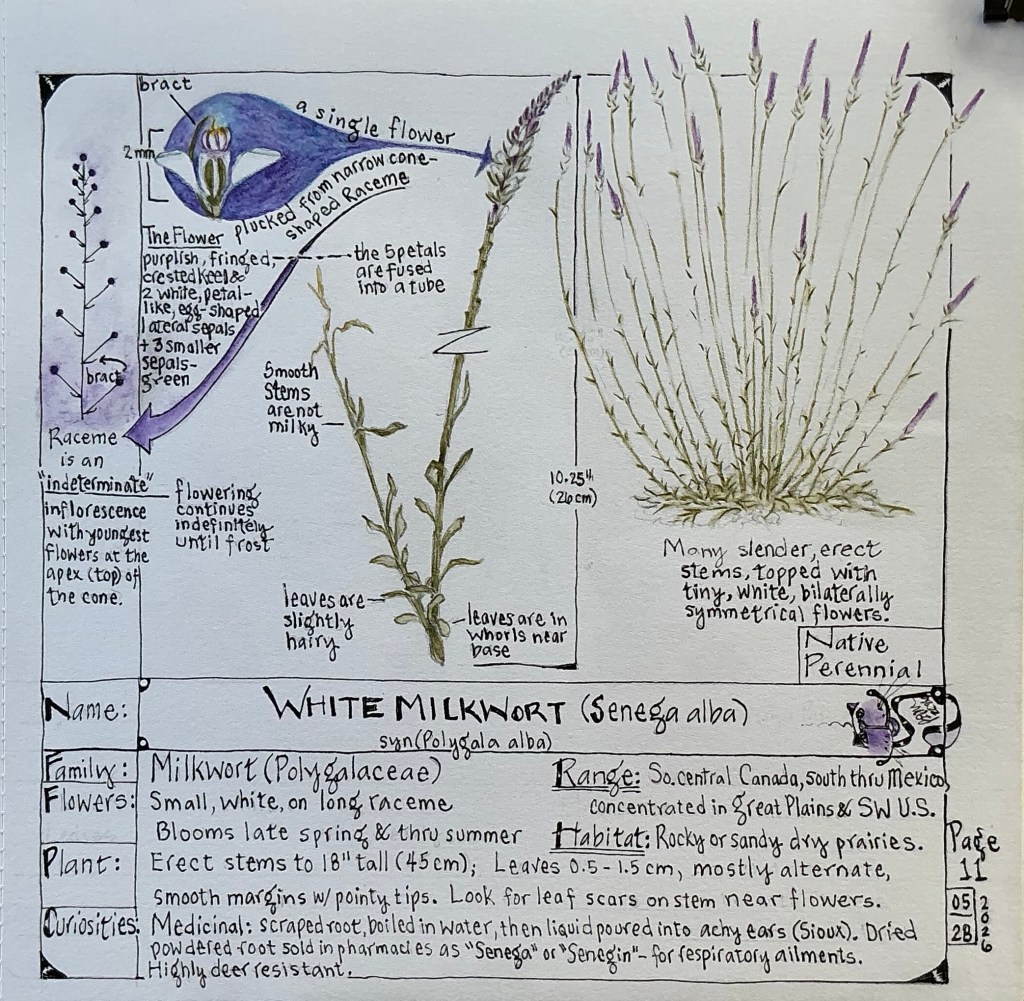
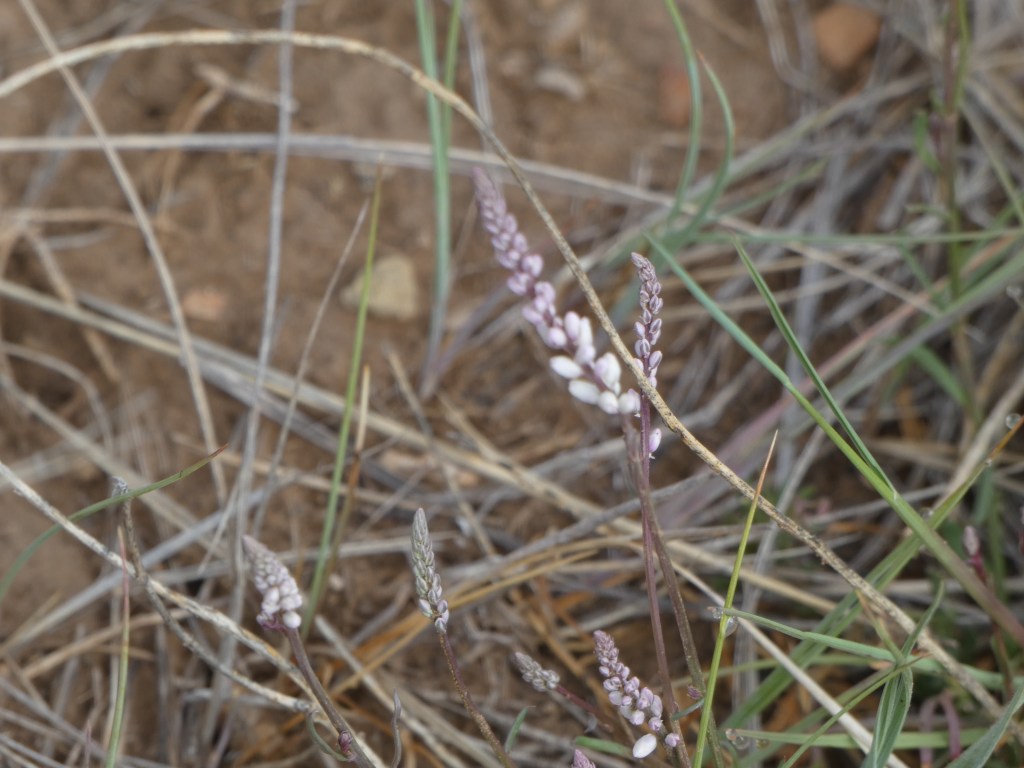
White Milkwort (Senega alba (Nutt.) J.F.B. Pastore & J.R. Abbott)
(synonymous with Polygala alba Nutt.)
A Light Touch
It was a beautiful morning for a walk along one of the neighborhood’s 2-track dirt roads. I was searching for late blooming Spring wildflowers when something lightly brushed against my leg, bringing me to a full stop. There, at my feet, gently swaying in the quiet breeze were a dozen+ foot tall, nearly naked, skinny green stems topped with lavender and white cones. Not wishing to crush these delicate stalks, I noticed there were five other groupings nearby, all growing in the road’s old tire depressions. Upon closer inspection, I recalled having seen this plant before in the yard of our previous home, but they had fewer and shorter stems, and larger (?) flower cones. Still, this was the white milkwort species (back then known as Polygala alba; today called Senega alba) I identified four years ago. It was the larger size and delicate nature of these plants at my feet – that puzzled me.
Here’s what I learned:
The stems, which are ridged, can grow to 18” tall. They branch from a basal caudex (a root-like thickened stem, often found underground, from which branching/stems grow …… and the more extensive the caudex, the more above ground stems form.
You can roughly age this perennial milkwort by counting the number of vertical stems. Typically there’s one stem on seedlings and one-year old plants; as many as 30 stems have been counted on much older (many, many years old) plants.
Even though the official flowering period ends late summer, if mid-summer/early fall rains (our monsoon season) are plentiful, another bloom period peaks and can continue into November. It’s been reported that when old flowers are removed from these milkworts (deadheaded), the plants will bloom continuously for up to four years! Obviously, those plants are not impacted by winter frosts.
The 90% of the pollinators visiting white milkwort are small to medium solitary or semi-solitary bees. Where we live (desert southwest), many of these ground-nesting bees are floral specialists, and based on research dating back to the early 70s, green metallic bees highly favor this native plant’s flowers for nectar and pollen. And with extended bloom times prompted by monsoons, this helps benefit these and other bee species. Unfortunately, the timing and intensity of our monsoons is no longer predictable and is likely causing unfavorable conditions for extended flower bloom and the bees.
Always be prepared to encounter a plant that tickles!
Classification and an Etymological Quandary
To learn the story about the old and new scientific names for white milkwort, and why being a botanist way back when and today is so challenging, read the next section on Etymology. It really is quite fascinating!
Etymology
Way back in the day (say, the early 1800s), when Thomas Nuttall, a English botanist, ornithologist, geologist and explorer, needed an unforgettably descriptive binomial name for a new species he’d discovered, “Polygala alba Nutt.” was his choice. The genus “Polygala,” which was originally assigned by Linnaeus to a group of plants with similar-looking flowers, is Greek for milkwort — meaning “much milk; ” the species name “alba” is Latin for “white, bright or clear.”
Thomas, logically picked “alba” as the species name for his new discovery, because the plant had white flowers. However, he apparently chose the “Polygala” genus based on an ancient belief that nursing mothers (and cows) that ate the milkwort plant experienced increased lactation. However, Polygala alba doesn’t have either milky sap or any plant parts with milk! After diving deeper into the Polygala genus as a whole, I couldn’t find any that ooze a milky substance.
The changing nature of botanical classification: It wasn’t until recently (2023 to be exact) that the official report announcing the transfer of 18 Polygala species to Senega, including Polygala alba to Senega alba, was published by botanists J.F.B. Pastore & J.R. Abbott. This change was based on a number of scientifically-researched plant characteristics, which addressed deviations in seed, fruit, and floral anatomy between Senega and true Polygala species. Now I know I need a bigger microscope!
In case you’re curious (I certainly was) there are no Senega milkworts (today referred to as American milkworts, formerly classified under Polygala) with a milky sap. So, despite their family (Polygalaceae) and originally assigned genus name (Polygala), these plants exude a clear, watery sap when their stems are broken.
Why “Senega” was selected as the genus name for all American milkworts: The genus name “Senega” comes from the Seneca Native American tribe. The first use of the name in the English language was in the 1730s; the Seneca snakeroot plant was given the scientific name Polygala senega, to honor the tribe’s traditional use of the root as a remedy for snakebites and respiratory issues.