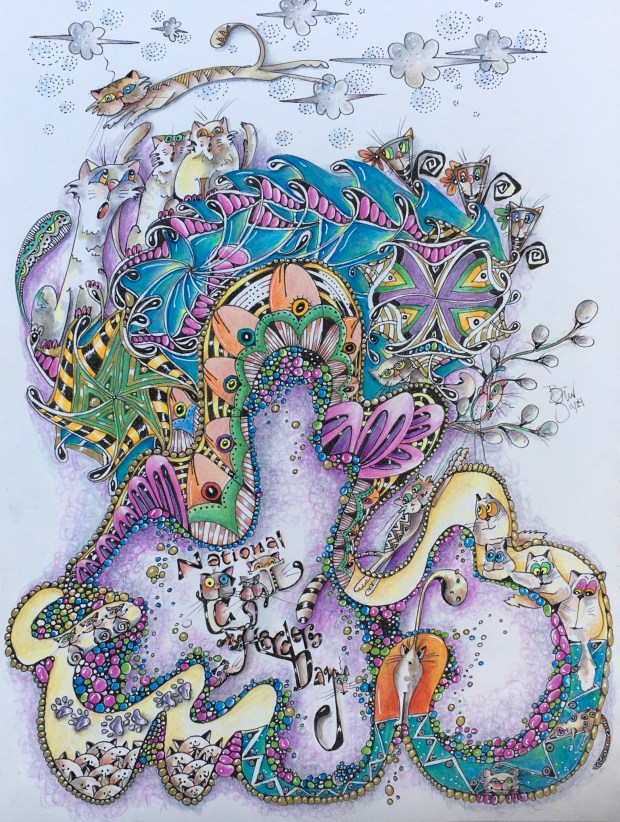
You don’t have to be a cat lover to celebrate National Cat Herders Day. The only requirement is to know someone or even be that someone who’s attempted to accomplish a complex task by controlling the uncontrollable, organizing the disorganized, or bringing to order a disorderly cast of characters, akin to like trying to herd cats*. From parents and teachers to project managers and team leaders, this humorous observance pays tribute to those willingly and persistently taking on the challenge of controlling difficult or chaotic situations. Show the love and appreciation for people in your life, and quite possibly yourself, who take on any impossible or frustrating task with patience and humility.
Zentangle patterns used: Choir, Ease, Windflower, KittyKitty, Fragment oA6, Apichu, Budlite, Cat-kin, CD Joy, Cloudy Day, Raindotty
*The origin of the phrase “like herding cats” likely came from the opening scene of Monty Python’s Life of Brian (1979). In this scene, shepherds are discussing sheep and the topic strays to cats: “Can you imagine a herd of cats waiting to be sheared?”
___________________________________
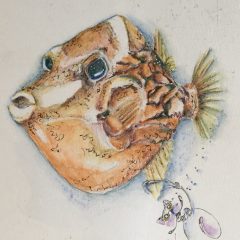
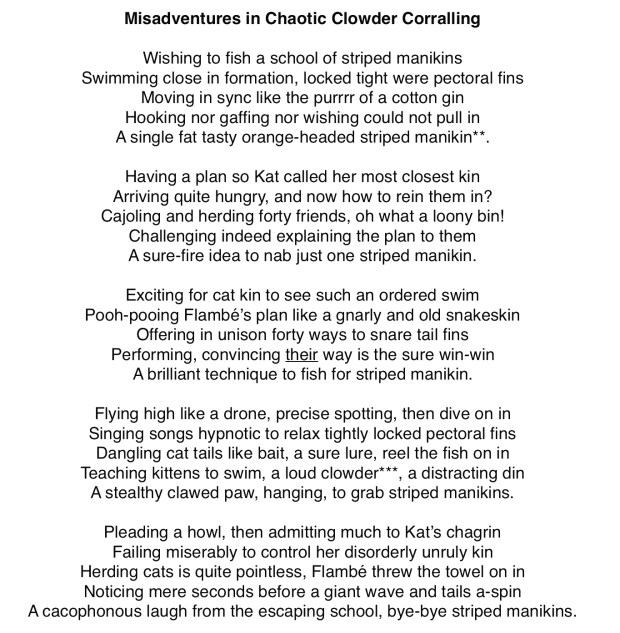
**A fish manikin is a form carved from wood or foam by taxidermists used to mount a trophy fish. Flambé’s school of striped manikins all looked like trophies to her! If only she could’ve herded her cat kin into an attentive and cohesive group long enough to teach them her sure-fire plan for breaking up that school of fish …….. maybe, just maybe she would’ve had a striped manikin to Mount on the wall of her den!
___________________________________
***A clowder is a real thing! It’s what “they” call a group of cats. Honest. But then being naturally curious like my sidekick, Flambé, I wanted to know how many cats are needed to make a clowder. Here’s what I learned:
“Three or more cats make up a clowder, which makes sense. After all, three is a clowd—er, crowd. Jokes aside, this is mainly because the word “pair” covers pretty much any group of two, and if a cat is by themselves, then they’re just … a cat.”
But that doesn’t explain how these feline groups are ever formed ……. after all, wouldn’t that be a frustrating endeavor and quite nearly impossible …… exactly like Herding Cats?
I’ll let you be the judge, but please let me know!
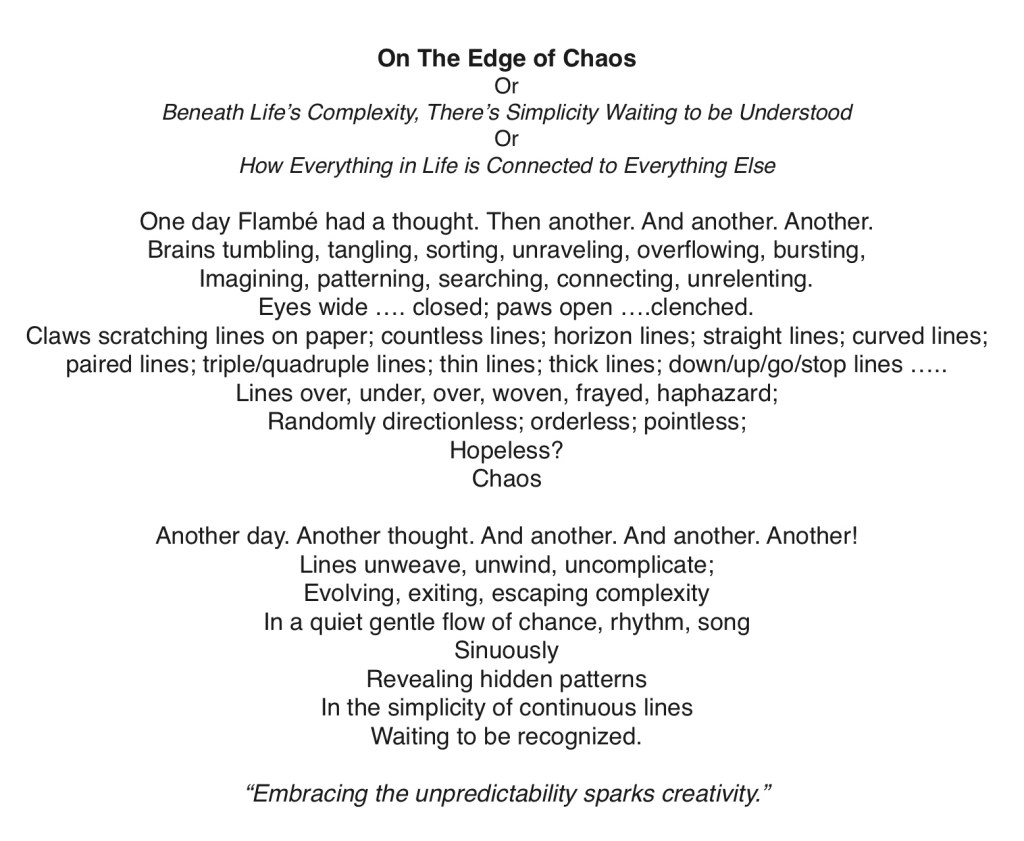
Chaos Never Dies Day is an annual holiday observed on November 9th that reminds us that chaos and disorder are natural and inevitable parts of life. The day encourages us to embrace the chaos and find humor, creativity, and resilience in the face of uncertainty and unpredictability. It’s a time to let go of perfectionism, embrace imperfection, and enjoy the ride.
Flowing from Flambé’s depiction of the chaotic world that lives between her pointy ears, emerges 16 simple continuous line shapes. Can you find them all?
(If you’d like a little help finding these shapes, the answers can be found at the end of this post. But only peek after you’ve given the illustration a thorough looking over.)
Of course, Kat has embedded herself within the chaos; her discovery makes for 17 total shapes.
Flambé’s thoughts on Chaos to Creativity OR an attempt to interpret her scratched lines on paper, in the above illustration.
A few of my elementary thoughts about Chaos and Chaos Theory
Now that Flambé has delighted and (most likely) confused you on the Nature of Chaos, allow me to reflect on my first exploration into the fascinatingly mind bending subject of Chaos Theory. Having never given much thought to the Theory, per se, I’ve always pictured “chaos” as something hectic and uncontrollable. A state of unruliness, mayhem, or disarray liken to natural disasters, mob pandemonium, mass shootings. Sound familiar? We’ve all likely been witness to an unfathomable situation and declared our world to be in “complete and utter chaos!” But there’s more, a lot more to Chaos Theory, where it is encountered and how it affects us.
When my reference list of lesser known Annual Days revealed November 9th is celebrated every year as “Chaos Never Dies” day, I was appalled. I mean, really; who wants to live in a world of ever-present and everlasting chaos?
But from the description of this Day, it appeared there was a positive side to chaos, piquing my curiosity. Anything that can make us laugh and inspire creativity has to be awesome! So began my last few weeks of intense study and pouring over countless YouTube videos to learn about Chaos Theory.
The more I read and viewed educational videos proclaiming to explain Chaos Theory in easy-to-understand language, the more confusing it seemed. The language was English, but the concepts seemed abstract to me …….. well, they were just plain chaotic! (This caused me to laugh!). It would be easy to spend a lifetime trying to “get it.” I’ll just have to keep learning!
So far, I learned about many familiar and new terms associated with Chaos Theory. These include the Butterfly Effect (highly central to Chaos Theory) which shows the connection between disorderly and highly organized things, like how the flap of a butterfly’s wings can lead to a string of events that can form a hurricane! It’s complex, but emphasizes (among many things) that we can’t know the consequences of seemingly simple systems due to unpredictable variables. That leads to Heisenberg’s Uncertainty Principle, Feedback Loops, Fractals, Probabilistic and Deterministic modes, etc.
Are you still with me?
In a nutshell, Chaos Theory “provides a scientifically quantifiable but simultaneously poetically suggestive way of looking at how almost everything in life is connected to everything else.”
We live in a “chaotic” world, and how we react and/or adapt to its unpredictability and complexities matters. But as someone (?) once said, “Embracing unpredictability sparks creativity.” What does Chaos spark in you?
The images of all Continuous Line drawings and their order of emergence.
World Smile Day is an annual celebration of the simple yet powerful act of smiling and spreading joy to others. It was created by commercial artist Harvey Ball in 1999 to honor the iconic smiley face he created in 1963. On this day, people are encouraged to perform acts of kindness and make others smile, both in person and through social media. World Smile Day is celebrated on the first Friday in October.
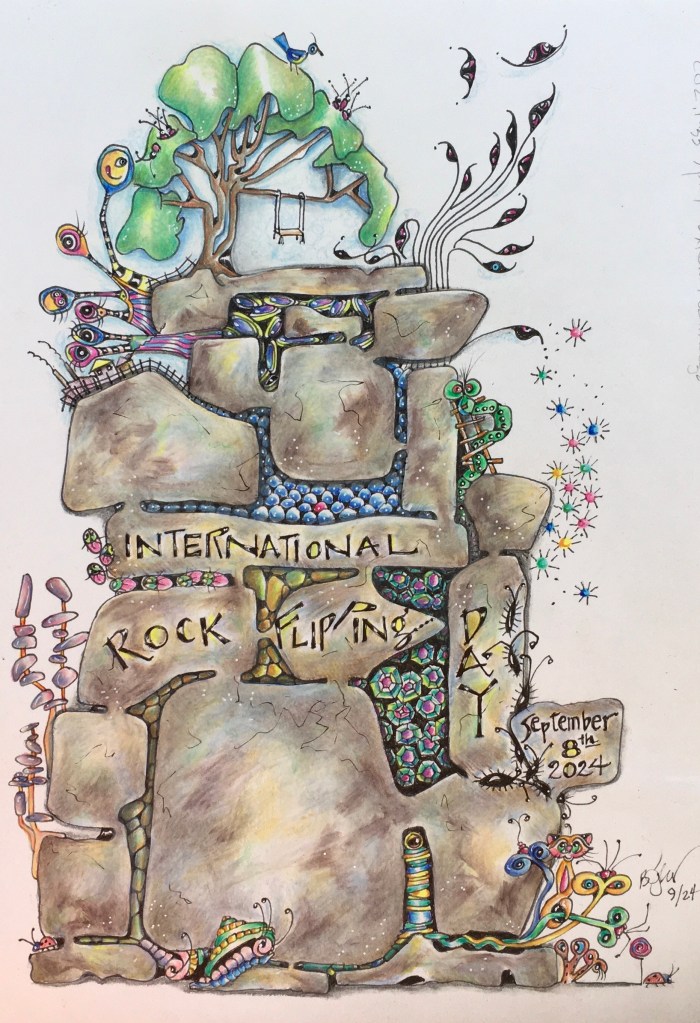
Unbeknownst to me …… until right now! Hitting me like a ton of rocks, I just learned that every second Sunday in September each year marks a worldwide celebration known as
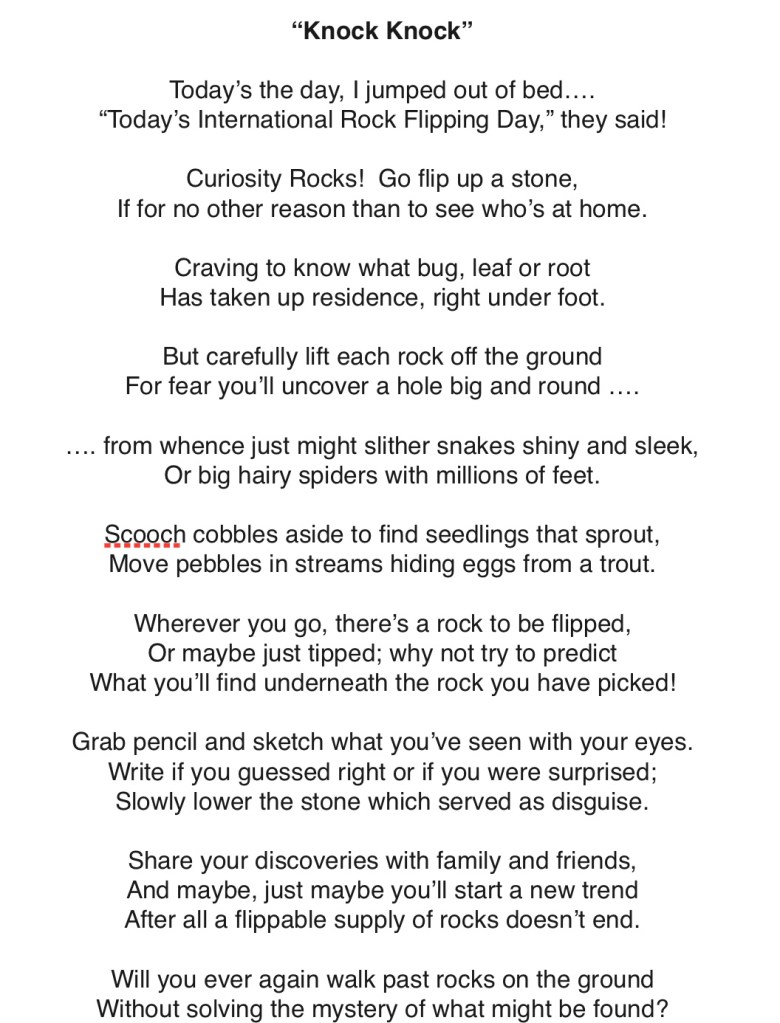
International Rock Flipping Day
Today is a day to encourage people to explore and learn about the natural world by flipping over rocks to see what creatures and other organisms live underneath them. Participants share their findings and observations with others to promote curiosity and appreciation for the environment.
If no one was at home, tell me about your flipped rock(s)!
Bring out your Inner Child!
I don’t care what town you’re born in, what city, what country. If you’re a child, you are curious about your environment. You’re overturning rocks. You’re plucking leaves off of trees and petals off of flowers, looking inside, and you’re doing things that create disorder in the lives of the adults around you. – Neil deGrasse Tyson
A few more …..
As with other phases of nature, I have probably loved the rocks more than I have studied them. – John Burroughs
If it weren’t for the rocks in its bed, the stream would have no song. – Carl Perkins
The problem is not scientifically illiterate kids; it is scientifically illiterate adults. Kids are born curious about the natural world. They are always turning over rocks, jumping with two feet into mud puddles and playing with the tablecloth and fine china. – Neil deGrasse Tyson
Today is National Sea Serpent Day, and while these magical, mystical, and mythological creatures may not ring true for you, Flambé now believes otherwise. Read why a Mama Kat’s lessons should be heeded at all costs, and how a litter of 8 kittens would’ve been better off if they’d had a wise Mama like Flambé. Learn how a Sea Serpent finds his lunch in murky water, and what they like to binge eat. But most of all, be sure to celebrate this auspicious day …… perhaps by visiting an aquarium to see what a “real” Sea Serpent looks like, and to learn about their life cycle, color(s), size and the habitats where they live.
National Sea Serpent Day is a day dedicated to the legendary creature known as the sea serpent. It is a time to celebrate and learn about these mythical sea creatures, which are often described as large, snake-like creatures that live in the depths of the Oceans.
Poor Flambé has been searing her paw pads while conducting daily curiosity quests. To cool the burn, she’s been wading into a sizable neighborhood pond, becoming engulfed in a cloud of steam as all four paws are instantly chilled. “Aaaahhhhhhh! Now that’s relief!”
However, one day Kat decided to indulge in a full body pond plunge, completely drenching her lush fur coat. Because the pond was unfathomably deep, and since she was soaked to the tip of her tail, Flambé decided to practice a bit of free diving. Gulping a huge breath of air then turning tail, down …. down ….. down she plunged into the murky cold water. After zipping up to the surface to fill her lungs, Kat exclaimed, “Cool! I’ll return every hot afternoon to chill out!”
But during her second deep … deep … deep dive, Flambé saw she was not alone. Emerging out of the dim depths of the pond was a gynormously scary creature with a huge head, foot-long eyes, sharp teeth, and long wavy arms! Could it be her nemesis?
As a wee kitten, mama Kat warned her about swimming or diving in deep water. Mama Kat warned Flambé about the presence of the always ravenous, underwater creatures known as Hydra, Kraken, or Sea Serpent. Mama said these monstrous Sea Serpents had such a keen sense of smell, they could instantly sniff a potential meal of “fat furry feline” frolicking frivolously in their watery realm. In the blink of a foot-long eye, an unsuspecting Kat might be greedily gobbled and gulped!
Now back to dire matters at “paw” ….. Daring to take a closer look at the menacing Kraken, Flambé gazed in horror at one of its five crops; it was plum full with a litter of eight kittens! Mama Kat was right.
Sea Serpents may have an excellent sense of smell, but Flambé’s hearing was superb. Before the Hydra could sniff out Kat, simultaneously those eight kaptured kitties let out a yowl loud enough to raise an undersea garden! “They’re alive!” Flambé to the rescue!!!
What is Flambé’s plan to rescue all eight kitties? How does she avoid being sniffed out by the Sea Serpent? Will hiding in plain sight right next to that row of razor sharp teeth, fool the Kraken? What can Kat use to quickly pry open the Hydra’s crop cage, rapidly expelling the kitties? Are Sea Serpents ticklish, and if so, where? If you were in Flambe’s predicament, what would you do?
Please share your ideas quickly …. just in case Kat’s efforts are foiled and all is lost!
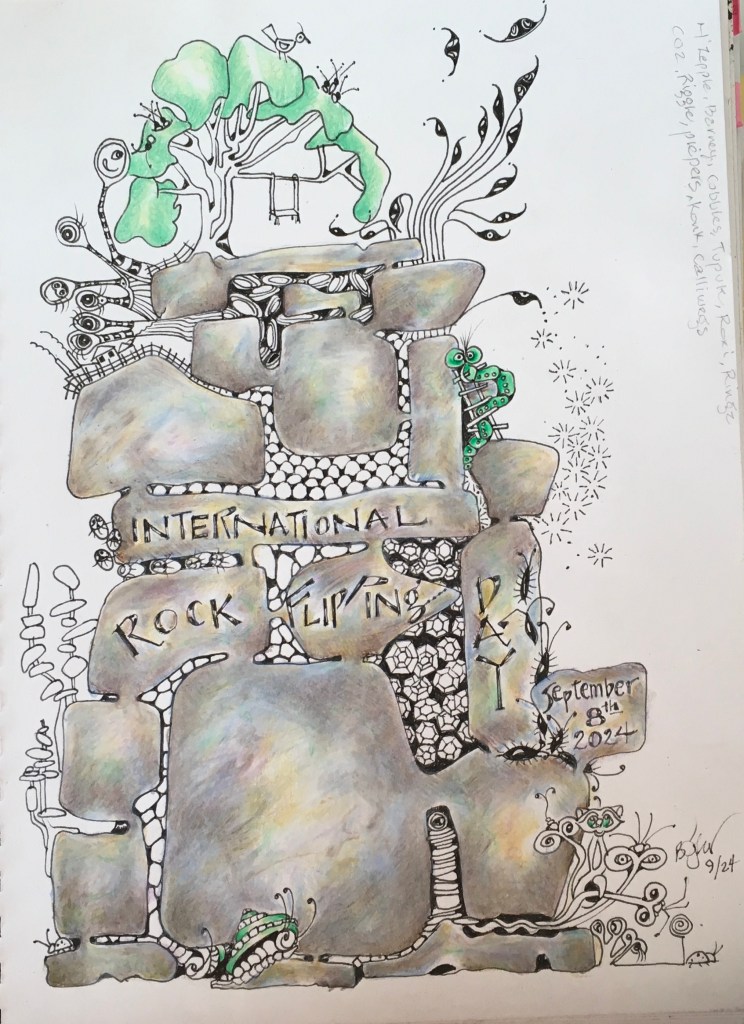
Line work before color.
Until the next chapter of Flambé’s exciting Misadventures!
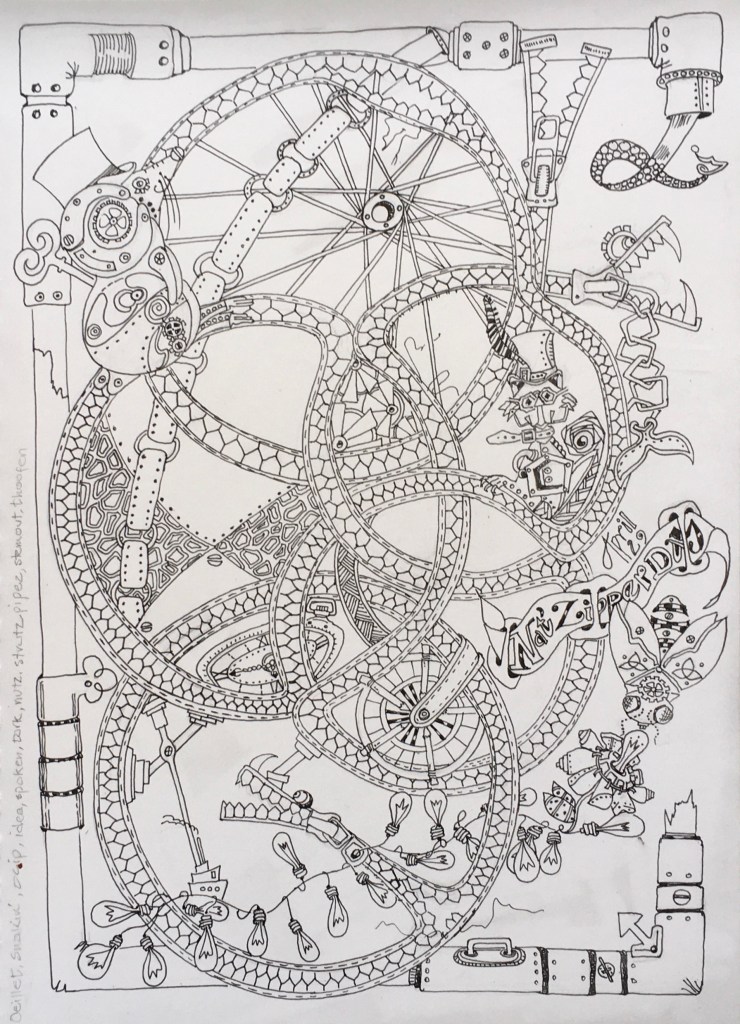
While you’re having fun (or going crazy) chasing Flambé’s maze of zippers, here’s some very cool facts about the world’s largest Zipper manufacturer ….. YKK.
The initials YKK stand for Yoshida Kōgyō Kabushiki (Kabushibibaisha), a Japanese business that owns the most popular zipper brand in the world. Because of its cutting-edge technology and reliable materials, YKK continues to dominate the fastener market worldwide.
Today, YKK produces more than 50% of zips worldwide. Zips may be easy to make; they may have not seen much innovation in the last fifty years, and they may be simple but (so far) no other zipper company can compete against the YKK monopoly.
YKK, founded in 1934, manufactures and produces about 10 billion zippers a year. The YKK Group consists of two main operations – 1) the fastening business, and 2) the architectural products business. The fastening business, includes zippers made for the apparel industry, comprises about 40% of its global business. The architectural products business, includes products for windows, doors, curtain walls, and even bridges and ocean clean-up products for the oil and gas industry, comprises the other 60%.
The largest zipper factory in the world! The YKK factory in Macon, Georgia has earned that label. This mega factory boasts 14 modern plants and over 900 employees, producing 7 million zippers a day. These zips, which come in more than 427 standard colors, total over 1,500 styles including a luxury style called Excella, where all of the parts are highly polished!
What’s so special about YKK Zippers? They are amazing in their ability to self-lubricate the more you use them. Have you ever had a zipper that becomes sticky and gritty over time? If you check the brand on the pull, it will always be some lesser make of zipper. “Sticky and gritty” are nasty characteristics experienced with a YKK. As a matter of fact, the YKK brand zips up and down more smoothly the more you use them!
After learning a bit about YKK (my curiosity at last satisfied), I immediately ran around to all of our closets checking for the brand …….. hey, they’re all YKK! Now it’s your turn …… Check your zipper pull tabs! Are they YKK? I’ll anxiously await your full report!
On and on and up and down! Because I put so much detail and time into my Steampunked Zentangle tangle, I was going to make Flambé’s post to commemorate National Zipper Day short and sweet. But because there’s so much information about Zippers, my fascination grew exponentially, much like my Zipper maze!
Line work before color.
Hope you enjoy this abbreviated overview about Zippers! If you’re heading outdoors to ponder this fascinating technology, don’t forget to Zip Up!
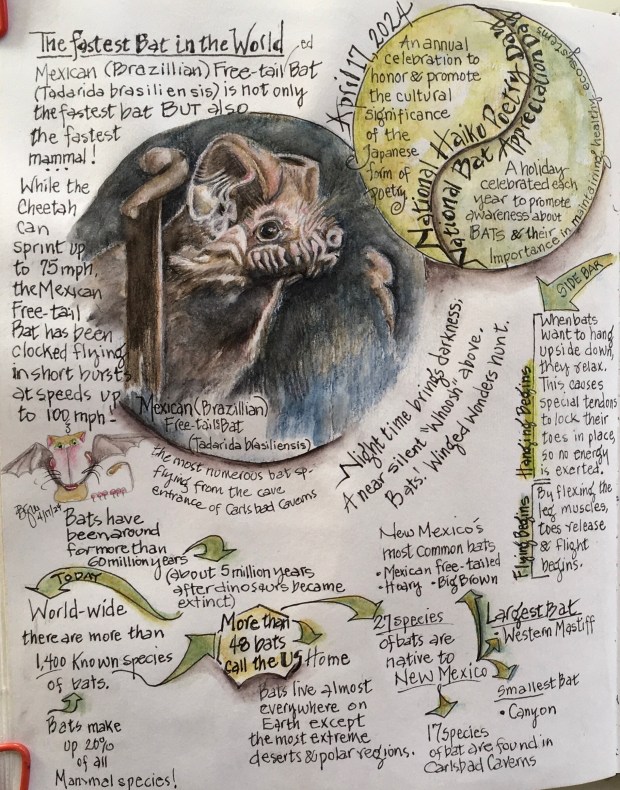
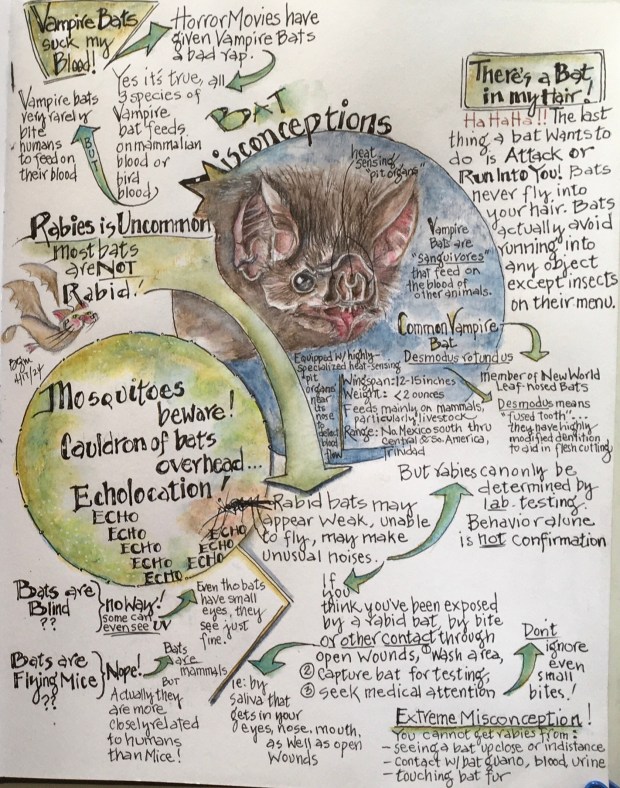
Of the dozen or so celebrations taking place annually on April 17th, you might think that combing both National Bat Appreciation Day and National Haiku Poetry Day in one blog post makes no sense at all. But if you’ve ever spent even a bit of time witnessing a bat ‘out flight’ at dusk, you’d agree with me that their near-silent hunting maneuvers are sheer poetry!
National Bat Appreciation Day
A holiday celebrated each year to promote awareness about bats and their importance in maintaining healthy ecosystems.
National Haiku Poetry Day
An annual celebration to honor and promote the cultural significance of Haiku, a Japanese form of poetry.
Dedication
This post is dedicated to my good friend, Holly Silva, who finds bats fascinating. She suggested for my first celebratory day in April, I tackle bats. (Not literally of course!) Like Holly, I’ve always been in awe of bats, having seen many ‘out-flights’ of the tiny insectivorous myotis bat and little brow bat. And then there’s fruit bats! Oh my …… so hard to resist sharing my story of an amazing fruit bat ‘out flight’ Roy & I witnessed in the Australian Outback, Bats in OZ!
Bats in OZ
Talk about right place/right time scenario! We had finally arrived at a well known hot springs south of Katherine after a long, hot, dry day through central Australia. Mataranka, a beautiful series of natural pools surrounded by hundreds of eucalyptus (gum) trees. It was late in the day and we were luxuriating in the hot water, when we noticed everyone there before us was leaving. It was a mass exodus; suddenly we had the springs to ourselves. Five minutes later that we noticed the water rippling around us. We figured a freak storm had appeared out of nowhere to offload huge raindrops in just this spot. Then the “rain” became more intense, the noise became cacophonous, and day turned into night.
When we first arrived at Mataranka, our focus was on the inviting pools of water nicely shaded by the gum trees. We never looked up into any of those tall, branchy trees … we were happy to have the shade. Now, soaking in the hot water while getting pelted by “rain,” we wondered if we should haul ourselves out, recalling that the locals must’ve known this storm was about to happen (as it did every night); maybe it wasn’t safe for some reason? So wondering how big the storm cloud was we glanced up at the sky through the tree branches. That’s when shock and awe grabbed us! Hundreds and hundreds of tree branches which must’ve been straining under a great weight minutes ago were sighing relief as thousands of fruit bats (aka flying foxes) dropped from their roosts to take flight. Wing membranes spread wide, their sheer numbers blocked out the fading sun. We were speechless! Gaping in awe at the spectacle, our mouths quickly snapped shut …… you see, that “downpour” wasn’t rain at all! All of those big, beautiful bats were pooping out guano as fast as they could! Another ah-ha moment struck us (along with copious quantities of guano) as we made a hasty retreat out of the water, grabbing our clothes and sun hats, and laughing uproariously while beating feat back to the safety and cover of the rental car!
As fast as the “storm” of bats appeared, they were gone, flying off to feed for the night on a Downunder spring bounty of fruits only they knew about. Stuffed by sunrise they would return to the Mataranka community roost to rest and digest before once again taking flight while pooping on the heads of foolish tourists tomorrow at dusk!
The Post
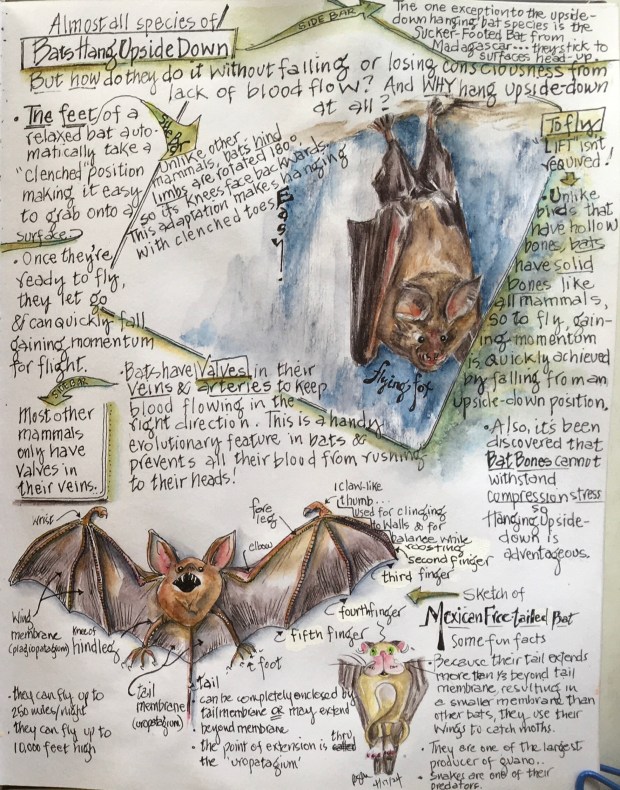
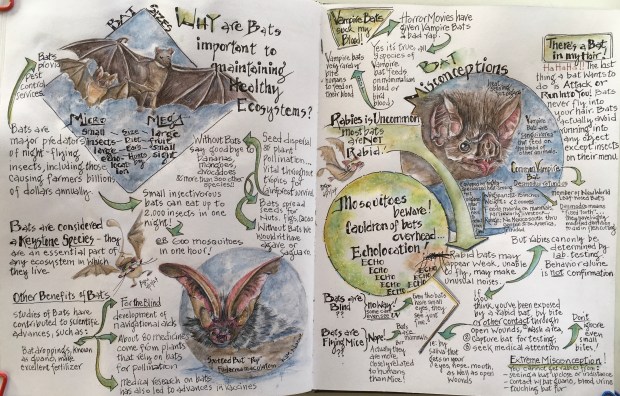
For this post, while exploring bats’ importance in the ecosystem, to science, and while recalling all of those Australian flying foxes I was curious about why and how bats hang upside down, the types of bats and their diets, and what adaptations Vampire bats have causing them to crave a diet of blood. Much of this rabbit-trailing led to myths and misconceptions about bats, then back to New Mexico’s most famous ‘out flight’ of the American Free-tailed Bat every spring, summer and fall evening from Carlsbad Caverns. While learning, several Haiku poems materialized reflecting bat behavior.
Nighttime brings darkness A near silent “whoosh” above Bats! Winged wonders hunt
It would’ve been easy and fun to fill up the rest of my journal with bat facts and more Haiku, but because the celebratory date of both National Bat Appreciation Day and National Haiku Poetry Day has now come and gone, I had to stop. Maybe you’ll want to answer a bunch of your own questions about bats? Maybe you’ll want to write your own Haiku about bats in honor of this style of poetry?
Mosquitoes beware! Cauldron of bats overhead …. Echolocation!
Share your bat stories and Haiku, and let me know if this inspires you to dig deeper into the fascinating world of bats!
National Crayon Day is a day dedicated to celebrating the beloved colorful drawing tool. Observed annually on March 31st, it encourages people of all ages to embrace their creativity and express themselves through art using crayons.
So much history ….. So much enjoyment!
But where to begin? Because I’ve posted about crayons in the past and didn’t wish to repeat myself (too much) … I dug deeper this time and learned something new … there’s a “place” called The Crayola® Hall of Fame!
Since 1904, when cousins Edwin Binney and C. Harold Smith sold their first box of 8 “Gold Medal” Crayola® crayons, colors have come and gone. There’s been an assortment of reasons for changing out colors such as unpopularity, social, racial or politically incorrect names, or discovery of a new pigment. The fate of colors also varies:
they may be renamed to better represent current trends or social acceptability (e.g. the color Chestnut replaced Indian Red and Peach is now the new name for Flesh),
they may be temporarily discontinued to make way for a new promotion or contest (e.g. plain colors have made way for a naming contest for sparkly or neon colors),
they may be permanently retired (e.g. Dandelion lost out to Bluetiful, to introduce the latest pigment discovery of blue)
And once a color is discontinued or retired (even temporarily) gaps are left in the box where each color lived, whether that be the small box of 8 Crayola crayons, all the way up to the box of 120!
One of my many rainbow-colored rabbit trails led me down the path to The Crayola Hall of Fame. I had no idea! Apparently there is such a place, established in 1990, populated with crayon colors that have been retired as far back as 1910. Most of these colors are now permanent residents in Easton, PA, where The Crayola Hall of Fame is located. There they are (re)learning the joys of coloring outside the lines, golf cart decorating, and marathon rolling. But some of the retired colors, having a taste of the easy life, have decided to rejoin the active ranks of worker-writers, painters, and scribblers, as re-employed annuitants.
The Short but Brilliant Story of Dandelion
Doesn’t look like annuitant status will happen any time soon for the self-retired, extremely happy-cheerful and brilliantly radiant Dandelion yellow Crayola. From 1990 through 2017, a short 27-year blip on the Crayola history timeline, Dandelion was the color lighting up the boxes of 24+. But when he heard a gorgeous new blue hue had been discovered, Dandelion graciously checked into The Crayola Hall of Fame allowing the exciting new Bluetiful to take center stage! What a guy!
Being honored with permanent residency in The Crayola Hall of Fame also means the retired color has gone out of production permanently. How lucky to have found two brand new, never before used Dandelions in my stash of crayons! And a single Dandelion is worth as much as $20!
$20 is also the value of each of the four recently retired (2003) Crayola crayons: Magic Mint, Mulberry, Teal Blue, and Blizzard Blue. I also own these four colors! You can do the math, but instead of cashing in on any of the 5 colors in my possession, I’ve decided to keep them, then created this floral page using only these colors for my post, showing off their beauty in celebration of this year’s ………………………………..
Happy Birthday Dr. Seuss! Born in Springfield, MA in 1904, if this brilliant author, poet, and illustrator of more than 66 memorable children’s books was alive today, he would be 120 years old! That’s a lot of candles …….. and imagine the variety of fanciful characters he would still be gifting all of us “kids!”
Dr. Seuss Day is an annual celebration held on March 2nd to honor the birthday of Dr. Seuss, a famous children’s author. The day is marked by reading Dr. Seuss books and participating in educational activities.
March 2, 1904 – September 24, 1991
Seriously, is there anyone out there who’s never heard of Dr. Seuss? Born Theodore Seuss Geisel, Dr. Seuss began his career as a cartoonist early in life. With an imagination beyond compare, he began writing children’s books in the 1930’s, publishing his first, And to Think That I Saw it on Mulberry Street, (one of my first Seuss books) in 1937. Then war interrupted his career, and for a number of years he turned political cartoonist (note to self: haven’t seen those ….. must find!), returning to writing children’s books after the war.
I always have, and always will love the works of Dr. Seuss. Apparently Flambé is a fan too. And even though it’s not her birthday, I wanted to delight Kat with my best attempt at Seussian-style storytelling poetry, inspired by her favorite book (and food), One Fish, Two Fish, Red Fish, Blue Fish.
Happy Birthday Dr. Seuss!
Line work before color.
Like myself and Flambé, do you have an insatiable appetite for all things Dr. Seuss? If so, share your favorite character(s) or book(s)!
Honest …. You can’t make up this stuff! You’ve got to wonder what the person or persons who began the National social media movement, “I Hate Coriander” Day, have against an innocent little herb.
“National I Hate Coriander Day, celebrated annually on February 24th, is a social media movement to express disdain for the herb coriander (also known as cilantro) and its taste and smell.”
“Hate” is such a strong word under any circumstances, but to “hate” an herb? … What do these Coriander “Haters” find offensive about the look of this bright green leafy plant? What is it about the taste and/or smell of Cilantro that elicits such a strong reaction? Now I’m not a Coriander (aka Cilantro) addict ….. a bit now and then as garnish or to flavor a fresh salsa is perfectly fine with me. I’ve even grown Coriander in my garden and marveled at the plant’s growth rate, intense leaf and stem coloring, bouquets of delicate flowers and abundance of seed. So my curiosity was definitely piqued when I came across this peculiar National Day. Just what is it that has and keeps these people all riled up over Coriander?
Coriander – The Plant
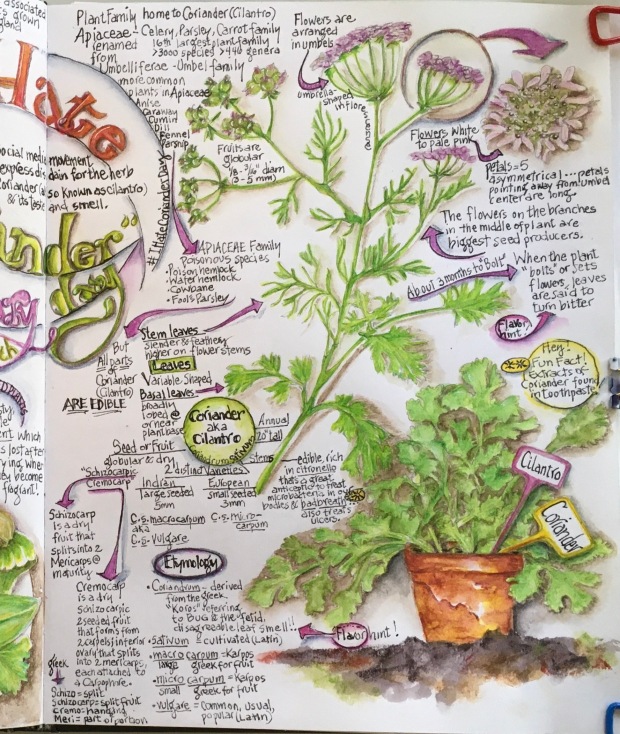
Not to be confusing, but Coriander and Cilantro are actually the same thing, Coriandrumsativum. However, in the U.S. we tend to refer to the leaves and stems as Cilantro; the seeds (whole raw or toasted, or ground) as Coriander. But because the National Day is about hating Coriander, I’ve made a leap in assuming they hate the entire plant, including the roots, stems, leaves, flowers and seeds (all of which are edible; all of which are eaten).
The plant is an annual that grows up to 20” tall. The bright green leaves are variable in shape, broadly lobed at the base of the plant, and slender and feathery higher on the stems. Flowers are arranged in umbels (like a wind blown, inside-out umbrella), are white to pale pinkish-mauve. Each asymmetrical flower has longer petals pointing away from the center of the umbel than those pointing inwards. And each flower produces a dry globular fruit (schizocarpic cremocarp) about 1/8 – 3/16” diameter, which splits when mature into 2 mericarps, each mericarp with a single seed.
Coriander – The Seed
The name, Coriander, is the common name used around the world, for the seed of Coriandrumsativum. There are two cultivated varieties of Coriandrum sativum grown around the world. Although the plants of both varieties appears the same, it’s the seed where the visible differences occur. C. s. var microcarpum is the small-seeded variety found in temperate climates, such as in Europe and the U.S. Its seeds are about 3 mm in diameter, round, and very potent as a spice. C. s. var macrocarpum (aka C. s. var vulgare) is the large-seeded variety found in hot, subtropical areas of Asia and India. It’s seeds are 5 mm in diameter, football shaped and have a very delicate flavor.
If you’ve ever grown Coriander from seed, you probably planted one seed at a time, being careful to follow the spacing instructions on the package. Then when your seeds germinated, sending up those first immature leaves (cotyledons), you noticed that for each seed planted there are 2 little plants! “What the heck?” you say. When you sowed the seeds in each well-spaced spot, you obviously planted an entire globular fruit (both mericarps at once) resulting in the germination of both seeds!
Is There a Consensus of Opinions on Leaf Taste and Aroma?
Nope! Opinions are far from consensual. As a matter of fact, they are frequently polar opposites. Coriander has been described as the “Marmite”*****!!! of herbs; either you love it or hate it. This great analogy reflects how strongly people do feel about flavors of their food.
Opinions on leaf taste and aroma: The good – tart, lemon-lime, fragrant, pleasant, distinctive, spicy hot, peppery, aromatic. The bad – bitter, stinky, unpleasant, nasty, fetid. And the bleh – The leaves smell and taste like dish soap!
Is There a Consensus of Opinions on Seed Taste and Aroma?
Again, Nope! But curiously, most of the opinions about seed taste and aroma were fairly positive, provided the correct variety of C. sativum was properly prepared and used. For example, all seeds contain 1% volatile essential oils, but the quality of oils is different between the two varieties. For some reason the smaller European variety seeds (C. s. var microcarpum) have far superior essential oils resulting in far superior flavor and yield when compared to the larger India variety seed (C. s. var macrocarpum). The larger India variety seeds are preferred as a spice, both whole and ground.
Opinions on taste and aroma of fresh or dried seeds: Spicy, earthy, cumin-like, orange peel, aromatic, dried seeds have full flavor, fresh seeds are undesirable.
Opinions on taste and aroma of toasted seeds++, whole or ground: Fruity, Fruit Loops, lemony, floral, mild perfumy, aromatic, bitingly pungent, delightful bouquet, distinctive flavor.
Now it’s your turn! Where do you stand on the issue of Coriander; it’s taste and smell? Are you celebrating today’s National “I Hate Coriander” Day? Or are you a regular Coriander Connoisseur, savoring the taste, smell and texture in all of your favorite dishes, from sauces and marinades, curries, meats and seafood, stews, to pastries and desserts?
***!!! Marmite! Invented, made and sold in England, this stuff is a sticky, dark brown paste made from fermented yeast. It has a very salty and powerful (understatement) flavor, and is frequently slathered on toasted breads like jam. If you haven’t experienced Marmite, perhaps you’ve dared to taste its equally unappetizing knockoff, “Vegemite,” found all over Australia? If you’ve tasted either or both (wow, you’re tough), what was your reaction? If you’ve never had the culinary pleasure, consider this fair warning! Wonder if there’s a social media group that’s declared “International I Hate Marmite (Vegemite) Day?” I would happily eat a bushel basket of cilantro greens, than dare give these yeasty products another go. (No offense to the marmite and/or vegemite lovers of the world.)
++Toasting Coriander Seed: In a non-stick skillet, over medium-high heat, add the seeds. Keeping the skillet in constant circular motion. When the seed’s aroma is released, toasting is complete! Cool completely and grind with mortar/pestle or in a small electric grinder. Store ground coriander in a cool (refrigerated) location, away from light and moisture. It’s best to toast and grind seeds in small amounts, on an as needed basis, to experience the full flavor.












 a curious nature