House Finch – Page 14 .. The 100 Day Project (2026)

July 14, 2026

House Finch (Haemorhous mexicanus ssp. frontalis)

aka Common House Finch

More than likely you’ve seen the sparrow-sized House Finch if you live almost anywhere in the U.S., southern Canada, or Mexico. The males are particularly showy with their bright red heads, throats and breasts, and their bouncy flight is sure to catch your attention. Just filling a backyard bird feeder with black oil sunflower seeds can bring a flock of 50 House Finches in to feast. They tend to dominate their favorite feeders, often chasing off competitors, after which you’ll have plenty of time to observe these finches as they sit still while shelling seeds by rapidly biting and crushing them with their large beaks. 

If you aren’t familiar with House Finches, you’ve probably heard their long, twittering song, which they belt out in most neighborhoods from coast to coast. Their song, so full of excitement and energy, is usually sung from the top branch of a tall juniper or pinyon pine tree. House Finches seem to be pleading urgently for attention by clearly singing, “Talk to me PLEASE, isn’t anybody THERE!!” (At least that’s what I hear over and over again first thing every morning throughout the Spring and Summer!) 

Not knowing how many broods have been reared this year, to date, it seems like we’ve enjoyed a large number of family groups around the house. Fledglings are fun to watch in flight as they constantly chase adults to beg for food. These futile attempts for free handouts strengthens their wing muscles and hones their acrobatic skills. Usually defeated, these novice students soon land in a tree and begin a long, hard practice session to learn their parents’ complex song.  

Completely exhausted, they will return to a certain cholla and the nest where the adult female fed and defended them as nestlings during the first 12-20 days of their lives. Finding even one of their well-hidden nests in any of those 4 to 7 foot tall cactus “trees” is quite the prickly endeavor! Even knowing how to recognize a House Finch nest hasn’t prevented me from experiencing plentiful and painful spiny jabs. What an excellent defensive location our local birds choose for nesting.

The Nest and Nesting Habits

In as little as two days, the female builds a cup-shaped nest made of fine stems, leaves, rootlets, thin twigs, string, wool, and feathers, with similar, but finer materials for the lining. This sturdy nest, durable enough to raise up to six broods a season, measures 3-7 inches wide; the inside cup is 1-3 inches across and up to 2 inches deep.

House Finches usually build their nests in cavities in deciduous and coniferous trees, on cactus and rocky ledges, and in or on buildings using sites like vents, ledges, street lamps, ivy, and hanging planters. They will also claim nests abandoned by other birds.

A western House Finch is likely to build its nest within 60 feet of where it was the previous breeding season; eastern birds choose sites more than half a mile away from prior nests. Despite these differing habits, all nest sites have a few things in common: a sturdy base and a roof-like overhang to shelter against sun and rain.

House Finch Facts

  • With over 40 million House Finches across North America, they are currently one of the most widespread and common bird species across the United States, second only to the American goldfinch. 
  • Native to the Southwest U.S. and Mexico, in 1939 a few House Finches captured in Santa Barbara, California, were sold to a New York City pet store owner as “Hollywood Birds.” Even back then, the sale of these birds was recognized as illegal under the Migratory Bird Treaty Act of 1918. To avoid prosecution under the Act, the pet store owner released the finches …. they were set free on New York’s Long Island. By the early 1940s wild nests were discovered on Long Island, and from there the spread continued. 
  • Sometime before 1870, House Finches were introduced to Oahu from San Francisco. By 1901, they had become abundant on all the major Hawaiian Islands.
  • Where House Finches are an introduced species, they are considered naturalized 1. They’re also considered an invasive species in some places, largely in unforested lands across the eastern U.S. where they’ve displaced the native purple finch (and even the non-native house sparrow!).
  • In their native range in the Southwest U.S. and Mexico, House Finches live in desert, grassland, shrubland, and open woodland environments, as well as near human dwellings and cities. The biggest House Finch flocks in the East are found in cities, and it’s much more common to find the eastern birds in habitats developed by people than anywhere else. 
  • Depending on where they live, House Finches can appear very different. Within the 11 officially recognized subspecies, body size, beak size and shape, wing length, tail length, and coloring can all vary regionally. For example, the northeastern migratory populations have longer and more pointed wings better suited for longer flights than the western finches which tend to be permanent, year-round residents.  Also, House Finches on Guadalupe Island off the coast of Baja California, Mexico, have heftier beaks than mainland birds.
  • The bright red (and sometimes orange or yellow) plumage on the head, throat and chest of mature House Finch males comes from compounds in their food (bird species are unable to produce red or yellow other than by diet). These pigments, called carotenoids (the same ones found in carrots and tomatoes), come from the berries and other fruits they eat. Females prefer mates with the biggest and brightest red-colored patches — a sign of a well-fed male.
  • House Finches are among the strictest avian vegetarians: seeds, buds, fruit, and foliage comprise 97% of their year-round diet. Most seed-eating birds not only eat insects in the spring and summer when they are abundant, but will feed bugs to their nestlings to add protein for growth. Except for the occasional fly larva, House Finches stick to a vegetarian diet.
  • Dealing with a pandemic for decades, these birds suffer from “House Finch Eye Disease,” a form of conjunctivitis that was first detected in Washington D.C. in the winter of 1994. Since then, the bacterial illness has expanded continent-wide causing big declines in House Finch numbers. Infected birds often have swollen or reddened eyes and may appear inactive or confused. Over time, it leads to birds becoming blind, disoriented, and vulnerable to predators. Other finch species, such as the American Goldfinch, are also affected. Because the disease is spread through social contact, it’s very important to keep bird feeders and baths clean.
  • The mite, Pellonyssus reedi, is often found on House Finch nestlings, particularly later in the season. However, the adult female has a clever strategy in response to these often fatal attacks. Since male chicks are more vulnerable to a mite outbreak, she will lay eggs containing females first to reduce the length of time male chicks are exposed to mites. This strategy increases the likelihood that representative numbers of both sexes will survive.

…………………………………………………………………………………………………

Share stories of your local House Finches!

Hope you found this interesting!

As always, thanks for stopping by!

1  A species is considered “naturalized” if it didn’t originally evolve in an area but has successfully adapted, established a permanent population, and is reproducing independently in the wild. These species are non-native, surviving without human help. Note: not all naturalized species are considered invasive.

References

allaboutbirds.org

audubon.org

iNaturalist.org

Lanceolated Chafer- Page 13 .. The 100 Day Project (2026)

July 9, 2026

Lanceolated Chafer (Phyllophaga lanceolata)

(syn Melolontha lanceolata)

aka Brown Scarab Beetle, May (June) Beetle

The Lanceolated Chafer (Phyllophaga lanceolata) is a scarab beetle native to North America. In New Mexico (along with Colorado and Kansas) these chafers thrive in open, grassy ecosystems, including native shortgrass prairies, pastures, rangelands, and agricultural fields dominated by grasses like blue grama (Bouteloua gracilis) and others. It’s in these arid habitats that the larvae (grubs) are rarely considered major pests1. Unlike most Phyllophaga species, adults are diurnal (active during the day); females are flightless

Adults – This small to medium-sized chunky beetle, is about 0.5 to 0.7 inches (13 to 17 mm) long; females are larger than males. Their hard wing/body cover (elytra) is brown with several darker brown/grayish longitudinal marks under a coat of white bristly hairs. Their segmented abdomens are mostly a smooth grayish/white; their thorax (pronotum) is heavily covered with long brown hairs. Because of their noticeably long, magenta-colored legs, they stand tall above the ground while walking. If picked up, their legs feel clingy and prickly. Adults live only 1 – 2 months, just long enough to grab a quick bite to eat, mate, and lay eggs.

Calling All Males!

The female Lanceolated Chafer produces and uses a unique sex pheromone, l-leucine methyl ester, to attract males! Because this pheromone acts as a highly-targeted sex attractant in the wild, she is able to communicate her readiness to mate and get a rapid response. As has been demonstrated in field trials, male chafers catching a whiff of her urgent communication can’t resist the call and come flying (read the true story of my eye-witness account in my post titled The Life and Times of the Lanceolated Chafer ). Research scientists (and I) whole-heartedly believe this pheromone contributes to the species’ reproductive success in its native range. 

This was a unique discovery because the Lanceolated Chafer is the first scarab beetle ever identified to produce an amino acid-derived pheromone. (And there are over 35,000 species of scarab beetles in the world, making up one of the largest and most diverse insect families on Earth!) The pheromone is so effective at targeting male chafers that entomologists use it to monitor and manage populations of these beetles in agricultural crops and turfgrass. 

Probably a male chafer, walking along the 2-track trail

And now a note about topic organization  ….. 

As in all beetle species, it’s usually the adults that are encountered. And it was the adult stage of the Lanceolated Chafer that’s most obvious along the subdivision’s 2-track rockpile trail. That’s why information about the adults was placed first, even though it’s actually the final stage in the life cycle of the chafer. But it’s interesting to understand how all those adults came to be. So the following few sections tackle the highlights of the 1 – 3 year long larval stage, and pupal stage of their life cycle, which take place after egg laying and hatching. Afterall, the Lanceolated Chafer spends the longest parts of their lives underground.  And then, for no particular reason, I’ll end with a section on entomology.

Larval Stage – Larvae (grubs) have a translucent white to cream-colored body and a light tan to brown hard and stiff (sclerotized) head capsule.  Larvae have three pairs of well-developed legs. When at rest they do so in a C-shaped curve.

By the 3rd instar, internal organs are more visible and jaws are larger! Grubs have a voracious appetite.

Larvae live for 1 – 3 years, primarily in the upper layers of the soil profile. To protect themselves from extremes in soil temperatures, both in  summer and winter, they will burrow to depths ranging from 3 to 20 inches (7.6 to 50.8 cm), averaging 10.3 inches (26.2 cm). Larvae actually hibernate in the winter.

The three instar stages of larvae development, serves to progressively increase body size, head capsule width, and degree of sclerotization. At the end of each instar, larva take up excess air and/or water to swell their bodies. This extra pressure causes its old exoskeleton to split, allowing it to be shed (a process called ecdysis). Mature (third instar) larvae are 1.75 inches (45 mm) long with a nearly uniform body width.

Pupal Stage and Metamorphosis – When larvae are ready to move beyond the third instar, each individual builds a protective, earthen cell in the soil 8 to 12 inches (20 to 30 cm) deep where they will remain for the next 2 – 4 weeks while they undergo metamorphosis and and finally emerge as adult beetles.

Etymology 

The genus, Phyllophaga, is a generic name that comes from two Greek words ….. phyllon which means “leaf,” and phagos which means “eater.”  The specific epithet lanceolata comes from the Latin word lanceolatus, meaning lance-shaped, probably referring to the fine, lanceolate hair-like scales covering parts of the beetle’s body, such as the head (frons) and thorax (pronotum).  The etymology of the word “chafer” comes from an Old English word meaning “gnawer,” referring to the beetle’s strong jaws.

…………………………………………………………………………………………………

Hope you found this interesting!

As always, thanks for stopping by!

1  Larvae of Lanceolated chafers are considered serious pests in the humid central and eastern U.S. they cause extensive damage to agricultural crops like corn, timothy, potatoes, and various other plants in the grass (Gramineae), pea (Fabaceae), and sunflower (Asteraceae) families.

References
ageconsearch.unm.edu

bugguide.net

grokipedia.com

iNaturalist.org

insectIdentification.org

invasive.org

npsnm.org

Lunginbill Sr., P and Printer, H.R., 1953, May Beetles of the US 

The Life and Times of the Lanceolated Chafer

The Case of a Mysterious Wormy Thing

July 9, 2026

This is the third year in a row that I’ve noticed these seemingly unremarkable-looking brown beetles “hiking” along the rock pile 2-track road. They appear all at once, about mid-June, then vanish after several weeks. This year (2026) these scruffy/fuzzy beetles, know as Lanceolated Chafers (Phyllophaga lanceolata), really caught my attention, especially after finding myself at ground zero of a mass male Flash Mob1 !!! From all directions, determined (and awkwardly) flying male chafers were dodging my legs to land on top of a lone female beetle frantically struggling against an earlier arriving male. His prickly lance-like legs had pinned her to the ground so she was lying on her side unable to use her legs. While she squirmed at my feet, newly landed beetles tried to fling off the original male to claim their rights to the female. Males continued to land until there must’ve been 30 or more, with fights breaking out everywhere, on top of the female and all around my feet. Each male was jousting to be victor. 

Males arriving, fights break out

But a victor of what? Was this some sort of mating ritual? Had the female released highly potent pheromones to attract a mate? If so, how far did her “call” drift on the wind to bring together so many males at one time? Did she intend to call only one male, or was her purpose to entice a stampede? If she anticipated a herd, was her intent to mate with the first one (the fastest?) to arrive? Maybe she hoped for battles and skirmishes to ensue, where the strongest of all males would win her favor(s)? This still remains a mystery, as I couldn’t find anything in the literature to explain this behavior? 

While pondering these questions (and daring not to move my feet for fear of squishing one of the many male pile-ups), I bent over for a better look. It was then I noticed an opaque white, worm-like thing slowly emerging from the female’s abdomen! “What could this be?” ….. 

Was it a larva? Probably not ….. Female chafers don’t give live birth; they lay eggs in the soil beneath their favorite host plants (such as mallows), where they hatch into grubs that remain underground for up to two years before emerging as adult beetles. 

Five males fighting for the female (notice how much larger she is than a male). Bit of a skirmish, left side.

Was it part of or the actual female genitalia? Maybe? I’m still searching for information about that notion.

Was it part of the male genitalia that had somehow broken off inside the female during insemination? Is that even possible? Again, still searching for answers about chafer sex.

Three males with the female (notice the “wormy” thing). One male, lower left, apparently confused?

For another 5 minutes I closely observed the squirming female laying helpless on the ground fighting off numerous suitors while still displaying the wormy “thing.” As more males continued to arrive, crash-landing on other grounded males and adding to the chaos, something changed. Can’t explain what happened, but in a matter of 15 seconds all the males stopped their aggressive fighting and took flight; the female uprighted herself (regaining her dignity?), quickly walking away like the nothing unusual had just happened. I watched her go, noticing she was no longer in possession of the wormy “thing,” and couldn’t find it anywhere at or near the scene! 

The party is over. A male walking away, looking for a mallow to snack on.

After-math

Over the next several days, nary a chafer was found! Had all the males satisfied their natural desires? Had all the females become pregnant, laid their eggs and vanished? “After” doing the “math” on the days following the event, I counted only two beetles walking the 2-track road, one headed north — one headed south. Scouts? ….. Because Lanceolated Chafer adults only live 1-2 months, and because none have been seen since the last two, that may be the end of sightings for this year. While there’s still the occasional pack of ants dragging away a dead beetle to share with their colony, the legacy of adult chafers lives on. Recently-laid eggs will hatch after only 18 days into white or cream colored, C-shaped larvae. Those grubs will munch away on mallow and grass roots for the next 1-3 years until a perfectly warm mid-June day, sometime in the future, the adults emerge from the soil to complete their life cycle. 

Epilogue 

Since most chafer beetles are nocturnal (active at night), if you’ve seen an adult during the day, it may have been the Lanceolated species which are diurnal (active during the day).  And you may have unwittingly encountered any of the chafer species found in North America……. 

An exhausted male, a bit off balance, as he feeds on mallow leaves.

…….. If you’ve ever seen one or more of your carefully-tended, vigorously-growing garden plants up and die overnight, it may have been victimized by root-living chafer grubs.

…….. If you live in the central or eastern U.S., grubs may be feasting on the roots of agricultural crops, like corn, soy, or sunflowers. Headline news is sure to cover the story of devastation and financial ruin brought on by the voracious chafer beetle larvae, complete with video of farmers holding a handful of grubs dug from below the soil surface.

Have you experienced one of these close encounters?

Hope you’ve found the “Life and Times of the Lanceolated Chafer” interesting (or maybe educational, peculiar, or maybe even fascinating!?!). Let me know what you thought.

As always, thanks for stopping by!

1 A flash mob is defined as a large group of people who suddenly assemble in a public place, perform a brief, pre-arranged action (like a synchronized dance), and then quickly disperse. Flash mobs are typically organized online via social media or viral messaging for entertainment or artistic expression. I think this definition nearly perfectly fits the chafer beetle dance I was witness to on that fine mid-June morning somewhere along the 2-track rock pile trail. 

Western Meadowlark – Page 8 .. The 100 Day Project (2026)

May 4, 2026

Western Meadowlark  (Sturnella neglecta)

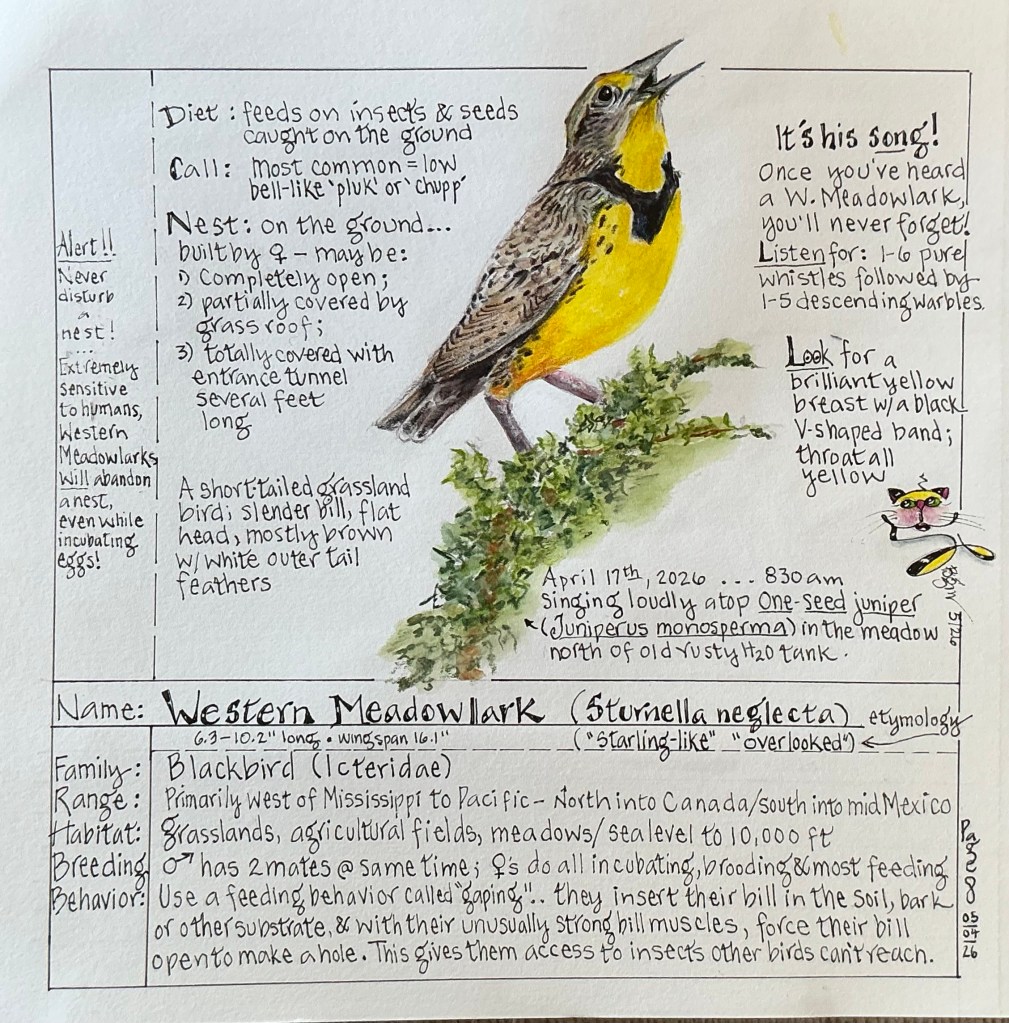
When male meadowlarks return to the grassy meadow north of the old rusty water tank and begin singing, you know it’s Spring! 

There’s something wonderful about his song ……. At first he stutters a few practice notes; rough and rusty like the old water tank. But as daylight lengthens and temperatures warm, his song grows long, strong and melodic. Having perfected that signature song, he sings intently from sunrise to sunset, defending his territorial boundaries against all invaders. And he sings lovingly to announce his breeding readiness, enticing not just one, but two female meadowlarks to mate with him.

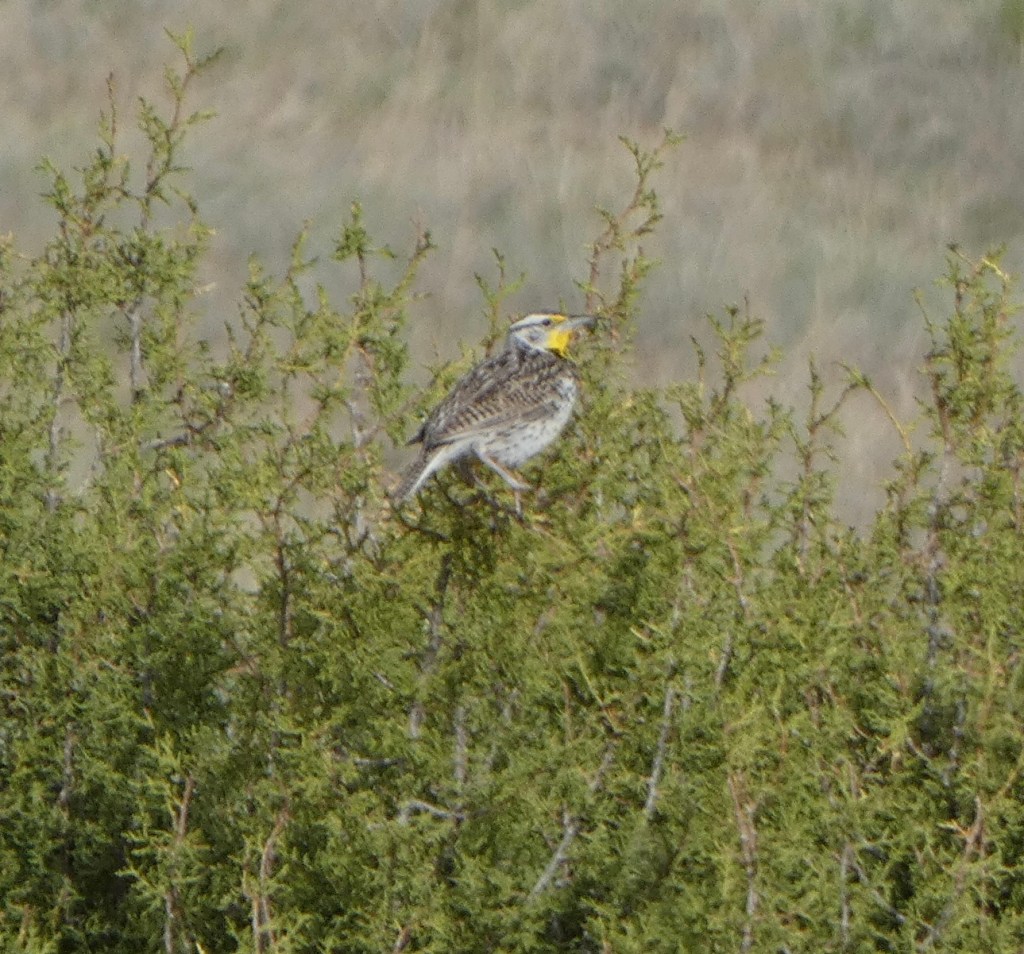
While walking the perimeter of the meadow in mid-April, it was easy to hear a male singing at the top of his lungs about 1/4 mile away. After a few moments scanning the tops of the widely scattered juniper trees with binoculars, I spotted him. (Males seem to favor these trees as perches, perhaps because they get a great view of their territory, and their voices really carry!) Able to get only 50 yards closer, I managed to take a few telephoto pics before he flew to the top of another juniper. Western meadowlarks are very skittish around people, so I held my ground and just watched and listened. It was a wonderful encounter.

Below are a few more fun facts about Western Meadowlarks, in addition to those on my illustrated page ….

If you’re lucky to see a Western Meadowlark, you’ll notice they’re a robin-sized bird but chunkier and with a shorter tail. Their flat head and long, slender bill are visible above a round-shouldered posture that nearly conceals its neck. They have short rounded wings, and a short, stiff, and spiky tail.

When flushed, Western Meadowlarks fly low, wings below the horizontal, gliding and flapping with short, stiff, quail-like wingbeats. 

Other than perching on tall trees, don’t be surprised to find males singing from atop fence posts, bushes, power lines, and anything higher than their surrounding habitat.

John James Audubon gave the Western Meadowlark its scientific name, Sturnella neglecta; Sturnella meaningstarling-like,” and neglecta because he felt most explorers (after Lewis and Clark) and settlers who traveled west of the Mississippi overlooked this common bird.

The oldest recorded Western Meadowlark was at least 6 years, 6 months old when it was found in Colorado in 1965.

…………………………………………………………………………………………………

When was the last time you went Birding? Meadowlarks are calling!

As always, thanks for stopping by!

References:   allaboutbirds.org and inaturalist.org

Dark Jerusalem Cricket – Page 5 .. The 100 Day Project (2026)

April 5, 2026

Dark Jerusalem Cricket (Ammopelmatus fuscus)

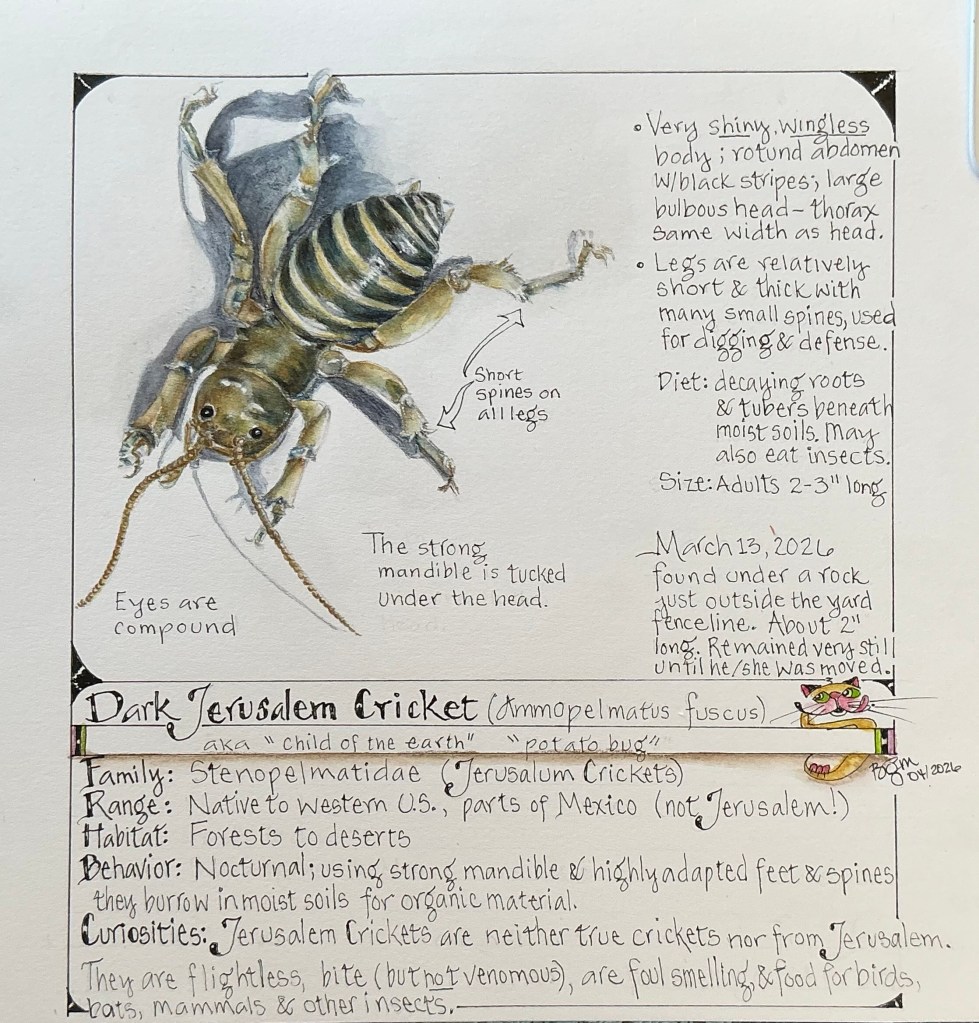
Last month (mid-March), while looking everywhere for signs of spring (something green and growing), I dared to peek under a flat rock and gasped with surprise! Instead of uncovering a tiny flower bud was a gigantic “creepy-crawly” bug! Yikes! After quickly dropping the rock back on his head I realized my run-away imagination had gotten the better of me. 

So gathering my courage, I took another look. There, hiding under that rock was a “cuddly” Jerusalem cricket trying his best to be invisible (while avoiding the bright sunlight). 

This wasn’t my first Jerusalem cricket, but seeing this guy prompted me to learn more about this curious insect……

Firstly, Jerusalem crickets are neither true crickets nor are they native to Jerusalem

  • Taxonomists agree, “Jerusalem crickets are in a very different family than true crickets. This includes a bunch of flightless varieties, and some with wings, found in Africa. The Jerusalem crickets are wingless and are found in the Americas.”
  • “The origins of the name, “Jerusalem” cricket isn’t certain, but it’s thought that it comes either as a reference to the skull-shaped head (they’re also known as skull crickets), which is associated with skull hill in Jerusalem; or, comes from a watered-down swear word from the ‘40s and ‘50s. Around this time, in the US, both “Jerusalem” and “Cricket” were expletives, associated with being startled.”

Next, some Jerusalem Cricket Mating Characteristics

  • Similar to true crickets, each species of “sings” a different song during mating. They actually sing by drumming and they drum by beating their butts on the ground.
  • Once a larger female has successfully mated with a smaller male, and before she lays eggs, females usually eat the males!
  • She lays her egg masses in holes in the soil. After hatching, over the next 1-2 years, nymphs undergo several molts (as many as 10) until they reach sexual maturity which lasts for only 2-6 months.
  • Adults can reach up to 2 to 3 inches in length. Females are often larger in size; males have longer hind legs.

Third, Jerusalem Cricket Habitats and Out-of-Sight Living Quarters

  • They are “well-adapted to living in sandy soils, but can be found in sand dunes, chaparrals, grasslands, woodlands, and forests.”
  • Being nocturnal, they spend a majority of their lives underground. 
  • They hide underneath organic matter and other debris like rocks, wood. With their powerful mandibles, spiny legs and specially adapted feet, they also dig underground burrows for comfortable living quarters.

And Almost Lastly …. the Cultural Significance of Jerusalem Crickets

  • Of great importance to Native Americans as food, many tribes in southwestern U.S. also considered Jerusalem crickets as a powerful cultural symbol. Its striking appearance leads some to think the cricket brings mortality, as depicted in the folklore of the Chumash people of southern California. 
  • The Hopi, who settled in Arizona, portrays this cricket as a spirit being (a Kachina) named Sösööpa who races. As a result, it’s often carved into their Katsina dolls as a yellow humanlike character with black beady eyes, a black-and-white plaid skirt, and antennae made from sand grass, depicting traits of the cricket.
  • The Navajo associated the Yucca plant with the insect; you had to eat the plant as a cure of the cricket’s painful bite. This myth possibly gave rise to the misconception that their bite is venomous. 

It’s Greek to Me!  (Entomologically Speaking) 

Learning the meaning of a scientific name assigned to a species not only helps me remember uncommon words and how they’re pronounced, but often describes aspects of a species’ characteristics that may help differentiate it from another similar-looking species. Learning about these complex names falls into a study called entomology.   

Ammopelmatus fuscus, the scientific name for the Dark Jerusalem Cricket, is quite a mouthful. Curious about the meanings (in plain English) of these two strange words, I learned the name originates from Greek and Latin roots meaning “dark sand-sole” or “dark sand-burrower,” obviously referring to their sandy habitats, dark color, and burrowing behavior. But to learn how the common name with the word “sole” ties to one of the cricket’s characteristics, my dive continued. Here’s the entomology breakdown:

  • Genus Ammopelmatus
    • Ammos (Greek) means “sand,” referring to the cricket’s specialized adaptation to arid, sandy environments.
    • pelma (Greek) means “sole of the foot,” highlighting the specialized leg structures the cricket uses for burrowing.
    • tus (Greek) is a common word meaning either “them” or “their.” In this case, “tus” ties the first two parts together into “their sand sole.”
  • Species fuscus (Latin) means “dark,” “dusky,” or “brown,” describing the cricket’s color.
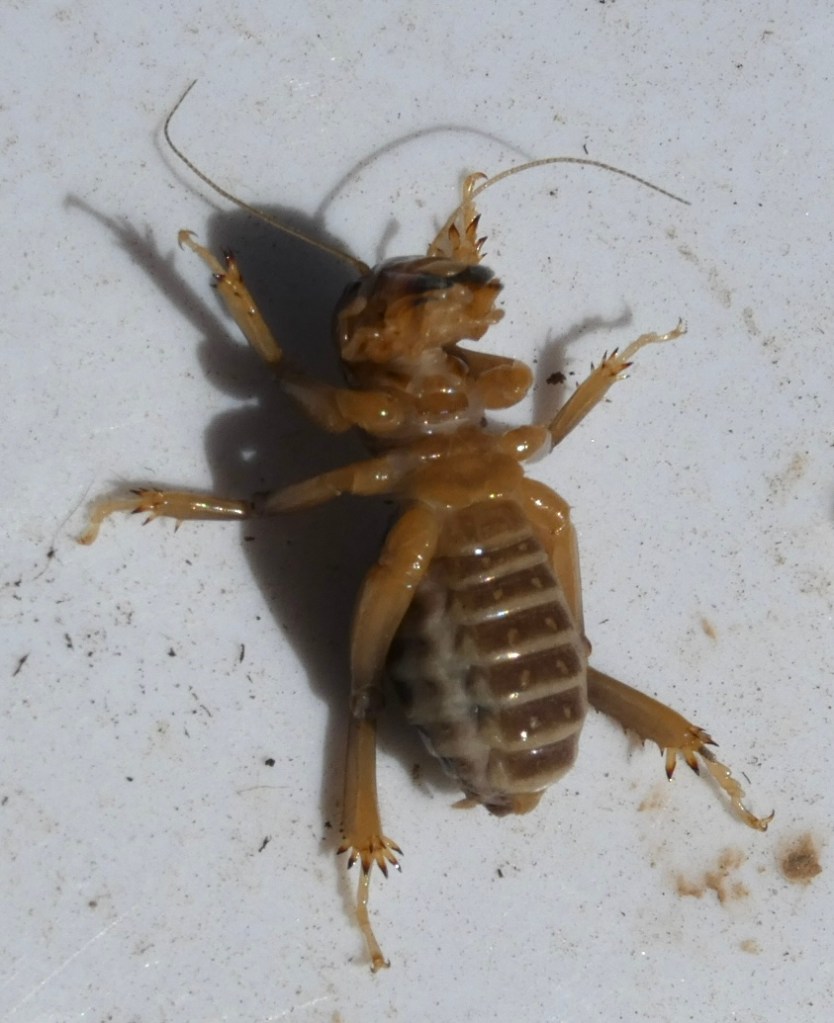
Here’s the underside of my Dark Jerusalem Cricket. The leg spines really show well as does the strong mandible. A scary fascinating view!

After learning more about the Dark Jerusalem Cricket, maybe next time I discover one, I won’t jump so high?! Do you think?

Have you seen a Jerusalem cricket hiding out in your yard? If so, what was your reaction?

Hope you enjoyed this post! Thanks for stopping by!

References
inaturalist.org/taxa

bugguide.net/node/view/154

factanimal.com/jerusalem-cricket/

  • Eaton, Eric R.; Kenn Kaufman (2007). Kaufman Field Guide to Insects of North America. New York: Houghton Mifflin. p. 84. 
  • Milne, Lorus Milne, Lorus and Milne, Margery (1980) The Audubon Society Field Guide to North American Insects & Spiders. Alfred A. Knopf, Inc, pp. 437. 
  • Stoffolano JG, Wright B (2005). “So so opa —Jerusalem Cricket: An Important Insect in the Hopi Katsina Pantheon.”American Entomologist. 51 (3): 174–179. doi:10.1093/ae/51.3.174

EggTober 2025/Submission Two ….. Days 9 – 16

October 16, 2025

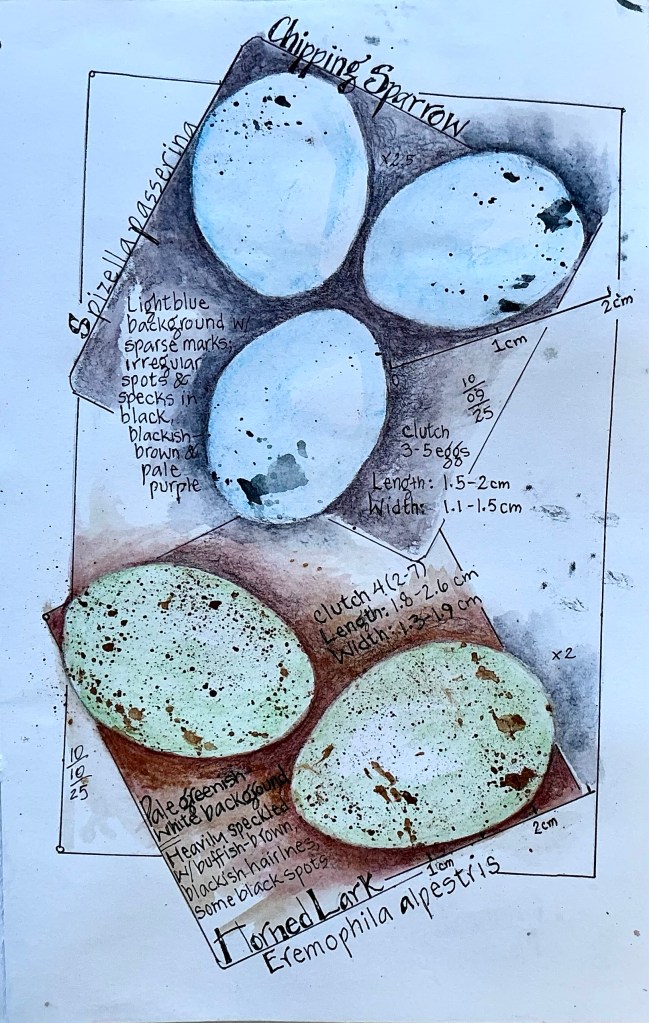
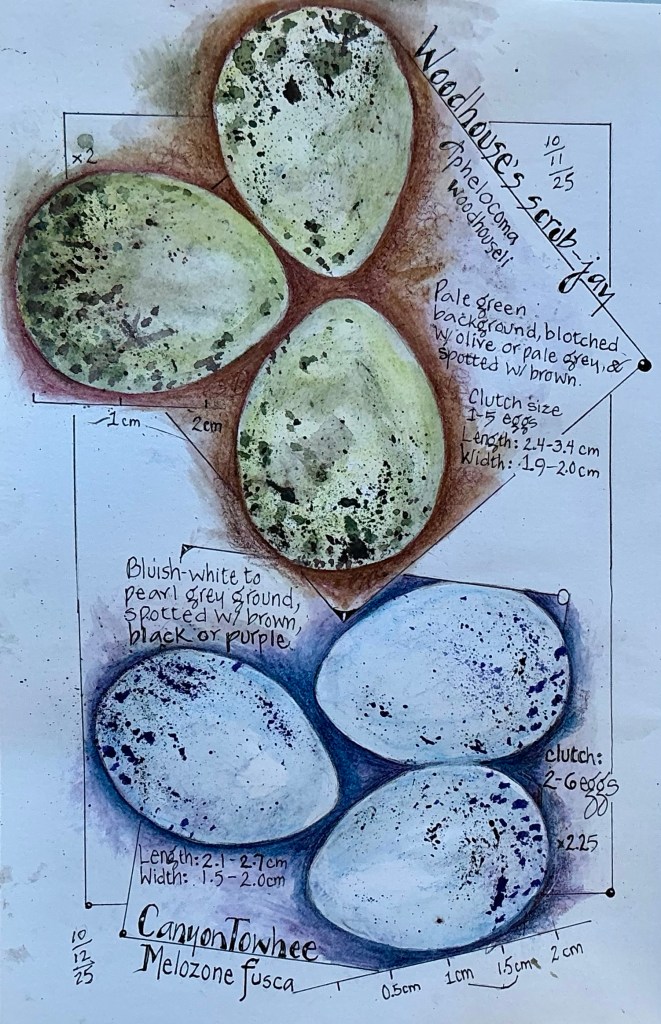
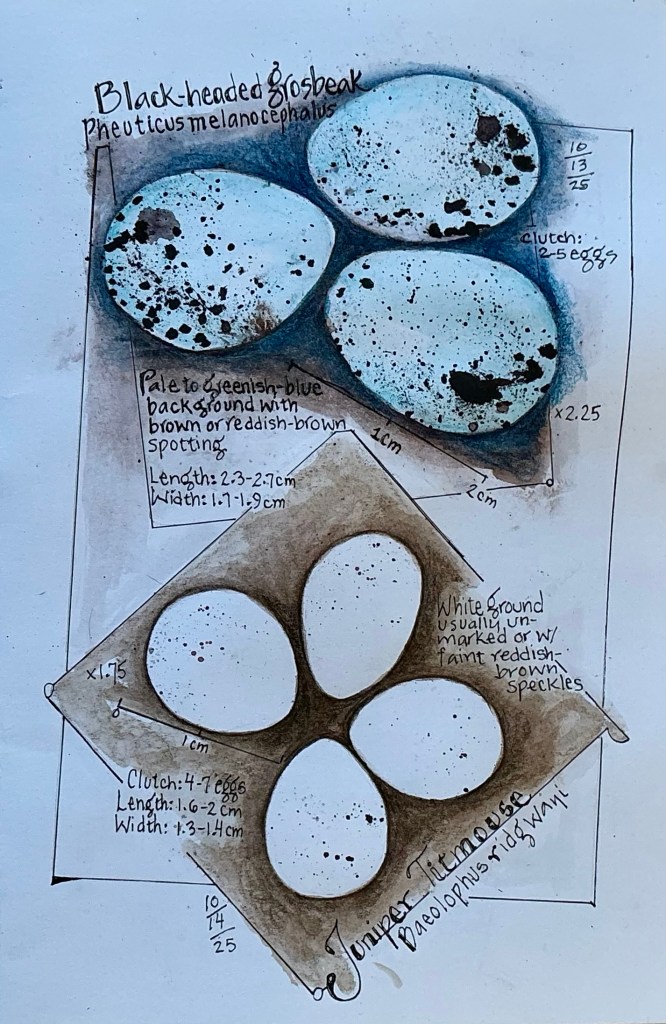
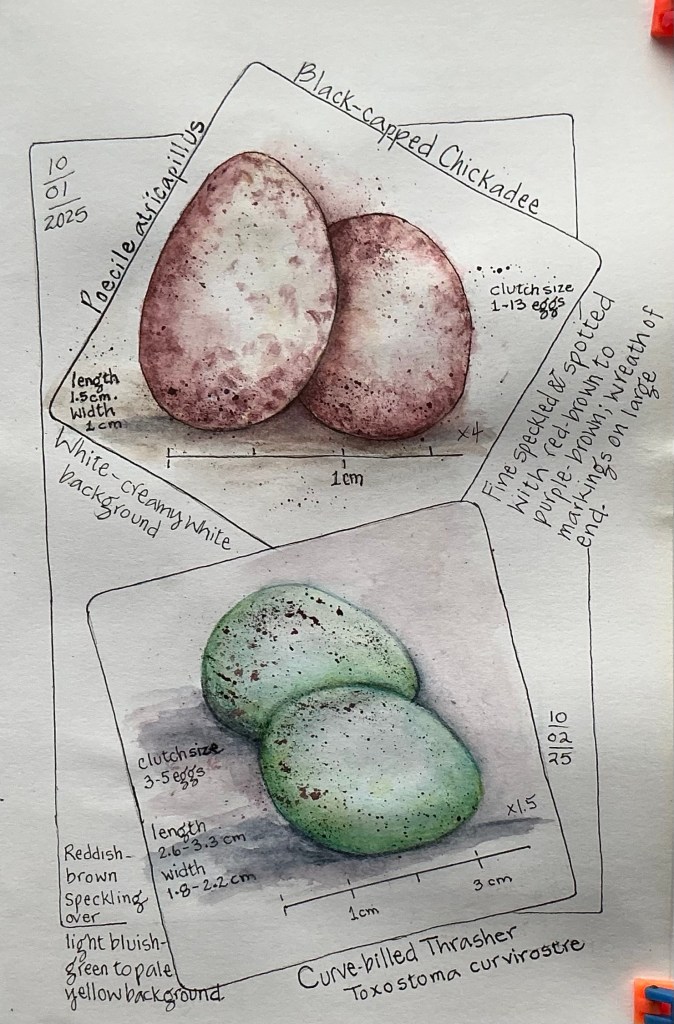
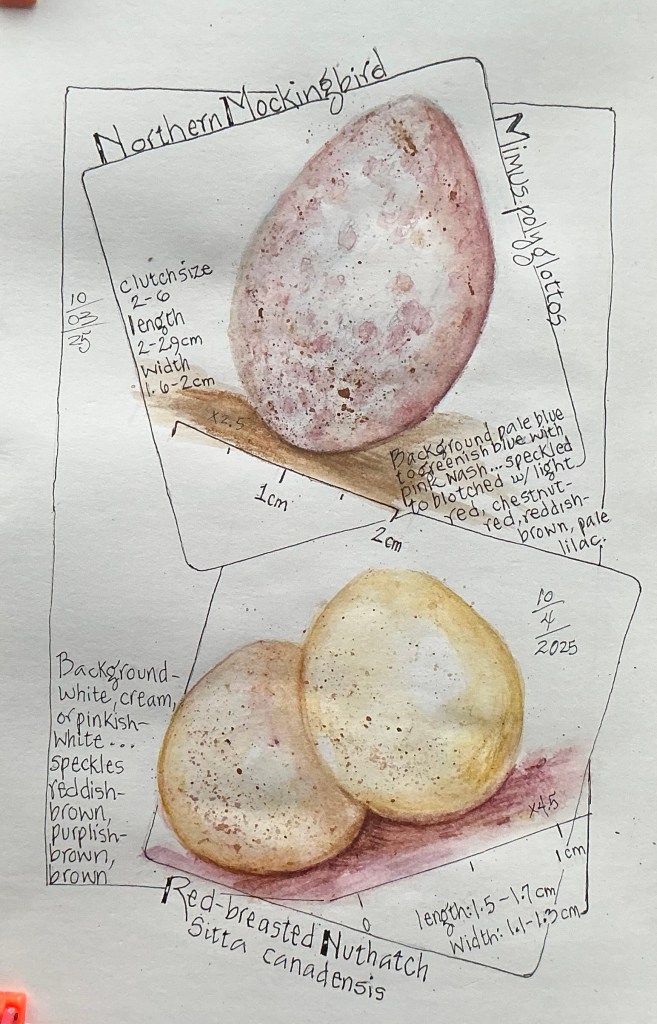
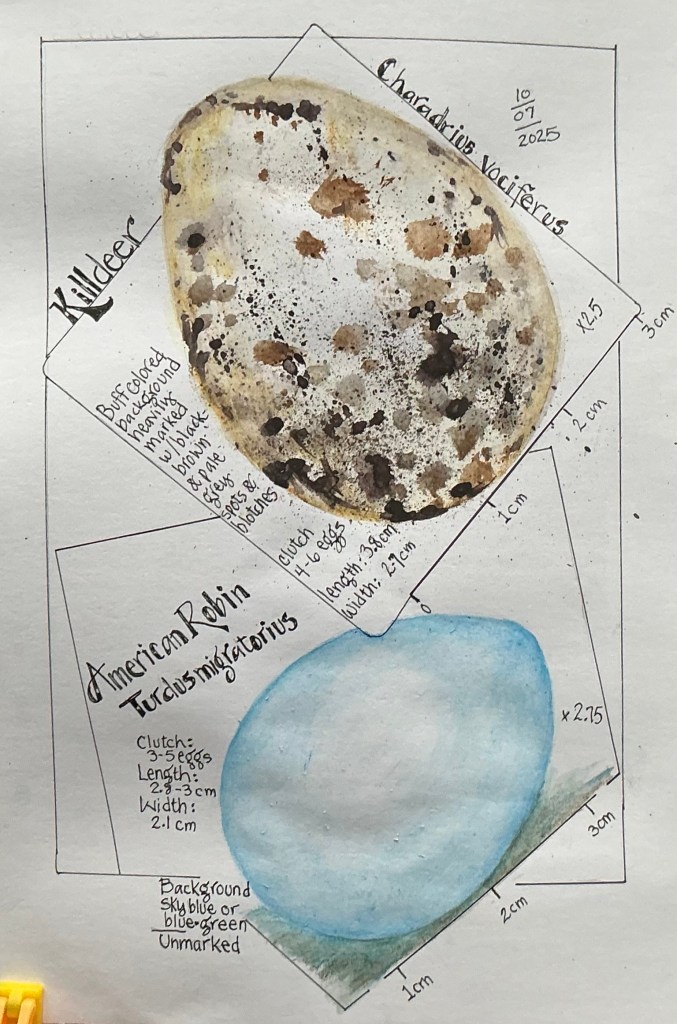
EggTober progress continued, with zeal, as I worked my way through week two. See for yourself! Check out the bird eggs that randomly popped up from my list of nesting birds of New Mexico. As with Submission One, included are a few fascinating facts about the shape of bird eggs to go along with week two birds. 

If you missed Submission One of my EggTober post and would like to catch up, click here.

Egg Shape

The typical oval-shaped bird egg isn’t coincidental. Evolution, influenced by factors such as bird genetics and environmental influences, produced a “smart egg;” a perfectly shaped package just right for survival …….. 

October 9th and 10th

1. Structural Strength

The oval shape provides greater strength and resilience, reducing the likelihood of breakage during incubation. It withstands external pressure more effectively, minimizing deformation or fractures in the developing embryo.

October 11th and 12th

2. Optimal Space

The oval shape maximizes the volume available for the embryo, ensuring proper development and sufficient reserves of nutrients, including proteins.

October 13th and 14th

3. Temperature Distribution

The oval shape promotes the even distribution of heat. When a female bird incubates the egg, her body heat is utilized to maintain warmth. The egg’s oval shape aids in evenly disseminating her body heat, ensuring a consistent temperature for the embryo throughout the incubation process.

October 15th and 16th

4. Prevents Rolling

The blunt, flat end of the oval egg shape helps prevent rolling within the nest. This stability safeguards the eggs, preventing them from accidentally falling from the nest or assuming an improper position.

Summary

While most bird eggs exhibit an oval shape, slight variations in shape do occur among different species. These variations are influenced by the birds’ lifestyles and specific incubation requirements. Overall, the oval shape plays a vital role in the reproductive ecology and physiological adaptations of birds.

Hope you have enjoyed Submission Two of EggTober! If so, please leave me a comment.  And as always, thanks for popping in! 

p.s. Stay tuned for Submission Three, landing in your in-basket next week!

EggTober 2025/Submission One ….. The First 8 Days 

October 8, 2025

Having participated in the Inktober for years by creating a daily drawing or painting throughout the month of October, I’ve found the challenge fun, rewarding, and motivating. However, rarely sticking to “ink only” creations and/or following the official prompts, I’ve shamelessly adopted a variety of approaches shared by others, have different media, or made up my own prompts. For me, this has added an elevated level of complexity that’s so appealing and somewhat wild!

In the past, my “Inktober” art has been about themes, like using a new Zentangle pattern a day that has a name beginning with “Q” or “Z” or “M” ……. or picking different botanical patterns. I’ve played with mixed media, watercolor, watercolor pencils, colored pencils, graphite, and (yes) ink to create a flower a day, rocks, mushrooms, candy, modes of transportation, the alphabet, fonts, portraits of famous people, etc. I’ve found the challenge is a great way to loosen up and try subjects I’m not comfortable or familiar with, while not worry about silly mistakes. 

So, each year I look forward to Inktober, and this year was no exception. 

This year I went way “out on a limb” and switched it up a bit.

This year I’ve named my personal 31-day challenge EggTober! And in keeping true with my love of nature, nature journaling and curiosity, each morning I’ll be randomly pick from a list of birds that nest in my home state of New Mexico and will draw one or several of of their eggs. 🥚 

Here’s my progress so far and a few fascinating facts about bird eggs.  At the end of my post, you can read about my process and materials used.  

Did you know that two pigments are responsible for most eggshell colors: biliverdins, which make blue-green hues; and, protoporphyrins, which make the background hues of rusty yellows, reds and browns.  

Eggshells that have markings like spots, blotches, speckles, or lines, have more protoporphyrins. These markings help camouflage eggs, especially those laid by ground-nesting birds.

The largest known bird egg belonged to the extinct elephant bird. This flightless bird, which stood about 10 feet (3 meters) tall and lived in Madagascar until the 18th century, laid eggs about 11 inches (28 centimeters) long. That’s about the size of an American football!

Bird eggs can be oval, to round, to pear-shaped, depending on the species of bird laying the eggs and where. Many sea birds nesting on cliffs tend to lay more pear-shaped eggs which helps keep them from rolling off steep ledges. It’s said that pushing one of those eggs, because it’s so heavy at one end, will cause it to spin in a circle.

Eggshells are largely made of calcium carbonate, and if hatched without their final ‘spray-paint’ of color, will look pure white to the human eye.  But some white eggshells contain ultraviolet colors visible to birds. (Wonder why?)

Process and Materials

Of course, given that it’s Autumn, and impossible to find any active bird nests housing unhatched eggs, I’ve formulated Plan B. For my references I’ll be relying on digital natural history museum egg collections, on-line bird identification resources, fascinating facts about bird eggs, several key references from my personal library, and other sources, to learn and satisfy my long held love of birds, their incredible eggs, and the egg-laying process. 
Staying as true to real life as possible, approximate egg shapes will be colored with Derwent Inktense watercolor pencils. For consistency, basic information specific to each individual bird species’ typical egg (clutch size, length and width, background (ground) color(s) and marking color(s) and patterns) will be included. For future reference, I’ve handmade a small booklet that will hold two species’ eggs/page. At the end of October, I’ll then add a title page, table of contents, and a list of references.  

And finally, for now, it’s entirely possible that my process and materials may be changed on a whim! So stay tuned as EggTober unfurls!

If you are an Inktober participant, or have never heard of this month-long creative event, please let me know!

As always, thanks for stopping by!

Shifts in Nature 

August Littles ….. 2025

September 8, 2025

Ohhhhhh, what a sweet month …… August. It almost got away from me without sharing a small collection of Littles1 that reflect the inevitable shifts in nature that occur during the month. It’s always hard to imagine summer winding down; where did the time go?  But as surely as butter melts on freshly baked bread, undeniably, August forms a reliable bridge between summer and autumn. It’s a time of change and transition; abundance and harvest; transformation and a period of letting go. 

So before I “let go” and before the snow flies (and it will), here’s a handful of little discoveries during the month of August:

-A female Wheel Bug gone slightly astray while searching for a protected place to overwinter the eggs she’s about to lay. 

-A female Soldier Beetle doing her best to attract a mate by sending out pheromones while munching late season pollen from the disk flowers of a brilliant yellow Showy Goldeneye. 

-An acorn that made it to maturity, ready to drop beneath a still green-leaved Gambel Oak soon to be decked out in radiant fall colors. 

-Some hot red trumpet-shaped Scarlet Gilia flowers, still irresistible to hummingbirds until migration, will all be pollinated in time for seed set and mature. 

-The snowy white fruit dangling from the draping branches of Roundleaf Snowberry shrubs are ripe and ready for plucking by hungry birds flying south for the winter. 

-And plump purple-black Chokecherry berries that will become a juicy dietary supplement for black bears needing to bulk up for hibernation.

Enjoy!

And as always, thanks for dropping by!

1Littles” is part of a blog series I began posting several years ago, beginning in January 2023. The concept was inspired by Fay (thanks again Fay!) who came up with the idea for her blog madebyfay.wordpress.com

If you’d like to read more of an explanation, check out my January 2023 post, Winter Birding on Sedillo Hill

Dance of the Bagworms

May 9, 2025

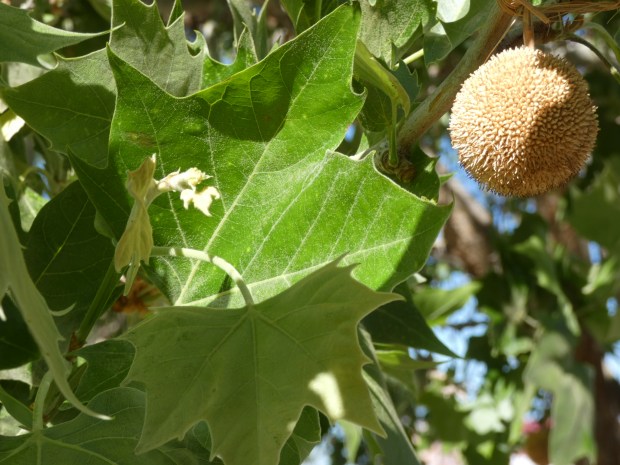
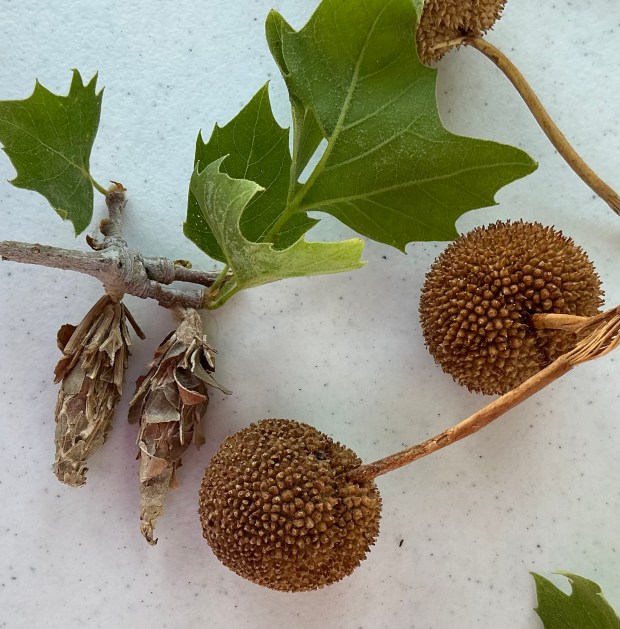
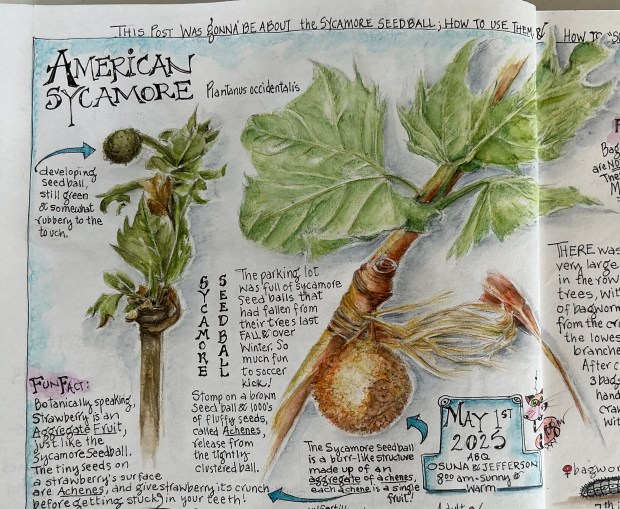
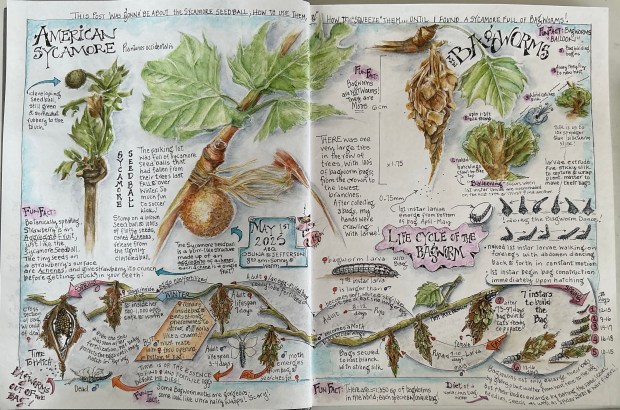
On a warm Spring morning, wandering around a grove of American Sycamore, I became curious about these magnificent trees: where in the US are they native; why are some leaves larger than the palm of my hand and some half the size; what about those odd pingpong sized seedballs lying on the ground everywhere you look ….. why don’t they roll away in search of an ideal spot to pop open so the seeds can germinate …… when the seedballs are kicked, stepped on or crushed beneath a car tire, do the 1,000’s of seeds inside blow away to sprout ….. are the seeds (all or some of them) even viable ….. do the seedballs make a good ink or dye or maybe they’re edible or even medicinal……. what, if any wildlife species eat the seedballs or seeds; and ooooohhhhhhh, sycamore bark! Why does this tree’s bark flaunt a pastel palette of greens, yellows and pinks. These and many more questions came to mind that it seemed about time the American Sycamore became a subject for my nature journal, until ……………..

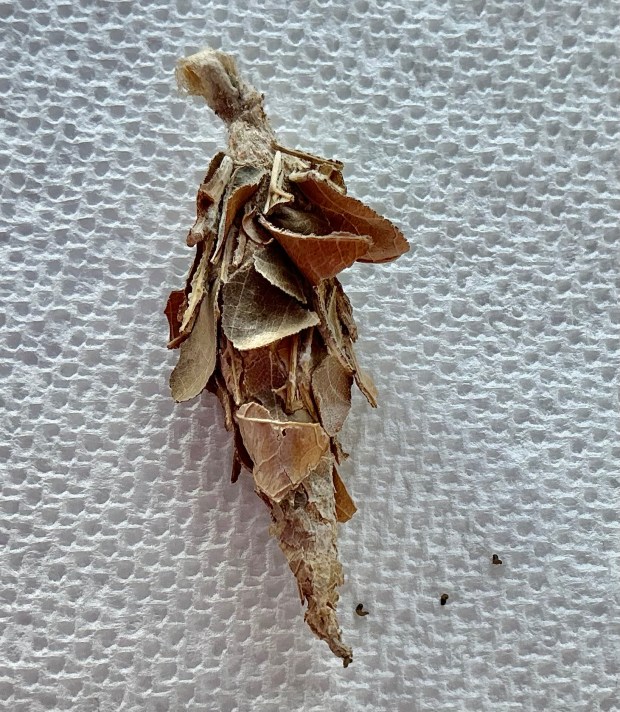
There! In the tree above my head, I spotted a most curious thing. Parting a few of that sycamore’s beautiful Spring green palmate-shaped leaves was a bundle of dead brown and beige leafy bits and sticks all haphazardly glued together. Wishing to get a closer look at that elongated ornament shaped “thing,” I found it was securely suspended from a branch. Trying to puzzle out this fascinating mystery while searching for my pen knife, a stiff breeze blew through the tree. It was then a I noticed hundreds of those 2-3” long bundles all over the tree; from the base to its crown!

Curiosity is the Essence of Nature Journaling

What continues to draw me to nature and nature journaling after so many years are the surprises in the familiar and in the unknown. I know well enough that new encounters in nature are infinite; you just have to open your eyes and look.  Having learned by carefully observing what appears to be familiar, often leads to new discoveries. That’s when my curiosity kicks into high gear ….. when it’s time to engage in some serious poking around to figure something out; to learn what the “thing” is. 

Curiosity, for me, is the very heart and soul of nature journaling. The ‘art’ of curiosity even precedes skill in observation. It’s what drives me out the door in the morning and fuels my exploration. Curiosity fills the mind with countless questions if for no other reason but to develop a deeper understanding of the natural world. 

But I “wax philosophical.” Needless to say, my curious discovery on that warm and breezy Spring morning prompted an abrupt change of mind for my next blog post (this post). Anxious to learn about the “thing” suspended from a tree branch, probably minding its own business, I proceeded to cut it down (along with two more) and popped them in a bag along with a few sycamore leaves and seedballs.

Later that same day …….

Upon completing my journal sketches of sycamore leaves and seedballs, and posting a few photos to iNaturalist for an initial ID, it was time to take a closer look at my discovery. Reaching into the bag for one of the “things” (wiping my hand free of spider webbing?), I placed it on my examination table surrounded by several hand lenses, a larger magnifying glass, a penknife, and 2 pairs of tweezers. Before beginning the dissection, I noticed about a dozen black pepper-sized bits moving about the “thing.” Thinking tiny spiders had come from the bag, I didn’t give them a second thought (should’ve been curious!).

This bagworm bag was the subject of my dissection. Notice the pepper-sized black dots next to the bag ….. those are wiggling 1st instar larva.

iNaturalist ID Pick :::::::::::::: BAGWORM MOTH ::::::::::::::: iNaturalist ID Pick

(awaiting genus/species ID)

A Bagworm Moth!

How cool is that!?!

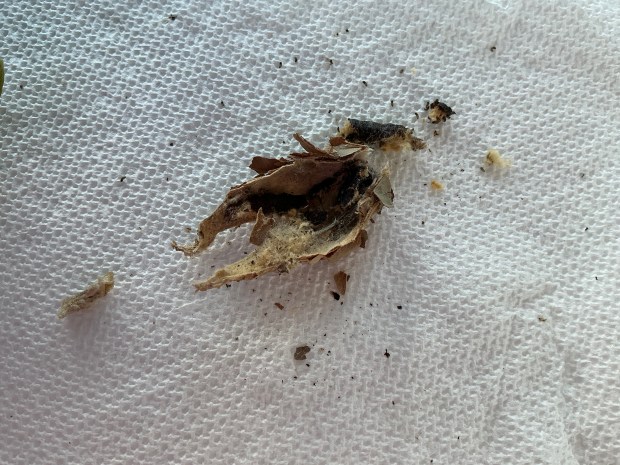
The opened bag of a female Bagworm moth. She’s very dead, but her progeny are escaping as fast as they can.

Dissection resumes ……

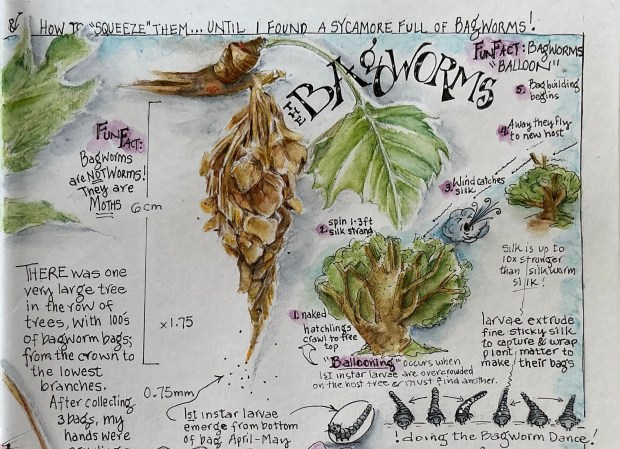
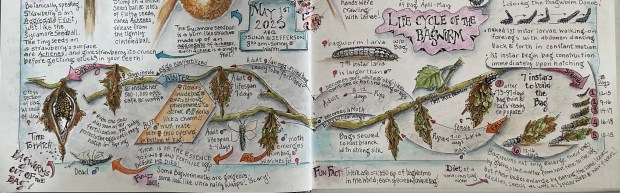
After finding out the “thing” I’ve been pondering over is the Bag of a bagworm moth, I learned the Bag was built during last Spring, Summer and Fall by either a male or female bagworm moth. If a male, the Bag would be empty; if a female, the Bag would contain her remains …. she would’ve died last fall after a male fertilized 500-1,000+ eggs she overwintered inside her body until Spring when newly-hatched larvae would emerge from the bottom of the Bag and begin the species’ life cycle all over again.

The Bag, that took about 10 minutes and all my dissection tools to open, contained the black and mushy remains of a female and 100’s of wiggling/dancing larvae! They were on the move; escaping from the now wide open Bag, and quickly covering my examination table like a pepper grinder out of control.

And my effort to open the Bag? This made sense after reading about the high tensile strength of the silk they produce. These thin strands of silk, 10x stronger than that produced by silkworms, is used in abundance to construct their Bags.

The coolest thing ever! Notice the either late 2nd or early 3rd instar larva, no longer naked, but swaddled in very chewed up leafy bits glued together with strong silk. This dude was hiking up a sycamore branch, continually chewing, wiggling, and gluing.

After disposing of all the naked 1st instar larvae waggling and dancing across my examination table, I placed the dissected Bag, the two whole Bags, and collected leaf material into a clear plastic ziplock to observe what would happen. Over 10 days, the number of larvae multiplied and the naked 1st instar caterpillars grew in size (at least to 2nd instar) while building their individual Bags from tiny bits of leaf litter! Their wiggling dance seemed to be the way their silk strands wrapped and secured leafy bits around their bodies. It’s been fun to watch all the activity.

Have you ever encountered one or more of the 1,350+ species of bagworm moths? What materials were their Bags made from? Please share your experience with these fascinating members of the butterfly/moth family of insects.

As always, thanks for stopping by!

Piñon or Pinyon, Piñon Seed or Pine Nut

November 11, 2024

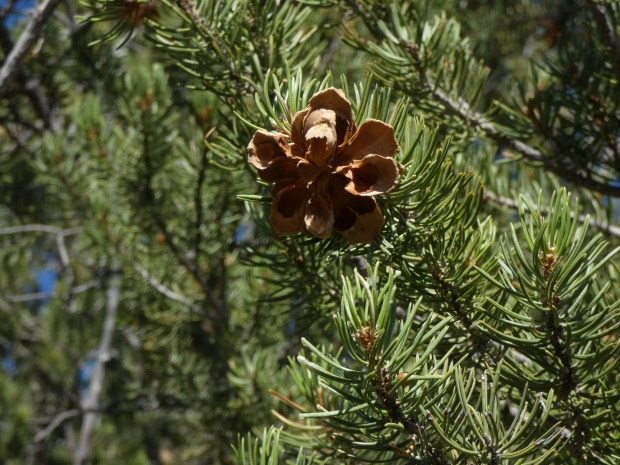
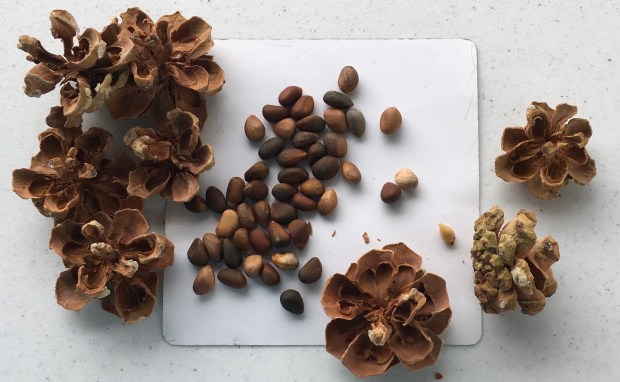
A fallen cone from Pinus edulis. Still a few seeds remain, tucked in the lowest scales. Typically there are 2 seeds per scale; 10-30 seeds are common per cone. Seed viability is uncertain until the inside kernel is exposed.

Pine Nuts Come From Where? 

Many years ago, maybe about 45 of them, Roy and I, his sister and her husband, set off on a pine nut safari in the mountains of south central Colorado. They knew of a large stand of a specific pine tree, called Pinyon (Piñon**) heavy with cones and ready to harvest.  This was my first encounter with the Colorado Pinyon Pine (Pinus edulis), and my first taste of the buttery rich tear-drop shaped seeds produced by these trees. I was hooked! After 4-5 hours collecting wide open seed stuffed cones from low hanging branches and off the ground, we had to stop.  Our fingers were impossibly stuck together from the cones’ copious coating of resin, definitely stickier than Super Glue! Without a solvent to dissolve this adhesive pine tar, we were in danger of losing our fingerprints. 

Having made a less-than-minor dent in the harvestable nuts, ample quantities of this energy rich bounty remained for foraging wildlife, such as migrating birds like pinyon jays, deer and squirrels.

For the past 45 years I truly believed pine nuts (which are, botanically speaking, not true nuts but the edible seeds of pinyon pines) only came from stands of Colorado Pinyon Pine. When the popularity of pesto skyrocketed, I thought “wow, you couldn’t pay me enough to harvest the amount of pine nuts necessary to make even one batch!” I honestly thought that was the reason the seeds were so expensive ….. harvesting is such a tedious and labor intensive job. Alas, we never returned to harvest pine nuts, and I never made pesto until years later. 

The result of my Pinus edulis cone and seed sketching exercise.

While studying a few dozen pine cones for my sketches, the seeds kept falling out and bouncing across my drawing table. This got me thinking about pine nuts and wondering how the Colorado Pinyon Pine could possibly fill the insatiable global demand! Of course by now I was well aware that this tree species is endemic in the southwest, but still ?……. 

News to Me ….

Of the 126 different species of pine in the world, 29 are considered edible; 20 of which have seeds large enough to be marketed. The biggest producers and exporters are China, Russia, Mongolia, Turkey, and Pakistan, in that order.  I found it interesting that China is also the largest importer of pine nuts, who’s marketing goal is to export 60% of the world’s demand.

What about the US? The pine nuts harvested from Colorado Pinyon Pine (Pinus edulis) is rated the best tasting in the world, with those produced by the One Leaf Pine (Pinus monophylla), harvested primarily from these California trees, comes in a close second. Yet, the US is a major importer of shelled pine nuts, primarily from China. But if China is the largest importer and the largest exporter of shelled pine nuts, then the pine nuts on the shelves of Trader Joe’s and Costco, labeled as imported from China, probably came from a variety of pinyon species from a combination of suppliers importing seeds to China?! 

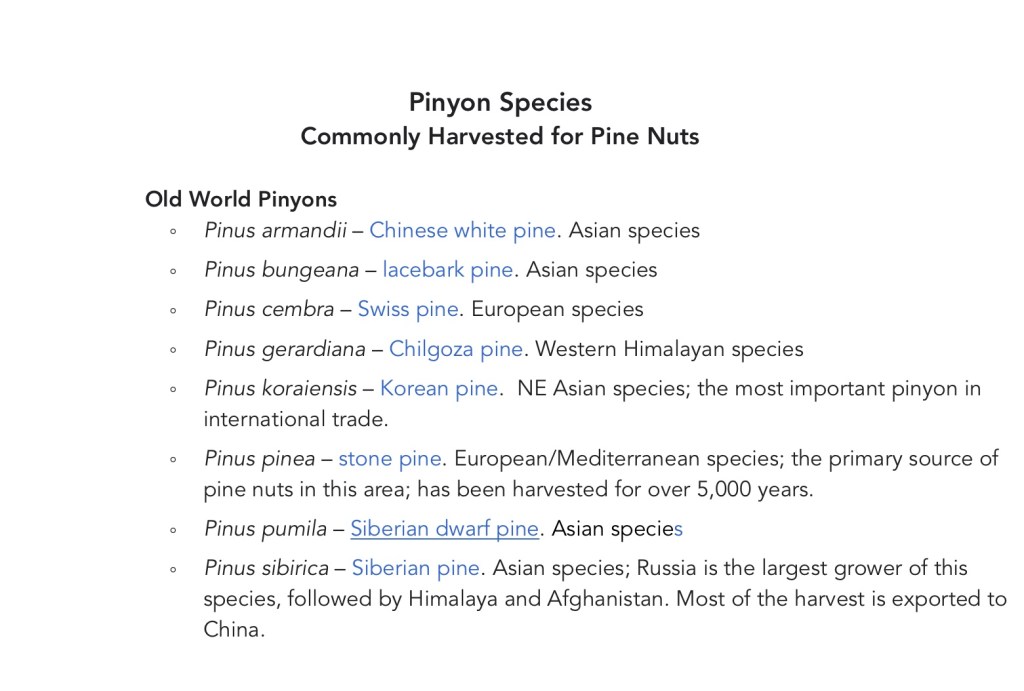
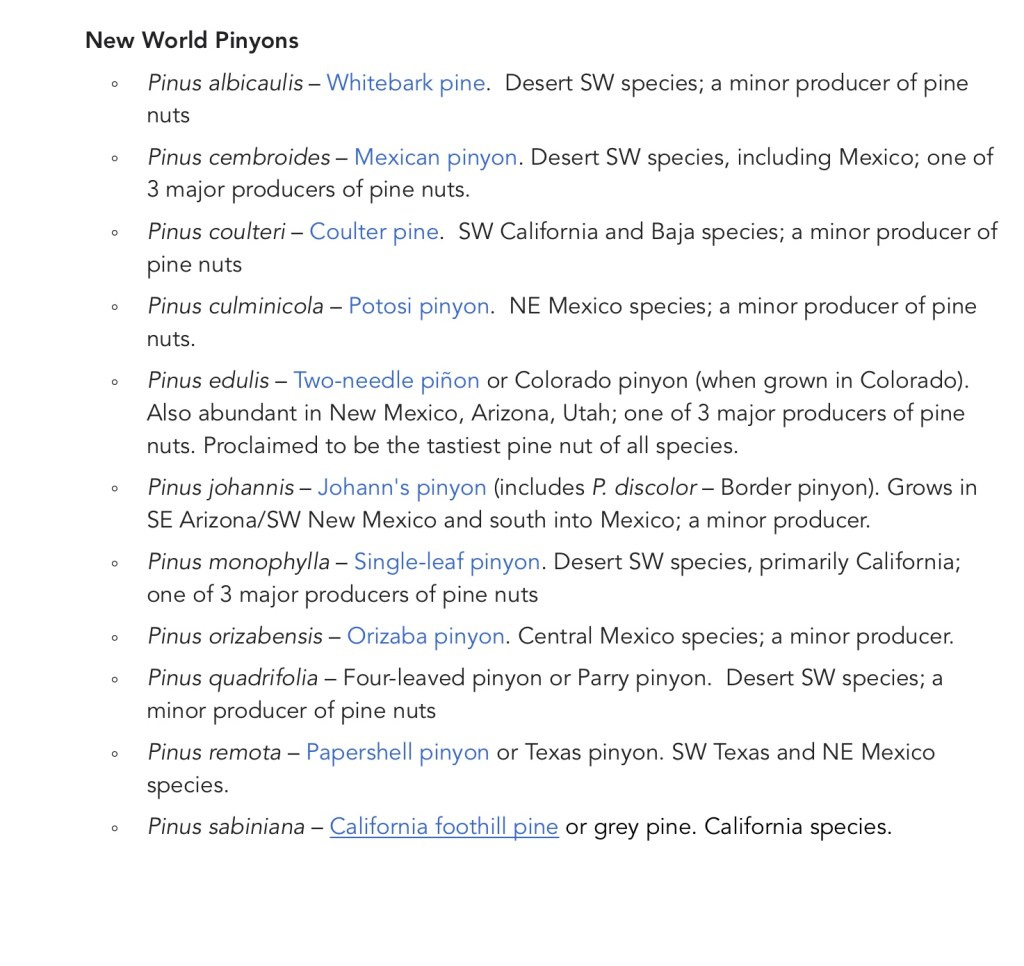
Being naturally curious about the Pinyon species that grow in various countries around the world, I included a list of 16 of the most commonly harvested trees the end of this post.

What’s the Real Reason Pine Nuts are so Expensive?

It’s said that “pine nuts are the most expensive seeds we would never buy!” (**** Check out this footnote for the 2024 costs/pound and my random calculations per serving and for a batch of pesto). Pine nuts are the second most expensive “nut” in the world, second only to the macadamia nut.  But why? While it’s true the seemingly exorbitant price of shelled pine nuts is directly influenced by labor costs, compounded by the annoying sticky factor, other challenges exist.

Harvesting Pine Cones

Cones are harvested by hand, directly gathering those that have fallen on the ground, and from tree branches (where the densest number congregate in the upper 1/4th of 30 foot tall trees). Another common harvesting technique is to whack the branches (which reportedly does not injure the trees [hmmmmm?]).  But a faster method used in many countries is to cut off branches with cones, resulting in a number of detrimental effects  to the trees (open entry points for insects and pathogens; stunted growth; stalled production; tree death).

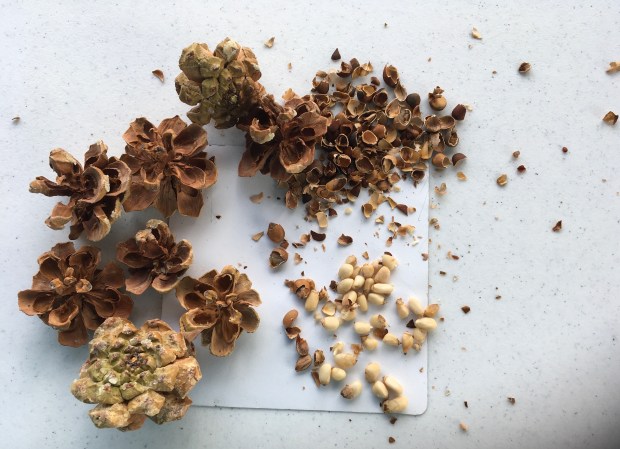
A sampling of Pinus edulis cones with hard coated seeds removed, ready for cracking. There’s a single kernel between the two lower right cones.

Pine Nuts

Once the seeds are taken out of the cones, their hard shells (seed coats) must be removed without damaging the soft edible kernels inside, the “pine nuts.” (And not every seed is viable ….. more about that below.) The shelled pine nuts must now be handled quickly and properly due to their short shelf life. It only takes a few weeks or even days in warm and humid conditions for shelled pine nuts to lose flavor, turn rancid, and completely deteriorate. Until they can be marketed for export, pine nuts must be kept frozen. Ideally, shelled pine nuts should remain frozen during export/import and until consumer purchase and consumption.

There were the remains of the Pinus edulis seeds extracted from these cones; 30 tasty kernels were viable; 20 were either missing or dried up.


Tree Characteristics

Slow growing trees and inconsistent production are several more reasons pine nuts are so expensive.  Pinyon pines are notoriously slow to grow, mature (10 years) and produce a harvestable crop of cones with viable seeds (75-100 years). But pinyon pines typically live an average 350 years, and have the potential to produce tons of harvestable seeds.  However, all pinyons exhibit a common characteristic called “masting,” where they may produce a bumper (harvestable) crop only once in as many as every eleven years. Good years are not predictable either, as many factors influence growth and production, with local droughts and a changing climate having the biggest impact. 

Gifford Pinchot (1909), U.S. Forest Service Chief said: “Seasons of especially abundant production occur, as a rule, at intervals of from five to seven years, although heavy crops are sometimes produced for two or three consecutive years, and heavy seed years are not the same throughout the range of the tree.”

A Pinus edulis tree showing the 2 needles/fascicle densely covering the branches, and a remaining cone ready to fall..

______________________________________________________________
A Few Footnotes

**Piñon or Pinyon?

The most common common name for Pinus edulis is “Colorado” Pinyon Pine, even though the species is widespread in New Mexico, Utah and Arizona as well as Colorado. The words pinyon and piñon are usually considered interchangeable. Use of the word “piñon” (Spanish for pine nut) is tied to the seed (i.e. piñon seed or pine nut seed) and the tree (i.e. piñon pine or pine nut pine) particularly used by Native Americans in the southwest US.  Because references consulted during my research were not consistent in their use of common names for Pinus edulis, to avoid (my) confusion I’ve opted to call the piñon seed (pine nut seed) a “pine nut” and the pine trees with edible seeds “pinyons.” 

**** The 2024 retail market cost (shelled raw or roasted seeds) averages $40/pound

  • 1 pound of seeds = about 4 cups (depending on seed size)
  • 1 cup of seeds weighs about 4 ounces (price $10§)
  • 1 ounce or 1/4 cup of seeds = 1 serving (price $2.50)
  • 1 serving = about 167 seeds (price 1.5 cents/seed)
  • 167 seeds = 191 calories (pine nuts are extremely high in unsaturated, heart-healthy fats and carbohydrates)
  • 1 cup of seeds = about 668 seeds = 764 calories
  • 4 cups of seeds = about 2,672 seeds = 3,056 calories

Number Play

  • Of the 50 seeds I harvested, only 30 were viable (price 45 cents)
  • It took me about 45 minutes to crack open the 50 seeds (this doesn’t include the time it took to collect the resin-coated cones and remove the seeds)
  • It would take me 67 hours to fill a 1 pound bag with 2,672 viable shelled seeds!
  • At $40/pound, a pine nut cracker would be paid only $0.59/hour for their labor, a wage earned back in the 1950’s and 1960’s which didn’t even come close to supporting a family then, let alone today. 
  • Assuming a pine nut cracker makes a minimum wage of $7/hour, it would cost $468 to fill a 1 pound bag.  That’s 1,170% more than the 2024 retail cost of a pound of pine nuts!

Obviously, a professional pine nut cracker is far more efficient than I was, using some form of mechanization to crack the seed coats (requiring more research on my part).

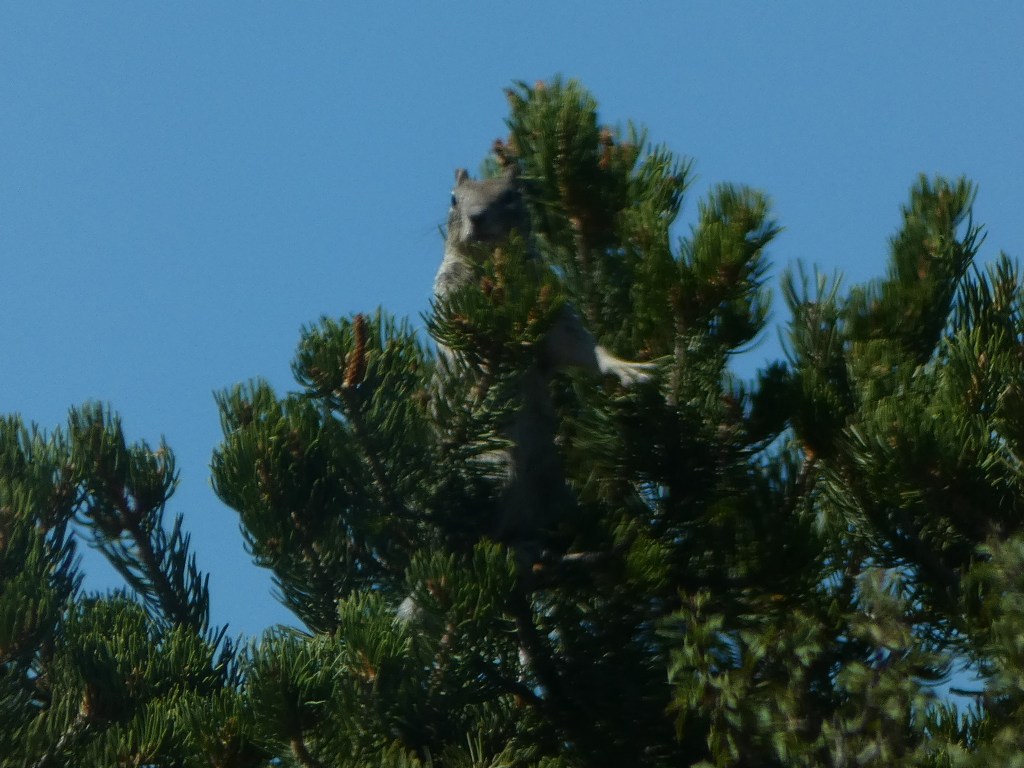
A rock squirrel high in a Pinus edulis tree, keeping watch for red tailed hawks while searching for pine nuts.

§ Pesto ……. most pesto recipes I found call for the addition of 1 cup of shelled pine nuts, or 668 seeds. At 1.5 cents/seed, you’d be adding $10 of pine nuts to make one batch of pesto. Enjoy slowly!

______________________________________________________________

Living in the East Mountains of central New Mexico ensures daily appreciation of hundreds and hundreds of Piñon Pines (Pinus edulis). This iconic pine, the state tree of New Mexico, has been a source of nutrient rich seeds for wildlife and indigenous peoples for millennia. It was fun learning more about this tree and the many Pinyon species that grow around the world.

As always, thanks for stopping by!

______________________________________________________________