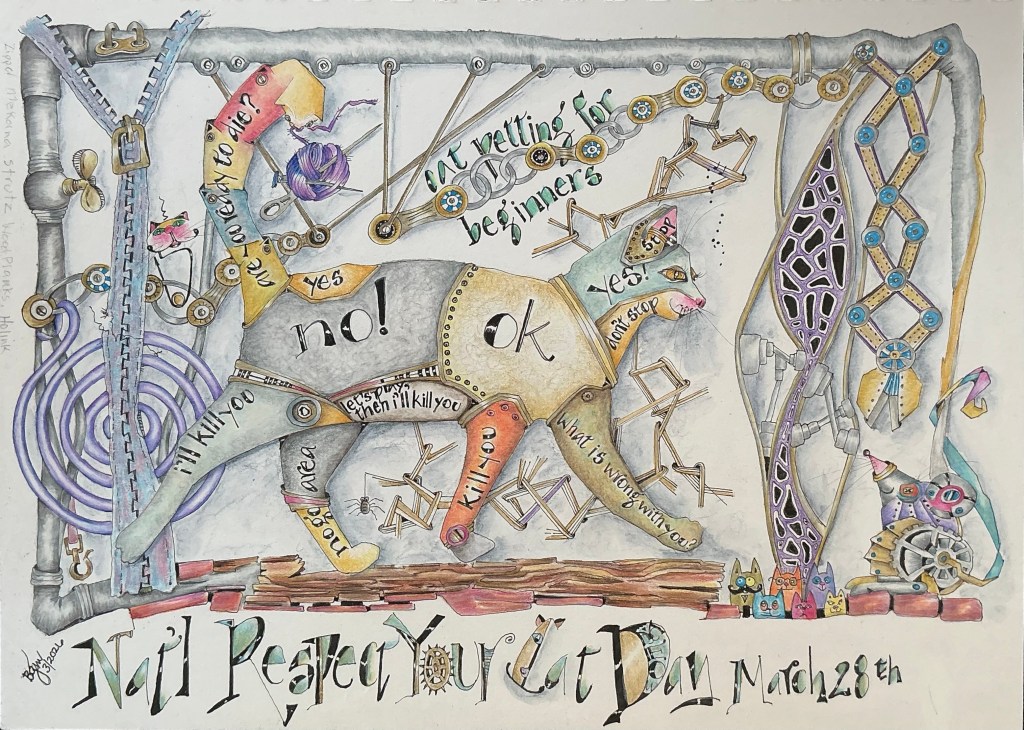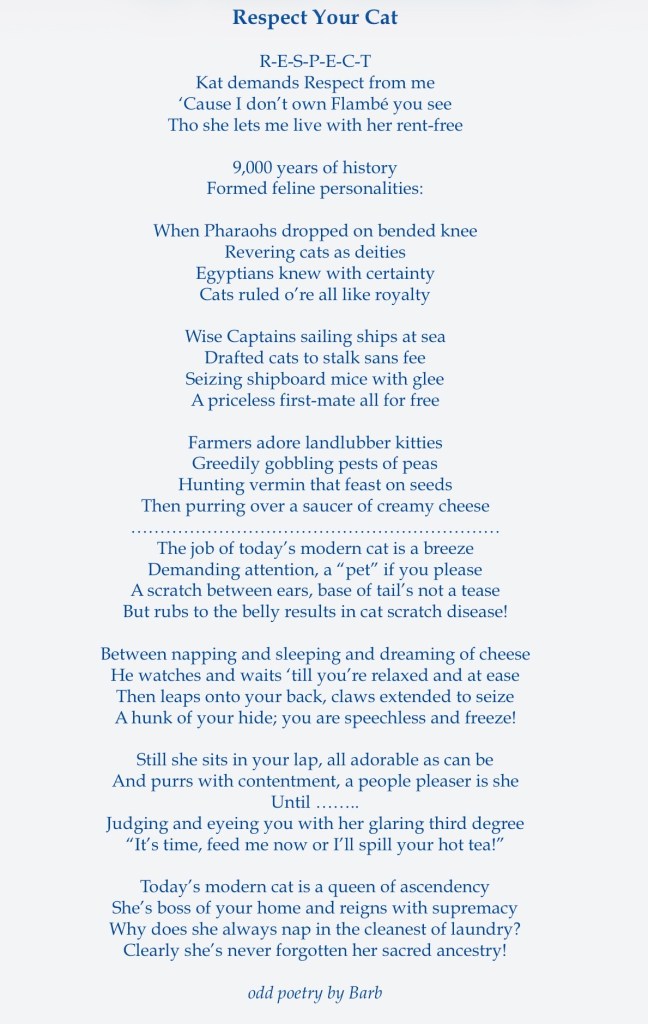
National Respect Your Cat Day

March 28, 2026

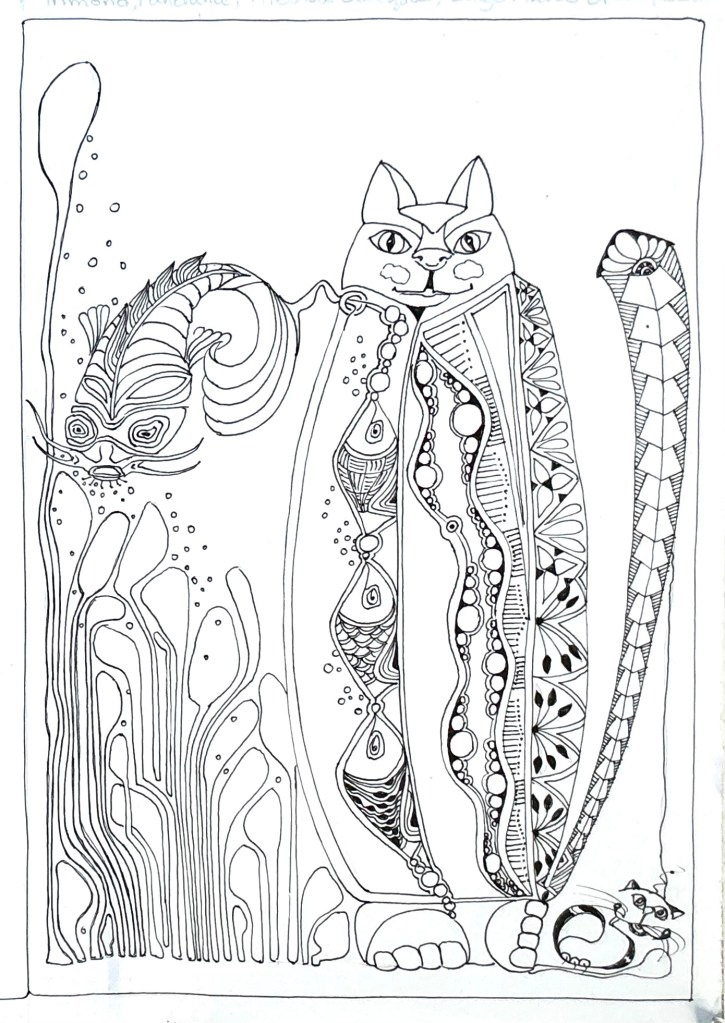
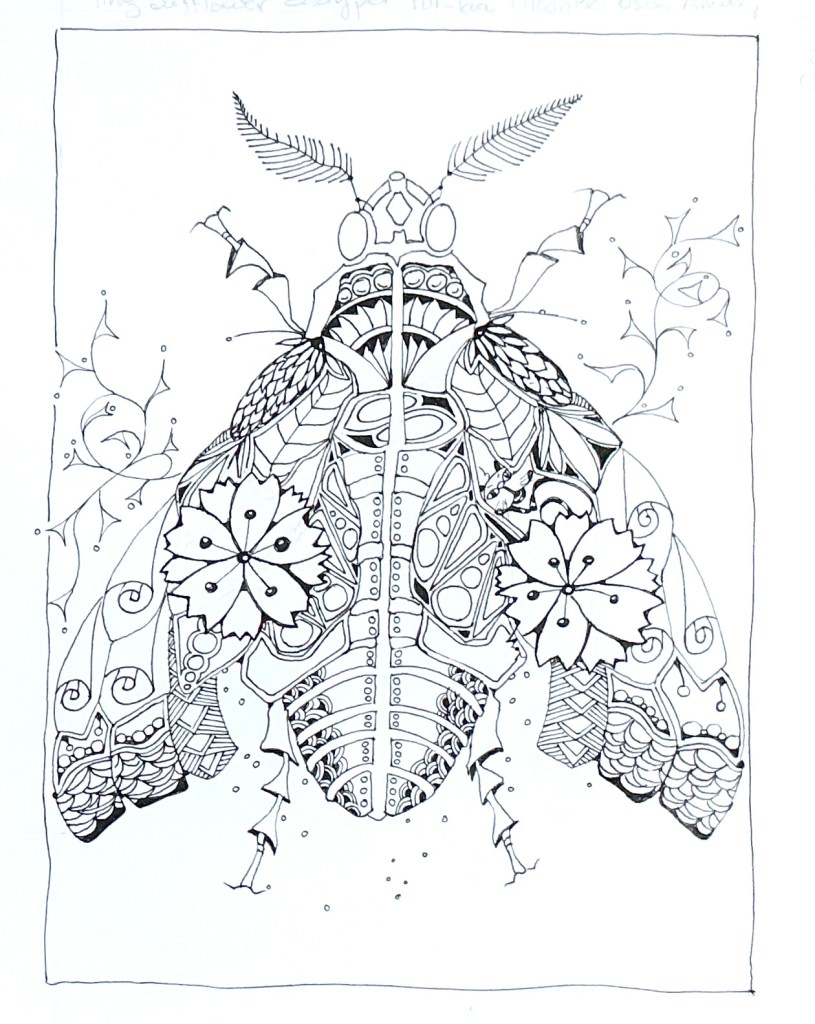
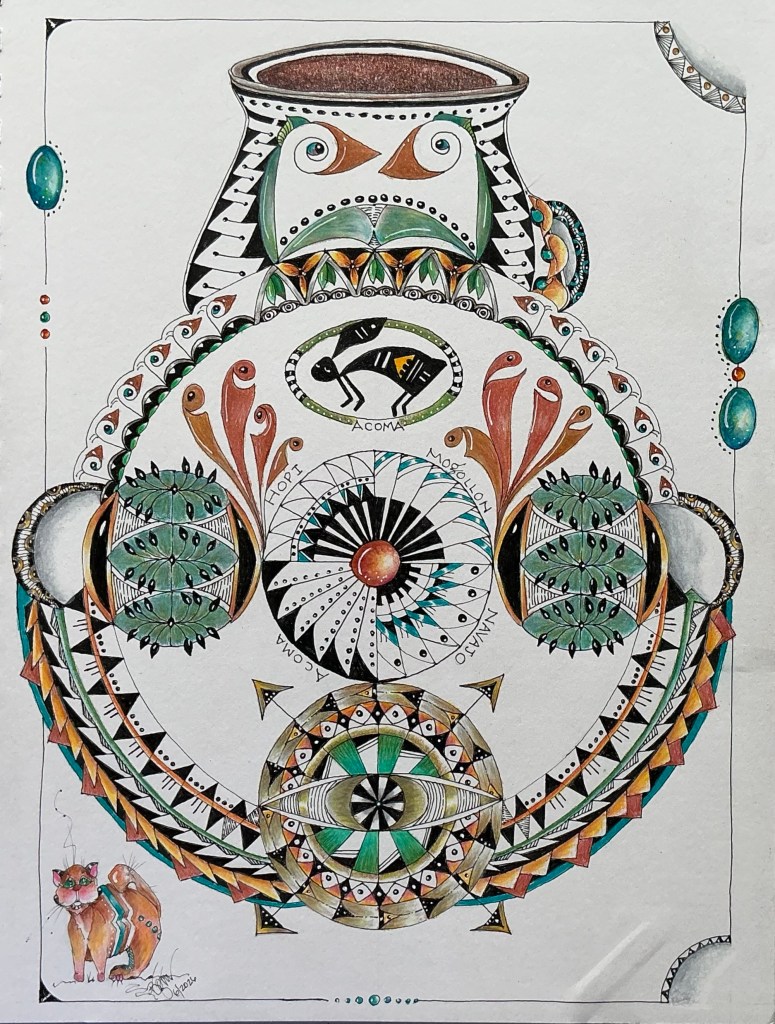
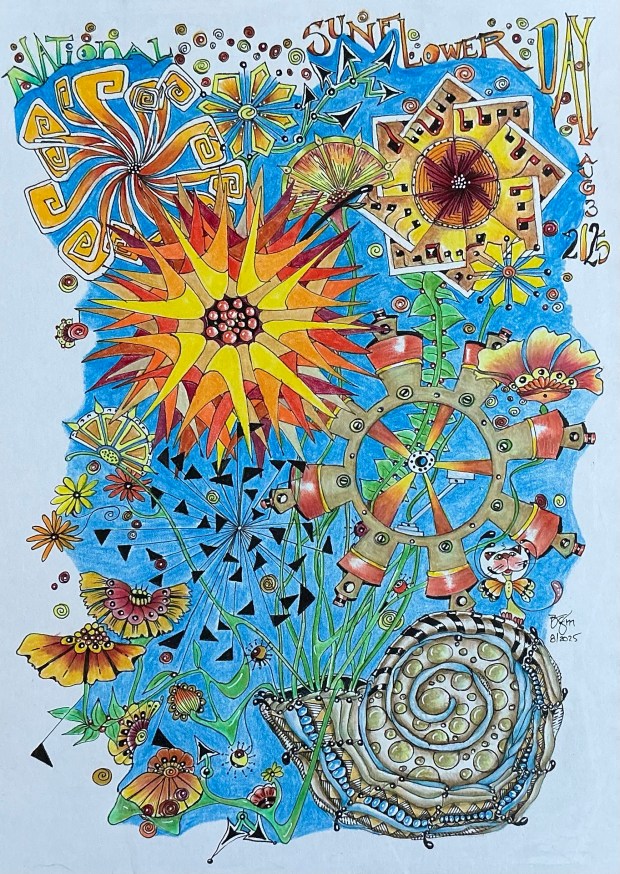
Zentangle patterns: Zipper, Mekorna, Strutz, Wood Planks, Holink, and a wild assortment of Zentangle steampunk patterns and steampunk ideas.

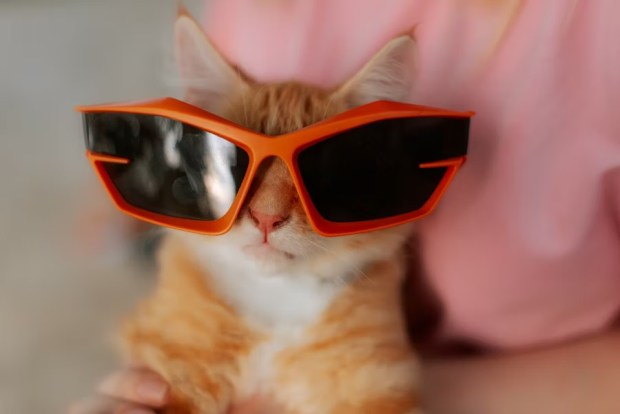
On March 28th, we stop pretending we’re the bosses and lean into the reality of National Respect Your Cat Day. On this National Day, acknowledge the truth: Your cat is better than you. Well? Someone had to say it! And if you don’t believe it, just ask your feline friend!


Do you ‘own’ your cat? Or does your cat ‘own’ you? 

If you answered “Yes” to the first question, you may be utterly and completely confused about the subordinate role you play in the life of your resident feline.  If you said “Yes” to question #2, and have willingly resigned to to being a pushover due to unconditional love, you obviously are an experienced cat chaperone.  

If you’re contemplating becoming a first time cat owner, well, good luck and have fun! Oh, and here’s some tips not only for living happily with a cat, but perhaps there’s a few ideas for all feline chaperones on how to celebrate National Respect Your Cat Day. These pointers will hopefully help you avoid catching a good swat in the process:

  • Keep an open door policy in your home. Once you acknowledge that a closed door (even a bathroom door) is a personal insult to a cat, you will avoid an irritable feline. Just because a cat is hanging out in a room for a long period of time doesn’t mean they want to stay there. They like to travel freely when they choose to. 
  • Use a slow blink when looking at your cat. In their language, blinking slowly is the ultimate sign of respect, trust, and true friendship. If you encounter your cat while wondering through your house, stop and make intense eye contact, then offer him a slow-blink to maintain your friendship. 
  • Respect the nap-zones. Cats spend up to 15 hours a day napping. Let them sleep where they want. If they fall asleep on your laptop, you obviously don’t need to check your e-mail. Are they sleeping on your lap? Moving before their nap is over will cause you to get claws poking through your jeans, causing the most hideous scratch. A cat knows their worth. Let them nap. 
  • The petting rule. Know the difference between a “nice” pet and a “you can quit now” pet. If you want be sure your cat is up for some affection, we recommend petting the cat for about 5 seconds, then pulling your hand away. If your cat wants more, they’ll show you with a bossy nudge. If they want to be left alone, they’ll probably swat at you.
  • Say your sorry. Has your cat every fallen off of a counter? Did they look at you like you pushed them? Of course you did! Cats don’t just lose their balance. You’re the problem (even if you’re not). Just say you’re sorry so they can move on with their day. 

Who was the creator of National Respect Your Cat Day?

No one knows for sure. The most likely possibility is this day was founded by a cat who learned how to type while its human fell asleep on the keyboard. 

Afterward …..

In addition to owning our 9 year old pit/lab ‘puppy,’ Luna, Roy and I share our home with two 12 year old indoor cats, Odo and Dax, a brother and sister we adopted as kittens from a shelter in North Carolina. When we moved to New Mexico in 2017, both cats rode in the car with me. For four long days and 2000 miles across country, the three of us ‘enjoyed’ many boisterous sing-alongs and stimulating conversations! Roy’s journey was much more peaceful!

Over the last 53+ years we’ve joyfully chaperoned ten cats total. All wonderful, all different, all lovable and unforgettable! The names of those we hold in our memories were Popeye, Poopsie, Tails, Fishbait, Darwin, Grizzz, Newt (who was our sailor cat and Captain aboard the S.V. Waterdog), and T.O.O.  

Now we have Odo and Dax to carry on their legacy, and with Luna (and Flambé, of course!) we love and adore them all! 

Share you cat stories, and what you do to “Respect” your feline family! 

As always, thanks for stopping by!

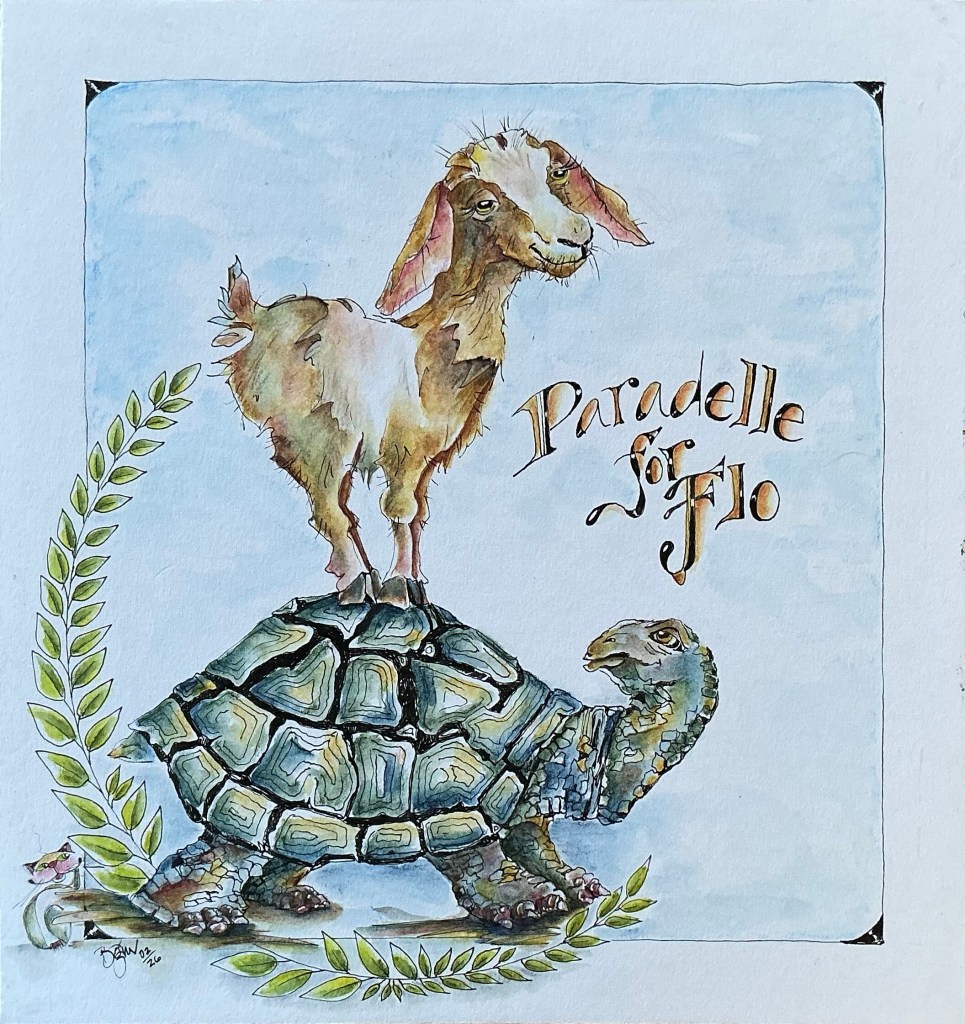
Paradelle for Flo

A Poetic Medieval Adventure Birthday Card for Elaine

March 24, 2026

If you’ve followed my blog for a few years, you may recall an annual post in late February or early March featuring my handmade birthday cards with one of my poems created for my most excellent and dear friend Elaine. Because she loves goats, all of the cards I’ve sent her include a variety of my goat illustrations. No ‘kidding!’ And because she’s an extraordinary poet, I try my best to write a unique poem following the rules of a lesser known (at least to me) style, and reprint my words somewhere inside the card. My efforts at poetry are usually hilarious (I would never call myself a poet), but always prompts Elaine to write a fantastic reciprocal poem in the same style.

The major prompt I follow every year is simply …… Have Fun! But I strictly observe a few rules, or else! (Or else this annual project would take me half a year to complete!) Haha!

Rule 1: Think of a theme. This year I had castles on my mind (I don’t know why), so illustrations could focus on things Medieval. You know, towers and moats, knights and shields.

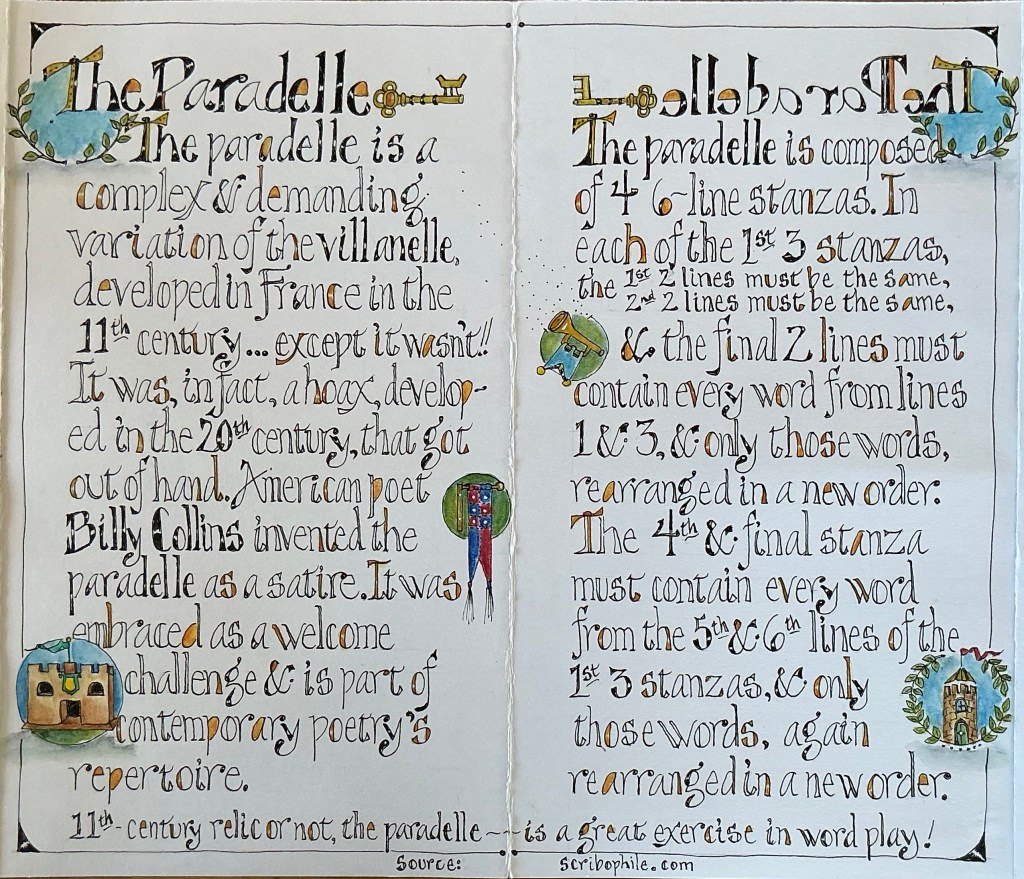
Rule 2: Find a style of poetry that would not only work with my theme, but has a high probability of generating a bunch of belly laughs while I wrote it and while Elaine read it. Next, write the poem. This year I chose to write a Paradelle (a parody on the Villanelle-style poem) that has high comedy potential. Also, the history behind the Paradelle was a hoot …. claiming to have been developed in the 11th Century (fitting my Medieval theme), but was actually introduced in the 20th Century (so I included the history behind the Paradelle in the card and below so you can read it for yourself).

Rule 3: Design and make an accordion card that would comfortably hold all the illustrations and the poem (and the history and rules of a Paradelle-style poem). Issue A ….. at this stage of the project, the illustrations and the poem were still vivid parts of my imagination. Exactly what would be an appropriately-sized accordion book? Hmmmmm? Issue Z ……. because I tend to have grandiose project ideas, the accordion book ended up being, well, grandiose! The outside cover panel was 9”x9” . and with two inside front-facing panels and a front-facing back panel, the entire length of the accordion book, unfolded, was nearly 3 feet long!

Rule 4: Complete the entire project during the first 3 weeks of February, allowing 1 week for mailing from central New Mexico to western North Carolina, arriving in time for Elaine’s birthday on February 28th (her birthday is actually on the 29th, but in years that don’t “leap” she always parties on the 28th). Not being able to complete the card until late the first week of March, I blew this rule, but did send her a ‘place-holder’ birthday puzzle of an underwater fantasy castle atop a sea turtle (alerting Elaine it contained an embedded hint of her actual “gift card” which finally arrived on 16th).


The following photos were taken of the pages from Elaine’s 2026 birthday card.

The cover panel, 9”x9”. I had to introduce a tortoise to tie together the card with the ‘place-holder’ gift she received in time for her birthday. Of course, a goat! Flambé approves!
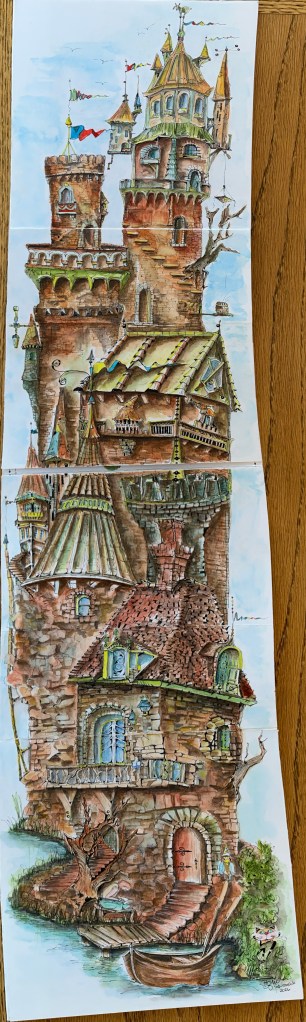
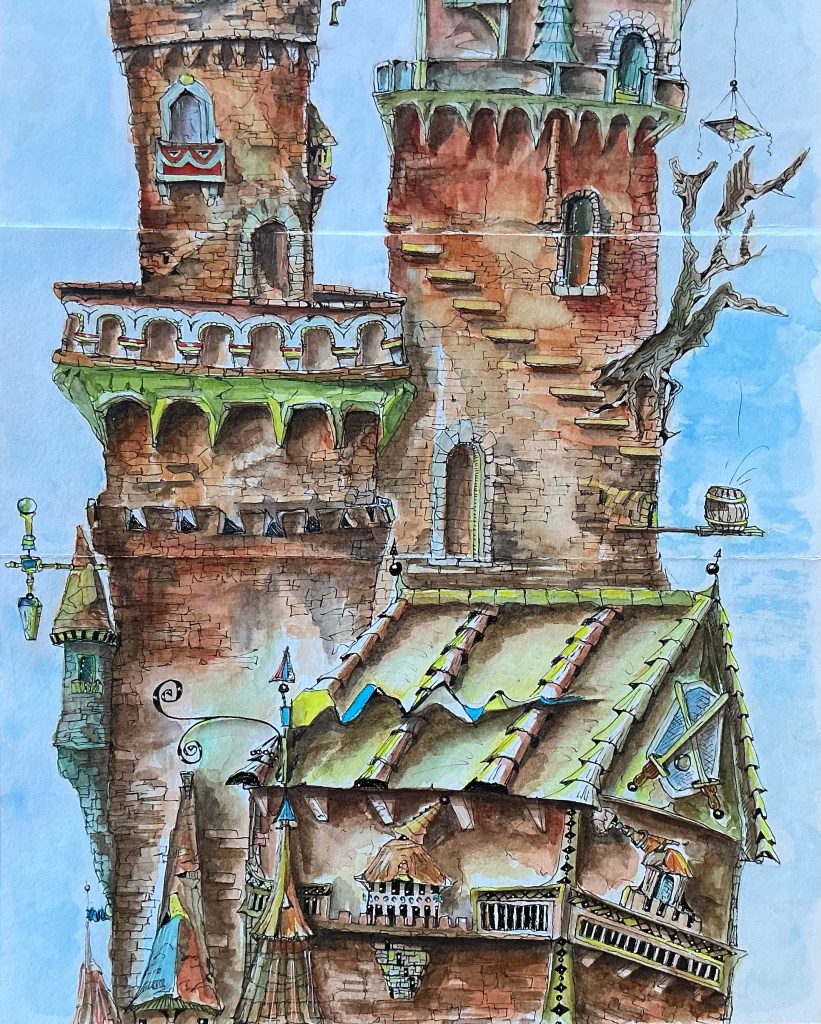
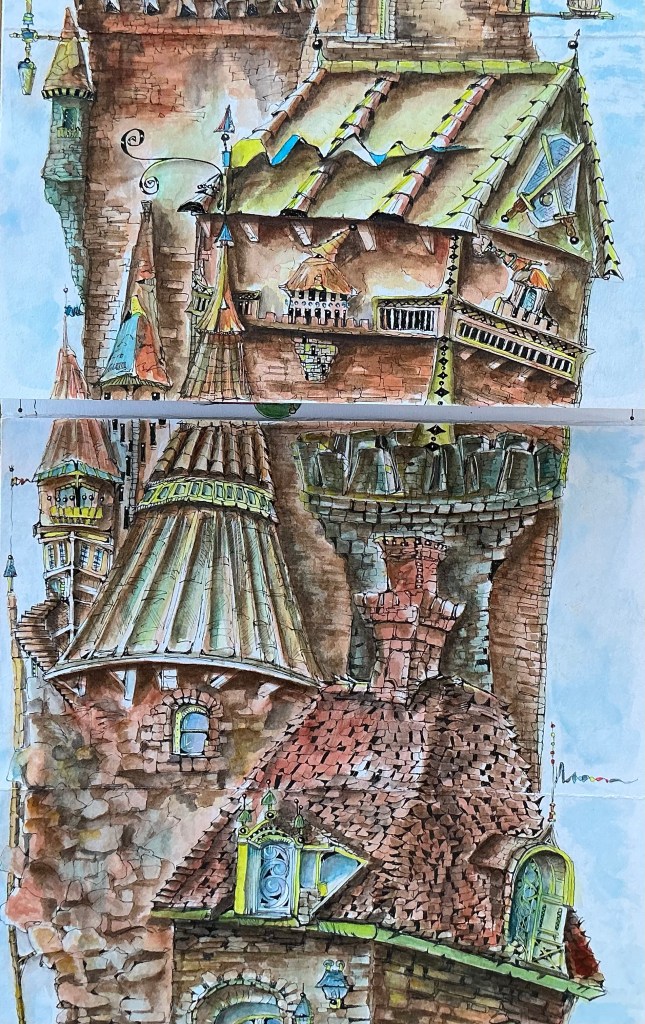
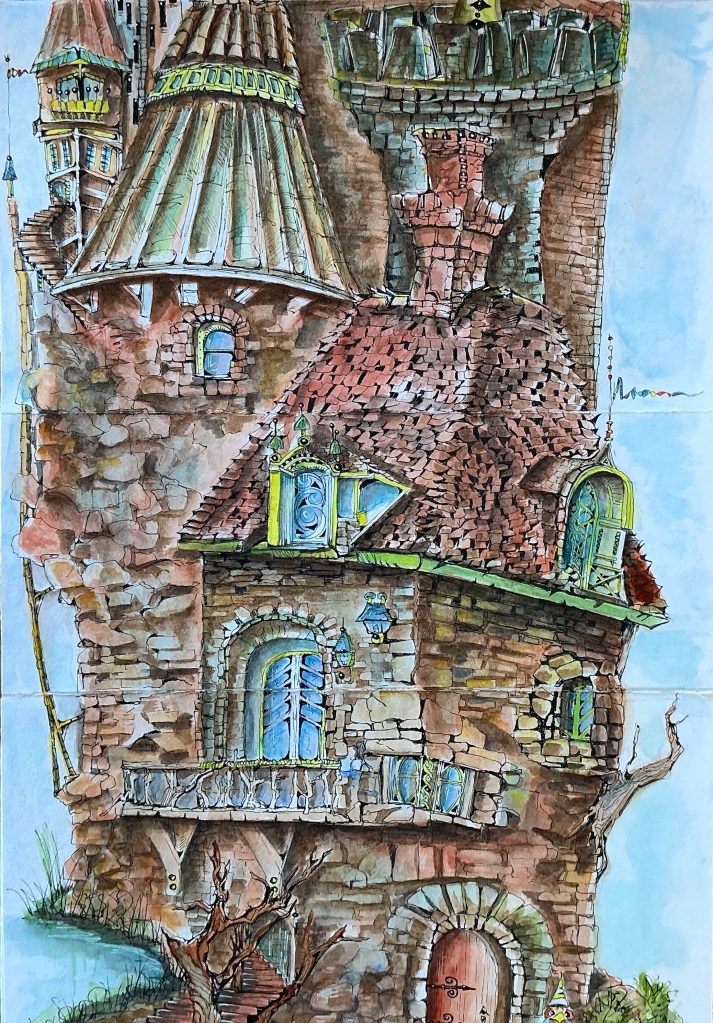
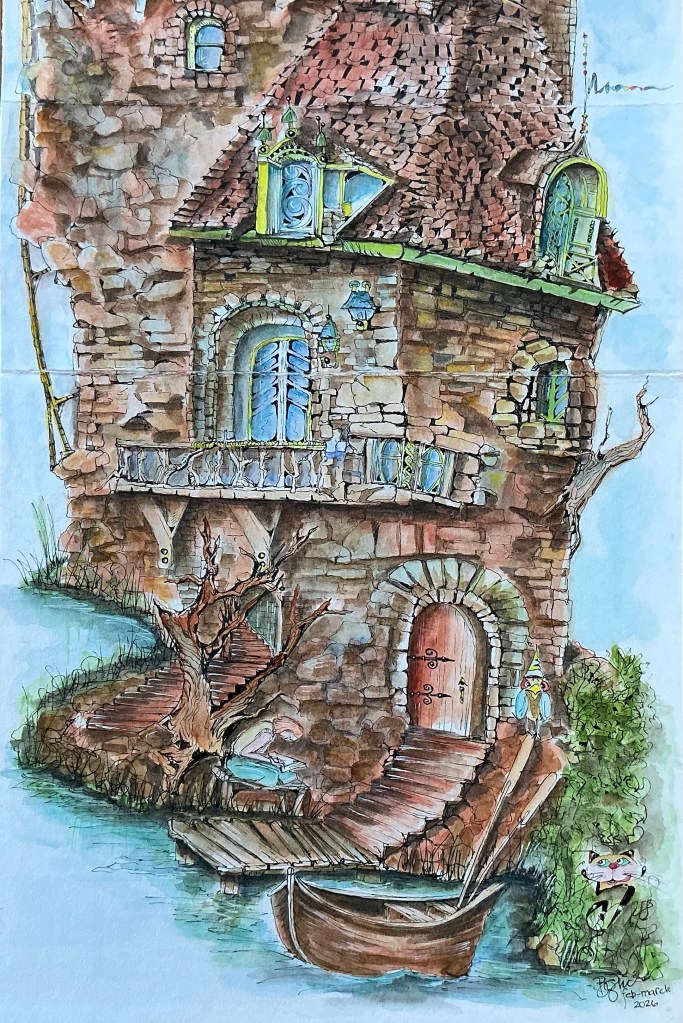
The Medieval Castle from my imagination. This 4-panel castle took up the entire inside of the accordion card, measuring nearly 3 feet long. The two center panels are bisected to make room for more printed words and illustrations. In this illustration, can you find the goat? Elaine busily composing her Paradelle? Flambé?
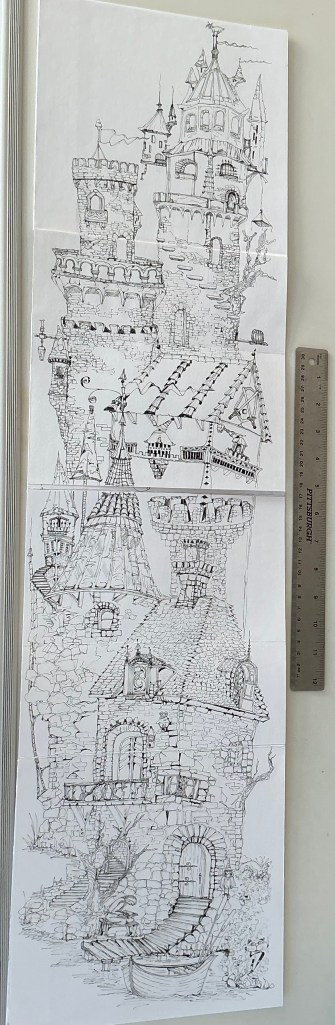
This was the line work. I began by pencil sketching the top panel, but before that was finished, I buried my pencil and finished the rest in ink only. The entire structure, top to bottom, is mostly from my imagination; making it up as I went. At first it was scary, but then I just went for it without fear. It was great fun!
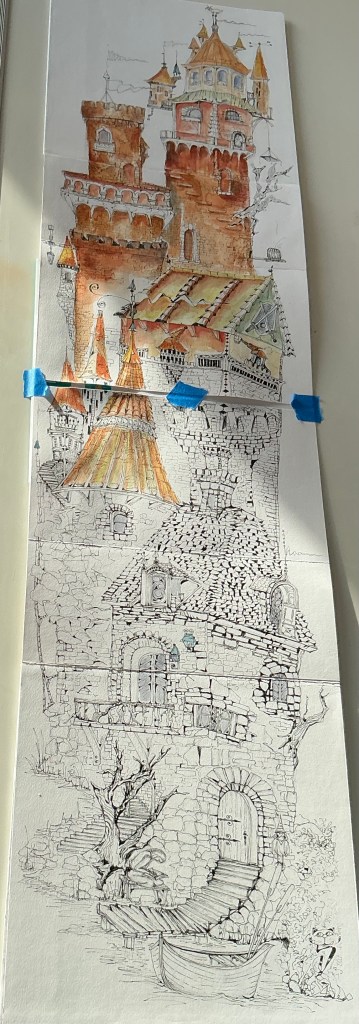
After the ink work was done, next came watercolor. I used a 12 half-pan set of van Gogh watercolors with a size 6 round brush for all the initial washes. Extra detail was then added with Derwent Inktense watercolor pencils and a water brush. The last step was to add extra shading with my neutral-colored set of Tombow dual brush pens which are water based and blendable. All fun!
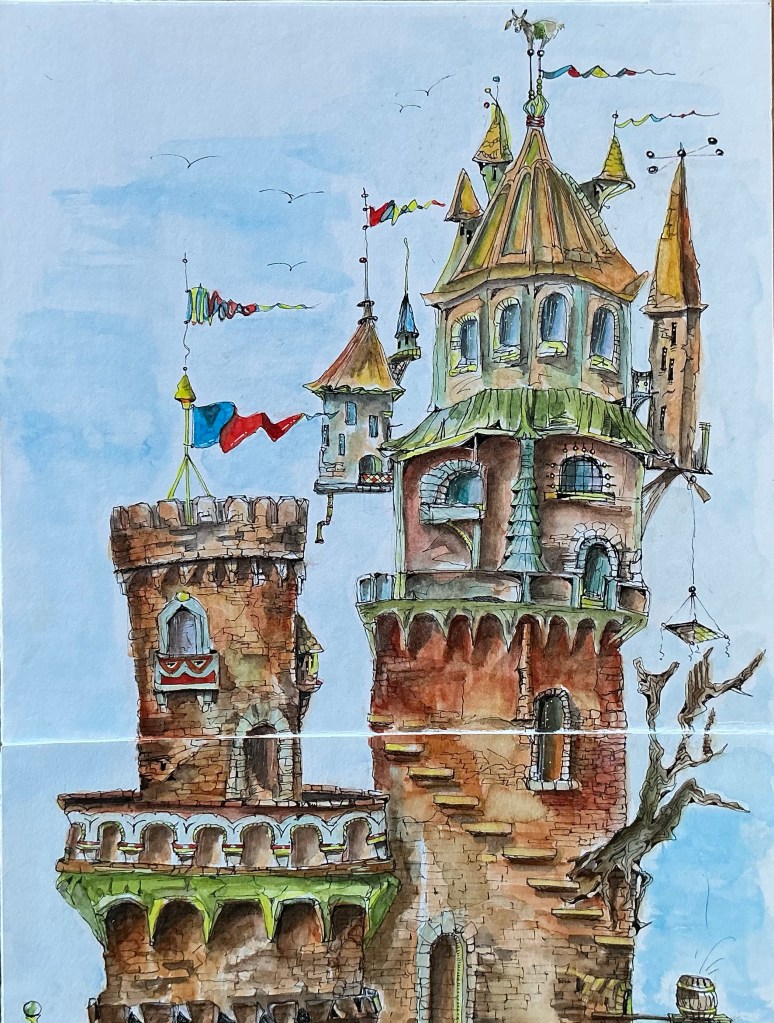
Castle details – top panel
Castle details
Castle details
Castle details
Castle details
This is -art of the center 2 panels underneath the castle. On the left is the humorous history of the Paradelle; on the right are the official rules you must follow when composing a Paradelle (should you wish to do so!)
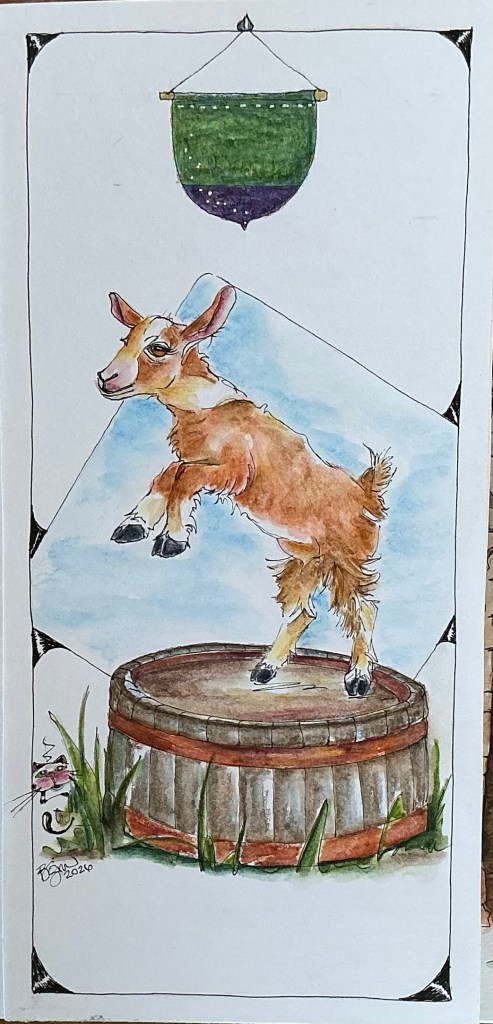
This is the illustration under the right side flap under the castle. This is one of the Queen’s performers! This little guy works for goat-chow..

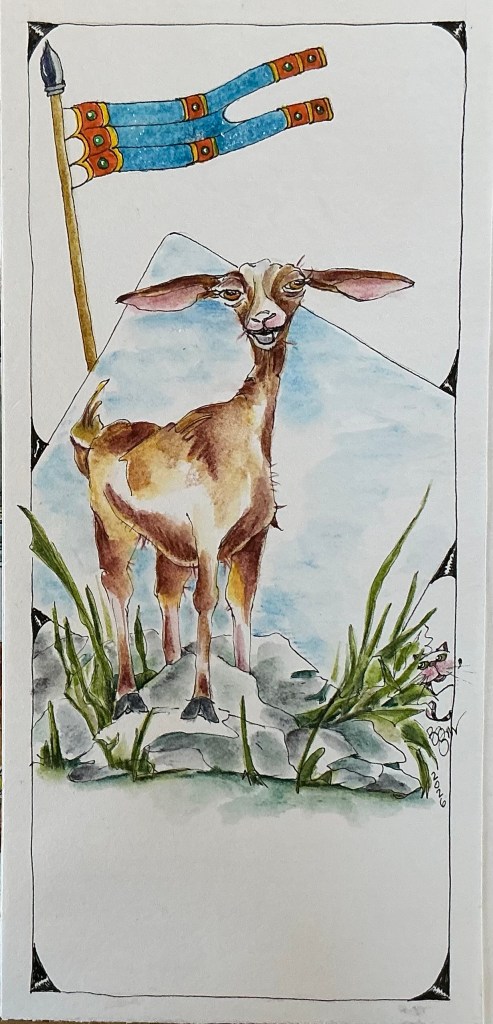
This is the illustration under the left side flap under the castle. This is the official banner bearer for the King when his Knights in Armor march off to battle. This little goat works for premium goat-chow..
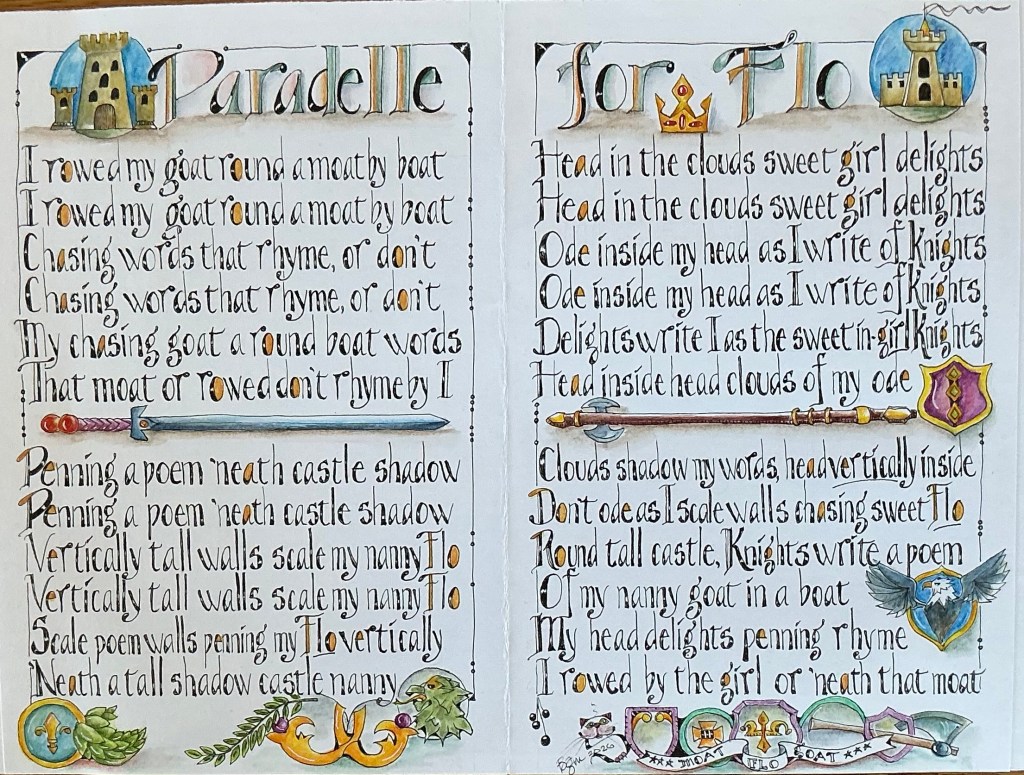
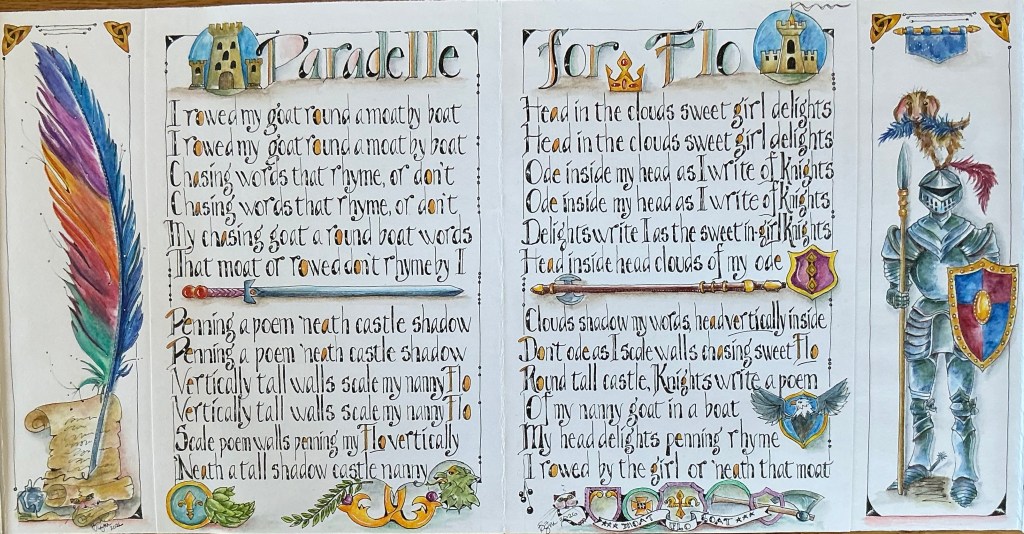
Paradelle for Flo!
The Paradelle for Flo layout, keeping with my Medieval theme.
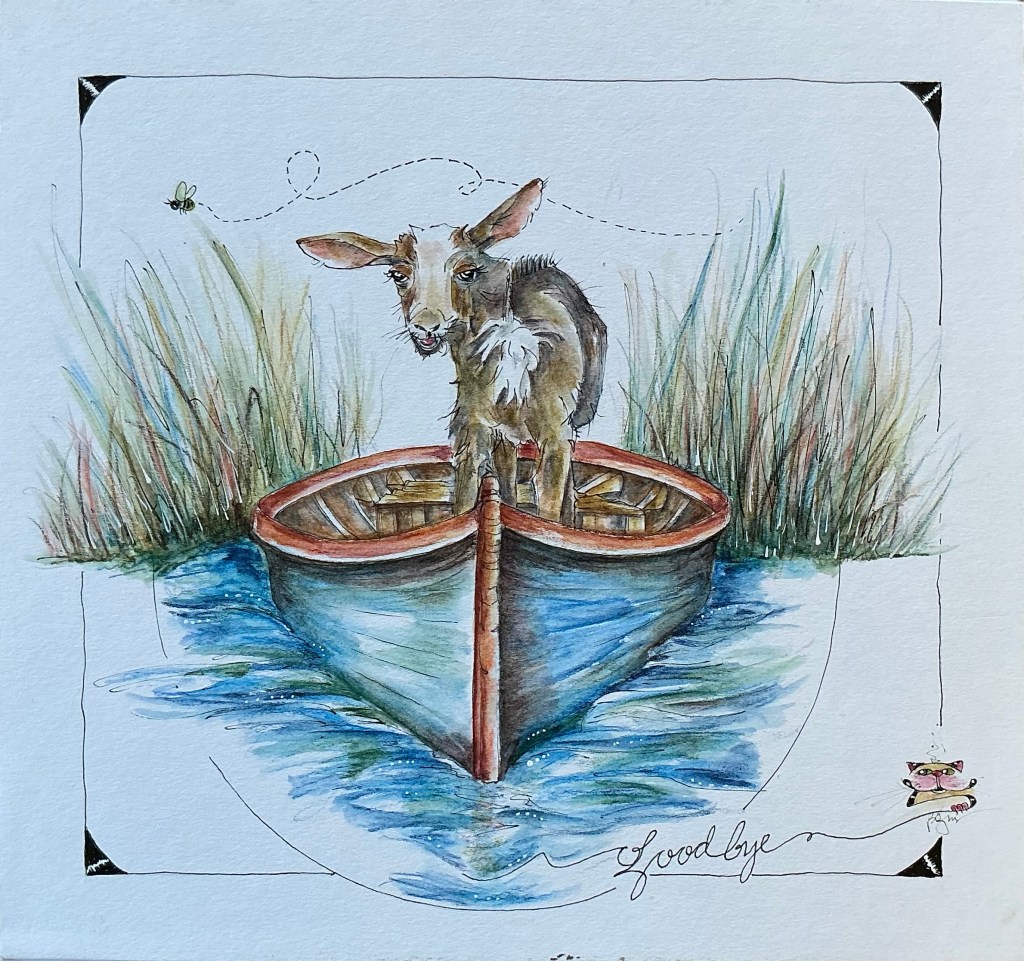
The Final page as Flo (and Flambé) quietly says ‘good bye’

Elaine loved her birthday card! Can’t describe how much fun it was to create Paradelle for Flo for such a wonderful friend! Thinking up the idea, making the accordion book, creating the illustrations and writing the poem was a great way to spend 5 weeks! It turned into quite a satisfying challenge, as well as a learning experience when it came to mixing various medias together and bringing to life all the components into one card!

If you enjoyed Paradelle for Flo, you might enjoy this one too!

Chasing a Dream … a poet, a few goats, and a circular pantoum : March 3, 2023

I’d love your feedback! And as always, thanks for stopping by!

Be Mine!

Happy Valentine’s Day

February 14, 2026

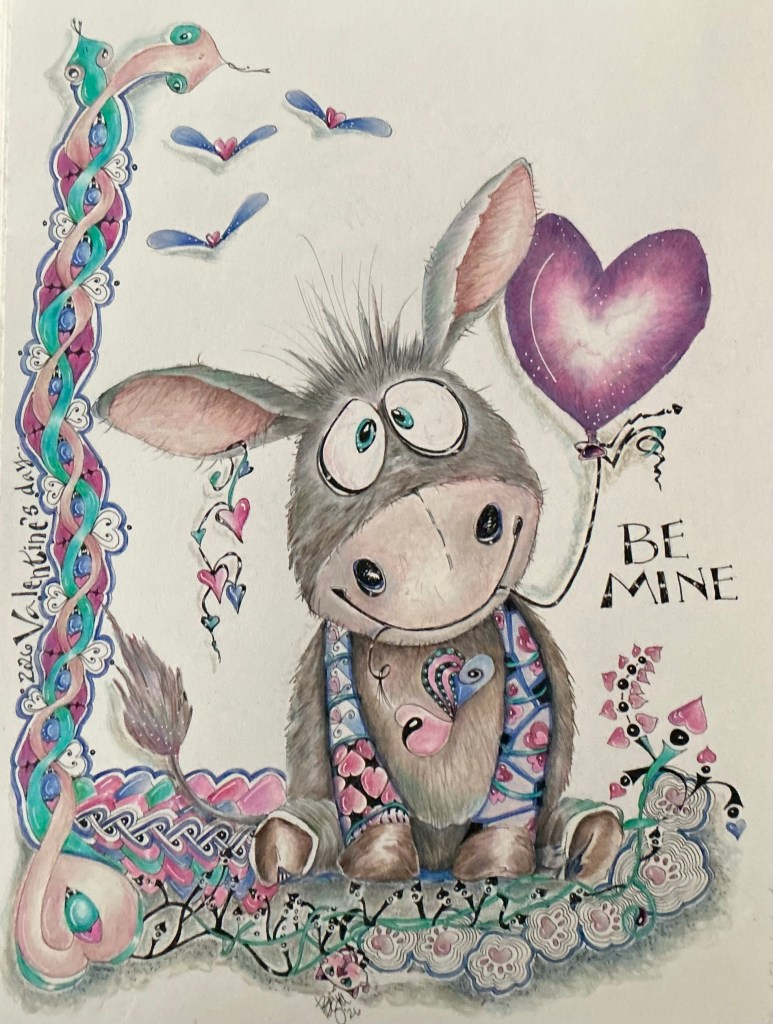
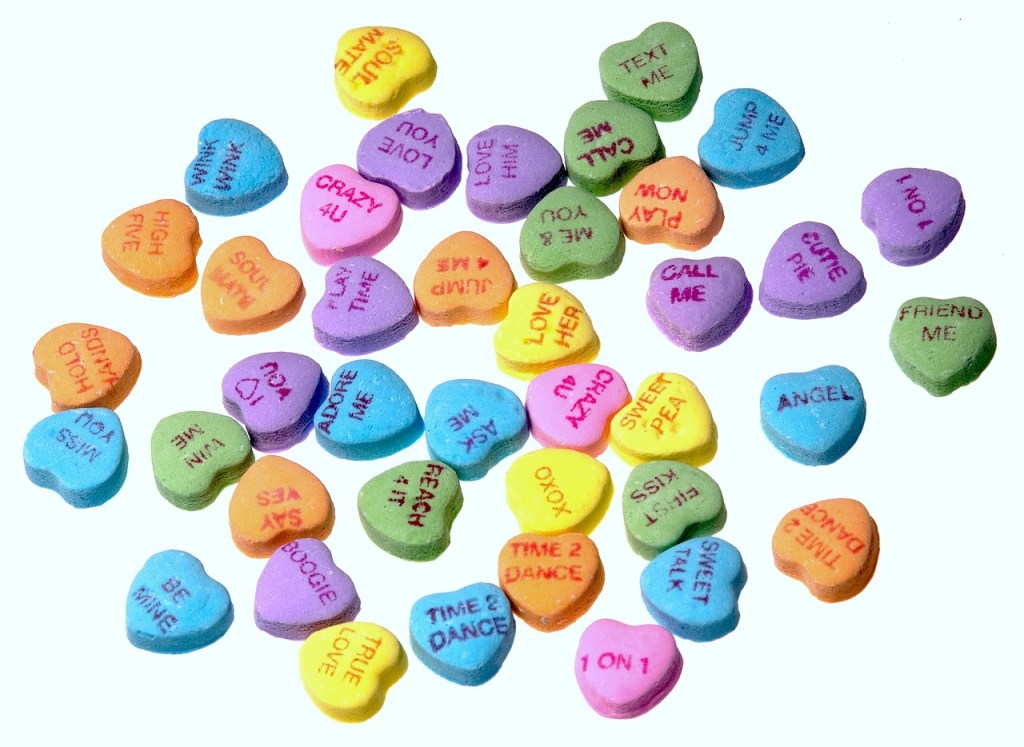
Burro-ito Jack galloped by our place this morning to wish y’all a Happy Valentine’s Day! And then he excitedly ‘brayed’ — in Conversation Heart 💜 style — BE MINE! …. KOOL KAT! … MARRY ME! … CRAZY 4 U! … BUY N BULK! … QT PIE! … U ROCK! … XOXO! … SAY YES! … HEE HAW! …… (knowing what a sweet tooth he has, I finally offered him a box full of those sugary hearts just to hush him up) 

Zentangle patterns: Heartvine, Flidfrerz, Kundalov, Holiheart, Cheuca, Rosie, Hart-Ellie, Heart Flower, Heartbox, Diamond Heart, Heart rope

Since Jack brought up such a sweet subject, did you know ………………….

Conversation Candies got their start as medical lozenges?  

Weirdly enough, the story began in 1847 when a Boston pharmacist named Oliver Chase invented a machine that simplified the way sore throat lozenges could be made. Then Ollie had another great idea. Instead of making lozenges, why not use the machine to make candy? Why not, indeed! And just like that, his invention became America’s first candy-making machine.  Soon after, Oliver founded the New England Confectionery Company, or NECCO, and the candy ‘lozenges’ soon became what we know today as NECCO wafers. (I didn’t know that’s what NECCO stands for! Did you?)

But that’s not the end of the story. 

Conversation Candies get sentimental!

For almost 20 years, the pharmacist-turned-candymaker kept cranking out sweet NECCO wafers.  But when 1866 rolled around, and fascination with those lozenge-shaped candies waned, it was Oliver’s brother, Daniel Chase who had a brilliant idea. “Let’s print sentimental messages on each wafer!” And that’s what he did. Because the candies were larger than today’s versions, printed sayings and phrases could be long. While Dan was busy creating witty messages that could stoke the flames of love or warn off flaky suitors, big brother Ollie redesigned his candy-making machine to “pretty up” the wafers. So sayings like “Married in white you have chosen right” and “How long shall I have to wait? Please be considerate” were now emblazoned on a pastel, scalloped NECCOs. It seemed everyone had fallen in love with these redesigned Conversation Candies.

Conversation Candies Evolve

Sales skyrocketed over the next 36 years, but before long, the brothers Chase decided one more key innovation was needed. In the winter of early 1902, just in time for Valentine’s Day, they transformed those pretty pastel colored, scalloped wafers into heart-shapes. Perfect!

Conversation Hearts Today

More than 8 billion Conversation Hearts are manufactured each year by NECCO. Their size may be smaller, and the sentiments much shorter, but each packed-full box has approximately 45 sayings like “True Love,” “Hug Me” and “You Rock.”  NECCO even let’s you can personalize your own sayings, too. And in case you need to know …. that secret supply of Conversation Hearts you stashed away last year are still “fresh” as they have a shelf life of five years. Oh goody!

Happy Valentine’s Day! Hope you enjoy your box of Conversation Hearts (but don’t forget to make a dentist appointment!). 

As always, thanks for stopping by! 

National Button Day

November 16, 2025

Go ahead and ‘Zip,’ ‘Lace,’ or ‘Snap,’ but don’t forget to ‘Button,’ for today we celebrate National Button Day!  And not just Button, the noun ….. that often round, oval, and curiously odd-shaped fastener useful for bravely closing shirts and blouses, trousers, and shorts, skirts, jackets …… but Button-ing, the verb …. the ubiquitous and organized hobby of button collecting officially recognized by the National Button Society. Don’t you think it’s about time to Honor the Button!?

Zentangle Patterns: Buttons, Bresa, Ribbon’nu, Suru, Beadlines, Fandance, Bounce, Amath, Antique, Beetwin, Deelish, Chain Gain, Elbe, Itsy Twisty, Centipede, Zeppo, Sea Wave

Button History

Throughout history, buttons have been mostly functional – used to fasten pieces of cloth together. But their intentional use as decoration is well documented.

The oldest known button was found in the Indus Valley, a region of modern Pakistan. Estimated to be around 5,000 years old, it was made from a curved shell and has a flat face that fits into a loop. This unbelievably old button is believed to have been used solely as decoration. (Wonder who the button artist was?)

Ancient Romans, who lived from the 8th century B.C.E. To the 5th century C.E., also made and used buttons. Because they wore loose-fitting garments made of heavy material, their buttons were thick and made of horn, wood, and bronze.

But the button didn’t serve as a functional fastener until the Middle Ages (5th to 15th centuries C.E), when buttons were used for more fitted clothing for men and women.  

Button makers didn’t become popular until the 1600s. During that time, buttons could only be afforded by wealthy men and women, becoming a symbol of prosperity and prestige. 
In the 1890s, in response to the fast-growing ready-to-wear industry, freshwater pearl button manufacturing exploded. In factories from Wisconsin to Iowa to Arkansas, workers used tubular saws to cut round blanks from mussel and clam shells, which were ground to standard thickness, then faced, drilled, and polished.

But it wasn’t until the 1920s, that button prices became more affordable and could be worn by everyone. This was primarily because buttons were made of inexpensive synthetic materials and could be made in larger sizes, in a rainbow of colors.  Becoming increasingly common, ready-to-wear fashions began featuring buttons that were not only functional but decorative.
Today, buttons can be simple disks with two to four holes, and are made of metals, plastics, resins, and acrylics. But button makers still create more elaborate designs. If you can imagine it, there’s probably a button like it. From animals and food to iconic buildings and famous people, button makers make them. They’re colorful and fun and designed to be decorative. While the fun ones may be less practical, they’re still made to function. 

What Makes a Button?

Over the millennia, people have made buttons from a variety of materials. In ancient times, buttons were formed from natural and readily available substances such as stone, shell, bone, clay, or wood. Some rare antique buttons (those more than 100 years old) made of early plastics like celluloid or Bakelite are highly collectible, as are those made from bone, stone or wood, glass or metal, and shells such as mother of pearl or tortoiseshell.  (Note: if your grandma left you her button jar, look for buttons made from just about anything but modern plastic ….. they may be considered collectibles and might demand a hefty price! (Do I see an Antiques Roadshow in your future?)In more modern times, metals, plastics, resins, and acrylics have been used. 

The Art of Buttoning

Did your grandma or mom snip the buttons off clothes headed for the rag bag? So many buttons collected in jars or tins. One day I discovered a decorative fruitcake tin high on a closet shelf. Afraid a waxed paper-wrapped brick of cake might still be ‘mulling’ inside, I held my breath and took a look. Instead of a dense cake, the tin was heavy with the weight of hundreds of colorful orphaned buttons! Running my hand through the collection, it was easy to imagine I’d stumbled upon a treasure chest of gold as the buttons fell between my fingers back into the tin! That ‘treasure’ continued to feed my imagination for years. They became great substitutes for missing Jax pieces; strung together, buttons made draped garlands, tree ornaments, a bracelet and necklace; even a stuffed bear who was ‘blind’ in one eye, regained his ‘sight’ after receiving a button transplant.

Today, the National Button Society (NBS), with a membership of over 3,000, reports there are thousands of button collectors in the United States (are you one of them?). Also, more than 70% of states have their own button societies (now that’s just ‘cute as a button’), and countless smaller, local clubs exist across the country. 

Did You Know ………

As of May of 2001, Guinness World Records certified that Dalton Stevens, from South Carolina, had the largest collection of buttons in the world. With a total of 439,900 unique buttons, he was also known as the “Button King.” His collection is housed in a museum in Bishopville, South Carolina, and features numerous objects covered with his unique buttons, including a car, an outhouse, and a coffin.  

Another large button collection can be experienced at the The Waterbury Button Museum, located on the top floor of the Mattatuk Museum in Waterbury, CT. This collection of over 20,000 buttons was donated by the Waterbury Companies in December 1999, and includes buttons from around the world. From mass-produced military buttons to handmade fashion buttons, the display includes buttons made from glass, bone, jade, porcelain, plastic, and metal. The buttons represent the history of Waterbury, which became synonymous with button manufacturing, particularly for military uniforms, since 1812. 

HOW TO OBSERVE NATIONAL BUTTON DAY

Do you have a fun button collection? Are you a member of a local button group? Have you joined The Official Button Lovers Group on Facebook? If you’re intrigued by buttons after reading this post, or want to be, here’s some ideas to pique your curiosity and cultivate a budding love of buttons: 

  • Start a button collection
  • Make a button necklace or bracelet
  • Design a craft using buttons
  • Make an ornament using buttons
  • Play a game with buttons, like Tic Tac Toe or Checkers

……………………………………………………………………………………………………………………

Did you ever imagine you would be thinking twice (or more times) about buttons today? I certainly didn’t! So why not come along with me and jump on that button-covered Band Wagon to celebrate and pay homage to the hard-working button, the “fossil of the sartorial world.” 

But more than anything, have a fun National Button Day, because as J.D. Barber once said, “Trying to make the presidency work these days is like trying to sew buttons on a custard pie.”

As always, thanks for clicking on your email button today, and stopping by!

NATIONAL DIATOMACEOUS EARTH DAY

Part 1 – Diatomaceous Earth

August 31, 2025

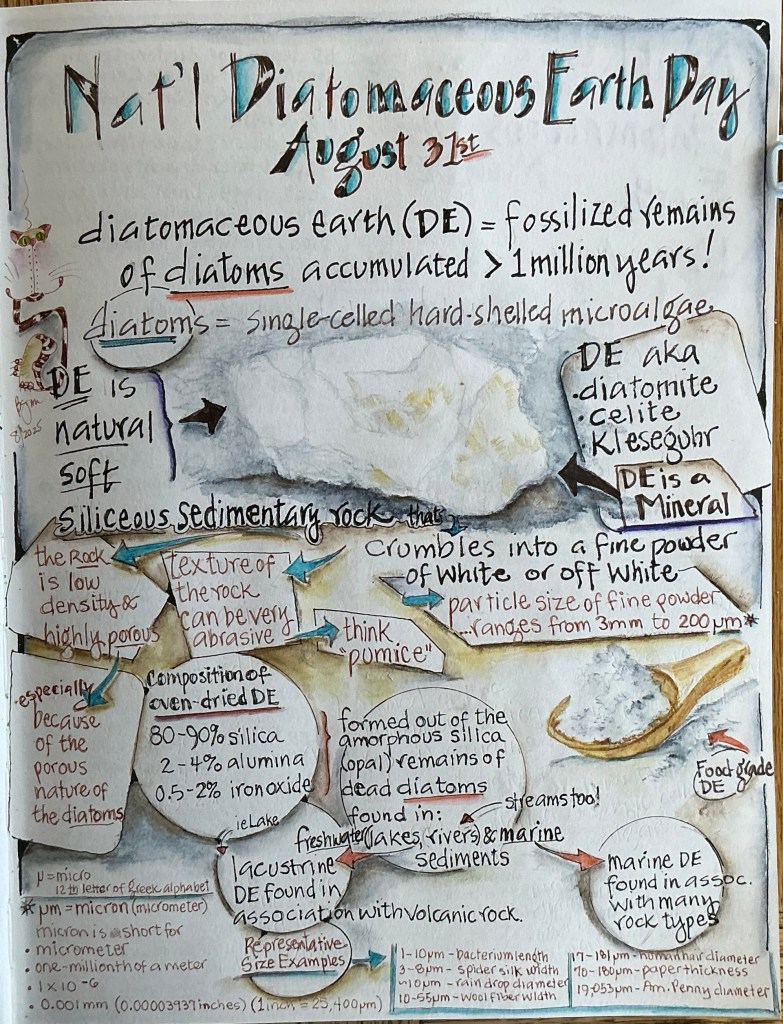
On August 31, National Diatomaceous Earth Day recognizes the diatom and the remarkable mineral it creates! 

Have you ever heard of Diatomaceous Earth (DE)? If you answer “yes” then perhaps you brew your own beer, have a swimming pool in need of water filtration, or a vegetable garden that’s been invaded by a herd of hungry slugs. But did you know DE is a mineral1 composed of the fossilized remains of single-celled, microscopic algae called Diatoms? (More about diatoms in an upcoming post.) DE is truly a remarkable mineral, found around the world in ancient marine and lacustrine (freshwater lakes, streams, and rivers) sedimentary deposits.

Early Discoveries and Uses of DE

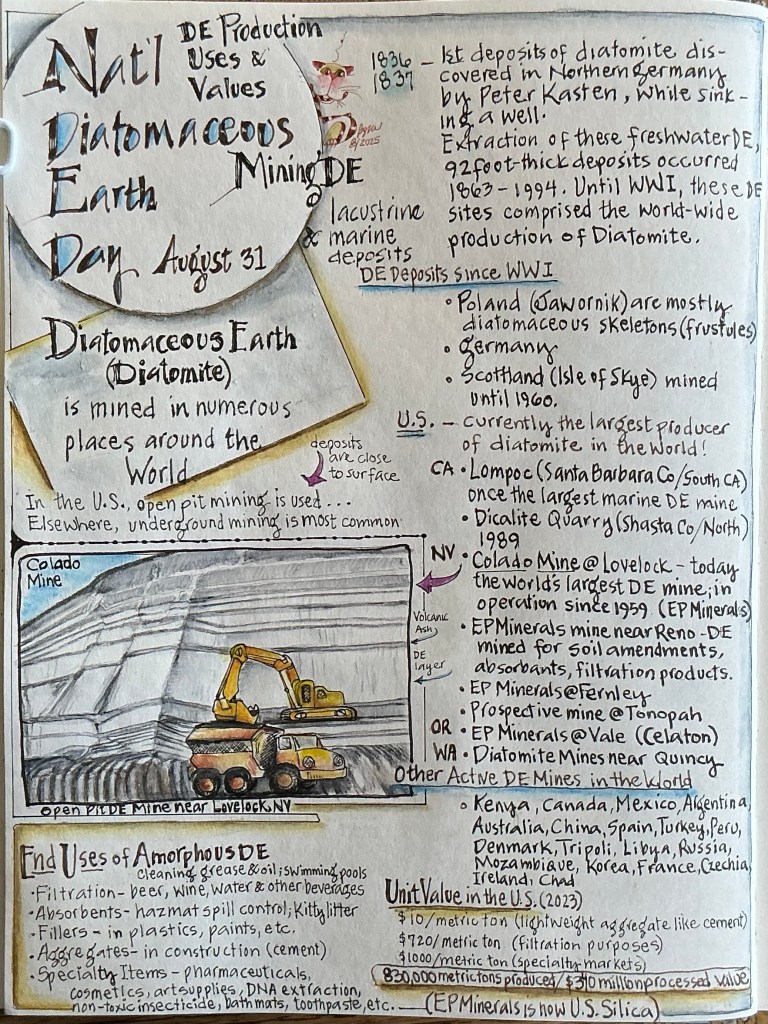
The year was 1836; the place, Northern Germany …… One day, a peasant named Peter Kasten was sinking a well when he encountered a mysterious-to-him layer of rock. Curious what this soft powdery rock might be, Pete took a sample to a friend who was a friend of a friend learned in the science of geology. This geologist carefully examined the rock then exclaimed (in German, of course), “Why this is the much prized and never-before-seen-in-Northern-Germany mineral known as Diatomaceous Earth! It has remarkably unique abilities to absorb, filtrate, polish, and stabilize!  These qualities make Diatomaceous Earth (aka Diatomite) valuable and much sought after by numerous industries!” 

Well, word spread and immediate exploration of the area commenced. It wasn’t long before numerous substantial deposits of lacustrine DE were discovered; some up to 92 feet thick!   Extraction began in 1863. Until WWI, these sites comprised the world-wide production of Diatomite. Mining these deposits ended in 1994, when all of the DE deposits had been extracted.  

But long before Pete’s discovery, Ancient Greeks used DE as an abrasive as well as a building material in lightweight bricks. Even in pre-historic times, DE was used in the ice-age cave paintings in France.

DE Deposits and Extraction – Worldwide

When diatoms die and fall to the bottom of marine and lacustrine waterbodies, they form large deposits. Over time, the organic portions of the diatoms weather away, leaving behind their hard silica shells. These remaining shells, called Frustules, with their opaline-like quality are what forms DE. Some of the largest deposits in the U.S. formed in ancient lakes that existed in California, Nevada, Oregon, and Washington. They also formed in oceans and occur along the coasts of North and South America.

Since WWI, exploration for and discovery of numerous DE deposits have occurred worldwide-wide, and are still on-going. Large mining companies have unearthed and continue to extract this mineral in substantial quantities, which is processed for use by industries that manufacture products for home and business (more on that below). DE deposits are (or have been) mined in many countries around the world, including the U.S., Mexico, Chile, Peru, France, Spain, Denmark, China, Canada, Argentina, Australia, Spain, Turkey, Libya, Russia, Mozambique, Ireland, and France. Today, the world’s largest DE mine, Colado Mine, is located just outside of Lovelock, NV, and has been in operation since 1959.

DE’s Modern Uses and Values

Today, DE is one of the most useful and durable substances known. The white to off-white powdery rock that makes up the more than 1 million year old DE deposits, is used in many common products likely encountered every day. One nearly universal use is in the filtration of liquids like the beer, wine and water. DE is also used to filter water in swimming pools, and to clean grease and oil. DE is used as an absorbent for hazmat spill control and in some kitty litters. As a filler in paint, it removes the sheen making flat paint flat; in plastics, it prevents blocking in plastic film. DE is used as an aggregate in construction, particularly in Portland Cement. And the list of specialty items that use DE for a variety of purposes is very long ….. including pharmaceuticals, cosmetics, art supplies, in the medical industry for DNA extraction, as a non-toxic insecticide, soil amendments, in bath mats for quick drying, in toothpaste as an abrasive, and as food additives to control moisture and extend shelf life. There are hundreds of other applications for DE with many more yet to be discovered!

But the biggest use of DE is in filtration. In 2023, the beverage industry paid $720/metric ton for processed food-grade DE (amount used to filter a keg of beer??). Compare that cost to $10/metric ton charged in 2023 for lightweight aggregates used in construction (wonder if or how tariffs impacted the 2025 cost?), or the $1000/metric ton charged for some specialty items. 

Ideas on How to Observe Diatomaceous Earth Day 

Discover more about DE, and learn about its common uses around your home or work. 

Read product labels to learn what you use on a daily basis that contains DE.

Consult the fda.gov website to learn more about labeling.

Visit a Diatomite mining operation.

Learn about unmined deposits near where you live.

Use a magnifying glass or microscope to inspect the contents of bag of insecticidal DE.

Stay tuned for NATIONAL DIATOMACEOUS EARTH DAY – Part 2 – Diatoms! They are ultra-fascinating! 

As always, thanks for stopping by!

1 Minerals are naturally occurring, inorganic solids with a definite chemical composition and internal structure, and are the main components of rocks.  DE (Diatomite) is a naturally occurring inorganic mineral that forms from the fossilized siliceous (silica-based) skeletons of diatoms, which are single-celled aquatic organisms. While the organisms themselves are organic, the hard, porous mineralized skeletons they produce are considered inorganic. 

Being an inorganic mineral, DE falls into the same category as minerals we’re all familiar with, such as Quartz, Feldspar, Mica, Pyrite, Hematite, Galena, Sulfur, Gold, and Copper. The chemical formula of DE is primarily SiO2 (silicon dioxide), with traces of other minerals.

National Find Your Inner Nerd Day 

You Might Be A Nerd If ………

August 23, 2025

Zentangle patterns: Flukes, laced, TunnelVizion, Furrballs, Paradox, Sppedwayxtra, Shattuck, 

Today’s the Day! Embrace your Inner Nerd, and set her free.

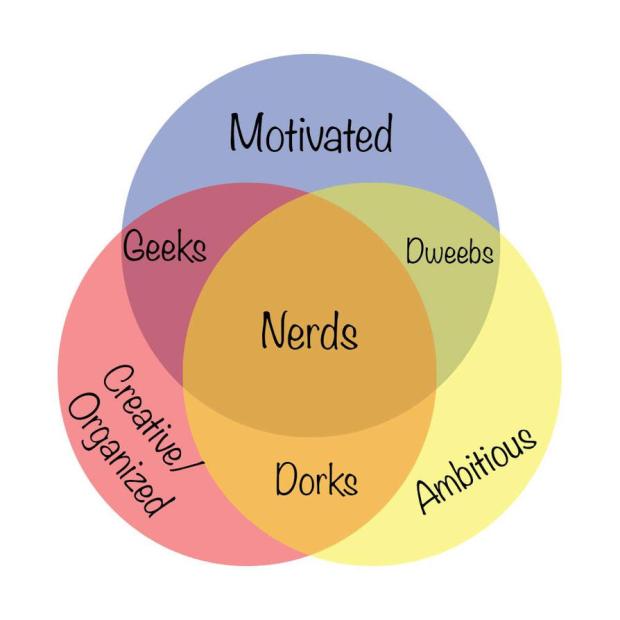
Back in the 1950s, the term “Nerd” was frequently heard to describe someone in a negative sense: “He’s not attractive;” “She’s awkward at socializing;” “What dorky glasses he’s wearing;” “She’s so shy.”  Before that time, “Geek” was the popular word in play. However, many of today’s Nerds and Geeks have proudly broken free of those decades-old definitions by tossing them aside and rewriting dictionaries.

Where do you fit?

While the terms “Nerd” and “Geek” are often used interchangeably, some dictionaries are splitters. You can find Nerds described as people typically associated with intellectual pursuits and academic achievement, often focusing on mastering skills and knowledge, where Geeks are known for their intense enthusiasm of specific hobbies or interests, particularly in areas like technology, science fiction, or gaming.

Not to nit-pick an officially-designated celebration, it appears National Find Your Inner Nerd Day has merged Nerd with Geek, matching a 2024 dictionary definition….. and I paraphrase: “Nerd” is someone who’s extremely enthusiastic and wise about a subject or something they’re passionate about, and who excitedly and obsessively talks about it while paying extraordinary attention to details. 

Are you an Inner Nerd? 

Deep down inside do you identify with parts or even all of those words and phrases that attempt to describe a Nerdy you? You do? Awesome!            Still not sure (or “On the Fence” and)/or not willing to admit to your Inner Nerdiness? Being someone who’s a self-identified Nerd, having recognized and accepted my quirkiness for decades, let me help! 

You might be an Inner Nerd if:

-you’re an academic, a book-worm, into classic movies, or a Trekkie;

-you knit holiday clothes every year for your dog, all your friend’s dogs, the neighbor’s dogs, and the humane society;

-you collect Pez dispensers, antique buttons, bars of soap, or banana labels;

-you collect Adventure Labs, GeoArt, EarthCaches, TravelBugs, and Geocoins;

-your house is full of stuffed toys from around the world; you ask friends to bring you a skein of yarn every time they travel somewhere new; the closet in your craft room holds more bolts of fabric than Hancock’s of Paducah, because you ‘never know;’

-you’re passionate about learning as much as you can about anything new and then sharing everything with everyone you meet;

-you’re obsessed about your daily creative practice in the fine arts (drawing, painting, music, song, dancing, acting), or creative writing (poetry, prose, essays, short stories), or in the culinary arts; 

-you have a rock from every state in the U.S., a pressed leaf from every deciduous tree in your county, a photo of front doors from all your neighbors’ homes, and neighboring neighbors’ homes;

-you’re obsessed about scrapbooking, making botanical inks, filling journal after journal with nature sketches, storytelling, song writing;

-your collection of art supplies rivals Jerry’s Artarama; your own more ukuleles than Jake Shimabukuro;

-and on and on and on! 

Being a Nerd is about embracing what you love and sharing all of your nerdy habits, collections, hobbies, and passions. Being a Nerd is about wanting to inspire others to embrace their inner nerdiness, too!  Isn’t it time to show the world how amazing your differences are? Isn’t it time to embrace your quirkiness and  share what you love?

And if you need more convincing, have no fear!  Nerds are some of the coolest people in the world, if not the world’s most creative and successful. They’re always up for learning new things and love to share what they have learned with others. National Find Your Inner Nerd Day gives permission for everyone to explore their inner nerd, because everyone has a little inner nerdiness inside ready to be set free! Nerds aren’t weird, Nerds are wonderfully unique!  So let’s celebrate our quirky nature and love ourselves for who we really are. 

Let’s Celebrate Our Inner Nerd 

  1. If you’re a collector of things, take the day to share your treasures with other people. Give them a glimpse inside your mind and share your enthusiasm about your collection. 
  2. Join a local club that offers similar interests to yours. Book clubs, art clubs, bird watching clubs, nature clubs, car clubs, astronomy clubs, cooking clubs , and stamp collecting clubs can always be found. The best way to meet people like you is to find people like you. 
  3. Attend a convention, such as Comicon, Star Trek, Anime, QuiltCon, National Narrow Gauge, and  Association of Speciality Cut Flowers, and see how fun and enthusiastic Nerds really are! Start by searching in your local area to find something that interests you. 

And lastly ……. Are you a self proclaimed Inner Nerd? Are you ready to finally submit to your Inner Nerdiness? What are you obsessed about; passionate about? Do you have an insatiable curiosity about one thing; lots of things? Are you a collector (of what); a dedicated and driven learner? Please share your uniqueness with family, friends, and me! Oh how I’d love to know!

I hope this post was fun! As always, thanks for dropping by!

P.S. I’ve been a self-proclaimed Inner Nerd for most of my life (and that’s a lot of years!). It’s been an ever changing, non-stop circular journey of obsessions and passions involving art, music, science and nature. Right now I’m passionate about nature journaling on a daily basis, and the joy of non-stop learning and sharing the limitless diversity of our natural world. Oh, and I’m crazy about my daily connections with art, Flambé, and storytelling through Zentangle.

National Sunflower Day

August 2, 2025

Zentangle patterns: Eeric, Dollpin, Alla, Citrus, Snowflower, Fancy Flower, Crizzy, Suru, KGI, Maryhill, Xplode, Lilyeyes, Odee, Sooflowers, Peaceout, Bulb Lantern, Arrowtree, Adobe

Sunflowers!🌻 Absolutely the happiest flower on Earth. Wouldn’t you agree?

Sunflowers, a symbol of adoration, loyalty, and longevity, represent happiness, friendship, and intelligence. Much like the sun, sunflowers reflect vibrancy and an energy of life. While National Sunflower Day is the official day to celebrate these beautiful flowers, why not declare the entire growing season reason a-plenty to radiate your inner sunshine and mirror the smiling faces of every sunflower encountered! 

Then and Now

Did you know sunflowers have been around since about 1000 BCE? In the U.S. indigenous peoples used sunflowers as a valuable food source, for oil, paint, and textiles, and during ceremonies. Some archaeologists even believe sunflowers may have been cultivated before corn. Today, sunflowers are still used for food (seeds, salad mixes) and beverages (tea), cooking oil, in beauty and skin care treatments, for medicinal purposes, and for hobbies and crafts.

Annual Sunflower over 6 feet tall!

The sunflower crop

The U.S. is a mass producer of sunflowers, particularly in the plains states, and is a major crop in both North Dakota and South Dakota. The average cultivated sunflower plant is five to six feet tall, and the central face of disc flowers can grow bigger than a human head. As the weight of the sunflower head becomes heavy, it begins to fall forward causing the petals to fall off. Shortly after the harvest begins. On average, one sunflower can produce up to 2,000 seeds per head. In 2022, North Dakota produced 762 billion pounds of sunflower seeds!

The Happiest and the most Intelligent flower

Have you ever noticed sunflowers track the sun, from sunrise to sunset? It’s true! Sunflowers follow the sun’s movements throughout the day. You may notice that before sunrise, a sunflower is in sort of a sleeping position with its head slightly down. As the sun comes over the horizon, the flower awakens and slowly lifts its face to ‘look’ directly at the rising sun. As the day progresses and we observe the sun moving from east to west, so too does the sunflower by turning its face in sync with the sun’s apparent movements until sunset.1  When the sun sets in the evening, sunflowers nod off to sleep, but not before untwisting themselves and slowly return to face the east. Ingenious!  

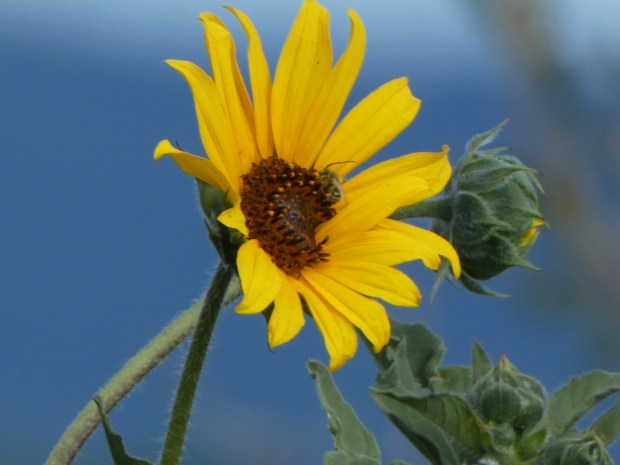
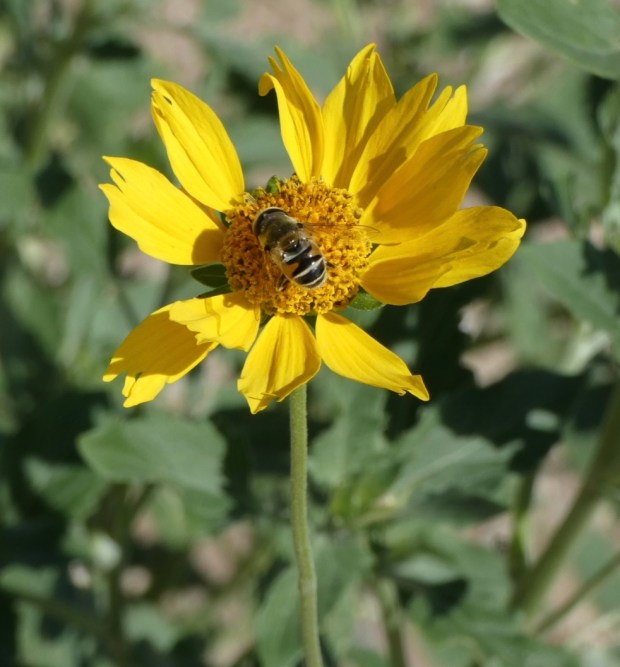
This charmer is called Cowpen Daisy

1 However, on very hot days, sunflowers tend to avoid looking directly at the sun to keep from overheating. And I’ve noticed on cloudy days, sunflowers may appear confused about the sun’s location, seeming to make their best guess on which way to face.

A season of yellows and oranges

Although you can find flowers in the Aster (sunflower) family in the Spring, August is the peak growing and blooming season for these cheerful plants. Brilliant displays of yellow flowers welcoming the morning sun can be found wherever sunflowers grow. Witnessing fields of sunflowers is guaranteed to lift your spirits as you oooooh and aaaaaaaah at their breathtaking beauty. 

A trio of cowpen daisies

Ideas to celebrate a day, week, month or year of sunflowers

  1. Spend a day with a wild sunflower and watch its face track the sun.
  2. Take a drive to view fields of sunflowers to see their true beauty in mass.
  3. Give a bouquet of sunflowers to a friend to brighten their day.
  4. Add sunflower petals and seeds to your salad.
  5. Create a painting of your favorite sunflower and frame it to enjoy year-round.
  6. Try your hand at a Zentangled sunflower bouquet ….. there are as many pattern possibilities as there are blooming sunflowers! 
  7. Plan a road trip to North Dakota in August and coordinate places to stop to visit sunflower fields and get updates from local farmers who cultivate sunflowers. 
A collection of cowpen daisies in my backyard.

If you missed celebrating this year’s National Sunflower Day, no worries! Every time you come across any sunflower, of any size, anywhere, pause and hold a personal celebration in honor of its splendiferous magnificence!

As always, thanks for stopping by!

Sunflower photos were taken in our backyard ….. all volunteers too!

It’s National Lollipop Day! 🍭

July 20, 2025

Zentangle patterns: Double 8, Wakka, Verve, Monkey Fist, Stikz, Windde, Thumbprinz, Vilbert, Bunny Buns, Watusee, Printemps, Binary, May Blossoms, Bunnyline

Lollipop Lollipop – oh-lolli-Lollipop! 🎶 

Today, Flambé was craving a generous dollop of whimsy and an extreme sugar rush to feed her ever insatiable sweet tooth. Today, she insisted on choosing the National celebratory day that would simultaneously satisfy both her exorbitant desires. Today, Kat took a calculated leap, gracefully “sticking” her landing on one of those oversized spirals of sweet colors-on-a-stick. Today, Flambé picked National Lollipop Day!

While Kat is frantically licking her paws to break free of that giant Lollipop, my task was to learn stuff about those ultra-sweet confections.

Pixabay photo

Lollipops have been around for how long? Apparently no one is really sure how old the ‘lollipop’ is, but it’s likely this treat on a stick has been around for centuries. There’s even speculation that during prehistoric times, a form of ‘lollipop’ may have preserved nuts and berries in honey. Then as sugar became commonplace, lollys “popped” up as a popular treat in 16th century Europe. In the 17th century, the English enjoyed boiled sugar candy treats on sticks, which made the candies easier to eat. And in the mid-19th century (1860s), confectionaries and medicine shops in the U.S sold ‘lollipops’ in various forms.

The Name Lollipop ….. may have been used for centuries.  A word sounding much like ‘lollipop’ was heard in Europe as early as the 4th century. Nomadic Roma people (also called Gypsies) migrating throughout Europe, had a tradition of selling candy apples on a stick. Red apple in the Romani language is loli phaba.  In the late 18th century (1796), English lexicographer1 Francis Grose recorded the term ‘lollipop’ that was likely derived by combining the words ‘lolly’ (which means tongue) and ‘pop’ (which means slap, describing the slapping or popping sound one made when sucking on hard candy). But it wasn’t until 1908, when Mr. George Smith, an American candy store owner and inventor from New Haven, Connecticut, developed a machine that could produce large quantities of hard candies mounted on sticks. Thinking about what to call those popular treats, he finally decided on Lollipop, the name of his favorite racehorse “Lolly Pops.”  Smith trademarked the lollipop name in 1931.

Pixabay photo

Today, the modern Lollipop comes in a variety of sizes, shapes, colors (usually brightly colored), and flavors (usually fruit flavored). Some have fillings, like bubblegum, soft candy (think Tootsie Pops), soft chocolate, jawbreakers, and fizzy candy. Some are even medicinal (where medicines for weight loss and cancer treatments are added to the candy).  And then there’s the novelty lollipops! Some contain unusual items like a mealworm larvae, scorpion, cricket, or ants, suspended in the clear-as-glass candy, so you can see the bugs while sucking on the lollipop! Some novelty lollipops have non-edible centers, like a flashing light, a small toy, or even a motorized device attached to the stick that makes the candy spin around in your mouth!

Pixabay photo

Lollipop Pop Culture – By now you’re probably humming one of Shirley Temple’s favorite tunes, “On the Good Ship Lollipop.” Maybe you’re thinking about “The Lollipop Guild” gleefully welcoming Dorothy to the Land of Oz. Did you ever (or maybe you still do) count the number of licks it takes to reach the center of a Tootsie Pop? I always questioned whether Kojak (you know, the TV series from the 70s) actually became more of a tough guy while sucking a lollipop. Hmmmmm?

Celebrate National Lollipop Day –  The phrase of the day must be Lollipop Fun! You’re never too old to enjoy a brightly-colored, spirally-twisted lollipop. Buy a bagful of Tootsie Pops or Dum-Dums and share them with your family, friends, and neighbors. Visit a local candy-making factory and watch how they make these sweet treats on a stick.  Try out one of the unique novelty lollipops, if you dare. Write a short story or a poem about lollipops and illustrate it in a kaleidoscope of colors. To me, lollipops remind me of riding a carousel pony, possibly named “Lolly Pops,” while at the carnival.

Pixabay photo

Now that Flambé has freed her paws from that giant spiral-shaped lollipop, she’s busy licking her way to the soft tuna center. That should keep her out of mischief for the rest of the day! Meanwhile, please let us know what your Lollipop Fun plans are for the day. Maybe share your favorite lollipop shape, color, and flavor guaranteed to put a big smile on your face!

Pixabay photo

As always, thanks for stopping by!

1 A lexicographer is a person who compiles dictionaries. You know …. of ‘Webster’s Dictionary’ fame, Noah Webster (October 16, 1758 – May 28, 1843) was an American lexicographer, textbook pioneer, English-language spelling reformer, political writer, editor, and author. He has been called the “Father of American Scholarship and Education”.

National Simplicity Day

July 12, 2025

Henry David Thoreau (July 12, 1817 – May 6, 1862), believed a life of simplicity could lead to greater happiness and a deeper connection with ourselves and the surrounding world. An American naturalist, essayist, author, poet and philosopher, Thoreau advocated a life free of unnecessary complexities; free of details. He declared “our life is frittered away by detail. Simplify, simplify!”

And Thoreau wasn’t just talking about material possessions. He also promoted reducing mental clutter, focusing on what truly matters, and living in harmony with nature. Thoreau so strongly advocated for Simplicity, he chose to live several years in a cabin he built in the woods at Walden Pond near Concord, Massachusetts. Writing about the experience in his well known book “Walden,”  was a reflection of his dedication to live simply and be self-sufficient while being surrounded by nature.

Thoreau’s famous quote, “Simplicity, Simplicity, Simplicity!”  sums up his philosophy perfectly.

Today is a celebration of Thoreau’s philosophical approach to a life well lived. 

Instead of spending hours drawing and coloring complex, ultra-detailed Zentangle art, I chose eight botanical patterns to recreate as stand-alone illustrations. Because of my insatiable need for details, this was challenging. But it was also very satisfying!

How might you choose to Simplify your life, if even for a day?

As always, thanks for stopping by!

Sketchbook Revival 2025 ….. Binge Fest Extravaganza!

June 16, 2025

What a whirlwind celebration! Sketchbook Revival (SR) 2025 Binge Fest was so much fun. And Wow! Two jam packed weeks of creativity was over in the blink of an eye! 

Karen Abend, SR creator, host extraordinaire, and wonderful artist, came up with a brilliant idea for the SR 2025 session. I would swear the creative gears inside her head were spinning with delight as she declared, “Yureka! I’ve got it!”

Beginning on May 27th thru June 9th, Karen generously opened up the SR historic vault and set free all of the workshops conducted the first 5 years of SR (2018-2022)! That unbelievable offering came to more than 130 one-hour-long workshops of inspiring, hands-on, and creative  play time all instructed by well-known experts in artistic fields associated with Sketchbook Journaling.  

Challenge presented ……. Challenge accepted.

Since I’ve been participating in SR each year since 2018, and attended most of these workshops in the past, my goals and strategies to tackle the challenge were these: 

  1. Complete a minimum of 4 workshops daily;
  2. Two workshops should involve a project outside of my comfort zone, such as portrait drawing, fantasy, word play, collage, and properly stitching my own SR sketchbook so it wouldn’t fall apart during the 2-week challenge, etc.;
  3. Two workshops should involve projects within my comfort zone, such nature subjects, urban sketching, whimsey, and lettering, and those using watercolor pencils, graphite, and ink;
  4. Develop fresh, interesting, and imaginative sketches during the workshops;
  5. Allow Flambé to play along;
  6. Slow down, breathe, and enjoy the 2-week marathon without becoming overwhelmed;
  7. Recognize and gather take-away tips and techniques to bring into my Nature Journaling practice and Zentangle storytelling. 
  8. Keep sketching and sharing.

After two weeks of play, I was able to fill up my handmade and successfully stitched SR 2025 sketchbook! With a total of 46 pages completed (doubling up workshop projects on a handful of pages), including several pockets with inserts, I was pretty happy (and a bit exhausted). 

If you’ve participated in SR in the past, or maybe took on the 2025 challenge as your first time, you know how intense (in an exhilarating way) it can become.   If not, and would like to learn more, check out this link 

This link will take you to Karen Abend’s website where you can ask for more information about Sketchbook Revival. https://karenabend.com

Hope my collection made you smile and laugh! I certainly got a kick out of the experience.

Well, until Sketchbook Revival next year, thanks for coming along!