It’s a wrap! EggTober 2025 – the Full Four Submissions- all in one place!
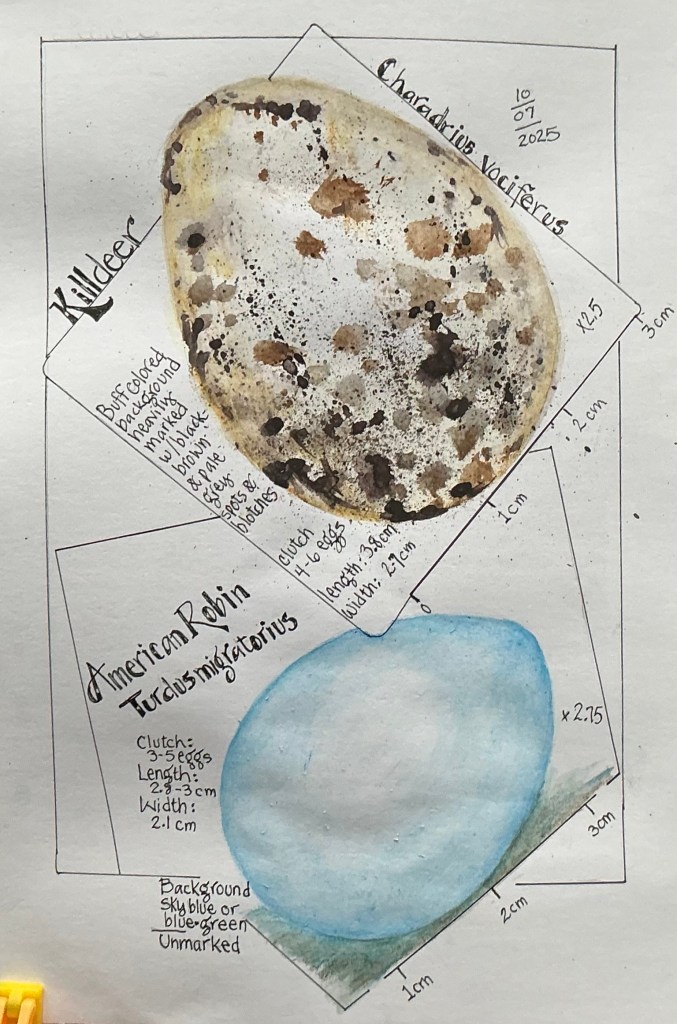
My 3 minute YouTube video (see link below) features all 32 annotated bird egg paintings submitted for Inktober2025, along with several bonuses you won’t want to miss!
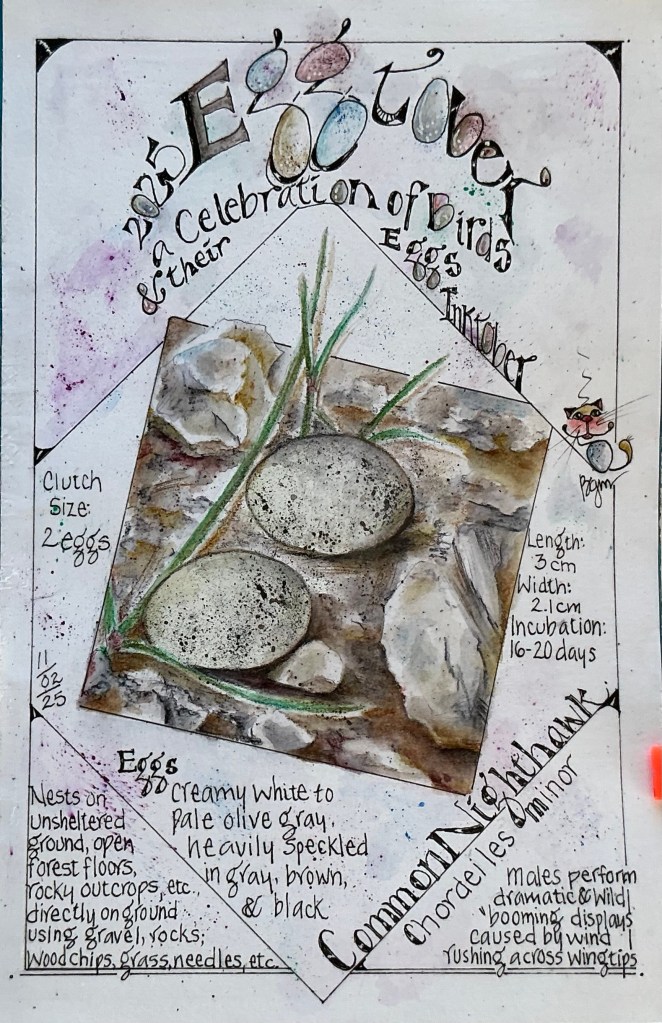
1) a pair of never-seen-before annotated Common Nighthawk eggs painted for the cover of my 6”x9” handmade journal ………
2) an index, by common name and date of appearance, of the 32 bird eggs painted and annotated between October 1 and November 1, 2025 ………
3) an accordion book attached to the inside back cover that has all the fascinating details about each of the 8 layers of an avian eggshell
YouTube Video Link
For some reason, I’m unable to embed my YouTube video directly into this post. This is rather inconvenient, huh! So until I can troubleshoot the player issue, I’d love for you to click on the link below to view the video on my YouTube channel!
Having participated in the Inktober for years by creating a daily drawing or painting throughout the month of October, I’ve found the challenge fun, rewarding, and motivating. However, rarely sticking to “ink only” creations and/or following the official prompts, I’ve shamelessly adopted a variety of approaches shared by others, have different media, or made up my own prompts. For me, this has added an elevated level of complexity that’s so appealing and somewhat wild!
In the past, my “Inktober” art has been about themes, like using a new Zentangle pattern a day that has a name beginning with “Q” or “Z” or “M” ……. or picking different botanical patterns. I’ve played with mixed media, watercolor, watercolor pencils, colored pencils, graphite, and (yes) ink to create a flower a day, rocks, mushrooms, candy, modes of transportation, the alphabet, fonts, portraits of famous people, etc. I’ve found the challenge is a great way to loosen up and try subjects I’m not comfortable or familiar with, while not worry about silly mistakes.
So, each year I look forward to Inktober, and this year was no exception.
This year I went way “out on a limb” and switched it up a bit.
This year I’ve named my personal 31-day challenge EggTober! And in keeping true with my love of nature, nature journaling and curiosity, each morning I’ll be randomly pick from a list of birds that nest in my home state of New Mexico and will draw one or several of of their eggs. 🥚
Here’s my progress so far and a few fascinating facts about bird eggs. At the end of my post, you can read about my process and materials used.
Did you know that two pigments are responsible for most eggshell colors: biliverdins, which make blue-green hues; and, protoporphyrins, which make the background hues of rusty yellows, reds and browns.
Eggshells that have markings like spots, blotches, speckles, or lines, have more protoporphyrins. These markings help camouflage eggs, especially those laid by ground-nesting birds.
The largest known bird egg belonged to the extinct elephant bird. This flightless bird, which stood about 10 feet (3 meters) tall and lived in Madagascar until the 18th century, laid eggs about 11 inches (28 centimeters) long. That’s about the size of an American football!
Bird eggs can be oval, to round, to pear-shaped, depending on the species of bird laying the eggs and where. Many sea birds nesting on cliffs tend to lay more pear-shaped eggs which helps keep them from rolling off steep ledges. It’s said that pushing one of those eggs, because it’s so heavy at one end, will cause it to spin in a circle.
Eggshells are largely made of calcium carbonate, and if hatched without their final ‘spray-paint’ of color, will look pure white to the human eye. But some white eggshells contain ultraviolet colors visible to birds. (Wonder why?)
Process and Materials
Of course, given that it’s Autumn, and impossible to find any active bird nests housing unhatched eggs, I’ve formulated Plan B. For my references I’ll be relying on digital natural history museum egg collections, on-line bird identification resources, fascinating facts about bird eggs, several key references from my personal library, and other sources, to learn and satisfy my long held love of birds, their incredible eggs, and the egg-laying process.
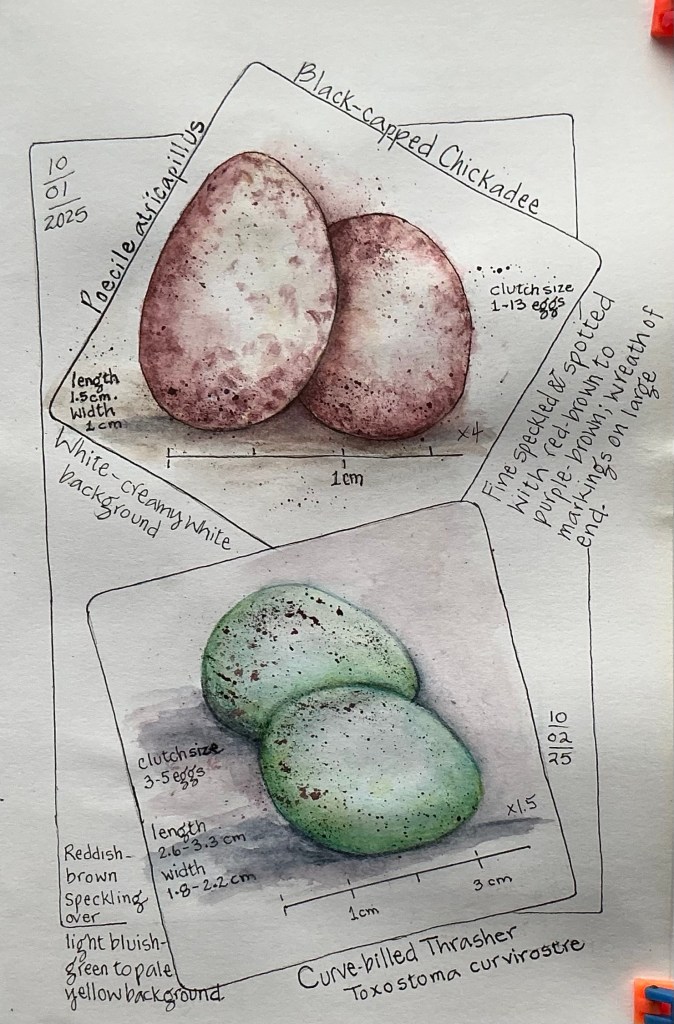
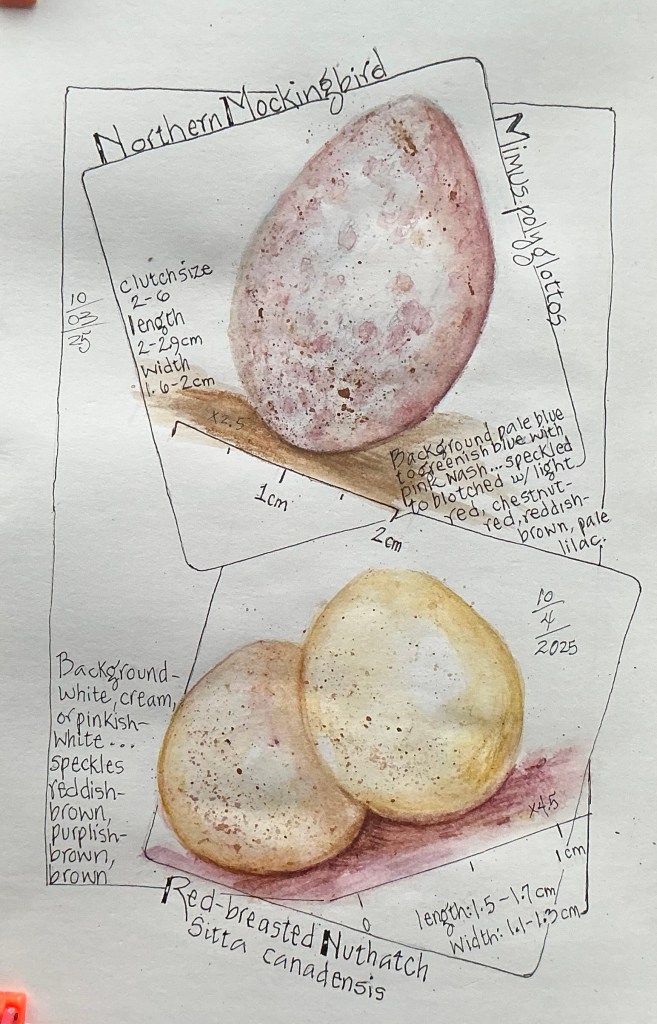
Staying as true to real life as possible, approximate egg shapes will be colored with Derwent Inktense watercolor pencils. For consistency, basic information specific to each individual bird species’ typical egg (clutch size, length and width, background (ground) color(s) and marking color(s) and patterns) will be included. For future reference, I’ve handmade a small booklet that will hold two species’ eggs/page. At the end of October, I’ll then add a title page, table of contents, and a list of references.
And finally, for now, it’s entirely possible that my process and materials may be changed on a whim! So stay tuned as EggTober unfurls!
If you are an Inktober participant, or have never heard of this month-long creative event, please let me know!

 a curious nature