House Finch – Page 14 .. The 100 Day Project (2026)

July 14, 2026

House Finch (Haemorhous mexicanus ssp. frontalis)

aka Common House Finch

More than likely you’ve seen the sparrow-sized House Finch if you live almost anywhere in the U.S., southern Canada, or Mexico. The males are particularly showy with their bright red heads, throats and breasts, and their bouncy flight is sure to catch your attention. Just filling a backyard bird feeder with black oil sunflower seeds can bring a flock of 50 House Finches in to feast. They tend to dominate their favorite feeders, often chasing off competitors, after which you’ll have plenty of time to observe these finches as they sit still while shelling seeds by rapidly biting and crushing them with their large beaks. 

If you aren’t familiar with House Finches, you’ve probably heard their long, twittering song, which they belt out in most neighborhoods from coast to coast. Their song, so full of excitement and energy, is usually sung from the top branch of a tall juniper or pinyon pine tree. House Finches seem to be pleading urgently for attention by clearly singing, “Talk to me PLEASE, isn’t anybody THERE!!” (At least that’s what I hear over and over again first thing every morning throughout the Spring and Summer!) 

Not knowing how many broods have been reared this year, to date, it seems like we’ve enjoyed a large number of family groups around the house. Fledglings are fun to watch in flight as they constantly chase adults to beg for food. These futile attempts for free handouts strengthens their wing muscles and hones their acrobatic skills. Usually defeated, these novice students soon land in a tree and begin a long, hard practice session to learn their parents’ complex song.  

Completely exhausted, they will return to a certain cholla and the nest where the adult female fed and defended them as nestlings during the first 12-20 days of their lives. Finding even one of their well-hidden nests in any of those 4 to 7 foot tall cactus “trees” is quite the prickly endeavor! Even knowing how to recognize a House Finch nest hasn’t prevented me from experiencing plentiful and painful spiny jabs. What an excellent defensive location our local birds choose for nesting.

The Nest and Nesting Habits

In as little as two days, the female builds a cup-shaped nest made of fine stems, leaves, rootlets, thin twigs, string, wool, and feathers, with similar, but finer materials for the lining. This sturdy nest, durable enough to raise up to six broods a season, measures 3-7 inches wide; the inside cup is 1-3 inches across and up to 2 inches deep.

House Finches usually build their nests in cavities in deciduous and coniferous trees, on cactus and rocky ledges, and in or on buildings using sites like vents, ledges, street lamps, ivy, and hanging planters. They will also claim nests abandoned by other birds.

A western House Finch is likely to build its nest within 60 feet of where it was the previous breeding season; eastern birds choose sites more than half a mile away from prior nests. Despite these differing habits, all nest sites have a few things in common: a sturdy base and a roof-like overhang to shelter against sun and rain.

House Finch Facts

  • With over 40 million House Finches across North America, they are currently one of the most widespread and common bird species across the United States, second only to the American goldfinch. 
  • Native to the Southwest U.S. and Mexico, in 1939 a few House Finches captured in Santa Barbara, California, were sold to a New York City pet store owner as “Hollywood Birds.” Even back then, the sale of these birds was recognized as illegal under the Migratory Bird Treaty Act of 1918. To avoid prosecution under the Act, the pet store owner released the finches …. they were set free on New York’s Long Island. By the early 1940s wild nests were discovered on Long Island, and from there the spread continued. 
  • Sometime before 1870, House Finches were introduced to Oahu from San Francisco. By 1901, they had become abundant on all the major Hawaiian Islands.
  • Where House Finches are an introduced species, they are considered naturalized 1. They’re also considered an invasive species in some places, largely in unforested lands across the eastern U.S. where they’ve displaced the native purple finch (and even the non-native house sparrow!).
  • In their native range in the Southwest U.S. and Mexico, House Finches live in desert, grassland, shrubland, and open woodland environments, as well as near human dwellings and cities. The biggest House Finch flocks in the East are found in cities, and it’s much more common to find the eastern birds in habitats developed by people than anywhere else. 
  • Depending on where they live, House Finches can appear very different. Within the 11 officially recognized subspecies, body size, beak size and shape, wing length, tail length, and coloring can all vary regionally. For example, the northeastern migratory populations have longer and more pointed wings better suited for longer flights than the western finches which tend to be permanent, year-round residents.  Also, House Finches on Guadalupe Island off the coast of Baja California, Mexico, have heftier beaks than mainland birds.
  • The bright red (and sometimes orange or yellow) plumage on the head, throat and chest of mature House Finch males comes from compounds in their food (bird species are unable to produce red or yellow other than by diet). These pigments, called carotenoids (the same ones found in carrots and tomatoes), come from the berries and other fruits they eat. Females prefer mates with the biggest and brightest red-colored patches — a sign of a well-fed male.
  • House Finches are among the strictest avian vegetarians: seeds, buds, fruit, and foliage comprise 97% of their year-round diet. Most seed-eating birds not only eat insects in the spring and summer when they are abundant, but will feed bugs to their nestlings to add protein for growth. Except for the occasional fly larva, House Finches stick to a vegetarian diet.
  • Dealing with a pandemic for decades, these birds suffer from “House Finch Eye Disease,” a form of conjunctivitis that was first detected in Washington D.C. in the winter of 1994. Since then, the bacterial illness has expanded continent-wide causing big declines in House Finch numbers. Infected birds often have swollen or reddened eyes and may appear inactive or confused. Over time, it leads to birds becoming blind, disoriented, and vulnerable to predators. Other finch species, such as the American Goldfinch, are also affected. Because the disease is spread through social contact, it’s very important to keep bird feeders and baths clean.
  • The mite, Pellonyssus reedi, is often found on House Finch nestlings, particularly later in the season. However, the adult female has a clever strategy in response to these often fatal attacks. Since male chicks are more vulnerable to a mite outbreak, she will lay eggs containing females first to reduce the length of time male chicks are exposed to mites. This strategy increases the likelihood that representative numbers of both sexes will survive.

…………………………………………………………………………………………………

Share stories of your local House Finches!

Hope you found this interesting!

As always, thanks for stopping by!

1  A species is considered “naturalized” if it didn’t originally evolve in an area but has successfully adapted, established a permanent population, and is reproducing independently in the wild. These species are non-native, surviving without human help. Note: not all naturalized species are considered invasive.

References
allaboutbirds.org

audubon.org

iNaturalist.org

Western Meadowlark – Page 8 .. The 100 Day Project (2026)

May 4, 2026

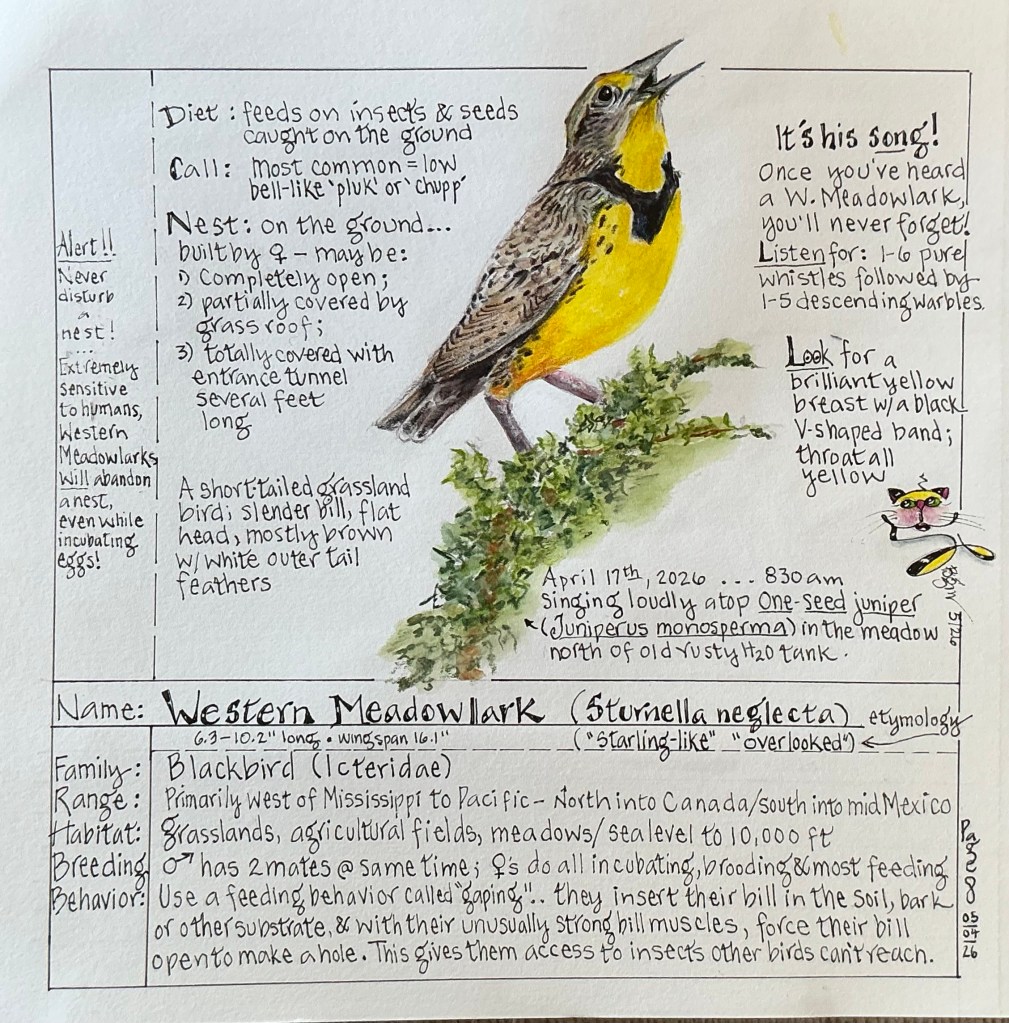
Western Meadowlark  (Sturnella neglecta)

When male meadowlarks return to the grassy meadow north of the old rusty water tank and begin singing, you know it’s Spring! 

There’s something wonderful about his song ……. At first he stutters a few practice notes; rough and rusty like the old water tank. But as daylight lengthens and temperatures warm, his song grows long, strong and melodic. Having perfected that signature song, he sings intently from sunrise to sunset, defending his territorial boundaries against all invaders. And he sings lovingly to announce his breeding readiness, enticing not just one, but two female meadowlarks to mate with him.

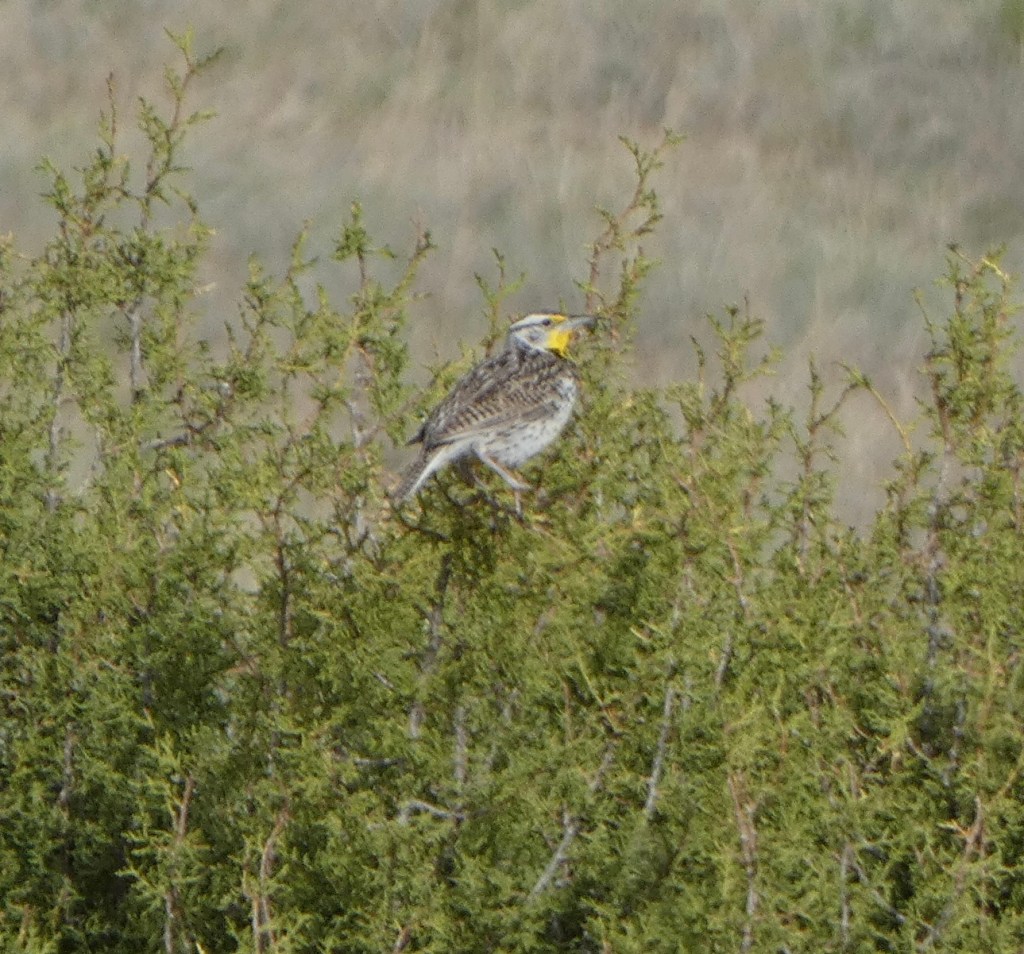
While walking the perimeter of the meadow in mid-April, it was easy to hear a male singing at the top of his lungs about 1/4 mile away. After a few moments scanning the tops of the widely scattered juniper trees with binoculars, I spotted him. (Males seem to favor these trees as perches, perhaps because they get a great view of their territory, and their voices really carry!) Able to get only 50 yards closer, I managed to take a few telephoto pics before he flew to the top of another juniper. Western meadowlarks are very skittish around people, so I held my ground and just watched and listened. It was a wonderful encounter.

Below are a few more fun facts about Western Meadowlarks, in addition to those on my illustrated page ….

If you’re lucky to see a Western Meadowlark, you’ll notice they’re a robin-sized bird but chunkier and with a shorter tail. Their flat head and long, slender bill are visible above a round-shouldered posture that nearly conceals its neck. They have short rounded wings, and a short, stiff, and spiky tail.

When flushed, Western Meadowlarks fly low, wings below the horizontal, gliding and flapping with short, stiff, quail-like wingbeats. 

Other than perching on tall trees, don’t be surprised to find males singing from atop fence posts, bushes, power lines, and anything higher than their surrounding habitat.

John James Audubon gave the Western Meadowlark its scientific name, Sturnella neglecta; Sturnella meaningstarling-like,” and neglecta because he felt most explorers (after Lewis and Clark) and settlers who traveled west of the Mississippi overlooked this common bird.

The oldest recorded Western Meadowlark was at least 6 years, 6 months old when it was found in Colorado in 1965.

…………………………………………………………………………………………………

When was the last time you went Birding? Meadowlarks are calling!

As always, thanks for stopping by!

References:   allaboutbirds.org and inaturalist.org

EggTober 2025/Submission One ….. The First 8 Days 

October 8, 2025

Having participated in the Inktober for years by creating a daily drawing or painting throughout the month of October, I’ve found the challenge fun, rewarding, and motivating. However, rarely sticking to “ink only” creations and/or following the official prompts, I’ve shamelessly adopted a variety of approaches shared by others, have different media, or made up my own prompts. For me, this has added an elevated level of complexity that’s so appealing and somewhat wild!

In the past, my “Inktober” art has been about themes, like using a new Zentangle pattern a day that has a name beginning with “Q” or “Z” or “M” ……. or picking different botanical patterns. I’ve played with mixed media, watercolor, watercolor pencils, colored pencils, graphite, and (yes) ink to create a flower a day, rocks, mushrooms, candy, modes of transportation, the alphabet, fonts, portraits of famous people, etc. I’ve found the challenge is a great way to loosen up and try subjects I’m not comfortable or familiar with, while not worry about silly mistakes. 

So, each year I look forward to Inktober, and this year was no exception. 

This year I went way “out on a limb” and switched it up a bit.

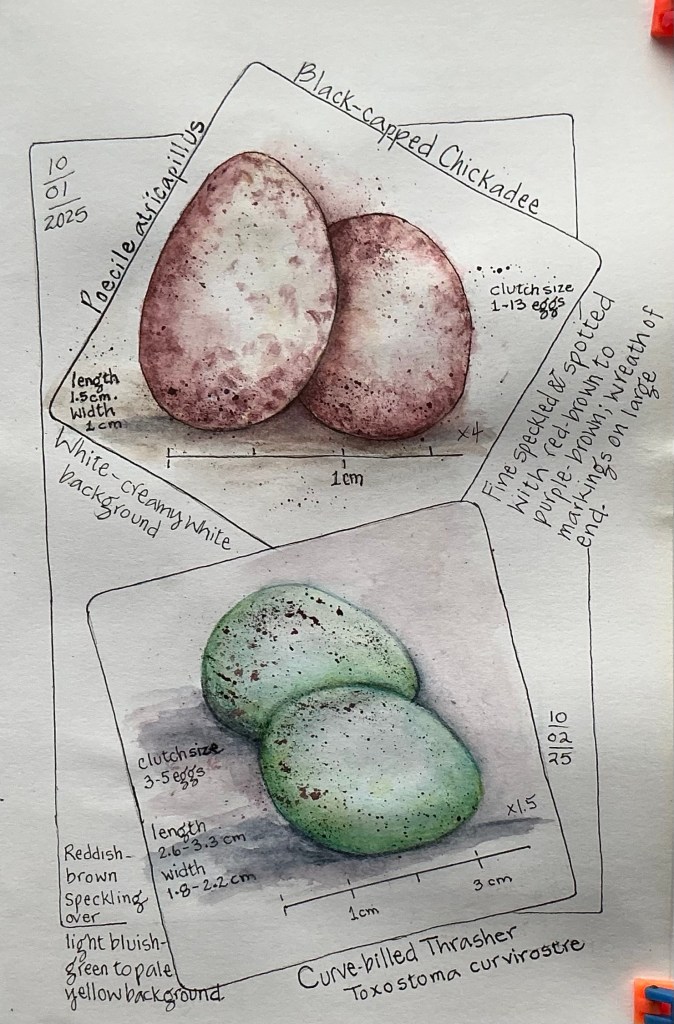
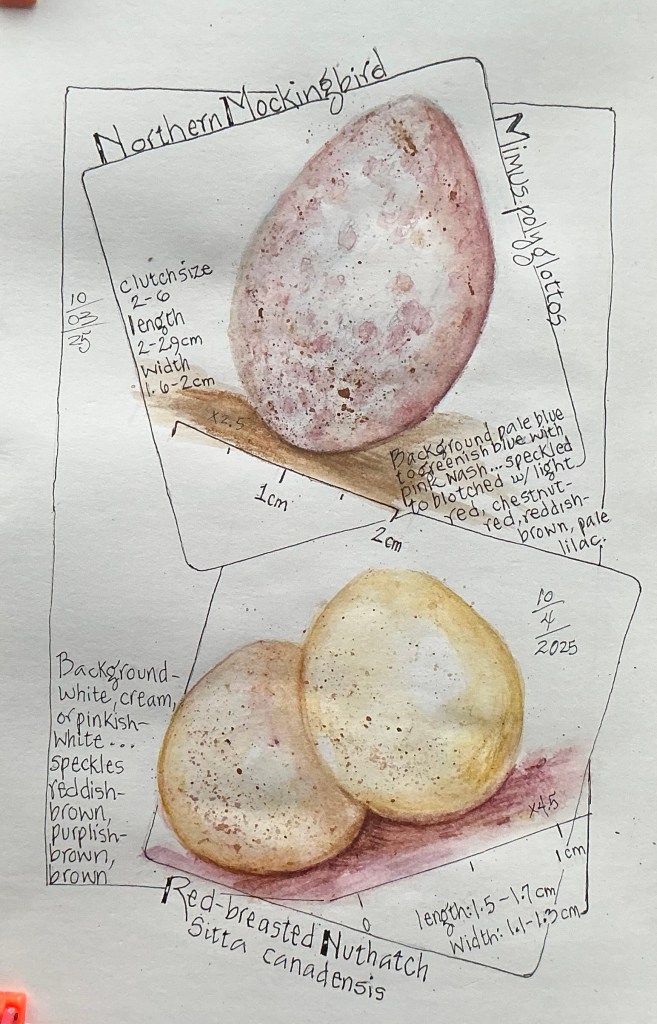
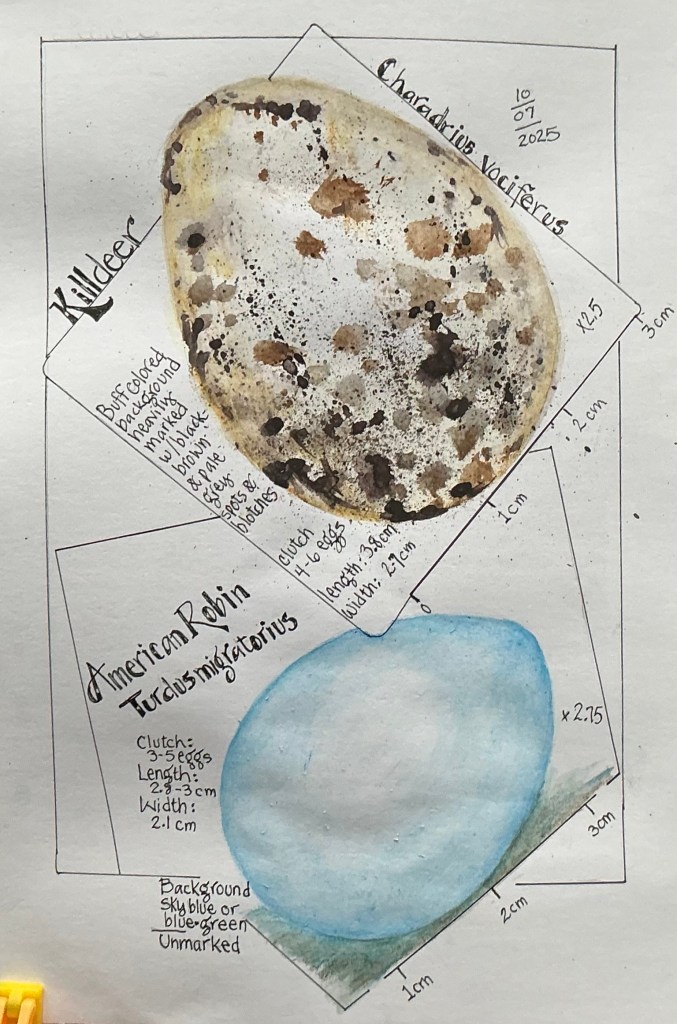
This year I’ve named my personal 31-day challenge EggTober! And in keeping true with my love of nature, nature journaling and curiosity, each morning I’ll be randomly pick from a list of birds that nest in my home state of New Mexico and will draw one or several of of their eggs. 🥚 

Here’s my progress so far and a few fascinating facts about bird eggs.  At the end of my post, you can read about my process and materials used.  

Did you know that two pigments are responsible for most eggshell colors: biliverdins, which make blue-green hues; and, protoporphyrins, which make the background hues of rusty yellows, reds and browns.  

Eggshells that have markings like spots, blotches, speckles, or lines, have more protoporphyrins. These markings help camouflage eggs, especially those laid by ground-nesting birds.

The largest known bird egg belonged to the extinct elephant bird. This flightless bird, which stood about 10 feet (3 meters) tall and lived in Madagascar until the 18th century, laid eggs about 11 inches (28 centimeters) long. That’s about the size of an American football!

Bird eggs can be oval, to round, to pear-shaped, depending on the species of bird laying the eggs and where. Many sea birds nesting on cliffs tend to lay more pear-shaped eggs which helps keep them from rolling off steep ledges. It’s said that pushing one of those eggs, because it’s so heavy at one end, will cause it to spin in a circle.

Eggshells are largely made of calcium carbonate, and if hatched without their final ‘spray-paint’ of color, will look pure white to the human eye.  But some white eggshells contain ultraviolet colors visible to birds. (Wonder why?)

Process and Materials

Of course, given that it’s Autumn, and impossible to find any active bird nests housing unhatched eggs, I’ve formulated Plan B. For my references I’ll be relying on digital natural history museum egg collections, on-line bird identification resources, fascinating facts about bird eggs, several key references from my personal library, and other sources, to learn and satisfy my long held love of birds, their incredible eggs, and the egg-laying process. 

Staying as true to real life as possible, approximate egg shapes will be colored with Derwent Inktense watercolor pencils. For consistency, basic information specific to each individual bird species’ typical egg (clutch size, length and width, background (ground) color(s) and marking color(s) and patterns) will be included. For future reference, I’ve handmade a small booklet that will hold two species’ eggs/page. At the end of October, I’ll then add a title page, table of contents, and a list of references.  

And finally, for now, it’s entirely possible that my process and materials may be changed on a whim! So stay tuned as EggTober unfurls!

If you are an Inktober participant, or have never heard of this month-long creative event, please let me know!

As always, thanks for stopping by!

Winter Birding on Sedillo Hill: January 2023


East Mountains, Tijeras, New Mexico elevation 7,300 ft

February 15, 2023

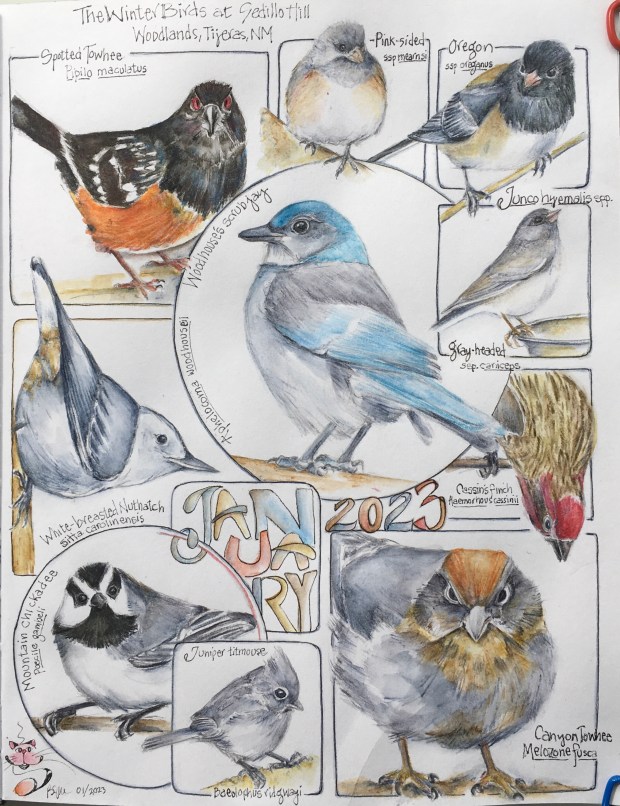
The design for today’s post was inspired by sketchbook artist Fay. I came across her blog (see link below) while searching for nature journalers who are active in creating art and who also share some unique approaches to page layout and composition.  “Littles” is the name Fay has given to one of her unique approaches.  This is where she lays out several pages full of empty boxes with the goal to fill up a box a day for an entire month.  Not only does this encourage a daily drawing and painting practice, but it’s her way of creating a record of what she’s observed for an entire month.  “Littles” reminds me of a hyper-compressed perpetual journal.

After seeing Fay’s blog post with all her miniature drawings and paintings, I knew this would be fun to try, and I had to learn more.  So we chatted and Fay encouraged me to give “Littles” a go.  And I did …… with a “little” twist!  I’ve been thinking of ways to keep a visual record of the birds visiting our feeders during the winter.  And I needed an approach with minimal fuss, without feeling each bird needed a detailed description. Ta da! 

So here’s my “Littles” page of the bird species that visit our feeders in January.  I kept my sketches to less than 5 minutes each; my watercolor pencil paintings took about 10 minutes each. My sketches were done using my own reference photos, and relied heavily on my many hours of observing these species’ poses and behaviors.

Let me know what you think! I just may create a “Littles” page for our February birds. Maybe by March, when all of our snow has melted, hints of new spring growth may appear in a few “Littles” boxes as well!

Oh and …… Follow Fay!  Her blog “Made By Fay” can be found at the link below.  If you enjoy my posts, I will guarantee you’ll love what Fay does.  She is an extraordinary visual storyteller, and enjoys drawing what she sees from her home state of Washington and on her travels about. 

https://madebyfay.wordpress.com