A Honey of a Prize!

Meet the Honeydew Gall-Wasp Gall

April 4, 2025

It’s Spring

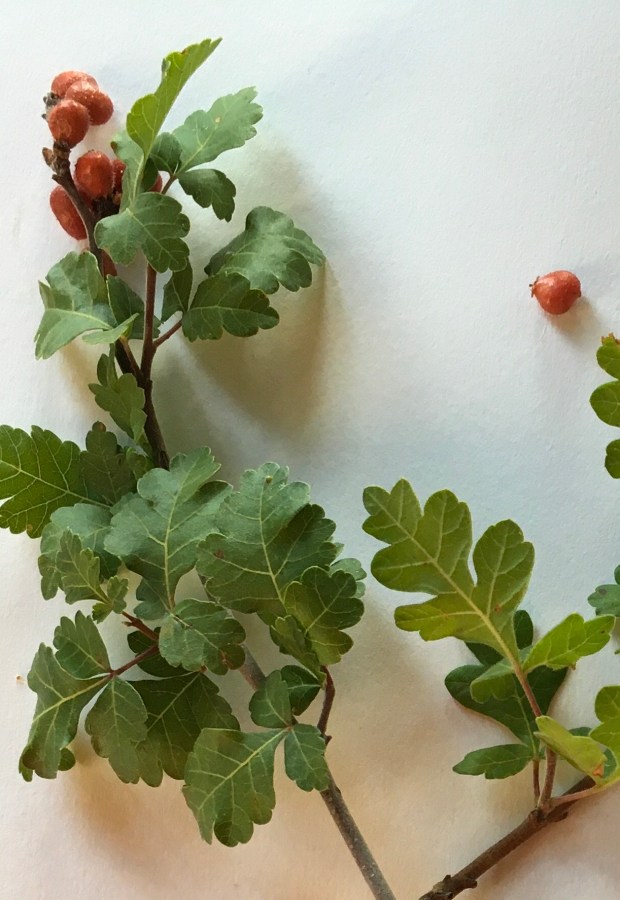
When the urge to nature journal is too hard to resist, but everything around you is still brown, crispy and covered in dust, I begin looking for any curious phenomena suitable for rabbit trailing (even rabbit tracks work!). The other day while hiking a steep hill, I was looking for sign the oaks were close to breaking bud. Spotting a string of little dark red beady objects lining many of the mostly leafless stems of am oak was certainly encouraging. From a distance they appeared to be swelling leaf buds; at least their color seemed right. But an up-close inspection revealed my hopeful find as last December’s vacated “homes” occupied by oak gall wasp larvae. Having never seen this species of stem gall before, naturally this would be a perfect most curious phenomenon to tackle. And that’s just what I did!

The Honeydew Gall-Wasp Gall

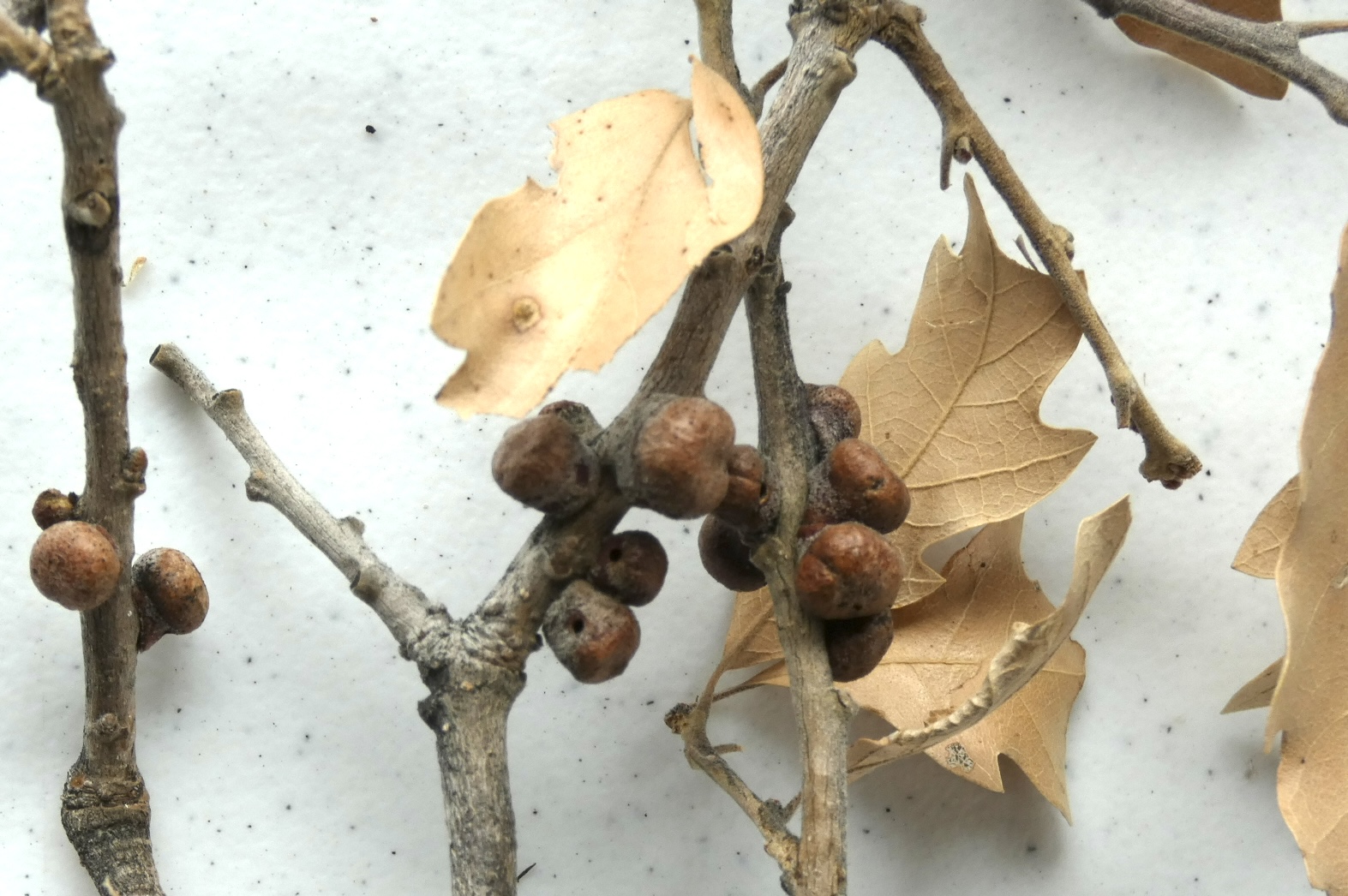
Arriving back home with a small collection of oak stems crowded with tightly packed galls (resembling miniature bread loaves), my work began. Assuming the host oak was a Gambel’s (Quercus gambelii), I began my search of stems galls on that species. Carefully scouring the literature the genus appeared to be Disholcaspis, but none of the species seemed a good match. So after many days in quandary, I consulted my favorite oak gall ID specialist, firing off a lot of questions, written descriptions and photos. Patiently awaiting his reply, I continued to find more resources to review. Gall wasps have a complex life cycle, and their galls are a challenge to identify. 

After 2 weeks a welcome reply arrived from the specialist.  Boy did I feel silly, knowing I should’ve known better! The oak host was not a Gambel’s but a cross between Gambel’s and Shrub Live Oak (Q. turbinella) which produces a hybrid called Wavyleaf oak (Quercus x undulata). Correcting my mistake was key to identifying the stem gall! Picky little wasps, huh? Happy the specialist agreed the genus is Disholcaspis, the obvious species responsible for the gall was turned out to be D. spissa; the Honeydew Gall-Wasp ….. making my discovery the Honeydew Gall-Wasp Gall!
Lesson Relearned  

When nature journaling, despite how excited you may be to find answers, it’s always, always best to slow down, breathe, carefully observe, ponder, question, make connections, and enjoy the journey ahead of the destination! 

Some Gall Descriptions and A Prize!

Outside appearance: Young galls of this wasp are yellowish and hairy. Mature galls have beige-brown to weathered grey sides, are black on top, and have a dull matte surface. They can have a round to ovoid to a rectangular ‘bread-loaf’ like shape. Texture appears mealy-granular. Galls sit snugly directly on the stems (sessile), and singly or in clusters of long compact chains that form all around the stems of host oak species. 

Inside the gall and back outside again: Each gall has one thin walled cell or chamber (known as monothalamous) that sits above the bottom of the gall. This is the larval chamber and is imbedded in dense cellular tissue that becomes a pulpy flesh with age. While the larvae are actively feeding and growing, they produce a copious amount of sticky-sweet honeydew that accumulates on the top of the gall. All of this honeydew attracts hordes of hungry ants and yellowjackets. The ecological importance of these secretions is unmistakeable; it provides a high energy food source for the insects. And while the ants and yellowjackets feed, they inadvertently protect the gall, like little bodyguards, from parasites and predators intent on infecting or eating the growing larvae inside. And another interesting ecological thing ….. the reason the tops of the galls are black and not the same color as their sides, has to do with a fungus called black sooty mold. The sugary secretions produced by the larvae accumulate in quantities too irresistible to the sooty mold. Colonies of the fungus develop rapidly on the honeydew giving the gall tops a dusty or powdery black color. So honeydew is the perfect medium for black sooty mold to complete its life cycle.

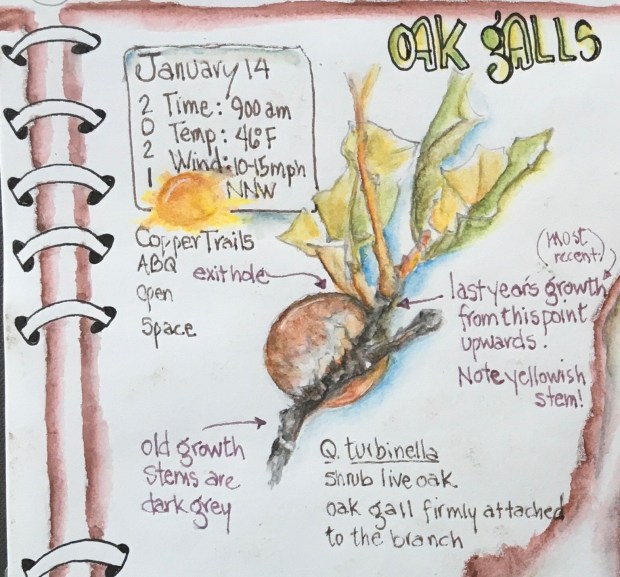
What about that Prize? Read on to learn more! Close-up inspection of the galls I collected, and there were about 25, revealed all but one had a single exit hole in a side just below its crusty red-black top. I learned the adult wasps emerge from these stem galls by late December; sometimes waiting for warmish temps until mid January. What happened to the adult wasps in the one gall without an exit hole? Because the gall had a sooty top, implying the larvae had been eating, growing and secreting honeydew, maybe the larvae died at some point or failed to develop into an adult? Had to know! Cutting the gall to find out wasn’t easy. The outer crust fell away first, then using steady knife pressure on the punky innards, the gall popped open, like a box of ‘Cracker Jacks!’ And there, near the bottom of the package, was a single sealed chamber. Carefully I was able to tease out the contents with fine pointed tweezers until out blurped the Prize! An intact cream colored gooey looking larvae, followed by a small puddle of viscous liquid. Even though the larvae filled up most of the chamber, there wasn’t any sign it was alive. And after an hour, when there still wasn’t any movement …. well, darn, I felt he must’ve died sometime before morphing into adult form. But peeking inside the gall did answer the question about the absence of an exterior exit hole.

And now an interesting note about these types of cynipid oak gall wasps: On my diagram, I used the term ‘agamic’ which is a formal label included with the genus/species name (i.e. Disholcaspis spissa ‘agamic’). This means these wasps have an asexual all female population that emerges from galls in late fall/early winter to lay fertilized eggs without needing to mate with males. Then a bisexual generation follows where adults emerge from galls in late winter/spring/early summer. This is the typical 2 generation annual life cycle of cynipid gall wasps, where the galls developed from each generation usually look very different and even occur on different parts of the host plant (on stems vs leaves). It’s interesting that nothing is known about the bisexual generation of D. spissa, but the asexual generation is common, well documented and abundant.

Known host oak species for D. spissa: Look for these galls on Shrub live oak (Quercus turbinella), Wavyleaf oak (Quercus x undulata), Mexican blue oak (Q. oblongifolia), Arizona white oak (Q. arizonica), and Shinnery oak (Q. havardi). 

******************************************************************************************

Hope you found my post interesting. Have you ever been curious enough about plant galls to look inside? Recalling the first time I saw a gall, I had no clue what it was and why it was precariously clinging to a plant leaf. It was round and hard, and reminded me of a tiny rusty red ping-pong ball. Was there something inside? Would it be squishy, alive, have teeth and bite, or perhaps whatever it was was dead and oh so smelly? Maybe it was some weird kind of flower bud, or a fruit lost under the leaf? Despite being a bit nervous, I needed to know what, if anything was inside. So I cut it in half, and in the center of the ball, suspended on hundreds of delicate threads, was a tiny, wormy creature twisting and turning and wriggling to music only it could hear! That was over 45 years ago, and to this day I still find galls irresistible!

As always, thanks for stopping by!

A Few References

Russo, Ronald A.: (2021) Plant Galls of the Western United States, section on tree galls; oak galls of the SW, page 173. 

Weld, LH: (1957) New American Cynipid Wasps From Oak Galls https://www.gallformers.org/gall/948

Nature’s Colorful Fall Patchwork ….. The Beauty of Gambel Oak Leaves

November 12, 2024

It’s late October, mid-Fall in the Manzano Mountains, perhaps a week before the first snow of the season. The Gambel Oak covering hillsides and mountains somehow sense a change in the air.  Seemingly overnight every leaf on every oak shrub and tree magically transformed from their summer greens to royal rusty reds, gleaming golden yellows, and shocking sunset oranges. As I look across the landscape and marvel at the sight, I can’t help wondering, “How do they know?”

The spectacle is short lived. Over the next few weeks, these gorgeously painted leaves slowly change to crispy beige brown, fooling the observer into believing they can’t face another winter; that every single oak shrub and tree just gave up and died! Thinking that was the case my first winter in central New Mexico, I was fooled. But since then I’ve learned a lot about the life cycle of Gambel Oak, and have come to appreciate the persistence of all those crispy browns covering up the otherwise barren nakedness of chaotically jumbled branches. 

There’s a lot that can be said about Gambel Oak (Quercus gambelii), but this post focuses on

The Leaves of Quercus gambelii 

The most interesting thing about this oak species’ leaves is no two are alike. Even though each leaf looks different from its neighbor, they do all have common characteristics that distinguish its leaves from other oak species. For example, All Gambel Oak Leaves …….

  • are lobed (but the number of lobes varies from side-to-side of a leaf’s mid-vein; depth of lobes varies on a single leaf and between leaves; lobes can be gently concave to acutely angled).
  • are flat and leaf margins are smooth (if leaves appear somewhat wavy and/or exhibit some serrated margins and/or points on the lobe tips, this is not a true Q. gambelii, but likely a hybrid of Gambel Oak and Shrub Live Oak (Q. turbinella) resulting in Wavyleaf Oak (Q. undulata), very common where ranges converge). 
  • are different lengths and widths, and leaf sizes are random along each branch, with large leaves adjacent to small ones adjacent to tiny ones adjacent to gigantic ones, etc.
  • change color in the Fall, eventually becoming beige brown and crispy (but color patterns on individual leaves and throughout a shrub/tree are wildly various; some leaves turn one color, while others become a mixture of greens, reds, yellows and/or oranges).
  • that are brown/crispy persist on the shrubs/trees throughout late Fall and Winter, then drop all at the same time in Spring when buds begin to open.
  • that are fresh have little 5-star hairs on the undersides, while the upper surface is smooth and leathery.
  • are relatively free of insect damage, with the exception of the occasional oak gall or insect nibbles (perhaps due to their leathery texture on the upper surface and hairy texture on the undersides?).

Every Fall I observe and collect Gambel Oak leaves. They make great subjects for my nature journal! Because every leaf looks different, the easiest way to depict the various shapes is to trace their outlines directly onto my journal pages. Then with leaves in hand, I can use my Inktense watercolor pencils to paint within the outlines, spending most of my effort on their beautiful colors.

I hope you’ve enjoyed my page of Gambel Oak leaves. Do you share nature with oaks? If so, which species, and are their leaves all the same or different somehow? Do you record your observations in a nature journal too? I’d love to know!

As always, thanks for stopping by!

The Gall! A Curiosity of Oak Galls, Revisited …… Part III

August 27, 2024

Webster’s had it “right on” when describing the Ubiquitous Plant Gall!

gall /ga:l/  1. something irritating; rude. 2. not able to understand a behavior is unacceptable.

—-the boldness of these guys; the sheer gall and effrontery; the chutzpah; the unmitigated gall; What gall!

“Yeah ….. What Gall is This?!”  

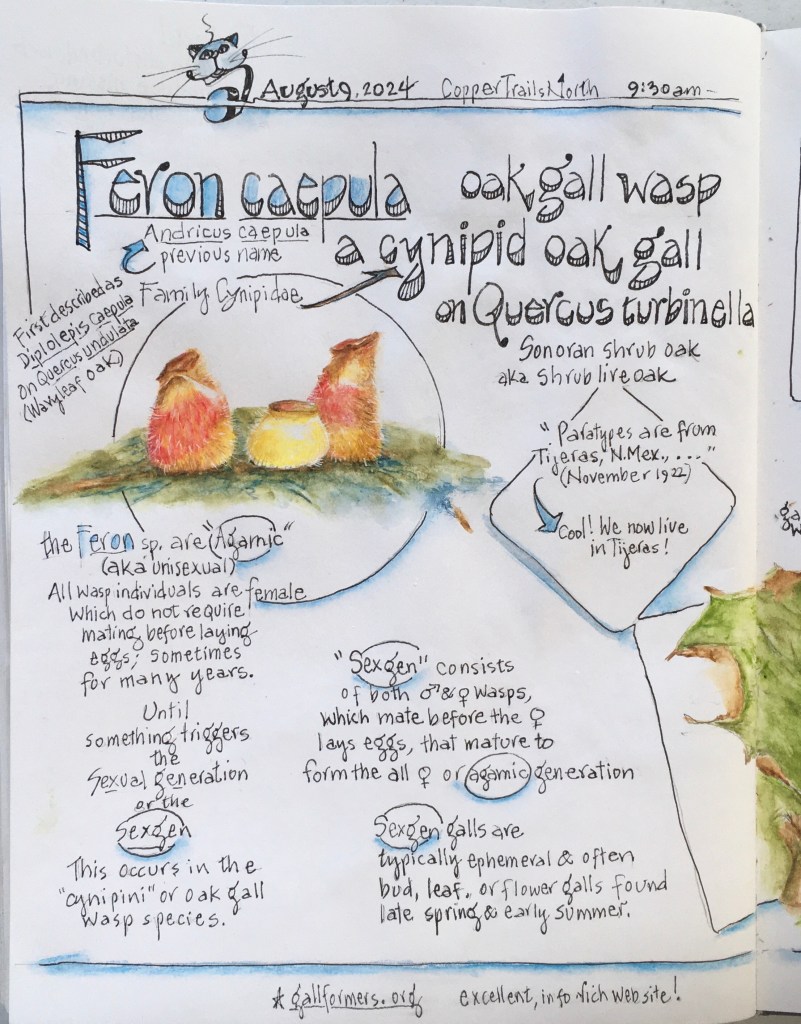
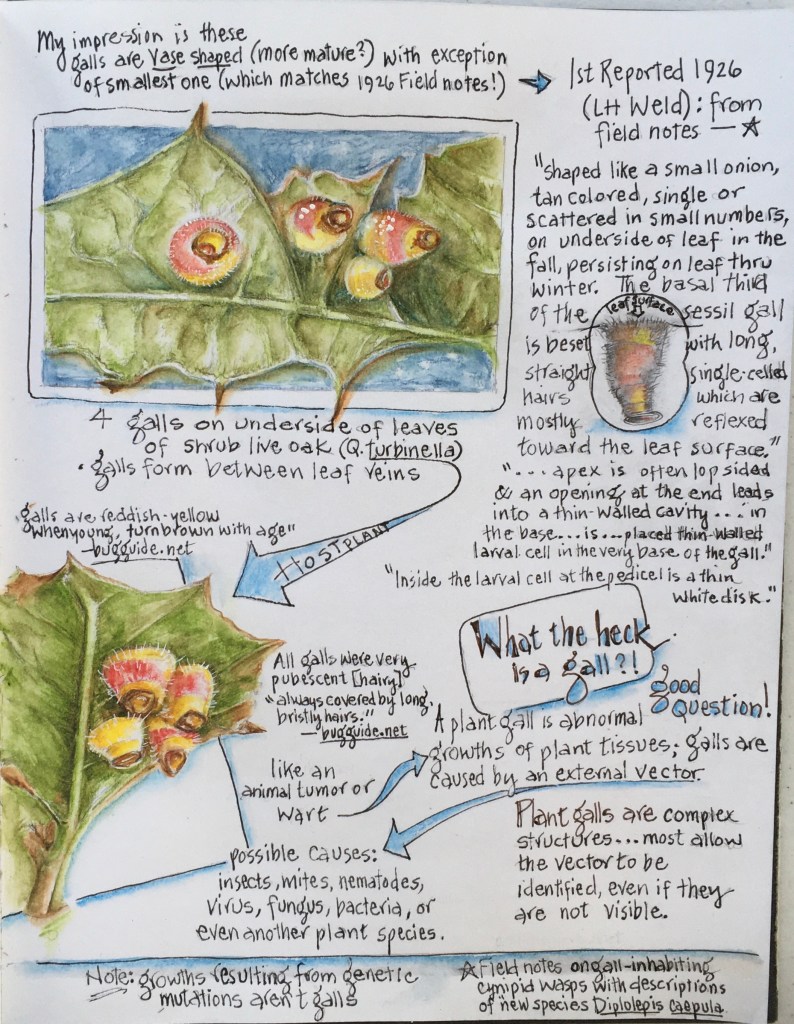
That was the question uppermost on my mind when a slight breeze wafting down the trail lifted a fresh oak leaf revealing four slightly wonky vase-shaped growths. One was squatty and pale;  three were colored with alternating bands of cadmium yellow and deep vermillion. All four galls were attached to the underside of the leaf, hanging upside down, so whatever might’ve been inside is out.

After 5 minutes of inspection ….. poking and prodding, and peering inside the tiny vases ….. I took some photos to post on iNaturalist to figure out this little mystery. It didn’t take long before my discovery was identified! These are galls of the parasitic cynipid wasp called Feron caepula, formed this Spring on a new leaf of Shrub Live Oak (Quercus turbinella).

Originally identified in a 1926 field report as a new species, Diplolepis undulata, this species’ name was reestablished as Feron caepula in a report published in 2023. Ordinarily I choose to only cite a field report, but decided to make an exception in this case for several reasons…… the description of this new species was helpful in better understanding my specimens, and……. one of the paratypes used to describe the new species came from Tijeras, NM (which happens to be my home!). So the entire 1926 field report* (surprisingly short) by LH Weld is added below.


Supplement to the Nature Journal Pages

A Curiosity of Oak Galls, Revisited …… Part III

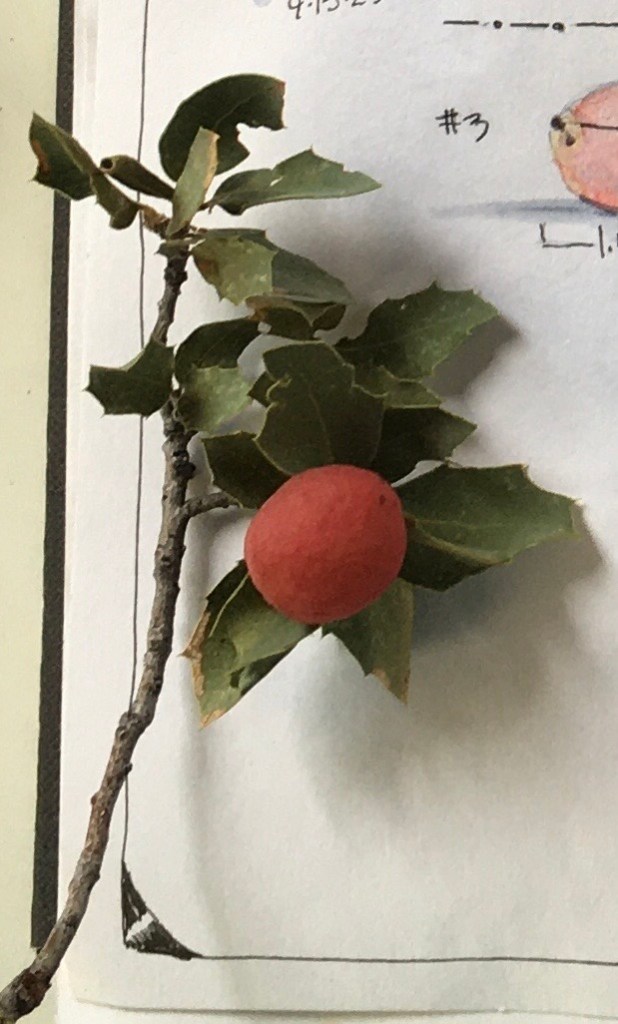
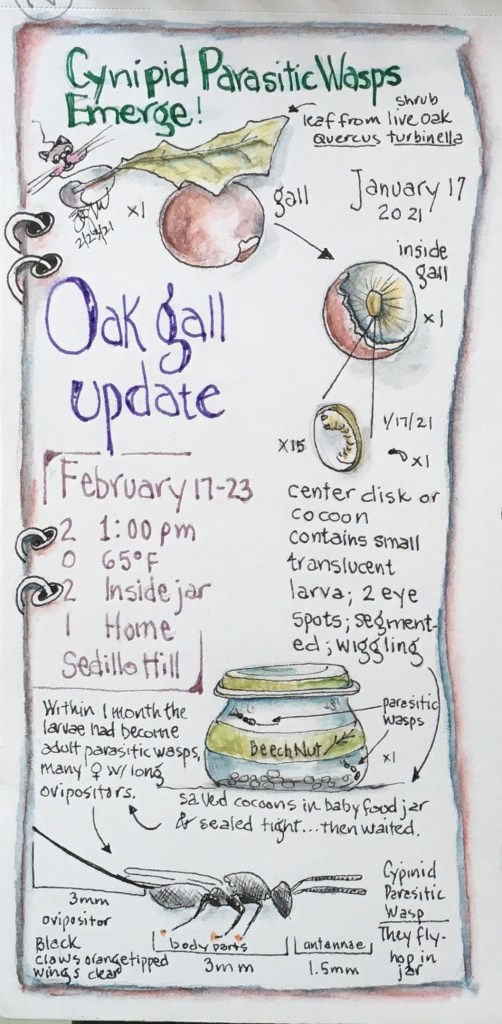
Curious about plant galls for decades, I finally began reading and experimenting to learn a bit about the inner world of oak galls. Throughout the winter of 2020-2021, I enlisted Roy’s help to collect about 100 nickel diameter, reddish-brown galls hanging on oak leaves like holiday decorations.  Not knowing what to expect, I cut into a bunch of these galls and found tiny squirming grubs (larvae) – one/gall.  The grubs seemed to be suspended by a complex network of stringy plant tissue radiating from each larva at the center to the inner gall shell. It reminded me of a snow globe frozen in time!  Of course I had to know what these guys would become. So I placed about half of the galls into glass jars, and the other half went into jars without their protective gall home. In a few weeks the jars were full of the smallest wasps ever! Wasps! Little parasitic cynipid gall wasps active and ready to be released back into the wild to do what these wasps do! (Rest assured, they were releases in the same area where the galls were collected.)

A few years later, I was once again smitten by these tiny wasps and their galls, and learned more about their life cycle and other facts about galls in general.  You can read all about my earlier experiences (and my efforts with experiments) in 2021 and 2023 at this post “No Small Galls this Fall! Oak galls, then and now, the sequel”.

Back to the Present

Here it is 2024, and while hiking the Albuquerque foothills, a new (to me) and colorful gall form appeared hanging beneath an oak leaf. My curiosity piqued. It was high time I gained some insight about the life cycle of cynipid gall wasps. Paraphrasing numerous expert sources, my attempt to interpret and understand what has been described the one of the most complicated life cycles known in the animal kingdom, still seems confusing. Maybe it’s been hard to wrap my mind around Parthenogenesis (asexual reproduction)***….. a key component of a cynipid gall wasp’s life cycle. By taking my time (over a month), and after many written and diagrammatic iterations, I stitched together a description that works.  If you’re curious, read on!

One of the oak galls collected late 2020 …. On Shrub Live Oak (aka Sonoran Live Oak)

Where do Oak Galls Come From, and Why?

Every year in late-Spring and through early Summer our shrub live oaks (Quercus turbinella) are a-buzz with a cloud of nearly microscopic cynipid gall wasps that have emerged from a hundreds and hundreds of leaf galls. These often weird looking abnormalities begin forming during an oaks’ accelerated growth period in the Spring. “But where do galls come from and why?”

It’s Complicated!

In the case of cynipid gall wasps, the majority of more than 1400 known species* parasitize oaks, while a much smaller number favor rose and chestnut as host plants. Where and how a gall forms on a host plant, along with the gall’s size, shape and coloring is vector-specific. This gall uniqueness makes it possible to identify what species of insect, such as a cynipid gall wasp (or other external vector like a mite or virus or nematode or fungus or virus or bacteria) was responsible for each gall.

The life cycle of cynipid gall wasps alternate between asexual and sexual generations. This process, called Cyclical Parthenogenesis, is both fascinating and baffling. Typically, the gall formed by the females of the sexual generation (sexgen) shows itself in late winter/early spring, and is on a different part of the oak (such as a twig or stem) than the later asexual (or agamic) generation (agamic galls usually appear on actively growing plant tissues).  The following is what appears to happen during the  ………………

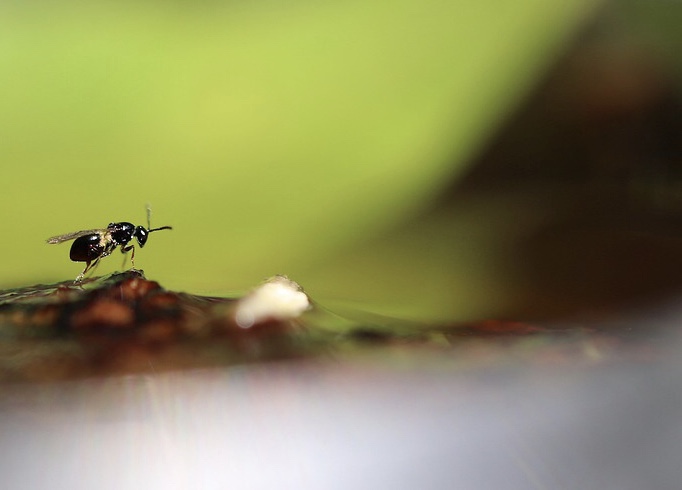
Photo of Cynipid gall wasp (courtesy Pixabay)

Lifecycle of a Cynipid Gall Wasp

The Asexual (Agamic) Generation

When the weather warms in late winter, an all-female generation of cynipid gall wasps emerge from galls which developed and became dormant the previous year, well before the cold and snow set in. This asexual generation of wasps initiates late Spring/early Summer gall development by inserting (with its ovipositor) an egg along with a maternal secretion from the venom gland, into a swollen leaf bud of the host oak. Egg laying takes place as the growing (meristematic) tissues inside the bud rapidly develop. The egg quickly hatches, and the larva begins feeding, all the while exuding specialized growth hormones that stimulate exaggerated tissue growth resulting in structures (the galls) that are visibly different from normal plant tissues. It’s during the Spring/Summer that developing galls are readily seen, often on the undersides of new leaves.

Portion of journal page from 2021

The safely hidden larva continues to eat the nutrient-rich plant tissues forming inside the gall and grows quickly until it develops into a pupa. After a few weeks in this pupal stage, an adult cynipid gall wasp has formed. Still tucked away, the adult (which is either a male or female) chews a small hole in the gall and emerges to mate. 

Another journal page from 2021

The Sexual Generation (aka “Sexgen”)

With the business of mating taken care of, and with no mouth parts to eat, the males quickly die, followed soon by the females. However, before the females die, they deposit one or more eggs on a leaf or within a twig or stem of the host plant. Before the plant’s growing season concludes, the eggs have hatched, larvae have eaten and grown within their individual galls, and have pupated in preparation for over-wintering. Depending on the length and/or severity of winter where these cynipid gall wasps live (and they can live nearly anywhere worldwide), the dormancy period may last from three-five months. 

And now …. back to the emergence of the Asexual or agamic generation (the females), in an on-going cyclic loop that is the life cycle of the cynipid gall wasp. 

A Supplement to the Supplement!

Types of Galls

Leaf galls

  • Form on leaf blades or petioles (leaf stems)
  • Most common galls appear on the upper or lower leaf surface, on or between leaf veins.
  • Galls may look like leaf curls, blisters, nipples or hairy, felt-like growths.
Oak galls on Gambel Oak

Stem and Twig Galls

  • Deformed growth on stems and twigs. 
  • Range from slight swelling to large knot-like growth. 
  • When seen, may be peppered with many tiny holes where the adult gall wasps have emerged.

Bud or Flower Galls

  • Deformed size and shape of buds or flowers. 

Fun Facts

  • Galls are growing plant parts and require nutrients just like other plant parts.
  • A gall keeps growing as the gall former feeds and grows inside the gall. 
  • Once galls start to form, they continue to grow even if larvae die.
  • Most galls remain on plants for more than one season.
  • Galls are usually not numerous enough to harm the plant and control is not warranted.
  • Gall numbers vary from season to season. 
  • Typically, plant galls become noticeable only after they are fully formed.
  • The asexual generation (agamic) galls are reported more often because they are larger and persist longer than the sexual generation (sexgen) galls.
  • Mature plant tissues are usually not affected by gall-inducing organisms.
  • Iron gall ink, which was the most common ink used from the Middle Ages to the 19th century, was used in line drawings by DaVinci, Van Gogh, and Rembrandt, and in the writing of many historical documents like the US Declaration of Independence.

It’s been so helpful to study the life cycle of these tiny parasitic cynipid wasps, if for no other reason than to admit my understanding remains basically rudimentary, and I must keep my Curiosity alive!

As always, thanks for stopping by!

………………………………………………………………………………………………………………

*Field report from 1926 by LH Weld

Diplolepis caepula, new species

Host. — Quercus undulata [Wavyleaf oak, Quercus x undulata]

Gall. — Shaped like a small onion, tan-colored, single or scattered in small numbers on under side of leaf in the fall, persisting on the leaf through the winter. The basal third of the sessile gall is beset with long straight single-celled hairs which are mostly reflexed toward the leaf surface. The conical apex is often lop sided and an opening at the end leads into a thin-walled cavity in which are a few scattered hairs and in the base of which is the transversely placed thin-walled larval cell in the very base of the gall. Inside the larval cell at the pedicel is a thin white disk.

Habitat. — The type is selected from a series from galls collected November 14, 1921, near Hillsboro, N. Mex., the flies emerging April 5-25, 1922. Paratypes are from Tijeras, N. Mex., and of the adults cut out of the galls on November 1 some lived in a pill box until December 28. Other paratypes are from Blue Canyon west of Socorro, adults being cut out of the galls on January 2.  ….. Similar galls were seen on Q. grisea at Magdalena, N. Mex.

  • LH Weld: (1926) Field notes on gall-inhabiting cynipid wasps with descriptions of new species”

Reference: https://gallformers.org

**The 1400 known species of cynipid gall wasps have been identified worldwide, with an estimated total of more than 6,000 species.  In the U.S. there are over 2,000 known species of gall-inducing insects, including 750+ cynipid wasps (500 of which are found in just the West). Worldwide, entomologists have estimated that there are over 210,000 gall-inducing insects yet to be identified!

*** Parthenogenesis is a form of asexual reproduction where an egg develops into a complete individual without being fertilized. The resulting offspring can be either haploid or diploid, depending on the process and the species. Parthenogenesis occurs in invertebrates such as water fleas, rotifers, aphids, stick insects, some ants, wasps, and bees. Bees use parthenogenesis to produce haploid males (drones) and diploid females (workers). 

Some vertebrate animals, such as certain reptiles, amphibians, and fish, also reproduce through parthenogenesis. Although more common in plants, parthenogenesis has been observed in animal species that were segregated by sex in terrestrial or marine zoos. Two Komodo dragons, a bonnethead shark, and a blacktip shark have produced parthenogenic young when the females have been isolated from males.