Acorn or Gall? Update!

An Albuquerque Park Mystery #26 —Mystery Solved!

September 8, 2026

It’s not about what it is, it’s about what it can become. — Dr. Seuss, The Lorax

The creation of a thousand forests is in one acorn. — Ralph Waldo Emerson

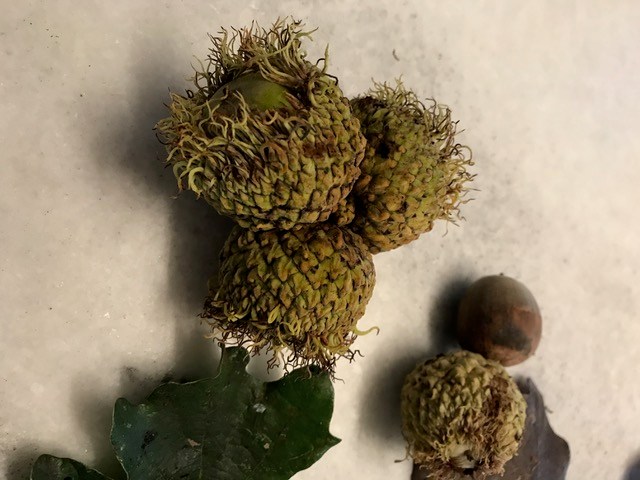
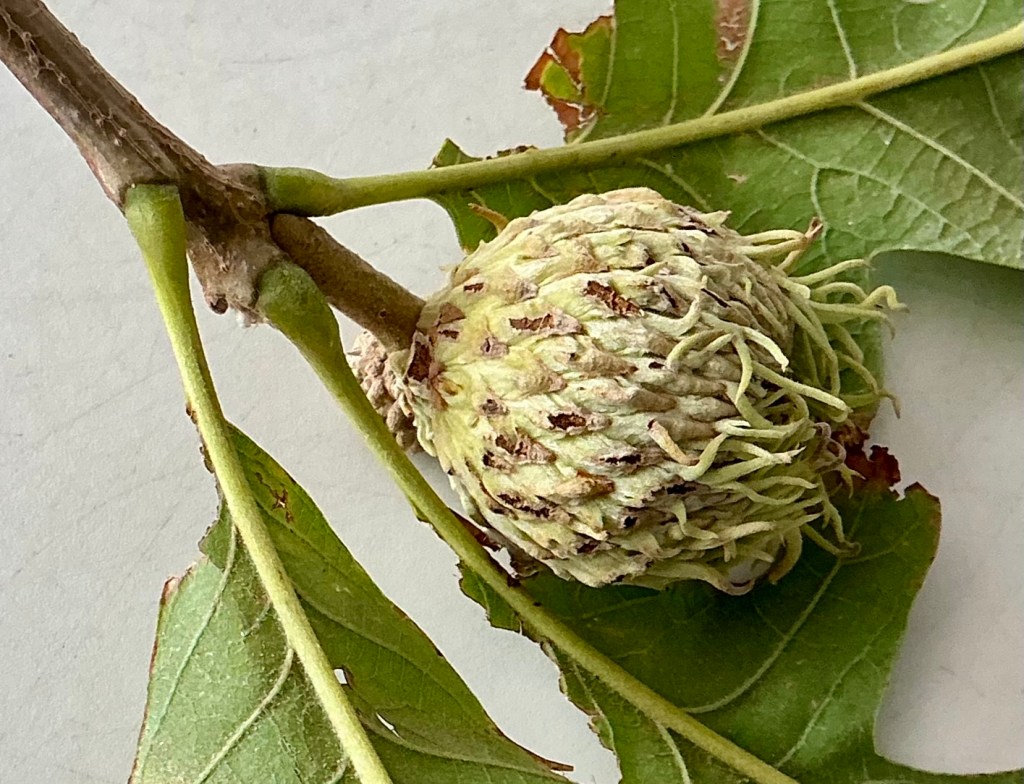
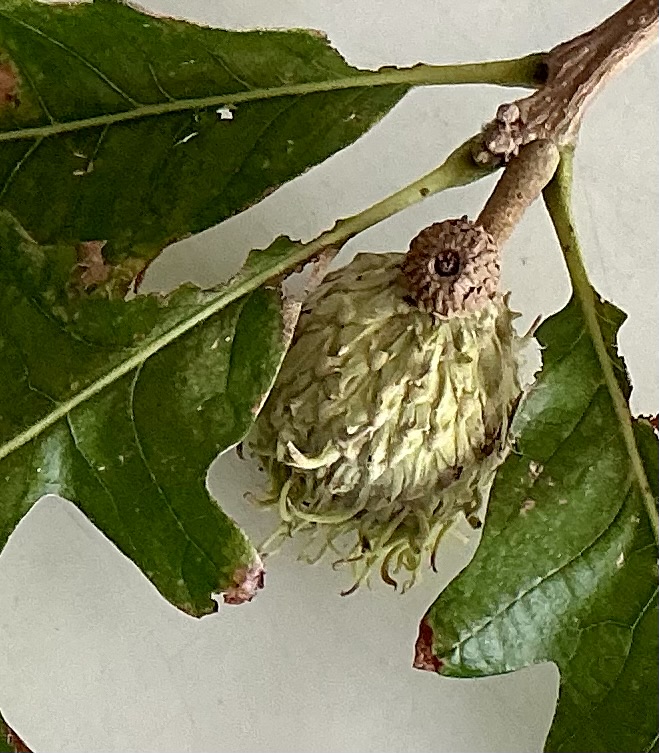
Super thanks to Dana P., a regular reader of my blog and a very savvy observer of my recent post, Acorn or Gall? Dana instantly recognized the mystery oak as Bur Oak (Quercus macrocarpa) from my sketches of the leaves and acorn! “Way to go Dana!!! I’m so grateful you commented and then generously allowed me to share your photos.”

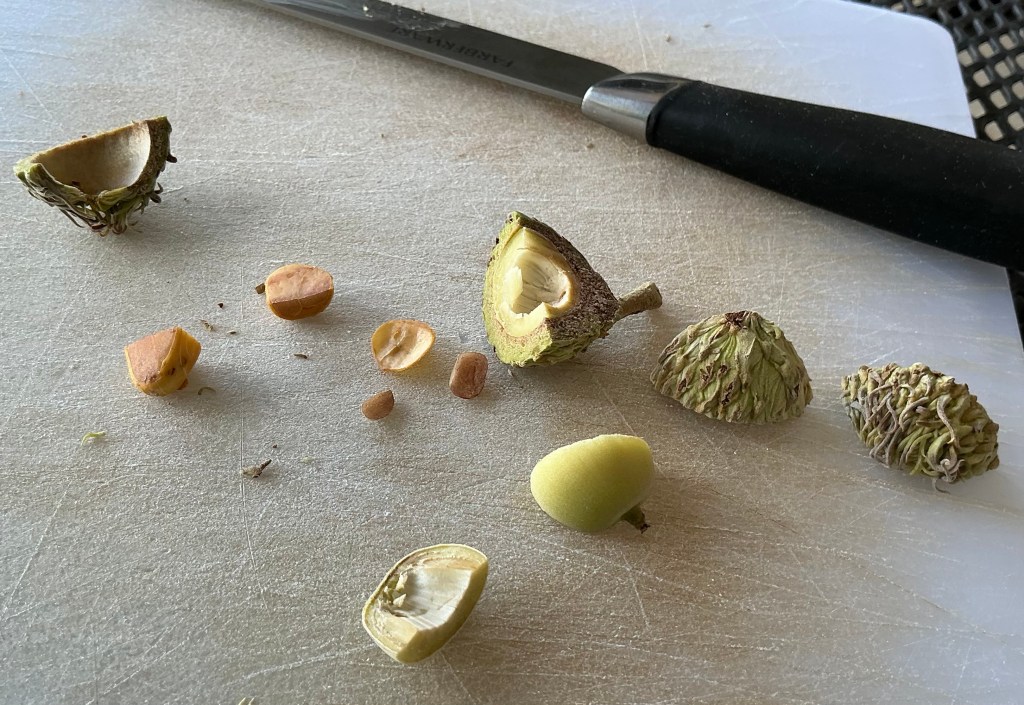
So, those shaggy pale green balls growing from the ends of many leafy branches are acorns after-all. The acorn I collected was apparently immature; that scary-looking tentacled orb was the cap (cupule) still tightly enclosing the growing fruit (the nut). 

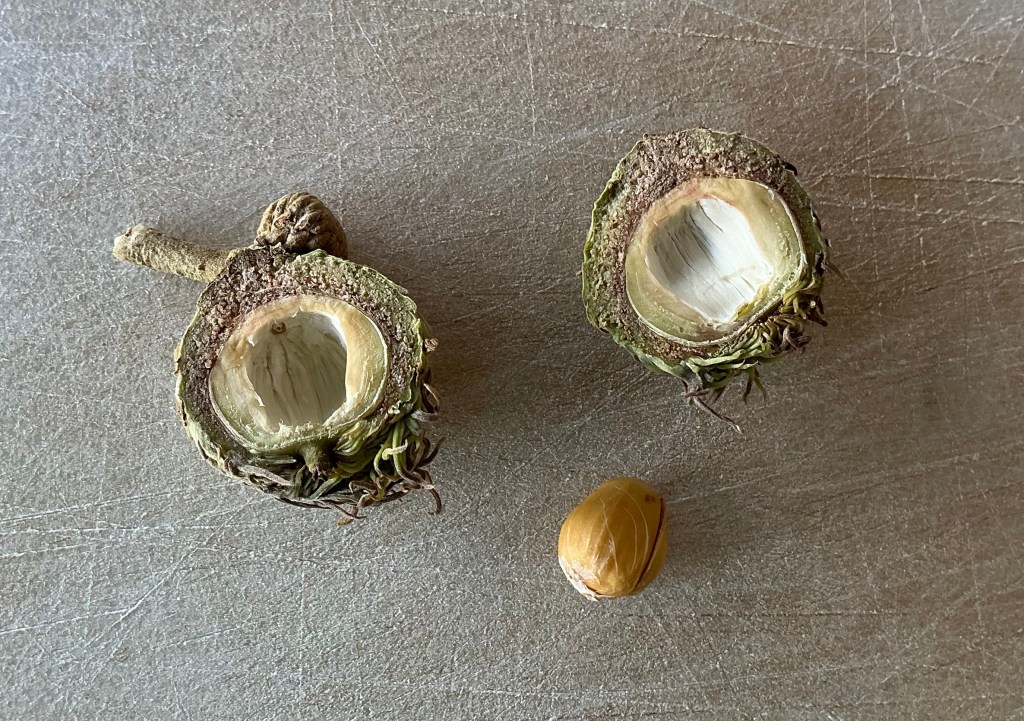
Dana has a lot of experience growing Bur Oak, some of which were germinated from collected nuts (see Dana’s photo below). Now we all can see how a mature acorn appears when nuts are ready for harvesting. (I still think they are the weirdest acorns ever, don’t you?)

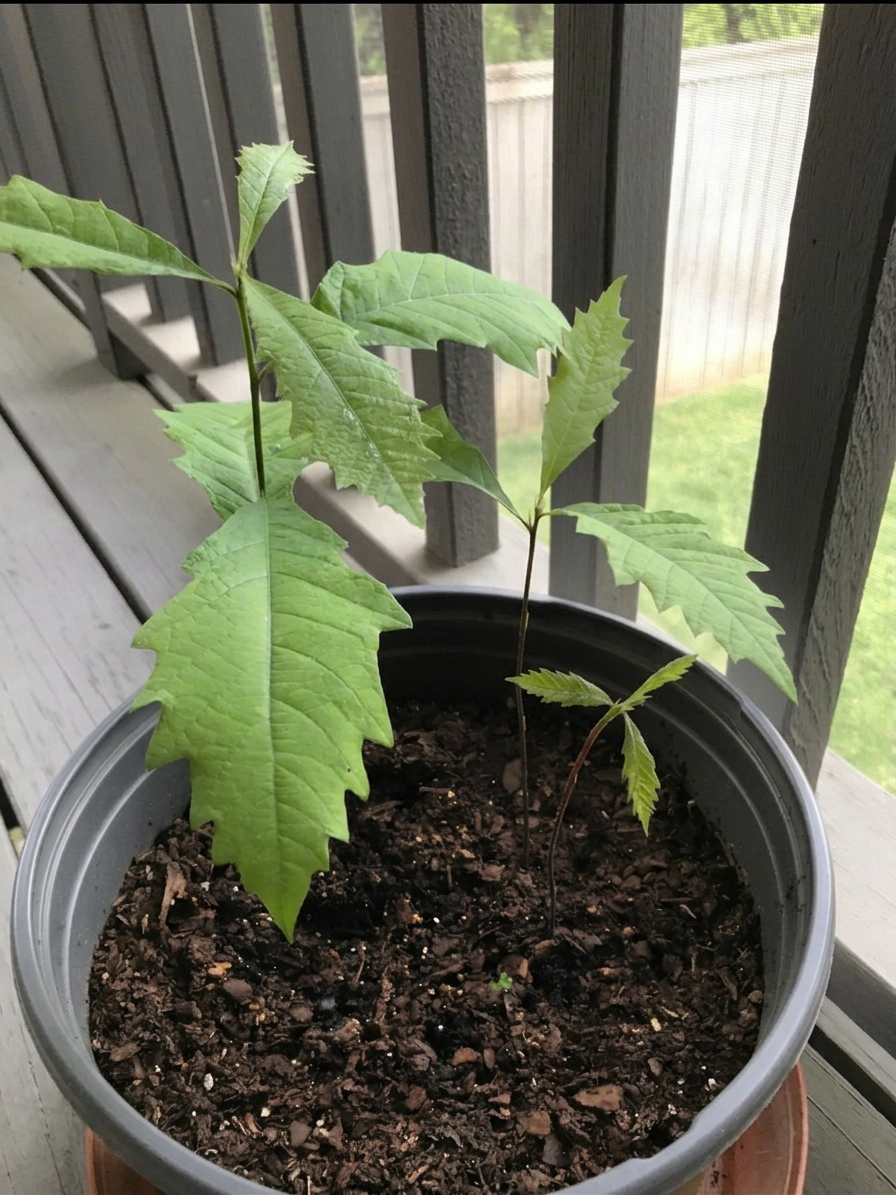
The next photo proudly displays three ‘baby burs’ that sprouted from Dana’s successful germination efforts. The nuts, harvested in the fall from a very old Bur growing in Nashville, Tennessee, were planted in the pot and allowed to overwinter outside, on a screened-in porch to prevent squirrel-theft. They emerged as little trees the following spring. These healthy sprouts in the photo have been happily living in east Texas for the past four years and have grown to four feet tall! 

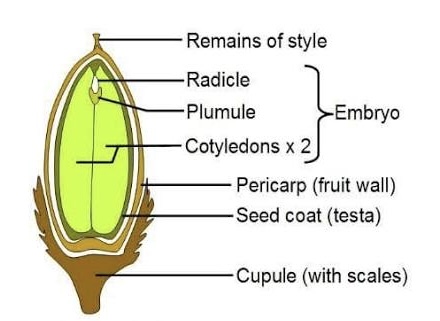
And now for a bit of acorn anatomy (you knew I couldn’t resist!).

The term “acorn” refers to the entire unit; the cap (cupule) and the oak fruit (nut). 

Exterior Parts

Cupule – the botanical name for the acorn’s ‘hat.’ It’s the cup-shaped or bowl-like cap made of hardened, modified leaves called bracts. The outside features scales that can be flat and smooth, bumpy and warty, or loose and fringed depending on the oak species. The cupule protects the nut and helps attach the acorn to the tree branch while it grows.

Pericarp – the hard, tough outer shell that encases the inner kernel of the nut.

Stem – the tiny twig attachment point at the base of the cupule.

Interior Parts

Seed Coat (testa) – the thin, papery layer just inside the outer shell that directly covers the nut meat.

Cotyledons – two large, fatty seed leaves that store starches, proteins, and fats to feed the growing plant (and wildlife).

Embryo – the tiny baby oak tree nestled between the two cotyledons at the pointed end of the nut, consisting of the plumule (future shoot) and radicle (future root).

……………………………………………………………………………………..

Always be Curious

As always, thanks for stopping by!

Acorn or Gall? 

An Albuquerque Park Mystery #26

September 6, 2026

The date: August 24, 2026 

The time: 8:30 am. 

The forecast: Severe clear; calm winds; 82oF & climbing

The place: The Promenade in Albuquerque  

The destination: el Oso Grande Park (“The Big Bear”)

After dropping Roy off for his annual eye exam, Luna and I decided to ‘sniff’ around the neighborhood on our way to nearby el Oso Grande Park. With the chance of rain being “zip,” I was confident walking east along a half-mile stretch of the large cement ditch used to drain storm water from Embudito Canyon. Other than creatively colorful graffiti, the ditch itself had nothing interesting to offer. The hot paved walkway, mostly lined by weedy species, provided perfect habitat for scattered bushy sacred datura plants in full bloom. The many city dwellers living ditch-side allowed landscaping plants to cascade over cinderblock privacy walls — the patches of shade – welcome; sprays of pale pink to magenta desert willow flowers – pretty and fragrant.

A sweaty 20 minutes later and the shady expanse of the Park was a welcome sight. Not one to waste time, Luna anxiously led me to tree trunk #1, circling and sniffing excitedly three times ‘round. Not being able to smell the wonderfully curious aromas capturing her full attention, I spent my time looking up into the leafy canopy of this full grown deciduous tree planted years ago in memory of a once local resident.  

We moved on to tree #2, a robust conifer towering over the well-manicured green lawn, supported by another aromatic trunk recently ‘watered’ by a happy dog walking their human. Before we could check out tree #3, Luna claimed #2 by leaving her ‘calling card.’ 

And on and on we wandered and circled, until ….

…. I realized, based on our exam speed/tree (largely driven by Luna’s satisfaction meter), our Park tour of over 100 trees would take a month of Sundays! So we ramped up our pace, making  decent progress to (hopefully) ensure our timely return to fetch Roy …. then tree #26 happened! 

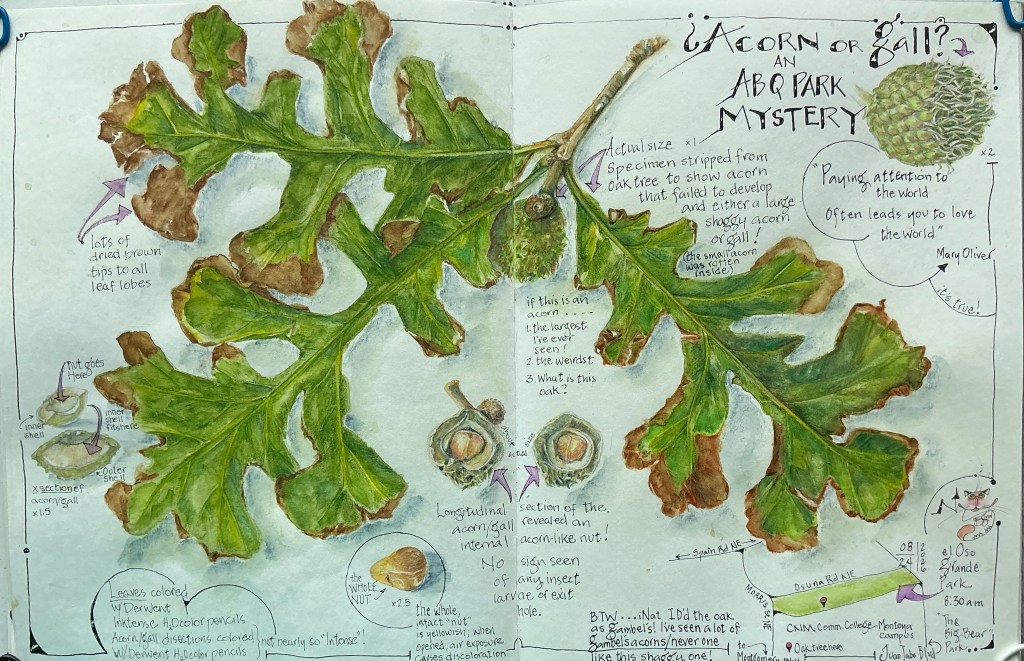
Oh! What was #26? Now it was my turn to encircle a tree, and I couldn’t stop.  In addition to the puzzled look on Luna’s sweet face, several other things were certain: 1– this very large tree was a 2– deciduous 3– dicotyledonous member of the 4– oak genus Quercus. The deeply-lobed leaves were a giveaway, even though most of each leaf’s margins were dried and crinkly. But it wasn’t the leaves catching all of my attention — it was the 1-inch diameter shaggy pale green balls growing from the ends of many leafy branches. This certainly didn’t look like any acorn I’d ever seen before …. besides, right beside this scary-looking tentacled orb was a single mini-acorn that tried but never fully developed — only the dried, withered acorn cup had partially formed before rotting. 

So what was it that sucked the life right out of that tiny failed acorn, and grew into something alien?  If this was some kind of acorn that grows on a non-native oak tree I’ve never seen before, then I had to learn more! If this was a gall, an unusually grotesque, weird and exaggerated growth stimulated by a developing wasp grub living deep inside, then I really had to learn a lot more! 

And then I collected and promptly zip-locked a specimen.

This became (and still is) An Albuquerque Park Mystery hanging like lime green ornaments all over, and also within reach from, tree #26!

P.S.

  • iNaturalist identified the tree as Gambel’s oak 
  • Never have I ever seen a Gambel’s oak acorn look like that!
  • Still waiting for an oak expert to identify the tree leaves and/or acorn/gall-thing

P.S. P.S.

  • So many questions remain
  • Upon arriving home, no wildlife observed inside zip-locked bag
  • I dissected the growth, inside and out — found what looked like an acorn nut 
  • No sign of a grub; no exit holes in the outer or inner shells

P.S. P.S. P.S.

  • Luna & I practically ran back to the eye doc’s office, arriving minutes before Roy’s exam concluded

……………………………………………………………………………………..

If you’ve seen anything growing on an oak that remotely resembles these mystery green goblins, please let me know what it may be, and what species of oak they come from! 

As always, thanks for stopping by!

P.S. P.S. P.S. P.S.

  • When “An Albuquerque Park Mystery #26” is solved, you’ll be the first to know!

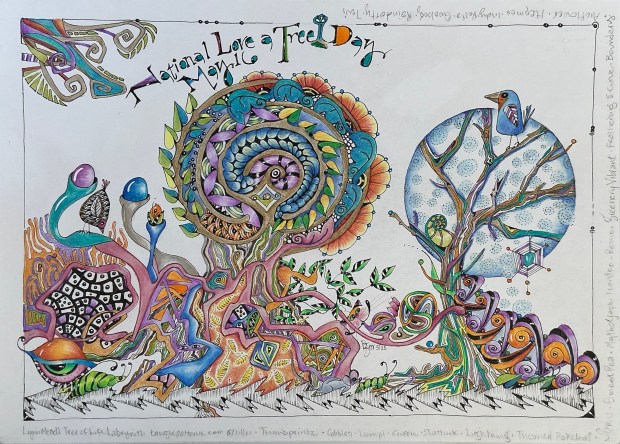
Happy National Love a Tree Day!

May 16, 2025

Zentangle Patterns: thumbprints, cobbles, Lumpi, Cruffle, Shattuck, lightning, thorned Pokeleaf, sweet pea, mythograph, Icantoo, remo, greenery vibrant, feathering s-curve, boundary, Arcflower, hepmee, Quabog, raindotty, tsui 


And many thanks to Lynn Mead for sharing her Tree of Life Labyrinth pattern. Super fun to give a whirl! The easy to follow directions can be found on tanglepatterns.com posted 08/14/2021 

Today, May 16th, just so happens to be National Love a Tree Day! It’s the official day to celebrate all of life’s joys brought to us by the trees we share this planet with. Whether you love reading in the shade or taking a bite out of a fresh fruit pie, National Love a Tree Day encourages y’all to get outside and enjoy a tree.

A Changing Landscape

We all know many tree species live many many years; some live to be several thousand years old. According to the U.S. Forest Service, about 766 million acres of forest land exists in the United States today, a number that’s held steady since 2012. But the nature of our forests has changed over the last 400 years, due to changes in management practices and demand. Population growth, rural and urban development, along with a variety of land uses (like conversion of forests to agriculture use) resulted in a steady decline of forested acres between 1630 and 1910;  a decline from 1,023 million acres to 753 million acres or 46% to 34% of the total land area in the U.S. Since that time until the present, where people choose to live and how the land is used has been constantly changing.  While some urban forests increase, other areas see a decline. Tree planting programs improve landscapes but human activities and population growth continue to impact these ecosystems.

We All Benefit from Trees

Trees provide more than just beautiful landscapes and a shady canopy on a sunny day. They play a significant role in reducing erosion and moderating the climate as well as give us oxygen. Large quantities of carbon are stored in their tissues as trees remove carbon dioxide from the atmosphere. They provide habitat and structure for strong ecosystems.

How to Observe National Love a Tree Day

This is a good day to plant a new tree native to your area, or spend some time enjoying the beauty of the trees, Take time to learn how to care for the trees you have, too, whether you live in the mountains or the desert. Write down all the reasons trees are important to you. If you have a favorite tree, or a tree you’re not familiar with, begin a little research project about that (or those) species, and journal about your findings. 

What will you do today to celebrate trees?

Happy National Love a Tree Day!

As always, thanks for stopping by!

Nature’s Colorful Fall Patchwork ….. The Beauty of Gambel Oak Leaves

November 12, 2024

It’s late October, mid-Fall in the Manzano Mountains, perhaps a week before the first snow of the season. The Gambel Oak covering hillsides and mountains somehow sense a change in the air.  Seemingly overnight every leaf on every oak shrub and tree magically transformed from their summer greens to royal rusty reds, gleaming golden yellows, and shocking sunset oranges. As I look across the landscape and marvel at the sight, I can’t help wondering, “How do they know?”

The spectacle is short lived. Over the next few weeks, these gorgeously painted leaves slowly change to crispy beige brown, fooling the observer into believing they can’t face another winter; that every single oak shrub and tree just gave up and died! Thinking that was the case my first winter in central New Mexico, I was fooled. But since then I’ve learned a lot about the life cycle of Gambel Oak, and have come to appreciate the persistence of all those crispy browns covering up the otherwise barren nakedness of chaotically jumbled branches. 

There’s a lot that can be said about Gambel Oak (Quercus gambelii), but this post focuses on

The Leaves of Quercus gambelii 

The most interesting thing about this oak species’ leaves is no two are alike. Even though each leaf looks different from its neighbor, they do all have common characteristics that distinguish its leaves from other oak species. For example, All Gambel Oak Leaves …….

  • are lobed (but the number of lobes varies from side-to-side of a leaf’s mid-vein; depth of lobes varies on a single leaf and between leaves; lobes can be gently concave to acutely angled).
  • are flat and leaf margins are smooth (if leaves appear somewhat wavy and/or exhibit some serrated margins and/or points on the lobe tips, this is not a true Q. gambelii, but likely a hybrid of Gambel Oak and Shrub Live Oak (Q. turbinella) resulting in Wavyleaf Oak (Q. undulata), very common where ranges converge). 
  • are different lengths and widths, and leaf sizes are random along each branch, with large leaves adjacent to small ones adjacent to tiny ones adjacent to gigantic ones, etc.
  • change color in the Fall, eventually becoming beige brown and crispy (but color patterns on individual leaves and throughout a shrub/tree are wildly various; some leaves turn one color, while others become a mixture of greens, reds, yellows and/or oranges).
  • that are brown/crispy persist on the shrubs/trees throughout late Fall and Winter, then drop all at the same time in Spring when buds begin to open.
  • that are fresh have little 5-star hairs on the undersides, while the upper surface is smooth and leathery.
  • are relatively free of insect damage, with the exception of the occasional oak gall or insect nibbles (perhaps due to their leathery texture on the upper surface and hairy texture on the undersides?).

Every Fall I observe and collect Gambel Oak leaves. They make great subjects for my nature journal! Because every leaf looks different, the easiest way to depict the various shapes is to trace their outlines directly onto my journal pages. Then with leaves in hand, I can use my Inktense watercolor pencils to paint within the outlines, spending most of my effort on their beautiful colors.

I hope you’ve enjoyed my page of Gambel Oak leaves. Do you share nature with oaks? If so, which species, and are their leaves all the same or different somehow? Do you record your observations in a nature journal too? I’d love to know!

As always, thanks for stopping by!