“Time spent amongst trees is never wasted time” — Katrina Mayer
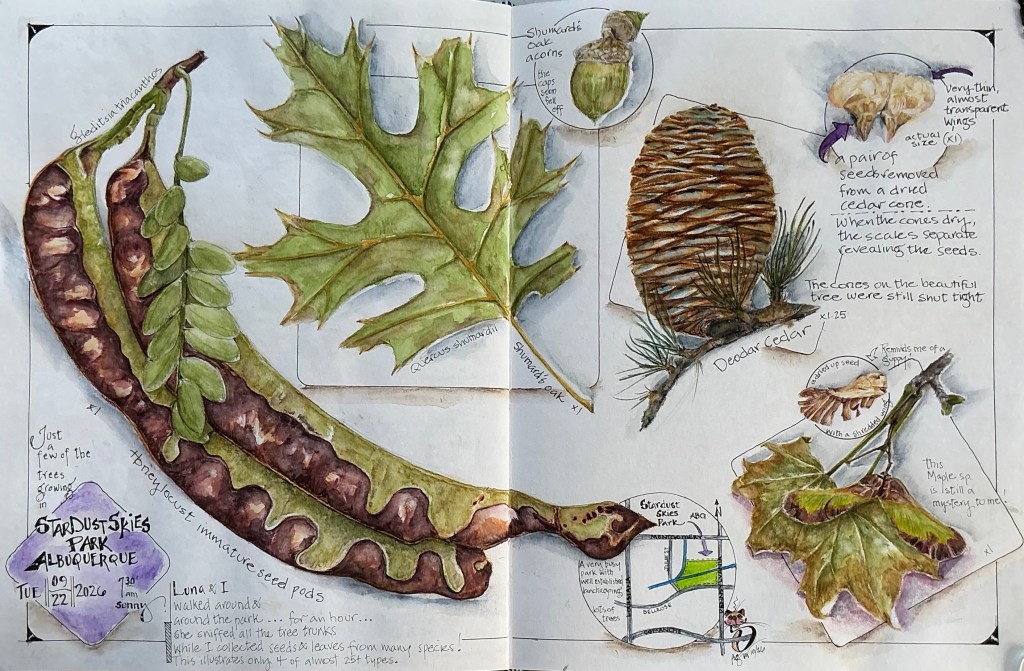
With nearly 300 public parks in Albuquerque (ABQ), it’s easy to find one beautifully landscaped with mature trees providing cool shade on a hot summer or fall day. The City’s Urban Forestry division manages roughly 25,000 trees within its parks, and when ‘in town,’ these parks feel like irresistible magnets reeling Luna and I in for an hour of discovery.
Star Dust Skies Park is one we’ve visited many times ….. as it’s just behind our dentist’s office. So on the morning of September 22nd, while Roy was “lounging” in a reclining chair discussing a tooth extraction with the Doc, Luna informed me the neighboring Park was calling.
Like many other City parks, the canopies of the abundance of mature trees seemed to touch, almost entirely eliminating the direct sunshine from penetrating the underlying lawn. Our walk-about was cool and refreshing as Luna sniffed every single tree trunk while I searched for seeds, seed pods and cones to draw.
As we moved from tree (trunk) to tree (trunk), I found myself wondering about the many non-native trees growing in the City. After all, ABQ is in the middle of a desert, in the middle of a drought (coincidentally, the 13 mile reach of the Rio Grande through town turned to sand from late May through mid-September 20261). Turns out the city has a water-wise urban forestry program; a permit must be obtained to plant a tree in a park, ensuring it is a drought-tolerant species. And growing trees in such an arid environment provides measurable annual benefits, like carbon sequestration, pollution reduction, and stormwater capture.
All of that (along with the other benefits of having established green spaces in the City) made me feel somewhat better about so many non-native trees in so many parks.
After an hour or so, it was time to head home. Both Luna and I were happy with our collections as we walked back to the dentist’s office ….. mine, a bag full of interesting and new-to-me seeds, seed pods and a few cones; Luna, a nose full of exquisite aromas describing the life and times of at least three dozen dogs who roamed Star Dust Skies Park this fine morning.
Where have you discovered Nature lately?
As always, thanks for stopping by!
1 During 2026, major stretches of the Rio Grande through the Middle Rio Grande Valley (including 13 miles through central ABQ and southward) reached historic dryness levels, running dry for approximately three months; sections drying as early as late March and June. By late August, total dry river miles across the Middle Rio Grande Valley reached 112.4 miles (from Cochiti to Elephant Butte Reservoir), surpassing previous records.
On September 3rd, water temporarily returned to the Rio Grande in ABQ, after a 650-million-gallon release was ordered from the Abiquiú Reservoir for a brief three-day research and environmental rewetting period. But it wasn’t until September 18th, that consistent late-summer rains finally brought natural flows back to the river around ABQ.
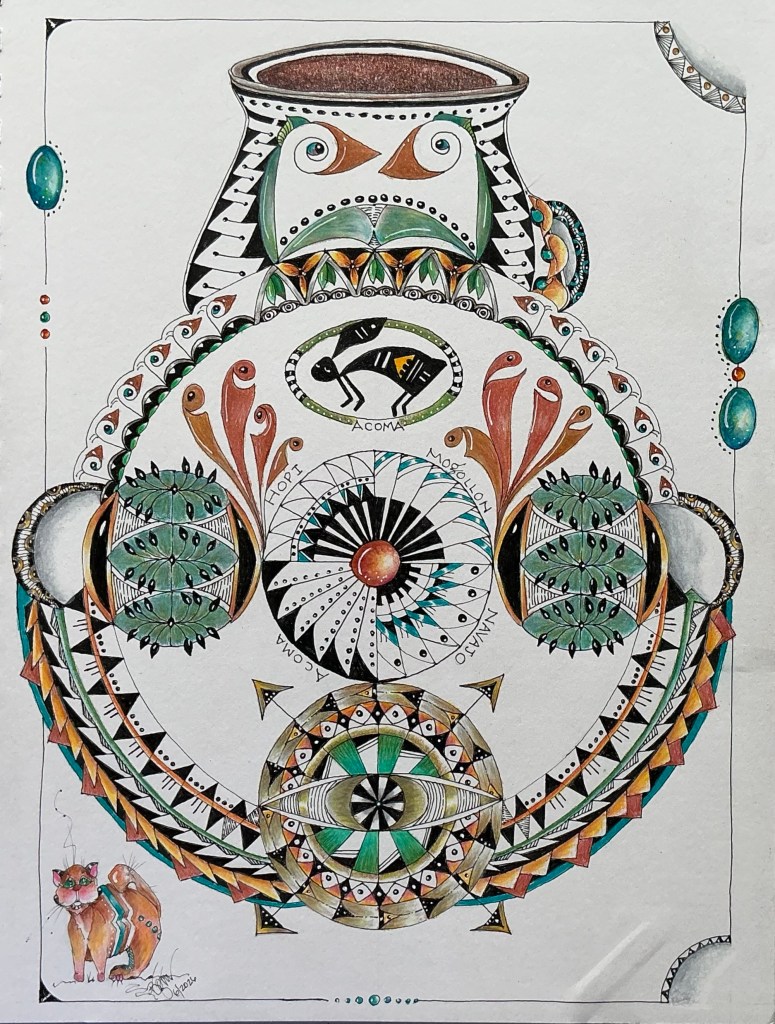
The Tale of the Tangled Pot: Recognizing our Deeply Rooted and Inseparable Connection with the Natural World Through the Practice of Nature Journaling
June 14, 2026
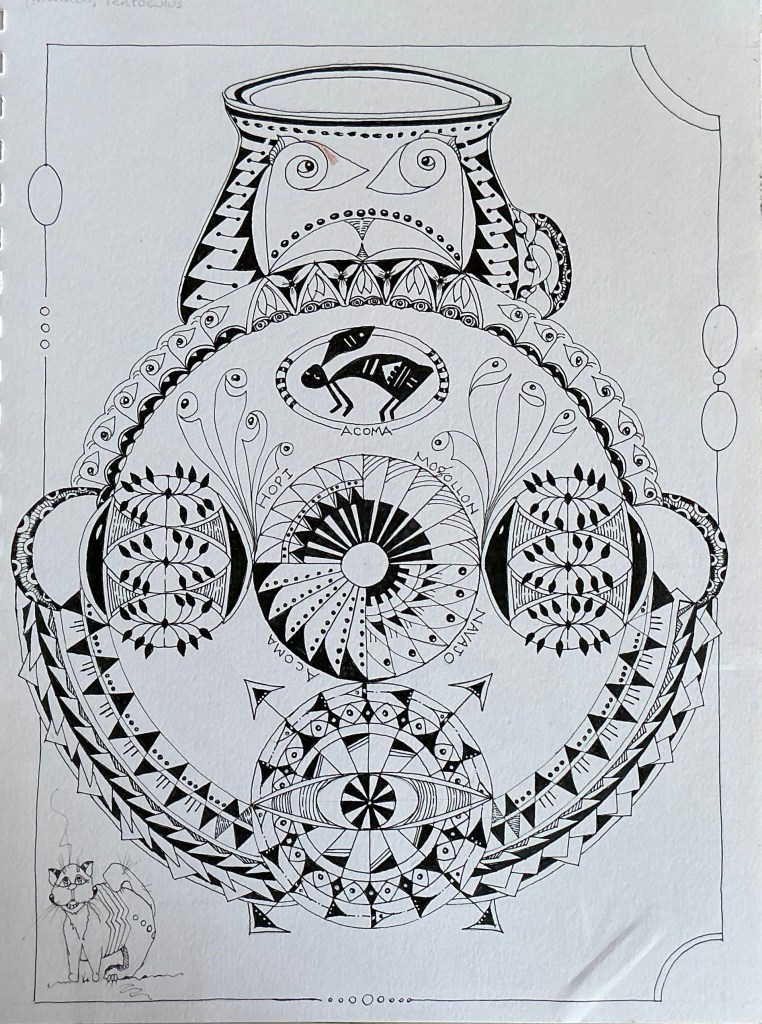
Zentangle patterns: Mogo, Sage, Roadrunner, Agave, Lazy Leaf, Monsoon, Zona, Voyage, Hokam (patterns created by Angie Gittles). Also added Hahna and Tentoculus. All patterns found on tanglepatterns.com
Living in the desert Southwest, inspiration for many of my Zentangle work comes from the representative art created by the indigenous peoples of New Mexico and the Four Corners region. Their deep connection with nature was often expressed in ancient rock art and on handcrafted pottery in ways that amaze. It takes me back to a different time and place; where their way of life was deeply rooted and inseparable from the natural world; where survival required an understanding and appreciation of the countless interdependent components required for the productive function and evolution of complex ecosystems.
Fast forward to today. Our fast-paced, stress-filled, consumer-centric lifestyles, full of techno-gadgets (demanding so much of our attention), and instant gratification, offers people a cushy arm-chair view of the world. Why put down those phones or turn off the TV, when we can safely and comfortably “witness” nature from our homes? Better yet, why not?
While pondering that question, many compelling reasons came so easily. Just being present in nature can be calming; relaxing; stress-reducing — we slow down, taking time to observe our natural surroundings. By really “seeing” local ecosystem(s) with all of our senses, we experience awe and wonder and make meaningful memories. Our once dormant skills in curiosity and critical thinking come alive as we learn about the integral connectedness of nature’s many and diverse components. By understanding and valuing how our connectedness to nature always has been and always will be critical not only to our very survival, but to the survival of all species, we realize the ability of all living things to thrive benefits from natural ecosystem services that provide things like clean water to drink, clean air to breathe, food to eat, and a habitable climate. These vital services are priceless. All nature asks is that we keep it healthy. First-hand personal exposure to the natural world fosters appreciation, love, and a desire to nurture and protect nature; an investment in the future of all life on Earth.
Observing the Natural World through the Practice of Nature Journaling
People have been observing, learning, and recording nature around the world for millennia. The oldest known cave art (pictographs) with paintings of wildlife, primitive humans, and human-bird hybrids hunting pigs, was discovered on an Indonesian island, and dates back almost 70,000 years. The oldest known rock carvings (petroglyphs), created by the Aborigines of Western Australia 40,000 – 50,000 years ago, depict wildlife and hunting parties. The oldest known petroglyphs found in North America were carved into boulders by still-unidentified humans that lived in the Winnemucca, NV area (east of Reno) between 10,000 and 14,800 years ago; their rock art represents leaves and trees. The oldest pictographs and petroglyphs found in New Mexico were made by Ancestral Puebloans and other Indigenous groups between 3,000 to 4,000 years ago in the Guadalupe Mountains/Carlsbad Region (southern NM) and depict hunting parties, wildlife and other natural elements.
The travelers, explorers and settlers that arrived in North America significantly influenced nature recording. They kept journals, field notes, and artistic renderings tracing a rich history of scientific inquiry and ecological changes spanning early colonial times to the formal natural history expeditions of the American West. For example, John Lawson (1709) and Mark Catesby (1731-1743), each published a book with their observations of the flora and fauna of the eastern colonial colonies (Catesby) and the southeast (Lawson). Extensive and diverse nature observations were recorded by all members of the Lewis and Clark Expedition (1804-1806), and by John James Audubon (1827-1838) with a focus on birds in their natural habitats. These and many more examples of “journaling nature” provided an understanding of the complex ecosystems that existed between two oceans, and was indispensable to the successful settling of North America.
Today’s Practice of Nature Journaling — paying attention, recording observations, asking questions, noticing changes, and reflecting on the natural world — is nearly identical to historical journaling practices, with some healthy advantages for mind and body. For example, Nature Journaling offers much needed mental, cognitive, and emotional relief, particularly important in today’s world. It also provides a screen-free way to reduce stress, encourage mindfulness, and sharpen observational and critical thinking skills. By intentionally immersing ourselves in nature — by being fully present — we can experience these benefits, and more. We find our place in nature by making connections and understanding how we are an integral and inseparable part of the environment around us.
“Walking” thoughtfully and gently in nature inspires us to nurture and protect what we are all part of, instilling in us a deep appreciation for the natural resources essential for the survival of our ancestors, as well as for our survival today and for future generations.
……………………………………………………………………………………………………
Zentangle patterns: Mogo, Sage, Roadrunner, Agave, Lazy Leaf, Monsoon, Zona, Voyage, Hokam (patterns created by Angie Gittles). Also added Hahna and Tentoculus. All patterns found on tanglepatterns.com
Many thanks to Angie Gittles, a Certified Zentangle Teacher, for developing the step-outs to an abundance of patterns inspired by Indigenous Peoples of the Southwest. Her inspiration inspired me to weave 10 of her different designs into a stylized pot to honor and encourage such an important way of life. In doing so, I took my time, taking many deep breaths during the process, and thought about the days when appreciating and expressing nature was a natural way of living.
……………………………………………………………………………………………………
Resources and a Few Important Tips
Whether you consider yourself a “Nature Journaler” and would like to learn more, or are interested in how to begin, there are countless resources and examples to refresh your skills or to get you started. Borrow a library book, such as Nature Drawing by Claire Walker Leslie, Keeping a Nature Journal by Leslie Roth, or Nature Drawing and Journaling by John Muir Laws.
To get started in journal sketching or to improve your skills, check out the following: Discovering the Art of Field Sketching by Kristin Link, Botanical Drawing using Graphite and Colored Pencil by Sue Vize, or The Artist’s Guide to Sketching by James Gurney and Thomas Kinkade.
Of course there hundreds of thousands of on-line resources and social media sites about Nature Journaling and related topics. But beware the pit trap ….. lest you get caught up in doom of perpetual scrolling, never to get a breath of fresh air in the light of day!
If you’re unsure about becoming a “Nature Journaler,” know that anyone can head to the woods, the backyard, or sit by a window. You don’t have to travel hundreds of miles to visit a National Park ….. nature is everywhere! All you need is a pencil and piece of paper, the curiosity to see what’s around you, and the desire to slow down and observe with all your senses. There’s no right or wrong way to journal in nature, but when you do, be fully present; take the time to really “see” your surroundings. Just committing to turning off your screens to nature journal for 5 minutes a day will be perfect for you!
……………………………………………………………………………………………………
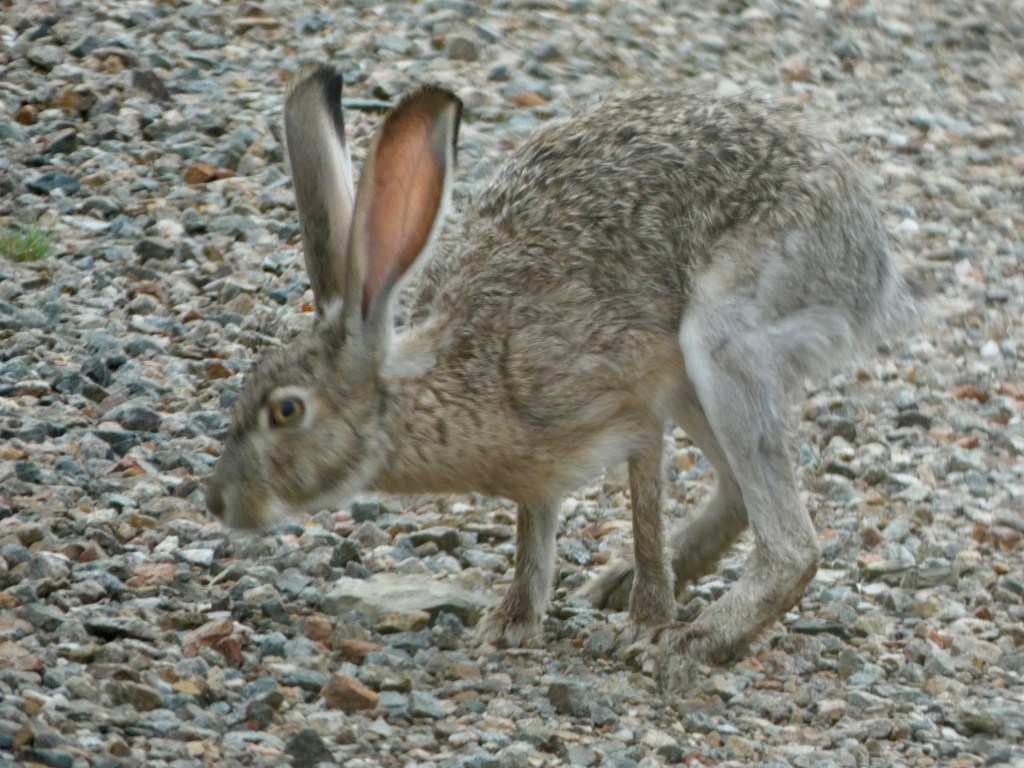
Black-tailed jack rabbit on the move!
Hope you enjoyed my Tangled Pot. As I always do while nature journaling, when creating these kinds of Zentangle-inspired works, my automatic slow-down mode becomes engaged, allowing me to think about possible directions I can take to complete a page. Sometimes the path is direct, but more often a world of rabbit trails leading to deep holes opens up before me, and I gotta take the plunge. That’s exactly what happened while tangling the Pot. And that’s what got me thinking about— how our ancestors used to live in nature, how art represents nature— how nature is endlessly tangled up in life— how today’s values take a back seat to our crucial connections with nature—how nature journaling can be used as a tool to restore gratitude and appreciation for nature—how, without nature, life as we know it would not exist.
I’m going to turn off my computer now and go enjoy a walk in nature with my journal. Are you inspired to do the same?
Today’s the Day! Embrace your Inner Nerd, and set her free.
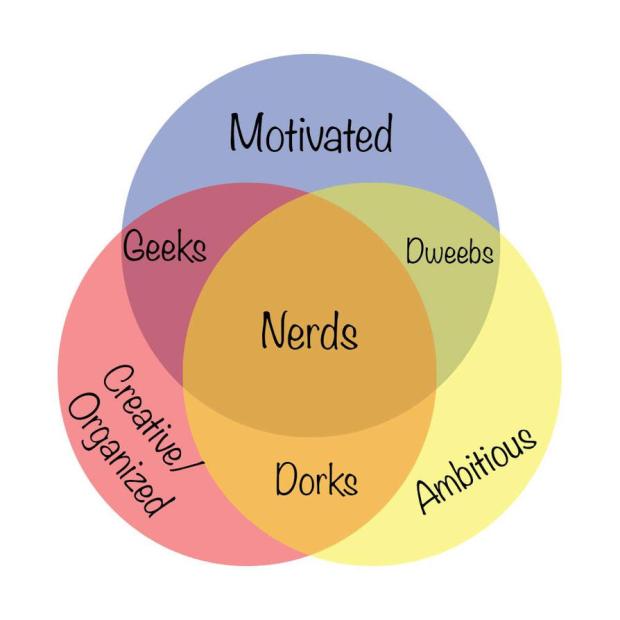
Back in the 1950s, the term “Nerd” was frequently heard to describe someone in a negative sense: “He’s not attractive;” “She’s awkward at socializing;” “What dorky glasses he’s wearing;” “She’s so shy.” Before that time, “Geek” was the popular word in play. However, many of today’s Nerds and Geeks have proudly broken free of those decades-old definitions by tossing them aside and rewriting dictionaries.
Where do you fit?
While the terms “Nerd” and “Geek” are often used interchangeably, some dictionaries are splitters. You can find Nerds described as people typically associated with intellectual pursuits and academic achievement, often focusing on mastering skills and knowledge, where Geeks are known for their intense enthusiasm of specific hobbies or interests, particularly in areas like technology, science fiction, or gaming.
Not to nit-pick an officially-designated celebration, it appears National Find Your Inner Nerd Day has merged Nerd with Geek, matching a 2024 dictionary definition….. and I paraphrase: “Nerd” is someone who’s extremely enthusiastic and wise about a subject or something they’re passionate about, and who excitedly and obsessively talks about it while paying extraordinary attention to details.
Are you an Inner Nerd?
Deep down inside do you identify with parts or even all of those words and phrases that attempt to describe a Nerdy you? You do? Awesome! Still not sure (or “On the Fence” and)/or not willing to admit to your Inner Nerdiness? Being someone who’s a self-identified Nerd, having recognized and accepted my quirkiness for decades, let me help!
You might be an Inner Nerd if:
-you’re an academic, a book-worm, into classic movies, or a Trekkie;
-you knit holiday clothes every year for your dog, all your friend’s dogs, the neighbor’s dogs, and the humane society;
-you collect Pez dispensers, antique buttons, bars of soap, or banana labels;
-you collect Adventure Labs, GeoArt, EarthCaches, TravelBugs, and Geocoins;
-your house is full of stuffed toys from around the world; you ask friends to bring you a skein of yarn every time they travel somewhere new; the closet in your craft room holds more bolts of fabric than Hancock’s of Paducah, because you ‘never know;’
-you’re passionate about learning as much as you can about anything new and then sharing everything with everyone you meet;
-you’re obsessed about your daily creative practice in the fine arts (drawing, painting, music, song, dancing, acting), or creative writing (poetry, prose, essays, short stories), or in the culinary arts;
-you have a rock from every state in the U.S., a pressed leaf from every deciduous tree in your county, a photo of front doors from all your neighbors’ homes, and neighboring neighbors’ homes;
-you’re obsessed about scrapbooking, making botanical inks, filling journal after journal with nature sketches, storytelling, song writing;
-your collection of art supplies rivals Jerry’s Artarama; your own more ukuleles than Jake Shimabukuro;
-and on and on and on!
Being a Nerd is about embracing what you love and sharing all of your nerdy habits, collections, hobbies, and passions. Being a Nerd is about wanting to inspire others to embrace their inner nerdiness, too! Isn’t it time to show the world how amazing your differences are? Isn’t it time to embrace your quirkiness and share what you love?
And if you need more convincing, have no fear! Nerds are some of the coolest people in the world, if not the world’s most creative and successful. They’re always up for learning new things and love to share what they have learned with others. National Find Your Inner Nerd Day gives permission for everyone to explore their inner nerd, because everyone has a little inner nerdiness inside ready to be set free! Nerds aren’t weird, Nerds are wonderfully unique! So let’s celebrate our quirky nature and love ourselves for who we really are.
Let’s Celebrate Our Inner Nerd
If you’re a collector of things, take the day to share your treasures with other people. Give them a glimpse inside your mind and share your enthusiasm about your collection.
Join a local club that offers similar interests to yours. Book clubs, art clubs, bird watching clubs, nature clubs, car clubs, astronomy clubs, cooking clubs , and stamp collecting clubs can always be found. The best way to meet people like you is to find people like you.
Attend a convention, such as Comicon, Star Trek, Anime, QuiltCon, National Narrow Gauge, and Association of Speciality Cut Flowers, and see how fun and enthusiastic Nerds really are! Start by searching in your local area to find something that interests you.
And lastly ……. Are you a self proclaimed Inner Nerd? Are you ready to finally submit to your Inner Nerdiness? What are you obsessed about; passionate about? Do you have an insatiable curiosity about one thing; lots of things? Are you a collector (of what); a dedicated and driven learner? Please share your uniqueness with family, friends, and me! Oh how I’d love to know!
I hope this post was fun! As always, thanks for dropping by!
P.S. I’ve been a self-proclaimed Inner Nerd for most of my life (and that’s a lot of years!). It’s been an ever changing, non-stop circular journey of obsessions and passions involving art, music, science and nature. Right now I’m passionate about nature journaling on a daily basis, and the joy of non-stop learning and sharing the limitless diversity of our natural world. Oh, and I’m crazy about my daily connections with art, Flambé, and storytelling through Zentangle.
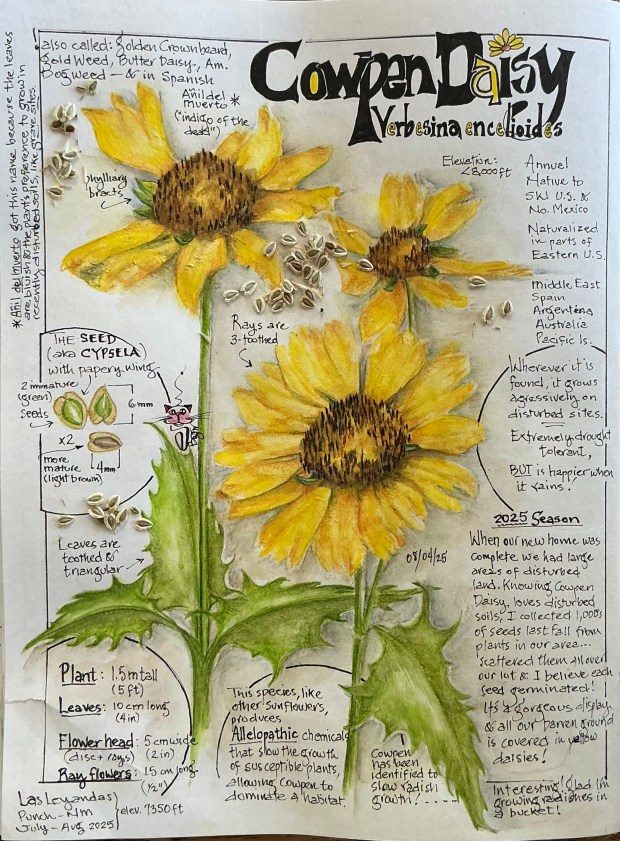
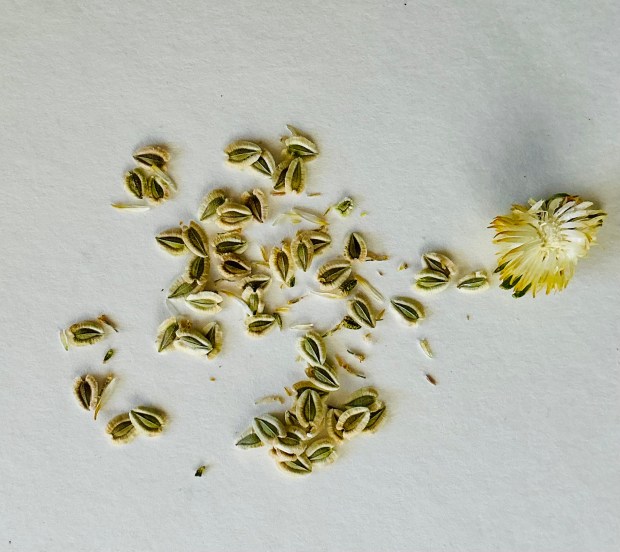
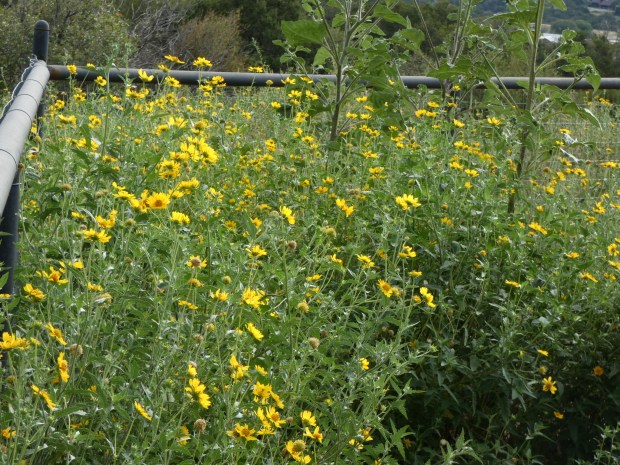
It was the Fall of 2024. A small cluster of Cowpen Daisies (Verbesinaencelioides) flourishing on the severely disturbed ground surrounding our new home was going to seed. Waiting several weeks until the migratory birds ate their fill, I spent an hour or so collecting as many remaining dried seeds (cypselas) as possible, stuffing full two quart-sized ziplock bags. About 1/3 of the seeds I scattered around the house where they would overwinter on the ground. The rest were poured into large pill vials that were labeled with species name, location, and date, then placed in the refrigerator to simulate cold storage until Spring.
Cowpen Daisy cypselas (seeds) 08/04/2025 at Punch
It was late April 2025. The chances of heavy frost seemed a distant memory. My fingers crossed, I chose a sunny 42 degree morning to liberate those refrigerated seeds from 6 months of cold storage, and scattered them in disturbed areas not seeded last Fall. Then I waited like an expectant parent, watching for signs of germination, worrying that runoff from late season snows might wash away my scattered seeds, expecting that flocks of migratory birds would gobble them all up, and hoping for gentle rain showers to swell those thousands of seed coats to aid those tiny embryos in growing their first roots (radicles) and first leaves (cotyledons).
Then early June 2025. Success! Cotyledons were literally popping up everywhere, which meant the radicles were already expanding into the soil. They were especially crowded where I’d scattered all the cold storage seeds, and germination was obvious where seeds had been scattered the Fall of 2024. By early July, those Cowpen daisies were crowding out many of the other native species I’d also seeded in the same areas.
Backyard and overflow Cowpen Daisies, robust growth after Fall 2024 seeding (08/03/2025)
And now it’s early August 2025, and what a dazzling show! Even though the sunflower yellow flowers of Cowpen Daisy are small (2” wide), there are up to 75 long-stemmed flowers on each plant that can grow from 4-5’ tall! They are so dense, the backyard fence is hardly visible, our walking paths are totally draped with 4” long leaves, and if there’s a rattlesnake lurking around under our massive Cowpen Daisy canopy, we’d probably (hopefully) hear him well before he slithered into view!
Goals and Lessons Learned
I’ve learned a lot by parenting these Daisies; from the best time to scatter seed (in the late Spring following cold storage) and where (not so close to other desirable natives or pathways), to managing the mass of growth (by organizing through selective removal). Our initial goal of seeding and growing native plant species was to attract and help feed wildlife (pollinators, reptiles, rodents, birds and mammals), and we are optimistic that achieving this goal long-term seems realistic with the success we’ve had to date. However, because so many of our native plants are losing the battle against habitat loss caused by invasive species encroachment and takeover, land development, and climate change, we will continue to explore ideas to expand our initial goal to address the habitat situation. As we gain insight about the best native plants to grow to help restore our disturbed soils, we will learn and share with our neighbors those species that: are drought tolerant; aid in building soils; are effective at invasive weed suppression; provide wildlife benefits; and increase plant diversity.
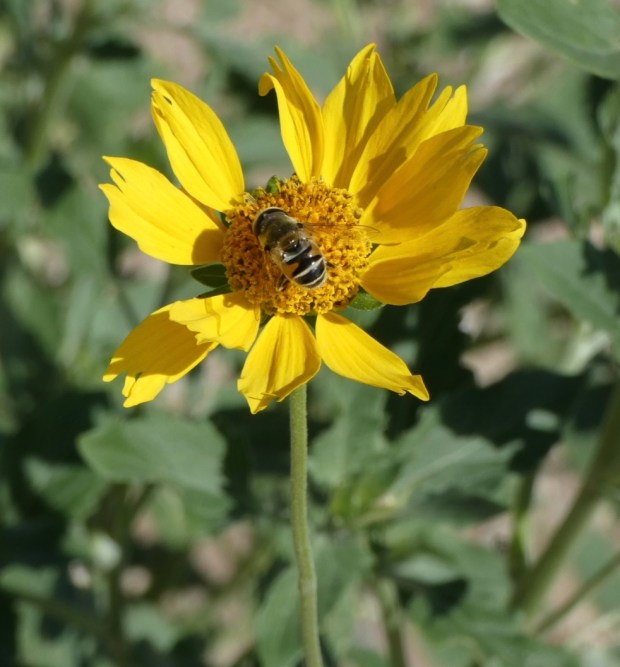
Cowpen Daisy and pollinator 08/01/2025 at Punch
Happy – Happy – Happy! Will I be collecting Cowpen Daisy seed again this Fall? You bet! Having all that sunshine yellow around our home is thrilling. Every morning all those thousands of sunflower faces looking East towards a new day are about the happiest sight ever! And having such wild, uninhibited growth of a native annual out our back door has been ideal for observing the pollinators that benefit from the abundant nectar and pollen, enjoying the aerial acrobatics of several phoebe families that have been feasting on those pollinators, and promises to be a perfect spot for bird watching this Fall when all those cypselas ripen into high protein food.
Can’t wait!
Do you ‘know’ a special native plant? How about a native butterfly garden? Are you a bird watcher? Maybe you enjoy the occasional deer, coyote, or bobcat wander through your yard? Please share your favorite wildlife encounter!
As always, thanks for stopping by!
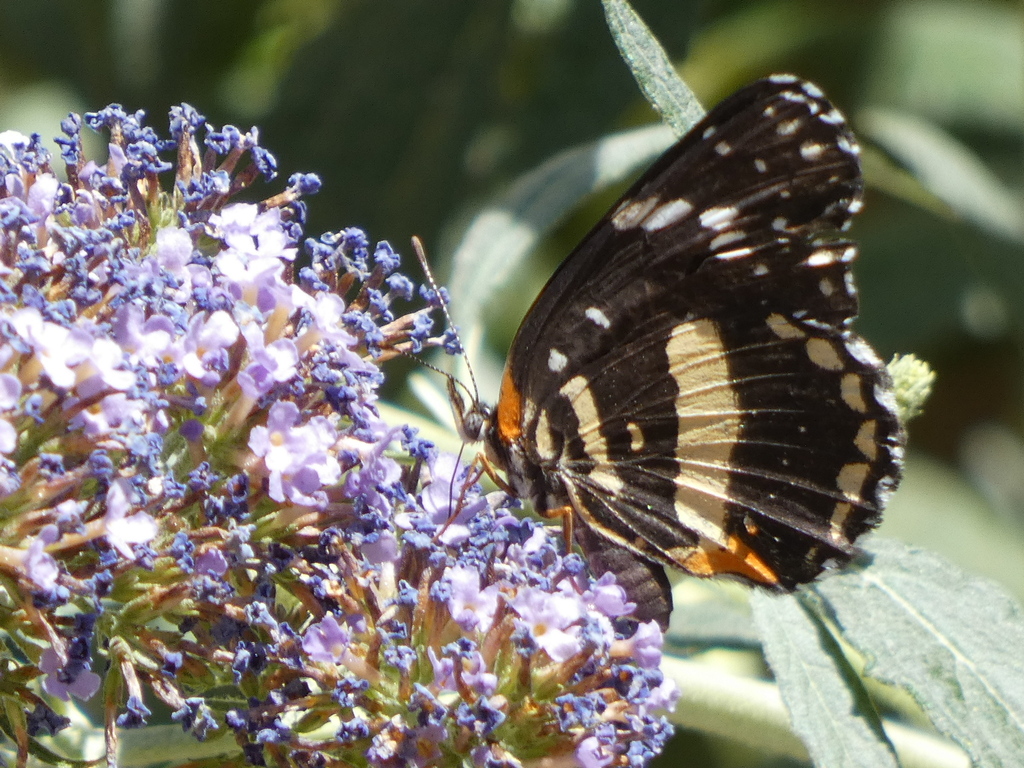
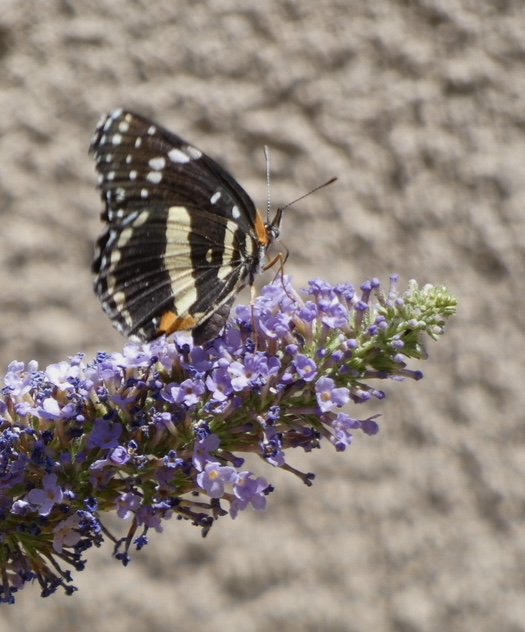
Bordered Patch (my photo/2023 – on butterfly bush)Bordered Patch catBordered Patch (my photo taken 2023These dandy little butterflies, the Bordered Patch, often choose the Cowpen Daisy as their larval host. (The butterfly nectaring on butterfly bush flowers are from my home collection)
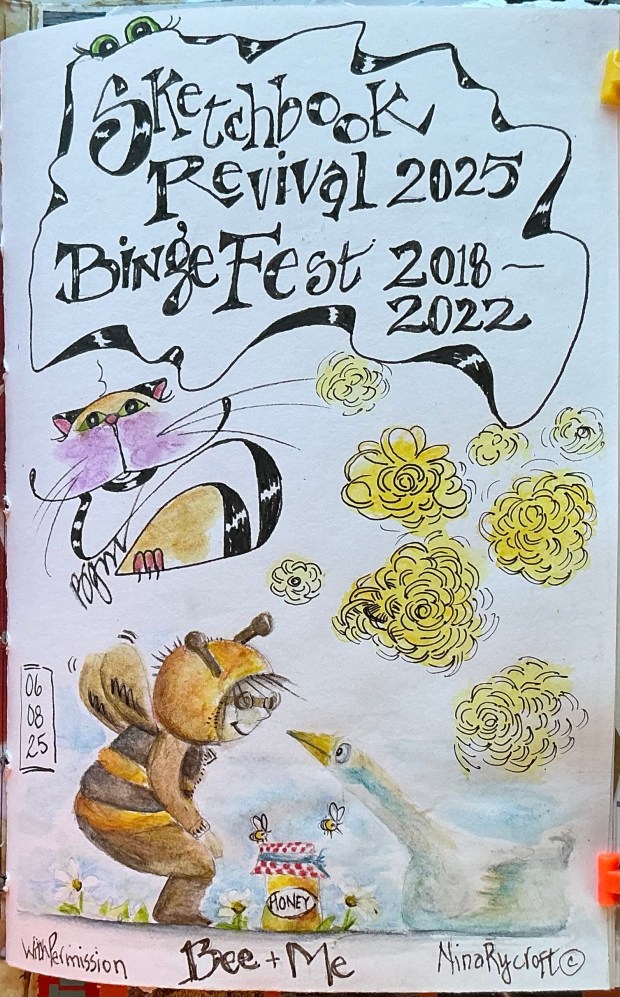
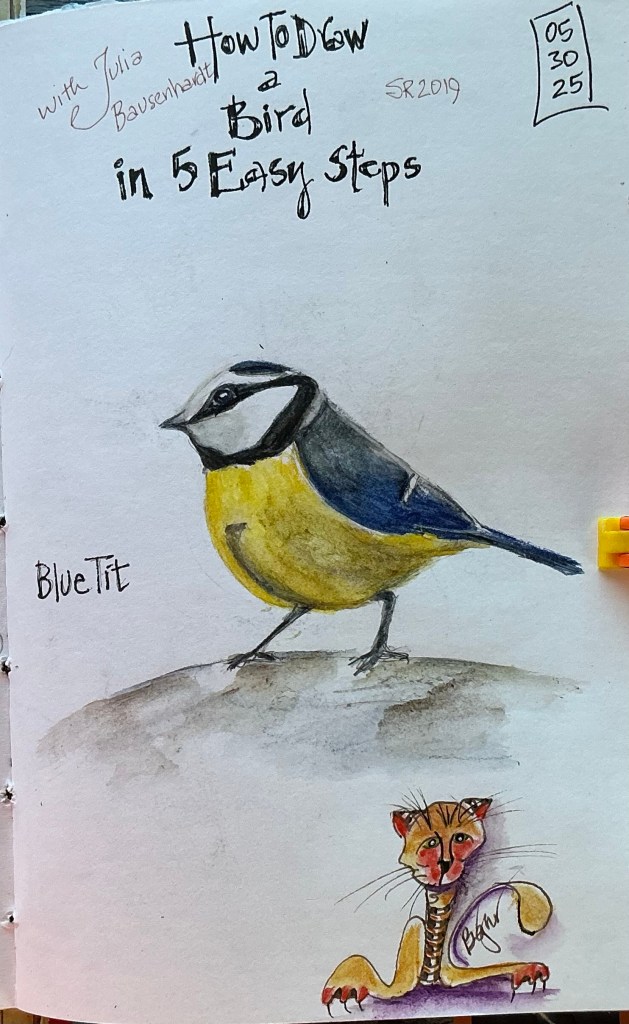
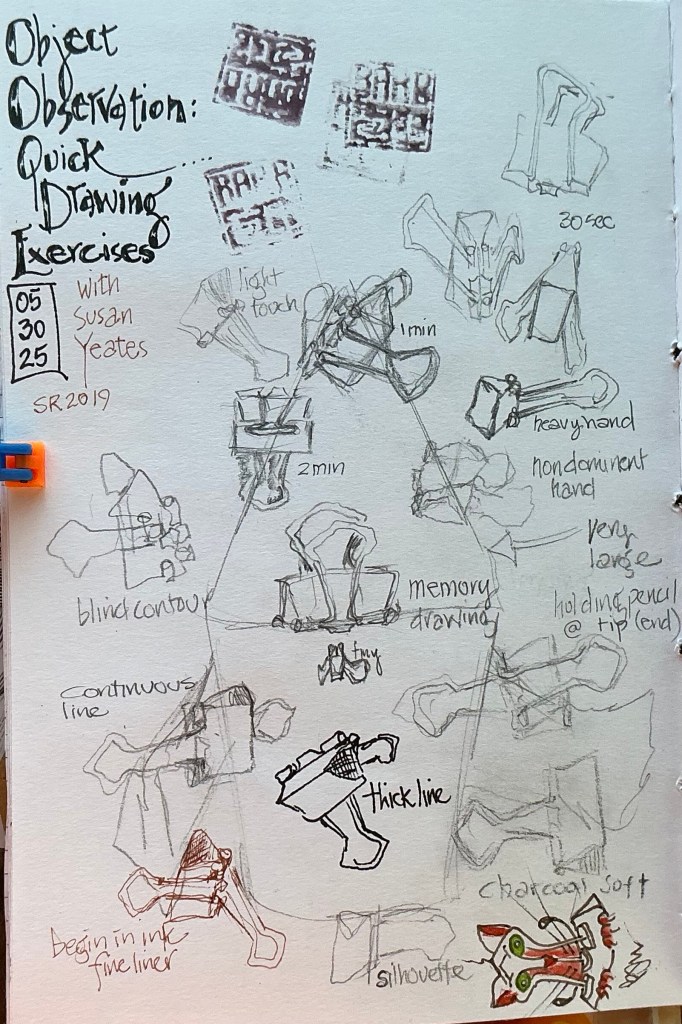
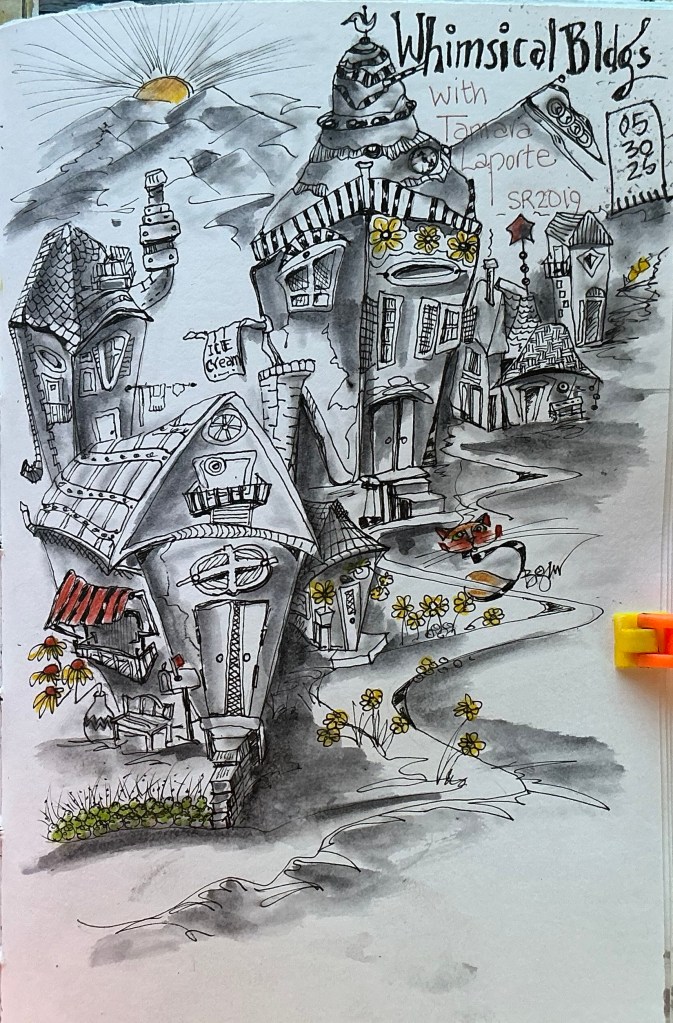
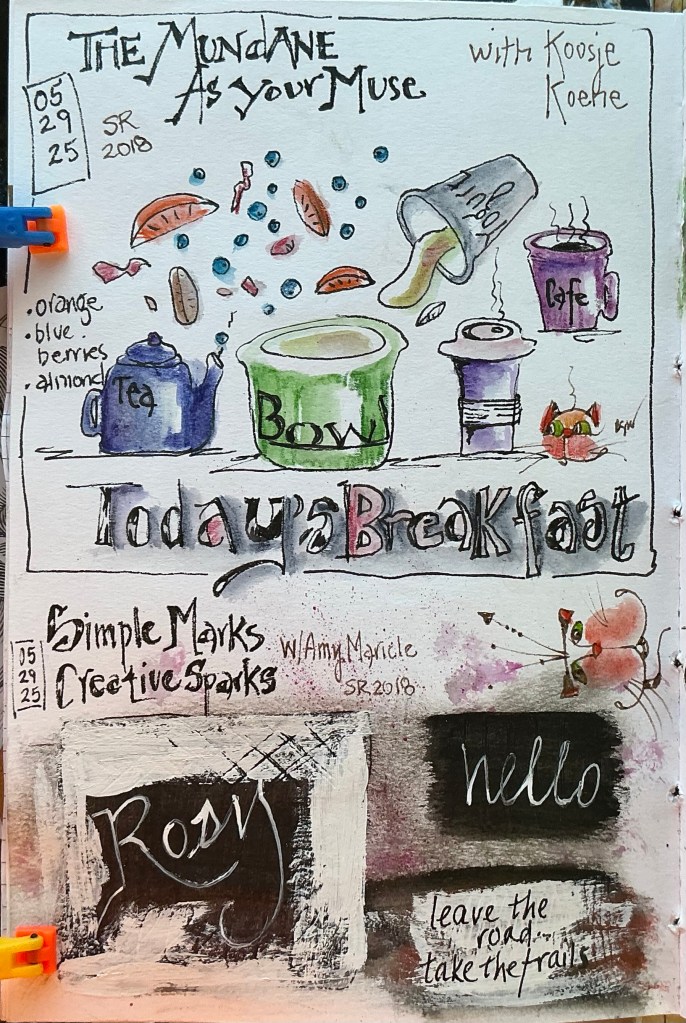
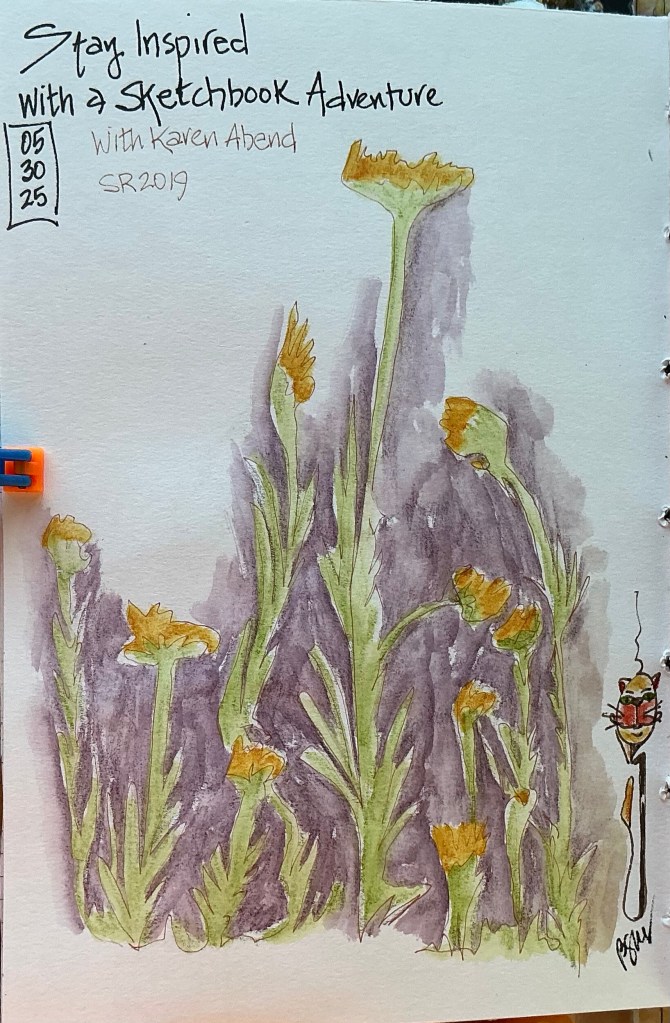
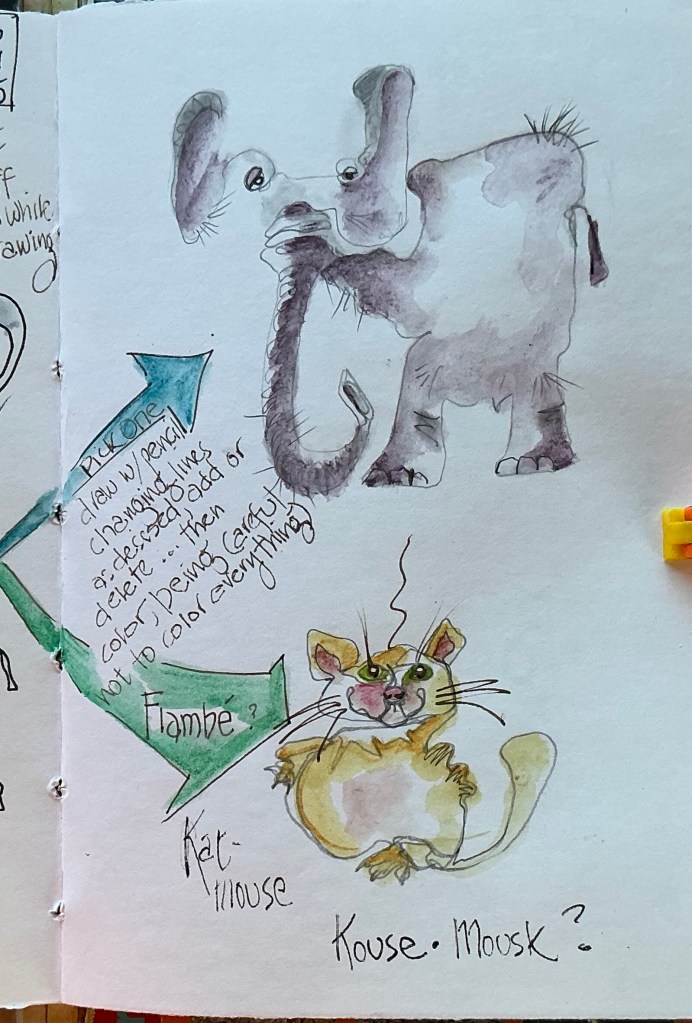
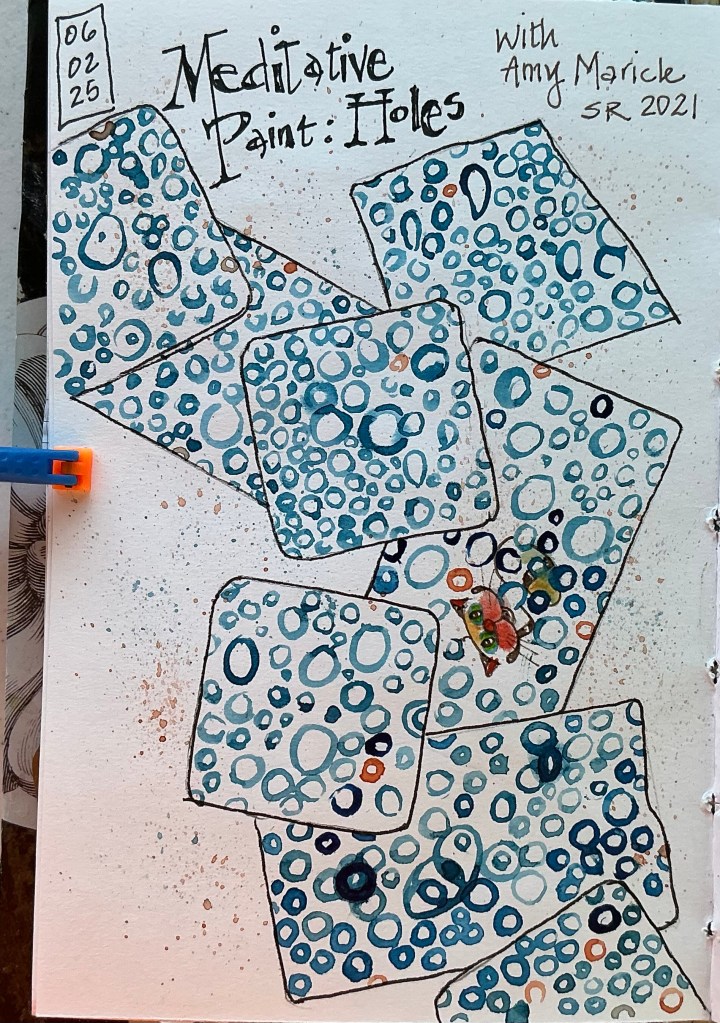
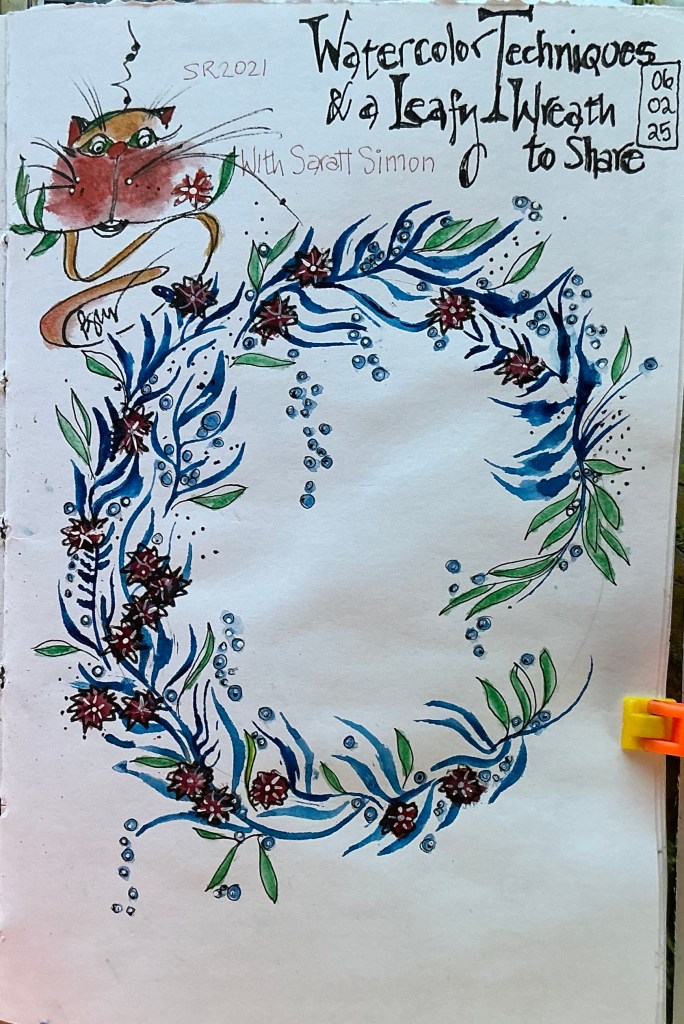
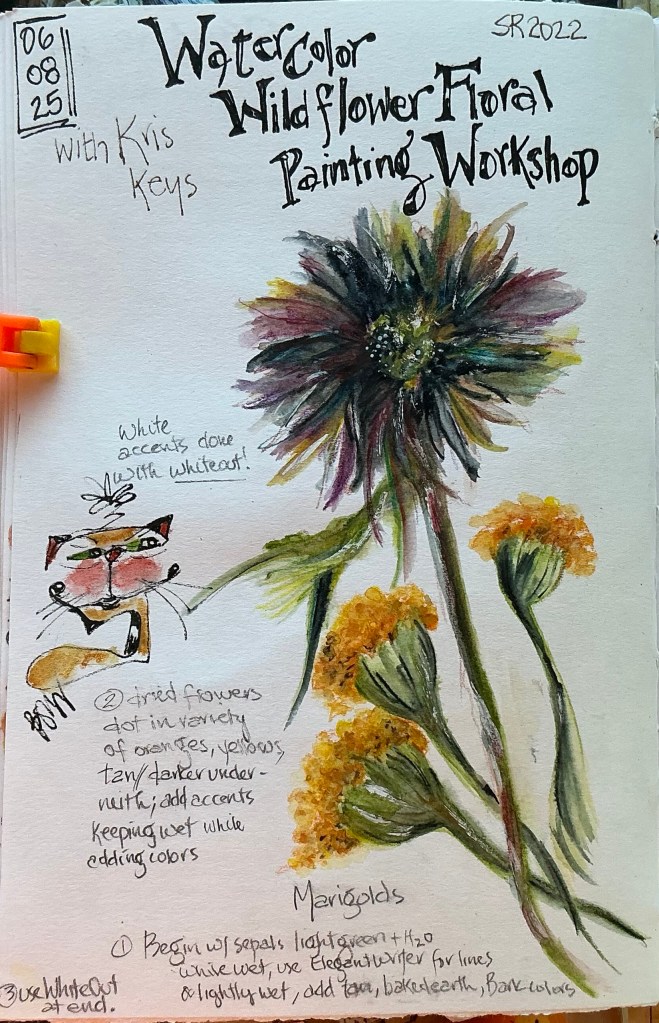
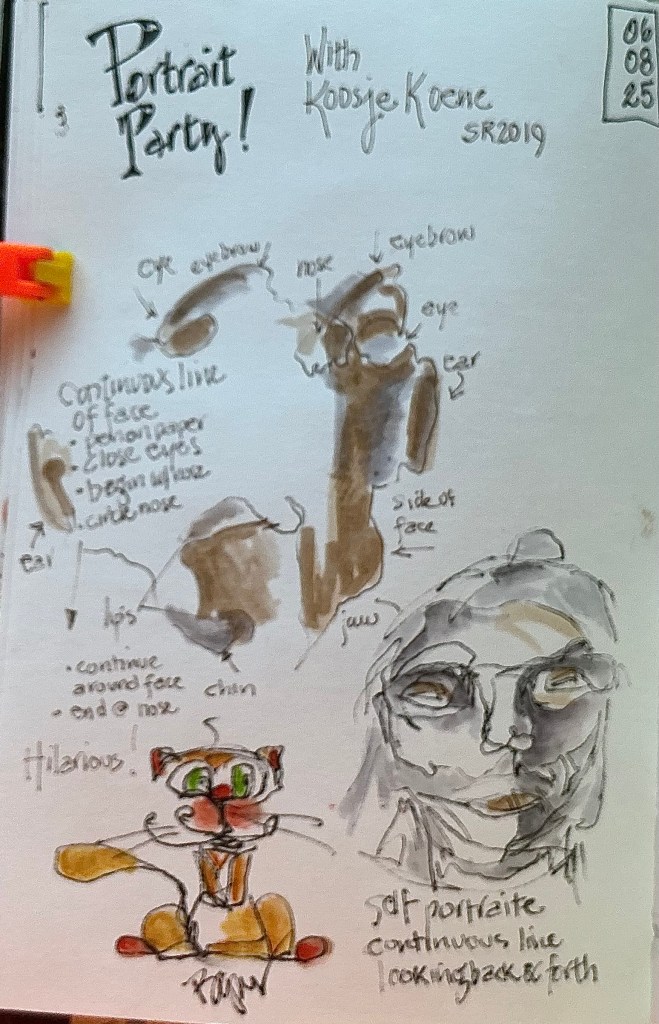
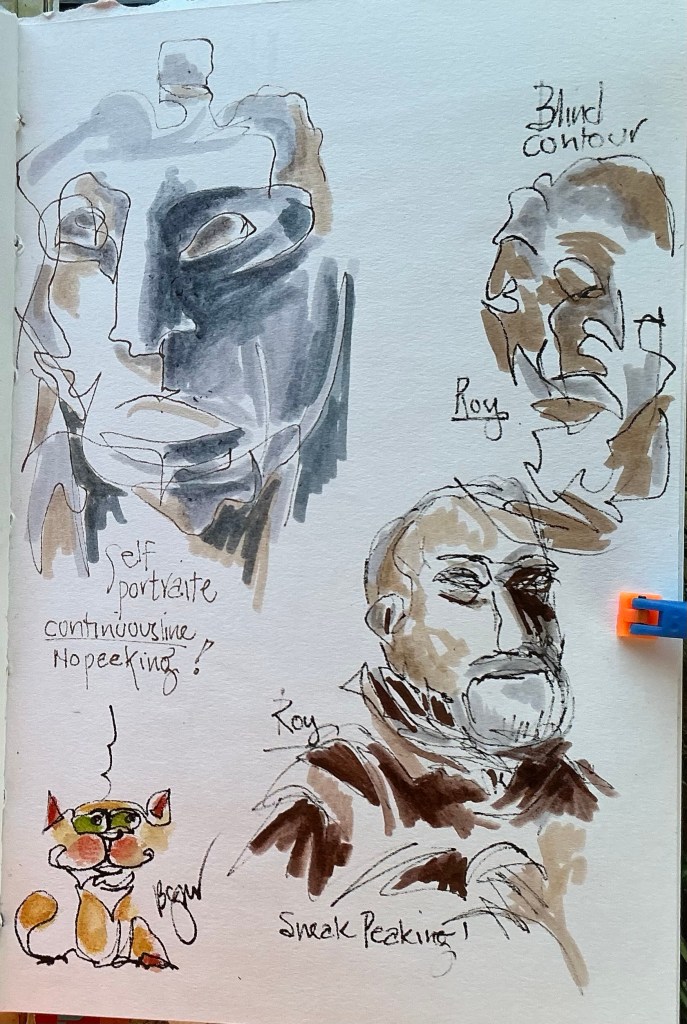
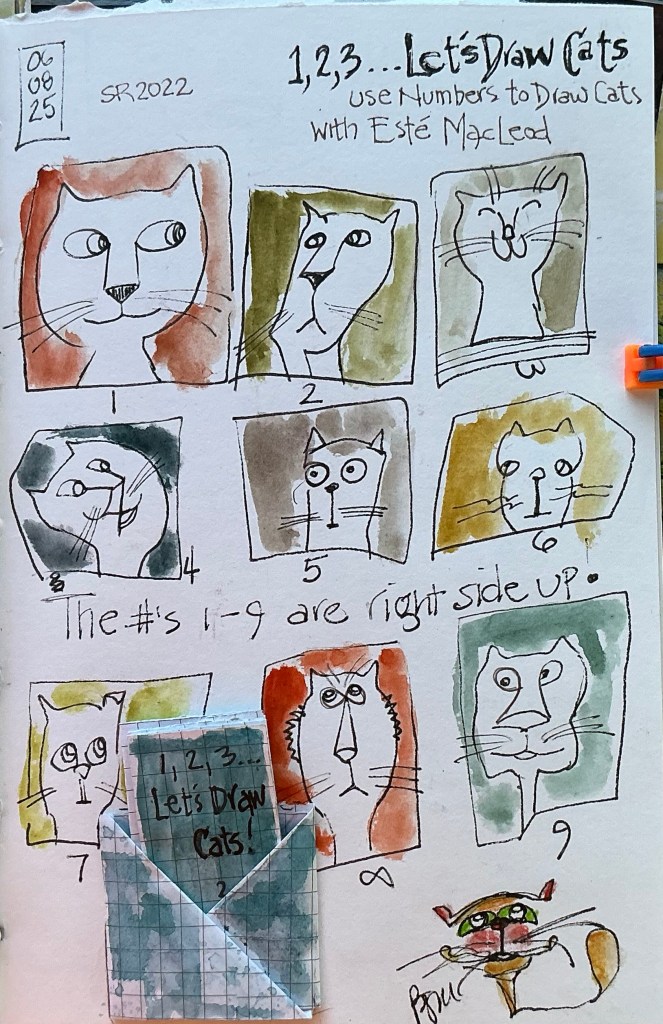
What a whirlwind celebration! Sketchbook Revival (SR) 2025 Binge Fest was so much fun. And Wow! Two jam packed weeks of creativity was over in the blink of an eye!
Karen Abend, SR creator, host extraordinaire, and wonderful artist, came up with a brilliant idea for the SR 2025 session. I would swear the creative gears inside her head were spinning with delight as she declared, “Yureka! I’ve got it!”
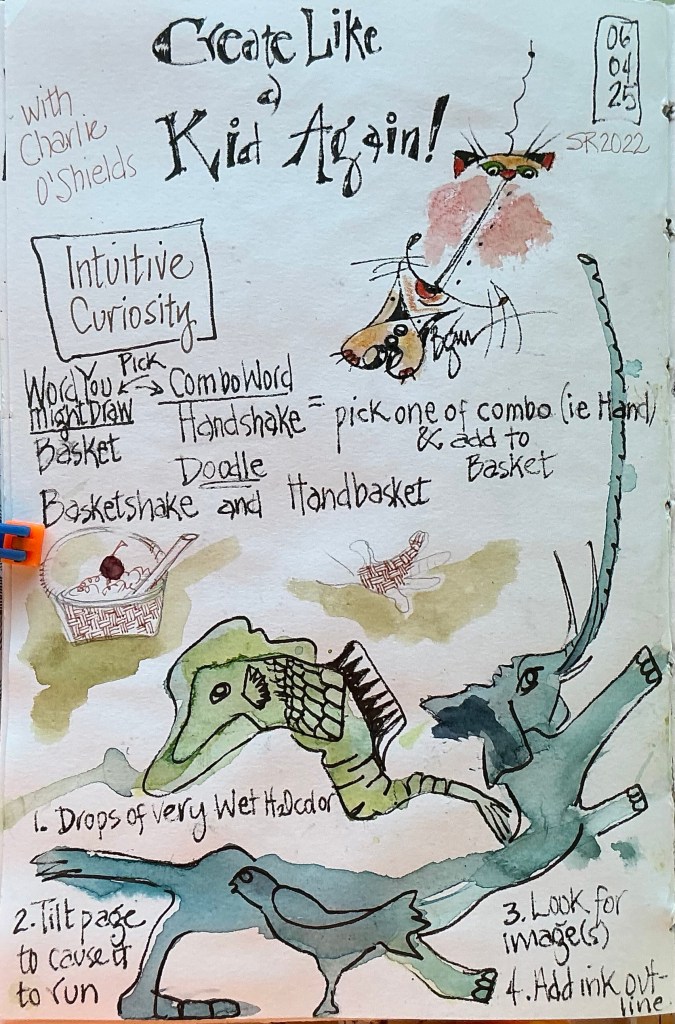
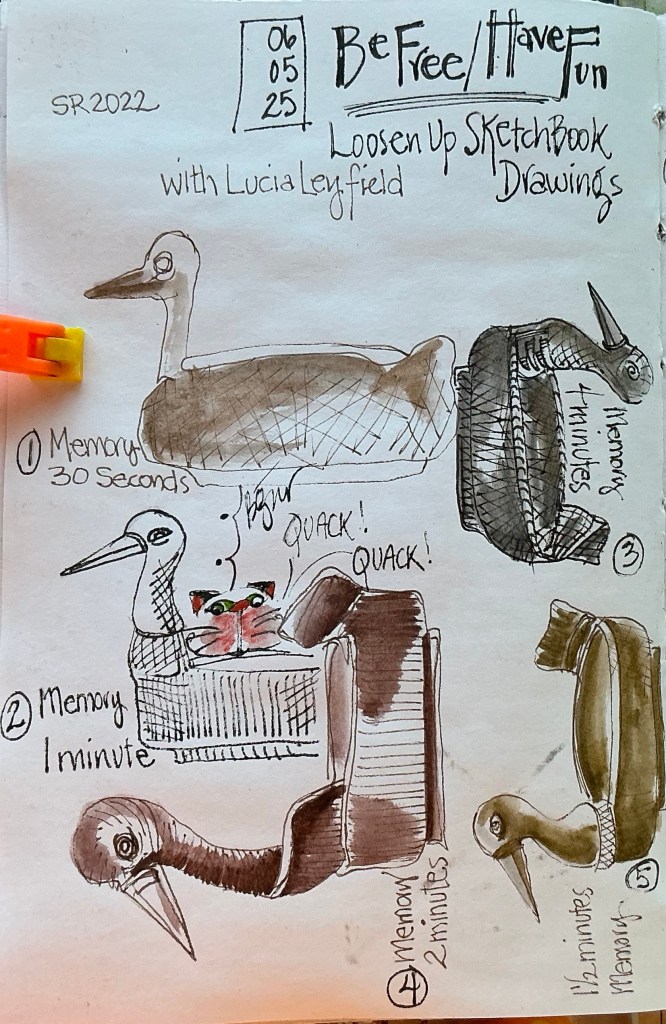
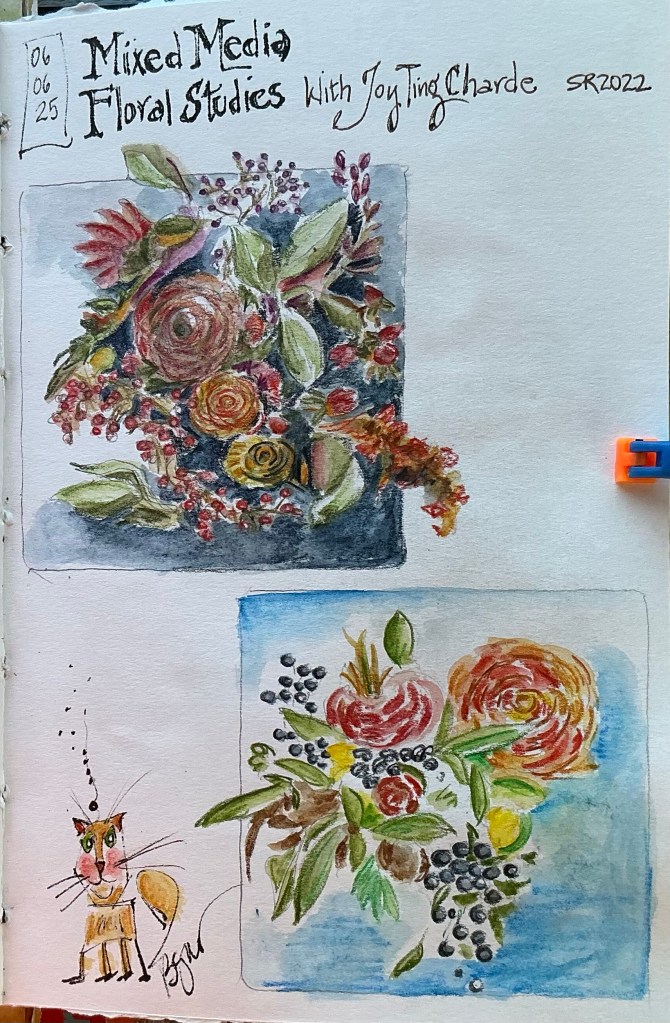
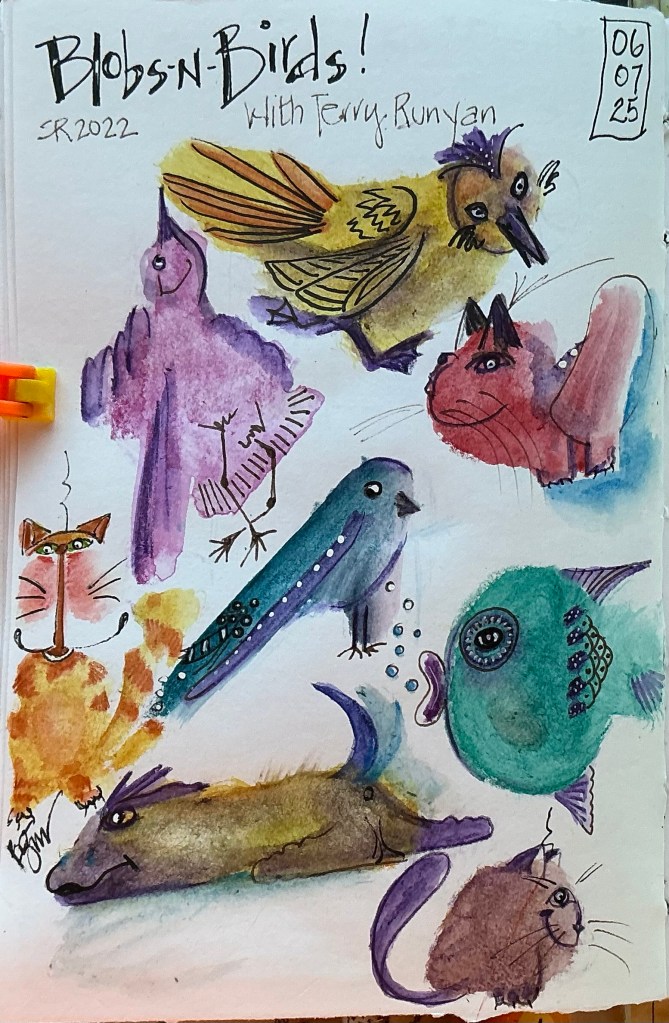
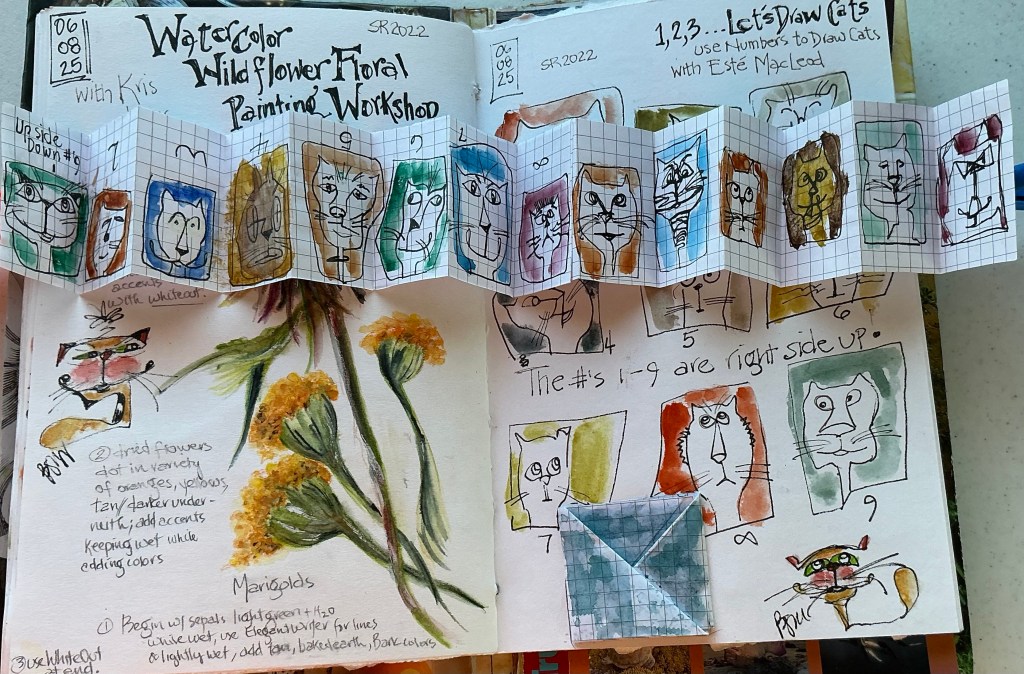
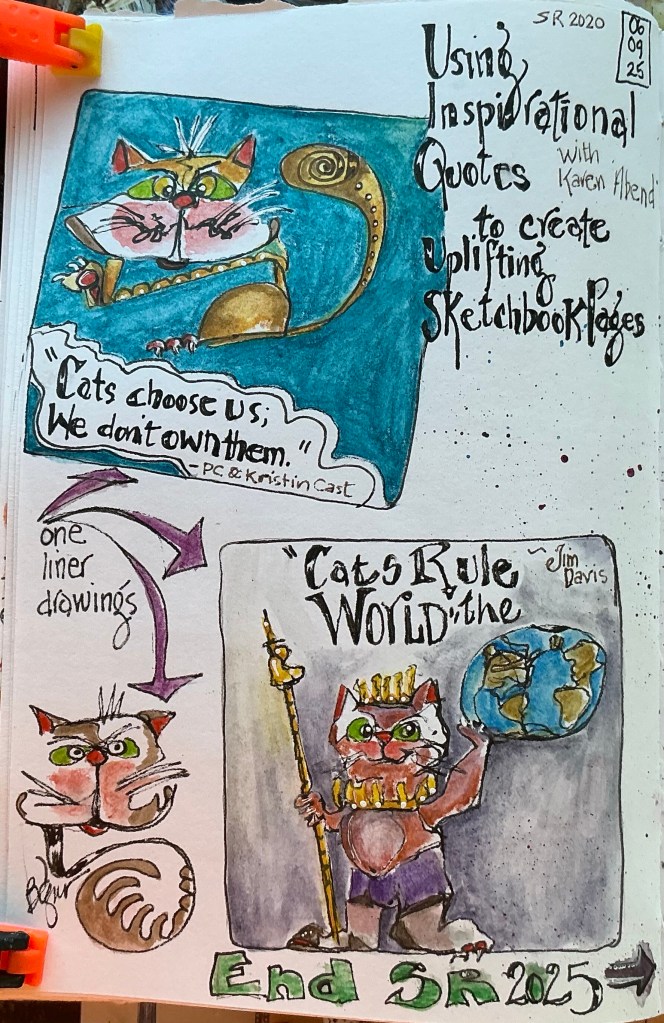
Beginning on May 27th thru June 9th, Karen generously opened up the SR historic vault and set free all of the workshops conducted the first 5 years of SR (2018-2022)! That unbelievable offering came to more than 130 one-hour-long workshops of inspiring, hands-on, and creative play time all instructed by well-known experts in artistic fields associated with Sketchbook Journaling.
Challenge presented ……. Challenge accepted.
Since I’ve been participating in SR each year since 2018, and attended most of these workshops in the past, my goals and strategies to tackle the challenge were these:
Complete a minimum of 4 workshops daily;
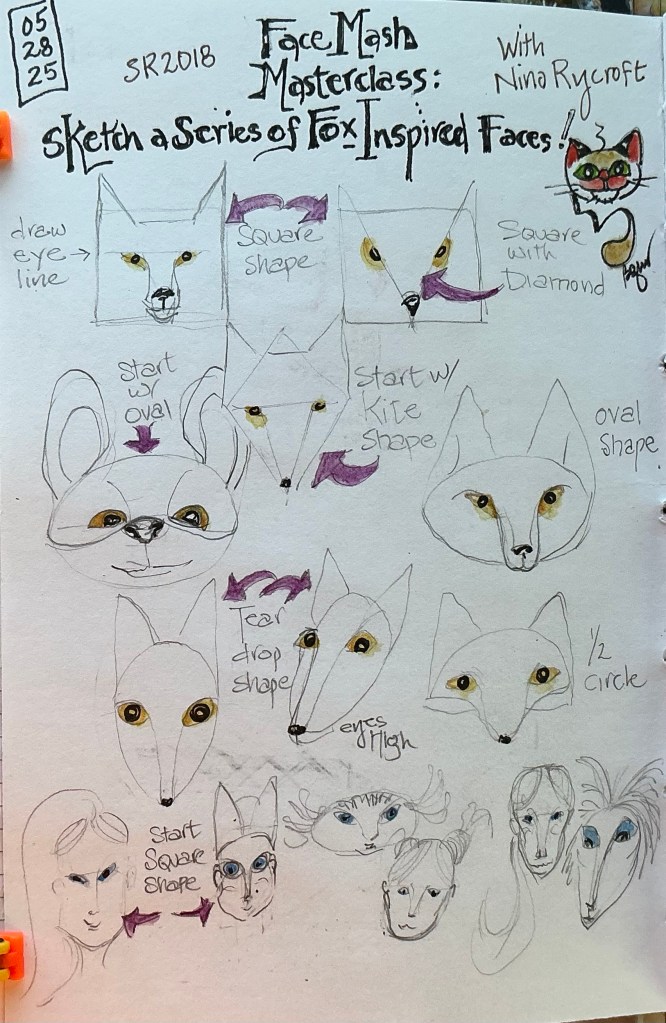
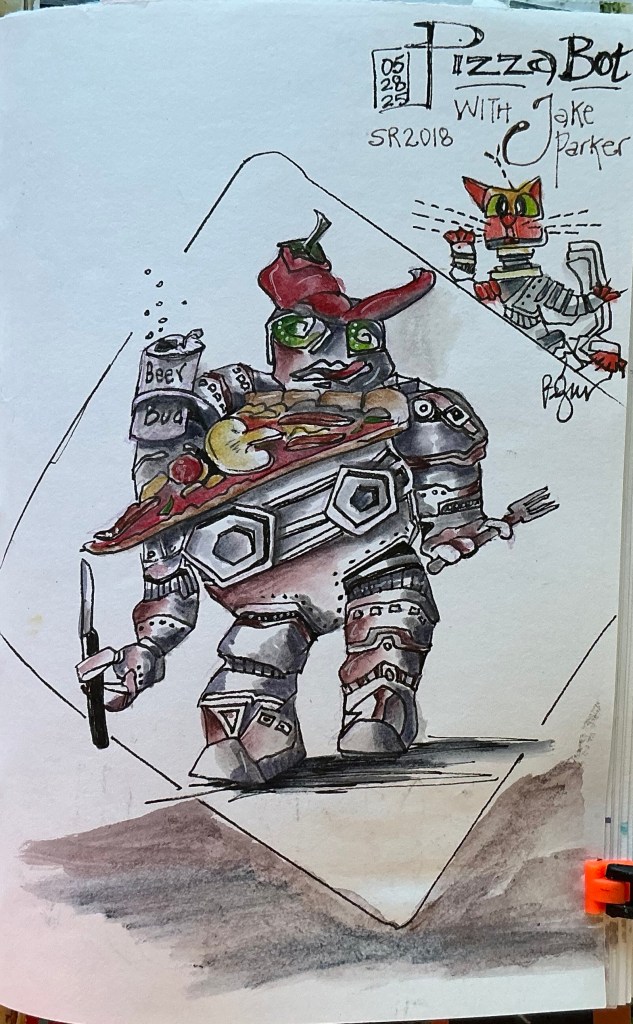
Two workshops should involve a project outside of my comfort zone, such as portrait drawing, fantasy, word play, collage, and properly stitching my own SR sketchbook so it wouldn’t fall apart during the 2-week challenge, etc.;
Two workshops should involve projects within my comfort zone, such nature subjects, urban sketching, whimsey, and lettering, and those using watercolor pencils, graphite, and ink;
Develop fresh, interesting, and imaginative sketches during the workshops;
Allow Flambé to play along;
Slow down, breathe, and enjoy the 2-week marathon without becoming overwhelmed;
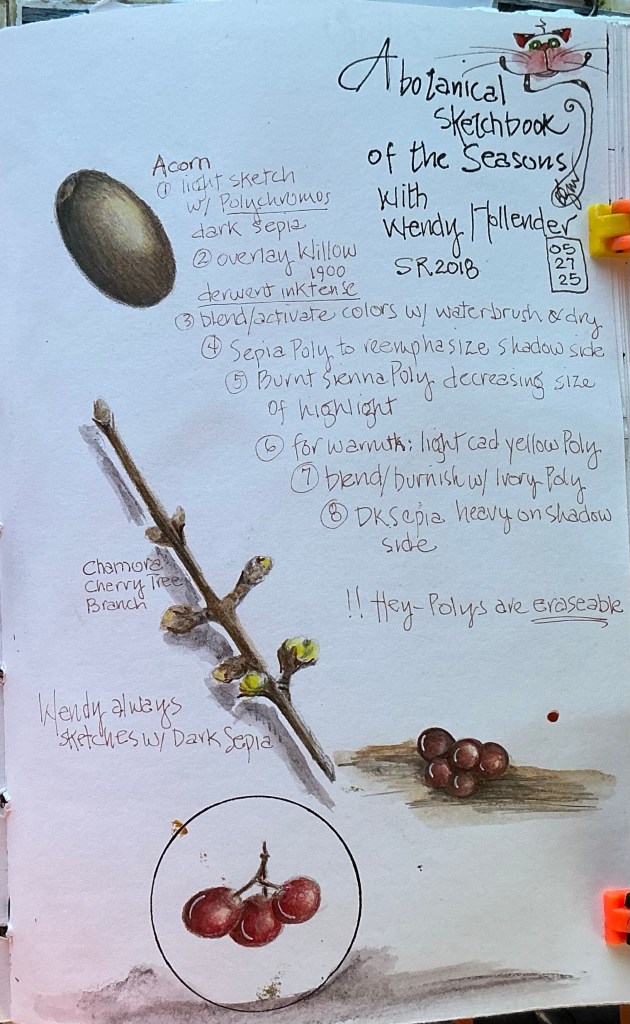
Recognize and gather take-away tips and techniques to bring into my Nature Journaling practice and Zentangle storytelling.
Keep sketching and sharing.
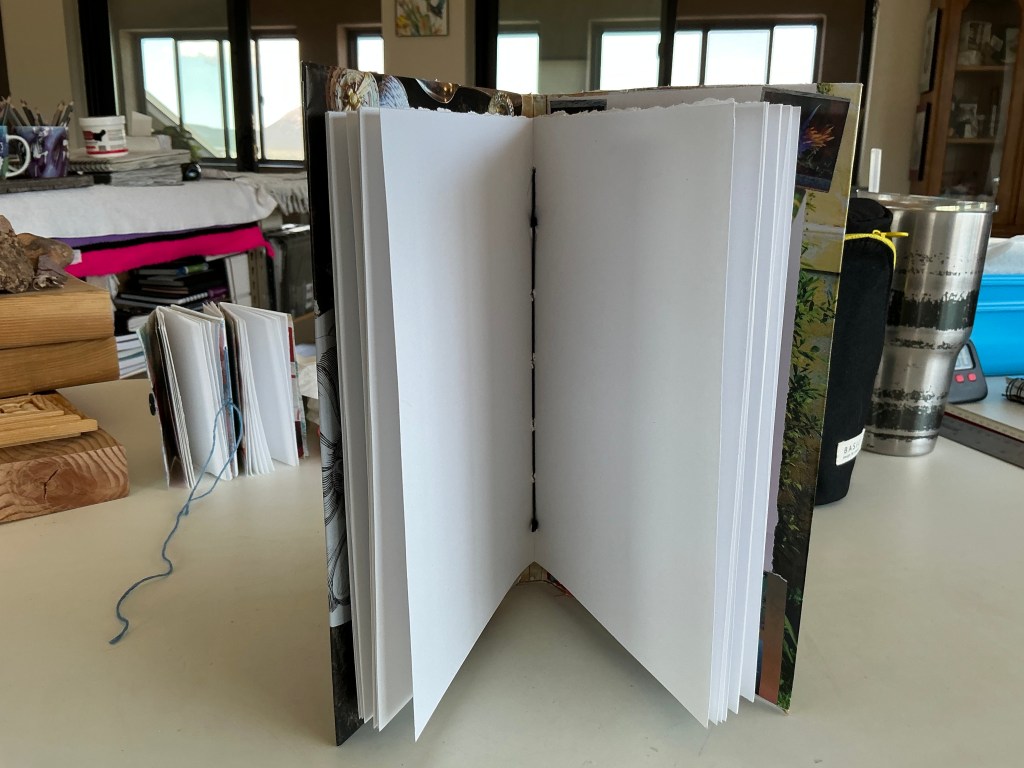
After two weeks of play, I was able to fill up my handmade and successfully stitched SR 2025 sketchbook! With a total of 46 pages completed (doubling up workshop projects on a handful of pages), including several pockets with inserts, I was pretty happy (and a bit exhausted).
If you’ve participated in SR in the past, or maybe took on the 2025 challenge as your first time, you know how intense (in an exhilarating way) it can become. If not, and would like to learn more, check out this link
This link will take you to Karen Abend’s website where you can ask for more information about Sketchbook Revival. https://karenabend.com
Hope my collection made you smile and laugh! I certainly got a kick out of the experience.
Well, until Sketchbook Revival next year, thanks for coming along!
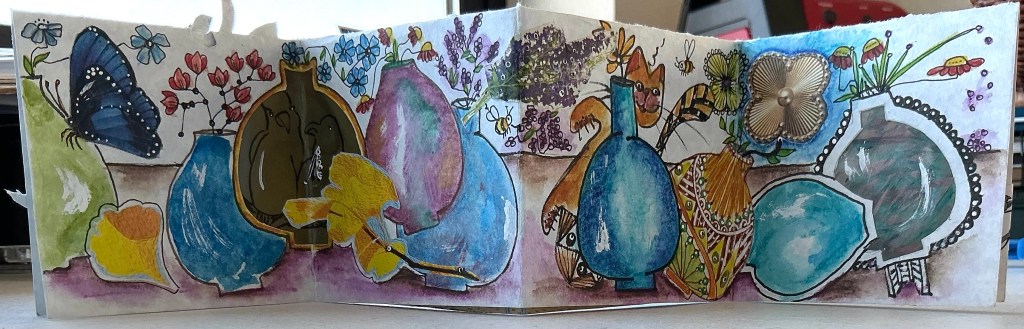
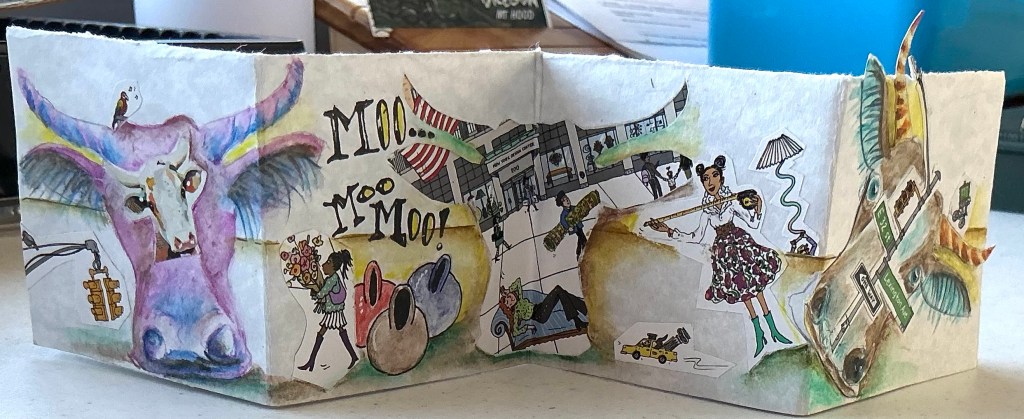
Front and back of the concertina book that tucks into the pocket above.My hand sewn, one signature SR 2025 Sketchbook.
Such an awesome-inspiring place to spend a Spring week in New Mexico!
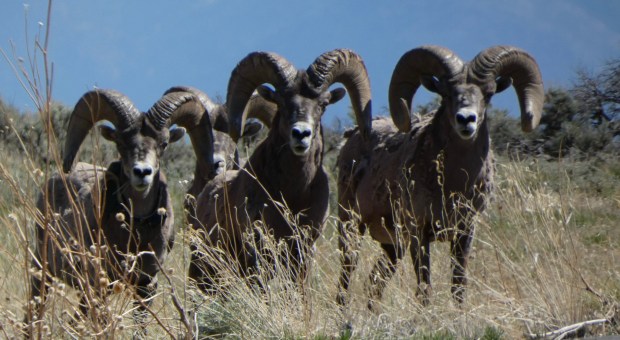
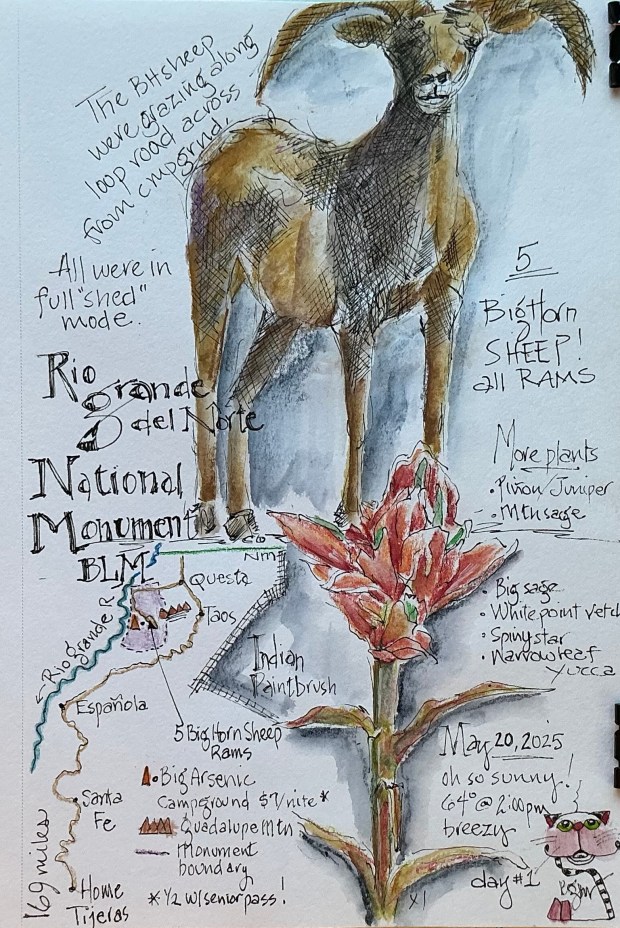
Three of the five big boys! Rocky Mountain Big Horn Sheep.
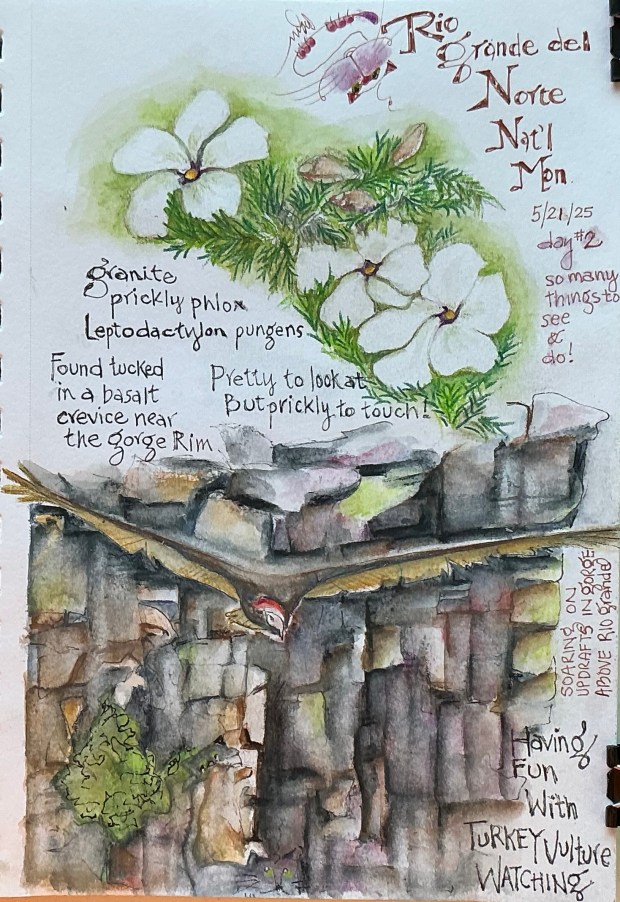
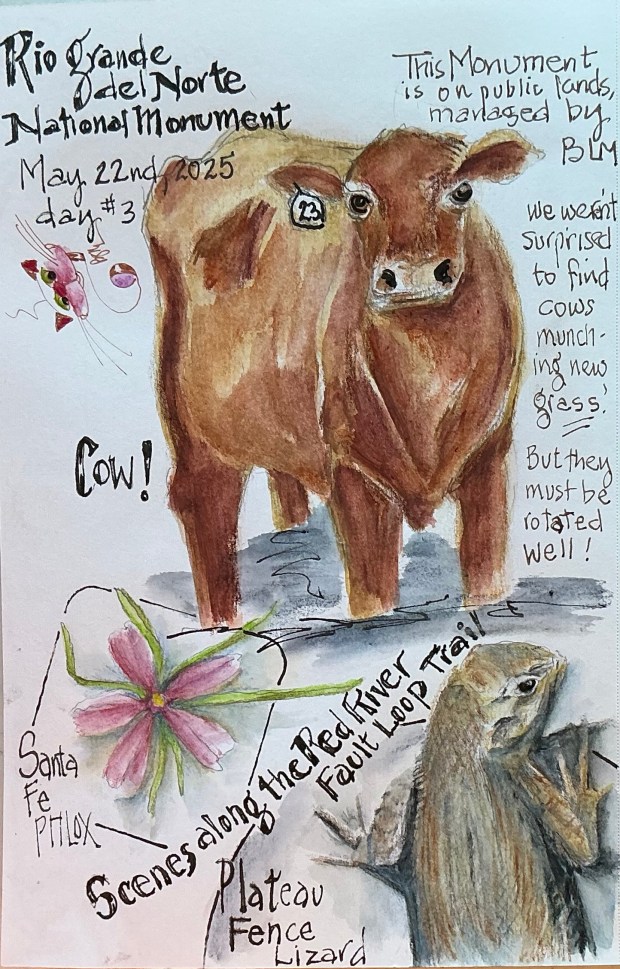
Rio Grande del Norte National Monument …..
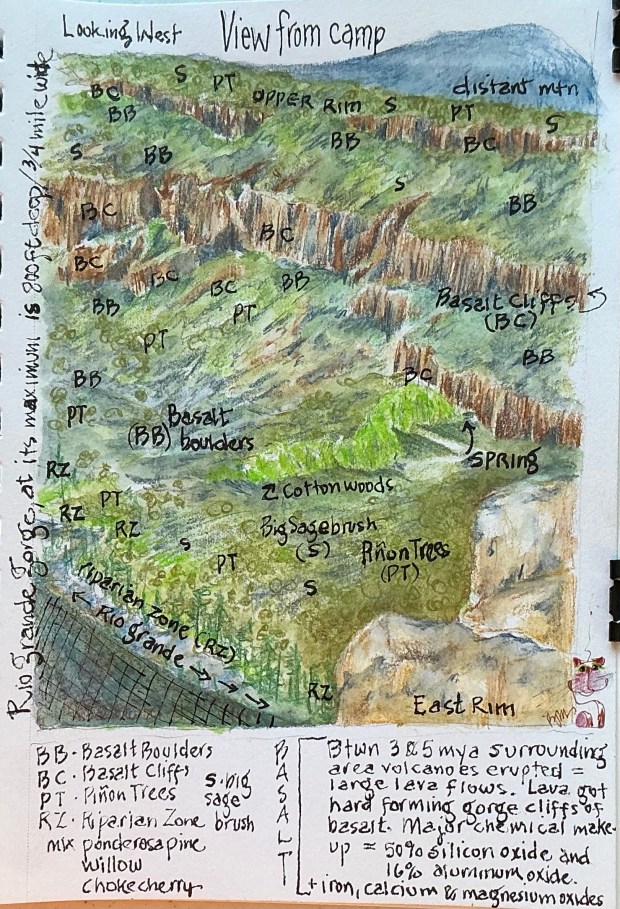
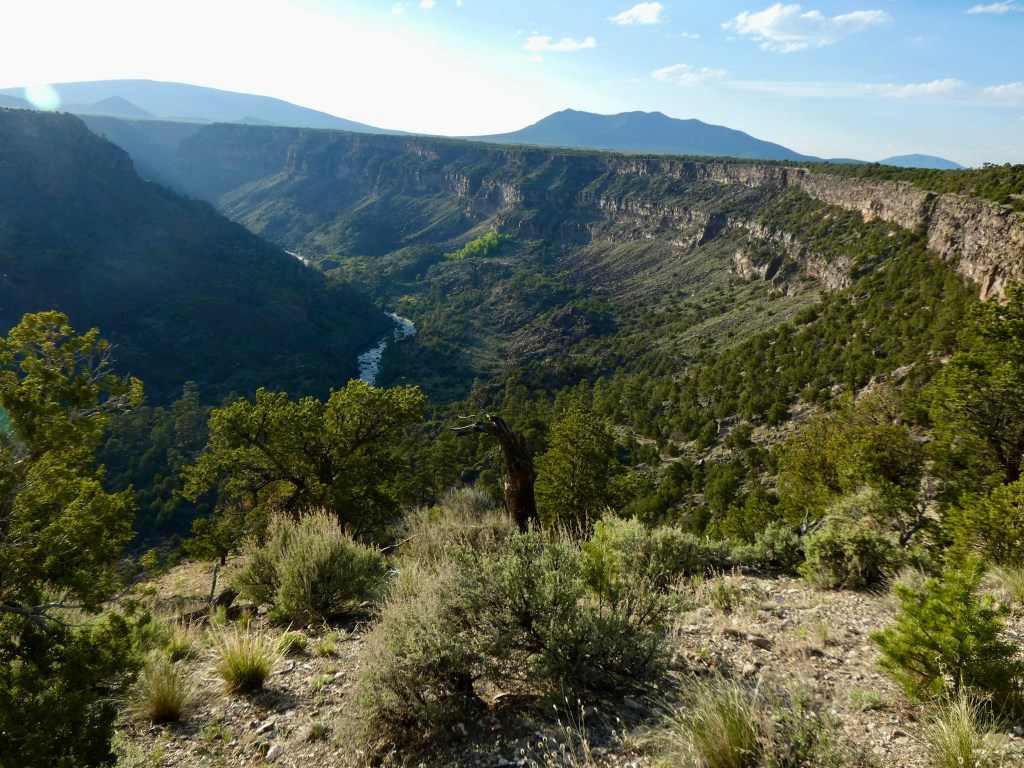
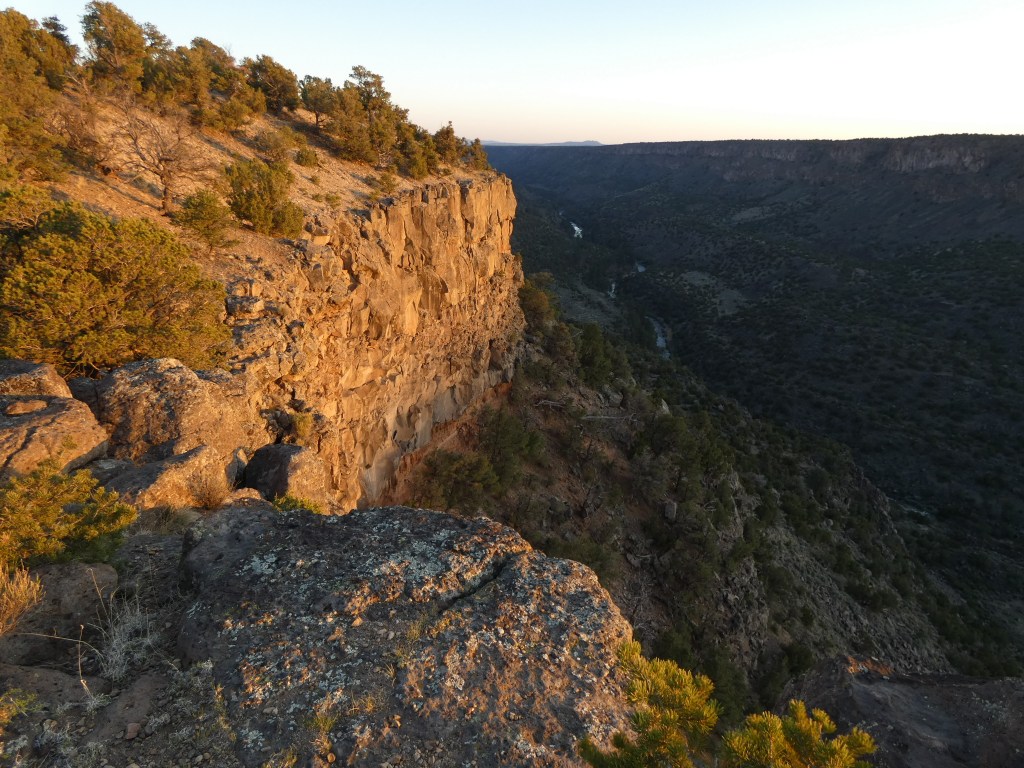
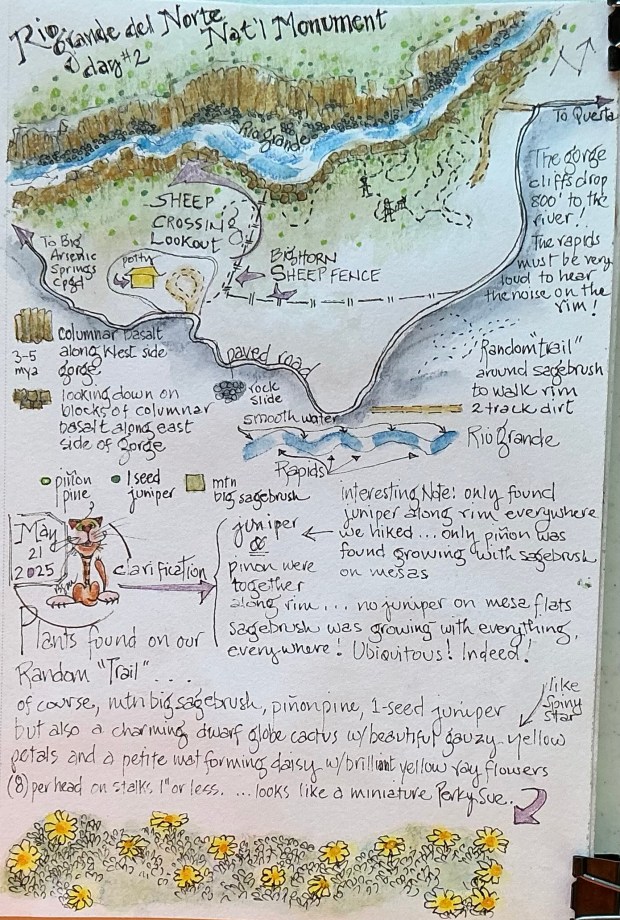
comprises a breathtaking 245,000 acre area of the northern Rio Grande rift valley in north central New Mexico. Established as a Bureau of Land Management (BLM) national monument in 2013, the rugged wide-open plains average 7,000 feet in elevation before dropping into steep narrow canyons carved into the landscape by rivers that have been flowing for millennia.
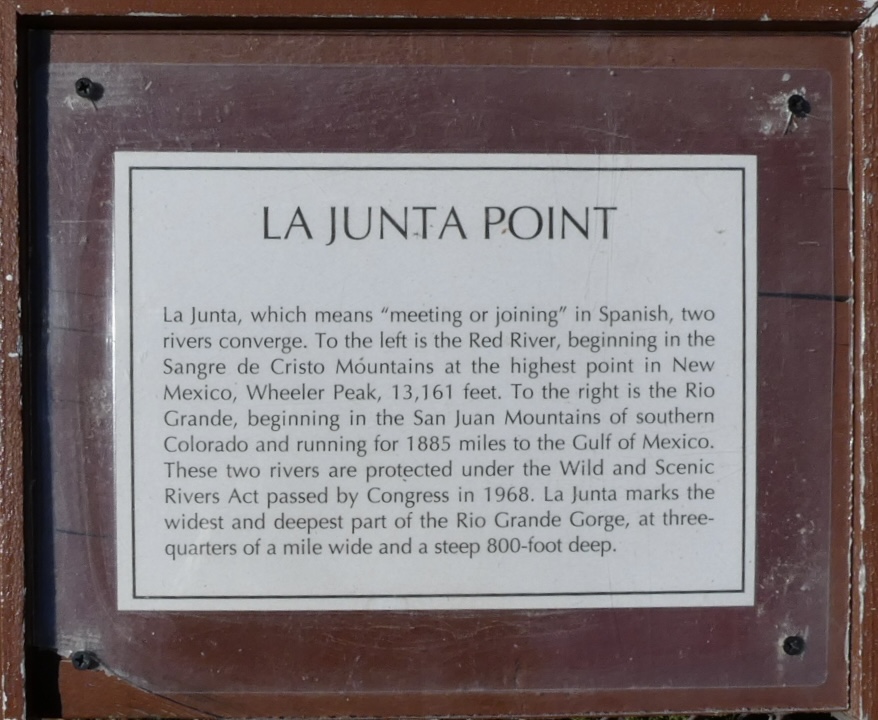
The confluence of two of these rivers, the Rio Grande and the Red River, occurs in the northern Wild Rivers area of the Monument. It’s at this confluence where the gorge is its deepest at 800 feet, and its widest from rim to rim measuring 3/4 mile. It’s an impressive view from the la Junta (“the Meeting”) Overlook. All of the views from anywhere along the rim are impressive.
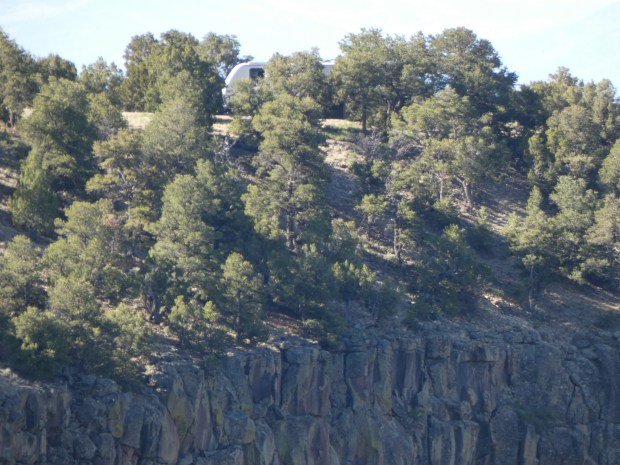
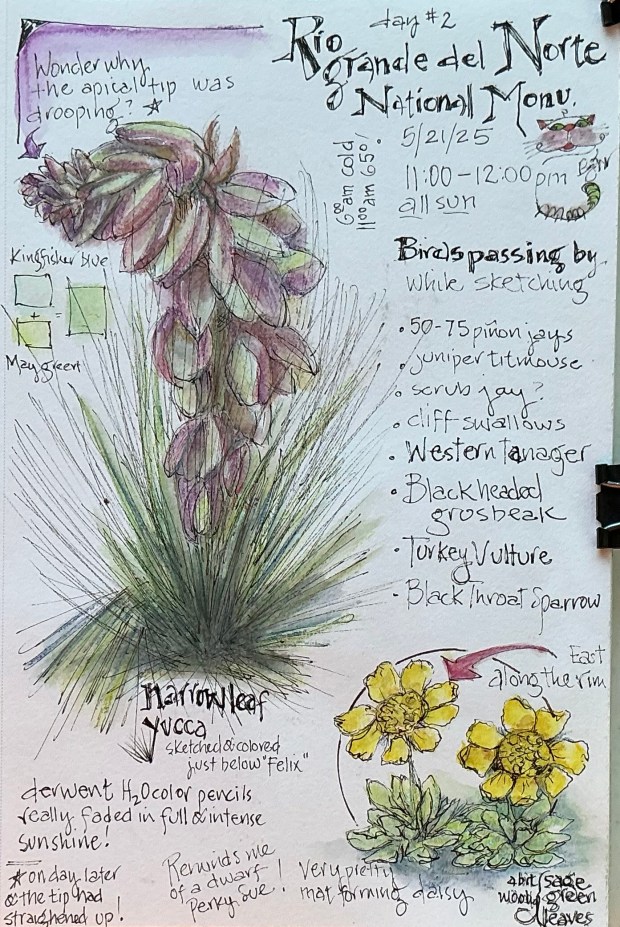
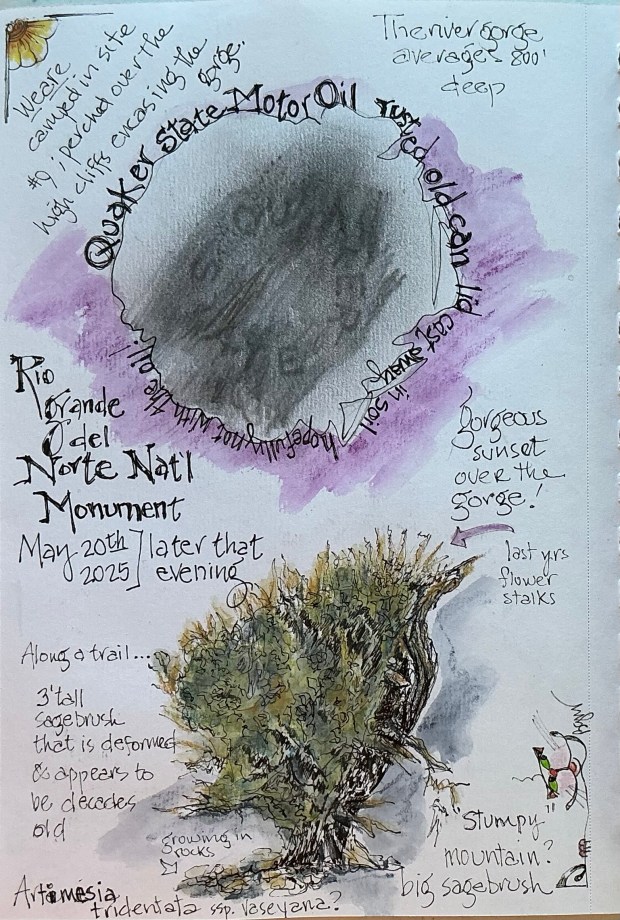
We backed our RV (‘Felix’) into what must’ve been the best designated camping site ever ….. #9 on the southern loop in Big Arsenic Springs Campground. After setting up, we discovered that Felix rested only a few steps west was the rim and the long plunge down to the Rio Grande! But immediately south of us, the rim formed a small peninsula where nearly every afternoon I could be found sketching the plants growing from the basalt cliffs, or the swifts and turkey vultures soaring along the cliffs and over the river aided by the canyon’s updrafts. This skinny little peninsula quickly became my favorite sit spot; then late one morning it became priceless …….
Can you spot our RV? We were precariously perched above the Rio Grande, right on the rim of the gorge!
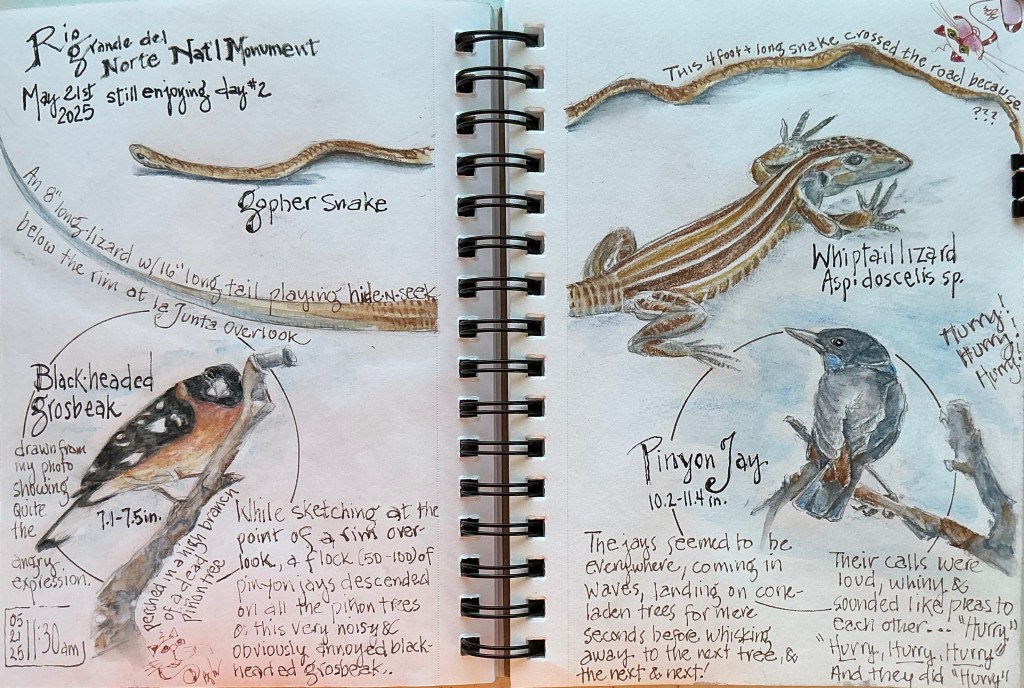
I could hear them approaching, like a swarm of bees. In a matter of seconds I was witnessing a cacophonous chorus of 100’s of pinyon jays. These noisy birds quickly moved in and onward while descending, like they were famished, on this year’s piñon pine cone-laden trees in large erratic groups, all the while screaming, “Hurry, Hurry, Hurry, Hurry!” Where exactly they came from or where they went remains a mystery. All I know was the spectacle must’ve lasted a good 10 minutes or more, as I watched wave after wave of these birds pass by. I still get goosebumps (jaybumps?) recalling those exciting moments.
We had planned to spend only one day camping in the Monument, but every morning we decided to stay at least another and then another day. We hiked every rim and interior trail (sometimes more than once), spent hours at all of the Overlooks getting ‘High on the Views,” were thrilled with our chance encounters of five (5) Rocky Mountain Big Horn Sheep rams (twice in one day), and marveled at how the forces of nature* collaborated to carve the narrow and steep 800 foot deep gorge within the Monument.
But alas, it became time to pack up our home away from home. Even tho a string of completely clear days allowed sun to shine on our solar panels from sunup to sundown, keeping Felix’s battery purring happily our entire stay, it did nothing to recharge our potable water tank. So the morning we found the water indicator light teetering on ‘Empty,’ was the day we headed for home (after enjoying a farewell hike, of course) with my nature journal full of sketches and memories for a lifetime!
Do you have an especially special place where you can spend time in nature? Please share your discovery and what makes it so awesome!
As always, thanks for stopping by!
*Geology 101
From the overlooks throughout the Monument, we could see stacks and stacks of basalt and ash lining the narrow canyon walls of the Rio Grande Gorge. It’s hard to imagine the volume of material deposited during two very active periods of volcanic activity that occurred 5 and 3 million years ago. Soon after these events, water moving through the major drainage in the area (today’s Red River) began eroding pathways into these deposits as it flowed downstream into the 10-16 million year old rift valley. Geologists refer to the ancient Red River drainage as the ‘original Rio Grande’ because the still-closed San Luis Basin to the north (in south central Colorado) would not overflow for a few million years. Then 400,000 years ago, coinciding with a change in climate resulting in an overabundance of snow and rain, the San Luis Basin filled and spilled. As water does so well, this new and powerful river, today’s Rio Grande, moved ‘downhill’ towards the ‘original Rio Grande’, cutting through everything in its path (including the ancient volcanic deposits). When it converged with the ‘original Rio Grande,’ the erosive force of both rivers became enough to eventually carve out an 800-foot deep gorge in the Rift.
Confluence of the Rio Grande and Red RiverSunset on basalt cliff
Many Hearty Thanks, Sharing Creative Ideas, Answering the ‘Kat’ Kwestion
April 1, 2025
Completing my 15th sketchbook, and beginning the next one is always cause for celebration! To do so, Kat and I thought it would be especially fitting to shout-from-the-treetops enthusiastically, THANK YOU! Thank you all, my loyal subscribers, for coming along on my interesting, hopefully educational, sometimes crazy, always curious nature journaling adventure.
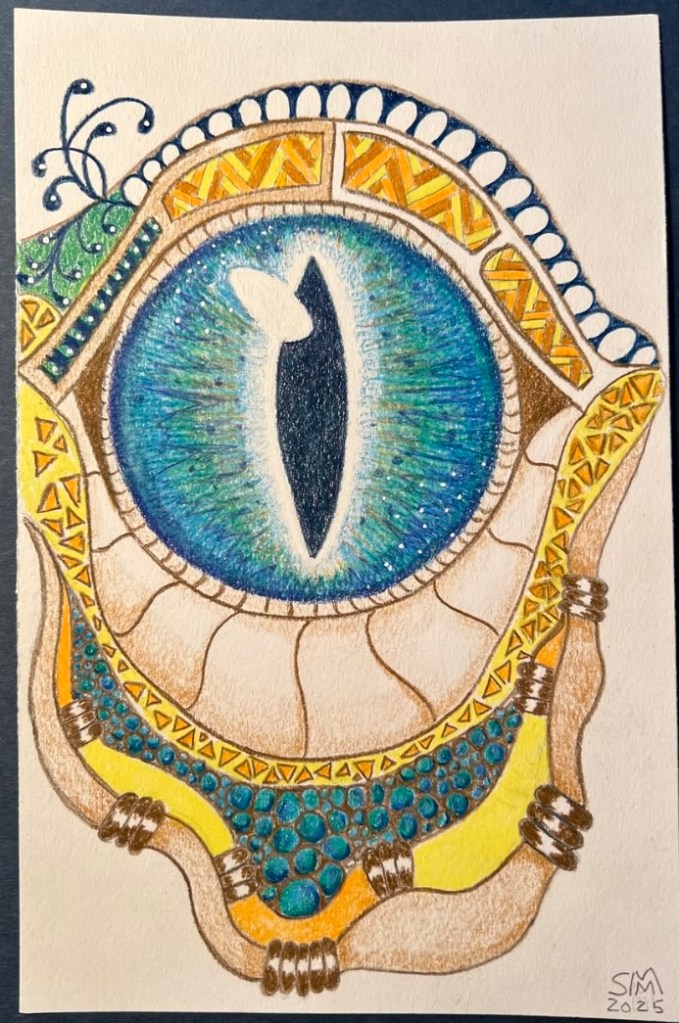
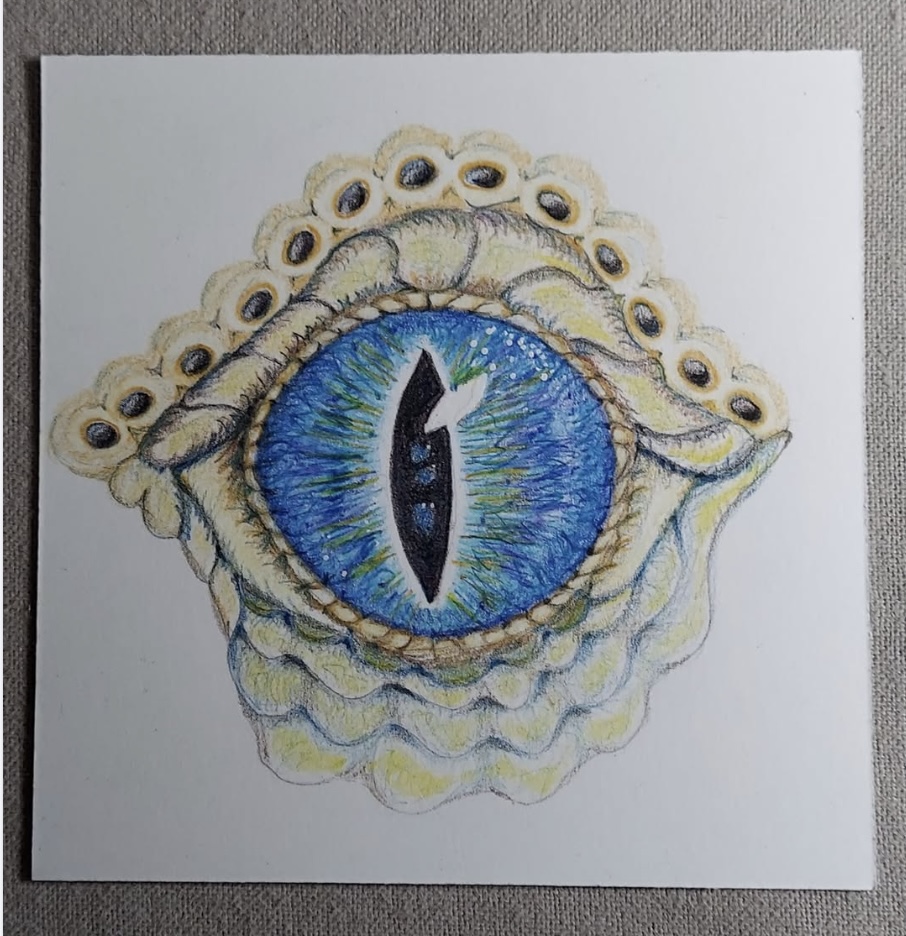
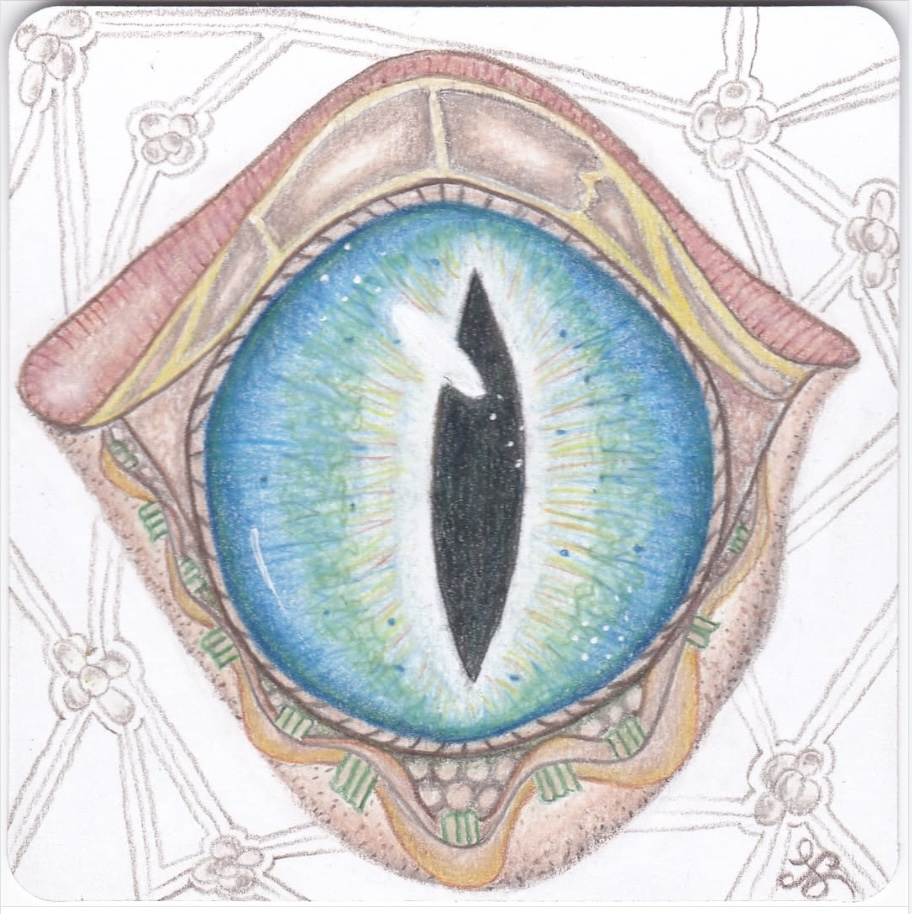
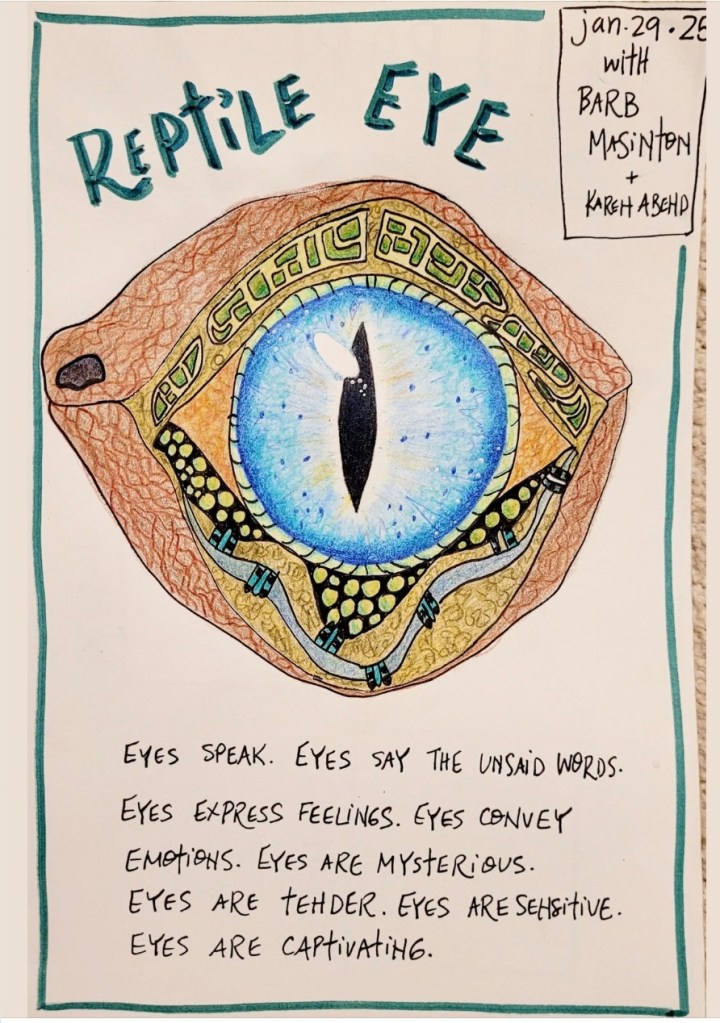
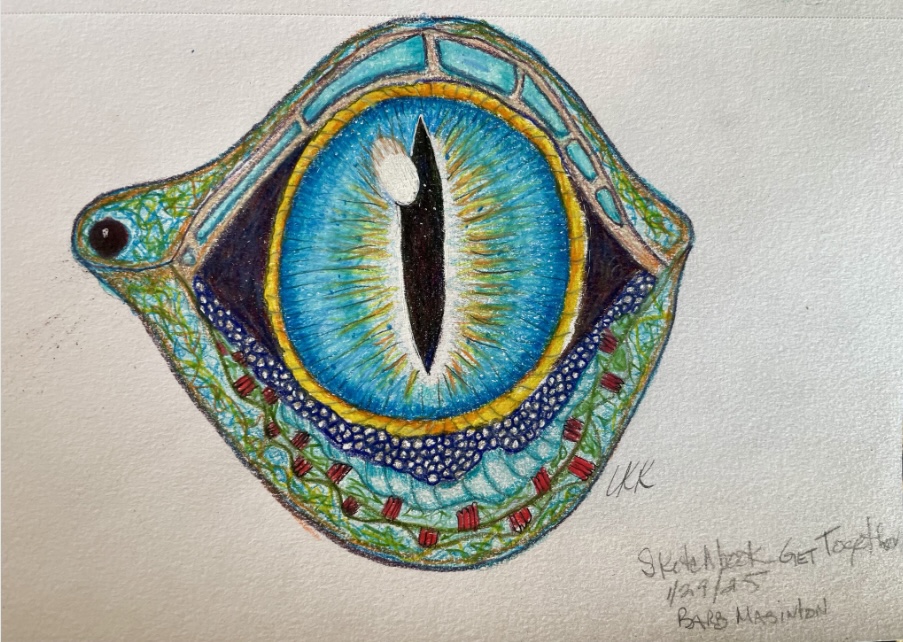
My recent webinar class, “Create a Colorful Reptile Eye1,” sponsored by Host Karen Abend (of Sketchbook Revival fame), generated many new subscribers to my web page and blog, “A Curious Nature.” Wow! And Thanks so much. A special thanks to those who attended the live and/or recorded class. I loved seeing so many colorful lizard eyes (a sampling below). They were incredible!
Sharing the Wonder of Nature
With all the past and current activity on my blog, I feel so fortunate and very encouraged to carry on. Even though new postings have been random lately, there’s lots of works-in-progress soon to be shared. Meanwhile, comments including what you like about my posts and what you’d like to see more of, are always appreciated. What inspired you to subscribe to this blog? If it’s just enjoy, that’s perfect! Or maybe you’d like tips to develop a regular or even a daily creative practice, how can I be more encouraging? I’d love to know if you are an active nature journaler or tangler, or express yourself by creating art in other ways, such as through music, poetry, or storytelling. Send me your ideas by commenting on this or any future posts. I’ve created my webpage and blog because of my insatiable curiosity about the natural world. It’s extraordinarily fun to go beyond learning what the names of flowers, animals, rocks, and clouds are. The excitement of wondering and discovering answers for all the why’s, who’s, when’s, and how’s is so rewarding. Sharing is my joy!
Explaining Kat
Thinking new subscribers may be puzzled by my constantly mentioning Flambé or Kat or both, now might be a good time for explanation and background (and perhaps provide a refresher for those who’ve been following along from day 1 of my blog):
In 2014, a young stray calico cat showed up one day on our doorstep when we (Roy and I) lived in Oriental, North Carolina (U.S.A.). This little wild miss seemed to magically appear from our backyard woods, perhaps in search of a meal or a friend. She sat and meowed for a few minutes, but when we opened the door, she ran away. Efforts to get close to her when she returned several times during the week were futile. Then one day she vanished and never returned. Not knowing what may have happened to this pretty kitty, Roy thought a nice remembrance of her visit would be to add a small cat sketch to my next drawing. A dandy idea!“But only one drawing,” I thought? It was at that moment that Flambé appeared on my creative doorstep, and has never left!
Flambé, aka Kat, is always smiling, popping in and out of all my art, regardless if the piece is imaginatively & whimsically tangled or a serious nature study. Along with forming the best part of my signature “chop,” she’s the heroine of some pretty wild and crazy tangled misadventures, sometimes pushing Kat’s 9-lives threshold to satisfy her insatiably curious nature (and appetite). Flambé adores being noticed, whether she hides inside the story, or shows up front and center. She makes everything creative more fun. Flambé may be just “Kat,” but she’s my inspiration for and reminder about the value of komic relief, and makes the perfect konstant kompanion!
Whew! That’s all for now. Hopefully your questions about this blog, inspiration and Kat have been answered. If you’re craving to learn answers to other related topics, let me know. Meanwhile, Flambé and I wish you an exciting and creative remainder of the year ….. have times full of happiness, creativity, and memorable adventures, but most of all laughter and fun!
Hope to hear from you soon, and as always, thanks for stopping by!
Meow!
1Unfortunately, the class or recording are no longer available for viewing. But I may have another live demo class some day in the future. If so, you can be sure the announcement will show up on my blog.
Give a seed the right conditions ……. enough water, sunlight, the perfect temperature ….. and this small package cannot resist emerging from its protective coat to grow into a full grown plant.
Seeds are tiny marvels of nature.
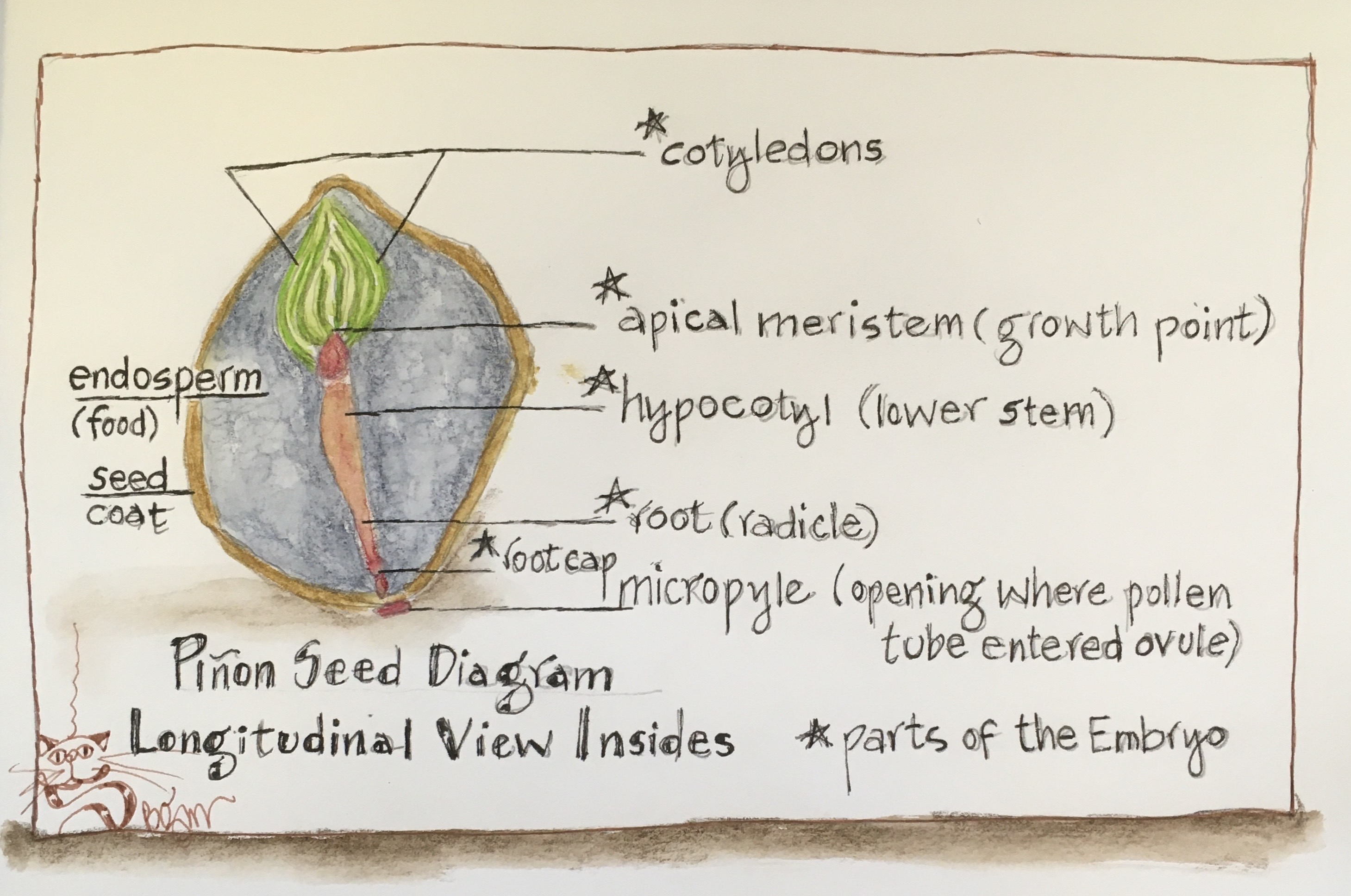
Looking inside the seed reveals a miniature pine tree!
Think about it ……. a seed is really a living baby plant (the embryo) surrounded by a cozy blanket (the endosperm) that cradles and nourishes the embryo while tucked inside the seed coat. When the coat unzips, freeing the “baby” as it begins to grow, it continues to be nourished by the endosperm until the first true leaves appear. Witnessing the process is so cool!
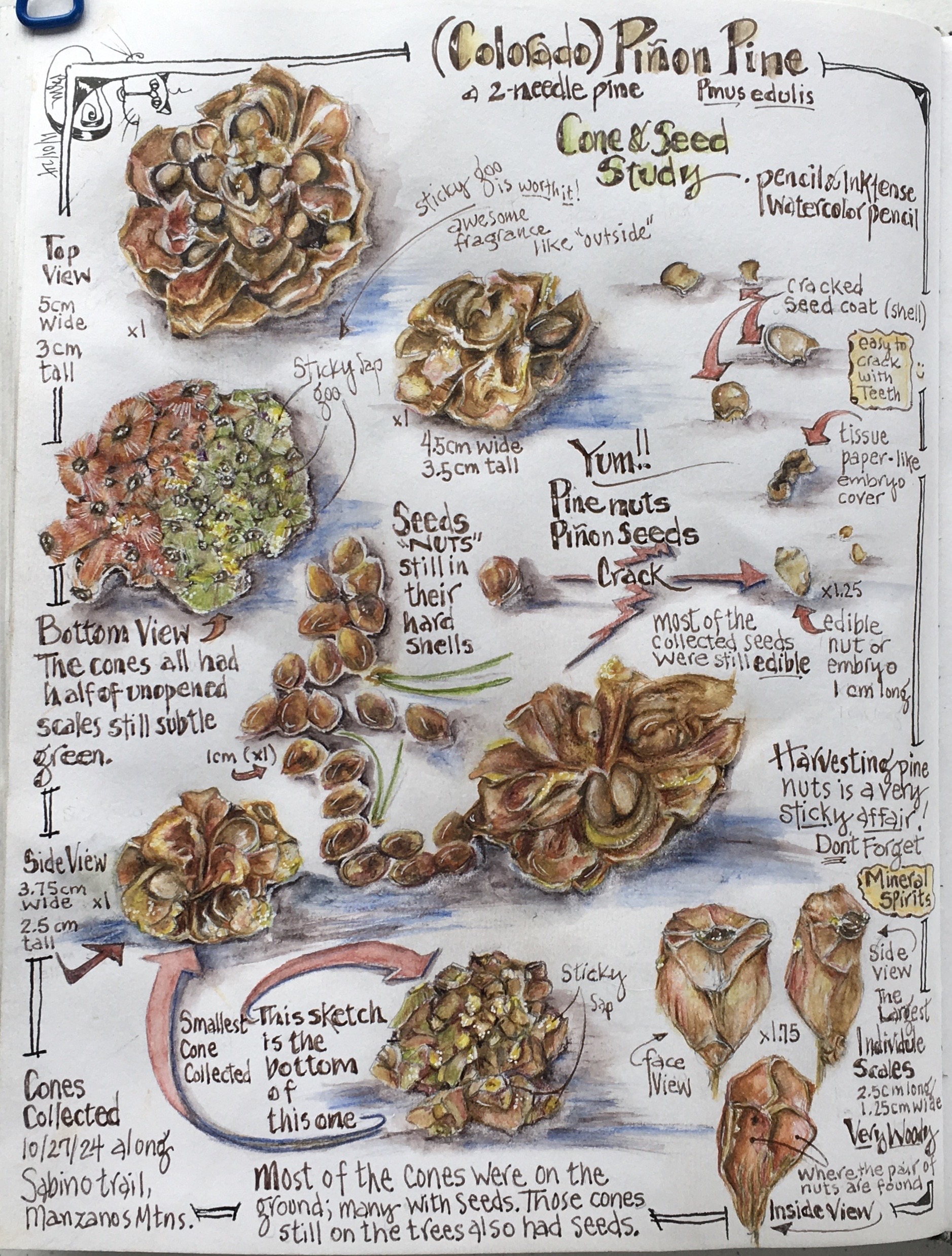
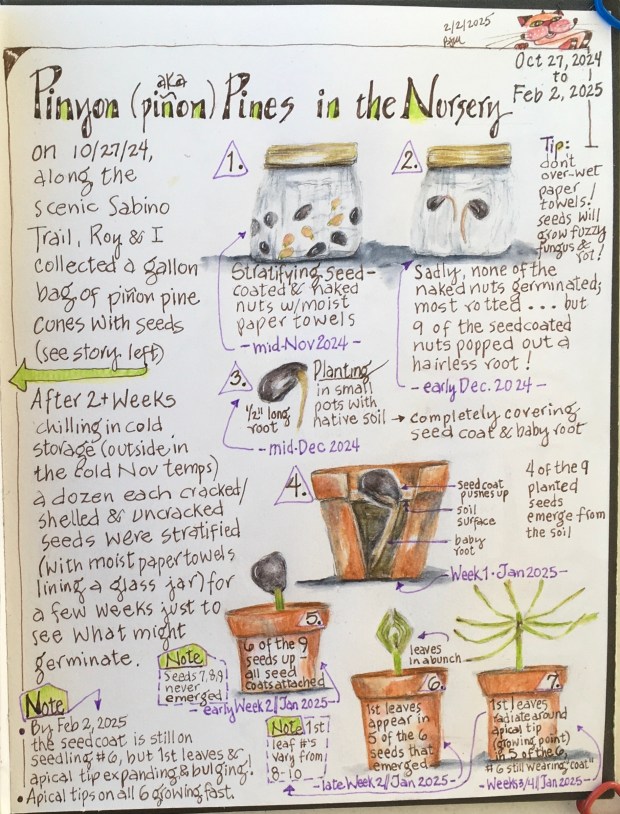
After collecting piñon seeds from last November’s foraging expedition, (Piñon or Pinyon, Piñon Seed or Pine Nut), we decided to treat a dozen or so to conditions just right to stimulate germination. But first the seeds required a short period of stratification (moisture) to help soften and crack the seed coats. Introducing moisture was done by lining a clear glass jar with damp paper towels and placing the seeds between the towels and glass to watch the action.
Post from November 2024 Seed Foraging Expedition
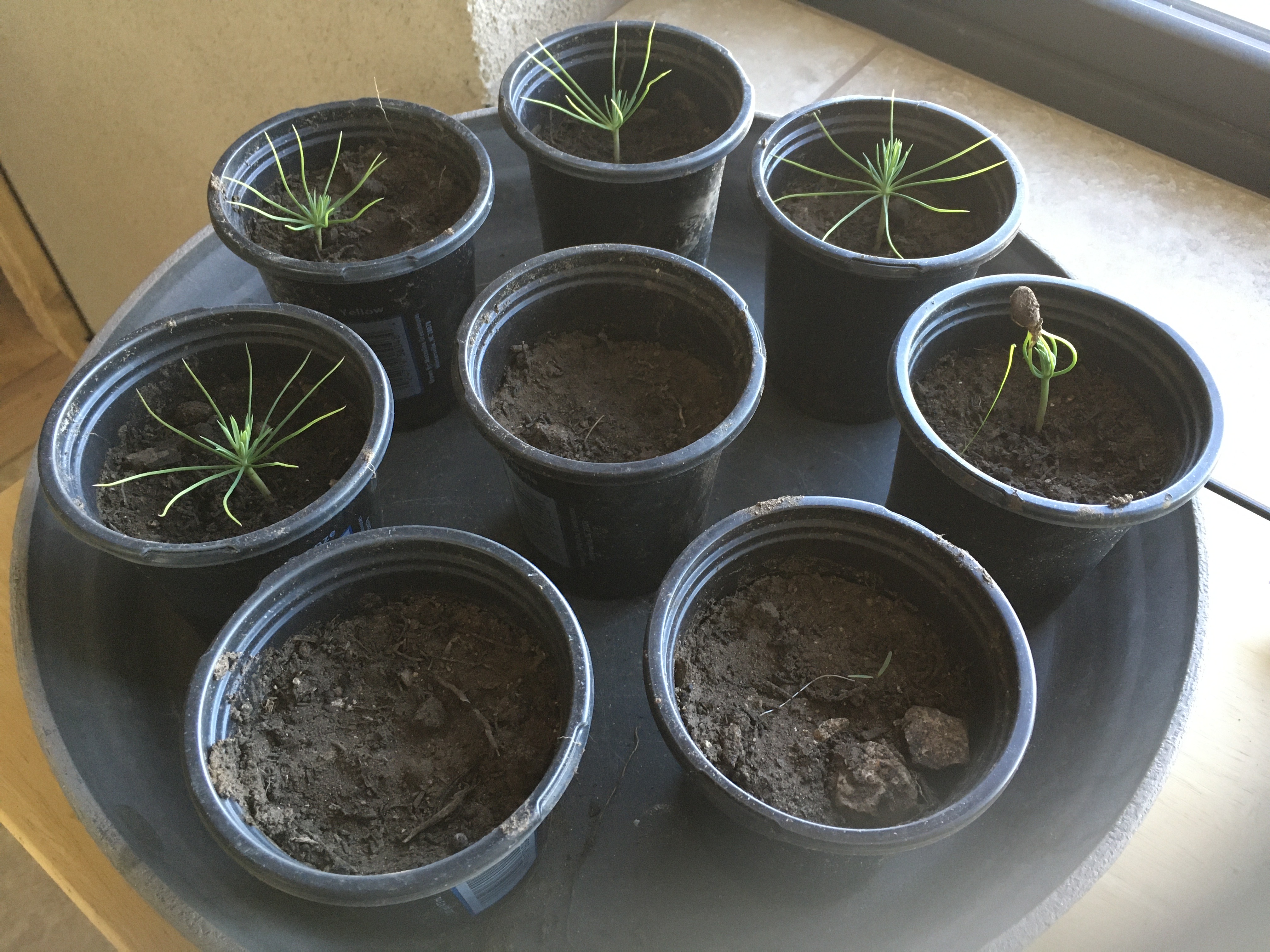
Soon embryonic roots (the radicles) successfully cracked the seed coats of nine seeds and began growing downward, as roots tend to do. In a week or so, before the embryonic leaves (cotyledons) appeared, all of the germinating embryos were planted. Six of the nine then sprouted their whorled cotyledons, followed by a growth spurt of the first true leaves, initiating the process of food manufacturing (photosynthesis).
Steps to Germination
All of the germination and seedling development details of these piñon seeds, to date, can be found in my update illustrations.
Seed germination is a fascinating process, and like the seed itself, is also a marvel of nature. Have you ever tried to germinate a seed? If not, give it a go. It’s fun, educational, and imagination provoking ….. from such a small seed comes a full-grown flowering plant!
Wandering about the neighborhood one warm summer morning in 2018, I noticed a dense stand of plants lining a 20 foot section of road. What caught my eye were the umbrella-like clusters of pearly white flowers topping each slender stem. From a distance these plants resembled our native white-flowering yarrow. But I soon realized the narrow dark green leaves were not fuzzy; the tiny exotic-looking flowers were not daisy shaped. Unmistakably, this plant was a species of milkweed! And the flowers of more than 50 individual plants in this population were a-flutter and a-buzz and a-crawling with hungry insects!
What was this milkweed species?
This is the Winter Botany portion of this post. All that remains of last summer’s Horsetail Milkweed are stems and mostly empty seed pods clinging to short branches. But some of the seed pods still hold silky tailed seeds clinging to their open pods. Hundreds of seed pods line the roadways in our neighborhood.
It didn’t take long to confirm this plant as Horsetail Milkweed (Asclepiassubverticillata), a species commonly found along roadsides in pinyon-juniper woodlands. Knowing what to look for on future walks, over the next several years I was excited to find 30+ more populations of various sizes along neighborhood roadways! From 2018 until early summer 2024, I continued to monitor these seemingly abundant populations. The small numbers of seeds I collected in the Fall were planted in our yard, and every year I checked for the presence, variety and numbers of insects busy feeding on nectar as they pollinated the flowers.
During June 2024, when we moved only a few miles to the northeast, I was happy to see Horsetail Milkweed grew abundantly in our new subdivision. This prompted me to dig deeper into researching this species. Its been exciting to discover how important this milkweed is to native insects, including monarch and queen butterflies.
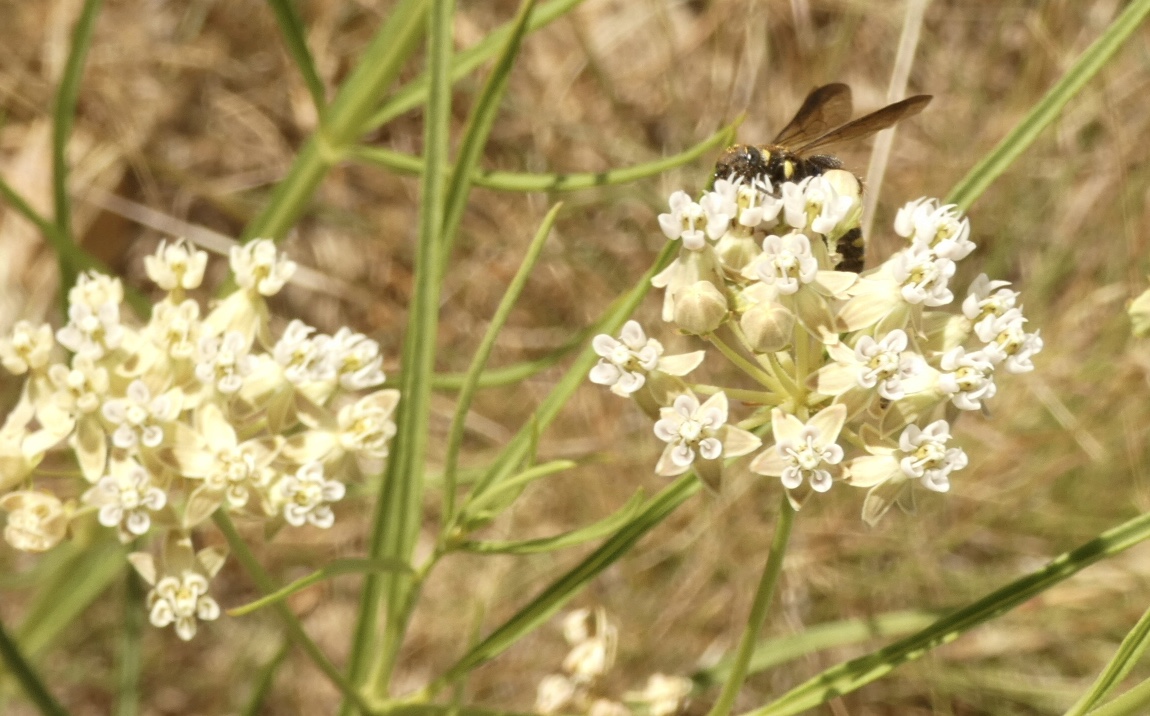
Photo (mine) taken in July 2022 of a blooming Horsetail Milkweed being enjoyed by a feeding wasp.
According to pollination ecologists, Horsetail Milkweed is especially valuable to large numbers of native bees. This plant species also supports conservation biological control by attracting predatory or parasitoid insects that prey upon pest insects.
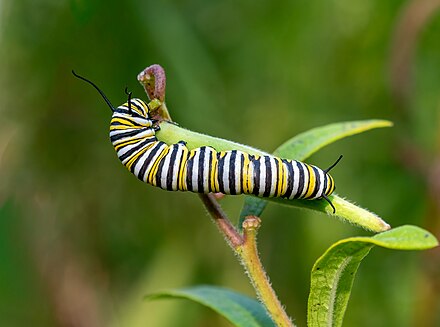
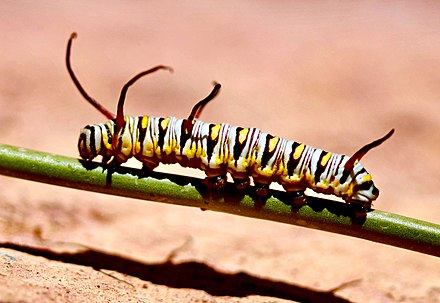
And Horsetail Milkweed is one of the favorite host plants for monarch and queen butterflies, all because it’s toxic! Producing an especially nasty tasting and potent neurotoxin strong enough to kill livestock, the caterpillars of these two butterflies have evolved to benefit from such a poisonous substance. Voraciously ingesting a diet of only milkweed leaves, obviously tasty to the larvae, makes them unpalatable to would-be predators, such as birds. The toxin from milkweed leaves has become their primary means of defense; definitely a benefit for such chubby, slow little caterpillars.
Monarch caterpillar (source: open commons)
Although central New Mexico isn’t in any of the major migratory routes of these butterflies, I have observed both species in our previous neighborhood. Since learning more about Horsetail Milkweed and it’s favored roadside habitat close to home, my hope is to provide actively growing plants throughout the summer (a safe distance away from roadside easements) for both the monarch and queen adult butterflies and their caterpillars ……. especially important when governing covenants of our previous and new subdivisions require the roadways be groomed (mowed down like a butch haircut!) on a monthly basis by subdivision landscape crews.
Because milkweeds are among my favorite of all plant species, mainly due to their complex flowers and the clever trickery they’ve developed to ensure pollination, I wrote about and illustrated two in-depth blog posts on this subject. Believe me when I say, “It’s overboard fascinating!”
Summer Botany: Meet the Milkweeds from July 2022. This is my first comprehensive look at milkweed flower structure, how pollination takes place, and the genus Asclepias.
Read on to learn more botanical information about Horsetail Milkweed AND how to find out if you live in Spring and/or the Fall Migration routes of the monarch butterfly AND where queen butterflies migrate to and from.
Characteristics and habitat requirements of Horsetail Milkweed
Horsetail Milkweed is a perennial species with a stout, woody rootstock. Plants readily spread by rhizomes (underground stems) producing dense communities. Cold-hardy to at least 0℉, this milkweed bounces right back in the Spring. Plants are also drought-tolerant once established, thriving in well-drained, sandy soil under full to partial sun.
Able to thrive in a variety of habitats and plant communities from 2500 – 8000 feet in elevation, Horsetail Milkweed grows among grasses, on sandy or rocky flats, on slopes, roadsides, and along trails in Chaparral, Semidesert Grasslands, Pinyon-Juniper Woodlands, Montane Conifer Forests, and in disturbed areas.
All of these characteristics and its adaptability to a wide range of habitats make Horsetail Milkweed one of the easiest milkweed species to grow.
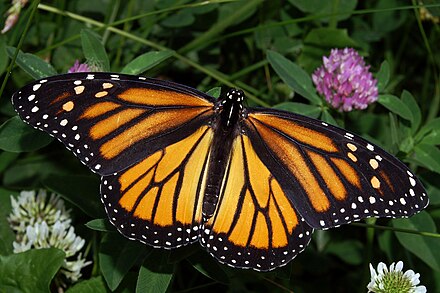
Monarch butterfly (source: open commons)
Monarch Butterfly
To learn if you live within the path of or close to spring and/or fall monarch butterfly migration routes, you can view a map or these route here:
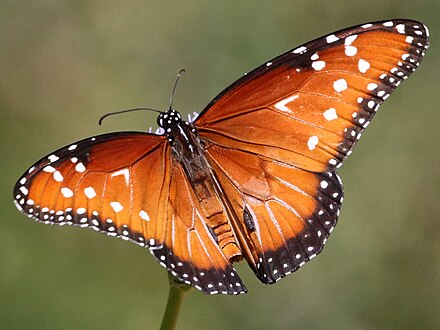
The queen is chiefly a tropical species. In the US, it is usually confined to the southern portion of the country. It can be found regularly in peninsular Florida and southern Georgia, as well as in the southern portions of Texas, New Mexico, Arizona, and California. Occasionally, the subspecies of the queen can be found somewhat north, in Kansas, Colorado and Utah.
Queen butterflies do not migrate as dramatically as monarch butterflies, but they do move short distances in tropical regions with dry seasons to higher elevations.
Winter can be challenging for nature journalers. Getting outside when it’s cold and windy, cloudy and dreary, snowy, icy or wet, are not ideal weather under any circumstances. And when everything looks brown and crispy and pretty much the same, the challenge to nature journal in the great outdoors grows exponentially. While these conditions make it difficult for spontaneous observing, I try to remember there’s always something remarkable to be discovered in nature, even in winter.
Who knew a little whack on the head would be just the thing to reawaken my curiosity?
Bundled in layers, leash in hand, Luna led me on her early morning walk around suburban Albuquerque. Having been along this route before, we’ve both made some interesting discoveries in the past. And as usual, this time was no exception for Luna. For me though, everything appeared brown, crispy and familiar. But I was inspired by and enjoying Luna’s sense of curiosity, and her encouraging tug on the leash.
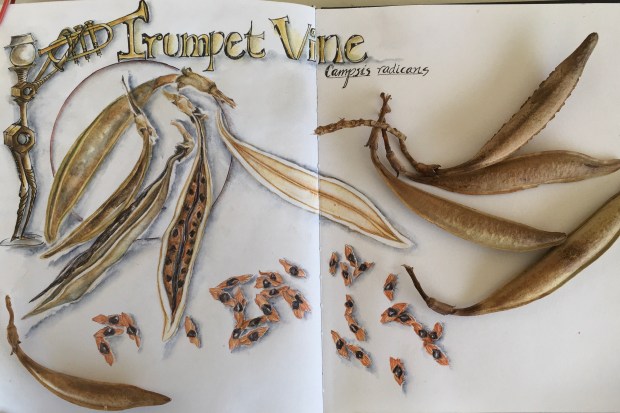
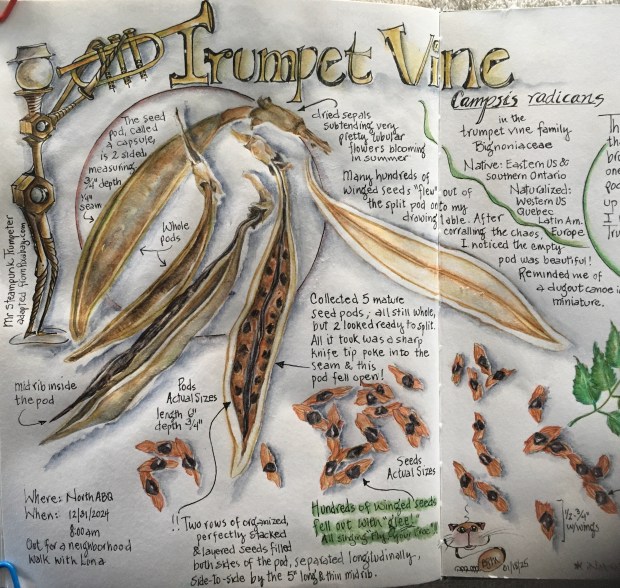
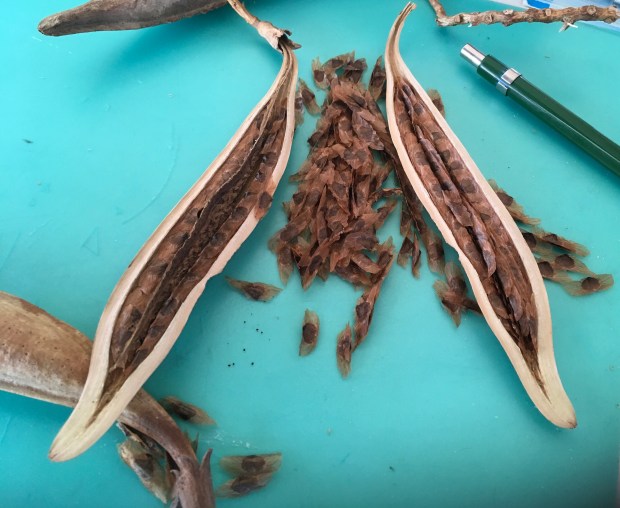
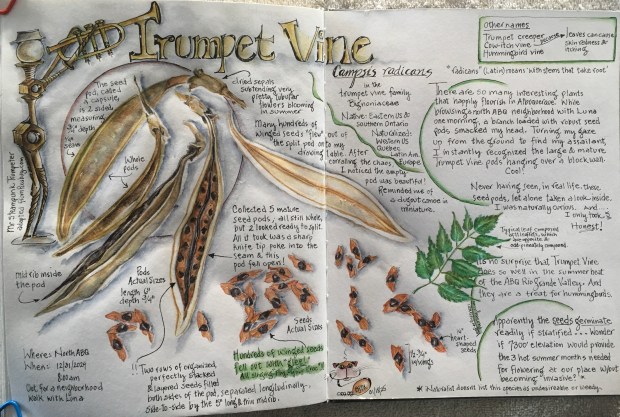
Nearing the end of our 2-1/2 mile walk, and mightily concerned I’d go home empty handed, we turned our last corner. It wasn’t 100 feet down the cement block-lined sidewalk that I abruptly stopped in my tracks. Something had lightly whacked me in the head! While the sound of rhythmic clacking rang out, I looked up, and to my surprise spotted the accidental assailant. Draped over the 6 foot wall, suspended from a hearty Trumpet Vine (Campsis radicans) growing in the hidden yard beyond was a string of pods resembling brown green beans. Long and plump and full of seeds, one of these pods had reached down low enough to make contact with to my head. (I say “reached” because that’s what my imagination said had happened.) Quickly awaking my sleepwalking brain, the effort made by the seed pod to get my attention paid off too. Silently whispering, “Pick me! Pick me!” it was as if the seed pod and its adjacent buddies either wanted to be harvested, or wanted to be featured in my nature journal (or both).
So I did ………… both!
I loved learning about and sketching these fascinating Trumpet Vine seed pods, while my mind was filled with the muffled notes of a trumpet. Tooo-too-too-toooooom!
Hope you enjoyed reading this story and browsing around my journal pages.