March 23, 2026
Davis Mountain Mock Vervain (Glandularia wrightii)
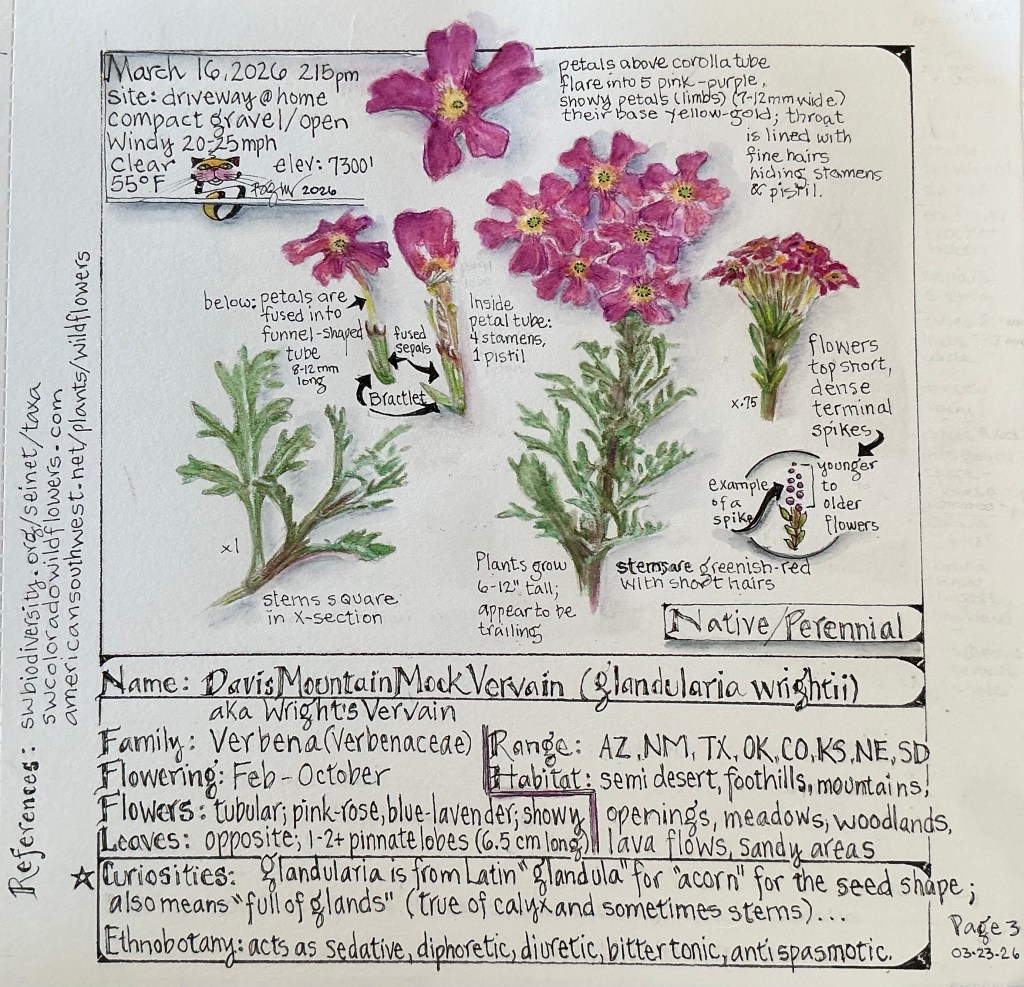
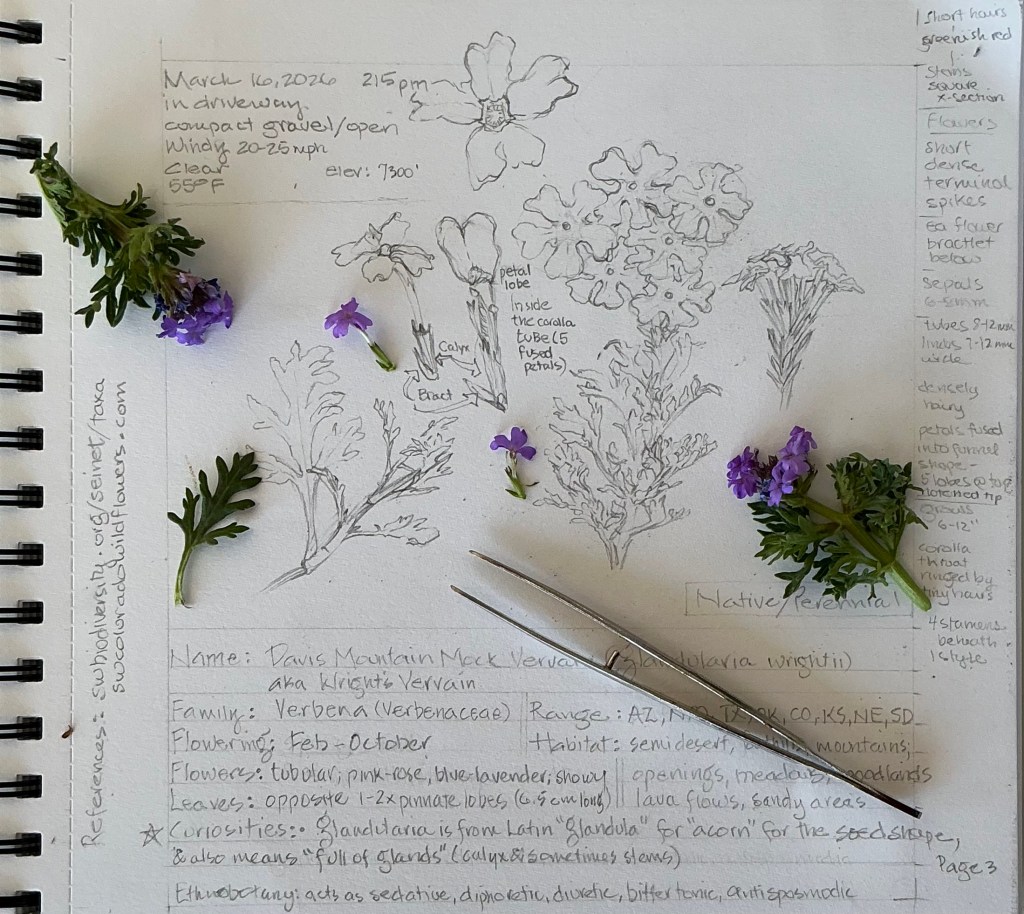
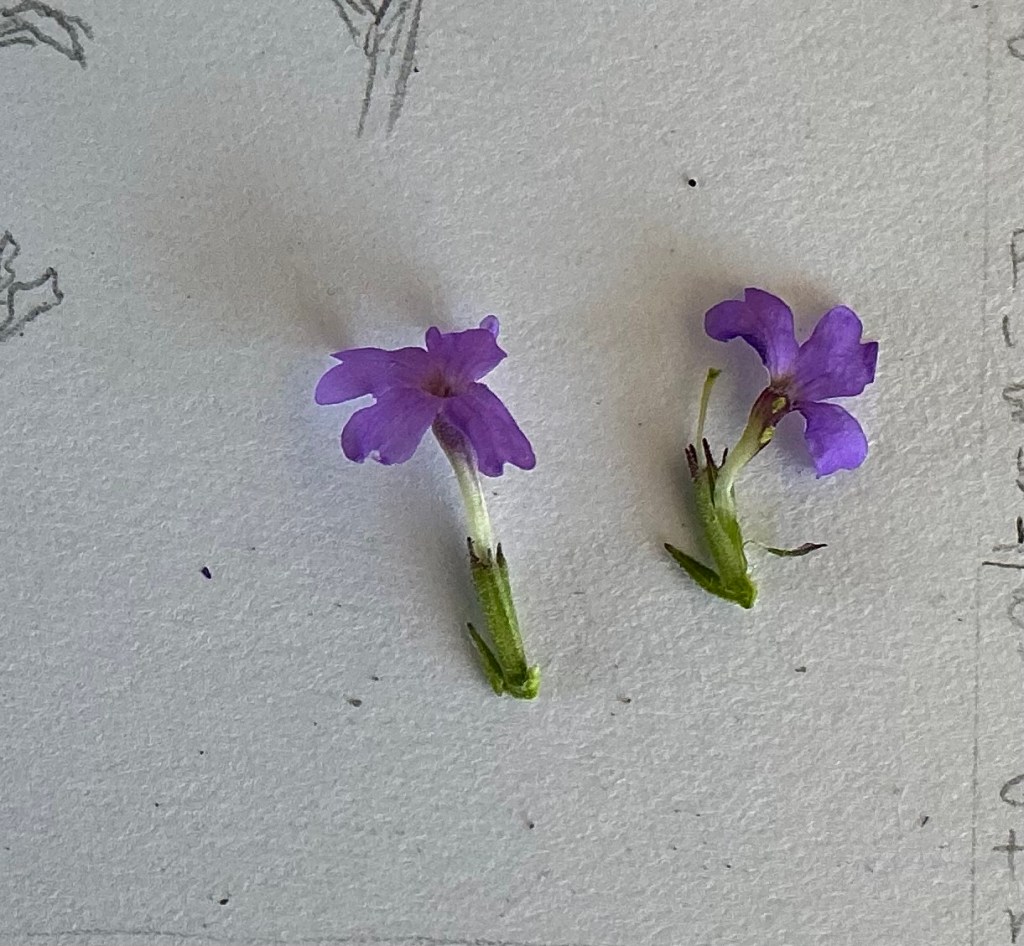
This is a photo of the two flowers I sketched for my final painting.
The specimen on the left shows the upper part of the flower, the “limb” where 5 petals flair out from the throat ringed by fine hairs. The throat leads to the lower part of the flower – the floral tube (5 fused pale green petals). . Both upper and lower petals make up the flower’s corolla. Below the floral tube are 5 red tipped green sepals (collectively called a calyx) all fused into a cup shape. The specimen on the right is a dissected flower; 2 upper petals are removed, and the floral tube has been opened to reveal the reproductive parts. On the left side are 2 of the female parts of the pistil (pale green style supporting the 2-lobed stigma of the pistil; the ovary was not exposed). Two of the four stamens (male) lie in the mid- to upper right side of the opened floral tube; look for the bright yellow anthers, each sitting atop their own filament
Here’s Another Curiosity to Ponder: I wondered why this plant has 5 petals and 5 sepals but doesn’t also have 5 stamens, which is usually the norm in so many other 5-merous plant species??? Here’s what I learned:
Davis Mountain Mock Vervain (Glandularia wrightii) exhibits a common evolutionary trait in the Vervain (Verbenaceae) family where the flower displays a 5-lobed calyx of fused sepals, and 5 5-lobed petals which fuse into a tube (the corolla). This trait, commonly described as 5-merous, curiously has a reduced the number of functional stamens to four.
This reduction is due to an evolutionary transition from a 5-stamen ancestor. According to literature, the four fertile stamens I observed in my specimens are properly arranged in two pairs (didynamous), both neatly hidden in the floral tube beneath a ring of fine hairs. Also properly so, the filaments (the stalks that support the anthers) of the stamens are fused to the inside of the tube, and not easily teased free.
So apparently, many, many, many, many, Many hundreds of years ago, plants in the Vervain family “decided” having a 5th stamen was unnecessary. “We can do just fine without it, thank you.” Thru the process of evolution, that expendable #5 was ever so slowly reduced to a tiny non-functional structure (referred to as a staminode in modern botanical lingo), or was completely and totally lost, becoming only a memory.
Believe me, this species is an energetic producer of leaves, flowers and seeds. In my experience, Davis Mountain Mock Vervain seems to explode in masses of pink and purple flowers throughout spring, summer and fall, and can last thru winters that don’t freeze. It’s easy to understand why the species has no need of a 5th fertile stamen. Once the plant becomes established, it keeps growing and flowering and spreading, often to the detriment of other desirable plants. If it wasn’t so gorgeous at the height of bloom, it might be considered a weed!
But I’m reminded of the definition of a “Weed ….. a plant out of place.” So yes, you’ll find me actively weeding actively growing Davis Mountain Mock Vervain so my other native plants have a chance at life too!!
Thanks for stopping by!

 a curious nature
Quite right … a weed is just a plant out of place! I find many weeds very beautiful and colorful. I’m wondering if this one has a floral scent? I’m sure they are enjoyable in your driveway but sounds like they may get out of hand, so a little weeding here and there can’t hurt! Thanks, Barb!
LikeLiked by 1 person
Thanks for the comments, Karen! I do try to keep this aggressive species under control, after it’s been able to complete the first initial and bountiful blooming phase. The plant produces what looks like ‘clouds’ of ground-hugging green and does a great job of controlling erosion caused by rain runoff (which is minor during late spring through mid-fall) and high winds which take surface soils across the valley. Once that’s over, the shrubby growth becomes ratty, brown and crispy. Oh, no floral scent I’ve ever detected. Guess they are happy with visually-attuned pollinators or rely on self pollination.
What’s spring like in your world right now? What’s your favorite arrival?
LikeLiked by 1 person
An important plant for erosion control! Spring weather has been all over the map the past couple of weeks! Wet, heavy snow broke so many tree branches along our streets, especially the plum trees that have pink blossoms. Not much else blooming just yet, but I am awaiting the very special trillium to bloom in our forest — we only get less than 10 along my woodland path!
LikeLiked by 1 person
Only less than 10 gorgeous trilliums on your path!?! Maybe that’s why they are so special! Your spring weather has been exceptionally weird. Very sad about broken tree branches ….. not the beautiful flowering plums too. Such a shame. While you’re shoveling snow, we’re sweating under a heat dome. So much is so crazy, huh? Thanks for sharing, dear Karen. May spring reveal,itself,soon.
LikeLiked by 1 person
Interesting evolution of plants and of course your drawings are spectacular. 💜
LikeLiked by 1 person
Many thanks, dear Michele! The evolution of the Verbena family was news to me, and I never would’ve known (at least at this time) had I not taken a very close look inside the flower! I really appreciate your comments on my drawings too!
LikeLiked by 1 person