Linnaeus named the genus Monarda to honor 16th century Spanish physician and botanist, NicolásBautista Monardes (1493-1588). Monardes never went to the Americas but was able to study medicinal plants in Spain, publishing the first systematic, in-depth book on medicinal plants and remedies brought to Europe from the Americas.
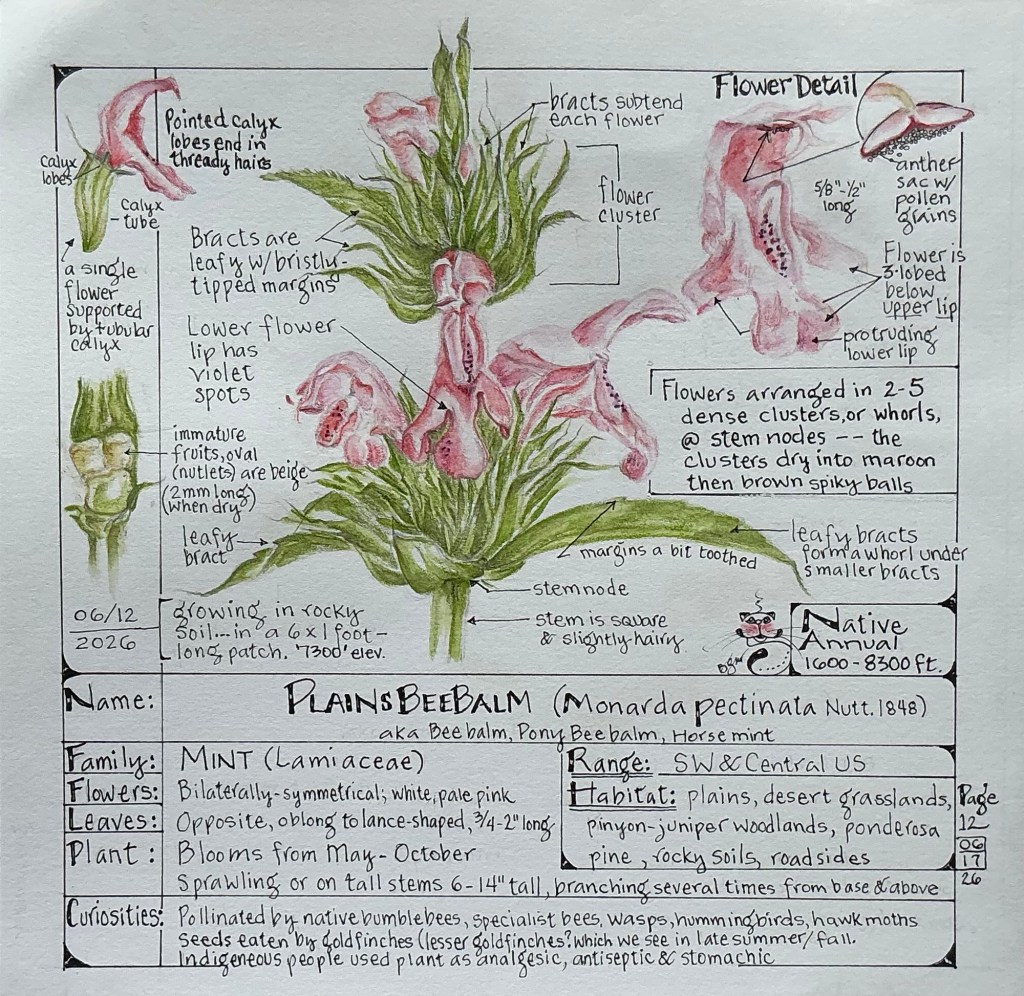
The species pectinata is derived from the Latin word pecten, meaning “comb.” The suffix -ata denotes possession or resemblance — so it translates loosely to “comb-like” or “having the form of a comb,” referring to the bristle-tipped bracts that sit below flower whorls.
Monarda pectinata is commonly called Plains Beebalm (or Pony Beebalm) because of its historically recorded uses by Indigenous peoples as an analgesic and antiseptic qualities.
Ethnobotanical and Culinary Uses
Indigenous peoples used a plant infusion to treat coughs, colds, fevers, and stomach complaints related to digestion. A flower infusion was used as a wash on insect bites and stings. The plant was rubbed on the head to bring relief from headache. In addition, historic records document that groups, such as the Kiowa, used Monarda pectinata leaves as a perfume due to its strong scent, and were chewed while traveling.
The strongly aromatic smell of crushed Plains Beebalm leaves smell both savory and citrusy, similar to oregano or lemon. Sometimes called “wild oregano,” they can be eaten fresh, dried or cooked to season in salads or other foods. In spring the leaves may be boiled to make herbal tea.
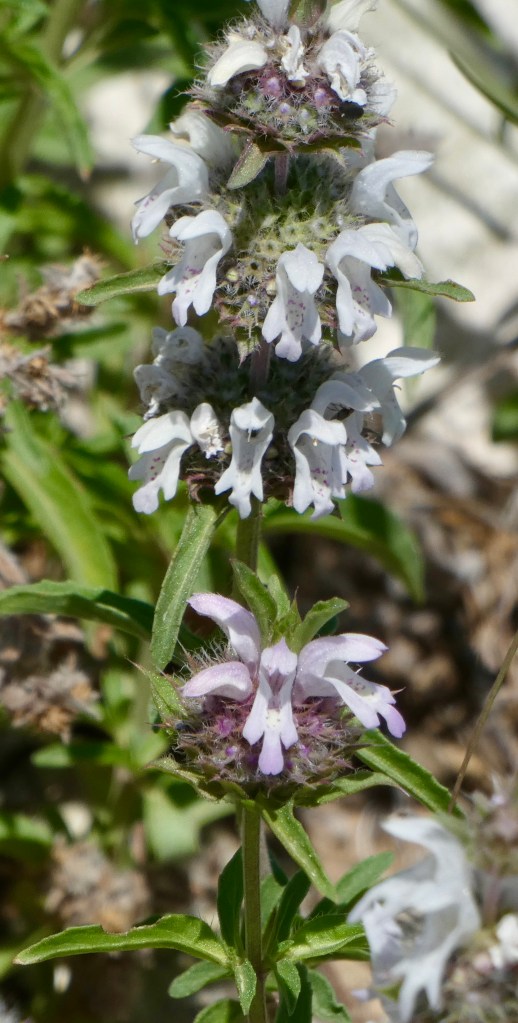
Plains Beebalm blooming in our yard, in bright sunshine and rocky soils.
Pollinators
According to the Xerces Society for Invertebrate Conservation, all Monarda species attract a number of native pollinators such as specialist bees, bumble bees, predatory wasps, hummingbirds, and hawk moths.
A Few Fun Facts
Desert Survivor: Although many Monarda species are moisture-loving, such as Wild Bergamot (Monarda fistulosa) found the along cool trails of Sandia Mountain, Plains Beebalm prefers hot, harsh, dry environments like desert washes, rocky slopes, and sandy pinyon-juniper woodlands.
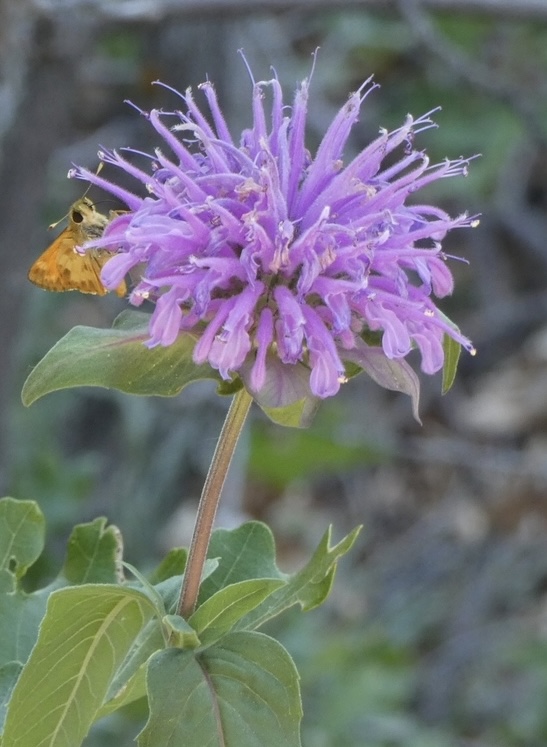
Wild Bergamot and a little skipper pollinator. Tecolote Trail, Sandia Mountain, NM. This Monarda species prefers living in moist soils under the shady canopy of white fir and ponderosa pine.
Mammal Resistant: While pollinators adore Plains Beebalm, its strong, minty-citrusy-oregano essential oils act as a natural deterrent, making the plant resistant to browsing deer and rabbits.
Pollinator Magnet: The tubular pale pink flowers of Plains Beebalm are an excellent nectar source for long-tongued native bees, butterflies, and hummingbirds, especially during the hot summer months.
Soothing Relief: Plants in the Monarda genus are commonly called “Beebalm” due to the soothing nature a wash application of the plant, especially the flowers, has on insect bites and stings — particularly bee stings. Turns out plants in the genus contain the active ingredient thymol, a natural antiseptic found in modern mouthwashes.
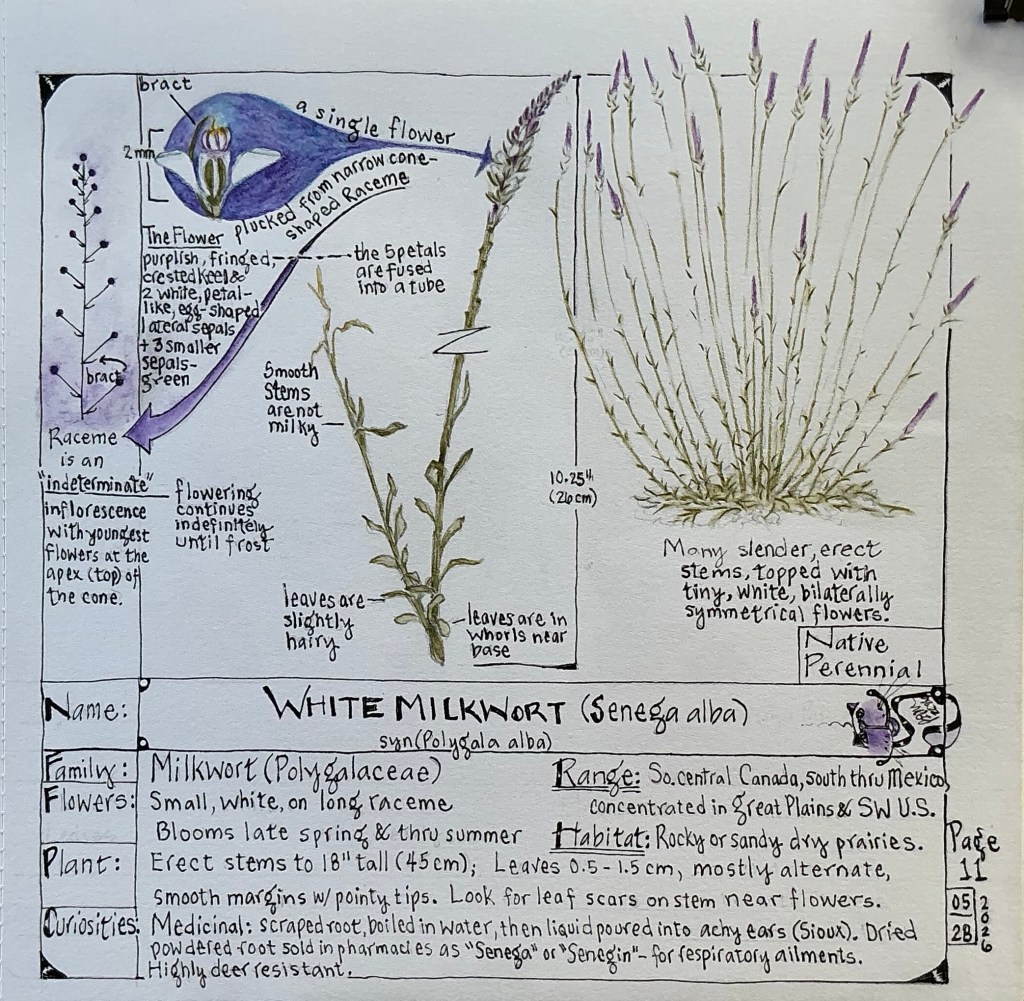
White Milkwort (Senega alba (Nutt.) J.F.B. Pastore & J.R. Abbott)
(synonymous with Polygala alba Nutt.)
A Light Touch
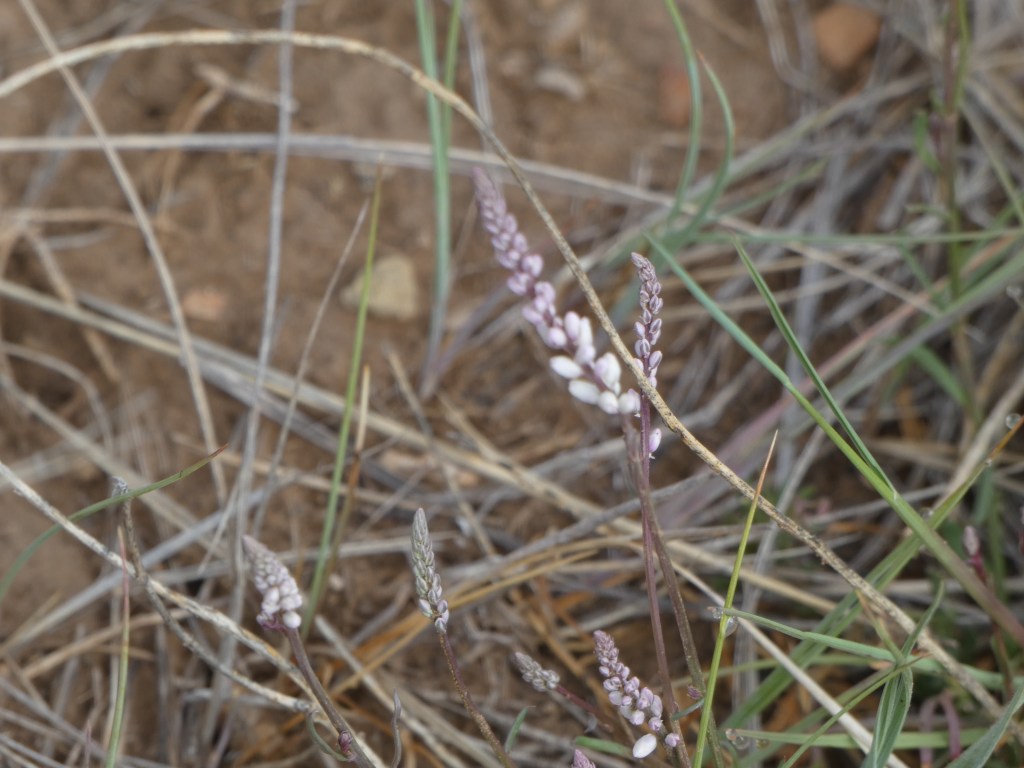
It was a beautiful morning for a walk along one of the neighborhood’s 2-track dirt roads. I was searching for late blooming Spring wildflowers when something lightly brushed against my leg, bringing me to a full stop. There, at my feet, gently swaying in the quiet breeze were a dozen+ foot tall, nearly naked, skinny green stems topped with lavender and white cones. Not wishing to crush these delicate stalks, I noticed there were five other groupings nearby, all growing in the road’s old tire depressions. Upon closer inspection, I recalled having seen this plant before in the yard of our previous home, but they had fewer and shorter stems, and larger (?) flower cones. Still, this was the white milkwort species (back then known as Polygala alba; today called Senega alba) I identified four years ago. It was the larger size and delicate nature of these plants at my feet – that puzzled me.
Here’s what I learned:
The stems, which are ridged, can grow to 18” tall. They branch from a basal caudex (a root-like thickened stem, often found underground, from which branching/stems grow …… and the more extensive the caudex, the more above ground stems form.
You can roughly age this perennial milkwort by counting the number of vertical stems. Typically there’s one stem on seedlings and one-year old plants; as many as 30 stems have been counted on much older (many, many years old) plants.
Even though the official flowering period ends late summer, if mid-summer/early fall rains (our monsoon season) are plentiful, another bloom period peaks and can continue into November. It’s been reported that when old flowers are removed from these milkworts (deadheaded), the plants will bloom continuously for up to four years! Obviously, those plants are not impacted by winter frosts.
The 90% of the pollinators visiting white milkwort are small to medium solitary or semi-solitary bees. Where we live (desert southwest), many of these ground-nesting bees are floral specialists, and based on research dating back to the early 70s, green metallic bees highly favor this native plant’s flowers for nectar and pollen. And with extended bloom times prompted by monsoons, this helps benefit these and other bee species. Unfortunately, the timing and intensity of our monsoons is no longer predictable and is likely causing unfavorable conditions for extended flower bloom and the bees.
Always be prepared to encounter a plant that tickles!
Classification and an Etymological Quandary
To learn the story about the old and new scientific names for white milkwort, and why being a botanist way back when and today is so challenging, read the next section on Etymology. It really is quite fascinating!
Etymology
Way back in the day (say, the early 1800s), when Thomas Nuttall, a English botanist, ornithologist, geologist and explorer, needed an unforgettably descriptive binomial name for a new species he’d discovered, “Polygala alba Nutt.” was his choice. The genus “Polygala,” which was originally assigned by Linnaeus to a group of plants with similar-looking flowers, is Greek for milkwort — meaning “much milk; ” the species name “alba” is Latin for “white, bright or clear.”
Thomas, logically picked “alba” as the species name for his new discovery, because the plant had white flowers. However, he apparently chose the “Polygala” genus based on an ancient belief that nursing mothers (and cows) that ate the milkwort plant experienced increased lactation. However, Polygala alba doesn’t have either milky sap or any plant parts with milk! After diving deeper into the Polygala genus as a whole, I couldn’t find any that ooze a milky substance.
The changing nature of botanical classification: It wasn’t until recently (2023 to be exact) that the official report announcing the transfer of 18 Polygala species to Senega, including Polygala alba to Senega alba, was published by botanists J.F.B. Pastore & J.R. Abbott. This change was based on a number of scientifically-researched plant characteristics, which addressed deviations in seed, fruit, and floral anatomy between Senega and true Polygala species. Now I know I need a bigger microscope!
In case you’re curious (I certainly was) there are no Senega milkworts (today referred to as American milkworts, formerly classified under Polygala) with a milky sap. So, despite their family (Polygalaceae) and originally assigned genus name (Polygala), these plants exude a clear, watery sap when their stems are broken.
Why “Senega” was selected as the genus name for all American milkworts: The genus name “Senega” comes from the Seneca Native American tribe. The first use of the name in the English language was in the 1730s; the Seneca snakeroot plant was given the scientific name Polygala senega, to honor the tribe’s traditional use of the root as a remedy for snakebites and respiratory issues.
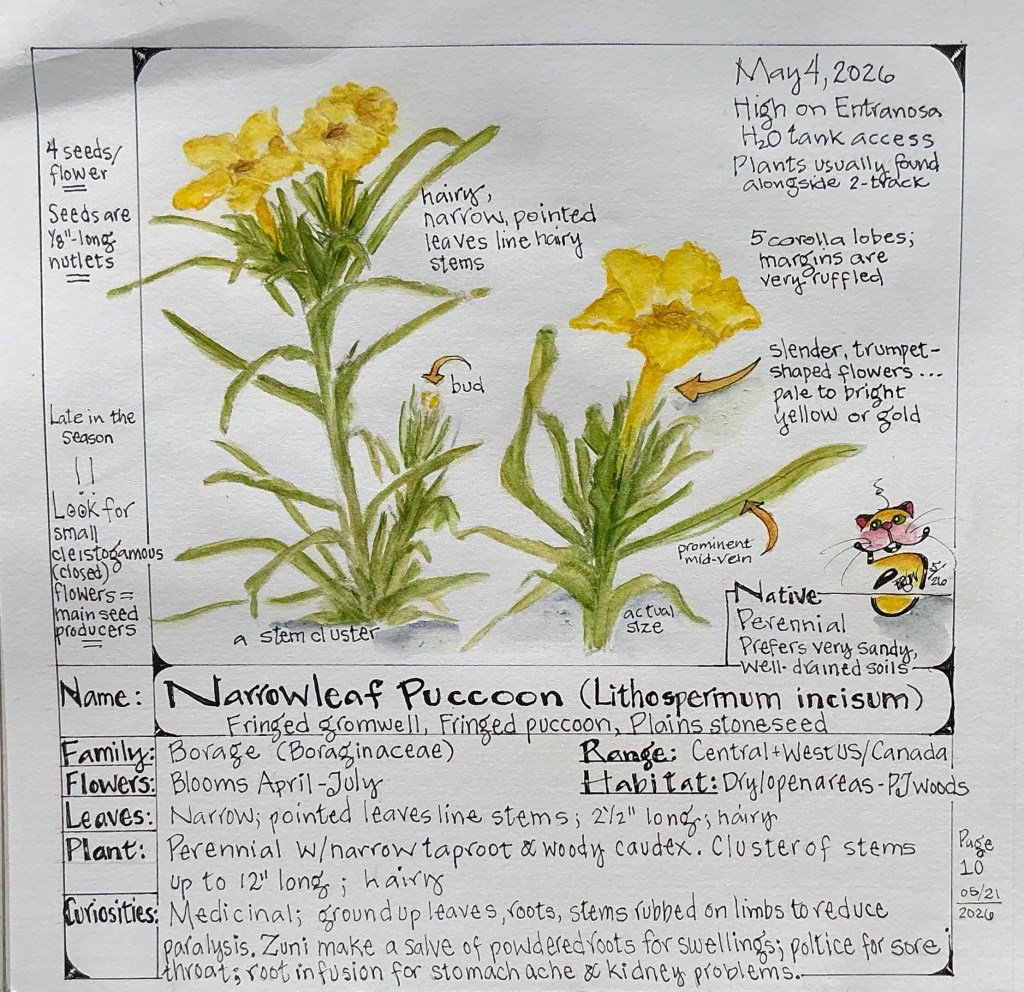
Lithospermum, the genus named by Linnaeus in 1753, is Greek for stone (“Lithos”) and seed (“sperma”), referring to the hard nutlets. And “incisum,” theLatin species name referring to the incised, fringed edges of the trumpet flowers, was named by Lehman (a German botanist) in 1818 from a specimen collected “near the rapids of theOhio” by Andre Michaux (a French botanist and explorer) in 1802.
Puccoon evolved from “poughkone,” a word the Virginia Algonquian language used for plants whose roots yield a red or yellow pigment. The roots of Narrowleaf Puccoon were historically used as dyes ranging from purple to red to yellow.
A Two-Flower Strategy
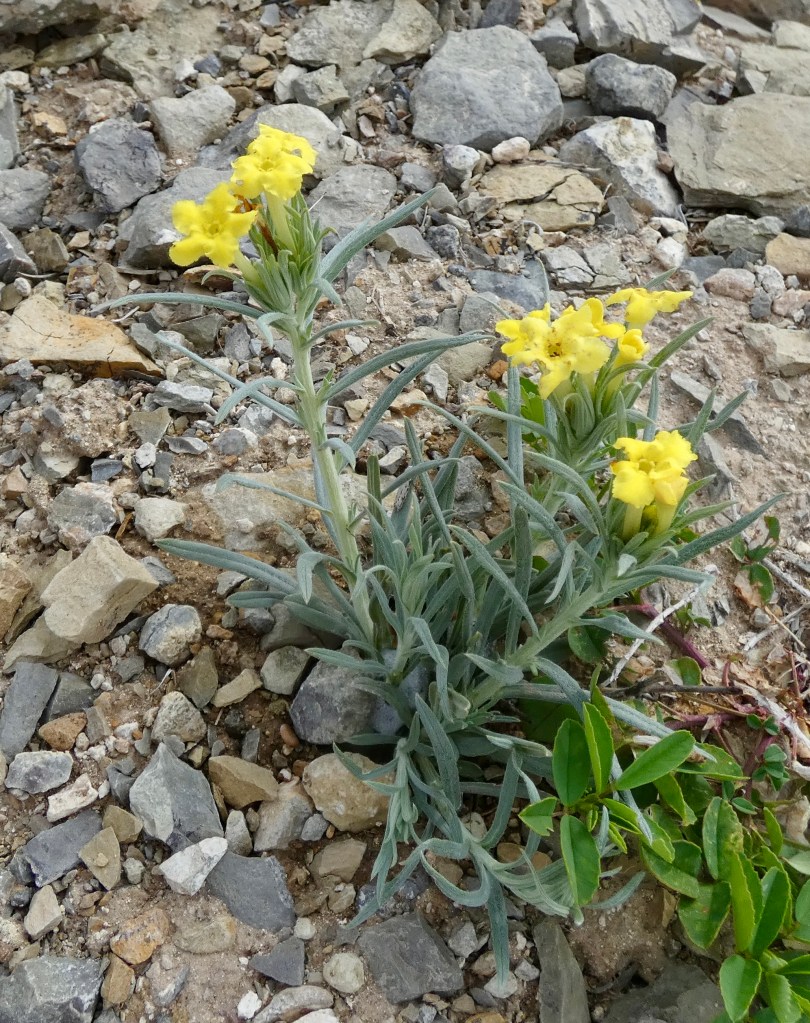
Very showy and quite lovely, the sunshine yellow trumpet-shaped flowers of Narrowleaf Puccoon are hard to miss. They often cluster at the ends of 12-20” long stems where the floral tube is ringed by five frilly petal lobes. The flowers depend on pollinators like butterflies for cross-pollination which adds genetic diversity to the few seeds they produce. Botanically speaking, these traditional, open flowers with exposed reproductive parts are referred to as Chasmogamous.
Then later in the season, the Narrowleaf Puccoon produces small, petal-less flowers that remain tightly closed. These highly fertile, self-pollinating flowers account for almost all of the plant’s seed production. Botanists refer to this type of closed, often inconspicuous flower as Cleistogamous.
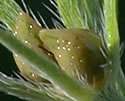
An immature nutlet
The“Stone Seed” Fruit
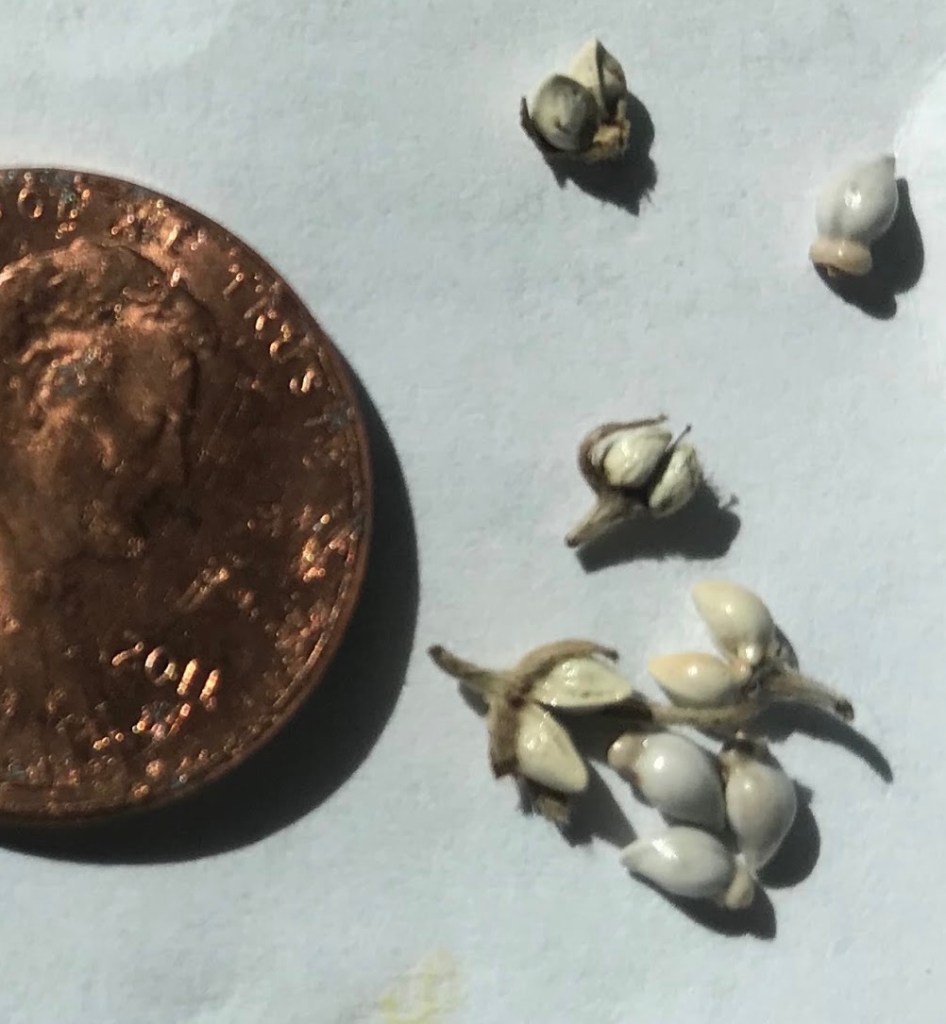
BecauseNarrowleaf Puccoon only produces the occasional fruit from its showy flowers, it takes a bit of searching around the plant’s lower leaf axils to locate a tiny group of up to four hard “stone seed” nutlets. Beginning growth inside the self-fertile, closed (Cleistogamous) flowers that are present late in the season, each egg-shaped nutlet, pitted across the surface, ripens to a shiny white.
Plant Propagation
Seed Germination – To grow Narrowleaf Puccoon from seed, nutlets should be collected in late summer. Soak them overnight in hot water then plant immediately. Because seed germination is sporadic and often disappointing, selecting a desirable location for planting is important. The plant grows best in very sandy, well drained soils found in the dry/open areas within our pinyon/juniper woodlands (though they do grow in soils with some loam or clay).
Shiny white nutlets with Penny for size Photo edited from a post by A Wandering Botanist
Root Cutting – A more successful method may be to take a 2-inch cutting of the taproot in the fall. Dip the cutting in a root stimulant and plant in a desirable location.
Suggestions for root stimulants
Powdered Hormones: Highly cost-effective, have a long shelf life and easy to use. After you moisten the root cutting, just dip it directly into the powder (e.g., Garden Safe TakeRoot) and plant.
Natural/DIY Options: Raw aloe vera gel and crushed, uncoated aspirin both contain natural growth-promoting enzymes. You can also use diluted willow bark extract, which is naturally rich in rooting hormones.
Plant Care – Narrowleaf Puccoon requires full sun and very little water, making it a good plant for xeric gardens or included with other native plants to establish a wildflower meadow.
Photo taken early May 2026 along the Entranosa access road
Medicinal Properties and a Cautionary Note
The Navajo chewed the root of Narrowleaf Puccoon for coughs and colds. They, and the Zuni rubbed the plant’s finely powdered leaves, root and stem on the body to treat paralyzed limbs. An infusion of the root was used for stomach aches and kidney problems. The plant was eaten as an oral contraceptive, and a cold infusion of the pulverized root and seed was used as an eyewash.
Although Narrowleaf Puccoon does have medicinal properties, it contains potentially toxic alkaloids. Self-treatment involving this plant is strongly discouraged.
…………………………………………………………………………………………………
If you’ve seen Narrowleaf Puccoon, did you find their highly fertile, tightly closed flowers and/or the shiny white nutlets? Have you tried growing the plant from seed or root cuttings, and were you successful?
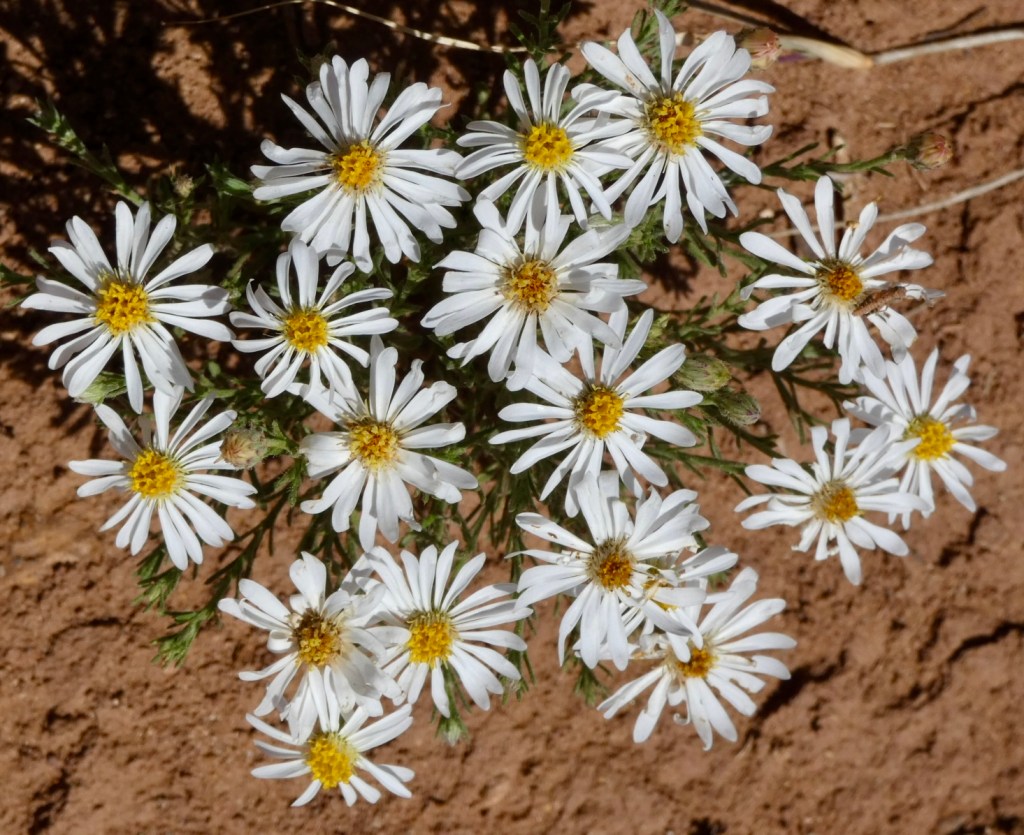
When the last Spring snow melts and the runoff soaks into the nooks and crannies of dehydrated soils, there’s a thirsty little shrub that eagerly drinks its fill. The leafy stems of this tiny shrub, so easily overlooked in the winter, rapidly grows on bare ground, around the drip line of pinyon and juniper trees, in the negative spaces between rocks and broken branches, and through beds of dried grasses. Then in a day or two a very small flower bud forms on the top of each stem, and in half a week the buds open simultaneously. What a spectacular display of brilliant white daisies ….. bouquets of light!
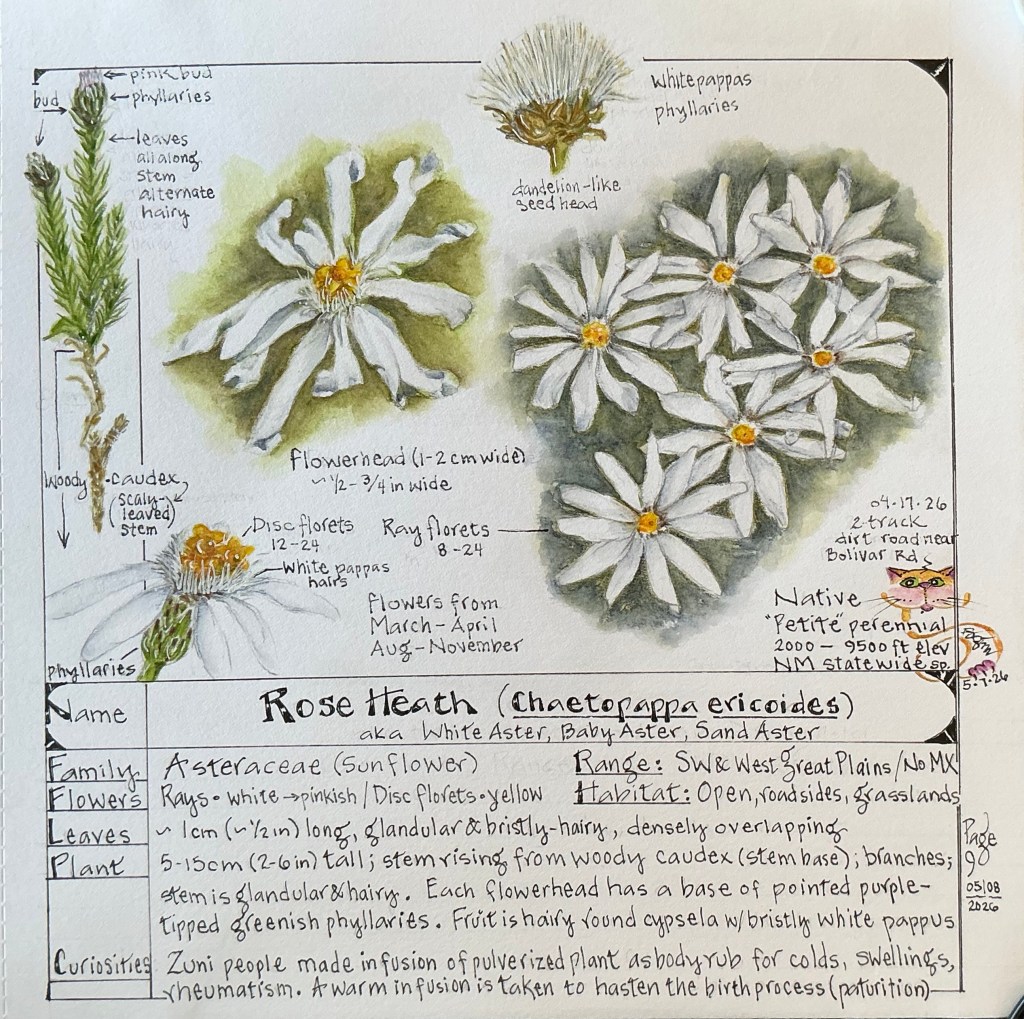
Barely ankle high, each flowerhead can have up to 24 white ray florets surrounding a rich buttery yellow center of 12-25 disc florets. And don’t fret if you notice the ray florets have curled downward in the evening. They magically unfurl to their full length by mid-morning the following day.
This annual Spring show, which takes place all across the U.S. west and western Great Plains, is brought to you by the “petite” perennial called Rose Heath (Chaetopappa eriocoides). (Widespread and common in New Mexico, Rose Heath is adaptable to a variety of soils, elevation, and drought.)
The show typically begins in late March and continues into early May. And for those craving more, flowering resumes in August and can run until November; no charge. You just have to get out there and see for yourself!
Origin and Etymology – What’s in a Name?
Origin of the Scientific Name, Chaetopappa ericoides
Augustin Pyramus de Candolle, a Swiss botanist, named this genus Inula in the early 1800s. But in 1827, it was the American botanist John Torrey, who named the species Inula ericoides, from a specimen collected by botanist Edwin James along the Canadian River during Major Stephen Long’s Expedition of 1819-1820. Since that time, the species has undergone more than a dozen name changes including Leucelene ericoides (Edward Greene in 1896) and finally Chaetopappa ericoides (Guy Nesom in 1988).
Etymology of the Scientific Name, Chaetopappa ericoides
The genus “Chaetopappa” is Greek for ‘bristly pappus’ (pappus refers to the score of tiny white bristles surrounding the disc florets; the same bristles, one per seed, that helps carry Rose Heath’s mature seeds up, up and away. The species “Ericoides,” also Greek, means ‘similar (“oides“) to Heath’ (“eric”); i.e., the plant’s tiny, overlapping leaves are similar to those of some Heaths (Ericaceae is the scientific name of the Heath Family.)
Common Name, Rose Heath
From the previous paragraph, it’s obvious where the name ‘Heath’ comes from, as Rose Heath does have stems and leaves very similar to a heath plant. But why ‘Rose?’ What I found is ‘Rose’ is Latin in origin, derived from “rosa,” referring to the flower. Because the daisy-like flowers of Rose Heath don’t resemble a rose flower, deeper diving was needed. I discovered that throughout history ‘Rosa’ and ‘Rose’ have represented love, passion, innocence, and beauty. So perhaps ……. ? If you’re familiar with Rose Heath or have seen photos of the plant in bloom, do you love or could you love its beautiful floral bouquets? I think whoever thought to call this plant by the common name ‘Rose Heath,’ must’ve loved its stunning display!
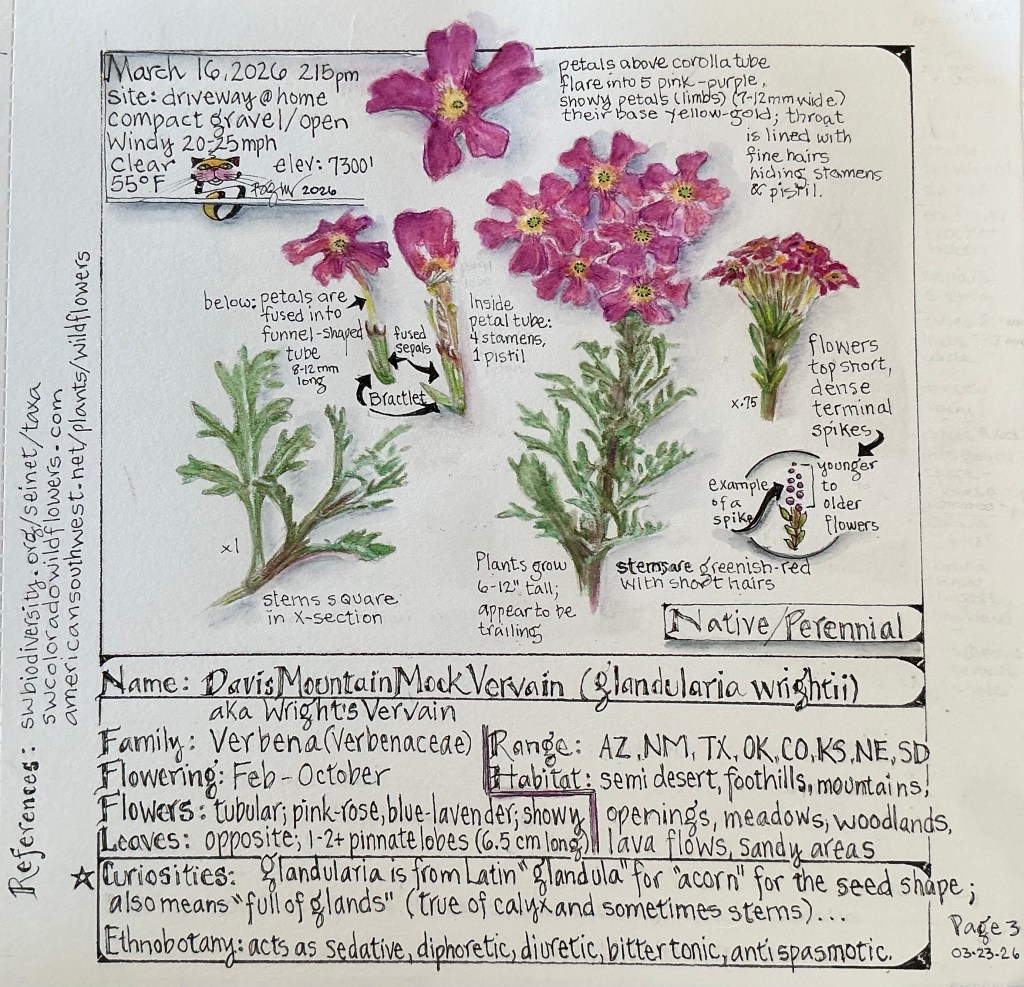
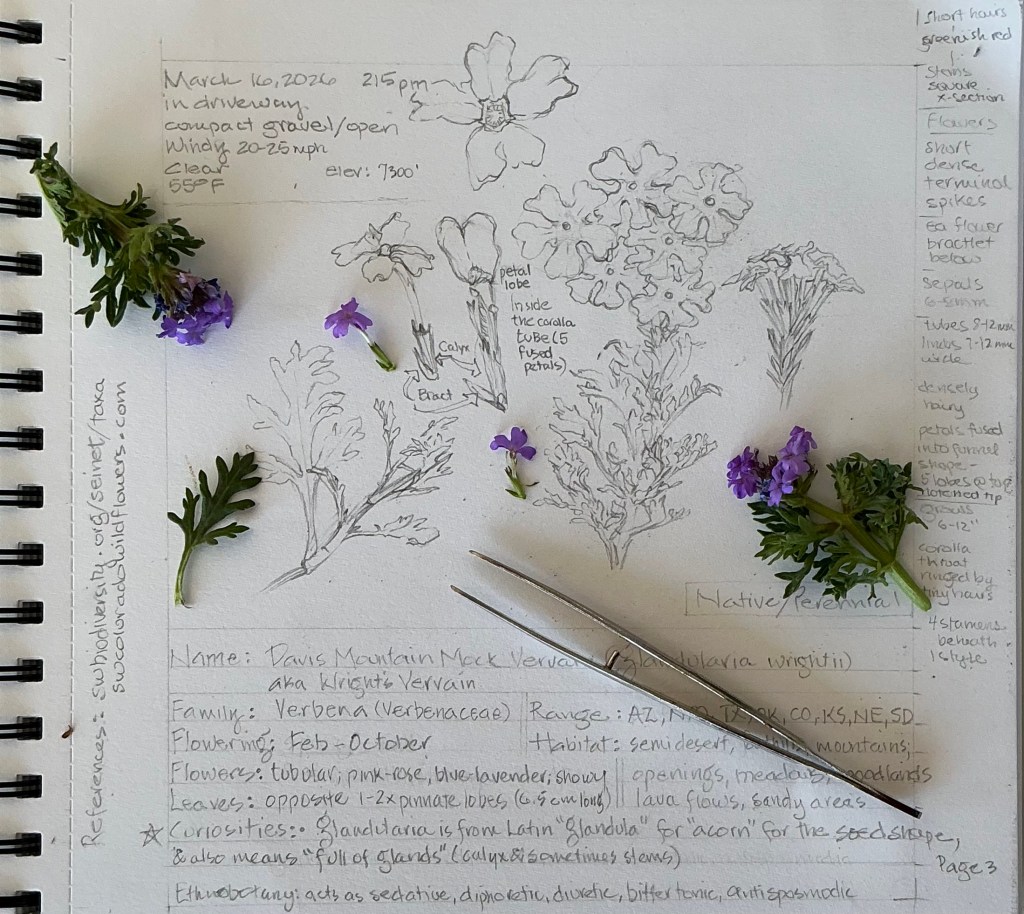
Davis Mountain Mock Vervain (Glandularia wrightii)
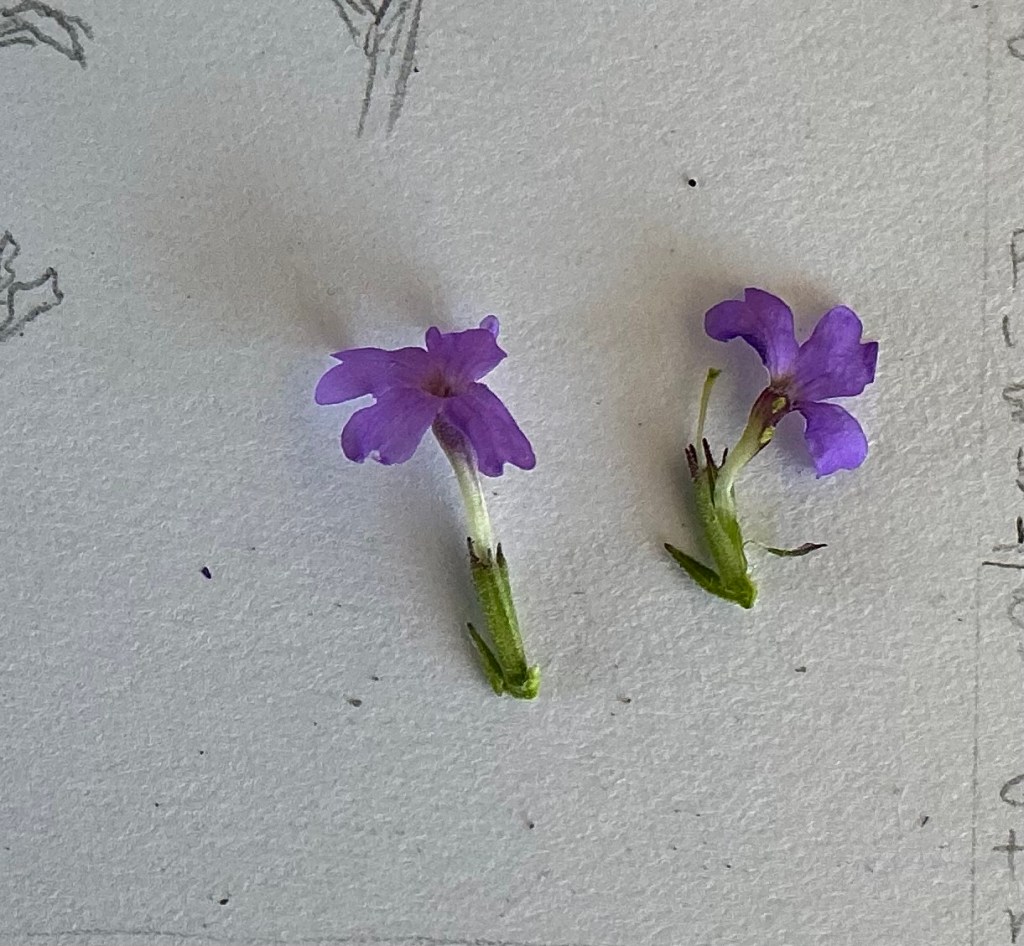
The final pageThis page shows samples from my specimen.. Although the flowers of my specimens are a purple-blue color, I chose to create the flower petals as reddish-pink; this color is also common. This is a photo of the two flowers I sketched for my final painting. The specimen on the left shows the upper part of the flower, the “limb” where 5 petals flair out from the throat ringed by fine hairs. The throat leads to the lower part of the flower – the floral tube (5 fused pale green petals). . Both upper and lower petals make up the flower’s corolla. Below the floral tube are 5 red tipped green sepals (collectively called a calyx) all fused into a cup shape. The specimen on the right is a dissected flower; 2 upper petals are removed, and the floral tube has been opened to reveal the reproductive parts. On the left side are 2 of the female parts of the pistil (pale green style supporting the 2-lobed stigma of the pistil; the ovary was not exposed). Two of the four stamens (male) lie in the mid- to upper right side of the opened floral tube; look for the bright yellow anthers, each sitting atop their own filament
Here’s Another Curiosity to Ponder: I wondered why this plant has 5 petals and 5 sepals but doesn’t also have 5 stamens, which is usually the norm in so many other 5-merous plant species??? Here’s what I learned:
Davis Mountain Mock Vervain (Glandularia wrightii) exhibits a common evolutionary trait in the Vervain (Verbenaceae) family where the flower displays a 5-lobed calyx of fused sepals, and 5 5-lobed petals which fuse into a tube (the corolla). This trait, commonly described as 5-merous, curiously has a reduced the number of functional stamens to four.
This reduction is due to an evolutionary transition from a 5-stamen ancestor. According to literature, the four fertile stamens I observed in my specimens are properly arranged in two pairs (didynamous), both neatly hidden in the floral tube beneath a ring of fine hairs. Also properly so, the filaments (the stalks that support the anthers) of the stamens are fused to the inside of the tube, and not easily teased free.
So apparently, many, many, many, many, Many hundreds of years ago, plants in the Vervain family “decided” having a 5th stamen was unnecessary. “We can do just fine without it, thank you.” Thru the process of evolution, that expendable #5 was ever so slowly reduced to a tiny non-functional structure (referred to as a staminode in modern botanical lingo), or was completely and totally lost, becoming only a memory.
Believe me, this species is an energetic producer of leaves, flowers and seeds. In my experience, Davis Mountain Mock Vervain seems to explode in masses of pink and purple flowers throughout spring, summer and fall, and can last thru winters that don’t freeze. It’s easy to understand why the species has no need of a 5th fertile stamen. Once the plant becomes established, it keeps growing and flowering and spreading, often to the detriment of other desirable plants. If it wasn’t so gorgeous at the height of bloom, it might be considered a weed!
But I’m reminded of the definition of a “Weed ….. a plant out of place.” So yes, you’ll find me actively weeding actively growing Davis Mountain Mock Vervain so my other native plants have a chance at life too!!
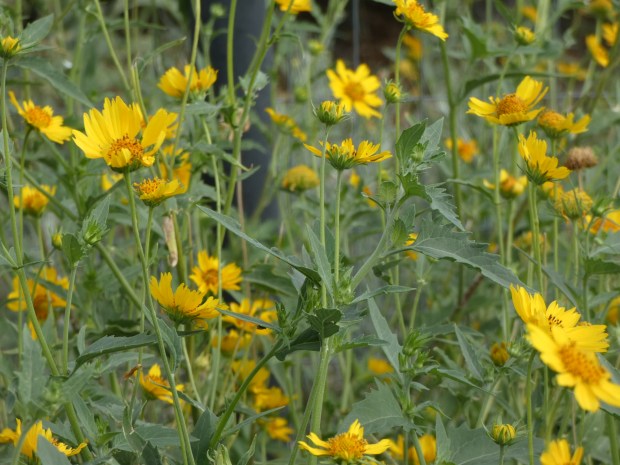
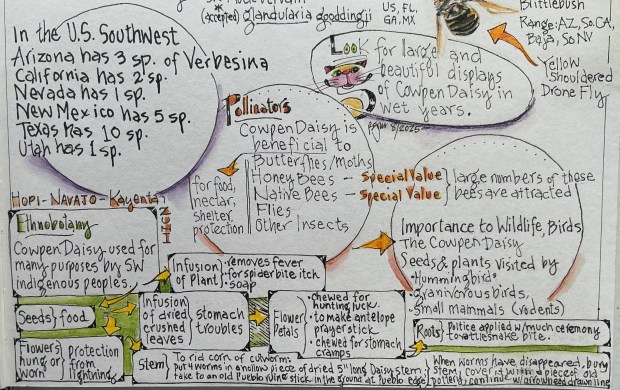
While compiling last week’s post about the happy Cowpen Daisy party taking place outside our back door, it was no surprise to find way more interesting info about this sunflower than could ever fit on my journal page. Decisions …… decisions! To keep the August 5th illustrated page relatively uncluttered, I decided to include just the botanical basics (mostly), focusing on Cowpen Daisy flowers, leaves and seeds.
Then the past week I found my nature journal wide open to a blank page, ‘begging me’ for another Cowpen Daisy entry ….. “What about all those interesting info bits?” she asked. Replying* to my journal with a hearty, “OK,” I proceeded to locate and gather my rabbit-trailing notes. This scavenger hunt reminded me just how many pages there were; so many fascinating things about the Cowpen Daisy I wanted to remember and share. Decisions …… decisions! How to keep this next post to one page? By limiting the topics to only three, was it possible?
Barely! (after some clever editing, not a single word dropped off the page)
A little bit closer view for those without a microscope!
P.S. By the way, you may have noticed I’ve indicated this post is Part 2 of what’s now become my Cowpen Daisy series. Unless I start journaling on larger than 8” x 11” paper, there’s likely to be more Parts in store. And this multi-part series resulted in a minor edit to last week’s post, not titled “One of the Happiest Sunflowers Ever! The Cowpen Daisy; Part 1 ….. Can There Be Too Many Sunflowers?” In case you missed it, please check it out here.
*Yes, you read that right; I talk with my nature journals. Don’t you? After all, we do spend quite a bit of time together!
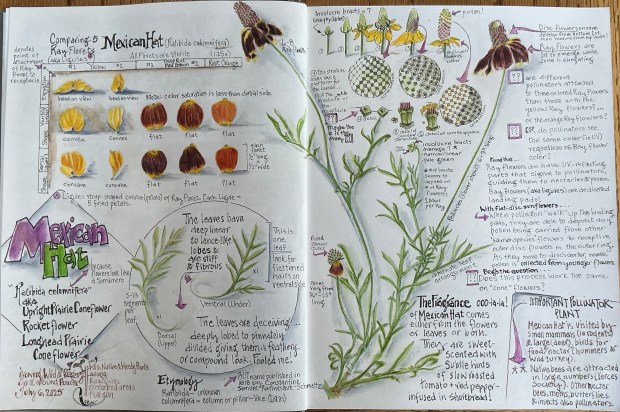
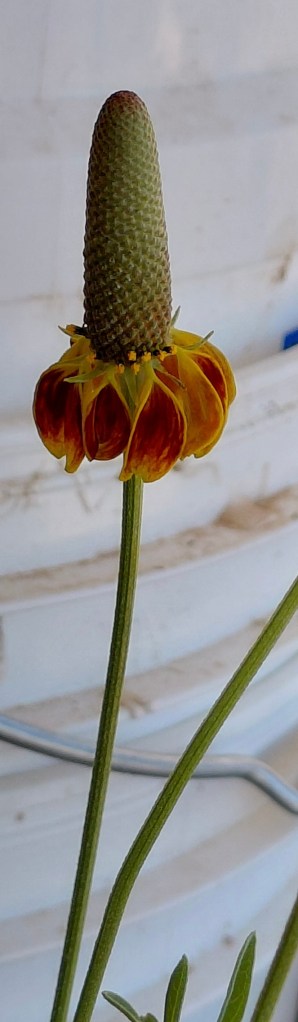
A few years ago I stumbled across this plant while walking around our neighborhood. Being immediately awed by its richly-colored petals skirting an upright cylinder or cone, I knew it would be a perfect addition to our high elevation (7,300 feet) landscape. My idea was to wait until the flowers on the cone faded and collect some seed to scatter in our yard. After repeated trips hoping to find evidence of seed, I was skunked. Either I missed the dispersal event, or this plant was 100% sterile. On the outside chance there were microscopic seeds embedded in the cone, I resorted to cone collection. Fast forward to the next spring …… every spot I’d planted those cones was barren; nothing had sprouted; zero; zip.
Fast forward again to early July 2025. This wildly blooming plant was growing vigorously in many of the dry disturbed openings and roadside areas throughout our new neighborhood! Time to learn more about such a charming member of the sunflower family called Mexican Hat.
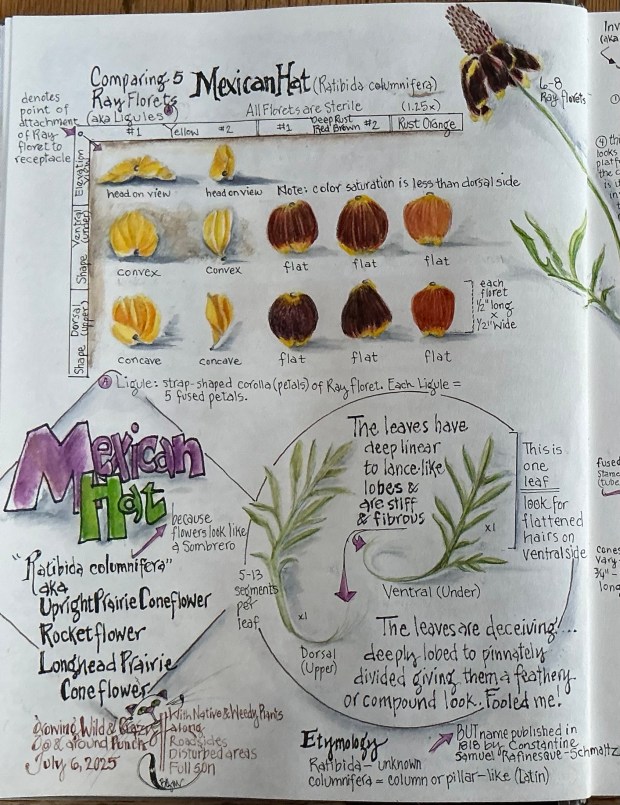
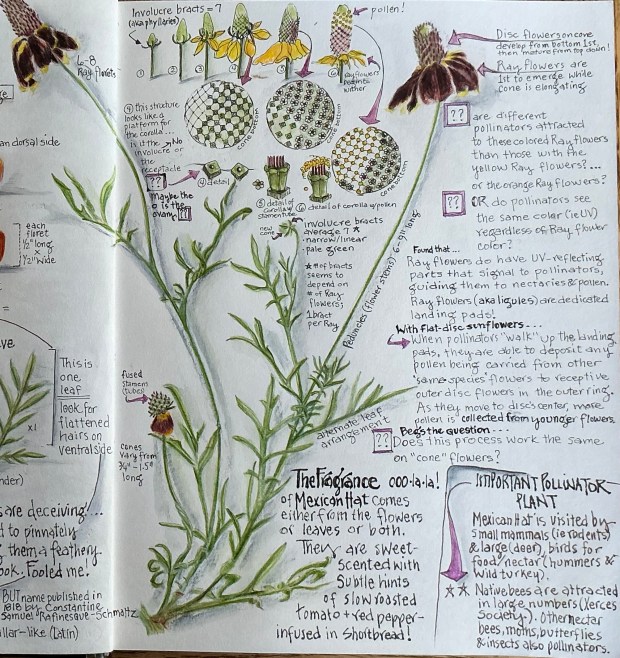
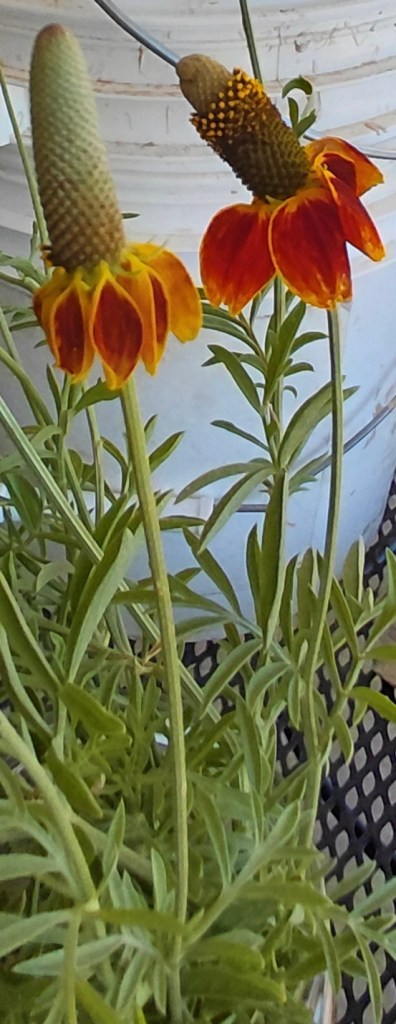
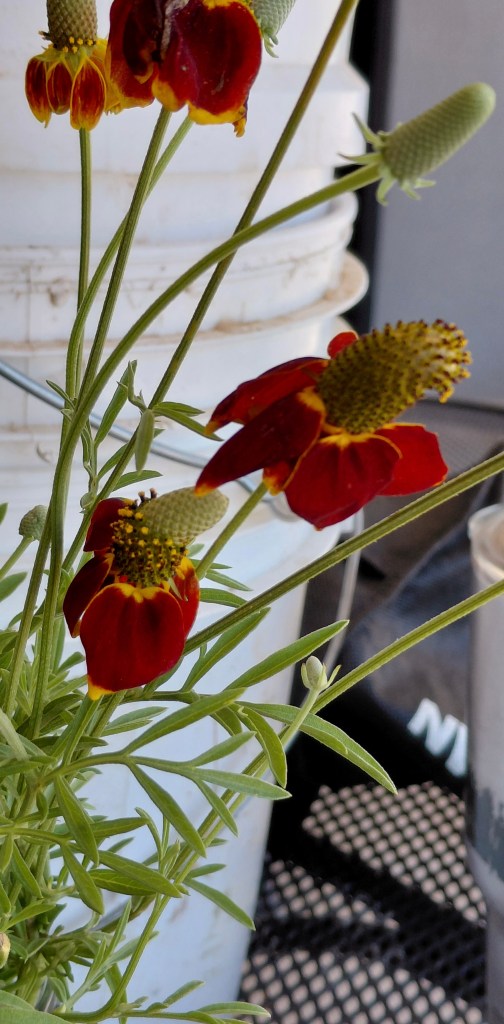
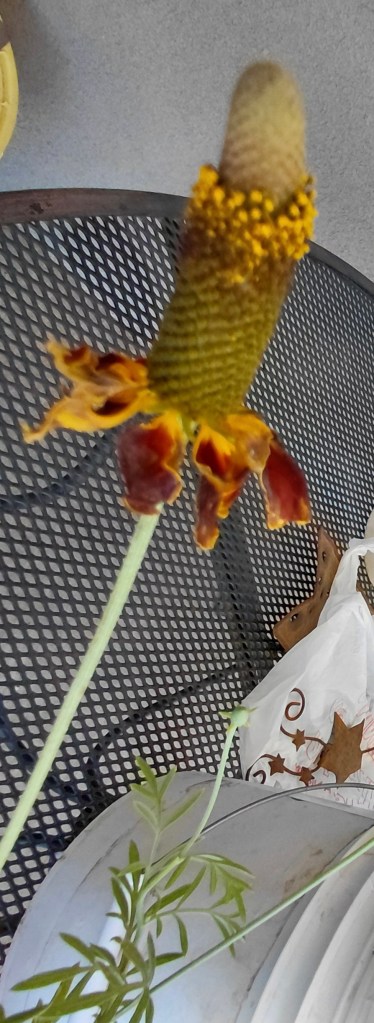
Mexican Hat (Ratibidacolumnifera), also commonly known as rocketflower, and both upright and longhead prairie coneflower, is a native perennial found across the Lower “48” (U.S.), southern Canada and northern Mexico at elevations ranging from 5,000-7,500 feet. Its Ray flowers come in a dazzling sunshine yellow, along with a soft velvety royal purple-brown, an intensely deep rust-red brown, and rusty oranges – all with some measure of sunshine yellow marginal accents. Each Disc flower (those tiny spots that spiral, Fibonacci fashion, around the upright cone) has 5 fused pale-green petals (the Corolla). The Corolla surrounds 5 fused purple/red oxide-colored Anthers (the pollen structures of the Stamens). The Anthers are shoved up through the Corolla by the developing Style (the stalk of the Pistil) where they burst into 5 sunshine yellow pollen “strands” resembling a hairdo of long, twisted, windblown dreadlocks! The shockingly beautiful colors unfailingly lure many insects hungry for pollen and/or nectar.
The entire Capitulum (the densely packed flowerhead of a composite “flower”) continually waves in the slightest of breezes as it perches atop the long stiff and naked stem (the Peduncle) of the flowerhead. Below the Peduncle are the many branched feathery-like, deeply lobed leaves. These leaves seem to be the primary source of a curiously fascinating fragrance. After handling the plants for several days, I began thinking of the aroma as being cautiously sweet-scented with subtle hints of slow roasted tomato + red pepper-infused homemade shortbread cookies! I’m looking for a recipe!
All “said and done,” Mexican Hat can grow from 8 inches tall to over 3 feet!
Benefits of and Curiosities About Mexican Hat
Special Value to Native Bees – According to The Xerces Society for Invertebrate Conservation, Mexican Hat is recognized by pollination ecologists as attracting large numbers of native bees.
Food Source for Wildlife Species – In addition to being an important source of pollen and nectar for native bees, Mexican Hat also attracts many other insects like butterflies and moths, and hummingbirds sip its sweet nectar. Wildlife that feast on its seeds include small song birds, wild turkey and rodents. Even white-tailed deer will eat the foliage, despite its reported deer-resistant qualities.
Supports Native Pollinators, Attracts Beneficial Insects, and Promotes Biological Diversity – Mexican Hat is a adaptable and resilient wildflower species, able to endure extended periods of drought, hot and cold temperatures, and diverse habitat and soil conditions. Because of these characteristics, and because the species is a self-seeder, Mexican Hat provides food and cover for wildlife, is a reliable source of pollen for at-risk native bees, and makes an excellent choice for sustainable gardening, habitat and soil restoration, and prairie conservation efforts. And not to be overlooked, Mexican Hat attracts beneficial insects like lady beetles and lacewings that help control garden pests like aphids and caterpillars, and makes a valuable contribution to natural pest management strategies.
Many Uses; the Ethnobotany of Mexican Hat – North American indigenous peoples prepared the leaves, stems, flowers and/or the cones in certain ways to treat specific ailments suffered by people and animals. By creating washes, by boiling, physically rubbing and crushing, decoctions, concoctions and infusions were used to treat chest pains, wounds, stomach aches, fevers, headaches, urinary problems, rattlesnake bites and to induce vomiting. Mothers wishing to wean their babies had crushed leaves rubbed on their breasts. Horses with urinary problems were hand fed the entire plant as a cure, and sheep that are “out of their minds” are given a cold infusion.
The cones were used as baby nipples. Leaves and flowerheads were boiled to make a pleasant tasting tea.
A Symbolic Meaning and Familiar Visual of Mexican Hat – In Mexican culture, this wildflower is often associated with traditional celebrations, ceremonies and festivals. Mexican Hat is a symbol of joy, abundance and cultural heritage. The common name “Mexican Hat” was given to this wildflower because it reminds many of the shape of a traditional Mexican sombrero.
Origin of the Scientific Name Ratibidacolumnifera – The Etymology of the genus name Ratibida was published in 1818 by Constantine Samuel Rafinesque-Schmaltz (1783–1840). Even to this day, the meaning of Ratibida is a mystery. It’s well known that Rafinesque-Schmaltz often assigned unexplained names to plants. Oh, and be aware that around 60 sites online use the spelling “Ratidiba” rather than Ratibida. So if poking around the internet for more information about Mexican Hat or any of the other prairie coneflowers, don’t be fooled by the typo!
The species epithet columnifera is a Latin name meaning “bearing columns.” This refers the tall cylindrical or cone-shaped flowerhead (Capitulum) which is the support structure (the Receptacle) for the numerous Disc flowers, the 7 Ray flowers, and the 7 small leafy bracts (Phyllaries).
Loving My Mexican Hat!
Early this spring I purchased 2 Mexican Hat plants for our garden. I’m happy to report they are doing great and loaded with 10-20 yet-to-mature pale green cones. Wonder what color the Ray petals will be?
I’m also planning to collect seed again this year, after learning the best time is early Fall when the cones look like they’re withering. Wish me luck!
Hope you enjoyed my exploration of this marvelous native perennial member of the sunflower family. Even though in a previous post I made a thorough plunge into the sunflower family, I learned even more putting this post together.
It’s Spring in my neighborhood, and not a day too soon!! Along with gusty winds carrying clouds of yellow pollen come drifts of an outrageously bright yellow ‘sunflower’ named Perky Sue.
How Perky Sue got its common name is a mystery. My best guess is this herbaceous forb, native to New Mexico, has to be the Perky-est, Happiest Spring Flower, Ever!
What is your favorite native flower signaling the arrival of Spring in your world? Does its bloom cause you to smile; perhaps you break out in your happy dance?
Thanks for stopping by …… and Happy Mother’s Day to all!