April 5, 2026
Dark Jerusalem Cricket (Ammopelmatus fuscus)
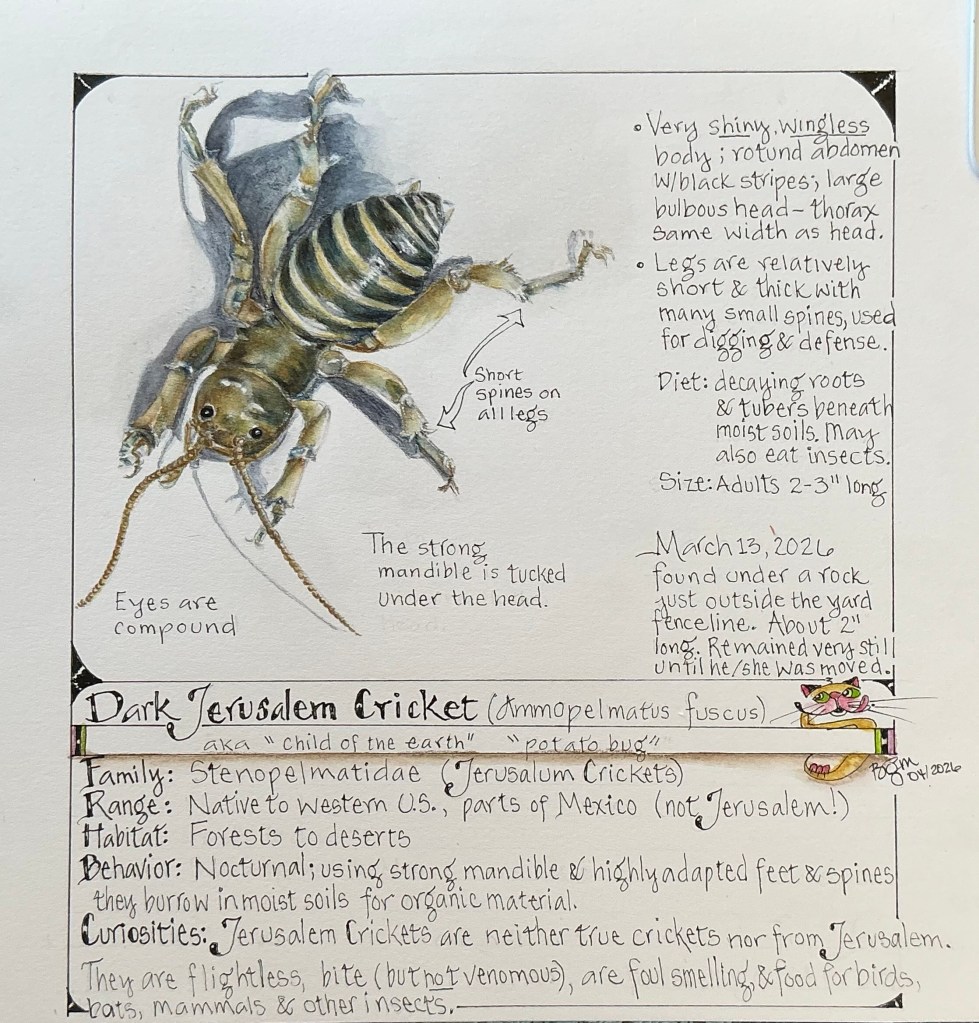
Last month (mid-March), while looking everywhere for signs of spring (something green and growing), I dared to peek under a flat rock and gasped with surprise! Instead of uncovering a tiny flower bud was a gigantic “creepy-crawly” bug! Yikes! After quickly dropping the rock back on his head I realized my run-away imagination had gotten the better of me.
So gathering my courage, I took another look. There, hiding under that rock was a “cuddly” Jerusalem cricket trying his best to be invisible (while avoiding the bright sunlight).
This wasn’t my first Jerusalem cricket, but seeing this guy prompted me to learn more about this curious insect……
Firstly, Jerusalem crickets are neither true crickets nor are they native to Jerusalem
- Taxonomists agree, “Jerusalem crickets are in a very different family than true crickets. This includes a bunch of flightless varieties, and some with wings, found in Africa. The Jerusalem crickets are wingless and are found in the Americas.”
- “The origins of the name, “Jerusalem” cricket isn’t certain, but it’s thought that it comes either as a reference to the skull-shaped head (they’re also known as skull crickets), which is associated with skull hill in Jerusalem; or, comes from a watered-down swear word from the ‘40s and ‘50s. Around this time, in the US, both “Jerusalem” and “Cricket” were expletives, associated with being startled.”
Next, some Jerusalem Cricket Mating Characteristics
- Similar to true crickets, each species of “sings” a different song during mating. They actually sing by drumming and they drum by beating their butts on the ground.
- Once a larger female has successfully mated with a smaller male, and before she lays eggs, females usually eat the males!
- She lays her egg masses in holes in the soil. After hatching, over the next 1-2 years, nymphs undergo several molts (as many as 10) until they reach sexual maturity which lasts for only 2-6 months.
- Adults can reach up to 2 to 3 inches in length. Females are often larger in size; males have longer hind legs.
Third, Jerusalem Cricket Habitats and Out-of-Sight Living Quarters
- They are “well-adapted to living in sandy soils, but can be found in sand dunes, chaparrals, grasslands, woodlands, and forests.”
- Being nocturnal, they spend a majority of their lives underground.
- They hide underneath organic matter and other debris like rocks, wood. With their powerful mandibles, spiny legs and specially adapted feet, they also dig underground burrows for comfortable living quarters.
And Almost Lastly …. the Cultural Significance of Jerusalem Crickets
- Of great importance to Native Americans as food, many tribes in southwestern U.S. also considered Jerusalem crickets as a powerful cultural symbol. Its striking appearance leads some to think the cricket brings mortality, as depicted in the folklore of the Chumash people of southern California.
- The Hopi, who settled in Arizona, portrays this cricket as a spirit being (a Kachina) named Sösööpa who races. As a result, it’s often carved into their Katsina dolls as a yellow humanlike character with black beady eyes, a black-and-white plaid skirt, and antennae made from sand grass, depicting traits of the cricket.
- The Navajo associated the Yucca plant with the insect; you had to eat the plant as a cure of the cricket’s painful bite. This myth possibly gave rise to the misconception that their bite is venomous.
It’s Greek to Me! (Entomologically Speaking)
Learning the meaning of a scientific name assigned to a species not only helps me remember uncommon words and how they’re pronounced, but often describes aspects of a species’ characteristics that may help differentiate it from another similar-looking species. Learning about these complex names falls into a study called entomology.
Ammopelmatus fuscus, the scientific name for the Dark Jerusalem Cricket, is quite a mouthful. Curious about the meanings (in plain English) of these two strange words, I learned the name originates from Greek and Latin roots meaning “dark sand-sole” or “dark sand-burrower,” obviously referring to their sandy habitats, dark color, and burrowing behavior. But to learn how the common name with the word “sole” ties to one of the cricket’s characteristics, my dive continued. Here’s the entomology breakdown:
- Genus Ammopelmatus
- Ammos (Greek) means “sand,” referring to the cricket’s specialized adaptation to arid, sandy environments.
- pelma (Greek) means “sole of the foot,” highlighting the specialized leg structures the cricket uses for burrowing.
- tus (Greek) is a common word meaning either “them” or “their.” In this case, “tus” ties the first two parts together into “their sand sole.”
- Species fuscus (Latin) means “dark,” “dusky,” or “brown,” describing the cricket’s color.
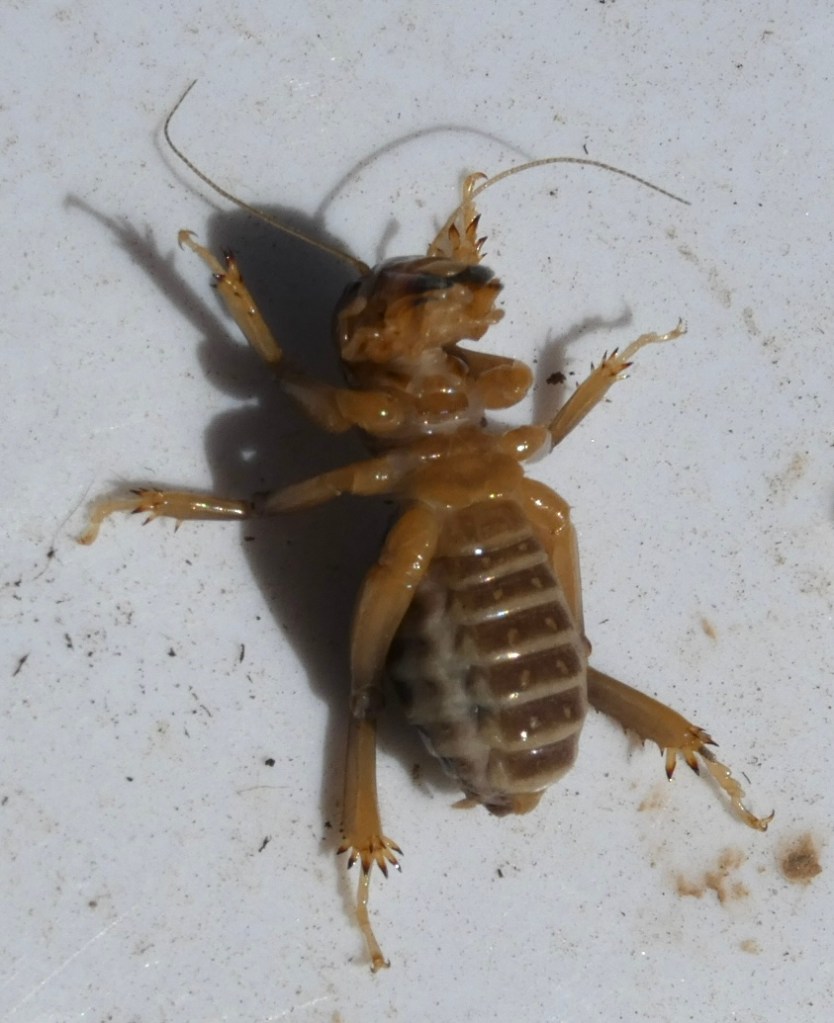
After learning more about the Dark Jerusalem Cricket, maybe next time I discover one, I won’t jump so high?! Do you think?
Have you seen a Jerusalem cricket hiding out in your yard? If so, what was your reaction?
Hope you enjoyed this post! Thanks for stopping by!
References
factanimal.com/jerusalem-cricket/
- Eaton, Eric R.; Kenn Kaufman (2007). Kaufman Field Guide to Insects of North America. New York: Houghton Mifflin. p. 84.
- Milne, Lorus Milne, Lorus and Milne, Margery (1980) The Audubon Society Field Guide to North American Insects & Spiders. Alfred A. Knopf, Inc, pp. 437.
- Stoffolano JG, Wright B (2005). “So so opa —Jerusalem Cricket: An Important Insect in the Hopi Katsina Pantheon.”American Entomologist. 51 (3): 174–179. doi:10.1093/ae/51.3.174

 a curious nature
I found one of these little guys in our yard last year. It was the first time I’d seen one, and I was so excited that I had to tell our “bug guy.” I love to challenge him and see if he has seen different types of bugs. They are kinda cute in a buggy way, huh?
LikeLiked by 1 person
It’s wild how much their heads resemble a person’s face! Love your description “kinda cute in a buggy way”. You nailed it! How fun to have a “bug guy” to consult. Love all your comments! Many many thanks!
LikeLike