Linnaeus named the genus Monarda to honor 16th century Spanish physician and botanist, NicolásBautista Monardes (1493-1588). Monardes never went to the Americas but was able to study medicinal plants in Spain, publishing the first systematic, in-depth book on medicinal plants and remedies brought to Europe from the Americas.
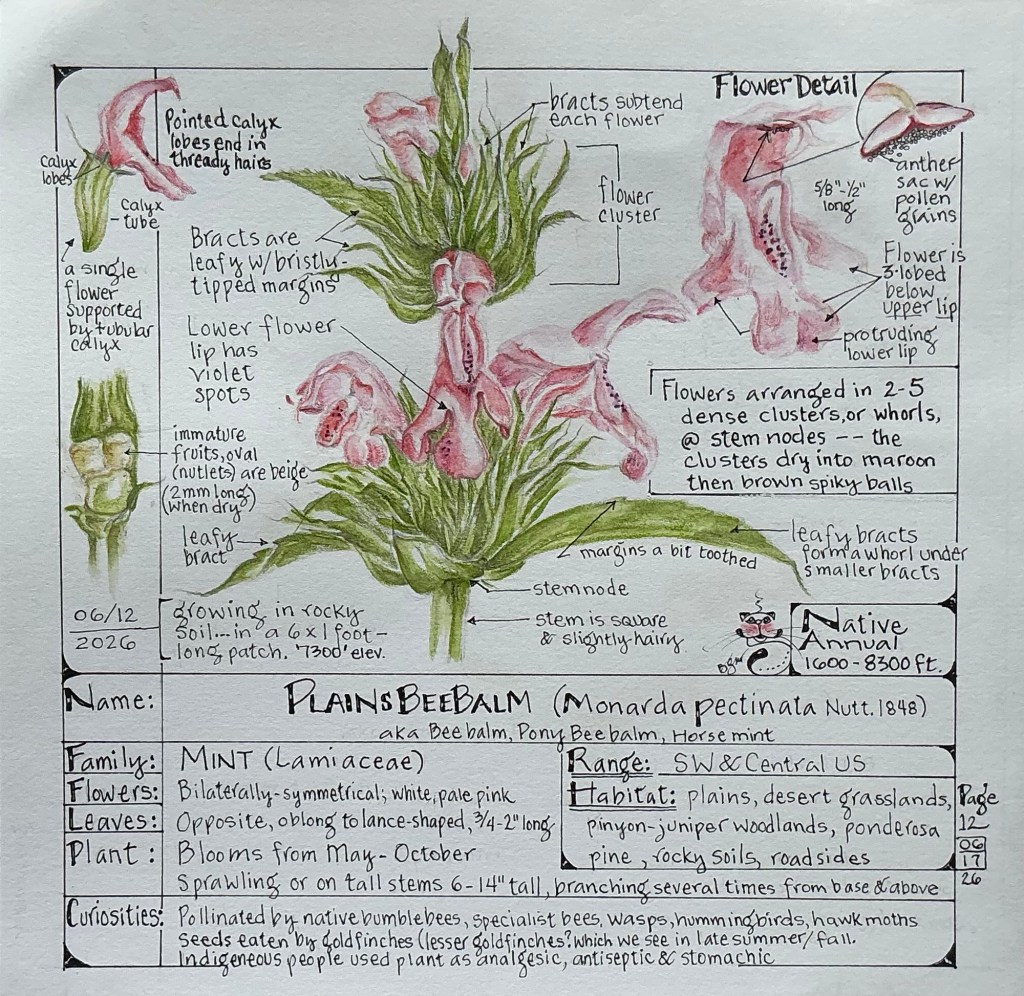
The species pectinata is derived from the Latin word pecten, meaning “comb.” The suffix -ata denotes possession or resemblance — so it translates loosely to “comb-like” or “having the form of a comb,” referring to the bristle-tipped bracts that sit below flower whorls.
Monarda pectinata is commonly called Plains Beebalm (or Pony Beebalm) because of its historically recorded uses by Indigenous peoples as an analgesic and antiseptic qualities.
Ethnobotanical and Culinary Uses
Indigenous peoples used a plant infusion to treat coughs, colds, fevers, and stomach complaints related to digestion. A flower infusion was used as a wash on insect bites and stings. The plant was rubbed on the head to bring relief from headache. In addition, historic records document that groups, such as the Kiowa, used Monarda pectinata leaves as a perfume due to its strong scent, and were chewed while traveling.
The strongly aromatic smell of crushed Plains Beebalm leaves smell both savory and citrusy, similar to oregano or lemon. Sometimes called “wild oregano,” they can be eaten fresh, dried or cooked to season in salads or other foods. In spring the leaves may be boiled to make herbal tea.
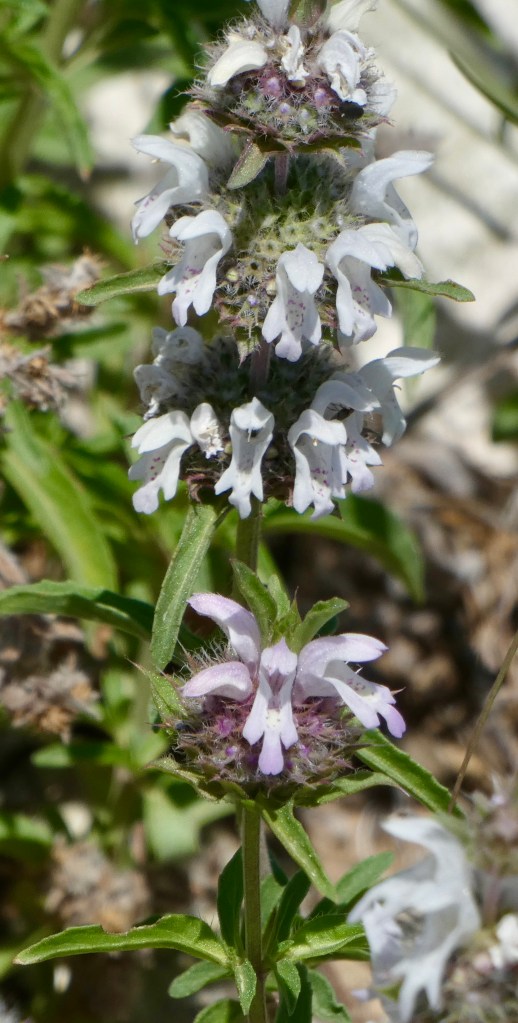
Plains Beebalm blooming in our yard, in bright sunshine and rocky soils.
Pollinators
According to the Xerces Society for Invertebrate Conservation, all Monarda species attract a number of native pollinators such as specialist bees, bumble bees, predatory wasps, hummingbirds, and hawk moths.
A Few Fun Facts
Desert Survivor: Although many Monarda species are moisture-loving, such as Wild Bergamot (Monarda fistulosa) found the along cool trails of Sandia Mountain, Plains Beebalm prefers hot, harsh, dry environments like desert washes, rocky slopes, and sandy pinyon-juniper woodlands.
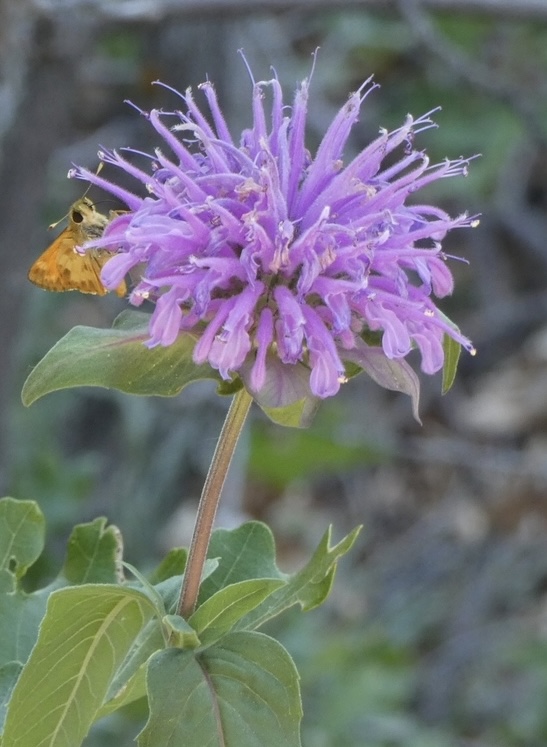
Wild Bergamot and a little skipper pollinator. Tecolote Trail, Sandia Mountain, NM. This Monarda species prefers living in moist soils under the shady canopy of white fir and ponderosa pine.
Mammal Resistant: While pollinators adore Plains Beebalm, its strong, minty-citrusy-oregano essential oils act as a natural deterrent, making the plant resistant to browsing deer and rabbits.
Pollinator Magnet: The tubular pale pink flowers of Plains Beebalm are an excellent nectar source for long-tongued native bees, butterflies, and hummingbirds, especially during the hot summer months.
Soothing Relief: Plants in the Monarda genus are commonly called “Beebalm” due to the soothing nature a wash application of the plant, especially the flowers, has on insect bites and stings — particularly bee stings. Turns out plants in the genus contain the active ingredient thymol, a natural antiseptic found in modern mouthwashes.
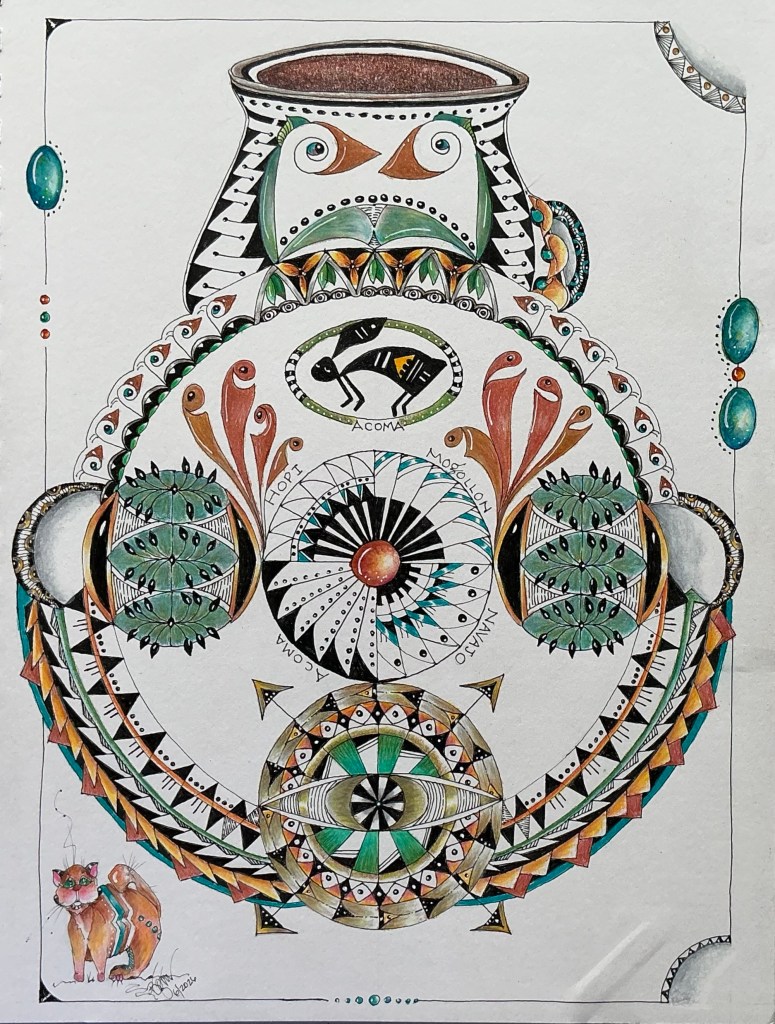
The Tale of the Tangled Pot: Recognizing our Deeply Rooted and Inseparable Connection with the Natural World Through the Practice of Nature Journaling
June 14, 2026
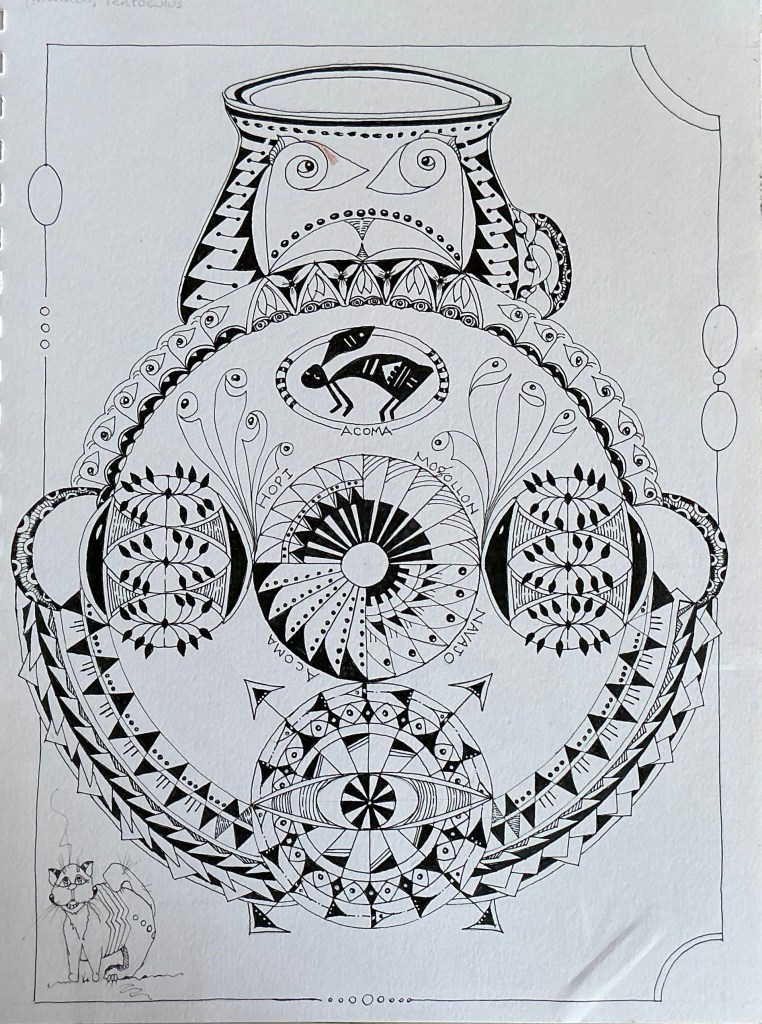
Zentangle patterns: Mogo, Sage, Roadrunner, Agave, Lazy Leaf, Monsoon, Zona, Voyage, Hokam (patterns created by Angie Gittles). Also added Hahna and Tentoculus. All patterns found on tanglepatterns.com
Living in the desert Southwest, inspiration for many of my Zentangle work comes from the representative art created by the indigenous peoples of New Mexico and the Four Corners region. Their deep connection with nature was often expressed in ancient rock art and on handcrafted pottery in ways that amaze. It takes me back to a different time and place; where their way of life was deeply rooted and inseparable from the natural world; where survival required an understanding and appreciation of the countless interdependent components required for the productive function and evolution of complex ecosystems.
Fast forward to today. Our fast-paced, stress-filled, consumer-centric lifestyles, full of techno-gadgets (demanding so much of our attention), and instant gratification, offers people a cushy arm-chair view of the world. Why put down those phones or turn off the TV, when we can safely and comfortably “witness” nature from our homes? Better yet, why not?
While pondering that question, many compelling reasons came so easily. Just being present in nature can be calming; relaxing; stress-reducing — we slow down, taking time to observe our natural surroundings. By really “seeing” local ecosystem(s) with all of our senses, we experience awe and wonder and make meaningful memories. Our once dormant skills in curiosity and critical thinking come alive as we learn about the integral connectedness of nature’s many and diverse components. By understanding and valuing how our connectedness to nature always has been and always will be critical not only to our very survival, but to the survival of all species, we realize the ability of all living things to thrive benefits from natural ecosystem services that provide things like clean water to drink, clean air to breathe, food to eat, and a habitable climate. These vital services are priceless. All nature asks is that we keep it healthy. First-hand personal exposure to the natural world fosters appreciation, love, and a desire to nurture and protect nature; an investment in the future of all life on Earth.
Observing the Natural World through the Practice of Nature Journaling
People have been observing, learning, and recording nature around the world for millennia. The oldest known cave art (pictographs) with paintings of wildlife, primitive humans, and human-bird hybrids hunting pigs, was discovered on an Indonesian island, and dates back almost 70,000 years. The oldest known rock carvings (petroglyphs), created by the Aborigines of Western Australia 40,000 – 50,000 years ago, depict wildlife and hunting parties. The oldest known petroglyphs found in North America were carved into boulders by still-unidentified humans that lived in the Winnemucca, NV area (east of Reno) between 10,000 and 14,800 years ago; their rock art represents leaves and trees. The oldest pictographs and petroglyphs found in New Mexico were made by Ancestral Puebloans and other Indigenous groups between 3,000 to 4,000 years ago in the Guadalupe Mountains/Carlsbad Region (southern NM) and depict hunting parties, wildlife and other natural elements.
The travelers, explorers and settlers that arrived in North America significantly influenced nature recording. They kept journals, field notes, and artistic renderings tracing a rich history of scientific inquiry and ecological changes spanning early colonial times to the formal natural history expeditions of the American West. For example, John Lawson (1709) and Mark Catesby (1731-1743), each published a book with their observations of the flora and fauna of the eastern colonial colonies (Catesby) and the southeast (Lawson). Extensive and diverse nature observations were recorded by all members of the Lewis and Clark Expedition (1804-1806), and by John James Audubon (1827-1838) with a focus on birds in their natural habitats. These and many more examples of “journaling nature” provided an understanding of the complex ecosystems that existed between two oceans, and was indispensable to the successful settling of North America.
Today’s Practice of Nature Journaling — paying attention, recording observations, asking questions, noticing changes, and reflecting on the natural world — is nearly identical to historical journaling practices, with some healthy advantages for mind and body. For example, Nature Journaling offers much needed mental, cognitive, and emotional relief, particularly important in today’s world. It also provides a screen-free way to reduce stress, encourage mindfulness, and sharpen observational and critical thinking skills. By intentionally immersing ourselves in nature — by being fully present — we can experience these benefits, and more. We find our place in nature by making connections and understanding how we are an integral and inseparable part of the environment around us.
“Walking” thoughtfully and gently in nature inspires us to nurture and protect what we are all part of, instilling in us a deep appreciation for the natural resources essential for the survival of our ancestors, as well as for our survival today and for future generations.
……………………………………………………………………………………………………
Zentangle patterns: Mogo, Sage, Roadrunner, Agave, Lazy Leaf, Monsoon, Zona, Voyage, Hokam (patterns created by Angie Gittles). Also added Hahna and Tentoculus. All patterns found on tanglepatterns.com
Many thanks to Angie Gittles, a Certified Zentangle Teacher, for developing the step-outs to an abundance of patterns inspired by Indigenous Peoples of the Southwest. Her inspiration inspired me to weave 10 of her different designs into a stylized pot to honor and encourage such an important way of life. In doing so, I took my time, taking many deep breaths during the process, and thought about the days when appreciating and expressing nature was a natural way of living.
……………………………………………………………………………………………………
Resources and a Few Important Tips
Whether you consider yourself a “Nature Journaler” and would like to learn more, or are interested in how to begin, there are countless resources and examples to refresh your skills or to get you started. Borrow a library book, such as Nature Drawing by Claire Walker Leslie, Keeping a Nature Journal by Leslie Roth, or Nature Drawing and Journaling by John Muir Laws.
To get started in journal sketching or to improve your skills, check out the following: Discovering the Art of Field Sketching by Kristin Link, Botanical Drawing using Graphite and Colored Pencil by Sue Vize, or The Artist’s Guide to Sketching by James Gurney and Thomas Kinkade.
Of course there hundreds of thousands of on-line resources and social media sites about Nature Journaling and related topics. But beware the pit trap ….. lest you get caught up in doom of perpetual scrolling, never to get a breath of fresh air in the light of day!
If you’re unsure about becoming a “Nature Journaler,” know that anyone can head to the woods, the backyard, or sit by a window. You don’t have to travel hundreds of miles to visit a National Park ….. nature is everywhere! All you need is a pencil and piece of paper, the curiosity to see what’s around you, and the desire to slow down and observe with all your senses. There’s no right or wrong way to journal in nature, but when you do, be fully present; take the time to really “see” your surroundings. Just committing to turning off your screens to nature journal for 5 minutes a day will be perfect for you!
……………………………………………………………………………………………………
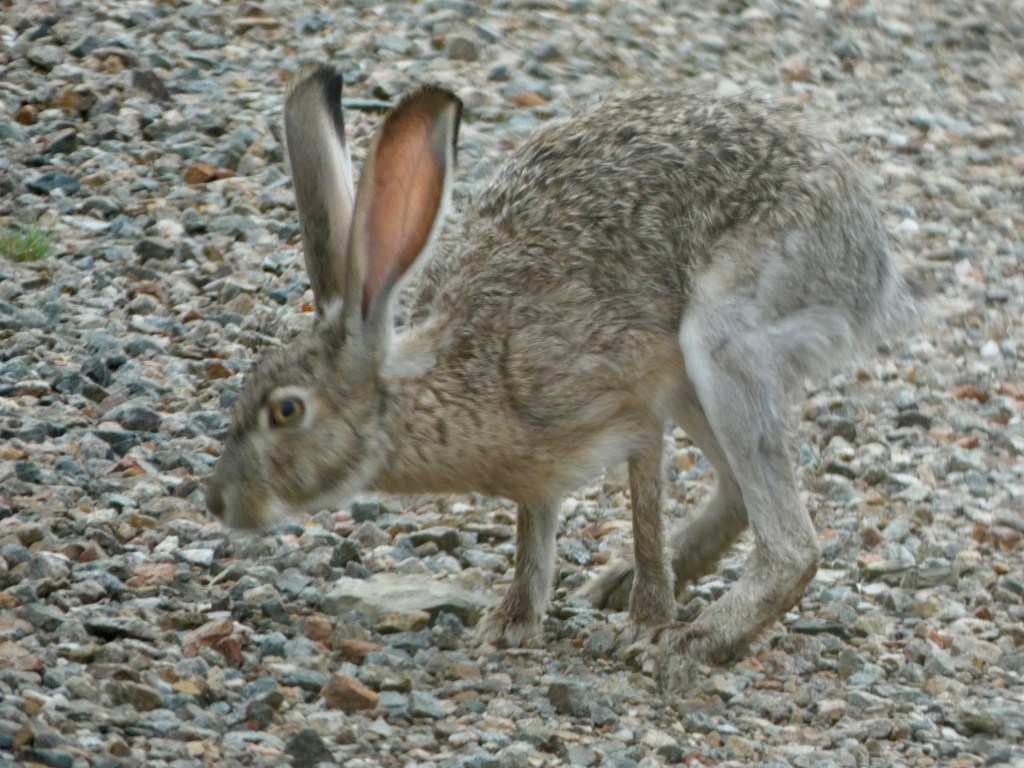
Black-tailed jack rabbit on the move!
Hope you enjoyed my Tangled Pot. As I always do while nature journaling, when creating these kinds of Zentangle-inspired works, my automatic slow-down mode becomes engaged, allowing me to think about possible directions I can take to complete a page. Sometimes the path is direct, but more often a world of rabbit trails leading to deep holes opens up before me, and I gotta take the plunge. That’s exactly what happened while tangling the Pot. And that’s what got me thinking about— how our ancestors used to live in nature, how art represents nature— how nature is endlessly tangled up in life— how today’s values take a back seat to our crucial connections with nature—how nature journaling can be used as a tool to restore gratitude and appreciation for nature—how, without nature, life as we know it would not exist.
I’m going to turn off my computer now and go enjoy a walk in nature with my journal. Are you inspired to do the same?
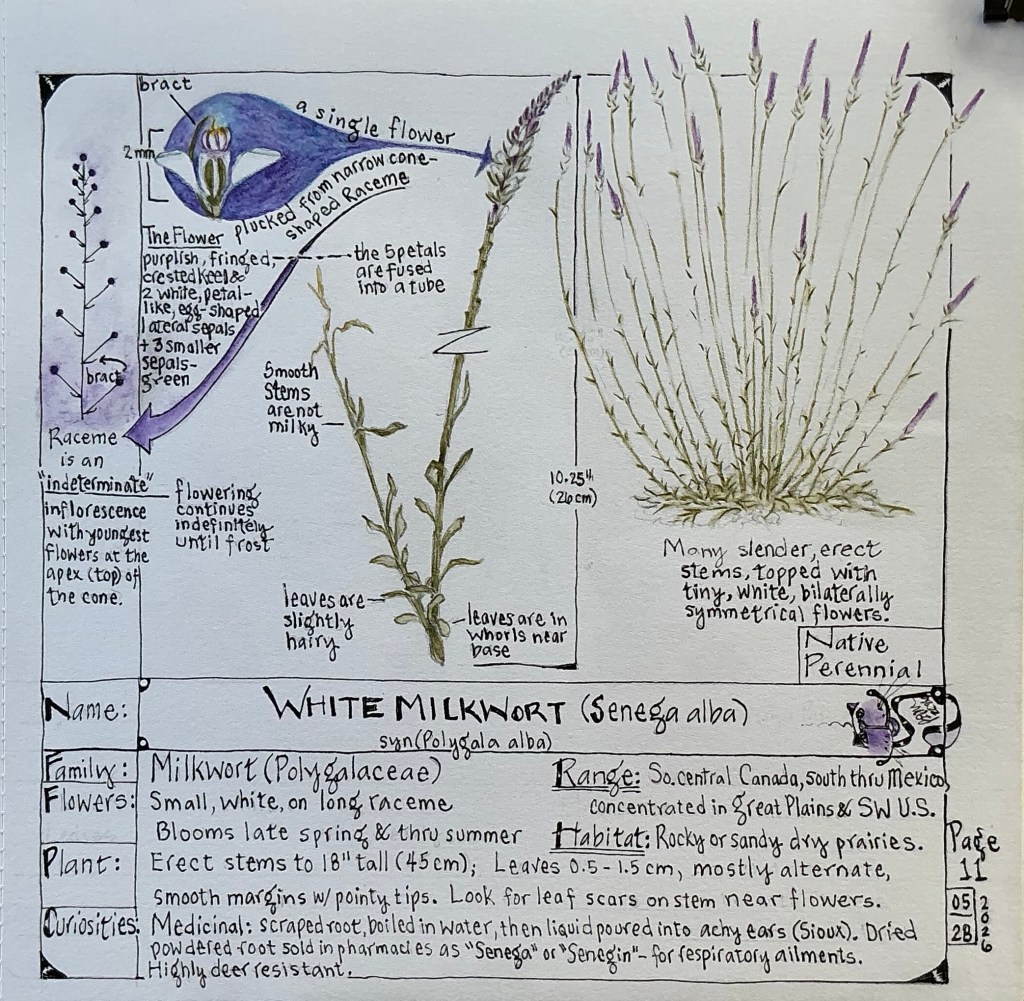
White Milkwort (Senega alba (Nutt.) J.F.B. Pastore & J.R. Abbott)
(synonymous with Polygala alba Nutt.)
A Light Touch
It was a beautiful morning for a walk along one of the neighborhood’s 2-track dirt roads. I was searching for late blooming Spring wildflowers when something lightly brushed against my leg, bringing me to a full stop. There, at my feet, gently swaying in the quiet breeze were a dozen+ foot tall, nearly naked, skinny green stems topped with lavender and white cones. Not wishing to crush these delicate stalks, I noticed there were five other groupings nearby, all growing in the road’s old tire depressions. Upon closer inspection, I recalled having seen this plant before in the yard of our previous home, but they had fewer and shorter stems, and larger (?) flower cones. Still, this was the white milkwort species (back then known as Polygala alba; today called Senega alba) I identified four years ago. It was the larger size and delicate nature of these plants at my feet – that puzzled me.
Here’s what I learned:
The stems, which are ridged, can grow to 18” tall. They branch from a basal caudex (a root-like thickened stem, often found underground, from which branching/stems grow …… and the more extensive the caudex, the more above ground stems form.
You can roughly age this perennial milkwort by counting the number of vertical stems. Typically there’s one stem on seedlings and one-year old plants; as many as 30 stems have been counted on much older (many, many years old) plants.
Even though the official flowering period ends late summer, if mid-summer/early fall rains (our monsoon season) are plentiful, another bloom period peaks and can continue into November. It’s been reported that when old flowers are removed from these milkworts (deadheaded), the plants will bloom continuously for up to four years! Obviously, those plants are not impacted by winter frosts.
The 90% of the pollinators visiting white milkwort are small to medium solitary or semi-solitary bees. Where we live (desert southwest), many of these ground-nesting bees are floral specialists, and based on research dating back to the early 70s, green metallic bees highly favor this native plant’s flowers for nectar and pollen. And with extended bloom times prompted by monsoons, this helps benefit these and other bee species. Unfortunately, the timing and intensity of our monsoons is no longer predictable and is likely causing unfavorable conditions for extended flower bloom and the bees.
Always be prepared to encounter a plant that tickles!
Classification and an Etymological Quandary
To learn the story about the old and new scientific names for white milkwort, and why being a botanist way back when and today is so challenging, read the next section on Etymology. It really is quite fascinating!
Etymology
Way back in the day (say, the early 1800s), when Thomas Nuttall, a English botanist, ornithologist, geologist and explorer, needed an unforgettably descriptive binomial name for a new species he’d discovered, “Polygala alba Nutt.” was his choice. The genus “Polygala,” which was originally assigned by Linnaeus to a group of plants with similar-looking flowers, is Greek for milkwort — meaning “much milk; ” the species name “alba” is Latin for “white, bright or clear.”
Thomas, logically picked “alba” as the species name for his new discovery, because the plant had white flowers. However, he apparently chose the “Polygala” genus based on an ancient belief that nursing mothers (and cows) that ate the milkwort plant experienced increased lactation. However, Polygala alba doesn’t have either milky sap or any plant parts with milk! After diving deeper into the Polygala genus as a whole, I couldn’t find any that ooze a milky substance.
The changing nature of botanical classification: It wasn’t until recently (2023 to be exact) that the official report announcing the transfer of 18 Polygala species to Senega, including Polygala alba to Senega alba, was published by botanists J.F.B. Pastore & J.R. Abbott. This change was based on a number of scientifically-researched plant characteristics, which addressed deviations in seed, fruit, and floral anatomy between Senega and true Polygala species. Now I know I need a bigger microscope!
In case you’re curious (I certainly was) there are no Senega milkworts (today referred to as American milkworts, formerly classified under Polygala) with a milky sap. So, despite their family (Polygalaceae) and originally assigned genus name (Polygala), these plants exude a clear, watery sap when their stems are broken.
Why “Senega” was selected as the genus name for all American milkworts: The genus name “Senega” comes from the Seneca Native American tribe. The first use of the name in the English language was in the 1730s; the Seneca snakeroot plant was given the scientific name Polygala senega, to honor the tribe’s traditional use of the root as a remedy for snakebites and respiratory issues.
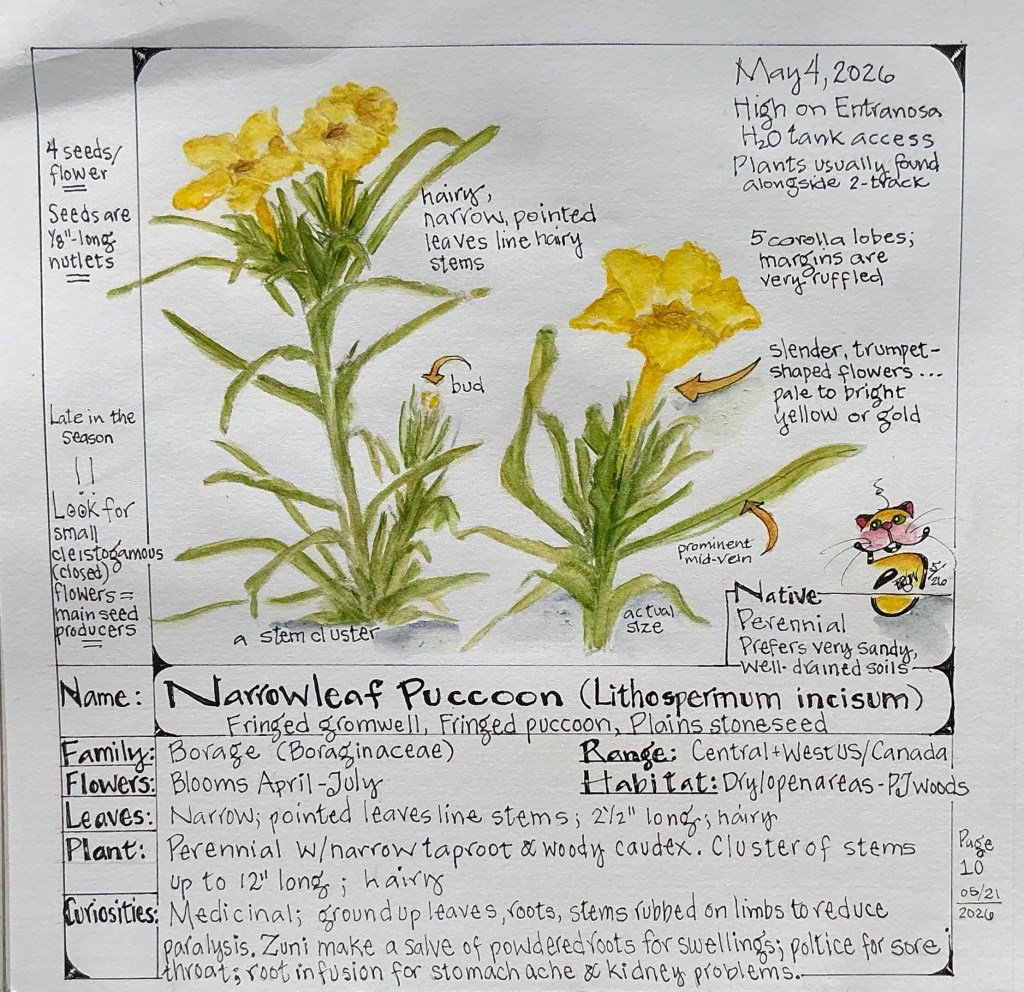
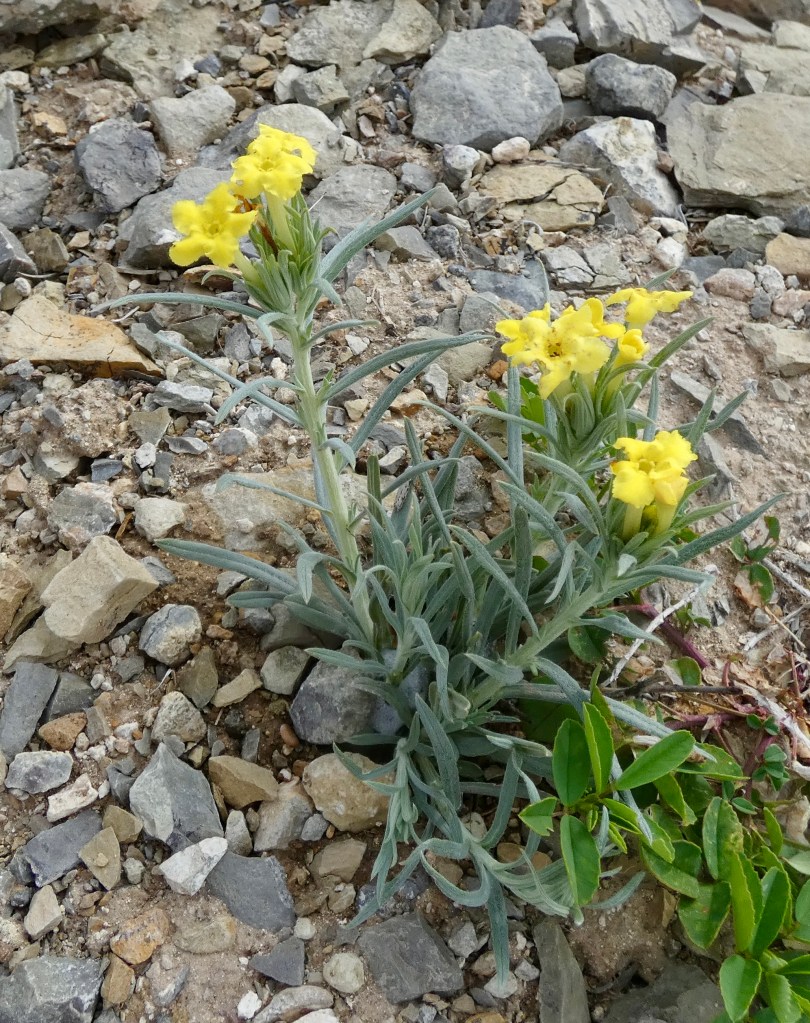
Lithospermum, the genus named by Linnaeus in 1753, is Greek for stone (“Lithos”) and seed (“sperma”), referring to the hard nutlets. And “incisum,” theLatin species name referring to the incised, fringed edges of the trumpet flowers, was named by Lehman (a German botanist) in 1818 from a specimen collected “near the rapids of theOhio” by Andre Michaux (a French botanist and explorer) in 1802.
Puccoon evolved from “poughkone,” a word the Virginia Algonquian language used for plants whose roots yield a red or yellow pigment. The roots of Narrowleaf Puccoon were historically used as dyes ranging from purple to red to yellow.
A Two-Flower Strategy
Very showy and quite lovely, the sunshine yellow trumpet-shaped flowers of Narrowleaf Puccoon are hard to miss. They often cluster at the ends of 12-20” long stems where the floral tube is ringed by five frilly petal lobes. The flowers depend on pollinators like butterflies for cross-pollination which adds genetic diversity to the few seeds they produce. Botanically speaking, these traditional, open flowers with exposed reproductive parts are referred to as Chasmogamous.
Then later in the season, the Narrowleaf Puccoon produces small, petal-less flowers that remain tightly closed. These highly fertile, self-pollinating flowers account for almost all of the plant’s seed production. Botanists refer to this type of closed, often inconspicuous flower as Cleistogamous.
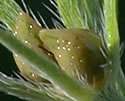
An immature nutlet
The“Stone Seed” Fruit
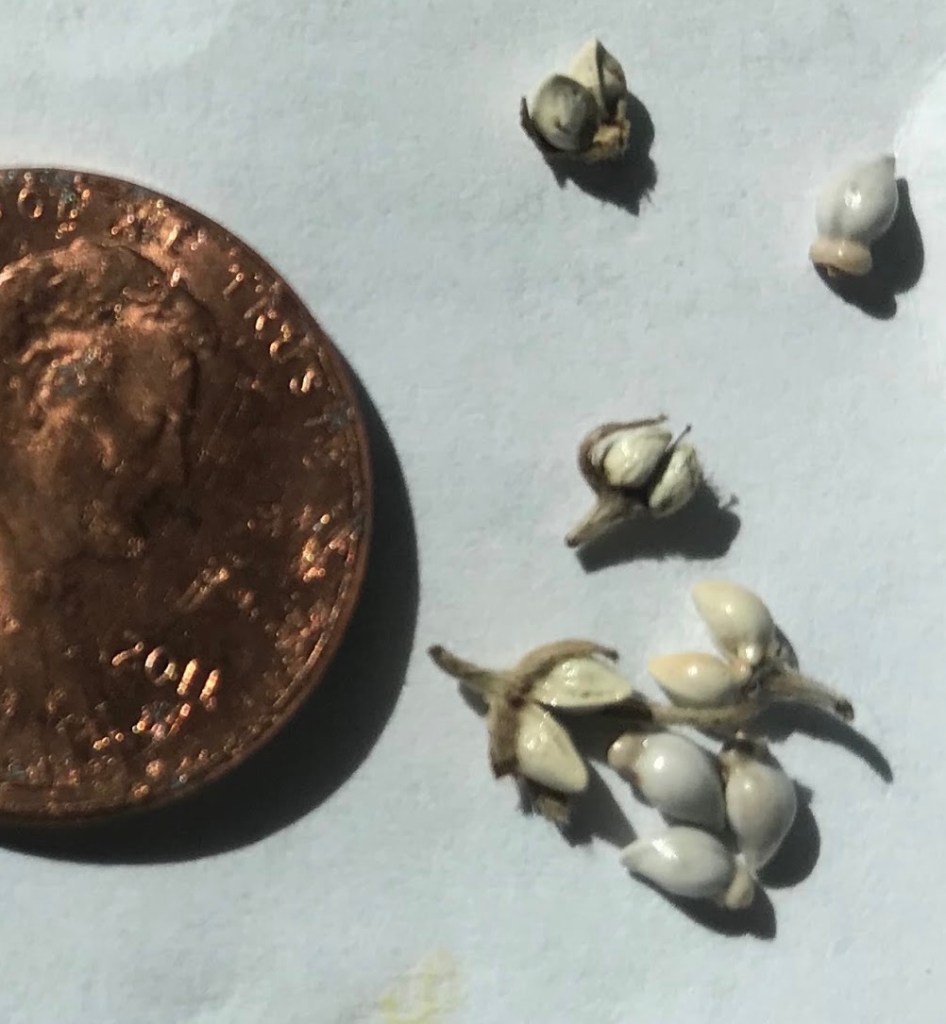
BecauseNarrowleaf Puccoon only produces the occasional fruit from its showy flowers, it takes a bit of searching around the plant’s lower leaf axils to locate a tiny group of up to four hard “stone seed” nutlets. Beginning growth inside the self-fertile, closed (Cleistogamous) flowers that are present late in the season, each egg-shaped nutlet, pitted across the surface, ripens to a shiny white.
Plant Propagation
Seed Germination – To grow Narrowleaf Puccoon from seed, nutlets should be collected in late summer. Soak them overnight in hot water then plant immediately. Because seed germination is sporadic and often disappointing, selecting a desirable location for planting is important. The plant grows best in very sandy, well drained soils found in the dry/open areas within our pinyon/juniper woodlands (though they do grow in soils with some loam or clay).
Shiny white nutlets with Penny for size Photo edited from a post by A Wandering Botanist
Root Cutting – A more successful method may be to take a 2-inch cutting of the taproot in the fall. Dip the cutting in a root stimulant and plant in a desirable location.
Suggestions for root stimulants
Powdered Hormones: Highly cost-effective, have a long shelf life and easy to use. After you moisten the root cutting, just dip it directly into the powder (e.g., Garden Safe TakeRoot) and plant.
Natural/DIY Options: Raw aloe vera gel and crushed, uncoated aspirin both contain natural growth-promoting enzymes. You can also use diluted willow bark extract, which is naturally rich in rooting hormones.
Plant Care – Narrowleaf Puccoon requires full sun and very little water, making it a good plant for xeric gardens or included with other native plants to establish a wildflower meadow.
Photo taken early May 2026 along the Entranosa access road
Medicinal Properties and a Cautionary Note
The Navajo chewed the root of Narrowleaf Puccoon for coughs and colds. They, and the Zuni rubbed the plant’s finely powdered leaves, root and stem on the body to treat paralyzed limbs. An infusion of the root was used for stomach aches and kidney problems. The plant was eaten as an oral contraceptive, and a cold infusion of the pulverized root and seed was used as an eyewash.
Although Narrowleaf Puccoon does have medicinal properties, it contains potentially toxic alkaloids. Self-treatment involving this plant is strongly discouraged.
…………………………………………………………………………………………………
If you’ve seen Narrowleaf Puccoon, did you find their highly fertile, tightly closed flowers and/or the shiny white nutlets? Have you tried growing the plant from seed or root cuttings, and were you successful?
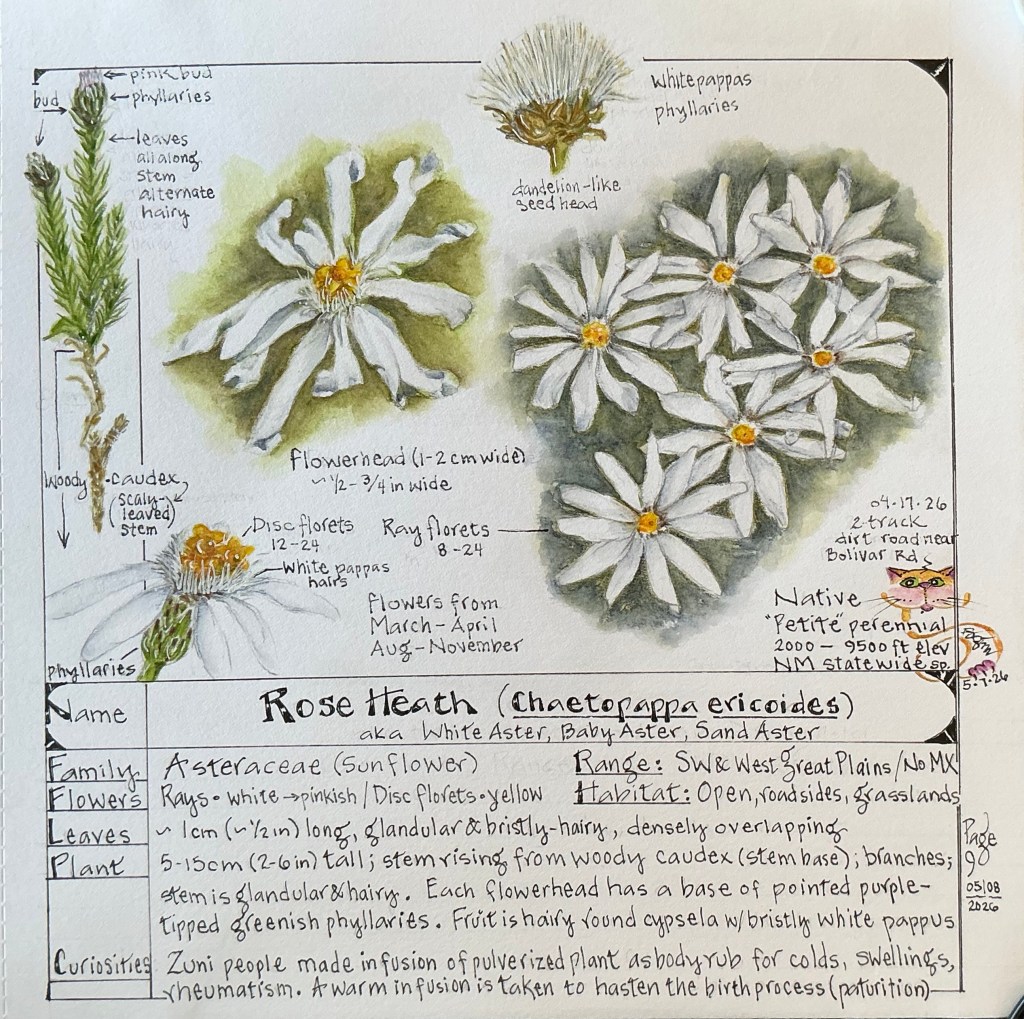
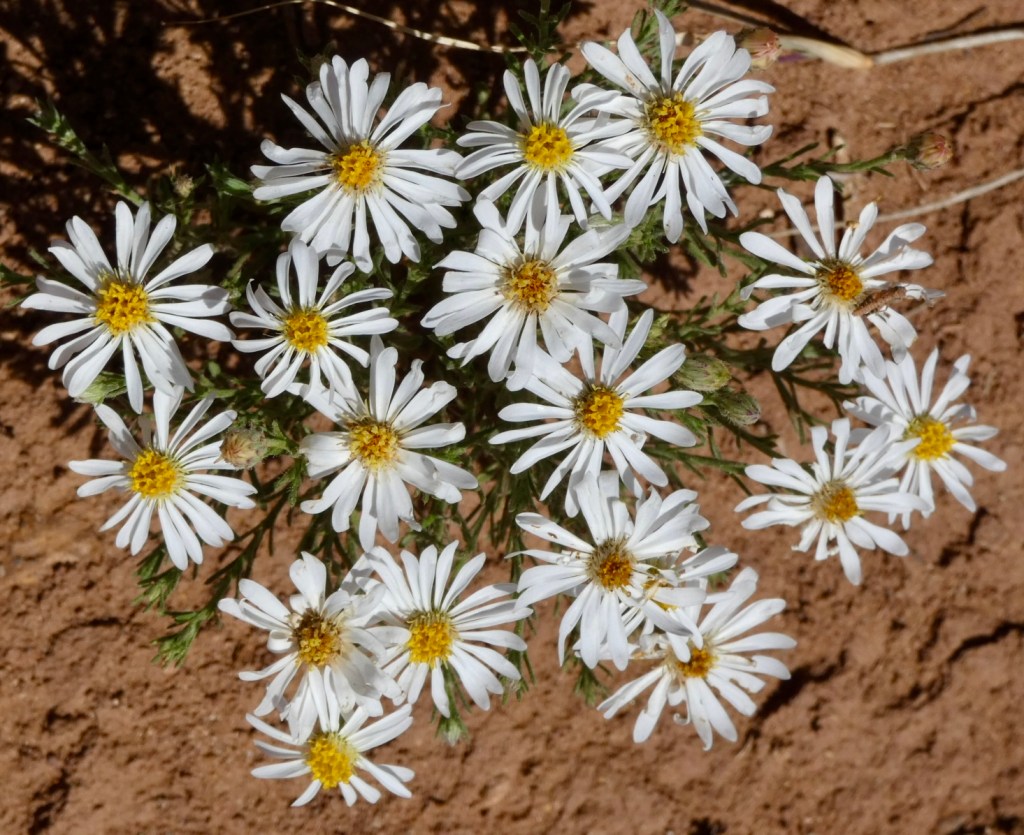
When the last Spring snow melts and the runoff soaks into the nooks and crannies of dehydrated soils, there’s a thirsty little shrub that eagerly drinks its fill. The leafy stems of this tiny shrub, so easily overlooked in the winter, rapidly grows on bare ground, around the drip line of pinyon and juniper trees, in the negative spaces between rocks and broken branches, and through beds of dried grasses. Then in a day or two a very small flower bud forms on the top of each stem, and in half a week the buds open simultaneously. What a spectacular display of brilliant white daisies ….. bouquets of light!
Barely ankle high, each flowerhead can have up to 24 white ray florets surrounding a rich buttery yellow center of 12-25 disc florets. And don’t fret if you notice the ray florets have curled downward in the evening. They magically unfurl to their full length by mid-morning the following day.
This annual Spring show, which takes place all across the U.S. west and western Great Plains, is brought to you by the “petite” perennial called Rose Heath (Chaetopappa eriocoides). (Widespread and common in New Mexico, Rose Heath is adaptable to a variety of soils, elevation, and drought.)
The show typically begins in late March and continues into early May. And for those craving more, flowering resumes in August and can run until November; no charge. You just have to get out there and see for yourself!
Origin and Etymology – What’s in a Name?
Origin of the Scientific Name, Chaetopappa ericoides
Augustin Pyramus de Candolle, a Swiss botanist, named this genus Inula in the early 1800s. But in 1827, it was the American botanist John Torrey, who named the species Inula ericoides, from a specimen collected by botanist Edwin James along the Canadian River during Major Stephen Long’s Expedition of 1819-1820. Since that time, the species has undergone more than a dozen name changes including Leucelene ericoides (Edward Greene in 1896) and finally Chaetopappa ericoides (Guy Nesom in 1988).
Etymology of the Scientific Name, Chaetopappa ericoides
The genus “Chaetopappa” is Greek for ‘bristly pappus’ (pappus refers to the score of tiny white bristles surrounding the disc florets; the same bristles, one per seed, that helps carry Rose Heath’s mature seeds up, up and away. The species “Ericoides,” also Greek, means ‘similar (“oides“) to Heath’ (“eric”); i.e., the plant’s tiny, overlapping leaves are similar to those of some Heaths (Ericaceae is the scientific name of the Heath Family.)
Common Name, Rose Heath
From the previous paragraph, it’s obvious where the name ‘Heath’ comes from, as Rose Heath does have stems and leaves very similar to a heath plant. But why ‘Rose?’ What I found is ‘Rose’ is Latin in origin, derived from “rosa,” referring to the flower. Because the daisy-like flowers of Rose Heath don’t resemble a rose flower, deeper diving was needed. I discovered that throughout history ‘Rosa’ and ‘Rose’ have represented love, passion, innocence, and beauty. So perhaps ……. ? If you’re familiar with Rose Heath or have seen photos of the plant in bloom, do you love or could you love its beautiful floral bouquets? I think whoever thought to call this plant by the common name ‘Rose Heath,’ must’ve loved its stunning display!
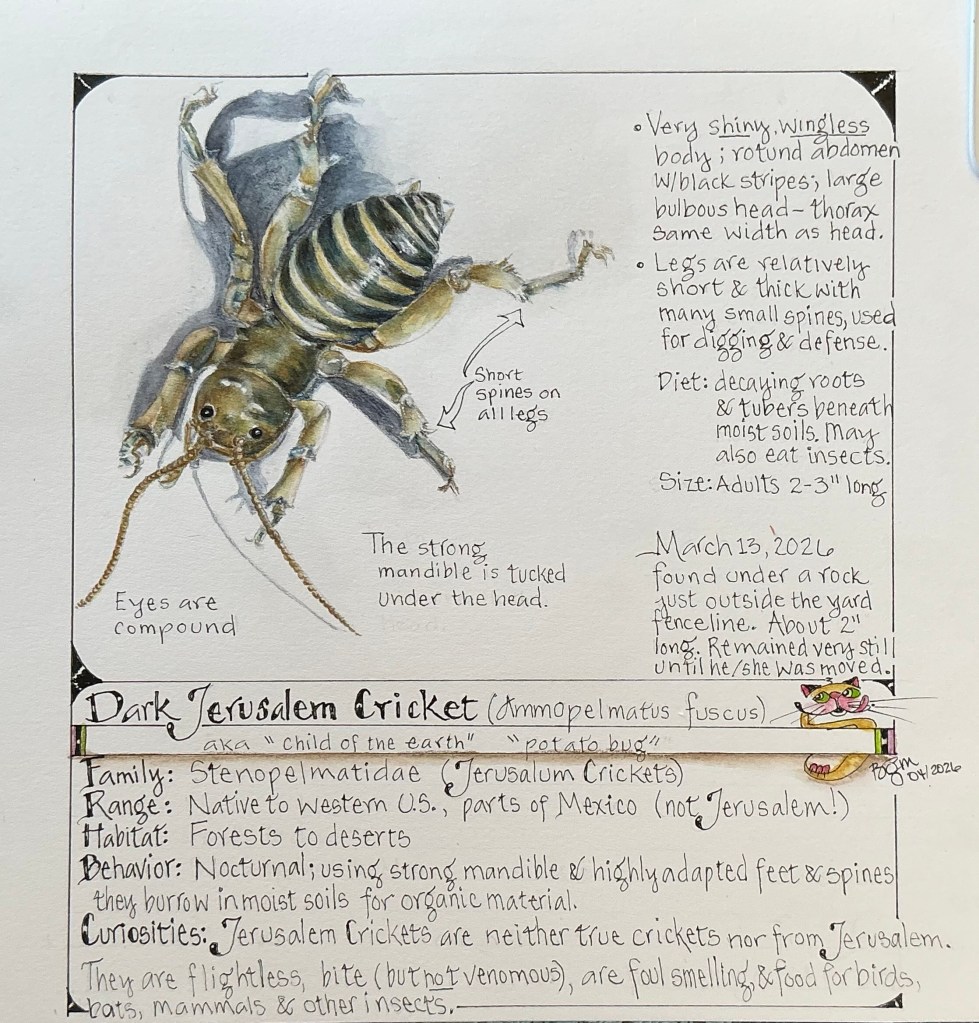
Last month (mid-March), while looking everywhere for signs of spring (something green and growing), I dared to peek under a flat rock and gasped with surprise! Instead of uncovering a tiny flower bud was a gigantic “creepy-crawly” bug! Yikes! After quickly dropping the rock back on his head I realized my run-away imagination had gotten the better of me.
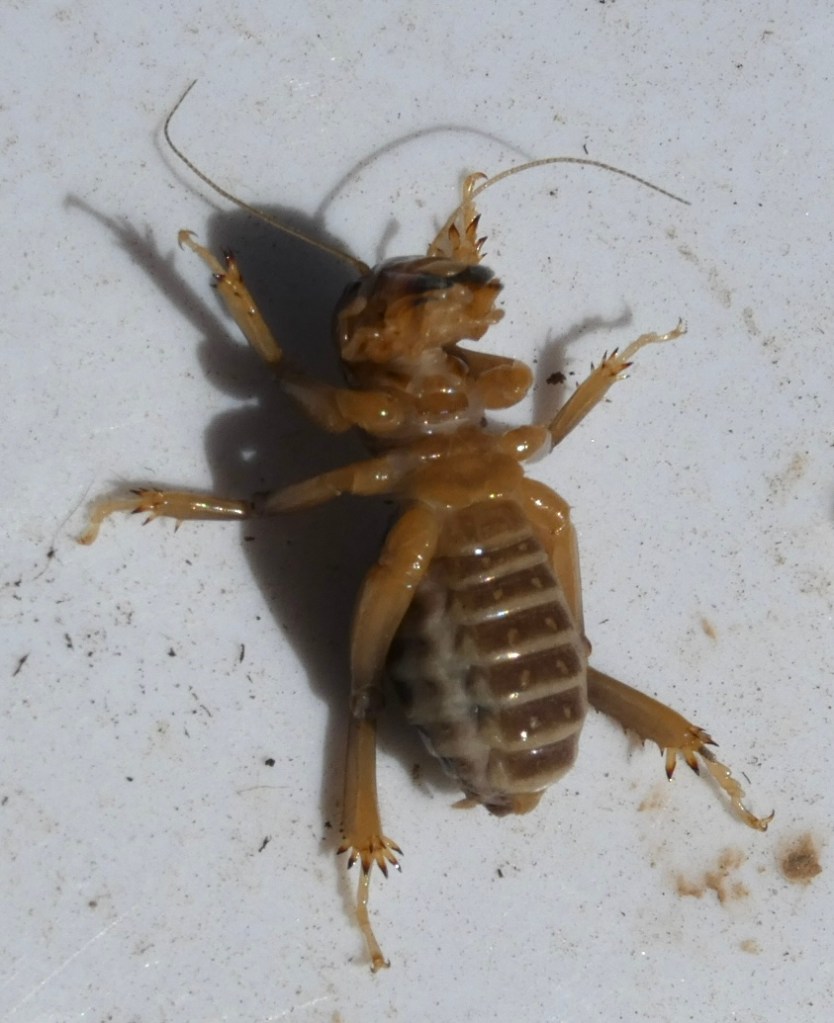
So gathering my courage, I took another look. There, hiding under that rock was a “cuddly” Jerusalem cricket trying his best to be invisible (while avoiding the bright sunlight).
This wasn’t my first Jerusalem cricket, but seeing this guy prompted me to learn more about this curious insect……
Firstly, Jerusalem crickets are neither true crickets nor are they native to Jerusalem
Taxonomists agree, “Jerusalem crickets are in a very different family than true crickets. This includes a bunch of flightless varieties, and some with wings, found in Africa. The Jerusalem crickets are wingless and are found in the Americas.”
“The origins of the name, “Jerusalem” cricket isn’t certain, but it’s thought that it comes either as a reference to the skull-shaped head (they’re also known as skull crickets), which is associated with skull hill in Jerusalem; or, comes from a watered-down swear word from the ‘40s and ‘50s. Around this time, in the US, both “Jerusalem” and “Cricket” were expletives, associated with being startled.”
Next, some Jerusalem Cricket Mating Characteristics
Similar to true crickets, each species of “sings” a different song during mating. They actually sing by drumming and they drum by beating their butts on the ground.
Once a larger female has successfully mated with a smaller male, and before she lays eggs, females usually eat the males!
She lays her egg masses in holes in the soil. After hatching, over the next 1-2 years, nymphs undergo several molts (as many as 10) until they reach sexual maturity which lasts for only 2-6 months.
Adults can reach up to 2 to 3 inches in length. Females are often larger in size; males have longer hind legs.
Third, Jerusalem Cricket Habitats and Out-of-Sight Living Quarters
They are “well-adapted to living in sandy soils, but can be found in sand dunes, chaparrals, grasslands, woodlands, and forests.”
Being nocturnal, they spend a majority of their lives underground.
They hide underneath organic matter and other debris like rocks, wood. With their powerful mandibles, spiny legs and specially adapted feet, they also dig underground burrows for comfortable living quarters.
And Almost Lastly …. the Cultural Significance of Jerusalem Crickets
Of great importance to Native Americans as food, many tribes in southwestern U.S. also considered Jerusalem crickets as a powerful cultural symbol. Its striking appearance leads some to think the cricket brings mortality, as depicted in the folklore of the Chumash people of southern California.
The Hopi, who settled in Arizona, portrays this cricket as a spirit being (a Kachina) named Sösööpa who races. As a result, it’s often carved into their Katsina dolls as a yellow humanlike character with black beady eyes, a black-and-white plaid skirt, and antennae made from sand grass, depicting traits of the cricket.
The Navajo associated the Yucca plant with the insect; you had to eat the plant as a cure of the cricket’s painful bite. This myth possibly gave rise to the misconception that their bite is venomous.
It’s Greek to Me! (Entomologically Speaking)
Learning the meaning of a scientific name assigned to a species not only helps me remember uncommon words and how they’re pronounced, but often describes aspects of a species’ characteristics that may help differentiate it from another similar-looking species. Learning about these complex names falls into a study called entomology.
Ammopelmatus fuscus, the scientific name for the Dark Jerusalem Cricket, is quite a mouthful. Curious about the meanings (in plain English) of these two strange words, I learned the name originates from Greek and Latin roots meaning “dark sand-sole” or “dark sand-burrower,” obviously referring to their sandy habitats, dark color, and burrowing behavior. But to learn how the common name with the word “sole” ties to one of the cricket’s characteristics, my dive continued. Here’s the entomology breakdown:
Genus Ammopelmatus
Ammos (Greek) means “sand,” referring to the cricket’s specialized adaptation to arid, sandy environments.
pelma (Greek) means “sole of the foot,” highlighting the specialized leg structures the cricket uses for burrowing.
tus (Greek) is a common word meaning either “them” or “their.” In this case, “tus” ties the first two parts together into “their sand sole.”
Species fuscus (Latin) means “dark,” “dusky,” or “brown,” describing the cricket’s color.
Here’s the underside of my Dark Jerusalem Cricket. The leg spines really show well as does the strong mandible. A scary fascinating view!
After learning more about the Dark Jerusalem Cricket, maybe next time I discover one, I won’t jump so high?! Do you think?
Have you seen a Jerusalem cricket hiding out in your yard? If so, what was your reaction?
Hope you enjoyed this post! Thanks for stopping by!
Eaton, Eric R.; Kenn Kaufman (2007). Kaufman Field Guide to Insects of North America. New York: Houghton Mifflin. p. 84.
Milne, Lorus Milne, Lorus and Milne, Margery (1980) The Audubon Society Field Guide to North American Insects & Spiders. Alfred A. Knopf, Inc, pp. 437.
Stoffolano JG, Wright B (2005). “So so opa —Jerusalem Cricket: An Important Insect in the Hopi Katsina Pantheon.”American Entomologist. 51 (3): 174–179. doi:10.1093/ae/51.3.174
Today is the second Monday in October ….. a day to pause and honor the deep roots, rich cultures, and enduring spirit of the first peoples of this land. Native American Day celebrates the history, contributions, and resilience of Native American tribes all across the nation.
Yesteryears
Native American Day honors all Native Americans. South Dakota led the way, officially changing Columbus Day to Native American Day in 1990 after a “Year of Reconciliation” was declared by Governor George S. Mickelson. California soon followed. In recent years, the movement has gained national momentum. Many states and cities have chosen to celebrate Indigenous Peoples’ Day on the same date. Then in 2021, President Joseph Biden issued the first-ever presidential proclamation for National Indigenous Peoples’ Day, marking a significant step in acknowledging and respecting the history and contributions of America’s first inhabitants.
Celebrating the second Monday in October is more than acknowledging the past ….. it’s a day to recognize the living cultures that continue to enrich our country’s tapestry. It’s an opportunity to move beyond stereotypes and learn about the diverse traditions, languages, and stories that have shaped this continent for millennia. Native American Day also highlights the efforts to revitalize and preserve hundreds of indigenous languages, each one a unique expression of culture and knowledge. When we celebrate Native American Day, we celebrate the incredible diversity of traditions. Instead of a single culture, there are hundreds of distinct nations, each with its own unique customs.
Storytelling and Art Making
Native Americans have a powerful storytelling tradition of oral history, where foundational stories, lessons, and legacies were and still are passed down through generations. Many of these stories of life and culture are told through artwork, from ancient pictographs (rock paintings) and petroglyphs (images cut into rocks by pecking, incising or abrading) created by the indigenous peoples that lived throughout America, the intricate beadwork of the Plains tribes, the iconic pottery of the Pueblo peoples of the Southwest, to contemporary painting and sculpture. Native art is a cornerstone of American culture.
New Mexico Rock Art
Images painted on and carved into rock that were used in ancient storytelling can be found throughout my home state of New Mexico. Many of these sites are protected and preserved by federal designation as National historic landmarks, National Parks, and by the Bureau of Land Management as Areas of Critical Environmental Concern, and as a significant part of our Archaeological heritage.
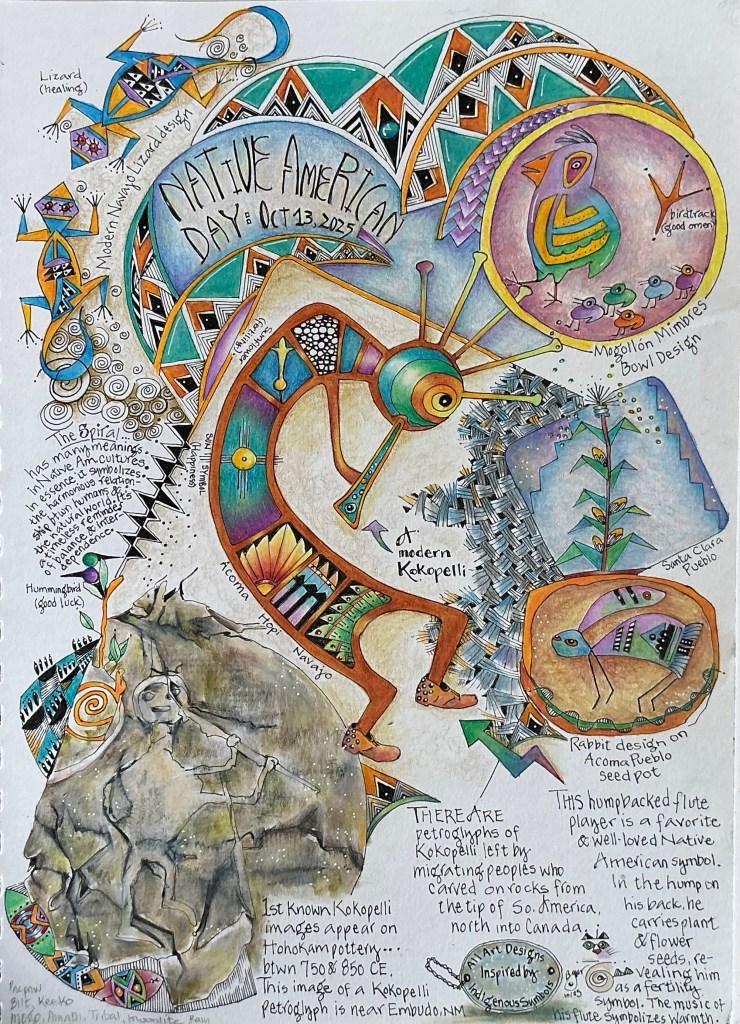
Traditional cultures and customs continue to fascinate me, and in “drawing” attention to the important contribution rock art has and continues to play, I wished to shared some of the designs (symbols) created by Native American tribes indigenous to the 4-corners region of the Southwest, with focus on those found in New Mexico. The Kokopelli symbol, the dancing flute player, is a familiar and favorite character throughout the area and has many meanings tied to fertility and harvest. The symbol depicted shows Kokopelli with a hump in his back where he carries seeds ready for planting, while he plays his flute, a symbol of warmth. He also carries a sunflower disk flower (the ‘complete’ inflorescence) to display fertility, the Sun symbol for happiness, and several crop symbols designed by the Acoma, Hopi, and Navajo.
A Kokopelli created in 2017 … on toned grey paper and colored with Prismacolors
The very first known Kokopelli images appeared on ancient Hohokam pottery, dating from between 850 and 750 C.E. The drawing of the Kokopelli petroglyph, in the bottom left of my panel, is inspired by one of these first images that was discovered near Embudo, NM.
Ideas to Celebrate Native American Day ….. Learn, listen and engage by …..
.…. reading a book by a Native American author, such as Louise Erdrich, Sherman Alexie or Tommy Orange,
….. exploring a museum or a state historic site to learn firsthand about the lives and history of the region’s tribes,
….. purchasing authentic arts, crafts, and goods from Native artists, which directly supports and helps preserve their cultural practices,
….. attending one of many community- or university-hosted talks, film screenings, or celebrations such as a powwow
When you think of ‘Barberry,’ does a shrubby knee-high landscaping bush that transforms to flame red in the fall, come to mind? If so, you may have seen hedge rows of the plant known as Japanese barberry ……
Japanese barberry (Berberisthunbergii) is a non-native shrub that was introduced from Japan in 1875 as an ornamental that’s planted for erosion control and as a living fence. But this invasive shrub outcompetes and displaces native plants, alters ecosystems, and is a host species of black-legged ticks that carry Lyme disease.
When you think of ‘Holly,’ does a plant with boughs of prickly green leathery leaves naturally ‘decorated’ for the holidays with red berries, come to mind? If so, you’re likely familiar with the iconic American holly ……
American holly (Ilexopaca) is a native shrub of eastern and south-central U.S. that grows well in both dry and swampy soils. The plant, which is also cultivated as an ornamental, forms thick a canopy cover for birds and other wildlife, and the female plants produce an abundance of shocking red berries, loved by birds but poisonous to dogs, cats and humans. Regardless of the risk, bountiful quantities of leafy boughs and clusters of red berries are harvested each fall and brought indoors to create holiday wreaths and other seasonal decorations.
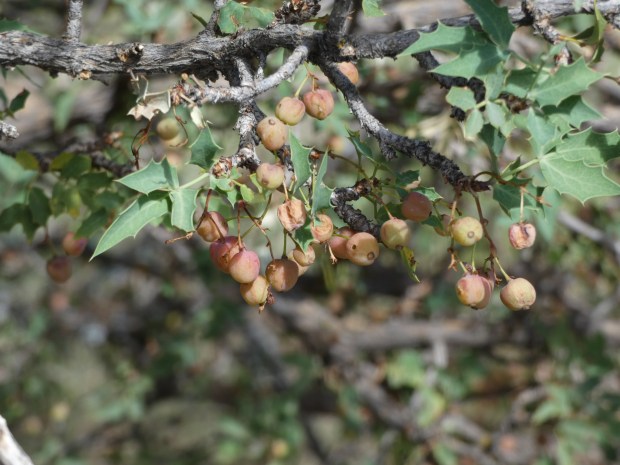
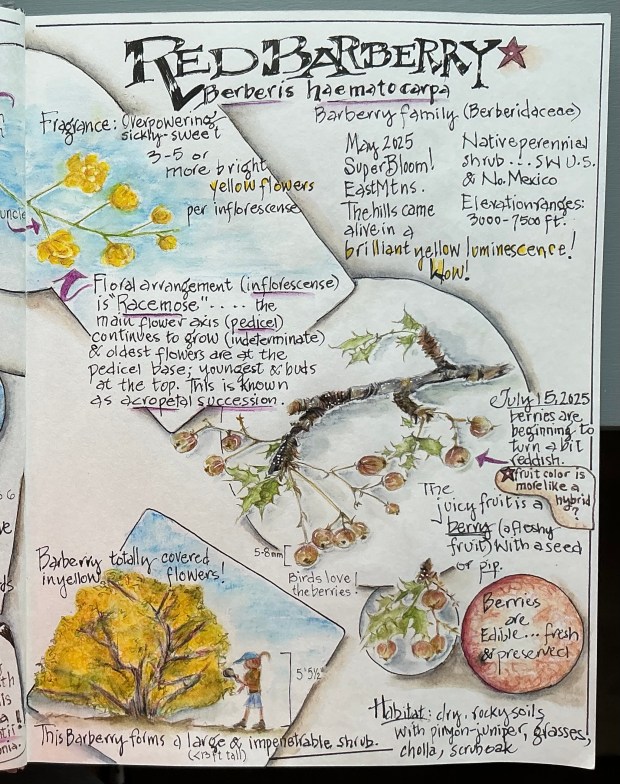
Red Barberry berries beginning to ripen
Now imagine you’re hiking in a pinyon-juniper forest of the American Southwest. You decide to bushwhack to a connecting trail and all of a sudden find yourself hopelessly stuck in a 10 foot high shrub covered in juicy red berries and very prickly holly-like leaves. This large (somewhat familiar) shrub is a surprisingly effective barricade; a formidable fence. You’ve become entangled in thousands of armed leaves preventing your forward or backwards movement without getting seriously poked and stabbed!
Is this the desert variety of American holly? Maybe it’s the giant living fence of a Japanese barberry gone rogue?
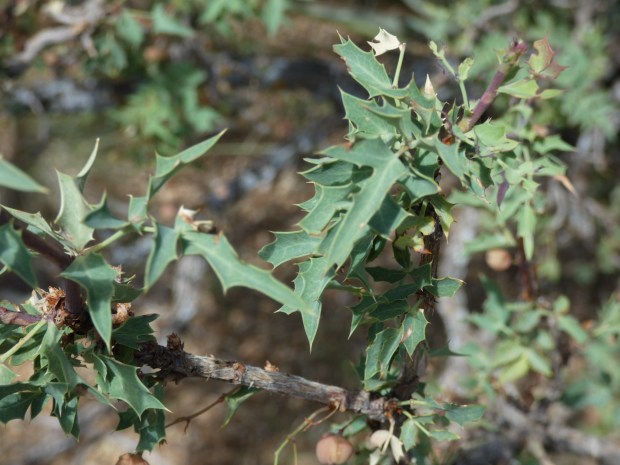
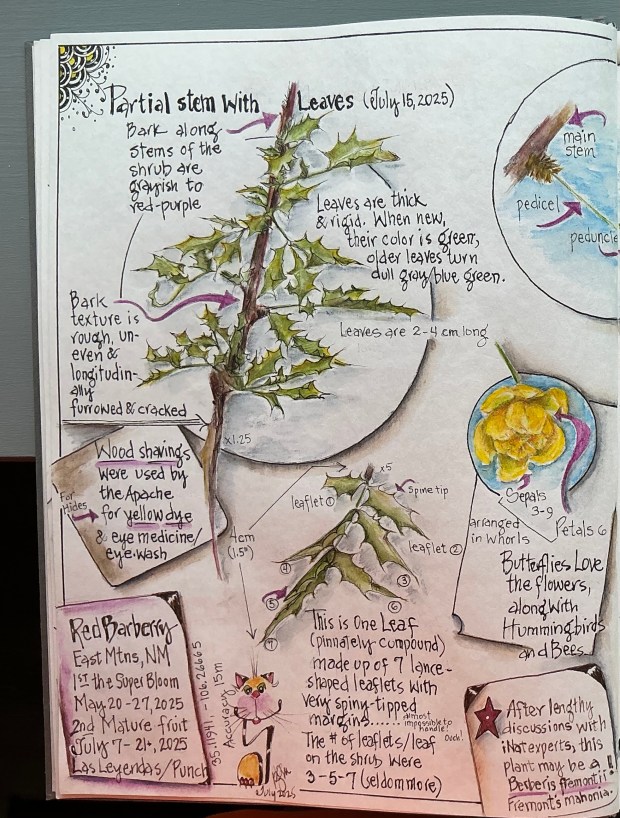
Nope! It’s neither. You’ve stumbled upon (into) a hardy specimen of the desert Southwest native Red Barberry (Berberishaematocarpa). But no wonder you were confused. This shrub, which can grow to 13 feet tall and nearly as wide, has an abundance of holly-shaped leaflets armed by a sharp spine on each lobe tip. And if birds haven’t devoured all of the red berries, you may find an ample supply of a refreshing (albeit tart) snack while you carefully and oh-so-slowly free yourself from the shrub’s embrace.
Red Barberry leaves – each lobe tip is armed with a needle-like spine
By now you’ve created lasting memories of Red Barberry, and have promised to always be alert for surprise encounters when visiting the desert island Southwest.
The hiking scenario above conjured up one of my hard-learned lessons from 8 years ago. Having just moved to New Mexico, Roy & I began avidly hiking local trails. Wishing to master the native flora as quickly as possible, one day I discovered clusters of red berries hanging inside the leafy canopy of a 5 foot shrub. What could they be?! Only having eyes for those juicy berries and an irresistible urge to gather a bunch for closer inspection, I plunged my open hand through several layers of small leaflets and successfully clutched a cluster. It was then I realized those spiny leaflets had poked, scratched and even penetrated my bare skin, as evidenced by tiny trickles of blood dripping from my hand and arm! Now that I had captured those pretty berries, it was obvious they had to be released to permit me the delicate maneuvers required to free my arm and minimize further injury. It was that day that I learned all about Red Barberry; lessons that will likely stick with me always!
Red Barberry berries amid armored leaves
Since that close encounter 8 years ago, it’s no surprise I’ve never been a big Red Barberry fan, until ……
Spring Super Bloom
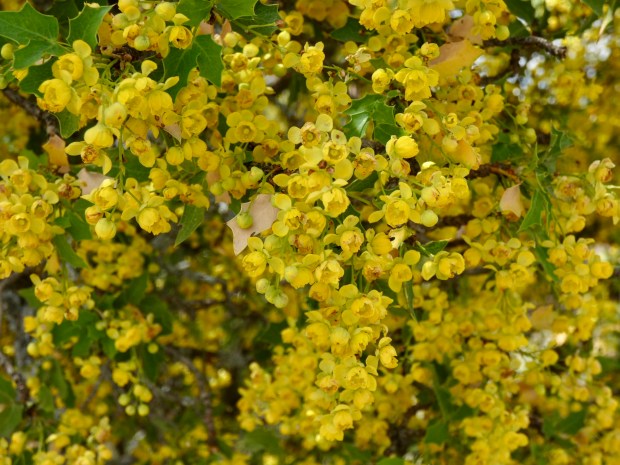
…… this past May a 13 foot tall plant in front of our home burst out in the most spectacular display of sunshine yellow flowers, literally covering the entire shrub front to back; top to bottom! The fragrance was overwhelming for the entire 2+ weeks the flowers were in bloom. And not only our Barberry was in full bloom, but about a dozen more barberries in our neighborhood and surrounding area were also covered in vibrant yellow. It was an amazing sight, causing me to figuratively re-embrace the native Red Barberry!
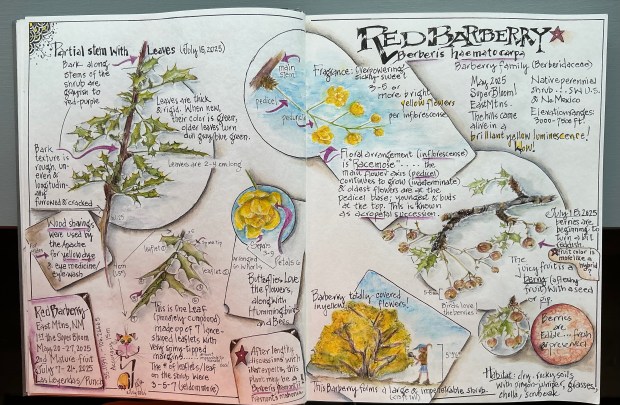
For more tidbits about Red Barberry, browse the text and illustrations displayed on my journal pages. Hope you enjoyed this post.
As always, thanks for stopping by!
P.S. In case you’d like to know about the etymology of the name Berberis haematocarpa…… ‘Berberis’ is a Latinized form of the Arabian name ‘barbaris, for barberry. “Haematocarpa” means ‘blood-red fruit’ referring to the bright red berries produced by this shrub. The word is derived from the Greek words “haima” (blood) and “karpos” (fruit).
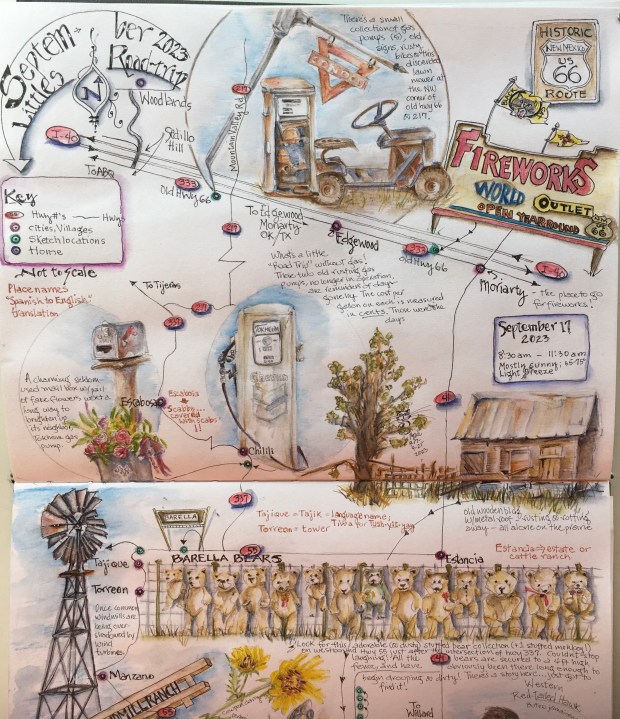
Ahhhh, September! The month of slowing down, hints of crisp morning air, tree leaves turning ever so slightly from green to golden, a bit of wanderlust satisfied.
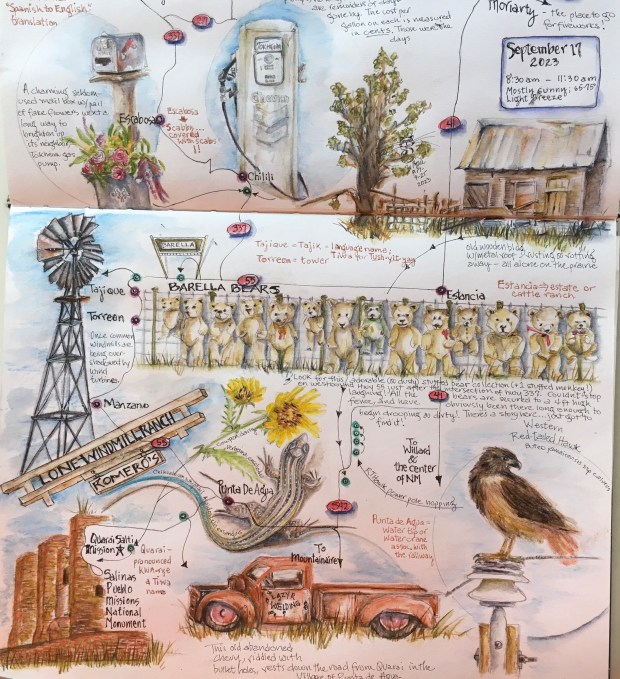
Instead of creating “Little” paintings of a month of highlights, and there have been many, I decided to focus on a single “Little” road-trip down the east side of the Manzano Mountains. My goal was to take a fresh look at, well, everything …….. and watch as the story of rural life unfolded.
As we wound our way along scenic backroads, I mentally sketched out our route map to depict some of the historic and present day highlights across the landscape. My imagination envisioned the full, prosperous and peaceful village life of the Tiwa Indians, and their conquest and struggle to survive Spanish occupation. There was evidence of the optimistic outlook of early settlers who came west to build a life centered around dryland farming and ranching. And today, modern day ranchers live on the land adjacent to land grants where indigenous peoples live a rural lifestyle on their native lands. I hope you enjoy my route map with some of these highlights, ranging from serious to funny, natural to commercial.
I’d love to know what story unfolds for you as you travel along on this September “Littles” Road-trip. Be sure to pack a lunch!
Once again, a big shout-out to “Made by Fay” for the inspiring “Littles” idea! These pages are fun to create, and remind me of monthly highlights and the random road-trip as I revisit my previous “Littles” posts. Hope you’re enjoying them too, along with the ending days of the season. Stay tuned for the next installment of “Littles.”
Have you ever seen a living dinosaur? If you’ve seen a sturgeon, then count yourself among the lucky few. If not, a visit an aquarium where these 10 foot + fish are on display, will amaze. There are more than 2 dozen species of sturgeon worldwide, but in celebration of the August 1st Full Moon, look close as it rises and imagine an image (or 2) of the North American species of sturgeon swimming gracefully across the Moon’s smiling face. Keep on reading to learn more about the August Full Sturgeon Moon and Flambé’s encounter with not one, but two of these incredible fish!