Acorn or Gall? 

An Albuquerque Park Mystery #26

September 6, 2026

The date: August 24, 2026 

The time: 8:30 am. 

The forecast: Severe clear; calm winds; 82oF & climbing

The place: The Promenade in Albuquerque  

The destination: el Oso Grande Park (“The Big Bear”)
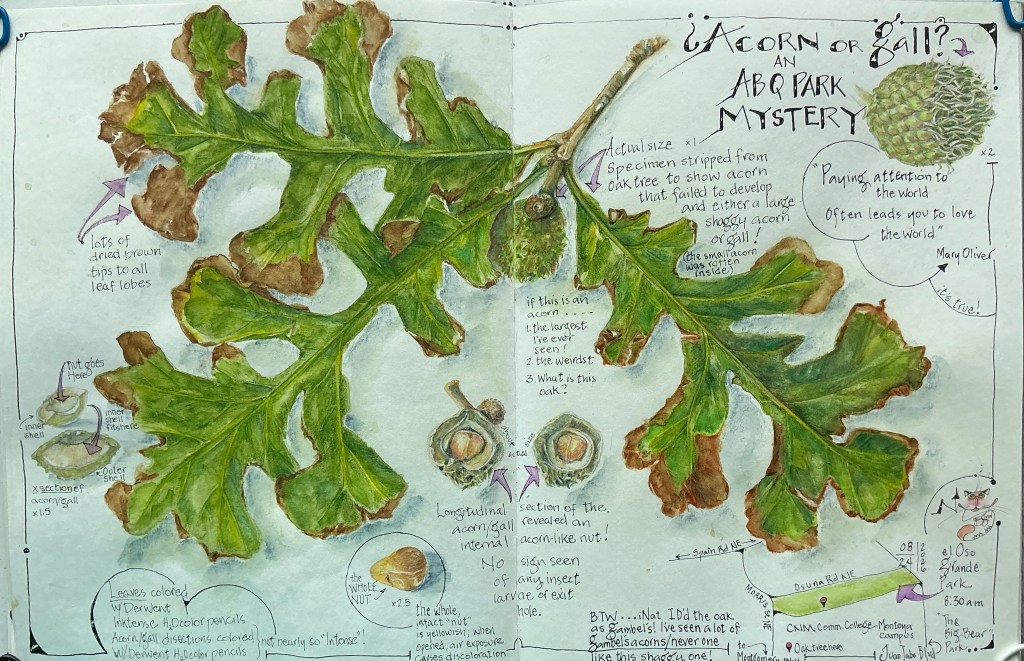
After dropping Roy off for his annual eye exam, Luna and I decided to ‘sniff’ around the neighborhood on our way to nearby el Oso Grande Park. With the chance of rain being “zip,” I was confident walking east along a half-mile stretch of the large cement ditch used to drain storm water from Embudito Canyon. Other than creatively colorful graffiti, the ditch itself had nothing interesting to offer. The hot paved walkway, mostly lined by weedy species, provided perfect habitat for scattered bushy sacred datura plants in full bloom. The many city dwellers living ditch-side allowed landscaping plants to cascade over cinderblock privacy walls — the patches of shade – welcome; sprays of pale pink to magenta desert willow flowers – pretty and fragrant.

A sweaty 20 minutes later and the shady expanse of the Park was a welcome sight. Not one to waste time, Luna anxiously led me to tree trunk #1, circling and sniffing excitedly three times ‘round. Not being able to smell the wonderfully curious aromas capturing her full attention, I spent my time looking up into the leafy canopy of this full grown deciduous tree planted years ago in memory of a once local resident.  

We moved on to tree #2, a robust conifer towering over the well-manicured green lawn, supported by another aromatic trunk recently ‘watered’ by a happy dog walking their human. Before we could check out tree #3, Luna claimed #2 by leaving her ‘calling card.’ 

And on and on we wandered and circled, until ….

…. I realized, based on our exam speed/tree (largely driven by Luna’s satisfaction meter), our Park tour of over 100 trees would take a month of Sundays! So we ramped up our pace, making  decent progress to (hopefully) ensure our timely return to fetch Roy …. then tree #26 happened! 
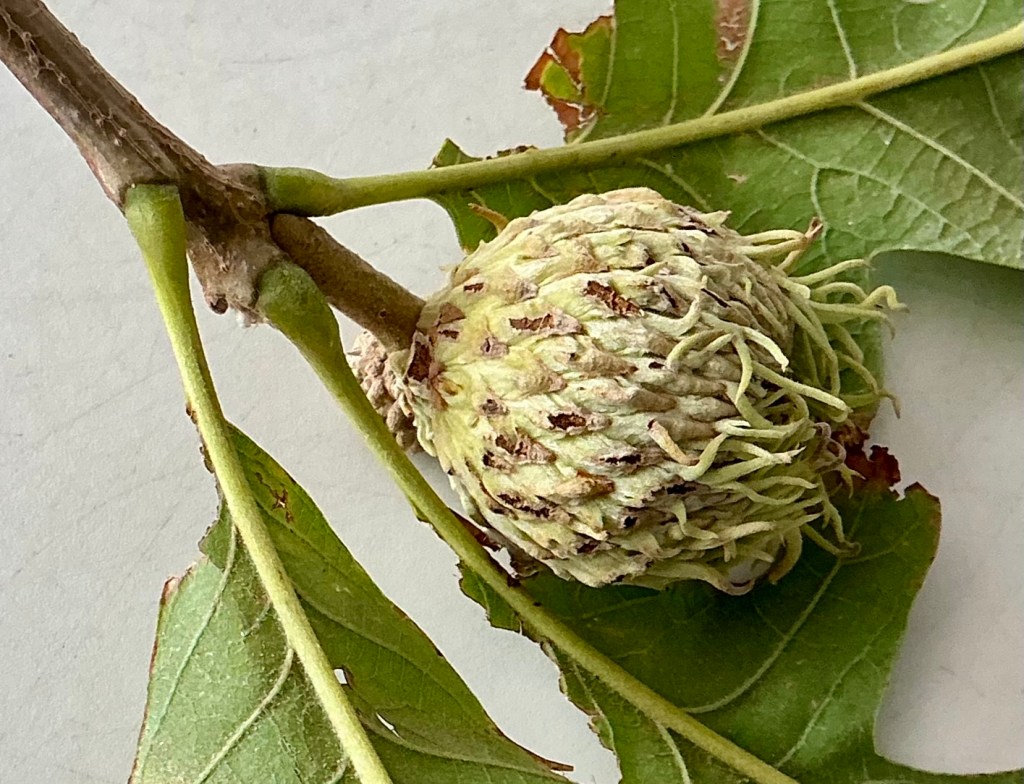
Oh! What was #26? Now it was my turn to encircle a tree, and I couldn’t stop.  In addition to the puzzled look on Luna’s sweet face, several other things were certain: 1– this very large tree was a 2– deciduous 3– dicotyledonous member of the 4– oak genus Quercus. The deeply-lobed leaves were a giveaway, even though most of each leaf’s margins were dried and crinkly. But it wasn’t the leaves catching all of my attention — it was the 1-inch diameter shaggy pale green balls growing from the ends of many leafy branches. This certainly didn’t look like any acorn I’d ever seen before …. besides, right beside this scary-looking tentacled orb was a single mini-acorn that tried but never fully developed — only the dried, withered acorn cup had partially formed before rotting. 
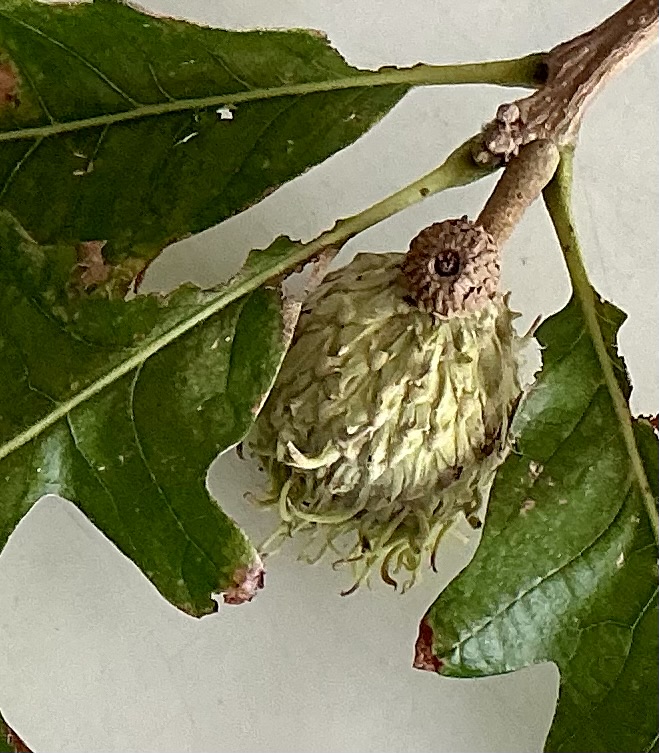
So what was it that sucked the life right out of that tiny failed acorn, and grew into something alien?  If this was some kind of acorn that grows on a non-native oak tree I’ve never seen before, then I had to learn more! If this was a gall, an unusually grotesque, weird and exaggerated growth stimulated by a developing wasp grub living deep inside, then I really had to learn a lot more! 

And then I collected and promptly zip-locked a specimen.

This became (and still is) An Albuquerque Park Mystery hanging like lime green ornaments all over, and also within reach from, tree #26!

P.S.

  • iNaturalist identified the tree as Gambel’s oak 
  • Never have I ever seen a Gambel’s oak acorn look like that!
  • Still waiting for an oak expert to identify the tree leaves and/or acorn/gall-thing
P.S. P.S.

  • So many questions remain
  • Upon arriving home, no wildlife observed inside zip-locked bag
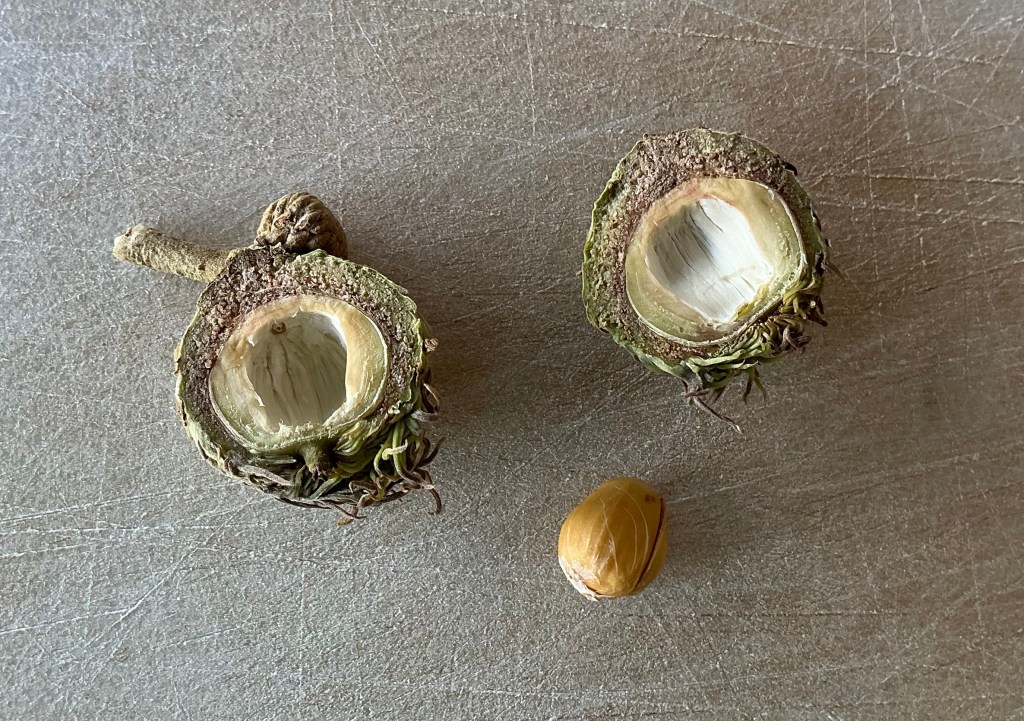
  • I dissected the growth, inside and out — found what looked like an acorn nut 
  • No sign of a grub; no exit holes in the outer or inner shells
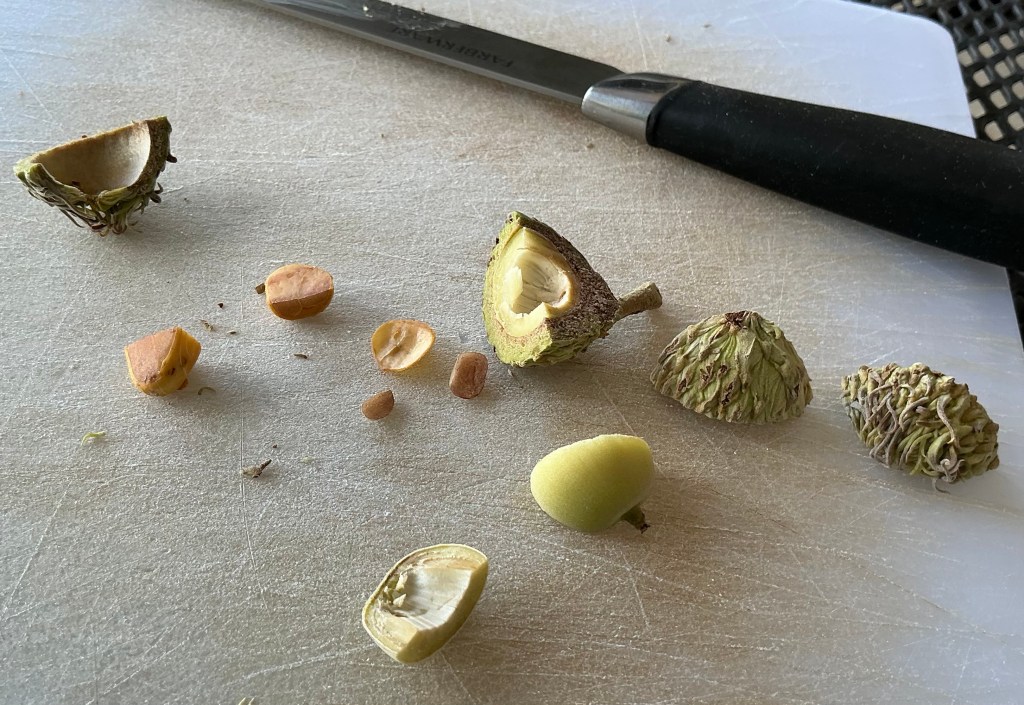
P.S. P.S. P.S.

  • Luna & I practically ran back to the eye doc’s office, arriving minutes before Roy’s exam concluded

……………………………………………………………………………………..

If you’ve seen anything growing on an oak that remotely resembles these mystery green goblins, please let me know what it may be, and what species of oak they come from! 

As always, thanks for stopping by!

P.S. P.S. P.S. P.S.

  • When “An Albuquerque Park Mystery #26” is solved, you’ll be the first to know!
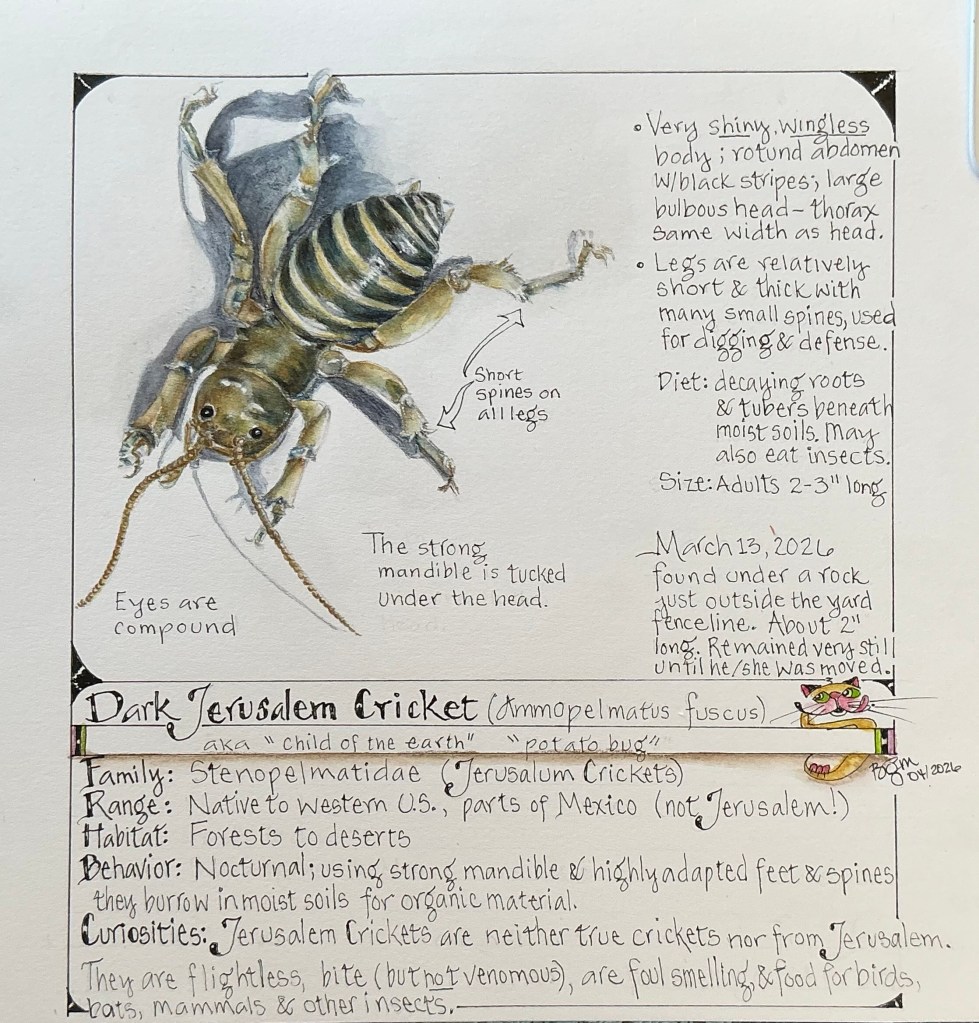
Dark Jerusalem Cricket – Page 5 .. The 100 Day Project (2026)

April 5, 2026

Dark Jerusalem Cricket (Ammopelmatus fuscus)

Last month (mid-March), while looking everywhere for signs of spring (something green and growing), I dared to peek under a flat rock and gasped with surprise! Instead of uncovering a tiny flower bud was a gigantic “creepy-crawly” bug! Yikes! After quickly dropping the rock back on his head I realized my run-away imagination had gotten the better of me. 

So gathering my courage, I took another look. There, hiding under that rock was a “cuddly” Jerusalem cricket trying his best to be invisible (while avoiding the bright sunlight). 

This wasn’t my first Jerusalem cricket, but seeing this guy prompted me to learn more about this curious insect……

Firstly, Jerusalem crickets are neither true crickets nor are they native to Jerusalem

  • Taxonomists agree, “Jerusalem crickets are in a very different family than true crickets. This includes a bunch of flightless varieties, and some with wings, found in Africa. The Jerusalem crickets are wingless and are found in the Americas.”
  • “The origins of the name, “Jerusalem” cricket isn’t certain, but it’s thought that it comes either as a reference to the skull-shaped head (they’re also known as skull crickets), which is associated with skull hill in Jerusalem; or, comes from a watered-down swear word from the ‘40s and ‘50s. Around this time, in the US, both “Jerusalem” and “Cricket” were expletives, associated with being startled.”

Next, some Jerusalem Cricket Mating Characteristics

  • Similar to true crickets, each species of “sings” a different song during mating. They actually sing by drumming and they drum by beating their butts on the ground.
  • Once a larger female has successfully mated with a smaller male, and before she lays eggs, females usually eat the males!
  • She lays her egg masses in holes in the soil. After hatching, over the next 1-2 years, nymphs undergo several molts (as many as 10) until they reach sexual maturity which lasts for only 2-6 months.
  • Adults can reach up to 2 to 3 inches in length. Females are often larger in size; males have longer hind legs.

Third, Jerusalem Cricket Habitats and Out-of-Sight Living Quarters

  • They are “well-adapted to living in sandy soils, but can be found in sand dunes, chaparrals, grasslands, woodlands, and forests.”
  • Being nocturnal, they spend a majority of their lives underground. 
  • They hide underneath organic matter and other debris like rocks, wood. With their powerful mandibles, spiny legs and specially adapted feet, they also dig underground burrows for comfortable living quarters.

And Almost Lastly …. the Cultural Significance of Jerusalem Crickets

  • Of great importance to Native Americans as food, many tribes in southwestern U.S. also considered Jerusalem crickets as a powerful cultural symbol. Its striking appearance leads some to think the cricket brings mortality, as depicted in the folklore of the Chumash people of southern California. 
  • The Hopi, who settled in Arizona, portrays this cricket as a spirit being (a Kachina) named Sösööpa who races. As a result, it’s often carved into their Katsina dolls as a yellow humanlike character with black beady eyes, a black-and-white plaid skirt, and antennae made from sand grass, depicting traits of the cricket.
  • The Navajo associated the Yucca plant with the insect; you had to eat the plant as a cure of the cricket’s painful bite. This myth possibly gave rise to the misconception that their bite is venomous. 

It’s Greek to Me!  (Entomologically Speaking) 

Learning the meaning of a scientific name assigned to a species not only helps me remember uncommon words and how they’re pronounced, but often describes aspects of a species’ characteristics that may help differentiate it from another similar-looking species. Learning about these complex names falls into a study called entomology.   

Ammopelmatus fuscus, the scientific name for the Dark Jerusalem Cricket, is quite a mouthful. Curious about the meanings (in plain English) of these two strange words, I learned the name originates from Greek and Latin roots meaning “dark sand-sole” or “dark sand-burrower,” obviously referring to their sandy habitats, dark color, and burrowing behavior. But to learn how the common name with the word “sole” ties to one of the cricket’s characteristics, my dive continued. Here’s the entomology breakdown:

  • Genus Ammopelmatus
    • Ammos (Greek) means “sand,” referring to the cricket’s specialized adaptation to arid, sandy environments.
    • pelma (Greek) means “sole of the foot,” highlighting the specialized leg structures the cricket uses for burrowing.
    • tus (Greek) is a common word meaning either “them” or “their.” In this case, “tus” ties the first two parts together into “their sand sole.”
  • Species fuscus (Latin) means “dark,” “dusky,” or “brown,” describing the cricket’s color.
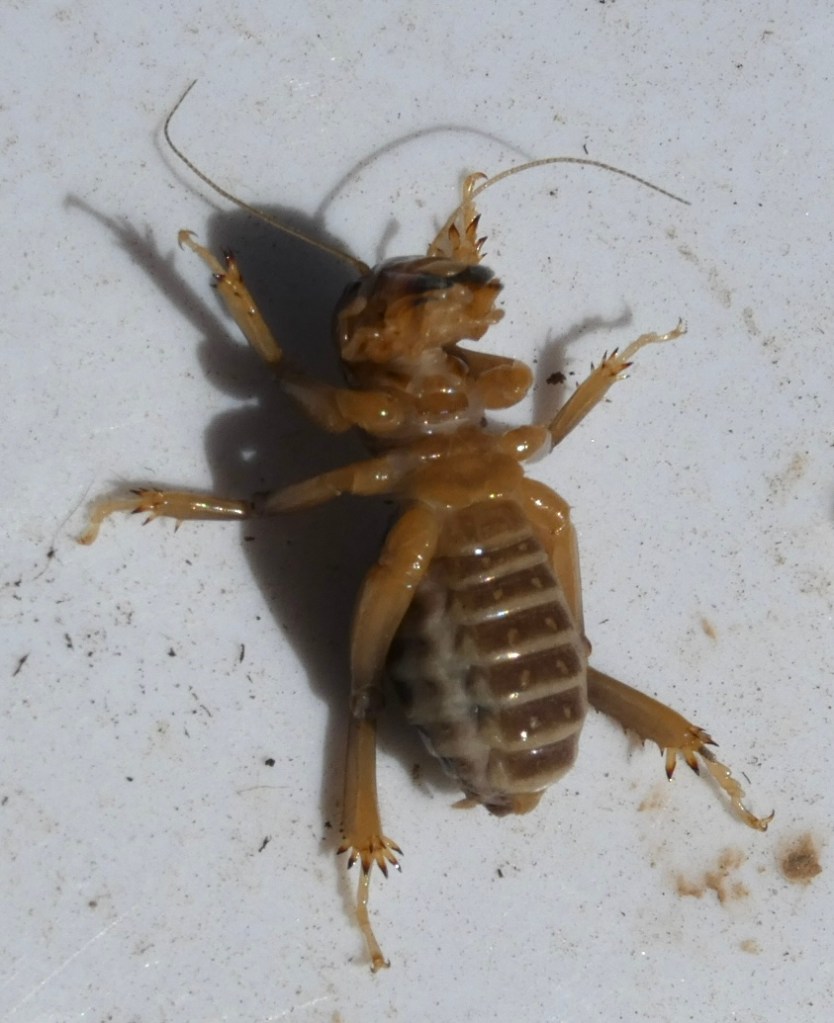
Here’s the underside of my Dark Jerusalem Cricket. The leg spines really show well as does the strong mandible. A scary fascinating view!

After learning more about the Dark Jerusalem Cricket, maybe next time I discover one, I won’t jump so high?! Do you think?

Have you seen a Jerusalem cricket hiding out in your yard? If so, what was your reaction?

Hope you enjoyed this post! Thanks for stopping by!

References

inaturalist.org/taxa

bugguide.net/node/view/154

factanimal.com/jerusalem-cricket/

  • Eaton, Eric R.; Kenn Kaufman (2007). Kaufman Field Guide to Insects of North America. New York: Houghton Mifflin. p. 84. 
  • Milne, Lorus Milne, Lorus and Milne, Margery (1980) The Audubon Society Field Guide to North American Insects & Spiders. Alfred A. Knopf, Inc, pp. 437. 
  • Stoffolano JG, Wright B (2005). “So so opa —Jerusalem Cricket: An Important Insect in the Hopi Katsina Pantheon.”American Entomologist. 51 (3): 174–179. doi:10.1093/ae/51.3.174

Switched the Midge!

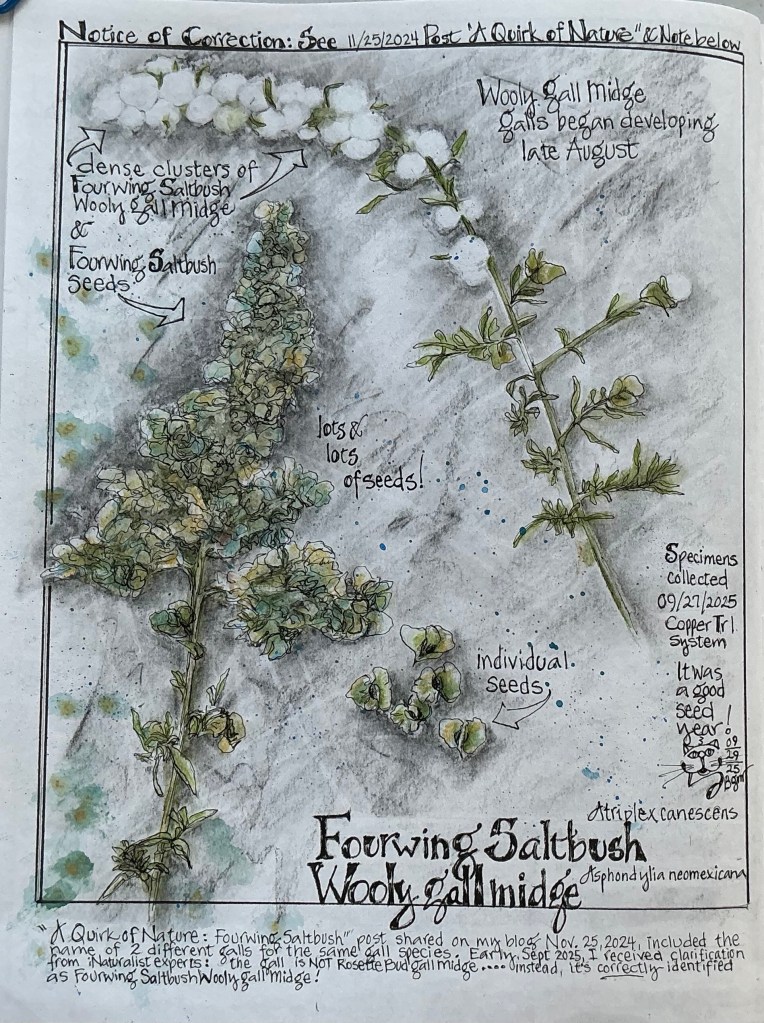
A Fourwing Saltbush Gall Mystery Solved

September 30, 2025

If you’re a fan of weird twists in nature (like me), and enjoyed my November 25, 2024 post, “A Quirk of Nature: Fourwing Saltbush,” you may have lost many hours of sleep wondering how I could’ve missed such an obvious mistake! You know the one. The labeling error made when naming those cottonball-like insect galls hugging the Fourwing stems.

In my confusion (or wishing to cover all options?), I seemed to believe two different midge species were somehow responsible for the same gall.

Are they Rosette Bud Gall Midge galls or Fourwing Saltbush Wooly Gall Midge galls?

Decisions, decisions.  

My Quandry quite clear, it was time to consult the experts. 

A short 10 months later, confirmation arrived from the iNaturalist experts in all things “Fourwing.”  All the puffy galls are none other than those made by Fourwing Saltbush Wooly Gall Midges!

And the answer to my question is well timed, as the stems of the female Fourwing shrubs are once again ‘heavy’ with Wooly Gall Midge galls. Now I know! Now you also know!

Enjoy this official correction, at long last, and wishing you sweet dreams.

As always, thanks for stopping by!

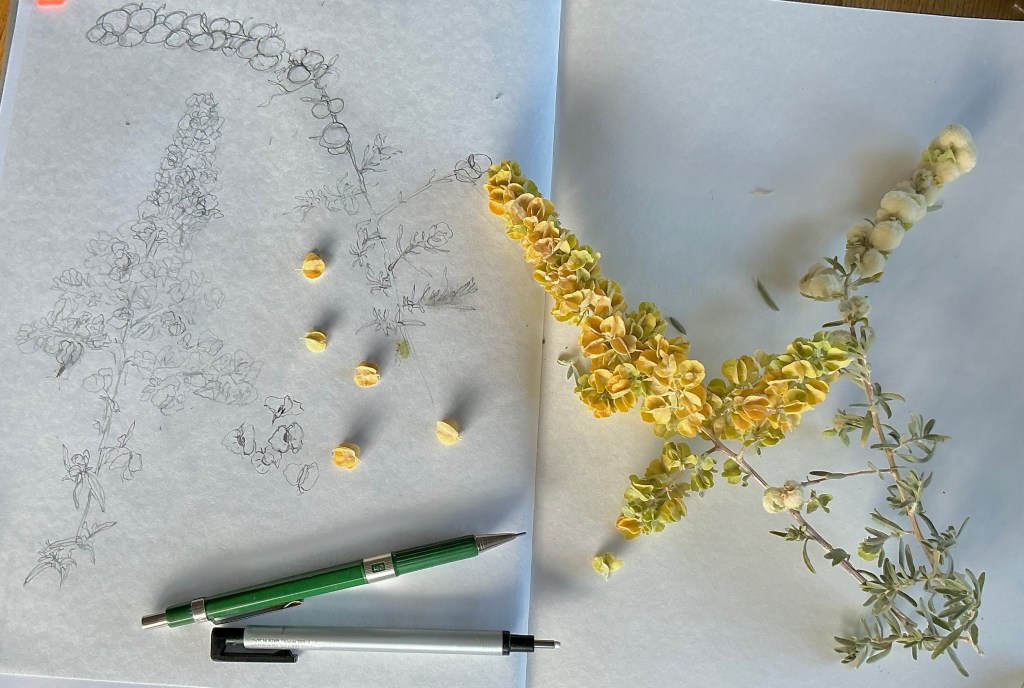
PS: My journal page was created by first sketching in graphite the two Fourwing stems, followed by outlining with loose ink lines from a Micron 005, adding a background of both soft and medium charcoal – blending with a stump, then using a Tombow Mono Zero eraser to clean up the ‘cottonballs,’ before adding watercolor pencil, color splatters, and eraser lines randomly placed through the charcoal background. A bit experimental, and lots of fun.