House Finch – Page 14 .. The 100 Day Project (2026)

July 14, 2026

House Finch (Haemorhous mexicanus ssp. frontalis)

aka Common House Finch

More than likely you’ve seen the sparrow-sized House Finch if you live almost anywhere in the U.S., southern Canada, or Mexico. The males are particularly showy with their bright red heads, throats and breasts, and their bouncy flight is sure to catch your attention. Just filling a backyard bird feeder with black oil sunflower seeds can bring a flock of 50 House Finches in to feast. They tend to dominate their favorite feeders, often chasing off competitors, after which you’ll have plenty of time to observe these finches as they sit still while shelling seeds by rapidly biting and crushing them with their large beaks. 

If you aren’t familiar with House Finches, you’ve probably heard their long, twittering song, which they belt out in most neighborhoods from coast to coast. Their song, so full of excitement and energy, is usually sung from the top branch of a tall juniper or pinyon pine tree. House Finches seem to be pleading urgently for attention by clearly singing, “Talk to me PLEASE, isn’t anybody THERE!!” (At least that’s what I hear over and over again first thing every morning throughout the Spring and Summer!) 

Not knowing how many broods have been reared this year, to date, it seems like we’ve enjoyed a large number of family groups around the house. Fledglings are fun to watch in flight as they constantly chase adults to beg for food. These futile attempts for free handouts strengthens their wing muscles and hones their acrobatic skills. Usually defeated, these novice students soon land in a tree and begin a long, hard practice session to learn their parents’ complex song.  

Completely exhausted, they will return to a certain cholla and the nest where the adult female fed and defended them as nestlings during the first 12-20 days of their lives. Finding even one of their well-hidden nests in any of those 4 to 7 foot tall cactus “trees” is quite the prickly endeavor! Even knowing how to recognize a House Finch nest hasn’t prevented me from experiencing plentiful and painful spiny jabs. What an excellent defensive location our local birds choose for nesting.

The Nest and Nesting Habits

In as little as two days, the female builds a cup-shaped nest made of fine stems, leaves, rootlets, thin twigs, string, wool, and feathers, with similar, but finer materials for the lining. This sturdy nest, durable enough to raise up to six broods a season, measures 3-7 inches wide; the inside cup is 1-3 inches across and up to 2 inches deep.

House Finches usually build their nests in cavities in deciduous and coniferous trees, on cactus and rocky ledges, and in or on buildings using sites like vents, ledges, street lamps, ivy, and hanging planters. They will also claim nests abandoned by other birds.

A western House Finch is likely to build its nest within 60 feet of where it was the previous breeding season; eastern birds choose sites more than half a mile away from prior nests. Despite these differing habits, all nest sites have a few things in common: a sturdy base and a roof-like overhang to shelter against sun and rain.

House Finch Facts

  • With over 40 million House Finches across North America, they are currently one of the most widespread and common bird species across the United States, second only to the American goldfinch. 
  • Native to the Southwest U.S. and Mexico, in 1939 a few House Finches captured in Santa Barbara, California, were sold to a New York City pet store owner as “Hollywood Birds.” Even back then, the sale of these birds was recognized as illegal under the Migratory Bird Treaty Act of 1918. To avoid prosecution under the Act, the pet store owner released the finches …. they were set free on New York’s Long Island. By the early 1940s wild nests were discovered on Long Island, and from there the spread continued. 
  • Sometime before 1870, House Finches were introduced to Oahu from San Francisco. By 1901, they had become abundant on all the major Hawaiian Islands.
  • Where House Finches are an introduced species, they are considered naturalized 1. They’re also considered an invasive species in some places, largely in unforested lands across the eastern U.S. where they’ve displaced the native purple finch (and even the non-native house sparrow!).
  • In their native range in the Southwest U.S. and Mexico, House Finches live in desert, grassland, shrubland, and open woodland environments, as well as near human dwellings and cities. The biggest House Finch flocks in the East are found in cities, and it’s much more common to find the eastern birds in habitats developed by people than anywhere else. 
  • Depending on where they live, House Finches can appear very different. Within the 11 officially recognized subspecies, body size, beak size and shape, wing length, tail length, and coloring can all vary regionally. For example, the northeastern migratory populations have longer and more pointed wings better suited for longer flights than the western finches which tend to be permanent, year-round residents.  Also, House Finches on Guadalupe Island off the coast of Baja California, Mexico, have heftier beaks than mainland birds.
  • The bright red (and sometimes orange or yellow) plumage on the head, throat and chest of mature House Finch males comes from compounds in their food (bird species are unable to produce red or yellow other than by diet). These pigments, called carotenoids (the same ones found in carrots and tomatoes), come from the berries and other fruits they eat. Females prefer mates with the biggest and brightest red-colored patches — a sign of a well-fed male.
  • House Finches are among the strictest avian vegetarians: seeds, buds, fruit, and foliage comprise 97% of their year-round diet. Most seed-eating birds not only eat insects in the spring and summer when they are abundant, but will feed bugs to their nestlings to add protein for growth. Except for the occasional fly larva, House Finches stick to a vegetarian diet.
  • Dealing with a pandemic for decades, these birds suffer from “House Finch Eye Disease,” a form of conjunctivitis that was first detected in Washington D.C. in the winter of 1994. Since then, the bacterial illness has expanded continent-wide causing big declines in House Finch numbers. Infected birds often have swollen or reddened eyes and may appear inactive or confused. Over time, it leads to birds becoming blind, disoriented, and vulnerable to predators. Other finch species, such as the American Goldfinch, are also affected. Because the disease is spread through social contact, it’s very important to keep bird feeders and baths clean.
  • The mite, Pellonyssus reedi, is often found on House Finch nestlings, particularly later in the season. However, the adult female has a clever strategy in response to these often fatal attacks. Since male chicks are more vulnerable to a mite outbreak, she will lay eggs containing females first to reduce the length of time male chicks are exposed to mites. This strategy increases the likelihood that representative numbers of both sexes will survive.

…………………………………………………………………………………………………

Share stories of your local House Finches!

Hope you found this interesting!

As always, thanks for stopping by!

1  A species is considered “naturalized” if it didn’t originally evolve in an area but has successfully adapted, established a permanent population, and is reproducing independently in the wild. These species are non-native, surviving without human help. Note: not all naturalized species are considered invasive.

References

allaboutbirds.org

audubon.org

iNaturalist.org

The Life and Times of the Lanceolated Chafer

The Case of a Mysterious Wormy Thing

July 9, 2026

This is the third year in a row that I’ve noticed these seemingly unremarkable-looking brown beetles “hiking” along the rock pile 2-track road. They appear all at once, about mid-June, then vanish after several weeks. This year (2026) these scruffy/fuzzy beetles, know as Lanceolated Chafers (Phyllophaga lanceolata), really caught my attention, especially after finding myself at ground zero of a mass male Flash Mob1 !!! From all directions, determined (and awkwardly) flying male chafers were dodging my legs to land on top of a lone female beetle frantically struggling against an earlier arriving male. His prickly lance-like legs had pinned her to the ground so she was lying on her side unable to use her legs. While she squirmed at my feet, newly landed beetles tried to fling off the original male to claim their rights to the female. Males continued to land until there must’ve been 30 or more, with fights breaking out everywhere, on top of the female and all around my feet. Each male was jousting to be victor. 

Males arriving, fights break out

But a victor of what? Was this some sort of mating ritual? Had the female released highly potent pheromones to attract a mate? If so, how far did her “call” drift on the wind to bring together so many males at one time? Did she intend to call only one male, or was her purpose to entice a stampede? If she anticipated a herd, was her intent to mate with the first one (the fastest?) to arrive? Maybe she hoped for battles and skirmishes to ensue, where the strongest of all males would win her favor(s)? This still remains a mystery, as I couldn’t find anything in the literature to explain this behavior? 

While pondering these questions (and daring not to move my feet for fear of squishing one of the many male pile-ups), I bent over for a better look. It was then I noticed an opaque white, worm-like thing slowly emerging from the female’s abdomen! “What could this be?” ….. 

Was it a larva? Probably not ….. Female chafers don’t give live birth; they lay eggs in the soil beneath their favorite host plants (such as mallows), where they hatch into grubs that remain underground for up to two years before emerging as adult beetles. 

Five males fighting for the female (notice how much larger she is than a male). Bit of a skirmish, left side.

Was it part of or the actual female genitalia? Maybe? I’m still searching for information about that notion.

Was it part of the male genitalia that had somehow broken off inside the female during insemination? Is that even possible? Again, still searching for answers about chafer sex.

Three males with the female (notice the “wormy” thing). One male, lower left, apparently confused?

For another 5 minutes I closely observed the squirming female laying helpless on the ground fighting off numerous suitors while still displaying the wormy “thing.” As more males continued to arrive, crash-landing on other grounded males and adding to the chaos, something changed. Can’t explain what happened, but in a matter of 15 seconds all the males stopped their aggressive fighting and took flight; the female uprighted herself (regaining her dignity?), quickly walking away like the nothing unusual had just happened. I watched her go, noticing she was no longer in possession of the wormy “thing,” and couldn’t find it anywhere at or near the scene! 

The party is over. A male walking away, looking for a mallow to snack on.

After-math

Over the next several days, nary a chafer was found! Had all the males satisfied their natural desires? Had all the females become pregnant, laid their eggs and vanished? “After” doing the “math” on the days following the event, I counted only two beetles walking the 2-track road, one headed north — one headed south. Scouts? ….. Because Lanceolated Chafer adults only live 1-2 months, and because none have been seen since the last two, that may be the end of sightings for this year. While there’s still the occasional pack of ants dragging away a dead beetle to share with their colony, the legacy of adult chafers lives on. Recently-laid eggs will hatch after only 18 days into white or cream colored, C-shaped larvae. Those grubs will munch away on mallow and grass roots for the next 1-3 years until a perfectly warm mid-June day, sometime in the future, the adults emerge from the soil to complete their life cycle. 

Epilogue 

Since most chafer beetles are nocturnal (active at night), if you’ve seen an adult during the day, it may have been the Lanceolated species which are diurnal (active during the day).  And you may have unwittingly encountered any of the chafer species found in North America……. 

An exhausted male, a bit off balance, as he feeds on mallow leaves.

…….. If you’ve ever seen one or more of your carefully-tended, vigorously-growing garden plants up and die overnight, it may have been victimized by root-living chafer grubs.

…….. If you live in the central or eastern U.S., grubs may be feasting on the roots of agricultural crops, like corn, soy, or sunflowers. Headline news is sure to cover the story of devastation and financial ruin brought on by the voracious chafer beetle larvae, complete with video of farmers holding a handful of grubs dug from below the soil surface.

Have you experienced one of these close encounters?

Hope you’ve found the “Life and Times of the Lanceolated Chafer” interesting (or maybe educational, peculiar, or maybe even fascinating!?!). Let me know what you thought.

As always, thanks for stopping by!

1 A flash mob is defined as a large group of people who suddenly assemble in a public place, perform a brief, pre-arranged action (like a synchronized dance), and then quickly disperse. Flash mobs are typically organized online via social media or viral messaging for entertainment or artistic expression. I think this definition nearly perfectly fits the chafer beetle dance I was witness to on that fine mid-June morning somewhere along the 2-track rock pile trail. 

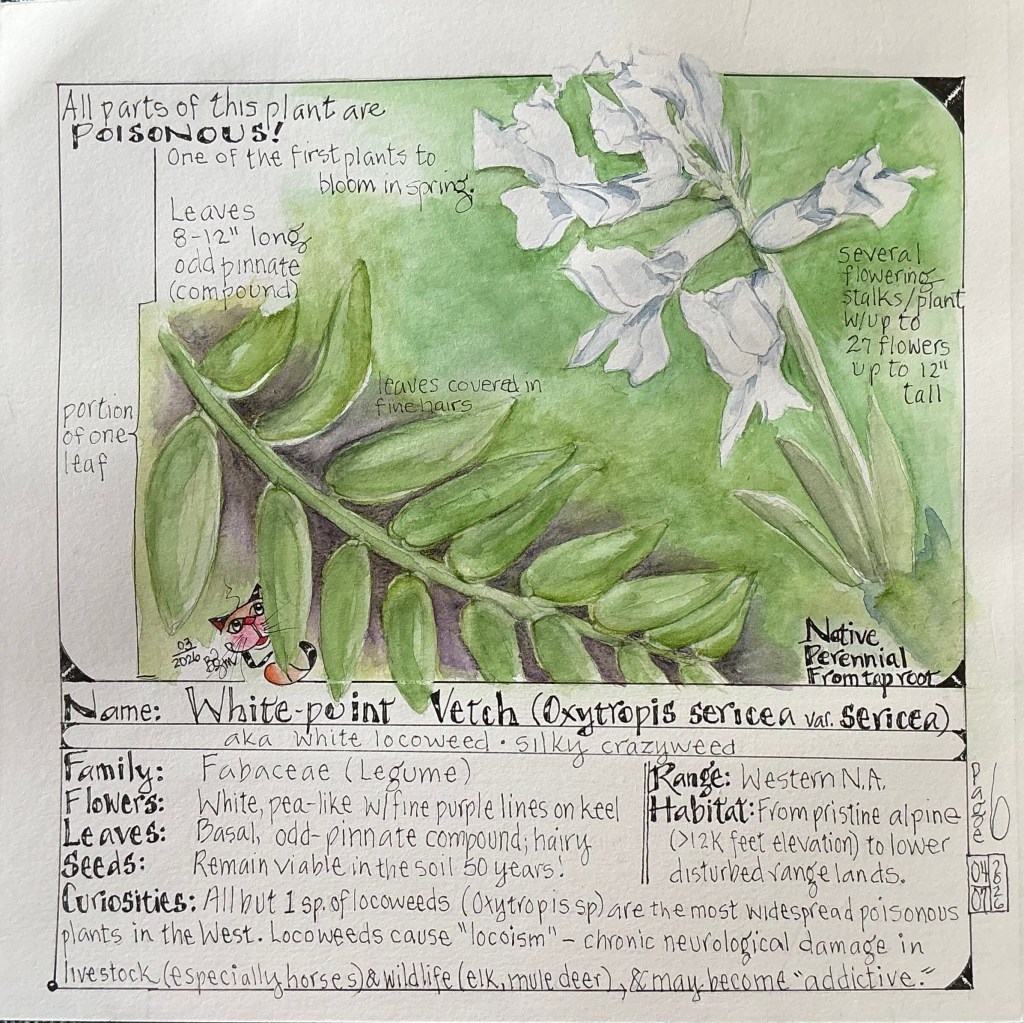
White-point Vetch – Page 6 .. The 100 Day Project (2026)

April 27, 2026

White-point Vetch (Oxytropis sericea var. sericea)

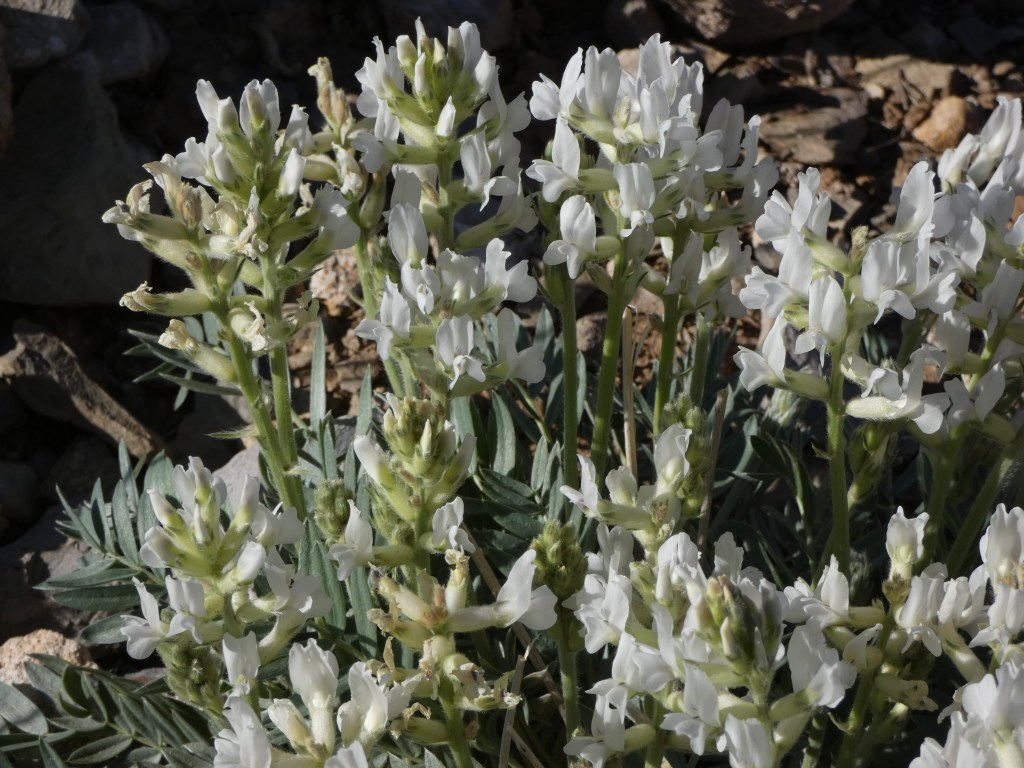
One of the first flowers to bloom in the spring, white-point vetch forms a dense bouquet of brilliant white, pea-shaped flowers that grow on 12 inch tall stalks arising from many basal, soft-hairy compound leaves. 

Beautiful to look at ….. POISONOUS if ingested … 

….… especially if you’re a cow, horse, sheep, goat, elk or mule deer

All parts of white-point vetch (aka white locoweed) are poisonous at all times, even when dried. The culprit is an alkaloid toxin called Swainsonine, which inhibits enzymes essential for normal carbohydrate and glycoprotein metabolism in cells. This causes carbohydrates to accumulate in the brain and most other organs preventing normal cell function. Depending on how long the locoweed is eaten, the affected cells can be permanently damaged; one to three months of heavy consumption can cause death. Also, Swainsonine is present in the milk of lactating animals affecting their nursing youngsters. 

Are locoweeds naturally poisonous? Well, yes, in a way. But the poison isn’t made by the plant itself. Swainsonine is produced by a fungus (Undifilium oxytropis) that acts as an “endophyte,” happily living between the plant’s cells of certain locoweeds in the genus’ Astragalus and Oxytropis. This fungus, thriving at high elevations on Western US rangelands, coexists symbiotically with the host plant, causing little to no harm to the host locoweed. In fact the host may even benefit from the fungus by receiving enhanced drought tolerance, as well as a “don’t eat me” sign to all hungry ungulates. Meanwhile, the fungus goes about its business of keeping the plant well stocked with Swainsonine. Only the species of locoweed without the endophytic fungus are not poisonous. Review the list at the end of my post to learn which Astragalus and Oxytropis species are known to cause “locoism.” (But the real lesson is to be wary of all species in these two genus’ until you seek expert identification.)

Symptoms of locoism in ungulates: Malabsorption of essential minerals and vitamins in the intestinal tract. Decreased appetite and weight loss. Decreased liver function and damage due to elevated liver serum enzymes. Calves, lambs, and foals may be born with deformed legs. Abortions and fetal death are common. Other general symptoms include depression, blindness, loss of coordination, emancipation, tremors, paralysis, constipation and deterioration of the coat.

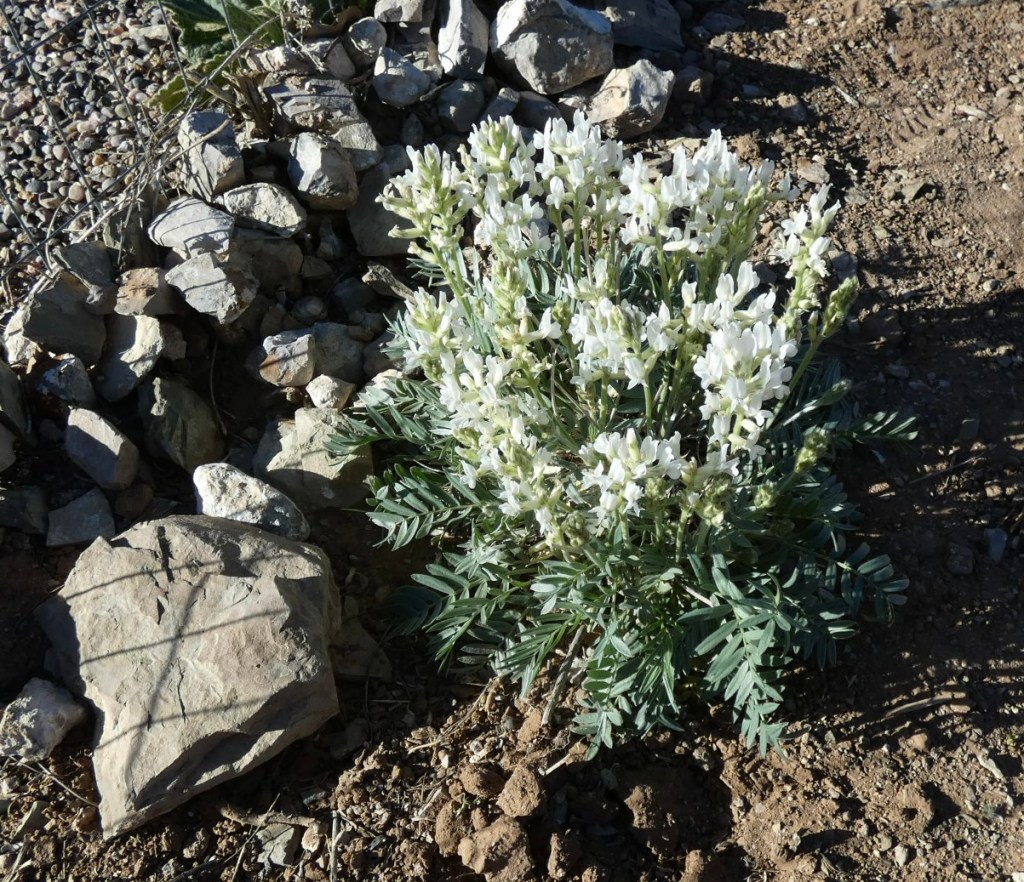
We have 5 of these plants scattered around our property., and this is one of them. We also have a group of mule deer that walk by this plant almost daily. They must know not to eat the leaves and flowers, moving quickly by in search of something safe to eat.

Abnormal behaviors emerge, such as sudden changes in temperament, aggressiveness, ataxia, falling over unexpectedly, violent reaction to routine management practices such as putting on a halter or refusing to go through a chute. Horses become very depressed and sleepy, and often show more severe neurological effects of locoweed poisoning than cattle and sheep.

Specific to cattle, the major problem encountered with locoweed poisoning is decreased fertility characterized by lower conception and calving rates; semen fertility of affected bulls is also decreased. In addition, cows and bulls consuming locoweed experience reduced libido, behavioral changes, weight loss, and heart failure. Typical findings in calves are decreased growth rates resulting in lower weaning weights. Some calves may be born weak and die shortly after birth.

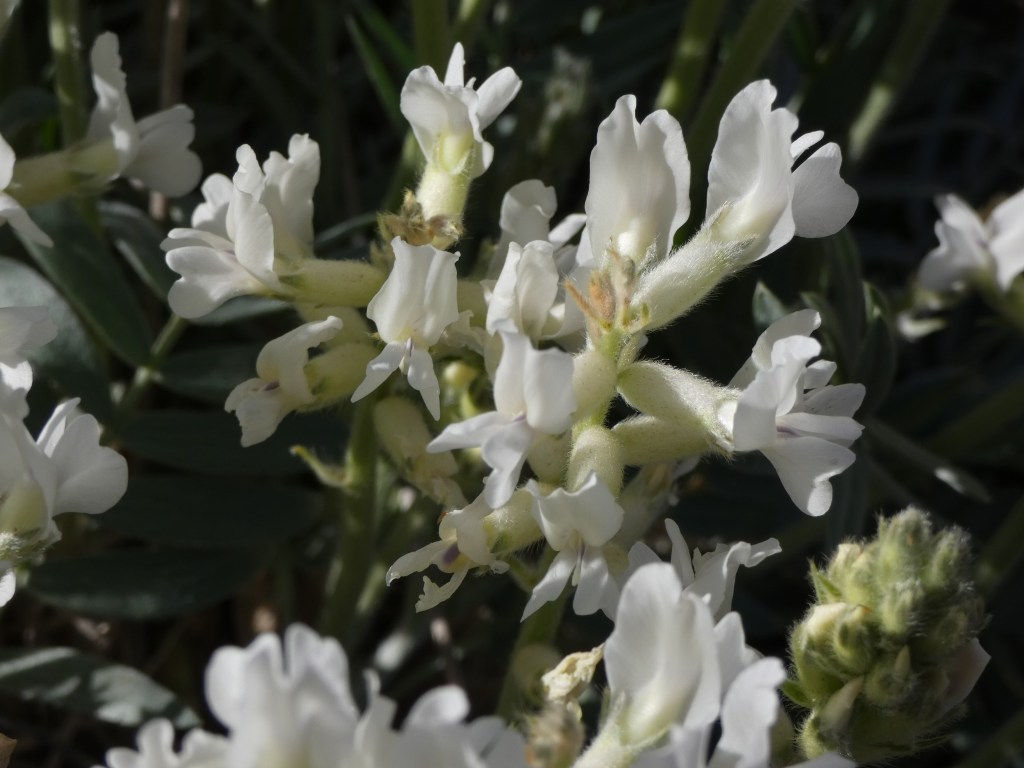
The flowers of White-point Vetch are bright white and quite lovely. This close-up shows how their form resembles a garden pea flower.

There is no effective treatment for locoweed poisoning! Recovery depends on the duration of ingestion and severity of the lesions. Locoed horses are considered permanently affected.

So why do animals eat poisonous locoweeds when other non-poisonous forage is available? One reason is locoweeds are palatable and have a similar nutrient value to alfalfa. Also, they become habituated to eating them from each other. Once one animal starts to eat locoweed others follow. Removing animals that are locoweed eaters from the herd can reduce the chances of other animals ‘learning’ to eat the plant through social observation.

Is the toxin Swainsonine poisonous to humans? While primarily a risk to livestock, unintentional human exposure, usually through ingestion or smoking, can cause hallucinations, severe liver damage, or even fatal poisoning.

From what I’ve read, people seeking to get “high” from Jimson weed (a Datura species), aka “loco  weed,” often mistake a true “locoweed,” (like Oxytropis sericea) for the Datura, even though they look nothing alike. As they begin smoking the leaves or any other part of O. sericea, they can experience severe and rapid hallucinations, delirium, intense paranoia, psychosis, anxiety, agitation and disorientation as their heart races, pupils dilate, vision blurs, and a high fever sets in. Chronic ingestion inhibits cellular enzymes, potentially leading to long-term neurological impairment, reproductive dysfunction, and severe organ damage.


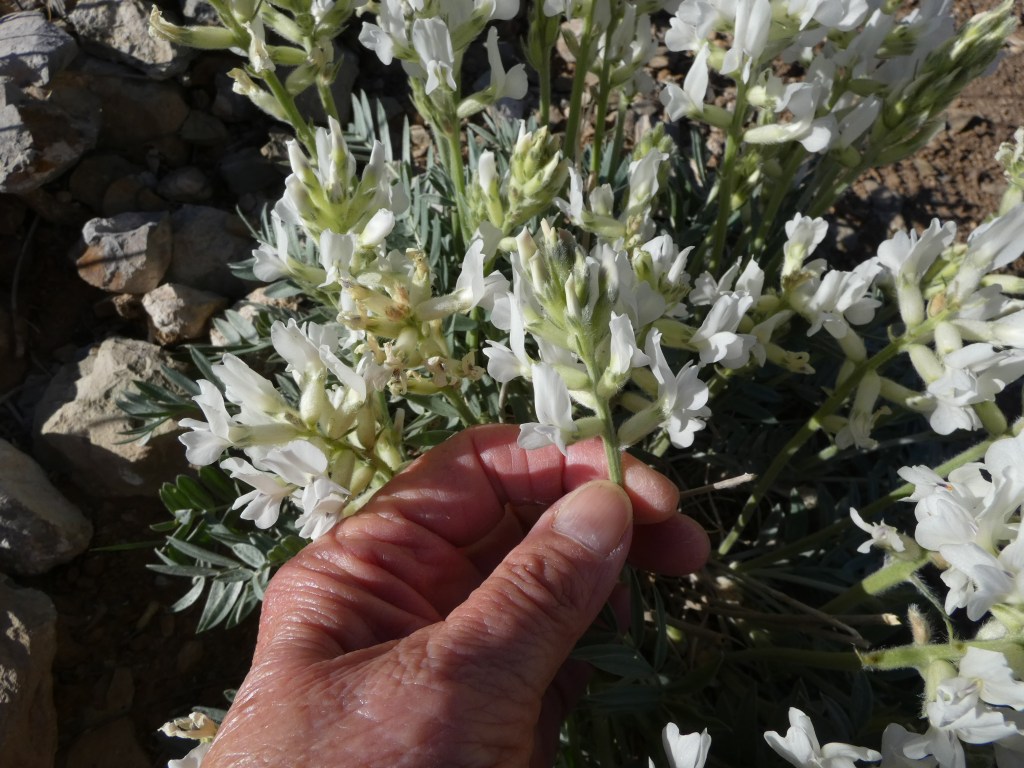
My hand carefully holding a flower stalk. This shows just how large the flowers are. Notice there are quite a lot of buds present at the flower stalk tip. (I did wash my hands after handling the plant)

………………………………………………………………………………………………

Well, that’s a lot of scary stuff! Let me end my post with something light-hearted and laughable from the Wild Wild West — something unbelievably crazy involving the extreme measures that were taken by Colorado ranchers during 1881 to 1885, to prevent their livestock from dining on poisonous locoweed. 

Locoweed—The Most Infamous Plant of the Southwest!

As early as the 1800s, livestock growers in the west considered the presence of “weeds” (whether native or non-native) on rangelands an unwelcome nuisance, especially if they outcompeted the growth and availability of “desirable” plants (forage) needed to feed their herds. And if a tasty “weed” or two turned out to be poisonous to their livestock, then its elimination was critical. This was the case with white-point vetch, aka white locoweed (Oxytropis sericea), and its close relative, purple locoweed (O. lambertii), both native perennial species found throughout the intermountain west. Ranchers in the late 1870s were shocked by the skyrocketing deaths of their livestock that were eating locoweed. And in Colorado, ranchers demanded action. 

This is a true story of locoweed, the first “weed” for which the 1880s Colorado legislature enacted radical management regulations; the first “weed” where detailed steps were laid out to not only control locoweed, but eliminate all signs of this poisonous plant from Colorado rangelands.

The following is an excerpt from an article written by Charles Bryant, Huerfano County’s (Colorado) Noxious Weed Manager, and printed in “The Learning Ledger” on June 2, 2025. 


A young bouquet of White-point vetch was nearly 10” tall, with more growth expected.

One of Colorado’s Most Loco Laws ……… 

….. the ‘Loco’ or Poison Weed Act of 1881

“At the time of enactment, Colorado had been a state for less than five years and was the epitome of the “Old West,” with the livestock industry being one of the primary drivers of the newly-formed state’s economy.  Because of the impact locoweed was having on the health of livestock by 1881, Colorado legislators became preoccupied with the native Oxytropis species.

The 1881 “Loco or Poison Weed Act” (Act) allowed citizens to “dig up not less than three inches below the surface of the ground any ‘loco’ or poison weed during the months of May, June or July and shall receive a premium of one-half cents per pound for each pound of such weed dug up, to be paid out of the state treasury as hereinafter provided; provided, that such weed shall not be weighed in a green state, but shall be thoroughly dry when weighed.”

“The Act went on further to describe how locoweed bounty hunters of the state were to deliver their dried loads of locoweed to their county clerk within two months of their digging. Upon delivery to the clerk of the county where the weeds were gathered, the clerk was to weigh the load and require those seeking reimbursement to sign an oath stating:  “I do solemnly swear that the weed here produced by me this day is ‘loco’ or poisonous weed of X amount of pounds, dug up by me within two months last past.”  Upon the recitation of this somber oath the county clerk was to “forthwith destroy such weed by burning” and issue a certificate for payment that was to be paid by the county, with the county later being reimbursed from the state treasury after their submission of an annual report that detailed the amount of locoweed gathered and to whom bounties were paid.

“By 1885 it became glaringly apparent that the locoweed bounty program was unsustainable, to say the least, and rife with fraud.  The February 12, 1885, edition of the Rocky Mountain News lambasted the “loco industry” and pointed to the handsome sum of $8,727.27 that had been paid out in one month alone to El Paso County, equivalent to over $283,333 in today’s dollars. The coverage went on to question how over half a million pounds could be collected in El Paso County in a month, and stated that the monthly locoweed bounty expenditures for El Paso County matched the total monthly operating cost of the Colorado State Penitentiary.  Only six days after this scathing review, Colorado legislator Rep. Abraham Bergh of Park County led the repeal effort of the Act, and the state finally did away with perhaps one of the most “loco” laws to ever be enacted in Colorado.”

Are you familiar with your local locoweeds? If so, I’d love to know which species you’ve encountered and if they’re on the list (below) of those known to cause locoism?

After learning more about the poisonous nature of locoweeds, next time you discover one, will you think twice before handling the plant? (And please, if you do, be sure to wash your hands!)

Hope you enjoyed this post! Thanks for stopping by!

Astragalus and Oxytropis species known to cause locoism: Astragalus lentiginosis (spotted loco), A. mollissimus (woolly, purple loco), A. wootonii (Wooton loco), A. thurberi (Thurber’s loco), A. nothoxys (sheep loco), A. dyphysus (blue loco, rattlewood), A. earlei (Earle’s loco), A. argillophilus (half moon loco), Oxytropis sericea (white-point vetch, white loco), O. lambertii (purple point loco), O. bessyi (Bessy point vetch), and O. campestris (field loco). 

(I’m thinking that just because these species are known to have the poisonous toxin Swainsonine, it might be best to err on the side of caution and treat Astragalus and Oxytropis species as suspect? Do you think so too?)

References

en.wikipedia.org

wildflower.org

poisonousplants.cvmbs.coloradostate.edu

inaturalist.org

oregonflora.org

coloradohistoricnewspapers.org/?a=d&d=RMD18850212-01.2.24

Dark Jerusalem Cricket – Page 5 .. The 100 Day Project (2026)

April 5, 2026

Dark Jerusalem Cricket (Ammopelmatus fuscus)

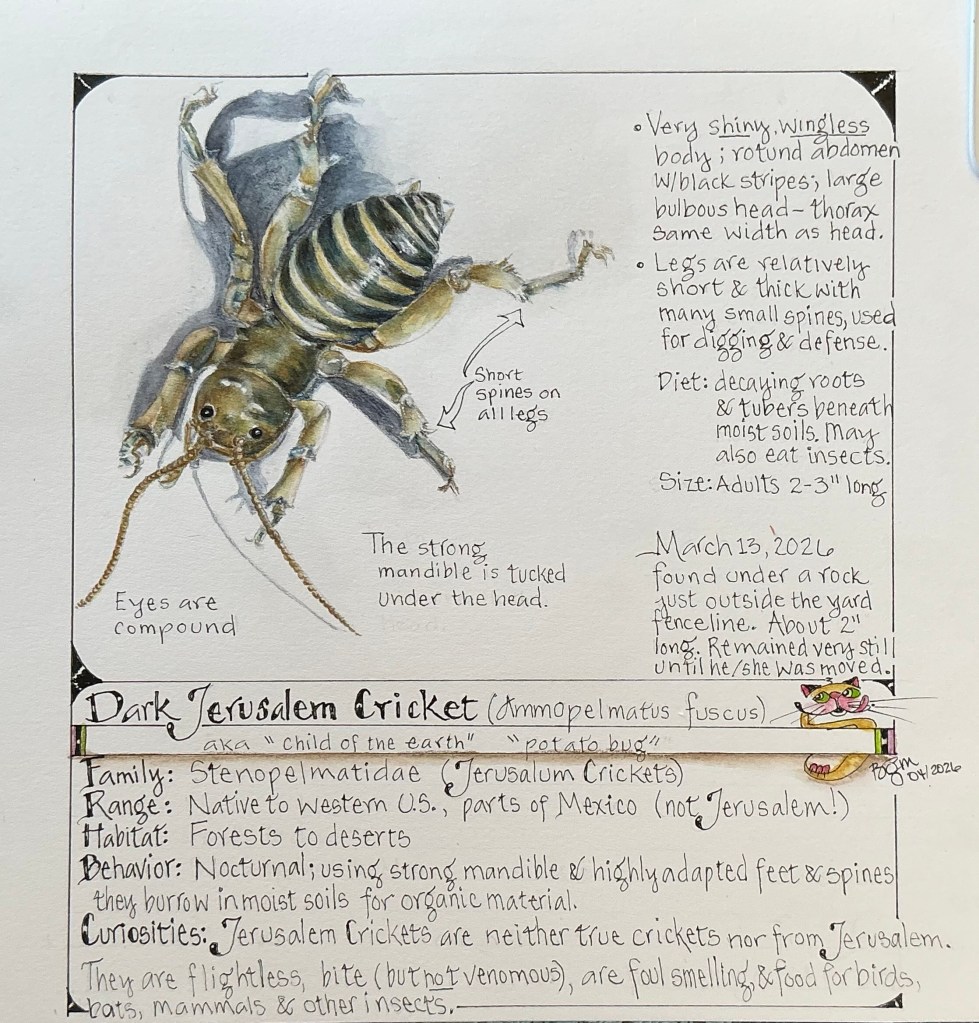
Last month (mid-March), while looking everywhere for signs of spring (something green and growing), I dared to peek under a flat rock and gasped with surprise! Instead of uncovering a tiny flower bud was a gigantic “creepy-crawly” bug! Yikes! After quickly dropping the rock back on his head I realized my run-away imagination had gotten the better of me. 

So gathering my courage, I took another look. There, hiding under that rock was a “cuddly” Jerusalem cricket trying his best to be invisible (while avoiding the bright sunlight). 

This wasn’t my first Jerusalem cricket, but seeing this guy prompted me to learn more about this curious insect……

Firstly, Jerusalem crickets are neither true crickets nor are they native to Jerusalem

  • Taxonomists agree, “Jerusalem crickets are in a very different family than true crickets. This includes a bunch of flightless varieties, and some with wings, found in Africa. The Jerusalem crickets are wingless and are found in the Americas.”
  • “The origins of the name, “Jerusalem” cricket isn’t certain, but it’s thought that it comes either as a reference to the skull-shaped head (they’re also known as skull crickets), which is associated with skull hill in Jerusalem; or, comes from a watered-down swear word from the ‘40s and ‘50s. Around this time, in the US, both “Jerusalem” and “Cricket” were expletives, associated with being startled.”

Next, some Jerusalem Cricket Mating Characteristics

  • Similar to true crickets, each species of “sings” a different song during mating. They actually sing by drumming and they drum by beating their butts on the ground.
  • Once a larger female has successfully mated with a smaller male, and before she lays eggs, females usually eat the males!
  • She lays her egg masses in holes in the soil. After hatching, over the next 1-2 years, nymphs undergo several molts (as many as 10) until they reach sexual maturity which lasts for only 2-6 months.
  • Adults can reach up to 2 to 3 inches in length. Females are often larger in size; males have longer hind legs.

Third, Jerusalem Cricket Habitats and Out-of-Sight Living Quarters

  • They are “well-adapted to living in sandy soils, but can be found in sand dunes, chaparrals, grasslands, woodlands, and forests.”
  • Being nocturnal, they spend a majority of their lives underground. 
  • They hide underneath organic matter and other debris like rocks, wood. With their powerful mandibles, spiny legs and specially adapted feet, they also dig underground burrows for comfortable living quarters.

And Almost Lastly …. the Cultural Significance of Jerusalem Crickets

  • Of great importance to Native Americans as food, many tribes in southwestern U.S. also considered Jerusalem crickets as a powerful cultural symbol. Its striking appearance leads some to think the cricket brings mortality, as depicted in the folklore of the Chumash people of southern California. 
  • The Hopi, who settled in Arizona, portrays this cricket as a spirit being (a Kachina) named Sösööpa who races. As a result, it’s often carved into their Katsina dolls as a yellow humanlike character with black beady eyes, a black-and-white plaid skirt, and antennae made from sand grass, depicting traits of the cricket.
  • The Navajo associated the Yucca plant with the insect; you had to eat the plant as a cure of the cricket’s painful bite. This myth possibly gave rise to the misconception that their bite is venomous. 

It’s Greek to Me!  (Entomologically Speaking) 

Learning the meaning of a scientific name assigned to a species not only helps me remember uncommon words and how they’re pronounced, but often describes aspects of a species’ characteristics that may help differentiate it from another similar-looking species. Learning about these complex names falls into a study called entomology.   

Ammopelmatus fuscus, the scientific name for the Dark Jerusalem Cricket, is quite a mouthful. Curious about the meanings (in plain English) of these two strange words, I learned the name originates from Greek and Latin roots meaning “dark sand-sole” or “dark sand-burrower,” obviously referring to their sandy habitats, dark color, and burrowing behavior. But to learn how the common name with the word “sole” ties to one of the cricket’s characteristics, my dive continued. Here’s the entomology breakdown:

  • Genus Ammopelmatus
    • Ammos (Greek) means “sand,” referring to the cricket’s specialized adaptation to arid, sandy environments.
    • pelma (Greek) means “sole of the foot,” highlighting the specialized leg structures the cricket uses for burrowing.
    • tus (Greek) is a common word meaning either “them” or “their.” In this case, “tus” ties the first two parts together into “their sand sole.”
  • Species fuscus (Latin) means “dark,” “dusky,” or “brown,” describing the cricket’s color.
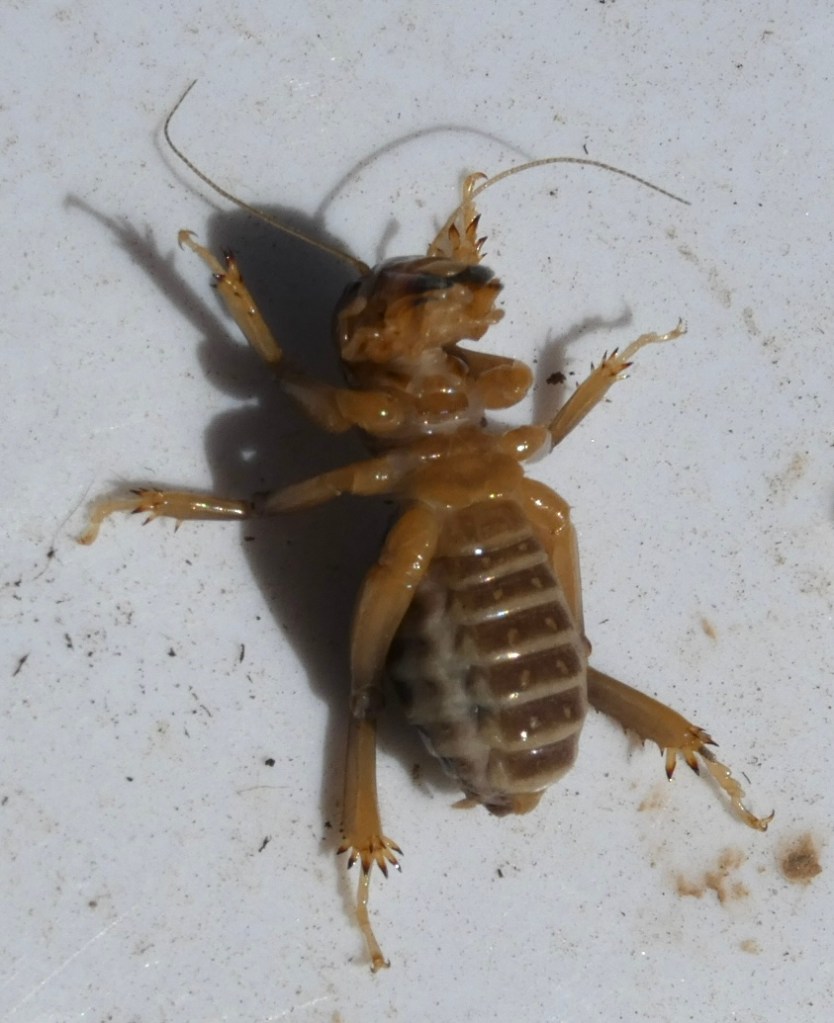
Here’s the underside of my Dark Jerusalem Cricket. The leg spines really show well as does the strong mandible. A scary fascinating view!

After learning more about the Dark Jerusalem Cricket, maybe next time I discover one, I won’t jump so high?! Do you think?

Have you seen a Jerusalem cricket hiding out in your yard? If so, what was your reaction?

Hope you enjoyed this post! Thanks for stopping by!

References

inaturalist.org/taxa

bugguide.net/node/view/154

factanimal.com/jerusalem-cricket/

  • Eaton, Eric R.; Kenn Kaufman (2007). Kaufman Field Guide to Insects of North America. New York: Houghton Mifflin. p. 84. 
  • Milne, Lorus Milne, Lorus and Milne, Margery (1980) The Audubon Society Field Guide to North American Insects & Spiders. Alfred A. Knopf, Inc, pp. 437. 
  • Stoffolano JG, Wright B (2005). “So so opa —Jerusalem Cricket: An Important Insect in the Hopi Katsina Pantheon.”American Entomologist. 51 (3): 174–179. doi:10.1093/ae/51.3.174

Spotted Towhee – Page 4 .. The 100 Day Project (2026)

April 1, 2026

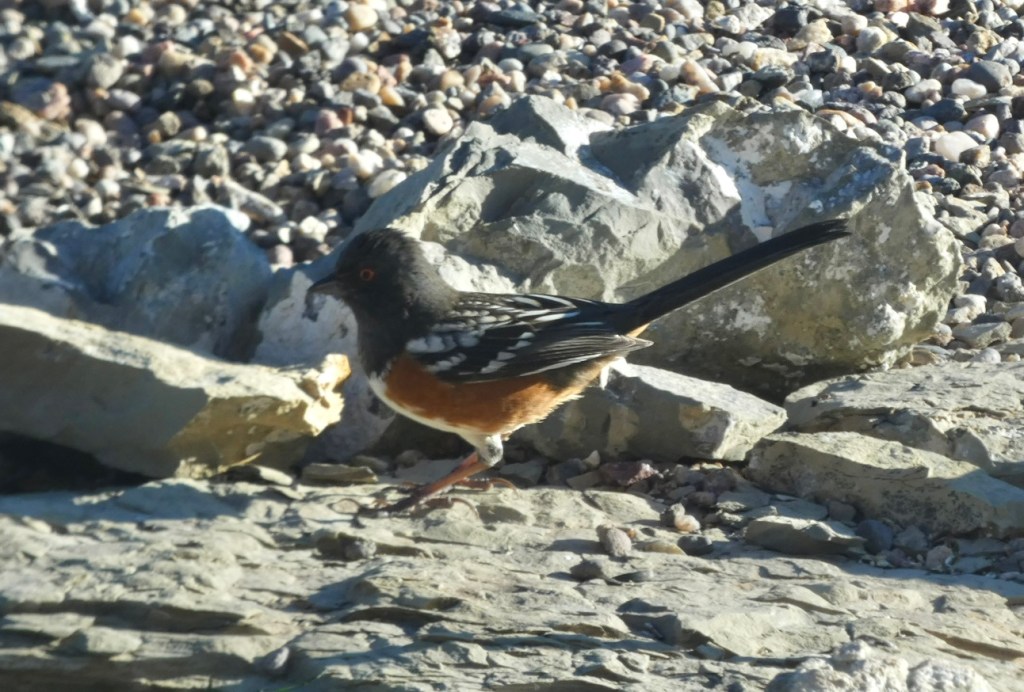
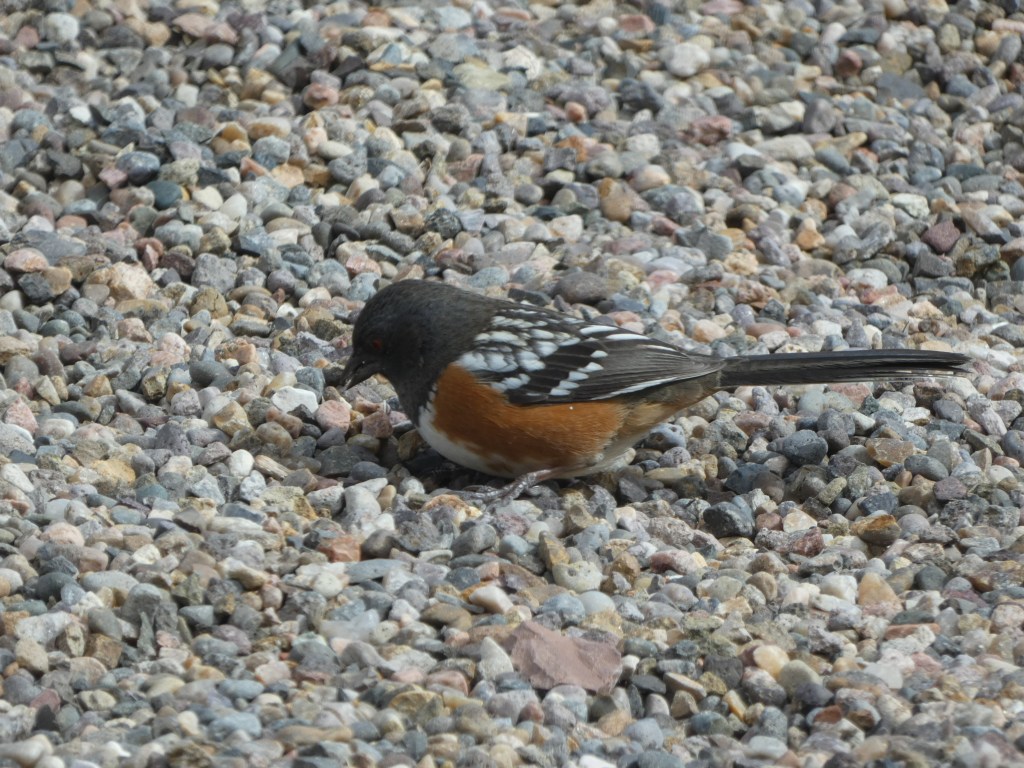
Spotted Towhee (Pipilo maculatus)

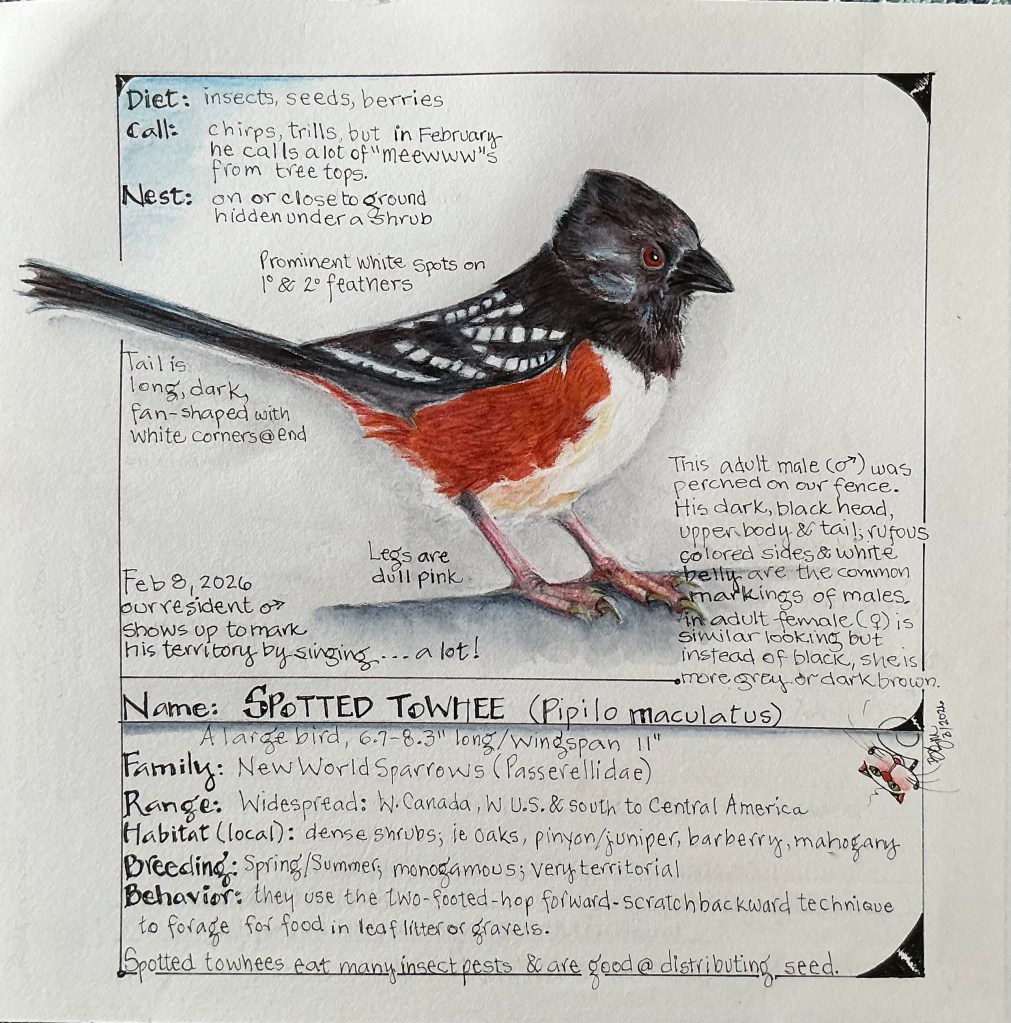
Here’s one of my favorite birds that’s a regular visitor to our yard. Spotted towhees, especially the males, are year-round residents throughout most of New Mexico, which means they breed in the shrubby vegetation surrounding our home. In our area, males sing at the crack of dawn until late afternoon beginning in early February. Instantly recognizable, their beautiful songs carry far and wide. Their songs not only signal to their mate it’s time to pair up again (spotted towhees are monogamous), they also let other male competitors know they’re horning in on his territory.

With favorable weather and abundant food, spotted towhees can produce two clutches of chicks during the breeding season. Their ground nests are hidden so well under a dense oak that I’ve never been able to find one. But it’s a lot of fun to watch clumsy fledglings trying to master the “two-footed-hop-forward-scratch-backward” forging technique all spotted towhees use to uncover hidden bugs and seeds.

Fun Facts

  • The spotted towhee and the eastern towhee were considered to be the same species called the rufous-sided towhee until 1995.
  • Male towhees have been recorded spending 70% to 90% of their mornings singing during breeding season.
  • Once a male mates, he only spends about 5% of his time singing.
  • It’s thought that the spotted towhee’s white spots are a form of camouflage.
  • Spotted towhees will sun themselves by lying on the ground feathers spread.
  • They will bathe in the dew or fog that has collected on vegetation.
  • Nesting females have been seen running away when disturbed rather than flying.
  • A group of towhees is called a “tangle” or a “teapot.”
  • When two towhees fight, one bird will pick up a piece of twig and carry it around as a sign of submission. 
  • Their bright red eyes act as a visual signal during the breeding season, standing out in their dark, shady, ground-level habitats.

Do spotted, canyon, green, eastern or any of the towhee species visit your yard? 

Hope you enjoyed this post! Thanks for stopping by!

References

audubon.org

inaturalist.org/taxa

allaboutbirds.org

explorer.natureserve.org

https://peecnature.org/learn/nature-guides/featured-critters/spotted-towhee/