April 29, 2026
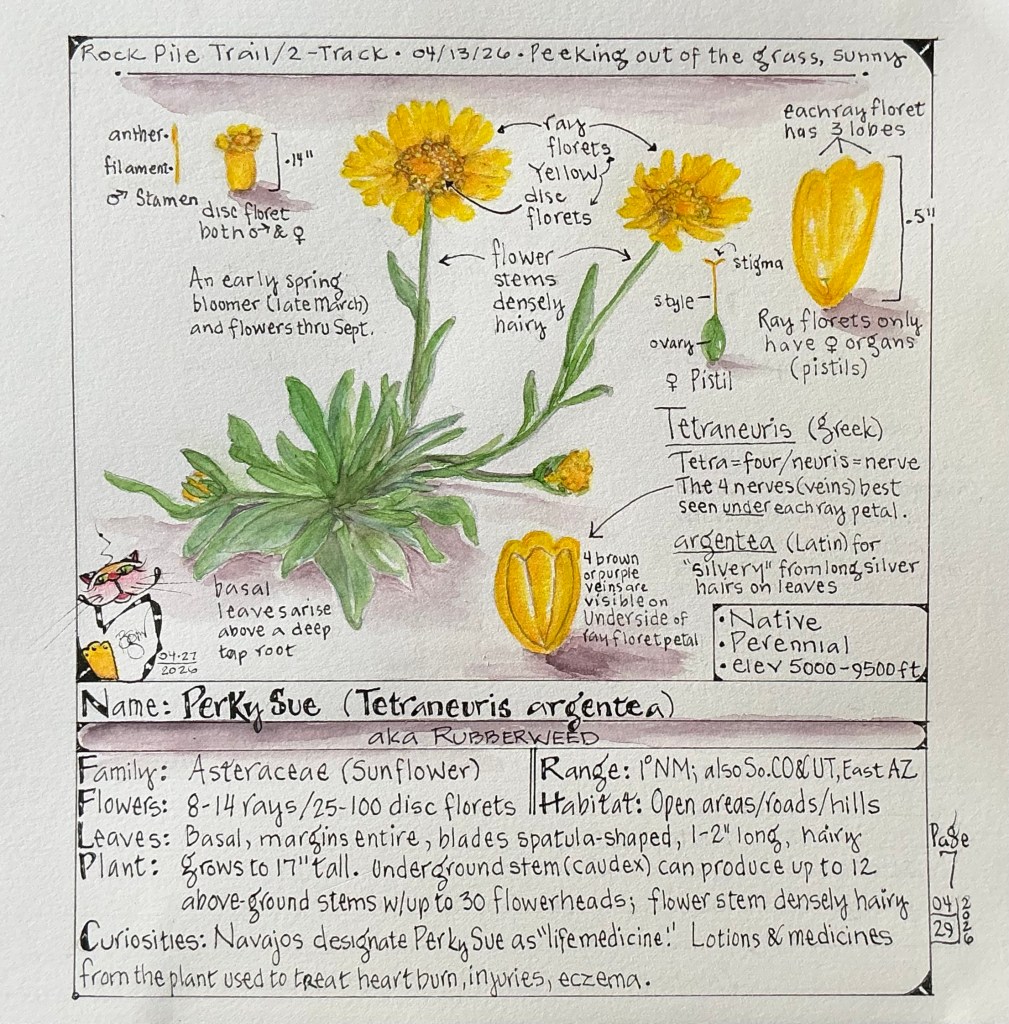
Perky Sue (Tetraneuris argentea)
Perky Sue has to be the happiest little sunflower on planet Earth!
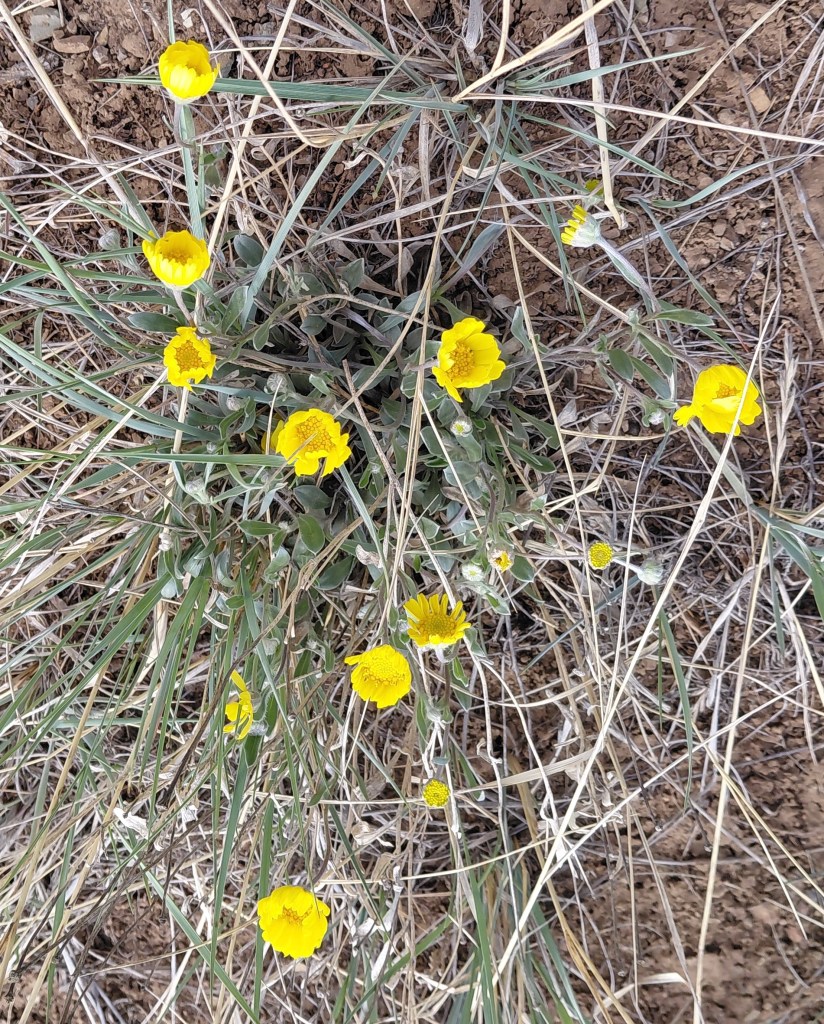
“Is it because Perky Sue is an early spring bloomer, it’s smiling face opening in mid- to late March? Maybe it’s how those brilliant yellow flowers climb above fields of drab, dry grasses to brighten the landscape? Perhaps it’s those tall, soft and silky flower stems that dance with wild abandon to the music of our spring breezes?”
No matter why Perky Sue always brings smiles, you can’t deny that encountering a blooming bunch makes you instantly happy!
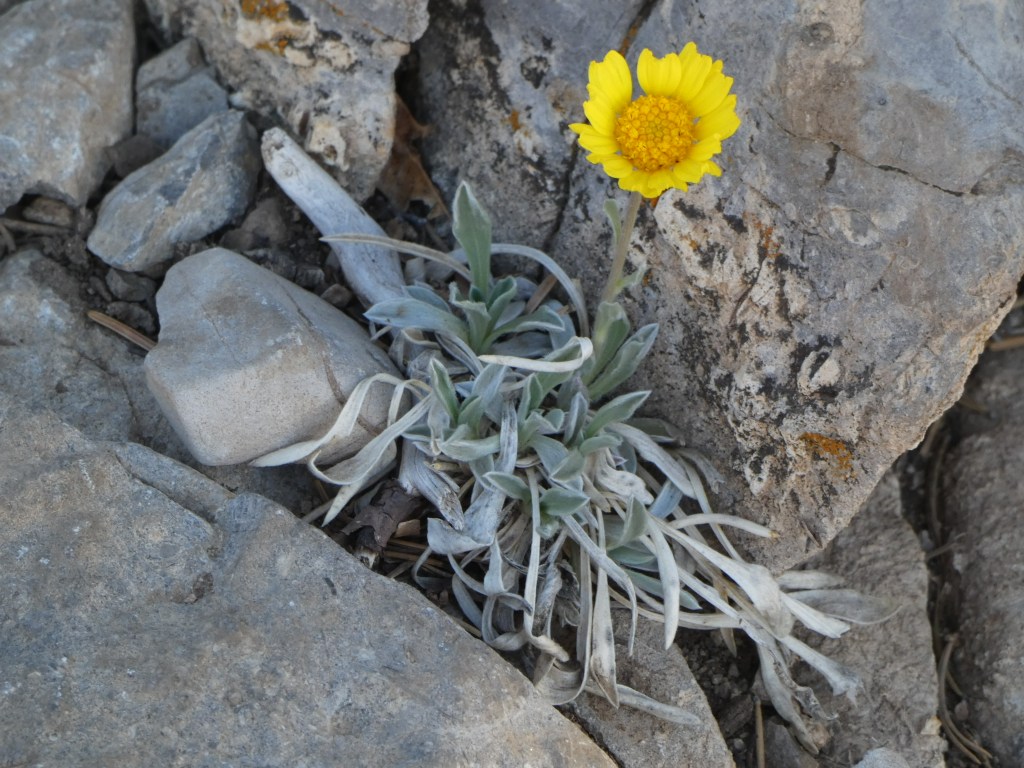
Look for these stunning sunflowers in the open areas scattered throughout and adjacent to the subdivision. Separate the dried grass and discover the soft sage-colored, spatula-shaped leaves densely clustered at ground level. Remember this spot and return every Spring to watch our grassy meadows awaken with dazzling yellow sunshine.
Did You Know ………………. ?
When you encounter Perky Sue (or most any other sunflower) take a close-up look at one of it’s flowers. What you’re actually seeing is a collection of tiny flowers (florets). The most numerous type of floret lies within the face or center of the flower head (these are the disc florets). But you may be surprised to learn there’s a second type of floret often thought of as the sunflower’s petals (called the ray florets).
The Sunflower Face
The face or central part of the flower head is called a disc; the individual flowers, the disc florets, are arranged in clockwise and counterclockwise spirals. Look close and notice each floret has five distinctly flared petal lobes attached to a fused floral tube (which together form the corolla). Each floret is fertile, having both male (staminate) and female (pistillate) organs, able to produce pollen and seeds.
The Sunflower “Petals”
Radiating out from the disc like the rays of the Sun is a showy ring (or multiple rings) of what looks like flower “petals.” However, each “petal” is a single ray floret consisting of a single strap-shaped flower (ligule) of five fused petals (corolla) that form a tube at the base. In Perky Sue and some other sunflowers, the ray florets are pistillate. But in the majority of species the ray florets are sterile.
The Sunflower “Landing Pad”
Sunflowers have one of the most highly evolved “flowers” in the plant kingdom. To maximize their visual attraction to pollinators, the ray florets became large showy structures that act as a “landing pad” for bees and other pollinators. When they “touch down” they are immediately drawn along the ligule to the bountiful pollen supply of the disc florets. Large pollinators also use the ligules of ray florets as a supporting platform to balance and feed from the disc florets’ floral tubes. So, ray florets evolved to increase the pollination success of the fertile disc florets at the center of the sunflower. And in the case of Perky Sue, insects carrying pollen as they fl to other “landing pads” increase the pollination of the pistillate ray florets.
Want to Learn More?
The biology of sunflowers is a fascinating subject, and I’ve spent many hours researching and illustrating their intricate parts and pieces, and how they work. If you’d like to learn more, check out these detailed posts I put together in the summer of 2023:
Geeking Out …… Total Bliss ….. Sunflowers!
…. and for a bit more about Perky Sue, get more here from my summer 2024 post
…………………………………………………………………………………………………
Does Perky Sue bloom in your neighborhood?
Have you ever taken a close look at its flower head or inspected the florets of another sunflower species?
What did you see?
Hope you enjoyed this page of my field guide. I’d love to know if you found the information new and/or inspired you to check out the details of your local sunflowers.
As always, thanks for stopping by!
References


Perky Sue sounds like a fun, cheery plant to hang out with! Isn’t it amazing how the indigenous know how to use the gifts from plants as medicine? I love the description of the pollinator landing pad. These don’t bloom in my area, but I hope they hang out on your property and brighten your day!
LikeLiked by 1 person
What an interesting thought ….. how do indigenous peoples know which plants safely provide medicinals? Years of trial and error? Experience passed down thru generations? For several years I was hopeful Perky Sue would appear on our property; afterall it’s just down the road. Then last month I did a little jig! A robust plant with a large flower head (one, so far) is in full bloom right outside our front porch! I’m so happy! Should I install an “Invitation to all pollinators” to the landing pad? Thanks for the comments Karen!
LikeLiked by 1 person