Narrowleaf Puccoon – Page 10 .. The 100 Day Project (2026)

May 25, 2026

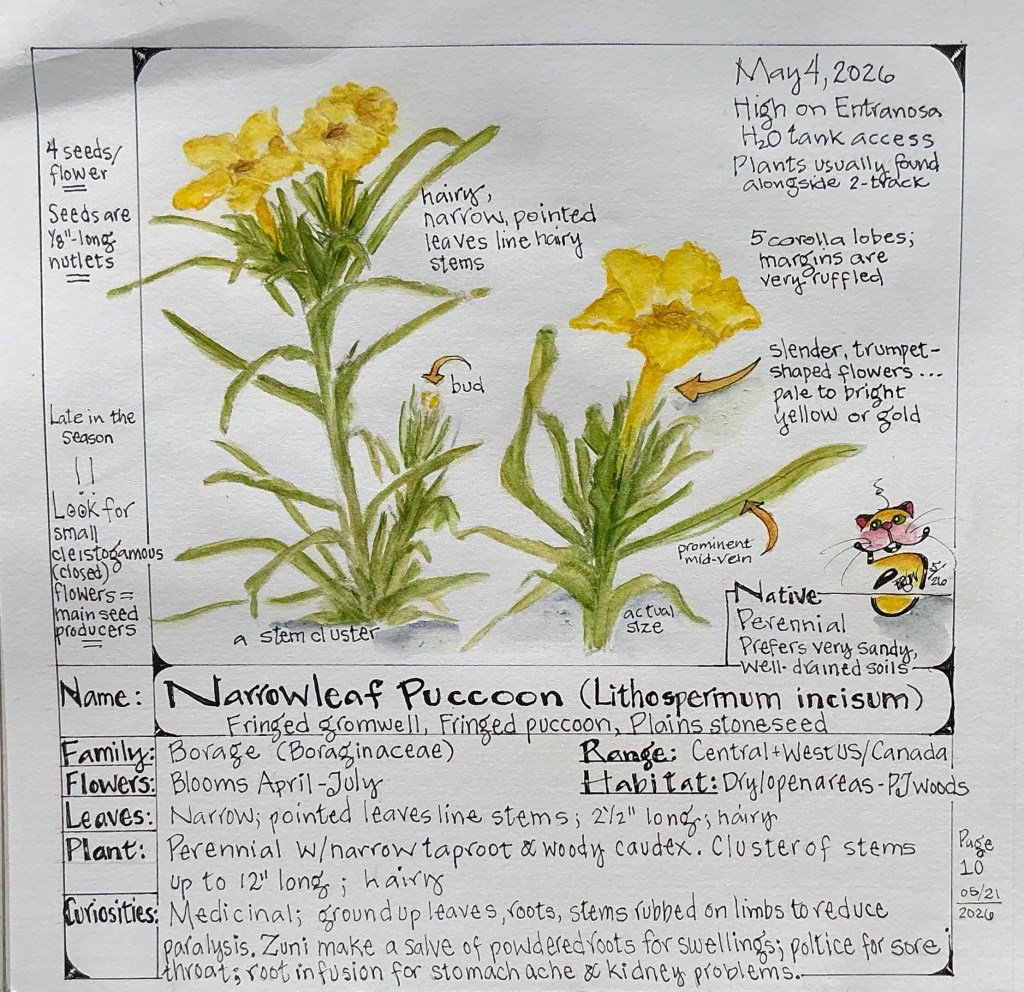
Narrowleaf Puccoon (Lithospermum incisum)

Etymology

Lithospermum, the genus named by Linnaeus in 1753, is Greek for stone (“Lithos”) and seed (“sperma”), referring to the hard nutlets. And “incisum,” the Latin species name referring to the incised, fringed edges of the trumpet flowers, was named by Lehman (a German botanist) in 1818 from a specimen collected “near the rapids of the Ohio” by Andre Michaux (a French botanist and explorer) in 1802.

Puccoon evolved from “poughkone,” a word the Virginia Algonquian language used for plants whose roots yield a red or yellow pigment. The roots of Narrowleaf Puccoon were historically used as dyes ranging from purple to red to yellow.

A Two-Flower Strategy

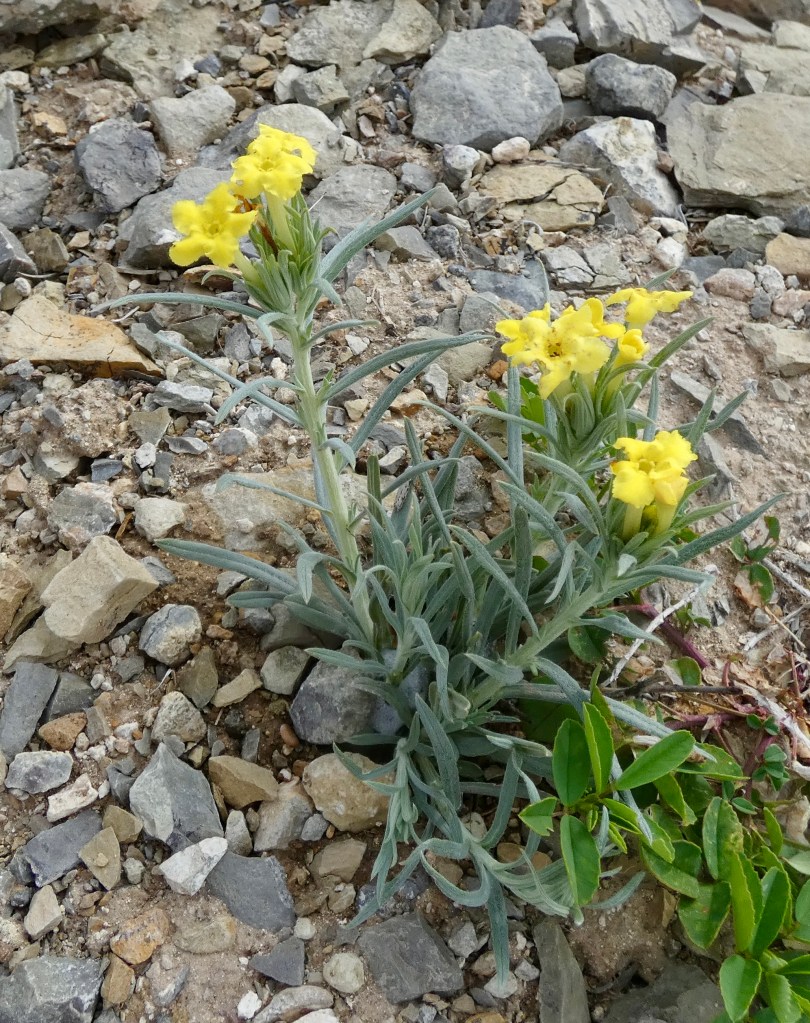
Very showy and quite lovely, the sunshine yellow trumpet-shaped flowers of Narrowleaf Puccoon are hard to miss. They often cluster at the ends of 12-20” long stems where the floral tube is ringed by five frilly petal lobes. The flowers depend on pollinators like butterflies for cross-pollination which adds genetic diversity to the few seeds they produce. Botanically speaking, these traditional, open flowers with exposed reproductive parts are referred to as Chasmogamous.  

Then later in the season, the Narrowleaf Puccoon produces small, petal-less flowers that remain tightly closed. These highly fertile, self-pollinating flowers account for almost all of the plant’s seed production. Botanists refer to this type of closed, often inconspicuous flower as Cleistogamous.

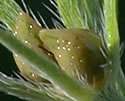
An immature nutlet

The“Stone Seed” Fruit

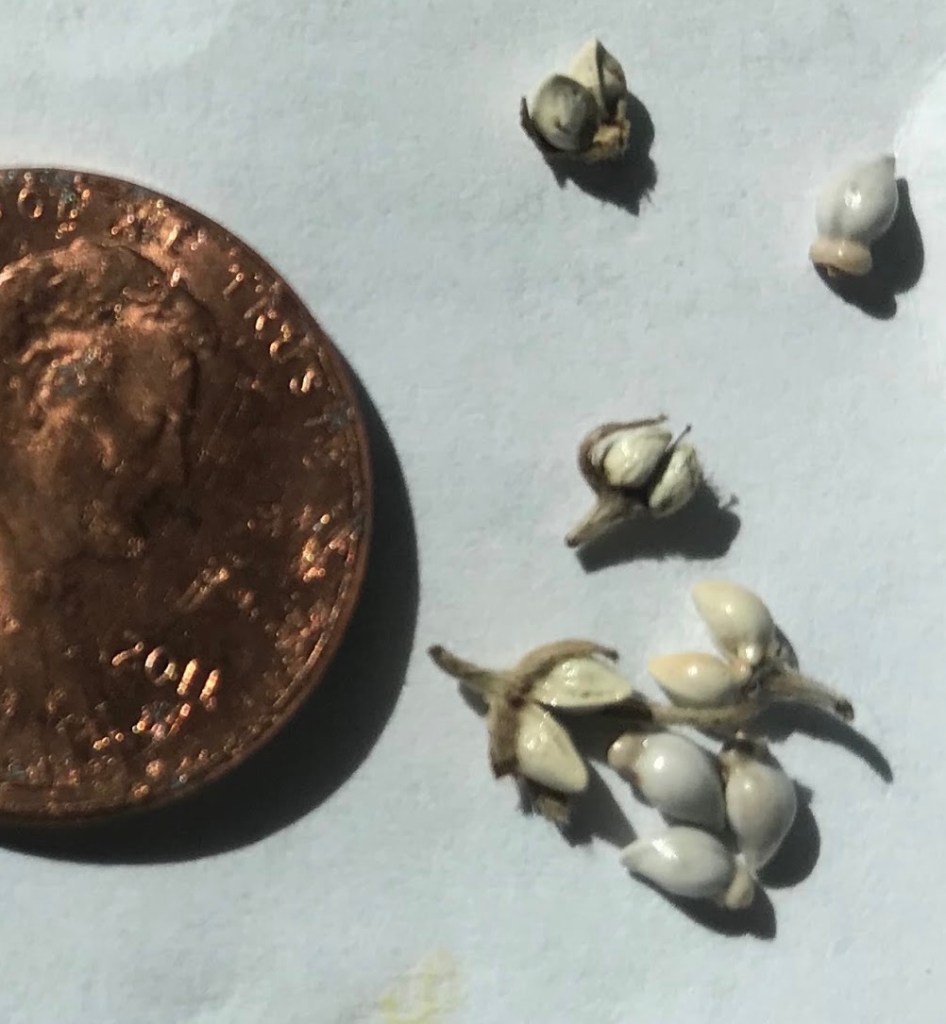
Because Narrowleaf Puccoon only produces the occasional fruit from its showy flowers, it takes a bit of searching around the plant’s lower leaf axils to locate a tiny group of up to four hard “stone seed” nutlets. Beginning growth inside the self-fertile, closed (Cleistogamous) flowers that are present late in the season, each egg-shaped nutlet, pitted across the surface, ripens to a shiny white.

Plant Propagation

Seed Germination – To grow Narrowleaf Puccoon from seed, nutlets should be collected in late summer.  Soak them overnight in hot water then plant immediately. Because seed germination is sporadic and often disappointing, selecting a desirable location for planting is important.  The plant grows best in very sandy, well drained soils found in the dry/open areas within our pinyon/juniper woodlands (though they do grow in soils with some loam or clay).  

Shiny white nutlets with Penny for size
Photo edited from a post by
A Wandering Botanist

Root Cutting – A more successful method may be to take a 2-inch cutting of the taproot in the fall. Dip the cutting in a root stimulant and plant in a desirable location. 

Suggestions for root stimulants

  • Powdered Hormones: Highly cost-effective, have a long shelf life and easy to use. After you moisten the root cutting, just dip it directly into the powder (e.g., Garden Safe TakeRoot) and plant.
  • Natural/DIY Options: Raw aloe vera gel and crushed, uncoated aspirin both contain natural growth-promoting enzymes. You can also use diluted willow bark extract, which is naturally rich in rooting hormones.

Plant Care – Narrowleaf Puccoon requires full sun and very little water, making it a good plant for xeric gardens or included with other native plants to establish a wildflower meadow.

Photo taken early May 2026 along the Entranosa access road

Medicinal Properties and a Cautionary Note 

The Navajo chewed the root of Narrowleaf Puccoon for coughs and colds. They, and the Zuni rubbed the plant’s finely powdered leaves, root and stem on the body to treat paralyzed limbs. An infusion of the root was used for stomach aches and kidney problems. The plant was eaten as an oral contraceptive, and a cold infusion of the pulverized root and seed was used as an eyewash.

Although Narrowleaf Puccoon does have medicinal properties, it contains potentially toxic alkaloids. Self-treatment involving this plant is strongly discouraged.

…………………………………………………………………………………………………

If you’ve seen Narrowleaf Puccoon, did you find their highly fertile, tightly closed flowers and/or the shiny white nutlets? Have you tried growing the plant from seed or root cuttings, and were you successful?

As always, thanks for stopping by!

Happy Memorial Day!

References

backyardnature.net

iNaturalist.org

minnesotawildflowers.info

openprairie.sdstate.edu

swcoloradowildflowers.com

visitsfbg.org

wildflower.org

Rose Heath – Page 9 .. The 100 Day Project (2026)

May 9, 2026

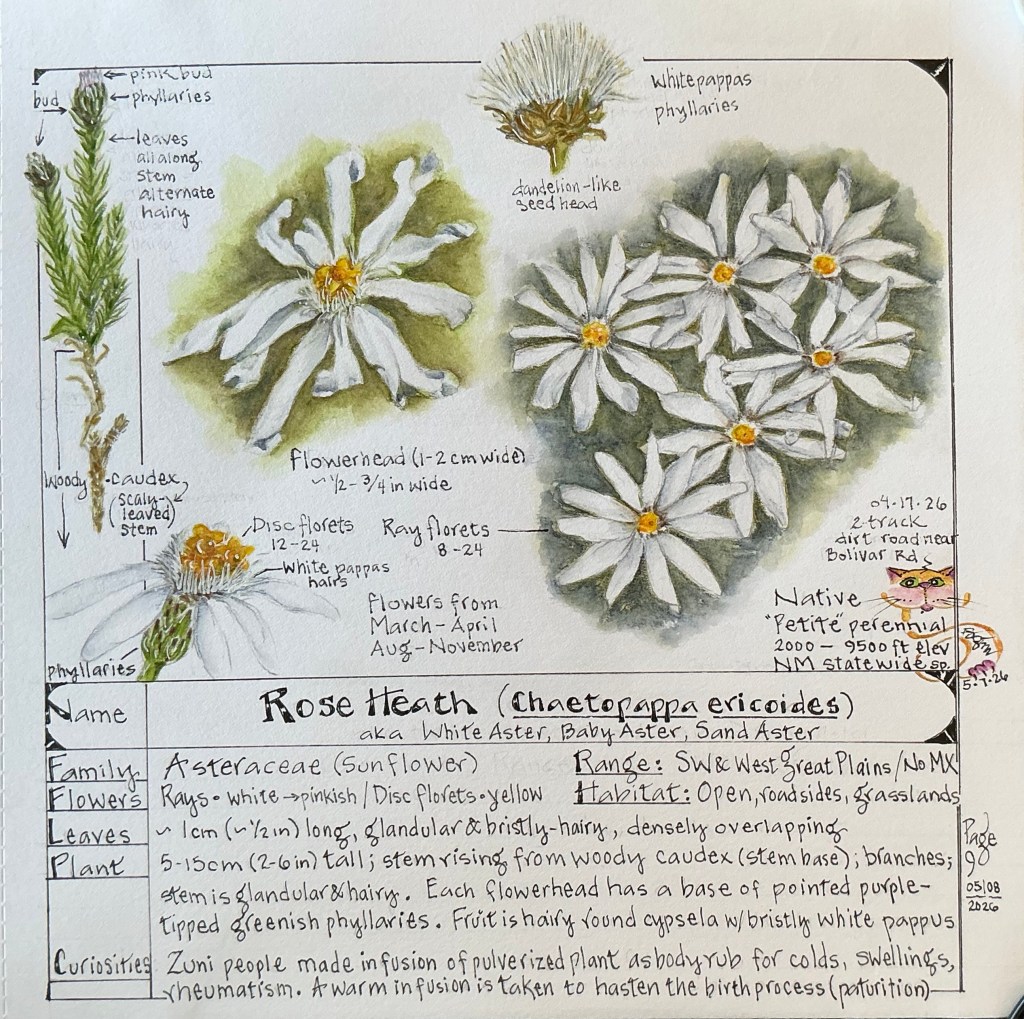
Rose Heath (Chaetopappa ericoides)

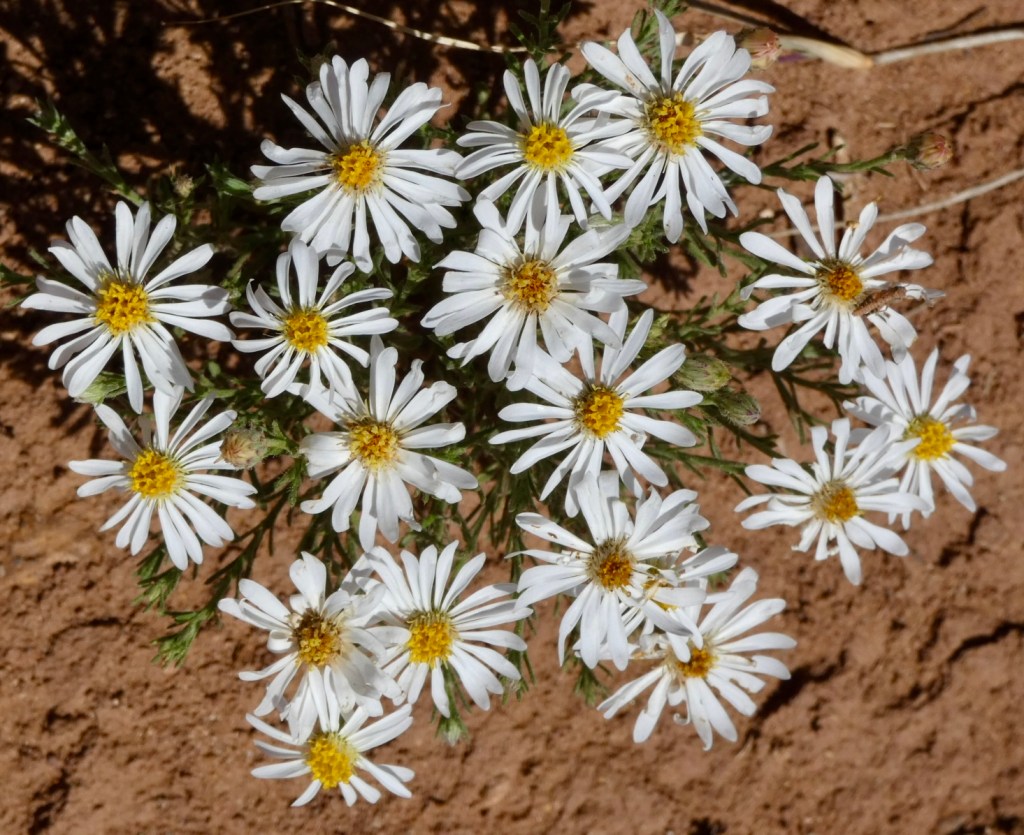
When the last Spring snow melts and the runoff soaks into the nooks and crannies of dehydrated soils, there’s a thirsty little shrub that eagerly drinks its fill. The leafy stems of this tiny shrub, so easily overlooked in the winter, rapidly grows on bare ground, around the drip line of pinyon and juniper trees, in the negative spaces between rocks and broken branches, and through beds of dried grasses. Then in a day or two a very small flower bud forms on the top of each stem, and in half a week the buds open simultaneously. What a spectacular display of brilliant white daisies ….. bouquets of light!

Barely ankle high, each flowerhead can have up to 24 white ray florets surrounding a rich buttery yellow center of 12-25 disc florets. And don’t fret if you notice the ray florets have curled downward in the evening. They magically unfurl to their full length by mid-morning the following day. 

This annual Spring show, which takes place all across the U.S. west and western Great Plains, is brought to you by the “petite” perennial called Rose Heath (Chaetopappa eriocoides). (Widespread and common in New Mexico, Rose Heath is adaptable to a variety of soils, elevation, and drought.)

The show typically begins in late March and continues into early May. And for those craving more, flowering resumes in August and can run until November; no charge. You just have to get out there and see for yourself!

Origin and Etymology – What’s in a Name?

Origin of the Scientific Name, Chaetopappa ericoides

Augustin Pyramus de Candolle, a Swiss botanist, named this genus Inula in the early 1800s. But in 1827, it was the American botanist John Torrey, who named the species Inula ericoides, from a specimen collected by botanist Edwin James along the Canadian River during Major Stephen Long’s Expedition of 1819-1820. Since that time, the species has undergone more than a dozen name changes including Leucelene ericoides (Edward Greene in 1896) and finally Chaetopappa ericoides (Guy Nesom in 1988). 

Etymology of the Scientific Name, Chaetopappa ericoides

The genus “Chaetopappa” is Greek for ‘bristly pappus’ (pappus refers to the score of tiny white bristles surrounding the disc florets; the same bristles, one per seed, that helps carry Rose Heath’s mature seeds up, up and away.  The species “Ericoides,” also Greek, means ‘similar (“oides“) to Heath’ (“eric”); i.e., the plant’s tiny, overlapping leaves are similar to those of some Heaths (Ericaceae is the scientific name of the Heath Family.)  

Common Name, Rose Heath

From the previous paragraph, it’s obvious where the name ‘Heath’ comes from, as Rose Heath does have stems and leaves very similar to a heath plant. But why ‘Rose?’ What I found is ‘Rose’ is Latin in origin, derived from “rosa,” referring to the flower. Because the daisy-like flowers of Rose Heath don’t resemble a rose flower, deeper diving was needed. I discovered that throughout history ‘Rosa’ and ‘Rose’ have represented love, passion, innocence, and beauty. So perhaps ……. ? If you’re familiar with Rose Heath or have seen photos of the plant in bloom, do you love or could you love its beautiful floral bouquets?  I think whoever thought to call this plant by the common name ‘Rose Heath,’ must’ve loved its stunning display!

…………………………………………………………………………………………………

Have you seen this beautiful plant, Rose Heath? 

As always, thanks for stopping by!

References

inaturalist.org

npsnm.org/wildflowersnm

Stevenson, M., 1915 Ethnobotany of the Zuni Indians. SI-BAE Annual Report #30, p.55 (as referenced by iNaturalist)

swbiodiversity.org

swcoloradowildflowers.com

Perky Sue – Page 7 .. The 100 Day Project (2026)

April 29, 2026

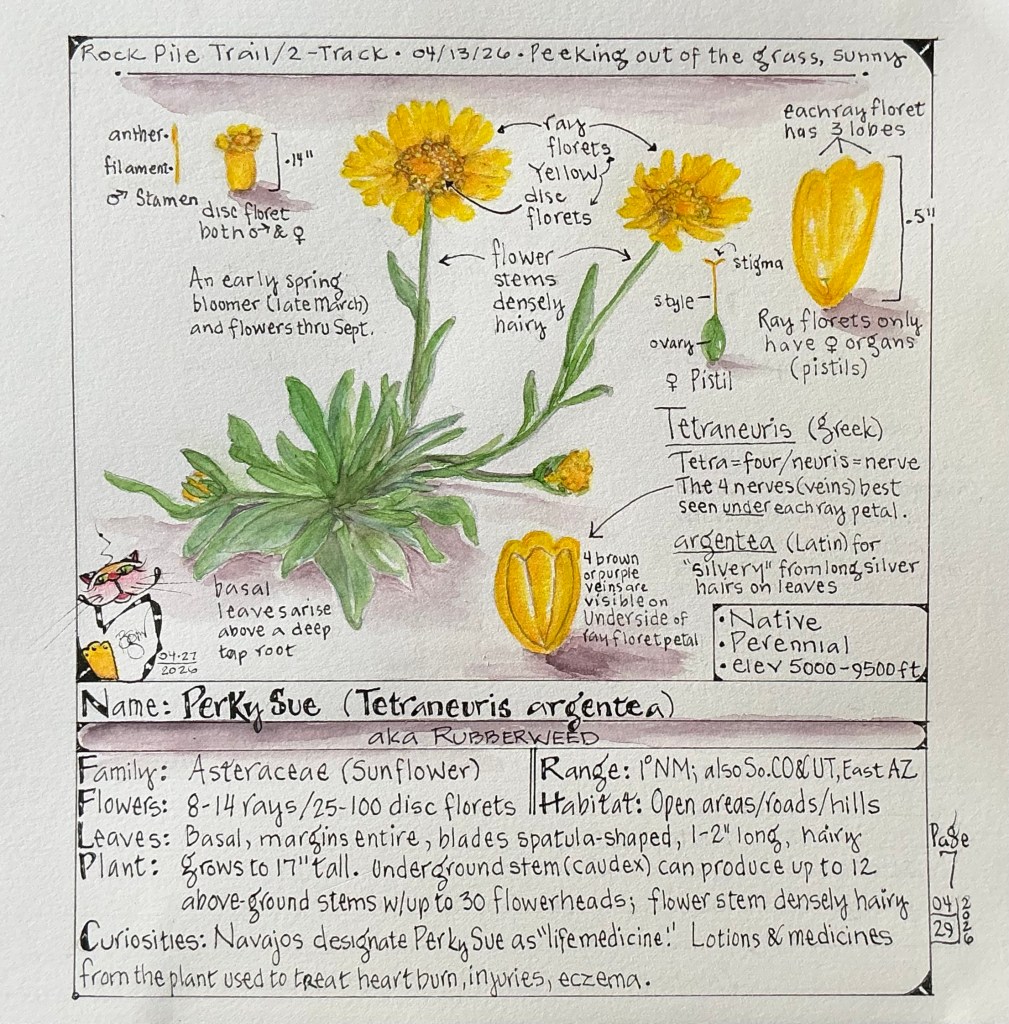
Perky Sue (Tetraneuris argentea)

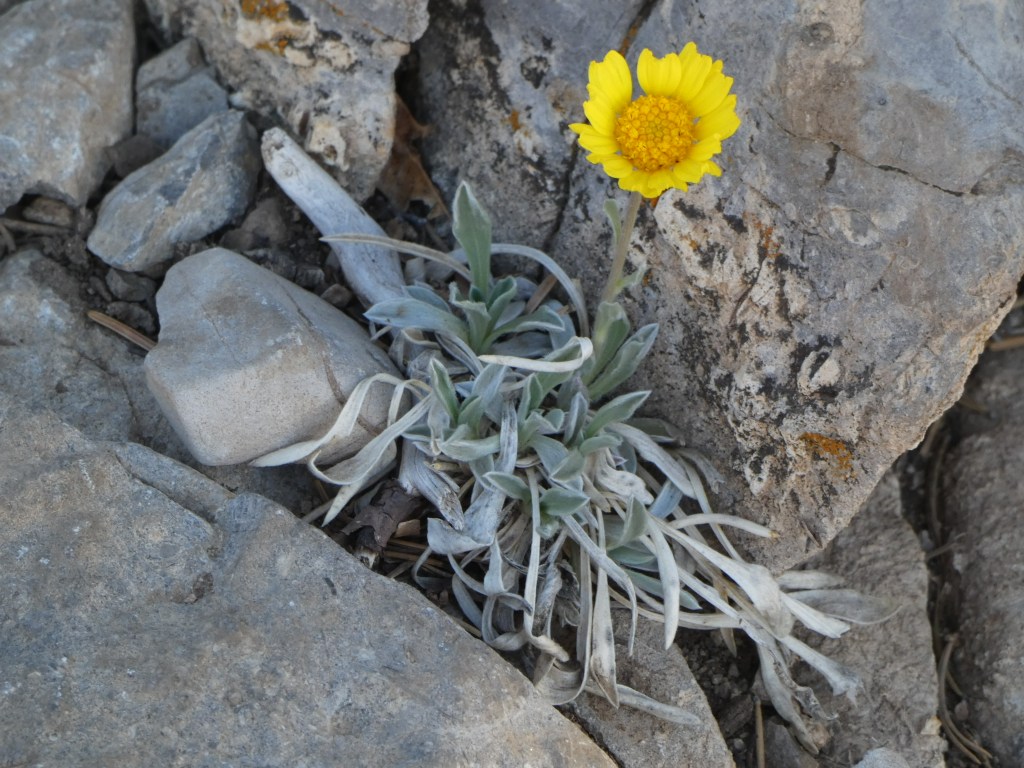
Perky Sue has to be the happiest little sunflower on planet Earth!

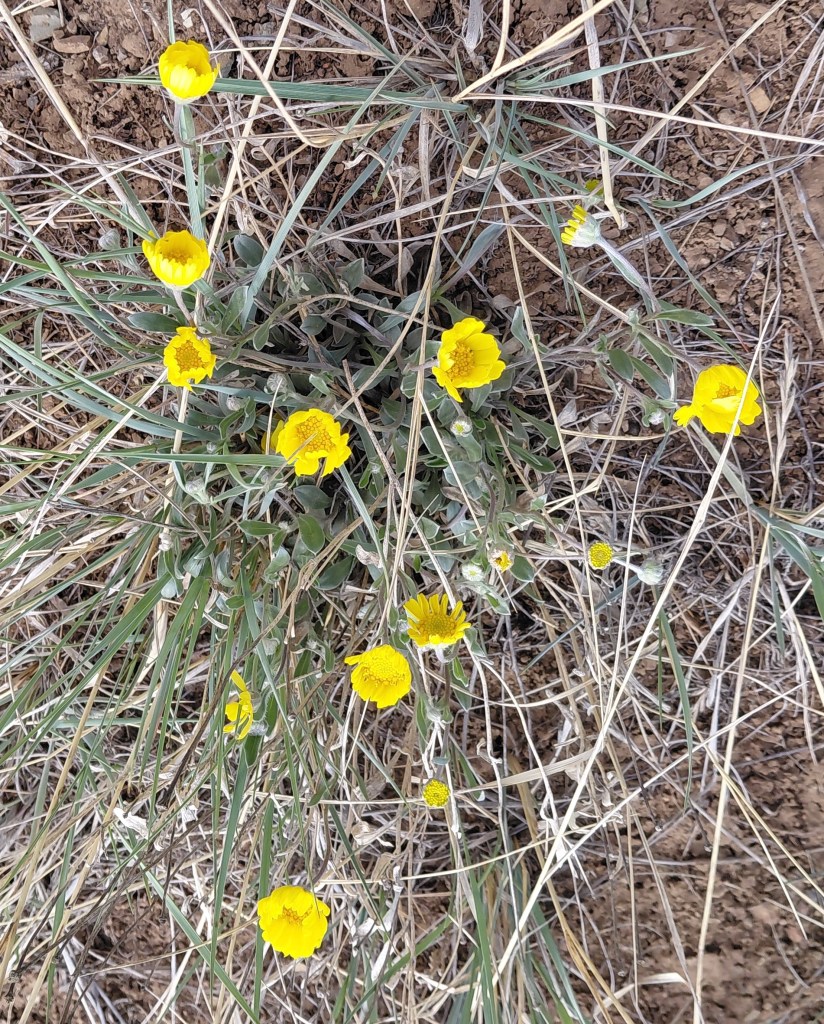
“Is it because Perky Sue is an early spring bloomer, it’s smiling face opening in mid- to late March? Maybe it’s how those brilliant yellow flowers climb above fields of drab, dry grasses to brighten the landscape? Perhaps it’s those tall, soft and silky flower stems that dance with wild abandon to the music of our spring breezes?”

No matter why Perky Sue always brings smiles, you can’t deny that encountering a blooming bunch makes you instantly happy!

Look for these stunning sunflowers in the open areas scattered throughout and adjacent to the subdivision. Separate the dried grass and discover the soft sage-colored, spatula-shaped leaves densely clustered at ground level. Remember this spot and return every Spring to watch our grassy meadows awaken with dazzling yellow sunshine.

Did You Know ………………. ?

When you encounter Perky Sue (or most any other sunflower) take a close-up look at one of it’s flowers. What you’re actually seeing is a collection of tiny flowers (florets). The most numerous type of floret lies within the face or center of the flower head (these are the disc florets). But you may be surprised to learn there’s a second type of floret often thought of as the sunflower’s petals (called the ray florets).

The Sunflower Face

The face or central part of the flower head is called a disc; the individual flowers, the disc florets, are arranged in clockwise and counterclockwise spirals. Look close and notice each floret has five distinctly flared petal lobes attached to a fused floral tube (which together form the corolla). Each floret is fertile, having both male (staminate) and female (pistillate) organs, able to produce pollen and seeds.

The Sunflower “Petals”

Radiating out from the disc like the rays of the Sun is a showy ring (or multiple rings) of what looks like flower “petals.” However,  each “petal” is a single ray floret ‎consisting of a single strap-shaped flower (ligule) of five fused petals (corolla) that form a tube at the base. In Perky Sue and some other sunflowers, the ray florets are pistillate. But in the majority of species the ray florets are sterile. 

The Sunflower “Landing Pad”

Sunflowers have one of the most highly evolved “flowers” in the plant kingdom. To maximize their visual attraction to pollinators, the ray florets became large showy structures that act as a “landing pad” for bees and other pollinators. When they “touch down” they are immediately drawn along the ligule to the bountiful pollen supply of the disc florets. Large pollinators also use the ligules of ray florets as a supporting platform to balance and feed from the disc florets’ floral tubes. So, ray florets evolved to increase the pollination success of the fertile disc florets at the center of the sunflower. And in the case of Perky Sue, insects carrying pollen as they fl to other “landing pads” increase the pollination of the pistillate ray florets.       

Want to Learn More?

The biology of sunflowers is a fascinating subject, and I’ve spent many hours researching and illustrating their intricate parts and pieces, and how they work. If you’d like to learn more, check out these detailed posts I put together in the summer of 2023: 

Geeking Out …… Total Bliss ….. Sunflowers! 

Cypsela! The Sunflower Seed

…. and for a bit more about Perky Sue, get more here from my summer 2024 post

Perky Sue!

…………………………………………………………………………………………………

Does Perky Sue bloom in your neighborhood? 

Have you ever taken a close look at its flower head or inspected the florets of another sunflower species?

What did you see?

Hope you enjoyed this page of my field guide. I’d love to know if you found the information new and/or inspired you to check out the details of your local sunflowers.

As always, thanks for stopping by!

References

inaturalist.org

swbiodiversity.org

deercanyonfolks.org

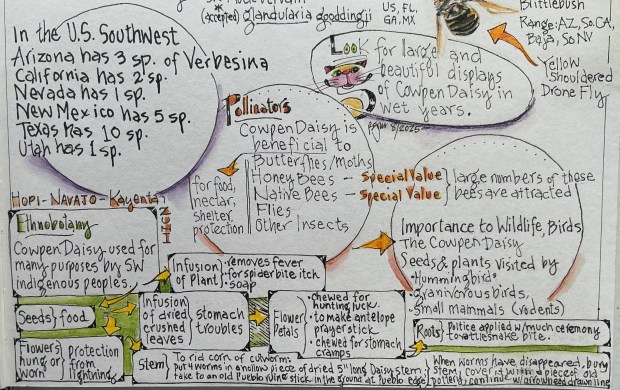
One of the Most Edible Sunflowers Ever! The Cowpen Daisy

Part 2 ….. Ethnobotany, Etymology and Epicureans

August 11, 2025

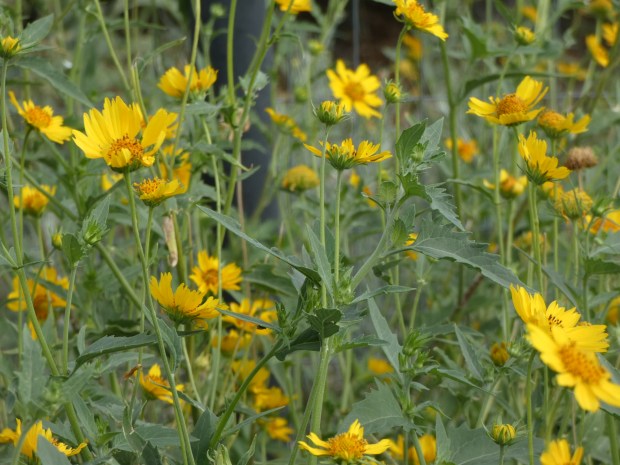
While compiling last week’s post about the happy Cowpen Daisy party taking place outside our back door, it was no surprise to find way more interesting info about this sunflower than could ever fit on my journal page. Decisions …… decisions! To keep the August 5th illustrated page relatively uncluttered, I decided to include just the botanical basics (mostly), focusing on Cowpen Daisy flowers, leaves and seeds. 

Then the past week I found my nature journal wide open to a blank page, ‘begging me’ for another Cowpen Daisy entry ….. “What about all those interesting info bits?” she asked.   Replying* to my journal with a hearty, “OK,”  I proceeded to locate and gather my rabbit-trailing notes. This scavenger hunt reminded me just how many pages there were; so many fascinating things about the Cowpen Daisy I wanted to remember and share. Decisions …… decisions!  How to keep this next post to one page? By limiting the topics to only three, was it possible?

Barely! (after some clever editing, not a single word dropped off the page)

A little bit closer view for those without a microscope!

P.S. By the way, you may have noticed I’ve indicated this post is Part 2 of what’s now become my Cowpen Daisy series. Unless I start journaling on larger than 8” x 11” paper, there’s likely to be more Parts in store. And this multi-part series resulted in a minor edit to last week’s post, not titled “One of the Happiest Sunflowers Ever! The Cowpen Daisy; Part 1 ….. Can There Be Too Many Sunflowers?”  In case you missed it, please check it out here.

*Yes, you read that right; I talk with my nature journals. Don’t you?  After all, we do spend quite a bit of time together! 

As always, thanks for stopping by!

Red Barberry – An Unforgettable Encounter

July 23, 2025

When you think of ‘Barberry,’ does a shrubby knee-high landscaping bush that transforms to flame red in the fall, come to mind? If so, you may have seen hedge rows of the plant known as Japanese barberry ……

Japanese barberry (Berberis thunbergii) is a non-native shrub that was introduced from Japan in 1875 as an ornamental that’s planted for erosion control and as a living fence. But this invasive shrub outcompetes and displaces native plants, alters ecosystems, and is a host species of black-legged ticks that carry Lyme disease. 

When you think of ‘Holly,’ does a plant with boughs of prickly green leathery leaves naturally ‘decorated’ for the holidays with red berries, come to mind? If so, you’re likely familiar with the iconic American holly ……

American holly (Ilex opaca) is a native shrub of eastern and south-central U.S. that grows well in both dry and swampy soils. The plant, which is also cultivated as an ornamental, forms thick a canopy cover for birds and other wildlife, and the female plants produce an abundance of shocking red berries, loved by birds but poisonous to dogs, cats and humans. Regardless of the risk, bountiful quantities of leafy boughs and clusters of red berries are harvested each fall and brought indoors to create holiday wreaths and other seasonal decorations. 

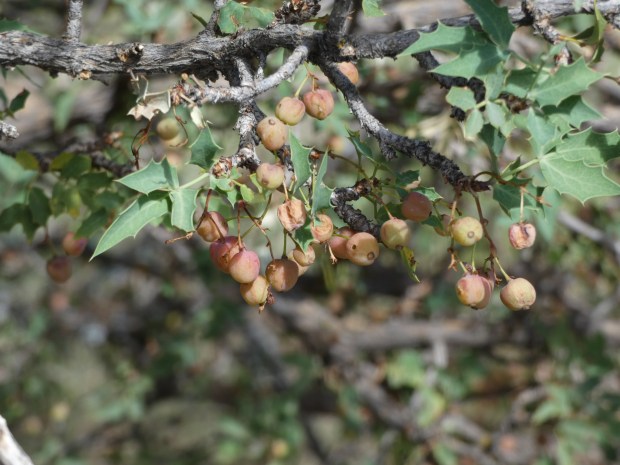
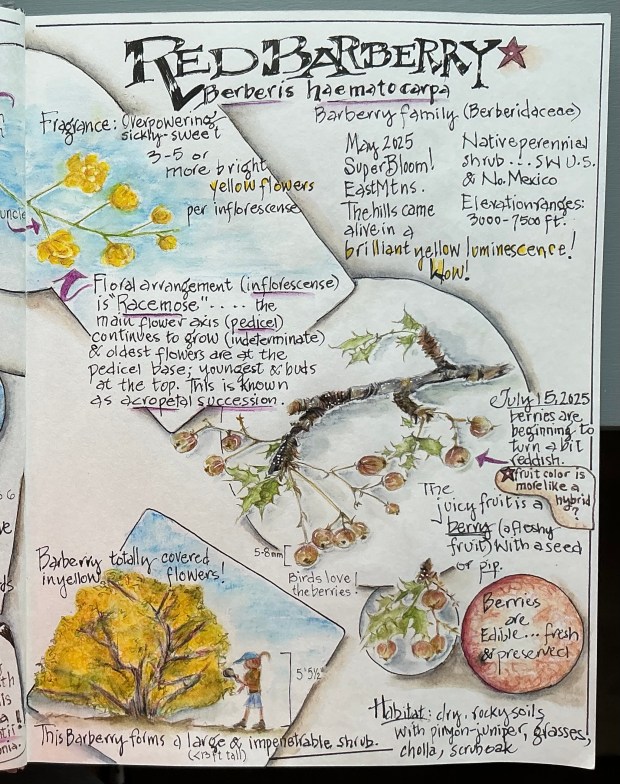
Red Barberry berries beginning to ripen

Now imagine you’re hiking in a pinyon-juniper forest of the American Southwest. You decide to bushwhack to a connecting trail and all of a sudden find yourself hopelessly stuck in a 10 foot high shrub covered in juicy red berries and very prickly holly-like leaves. This large (somewhat familiar) shrub is a surprisingly effective barricade; a formidable fence. You’ve become entangled in thousands of armed leaves preventing your forward or backwards movement without getting seriously poked and stabbed!

Is this the desert variety of American holly? Maybe it’s the giant living fence of a Japanese barberry gone rogue?

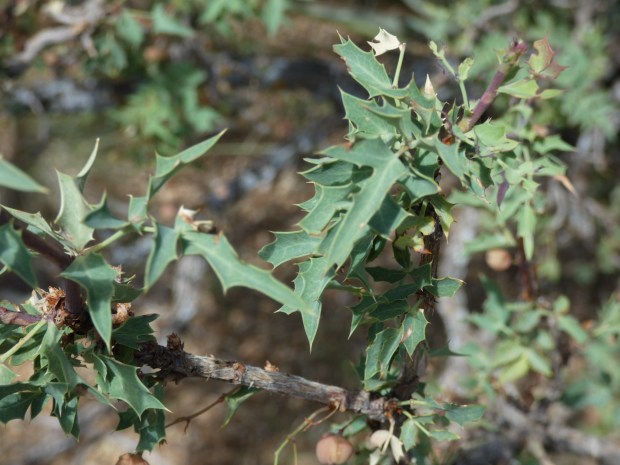
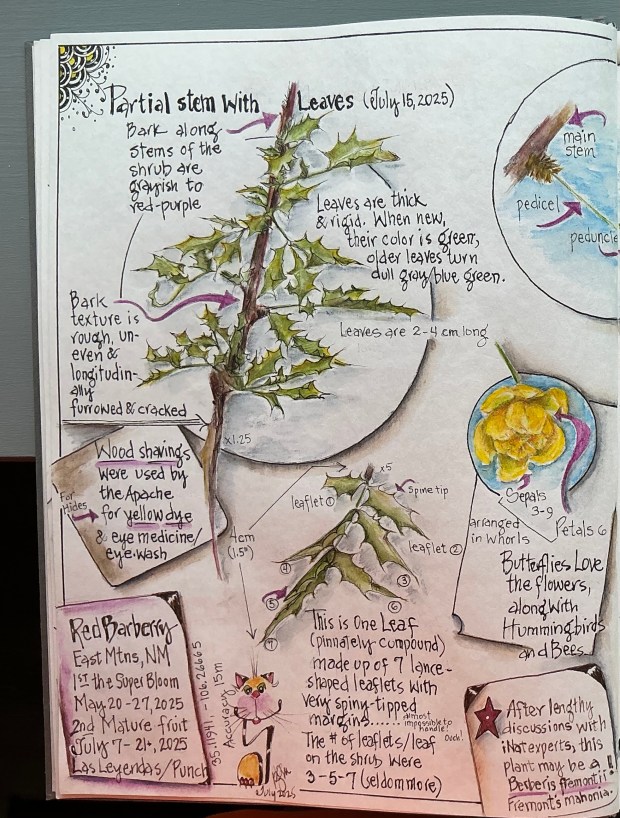
Nope! It’s neither. You’ve stumbled upon (into) a hardy specimen of the desert Southwest native Red Barberry (Berberis haematocarpa). But no wonder you were confused. This shrub, which can grow to 13 feet tall and nearly as wide, has an abundance of holly-shaped leaflets armed by a sharp spine on each lobe tip. And if birds haven’t devoured all of the red berries, you may find an ample supply of a refreshing (albeit tart) snack while you carefully and oh-so-slowly free yourself from the shrub’s embrace.  

Red Barberry leaves – each lobe tip is armed with a needle-like spine

By now you’ve created lasting memories of Red Barberry, and have promised to always be alert for surprise encounters when visiting the desert island Southwest.  

The hiking scenario above conjured up one of my hard-learned lessons from 8 years ago. Having just moved to New Mexico, Roy & I began avidly hiking local trails. Wishing to master the native flora as quickly as possible, one day I discovered clusters of red berries hanging inside the leafy canopy of a 5 foot shrub. What could they be?! Only having eyes for those juicy berries and an irresistible urge to gather a bunch for closer inspection, I plunged my open hand through several layers of small leaflets and successfully clutched a cluster. It was then I realized those spiny leaflets had poked, scratched and even penetrated my bare skin, as evidenced by tiny trickles of blood dripping from my hand and arm! Now that I had captured those pretty berries, it was obvious they had to be released to permit me the delicate maneuvers required to free my arm and minimize further injury. It was that day that I learned all about Red Barberry; lessons that will likely stick with me always!

Red Barberry berries amid armored leaves

Since that close encounter 8 years ago, it’s no surprise I’ve never been a big Red Barberry fan, until ……             

Spring Super Bloom

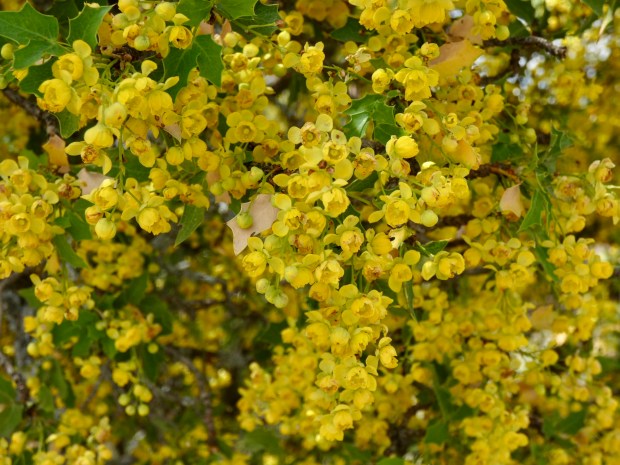
…… this past May a 13 foot tall plant in front of our home burst out in the most spectacular display of sunshine yellow flowers, literally covering the entire shrub front to back; top to bottom! The fragrance was overwhelming for the entire 2+ weeks the flowers were in bloom.  And not only our Barberry was in full bloom, but about a dozen more barberries in our neighborhood and surrounding area were also covered in vibrant yellow. It was an amazing sight, causing me to figuratively re-embrace the native Red Barberry!  

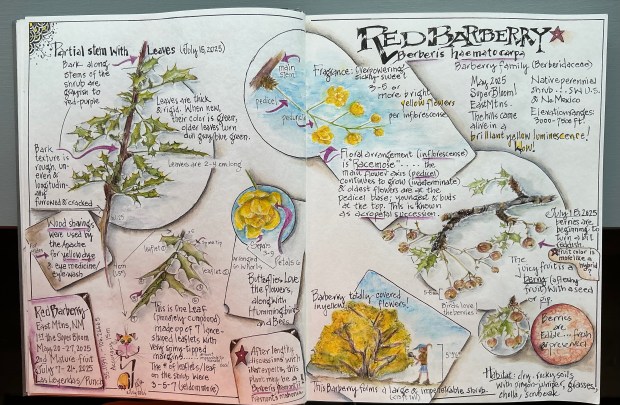
For more tidbits about Red Barberry, browse the text and illustrations displayed on my journal pages.                            Hope you enjoyed this post. 

As always, thanks for stopping by!

P.S. In case you’d like to know about the etymology of the name Berberis haematocarpa……   ‘Berberis’ is a Latinized form of the Arabian name ‘barbaris, for barberry.  “Haematocarpa” means ‘blood-red fruit’ referring to the bright red berries produced by this shrub. The word is derived from the Greek words “haima” (blood) and “karpos” (fruit).