Under Siege! 

A Battle of Wits

Conflict of Interest

November 24, 2025
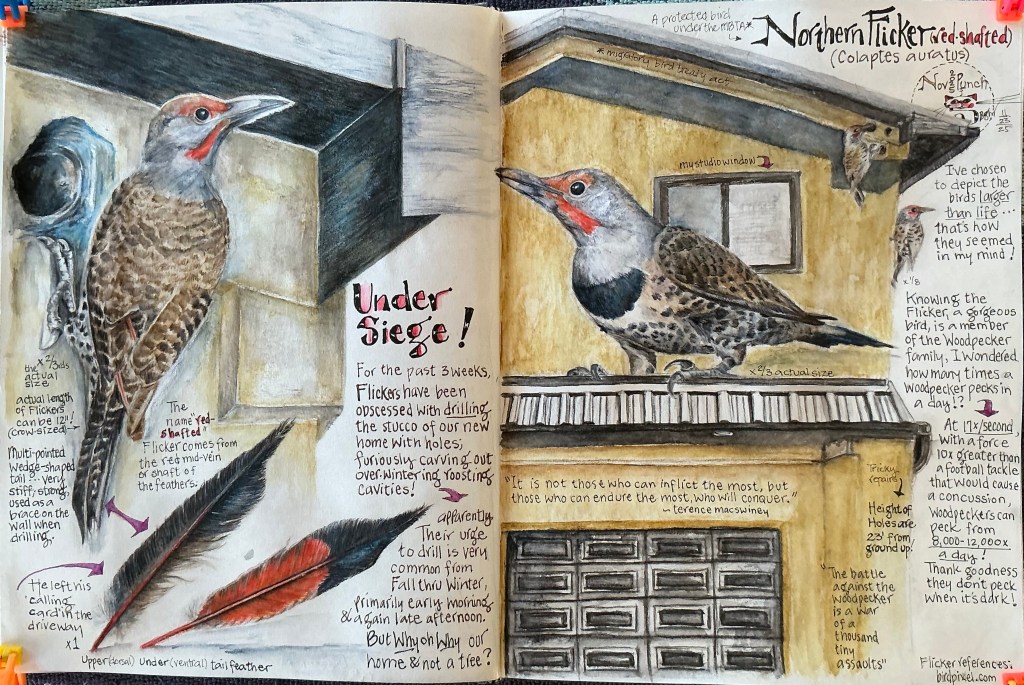
Were you ever so challenged by something so clever, while at the same time so frustrated with something so beautiful? No, no, wait….. that question may be more complicated than need be. Let me put it this way …… 

Were you ever at your wit’s end finding a solution to a seemingly simple problem that you thought was obviously and repeatedly staring you right in the face?

My reply? Yes!

It’s All About the Genes

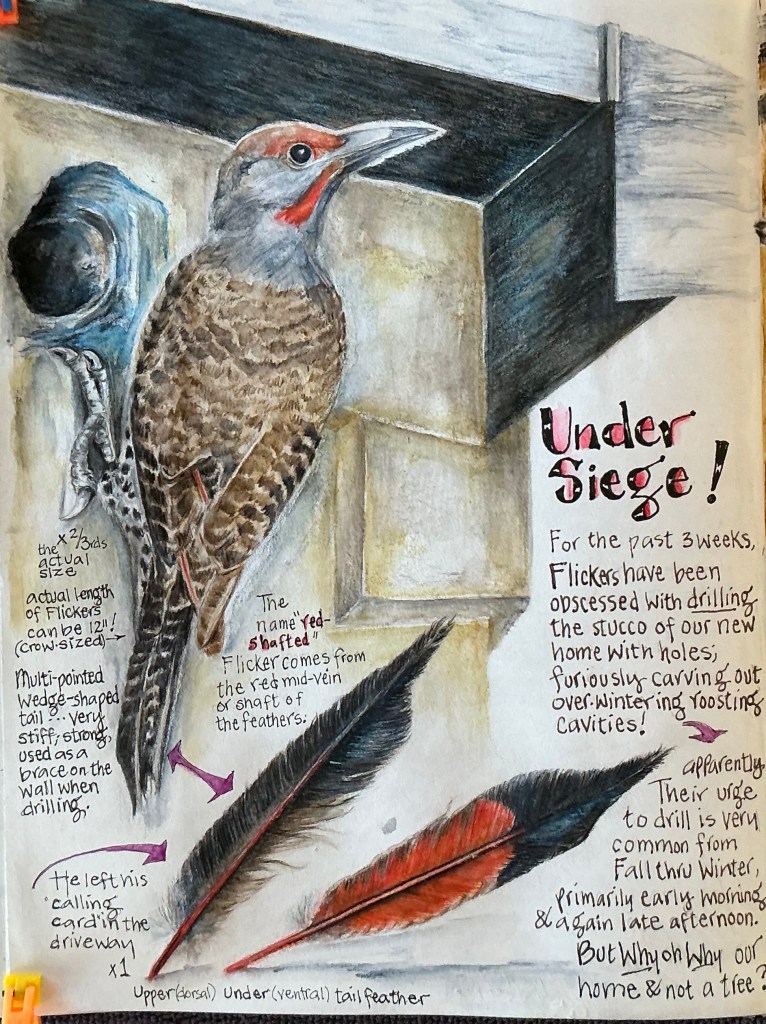
Meet the Northern Flicker (Colaptes auratus) … or more specifically, the Western red-shafted flicker (C. auratus ssp. cafer)*, a gorgeously flamboyant and noisy member of the Woodpecker family, that’s common throughout its western range.**  And as woodpeckers do so well, they peck and peck and hammer and drill with the determination and force of a jackhammer*** on nearly any vertical (preferably wooden) surface. They’re single-minded, from start to finish, when it comes to creating a cozy nesting or roosting cavity, whether in a tree trunk or into your home.  (More about that in a bit.)

Flicker ID – 101

How do you know a Flicker has laid claim to your place? Well, he’s a big, heavy-bodied bird, and when flying overhead, your first thought might be “Crow!” At 12-14” long, with a wingspan of 18”-21”, the size is right. But as he flashes a large showy white rump patch bookended by reddish-orange underwings, you realize he’s not black. Anything but! As his flight slows and dips you notice his brown back is marked with narrow black bars. In preparation for landing, with wings open wide, he vertically aligns his body and feet with the wall, exposing a pale gray belly with bold black spots and a chest-wide black patch. Two strong clawed-toes up, two down (zygodactyl), and a stiff wedge-shaped tail adjusted as a brace, he taps out a few test spots, drawing your attention to his long and heavy bill, on a slate gray head broken by a buff-brown crown, a bright red whisker (male), and light gray cheeks. 
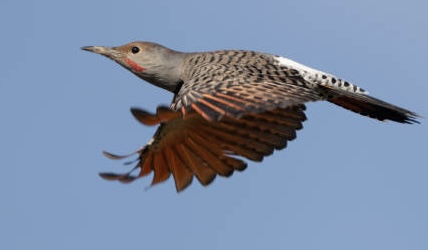
Male Western red-shafted flicker in flight. Note white rump patch (unsplash.com)

On a crisp cool Autumn morning, as you watch in horror …… 

Before you can declare, “It’s a Male Flicker!” ……

This bigger-than-life bird has landed, tested, and pecked away at his chosen spot  170 times in 10 seconds! He’s created an entry hole about 3” wide, right through the stucco and foam sub layer. This determined Flicker knows winter is coming and he intends to drill into our home, making a cozy roosting cavity in which to hunker down until Spring!  

Oh no, No, NO!

We love Flickers and have no wish to harm this beautiful bird.**** But he’s already caused enough damage (23 feet high on the wall) that needs immediate repair. So I clap my hands and holler loudly (something unintelligible), and off he flys to a nearby snag to see how serious my noise-making was.

That’s the story of Flicker hole #1 

Oh Not Again, and Again, and Again!

Since early November, our resident Flicker (I call him Jack), has continued to return many times, usually between sunrise and 10am. Sometimes he’ll make a fly-by before sunset. Often his quiet arrival escapes our notice; either we’ve been running errands, we’re out hiking with Luna, or enjoying a short roadtrip. These are the times he’s been able to drill six 3”-wide holes on the initial wall, and another 3”x6” hole just around the corner which was so deep, he almost penetrated the interior of Roy’s woodshop! This gives a whole new meaning to the term “Airbnb!”

After a few weeks up and down our fully-extended extension ladder to make a 2-step/2-day repair job/hole, we were making ZERO headway. Jack, unable to resist the need to drill him a roost cavity, was always one hole ahead of us. And because he didn’t hesitate to redrill newly repaired holes, was there something we were doing wrong?
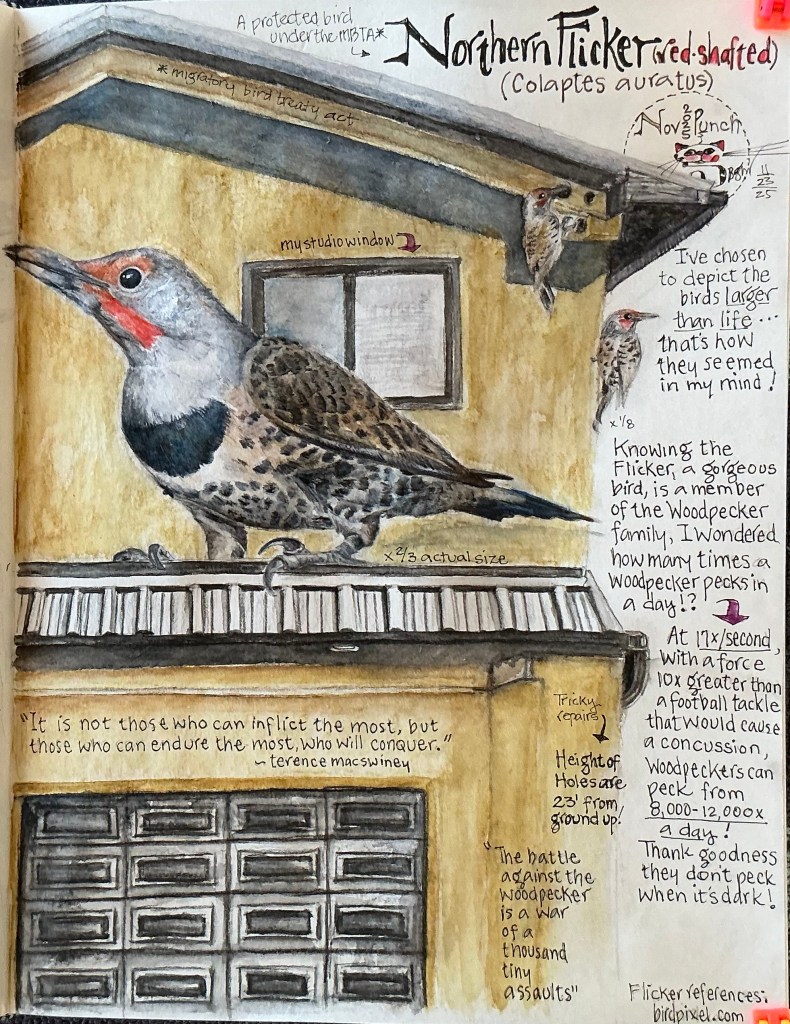
All Flicker painting are larger than life, because that’s how they seemed to me!

It’s an Education in Biology and Patience

So we learned to listen for his noisy “kerrreee” scream-like call announcing his presence from one of Jack’s many favored perches around the house. Unless we missed it, his territorial call would put us on high alert, ready for action. We also listened for his series of warm-up test pecks that usually sounded inside the house. This “alarm” would catapult one or both of us from a comfy chair and run outside yelling and clapping our hands. 

Between listening, running, clapping and yelling (and wondering what the neighbors might be thinking), I discovered a few interesting things on-line…..

  1. Woodpeckers can’t resist drilling holes in synthetic stucco. This product provides the perfect surface for woodpeckers to hammer. When they begin tap pecking, it creates a hollow sound because the synthetic stucco includes a foam layer. The woodpeckers peck through the hard outer surface into the foam where it is easier to create a larger cavity to nest. 

#1 …. Our entire home happens to be covered with synthetic stucco! While this might explain Jack’s insatiable desire to drill his roosting cavity into our home and not into one of the surrounding hardwood piñon pines, we’re not going to replace  the stucco. 

  1. Basil, mint, cinnamon and/or lavender are suggested as natural, non-toxic deterrents for woodpeckers, who dislike strong aromas. The scent of basil, in particular, can be overwhelming and confusing to woodpeckers. Crushing one or a mix of these herbs with adding a bit of water, creates a green slurry that can be filtered and applied with a spray bottle to the affected area(s).

#2 …. This idea was worth a try, especially since there’s still have basil and mint growing in the garden. After collecting several handfuls of each, I popped the mix into the food processor with a bit of water and flipped the on switch. Gathering the resulting slurry, I filtered it through paper towels and collected the liquid for a spray bottle. That was several weeks ago, and with every hole repair, Roy’s been thoroughly soaking first the patch job then follow-up stucco coating with the basil/mint spray. It’s hard to know if it’s actually working, but the initial drilling sites haven’t been redrilled in the past week. It could also be that Jack is gone; pushed out with one of our heavy rainstorms.  Or he’s begun drilling more recent holes over the RV garage door. With each repair, Roy continues to spray the basil/mint mix.

  1. The Federal Migratory Bird Treaty Act*** provides protection for Flickers (and all woodpeckers), making it illegal to harm or kill them. But when warranted, migratory birds can be killed under a depredation permit issued by the Law Enforcement Division of the USDI-Fish and Wildlife Service (USFWS). Authorization by the relevant state wildlife agency also may be required before lethal control methods are initiated. Sound justification must be present for the issuance of depredation permits.

#3 …. Applying for a depredation permit may be our last resort, if Jack and his cohorts threaten to turn our brand new home into Swiss cheese. 

AGAIN!

That’s the story, almost. This clear Conflict of Interest; an obvious Battle of Wits, continues. Just yesterday, one of the holes Roy patched above the RV garage door was redrilled this morning!

Oh Good Grief!

 It’s already been repatched and resprayed, and while writing this story in my studio with window cracked and a clear view of the patched hole, I’m sure to hear and see that gorgeously determined Flicker if he returns to jackhammer away, once again, into a side of our home!

I’d love to know if you or anyone you know has a proven solution to this natural dilemma. Meanwhile ….. 

Thanks for stopping by, and Happy Thanksgiving!
……………………………………………………………………………………………………………

*Northern Flickers are divided into 2 subspecies, the Western red-shafted flicker (C. auratus ssp. cafer) and the Eastern yellow-shafted Flicker (C. auratus ssp. auratus). The red-shafted subspecies is found throughout Mexico, western and west-central U.S. (where it is common all year long), and British Columbia, Canada. The closely related yellow-shafted subspecies, which is highly migratory, is found in eastern and east-central U.S., the Canadian provinces and Territories (except B.C.), and far north into AK. 

**Where the range for both subspecies overlaps (in the ‘lower 48’), a lot of hybridization occurs. It’s common to see a red-shafted flicker with more orange feather shafts and/or shades of yellow-orange on the underside of their flight feathers. The same holds true for the yellow-shafted hybrid. Otherwise, appearances differ notably between both subspecies of the Northern Flicker, primarily where the malar (mustache), nape pattern (back of the head below the crown), face color, and tail and flight feathers are concerned. See the table below for non-hybrid subspecies characteristics. For hybrids, any color and pattern variation(s) and combination(s) you can imagine have probably been found! 

Northern Flicker subspeciesRed-shafted Yellow-shafted
Face colorGrayBuffy to warm, light brown
Malar colorMale: red Female: brownMale: black Female: brown
Nape color & patternGray, unpatternedMale: Red crescent on gray Female: gray, unpatterned
Feather shaft/under flight feathersPinkish to reddish to redYellow

***A woodpecker can peck wood 17x/second, and from 8,000-12,000x/day! Really! And they can drill into wood at a force 10x greater than a football tackle that would cause a concussion. On the November 17, 2025 episode of the Science Friday (SciFri) podcast, biologist Nick Antonson stated that woodpeckers can peck 20-30x their body weight. Now that’s amazing for a Flicker that weighs about 6 ounces! 

****Because we had no desire to harm the Flicker(s) drilling into our new home, even when we reached our point of extreme frustration, we wanted to ensure our deterrent efforts aligned with wildlife regulations; especially with the Federal Migratory Bird Treaty Act (Act). Flickers (and all woodpeckers) are considered a migratory non-game bird species, and protected under the Act. It’s illegal, punishable by fine and/or imprisonment, to harm or kill them. 
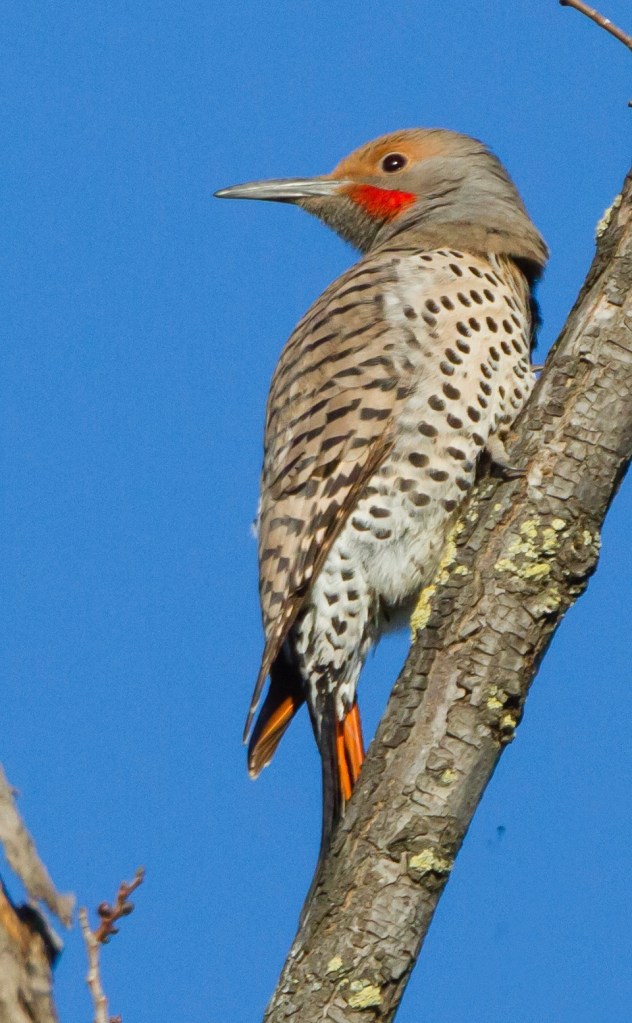
Male Western red-shafted woodpecker with his tail braced against the branch(bird pixels.com)

Always Remember to Explore the Cracks!

Sidewalk Crack Discoveries

October 12, 2024

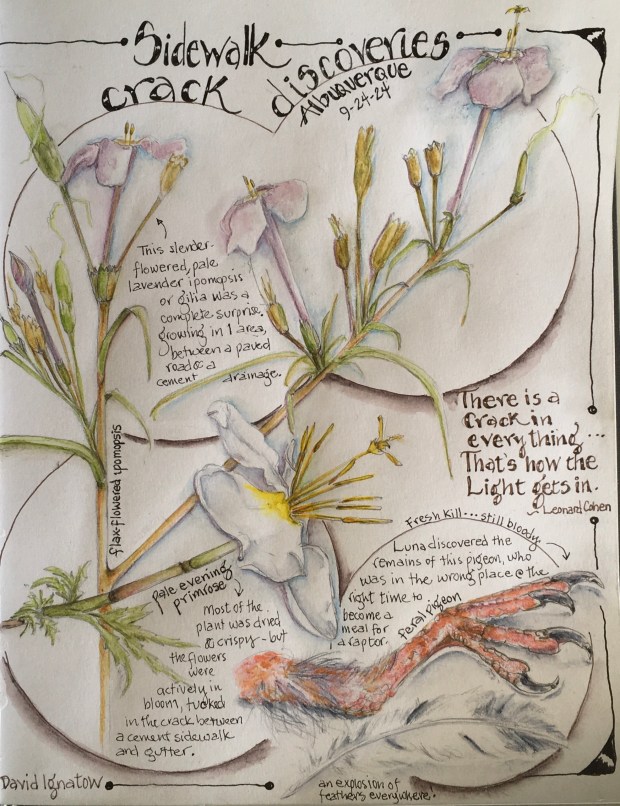
Roy had a doctor’s appointment one morning in late September, at an office right off busy I-25, near the ABQ airport. Instead of hanging out in the sterile waiting room, Luna and I spent our time exploring the areas surrounding the office, just to see if there was anything worth observing.

For 2 miles, we wandered about the not quite urban/suburban/industrial/residential neighborhood ….. me looking for a sketchbook entry; Luna sniffing out messages left just for her by visiting dogs, squirrels, or bunnies. 

Interesting discoveries seemed lacking, until Luna caught whiff of something irresistible. Tugging hard on her end of the leash, she urged me to run with her as she zeroed in on the source of the smell. 

By a parking lot light, on the pavement next to a cement curb was an explosion of feathers, but Luna kept leading me on to something better.  There! Lying on the curb was a still wet and bloody bird foot barely connected to what remained of the thigh. All clues pointed to the very recent drama, where a raptor (possibly a red-tailed hawk) had swooped in and nabbed the hapless victim (a feral pigeon), killed and then ate his prey from the platform atop the parking lot light. The inedible remains fell to the ground as a group of 2 dozen “relieved-it-wasn’t-me” pigeon friends looked on.

Quickly solving most of this puzzle in the time it took to pry the pigeon foot from Luna’s mouth, gave me the idea of sketching not only the foot, but to look for other unlikely nature discoveries in this urban/suburban/industrial/residential neighborhood setting. 

Mentally armed with a keener power of observation and purpose, we retraced our earlier route with excitement!  Now it was obvious an abundance of interesting and beautiful plants were growing from every sidewalk crack and along crumbled pavement edges throughout the ‘hood.  How had I missed seeing these beauties? 

And that’s how my idea for this 2-page layout was born, along with a reminder that finding bits of nature doesn’t have to occur at a botanical garden, wildlife preserve or national park. Nature is everywhere. If you just slow down and really look, even in the most unlikely places like sidewalk cracks, there’s always something to discover. So Remember to Explore the Cracks too and let me know what you find!

As always, thanks for stopping by!

Intentional Wanderings; The Grasslands of NE New Mexico

September 15-17, 2024

Sometimes short adventures become the most memorable.  

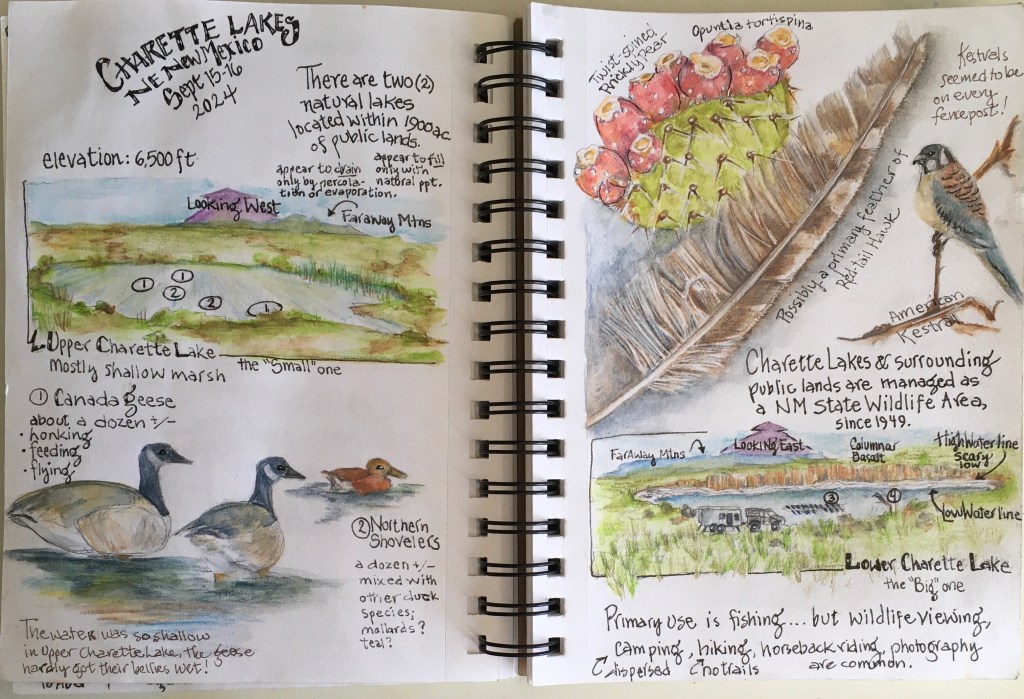
After pouring over our NM map, looking for new places to camp, based on a recommendation from good friends we decided to visit Charette Lakes.  Located within the grasslands of NE New Mexico, this would be our kind of country. About time to check out the Shortgrass Prairie.  

Planning to be gone 4-5 days, and as long as we were headed to Charette, why not also visit Clayton Lake State Park and Kiowa National Grasslands! The weather certainly looked good for a week, allowing easy access on backcountry 2-track dirt roads.

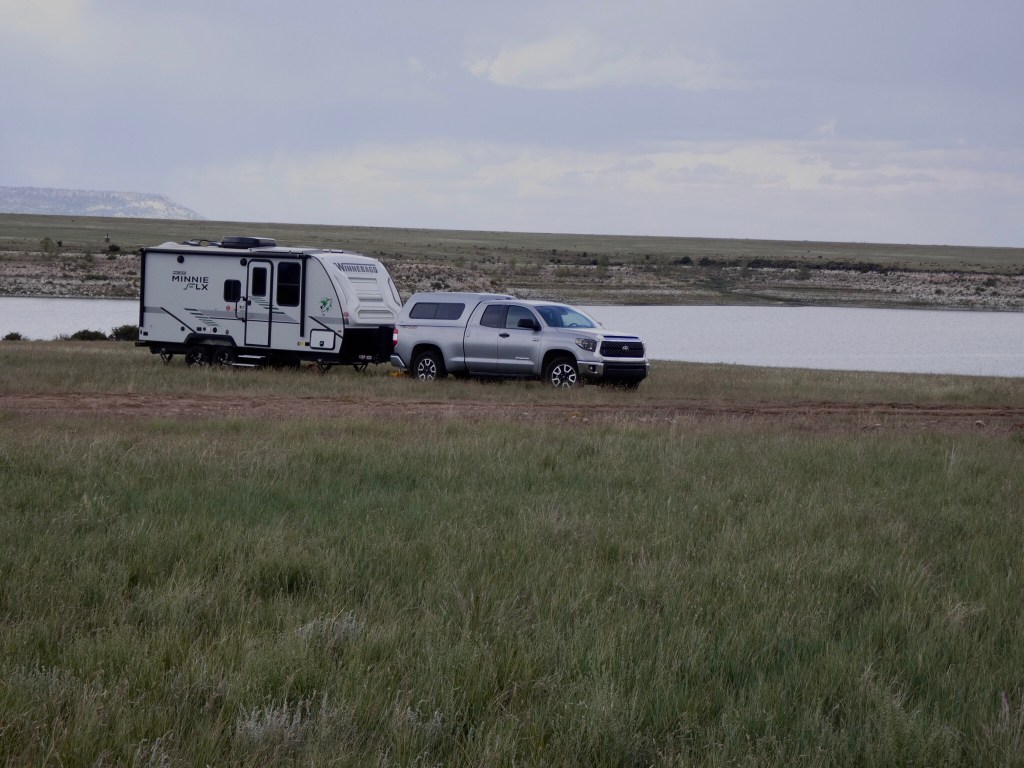
Felix at home just west of Lower Charette Lake

Charette Lakes

Arriving at Charette Lakes mid-day allowed plenty of time to set up camp with a view of the Lower (larger) lake, before heading off, on foot, to wander these lush grasslands. It seemed like Spring ….. so many wildflowers in bloom! Late afternoon saw a mass exodus of fisherpeople, and by 5:30 pm we pretty much had the entire area to ourselves! Hiking about some more, we encountered a small group of pronghorn, gazed skyward as hungry migratory ducks and Canada geese flew in to Upper Charette Lake, observed a number of beautiful kestrels, and enjoyed the antics of a coot flotilla on the lower lake. 

The wind blew, the rains poured, but we managed several hikes across the short grass prairie surrounding Charette Lakes

By 6:00 pm we got caught in a downpour! Wait! This wasn’t supposed to happen! But the rain and gusty winds persisted until morning, as heavy gray clouds continued to roll by.

We found most of the migratory birds on and feeding at Upper Charette Lake. Mostly marshy and shallow, this small lake had more food for hungry birds than the larger and deeper Lower Charette a lake.

After rechecking the weather forecast, it seemed like this storm was headed north, well out of the area we planned to visit next ….. Clayton Lake State Park, in the extreme NE corner of NM, bordering TX.  

We shook out our rain gear, toweled off the dog, packed up Felix and headed out, dropping down the basalt escarpment we ascended yesterday, thankful this section of steep decline was paved. 

Clayton Lake State Park

Excited to see more of the grasslands and the famous Dinosaur Trackways, a historic landmark site managed by the State Park, we approached from Raton, NM, very close to the Colorado border. Traveling about 50+/- miles SE (leaving the rain behind), the surrounding shortgrass prairie was dotted with a number of resting volcanoes, including Capulin (managed by the National Park Service). 

Our route from Charette Lakes to Clayton Lake State Park and Dinosaur Trackways passed through more shortgrass prairie habitat adjoining a cluster of Forest Service-managed grasslands (Kiowa in NM; Rita Blanca in TX; Cimarron in KS; Comanche in CO), remnants of the vast “sea” of grasslands that used to be.

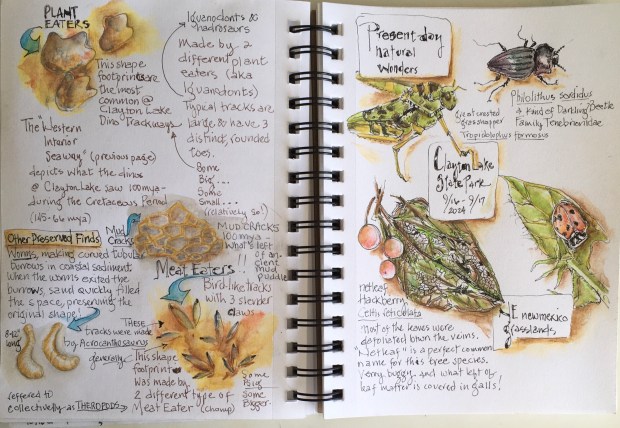
Arriving at Clayton Lake SP about noon, we quickly parked Felix, then walked the 1/4 mile to the Dino Trackways! Very, very cool. It’s hard to imagine that 100 million years ago this area of NM/TX was a beach along the western side of a great inland sea! Paleontologists believe the dinosaur tracks were made by both plant and meat eaters that migrated north and south along this sandy beach. The tracks showed the plant eaters likely moved about in herds as they foraged for food. There were also foot long tube worm tunnels and some pretty interesting mud cracks preserved in today’s hard sandstone. 

At Clayton Lake State Park we learned about the 100 million years old dinosaur tracks uncovered during the construction of the Clayton Lake emergency spillway, found some wind-stunted and deformed plants lining the the earthen dam, discovered a new grasshopper and beetle, and enjoyed watching terns perform aerobatic stunts over the lake.

Dinner time and it began raining (what!), varying from drizzle to deluge, we started to have second thoughts about tomorrow’s access into Mills Canyon on the Kiowa National Grasslands. But the radar showed this area wasn’t getting rain, and we felt it was worth a try (as long as we were so close!).

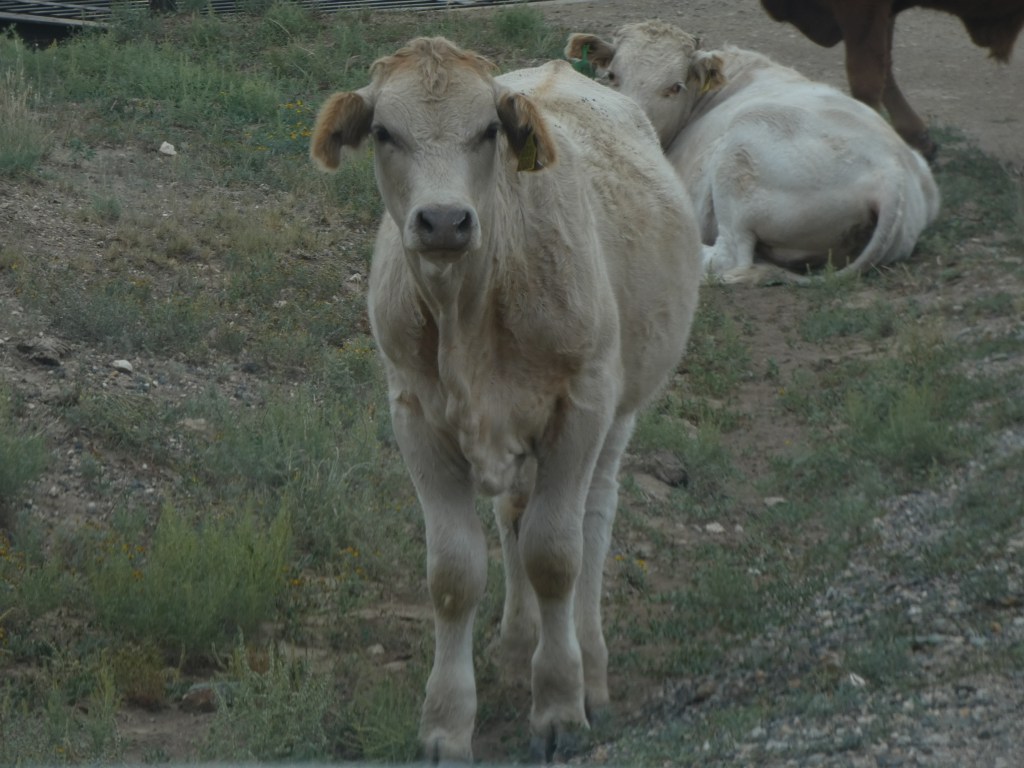
One of many cows that graze the grasslands on allotments that often span private, State and Federal lands.

Clayton Lake to Mills Canyon (Kiowa NG)

Early morning sunrise was gorgeous, then from who-knows-where, storm clouds rumbled in, and kept coming nearly the entire way to the Kiowa. But nearing our arrival, the clouds cleared out and things looked promising; so much so that we agreed to try our luck. 

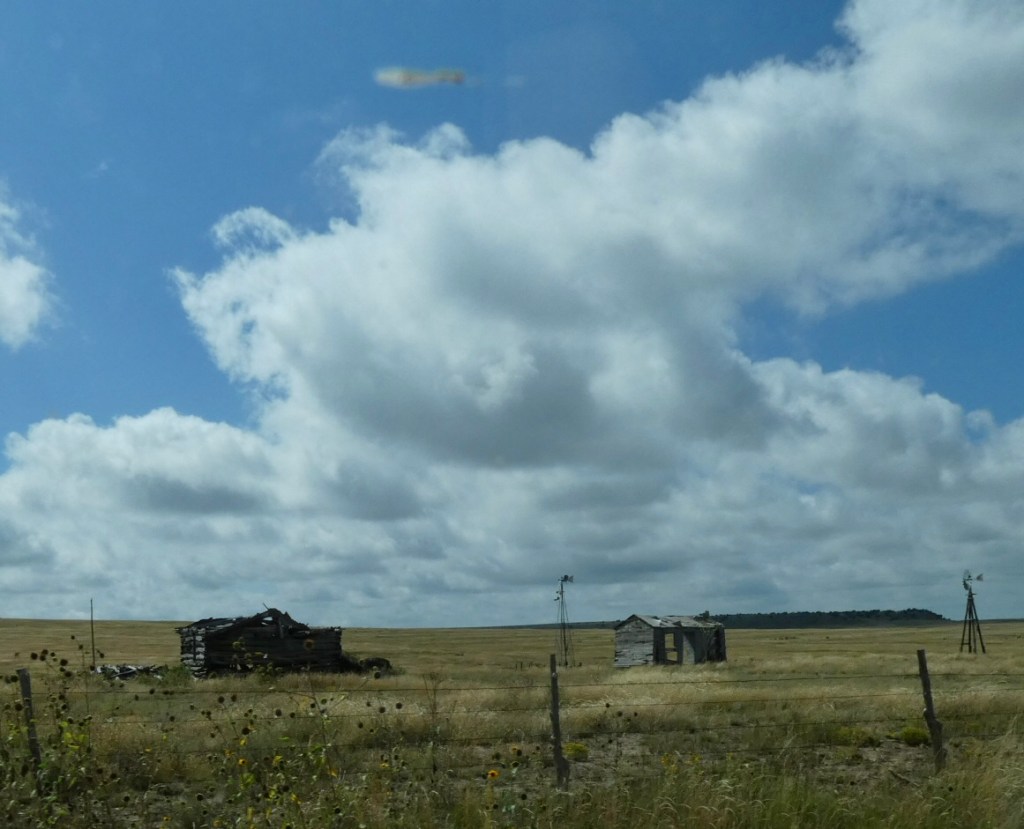
Long abandoned and “melting” into the soil, the shortgrass prairie saw its share of homesteaders back in the middle to late 1800s.

The Grasslands boundary was six miles off the pavement, on dirt and gravel ranch roads. Once on the Grasslands 2-track access to the campground our luck nearly ran out. Down down down the road went, saturated with the last several days of pouring rain. But we didn’t really know this, and began the descent. It wasn’t 200 slippery yards later, Roy’s executive decision to reverse course probably saved us being stranded somewhere for days! As he began backing Felix up the sloppy slick road, conditions somehow felt worse. Felix had a mind of his own and began weaving all over the place, half the time getting stuck in the ruts we made during our descent. 

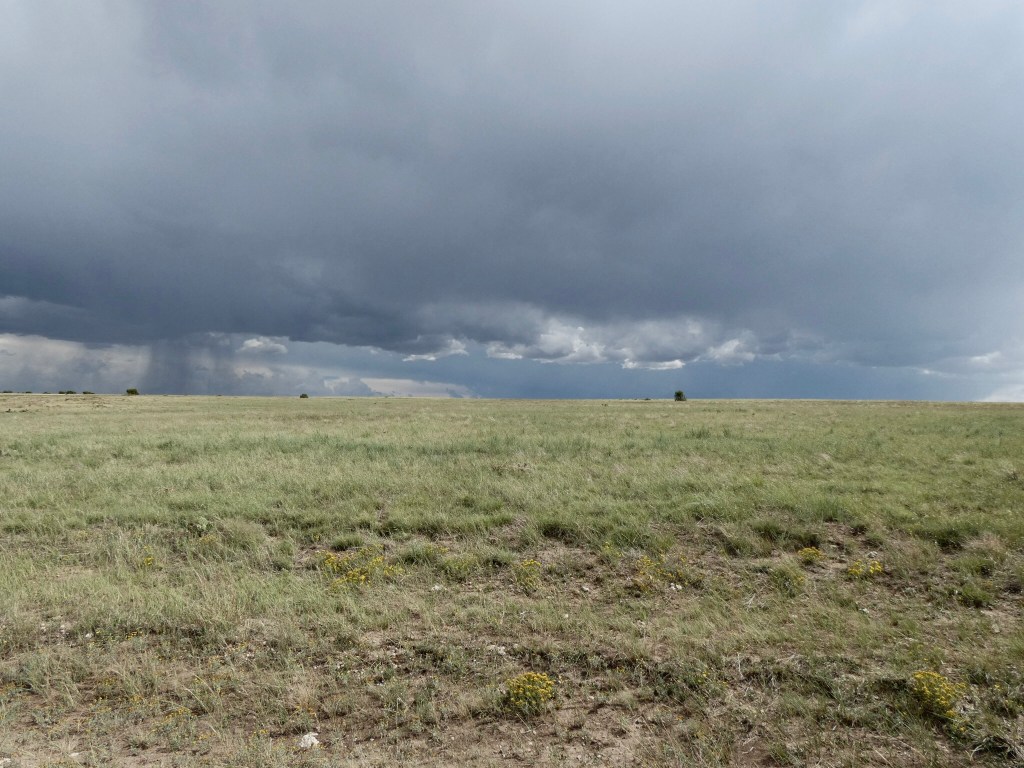
What looks like a lonely landscape is actually lush and thriving grasslands thanks, in part, to an abundance of rain this year. And Wow! Did it ever rain!

Finally after 30 minutes of careful maneuvering, Roy managed to coax the RV back to the Grasslands boundary. Our relief to be back on somewhat solid ground overshadowed our disappointment in not being able to visit this dramatic canyon area. But we were safe even though both the truck and Felix were coated above the axles with 6-8 inches of mucky sticky clay. 

So, with this area and any other likely destinations soaking wet, and only being 3 hours from home, we agreed to end this crazy camping trip, promising ourselves to return another day. Turns out the decision was wise, as we drove through one downpour after another on the way home! (The rain was so hard at times, visibility was zip! But the good news was it rained so hard that most of that mucky sticky clay got washed away.)

The End…..

And that was the ending to a short, yet memorable trip. Of course by the time we got home, the clouds had cleared totally, and we haven’t had a drop of rain since! Go figure! 

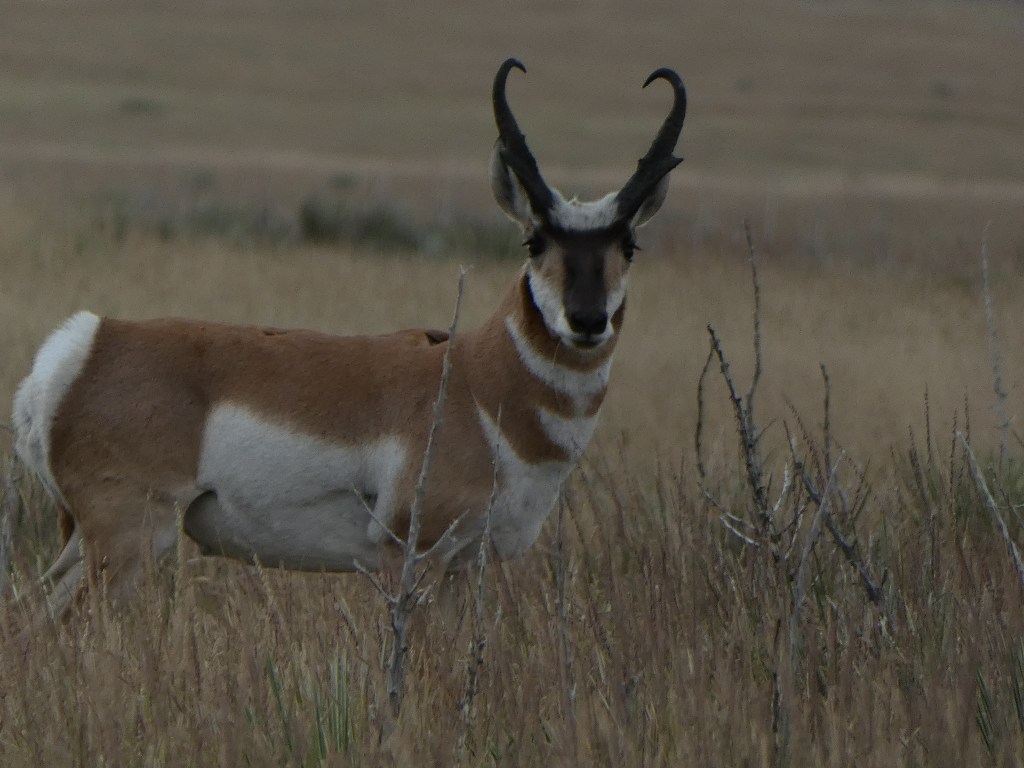
A pronghorn wary of our presence, passing with a herd between Upper and Lower Charette Lakes.


As always, thanks for stopping by!

Williamson’s Sapsucker …………. A Life-List Species!

March 19, 2024

There are a number of different woodpecker and closely related species (sapsuckers and flickers) that frequent our Piñon-Juniper woodlands in the East Mountains of central New Mexico. These include the downy, hairy, Lewis’s, red-naped, Northern flicker, and Williamson’s sapsucker. They are always such a joy to observe, unless they’re drilling a hole in the side of the house. Their stiff tails allow them to ‘walk’ up and down tree trunks and other vertical surfaces that house insects or exude sticky sap. Their sharp bills are ideal for creating nest holes and sapwells in tree trunks. Their sharp calls, drumming, and stiff-winged flight make them easy to recognize as a member of the woodpecker group of birds. 

Until mid-March we’ve never seen a Williamson’s sapsucker. Then one morning Roy was trying to catch a glimpse of a strange woodpecker on one of our old growth piñon pines. Immediately recognizing the markings of this bird were unlike any we’ve seen before, he excitedly fetched me from my studio to have a look. 

Sure enough! Realizing this was likely a life list sighting for us both, the markings looked just like those illustrated in our numerous field guides. Indubitably, dear Watson! This was a Williamson’s Sapsucker (Sphyrapicus thyroideus) and he was treating us to a visit. We watched him (definitely a male, as females look completely different than the males, which is unusual for woodpecker species) working his way up and down the tree trunk. As he walked and hopped up and down the tree, he would circle the trunk and pause to lick up actively flowing tree sap from rows and rows of sapwells! Why had we never noticed so many sapwells on this tree before? 
Did this or other Williamson’s sapsuckers drill these shallow sapwells? Maybe another woodpecker species created them and the Williamson’s was stealing the nutritious sap? Are these new sapwells or have woodpeckers been drilling this tree for many years? Countless questions, but this handsome fellow wasn’t giving up his secrets. So we enjoyed his antics for about 30 minutes until he flew off, maybe to another piñon to lap its sap? 


The next day, as we were about to pull into the garage, we spotted the Williamson’s again …… again working the sapwells up and down the piñon tree. We sat in the car and watched him while mulling over new questions, like “isn’t this the same time he was here yesterday?” “Why yes!” We closely observed his feeding pattern, beginning at about 5 feet above the ground, walking and hopping up the tree while circling the trunk, and when he reached the needled branches about 25 feet high, he would make a diving flight back down to the 5 foot height and again work his way up. This went on repeatedly for about 5 times before he flew away. Hmmmm! Why did he stop when he did? Had he licked up all the available sap for the day, and had to wait until the sap began flowing again? (I showed up later to see if he returned ….. he didn’t. Maybe my timing was off? Maybe the sap flow still wasn’t worth his trip?).Day 3, and same time/same place. This hungry bird was back lapping sap! Same up and down behaviors; same departure time.

Day 3, and same time/same place. This hungry bird was back lapping sap! Same up and down behaviors; same departure time.

Day 4, ditto

Day 5, ditto

Day 6 ……. We arrived at the same mid-morning time, and waited. And waited. And waited. The Williamson’s sapsucker was a no show. And we haven’t seen him since.

Was he only migrating through, just long enough to stock up on high energy meals? Apparently this species is widespread and fairly common throughout the Rocky Mountain West, but their breeding range begins just north of us and extends into Canada. However, we are well within the Williamson’s sapsucker’s winter range. Hope he returns again next year! 

Meanwhile we’ll be watching that old growth piñon to see if the sapwells draw in other hungry birds!

Now, a few fun facts about the Williamson’s sapsucker and sapsuckers in general.

While the male Williamson’s sapsucker is silky black with a cherry-red throat, a brilliant lemon-yellow belly and bright white wing patches, the female looks totally different. This is very unusual for birds in the woodpecker group. The female has a mousy brown head, banded back and small patches of black and yellow on the belly.

  • The difference is so striking between the male and female, they were originally thought to be different species entirely. It wasn’t until 1873 that ornithologists realized they were the same species. Naturalist Henry Henshaw located a pair at their nest in Colorado and published his observations, thus putting an end to the confusion.

Sapsuckers get their name from their habit of drilling rows of shallow holes in tree bark. The birds come back to these holes to lick the sap that flows from these holes and to eat insects that have become caught in the sticky residue.

  • Early ornithologists in the West reported seeing Williamson’s Sapsuckers at sapwells in aspen trees; however, in the past 100 years, observers have seen their sapwells only in conifers, never in deciduous trees. The early reports might have been of Williamson’s stealing sap from wells made by Red-naped Sapsuckers.

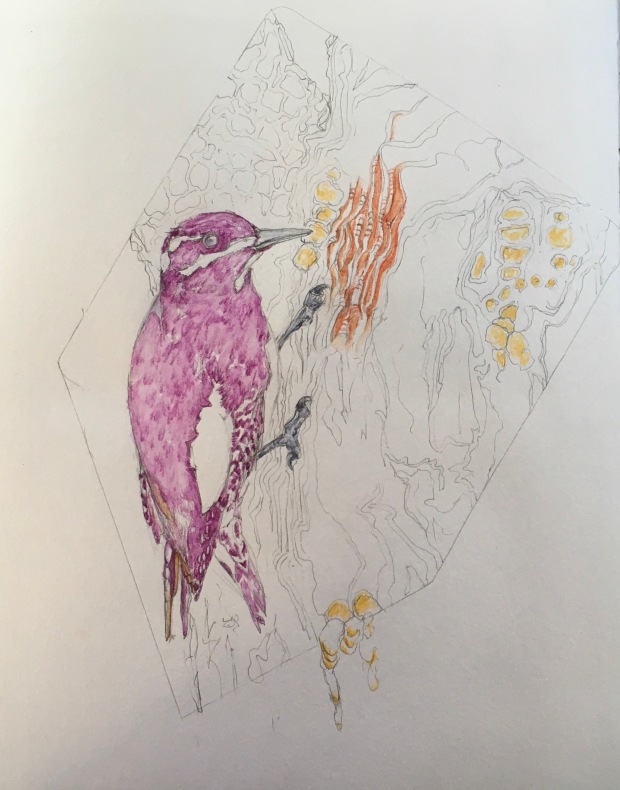
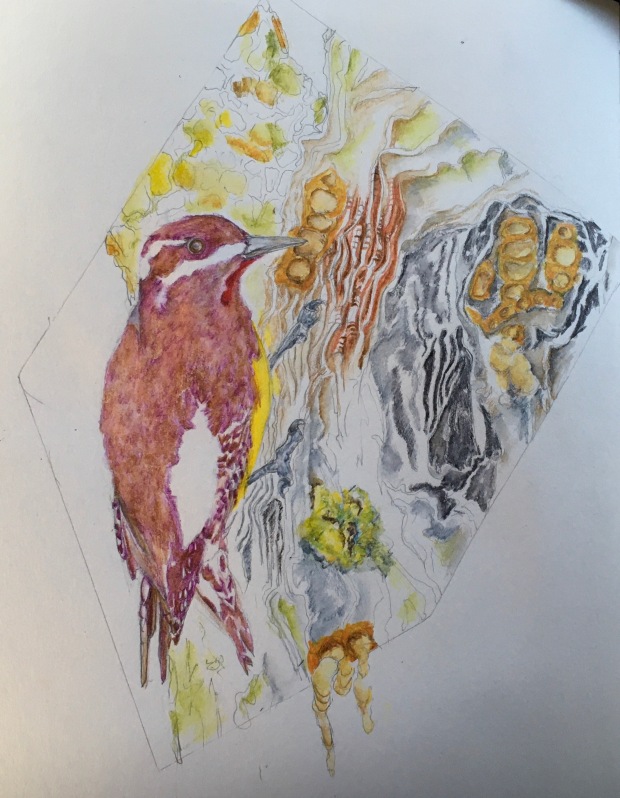
Here’s a few progress shots I remembered to capture while creating the Williamson’s clinging to the tree

Earliest coloring stages …. Laying down base colors to build up to the Williamson’s silky black back
Adding more base colors, sapwell and tree bark furrowing details
Close to final image. The black was achieved by using purples, browns, blues and greens to achieve the iridescence of his black coloring.

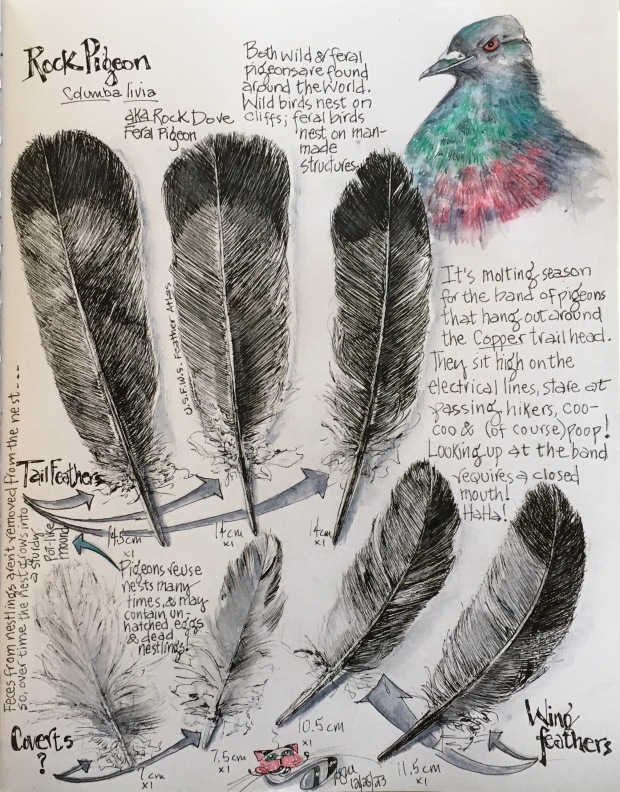
Pigeons ….. Prize or Pest

December 26, 2023

What comes to mind when you see a group of pigeons perched on electrical wires high above your head, or when a large flock or band of these birds suddenly flushes from under a highway overpass to escape a winged predator, or when you’re walking through a grocery store parking lot full of discarded food scraps and must shoo away pigeons to avoid stepping on them?

click the link below for the entire post, and learn if you believe this large bird is a pest or a prize

Continue reading “Pigeons ….. Prize or Pest”