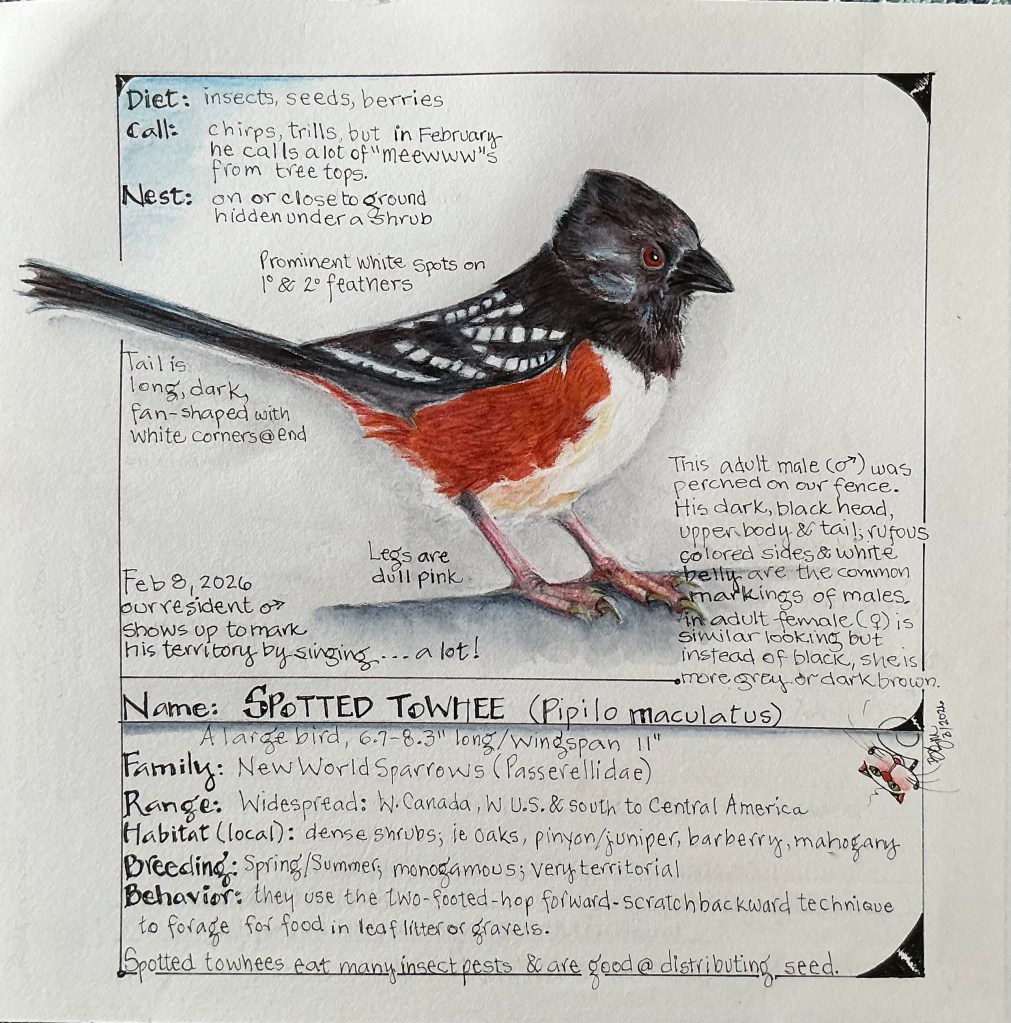
Spotted Towhee – Page 4 .. The 100 Day Project (2026)

April 1, 2026

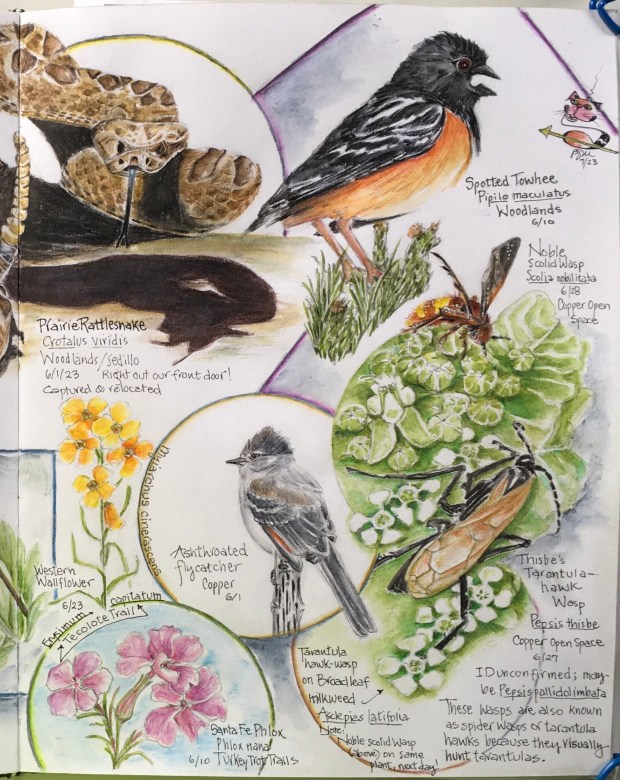
Spotted Towhee (Pipilo maculatus)

Here’s one of my favorite birds that’s a regular visitor to our yard. Spotted towhees, especially the males, are year-round residents throughout most of New Mexico, which means they breed in the shrubby vegetation surrounding our home. In our area, males sing at the crack of dawn until late afternoon beginning in early February. Instantly recognizable, their beautiful songs carry far and wide. Their songs not only signal to their mate it’s time to pair up again (spotted towhees are monogamous), they also let other male competitors know they’re horning in on his territory.

With favorable weather and abundant food, spotted towhees can produce two clutches of chicks during the breeding season. Their ground nests are hidden so well under a dense oak that I’ve never been able to find one. But it’s a lot of fun to watch clumsy fledglings trying to master the “two-footed-hop-forward-scratch-backward” forging technique all spotted towhees use to uncover hidden bugs and seeds.
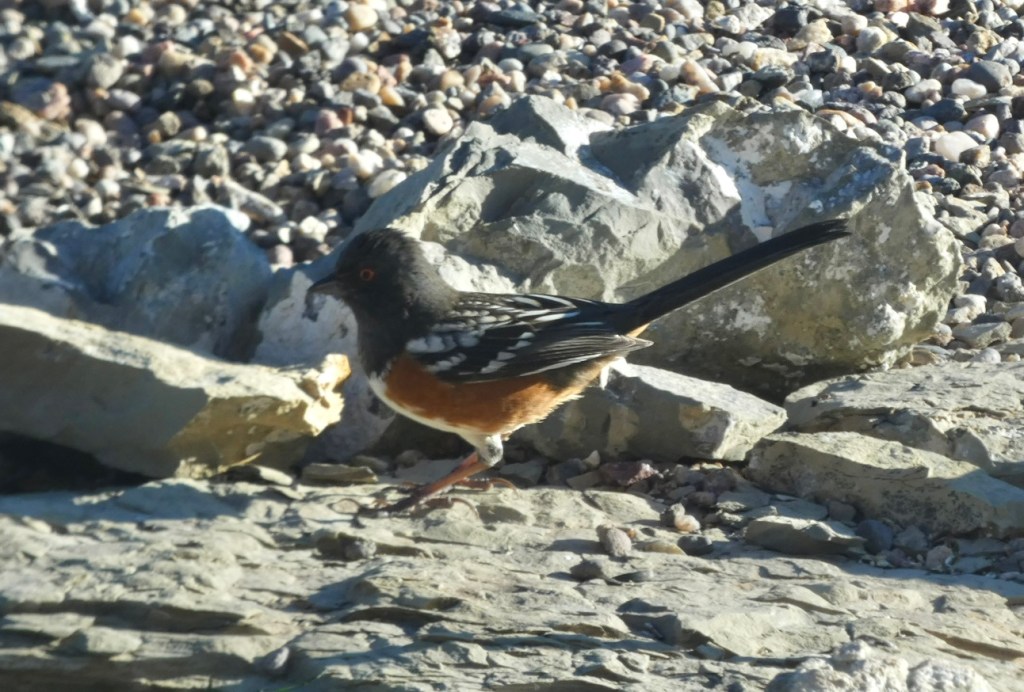
Fun Facts

  • The spotted towhee and the eastern towhee were considered to be the same species called the rufous-sided towhee until 1995.
  • Male towhees have been recorded spending 70% to 90% of their mornings singing during breeding season.
  • Once a male mates, he only spends about 5% of his time singing.
  • It’s thought that the spotted towhee’s white spots are a form of camouflage.
  • Spotted towhees will sun themselves by lying on the ground feathers spread.
  • They will bathe in the dew or fog that has collected on vegetation.
  • Nesting females have been seen running away when disturbed rather than flying.
  • A group of towhees is called a “tangle” or a “teapot.”
  • When two towhees fight, one bird will pick up a piece of twig and carry it around as a sign of submission. 
  • Their bright red eyes act as a visual signal during the breeding season, standing out in their dark, shady, ground-level habitats.

Do spotted, canyon, green, eastern or any of the towhee species visit your yard? 
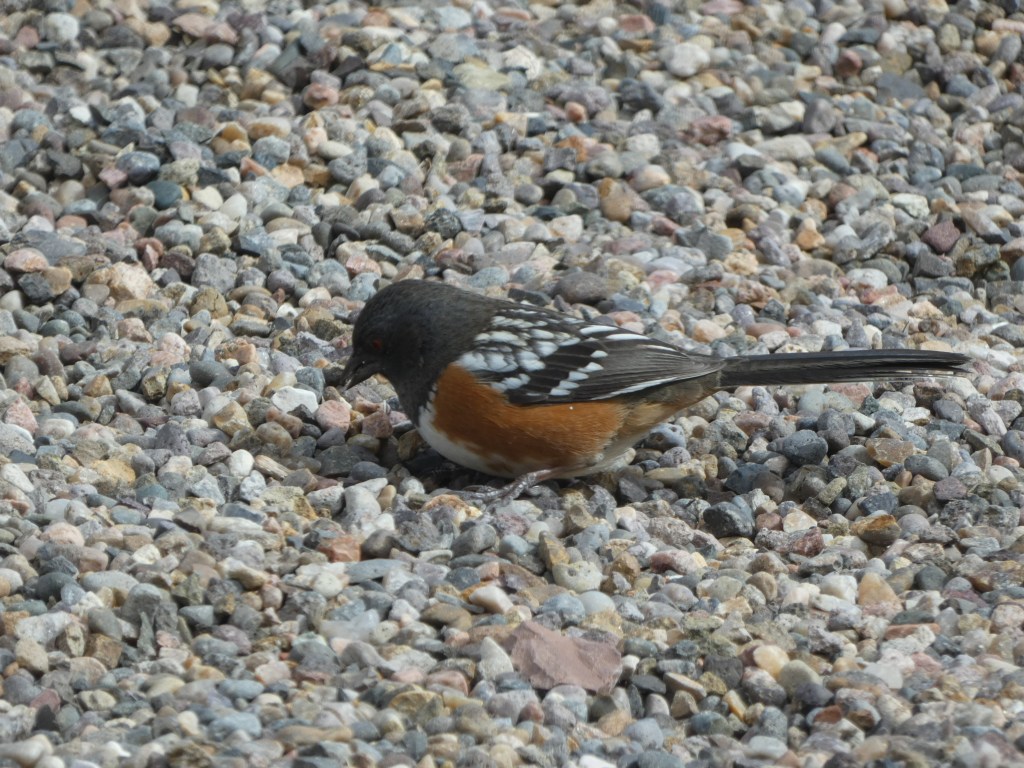
Hope you enjoyed this post! Thanks for stopping by!

References

audubon.org

inaturalist.org/taxa

allaboutbirds.org

explorer.natureserve.org

https://peecnature.org/learn/nature-guides/featured-critters/spotted-towhee/

June “Littles” ….. a buzzy, buggy, snake-y month

June was hot, Hot, HOT

Two-page spread with 14 June Littles + Flambé

June was dry, Dry, DRY

Close-up

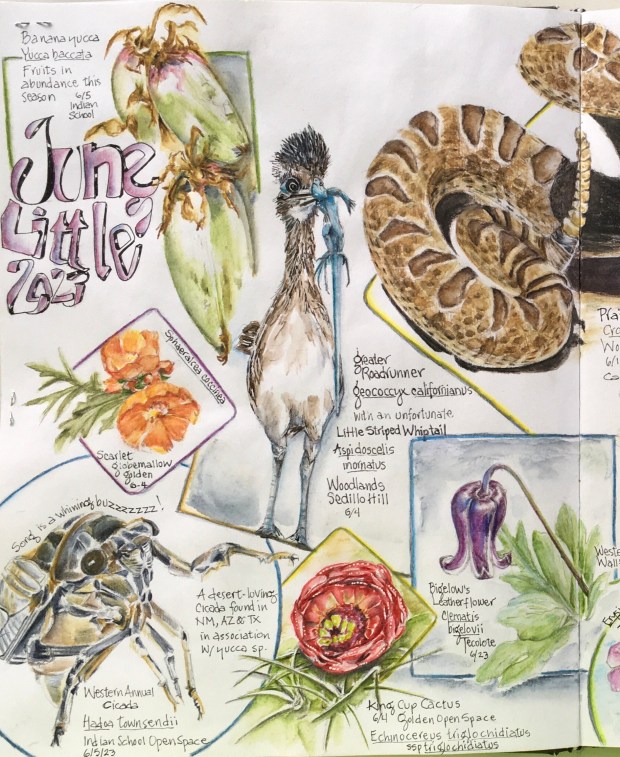
June was the month of bugs (from the big tarantula hawk wasps, to the microscopic gnats), withering flowers, disappearing birds, and snakes! We seemed to encounter an extraordinary number of snakes this month, including gopher (bull) snakes, diamondback rattlesnakes, patch nose snakes, garter snakes, and one very scary prairie rattlesnake. Read on for that story.

Another close-up

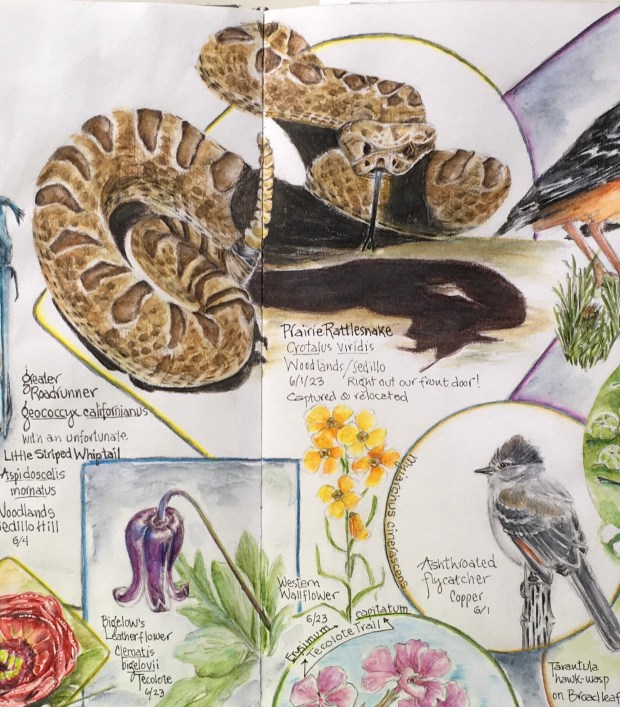
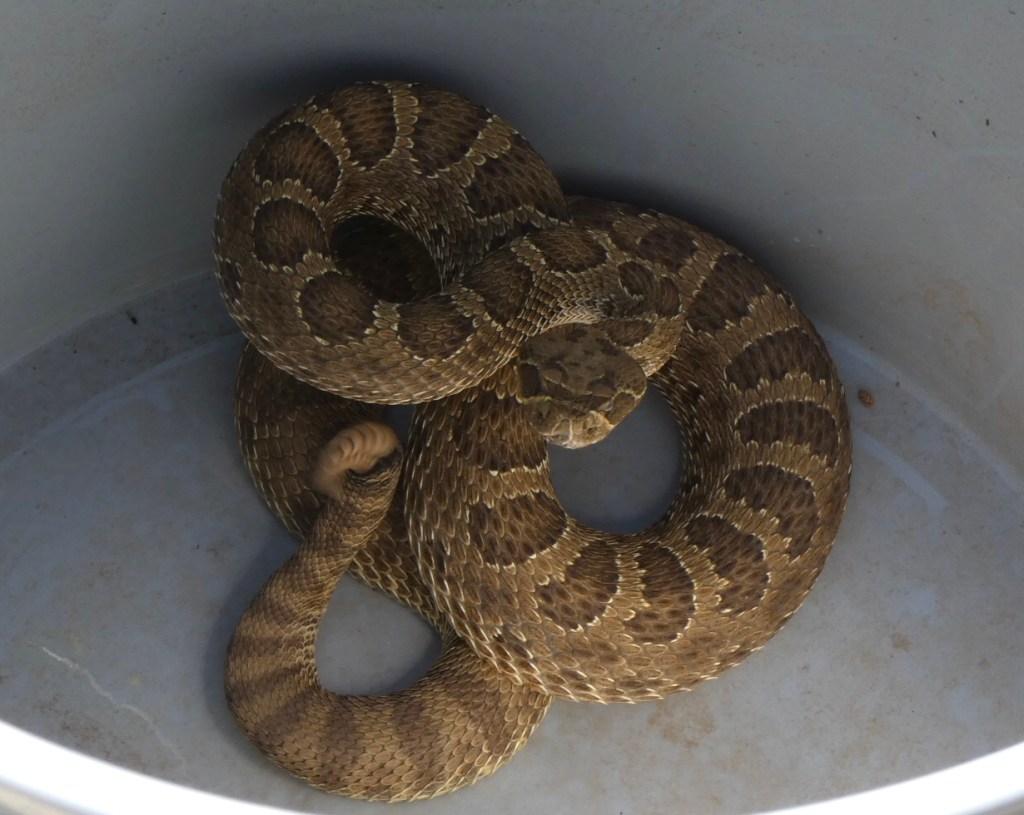
Luna and the Prairie Rattler! Our scariest encounter was with a 3-foot prairie rattlesnake right in our front courtyard. One day he had crawled out from the shade of a blue spruce to warm up in the morning sun. It was Luna that had changed his demeanor from placid to pissed off. Prairie rattlers don’t typically alert trespassers; that’s the secret to their hunting success, and Luna didn’t recognize the danger. She began sniffing around and unintentionally violated his personal space. The snake responded by instantly coiling and violently rattling his tail. The noise seemed deafening and was definitely alarming. As I came running to Luna’s rescue, Roy noticed the commotion and quickly arrived with snake stick and bucket in hand. By this time the snake had backed into a corner, furiously rattling, but was relatively easy to capture. Snake temporarily out of the way, we then carefully checked Luna for signs of snake bite (none detected! Lucky Luna).

Another close-up
Another close-up

Now back to the snake in bucket. It had taken less than 30 seconds for Roy to capture and slip him into the 5 gallon bucket. It was then that I was able to take my first photos, from a respectable distance just in case the snake decided to leap clear of the bucket!. If looks could kill, well ………….. About 15-20 photos later, the bucket lid was secured in place, and we took the snake for a little ride about a mile from home where he was carefully released in an uninhabited area, unharmed.

After release

Again, a big shout-out to “Made by Fay” for the inspiring “Littles” idea!   Stay tuned for the next installment of “Littles.” 

July 27, 2023

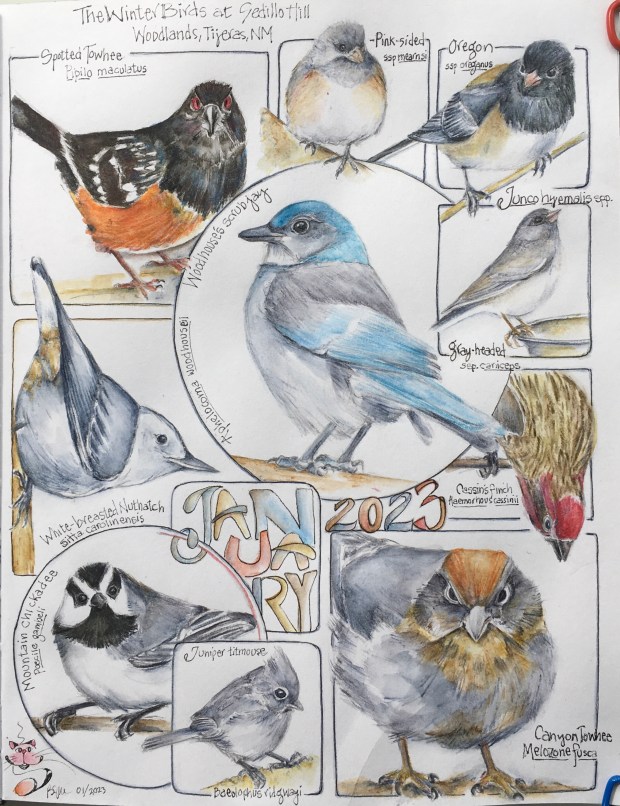
Winter Birding on Sedillo Hill: January 2023


East Mountains, Tijeras, New Mexico elevation 7,300 ft

February 15, 2023

The design for today’s post was inspired by sketchbook artist Fay. I came across her blog (see link below) while searching for nature journalers who are active in creating art and who also share some unique approaches to page layout and composition.  “Littles” is the name Fay has given to one of her unique approaches.  This is where she lays out several pages full of empty boxes with the goal to fill up a box a day for an entire month.  Not only does this encourage a daily drawing and painting practice, but it’s her way of creating a record of what she’s observed for an entire month.  “Littles” reminds me of a hyper-compressed perpetual journal.

After seeing Fay’s blog post with all her miniature drawings and paintings, I knew this would be fun to try, and I had to learn more.  So we chatted and Fay encouraged me to give “Littles” a go.  And I did …… with a “little” twist!  I’ve been thinking of ways to keep a visual record of the birds visiting our feeders during the winter.  And I needed an approach with minimal fuss, without feeling each bird needed a detailed description. Ta da! 

So here’s my “Littles” page of the bird species that visit our feeders in January.  I kept my sketches to less than 5 minutes each; my watercolor pencil paintings took about 10 minutes each. My sketches were done using my own reference photos, and relied heavily on my many hours of observing these species’ poses and behaviors.

Let me know what you think! I just may create a “Littles” page for our February birds. Maybe by March, when all of our snow has melted, hints of new spring growth may appear in a few “Littles” boxes as well!

Oh and …… Follow Fay!  Her blog “Made By Fay” can be found at the link below.  If you enjoy my posts, I will guarantee you’ll love what Fay does.  She is an extraordinary visual storyteller, and enjoys drawing what she sees from her home state of Washington and on her travels about. 

https://madebyfay.wordpress.com


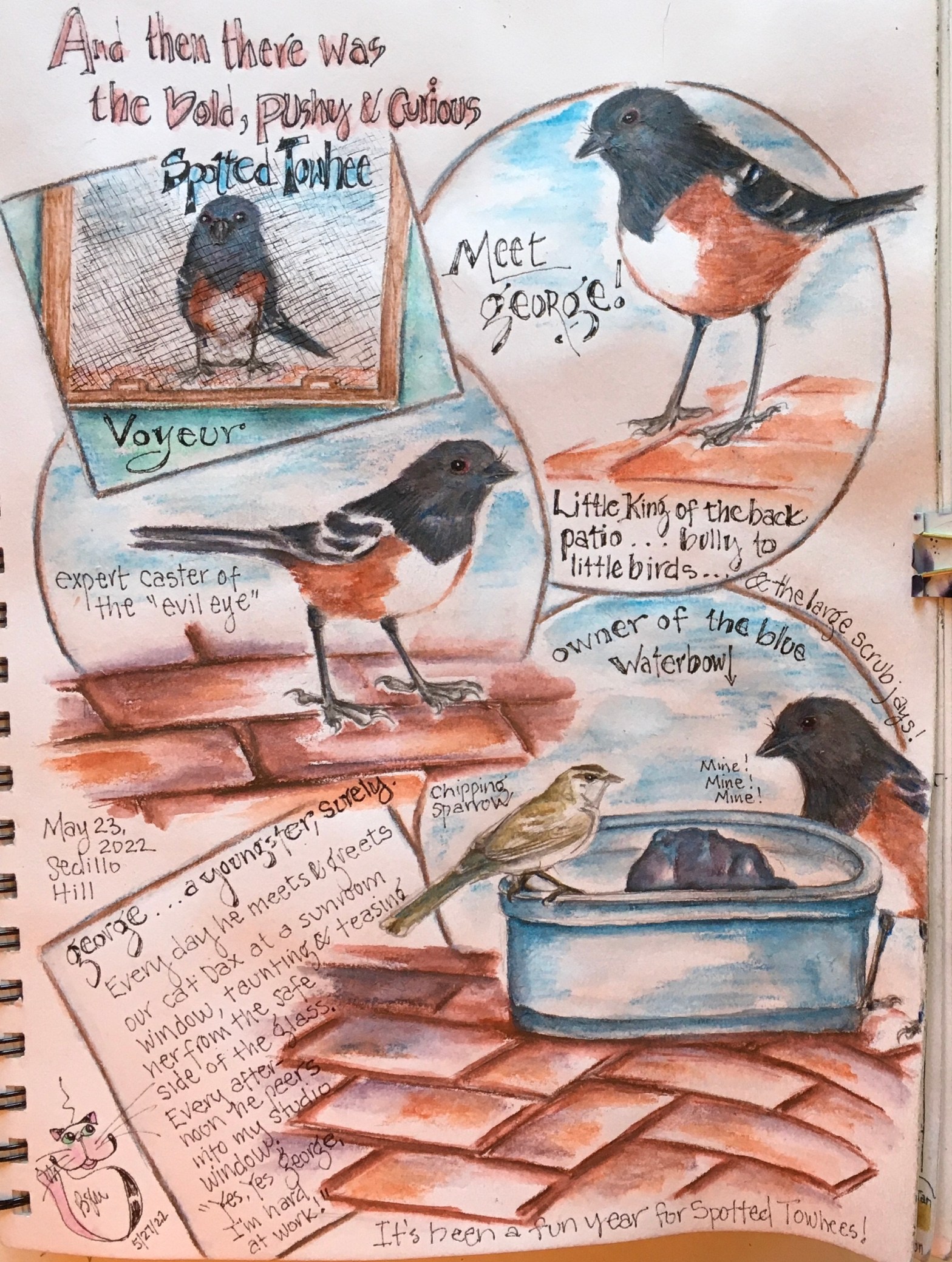
Backyard Birds: The bold, the pushy, the curious

What a successful breeding season it’s been! Our backyard bird population exploded in size during May. with the addition of dozens of youngsters. The house finches have been the most prolific, and watching the newbies spar at the waterbowl or compete for the best perch on the feeders has been hilarious. But I’ve had the most fun getting to know the newest addition to the spotted towhee clan …….

…… George.

Continue reading “Backyard Birds: The bold, the pushy, the curious”

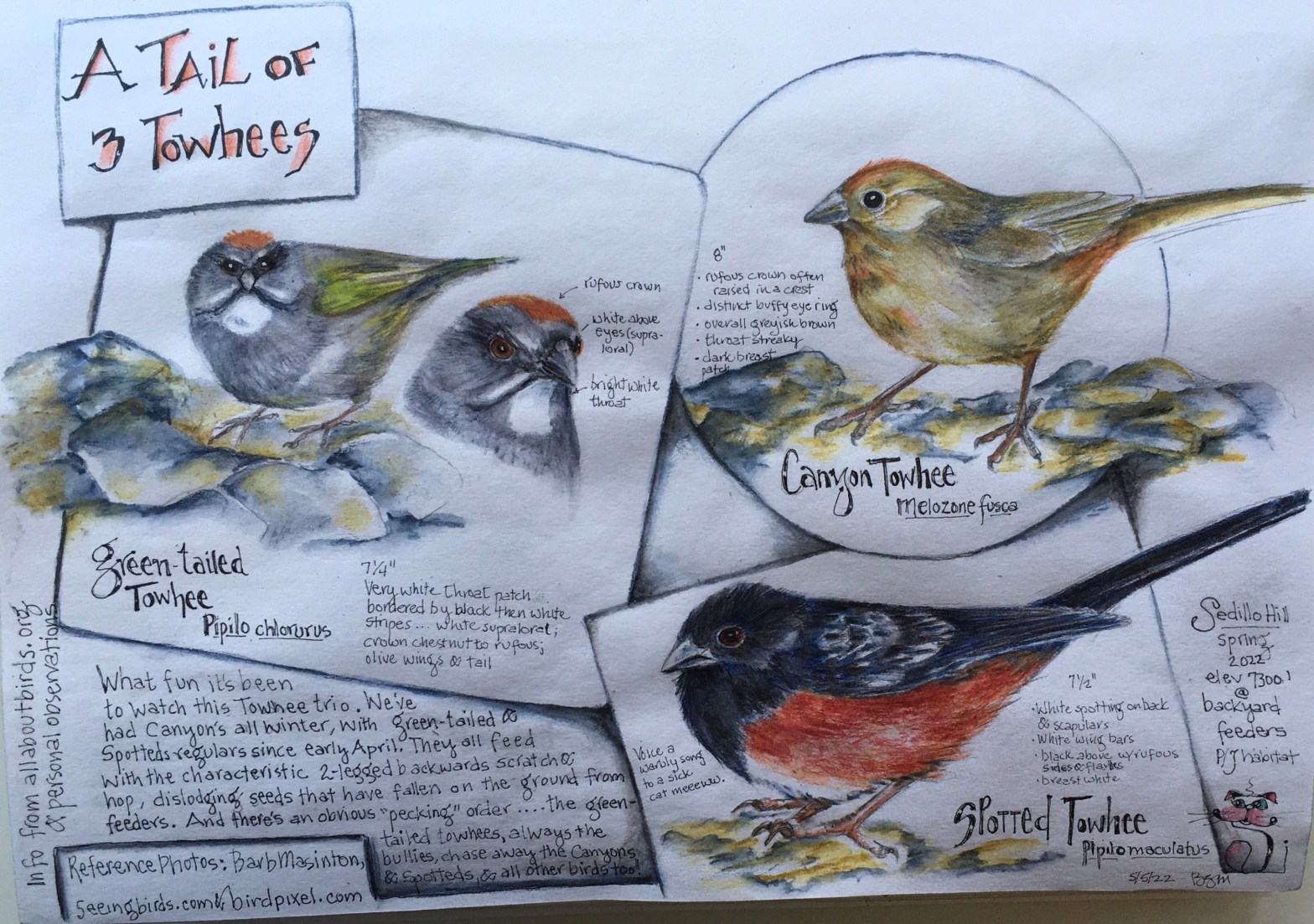
Backyard Birds: A Tail of Three Towhees

Winter dissolves into Spring in New Mexico’s East Mountains, and with this change of seasons comes clouds of pollen, strong winds and a new cast of songbirds. As the Dark-eyed Juncos head north to their Canadian and Alaskan breeding grounds, they leave behind the resident Juniper Titmice, House Finches, and Mountain Chickadees, and one of the largest sparrows in the songbird group, the Canyon Towhee.

By early April, the warbly bell ringing song and raspy cat-like mewling call of the male Spotted Towhee can be heard from the tree tops, as he invites all willing suitors and warns off competitors, declaring our backyard his private territory.

Then by mid-April, in moves the dapper Green-tailed Towhee, dominating the seed-littered ground beneath the feeders and chasing away every other bird that dare to grab a bite.

Definitely Towhee season in the East Mountains!

Continue reading “Backyard Birds: A Tail of Three Towhees”