October 18, 2026
North American Wheel Bug (Arilus cristatus)
—aka—
“Lion or Eagle in the Food Web”
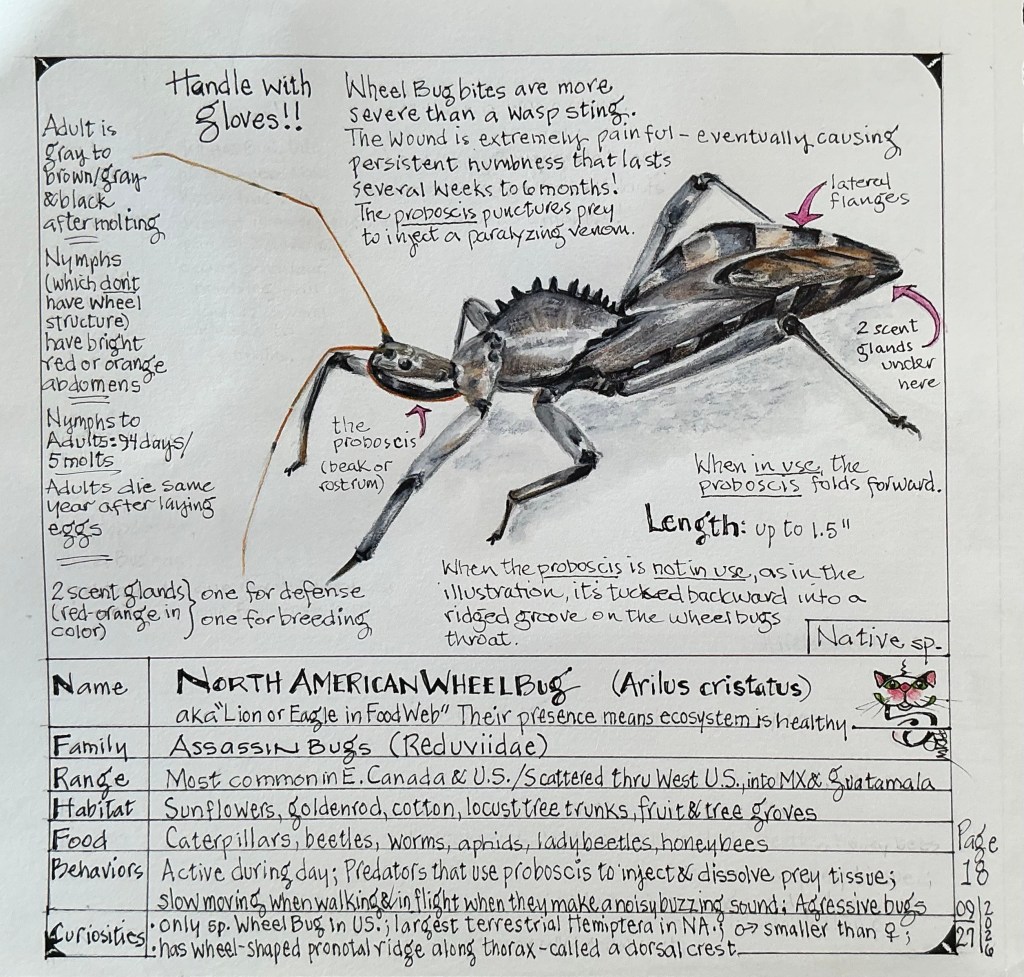
The first time a North American Wheel Bug crossed my path was in North Carolina. Instantly catching my attention, I was shocked. Not because of it’s size (oh my, she’s HUGE!), but because of the odd “deformity” on her back. I was certain this poor bug had to be in distress as she slowly lumbered across the road carrying half a spiky wheel-shaped disk growing from her back!
Back then I didn’t know much about bugs. But my insect field guide showed me this creature was a North American Wheel Bug, (Arilus cristatus), a species of assassin bug. As the only species of wheel bug found in the U.S., they are reported to be fairly common in the East. And that half cog-like wheel shape forming a prominent dorsal crest? Well that’s normal, and a distinguishing characteristic of the adults, both females and males. As it turned out, that lonely specimen was the first and only one I’d ever seen during the eight years we lived in NC.
Fast forward to New Mexico. Every Autumn since our 2017 relocation to the East Mountains, one or more adult wheel bugs have appeared on the ground and walking up the sides of our stucco-sided homes, always “toting” that instantly recognizable half toothy saw blade “stuck” in their thorax. I was happy to have these voracious predators as neighbors since they help control undesirable soft-bodied insect pests like caterpillars, worms and aphids. Also their presence indicates a healthy, pesticide-free ecosystem, despite preying on several ecologically beneficial species, like lady beetles and honey bees.
Handle With Gloves, Please!
Wheel bugs are predators. Like all assassin bugs1, they use their proboscis (the beak) to inject and dissolve prey into a slushie. Here’s how they hunt, kill, and eat:
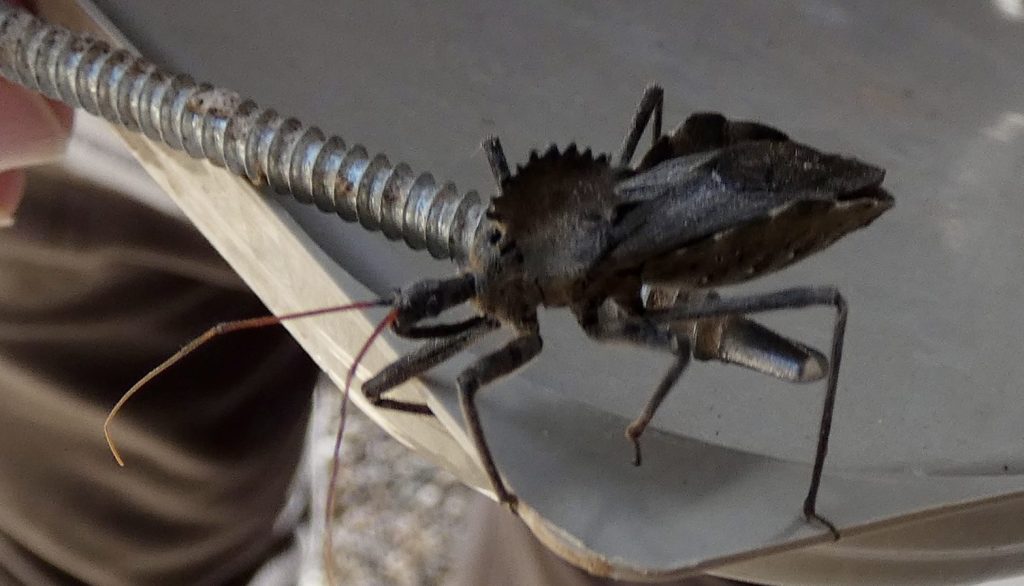
Predation is initiated by stalking. When “food” has been spotted, the wheel bug will ambush its prey, quickly gripping and pinning it with their front legs. The bug then plunges its unfolded beak into the victim before injecting it with a mixture of saliva, paralyzing venom, and digestive enzymes which dissolves its internal organs into liquid. Then the wheel bug uses the same hollow proboscis to suck out the liquefied contents, leaving behind an empty shell.
While obviously bad news for prey species, wheel bugs also wield their proboscis in defense against anything intent on causing them harm. If mishandled or threatened, they will jab humans with their proboscis, delivering a famously painful, burning bite. The pain is described as more intense than a wasp sting. Not considered to be highly venomous, the bite location can become heated and irritated followed by numbness that lasts from several weeks to 6 months. During the healing process a white crust sometimes forms around the wound that eventually deteriorates, leaving a small visible puncture.
1 Assassin Bug – most members of the family Reduviidae are fairly easy to recognize: they have a relatively narrow neck, sturdy build, and formidable curved proboscis (beak). Almost all species are predatory, except for a few blood-sucking species, some of which are important as disease vectors. About 7000 species have been described, making it one of the largest families in the Hemiptera (true bugs).
Scent Glands
Wheel bugs possess two red-orange scent glands located underneath their abdomen. These glands have two distinct chemical functions; one for defense against predators and one for breeding behaviors. The scent produced is not as powerful as that produced by stink bugs (like darkling beetles), but is still strong enough to be detected by humans.
What is that Noise?
Wheel bugs are capable of making audible sounds. They rub the tip of their proboscis in a groove under its thorax. Their reason for creating this sound is not known, but it’s thought to serve as a means of communication between members of the species. Wheel bugs also make a noisy buzzing sound during flight.
Reproduction
The reproductive cycle of wheel bugs begins in autumn. After mating, the female lays 40 to 200 small, brown, cylindrical eggs on trees, bushes, twigs, and other objects. She also secrets a gluey adhesive to adhere the eggs to the substrate and to keep the eggs in a cluster. Neither adult female or male wheel bugs overwinter.
The following spring, the eggs hatch into eight-millimeter-long nymphs with red abdomens that will undergo five molts until they reach the adult stage the following summer. The average length of each molt is about 19 days, with the interval of the 5th and final molt prior to the adult stage being the longest. Overall, eggs usually hatch at the beginning of May with nymphs maturing into adults by July, roughly over a 94 day period. However these timeframes may vary depending on climate, where populations that live in warm climates may not overwinter as eggs.
Note: Wheel bugs nymphs are predatory immediately upon hatching.
Another Note: The distinctive wheel-shaped dorsal crest appears only after the bug reaches the adult stage following the 5th and final molt.
And Yet Another Note! Wheel bugs are very aggressive in the wild, and cannibalistic behaviors between them have been observed. For example: nymphs may prey on one another; adult females may feed on the male after they’ve mated.
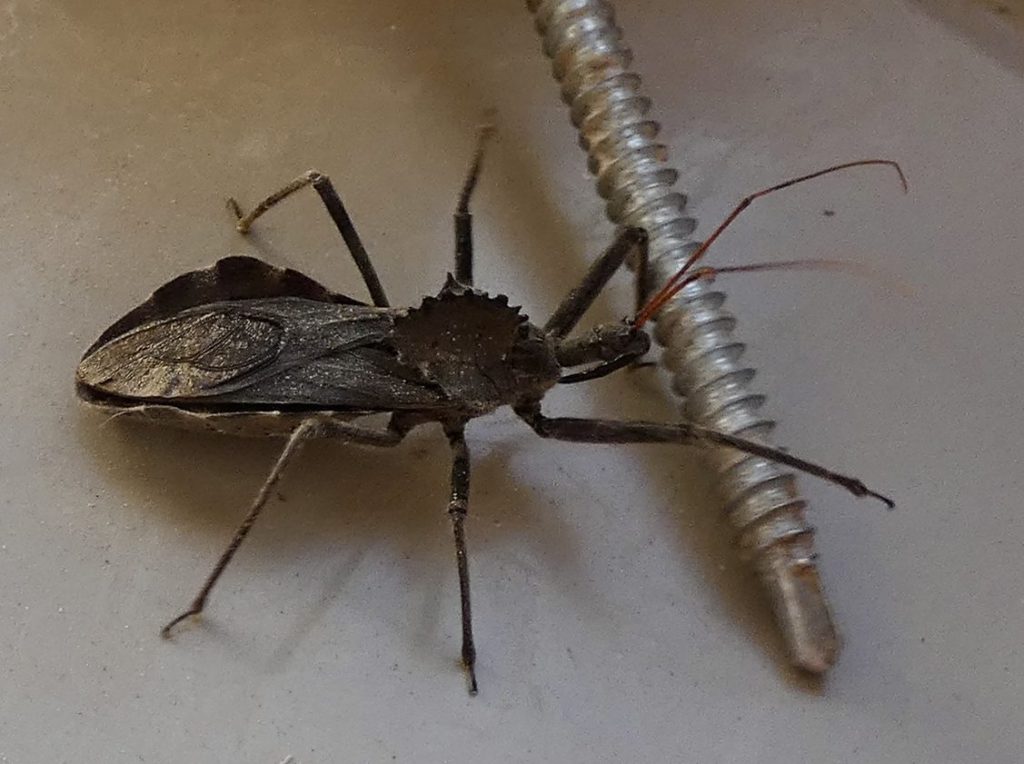
And that’s all for now, folks!
…………………………………………………………………………………………………
Have you ever seen a North American Wheel Bug? Maybe you’ve seen their mass of eggs? What about a nymph with a red abdomen? If so, let me know!
Hope you found this interesting!
As always, thanks for rolling by!
References: iNaturalist.org; wikipedia.org

