Steller’s Jay – Page 20 .. The 100 Day Project (2026)

November 24, 2026

Steller’s Jay  (Cyanocitta stelleri)

—aka—

That hefty, crested bird with attitude!

A few mornings past I happened to glance out our bedroom window overlooking the bird feeder. The sun had just popped over the horizon and a gorgeous sunrise highlighted the activity on and below the feeder. Expecting to see the usual assortment of winter birds — dark-eyed juncos, house finches, canyon towhees and their cousins the spotted towhee, I did a ‘double take’!
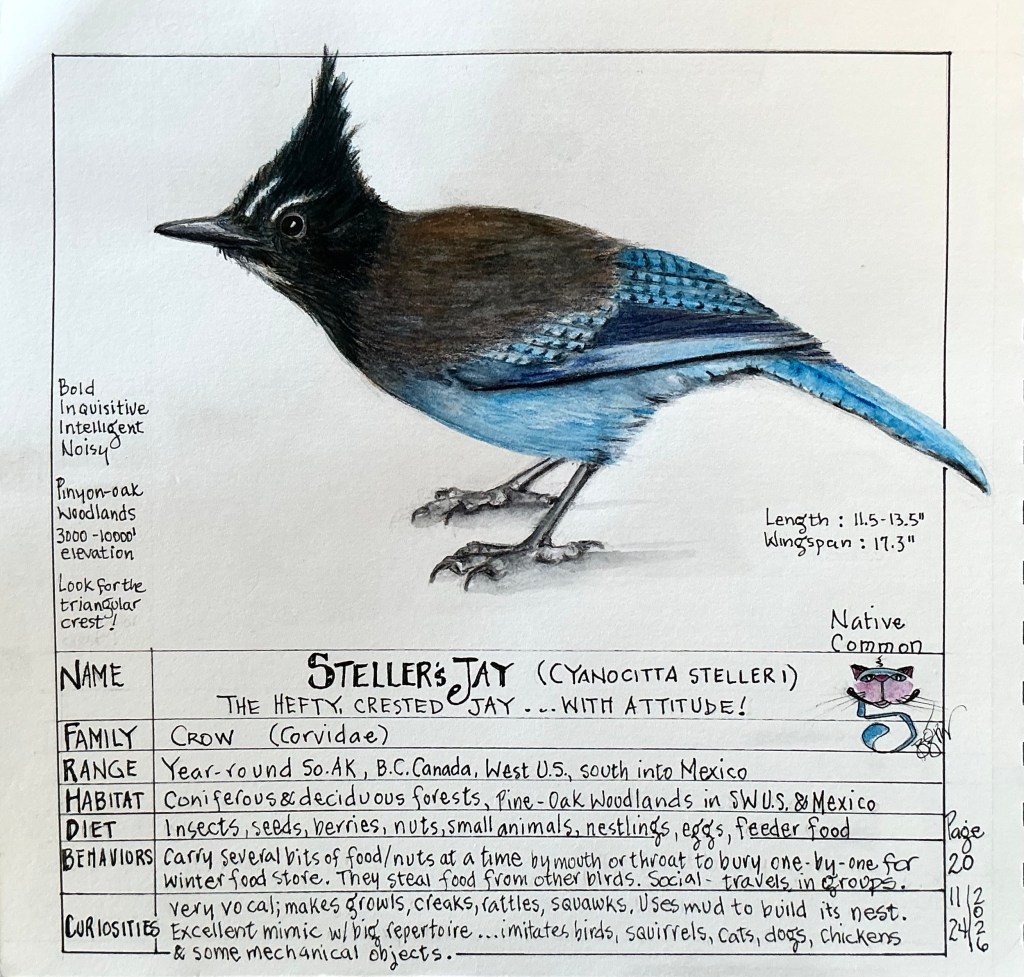
On the ground wasn’t one of the big Woodhouse’s scrub jays that frequently visits, but a larger, somewhat heftier bird. Unmistakably, it was a Steller’s Jay! Oh such brilliant blue, yet blue-greenish “Cyan” colored flight and tail feathers accented with bars of peacock blues harmonize perfectly with his shiny black head, a brownish green grey back, and powder blue belly. Slightly agitated, the large crest on his head was standing upright and spread wide, giving him a larger-than-usual appearance. This form of intimidation effectively chased away all of the smaller birds under the feeder allowing him to stuffed as many sunflower seeds in his mouth as possible, before flying off to hide his booty.

We’d been seeing a number of Steller’s Jays in the neighborhood — flying from one pinyon tree to another, but this was the first time one has visited our bird feeder!

How do you know a bird is a Steller’s Jay?

As a member of the Crow family, these large birds (which happens to be the only western jay with a crest) are very social. Often seen flying in groups with others of their own species, they may even travel with mixed-species flocks. As one of the most vocal species of mountainous forests, Steller’s Jays keep up a running commentary on events, while playing with or chasing each other, and when they instigate mobbing of predators and other possibly dangerous intruders.

In dense and towering evergreen forests you want to look up! Steller’s Jays stick to the high forest canopy, moving about with graceful, almost lazy long-swooping wingbeats. Listen for their harsh, scolding calls if they’re nearby. In significantly less dense and much shorter pinyon pine and oak forests typical of interior Southwest U.S., you’ll likely encounter Steller’s Jays moving from tree to tree at or above eye level!

There are 16 subspecies of the Steller’s Jay in North and Central America, each with different combinations of black and blue on the crest, head, and body. Some populations have black crests and backs, and others blue. One black-crested form in southern Mexico is surrounded by eight other blue-crested forms. The Queen Charlotte Islands off British Columbia are home to the largest and darkest race. In mainland North America, you can notice differences between darker Pacific forms, with blue streaks over the eye, and lighter Rocky Mountain forms with white streaks pointing to the crest and a partial white eye ring.

Where in the World do Steller’s Jays live?

Found wherever evergreen forests grow in the intermountain West, their range extends north into British Columbia and southeast Alaska, and south into Mexico and northern Central America. Steller’s Jays are common in forest wildernesses at elevations ranging from 3,000 to 10,000 feet. But within these areas, they are also common in campgrounds, recreational parks, picnic areas, and backyards, where they are quick to spy bird feeders as well as unattended picnic items.

The “Anything Goes” Diet of a Steller’s Jay

Described as a generalist forager, their diet consists of  insects, seeds, berries, nuts, small animals, eggs, and nestlings. In forested areas frequented by people, you’ll find them eating garbage, unguarded picnic items, and feeder fare such as peanuts, sunflower seeds, and suet. Steller’s Jays also never pass up an opportunity to steal food from other birds or look for handouts from people. When the menu includes large nuts like acorns and pinyon pine seeds, they will collect as many as they can carry at a time in their mouth and throat, then bury them one by one as a winter food store.

Like many other jay species, Steller’s Jays are habitual nest-robbers. And they’ve occasionally been seen attacking and killing small adult birds including a Pygmy Nuthatch and a Dark-eyed Junco.

Fun Facts About Steller’s Jays

  • They were discovered on an Alaskan island in 1741 by Georg Steller, a naturalist on a Russian explorer’s ship. When a scientist officially described the species, in 1788, they named it after him, along with other discoveries including the Steller’s sea lion and Steller’s Sea-Eagle.
  • Steller’s (the western species) and Blue jays (the eastern species) are the only North American jays with crests. The Blue Jay is expanding its range westward. Where they meet, the two species occasionally interbreed and produce hybrids.
  • The Steller’s Jay and the Blue Jay are the only New World jays that use mud to build their nests.
  • They are excellent mimics with a large repertoire, able imitate birds, squirrels, cats, dogs, chickens, and some mechanical objects like water sprinklers. It’s thought they make these noises so they don’t have to share food sources with others. Any thoughts?
  • A group of jays may be called a “band, ” “cast, ” “party,” or “scold” of jays.

Have you heard a Steller’s Jay squawking, creaking or gurgling calls? Have you heard them mimicking the neighborhood dog or your sprinkler? If so, I’d love to know!

And that’s all for now, folks!

…………………………………………………………………………………………………

Hope you found this interesting!

As always, thanks for stopping by!

References:  allaboutbirds.org; dirtyclassroom.com; estesparknews.com; iNaturalist.org; wikipedia.org
Abert’s Sanvitalia – Page 19 .. The 100 Day Project (2026)

November 11, 2026

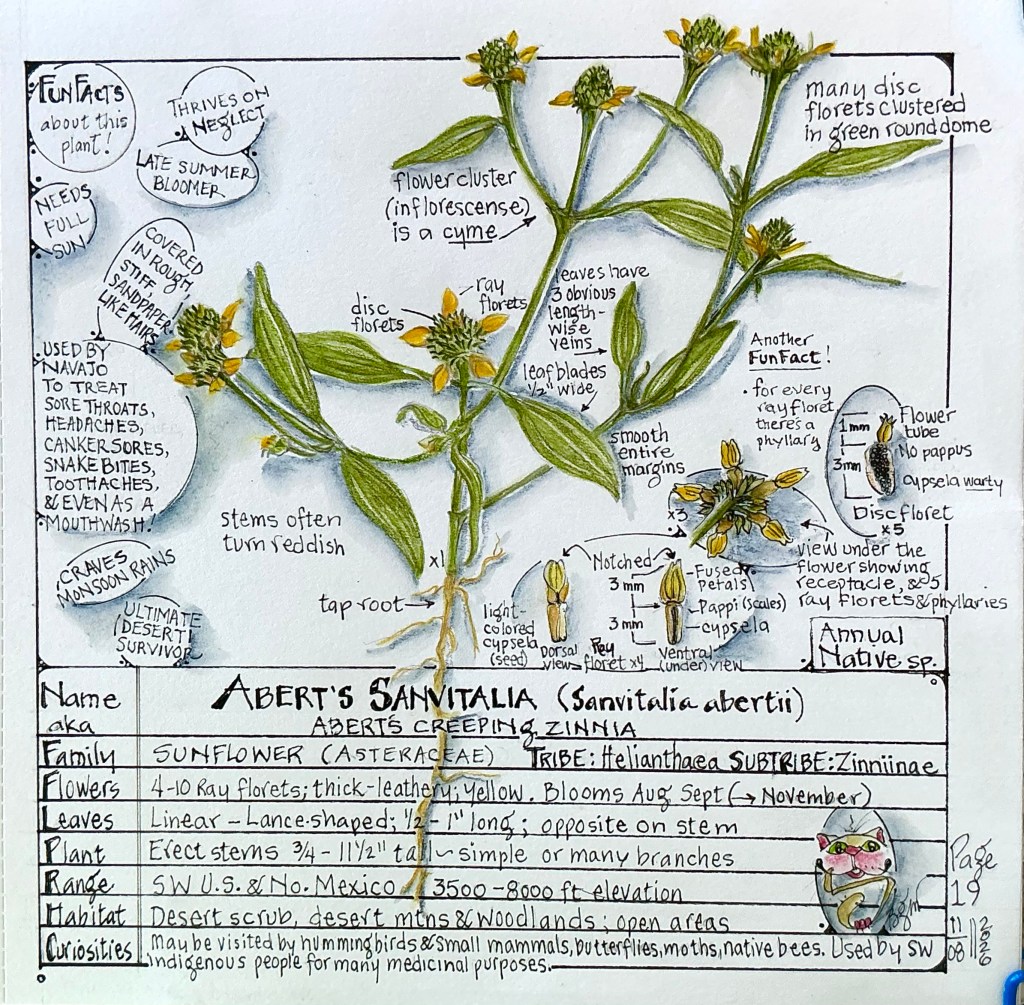
Abert’s Sanvitalia (Sanvitalia abertii)

—aka—

Abert’s Creeping Zinnia

Such a charming plant, if you can spot it! As a member of the Sunflower (Aster) family, you might expect Abert’s Sanvitalia to boast an abundant display of large glowing yellow flowerheads. Nope! Often overlooked, this plant seldom grows taller than 3 inches and usually has fewer than 6 ray florets whose petals are barely 1/8th-inch long. This modest number of yellow ‘rays’ are evenly spaced around a small domed cluster of disc florets, each tubular corolla hardly 1/16th-inch tall.  There may be less than 10 flowerheads/plant that rise above a pair of simple leaves. Is this diminutive plant what comes to mind when you think of a sunflower? Probably not.

Abert’s Sanvitalia may not be showy, but as desert southwest native species it is a survivor. Its hardy seeds that were scattered on the ground last year patiently wait almost the entire growing season for the heavy late summer Monsoon rains to germinate. That sudden flush of water stimulates new plants to grow and flower quickly hoping to entice pollinators to a late season feast before an early frost prevents seed set.

This delicate little annual can (usually) be found every August and September in scattered, sunny locations throughout the Las Leyendas Subdivision and surrounding areas. But I was beginning to worry this year (2026) would be an exception. Because it was very hot and dry during the summer through the our typical Monsoon season, it seemed likely Abert’s Sanvitalia seeds would not be germinating. But at the end of September and into October, boy did it pour! And not just once, but twice!  there was a heavy rain, followed by two more by mid-October. That seemed to do the trick. Soon after, a handful of these tiny sunflowers popped out of dormancy and began to bloom, and by late October and early November seeds were falling to the ground. It appears germination really is triggered by Monsoonal rains.

Fun Facts about Abert’s Sanvitalia

  • The species thrives on neglect and the sudden burst of summer Monsoon rains.
  • In the wild, it is a “summer annual.” Past year’s seeds wait patiently for the heavy summer Monsoons to break their dormancy and germinate. These rains mimic the deep, occasional soakings this plant depends upon to complete their life cycle.
  • It requires full, unobstructed sunlight to form into a healthy compact forb. If the plant grows in the shade, the stems become “leggy” and weak as it makes every possible effort to stretch toward the light.
  • A complete covering of rough, stiff, sandpaper-like hairs prevents moisture loss through its stems and leaves, and a stout tap root able to find water at depths deeper than many shallow-rooted annual species, makes this plant highly specialized to grow in dry rocky or sandy substrates, typical of our desert soils.
  • Each flowerhead produces two distinct types of fruit. The cypsela formed beneath the petal of an outer ray floret is light-colored and has little scales (pappi), while the cypsela that forms beneath the fused tubular petals of a disc floret are darker, warty, and lack a pappi).

Ethnobotany

Indigenous peoples of the southwestern U.S., particularly the Navajo, used Abert’s Sanvitalia for various remedies. Primarily the leaves were chewed or made into a poultice or an infusion to treat sore throats, fevers, headaches, mouth sores, toothaches, canker sores, menstrual pain, and snake bites. It was used as a general cure-all. A warm infusion of leaves was even used as a mouthwash.

Etymology

The genus Sanvitalia was published in 1792 by Jean-Baptiste Pierre Antoine de Monet de Lamarck (1744-1829). There are two theories about the adoption of the genus name Sanvitalia:

The primary and most widely accepted derivation honors the Italian Sanvitali family (or specifically Federico Sanvitali (1704–1761), a professor in Brescia, Italy); and/or

The genus was named for the Spanish botanist, Sanvital (a claim disputed by the Sanvitali family).

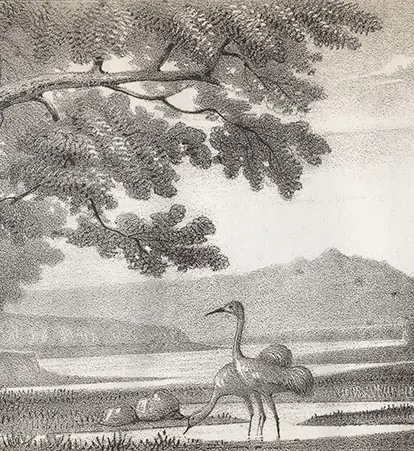
The species abertii was named after James William (J.W.) Abert (1820-1890), an American military soldier, explorer, and bird collector. More than a soldier and explorer, J.W. was a famous watercolorist and topographical artist who documented the flora and fauna of the American West while on expeditions with the Corps of Topographical Engineers. Run an internet search on J.W.’s art, and you’ll find images of his watercolors and sketches. Today, many of his original paintings are sold at auction for prices ranging from $7500 – $15,000. The following image (source henryehooper.blog) is a lithograph of his drawing of Bosque del Apache featuring sandhilll cranes.

Coincidentally, J.W. was the son of John James (J.J.) Abert (1788-1863) who led expeditions in the southwest during the mid-19th century as the head of the U.S. Corps of Topographical Engineers, a new organization formed in 1838 to supervise the mapping of the American West.

And that’s all for now, folks!

…………………………………………………………………………………………………

Hope you found this interesting!

As always, thanks for stopping by!

References: efloras.org (Flora of NA); iNaturalist.org; npsnm.org; swdesertflora.com; wikipedia.org

It’s the Holidays — Already???!!

Thanksgiving or Christmas?

November 8, 2026

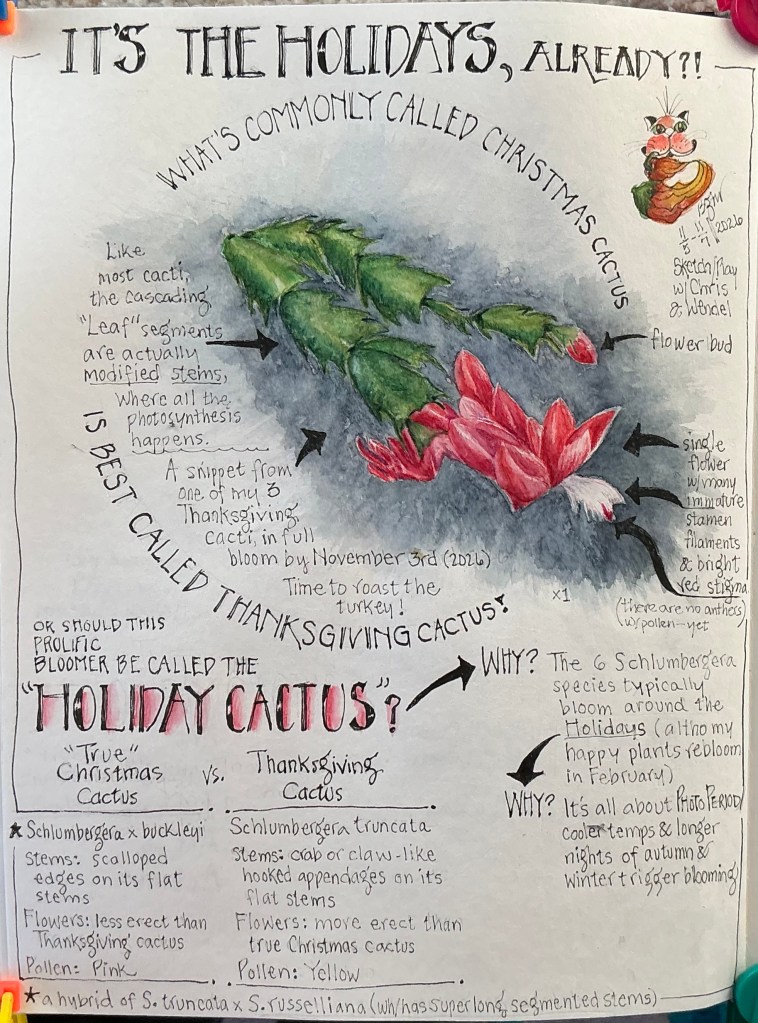
If you’re raising (or have ever grown) a Christmas cactus, is it loaded with flower buds, about to bloom, or already blooming? Mine are … and doing all of the above. Something I’ve noticed over the years is they always seem to ‘deck the halls’ in early November. Why? Why are they called ‘Christmas cacti’ when they always bloom right after Halloween?

It’s a curious question, and I searched for answers.

Have We All Been Fooled?

Although there is a true Christmas cactus (Schlumbergera x buckleyi) that grows on tree branches or rocky crevices in the humid, shaded coastal rainforests of southeastern Brazil, I learned that the festive plant widely sold in stores labeled as ‘Christmas cactus,’ is actually a ‘Thanksgiving cactus’ (Schlumbergera truncata)!

But you say your plant is the real McCoy because your 15-year-old specimen was inherited from your grandmama. It just may be! However, before going to the mat to defend the heritage of your treasured ‘Christmas cactus,’ take a close look.

  1. Do the margins of its flat segmented stems have the scalloped edges of a true Christmas cactus, or are they crab or claw-like with hooked appendages? and,
  2. Check out the pollen color — is it the bright pink of a true Christmas cactus, or pale yellow?

If you answered ‘Yes’ to the first half of each question, Congratulations! You are indeed, the proud owner of a true Christmas cactus. Now all of your friends will want a cutting of this seldom-seen species. But if you answered ‘Yes’ to the second half of each question, then your plant is a ‘Thanksgiving cactus,’ still as beautiful as it was a moment ago, just a different species. So this brings up the …

… Troubling Nature of Common Names

When it comes to plants, common names are informal, regional, and unregulated. This all leads to confusion, misidentification, and even ecological or safety risks. Because there are no governing bodies or official rules for assigning common names, a single botanical species can have dozens of different common names, making cross-referencing in literature or trade difficult. And this has been going on for ages.

To fix the problem, botanists and horticulturists use Latin binomials (genus and species), which provide a universal, regulated, and unchanging (mostly) way to identify a plant. But we really haven’t gotten rid of common names, which continue to be used world-wide, out of habit and are certainly easier to pronounce.

So What Does It Mean …

… for your ‘Thanksgiving cactus,’ which has been masquerading as a ‘Christmas cactus’ behind your back? Perhaps you could keep referring to that lovely holiday plant as your ‘Christmas cactus,’ while in the back of your mind you know it’s the Schlumbergera truncata species? Perhaps now that you know it’s S. truncata blooming away in November, you’ll want to adopt its new-to-you name of ‘Thanksgiving cactus?’ Or perhaps, in honor of this festive time of year, you’ll go out on a limb and call your centerpiece a ‘Holiday cactus?’

No matter what you call your plant, it’s all yours, after-all. And when it’s covered in blossoms, it’s cause for celebration!

As always, thanks for stopping by!

Every Leaf a Flower!

Welcome Autumn

November 4, 2026

Autumn’s arrival seemed subtle this year. Almost as if Summer refused to let go.

But the oaks could sense occasional overnight temperature dips despite persistent daytime highs in the low 90s. Finally, by mid-October the seasonal shift began, with the first sign of change appearing in oak leaves along the Sabino Open Space loop trail. Tenaciously clinging to their branches, those dill-pickle-green leaves showed hints of banana-peel yellows, tangelo oranges, and toasty caramel browns. A week later the trail was bathed in a brilliant golden glow!

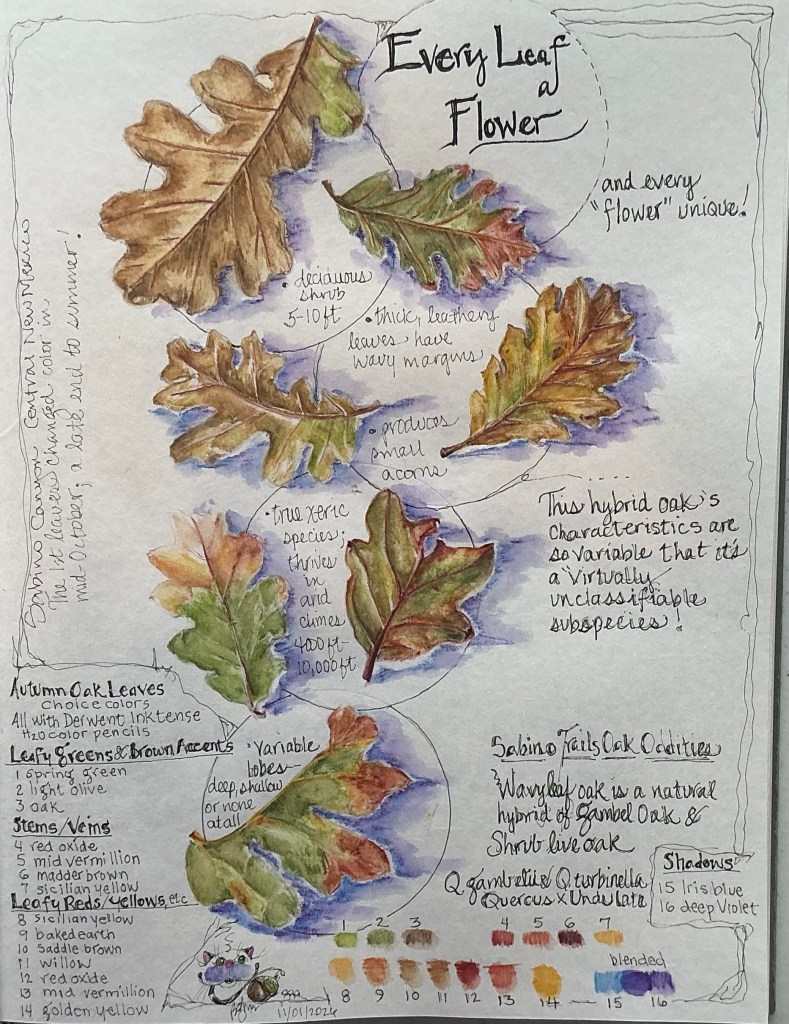
There are two distinct oak species growing in scattered locations within and surrounding the Open Space: Gambel Oak (Quercus gambelii) and Shrub Live Oak (Q. turbinella). And then there’s a weird-looking third oak which looks like a mash-up of the other two species — the Wavyleaf Oak (Quercus x undulata). According to botanists, Wavyleaf is a hybrid of the larger, deciduous, deeply-lobed Gambel’s and the smaller, evergreen, prickly-tipped Shrub Live Oak. The progeny of this merger is a consistently inconsistent-looking shrubby plant making its identification a visual guessing game.

What’s so eye catching when walking among Wavyleaf Oak, is the variability of leaves — not only between separate shrubs, but between leaves growing on the same plant. No two leaves are alike, even if they are side-by-side. And as is true of a naturally occurring botanical hybrid, called a nothospecies, leaves may more closely resemble one parent than the other, or may appear anywhere in between. A unique feature of this hybrid seems to be the wavy leaf margins,  a characteristic not present within either parent. But what I’ve noticed is the amount of margin waviness varies from extreme to hardly visible. Maybe there’s something else going on?

What I learned was that the freely interbreeding nature of Q. gambelii and Q. turbinella that produces Quercus x undulata – the Wavyleaf Oak, also freely backcrosses with one or both parents, populations referred to as variable hybrid swarms or complexes rather than a single uniform genetic line. Maybe all this backcrossing results in plants with leaves more similar to one parent or the other? Maybe, over time, if enough back-and-forth crossing occurs, a brand new botanically-distinct and stable oak species will result? Maybe that’s already happened somewhere since these plants hybridize and backcross freely across their native range from Colorado and Utah down to Texas and northern Mexico.

All of this is very mind boggling!

Back to my small collection of Wavyleaf Oak leaves, all different looking and exhibiting variable coloring. Hmmmmm …… does all this crossing and backcrossing cause leaves to change from green to Fall colors differently and at different rates? And what’s with the patterns?

As always, thanks for stopping by!

A Definition and a few other Notes:

  • Nothospecies – a botanical term for a hybrid species formed by the direct hybridization of two separate species (rather than crossing other hybrids)
  • Quercus x undulata represents a complex group of natural hybrids involving Quercus gambelii (Gambel oak) and several other scrub or white oak species—most notably Quercus turbinella (Shrub Live Oak), Quercus grisea (Gray Oak), and others in the southwestern United States and Mexico.
  • The multiplication sign (×) in Quercus × undulata explicitly designates it as a nothospecies (hybrid species) rather than a pure, primary species, though it was originally described by John Torrey in 1828 pro specie (as a distinct species) before its hybrid swarm nature was better understood.
  • I have confirmation, by species experts working through the iNaturalist database, stating my specimens collected within the Sabino Open Space and surrounding areas are Quercus × undulata, hybrids from Q. gambelii and Q. turbinella. (I’ve not asked any questions about backcrossing though.)