Inktober 2026

To Tangle or Not to Tangle

October 31, 2026

Wow, where did the year go? It seemed like only yesterday I was sharing 31 EggTober 2025 paintings as my creative twist on the annual Inktober challenge. For Inktober 2026, it was fun to take a more traditional approach and follow the official prompts list for the month. In a parallel challenge, I also took on the official Zentangle prompts, learning a few new patterns during the month.

To complete both lists by month’s end, and get some nature journaling done too, I found two inspiring templates, each designed with enough cubbyholes to contain all 62 prompts.
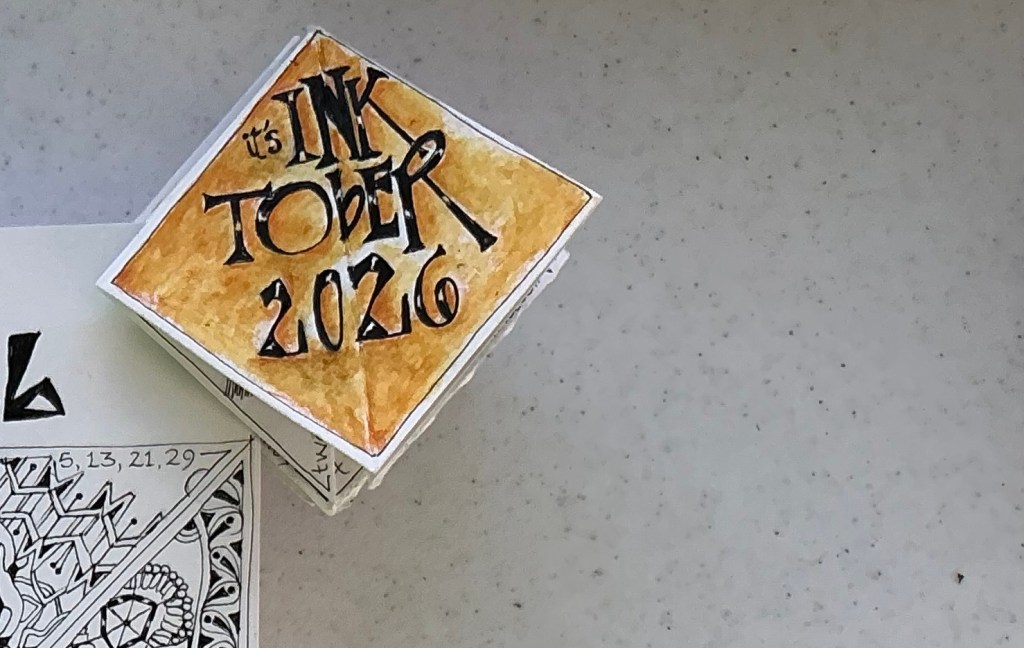
Cover of my 3-Square Fold booklet

To prepare for the Official Inktober 2026, I followed a step-by-step, 12-minute YouTube tutorial titled, “3-Square Fold.” This clever approach begins with three equal squares of paper (of any size) that are glued together in a certain way, and then folded down to make a standalone square-shaped booklet. It’s the specific folding method that defines 31 internal square- and triangle-shaped spaces, a front and back cover, and a spare square for notes, table of contents or whatever you wish. My three initial squares were 12cm x 12cm each, as suggested in the tutorial. This size resulted in a much smaller area than I typically work on, causing my illustrations to be small and simple. It was good practice though. However, if my squares were larger — even 18cm2 — my illustrations would’ve had more breathing room. But after having so much fun making this Inktober container, I made two more booklets to have for future projects!  To give this folded paper booklet a try, click this link.
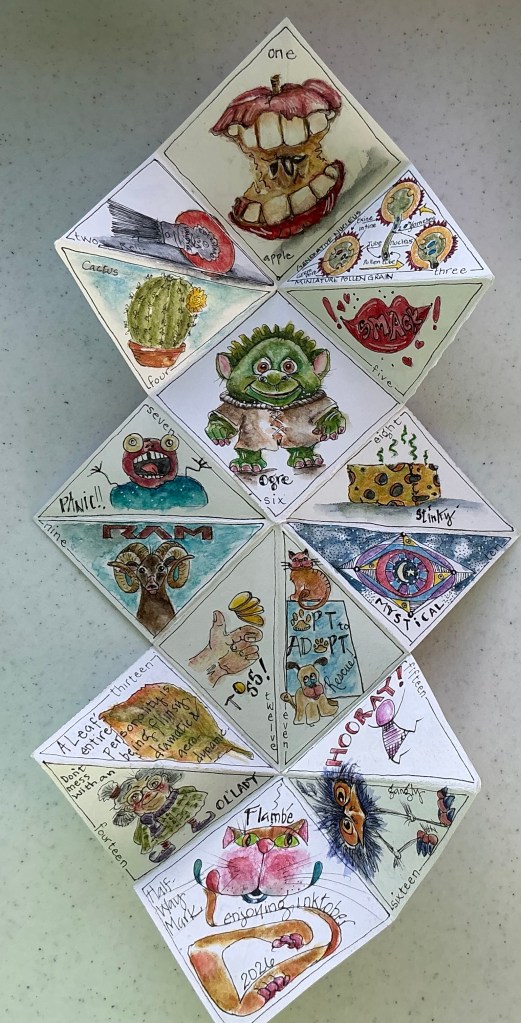
The unfolded 3-square fold booklet showing Illustrations for Inktober 2026 prompts 1-16 and a nod to Flambé

All of my illustrations were colored with watercolor pencils after drawn in ink.
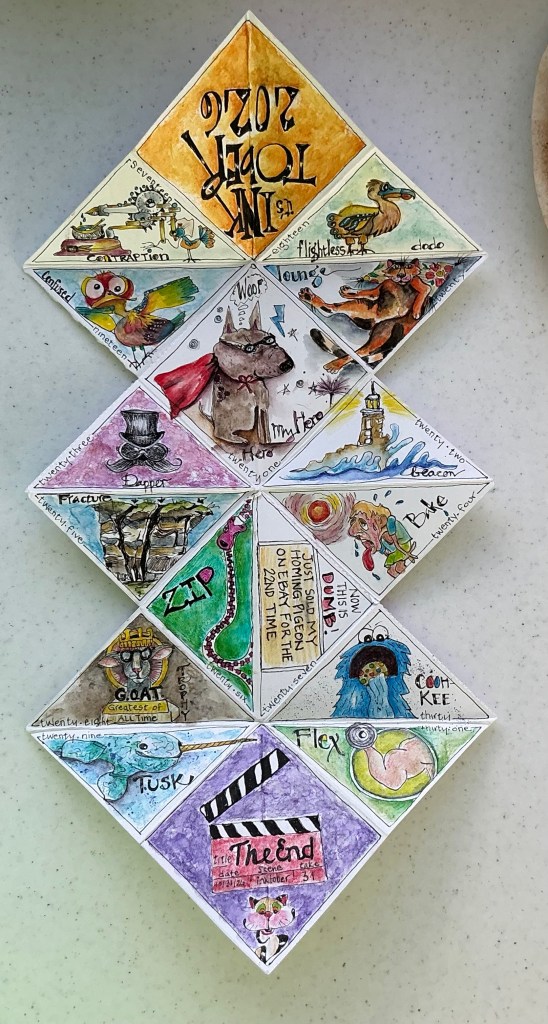
Unfolded 3-square fold booklet, flip side showing Inktober 2026 prompts 17-31 along with front and back covers
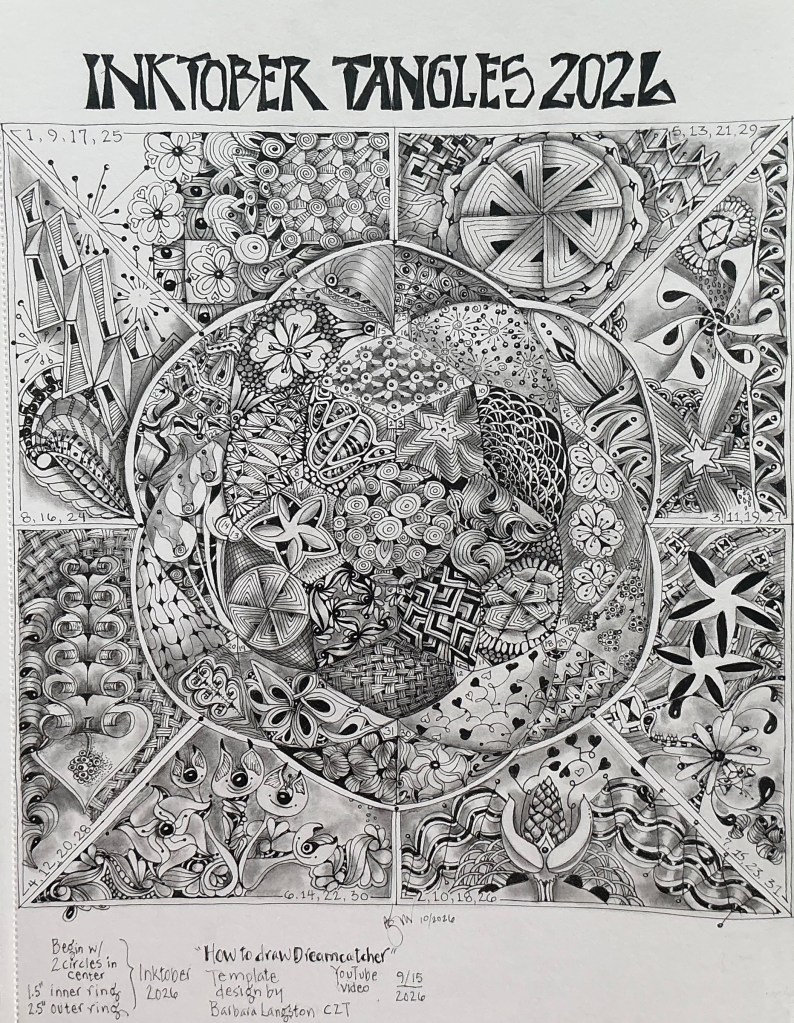
The finished Dreamcatcher design holding all 31 Zentangle patterns inside the Dreamcatcher, and in the 8 perimeter blocks – this image shows hours and hours of shading! Let me know if you spotted Flambé!

To prepare for the Official Zentangle Inktober Tangles 2026, I stumbled upon a lovely Dreamcatcher design developed by Barbara Langston—CZT (Certified Zentangle Instructor). Barbara’s 22-minute, step-by-step YouTube tutorial titled, “How to Draw the Dreamcatcher Template for Inktober Tangles” was designed to hold a space for each of the 31 patterns. My 9” x 12” paper size allowed me to place the Dreamcatcher into a 9” x 9” square, leaving room around the perimeter for eight large blocks. In these blocks I redrew up to five of the 31 patterns, in random order and without any repeats. This turned out to be a very busy and very full page — one that really satisfied my extreme love of detail!  Call me crazy! To try your hand at drawing this easier-than-it-looks Dreamcatcher, click this link.

All of the Zentangle patterns were drawn with a 005 micron pen.

This image shows the finished line work only – the ‘before’ look before all the shading shown in the previous image

As always, participating in the annual Inktober challenge was fun, rewarding, and motivating. And this year, by following official prompt lists, it was a great way to supplement my daily drawing practice with subjects very different from nature journaling.

Oh, and this year I followed the progress of several good friends who also had a great Inktober experience … Chris, who dared to draw the Dreamcatcher with perimeter blocks. She did a beautiful job filling up her page with all 31 Zentangle patterns, adding perfect touches of gold accents! ….. and Lunnette, who jumped outside the traditional ‘box’ with her “Leaf-tober.” Her challenge was to draw an Autumn leaf-a-day collected from her neighborhood.

Drop a comment to this post if you’ve ever participated Inktober, how you defined your unique challenge, and if you had fun.

Hope you enjoyed my Inktober 2026 creations.

Thanks for stopping by!
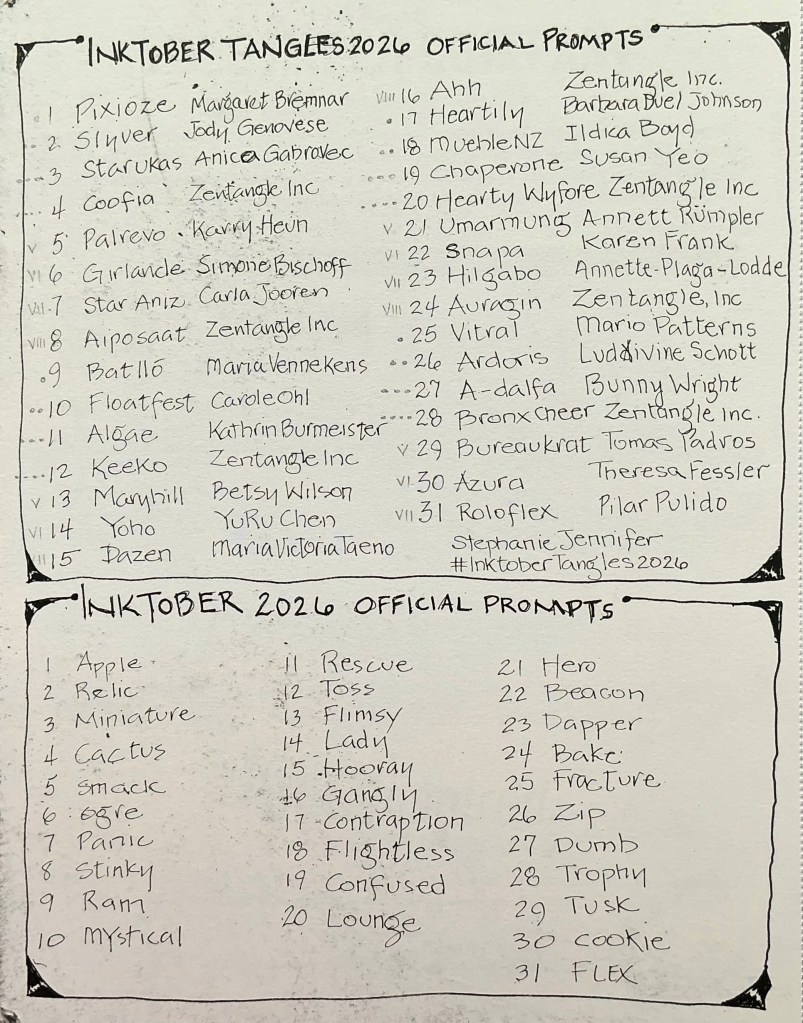
My hand written official prompts lists for Inktober 2026

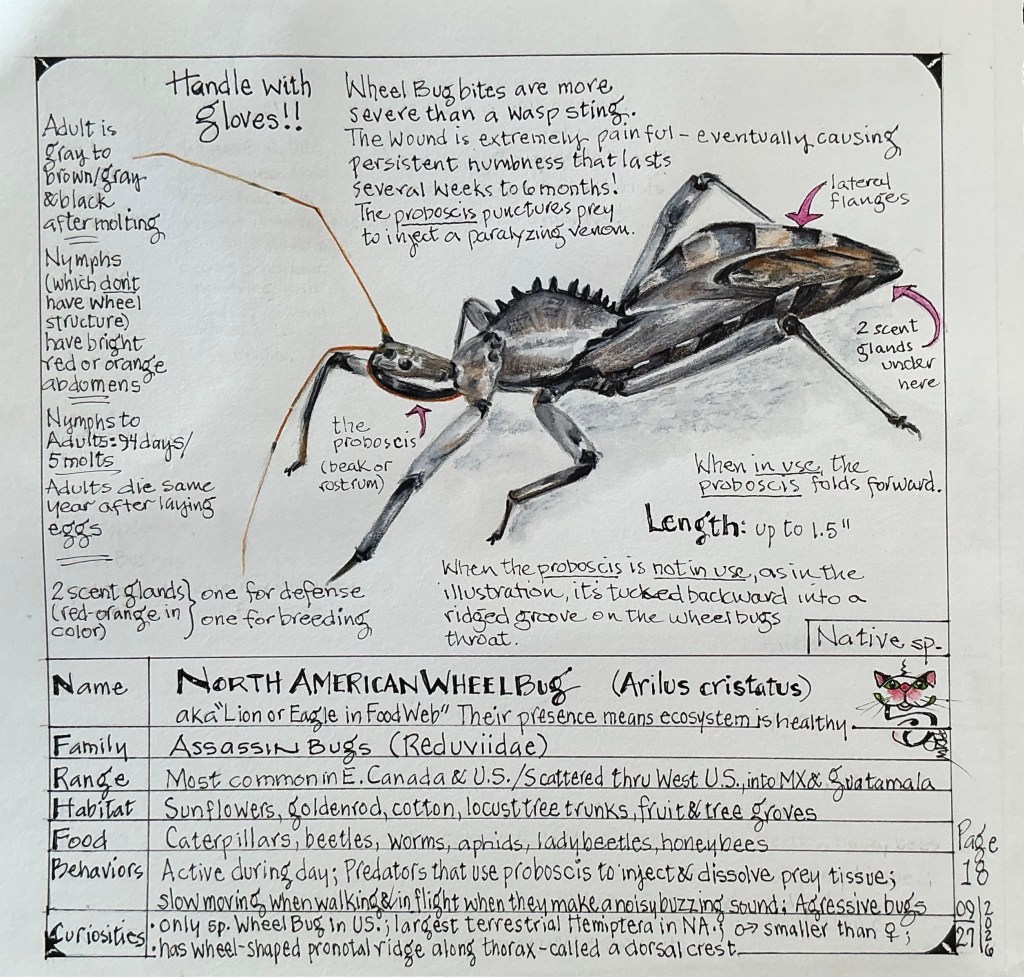
North American Wheel Bug – Page 18 .. The 100 Day Project (2026)

October 18, 2026

North American Wheel Bug (Arilus cristatus)

—aka—

“Lion or Eagle in the Food Web”

The first time a North American Wheel Bug crossed my path was in North Carolina. Instantly catching my attention, I was shocked. Not because of it’s size (oh my, she’s HUGE!), but because of the odd “deformity” on her back. I was certain this poor bug had to be in distress as she slowly lumbered across the road carrying half a spiky wheel-shaped disk growing from her back!

Back then I didn’t know much about bugs. But my insect field guide showed me this creature was a North American Wheel Bug, (Arilus cristatus), a species of assassin bug. As the only species of wheel bug found in the U.S., they are reported to be fairly common in the East. And that half cog-like wheel shape forming a prominent dorsal crest? Well that’s normal, and a distinguishing characteristic of the adults, both females and males. As it turned out, that lonely specimen was the first and only one I’d ever seen during the eight years we lived in NC.

Fast forward to New Mexico. Every Autumn since our 2017 relocation to the East Mountains, one or more adult wheel bugs have appeared on the ground and walking up the sides of our stucco-sided homes, always “toting” that instantly recognizable half toothy saw blade “stuck” in their thorax. I was happy to have these voracious predators as neighbors since they help control undesirable soft-bodied insect pests like caterpillars, worms and aphids. Also their presence indicates a healthy, pesticide-free ecosystem, despite preying on several ecologically beneficial species, like lady beetles and honey bees.

Handle With Gloves, Please!

Wheel bugs are predators. Like all assassin bugs1, they use their proboscis (the beak) to inject and dissolve prey into a slushie. Here’s how they hunt, kill, and eat:

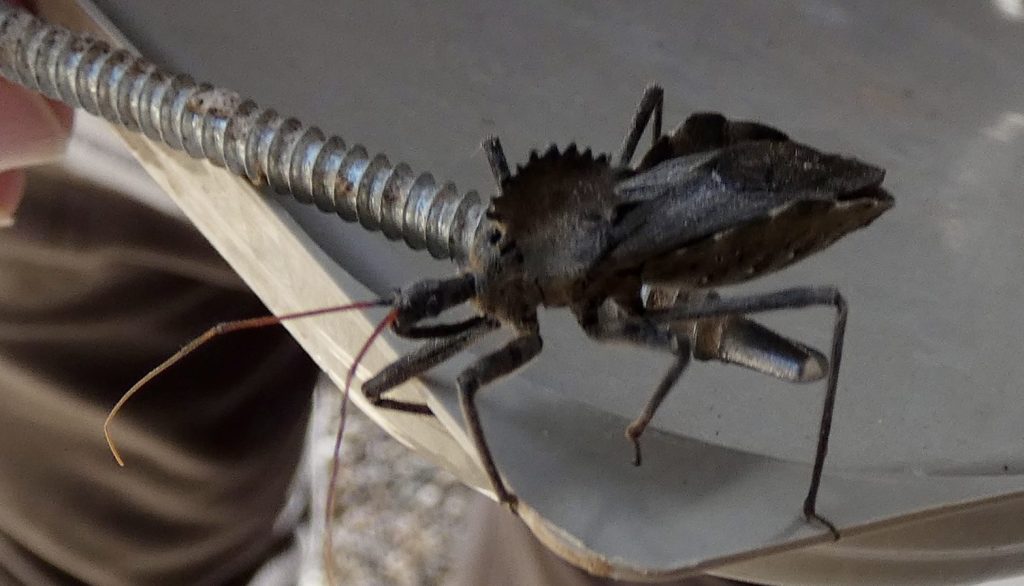
This was the Wheel Bug that inspired this page. She was being very carefully handled!

Predation is initiated by stalking. When “food” has been spotted, the wheel bug will ambush its prey, quickly gripping and pinning it with their front legs. The bug then plunges its unfolded beak into the victim before injecting it with a mixture of saliva, paralyzing venom, and digestive enzymes which dissolves its internal organs into liquid. Then the wheel bug uses the same hollow proboscis to suck out the liquefied contents, leaving behind an empty shell.

While obviously bad news for prey species, wheel bugs also wield their proboscis in defense against anything intent on causing them harm. If mishandled or threatened, they will jab humans with their proboscis, delivering a famously painful, burning bite. The pain is described as more intense than a wasp sting. Not considered to be highly venomous, the bite location can become heated and irritated followed by numbness that lasts from several weeks to 6 months. During the healing process a white crust sometimes forms around the wound that eventually deteriorates, leaving a small visible puncture.

1 Assassin Bug – most members of the family Reduviidae are fairly easy to recognize: they have a relatively narrow neck, sturdy build, and formidable curved proboscis (beak). Almost all species are predatory, except for a few blood-sucking species, some of which are important as disease vectors. About 7000 species have been described, making it one of the largest families in the Hemiptera (true bugs).

Scent Glands

Wheel bugs possess two red-orange scent glands located underneath their abdomen. These glands have two distinct chemical functions; one for defense against predators and one for breeding behaviors. The scent produced is not as powerful as that produced by stink bugs (like darkling beetles), but is still strong enough to be detected by humans.

What is that Noise?

Wheel bugs are capable of making audible sounds. They rub the tip of their proboscis in a groove under its thorax. Their reason for creating this sound is not known, but it’s thought to serve as a means of communication between members of the species. Wheel bugs also make a noisy buzzing sound during flight.

Reproduction

The reproductive cycle of wheel bugs begins in autumn. After mating, the female lays 40 to 200 small, brown, cylindrical eggs on trees, bushes, twigs, and other objects. She also secrets a gluey adhesive to adhere the eggs to the substrate and to keep the eggs in a cluster. Neither adult female or male wheel bugs overwinter.

The following spring, the eggs hatch into eight-millimeter-long nymphs with red abdomens that will undergo five molts until they reach the adult stage the following summer. The average length of each molt is about 19 days, with the interval of the 5th and final molt prior to the adult stage being the longest. Overall, eggs usually hatch at the beginning of May with nymphs maturing into adults by July, roughly over a 94 day period. However these timeframes may vary depending on climate, where populations that live in warm climates may not overwinter as eggs.

Note: Wheel bugs nymphs are predatory immediately upon hatching.

Another Note: The distinctive wheel-shaped dorsal crest appears only after the bug reaches the adult stage following the 5th and final molt.

And Yet Another Note! Wheel bugs are very aggressive in the wild, and cannibalistic behaviors between them have been observed. For example: nymphs may prey on one another; adult females may feed on the male after they’ve mated.

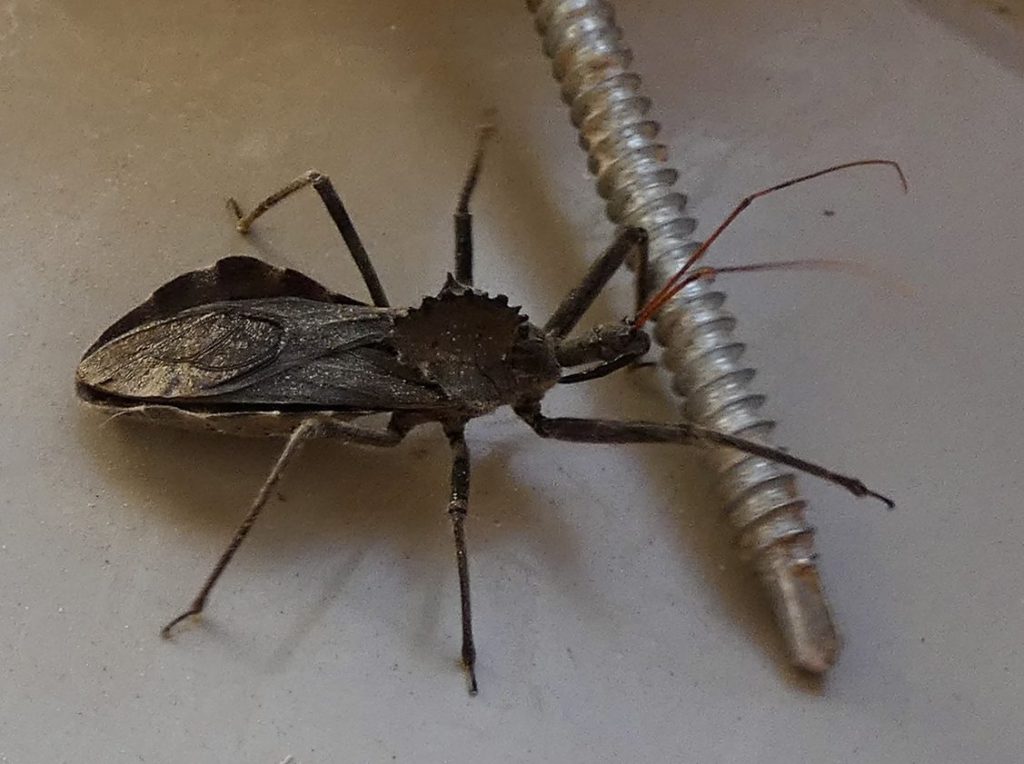
She was a very large Wheel Bug!

And that’s all for now, folks!

…………………………………………………………………………………………………

Have you ever seen a North American Wheel Bug? Maybe you’ve seen their mass of eggs? What about a nymph with a red abdomen?  If so, let me know!

Hope you found this interesting!

As always, thanks for rolling by!

References: iNaturalist.org; wikipedia.org

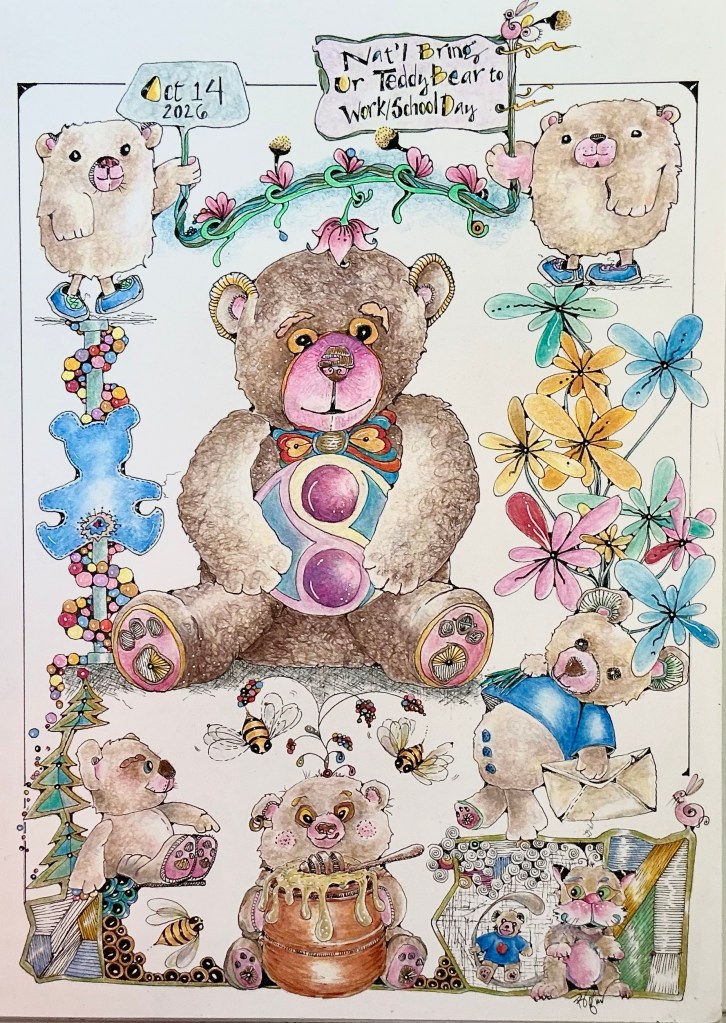
National “Bring Your Teddy Bear to Work/School” Day 

(or Anywhere You Can Think Of!)

October 14, 2026

Is that a Teddy Bear peeking over your colleague’s monitor? Do you know a teacher who just sat a 4-legged Teddy on their desk? Who was that father pushing his fuzzy Bear down aisle 7A selecting a breakfast cereal?  Really … a stuffed Bear hitching a ride-with-a-view from the top of a backpacker’s backpack as she climbs Mount Amazing? Why yes! But don’t be alarmed. It’s National “Bring Your Teddy Bear to Work/School” Day (or wherever you spend the day). This heartwarming National Day is a dedicated to embracing (literally) nostalgia and fun. 

Zentangle patterns: Bee’d, Infinitos, Bunny Buns, OSO, Patorrillo, Ripped Screen, Treeline, Droopy, Kev, Knot, Caviar, Holiday

What’s this Silliness All About?

Celebrated annually on every second Wednesday in October, National “Bring Your Teddy Bear to Work/School” Day is your official permission slip to let your cherished childhood companion tag along with you all day long. And quite likely you’ll find Teddy to be the best coworker or classmate, shopping trolley companion or hiking buddy you could ask for!

Do you remember your first Teddy Bear? Did he instantly became your first, and likely your forever, best friend? He was the one who knew all your secrets, stayed awake nights to keep the closet monsters at bay, and comforted you when sad, scared or sick. Teddy was always there. He was the keeper of your childhood tears and your biggest cheerleader.

As serious adults we spend our days working endlessly to meet deadlines and perform countless grown-up duties, returning home each night exhausted. But somehow we carry on thanks to the simple,  comforting presence of our Teddy Bear, who always greets us at the end of each day. Such a welcome breath of fresh, fuzzy air!  So why not, at least for one day, allow that best friend to join you at work or school, the market or even the great outdoors. It isn’t just silly—it’s a celebration! It’s guaranteed to put a smile on everyone’s face, spark the imagination, and start a conversation. It’s a stress-ball with a soul, a furry, low-maintenance mood booster, and a pure and simple delight.

How a Stuffed Bear Became a Toy Icon

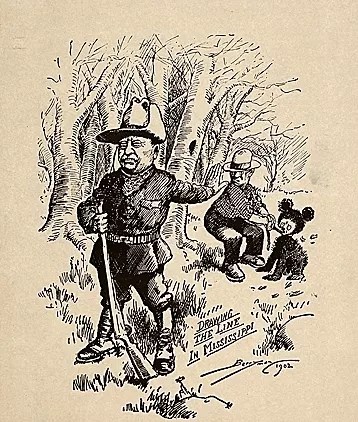
Teddy’s story begins, surprisingly, with a hunting trip and a moment of presidential sportsmanship. It was 1902, and President Theodore “Teddy” Roosevelt was hunting bear in the great state of Mississippi. After an unsuccessful day, his hunting party managed to corner and tie up a bear to a tree for the President to shoot. But Mr. Roosevelt, an avid hunter, refused to kill the bear, declaring it unsportsmanlike.

Word of the incident leaked to the press and the story quickly became national news.  Even Clifford Berryman, a well known political cartoonist of the times, immortalized the moment in The Washington Post (11/16/1902) with his cartoon depicting Roosevelt turning his back on the tethered bear. The cartoon became an instant classic.

The C. Berryman cartoon as it appeared in The Washington Post, November 16, 1902 (NPS)

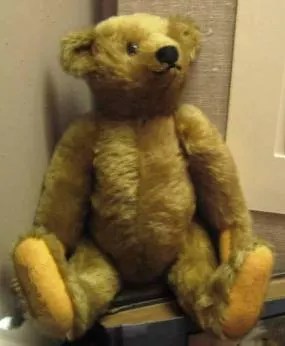
Instantly inspired by the Berryman cartoon, Morris Michtom, a New York candy store owner, along his wife Rose, created a stuffed bear cub. Michtom sent the bear to Roosevelt and asked for permission to call his creation  “Teddy’s Bear.” The President agreed, and voilà … a toy icon was born!

A replica of the first Teddy Bear created by Morris and Rose Michtom (NPS)

How Can I Join the Fun?

  1. Don’t let your Bear be a wallflower! Unabashedly introduce him to colleagues, classmates, and everyone you meet on this National Day. 
  2. As a new employee or teacher’s aide, Teddy will need a name tag and a fun job title like “Chief of Snack Inspection” or “Director of Naps.” At the food store, ask if he can volunteer to sample and rate speciality products like gummy bears, animal crackers, or “bear claw” pastries, to increase sales of these “bear-y delicious” treats. As a hiking buddy perched high on your backpack, Teddy can be your rear-view lookout — alerting you to dangers stealthily approaching from behind.  
  3. Have a little fun and take a photo your Teddy Bear “working” at the copier, “attending” a meeting, or “reading” a book in the library. Teddy might like to “push” the shopping cart, “point” at his favorite honey on the shelf, or “scan” items at the self-checkout station. Don’t forget to loan him your binoculars so he can “look” far down the trail for danger, or share your camera so he can “take photos” of the black bear mom and her three cubs standing right behind you!
  4. This is the perfect day to give a Teddy Bear to someone who needs a friend or a little encouragement. Organize a collection of new Teddy Bears to donate to a local children’s hospital, shelter, or first responders.
  5. Share the fuzzy fun online by posting pictures and stories using the hashtag  #BringYourTeddyBearToWorkSchoolDay.

………………………………………………………………………………………………………

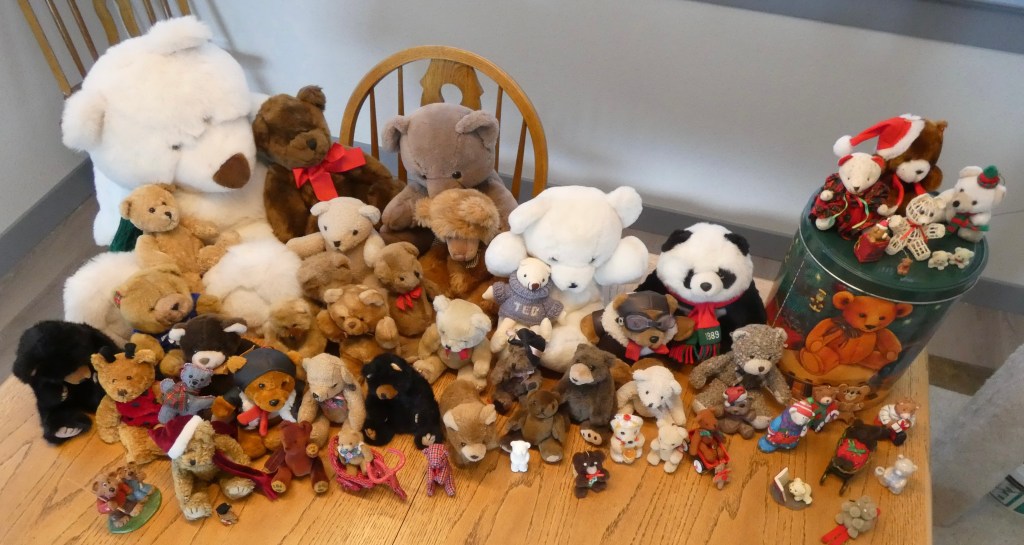
This amusing little post is dedicated to my sister-in-law, Larrie Jean — one of the most wonderfully influential and inspiring women I’ve ever had the good fortune to know and love. Her curious nature about the world and her sense of humor and good fun, resulted in her love of nearly everything imaginable, including Teddy Bears! When I discovered National “Bring Your Teddy Bear to Work/School” Day was an officially-designated National Day, I absolutely knew she would’ve celebrated with wild abandon, and most likely with each and every Teddy in her collection!  As the caretaker of Larrie Jean’s Bears (thanks Wendel!), from this year forward I’ll invite at least one of her Teddy Bears to spend this fun day with me celebrating a love of life and the “silly” in us all!

A sampling of Larrie Jean’s Bears

………………………………………………………………………………………………………

What is your Teddy Bear doing today?

As always, I couldn’t ‘bear’ it if you hadn’t stopped by!

A Walk in the Park

Star Dust Skies — ABQ

October 11, 2026

“Time spent amongst trees is never wasted time” — Katrina Mayer

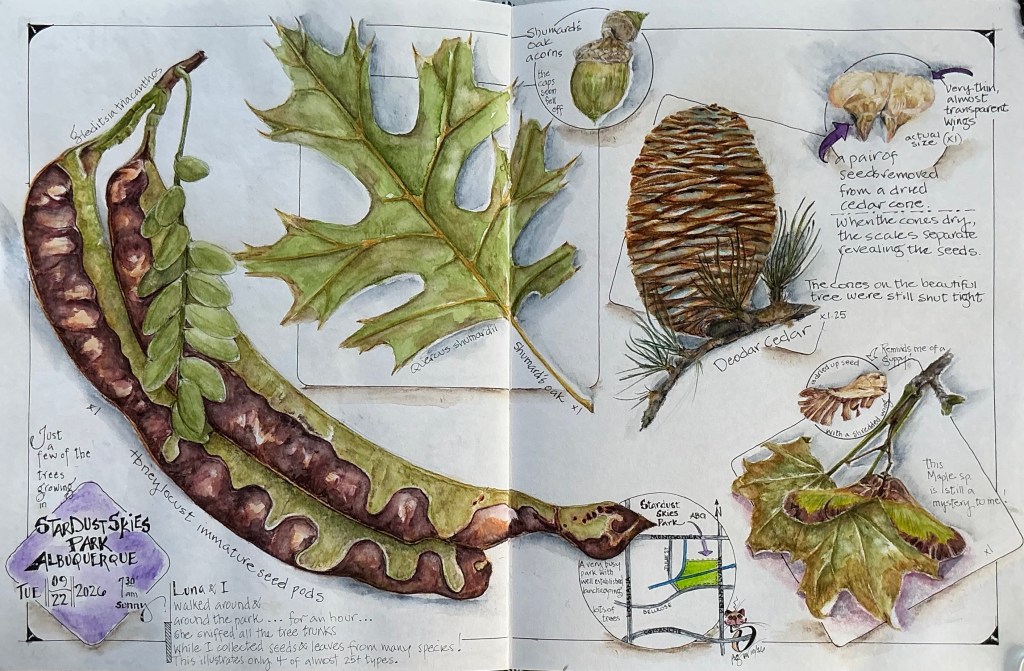
With nearly 300 public parks in Albuquerque (ABQ), it’s easy to find one beautifully landscaped with mature trees providing cool shade on a hot summer or fall day. The City’s Urban Forestry division manages roughly 25,000 trees within its parks, and when ‘in town,’ these parks feel like irresistible magnets reeling Luna and I in for an hour of discovery.  

Star Dust Skies Park is one we’ve visited many times ….. as it’s just behind our dentist’s office. So on the morning of September 22nd, while Roy was “lounging” in a reclining chair discussing a tooth extraction with the Doc, Luna informed me the neighboring Park was calling.

Like many other City parks, the canopies of the abundance of mature trees seemed to touch, almost entirely eliminating the direct sunshine from penetrating the underlying lawn. Our walk-about was cool and refreshing as Luna sniffed every single tree trunk while I searched for seeds, seed pods and cones to draw. 

As we moved from tree (trunk) to tree (trunk), I found myself wondering about the many non-native trees growing in the City. After all, ABQ is in the middle of a desert, in the middle of a drought (coincidentally, the 13 mile reach of the Rio Grande through town turned to sand from late May through mid-September 20261). Turns out the city has a water-wise urban forestry program; a permit must be obtained to plant a tree in a park, ensuring it is a drought-tolerant species. And growing trees in such an arid environment provides measurable annual benefits, like carbon sequestration, pollution reduction, and stormwater capture.

All of that (along with the other benefits of having established green spaces in the City) made me feel somewhat better about so many non-native trees in so many parks. 

After an hour or so, it was time to head home.  Both Luna and I were happy with our collections as we walked back to the dentist’s office  ….. mine, a bag full of interesting and new-to-me seeds, seed pods and a few cones; Luna, a nose full of exquisite aromas describing the life and times of at least three dozen dogs who roamed Star Dust Skies Park this fine morning.

Where have you discovered Nature lately?

As always, thanks for stopping by!

1 During 2026, major stretches of the Rio Grande through the Middle Rio Grande Valley (including 13 miles through central ABQ and southward) reached historic dryness levels, running dry for approximately three months; sections drying as early as late March and June. By late August, total dry river miles across the Middle Rio Grande Valley reached 112.4 miles (from Cochiti to Elephant Butte Reservoir), surpassing previous records. 

On September 3rd, water temporarily returned to the Rio Grande in ABQ, after a 650-million-gallon release was ordered from the Abiquiú Reservoir for a brief three-day research and environmental rewetting period. But it wasn’t until September 18th, that consistent late-summer rains finally brought natural flows back to the river around ABQ.