Lessons in Experimenting
May 17, 2026
“I have been careless, and so have been thwarted by luck and chance, those wreckers of all but the best laid plans.” ~ J. K. Rowling
Have you ever set foot in a place of business and the first thing you laid eyes on became yours?
That’s exactly what happened to me on April 13th ….
Adoption
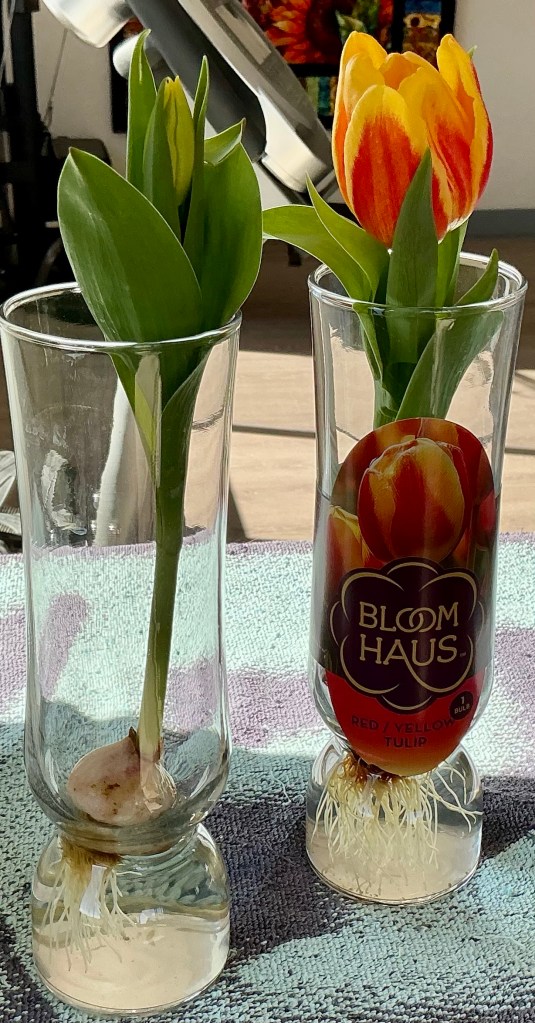
Upon entering a local grocery store, I immediately fell in love with a beautiful display of tulips growing in glass vases, their rooted bulbs producing bright spring green leaves surrounding fledgling flower buds and blossoms! Without hesitation (or consulting my shopping list), two healthy looking plants landed in my buggy! Like a proud parent, I proudly carted these treasures about while finding the actual items on my list, all the while justifying such a frivolous selection (the lovely tulip nearly in full bloom would be a gift for a dear friend; the other with a wee whisper of a bud would be mine to ‘nature journal’).
Nature Journaling
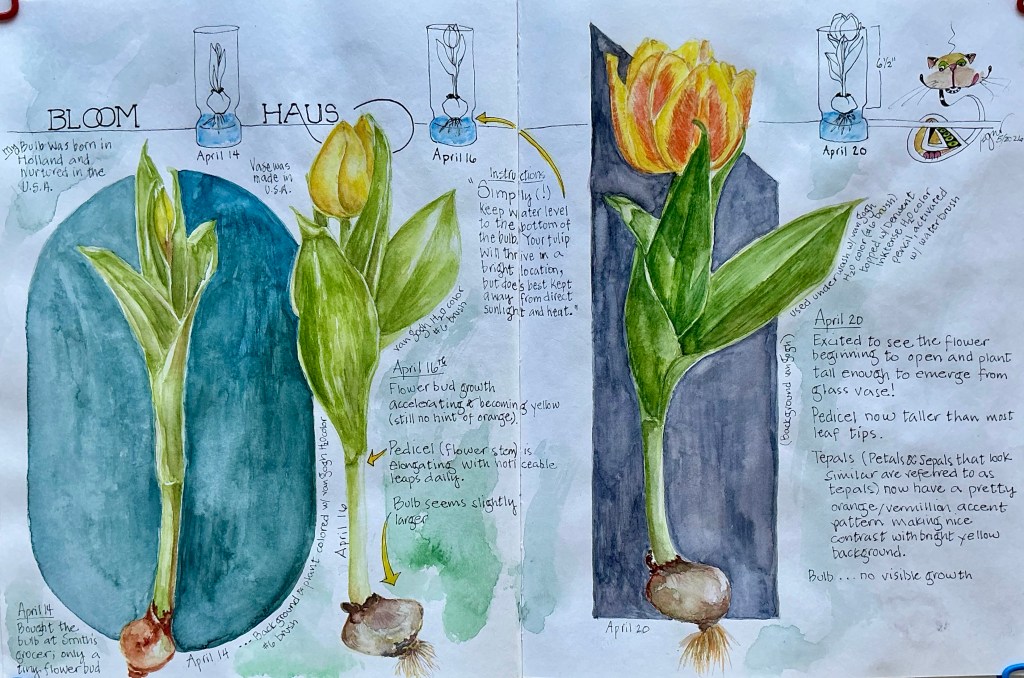
In a few days, my friend was enjoying her new tulip, and I was busy charting the growth of mine in my nature journal. It was amazing how quickly that little bud grew. When it broke free of the vase’s rim the petals and sepals (tepals) began to open, and the yellow became more intense while their centers grew more orange. It was very exciting to see these changes.
Disaster
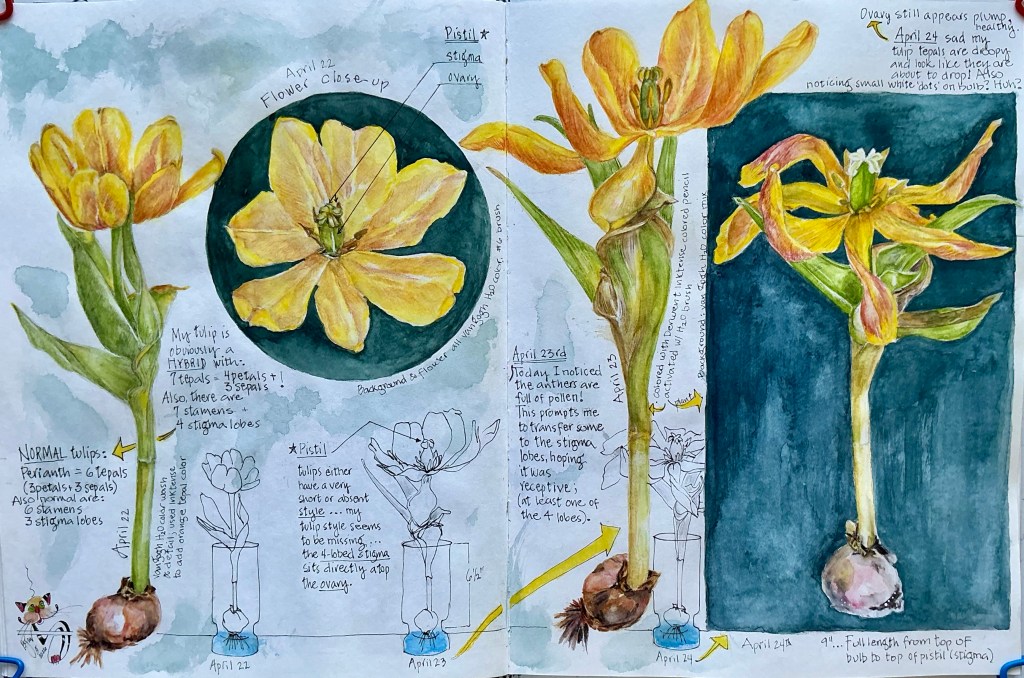
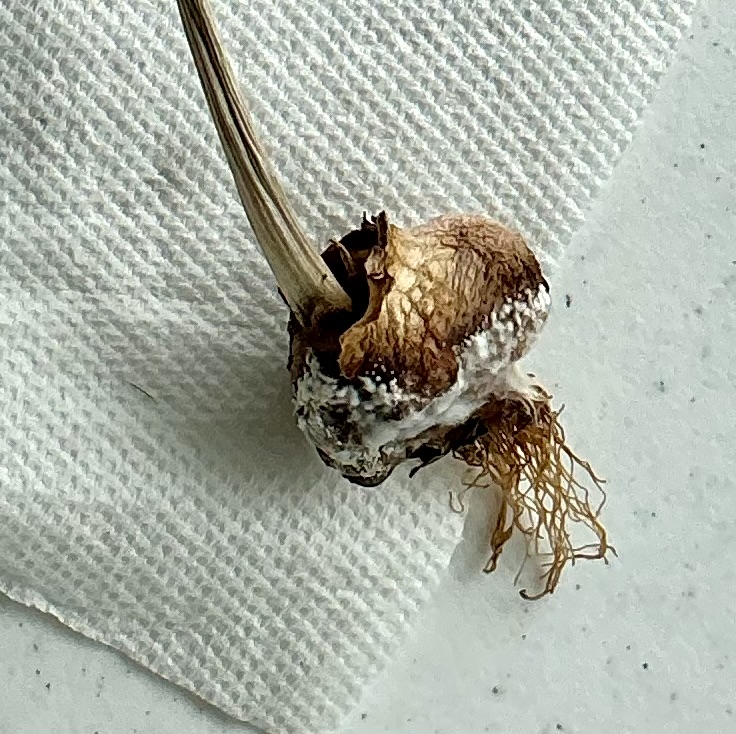
Then on April 24th, something changed. Tiny white dots appeared on the bulb’s papery cover (the tunic) and the tepals drooped. Over the next few days, the white dot population steadily expanded over the bottom of the bulb, along with soft white threads that seemed to reach out from the dots. Mold! A fungus was aggressively devouring the poor defenseless tulip bulb! Why and could it be saved?
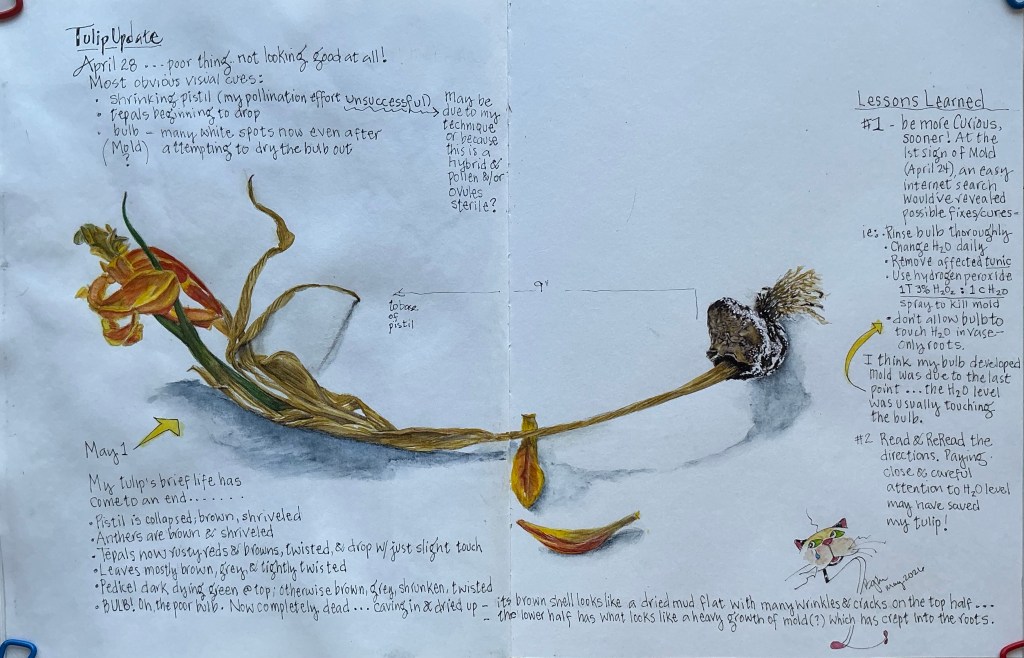
Although I’d been careful not to submerge the bottom of the bulb in water, the occasional slip-up had occurred. That, combined with the poor ventilation in the vase and the presence of fungal spores that float naturally in the air made for the perfect mold-loving environment. Even the use of filtered water wasn’t precaution enough to prevent this disaster. Even after gently rinsing the bulb, cleaning the vase and replacing the water with fresh, wasn’t remedy soon enough to save the bulb. The brief life of my adopted tulip had come to an end.
Lessons Learned
Following the demise of my tulip, I scoured the internet for diagnostic clues of a fungal attack and effective first aid. Apparently moldy fungus growth on tulip bulbs is very common, and I learned quite a bit about identifying and treating it in my post-bulb moments. Most importantly, never having grown a bulb of any kind in water (hydroponically), had I begun my aquaculture experiment by searching for helpful tips, my tulip bulb may still be alive. That’s my hindsight lesson.
However, knowing full well my passion for research into any and all things, had I 1) paused just a ‘sec’ and admitted to my lack of knowledge and experience in hydroponic tulip rearing, and 2) gone home to conducti my research in a careful and thorough manner, and 3) returned the next day to buy the two tulips, well ….. they might’ve been sold! (In fact I did return the following day and noticed the tulip display was gone.)
There’s something to be said for spontaneity!
“It’s good to be prepared, but spontaneity is very important — just to let yourself go and let it be whatever it is.” ~ Aron Eisenberg
If you’ve successfully raised a bulbed plant in water, what precautions did you take? If you’ve had an encounter with bulb mold, if you were able to stop it’s rapid spread, what measures did you take to save the bulb?
Hope you enjoyed journal pages I created to chart the life and death of my tulip bulb. Because I was conducting an experiment in hydroponics, I decided to experiment with various watercolor techniques, including trying out something new in adding backgrounds. Please let me know if and which compositions and/or colors you liked. I found experimenting with different watercolor materials and color mixing added valuable lessons for future journal pages. (On my pages I provided a brief description of what was used to color each stage of growth.)
As always, thanks for coming along on my nature journaling journey!

