“Time spent amongst trees is never wasted time” — Katrina Mayer
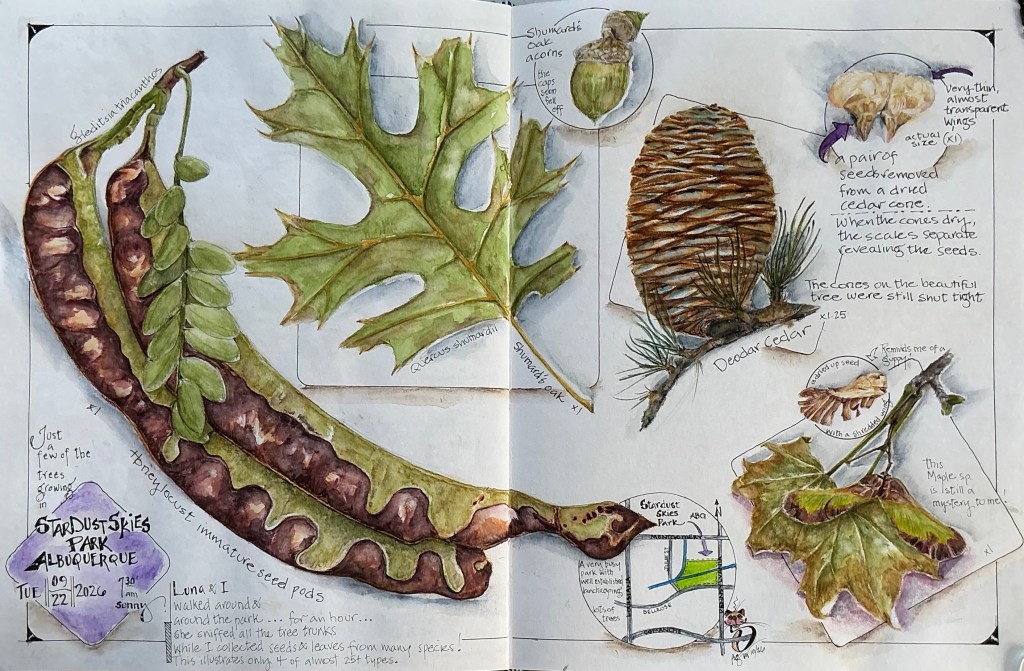
With nearly 300 public parks in Albuquerque (ABQ), it’s easy to find one beautifully landscaped with mature trees providing cool shade on a hot summer or fall day. The City’s Urban Forestry division manages roughly 25,000 trees within its parks, and when ‘in town,’ these parks feel like irresistible magnets reeling Luna and I in for an hour of discovery.
Star Dust Skies Park is one we’ve visited many times ….. as it’s just behind our dentist’s office. So on the morning of September 22nd, while Roy was “lounging” in a reclining chair discussing a tooth extraction with the Doc, Luna informed me the neighboring Park was calling.
Like many other City parks, the canopies of the abundance of mature trees seemed to touch, almost entirely eliminating the direct sunshine from penetrating the underlying lawn. Our walk-about was cool and refreshing as Luna sniffed every single tree trunk while I searched for seeds, seed pods and cones to draw.
As we moved from tree (trunk) to tree (trunk), I found myself wondering about the many non-native trees growing in the City. After all, ABQ is in the middle of a desert, in the middle of a drought (coincidentally, the 13 mile reach of the Rio Grande through town turned to sand from late May through mid-September 20261). Turns out the city has a water-wise urban forestry program; a permit must be obtained to plant a tree in a park, ensuring it is a drought-tolerant species. And growing trees in such an arid environment provides measurable annual benefits, like carbon sequestration, pollution reduction, and stormwater capture.
All of that (along with the other benefits of having established green spaces in the City) made me feel somewhat better about so many non-native trees in so many parks.
After an hour or so, it was time to head home. Both Luna and I were happy with our collections as we walked back to the dentist’s office ….. mine, a bag full of interesting and new-to-me seeds, seed pods and a few cones; Luna, a nose full of exquisite aromas describing the life and times of at least three dozen dogs who roamed Star Dust Skies Park this fine morning.
Where have you discovered Nature lately?
As always, thanks for stopping by!
1 During 2026, major stretches of the Rio Grande through the Middle Rio Grande Valley (including 13 miles through central ABQ and southward) reached historic dryness levels, running dry for approximately three months; sections drying as early as late March and June. By late August, total dry river miles across the Middle Rio Grande Valley reached 112.4 miles (from Cochiti to Elephant Butte Reservoir), surpassing previous records.
On September 3rd, water temporarily returned to the Rio Grande in ABQ, after a 650-million-gallon release was ordered from the Abiquiú Reservoir for a brief three-day research and environmental rewetting period. But it wasn’t until September 18th, that consistent late-summer rains finally brought natural flows back to the river around ABQ.
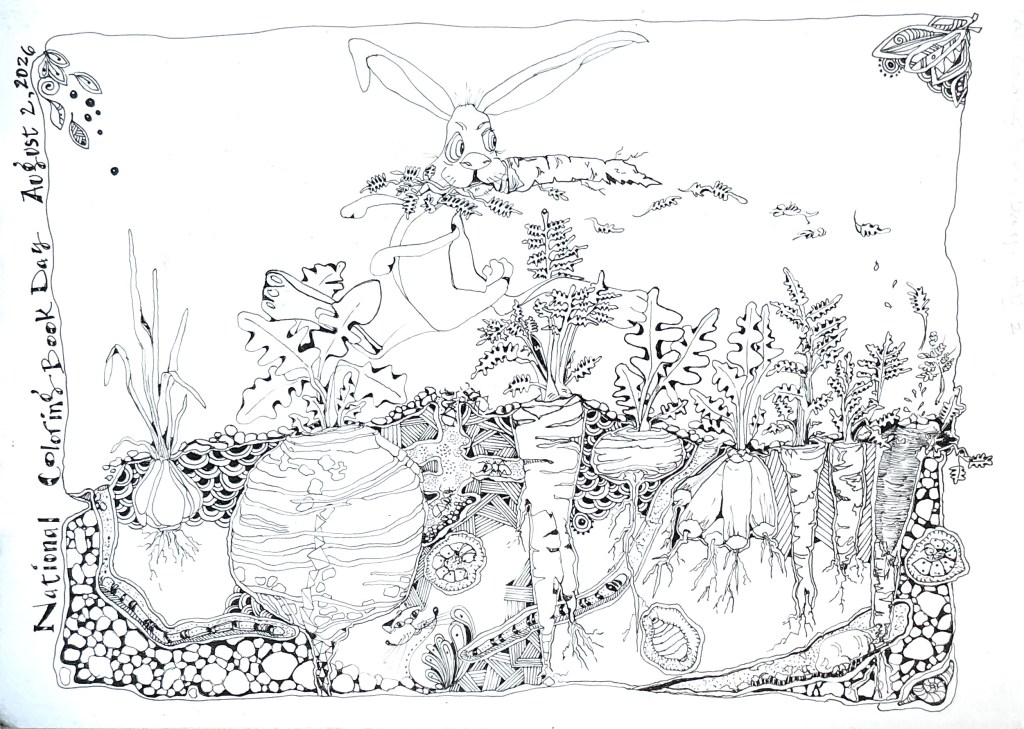
Who doesn’t remember coloring as a kid? Not only on brilliant bright white walls (haha!) but especially in a favorite coloring book. An activity that’s been popular with children for decades, adult coloring became a “thing” in the early 1960s. Anyone taking the time to color, find it fun and often educational. But the subtle benefits of coloring for both children and adults go much deeper.
Origin of National Coloring Book Day – Founded in 1941, Dover Publications, a company that’s been publishing adult coloring books since 1970, declared a National Coloring Book Day in May 2015. Taking their lead, and to make the day official, the Registrar at National Day Calendar declared National Coloring Book Day to be observed annually on August 2nd.
The year was 1879 when the first-of-its-kind “coloring book,” The Little Folks’ Painting Book, was published by McLoughlin Brothers (today known as the Milton Bradley Company). This book, meant to be painted with watercolors, became very popular — so much so that during the 1880s-1920s, educators and illustrators created a flurry of drawings for many more painting books that everyone could afford, not just the rich. These books, illustrating a wide range of topics, was a way to democratize art by making art available to all and encouraging artistic creativity, especially among children.
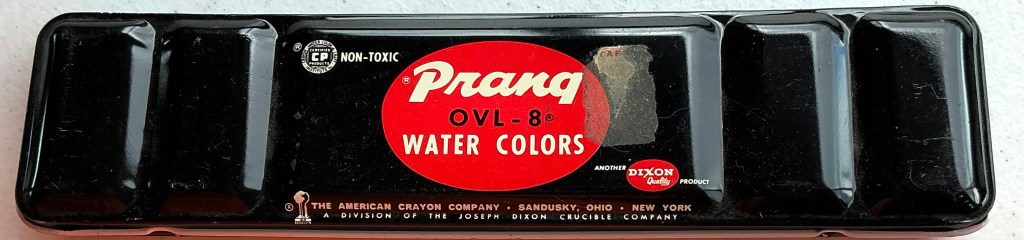
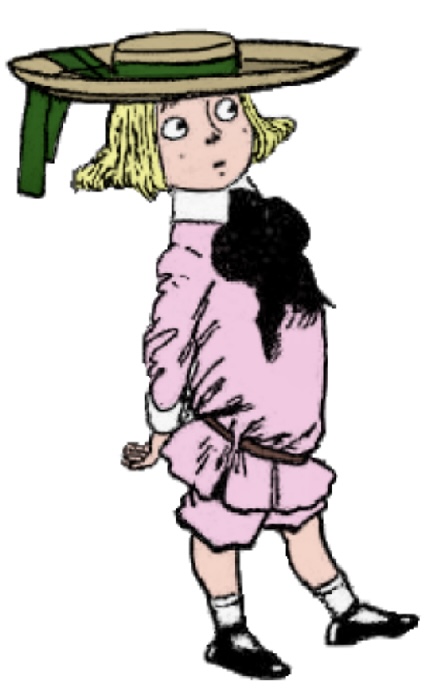
Of course there were other pioneers in painting books, such as including Louis Prang1 (I still have my first set of Prang watercolors!) and Richard F. Outcault2 (of Buster Brown fame).
Enter the Crayon! – Even after wax crayons were mass-produced in 1903 (read about the fascinating history of crayons in my 2024 post Happy National Crayon Day), the painting books were still largely designed to be painted. The transition of painting books to coloring books finally happened between the 1930s and 1940s, although the books were still designed to be painted as well as colored. This period of time is usually referred to as the golden age of childhood coloring.
Make Way Kids! – In 1961, adult coloring books became a cultural phenomenon with the release of The Executive Coloring Book, a satirical guide meant to mock corporate conformity. This somewhat controversial coloring book paved the way for the massive obsession with adult coloring books in the 2010s.
Learning Through Coloring – A picture is worth a thousand words! Since the 1980s, several publishers have produced educational coloring books intended for studying graduate-level topics like anatomy and physiology. This approach for teaching complicated subjects uses color-coding of highly detailed diagrams as a learning aid. Examples include The Anatomy Coloring Book, and others in the series covering topics in zoology, biology, human evolution, and botany. These coloring books and countless others specializing in educating people of all ages often have textbook quality descriptions accompanying each image.
Coloring as Meditation, and Other Benefits – It’s long been known that the practice of coloring in a coloring book, is a great way to relax, reduce anxiety and stress, and release your inner child in ways similar to meditation. Coloring helps create focus, and can develop fine motor skills and vision. Coloring books are often used as tools in rehabilitation of accident victims to aid recovery of hand-eye coordination. They are used with autistic children both for entertainment and for their soothing effect. Coloring books are also used to reduce the trauma of hospitalized children by explaining complicated medical conditions and/or their upcoming surgical procedure.
With so many colors and designs to choose from, coloring books offers enjoyment in so many settings, especially since they’re portable and come in a variety of sizes.
Take coloring books on vacation with you for rainy days or to document a fun memory.
Coloring books make great gifts any time of year. When someone visits, be sure to leave a coloring book and colors in the guest room for downtime. At the office, keep a variety of books in the breakroom for co-workers to fill up.
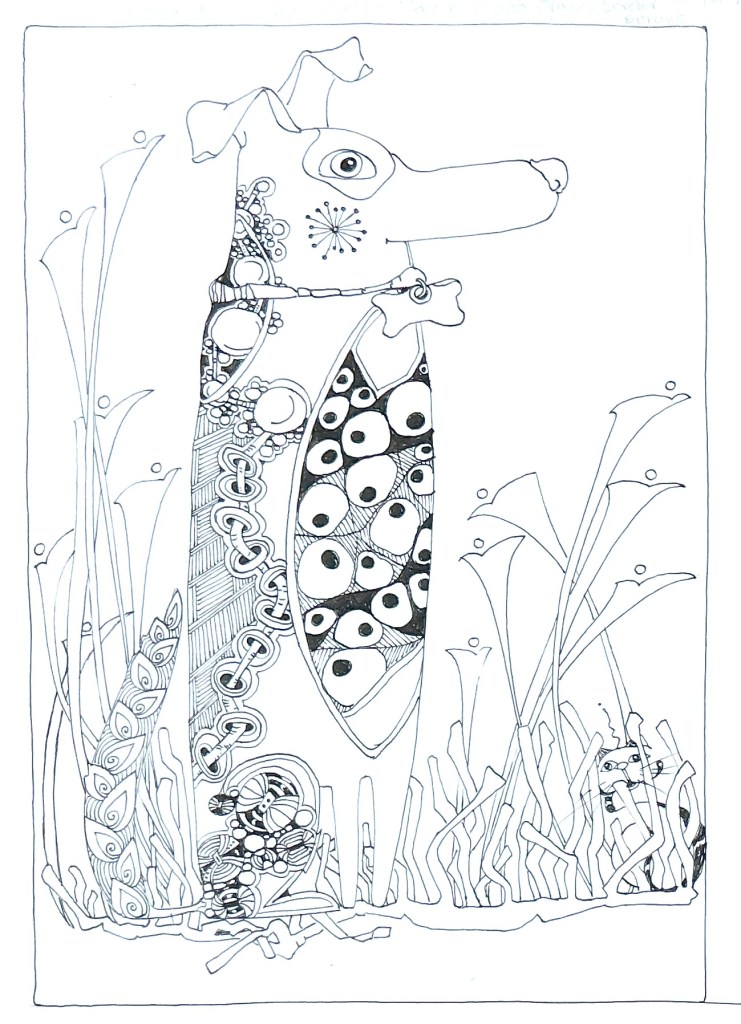
Next Steps – To get your National Coloring Book Day celebration off to a fun start, you’re invited to:
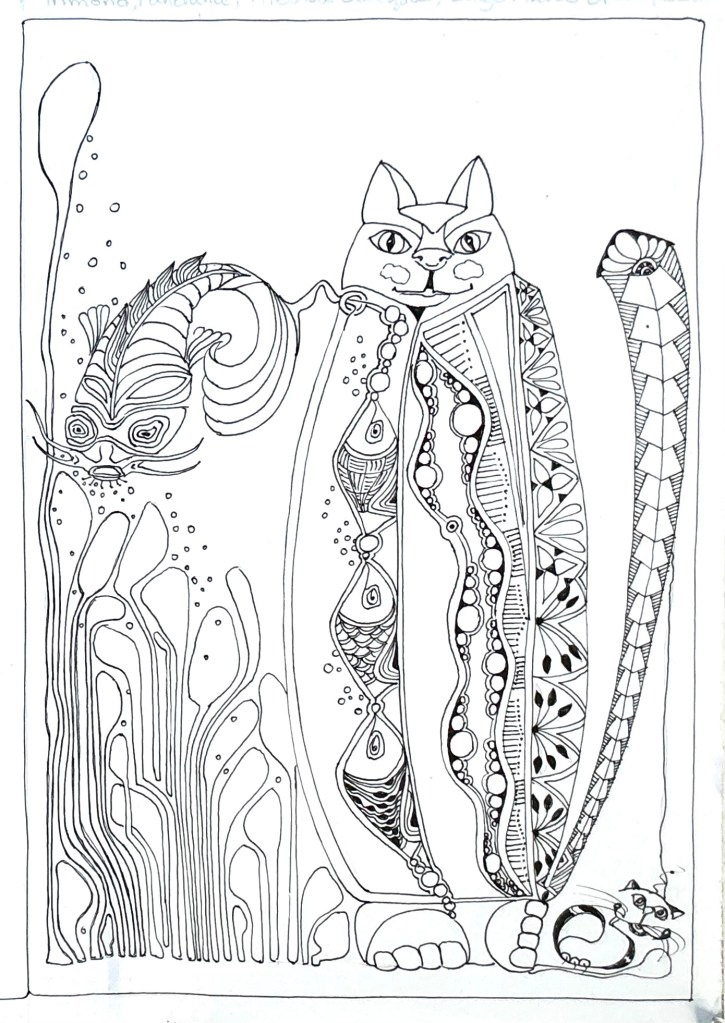
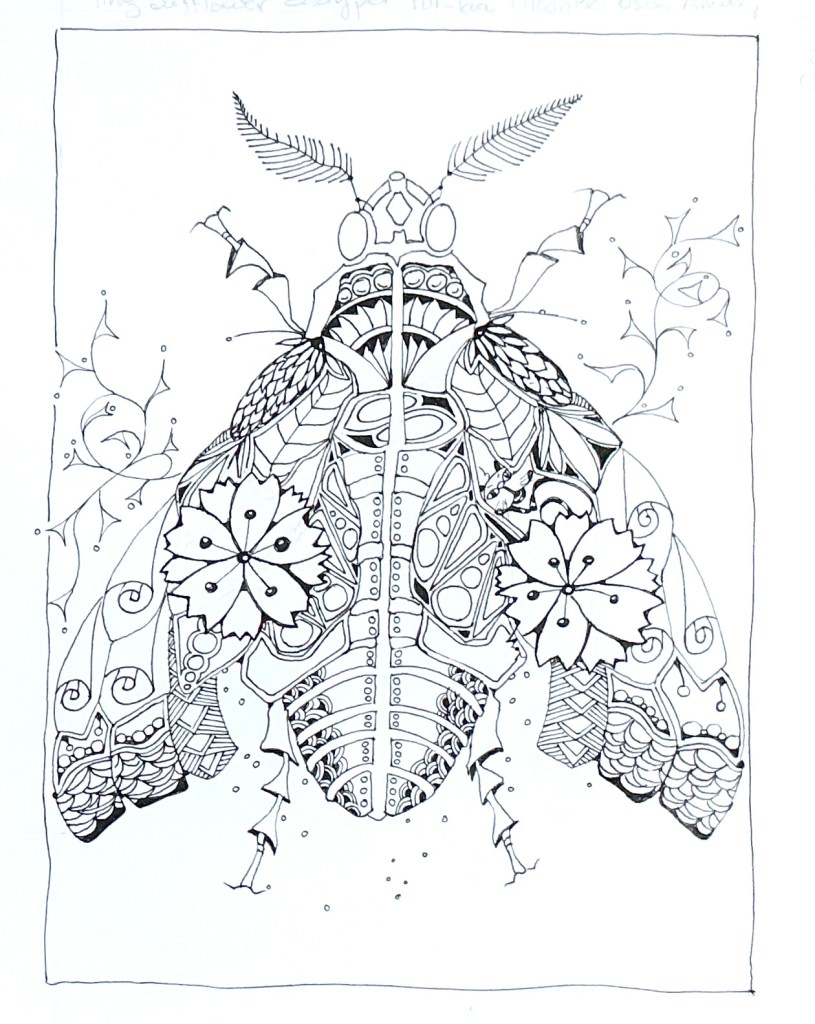
pick one (or all) of my illustrations to download and print — or create your own;
color it (them) with any single or combination of media you like or have never used before. Try watercolor with colored pencil. How about watercolor pencil! Use colorful ink markers for a vibrant effect. Choose pastels or even pan pastels, or both. Water soluble inks or tinted graphite might be your cuppa tea;
share your colored page(s) with me by emailing barb.masinton@gmail.com so I can post them on my blog (if you give me permission) AND/OR share your page(s) on social media – tagging #NationalColoringBookDay (keep following my blog to see how my colored pages turn out);
add a comment to my post letting me know if you accepted my invitation and describe your experience … did you realize any of the benefits of coloring described in my post? Most of all, did you have fun?
Happy National Coloring Book Day!
1Louis Prang (1824 – 1909), often referred to as the “Father of the American Christmas Card,” was a German-American printer whose goal was that every child have access to safe art tools. He created Prang watercolors in 1856 — affordable, non-toxic, moist pan watercolor sets designed specifically for public school student art education. As the founder of the Prang Educational Company in 1882, he supplied classrooms with all sorts of art supplies, launched art textbooks, and developed the Prang Method of instruction in the 1870s and 1880s. The American Crayon Company acquired Prang’s art lines in 1909, eventually becoming part of Dixon Ticonderoga.
My first watercolor set …. Long, long …… long ago!Inside my Prang watercolor set — the original pans but not the original brush (which wore out years ago).
2 Richard F. Outcault (1863 – 1928) was an American cartoonist who pioneered the modern comic strip. Creator of the character Buster Brown and his dog Tige, Outcault authored Buster’s Paint Book in 1907, launching a trend in using coloring books to advertise a wide variety of products, including coffee and pianos. In the early 1900s, Outcault licensed the name “Buster Brown” for use in a wide number of consumer products, including children’s shoes manufactured by the Brown Shoe Company (today known as Caleres, owner of Famous Footwear, Naturalizer, Dr. Scholl’s comfort shoes and a long list of luxury and athletic brands). Since 1904, the “Buster Brown” character and Tige have been Company mascots, appearing in television commercials (1940s and ‘50s) and in comics advertising their shoes. Both Buster Brown and Tige were revived with an updated, more contemporary look for a brief advertising campaign in the 1980s and 1990s.
“I have been careless, and so have been thwarted by luck and chance, those wreckers of all but the best laid plans.” ~ J. K. Rowling
Have you ever set foot in a place of business and the first thing you laid eyes on became yours?
That’s exactly what happened to me on April 13th ….
Adoption
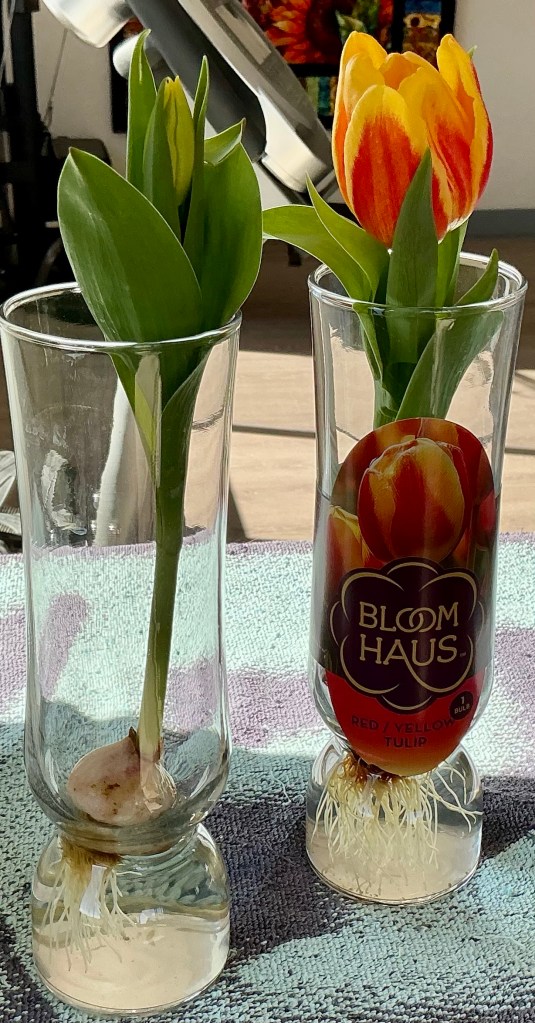
Upon entering a local grocery store, I immediately fell in love with a beautiful display of tulips growing in glass vases, their rooted bulbs producing bright spring green leaves surrounding fledgling flower buds and blossoms! Without hesitation (or consulting my shopping list), two healthy looking plants landed in my buggy! Like a proud parent, I proudly carted these treasures about while finding the actual items on my list, all the while justifying such a frivolous selection (the lovely tulip nearly in full bloom would be a gift for a dear friend; the other with a wee whisper of a bud would be mine to ‘nature journal’).
Nature Journaling
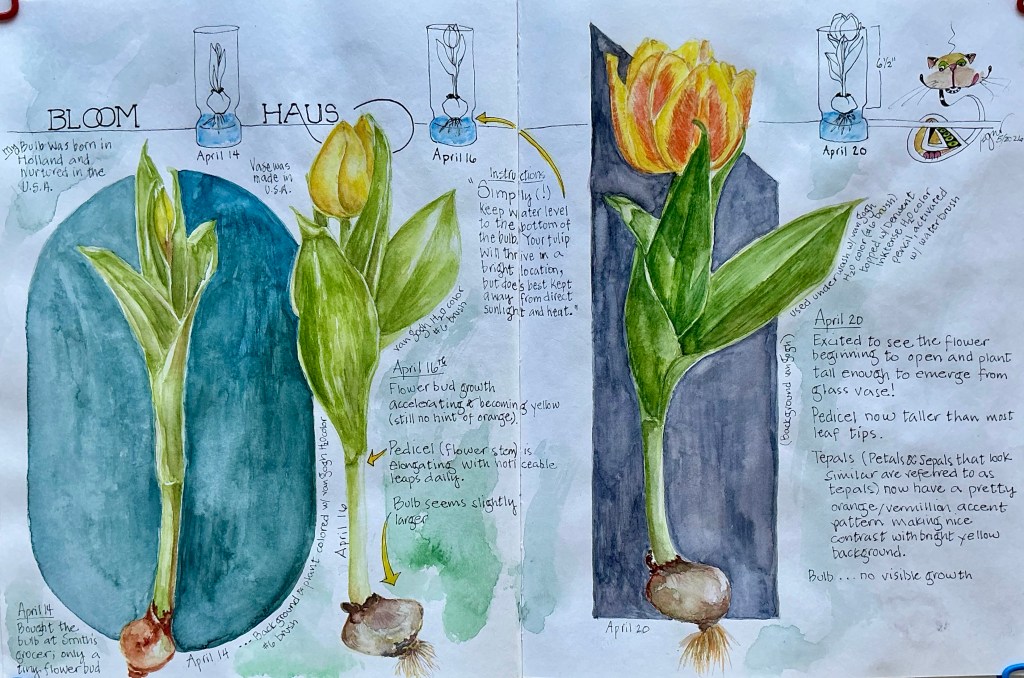
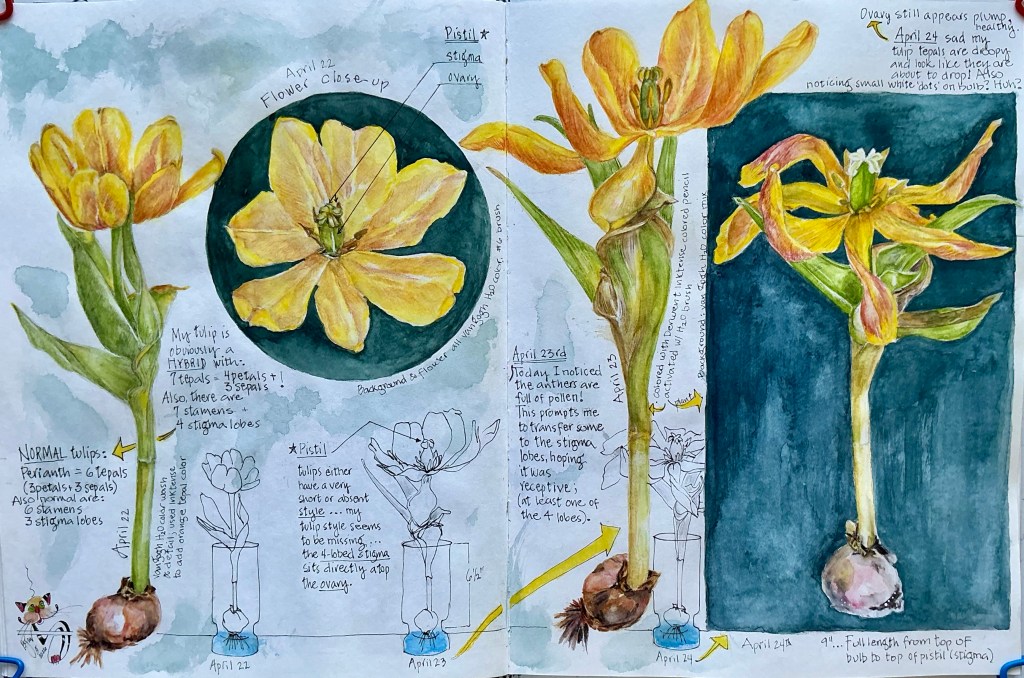
In a few days, my friend was enjoying her new tulip, and I was busy charting the growth of mine in my nature journal. It was amazing how quickly that little bud grew. When it broke free of the vase’s rim the petals and sepals (tepals) began to open, and the yellow became more intense while their centers grew more orange. It was very exciting to see these changes.
Disaster
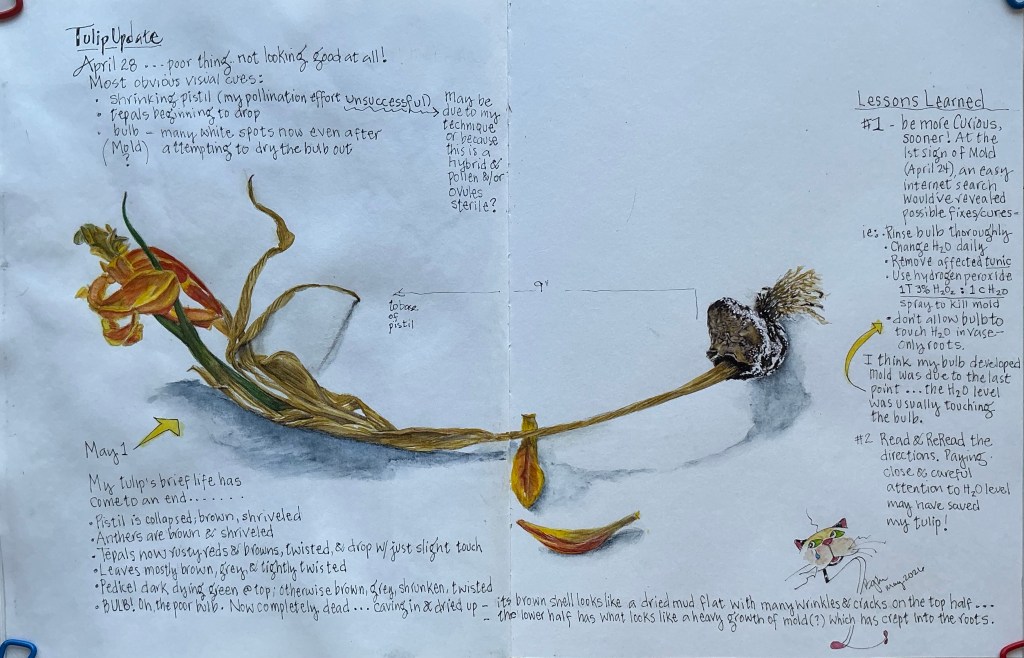
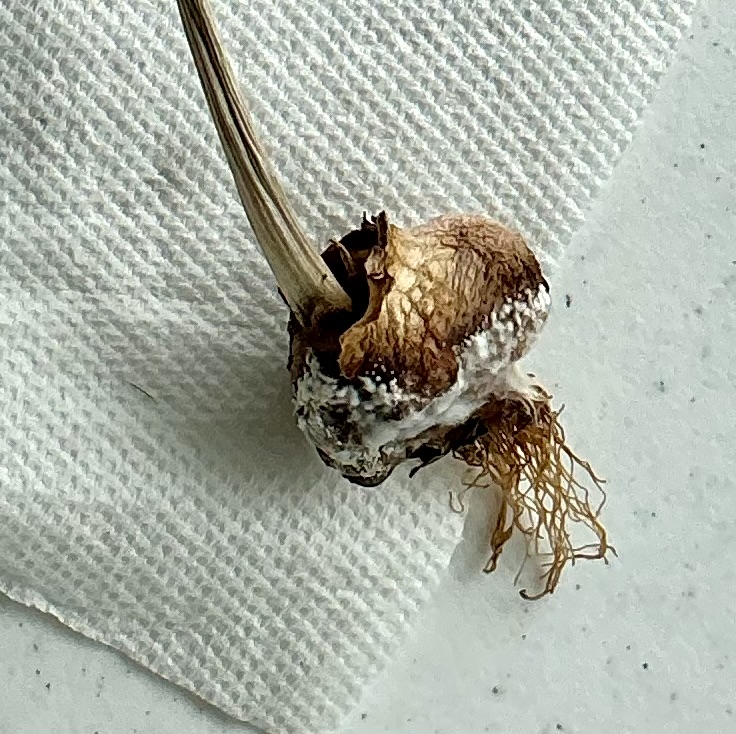
Then on April 24th, something changed. Tiny white dots appeared on the bulb’s papery cover (the tunic) and the tepals drooped. Over the next few days, the white dot population steadily expanded over the bottom of the bulb, along with soft white threads that seemed to reach out from the dots. Mold! A fungus was aggressively devouring the poor defenseless tulip bulb! Why and could it be saved?
Although I’d been careful not to submerge the bottom of the bulb in water, the occasional slip-up had occurred. That, combined with the poor ventilation in the vase and the presence of fungal spores that float naturally in the air made for the perfect mold-loving environment. Even the use of filtered water wasn’t precaution enough to prevent this disaster. Even after gently rinsing the bulb, cleaning the vase and replacing the water with fresh, wasn’t remedy soon enough to save the bulb. The brief life of my adopted tulip had come to an end.
Lessons Learned
Following the demise of my tulip, I scoured the internet for diagnostic clues of a fungal attack and effective first aid. Apparently moldy fungus growth on tulip bulbs is very common, and I learned quite a bit about identifying and treating it in my post-bulb moments. Most importantly, never having grown a bulb of any kind in water (hydroponically), had I begun my aquaculture experiment by searching for helpful tips, my tulip bulb may still be alive. That’s my hindsight lesson.
However, knowing full well my passion for research into any and all things, had I 1) paused just a ‘sec’ and admitted to my lack of knowledge and experience in hydroponic tulip rearing, and 2) gone home to conducti my research in a careful and thorough manner, and 3) returned the next day to buy the two tulips, well ….. they might’ve been sold! (In fact I did return the following day and noticed the tulip display was gone.)
There’s something to be said for spontaneity!
“It’s good to be prepared, but spontaneity is very important — just to let yourself go and let it be whatever it is.” ~ Aron Eisenberg
If you’ve successfully raised a bulbed plant in water, what precautions did you take? If you’ve had an encounter with bulb mold, if you were able to stop it’s rapid spread, what measures did you take to save the bulb?
Hope you enjoyed journal pages I created to chart the life and death of my tulip bulb. Because I was conducting an experiment in hydroponics, I decided to experiment with various watercolor techniques, including trying out something new in adding backgrounds. Please let me know if and which compositions and/or colors you liked. I found experimenting with different watercolor materials and color mixing added valuable lessons for future journal pages. (On my pages I provided a brief description of what was used to color each stage of growth.)
As always, thanks for coming along on my nature journaling journey!
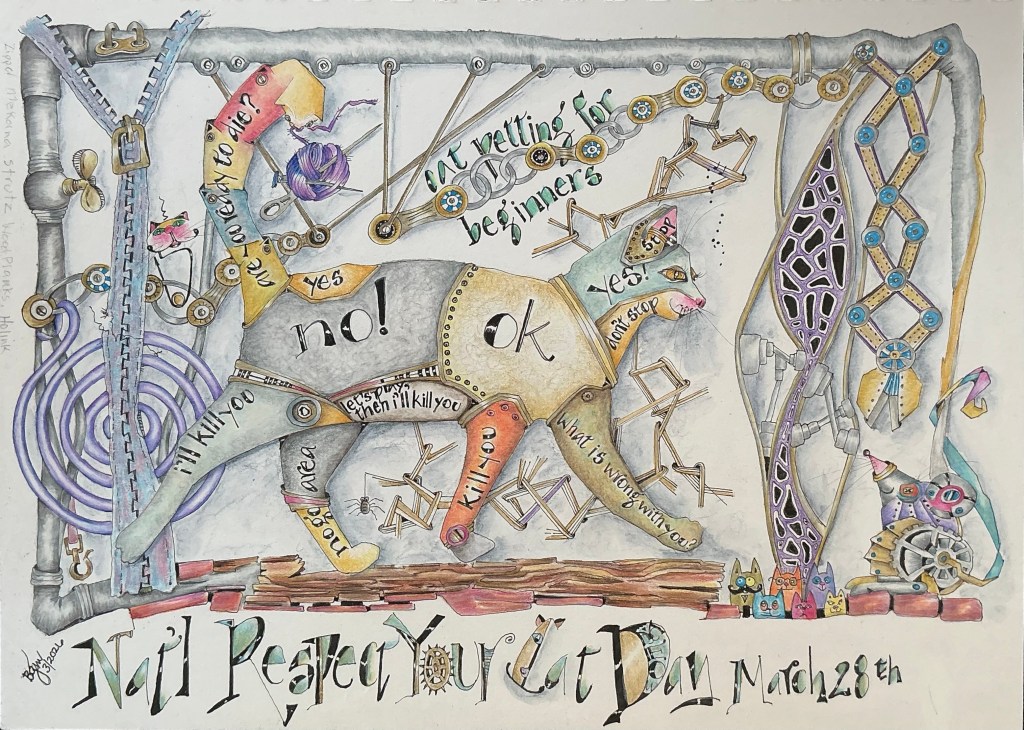
Zentangle patterns: Zipper, Mekorna, Strutz, Wood Planks, Holink, and a wild assortment of Zentangle steampunk patterns and steampunk ideas.
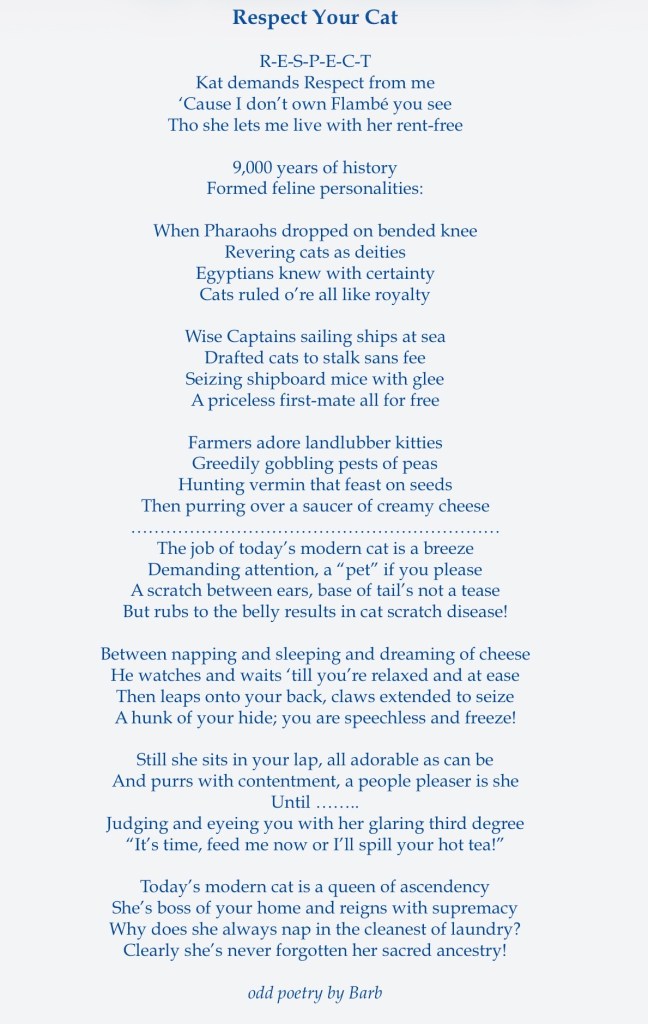
On March 28th, we stop pretending we’re the bosses and lean into the reality of National Respect Your Cat Day. On this National Day, acknowledge the truth: Your cat is better than you. Well? Someone had to say it! And if you don’t believe it, just ask your feline friend!
Do you ‘own’ your cat? Or does your cat ‘own’ you?
If you answered “Yes” to the first question, you may be utterly and completely confused about the subordinate role you play in the life of your resident feline. If you said “Yes” to question #2, and have willingly resigned to to being a pushover due to unconditional love, you obviously are an experienced cat chaperone.
If you’re contemplating becoming a first time cat owner, well, good luck and have fun! Oh, and here’s some tips not only for living happily with a cat, but perhaps there’s a few ideas for all feline chaperones on how to celebrate National Respect Your Cat Day. These pointers will hopefully help you avoid catching a good swat in the process:
Keep an open door policy in your home. Once you acknowledge that a closed door (even a bathroom door) is a personal insult to a cat, you will avoid an irritable feline. Just because a cat is hanging out in a room for a long period of time doesn’t mean they want to stay there. They like to travel freely when they choose to.
Use a slow blink when looking at your cat. In their language, blinking slowly is the ultimate sign of respect, trust, and true friendship. If you encounter your cat while wondering through your house, stop and make intense eye contact, then offer him a slow-blink to maintain your friendship.
Respect the nap-zones. Cats spend up to 15 hours a day napping. Let them sleep where they want. If they fall asleep on your laptop, you obviously don’t need to check your e-mail. Are they sleeping on your lap? Moving before their nap is over will cause you to get claws poking through your jeans, causing the most hideous scratch. A cat knows their worth. Let them nap.
The petting rule. Know the difference between a “nice” pet and a “you can quit now” pet. If you want be sure your cat is up for some affection, we recommend petting the cat for about 5 seconds, then pulling your hand away. If your cat wants more, they’ll show you with a bossy nudge. If they want to be left alone, they’ll probably swat at you.
Say your sorry. Has your cat every fallen off of a counter? Did they look at you like you pushed them? Of course you did! Cats don’t just lose their balance. You’re the problem (even if you’re not). Just say you’re sorry so they can move on with their day.
Who was the creator of National Respect Your Cat Day?
No one knows for sure. The most likely possibility is this day was founded by a cat who learned how to type while its human fell asleep on the keyboard.
Afterward …..
In addition to owning our 9 year old pit/lab ‘puppy,’ Luna, Roy and I share our home with two 12 year old indoor cats, Odo and Dax, a brother and sister we adopted as kittens from a shelter in North Carolina. When we moved to New Mexico in 2017, both cats rode in the car with me. For four long days and 2000 miles across country, the three of us ‘enjoyed’ many boisterous sing-alongs and stimulating conversations! Roy’s journey was much more peaceful!
Over the last 53+ years we’ve joyfully chaperoned ten cats total. All wonderful, all different, all lovable and unforgettable! The names of those we hold in our memories were Popeye, Poopsie, Tails, Fishbait, Darwin, Grizzz, Newt (who was our sailor cat and Captain aboard the S.V. Waterdog), and T.O.O.
Now we have Odo and Dax to carry on their legacy, and with Luna (and Flambé, of course!) we love and adore them all!
Share you cat stories, and what you do to “Respect” your feline family!
A Poetic Medieval Adventure Birthday Card for Elaine
March 24, 2026
If you’ve followed my blog for a few years, you may recall an annual post in late February or early March featuring my handmade birthday cards with one of my poems created for my most excellent and dear friend Elaine. Because she loves goats, all of the cards I’ve sent her include a variety of my goat illustrations. No ‘kidding!’ And because she’s an extraordinary poet, I try my best to write a unique poem following the rules of a lesser known (at least to me) style, and reprint my words somewhere inside the card. My efforts at poetry are usually hilarious (I would never call myself a poet), but always prompts Elaine to write a fantastic reciprocal poem in the same style.
The major prompt I follow every year is simply …… Have Fun! But I strictly observe a few rules, or else! (Or else this annual project would take me half a year to complete!) Haha!
Rule 1: Think of a theme. This year I had castles on my mind (I don’t know why), so illustrations could focus on things Medieval. You know, towers and moats, knights and shields.
Rule 2: Find a style of poetry that would not only work with my theme, but has a high probability of generating a bunch of belly laughs while I wrote it and while Elaine read it. Next, write the poem. This year I chose to write a Paradelle (a parody on the Villanelle-style poem) that has high comedy potential. Also, the history behind the Paradelle was a hoot …. claiming to have been developed in the 11th Century (fitting my Medieval theme), but was actually introduced in the 20th Century (so I included the history behind the Paradelle in the card and below so you can read it for yourself).
Rule 3: Design and make an accordion card that would comfortably hold all the illustrations and the poem (and the history and rules of a Paradelle-style poem). Issue A ….. at this stage of the project, the illustrations and the poem were still vivid parts of my imagination. Exactly what would be an appropriately-sized accordion book? Hmmmmm? Issue Z ……. because I tend to have grandiose project ideas, the accordion book ended up being, well, grandiose! The outside cover panel was 9”x9” . and with two inside front-facing panels and a front-facing back panel, the entire length of the accordion book, unfolded, was nearly 3 feet long!
Rule 4: Complete the entire project during the first 3 weeks of February, allowing 1 week for mailing from central New Mexico to western North Carolina, arriving in time for Elaine’s birthday on February 28th (her birthday is actually on the 29th, but in years that don’t “leap” she always parties on the 28th). Not being able to complete the card until late the first week of March, I blew this rule, but did send her a ‘place-holder’ birthday puzzle of an underwater fantasy castle atop a sea turtle (alerting Elaine it contained an embedded hint of her actual “gift card” which finally arrived on 16th).
The following photos were taken of the pages from Elaine’s 2026 birthday card.
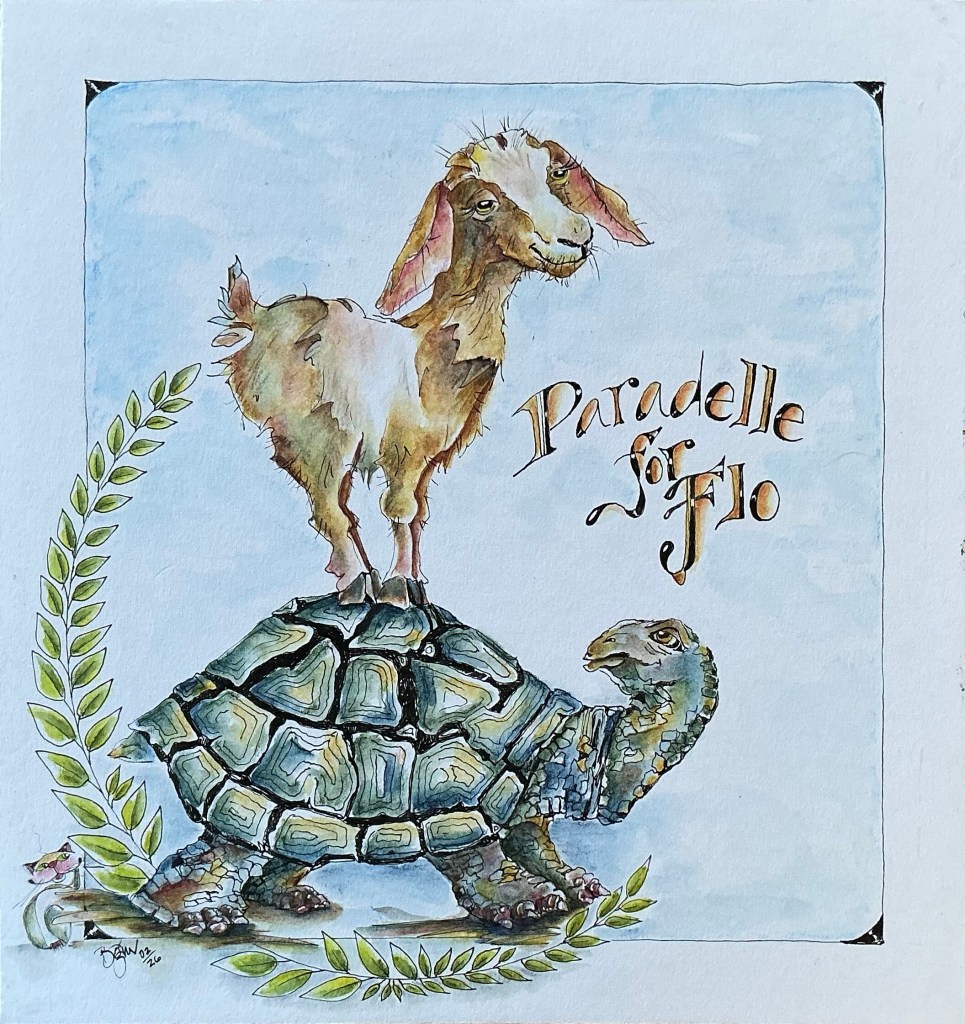
The cover panel, 9”x9”. I had to introduce a tortoise to tie together the card with the ‘place-holder’ gift she received in time for her birthday. Of course, a goat! Flambé approves!
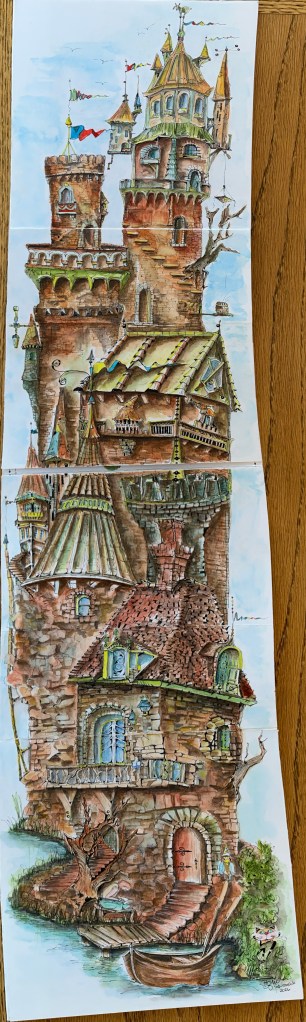
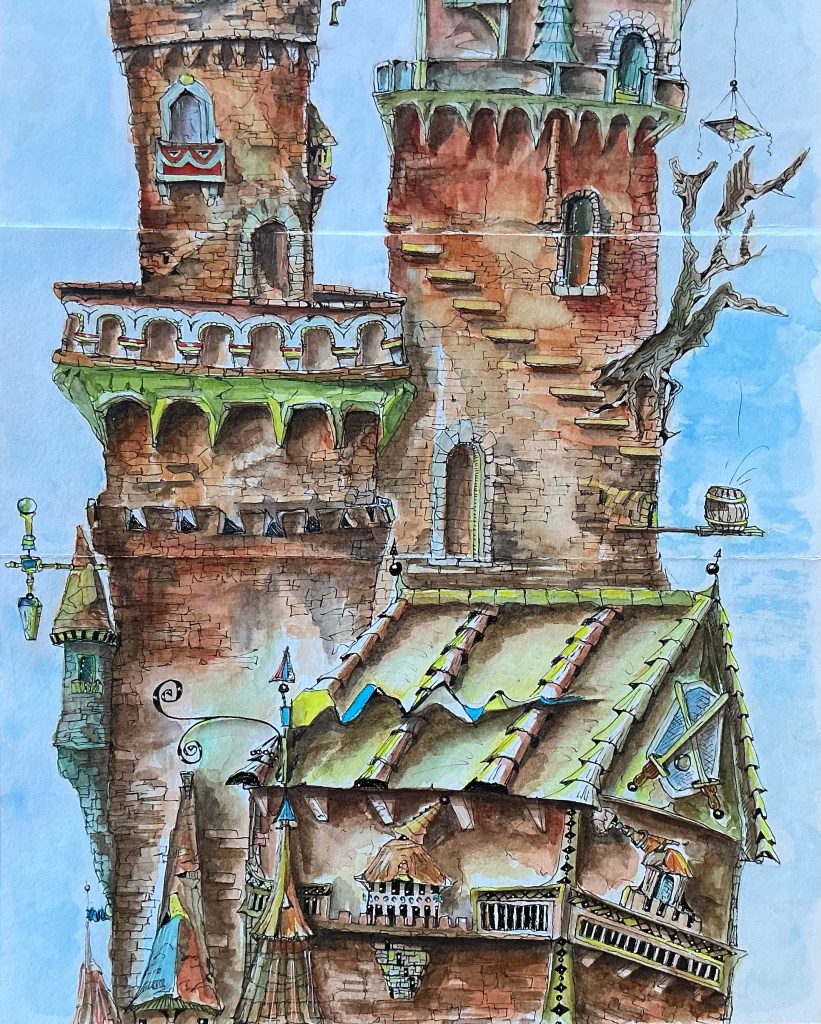
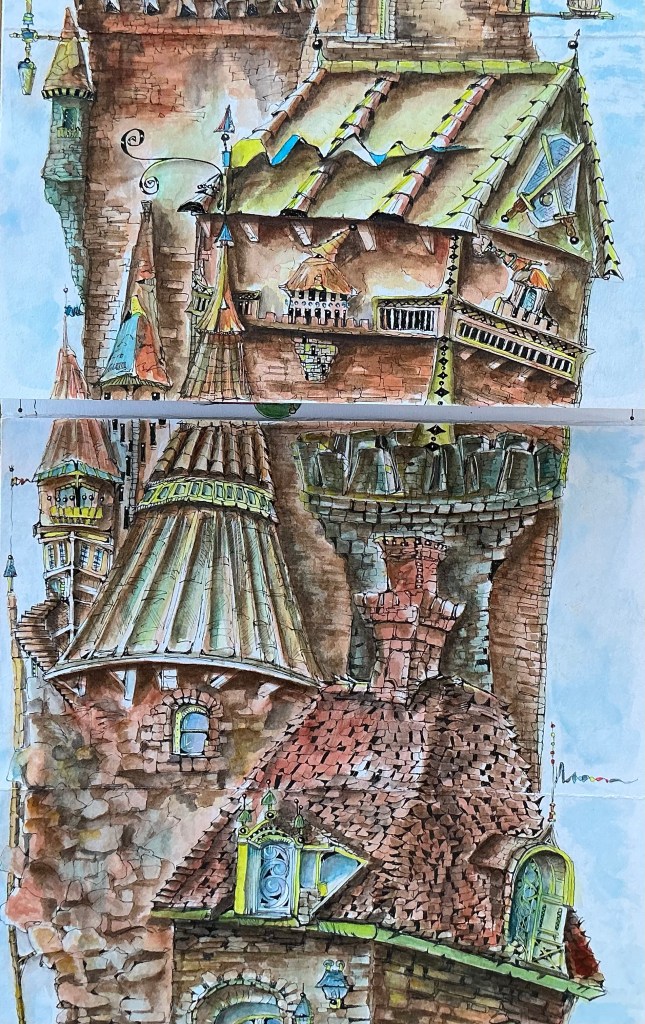
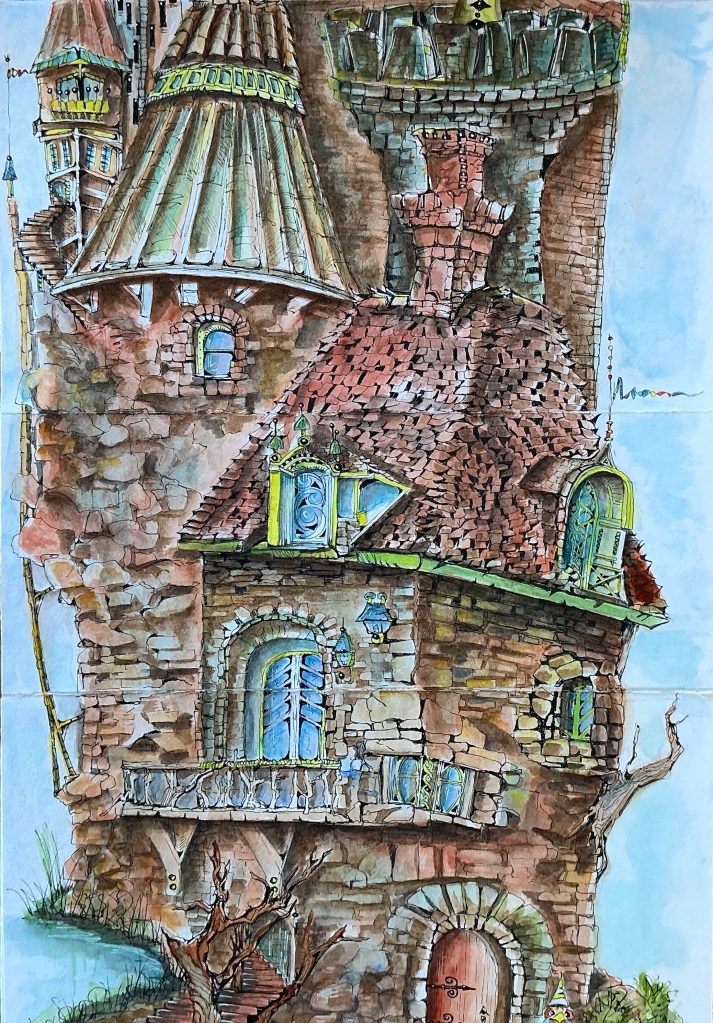
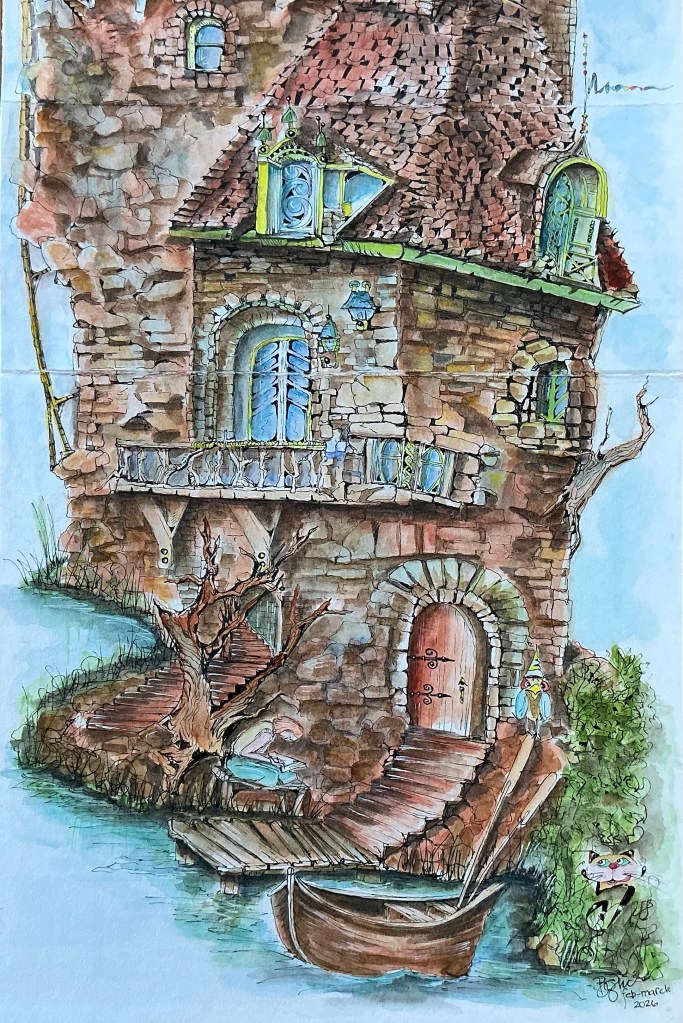
The Medieval Castle from my imagination. This 4-panel castle took up the entire inside of the accordion card, measuring nearly 3 feet long. The two center panels are bisected to make room for more printed words and illustrations. In this illustration, can you find the goat? Elaine busily composing her Paradelle? Flambé?
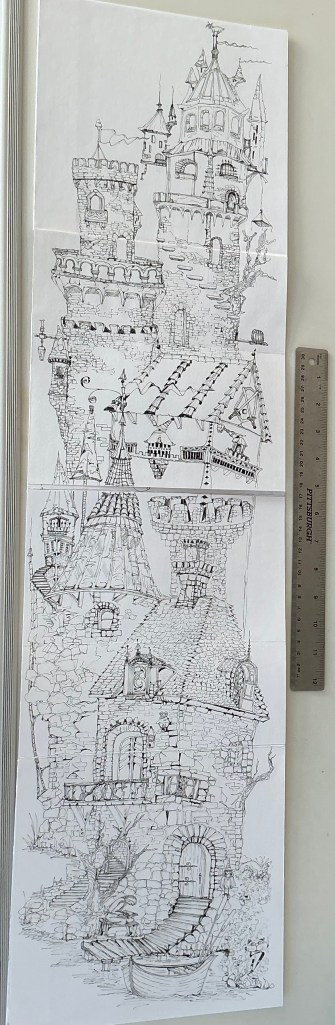
This was the line work. I began by pencil sketching the top panel, but before that was finished, I buried my pencil and finished the rest in ink only. The entire structure, top to bottom, is mostly from my imagination; making it up as I went. At first it was scary, but then I just went for it without fear. It was great fun!
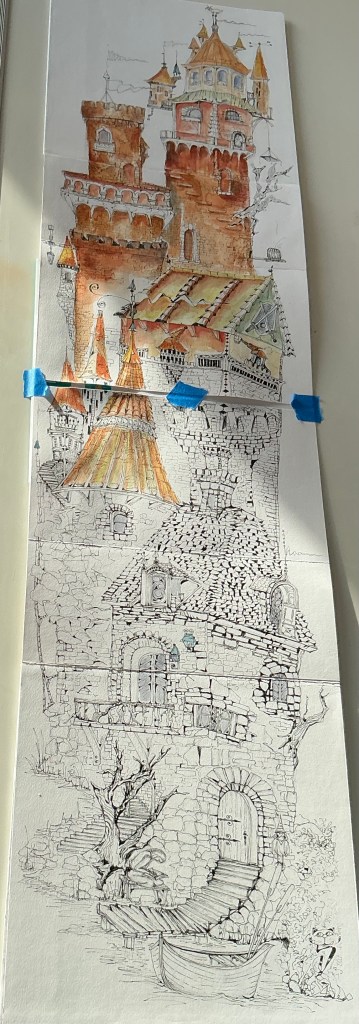
After the ink work was done, next came watercolor. I used a 12 half-pan set of van Gogh watercolors with a size 6 round brush for all the initial washes. Extra detail was then added with Derwent Inktense watercolor pencils and a water brush. The last step was to add extra shading with my neutral-colored set of Tombow dual brush pens which are water based and blendable. All fun!
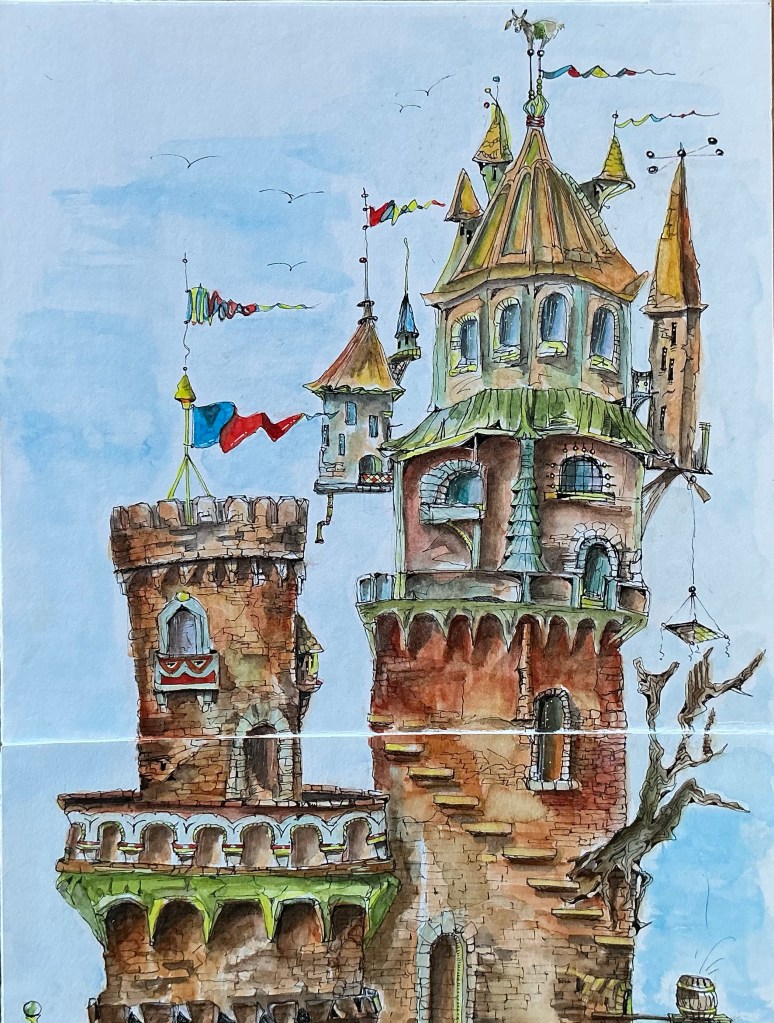
Castle details – top panel
Castle details
Castle details
Castle details
Castle details
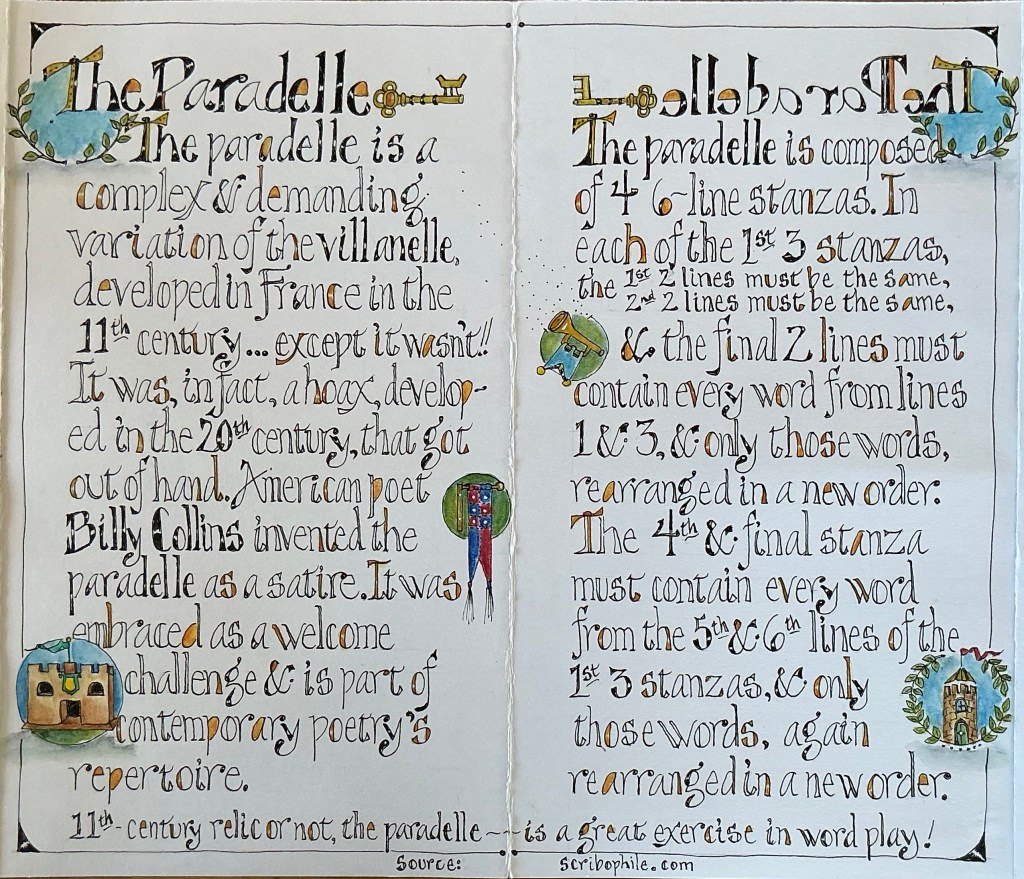
This is -art of the center 2 panels underneath the castle. On the left is the humorous history of the Paradelle; on the right are the official rules you must follow when composing a Paradelle (should you wish to do so!)
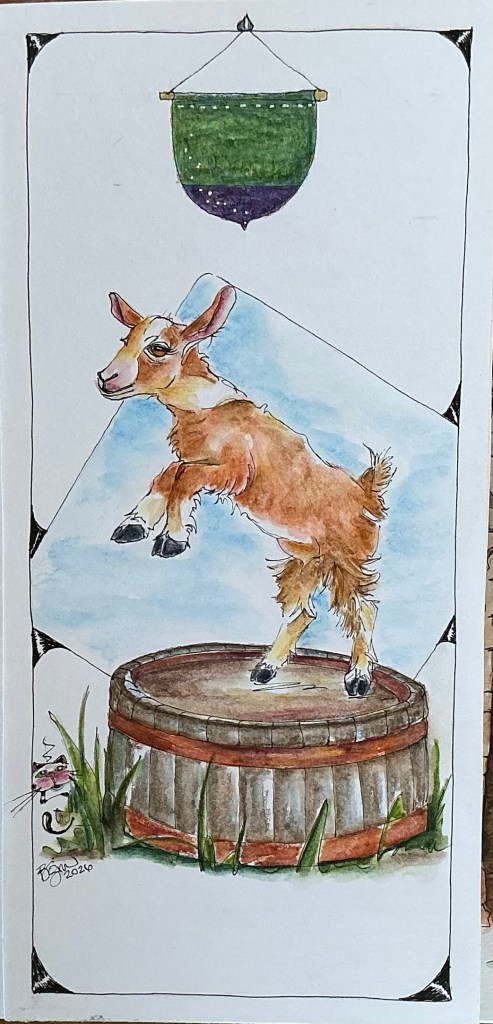
This is the illustration under the right side flap under the castle. This is one of the Queen’s performers! This little guy works for goat-chow..
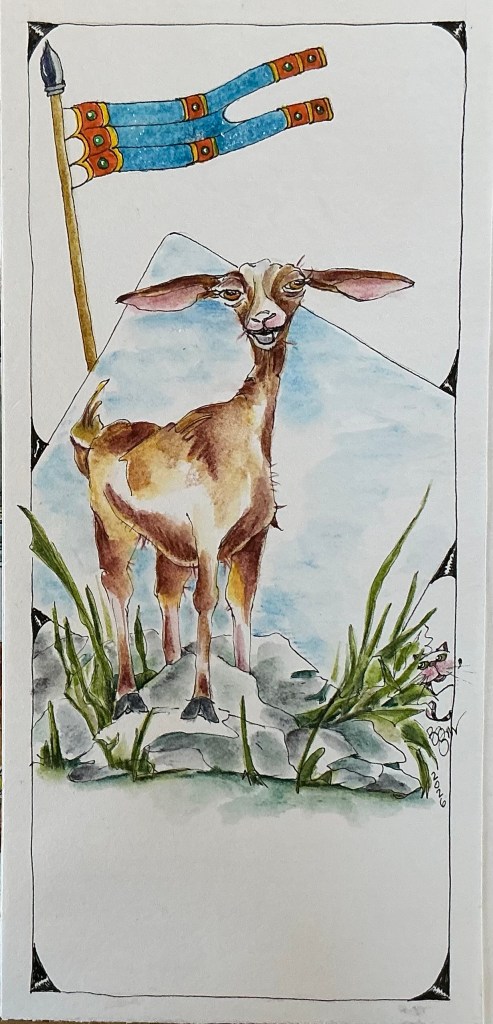
This is the illustration under the left side flap under the castle. This is the official banner bearer for the King when his Knights in Armor march off to battle. This little goat works for premium goat-chow..
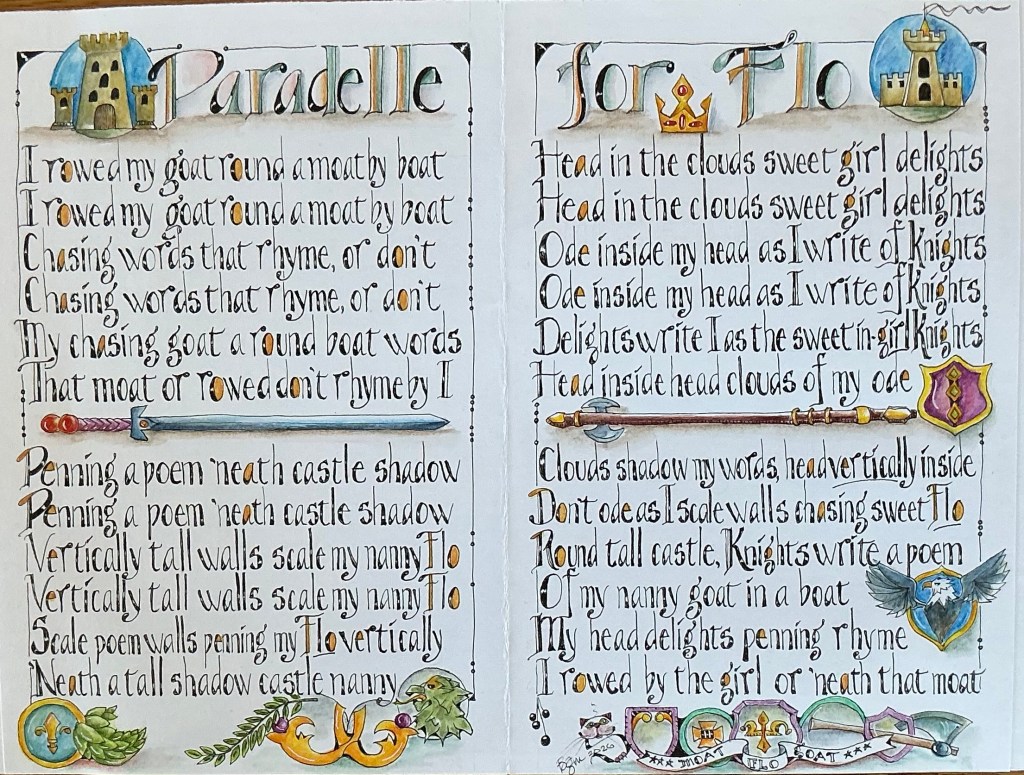
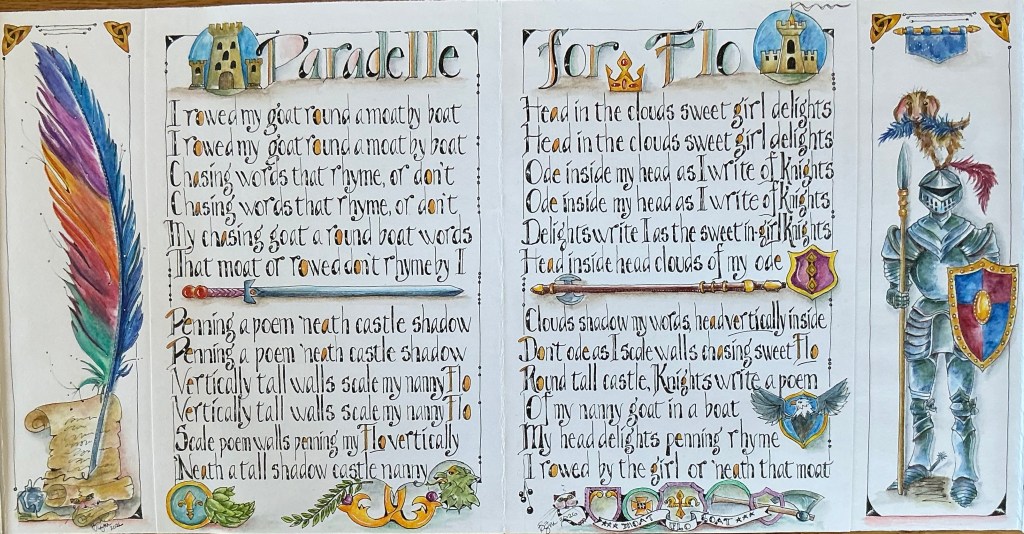
Paradelle for Flo!
The Paradelle for Flo layout, keeping with my Medieval theme.
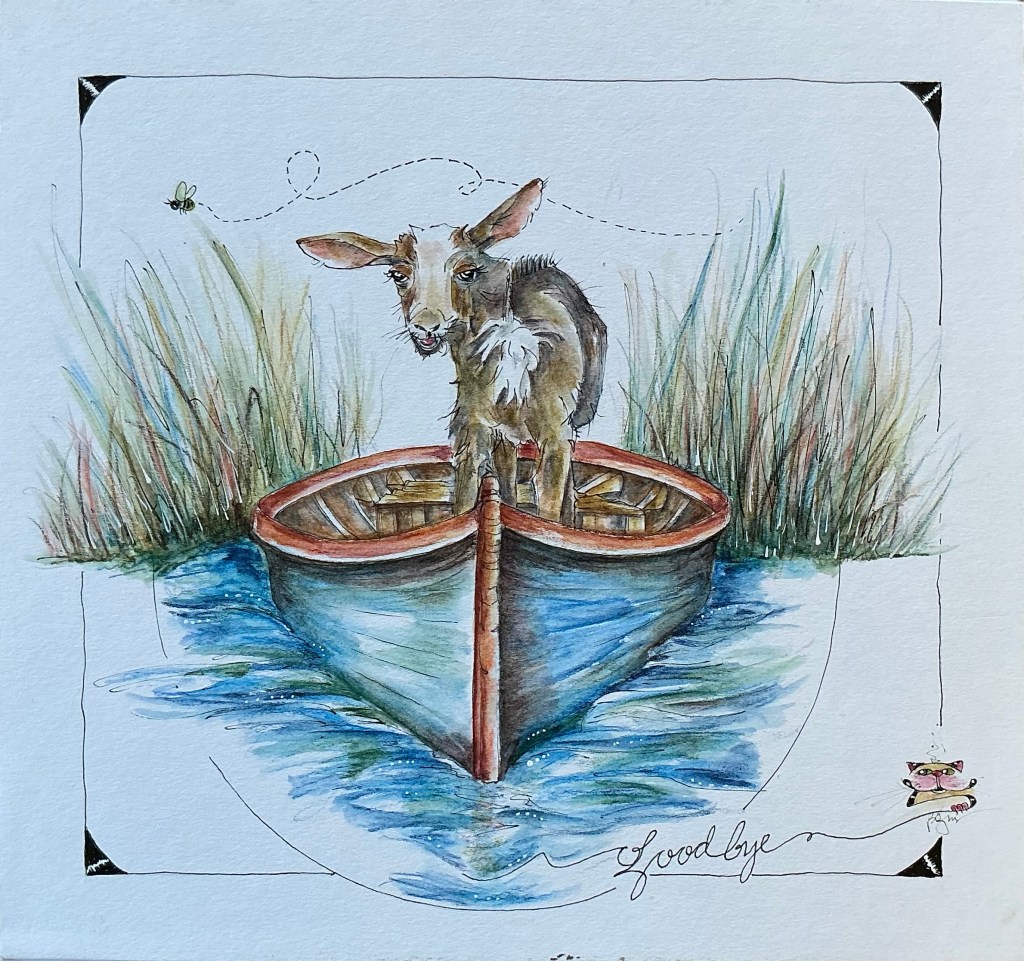
The Final page as Flo (and Flambé) quietly says ‘good bye’
Elaine loved her birthday card! Can’t describe how much fun it was to create Paradelle for Flo for such a wonderful friend! Thinking up the idea, making the accordion book, creating the illustrations and writing the poem was a great way to spend 5 weeks! It turned into quite a satisfying challenge, as well as a learning experience when it came to mixing various medias together and bringing to life all the components into one card!
If you enjoyed Paradelle for Flo, you might enjoy this one too!
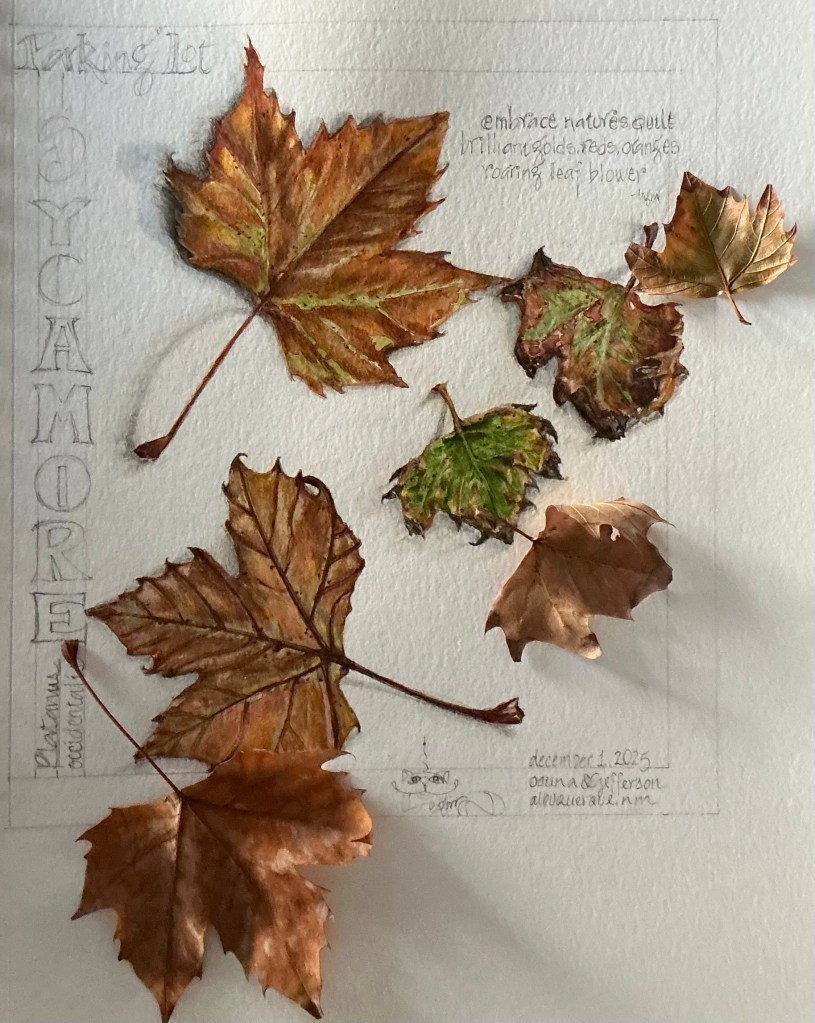
My search for still-beautiful Autumn leaves, half hanging, half fallen to the ground, took me to Albuquerque where temperatures hadn’t yet dipped below zero. Striking ‘gold’ in a large vacant parking lot next to a Disc Golf course, are at least 30 full-grown Sycamore trees with what looked to be full canopies of foliage still clinging tight. But for all the leaves yet to fall, there must’ve been 50x that number covering the ground. The morning breeze was causing the recently-fallen leaves to skid across the pavement in jerky movements, coming to rest in the parking lot’s gutters.
It was in these ankle deep gutter piles where the range of leaf sizes, colors and patterns were found. These 1” to 10” broad, palmately veined and ragged-toothed leaves appeared locked together like pieces from a newly-opened 5000 piece jigsaw puzzle. And, oh my! The lid to the box just blew away! Now I was faced with a dizzying jumble of multi-colored golden-yellows, burnt oranges, Ruddy duck rust, fading-to-spring greens and saddle browns. It was from these ankle deep gutter piles that I collected Autumn leaves for this project.
Lost in thought, I overlooked the white noise of the city ……. traffic mostly, constantly humming and impatiently honking ……. until a painful ringing in my ears invaded the relative calm of the morning. No longer able to think, I turned around and found an invasion of leaf blowers! Never was there a more loudly screaming, obnoxiously noxious sound. Coming closer and closer, louder and more insistent, their ear-muffled and gas-masked operators approached without hesitation, each blowing away (to where?) every bit of the “unsightly and offending” leaf-litter in their path.
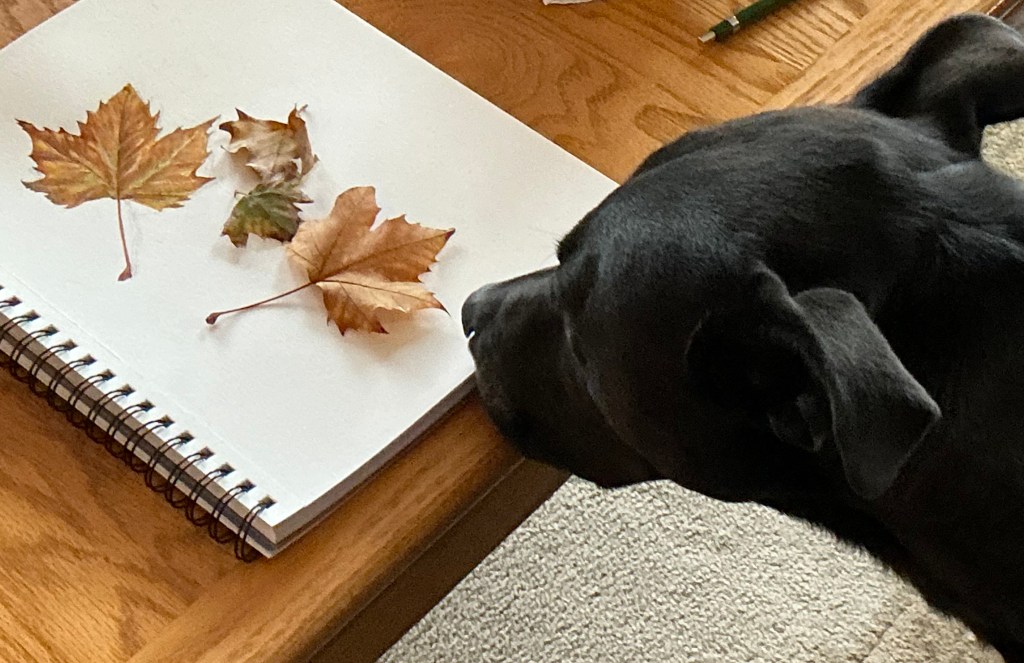
Luna approving of my Sycamore leaf selection
Dang-blasted!
It finally dawned on me this Friday morning that the vacant parking lot only opened for use on Sunday’s. Not agreeable to working weekends, the leaf blower operators were determinedly cleaning up the “messy” lot for the regular Sunday crowd. I was in their way.
Saving as many fallen Sycamore leaves as my collection bags could hold, and silently wishing all remaining leaves a happy landing somewhere on a nutrient-needy plot of land, I ran for the quiet of my car.
My Fallen Leaf Project
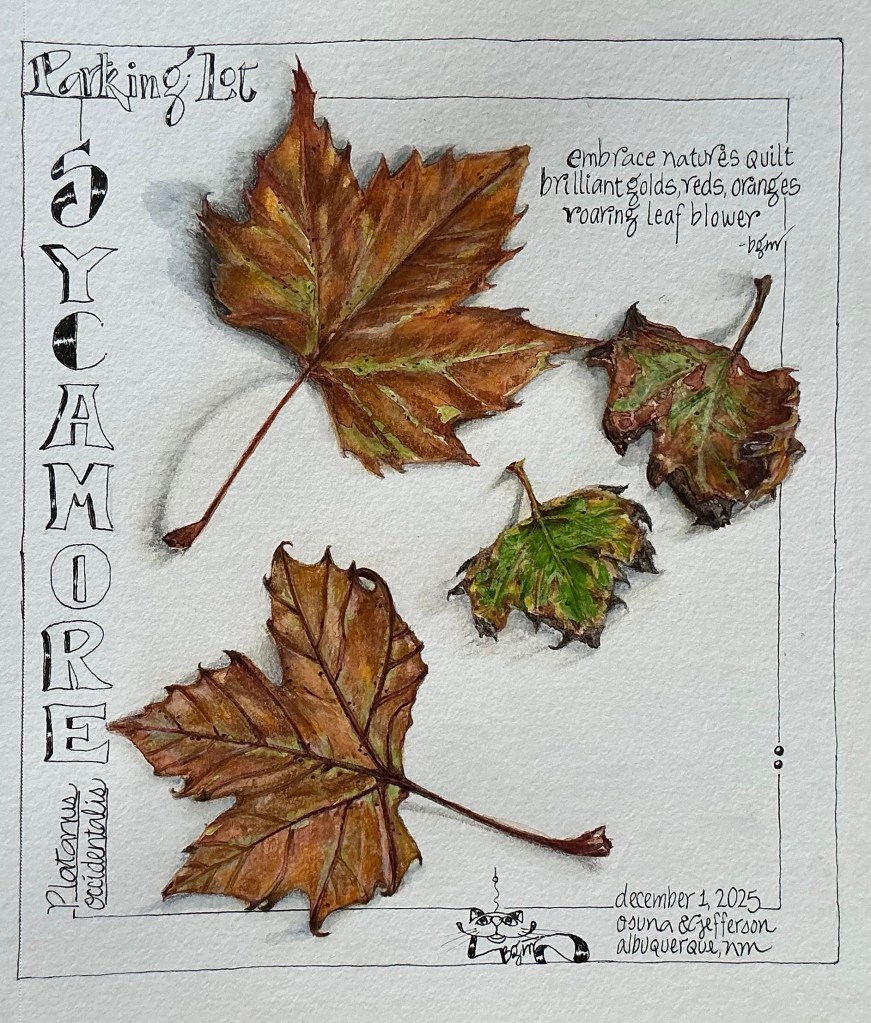
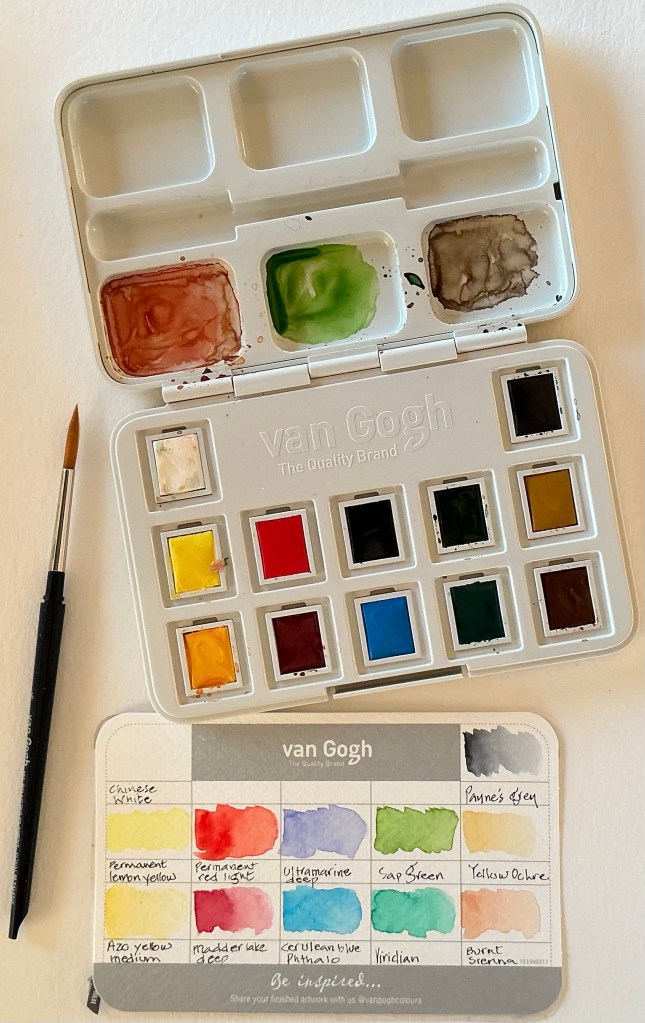
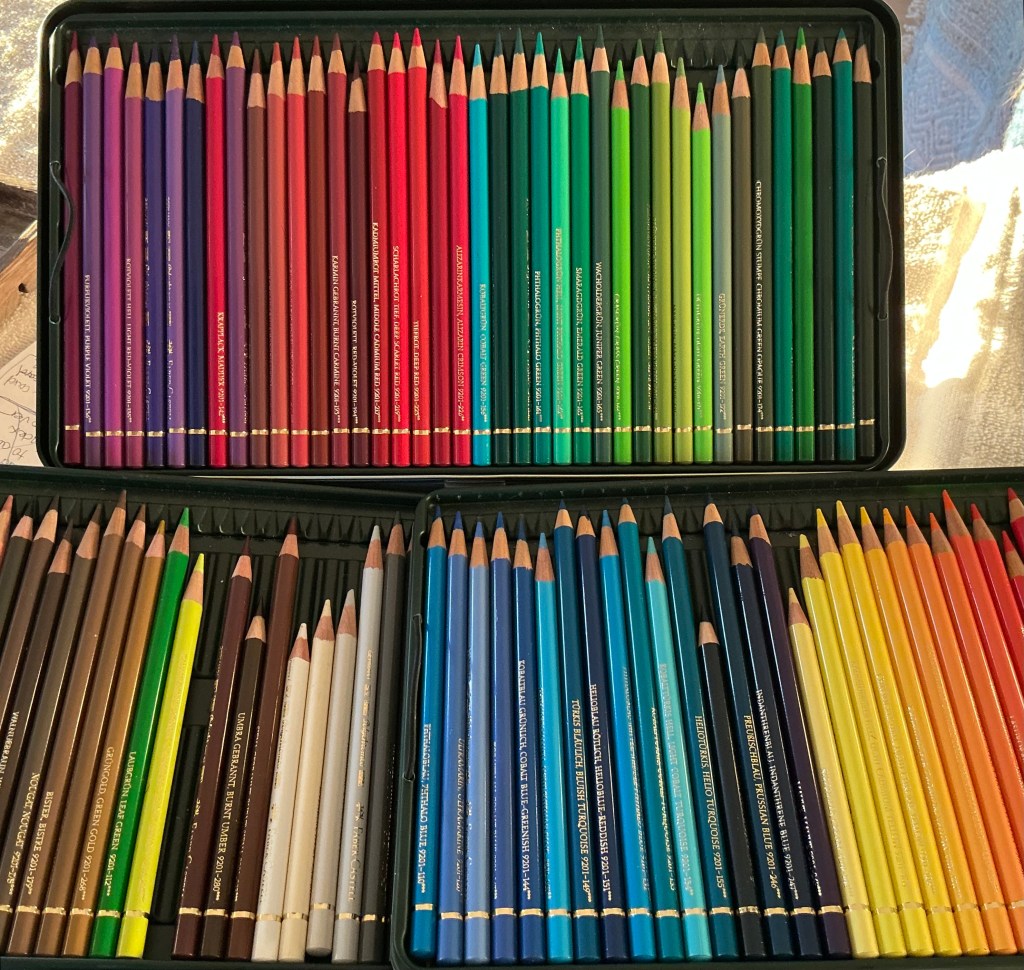
Using Sycamore leaves collected from that vacant Albuquerque parking lot, I tried my hand at a new technique; combining watercolor layers with layers of colored pencil. Using my new set of Van Gogh watercolors, I began each leaf with a layer of plain water followed by a light base layer, mixing Azo yellow medium with a touch of Yellow ochre. The bottom leaf (which was the underside of the top leaf) was duller and lighter in color, calling for a bit of Permanent lemon yellow. Allowing that layer to dry, I used various earthy colors from my set of Faber-Castell Polychromos colored pencils over the watercolor wash, mixing and matching the colors of my pencils with the actual leaf colors. This step tended to leave some areas uncolored with the pencils, so I applied another watercolor wash with Sap green, Burnt Sienna+Yellow ochre, and/or Madder lake deep+Azo yellow medium. I finished each leaf with a Dark sepia colored pencil outline, tipped the leaf margins with Dark sepia, and added shadowing first with Payne’s grey watercolor then Dark sepia colored pencil.
12 half-pan watercolor set and color swatch
The leaves were painted on 140# Canson XL Watercolor paper
Faber-Castell colored pencil set
If you have and questions or comments, please let me know. If you use this combined media technique, any tips you’d like to share would be greatly appreciated too.
…………………………………………………………………………………………
I’d like to send a shout-out and my deep gratitude to Wendy Hollender, botanical artist/illustrator/teacher extraordinaire, who announced in her newsletter free access for over a week to 19 of her bite-sized video lessons. Designed as companions to her book, The Joy of Botanical Drawing, each lesson focused on a different botanical subject and how to artistically render them using watercolor and colored pencil combined. I’ve always wanted to learn this technique and gave it a try with her leaf examples and then mine. Incorporating both media into the same painting was very challenging and way out of my comfort zone.
Thanks so much Wendy, for such wonderful lessons and your fabulous companion book! With lots more practice, my goal is that some day my botanical art looks as natural, skilled and professional as yours.
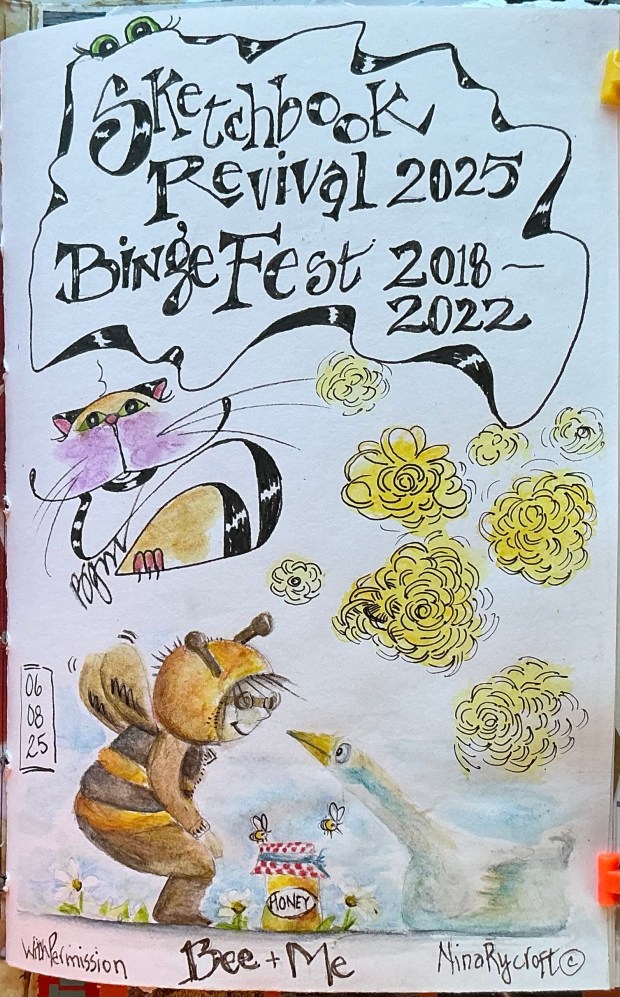
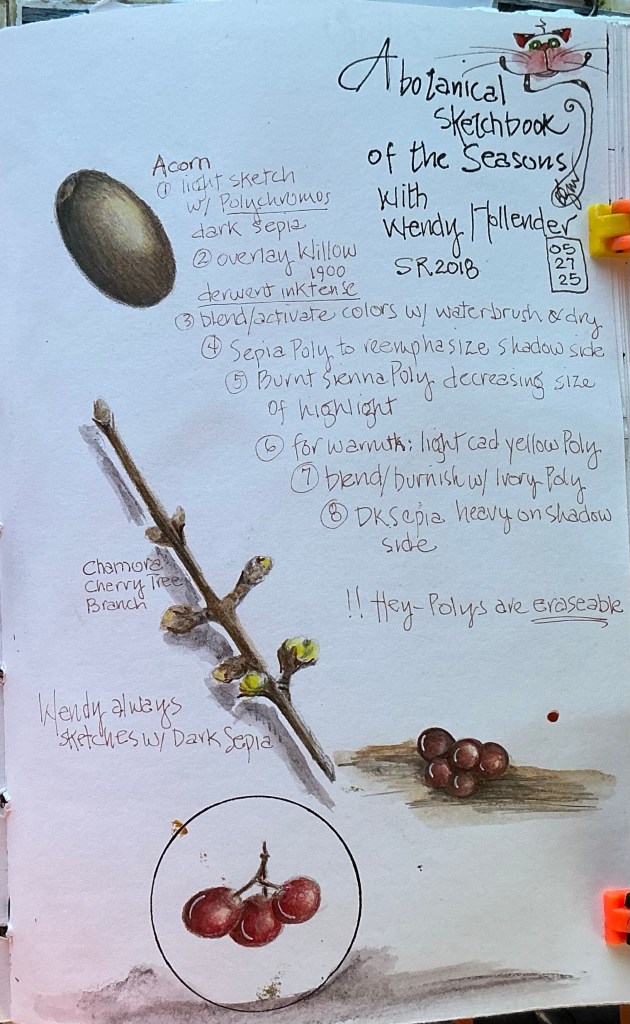
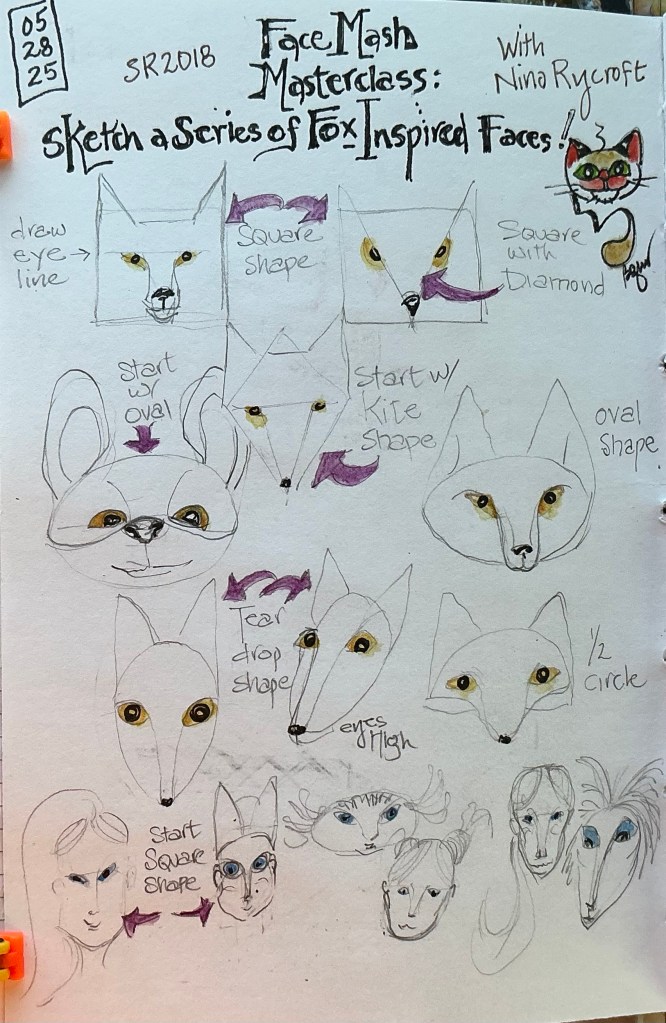
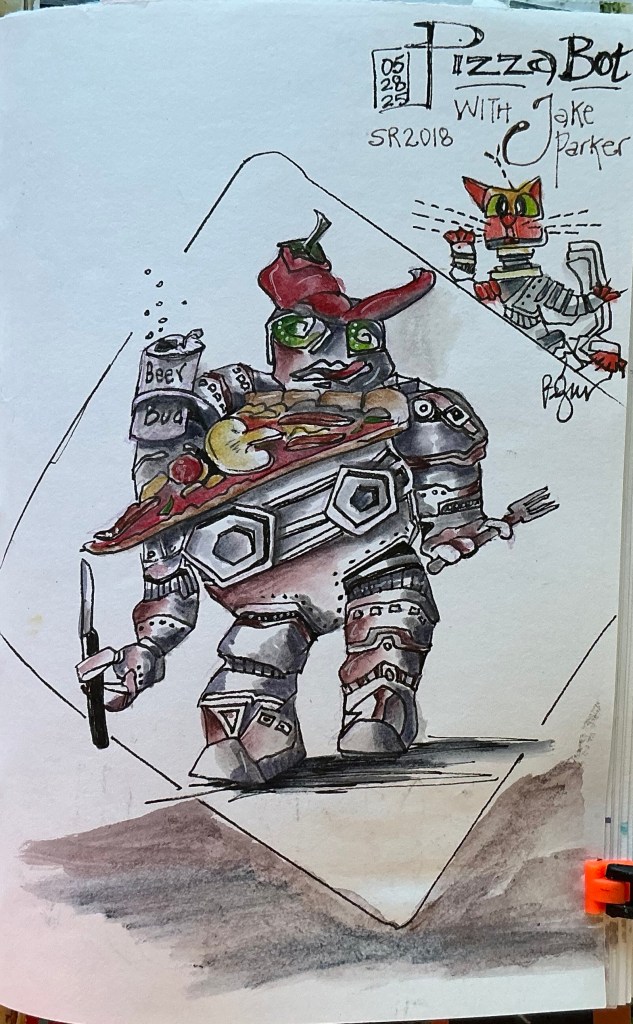
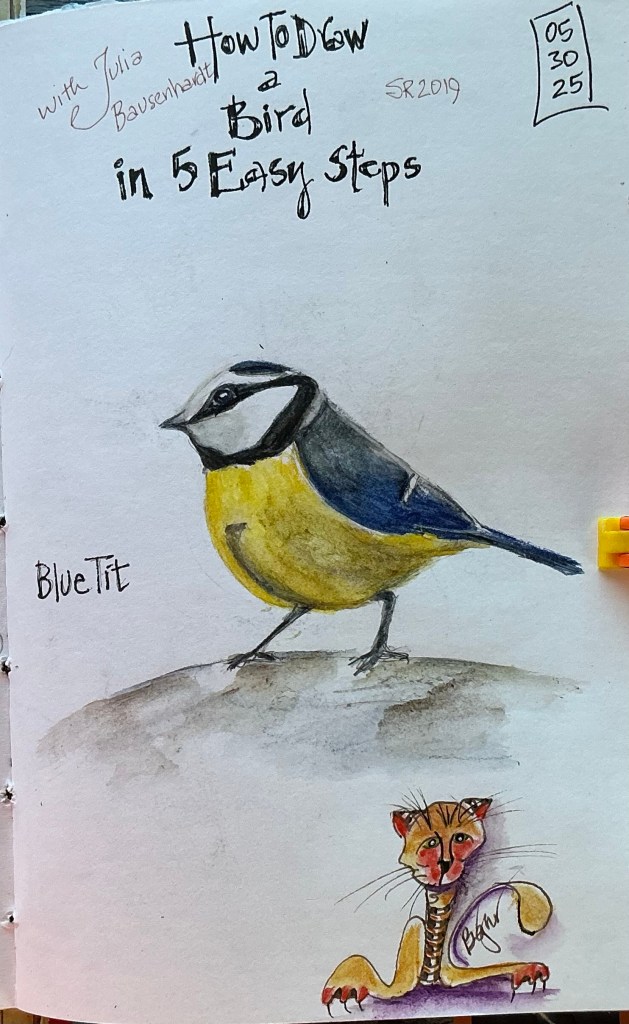
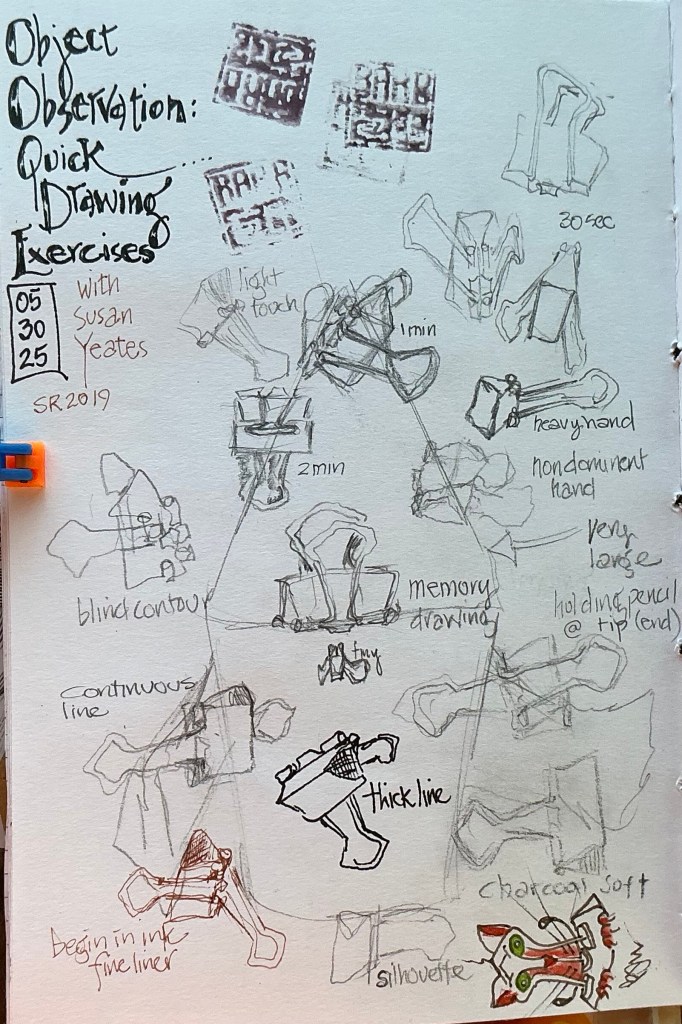
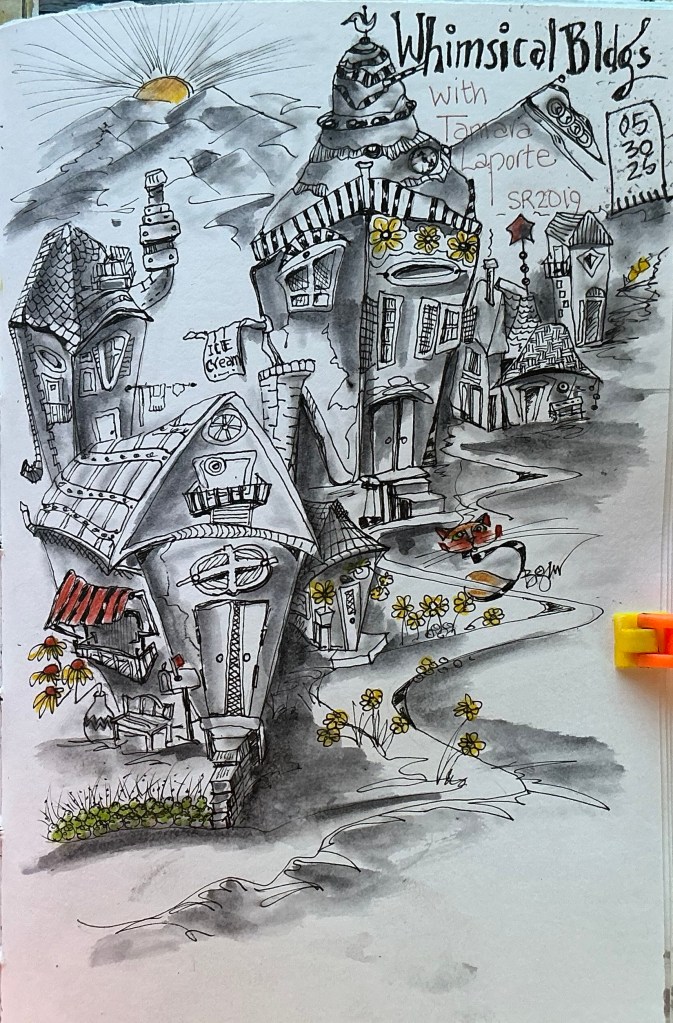
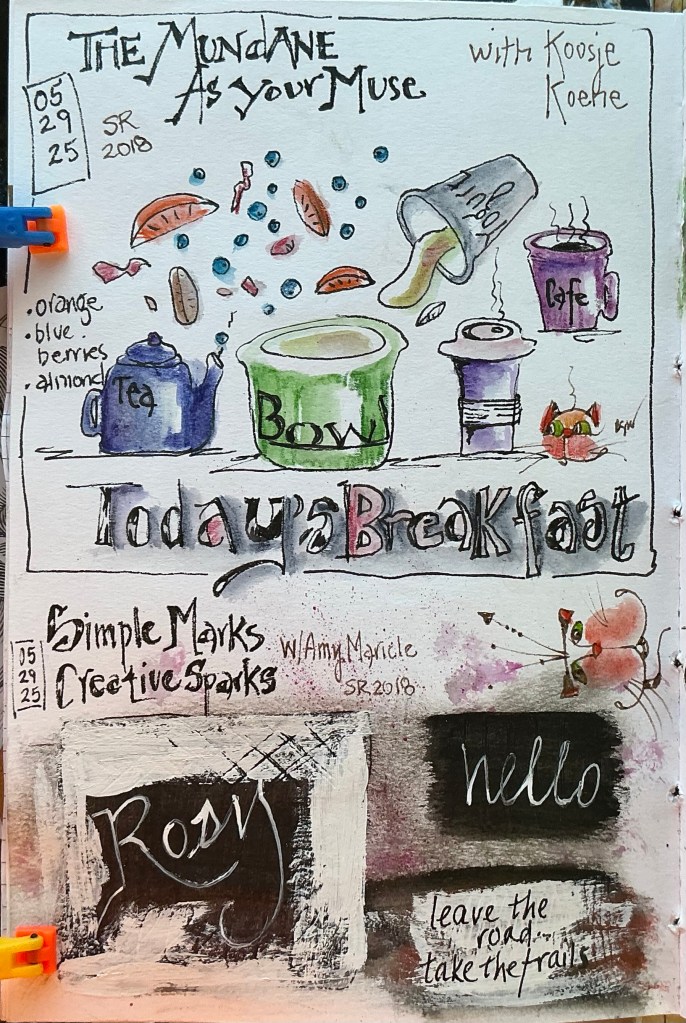
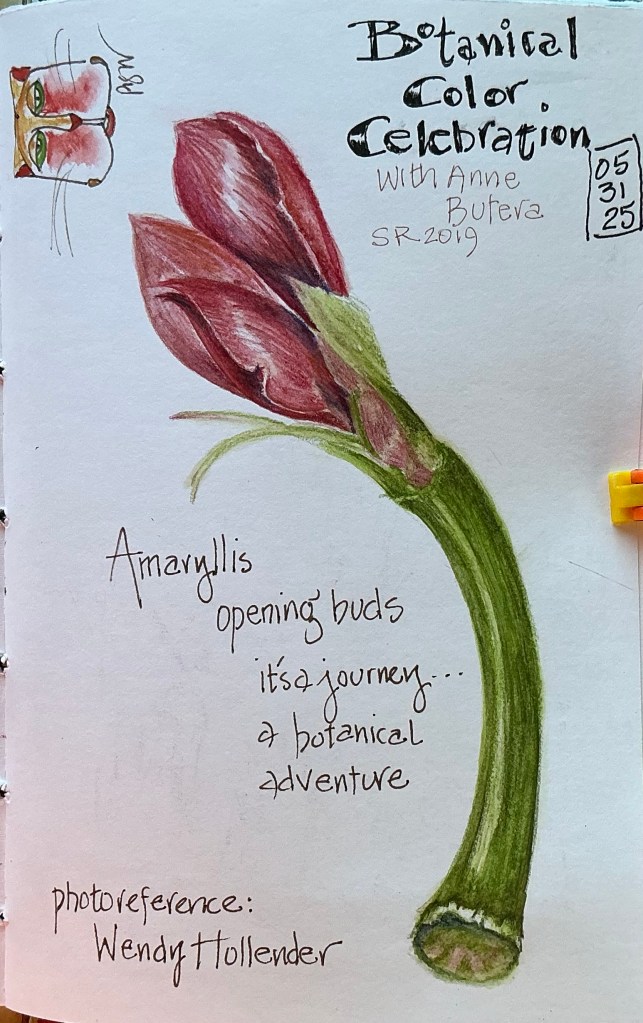
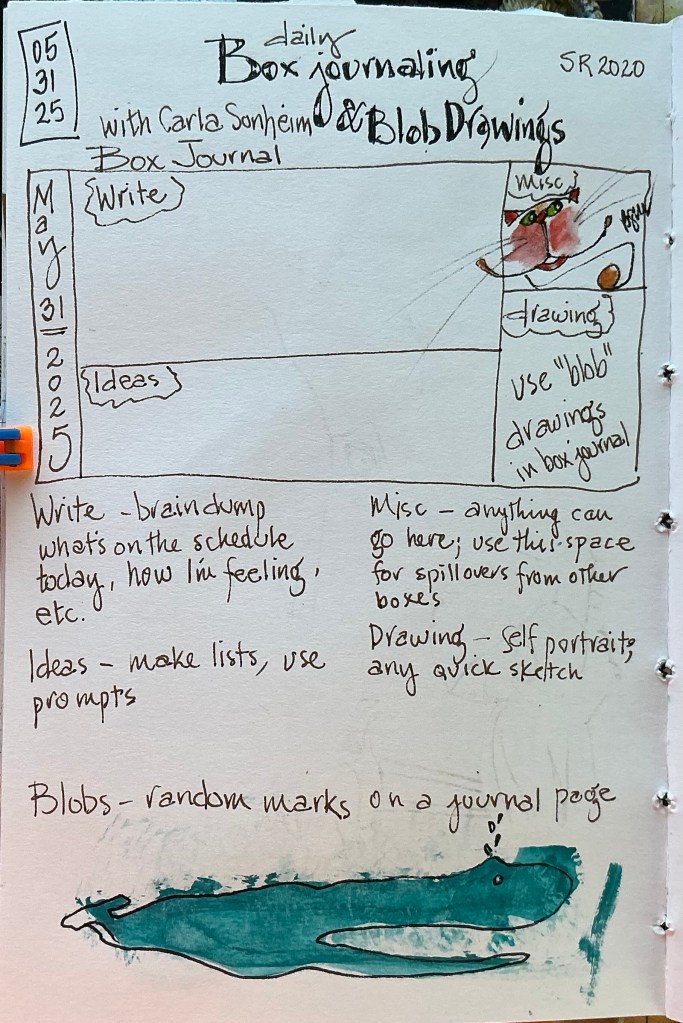
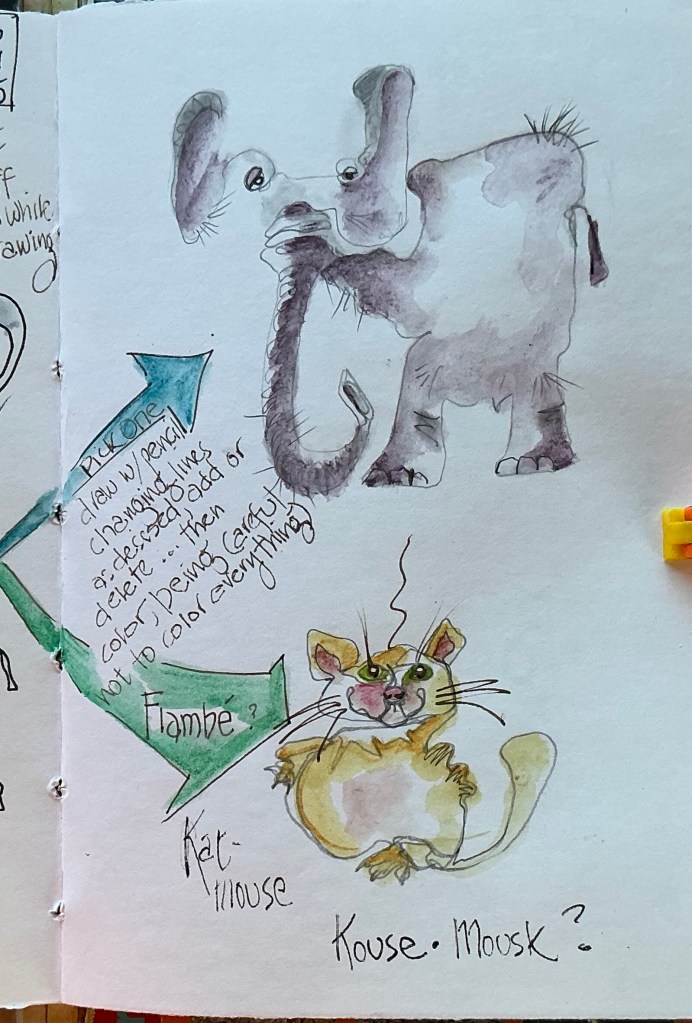
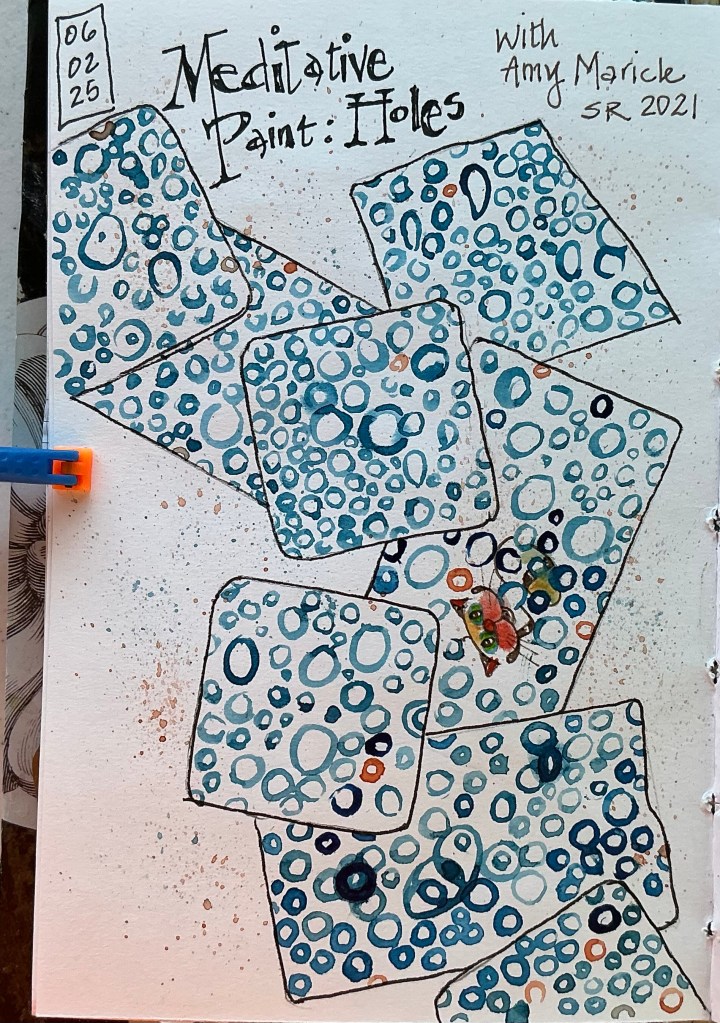
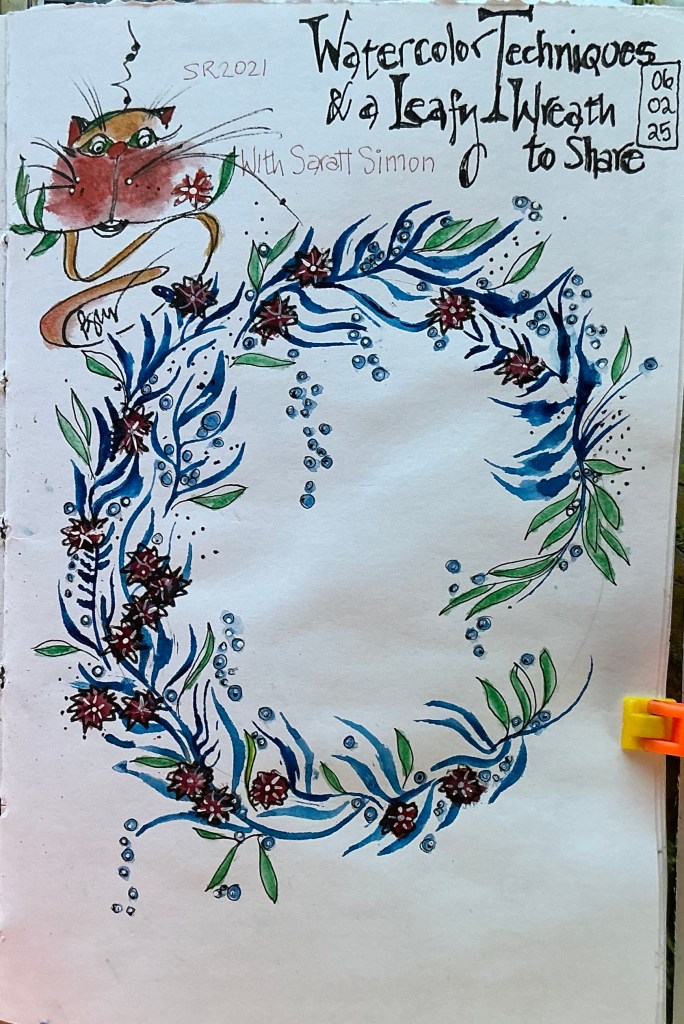
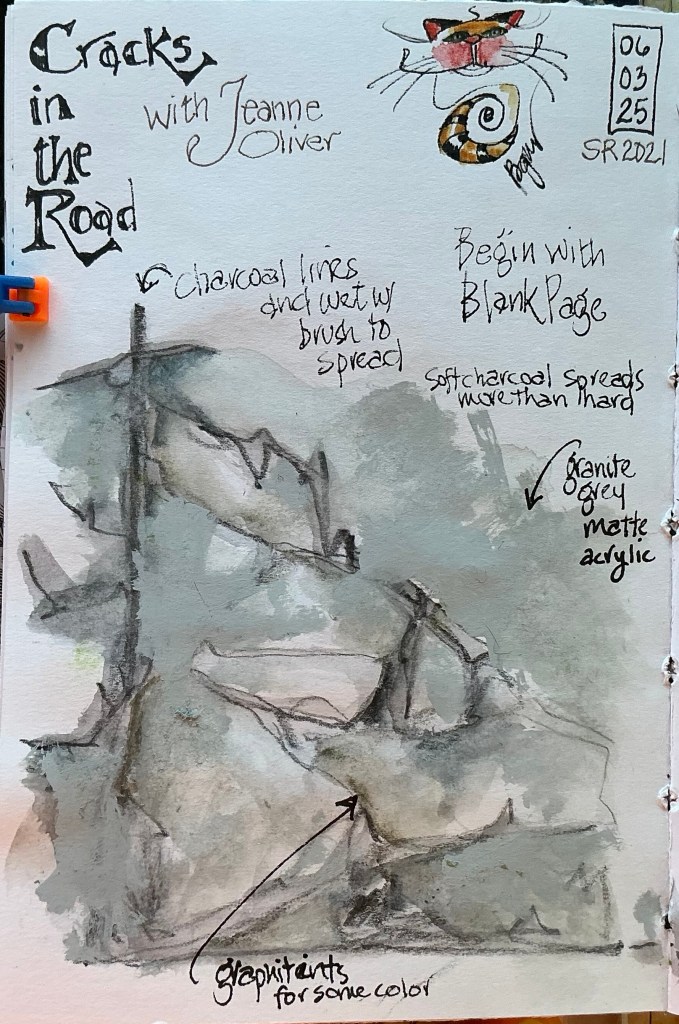
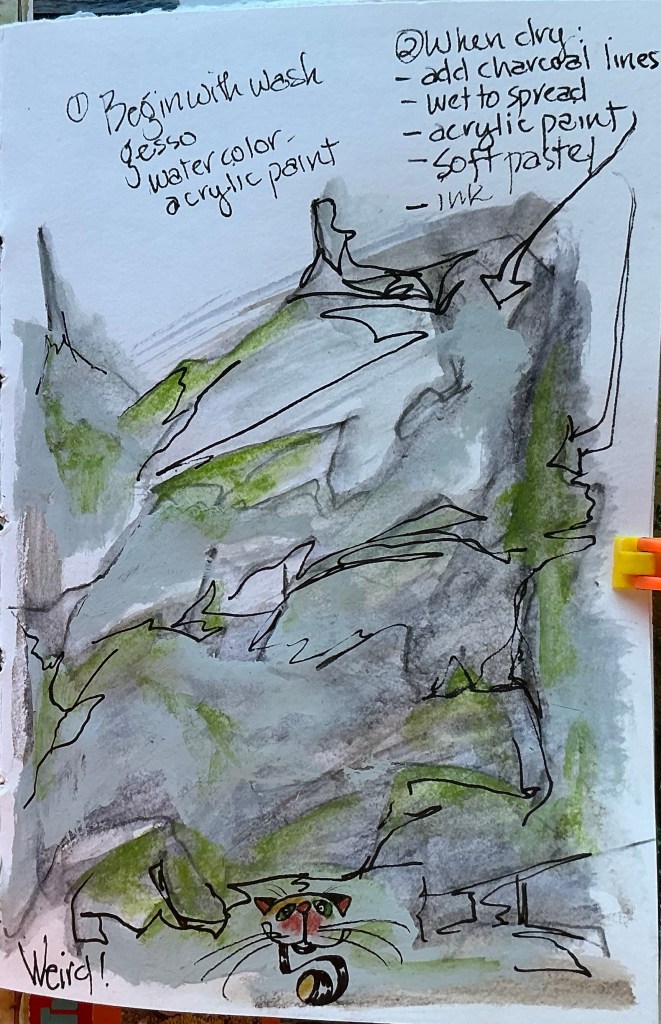
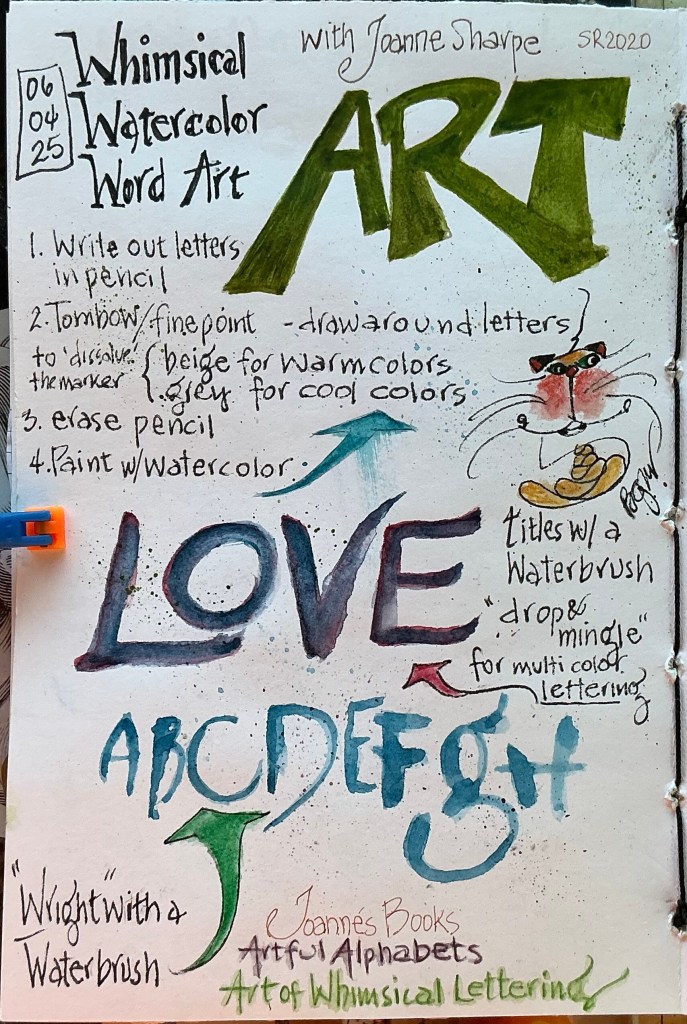
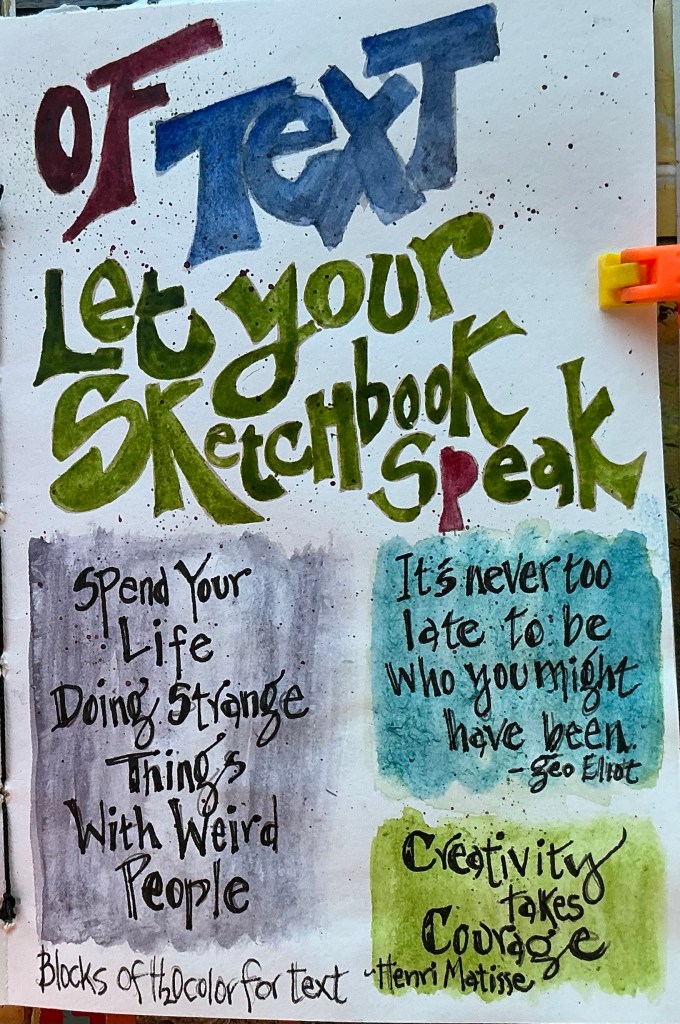
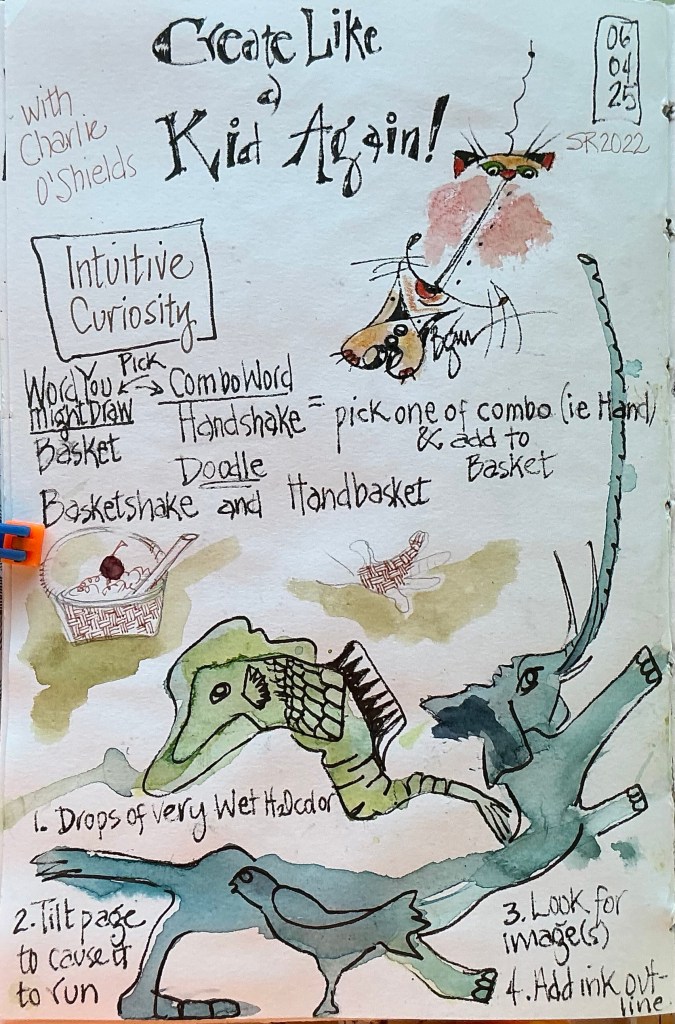
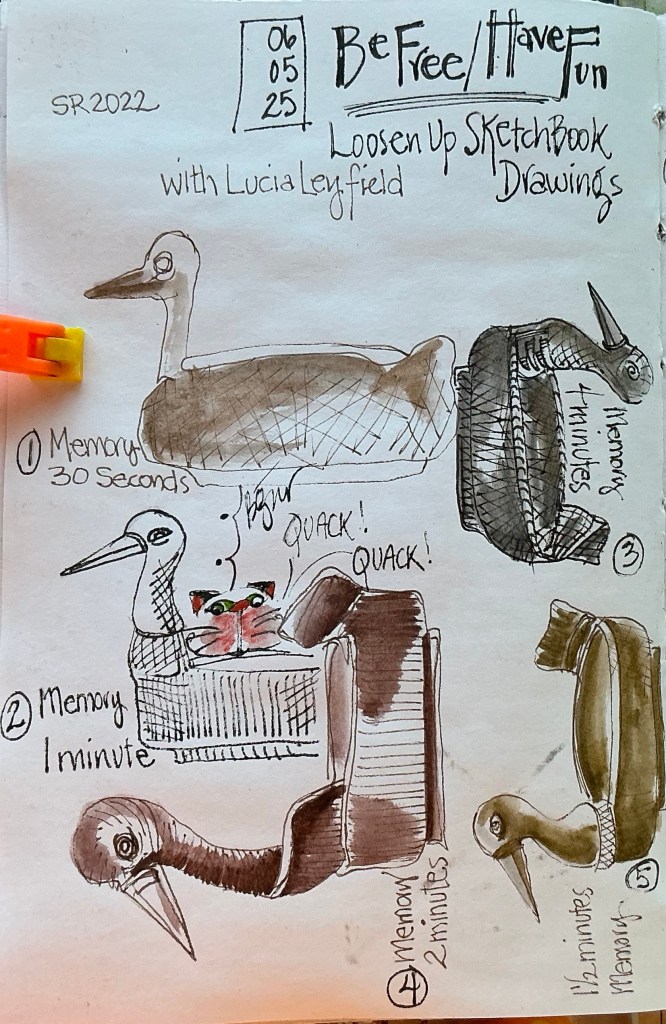
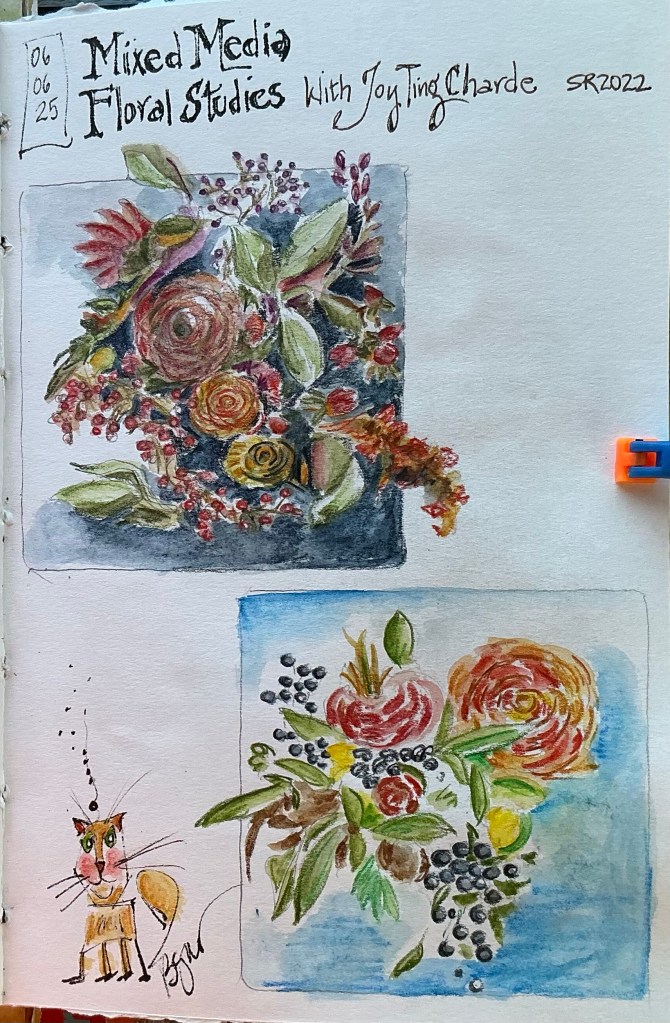
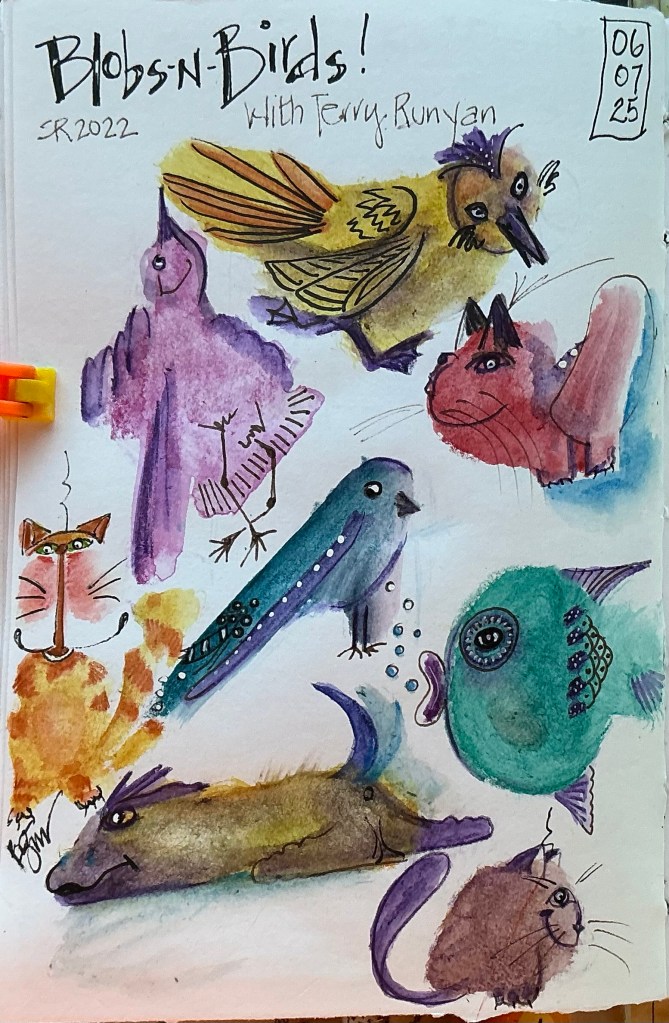
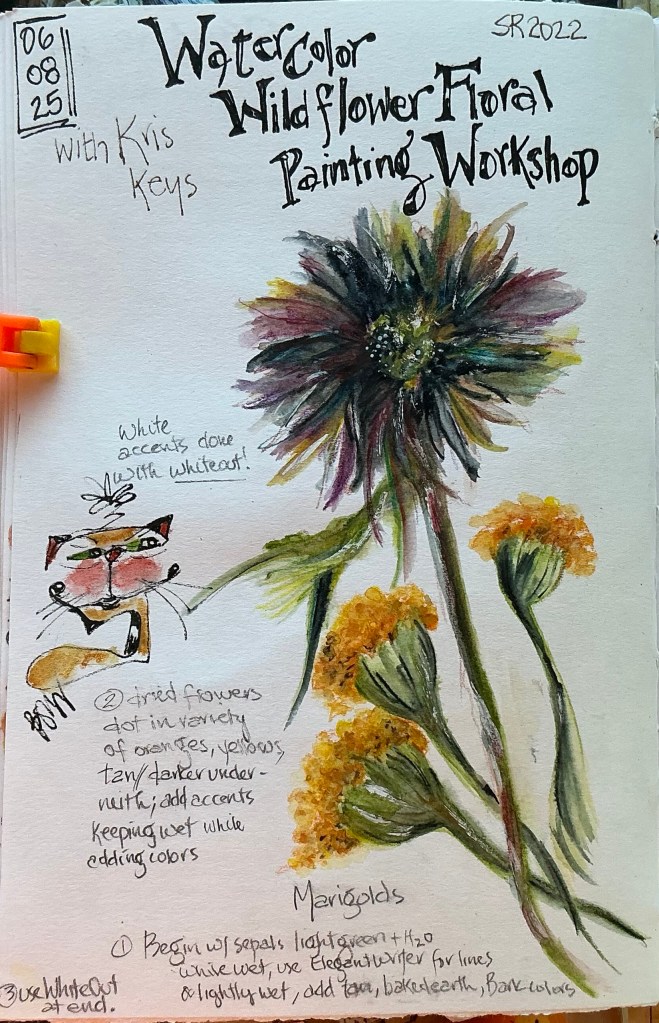
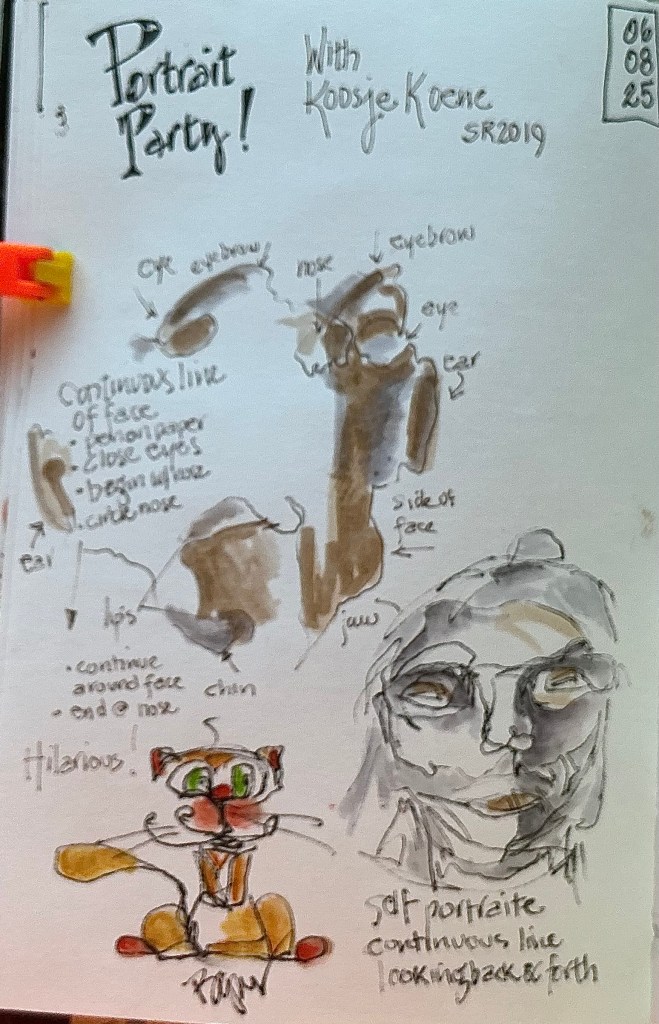
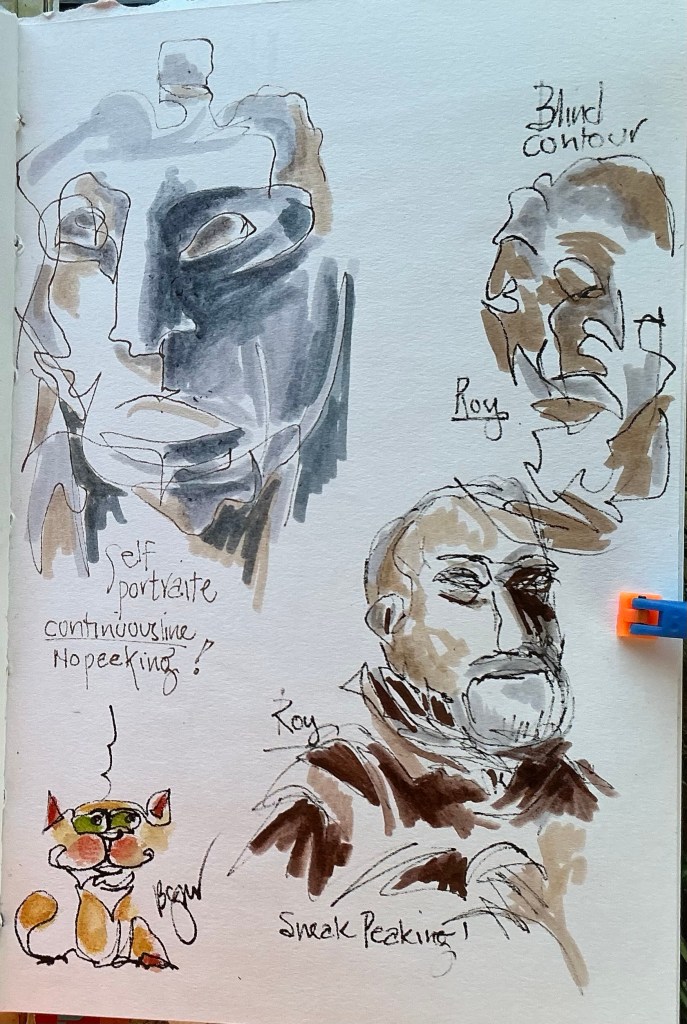
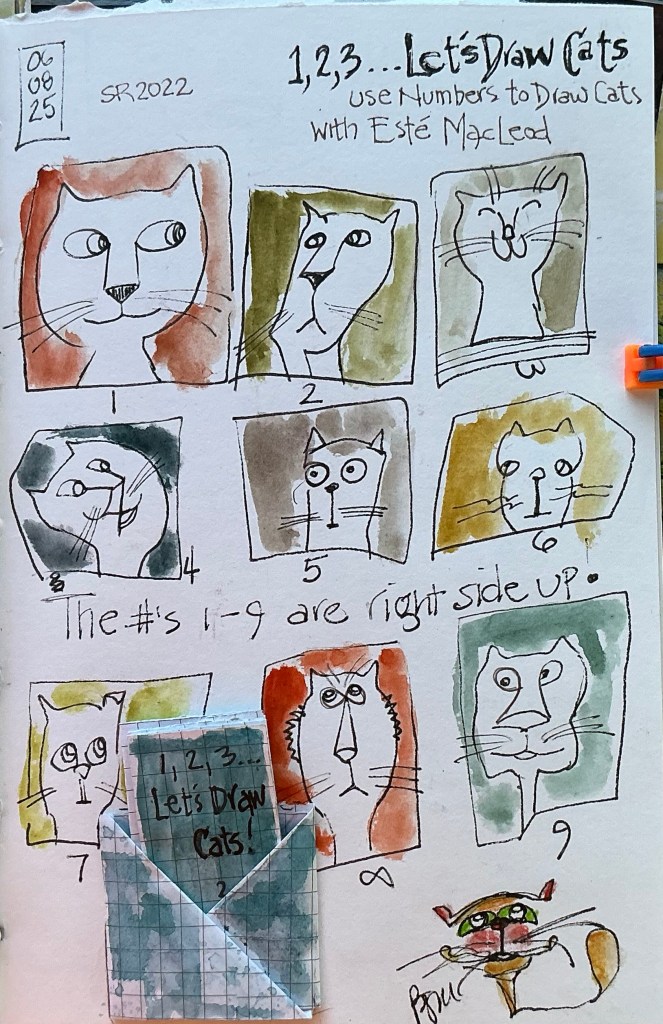
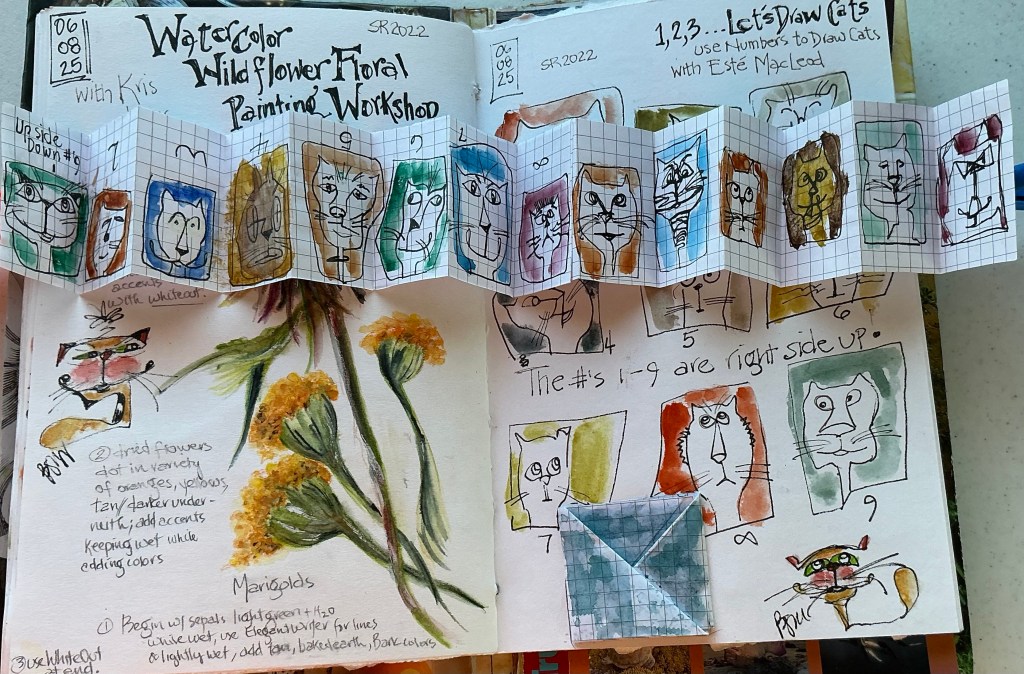
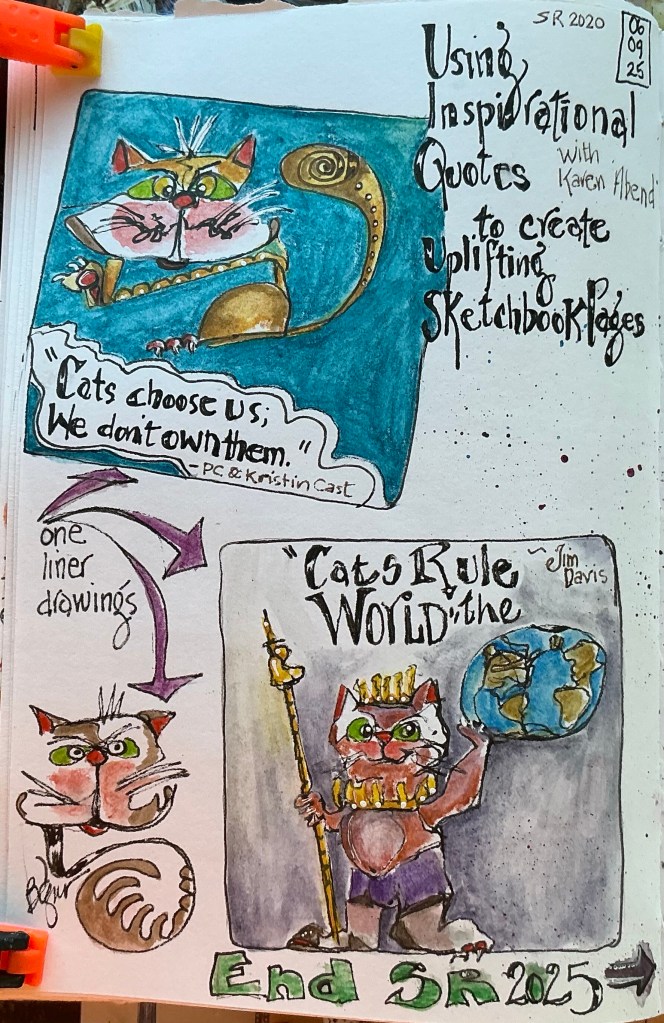
What a whirlwind celebration! Sketchbook Revival (SR) 2025 Binge Fest was so much fun. And Wow! Two jam packed weeks of creativity was over in the blink of an eye!
Karen Abend, SR creator, host extraordinaire, and wonderful artist, came up with a brilliant idea for the SR 2025 session. I would swear the creative gears inside her head were spinning with delight as she declared, “Yureka! I’ve got it!”
Beginning on May 27th thru June 9th, Karen generously opened up the SR historic vault and set free all of the workshops conducted the first 5 years of SR (2018-2022)! That unbelievable offering came to more than 130 one-hour-long workshops of inspiring, hands-on, and creative play time all instructed by well-known experts in artistic fields associated with Sketchbook Journaling.
Challenge presented ……. Challenge accepted.
Since I’ve been participating in SR each year since 2018, and attended most of these workshops in the past, my goals and strategies to tackle the challenge were these:
Complete a minimum of 4 workshops daily;
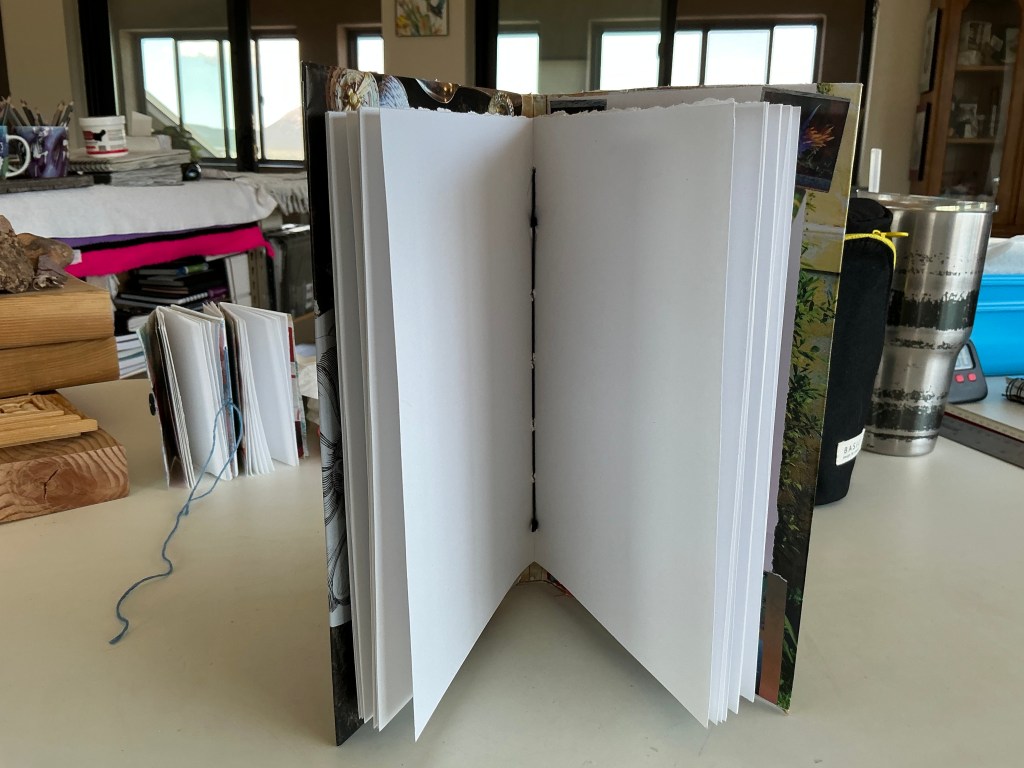
Two workshops should involve a project outside of my comfort zone, such as portrait drawing, fantasy, word play, collage, and properly stitching my own SR sketchbook so it wouldn’t fall apart during the 2-week challenge, etc.;
Two workshops should involve projects within my comfort zone, such nature subjects, urban sketching, whimsey, and lettering, and those using watercolor pencils, graphite, and ink;
Develop fresh, interesting, and imaginative sketches during the workshops;
Allow Flambé to play along;
Slow down, breathe, and enjoy the 2-week marathon without becoming overwhelmed;
Recognize and gather take-away tips and techniques to bring into my Nature Journaling practice and Zentangle storytelling.
Keep sketching and sharing.
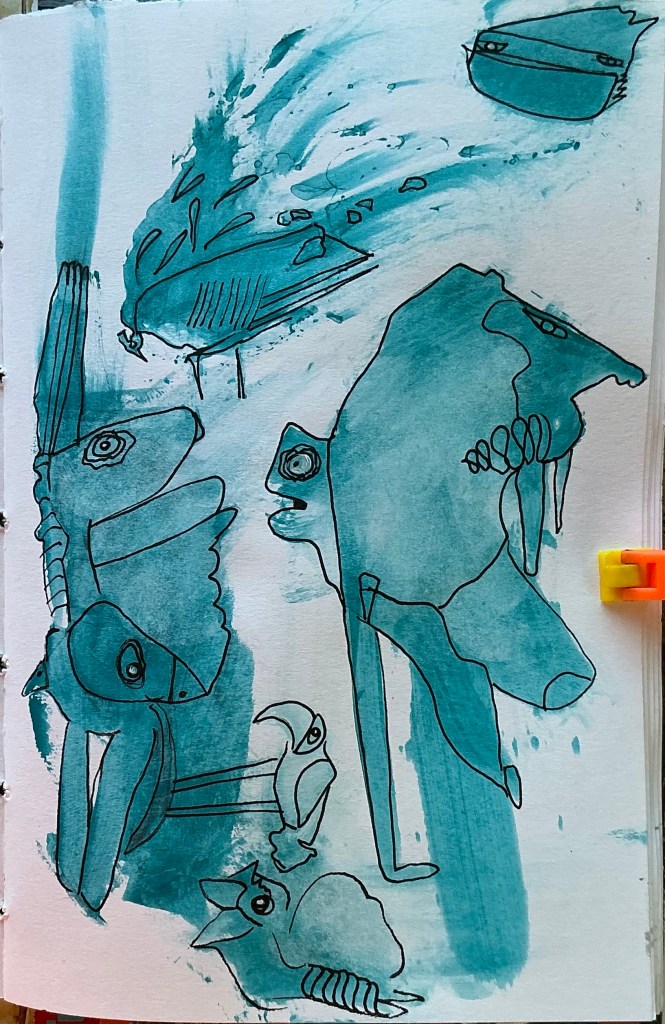
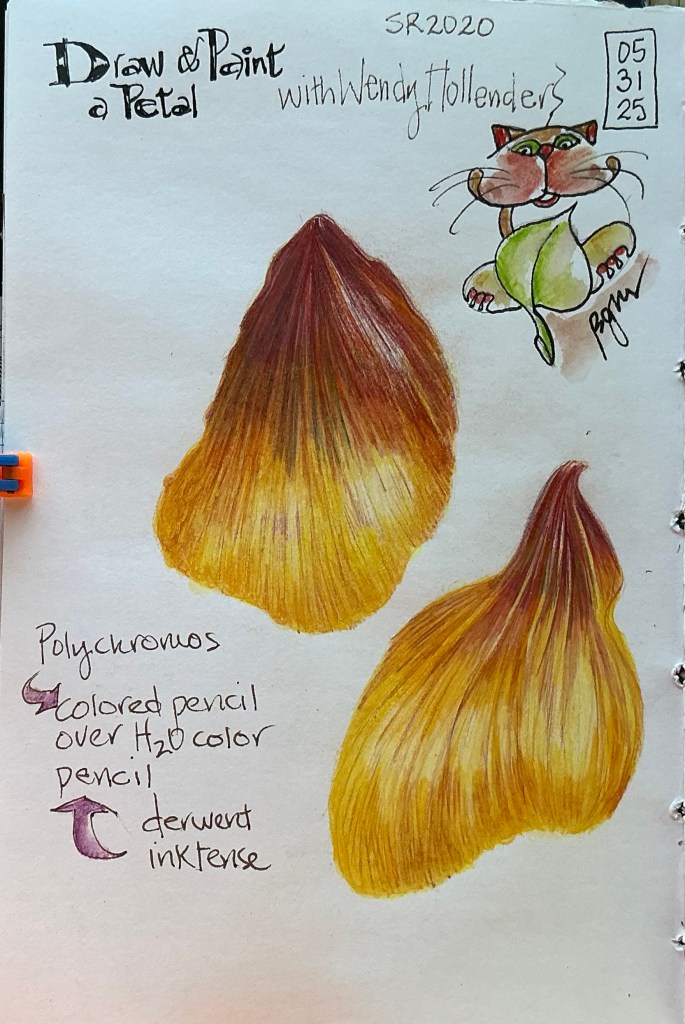
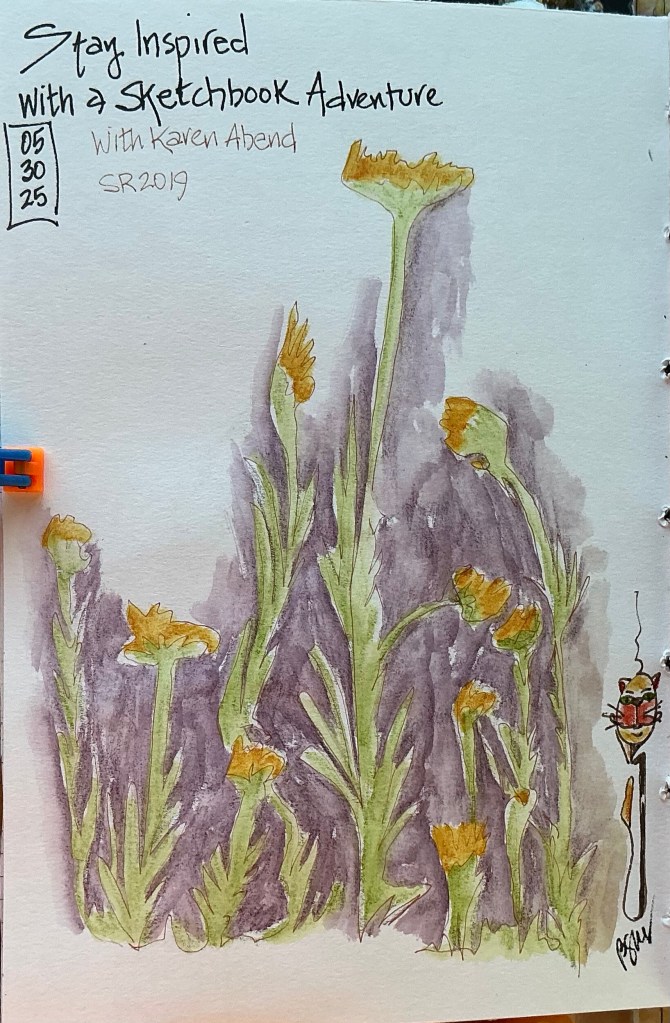
After two weeks of play, I was able to fill up my handmade and successfully stitched SR 2025 sketchbook! With a total of 46 pages completed (doubling up workshop projects on a handful of pages), including several pockets with inserts, I was pretty happy (and a bit exhausted).
If you’ve participated in SR in the past, or maybe took on the 2025 challenge as your first time, you know how intense (in an exhilarating way) it can become. If not, and would like to learn more, check out this link
This link will take you to Karen Abend’s website where you can ask for more information about Sketchbook Revival. https://karenabend.com
Hope my collection made you smile and laugh! I certainly got a kick out of the experience.
Well, until Sketchbook Revival next year, thanks for coming along!
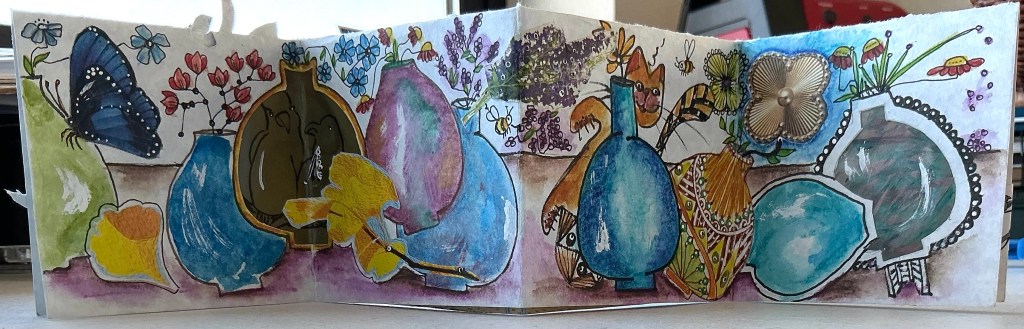
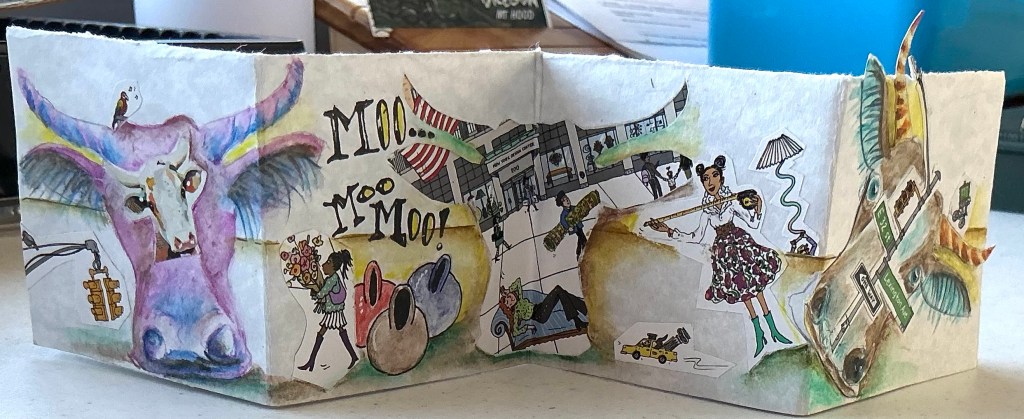
Front and back of the concertina book that tucks into the pocket above.My hand sewn, one signature SR 2025 Sketchbook.
Winter can be challenging for nature journalers. Getting outside when it’s cold and windy, cloudy and dreary, snowy, icy or wet, are not ideal weather under any circumstances. And when everything looks brown and crispy and pretty much the same, the challenge to nature journal in the great outdoors grows exponentially. While these conditions make it difficult for spontaneous observing, I try to remember there’s always something remarkable to be discovered in nature, even in winter.
Who knew a little whack on the head would be just the thing to reawaken my curiosity?
Bundled in layers, leash in hand, Luna led me on her early morning walk around suburban Albuquerque. Having been along this route before, we’ve both made some interesting discoveries in the past. And as usual, this time was no exception for Luna. For me though, everything appeared brown, crispy and familiar. But I was inspired by and enjoying Luna’s sense of curiosity, and her encouraging tug on the leash.
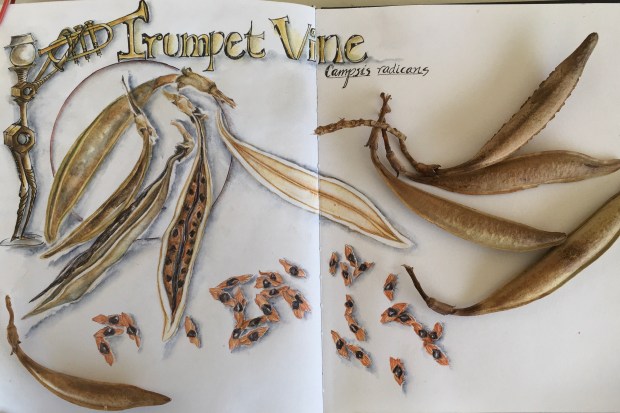
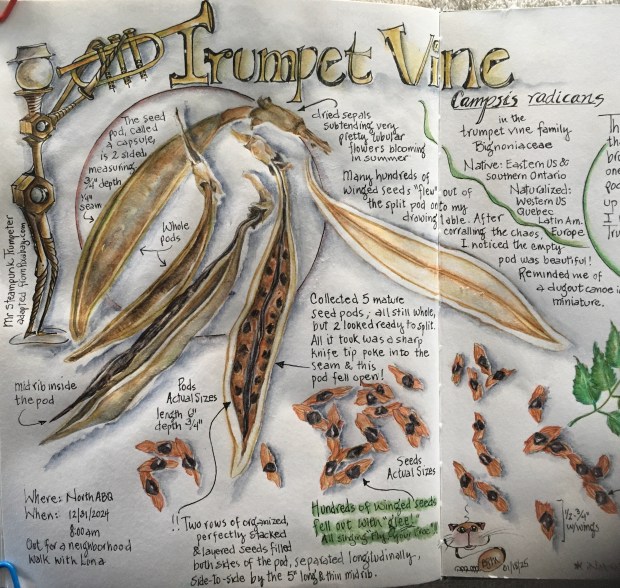
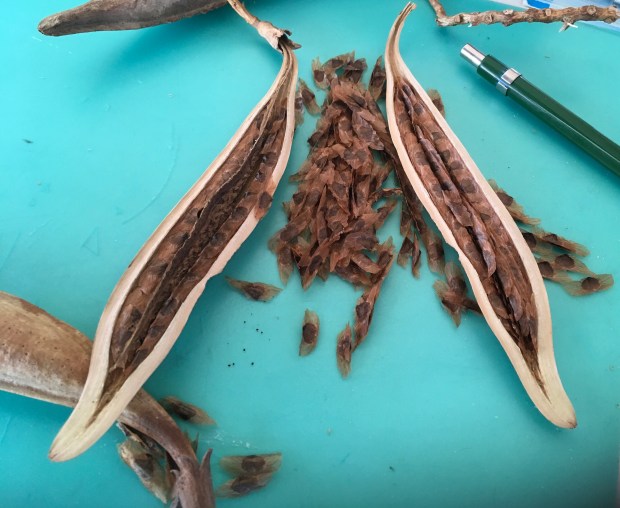
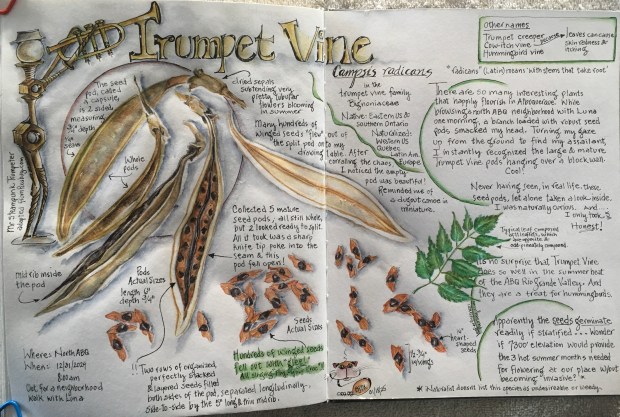
Nearing the end of our 2-1/2 mile walk, and mightily concerned I’d go home empty handed, we turned our last corner. It wasn’t 100 feet down the cement block-lined sidewalk that I abruptly stopped in my tracks. Something had lightly whacked me in the head! While the sound of rhythmic clacking rang out, I looked up, and to my surprise spotted the accidental assailant. Draped over the 6 foot wall, suspended from a hearty Trumpet Vine (Campsis radicans) growing in the hidden yard beyond was a string of pods resembling brown green beans. Long and plump and full of seeds, one of these pods had reached down low enough to make contact with to my head. (I say “reached” because that’s what my imagination said had happened.) Quickly awaking my sleepwalking brain, the effort made by the seed pod to get my attention paid off too. Silently whispering, “Pick me! Pick me!” it was as if the seed pod and its adjacent buddies either wanted to be harvested, or wanted to be featured in my nature journal (or both).
So I did ………… both!
I loved learning about and sketching these fascinating Trumpet Vine seed pods, while my mind was filled with the muffled notes of a trumpet. Tooo-too-too-toooooom!
Hope you enjoyed reading this story and browsing around my journal pages.
After an unseasonably warm, almost spring-like December in the mountains of central New Mexico, January clearly has something else in mind. Winter! Windy days have resulted in bitter cold as they brought us cloud-cover and a few mini-snowstorms.
The change in weather and absence of wildlife, combined with an abundance of dried vegetation is making it challenging to find nature journaling subjects. So a few days ago, I followed Luna around to see what was capturing her attention. Turns out burrowing rodents expanding their underground tunnels are leaving behind fresh mounds of soil with fascinating odors (to Luna, at least; I couldn’t smell a thing).
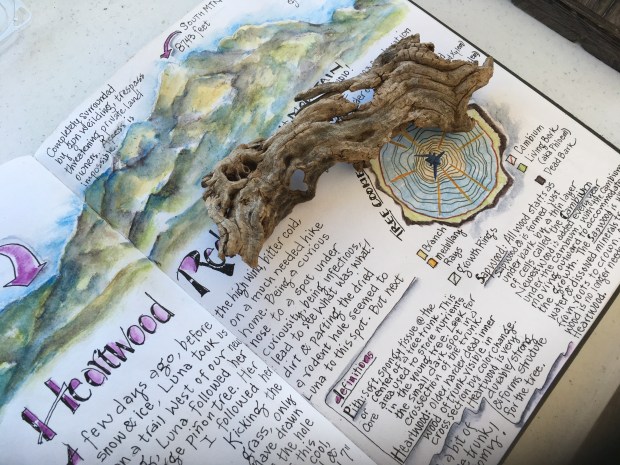
When one of her explorations led me under a good sized pinyon tree, I noticed a very interesting piece of bark lying on the ground. Turning the piece over and over, examining all the beautiful patterns in the wood, the colors, old bug holes, and woodpecker drillings, I was surprised and delighted to see a good-sized hole in the shape of a perfect Heart! Eureka!
The 7” piece of pinyon bark …. Can you find the Heart?
Many things crossed my mind in that moment …… but the one word that stuck was “Heartwood!!” Could this small piece of bark redefine the meaning of heartwood? Could this tree have been wearing it’s true emotions on its bark in the form of a heart-shaped window?
After a refresher on basic tree anatomy, and reconfirming that heartwood surrounds the core of the trunk, my imagination went wild. Could that heart-shaped hole in the bark been the opening of a mysterious pathway through the inner workings of the tree?!!! If I could’ve returned the piece of bark to the exact place from where it fell, could the heartbeat of the tree be heard?
My finished pages mostly about Redefining Heartwood, but also featuring the view of South Mountain (to the NE) as seen from our new home (including my studio) and the trail where the “Heartwood” bark was found.
While sketching the piece of bark with its perfectly-shaped heart, I wondered if peering at the inner workings of a tree through this window would make a fun children’s picture book? ….. Where the layers of a trunk and how they work would be experienced first hand by a child walking down the pathway?
After you stop laughing from all this nonsense, let me know what you think?
As always, thanks for stopping by (on my magic carpet ride!)
Photo display correction has been made in this second post, which has the identical in text as the first post presented earlier in the morning, please disregard the first post and apologies for any confusion. Barb
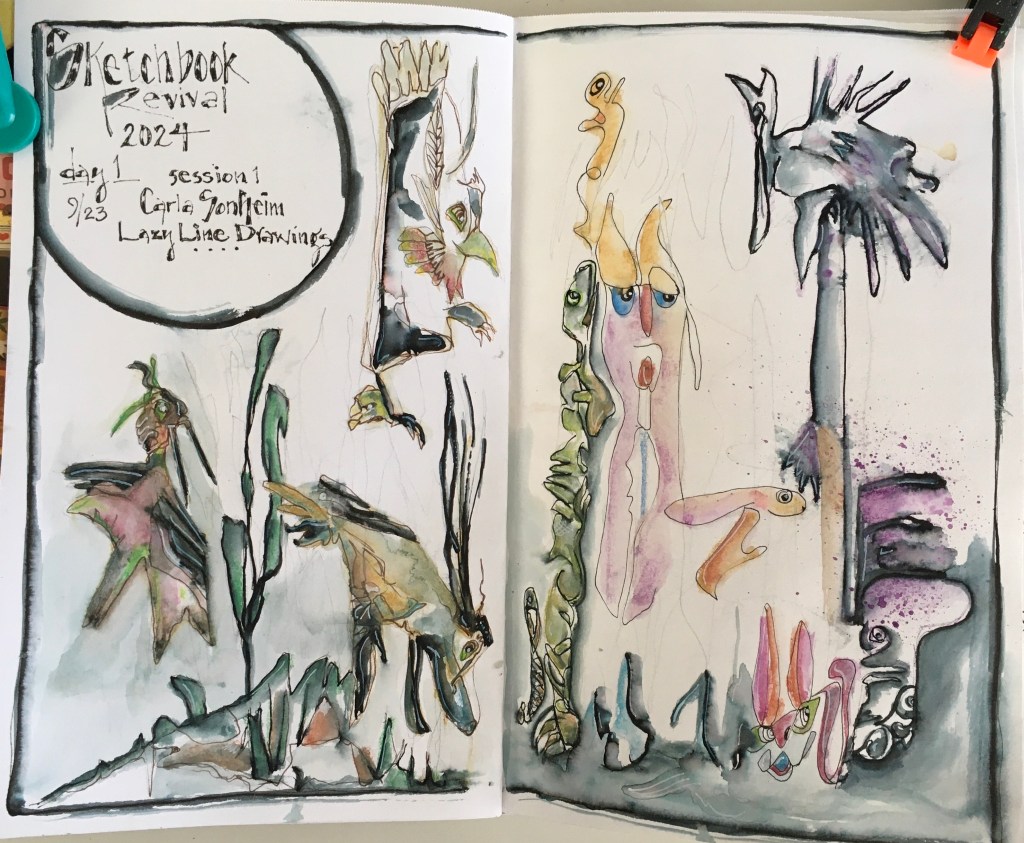
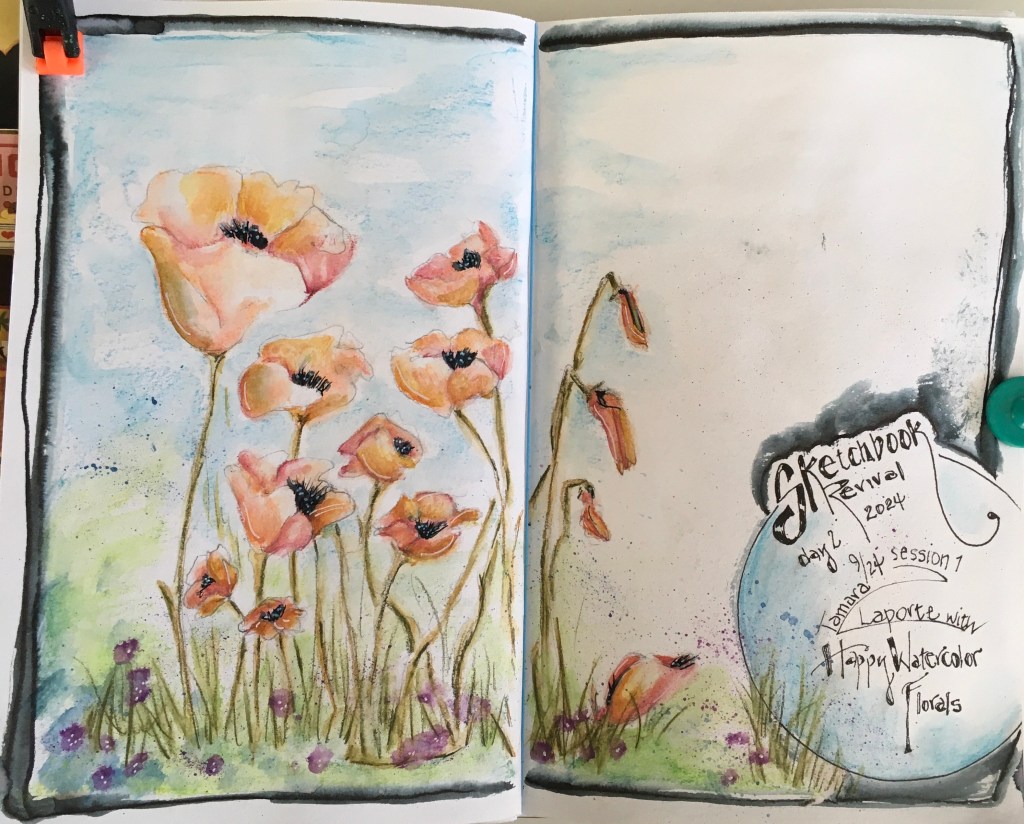
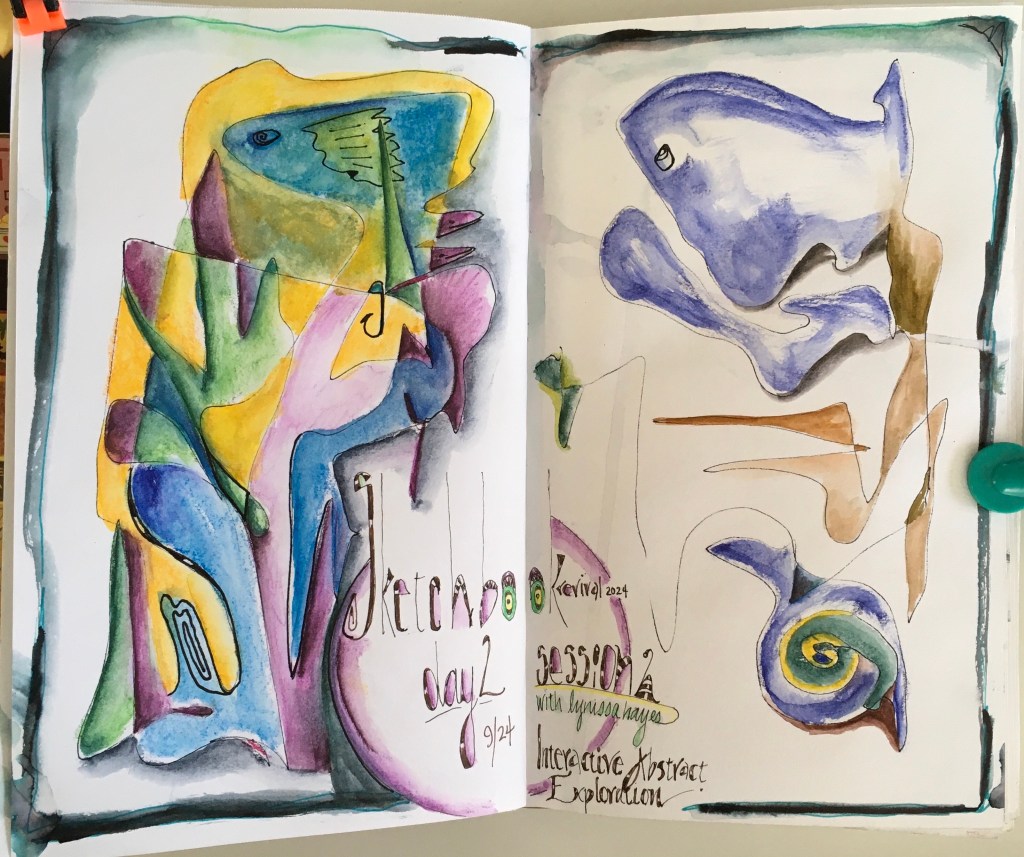
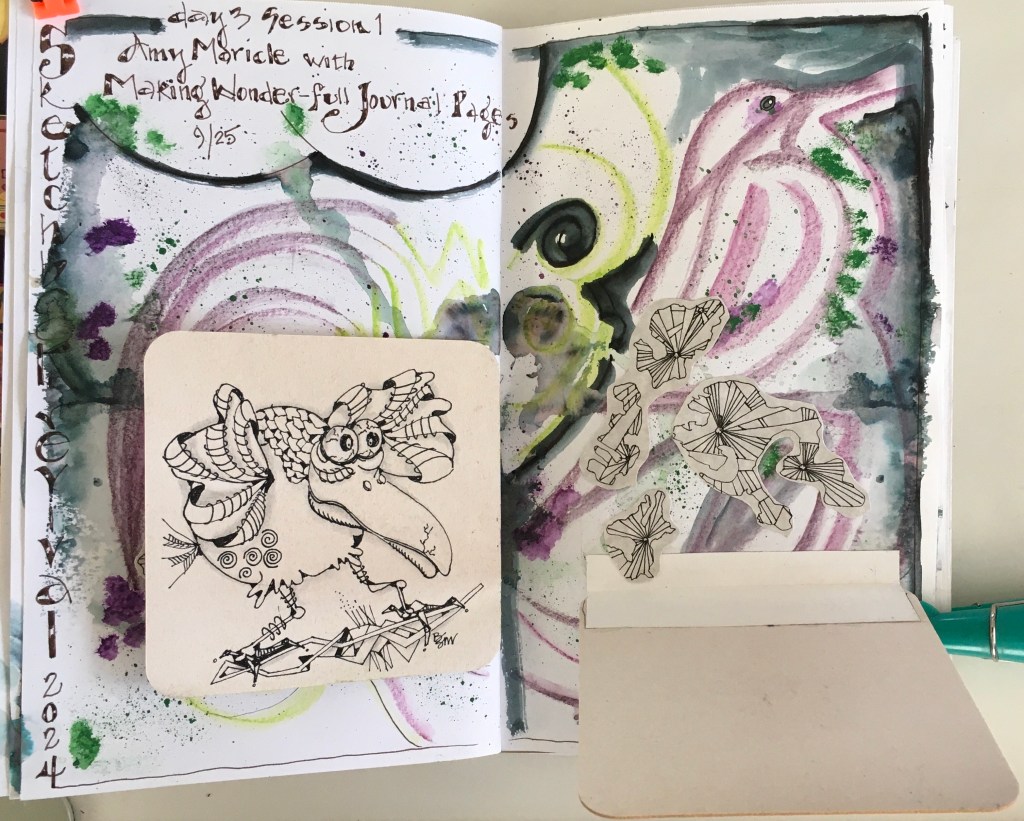
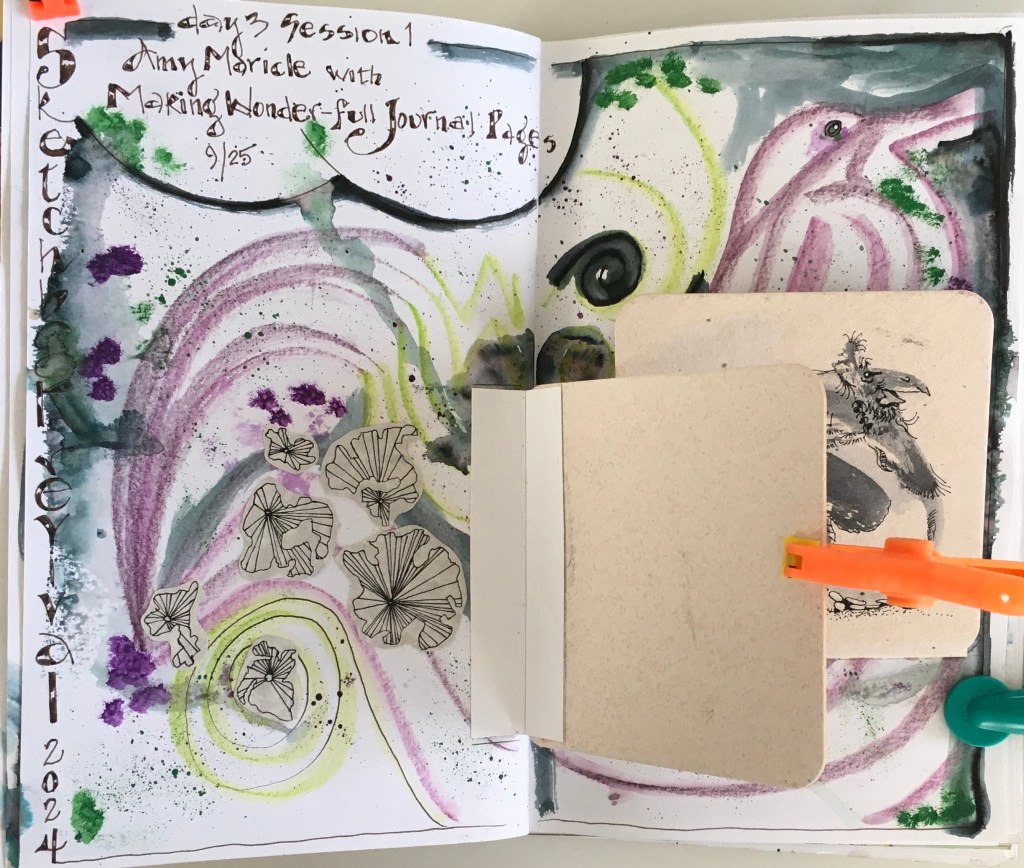
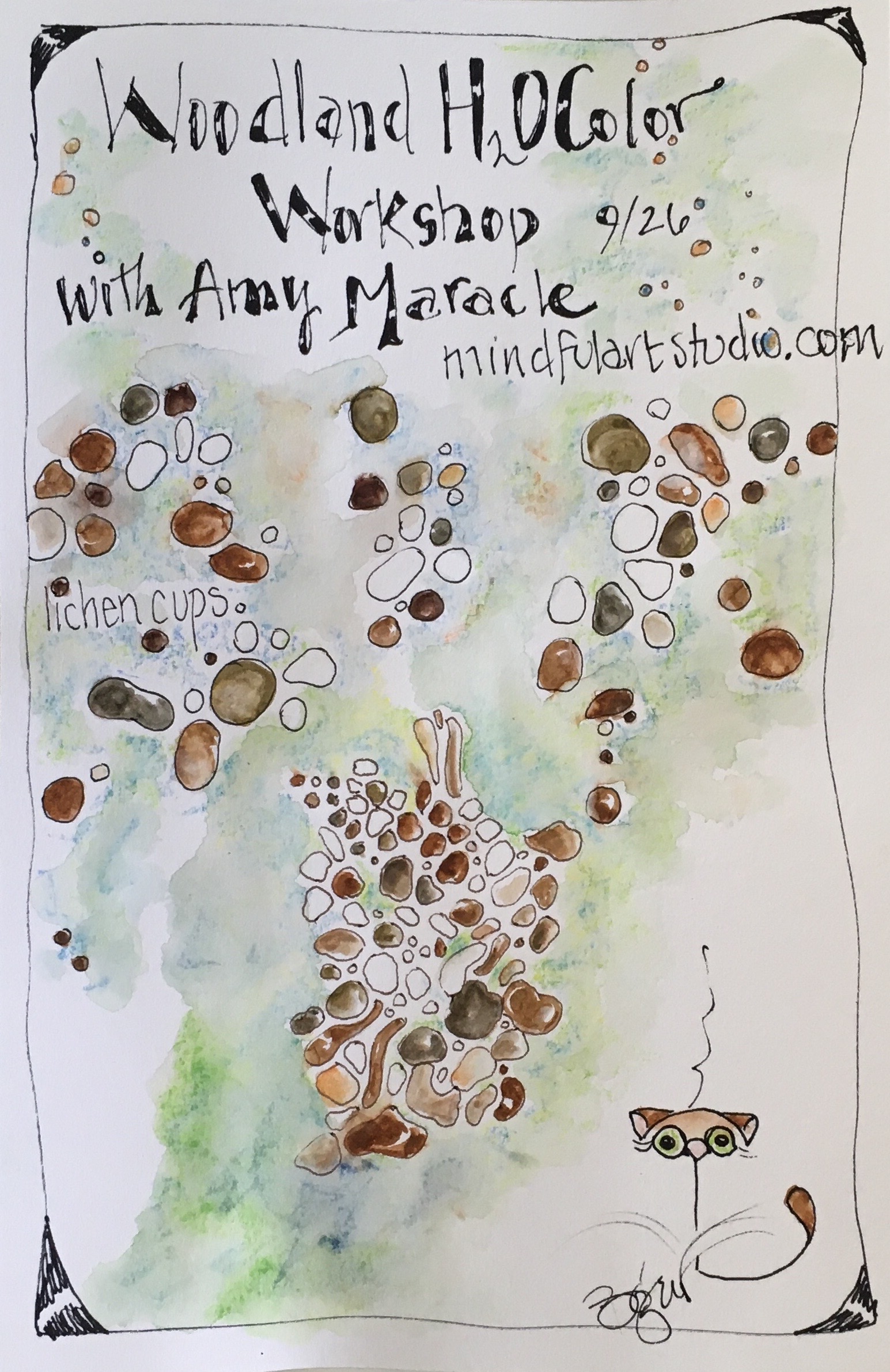
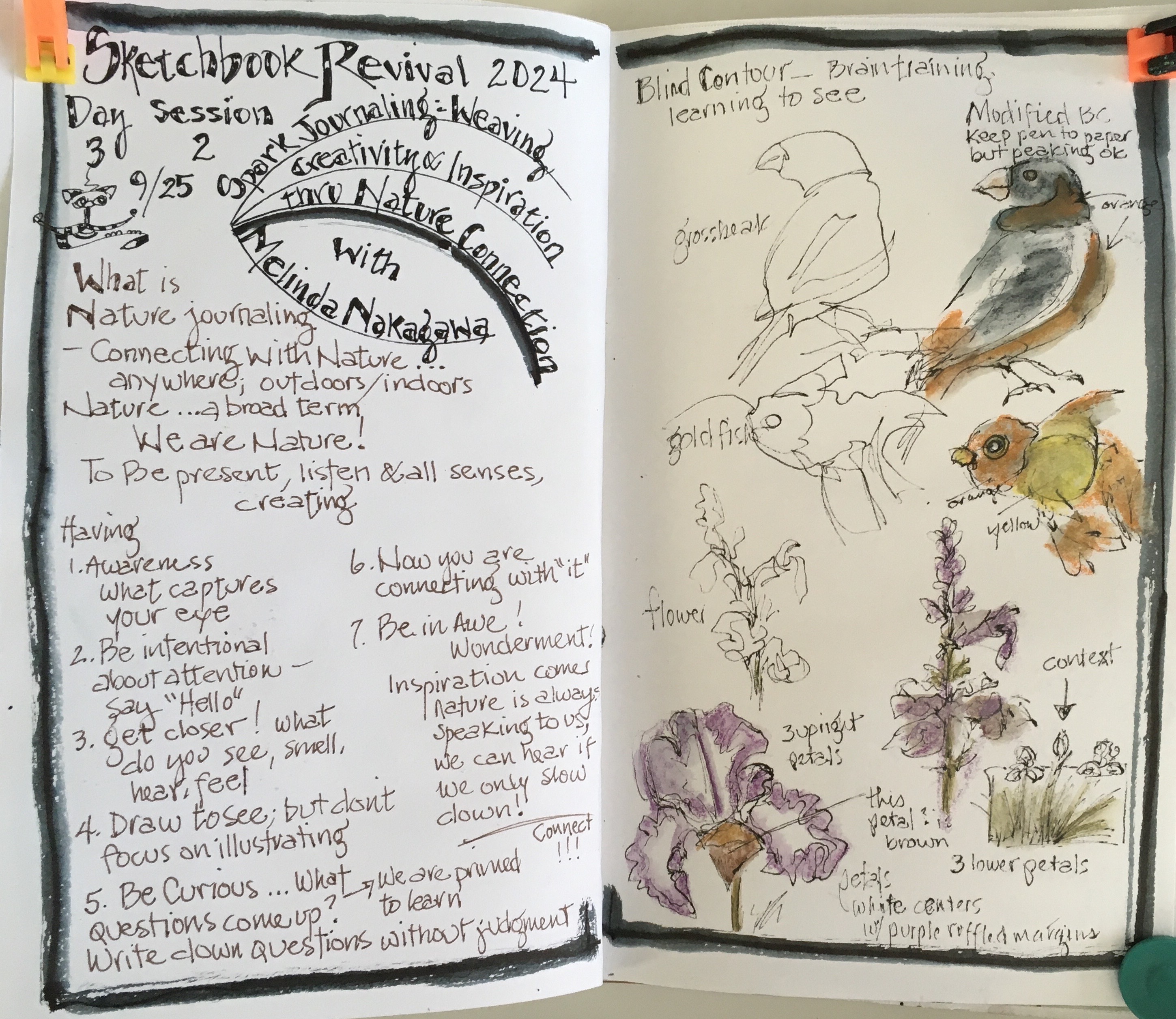
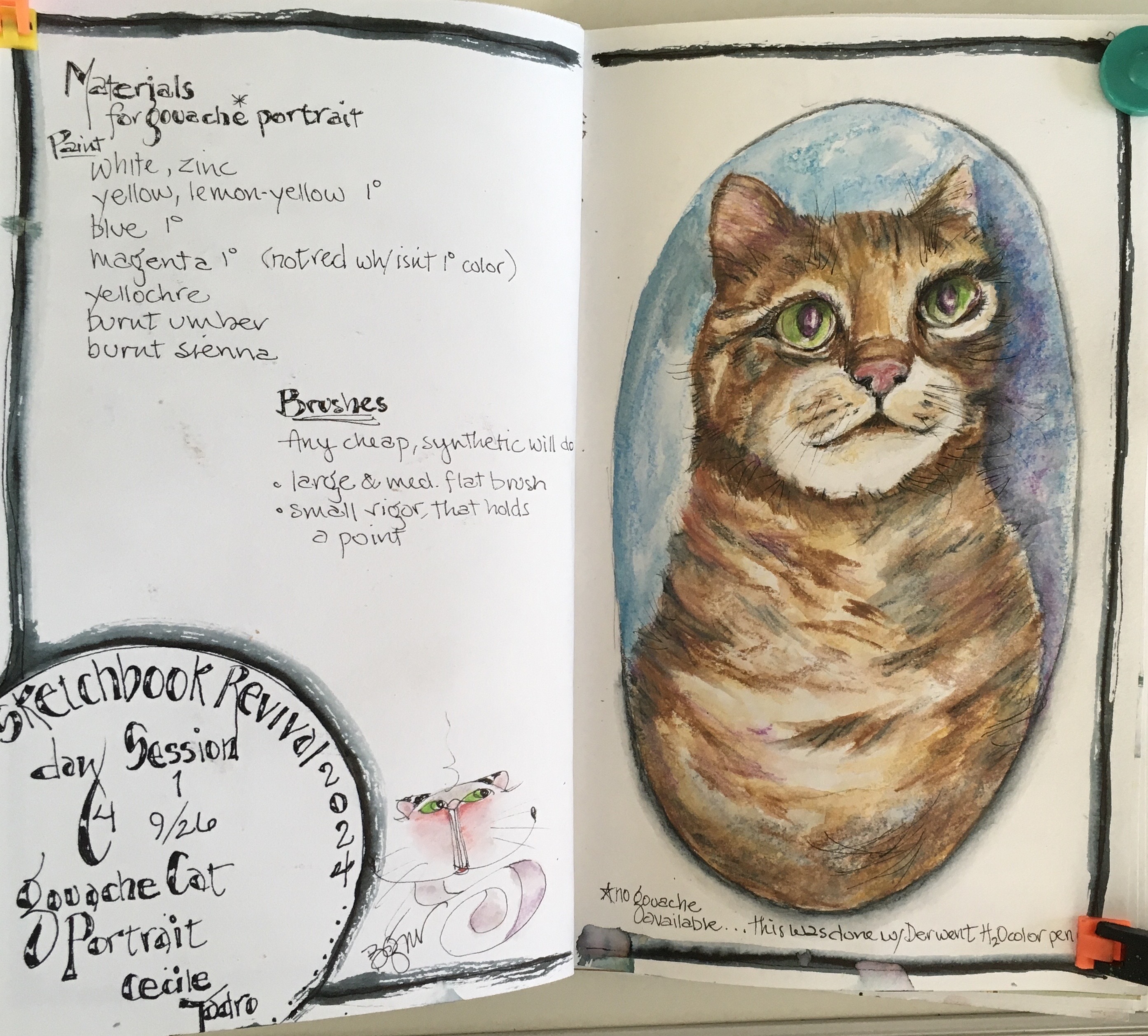
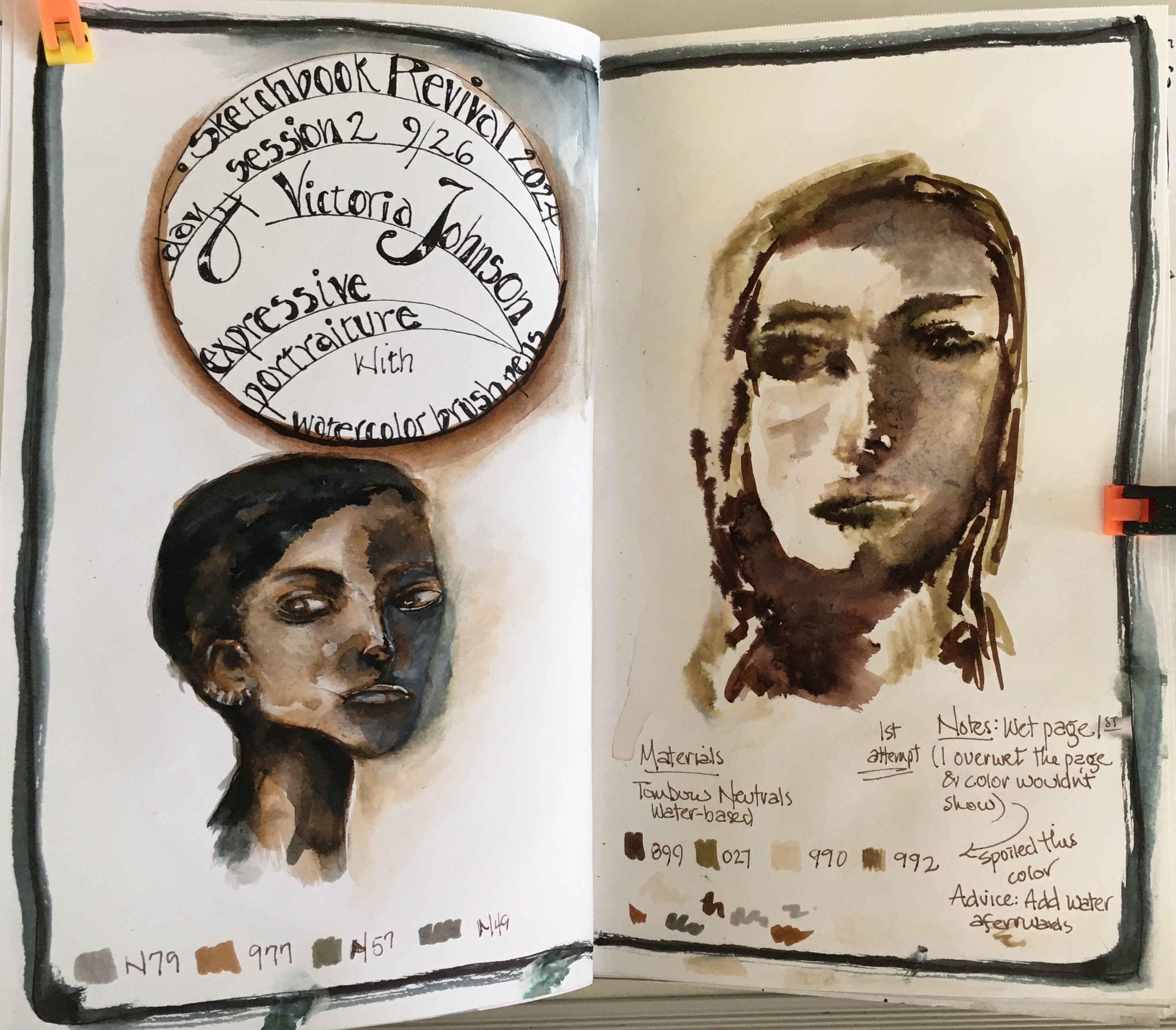
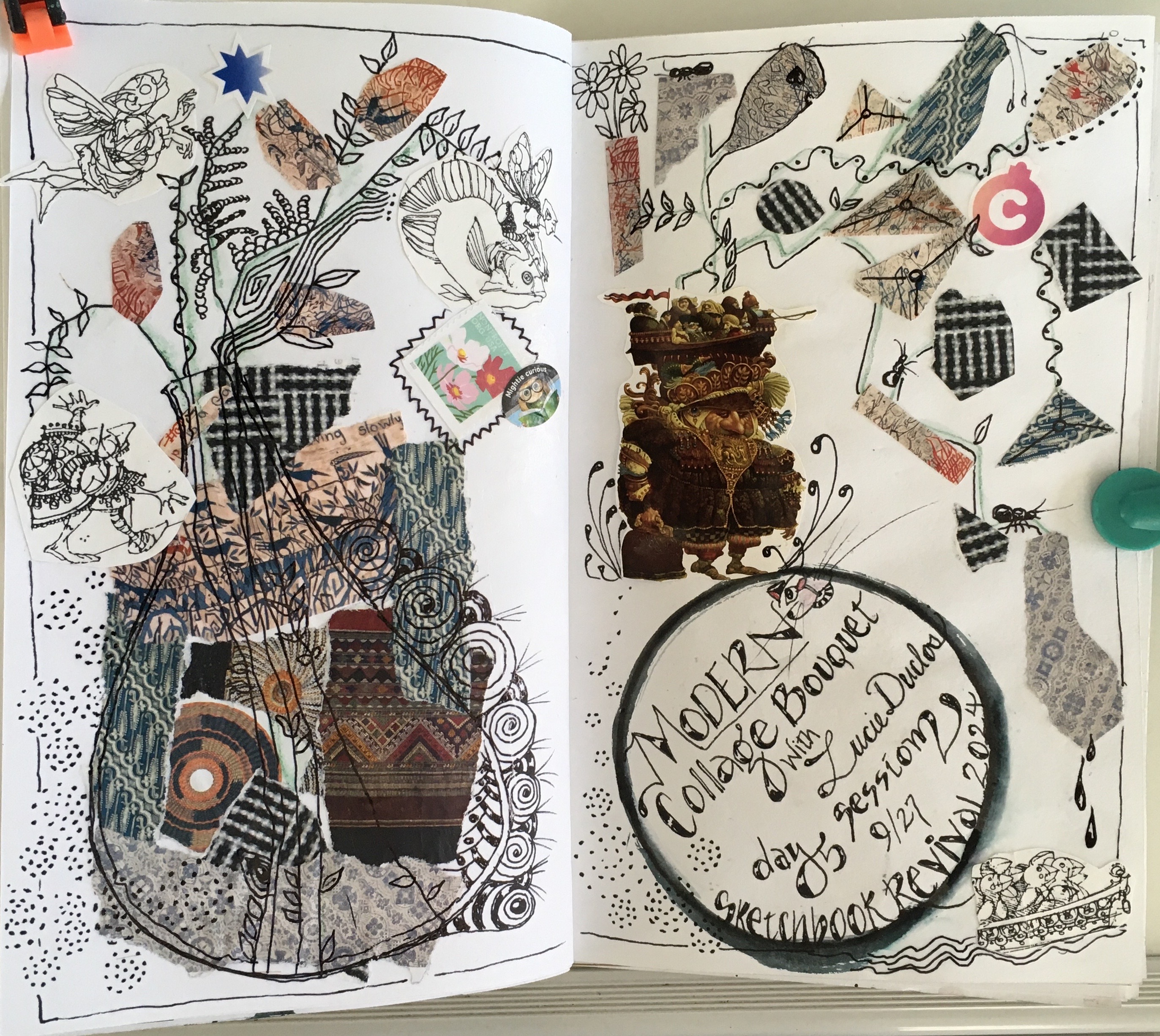
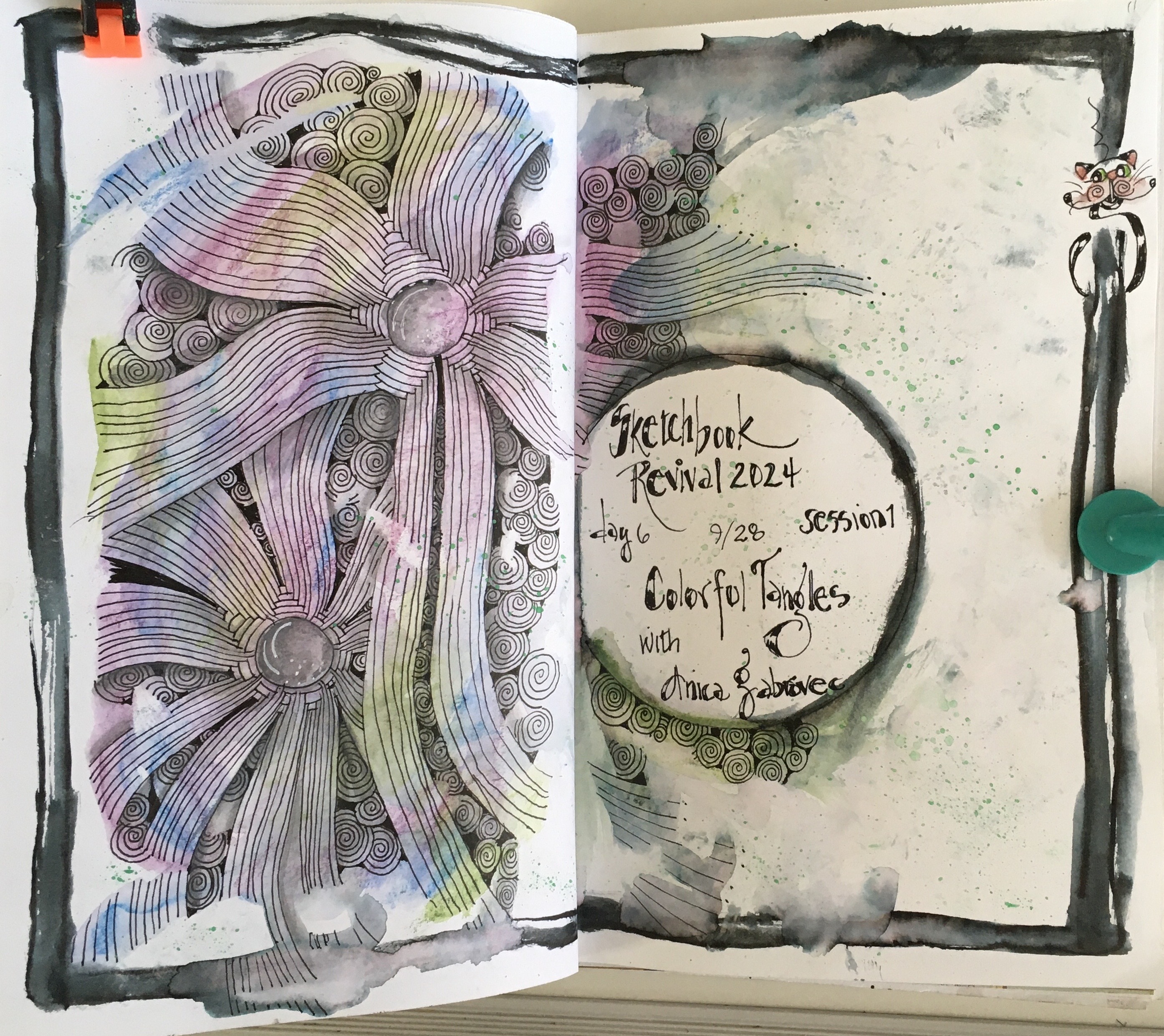
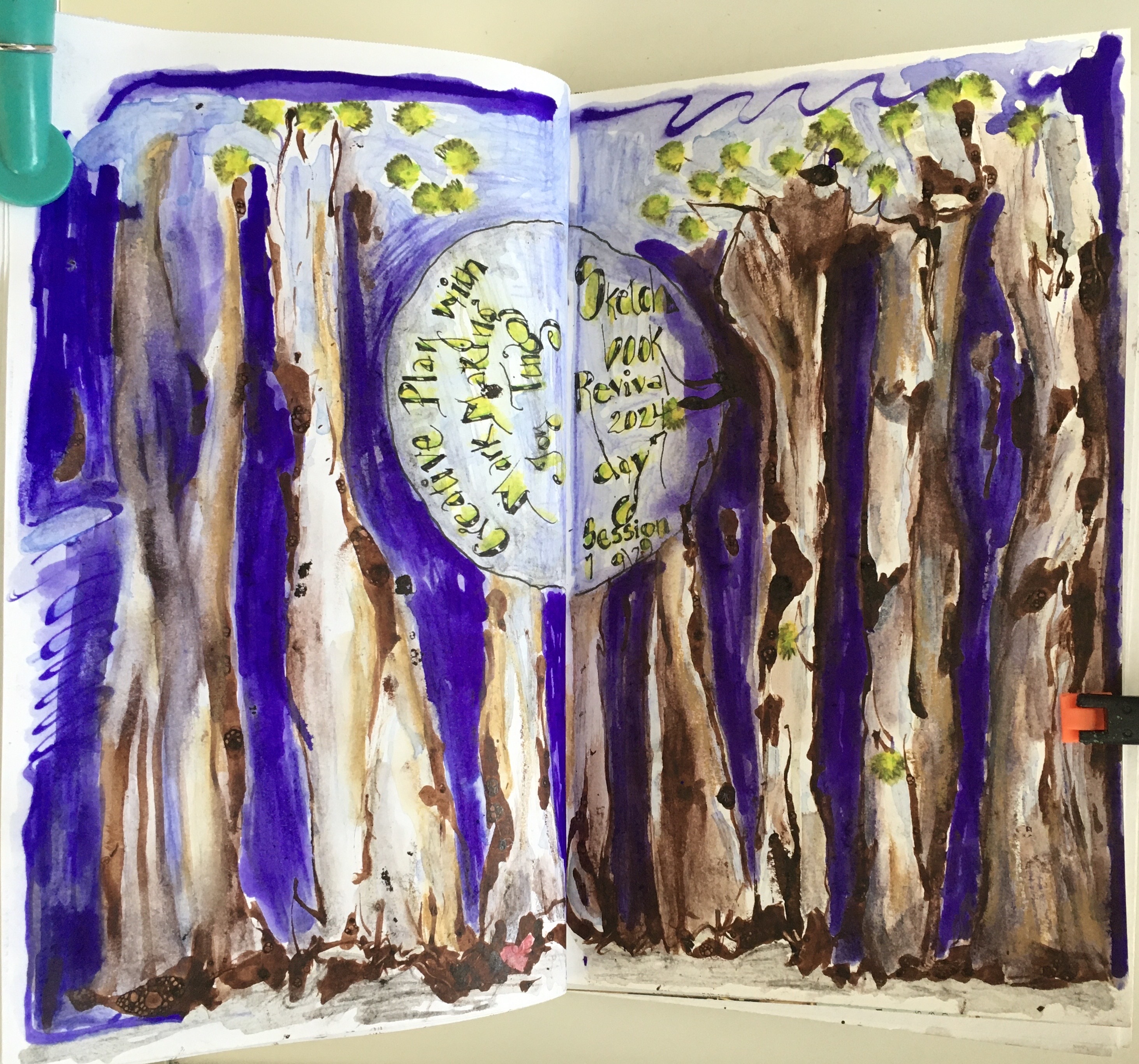
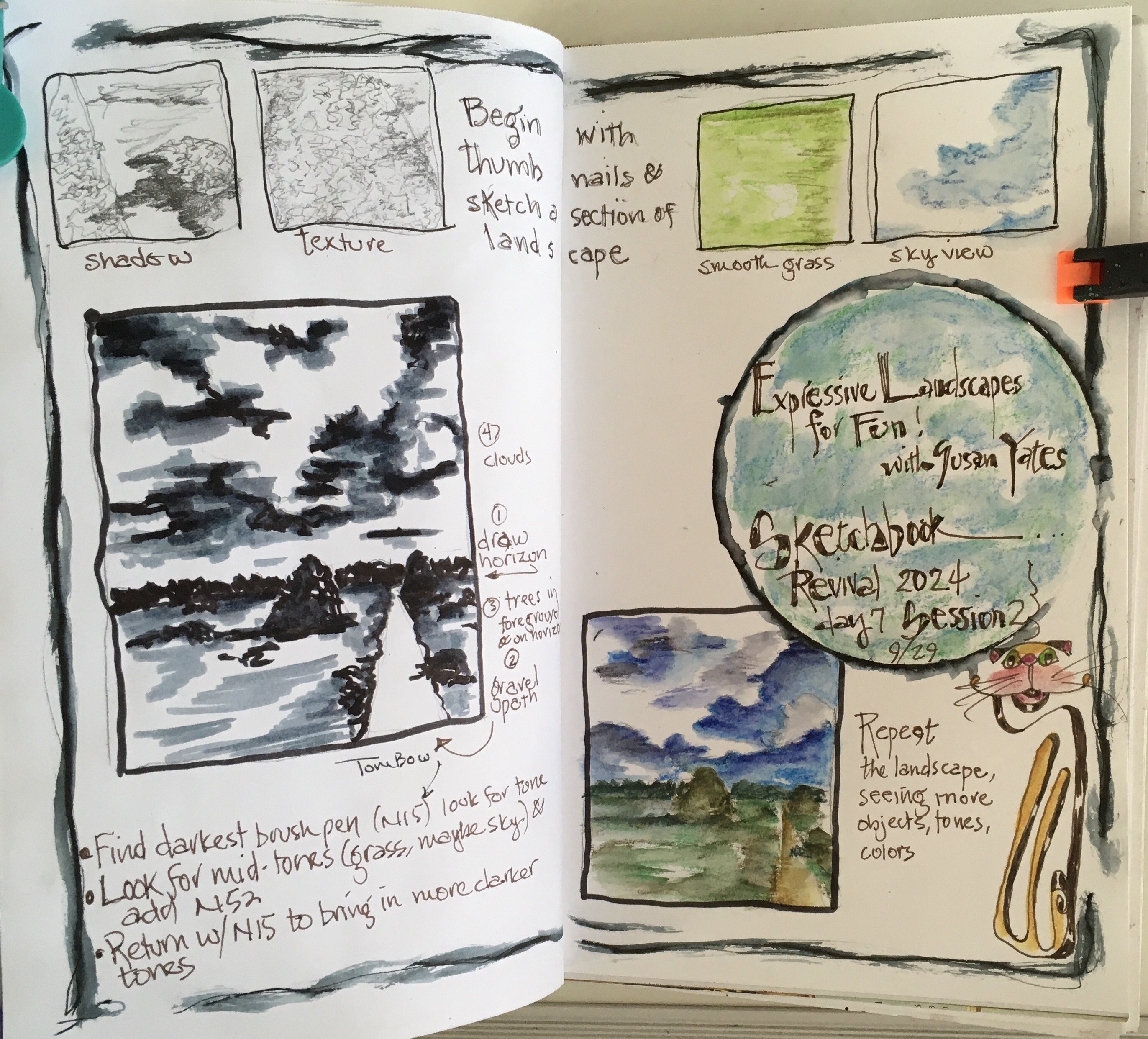
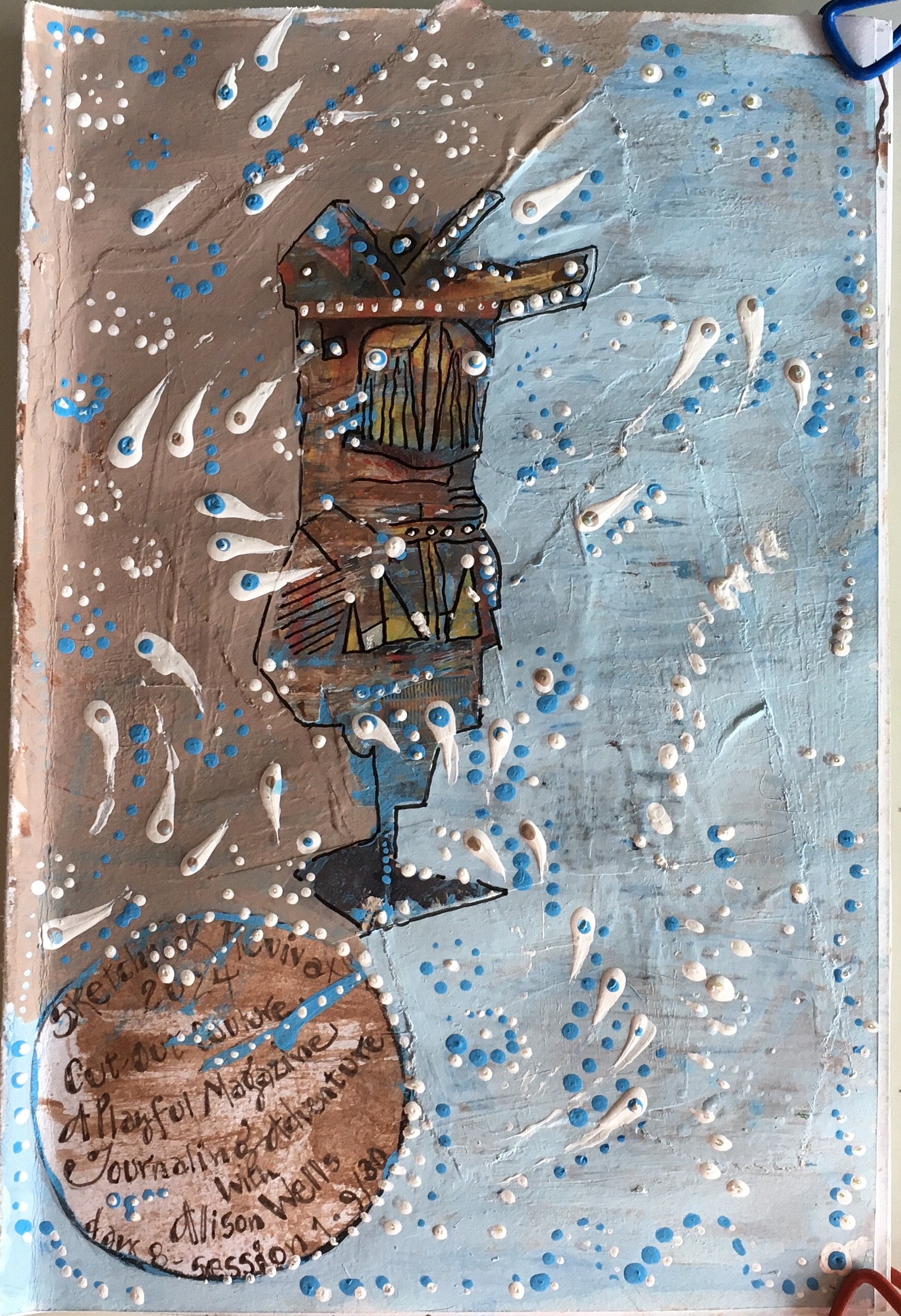
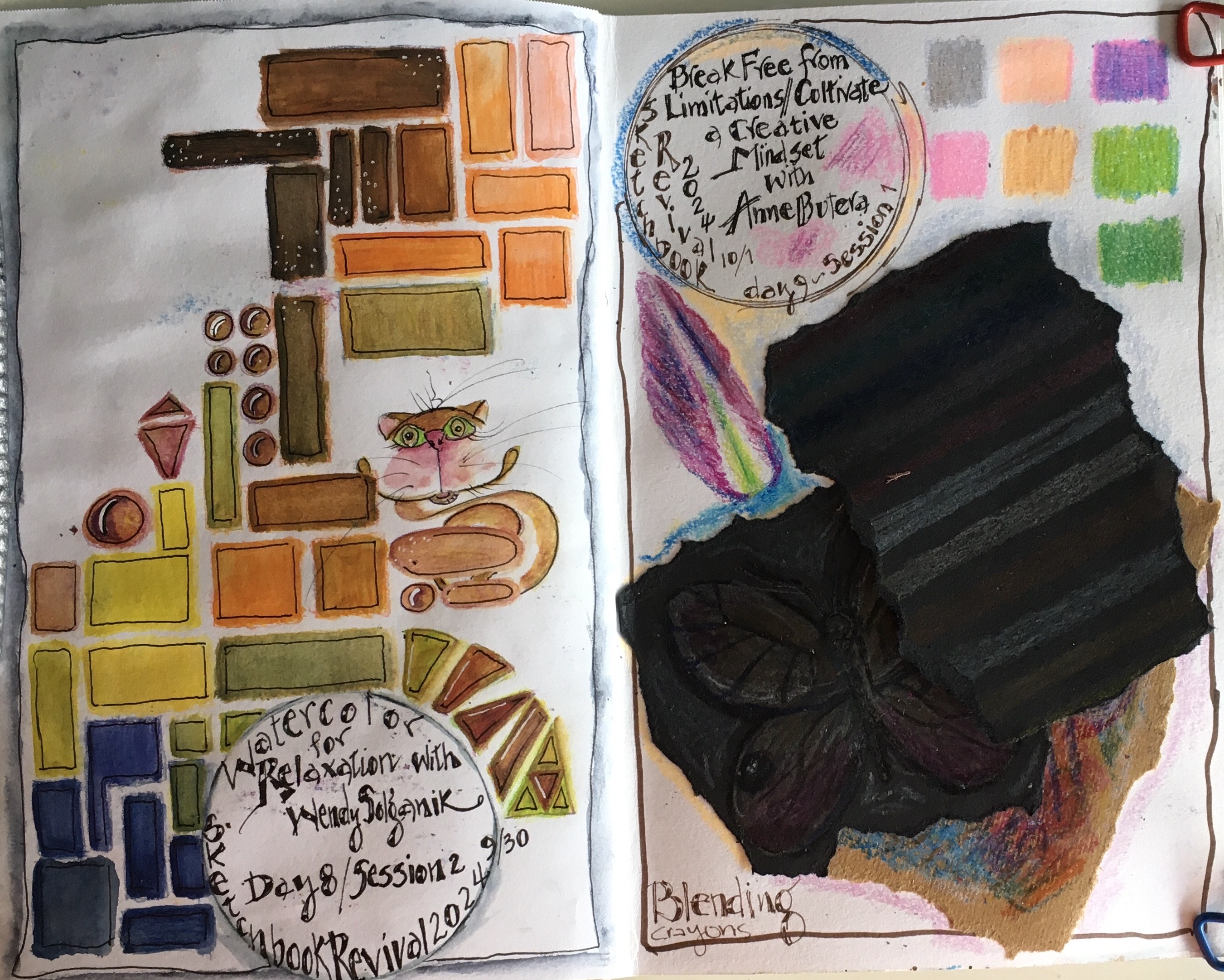
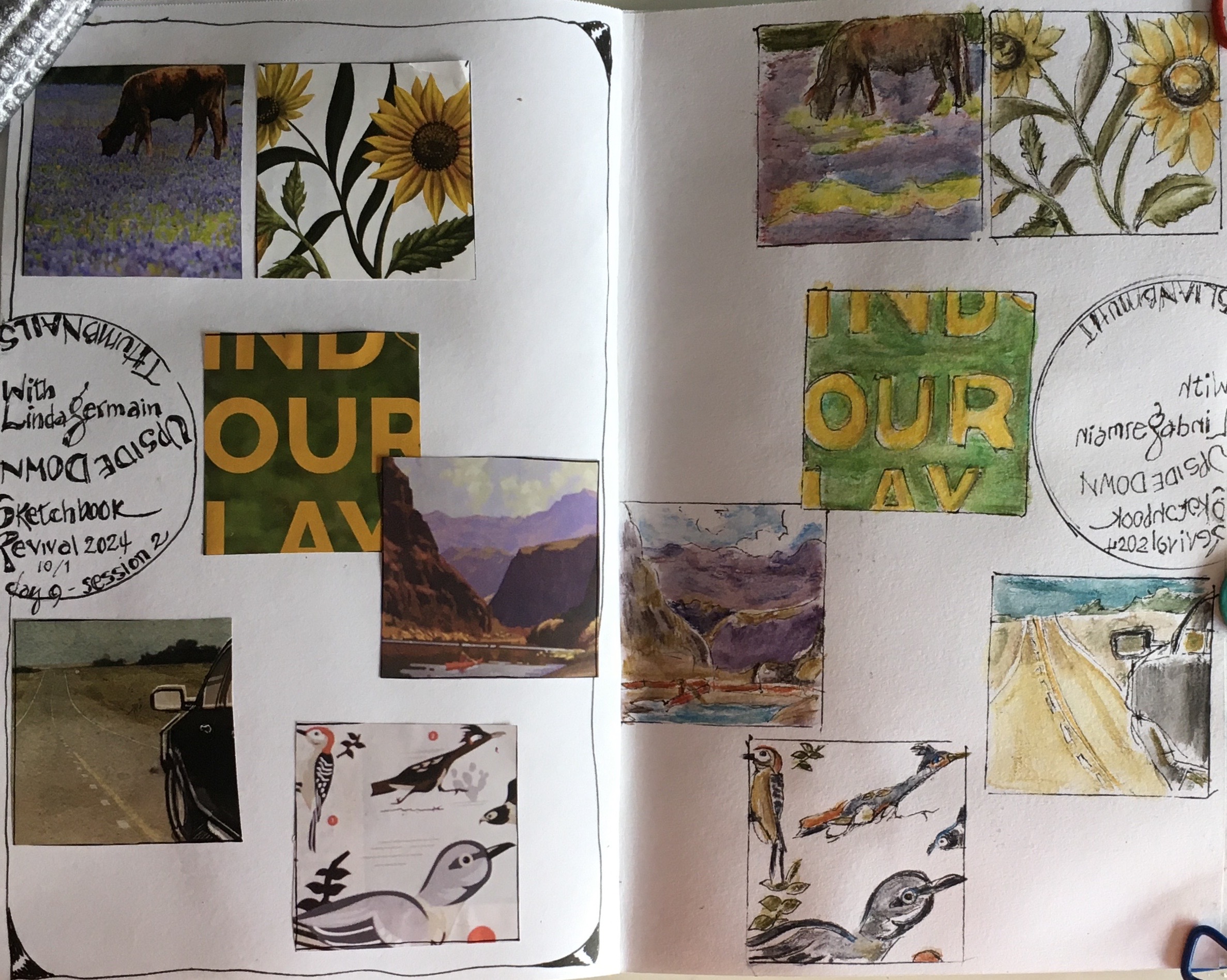
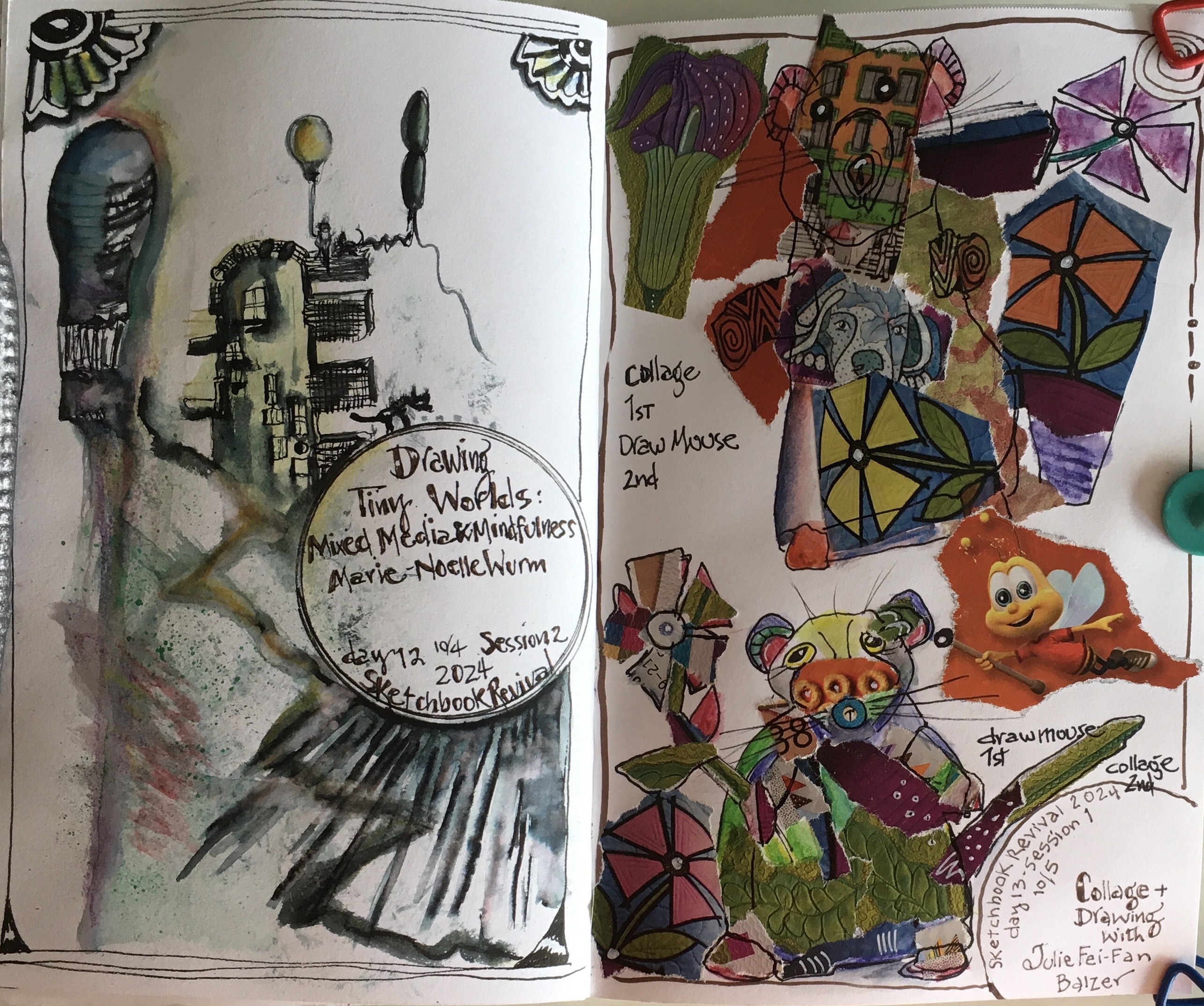
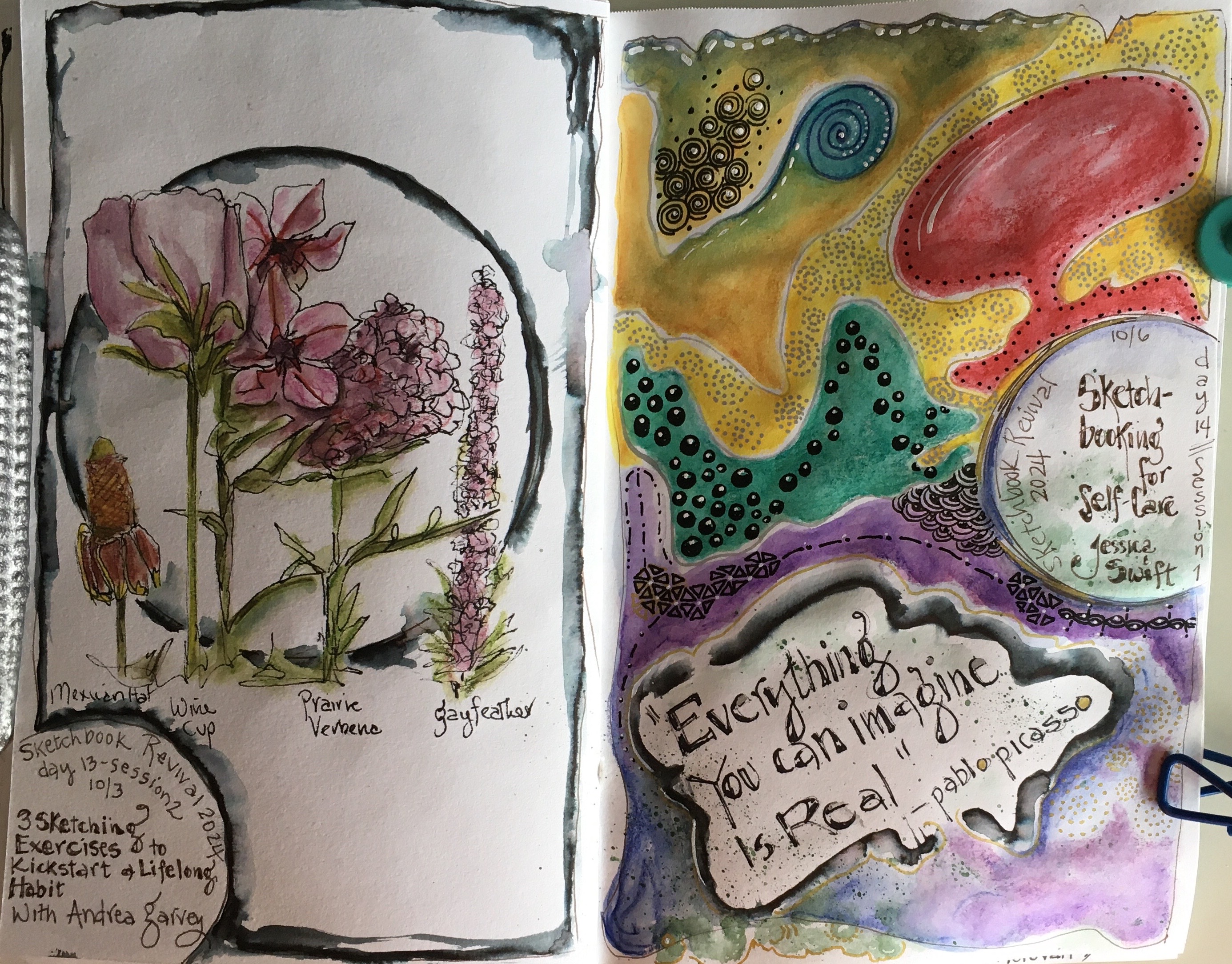
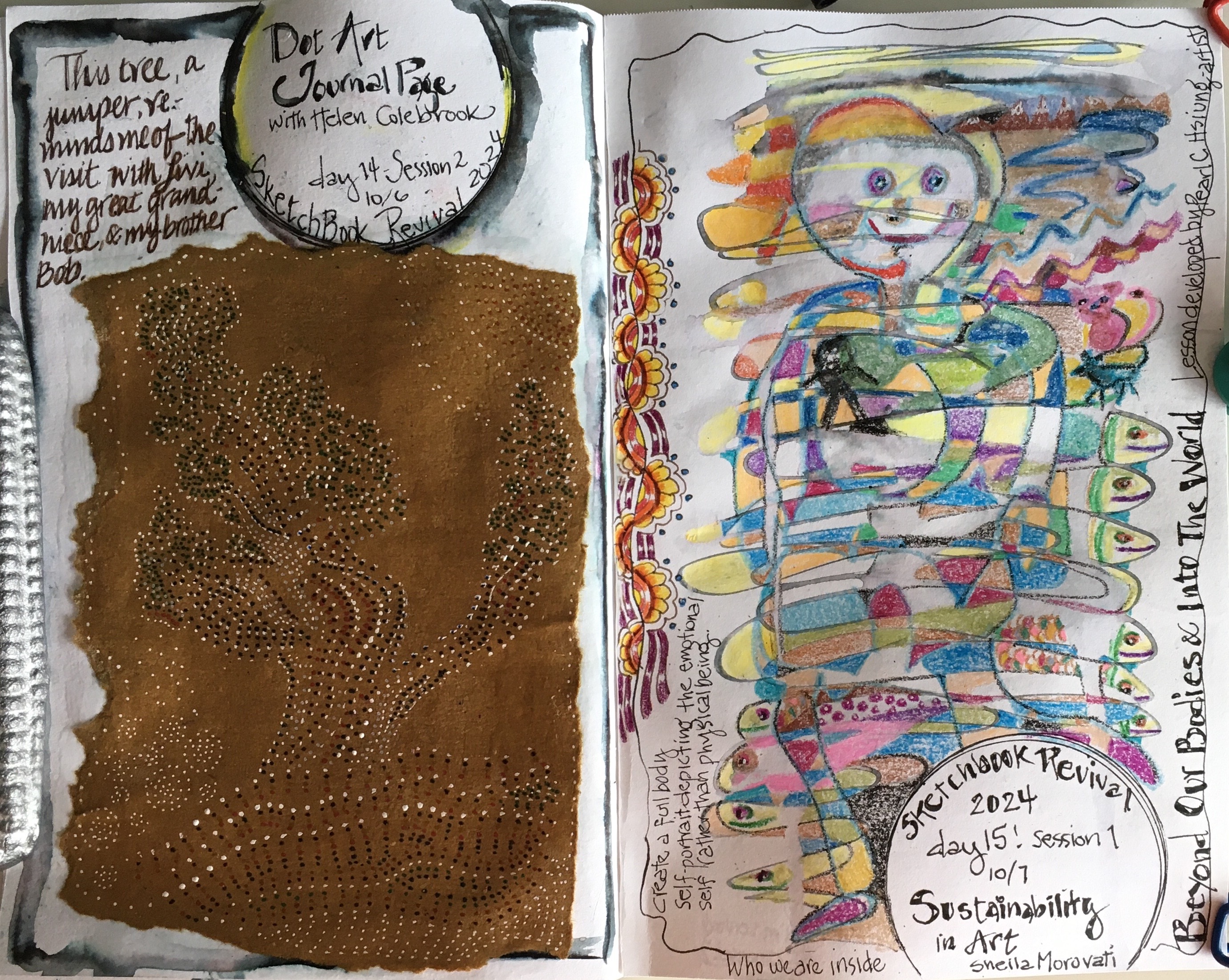
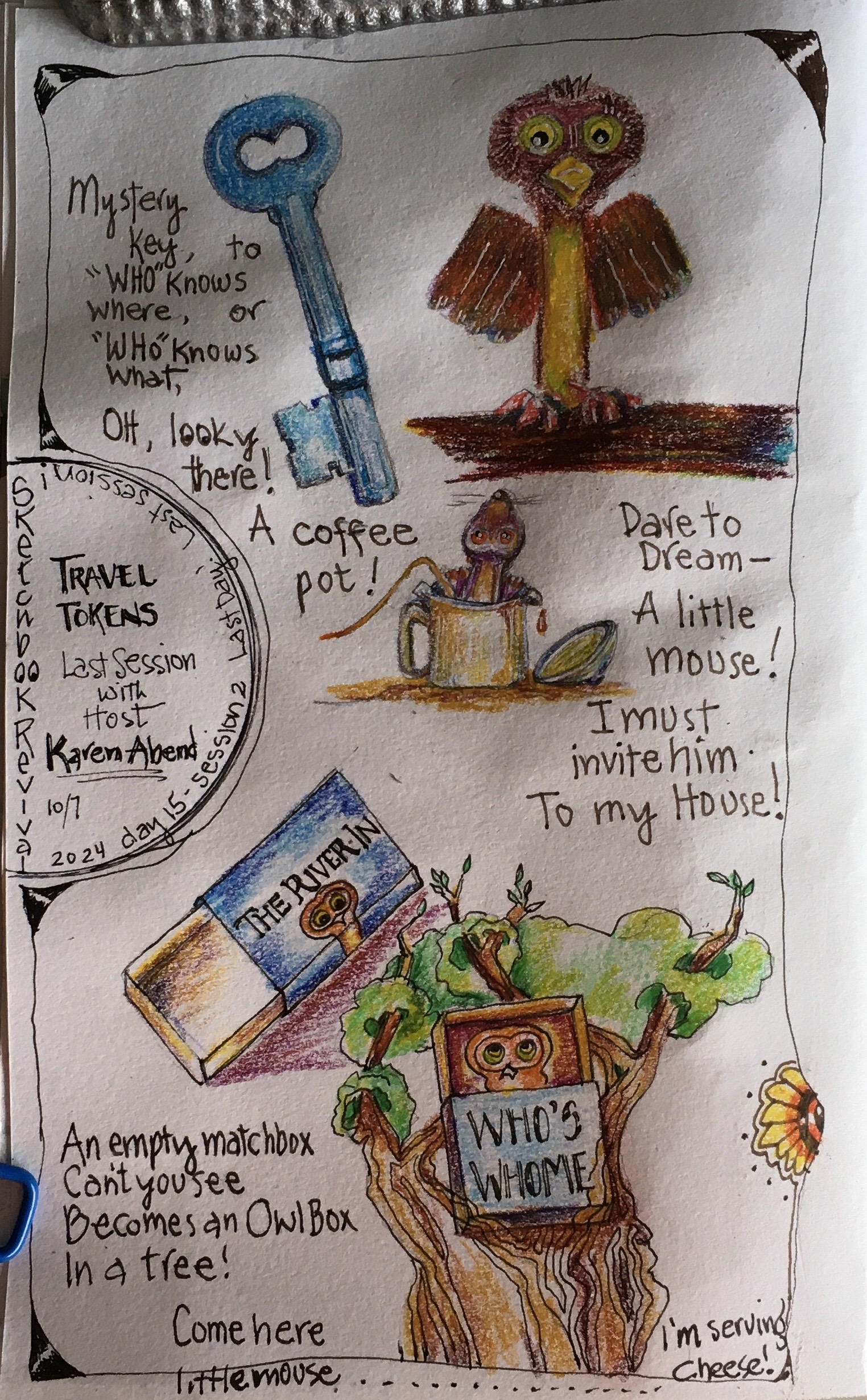
September 23 – October 7, 2024 For the last 7 years, I’ve participated in the annual, 2-week long sketching/drawing, painting and mixed media event, Sketchbook Revival, founded and hosted by a talented sketchbook artist, Karen Abend. Every year, Karen brings together a cast of creative artists for a mega on-line teaching marathon. Each day, 2 1-hour recorded sessions are available to hundreds of participants from around the world, providing an opportunity to interactively learn a skill or technique designed to begin or expand on a regular sketchbook practice. These sessions may include book binding, mark-making, collage, creating imaginary characters, urban sketching, composition, landscapes, flowers, mammals and bird painting, people or pet portrait drawing, nature journaling, Zentangle, map making, story telling, textiles, and on and on! Techniques shared by instructors involve a wide-variety materials, like watercolor, gouache, acrylic, markers, pencil and pen, colored pencil, and many forms of mixed-media.
The whole fun event is designed to stretch your creative comfort zone by experimenting with art supplies and new approaches to art making, and encourages play. And as incredible as it sounds, all you need to participate is your time and whatever materials you have on hand. Otherwise, it’s totally free! Wowza!
Not every session needs to be done (and this year there were 30 sessions in 15 days); I usually find time to complete about half of them. But this year I did all but one session (and may even complete the one skipped). From the very diverse cast of artists/instructors, I was able to learn new tips, techniques, approaches, and was invites to try new art supplies that would be useful in my regular sketchbooking and nature journaling practice.
Hopefully you’ll enjoy my 2024 Sketchbook Revival “play!” Not all are great or even good (a few are downright awful!) but it was so much fun! Maybe something from my collection will have you laughing, or maybe even entice you to give Sketchbook Revival 2025 a whirl!
That’s all for Sketchbook Revival 2024. Let me know what you think!