
Thanksgiving or Christmas?
November 8, 2026
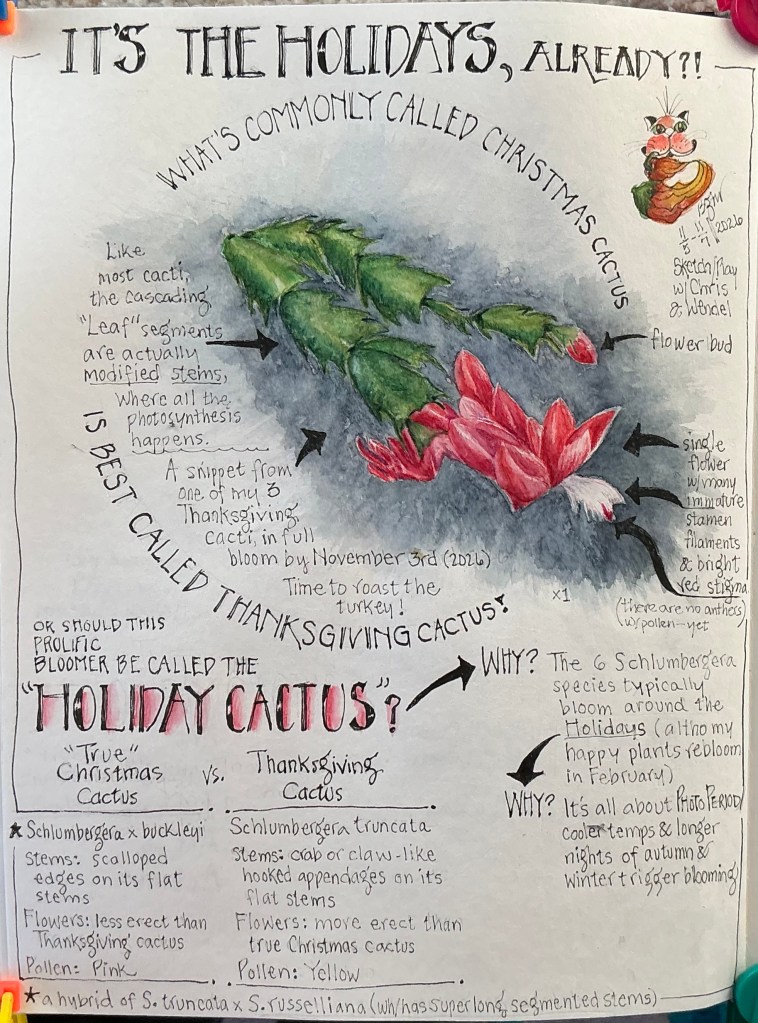
If you’re raising (or have ever grown) a Christmas cactus, is it loaded with flower buds, about to bloom, or already blooming? Mine are … and doing all of the above. Something I’ve noticed over the years is they always seem to ‘deck the halls’ in early November. Why? Why are they called ‘Christmas cacti’ when they always bloom right after Halloween?
It’s a curious question, and I searched for answers.
Have We All Been Fooled?
Although there is a true Christmas cactus (Schlumbergera x buckleyi) that grows on tree branches or rocky crevices in the humid, shaded coastal rainforests of southeastern Brazil, I learned that the festive plant widely sold in stores labeled as ‘Christmas cactus,’ is actually a ‘Thanksgiving cactus’ (Schlumbergera truncata)!
But you say your plant is the real McCoy because your 15-year-old specimen was inherited from your grandmama. It just may be! However, before going to the mat to defend the heritage of your treasured ‘Christmas cactus,’ take a close look.
- Do the margins of its flat segmented stems have the scalloped edges of a true Christmas cactus, or are they crab or claw-like with hooked appendages? and,
- Check out the pollen color — is it the bright pink of a true Christmas cactus, or pale yellow?
If you answered ‘Yes’ to the first half of each question, Congratulations! You are indeed, the proud owner of a true Christmas cactus. Now all of your friends will want a cutting of this seldom-seen species. But if you answered ‘Yes’ to the second half of each question, then your plant is a ‘Thanksgiving cactus,’ still as beautiful as it was a moment ago, just a different species. So this brings up the …
… Troubling Nature of Common Names
When it comes to plants, common names are informal, regional, and unregulated. This all leads to confusion, misidentification, and even ecological or safety risks. Because there are no governing bodies or official rules for assigning common names, a single botanical species can have dozens of different common names, making cross-referencing in literature or trade difficult. And this has been going on for ages.
To fix the problem, botanists and horticulturists use Latin binomials (genus and species), which provide a universal, regulated, and unchanging (mostly) way to identify a plant. But we really haven’t gotten rid of common names, which continue to be used world-wide, out of habit and are certainly easier to pronounce.
So What Does It Mean …
… for your ‘Thanksgiving cactus,’ which has been masquerading as a ‘Christmas cactus’ behind your back? Perhaps you could keep referring to that lovely holiday plant as your ‘Christmas cactus,’ while in the back of your mind you know it’s the Schlumbergera truncata species? Perhaps now that you know it’s S. truncata blooming away in November, you’ll want to adopt its new-to-you name of ‘Thanksgiving cactus?’ Or perhaps, in honor of this festive time of year, you’ll go out on a limb and call your centerpiece a ‘Holiday cactus?’
No matter what you call your plant, it’s all yours, after-all. And when it’s covered in blossoms, it’s cause for celebration!
As always, thanks for stopping by!


