November 11, 2026
Abert’s Sanvitalia (Sanvitalia abertii)
—aka—
Abert’s Creeping Zinnia
Such a charming plant, if you can spot it! As a member of the Sunflower (Aster) family, you might expect Abert’s Sanvitalia to boast an abundant display of large glowing yellow flowerheads. Nope! Often overlooked, this plant seldom grows taller than 3 inches and usually has fewer than 6 ray florets whose petals are barely 1/8th-inch long. This modest number of yellow ‘rays’ are evenly spaced around a small domed cluster of disc florets, each tubular corolla hardly 1/16th-inch tall. There may be less than 10 flowerheads/plant that rise above a pair of simple leaves. Is this diminutive plant what comes to mind when you think of a sunflower? Probably not.
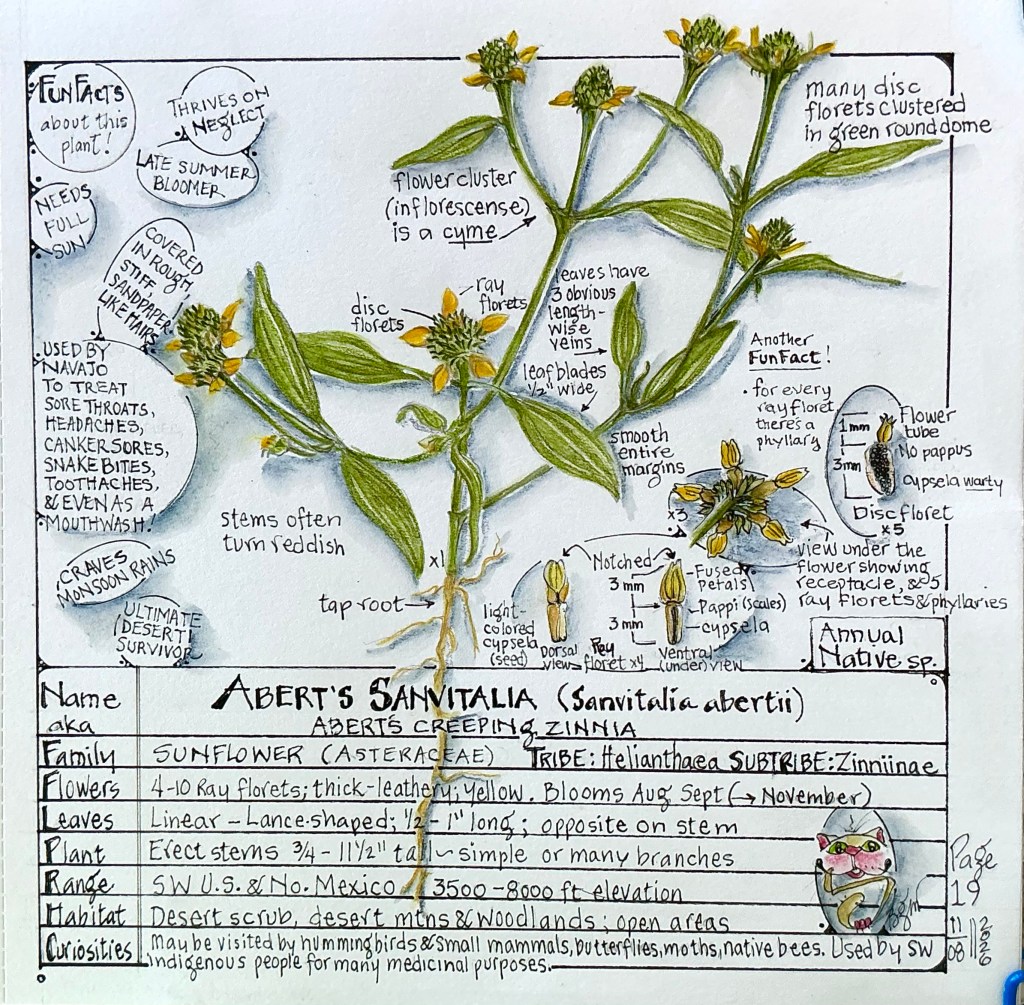
Abert’s Sanvitalia may not be showy, but as desert southwest native species it is a survivor. Its hardy seeds that were scattered on the ground last year patiently wait almost the entire growing season for the heavy late summer Monsoon rains to germinate. That sudden flush of water stimulates new plants to grow and flower quickly hoping to entice pollinators to a late season feast before an early frost prevents seed set.
This delicate little annual can (usually) be found every August and September in scattered, sunny locations throughout the Las Leyendas Subdivision and surrounding areas. But I was beginning to worry this year (2026) would be an exception. Because it was very hot and dry during the summer through the our typical Monsoon season, it seemed likely Abert’s Sanvitalia seeds would not be germinating. But at the end of September and into October, boy did it pour! And not just once, but twice! there was a heavy rain, followed by two more by mid-October. That seemed to do the trick. Soon after, a handful of these tiny sunflowers popped out of dormancy and began to bloom, and by late October and early November seeds were falling to the ground. It appears germination really is triggered by Monsoonal rains.
Fun Facts about Abert’s Sanvitalia
- The species thrives on neglect and the sudden burst of summer Monsoon rains.
- In the wild, it is a “summer annual.” Past year’s seeds wait patiently for the heavy summer Monsoons to break their dormancy and germinate. These rains mimic the deep, occasional soakings this plant depends upon to complete their life cycle.
- It requires full, unobstructed sunlight to form into a healthy compact forb. If the plant grows in the shade, the stems become “leggy” and weak as it makes every possible effort to stretch toward the light.
- A complete covering of rough, stiff, sandpaper-like hairs prevents moisture loss through its stems and leaves, and a stout tap root able to find water at depths deeper than many shallow-rooted annual species, makes this plant highly specialized to grow in dry rocky or sandy substrates, typical of our desert soils.
- Each flowerhead produces two distinct types of fruit. The cypsela formed beneath the petal of an outer ray floret is light-colored and has little scales (pappi), while the cypsela that forms beneath the fused tubular petals of a disc floret are darker, warty, and lack a pappi).
Ethnobotany
Indigenous peoples of the southwestern U.S., particularly the Navajo, used Abert’s Sanvitalia for various remedies. Primarily the leaves were chewed or made into a poultice or an infusion to treat sore throats, fevers, headaches, mouth sores, toothaches, canker sores, menstrual pain, and snake bites. It was used as a general cure-all. A warm infusion of leaves was even used as a mouthwash.
Etymology
The genus Sanvitalia was published in 1792 by Jean-Baptiste Pierre Antoine de Monet de Lamarck (1744-1829). There are two theories about the adoption of the genus name Sanvitalia:
The primary and most widely accepted derivation honors the Italian Sanvitali family (or specifically Federico Sanvitali (1704–1761), a professor in Brescia, Italy); and/or
The genus was named for the Spanish botanist, Sanvital (a claim disputed by the Sanvitali family).
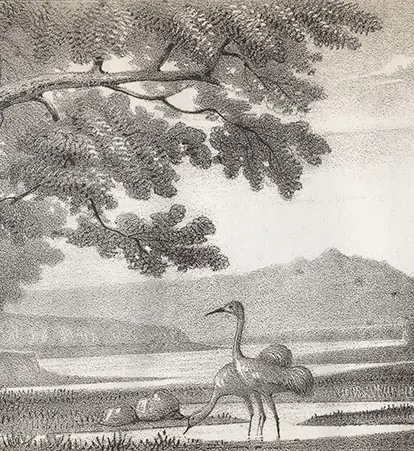
The species abertii was named after James William (J.W.) Abert (1820-1890), an American military soldier, explorer, and bird collector. More than a soldier and explorer, J.W. was a famous watercolorist and topographical artist who documented the flora and fauna of the American West while on expeditions with the Corps of Topographical Engineers. Run an internet search on J.W.’s art, and you’ll find images of his watercolors and sketches. Today, many of his original paintings are sold at auction for prices ranging from $7500 – $15,000. The following image (source henryehooper.blog) is a lithograph of his drawing of Bosque del Apache featuring sandhilll cranes.
Coincidentally, J.W. was the son of John James (J.J.) Abert (1788-1863) who led expeditions in the southwest during the mid-19th century as the head of the U.S. Corps of Topographical Engineers, a new organization formed in 1838 to supervise the mapping of the American West.
And that’s all for now, folks!
…………………………………………………………………………………………………
Hope you found this interesting!
As always, thanks for stopping by!
References: efloras.org (Flora of NA); iNaturalist.org; npsnm.org; swdesertflora.com; wikipedia.org


