In my last blog post, FascinatingFasciations, I shared my discovery of an extremely malformed Rush Skeletonplant. While researching this much branched and dainty member of the plant family, Asteraceae (which includes asters, sunflowers and daisies), I became entangled in the winding and seemingly never-ending number of rabbit trails on my journey, until finding myself on a surprising detour. Totally absorbed in the subject of plant malformations, and learning a lot of cool stuff about Rush Skeletonplant along the way …….
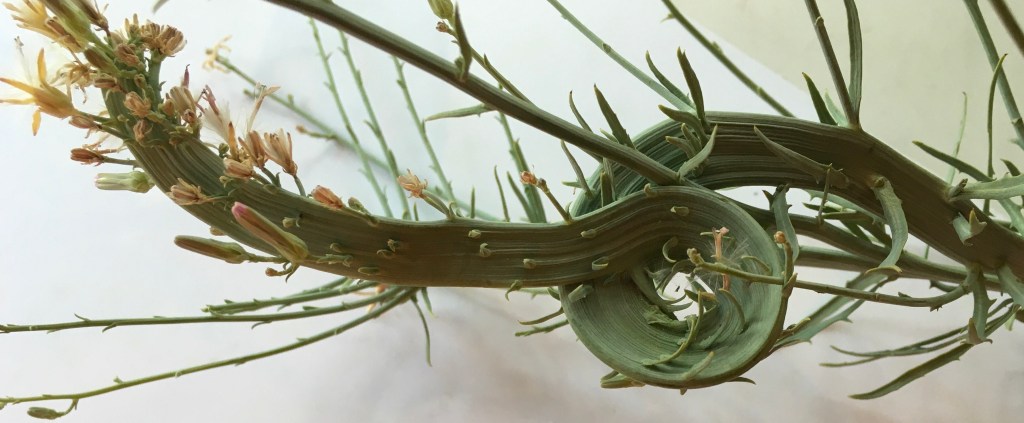
The weirdly wild fasciated Rush Skeletonplant
………. I tripped and fell flat on my face (only figuratively!). One of the published research papers appeared to be in error …… regarding the seed (aka fruit) name of this plant. Known to me for decades by the name “Achene,” the researchers had labeled the seed “Cypsela.” And not only did they call seed of Rush Skeletonplant a “Cypsela,” but they used this name when referring to all the seeds of the Aster family!
What! No Way! Who was responsible for this name change? When did this happen? Why oh Why
It was early morning, but already a hot 85F as we hiked the dry, dusty trails of the Albuquerque foothills. With a few exceptions, late June’s wildflower display is all but gone, replaced by an abundance of seeds ready to drop, blow away, or feed hungry chicks. While the “stage” resets for the next Act, the Summer Monsoons, plants in the Sunflower-Daisy-Aster family (Asteraceae) still dot the quickly browning landscape with bright yellows, whites, and shades of purples. One of the most curious plants now making a showing is Rush Skeletonplant (Lygodesmiajuncea).
Perfectly adapted to the desert environment with its chaotic tangle of blue-green mostly leafless stems, is Rush Skeletonplant. Spindly stems, standing up to 18” tall, are topped with 1-2 petite pale lavender-pink flowers. These tiny delicate beauties may not be as showy as your garden variety sunflower, but when closely examined you’ll find typical characteristics of the family, including 4-6 strap shaped ligulate florets each with a protruding hot pink anther tube surrounding a double lobed stigma. Short lived, the florets quickly transform into dandelion-like seed heads.
So there we were, hiking along, wishing for even the gentlest of breezes to keep the biting gnats from crawling into our ears and mouths, when out of the corner of my eye …… Weirdness Extreme! A wildly malformed Rush Skeletonplant.
Last April I was asked to present a workshop about nature journaling for the 2023 Master Naturalists interns. Of course I readily agreed by declaring a hearty, “Yes!” This was quite an honor, but I instantly knew it would be challenging especially since I’ve never formally taught anyone anything about nature journaling. I would also be stepping into some big shoes; the regular instructor, Margy O’Brien (a wonderful journaler and urban sketcher), had to decline teaching this year, and she recommended me. Wow, a double honor!!
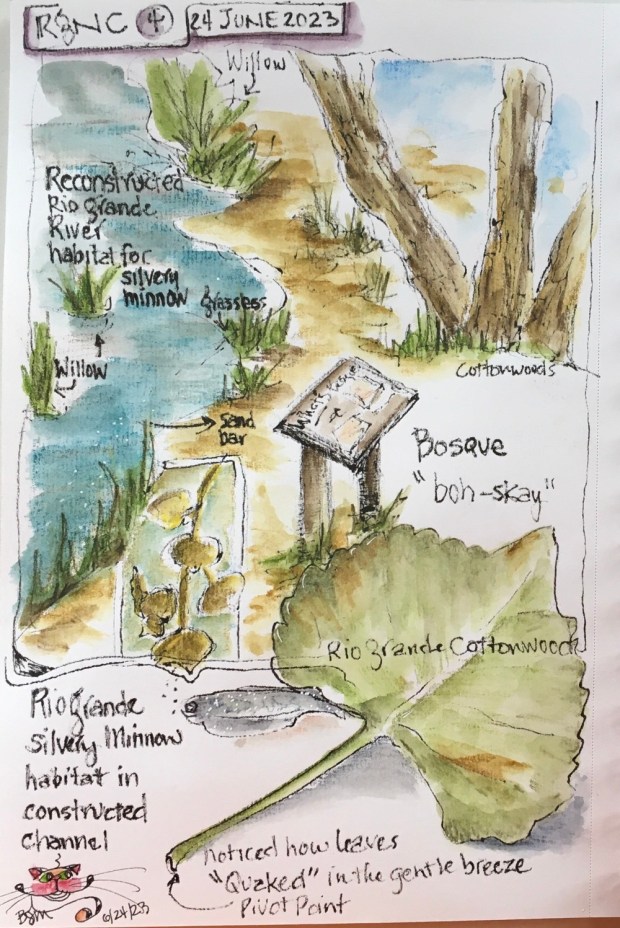
Sketching while walking around the Bosque at the Rio Grande Nature Center
So “drawing” upon my own journaling practice, and the treasure trove of information and resources available on the subject, my goal was to design a workshop that would be informative, inspiring and fun.
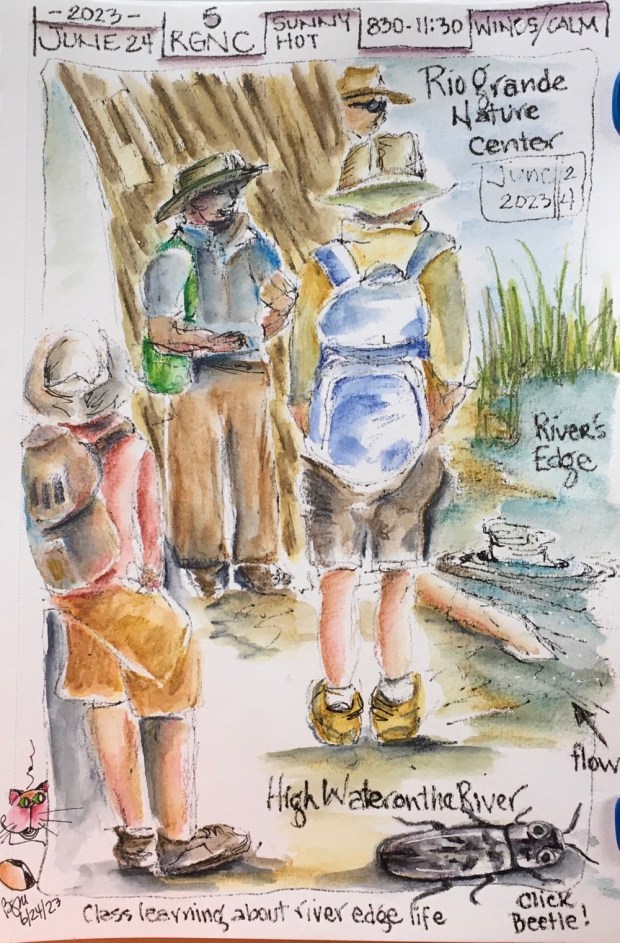
Sketching while walking around the Bosque at the Rio Grande Nature Center
After weeks of research, writing, and gathering baskets of phenomenon, the workshop day finally arrived!
Sketching while walking around the Bosque at the Rio Grande Nature Center
But first, my warm-up …..
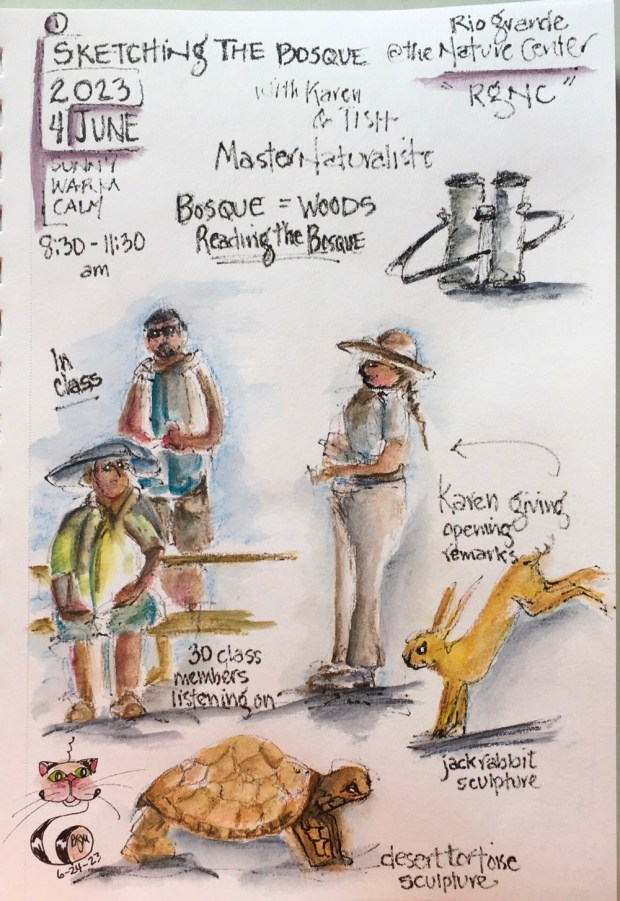
Joining almost 30 interns that gathered early in the morning, we began the day with a 3-hour guided nature walk through the Bosque (Boh-skay) managed by the Rio Grande Nature Center, Albuquerque. The Bosque, the Spanish word for “Woods,” refers to the cottonwood gallery forest and riparian habitat lining the Rio Grande River. During the walk, I took notes and sketched some of the wildlife, landscapitos, and the tour group, all the while watching the excited interns in action. As budding Master Naturalists, they were curious about everything; noticing so much and asking thoughtful questions. It was a great morning that included some surprising discoveries and discussion.
Sketching while walking around the Bosque at the Rio Grande Nature Center
Sketching while walking around the Bosque at the Rio Grande Nature Center
My first nature journaling workshop!
Then it was time for the workshop. The next 90 minutes flew by …. not nearly enough time to share what I wanted to about nature journaling and to have everyone create an actual journal page. But I loved every minute of the experience. My focus was on the 6 key nature journaling prompts, I Notice, I Wonder, It Reminds me of; Words, Pictures, Numbers. After warming up with several exercises, such as blind contour, continuous line and gesture sketching leaves and birds, each intern began creating their own journal page using their chosen phenomenon …… a mystery fruit. Although the time allocated for the workshop was short, everyone actively participated and seemed to get value from the presentation. Maybe, just maybe, one or all of the interns will become practicing nature journalers? That would be awesome!
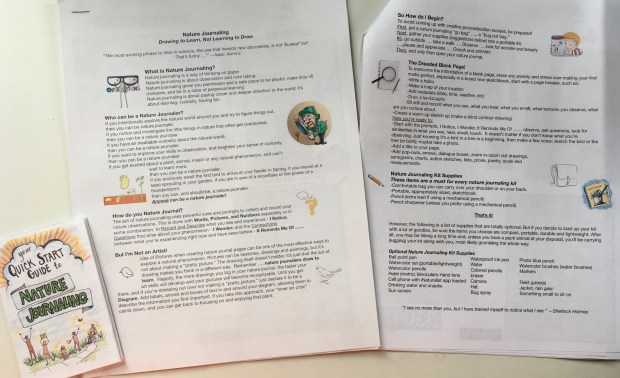
Nature Journaling Workshop Handouts
Workshop Take-aways
In addition to my 6-page handout which included tips on how to get started nature journaling, what to include in a nature journal kit, a list of books and online references (including videos, podcasts, and blogs), and the handy little pocket-sized “Quick Start Guide to Nature Journaling” Zine (thanks Wild Wonder!), I left them with these inspiring thoughts:
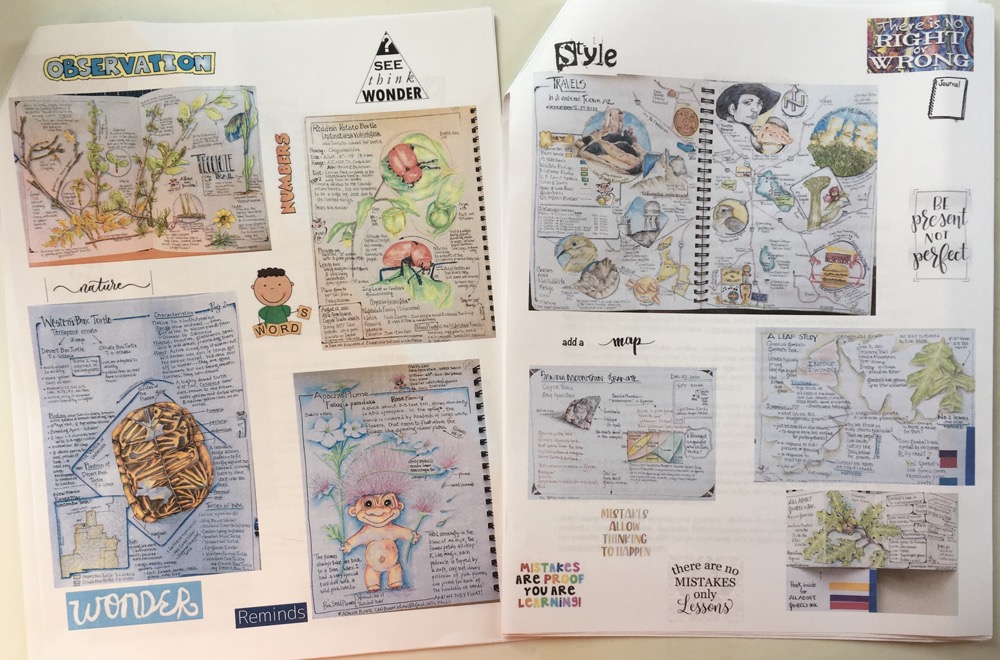
“Anyone can nature journal.” ……… “Nature journaling is not about learning to draw; it’s about drawing to learn.” ……. “You don’t have to be an artist to nature journal.” ……. “It’s not about pretty pictures.” ……. “There’s no wrong way to nature journal.” ……. “Zoom in …… Zoom out.” ……. “Have fun!”
Nature Journaling Workshop Handouts
Would I do this again? Absolutely!
I’d love to know if you are a nature journaler too, or would like to learn more about nature journaling and how to begin!
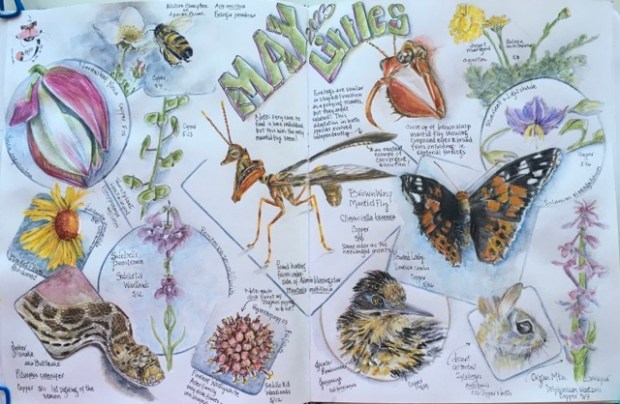
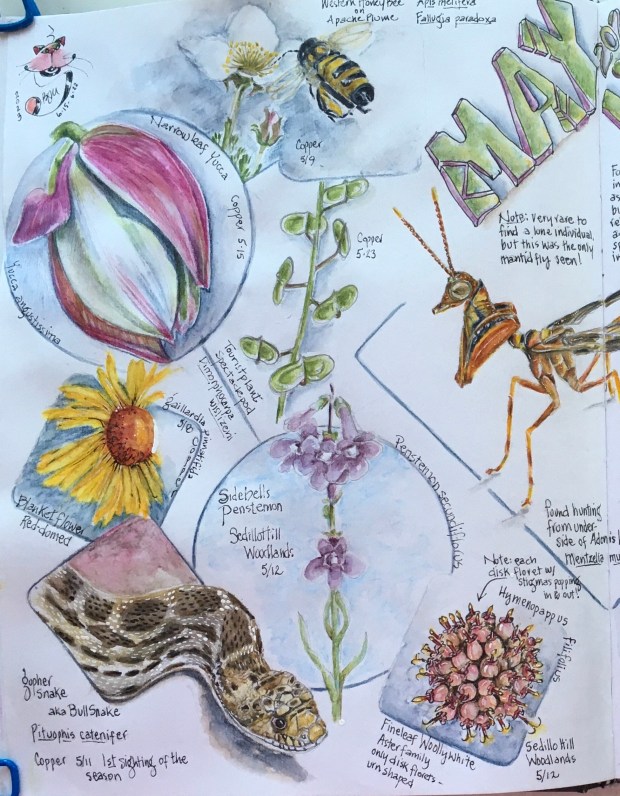
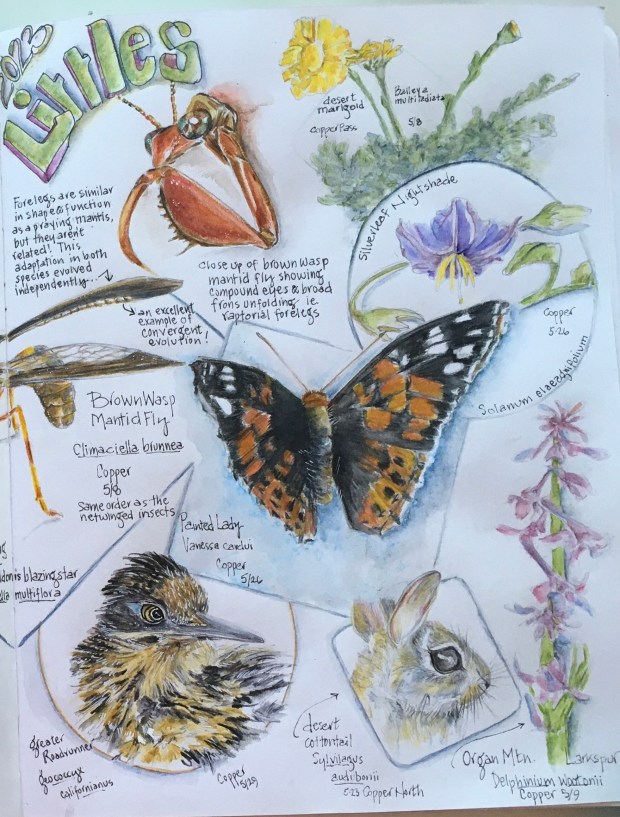
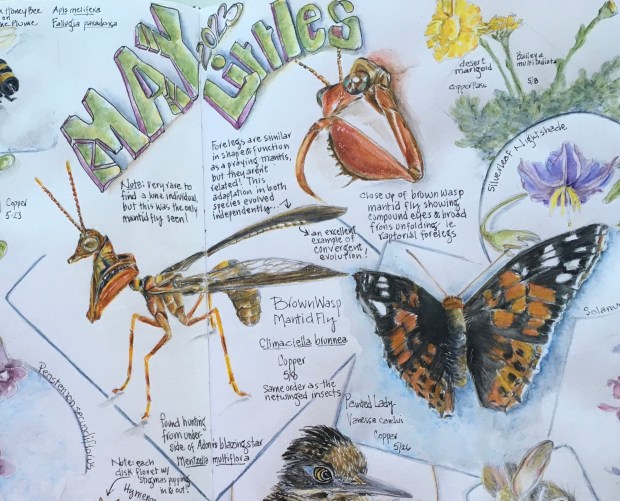
April may have been amazing, but it was nothing compared to the explosion of life during May. My 2-page spread doesn’t even come close to representing all that we encountered throughout the month. And the 15 species I chose as “picks” aren’t even a third of those making an appearance …… enter stage left and right!
Noticeably missing was the black chinned hummingbird. They arrived mid-May, and began defending breeding territories. One of these years, I hope to find one of their miniature nests to see what building materials the hummers use. Until then, their aerial performance is always breathtaking!
Close-up
Then there was the morning Luna nearly stepped right in the middle of a really upset, hissing and striking prairie rattlesnake, practically right out our front door! It was a scary few moments until we determined Luna did not get bit! Whew. Roy expertly wrangled up the guy, herding him into a 5-gallon bucket, and relocated him a safe distance away. (I may cheat and add him to my June “Littles,” if you don’t mind, along with the first rattlesnake encounter of the season! Gotta love the desert.)
Another close-up
Included in the long list of flowering plants, was prickly pear cactus. Several species began opening their buds to reveal 20-30 delicate waxy yellow to apricot colored petals per bloom. It didn’t take long for the pollinators to find these delicacies!
And Another close up
Blooming in the foothills (5,000’ up to 7300’ elevation), there was milkwort, fleabane, scarlet globemallow, banana yucca, sundrops, milkweed, paintbrush, golden weed, common hoptree, puccoon, several species of pink-flowered hedgehog cactus, blazingstars, bee blossom, tahoka daisy, NM thistle, ……. etc. I could go on and on! And even at nearly 9,000’ elevation, rock jasmine, valerian, creeping mahonia, prairie bluebells, pasque flower and dwarf lousewort were all in bloom.
All in all, a bountiful full-on Spring bloom!
A big shout-out to “Made by Fay” for the inspiring “Littles” idea! Stay tuned for the next installment of “Littles.”
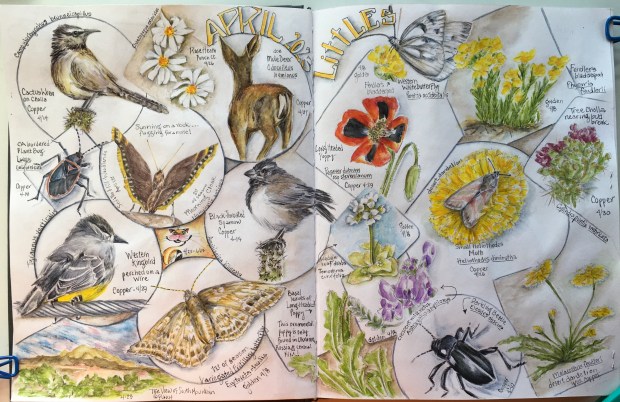
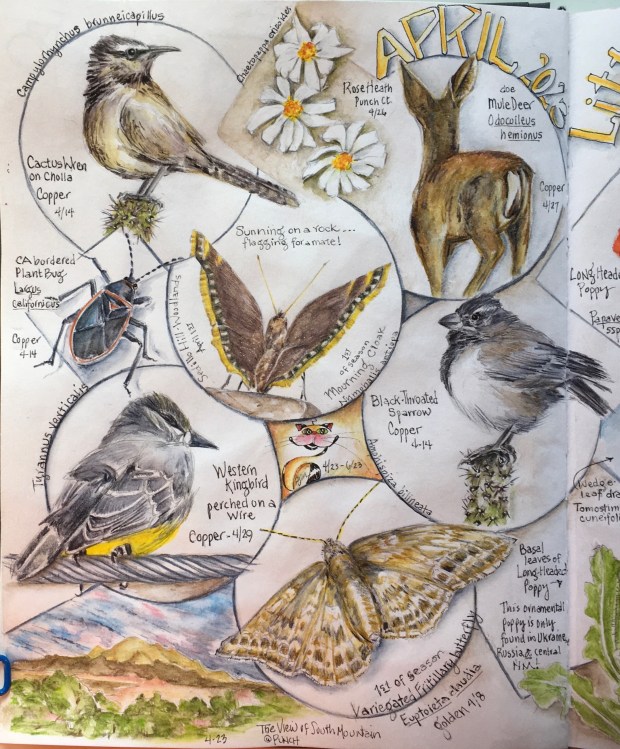
In the blink of an eye …… April! The dusty browns of late winter gave way to landscapes full of color! Movement was everywhere ….. Flower buds began opening as emerging insects smacked their lips in anticipation. Birds, flocking to their breeding grounds, had hungry eyes on the growing bug population. Hibernating reptiles began to stir as the earth warmed; lizards stretching sleepy legs in their underground burrows, that will help them flee slithering snakes; snakes wriggling and coiling and hissing, perhaps thinking about a breakfast of juicy lizard or a baby bird. Mule deer moved down from the surrounding hills to nibble fresh plant growth. Coyotes hunted desert cottontails as they snacked on prickly pear pads.
April was amazing! There was so much happening, that it was all I could do to take in so many changes. It was such a challenge just to slow hike the hills every day, observing and taking photos, that keeping up with my “Littles” pages seemed impossible!
Close up
So here it is mid-June, and I’ve finally put the finishing touches on my April “Littles.” While creating my tiny framed discoveries, I questioned my desire and/or the need to continue with this project. But then I quickly dismissed those thoughts. After seeing these pages finished, I realized it was not only great fun, but an important reminder of what happens in nature during April.
Another close up
Again, many thanks to “Made by Fay” for the inspiring “Littles” idea!
David Lukas, naturalist, presented an amazing 2 hour video workshop on the largest family of flowering plants, the family Asteraceae1, commonly called Sunflowers, Daisies, and Asters. Not only are they the largest family, they are also the most successful …. from a botanical and evolutionary perspective. That was the hook! I needed to know more!
Disclaimer! The following post is lengthy and covers many botanical things about sunflower “flowers” I wished to remember. If you decide to take this deep dive with me, prepare to be amazed. And if you make it all the way to the end, congratulations! But beware ….. you’ll develop an irresistible urge to stop and investigate every roadside sunflower on your next trip to town! Are you ready ……?
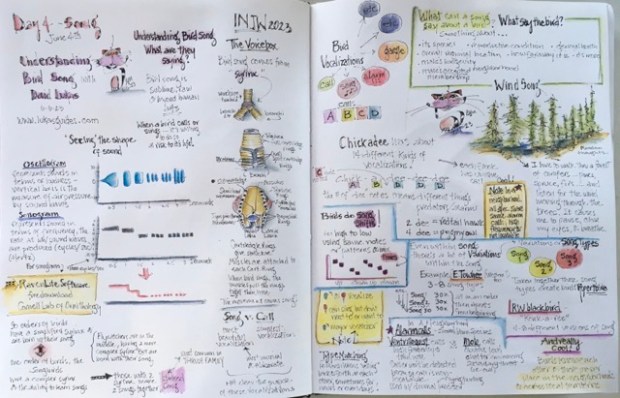
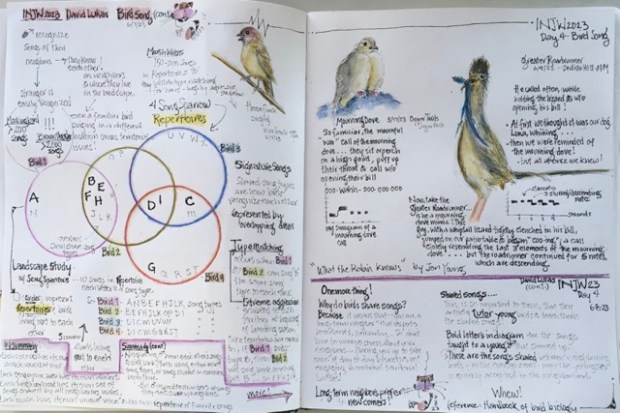
Wow! On Day 4: Song, we were treated to an incredibly exciting session “Understanding Bird Song” by naturalist David Lukas. David is an outstanding educator, and I found myself being totally blown away by his presentation. So much information that it was worth watching the video 3 times, so I could sketch note every fascinating detail!
The topics ranged from why birds sing, how they sing, and signature songs. We learned about song shifts, repertoires, is it a call or a song, understanding alarm calls, song mimics, song sharing and how birds tutor young birds in neighborhood songs.
Information overload, but that’s how I like it! I hope you enjoy my pages crammed with diagrams, descriptions and definitions. I ended my last page with a couple of illustrations of a mourning dove and greater roadrunner, comparing each of their similar-but-not-quite-the-same calls. Curious!
My sketch notes from the materials discussed during David Lukas’ session.
Thanks once again for taking a look! As always, I hope my pages spark in you a sense of curiosity and wonder, and that you would like to learn more. A good place to start is by visiting the INJW home page at https://www.naturejournalingweek.com/.
#naturejournalingweek
It’s still not too late to get involved in International Nature Journal Week 2023, and there’s no cost for participants, so check it out! All workshops and resources, the schedule and links to videos are available at https://www.naturejournalingweek.com/
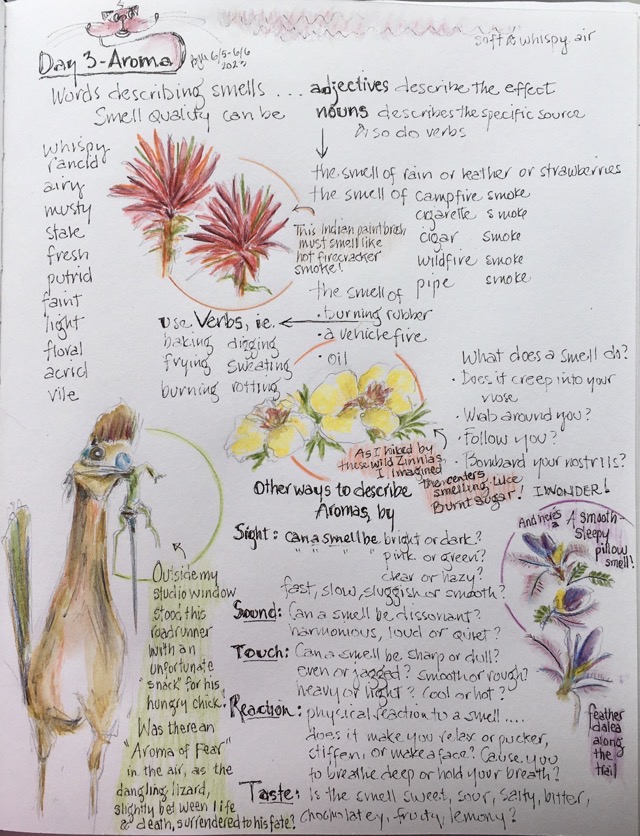
Still hooked on this year’s International Nature Journal (INJW) theme, a “Sensory Safari.” During Day 3: Aroma, I debated about whether or not to take a very personal approach, and finally decided to reveal my almost year-long challenge involving my sense of smell. (This is also tied closely to my dilemma with sense of taste, but maybe I’ll explore more ways to handle that in my Day 5: Flavor post).
I certainly learned a lot and had fun with Aromas and their ties to visual cues and memories. I hope you enjoy my story and the pages below.
Oh, and its not too late to get involved and there’s no cost for participants, so check it out! All workshops and resources, the schedule and links to videos are available at https://www.naturejournalingweek.com/
Day 3: Sense of Taste — Introductory Session on Aroma A very good introductory session with Corina Brdar. She explored with us how the sense of smell …. Aromas ….. can be incorporated in a nature journal. Also several good quotes came from this session …..
“Senses are the bridges to the world we live in.” …. and oh yeah ….. this gem: “Imagine being in nature and there’s no smell!”
It was the last quote that pushed me to explore my sensory journey, or lack thereof.
My sketch notes from the materials discussed during the introductory session. Love the connections with Nature Journaling cues!
Corina mentioned there’s not a lot known about the inner workings of our sense of smell. Researchers are only beginning to better understand this sense and its intimate connection with the sense of taste. Also, there’s been minimal thought put into how to describe a sense of smell on paper. Information was a bit challenging to find, but I stumbled across a fun and informative article that directly relates to “smell” descriptions using adjectives, nouns, verbs and metaphors …… thanks WikiHow!
After I shared my story on the below, I then sketch noted the WikiHow article, How to Describe a Smell, on the next page (link to the article is at the end of my post).
A brief account of my world without aromas!Sketch notes from How to Describe a Smell, and how I’ve adapted!
Thanks once again for taking a look! As always, I hope my pages spark in you a sense of curiosity and wonder, and that you would like to learn more. A good place to start is by visiting the INJW home page at https://www.naturejournalingweek.com/.
Well it didn’t take me long to get hooked on this year’s International Nature Journal (INJW) theme, a “Sensory Safari.” Both Day 1: Color, and Day 2: Texture, offered a wealth of inspiration, ideas and helpful tips and techniques about how to discover nature “like a pro,” and how to better capture observations in my nature journal. This is exciting stuff, y’all!
It’s not too late to get involved and there’s no cost for participants, so check it out! All workshops and resources, the schedule and links to videos are available at https://www.naturejournalingweek.com/
Day 2: Sense of Touch – Texture in Nature
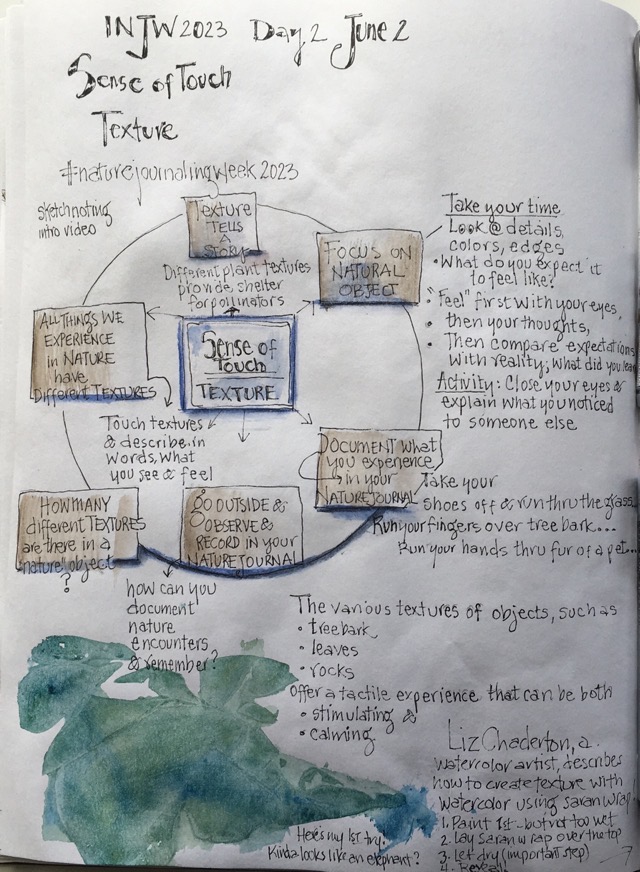
Introductory Session on Texture The natural world is full of texture ….. from tree bark, fresh Spring and crunchy Fall leaves, the bumpy outsides and fuzzy insides of a sycamore seed ball, to a cactus pad covered in spines. The texture of the fur on my dog is coarse, but closer to her skin it’s soft and silky. How many times have you plucked a downy soft dandelion “clock,” and then in a puff, propelled the seeds aloft, exposing its dimpled platform? You may readily run barefoot across a lawn of bluegrass, but think twice before doing so on a field of granite pebbles! Your conscious and intuitive interactions with the natural world are influenced by texture. For example, your willingness to touch the smooth textured skin of a dolphin probably outweigh your desire to “pet” the knobby skin of an alligator. One of the many suggestions I learned during the introductory session related to encounters with a natural object. It’s so important to take your time in nature and observe first with your eyes, textures of the familiar and the new. Then, if it’s safe to touch, do so, and ask yourself if your visual and tactile experience are the same or different? And then think about how to describe what you learned?
My sketch notes from the materials discussed during the introductory session. Some Brilliant stuff here!
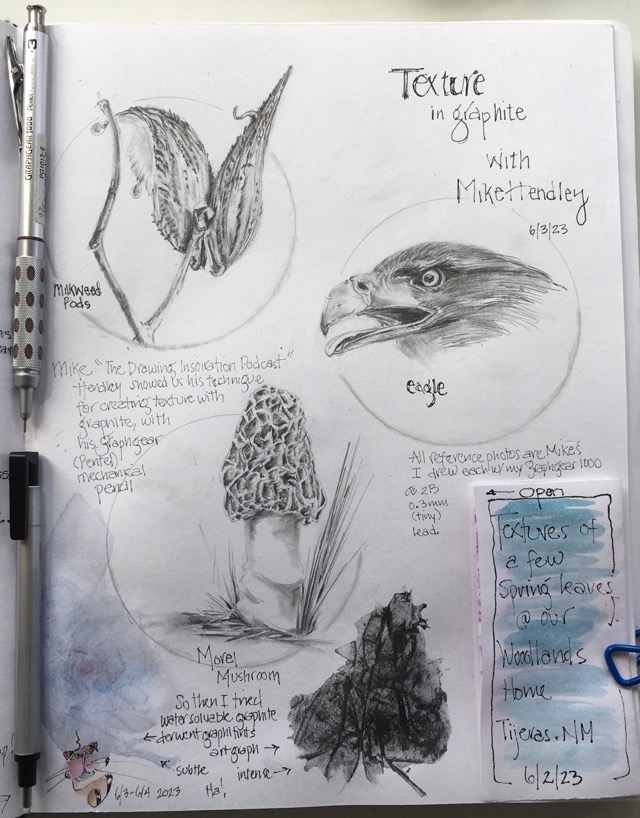
The live video workshop with artist Mike Hendley, involved techniques in graphite to depict various textures found in nature. He emohasized how careful observation revealed an object’s texture, and demonstrated a number of different pencil strokes to achieve a realistic effect.
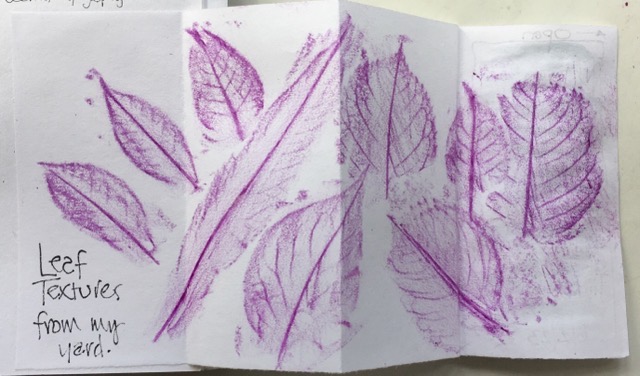
My journal page with graphite sketches I did along with Mike during the love workshop. Ooooo ….. I do love working with graphite!Here’s what’s inside of the little accordion booklet attached to the page above. This was a fun and easy activity, suitable for anyone able to hold a crayon!
Thanks for taking a look! As always, I hope my pages spark in you a sense of curiosity and wonder, and that you would like to learn more. A good place to start is by visiting the INJW home page at https://www.naturejournalingweek.com/.
It’s that time of year again …… International Nature Journaling Week (INJW), and I’m excited to be taking part in the fun. Beginning June 1st, a full week of nature-inspired workshops, interviews, prompts and other activities will be presented by an amazing line-up of nature journalers, artists and environmental educators from around the world. The host, founder and organizer of INJW, is nature journaler, teacher and environmental educator, Bethan Burton. This year the theme of INJW is a “Sensory Safari,” and Bethan, who also hosts her own podcast, Drawing with Nature, will take us through each day as we explore how nature engages at least seven of our senses: Color, Texture, Aroma, Song, Flavor, Movement, and Heart.
It’s not too late to get involved and there’s no cost for participants, so check it out! All workshops and resources, the schedule and links to videos are available at https://www.naturejournalingweek.com/
Day 1: Color Across Continents
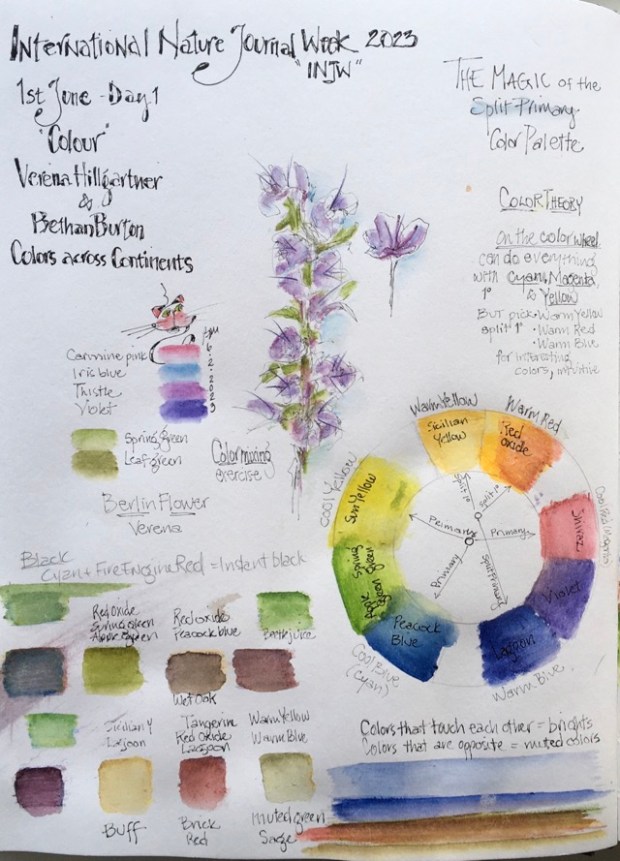
Imagine your world in black and white. Color brings life to our visual party and defines our sense of place. When I think about or see the colors of New Mexico …. the rusty reds and buff-colored rock and sand, the greens and blues of piñon pine and sagebrush, the lemon yellows and violet reds of spring wildflowers, all framed by vivid intensely blue skies ….. I know I’m home. After Verena (a naturalist from Berlin) and Bethan (who is from Queensland, Australia) talked about the use and how-to’s of color in a nature journal, Bethan presented a mind-blowing workshop on color mixing, color theory, and the Magic of the Split Primary. Admittedly, I’ve been a hit-or-miss approach artist when it comes to color mixing; struggling to achieve a color match with my surroundings. But there was something in the way Bethan explained color theory and the use and mixing of warm rather than vivid primaries; and all at once I was mixing those elusive sage greens and brick reds! It was a real “duh” moment for me; color theory definitely is something worth understanding!
Below is the practice page I created during the workshop guided by both Bethan and Verena. For fun, they even encouraged us to make up names for our color mixes ….. names that conjure up an image of the color based on a familiar object, such as Rusty Bike, Brick, Cotton Candy, Moldy Cheese (you instantly know those colors, right?!).
Then we were invited to create a journal page with colors of home. I quickly swatched out colors I’ve seen all Spring. Then borrowed on some of my photos captured while traveling about central New Mexico, adding in a few wildflowers and one of the most decorated bird to visit our feeders. When I look at this page, the colors truly warm my heart. This for me is a bit of what nature journaling is all about. But just a bit. I know this week will go a long way to reveal more of the “bits” that have made nature journaling such an important part of my world!
Thanks for taking a look! I hope my pages spark in you a sense of curiosity and wonder, and that you would like to learn more. A good place to start is by visiting the INJW home page at https://www.naturejournalingweek.com/.







 a curious nature