May 4, 2026
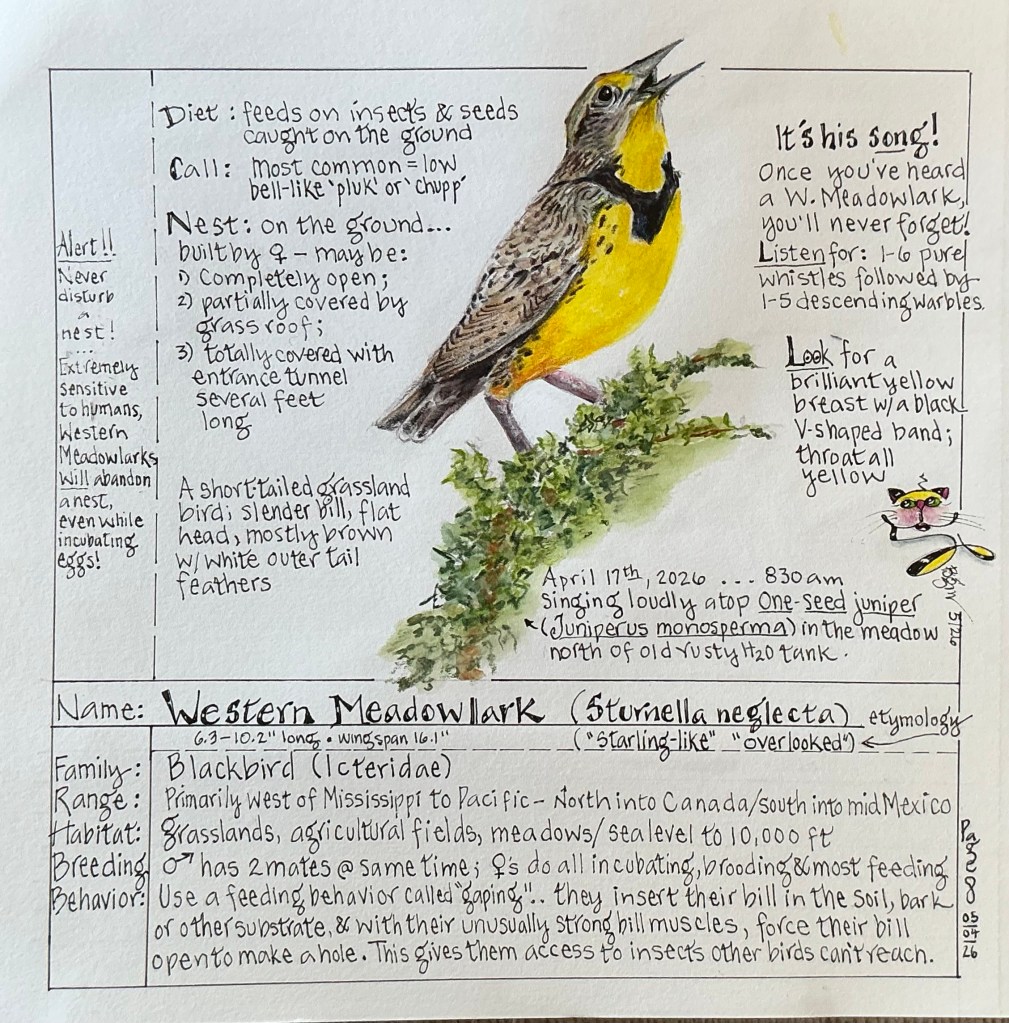
Western Meadowlark (Sturnella neglecta)
When male meadowlarks return to the grassy meadow north of the old rusty water tank and begin singing, you know it’s Spring!
There’s something wonderful about his song ……. At first he stutters a few practice notes; rough and rusty like the old water tank. But as daylight lengthens and temperatures warm, his song grows long, strong and melodic. Having perfected that signature song, he sings intently from sunrise to sunset, defending his territorial boundaries against all invaders. And he sings lovingly to announce his breeding readiness, enticing not just one, but two female meadowlarks to mate with him.
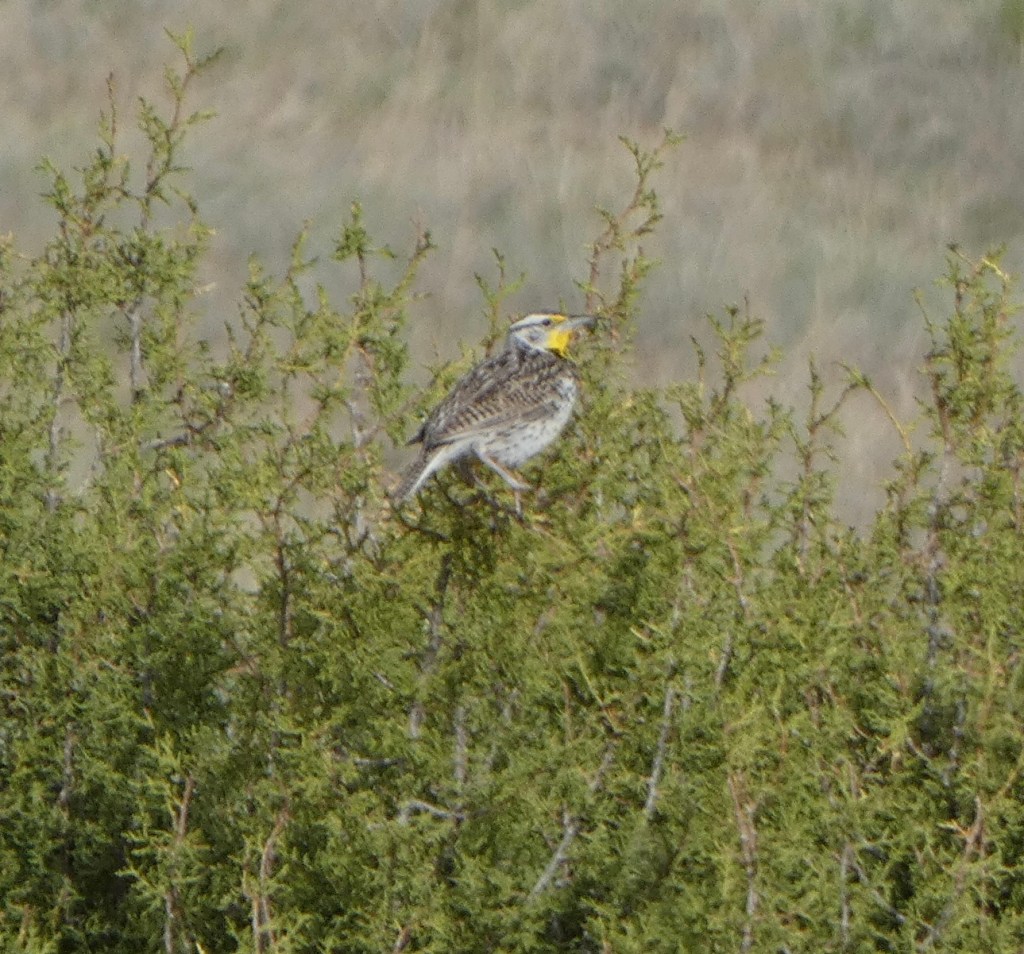
While walking the perimeter of the meadow in mid-April, it was easy to hear a male singing at the top of his lungs about 1/4 mile away. After a few moments scanning the tops of the widely scattered juniper trees with binoculars, I spotted him. (Males seem to favor these trees as perches, perhaps because they get a great view of their territory, and their voices really carry!) Able to get only 50 yards closer, I managed to take a few telephoto pics before he flew to the top of another juniper. Western meadowlarks are very skittish around people, so I held my ground and just watched and listened. It was a wonderful encounter.
Below are a few more fun facts about Western Meadowlarks, in addition to those on my illustrated page ….
If you’re lucky to see a Western Meadowlark, you’ll notice they’re a robin-sized bird but chunkier and with a shorter tail. Their flat head and long, slender bill are visible above a round-shouldered posture that nearly conceals its neck. They have short rounded wings, and a short, stiff, and spiky tail.
When flushed, Western Meadowlarks fly low, wings below the horizontal, gliding and flapping with short, stiff, quail-like wingbeats.
Other than perching on tall trees, don’t be surprised to find males singing from atop fence posts, bushes, power lines, and anything higher than their surrounding habitat.
John James Audubon gave the Western Meadowlark its scientific name, Sturnella neglecta; Sturnella meaning “starling-like,” and neglecta because he felt most explorers (after Lewis and Clark) and settlers who traveled west of the Mississippi overlooked this common bird.
The oldest recorded Western Meadowlark was at least 6 years, 6 months old when it was found in Colorado in 1965.
…………………………………………………………………………………………………
When was the last time you went Birding? Meadowlarks are calling!
As always, thanks for stopping by!
References: allaboutbirds.org and inaturalist.org