The much anticipated finale, Snowbirds, and wrap-up to a grand anniversary week celebration in and around Tucson, AZ, follows!
Despite an unexpected snow the evening of our arrival, we never seemed to slow down, taking in as many sights and good eats as humanly possible. …… Open the full post for a recap of our week, and a bit about some of the birds we found while traveling around.
We totally get it! Why Mt. Lemmon is nicknamed “Tucson’s Great Escape.” Why the scenic highway is ”Cool!” From the Lower Sonoran Desert and the Tucson Valley (2,200 feet) to the upper reaches of a Spruce-Fir Forest (topping out at about 9,200 feet), the popular Scenic Highway up Mt. Lemmon offers breathtaking views, plants to discover, geology to learn, recreation opportunities, and temperatures often 30 degrees F lower than the desert below. That means a lot, especially when Tucson’s summer temps are in the triple digits!
But on the day of our driving adventure we found snow ….. on the highway, at scenic overlooks, and on walking trails. The storm hit 4 days earlier forcing closure of much of the highway. But on this day, most of the roads were clear and so was the sky.
So come along and learn what there’s to see along the Mt. Lemmon Scenic Highway.
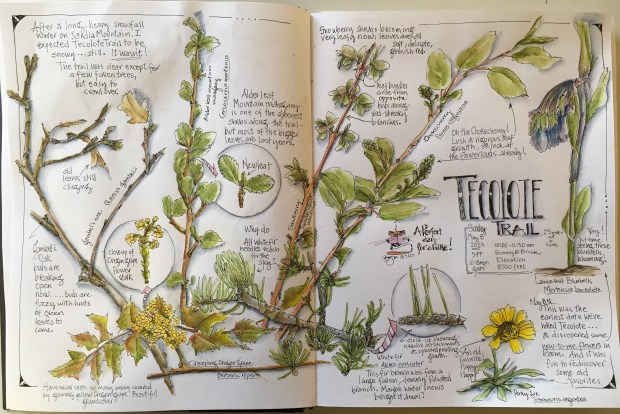
The Desert (Eastern) Mountain Mahogany is a very branchy shrub commonly found in the mid-elevation foothills of the Sandia, Manzanita, and Manzano Mountains east of the Rio Grande River in central New Mexico. This species’ formal and very appropriate name, Cercocarpusbreviflorus variety breviflorus, comes from both Greek (kerkos: tail; karpos: fruit) and Latin (brevi: short; florus: flowered). As a matter of fact, the 9 species of the genus Cercocarpus all have long feathery tails that twist and turn from the tip of a single fruit, called an achene (like a sunflower seed).
So why is this species odd?
Well, the fruit, for one reason. Most of the thousands of rose family members have fruits called a hip (rose), pome (apple), drupe (prune), or aggregate (strawberry). And even though the strawberry is composed of numerous miniature achenes, it’s the single achene found in the mountain mahoganies that’s unusual to the family.
To further emphasize the oddness of the Cercocarpus genera, all of its 9 species has a symbiotic relationship with a bacteria called Frankia. And that’s an unusual characteristic of the rose family, which moved Cercocarpus and 4 other genera into the subfamily Dryadoideae. That’s all a bit technical when it comes to plant classification, and kind of skips the real reason why the Frankia bacteria is important to the survival of Desert Mountain Mahogany. Nitrogen Fixation!
We certainly enjoyed visiting Saguaro NP – East. Most of the Rincon Mountains Unit is wilderness and only accessible on foot; no dogs allowed. But the cactus Forest Loop Drive was scenic, with views of the Rincon Mountains to the East, and saguaro everywhere!
Really couldn’t seem to get enough saguaro! The highlights of this day were finding another crested saguaro while hiking an area Luna could enjoy, standing next to some shoulder high fishhook barrel cactus, and enjoying the Phainopeplas with their shimmery black feathers.
If you’re up for more saguaro botany, read on. This post will be dedicated to this largest of all North American cactus, Carnegieagigantea. (Beware. This post is long, so settle in!)
This day we explored areas as far as 50 miles north of la Casita. Following the old highway between Tucson and Phoenix, we first came upon a roadside rest area and memorial to the legendary cowboy, Tom Mix, who died at this spot 83 years ago. Tom who? Of course we had to stop and learn more about this interesting bit of history.
Then on to Casa Grande Ruins National Monument where history dates back more than 1700 years, well before the first Spanish explorers showed up, exploring. Even Luna was permitted to wander around this cultural monument, but we may have appreciated the stories surrounding the Hohokam more than she did.
Then to complete our tour for the day, we came upon a lonely ranch road on the way back to la Casita, where the saguaro stood tall over countless cholla, barrel cactus, iron trees and palo verde. It was here, in the middle of “where-are-we-now?” that I peered under a creosote bush and found the weirdest puffball fungus ever.
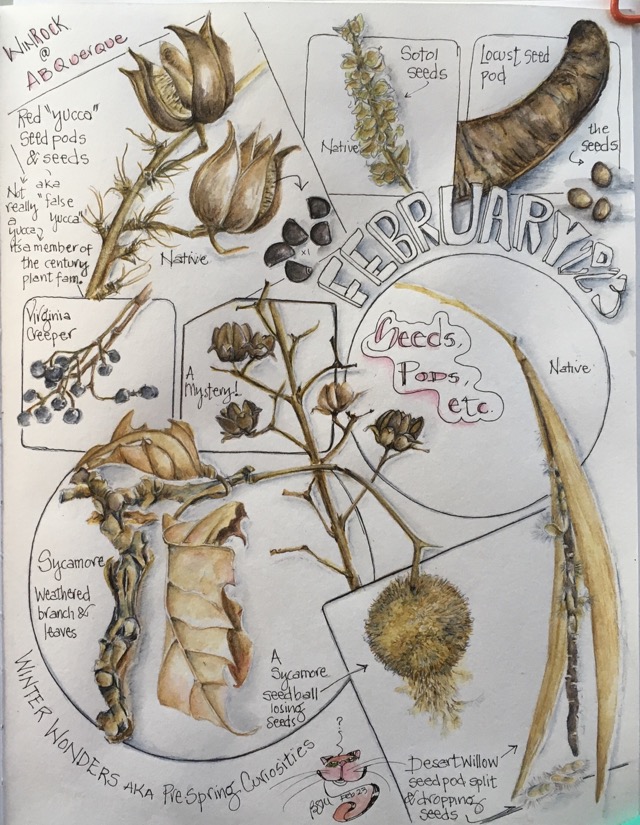
2023 journal page with a few of the actual seed pods scattered about
January 18, 2023
Not wild, but wildly rattling in the wind? Not snakes, but the showy seed pods from a row of Chinese Lantern trees, hanging on for dear life throughout our numerous winter wind events.
We frequently park near 8 of these non-native trees used as sidewalk landscaping, just before the Copper trailhead. After wondering for several years what these medium sized trees are, in September 2020, discovering the answer, I drew them out …… seed pods, leaves and all.
Searching for something wintery to add to my journal this year, these hardy seed pods called loudly. It was hard to resist!
Browsing my 2020 journals, I came across my first drawing. Always fun to see if and how my technique has changed. Can you detect the differences?
Before getting too far ahead of myself, I thought it would be a dandy idea to build a map of the circles we traveled in and around Tucson. This will not only aide those of you who are following along on our travels to see just where all these places are, but it helped me relive the week and will refresh my memory in years to come when browsing my journals.
Read on to view our trip highlights, and see just where all those parks, monuments, and mountains are found, and where to go to soak up the flora and fauna unique to the Sonoran Desert. Also, this map gives you a sneak peak of journal posts to come.
We woke early and excited, ready to explore. But wait! We woke to snow! What? Snow in Tucson?!!! Not unheard of, but a surprise-for-us coating of fluffy white covering everything. No matter ….. we changed out of our shorts, donned long pants and heavy coats and set off from la Casita south, towards Tucson and Saguaro NP West, the Tucson Mountain District.
Come along and see what we discovered this day in the Sonoran Desert!
Right now I’m watching it snow …… again. Logic tells me this moisture is so necessary for our drought-stressed juniper and piñon pine that provides year-round food and cover for a host of birds and mammals that call the East Mountains home. Our annual and perennial wildflowers, oaks and native shrubs depend on winter rains and snows to flourish in the growing season. So I say, “bring it on, Mother Nature!”
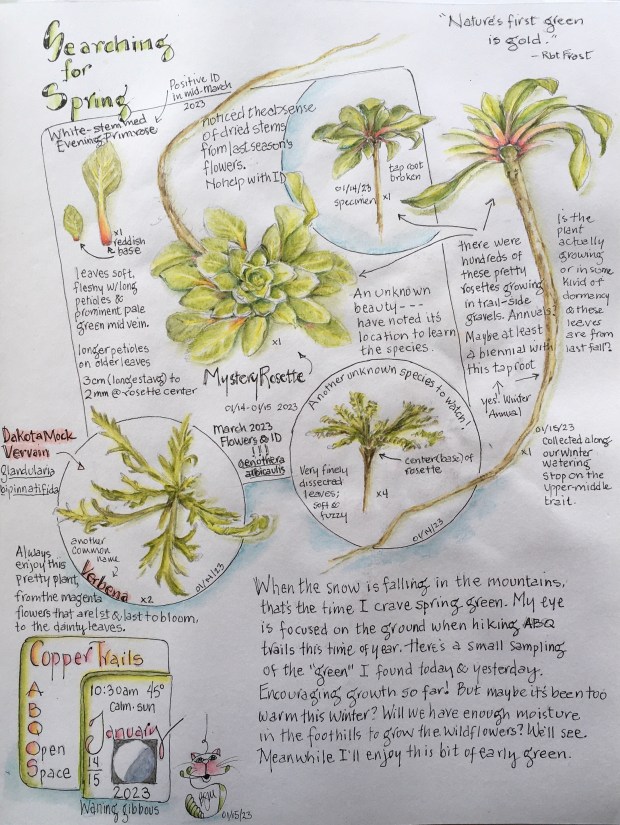
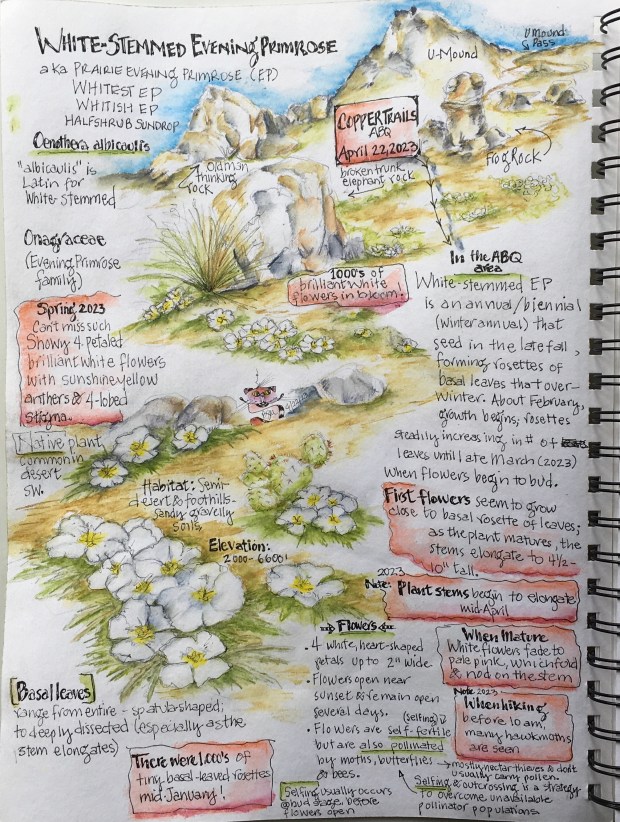
But by January and February I do tire of brown. My animal brain needs of a shot of “Spring Green” this time of year. Just a little bit to carry me through the winter; a tiny bit in anticipation of full-blown Spring is just the ticket!
This is why we take regular trips down our mountain to enjoy the Albuquerque foothills. It’s amazing the difference a 2,000 foot change in elevation can make in nearly everything.
Now don’t get me wrong. I love living at 7,300 feet, in the shadow of majestic Sandia Mountain, and in the winter we sometimes experience days of cloud cover and fog. So down the mountain we go, in search of sun, warmth, and Spring Green.
And to my delight, here’s what I found! “Nature’s first green is gold.” And indeed it is!
Wow! 50! Can’t believe we’ve been together for so many years. Can’t believe it seems like yesterday. Countless adventures, miles, laughs, memories. How the good times fly! 50 years on December 12th, and I wasn’t about to let the winter doldrums keep us hunkered down at home. Surely a road trip was in store to properly round out our year of desert discoveries! I booked us a week at a little one room home about 25 miles north of Tucson, AZ ….. in the land of the mighty saguaro cactus ….. where Roy and I, and of course Luna, could soak in some southwest winter sun and take our time exploring this new-to-us area of the Sonoran Desert.
Come along with us for 7 days of discoveries in the Sonoran Desert!