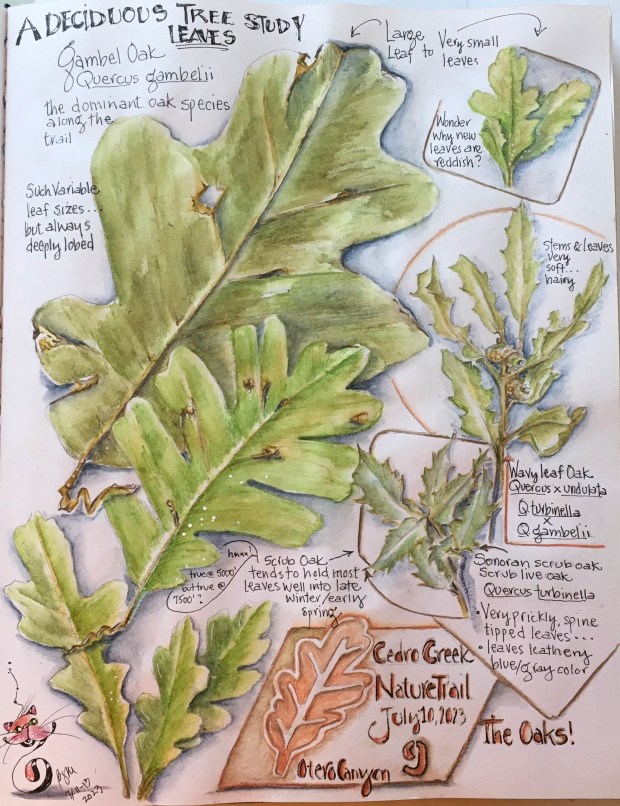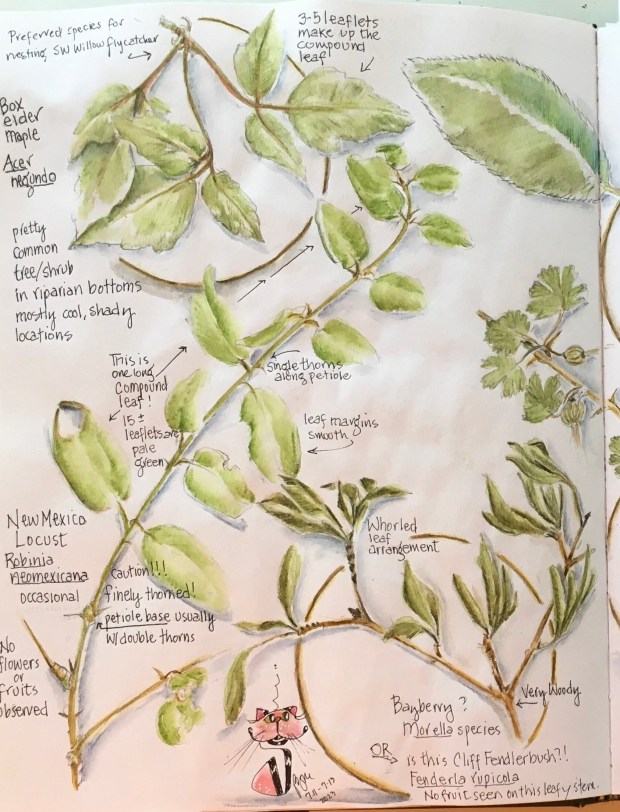
Fading Flowers Reveal Leafy Greens ….. Cedro Creek

July 14, 2023

Learning the deciduous Trees and Shrubs shading Cedro Creek Nature Trail ….. Grab n Go Nature Journaling

The timing and location of our daily hikes are being influenced by the extreme summer temperatures we’re experiencing throughout central New Mexico, and throughout the desert southwest. Whew! Even at 7300-8300’ elevation, 95-100F has become the norm, with no relief (or moisture) in sight.  I don’t even want to think about Albuquerque temperatures; over 100F before noon, and soaring. 

Because hiking in the Albuquerque foothills, at any time of the day, is out of the question, we’ve begun revisiting some our favorite mountain trails. But even tho these areas are higher in elevation, and shadier, it’s still plenty hot. That means if we set out between 7-8am, we can still manage a few miles before our water, like all the creeks, runs dry. 

A few mornings ago, we decided to hike Cedro Creek Nature Trail, a rocky but easy dirt path under the shade of big cottonwoods. Expecting to find some water in the creek (there was none), I was hoping to find some interesting wildflowers (which had all withered and dried). The further along the trail we hiked, my focus quickly changed from wildflowers to other natural elements. 

Geology is always interesting in these mountain drainages, and Cedro Creek is no exception. The overlying shales and limestones have long ago eroded to reveal large granite boulders that showed signs of erosion from long ago flowing water. That’s a nice thought!

And then there were so many varieties of deciduous trees and shrubs; their leafy greens not only provided relief from the heat, but became a visual treat as we explored the riparian areas alongside the dry creek bed. 

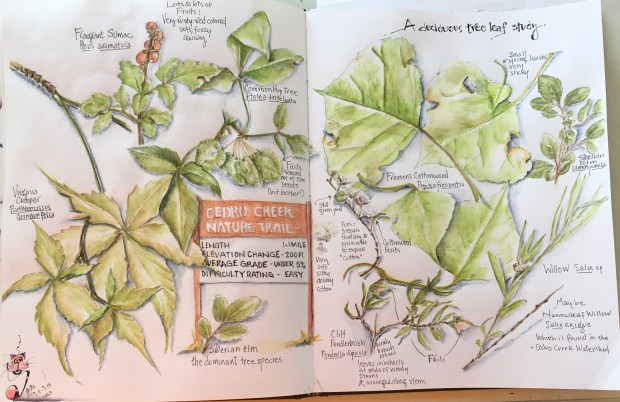
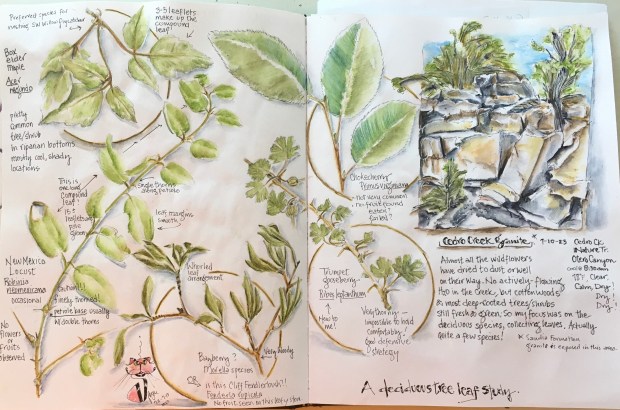
As my curiosity about the diversity of tree and shrub species began to grow, so did the air temperature. Not wanting to become reduced to a sweaty puddle in the middle of the trail, and sensing a swarm of drooling, biting gnats and flies giving me a hungry eye, I resorted to collecting leaf and branch samples using a Grab n Go technique. By the time we got back to the car, I had 3 large ziplocks stuffed with over a dozen species of tree and shrub leaves and some fruits.  

Back at home, in the comfort of my cool studio, I began my detailed study of these leaves (and the few bugs that managed to hitch a ride). Three days and several gallons of iced tea later, I had completed the 5 journal pages in this post.  

That iced tea was deliciously cool, but not as cool as learning what’s growing overhead along Cedro Creek!

Until next time ……. be curious

Cypsela! The Sunflower Seed

July 9, 2023

Buckle in …… 

In my last blog post, Fascinating Fasciations, I shared my discovery of an extremely malformed Rush Skeletonplant. While researching this much branched and dainty member of the plant family, Asteraceae (which includes asters, sunflowers and daisies), I became entangled in the winding and seemingly never-ending number of rabbit trails on my journey, until finding myself on a surprising detour. Totally absorbed in the subject of plant malformations, and learning a lot of cool stuff about Rush Skeletonplant along the way …….

The weirdly wild fasciated Rush Skeletonplant

………. I tripped and fell flat on my face (only figuratively!). One of the published research papers appeared to be in error …… regarding the seed (aka fruit) name of this plant. Known to me for decades by the name “Achene,” the researchers had labeled the seed “Cypsela.” And not only did they call seed of Rush Skeletonplant a “Cypsela,” but they used this name when referring to all the seeds of the Aster family! 

What! No Way! Who was responsible for this name change? When did this happen? Why oh Why

Continue reading “Cypsela! The Sunflower Seed”

Fascinating Fasciations …… Malformations in the Plant World

July 2, 2023

It was early morning, but already a hot 85F as we hiked the dry, dusty trails of the Albuquerque foothills. With a few exceptions, late June’s wildflower display is all but gone, replaced by an abundance of seeds ready to drop, blow away, or feed hungry chicks. While the “stage” resets for the next Act, the Summer Monsoons, plants in the Sunflower-Daisy-Aster family (Asteraceae) still dot the quickly browning landscape with bright yellows, whites, and shades of purples.  One of the most curious plants now making a showing is Rush Skeletonplant (Lygodesmia juncea). 

Perfectly adapted to the desert environment with its chaotic tangle of blue-green mostly leafless stems, is Rush Skeletonplant. Spindly stems, standing up to 18” tall, are topped with 1-2 petite pale lavender-pink flowers. These tiny delicate beauties may not be as showy as your garden variety sunflower, but when closely examined you’ll find typical characteristics of the family, including 4-6 strap shaped ligulate florets each with a protruding hot pink anther tube surrounding a double lobed stigma. Short lived, the florets quickly transform into dandelion-like seed heads.

So there we were, hiking along, wishing for even the gentlest of breezes to keep the biting gnats from crawling into our ears and mouths, when out of the corner of my eye …… Weirdness Extreme! A wildly malformed Rush Skeletonplant.

Continue reading “Fascinating Fasciations …… Malformations in the Plant World”

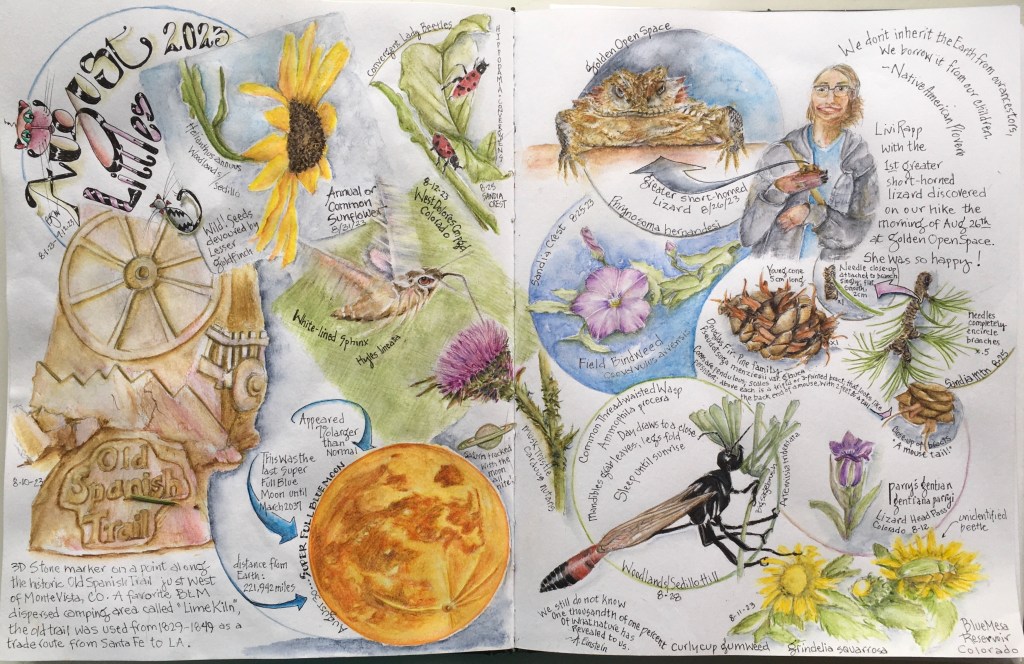
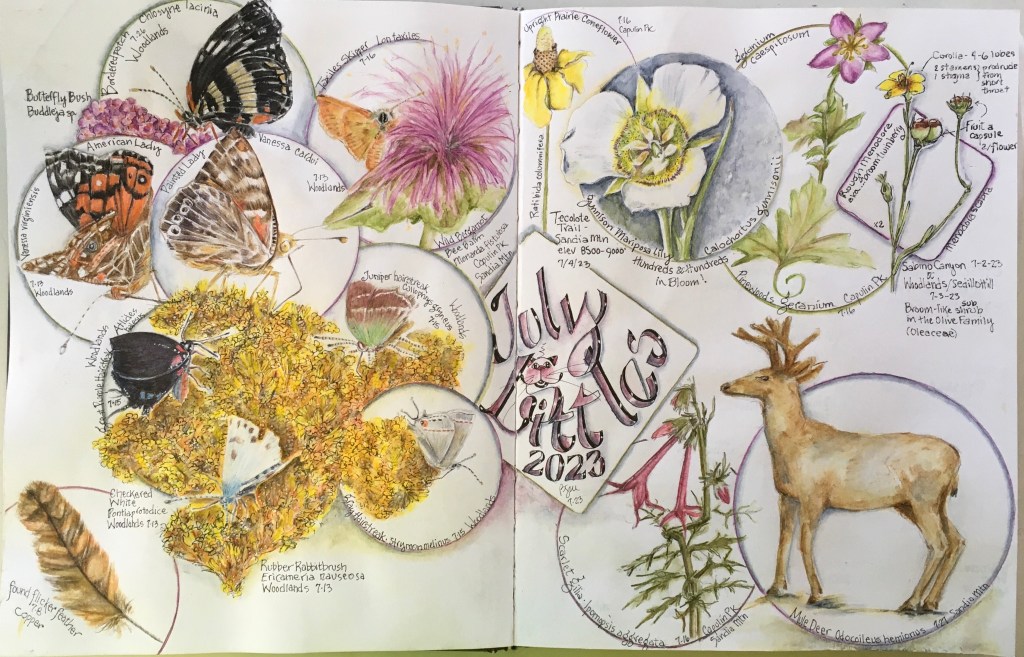
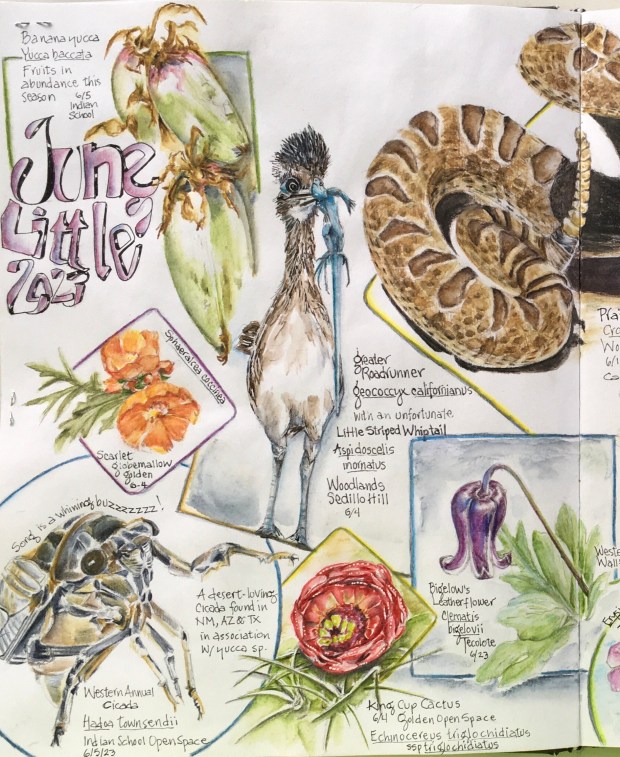
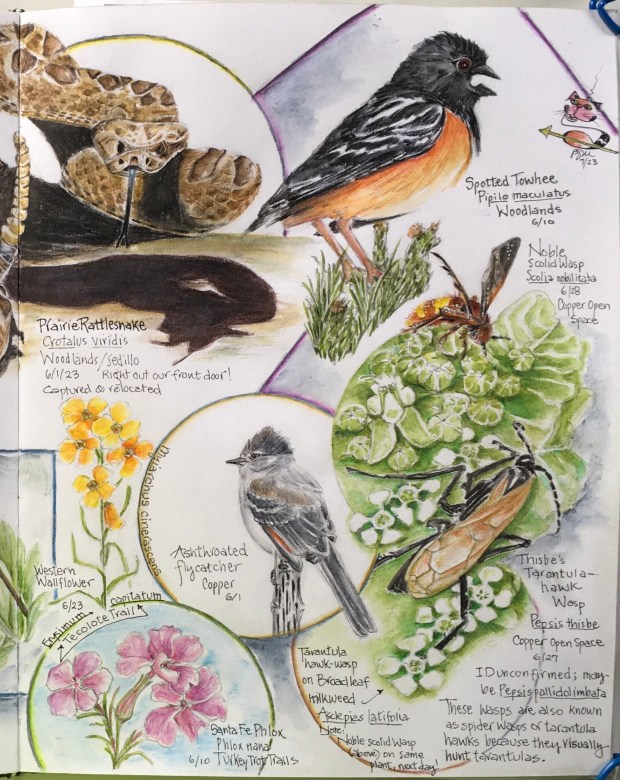
May “Littles” ….. blooming, buzzing, flying, fleeing, stalking, slithering surprises!

April may have been amazing, but it was nothing compared to the explosion of life during May. My 2-page spread doesn’t even come close to representing all that we encountered throughout the month. And the 15 species I chose as “picks” aren’t even a third of those making an appearance …… enter stage left and right! 

Noticeably missing was the black chinned hummingbird. They arrived mid-May, and began defending breeding territories. One of these years, I hope to find one of their miniature nests to see what building materials the hummers use. Until then, their aerial performance is always breathtaking! 

Close-up

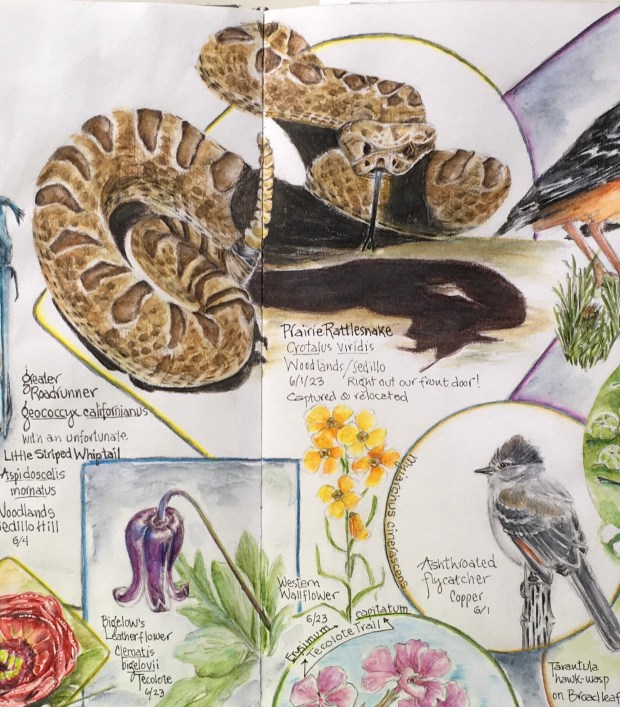
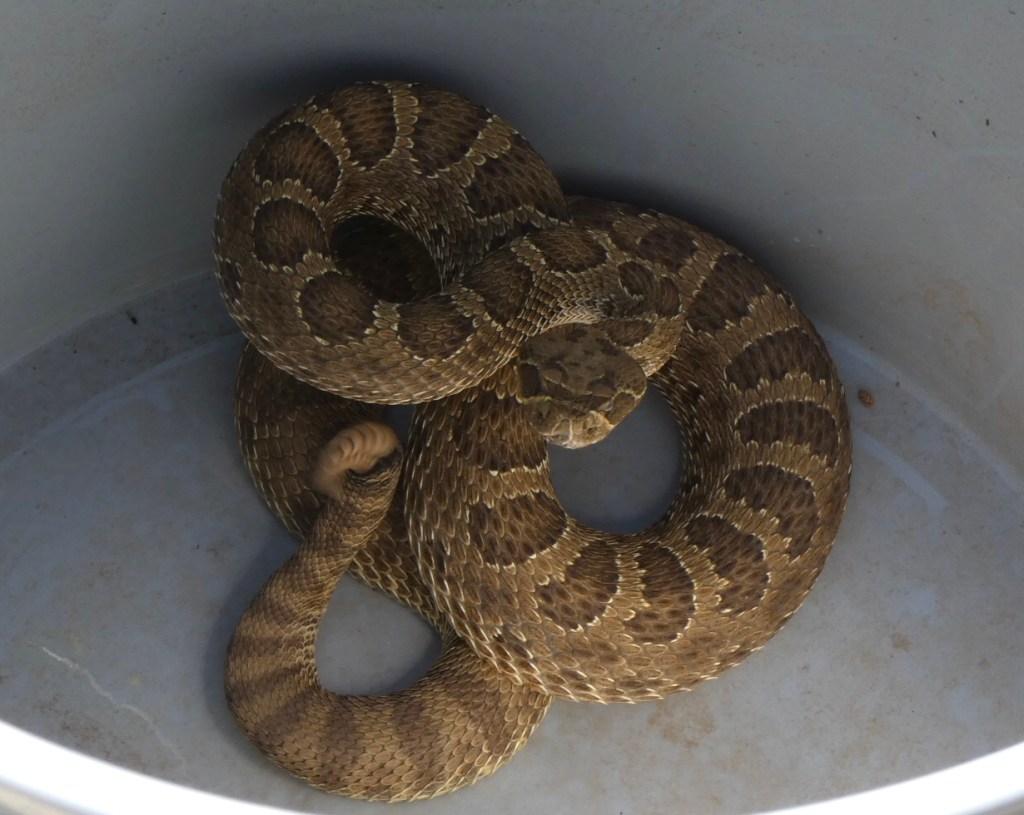
Then there was the morning Luna nearly stepped right in the middle of a really upset, hissing and striking prairie rattlesnake, practically right out our front door! It was a scary few moments until we determined Luna did not get bit! Whew.  Roy expertly wrangled up the guy, herding him into a 5-gallon bucket, and relocated him a safe distance away.  (I may cheat and add him to my June “Littles,” if you don’t mind, along with the first rattlesnake encounter of the season! Gotta love the desert.)

Another close-up

Included in the long list of flowering plants, was prickly pear cactus. Several species began opening their buds to reveal 20-30 delicate waxy yellow to apricot colored petals per bloom. It didn’t take long for the pollinators to find these delicacies! 

And Another close up

Blooming in the foothills (5,000’ up to 7300’ elevation), there was milkwort, fleabane, scarlet globemallow, banana yucca, sundrops, milkweed, paintbrush, golden weed, common hoptree, puccoon, several species of pink-flowered hedgehog cactus, blazingstars, bee blossom, tahoka daisy, NM thistle, ……. etc.  I could go on and on! And even at nearly 9,000’ elevation, rock jasmine, valerian, creeping mahonia, prairie bluebells, pasque flower and dwarf lousewort were all in bloom. 

All in all, a bountiful full-on Spring bloom! 

A big shout-out to “Made by Fay” for the inspiring “Littles” idea!   Stay tuned for the next installment of “Littles.” 

June 22, 2023

April “Littles” ….. A Rush of Spring!

In the blink of an eye …… April! The dusty browns of late winter gave way to landscapes full of color! Movement was everywhere ….. Flower buds began opening as emerging insects smacked their lips in anticipation. Birds, flocking to their breeding grounds, had hungry eyes on the growing bug population. Hibernating reptiles began to stir as the earth warmed; lizards stretching sleepy legs in their underground burrows, that will help them flee slithering snakes; snakes wriggling and coiling and hissing, perhaps thinking about a breakfast of juicy lizard or a baby bird. Mule deer moved down from the surrounding hills to nibble fresh plant growth. Coyotes hunted desert cottontails as they snacked on prickly pear pads. 

April was amazing! There was so much happening, that it was all I could do to take in so many changes. It was such a challenge just to slow hike the hills every day, observing and taking  photos, that keeping up with my “Littles” pages seemed impossible! 

Close up

So here it is mid-June, and I’ve finally put the finishing touches on my April “Littles.” While creating my tiny framed discoveries, I questioned my desire and/or the need to continue with this project. But then I quickly dismissed those thoughts. After seeing these pages finished, I realized it was not only great fun, but an important reminder of what happens in nature during April.  

Another close up

Again, many thanks to “Made by Fay” for the inspiring “Littles” idea!

June 17, 2023

“The Felix” 2023: Escapito #1


Come on along with us for 5 days of camping fun in the Land of Enchantment, where we had some weird and close encounters with botanical beauties, a bare-butted gopher, a swarm of bees, and voracious leaf-footed beetles! All this, and more while exploring a National Conservation Area, a Desert National Monument, and a New Mexico State Park, all within the Chihuahuan desert ecosystem.

Continue reading ““The Felix” 2023: Escapito #1”

A Sandia Mountain High

Sunday, May 7, 2023

After having just returned from a fabulous week in southern New Mexico (blog posts to come) where we hiked and hiked, and got reacquainted with the Spring-time desert flora and fauna, we seemed to be craving pine and fir trees and some mountain air. How high do we dare hike? Would there still be snow? These and more questions rattled about in my mind as we headed the truck up the 13 mile long and winding Sandia Mountain Crest Road (central New Mexico).  Ahhhhh …… so invigorating!

Satisfying our craving (at 8500 feet in elevation) and answering the question about leftover winter snow (not a single snowflake to be found), we pulled up to the Tecolote Trail trailhead and began our ascent, in shorts and T-shirts. The first half mile up was brisk, both in temperature and pace, but after I was well warmed up it was time to open my eyes to investigate anything and everything growing, sprouting and blooming.

This was the earliest date (May 7th) in the Spring we’ve hiked Tecolote, so I was hoping to see a variety of wildflowers that were new-to-me species. I wasn’t disappointed! Blooming beautifully were the minuscule Pygmy-flower rock jasmine (in the primrose family), Arizona valerian (a species of honeysuckle), along with lance-leaf bluebells (borage family), and White Mountain bladderpod (a brilliant yellow 4-petaled member of the mustard family). Covering the slopes everywhere we’re the bright yellow flowers of Oregon creeping grape (aka creeping mahonia), and common along the trail were flats and flats of the dwarf purple and white lousewort (in the broomrape family), it’s flowers growing close to the ground amongst its deep green dense and curly margined fern-like leaves.  Perky Sue (a happy yellow daisy) and the soft-like-a-teddy-bear prairie pasque flower (a type of buttercup) rounded out the bloomers that I could find.

These pages in my journal focused on the shrubs and trees showing growth alongside the trail, drawn from snippets collected during the hike.

It was a perfect morning for a hike! Wished you’d been there with us.

Until next time …… How’s your Spring is shaping up! Do you have a favorite plant that’s blooming, or a singing bird tending chicks? I’d love to hear your story.

P.S. This journal page layout was inspired by an amazing nature journaler, artist and teacher, Jean Mackay who loves all of nature and sharing her discoveries through illustration. Thanks Jean!

A “Snow White” Spring Super Bloom … Albuquerque Foothills

April 2023

Oh my goodness! What a brilliant Spring Super Bloom is on display mere steps east of Albuquerque. 

Alas, I found myself lamenting for months over the long and snowy wet winter we just climbed out of here in the East Mountains of central New Mexico. It seemed the back-to-back snowstorms since last November were never ending; snow shoveling every morning became the norm. But I know better than to whine. An abundance of winter moisture always results in a spectacular abundance of spring flowers.  And this Spring has proven that true.

Scrambled Eggs

The last two months we’ve seen a mad splash of sunshine yellow from the blooming of a native winter annual called Golden Corydalis, aka Scrambled Eggs (Corydalis aurea). This member of the poppy family quickly converted the dusty hillsides from brown to a glowing yellow as the many-flowered stalks of this plant seemed to shoot up over last season’s dried grasses. Scrambled Eggs was the plant I thought would be our Spring super bloomer.  

But, oh no!

During a full two weeks of being distracted by the glow of all that yellow, all around our feet, 1,000s and 1,000s of blue-gray-green rosettes began to grow. I noticed these rosettes (the very same mystery rosettes I described in my January journal), were rapidly expanding outward to make room for flower stalks heavily laden with little rosy orange buds. And then one day one of those buds unfurled into a brilliantly white 4-petaled flower.  In the center of that flower were 8 lemon-yellow pollen-heavy anthers surrounding a 4-fingered lemon-yellow stigma, ripe for pollination. Of course …… now I knew with certainty ….. the flower blooming atop the pretty winter rosettes is the White-stemmed Evening Primrose (Oenothera albicaulis)!

One of my January posts included this page where I illustrated a mystery rosette (top center) that seemed to be everywhere.

Also known as Whitest Evening Primrose, it wasn’t long until more flowers began to appear. “But, wow, was it possible that all those 1,000s and 1,000s of rosettes would each produce a bouquet of flowers?” Hiking these foothills every day paid of.  As the excitement of possibility steadily unfolded, hundreds of thousands of large 2-4” white flowers unfurled each evening about sunset to greet potential overnight pollinators, and to welcome hikers the following morning. 

My journal page illustrating the abundance of white-stemmed evening primrose
A vista of white
white-stemmed evening primrose

In about a week since I noticed that first open flower, this native Evening Primrose was carpeting the hillsides in white as brilliant and sparkly as newly fallen snow. The ground became “Snow White” with flowers, out-performing the still profusely-blooming Scrambled Eggs. 

white-stemmed evening primrose

And the show won’t end any time soon …. there are still an unbelievable number of White-stemmed Evening Primrose buds awaiting their turn to enter the play from stage right! Now that’s what I call a true Spring Super Bloomer.

A detailed page of my dissection of white-stemmed evening primrose

What marvelous transformations have or are happening outside your world this Spring? 

March “Littles” ….. Looking for Spring Amidst March Madness

April 3, 2023

March came in like a passive lion, allowing a few signs of Spring to peek through. My collection of nature snippets and decorative trail rocks was going well, until ……. Before long we were once again shoveling drifts and piles of snow, dumped on New Mexico thanks to California’s 13 atmospheric rivers that flowed from coast to coast. This was looking like the winter that would never end.

It was truly and literally “March Madness” out there. So, in the spirit of the crazy seasonal weather, an emergency road trip became necessary to search for some “Littles” filler. And I knew the perfect route to take …..

The Turquoise Trail Scenic Byway winds around the Ortiz Mountains and Cerrillos Hills, while passing through the historic mining towns of Golden, Madrid (MAH-drid) and Cerrillos (sir-REE-yoose). Today, there’s minimal mining taking place in them there hills. Today it’s all about art, and there’s some really weird stuff on display out there.

From Golden to just north of Cerrillos, the hillsides are adorned with metal sculptures like a Trojan horse, three boned fish on sticks, a scuba diver fleeing a curious dolphin, two-story tall origami made of folded metal, butterflies as big as pterodactyls, a squadron of green parrots, and a fleet of racing bicycles. You have to look around every bend in the road ….. they’re all there, and more!

It was fun “collecting” these images for my March “Littles” collection, but I needed one more. We had heard the story of Ethyl the Whale somehow living out of water, somewhere in Santa Fe. Sounded like the perfect weird addition to that blank spot on my page.

And there she was! Around the back side of the Santa Fe Community College, in a large, flat field was Ethyl, the 82-foot long blue whale sculpted out of single use plastics. Ethyl is HUGE! She not only holds the Guinness Book of Records for the World’s largest recycled plastic sculpture, she also delivers an important message about the health of our oceans.

Well, there you have it; my eclectic assortment of “Littles” to remember this March of 2023. Let me know what you think! I’m already looking forward to true Spring in April. Wildflowers should be popping up everywhere and maybe a few more bugs will make an appearance for my April “Littles.”

Thanks again to “Made by Fay” for the “Littles” inspiration!

February “Littles” Seeds, Pods, and Other Curiosities

March 13, 2023

Like my January “Littles” page of the bird species that visit our feeders in winter, here’s another “Littles” to commemorate the not-quite-winter-or-spring month of February ….. Seeds and Seed Pods.  As a way to pass the time while waiting for Roy to finish up with a doctor visit, Luna and I conducted a focused scavenger hunt along a 2 mile circuit surrounding a large Albuquerque shopping mall. In no time at all, my collection bag was full.   But knowing my pages would need some local flavor and color too, I scavenged a bit longer and turned up a few more curiosities.    

Like with January’s page of birds, sketches of the species of seed pod and seeds (if collected) took less than 5 minutes each; my watercolor pencil paintings took about 10 minutes each. The restaurant logo and the frog design took a bit longer, and were done using my photos as reference. 

I’m not sure why it took nearly the entire month to decide what to do for my February “Littles.”  In hindsight, the decision should have been obvious, because I love seeds and the seemingly unlimited variety of pods.  Now I have a record of a few city seeds that will soon germinate, helping change the landscape from brown to spring green! 

Let me know what you think! I’m looking forward to March, when wildflower seedlings will be popping up which may appear in a few “Littles” boxes as well!

Thanks to “Made by Fay” for the “Littles” inspiration!