A Poetic Medieval Adventure Birthday Card for Elaine
March 24, 2026
If you’ve followed my blog for a few years, you may recall an annual post in late February or early March featuring my handmade birthday cards with one of my poems created for my most excellent and dear friend Elaine. Because she loves goats, all of the cards I’ve sent her include a variety of my goat illustrations. No ‘kidding!’ And because she’s an extraordinary poet, I try my best to write a unique poem following the rules of a lesser known (at least to me) style, and reprint my words somewhere inside the card. My efforts at poetry are usually hilarious (I would never call myself a poet), but always prompts Elaine to write a fantastic reciprocal poem in the same style.
The major prompt I follow every year is simply …… Have Fun! But I strictly observe a few rules, or else! (Or else this annual project would take me half a year to complete!) Haha!
Rule 1: Think of a theme. This year I had castles on my mind (I don’t know why), so illustrations could focus on things Medieval. You know, towers and moats, knights and shields.
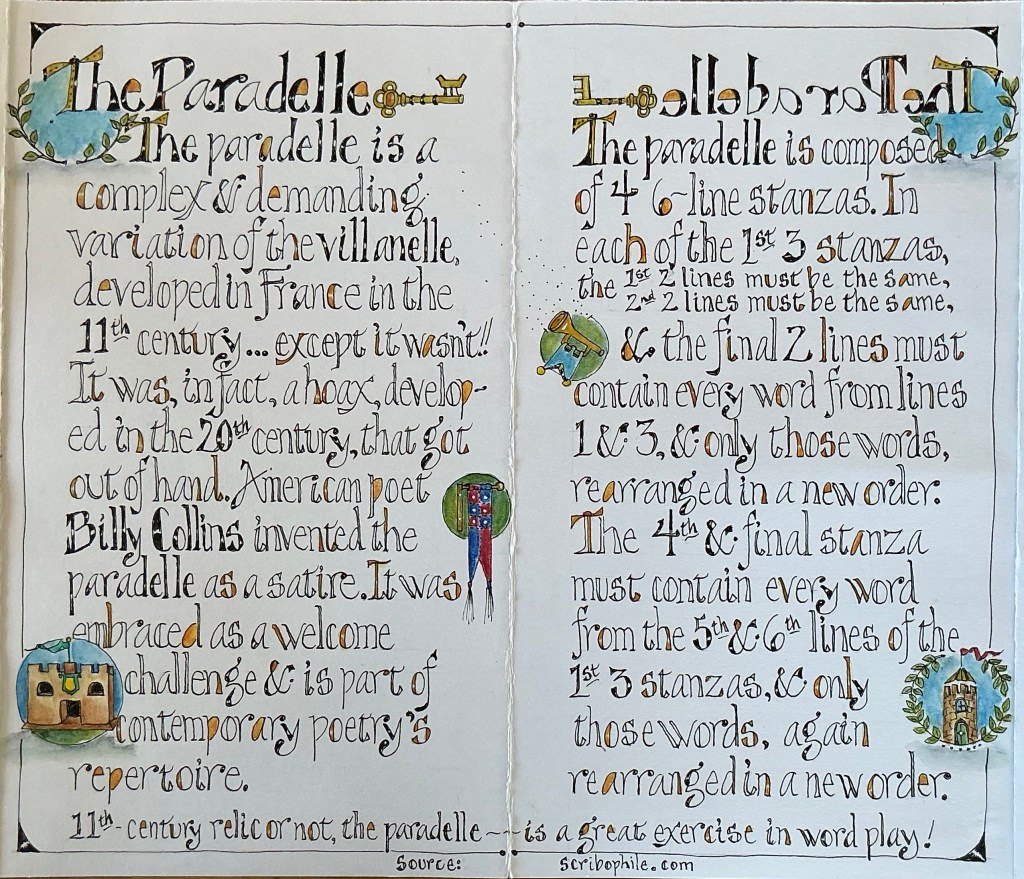
Rule 2: Find a style of poetry that would not only work with my theme, but has a high probability of generating a bunch of belly laughs while I wrote it and while Elaine read it. Next, write the poem. This year I chose to write a Paradelle (a parody on the Villanelle-style poem) that has high comedy potential. Also, the history behind the Paradelle was a hoot …. claiming to have been developed in the 11th Century (fitting my Medieval theme), but was actually introduced in the 20th Century (so I included the history behind the Paradelle in the card and below so you can read it for yourself).
Rule 3: Design and make an accordion card that would comfortably hold all the illustrations and the poem (and the history and rules of a Paradelle-style poem). Issue A ….. at this stage of the project, the illustrations and the poem were still vivid parts of my imagination. Exactly what would be an appropriately-sized accordion book? Hmmmmm? Issue Z ……. because I tend to have grandiose project ideas, the accordion book ended up being, well, grandiose! The outside cover panel was 9”x9” . and with two inside front-facing panels and a front-facing back panel, the entire length of the accordion book, unfolded, was nearly 3 feet long!
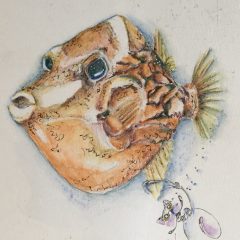
Rule 4: Complete the entire project during the first 3 weeks of February, allowing 1 week for mailing from central New Mexico to western North Carolina, arriving in time for Elaine’s birthday on February 28th (her birthday is actually on the 29th, but in years that don’t “leap” she always parties on the 28th). Not being able to complete the card until late the first week of March, I blew this rule, but did send her a ‘place-holder’ birthday puzzle of an underwater fantasy castle atop a sea turtle (alerting Elaine it contained an embedded hint of her actual “gift card” which finally arrived on 16th).
The following photos were taken of the pages from Elaine’s 2026 birthday card.
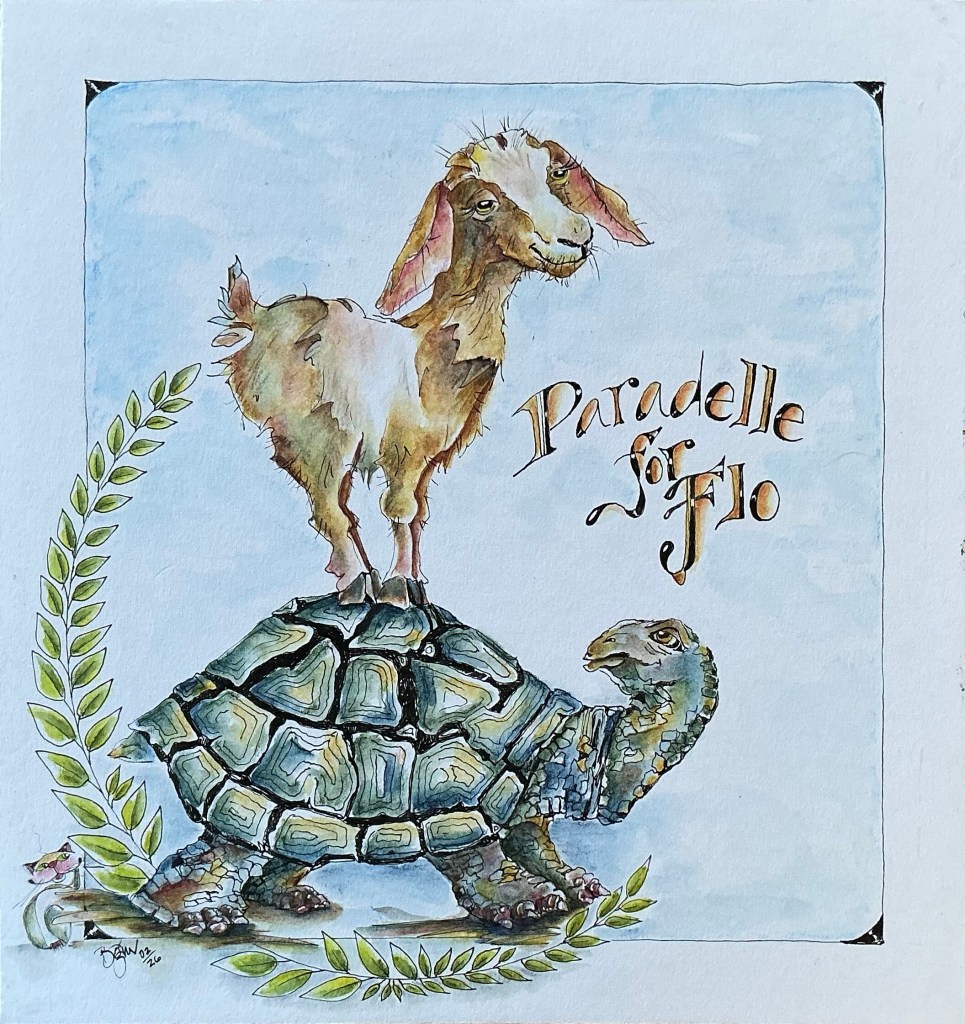
The cover panel, 9”x9”. I had to introduce a tortoise to tie together the card with the ‘place-holder’ gift she received in time for her birthday. Of course, a goat! Flambé approves!
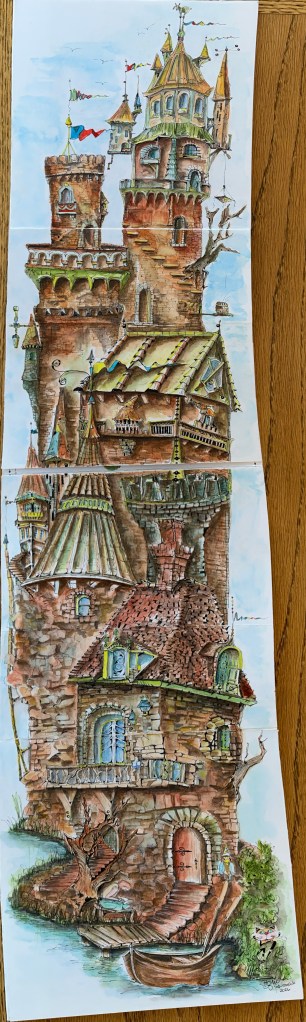
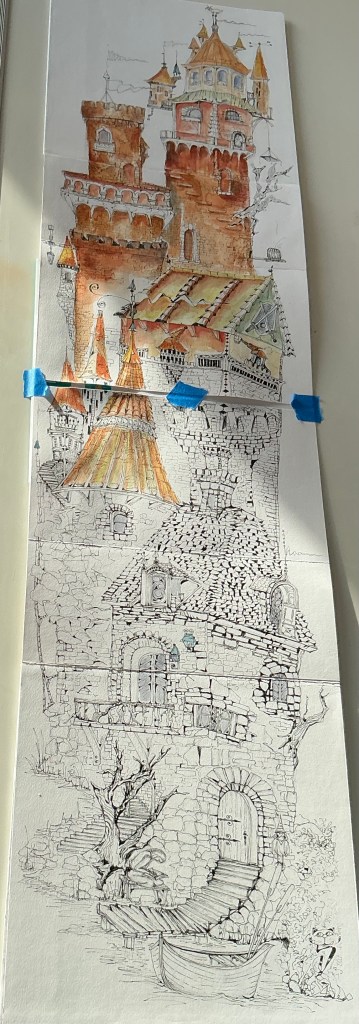
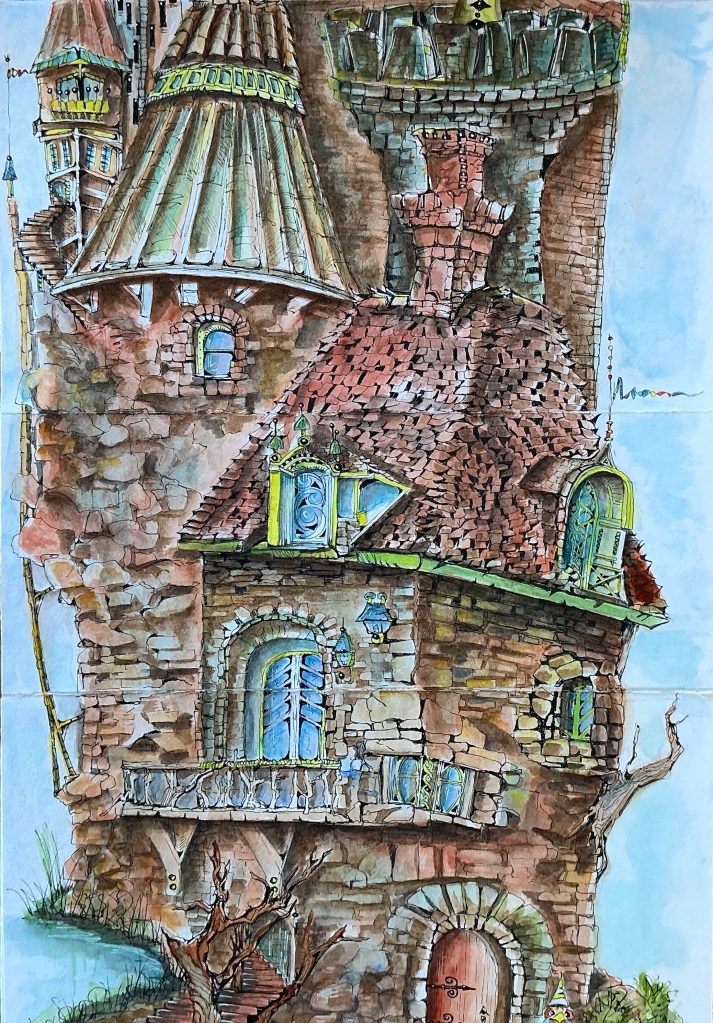
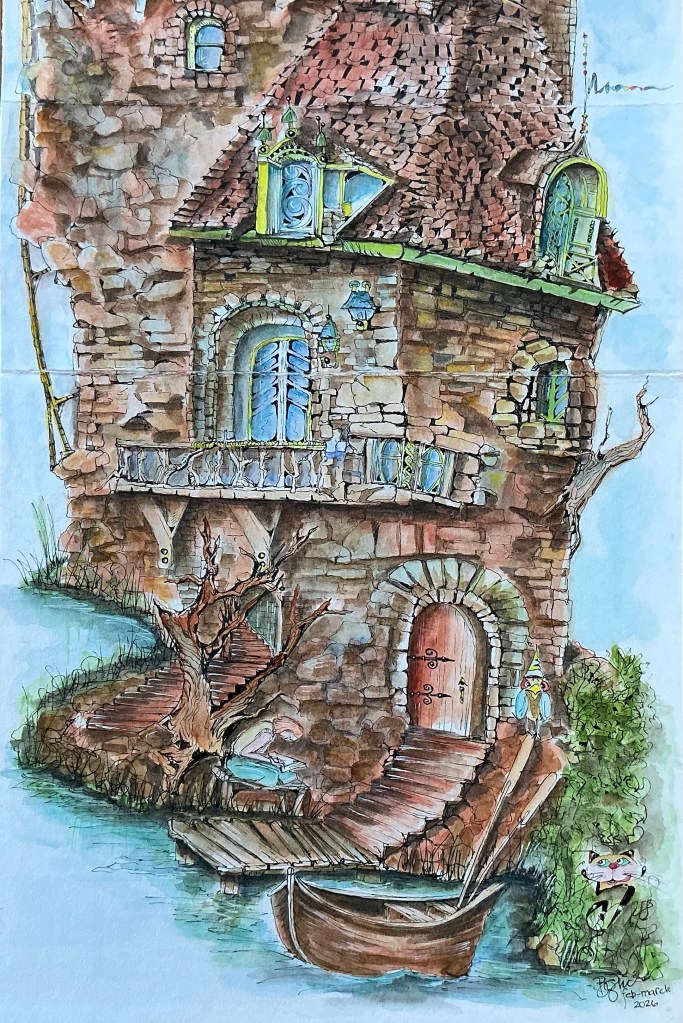
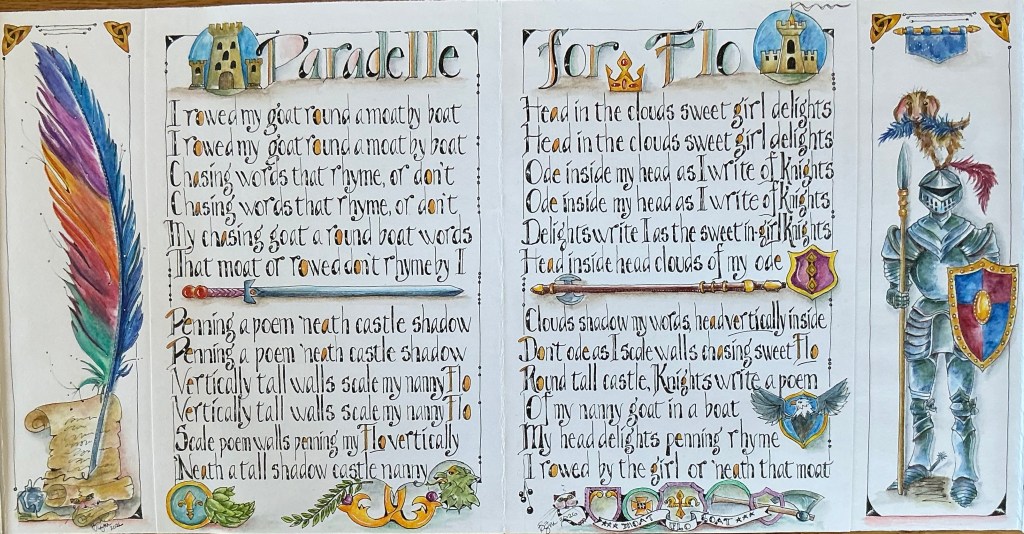
The Medieval Castle from my imagination. This 4-panel castle took up the entire inside of the accordion card, measuring nearly 3 feet long. The two center panels are bisected to make room for more printed words and illustrations. In this illustration, can you find the goat? Elaine busily composing her Paradelle? Flambé?
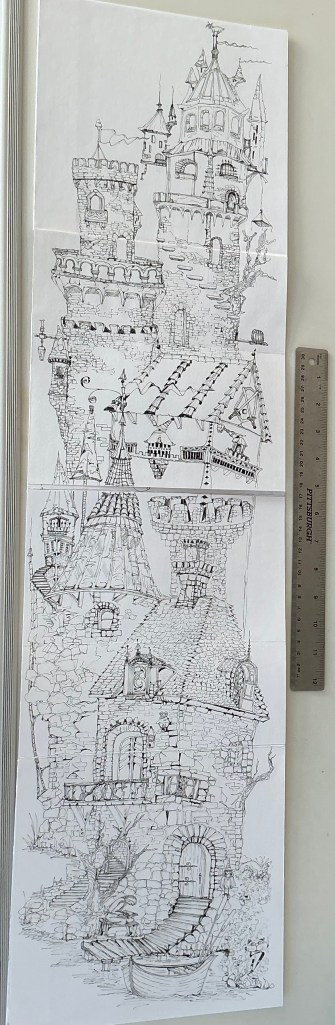
This was the line work. I began by pencil sketching the top panel, but before that was finished, I buried my pencil and finished the rest in ink only. The entire structure, top to bottom, is mostly from my imagination; making it up as I went. At first it was scary, but then I just went for it without fear. It was great fun!
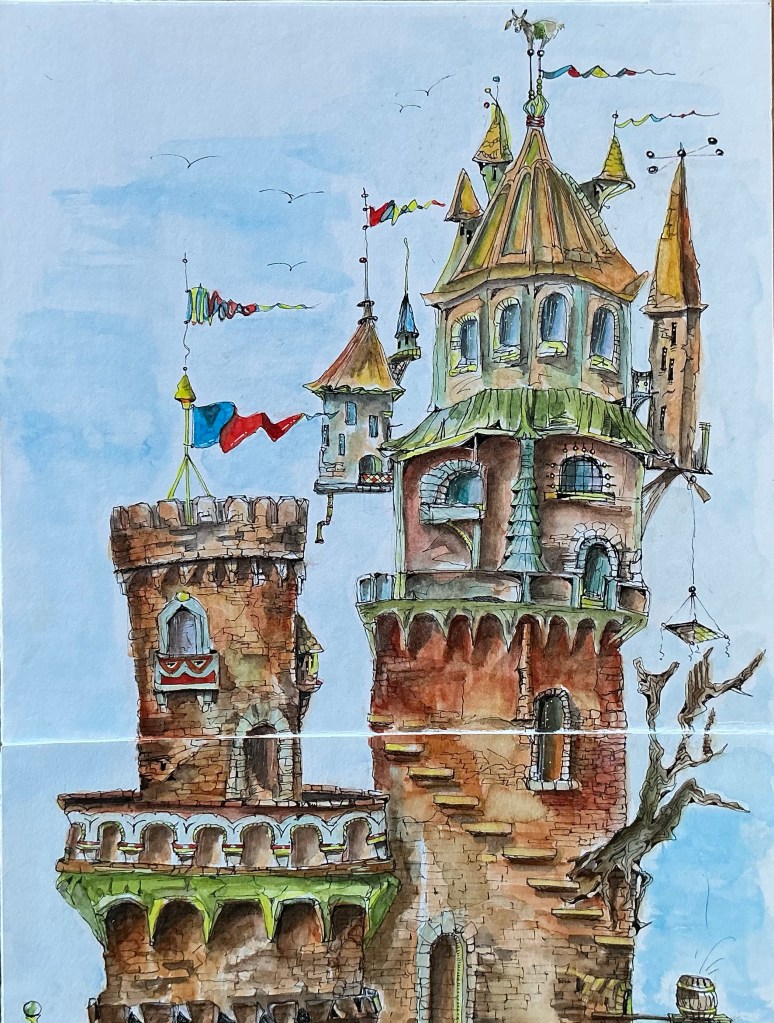
After the ink work was done, next came watercolor. I used a 12 half-pan set of van Gogh watercolors with a size 6 round brush for all the initial washes. Extra detail was then added with Derwent Inktense watercolor pencils and a water brush. The last step was to add extra shading with my neutral-colored set of Tombow dual brush pens which are water based and blendable. All fun!
Castle details – top panel
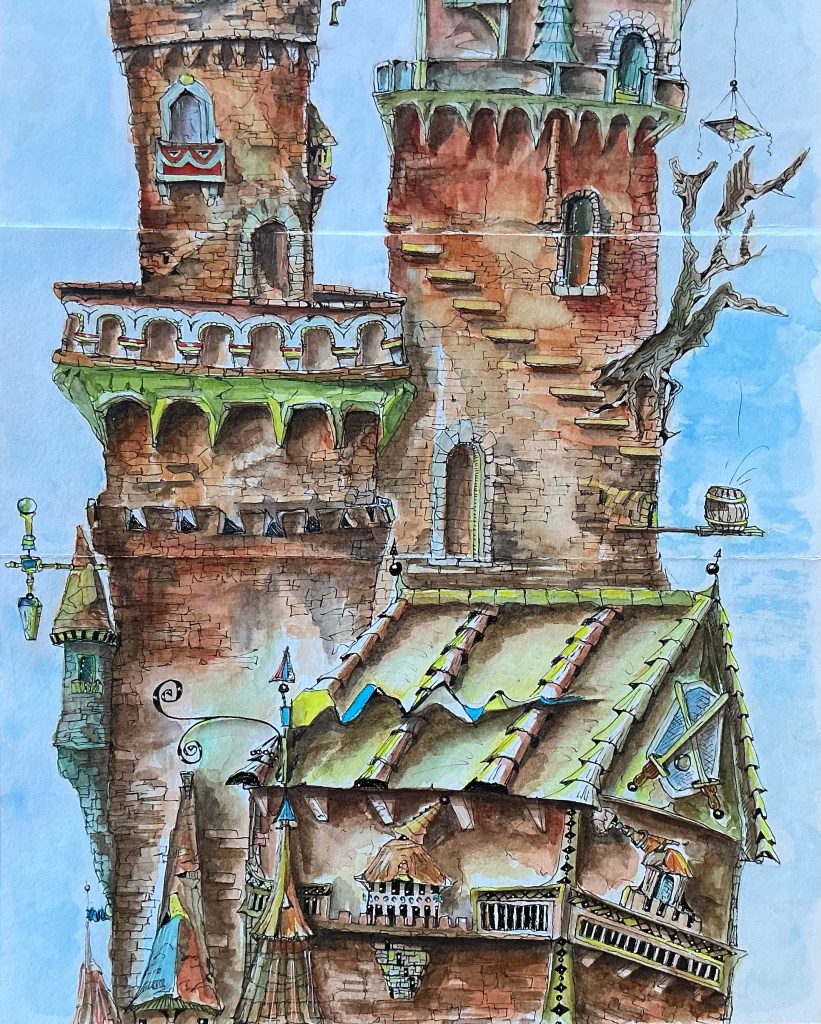
Castle details
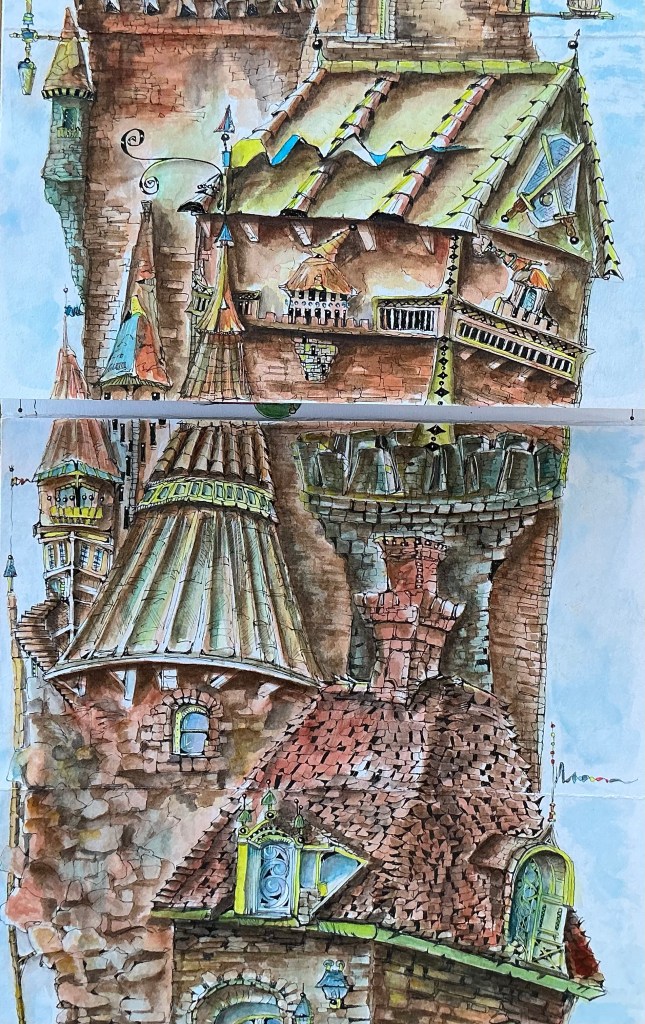
Castle details
Castle details
Castle details
This is -art of the center 2 panels underneath the castle. On the left is the humorous history of the Paradelle; on the right are the official rules you must follow when composing a Paradelle (should you wish to do so!)
This is the illustration under the right side flap under the castle. This is one of the Queen’s performers! This little guy works for goat-chow..
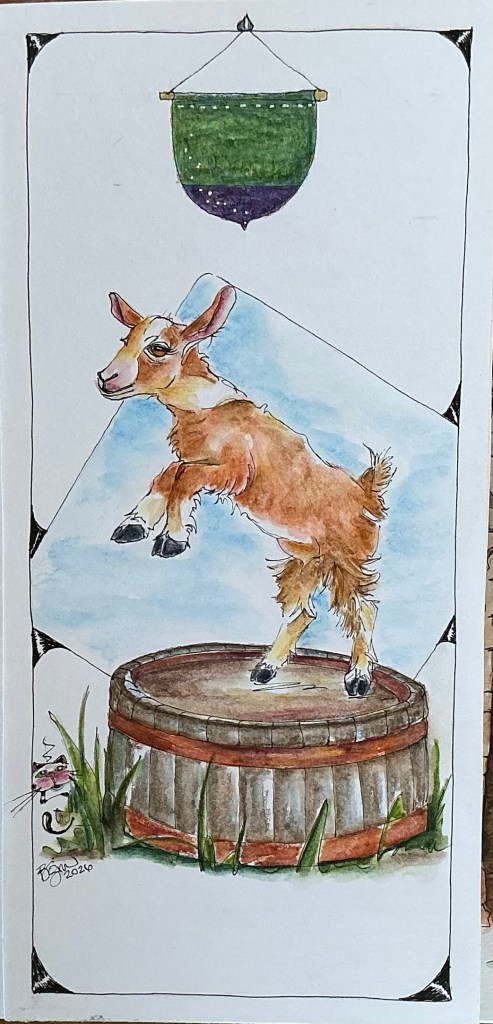
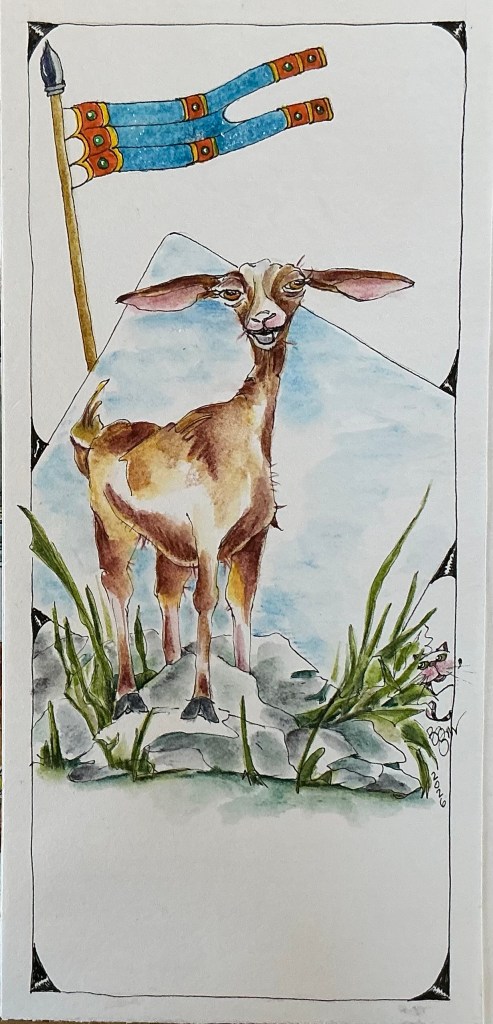
This is the illustration under the left side flap under the castle. This is the official banner bearer for the King when his Knights in Armor march off to battle. This little goat works for premium goat-chow..
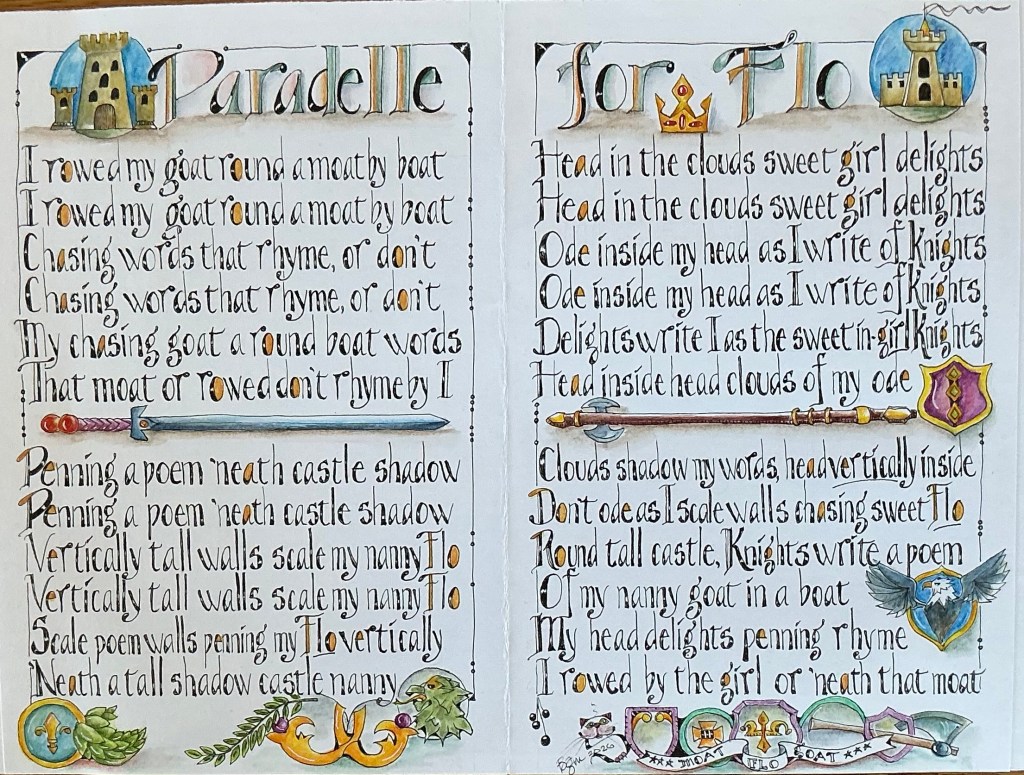
Paradelle for Flo!
The Paradelle for Flo layout, keeping with my Medieval theme.
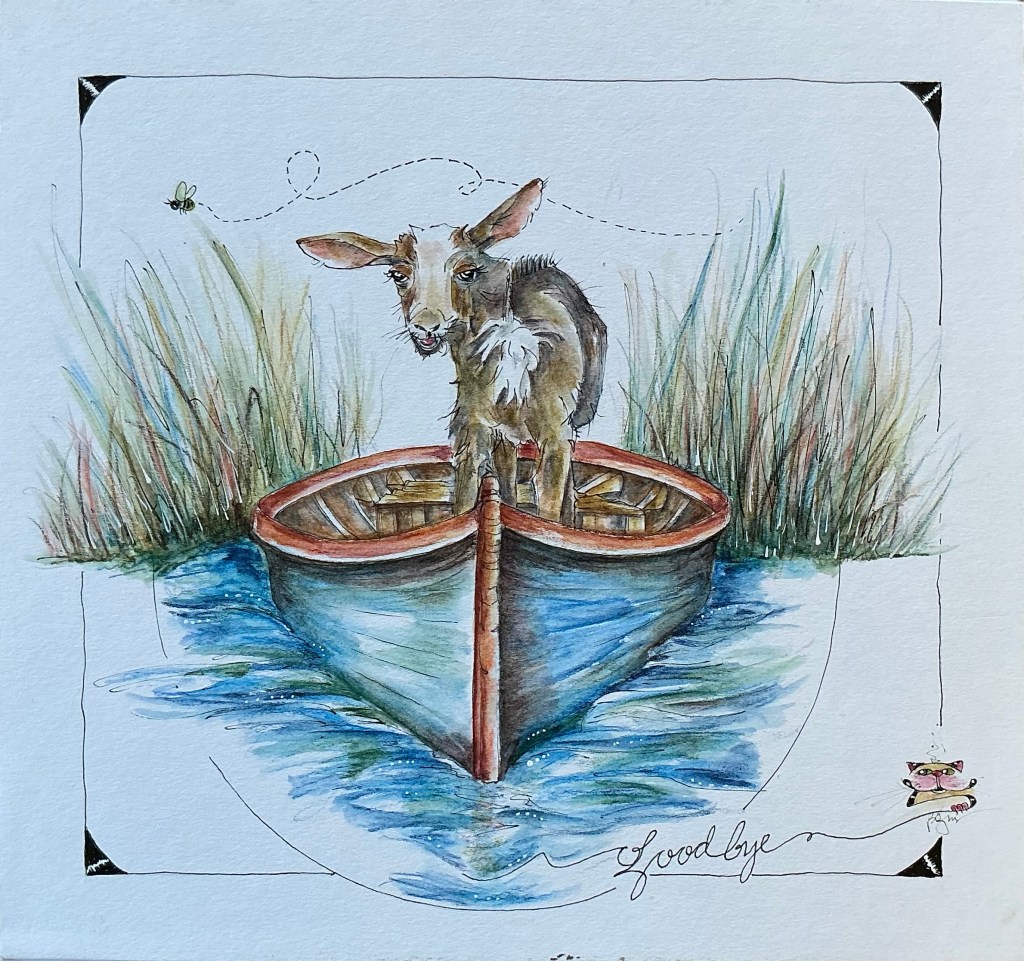
The Final page as Flo (and Flambé) quietly says ‘good bye’
Elaine loved her birthday card! Can’t describe how much fun it was to create Paradelle for Flo for such a wonderful friend! Thinking up the idea, making the accordion book, creating the illustrations and writing the poem was a great way to spend 5 weeks! It turned into quite a satisfying challenge, as well as a learning experience when it came to mixing various medias together and bringing to life all the components into one card!
If you enjoyed Paradelle for Flo, you might enjoy this one too!
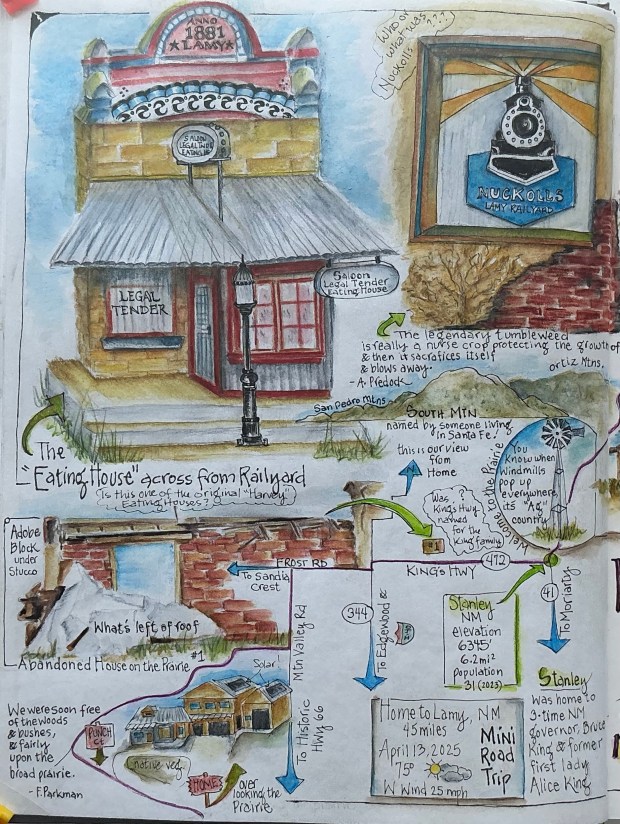
Woke one windy Spring morning about a week ago and decided it was time for a mini roadtrip …. 45 miles NNE, to visit the historic village of Lamy, New Mexico. Years ago (1991) when we lived in El Dorado (a sprawling subdivision southeast of Santa Fe), Lamy was a short 8 mile drive away. As seems true to our nature, we hardly ever visit someplace so close to home. So we didn’t. (Go figure.) But last Fall, the ABQ Urban Sketchers spent a morning exploring and sketching in and around Lamy. Unable to join them then, I promised myself that Roy and I would definitely make our own trip Lamy. So we did ….. and had a great time! Here’s a collection of my sketches and a lot of present day and historic facts about this little railroad community, many discoveries were anticipated; a few were complete surprises!
Lamy, New Mexico, preface: What’s in a Name?
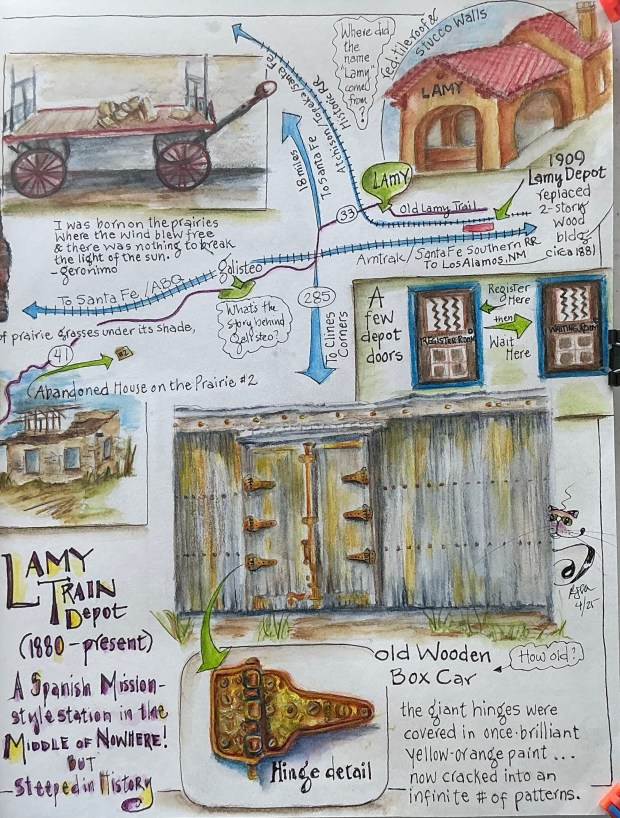
Sometime during the last half of the 19th century, Galisteo Junction was renamed “Lamy” to honor the first archbishop of Santa Fe (1853). Jean-Baptiste Lamy played a major role in the development of the region, including establishment of educational and medical facilities.
Lamy, part 1: Today
….. Location, Location, Location: Such a quaint little village, we found Lamy properly nestled in the foothills of the Sangre de Cristo Mountains, a beautiful range of mountains within the southernmost reach of the Rockies. Primarily a railroad town, Lamy boasted a population of 329 at its peak in the 1930s. Today, Lamy has a mere 93 residents, and continues to experience an annual population decline. With an “Eating House,” Saloon and a Museum, not to mention the historical Train Station, Lamy makes for a fine tourist destination and twice-daily Amtrak stop with shuttle service to and from Santa Fe, only 18 miles away.
….. The Lamy Railroad and History Museum: Dedicated to preserving local history and heritage, this museum emphasizes the railroads and their impact on the area. The museum is housed in the historic “Legal Tender” building, formerly the “Legal Tender Saloon and Restaurant.” But before that, it was the Pflueger General Merchandise Store (built in 1881) and attached Annex Saloon (built in 1884). Because this building complex is quite old, it has been listed on the National Register of Historic Places. If you’re planning a trip to Lamy, note the restaurant and museum are only open Thursday through Sunday, are run as a non-profit, and the waitstaff are volunteers.
Lamy, part 2: The Way-Back Yesteryears
….. Pre-Columbian Inhabitants: An archaeological site known today as The Lamy Junction Community, consists of 14 small Coalition Period1 (AD 1200-1325) pueblos and other structures. Occupying the SE facing slope, northwest and above the Rio Galisteo, the site was discovered by Adolph Bandelier on June 29,1882. Bandelier noted in his journal “a group of small house ruins” west of the depot at Lamy. Excavation of the area began in 1915, resuming in the 1930s and again in August 1981. Archaeologists reported almost all of the pueblos and other structures were similar to each other, having 10-20 rooms each and built of adobe and some stone. The largest structure, however, was probably 60 rooms in size and two or even three stories tall in places.
Today this historic site is located near the junction of US Highway 285 and Santa Fe County Road 33, the dead end spur road that passes through Lamy. The location of these roadways makes sense. Over the last century, or probably longer, Lamy Junction has been a crossroads for several roadbeds that crisscross the site: between Lamy and Galisteo, Lamy and Clines Corners, Galisteo/Clines Corners and Santa Fe. Although the history of these roads and their associated artifacts have yet to be studied, it’s clear from archaeological excavations of The Lamy Junction Community, the disturbance from construction, frequent use, and maintenance of these old roadbeds impacted artifacts from the prehistoric site and surrounding area. Also, when the tracks were laid in the early 1880s for the Atchison, Topeka and Santa Fe Railway, the ideal grade ran within the bed of the Rio Galisteo southeast of the Community. Railroad construction required relocating the river to the east, placing it on the far side of the railroad grade; actions impacting prehistoric artifacts in these areas.
Note to self: Because we came to Lamy to learn about the 1880s train station, I only discovered the area was occupied more than 1800 years ago during my follow-up research into Lamy! Yes ….. we will return and try to find this prehistoric Community, now owned by Santa Fe County.
1Coalition Period (AD 1200-1325) was a time of significant changes in the Pueblo culture of the Rio Grande Valley, which included The Lamy Junction Community of the Galisteo Basin. During this time of increasing population and intensified agriculture, expansion into new areas like the Pecos River Valley occurred. In addition, the growing population began living in larger pueblos.
Lamy, part 3: The Not So Way-Back Yesteryears
….. The Lamy Railroad and Train Station (aka Depot): When plans were made for the Atchison, Topeka, and Santa Fe railroad (aka the “Santa Fe”) to run from Atchison, KS to Santa Fe, NM, and then west to California, civil engineers didn’t take into account the challenging terrain surrounding Santa Fe. A direct run to and stop at Santa Fe was not going to happen. So about 145 years ago the line was built through Lamy. But because rail transport was still desired by Santa Feans, a spur line was built north of the Lamy Railroad Junction that could carry freight and passengers into the city. Now Plan “B” logically placed the train station in Lamy, and in 1881 a two-story wood frame building was constructed for that purpose. For 28 years that structure served as the official train station for the “Santa Fe” until a freight depot was needed. This prompted the construction of a new train station, allowing the original 1881 station to be converted into the much needed freight depot, which was in operation into the 1940s. The new train station, a one-story Mission-style red tile roofed/stucco sided structure, built in 1909, was opened to passengers upon completion. This station is still in operation, and is the one we visited.
Lamy, part 4: Growing a Railroad Town
….. El Ortiz: East of the depot, the famed Fred Harvey Company constructed a hotel named El Ortiz in 1910. Started by English immigrant Fred Harvey in the 1870s, the company that took his name ran a series of highly efficient Eating Houses along the “Santa Fe” rail lines, guaranteeing quick, quality meals. These eateries at set stations were necessary stops because dining cars on passenger trains were uncommon west of the Mississippi. The eateries were so successful, that a partnership was formed between Fred Harvey and the “Santa Fe” to branch out into the hotel business. Many hotels were located in trade and business centers, but other Harvey Houses like El Ortiz were built to develop tourism in Lamy. Hotel El Ortiz no longer exists. After a 1930s fire destroyed partial sections of the building, it was completely brought down in them1940s.
Note to self: when we revisit Lamy, must find the original location of El Ortiz. Is there anything remaining?
….. A secret destination: Lamy was commonly the first stop for staff and their families arriving to New Mexico on their way to the secret city of Los Alamos.
Lamy, part 5: Flashbacks of Yesterday
….. the Santa Fe Detour: Today, Amtrak Southwest Chief passengers headed to the state capital still detrain at the 1909 Lamy Station, where they can read interpretive displays about the past, visit historic buildings and the museum, walk around old train cars and engines, and maybe have a bite to eat at the Legal Tender, before catching the shuttle transporting them the remaining 18 miles to Santa Fe.
Well, that’s about all for now. Hope you enjoyed this virtual tour of Lamy, NM
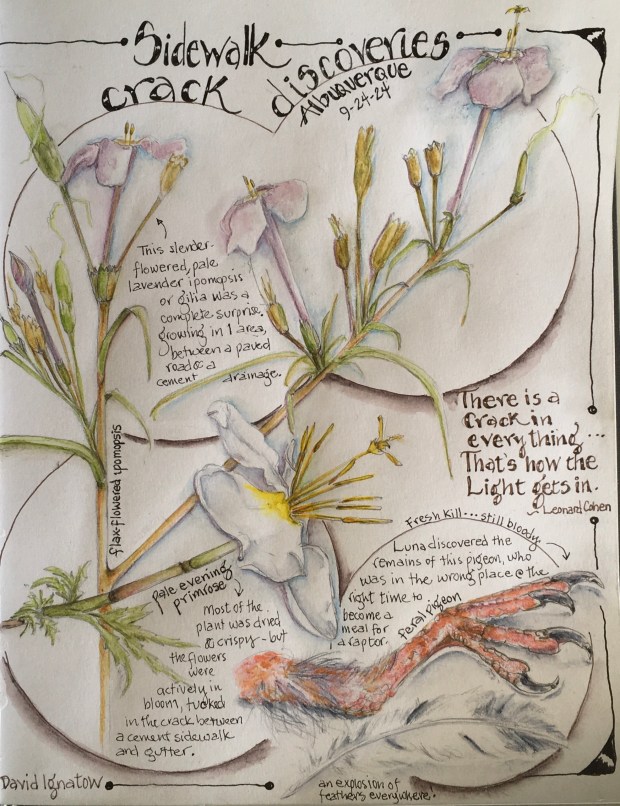
Roy had a doctor’s appointment one morning in late September, at an office right off busy I-25, near the ABQ airport. Instead of hanging out in the sterile waiting room, Luna and I spent our time exploring the areas surrounding the office, just to see if there was anything worth observing.
For 2 miles, we wandered about the not quite urban/suburban/industrial/residential neighborhood ….. me looking for a sketchbook entry; Luna sniffing out messages left just for her by visiting dogs, squirrels, or bunnies.
Interesting discoveries seemed lacking, until Luna caught whiff of something irresistible. Tugging hard on her end of the leash, she urged me to run with her as she zeroed in on the source of the smell.
By a parking lot light, on the pavement next to a cement curb was an explosion of feathers, but Luna kept leading me on to something better. There! Lying on the curb was a still wet and bloody bird foot barely connected to what remained of the thigh. All clues pointed to the very recent drama, where a raptor (possibly a red-tailed hawk) had swooped in and nabbed the hapless victim (a feral pigeon), killed and then ate his prey from the platform atop the parking lot light. The inedible remains fell to the ground as a group of 2 dozen “relieved-it-wasn’t-me” pigeon friends looked on.
Quickly solving most of this puzzle in the time it took to pry the pigeon foot from Luna’s mouth, gave me the idea of sketching not only the foot, but to look for other unlikely nature discoveries in this urban/suburban/industrial/residential neighborhood setting.
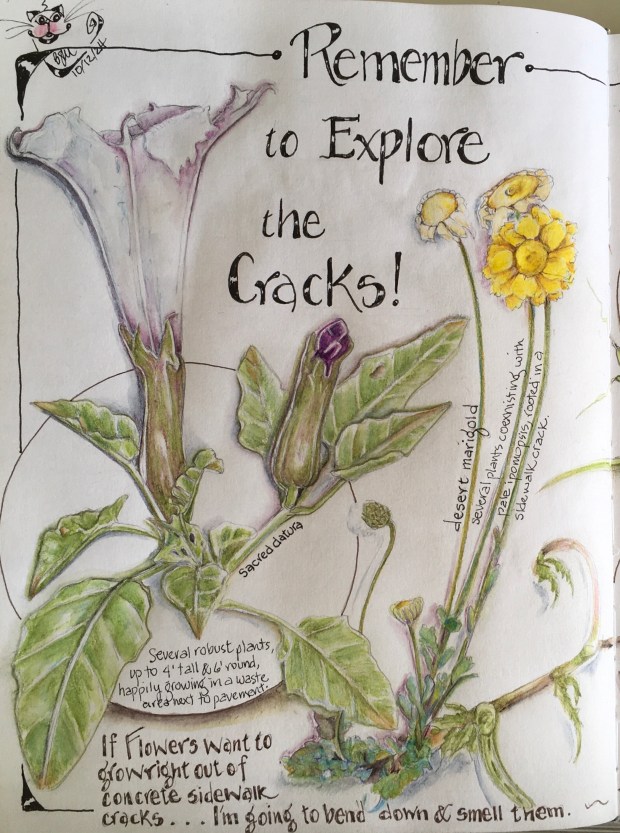
Mentally armed with a keener power of observation and purpose, we retraced our earlier route with excitement! Now it was obvious an abundance of interesting and beautiful plants were growing from every sidewalk crack and along crumbled pavement edges throughout the ‘hood. How had I missed seeing these beauties?
And that’s how my idea for this 2-page layout was born, along with a reminder that finding bits of nature doesn’t have to occur at a botanical garden, wildlife preserve or national park. Nature is everywhere. If you just slow down and really look, even in the most unlikely places like sidewalk cracks, there’s always something to discover. So Remember to Explore the Cracks too and let me know what you find!
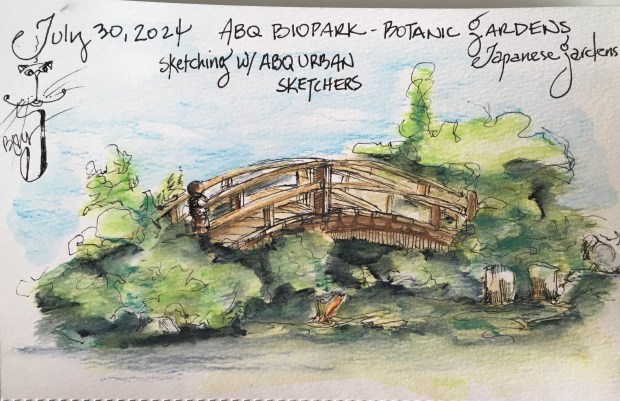
On July 30th, six of us Albuquerque (ABQ) Urban Sketchers gathered for an impromptu morning of exploring and sketching at the ABQ Biopark/Botanic Gardens. It’s always so much fun seeing what’s blooming any time of the year, even during the heat of summer. Despite the morning’s toasty hot temperatures, the plentiful shade and water features provided many “cool” locations for sketching and exploring.
Since the Japanese Gardens section of the park was new to me, I decided to make my way there to sketch, while enjoying summer flowers and many interesting seed pods from what must’ve been an outrageous, overly abundant Spring bloom. After a slow 15 minute stroll, I had arrived at the 4-acre Japanese Gardens, complete with a waterfall, koi pond, pagodas, wooden bridges, many stone statues, and many many ducks.
Walking bridge over the koi pond
My first sketch was of a pretty pagoda that served as a shady spot for one of the ABQ Plein Air members to paint the scene behind me.
Then, wandering deeper into the garden, past the waterfall, I found the koi pond with a few interesting features ….. a walking bridge bisecting the pond where parents brought their children to feed the ducks. Adjacent to the walking bridge was a weathered wooden bridge which crossed the inlet to the pond. As I sketched and painted while sitting on a large flat rock a foot back from the pond’s edge, many large dragonflies hovered nearby, several koi rolled in the water, mallards paddled about, and a bullfrog sounded his loud and low stuttering ru-ru-ruuuuummmmmmm. A few park visitors even stopped behind me to watch my sketches develop!
Small weathered, wooden bridge and rolling koi
It was so calming and peaceful sketching in the gardens, and before I knew it the morning had flown by. Quickly I packed up my supplies and scurried back towards the entrance to the Biopark where I met up with my small group for our “throw down” and photos.
Such a great morning!
As always, thanks for stopping by!
Supplies: Faber-Castell Pitt Artist Pen fineliner 0.3 (black) was used first to create quick sketches; Derwent watercolor pencils and Pentel waterbrush were used for the color
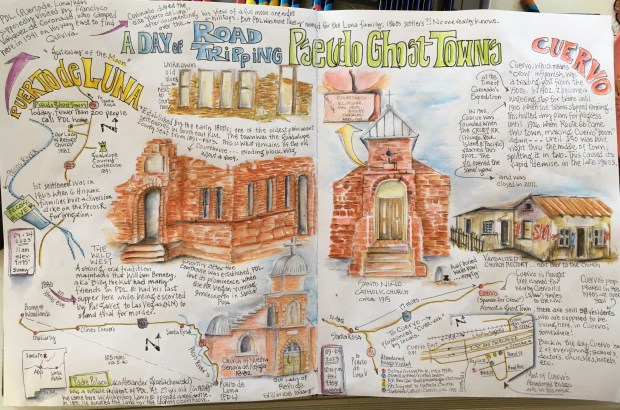
Wow! Time is flying. Here we are already well into the beautiful month of October, and realized my journal pages from our late September road trip fell asleep in the back seat of the car! But I felt my record of this day trip was worth sharing, especially since Halloween is fast approaching, and ghost towns are all the rage!
New Mexico always surprises and delights, and our trip to explore the pseudo ghost town of Cuervo, became two destinations. While in route to Cuervo, we found a curious notation on the highway map referencing the historic village of Puerto de Luna. Only a short, 9.5 mile detour south of Santa Rosa, we decided to check it out.
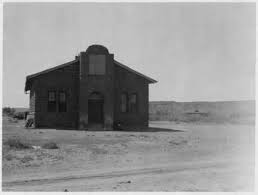
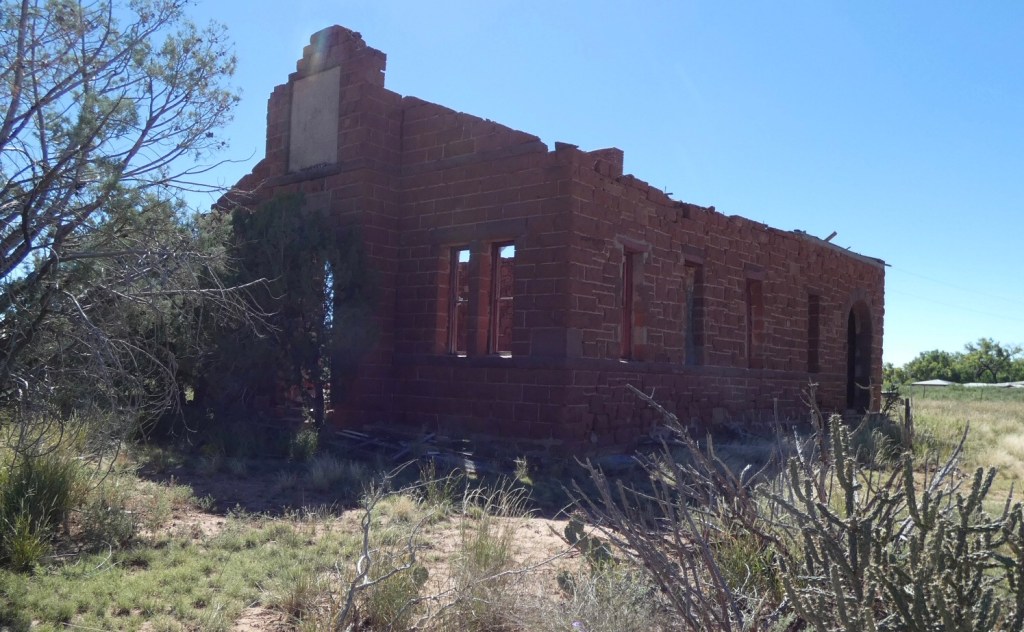
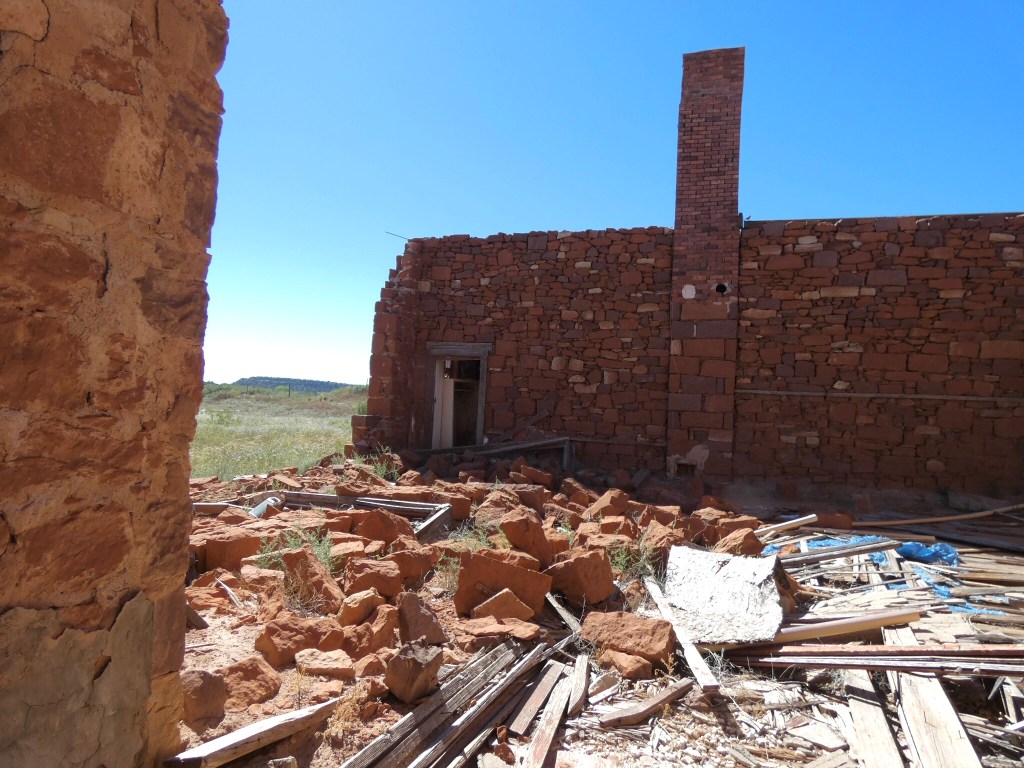
Puerto de Luna, NM The village of Puerto de Luna, Gateway of the Moon, is still inhabited, mostly on the West side of the Pecos River. However there are many wrecked and ruined buildings east of the river; enough to merit the label “Pseudo Ghost Town.” After a scenic ride through country used primarily to grow wheat and for livestock grazing, travelers first encounter the well maintained Church of Nuestra Senora del Refugio. Built in 1882, the church is still in use today. Just SE of the church sits the remains of the original Guadalupe County Courthouse. Constructed in 1891 of sandstone brick and blocks, it was only used for a few years. . Before the county seat was moved to Santa Rosa in 1903, a second, much larger building was constructed on the west side of the Pecos, which today is being used as the senior center. Not much remains of the original courthouse; the roof and half of the walls are piles of rubble lying inside the structure. The photos below show the changes from then to now.
Guadalupe County Courthouse, Puerto de Luna, 1891
Remains of Guadalupe Co Courthouse, Puerto de Luna, 2023
Looking inside the remains of Guadalupe Co Courthouse, 2023
Our brief visit to Puerto de Luna was fun. We learned about some of the pre-village history, like the Spanish explorer Coronado was said to have passed this location in 1541, naming the site Puerto de Luna after seeing a spectacular moon rise. And then there’s the more recent account from 1880, involving Billy the Kid and his last dinner here before being escorted by Pat Garret to Las Vegas, NM to stand trial for murder. After a hour of poking about a few more abandoned buildings, we headed back north to Santa Rosa and east 17 miles to our next pseudo ghost town.
Cuervo, NM ….. don’t blink or you’ll miss it!
If you zoom along on I-40 at 75-80 mph, heading east or west, and happen to blink, you’ll surely miss what remains of the old trading post and railroad town of Cuervo. Spanish for “crow,” Cuervo was officially established in 1902 as a watering stop for the CRI&P railroad. When the trains stopped running in 1910, the population declined, and businesses closed. But things took a turn for the better, when in 1926, Route 66 came through town, and Cuervo boomed again. By the 1940s, the population grew to 300, and had 2 of everything ….. schools, gas stations, hotels, churches, doctors, etc. All was just peachy for Cuervo until the late 1960s when the highway department decided to build I-40 right through town, slicing it in two and causing its rapid demise. Although the post office officially closed in 2011, the 58 permanent residents calling Cuervo home still have and use the old zip code, where they get their mail is anyone’s guess. Oh, and if you exit the highway hoping to fill up your tank, think again. Even though there’s a gas station sign that looks like it’s inviting you to stop, there’s no gas, or snacks …. nothing. Just a bunch of dusty roads, crumbled and weathered buildings, and tumbleweeds blowing in the wind.
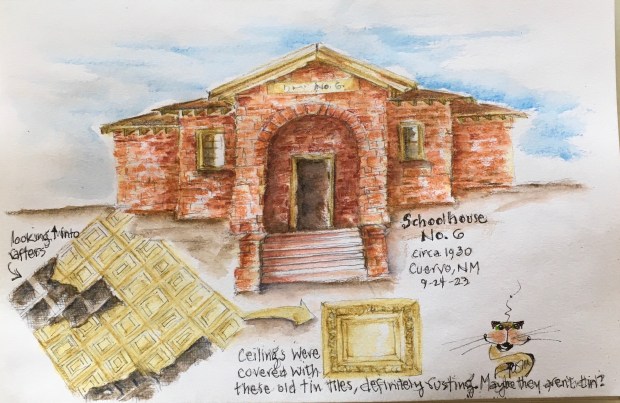
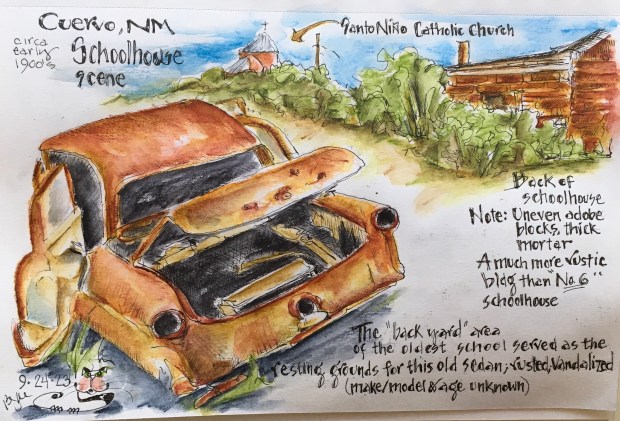
We spent a few hours poking about the old town grid, exploring a handful of abandoned properties. The old 1915 Catholic Church is padlocked, but opened on Sundays for service. The 1930s schoolhouse appears to be undergoing some renovation. And signs of more prosperous times exist when the old steam engines used to run into town to resupply. Actually there’s been very minimal vandalism considering how close Cuervo is to the interstate, but there’s one serious blemish that made headline news a few years back. The Baptist church was the site of some pretty scary satanic rituals; and it’s thought these practices conducted in the church by the perpetrator resulted in the disappearance and murder of a number of people. We chose not to investigate.
The 1930s Schoolhouse, Cuervo, NM
Early 1900s Schoolhouse and abandoned sedan, Cuervo, NM
Old wooden home and water storage bldg, Cuervo, NM
Boxcars, then and now …. which do you prefer? Cuervo, NM
And that concludes my post. Hope you enjoyed reading a bit about life as it was and is today in and around two interesting pseudo ghost towns located in central in New Mexico. I’d be very interested in knowing if you explore ghostly history where you live! Have an awesome day, and remember to be curious!
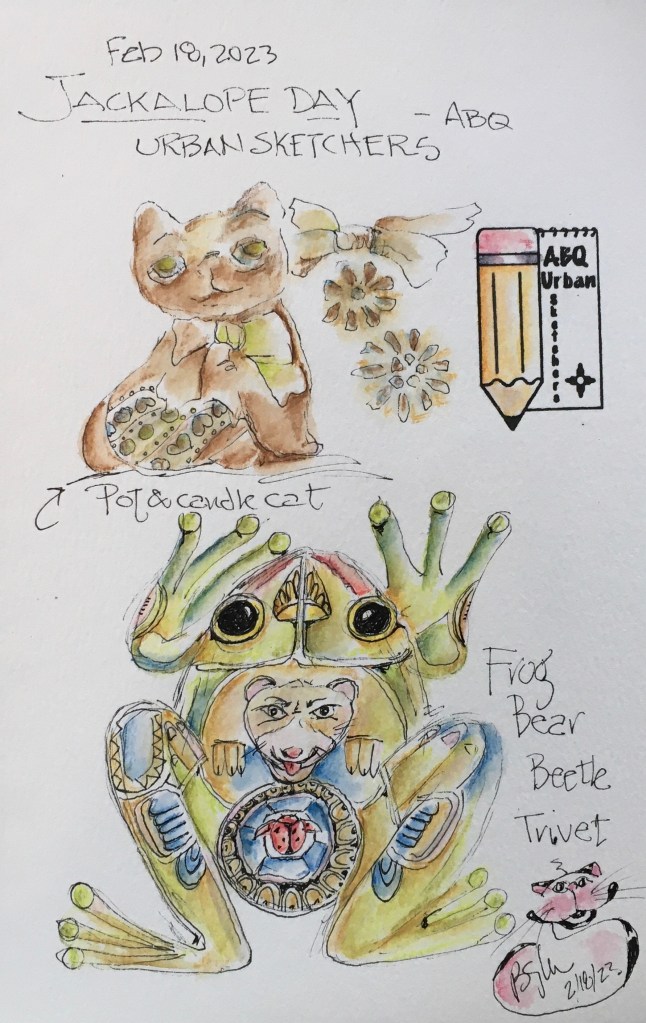
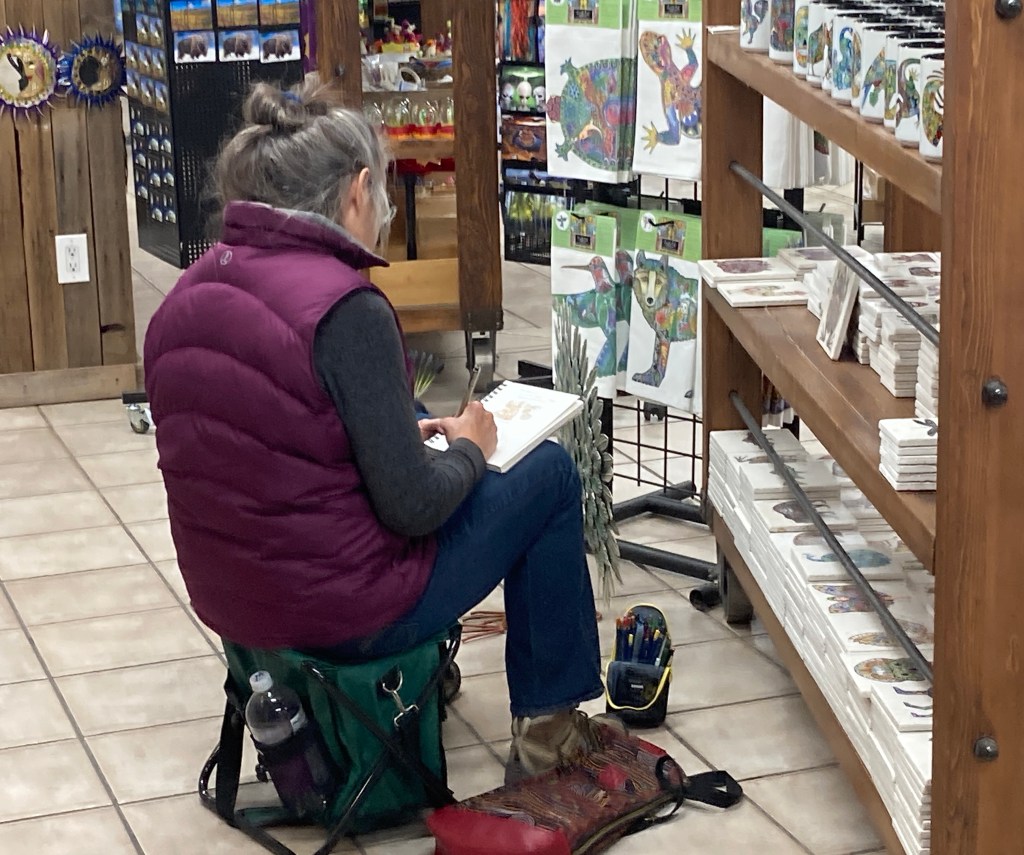
Fascinated by the work that so many urban sketchers turn out, and further inspired by a few Sketchbook Revival 2023 sessions, it’s no wonder I wanted to try my hand at Urban Sketching. Joining the Albuquerque Urban Sketchers, my first outing was to a very iconic New Mexico shop called Jackalope. In some ways, this was a great place for lots of newbies (we didn’t have to brave the still freezing February temps), but then again it was very challenging. So many things to choose from! Here’s a few of my sketches. Because there were so many interesting trinkets, I decided to spend no more than 15 minutes on each, including some quick watercoloring.
This one was sketched from a life sized sculpture of a roadrunner. Meep! Meep!This was sketched from a very typical Santa Fe-style painted wood cabinet. To me this style always looks like the furniture was hooked up to the hitch of a pick-up truck and drug down a dirt road at breakneck speeds! Luckily the very large rooster clay pot wasn’t hurt in the process.Someone captured a photo of me working on my frog trivet sketch. You can see my dilemma deciding what to sketch! Stacks of trivets, all different, to choose from!This was one of my attempts to urban sketch “solo.” I found a bit of early spring buds while waiting for Roy to finish up a doctor appointment.
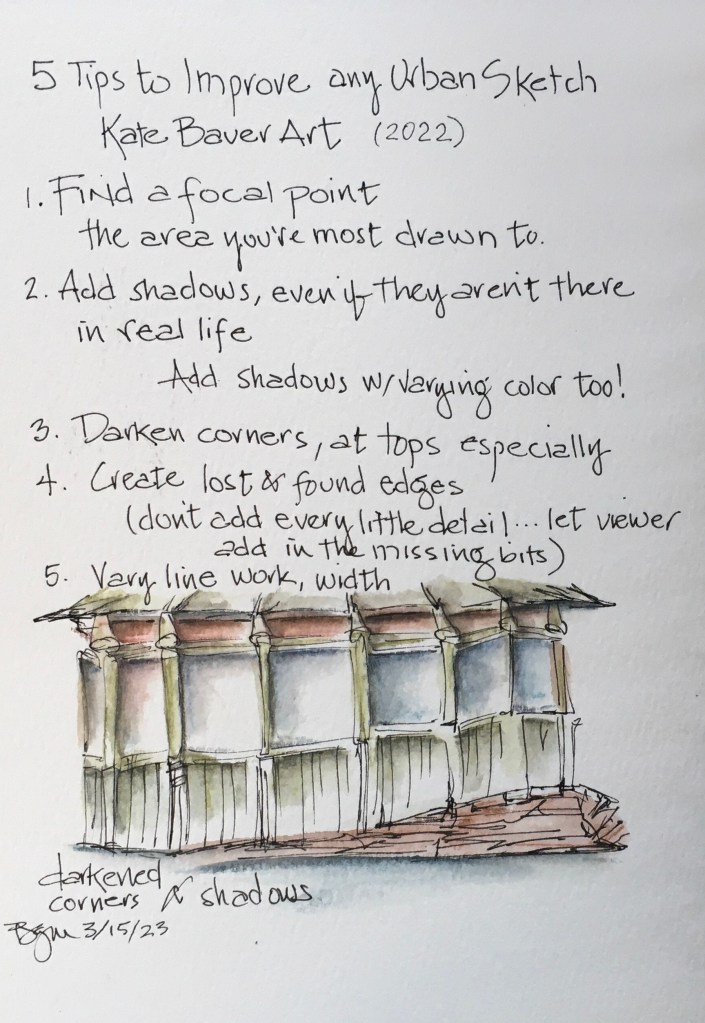
All of that was really fun, but not as easy as some urban sketchers make it seem. So I began practicing and searching on-line for a bit of sage advice.
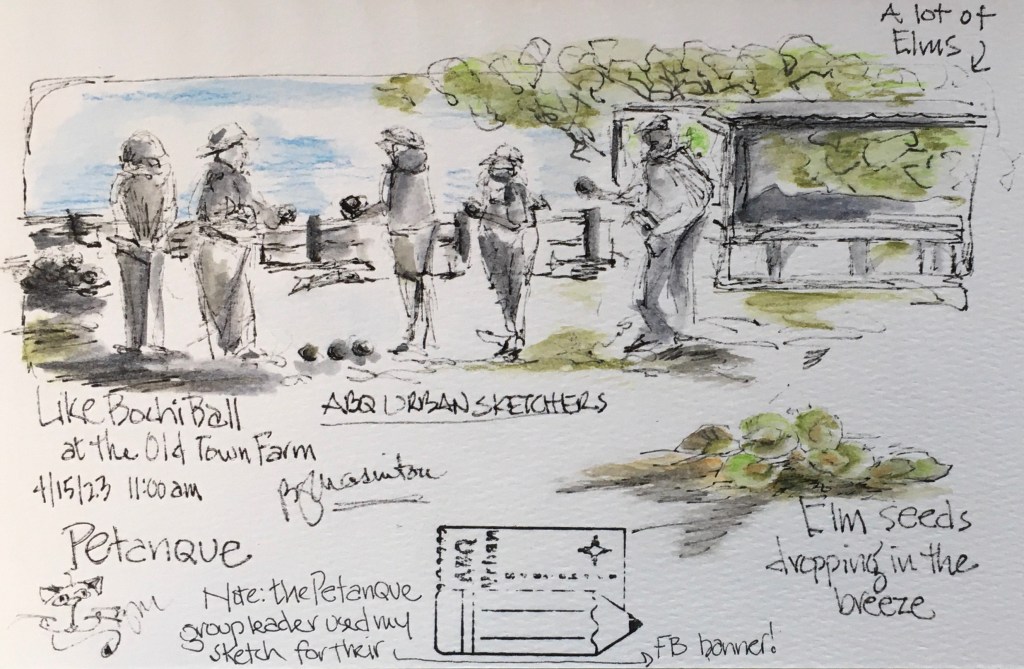
On Saturday (April 15th) the Urban Sketchers met again, this time at Old Town Farm, downtown Albuquerque. With the chance of sketching some rusted farm equipment and broken down barns, I wanted in on this event. And besides, the breezy day was supposed to be warm … ideal for a bit of plein air sketching! Well, on a Saturday, this place was buzzing with visitors, ranging from bikers and hikers; people sitting and enjoying a morning coffee and carrot cake; several teams playing something like bochi ball; venders; puppies for adoption. This definitely broke my fear of public sketching while giving me an opportunity to improve on my people sketching skills. Here’s what I found to draw in a few hours.
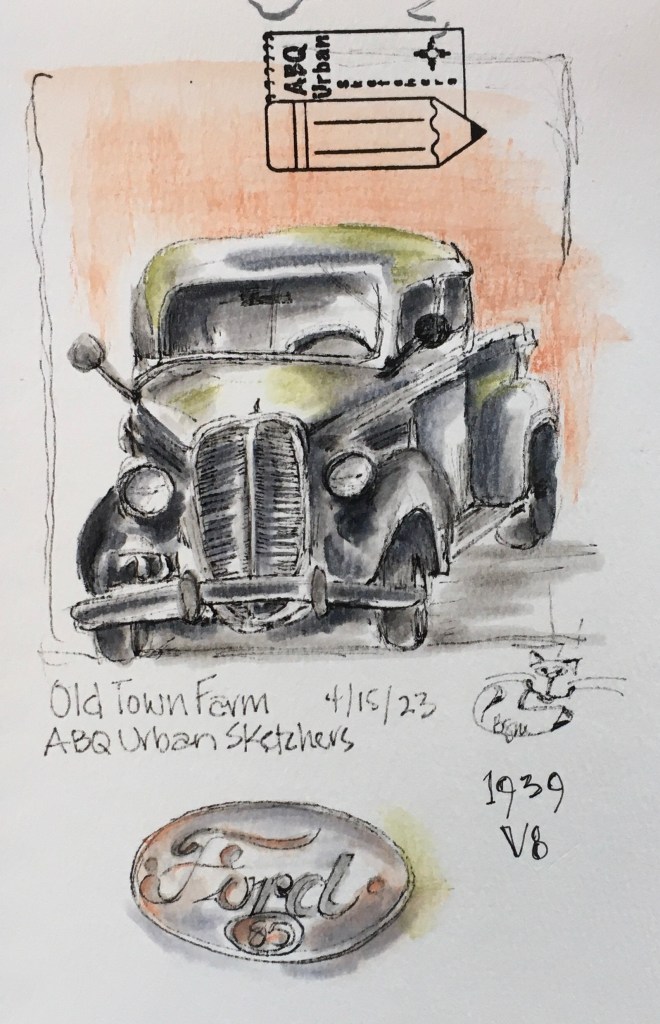
This was a pretty cool old barn, and still in fine shape. Looks like I could use lots of practice sketching old buildings! But I did meet several delightful women also trying their hand at barn sketching! When I realized my barn sketch was going wonky, all I had to do was turn around and find this action scene! There were 2 teams of bowlers playing Pétanque (like bocci ball) in the dirt behind the barn, Here’s my quick sketch trying to capture their action and conversation. This was very fun. Afterwards I walked over to show them what I had done. The team leader was very excited about the sketch and asked if he could take a photo to use it as the team banner on their Facebook page! Of course I said, “Absolutely!”Hard to resist drawing an old truck. Although not a rusty heap, this beautifully restored 1939 Ford V8 was just begging to be sketched. I had a little fun with the character of this truck, and never intended to make it a perfect replica. But this really suits my style. Have I found my happy style?
Hope you enjoyed my urban sketching efforts! Look for more posts in the future.










 a curious nature