July 11, 2025
A few years ago I stumbled across this plant while walking around our neighborhood. Being immediately awed by its richly-colored petals skirting an upright cylinder or cone, I knew it would be a perfect addition to our high elevation (7,300 feet) landscape. My idea was to wait until the flowers on the cone faded and collect some seed to scatter in our yard. After repeated trips hoping to find evidence of seed, I was skunked. Either I missed the dispersal event, or this plant was 100% sterile. On the outside chance there were microscopic seeds embedded in the cone, I resorted to cone collection. Fast forward to the next spring …… every spot I’d planted those cones was barren; nothing had sprouted; zero; zip.
Fast forward again to early July 2025. This wildly blooming plant was growing vigorously in many of the dry disturbed openings and roadside areas throughout our new neighborhood! Time to learn more about such a charming member of the sunflower family called Mexican Hat.

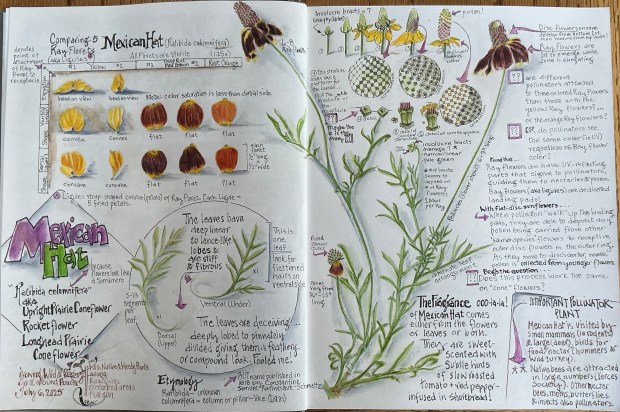
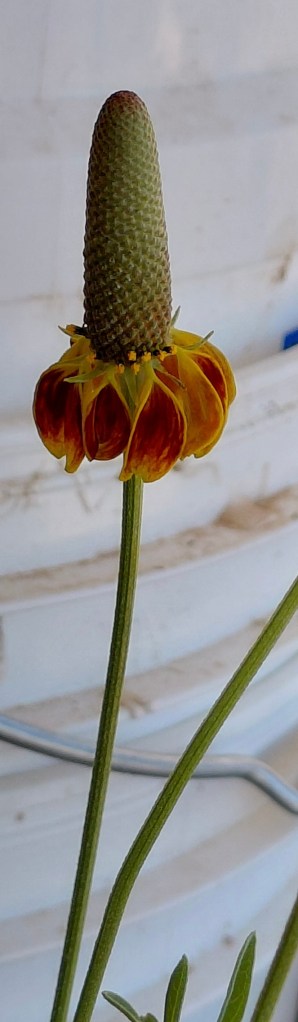
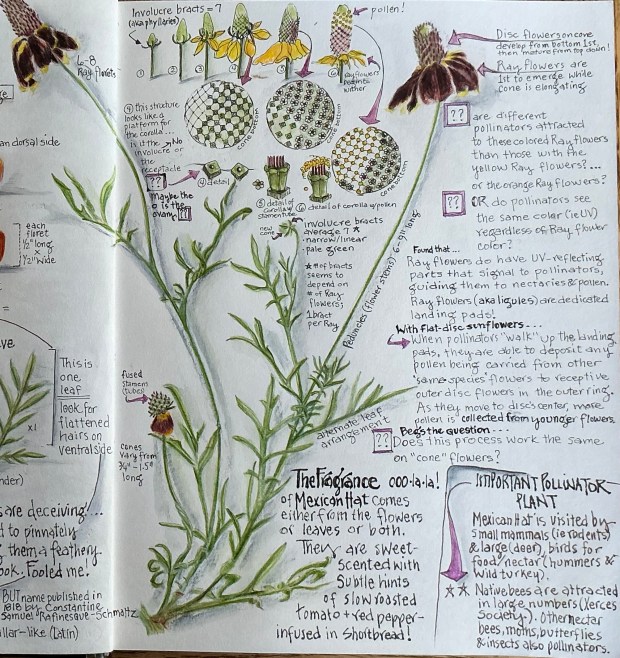
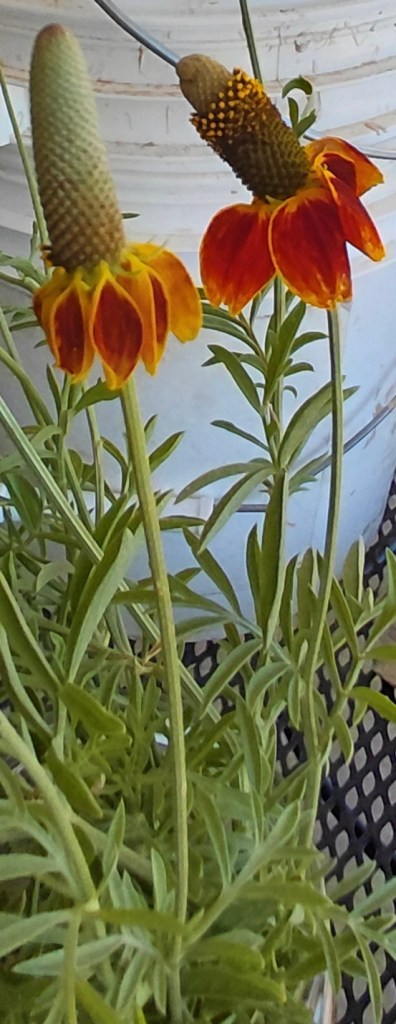
Mexican Hat (Ratibida columnifera), also commonly known as rocketflower, and both upright and longhead prairie coneflower, is a native perennial found across the Lower “48” (U.S.), southern Canada and northern Mexico at elevations ranging from 5,000-7,500 feet. Its Ray flowers come in a dazzling sunshine yellow, along with a soft velvety royal purple-brown, an intensely deep rust-red brown, and rusty oranges – all with some measure of sunshine yellow marginal accents. Each Disc flower (those tiny spots that spiral, Fibonacci fashion, around the upright cone) has 5 fused pale-green petals (the Corolla). The Corolla surrounds 5 fused purple/red oxide-colored Anthers (the pollen structures of the Stamens). The Anthers are shoved up through the Corolla by the developing Style (the stalk of the Pistil) where they burst into 5 sunshine yellow pollen “strands” resembling a hairdo of long, twisted, windblown dreadlocks! The shockingly beautiful colors unfailingly lure many insects hungry for pollen and/or nectar.
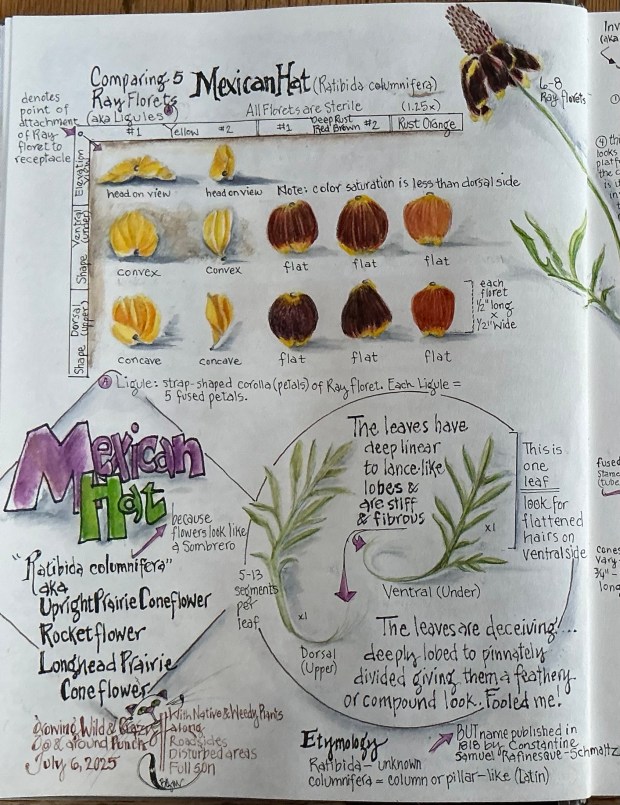
The entire Capitulum (the densely packed flowerhead of a composite “flower”) continually waves in the slightest of breezes as it perches atop the long stiff and naked stem (the Peduncle) of the flowerhead. Below the Peduncle are the many branched feathery-like, deeply lobed leaves. These leaves seem to be the primary source of a curiously fascinating fragrance. After handling the plants for several days, I began thinking of the aroma as being cautiously sweet-scented with subtle hints of slow roasted tomato + red pepper-infused homemade shortbread cookies! I’m looking for a recipe!
All “said and done,” Mexican Hat can grow from 8 inches tall to over 3 feet!
Benefits of and Curiosities About Mexican Hat
Special Value to Native Bees – According to The Xerces Society for Invertebrate Conservation, Mexican Hat is recognized by pollination ecologists as attracting large numbers of native bees.
Food Source for Wildlife Species – In addition to being an important source of pollen and nectar for native bees, Mexican Hat also attracts many other insects like butterflies and moths, and hummingbirds sip its sweet nectar. Wildlife that feast on its seeds include small song birds, wild turkey and rodents. Even white-tailed deer will eat the foliage, despite its reported deer-resistant qualities.
Supports Native Pollinators, Attracts Beneficial Insects, and Promotes Biological Diversity – Mexican Hat is a adaptable and resilient wildflower species, able to endure extended periods of drought, hot and cold temperatures, and diverse habitat and soil conditions. Because of these characteristics, and because the species is a self-seeder, Mexican Hat provides food and cover for wildlife, is a reliable source of pollen for at-risk native bees, and makes an excellent choice for sustainable gardening, habitat and soil restoration, and prairie conservation efforts. And not to be overlooked, Mexican Hat attracts beneficial insects like lady beetles and lacewings that help control garden pests like aphids and caterpillars, and makes a valuable contribution to natural pest management strategies.
Many Uses; the Ethnobotany of Mexican Hat – North American indigenous peoples prepared the leaves, stems, flowers and/or the cones in certain ways to treat specific ailments suffered by people and animals. By creating washes, by boiling, physically rubbing and crushing, decoctions, concoctions and infusions were used to treat chest pains, wounds, stomach aches, fevers, headaches, urinary problems, rattlesnake bites and to induce vomiting. Mothers wishing to wean their babies had crushed leaves rubbed on their breasts. Horses with urinary problems were hand fed the entire plant as a cure, and sheep that are “out of their minds” are given a cold infusion.
The cones were used as baby nipples. Leaves and flowerheads were boiled to make a pleasant tasting tea.
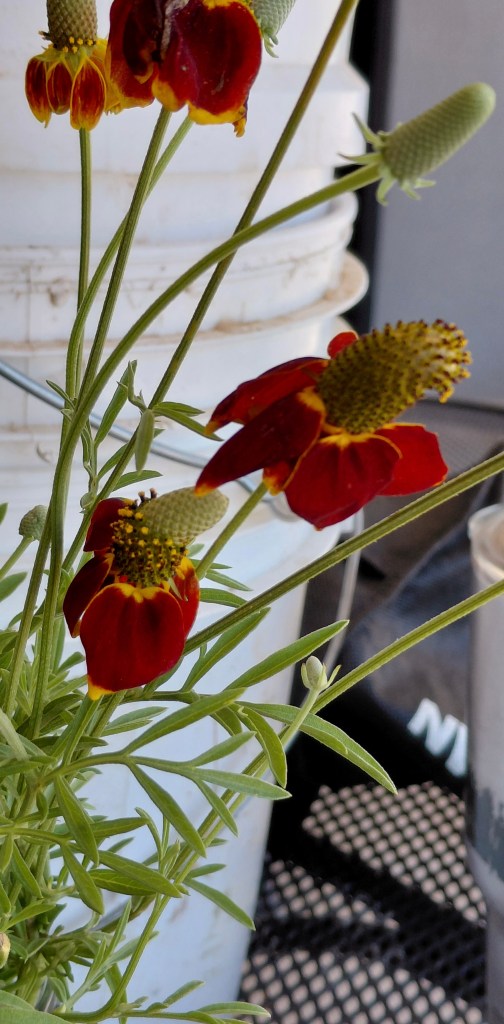
A Symbolic Meaning and Familiar Visual of Mexican Hat – In Mexican culture, this wildflower is often associated with traditional celebrations, ceremonies and festivals. Mexican Hat is a symbol of joy, abundance and cultural heritage. The common name “Mexican Hat” was given to this wildflower because it reminds many of the shape of a traditional Mexican sombrero.
Origin of the Scientific Name Ratibida columnifera – The Etymology of the genus name Ratibida was published in 1818 by Constantine Samuel Rafinesque-Schmaltz (1783–1840). Even to this day, the meaning of Ratibida is a mystery. It’s well known that Rafinesque-Schmaltz often assigned unexplained names to plants. Oh, and be aware that around 60 sites online use the spelling “Ratidiba” rather than Ratibida. So if poking around the internet for more information about Mexican Hat or any of the other prairie coneflowers, don’t be fooled by the typo!
The species epithet columnifera is a Latin name meaning “bearing columns.” This refers the tall cylindrical or cone-shaped flowerhead (Capitulum) which is the support structure (the Receptacle) for the numerous Disc flowers, the 7 Ray flowers, and the 7 small leafy bracts (Phyllaries).
Loving My Mexican Hat!
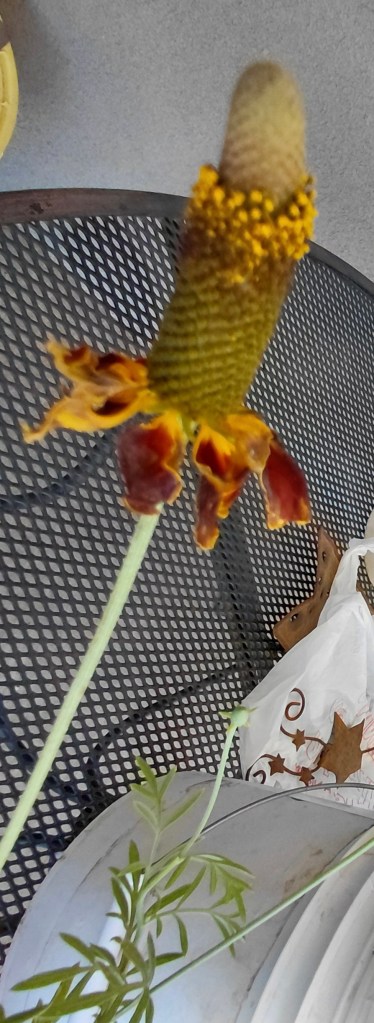
Early this spring I purchased 2 Mexican Hat plants for our garden. I’m happy to report they are doing great and loaded with 10-20 yet-to-mature pale green cones. Wonder what color the Ray petals will be?
I’m also planning to collect seed again this year, after learning the best time is early Fall when the cones look like they’re withering. Wish me luck!
Hope you enjoyed my exploration of this marvelous native perennial member of the sunflower family. Even though in a previous post I made a thorough plunge into the sunflower family, I learned even more putting this post together.
As always, thanks for stopping by!
 a curious nature